Towards WoT aware Business Processes Modeling Sonja Meyer, Klaus Sperner, Carsten Magerkurth, Jacques PasquierUniversity of Fribourg / SAP Research SwitzerlandJune 2011, San Francisco
Motivation and Pre-Selection for Process Modeling ComparisonProcess Modeling one significant part of the BPM lifecycle one basis for process execution and automation of business processesMain focusStandard  + Graphical Business Process Modeling NotationsIoT-awareness of  the notationPre-selected notations:
WoT specific Characteristics: Requirements and Analysis 1- Entity based concept: 		Expectation: 	Support of WoT domain model 		Analysis:	All notations allow to model  actors and roles. BPMN 				and UML offer to annotate expressions like the EoI to 				an activity. None of the notations distinguish the terms 			EoI, device and resource. 2- Distributed execution: 		Expectation:  	Support of distributed execution activities in the WoT		Analysis:	BPMN and UML provide annotation mechanism while 				this option is entirely missing in eEPC. 3- Interactions:		Expectation: 	Support of WoT specific interaction		Analysis:	All notations provide possibility to specify process flow. 			None notation can differentiate between  different 				types of interactions.
WoT specific Characteristics: Requirements and Analysis 4- Distributed data: 		Expectation: 	Support of distribution of data in the WoT 		Analysis:	All notations allow to specify a separated data flow. 				BPMN and UML allow to annotate the data object.5- Scalability: 		Expectation: 	Support of scalability		Analysis:	BPMN and UML offer mechanisms to symbolize EoIs 				and devices.6- Abstraction: 		Expectation: 	Provision of abstraction mechanism		Analysis:	BPMN provides two concepts for grouping activities. 				UML offers one grouping concept. .
WoT specific Characteristics: Requirements and Analysis 7- Availability: 		Expectation:	Support to model limited device availability in the WoT		Analysis:	No notation considers this aspect so far.8- Fault tolerance: 		Expectation: 	Support concepts for fault information in the WoT		Analysis:	BPMN allows to express a business process by 				specifying the process and data flow. UML offers to 				model bulk processing.9- Flexibility: 		Expectation: 	Support flexible process adaption for occurring events		Analysis:	BPMN supports several different types of events. UML 			offers to model events, but does not distinguish 				between different event types. eEPC is an event-based 			notation, but does not distinguish between technical 				and functional events. .
WoT specific Characteristics: Requirements and Analysis 10- Uncertainty of information:		Expectation: 	Support of means for expressing uncertainty of 				information		Analysis:	None of the notations offers to model the uncertainty of 			information.11- Real-time: 		Expectation: 	Support of real-time constraints		Analysis:	BPMN provides different types of time based events for 			taking into account real time restrictions. .
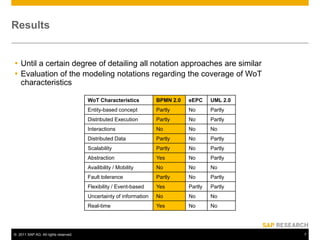
ResultsUntil a certain degree of detailing all notation approaches are similar Evaluation of the modeling notations regarding the coverage of WoT characteristics
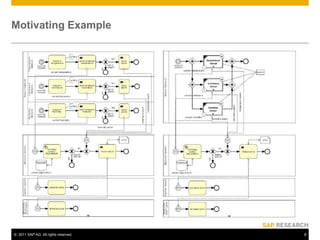
Motivating Example
ConclusionsState of the art analysis of available standard business process modeling notations
Definition of WoT-specific characteristics

Towards WoT aware business processes modeling

  • 1.
    Towards WoT awareBusiness Processes Modeling Sonja Meyer, Klaus Sperner, Carsten Magerkurth, Jacques PasquierUniversity of Fribourg / SAP Research SwitzerlandJune 2011, San Francisco
  • 2.
    Motivation and Pre-Selectionfor Process Modeling ComparisonProcess Modeling one significant part of the BPM lifecycle one basis for process execution and automation of business processesMain focusStandard + Graphical Business Process Modeling NotationsIoT-awareness of the notationPre-selected notations:
  • 3.
    WoT specific Characteristics:Requirements and Analysis 1- Entity based concept: Expectation: Support of WoT domain model Analysis: All notations allow to model actors and roles. BPMN and UML offer to annotate expressions like the EoI to an activity. None of the notations distinguish the terms EoI, device and resource. 2- Distributed execution: Expectation: Support of distributed execution activities in the WoT Analysis: BPMN and UML provide annotation mechanism while this option is entirely missing in eEPC. 3- Interactions: Expectation: Support of WoT specific interaction Analysis: All notations provide possibility to specify process flow. None notation can differentiate between different types of interactions.
  • 4.
    WoT specific Characteristics:Requirements and Analysis 4- Distributed data: Expectation: Support of distribution of data in the WoT Analysis: All notations allow to specify a separated data flow. BPMN and UML allow to annotate the data object.5- Scalability: Expectation: Support of scalability Analysis: BPMN and UML offer mechanisms to symbolize EoIs and devices.6- Abstraction: Expectation: Provision of abstraction mechanism Analysis: BPMN provides two concepts for grouping activities. UML offers one grouping concept. .
  • 5.
    WoT specific Characteristics:Requirements and Analysis 7- Availability: Expectation: Support to model limited device availability in the WoT Analysis: No notation considers this aspect so far.8- Fault tolerance: Expectation: Support concepts for fault information in the WoT Analysis: BPMN allows to express a business process by specifying the process and data flow. UML offers to model bulk processing.9- Flexibility: Expectation: Support flexible process adaption for occurring events Analysis: BPMN supports several different types of events. UML offers to model events, but does not distinguish between different event types. eEPC is an event-based notation, but does not distinguish between technical and functional events. .
  • 6.
    WoT specific Characteristics:Requirements and Analysis 10- Uncertainty of information: Expectation: Support of means for expressing uncertainty of information Analysis: None of the notations offers to model the uncertainty of information.11- Real-time: Expectation: Support of real-time constraints Analysis: BPMN provides different types of time based events for taking into account real time restrictions. .
  • 7.
    ResultsUntil a certaindegree of detailing all notation approaches are similar Evaluation of the modeling notations regarding the coverage of WoT characteristics
  • 8.
  • 9.
    ConclusionsState of theart analysis of available standard business process modeling notations
  • 10.