|
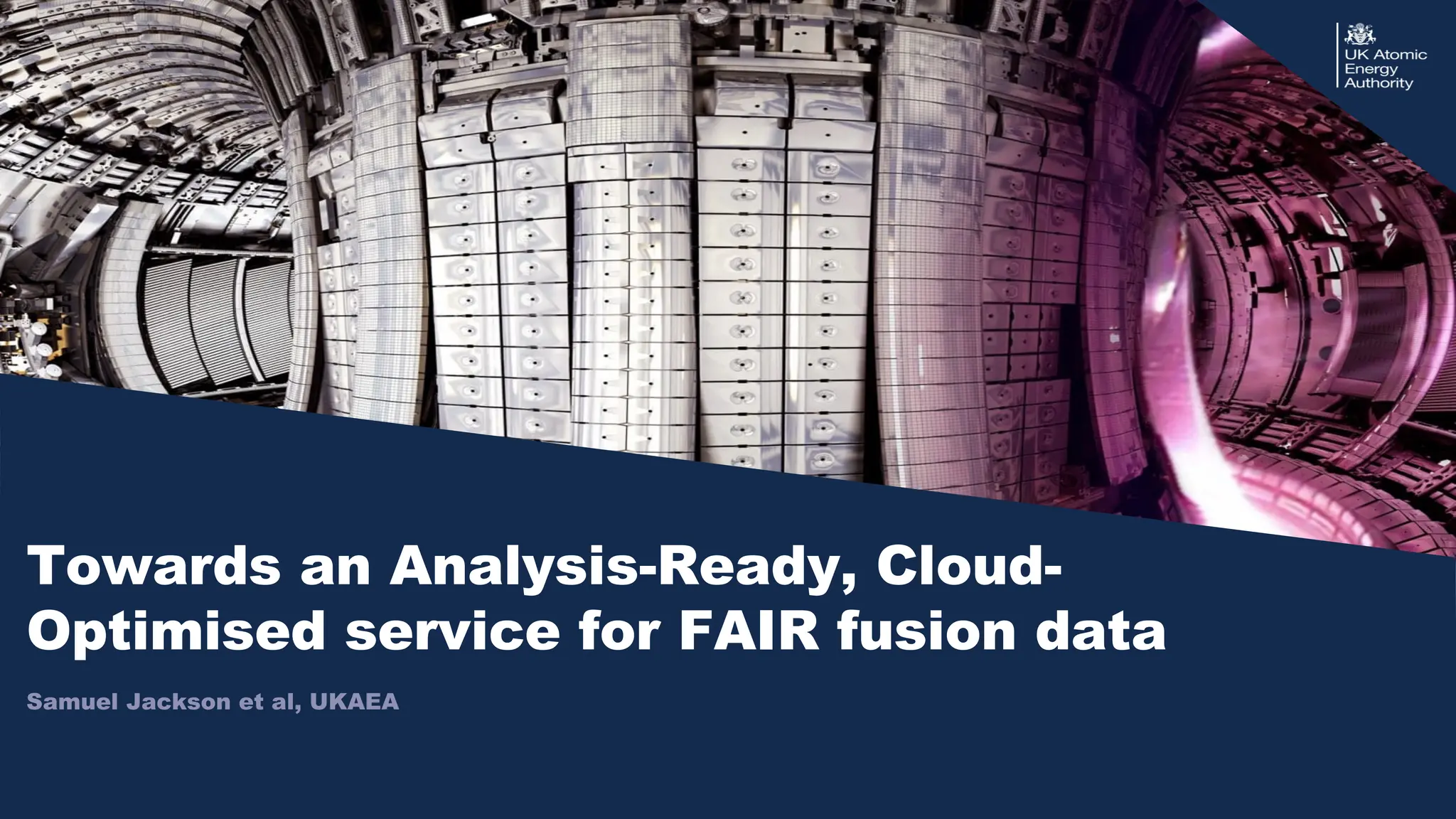
Towards an Analysis-Ready, Cloud-
Optimised service for FAIR fusion data
Samuel Jackson et al, UKAEA
|
|
2
Overview & Motivation
|
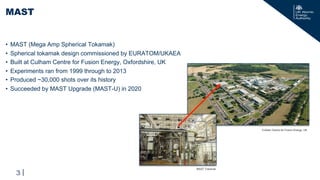
• MAST (Mega Amp Spherical Tokamak)
• Spherical tokamak design commissioned by EURATOM/UKAEA
• Built at Culham Centre for Fusion Energy, Oxfordshire, UK
• Experiments ran from 1999 through to 2013
• Produced ~30,000 shots over its history
• Succeeded by MAST Upgrade (MAST-U) in 2020
MAST
3
Culham Centre for Fusion Energy, UK
MAST Tokamak
|
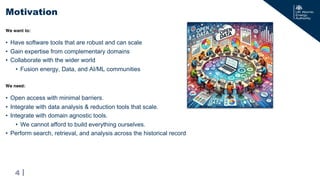
• Open access with minimal barriers.
• Integrate with data analysis & reduction tools that scale.
• Integrate with domain agnostic tools.
• We cannot afford to build everything ourselves.
• Perform search, retrieval, and analysis across the historical record
Motivation
4
We need:
• Have software tools that are robust and can scale
• Gain expertise from complementary domains
• Collaborate with the wider world
• Fusion energy, Data, and AI/ML communities
We want to:
|
Motivation
5
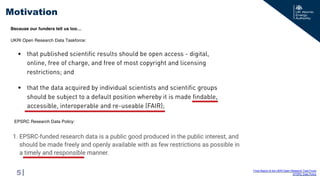
UKRI Open Research Data Taskforce:
EPSRC Research Data Policy:
Final Report of the UKRI Open Research Task Force
EPSRC Data Policy
Because our funders tell us too…
|
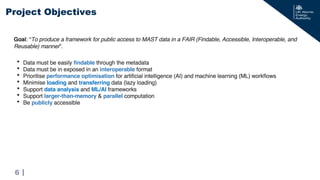
findable
interoperable
performance optimisation
loading transferring
data analysis ML/AI
larger-than-memory parallel
publicly
Project Objectives
6
|
|
7
The Wider Picture
|
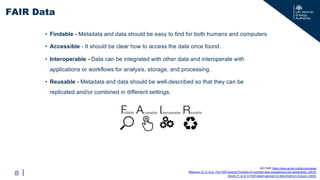
• Findable - Metadata and data should be easy to find for both humans and computers
• Accessible - It should be clear how to access the data once found.
• Interoperable - Data can be integrated with other data and interoperate with
applications or workflows for analysis, storage, and processing.
• Reusable - Metadata and data should be well-described so that they can be
replicated and/or combined in different settings.
FAIR Data
8
GO FAIR: https://www.go-fair.org/fair-principles/
Wilkinson, M. D. et al. The FAIR Guiding Principles for scientific data management and stewardship. (2016).
Strand, P. et al. A FAIR based approach to data sharing in Europe. (2022).
|
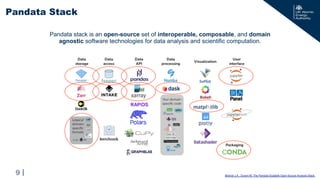
Pandata stack is an open-source set of interoperable, composable, and domain
agnostic software technologies for data analysis and scientific computation.
Pandata Stack
9 Bednar J.A., Durant M. The Pandata Scalable Open-Source Analysis Stack.
|
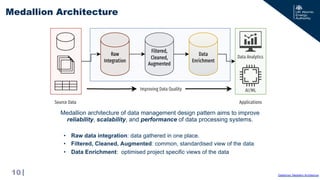
Medallion architecture of data management design pattern aims to improve
reliability, scalability, and performance of data processing systems.
Medallion Architecture
10 Databricks: Medallion Architecture
• Raw data integration: data gathered in one place.
• Filtered, Cleaned, Augmented: common, standardised view of the data
• Data Enrichment: optimised project specific views of the data
|
|
11
MAST Data
|
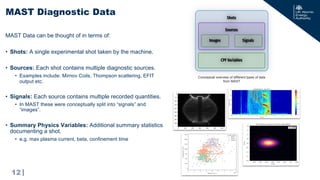
MAST Data can be thought of in terms of:
• Shots: A single experimental shot taken by the machine.
• Sources: Each shot contains multiple diagnostic sources.
• Examples include: Mirnov Coils, Thompson scattering, EFIT
output etc.
• Signals: Each source contains multiple recorded quantities.
• In MAST these were conceptually split into “signals” and
“images”.
• Summary Physics Variables: Additional summary statistics
documenting a shot.
• e.g. max plasma current, beta, confinement time
MAST Diagnostic Data
12
Conceptual overview of different types of data
from MAST
|
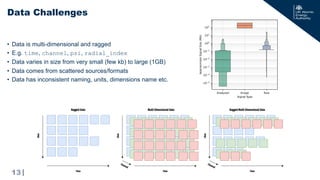
• Data is multi-dimensional and ragged
• E.g. time, channel, psi, radial_index
• Data varies in size from very small (few kb) to large (1GB)
• Data comes from scattered sources/formats
• Data has inconsistent naming, units, dimensions name etc.
Data Challenges
13
|
|
14
Architecture
|
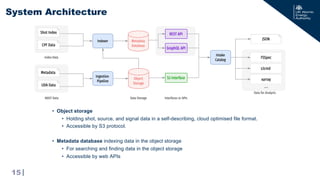
• Object storage
• Holding shot, source, and signal data in a self-describing, cloud optimised file format.
• Accessible by S3 protocol.
• Metadata database indexing data in the object storage
• For searching and finding data in the object storage
• Accessible by web APIs
System Architecture
15
|
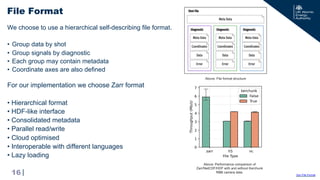
File Format
We choose to use a hierarchical self-describing file format.
• Group data by shot
• Group signals by diagnostic
• Each group may contain metadata
• Coordinate axes are also defined
For our implementation we choose Zarr format
• Hierarchical format
• HDF-like interface
• Consolidated metadata
• Parallel read/write
• Cloud optimised
• Interoperable with different languages
• Lazy loading
16 Zarr File Format
Above: File format structure
Above: Performance comparison of
Zarr/NetCDF/HDF with and without Kerchunk
RBB camera data.
|
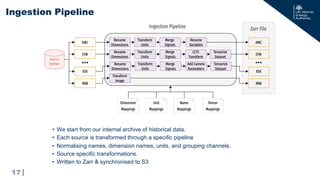
• We start from our internal archive of historical data.
• Each source is transformed through a specific pipeline
• Normalising names, dimension names, units, and grouping channels.
• Source specific transformations.
• Written to Zarr & synchronised to S3
Ingestion Pipeline
17
|
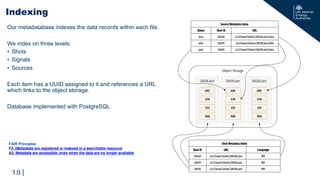
Our metadatabase indexes the data records within each file.
We index on three levels:
• Shots
• Signals
• Sources
Each item has a UUID assigned to it and references a URL
which links to the object storage.
Database implemented with PostgreSQL
Indexing
18
FAIR Principles
F4. (Meta)data are registered or indexed in a searchable resource
A2. Metadata are accessible, even when the data are no longer available
|
|
19
Usage
|
Metadata APIs: REST
20
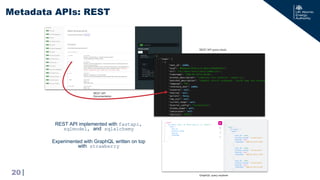
REST API implemented with fastapi,
sqlmodel, and sqlalchemy
Experimented with GraphQL written on top
with strawberry
REST API
Documentation
REST API query result
GraphQL query explorer
|
Loading MAST data in 2 lines of code:
User Access: Xarray, Dask, S3
21
import xarray as xr
dataset = xr.open_zarr("https://s3.echo.stfc.ac.uk/mast/level1/shots/30420.zarr/amc")
import s3fs
import xarray as xr
import matplotlib.pyplot as plt
# s3 storage location
endpoint_url = 'https://s3.echo.stfc.ac.uk'
# URL of data we want to load
url = 's3://mast/level1/shots/30420.zarr/amc'
# fsspec handle to remote file system
s3 = s3fs.S3FileSystem(anon=True, endpoint_url=endpoint_url)
# open the dataset
dataset = xr.open_zarr(s3.get_mapper(url))
# data only loaded at this point!
plt.plot(dataset['time'], dataset[‘plasma_current'])
A more explicit example with S3:
|
• A python package describing, loading, and processing data.
• Intake Catalogs can be thin and flexible access layers.
• Same example as before, but now agnostic to data specifics:
User Access: Intake Catalogs
22 Intake: ReadTheDocs
import intake
import matplotlib.pyplot as plt
catalog = intake.open_catalog('https://mastapp.site/intake/catalog.yml')
url = 's3://mast/level1/shots/30420.zarr/amc'
dataset = catalog.level1.shots(url=url)
dataset = dataset.to_dask()
# data only loaded at this point!
plt.plot(dataset['time'], dataset['plasma_current'])
This also enables us to insert a caching between the user and the data!
Second time reading is much faster!
Writing custom intake catalog is also completely possible. It’s just a YAML file.
|
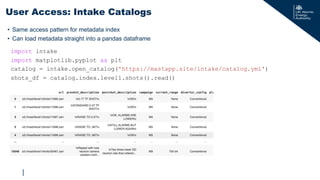
import intake
import matplotlib.pyplot as plt
catalog = intake.open_catalog('https://mastapp.site/intake/catalog.yml')
shots_df = catalog.index.level1.shots().read()
User Access: Intake Catalogs
• Same access pattern for metadata index
• Can load metadata straight into a pandas dataframe
|
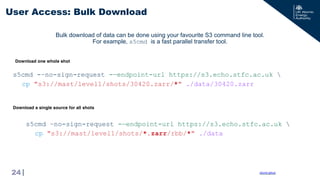
s5cmd –no-sign-request -—endpoint-url https://s3.echo.stfc.ac.uk 
cp "s3://mast/level1/shots/*.zarr/rbb/*" ./data
User Access: Bulk Download
24
s5cmd -–no-sign-request -—endpoint-url https://s3.echo.stfc.ac.uk 
cp "s3://mast/level1/shots/30420.zarr/*" ./data/30420.zarr
Download one whole shot
Download a single source for all shots
s5cmd github
Bulk download of data can be done using your favourite S3 command line tool.
For example, s5cmd is a fast parallel transfer tool.
|
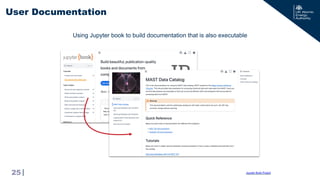
Using Jupyter book to build documentation that is also executable
User Documentation
25 Jupyter Book Project
|
|
26
Future Directions
|
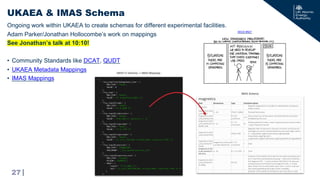
Ongoing work within UKAEA to create schemas for different experimental facilities.
Adam Parker/Jonathan Hollocombe’s work on mappings
See Jonathan’s talk at 10:10!
• Community Standards like DCAT, QUDT
• UKAEA Metadata Mappings
• IMAS Mappings
UKAEA & IMAS Schema
27
MAST-U Schema -> IMAS Mappings
IMAS Schema
XKCD #927
|
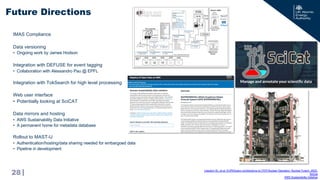
IMAS Compliance
Data versioning
• Ongoing work by James Hodson
Integration with DEFUSE for event tagging
• Collaboration with Alessandro Pau @ EPFL
Integration with TokSearch for high level processing
Web user interface
• Potentially looking at SciCAT
Data mirrors and hosting
• AWS Sustainability Data Initiative
• A permanent home for metadata database
Rollout to MAST-U
• Authentication/hosting/data sharing needed for embargoed data
• Pipeline in development
Future Directions
28 Litaudon XL, et al. EUROfusion contributions to ITER Nuclear Operation. Nuclear Fusion. 2023.
SciCat
AWS Sustainability Initiative
|
|
29
Summary
|
Towards being FAIR
30
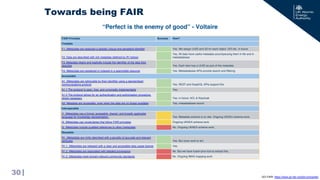
FAIR Principle Success How?
Findable
F1. (Meta)data are assigned a globally unique and persistent identifier Yes. We assign UUID and S3 for each object. DOI etc. in future.
F2. Data are described with rich metadata (defined by R1 below)
Yes. All data have useful metadata accompanying them in file and in
metadatabase
F3. Metadata clearly and explicitly include the identifier of the data they
describe Yes. Each item has a UUID as part of the metadata
F4. (Meta)data are registered or indexed in a searchable resource Yes. Metadatabase APIs provide search and filtering
Accessible
A1. (Meta)data are retrievable by their identifier using a standardised
communications protocol Yes. REST and GraphQL APIs support this
A1.1 The protocol is open, free, and universally implementable Yes.
A1.2 The protocol allows for an authentication and authorisation procedure,
where necessary Yes, in future: ACL & Keycloak
A2. Metadata are accessible, even when the data are no longer available Yes, metadatabase record
Interoperable
I1. (Meta)data use a formal, accessible, shared, and broadly applicable
language for knowledge representation. Yes. Metadata schema is on site. Ongoing UKAEA schema work.
I2. (Meta)data use vocabularies that follow FAIR principles Ongoing UKAEA schema work
I3. (Meta)data include qualified references to other (meta)data No. Ongoing UKAEA schema work.
Reusable
R1. (Meta)data are richly described with a plurality of accurate and relevant
attributes Yes. But more work to do!
R1.1. (Meta)data are released with a clear and accessible data usage license Yes.
R1.2. (Meta)data are associated with detailed provenance No. But we have fusion-prov tool to extract this.
R1.3. (Meta)data meet domain-relevant community standards No. Ongoing IMAS mapping work
GO FAIR: https://www.go-fair.org/fair-principles/
“Perfect is the enemy of good” - Voltaire
|
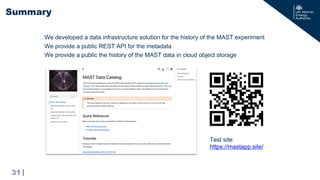
We developed a data infrastructure solution for the history of the MAST experiment
We provide a public REST API for the metadata
We provide a public the history of the MAST data in cloud object storage
Summary
31
Test site:
https://mastapp.site/
|
With Thanks
32
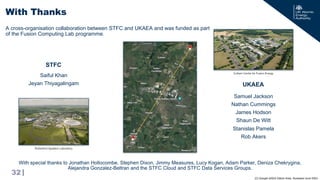
UKAEA
STFC
Saiful Khan
Jeyan Thiyagalingam
Samuel Jackson
Nathan Cummings
James Hodson
Shaun De Witt
Stanislas Pamela
Rob Akers
Culham Centre for Fusion Energy
Rutherford Appleton Laboratory
A cross-organisation collaboration between STFC and UKAEA and was funded as part
of the Fusion Computing Lab programme.
With special thanks to Jonathan Hollocombe, Stephen Dixon, Jimmy Measures, Lucy Kogan, Adam Parker, Deniza Chekrygina,
Alejandra Gonzalez-Beltran and the STFC Cloud and STFC Data Services Groups.
(C) Google (2024) Didcot Area, Accessed June 2024

Towards an Analysis-Ready, Cloud-Optimised service for FAIR fusion data

  • 1.
    | Towards an Analysis-Ready,Cloud- Optimised service for FAIR fusion data Samuel Jackson et al, UKAEA
  • 2.
  • 3.
    | • MAST (MegaAmp Spherical Tokamak) • Spherical tokamak design commissioned by EURATOM/UKAEA • Built at Culham Centre for Fusion Energy, Oxfordshire, UK • Experiments ran from 1999 through to 2013 • Produced ~30,000 shots over its history • Succeeded by MAST Upgrade (MAST-U) in 2020 MAST 3 Culham Centre for Fusion Energy, UK MAST Tokamak
  • 4.
    | • Open accesswith minimal barriers. • Integrate with data analysis & reduction tools that scale. • Integrate with domain agnostic tools. • We cannot afford to build everything ourselves. • Perform search, retrieval, and analysis across the historical record Motivation 4 We need: • Have software tools that are robust and can scale • Gain expertise from complementary domains • Collaborate with the wider world • Fusion energy, Data, and AI/ML communities We want to:
  • 5.
    | Motivation 5 UKRI Open ResearchData Taskforce: EPSRC Research Data Policy: Final Report of the UKRI Open Research Task Force EPSRC Data Policy Because our funders tell us too…
  • 6.
    | findable interoperable performance optimisation loading transferring dataanalysis ML/AI larger-than-memory parallel publicly Project Objectives 6
  • 7.
  • 8.
    | • Findable -Metadata and data should be easy to find for both humans and computers • Accessible - It should be clear how to access the data once found. • Interoperable - Data can be integrated with other data and interoperate with applications or workflows for analysis, storage, and processing. • Reusable - Metadata and data should be well-described so that they can be replicated and/or combined in different settings. FAIR Data 8 GO FAIR: https://www.go-fair.org/fair-principles/ Wilkinson, M. D. et al. The FAIR Guiding Principles for scientific data management and stewardship. (2016). Strand, P. et al. A FAIR based approach to data sharing in Europe. (2022).
  • 9.
    | Pandata stack isan open-source set of interoperable, composable, and domain agnostic software technologies for data analysis and scientific computation. Pandata Stack 9 Bednar J.A., Durant M. The Pandata Scalable Open-Source Analysis Stack.
  • 10.
    | Medallion architecture ofdata management design pattern aims to improve reliability, scalability, and performance of data processing systems. Medallion Architecture 10 Databricks: Medallion Architecture • Raw data integration: data gathered in one place. • Filtered, Cleaned, Augmented: common, standardised view of the data • Data Enrichment: optimised project specific views of the data
  • 11.
  • 12.
    | MAST Data canbe thought of in terms of: • Shots: A single experimental shot taken by the machine. • Sources: Each shot contains multiple diagnostic sources. • Examples include: Mirnov Coils, Thompson scattering, EFIT output etc. • Signals: Each source contains multiple recorded quantities. • In MAST these were conceptually split into “signals” and “images”. • Summary Physics Variables: Additional summary statistics documenting a shot. • e.g. max plasma current, beta, confinement time MAST Diagnostic Data 12 Conceptual overview of different types of data from MAST
  • 13.
    | • Data ismulti-dimensional and ragged • E.g. time, channel, psi, radial_index • Data varies in size from very small (few kb) to large (1GB) • Data comes from scattered sources/formats • Data has inconsistent naming, units, dimensions name etc. Data Challenges 13
  • 14.
  • 15.
    | • Object storage •Holding shot, source, and signal data in a self-describing, cloud optimised file format. • Accessible by S3 protocol. • Metadata database indexing data in the object storage • For searching and finding data in the object storage • Accessible by web APIs System Architecture 15
  • 16.
    | File Format We chooseto use a hierarchical self-describing file format. • Group data by shot • Group signals by diagnostic • Each group may contain metadata • Coordinate axes are also defined For our implementation we choose Zarr format • Hierarchical format • HDF-like interface • Consolidated metadata • Parallel read/write • Cloud optimised • Interoperable with different languages • Lazy loading 16 Zarr File Format Above: File format structure Above: Performance comparison of Zarr/NetCDF/HDF with and without Kerchunk RBB camera data.
  • 17.
    | • We startfrom our internal archive of historical data. • Each source is transformed through a specific pipeline • Normalising names, dimension names, units, and grouping channels. • Source specific transformations. • Written to Zarr & synchronised to S3 Ingestion Pipeline 17
  • 18.
    | Our metadatabase indexesthe data records within each file. We index on three levels: • Shots • Signals • Sources Each item has a UUID assigned to it and references a URL which links to the object storage. Database implemented with PostgreSQL Indexing 18 FAIR Principles F4. (Meta)data are registered or indexed in a searchable resource A2. Metadata are accessible, even when the data are no longer available
  • 19.
  • 20.
    | Metadata APIs: REST 20 RESTAPI implemented with fastapi, sqlmodel, and sqlalchemy Experimented with GraphQL written on top with strawberry REST API Documentation REST API query result GraphQL query explorer
  • 21.
    | Loading MAST datain 2 lines of code: User Access: Xarray, Dask, S3 21 import xarray as xr dataset = xr.open_zarr("https://s3.echo.stfc.ac.uk/mast/level1/shots/30420.zarr/amc") import s3fs import xarray as xr import matplotlib.pyplot as plt # s3 storage location endpoint_url = 'https://s3.echo.stfc.ac.uk' # URL of data we want to load url = 's3://mast/level1/shots/30420.zarr/amc' # fsspec handle to remote file system s3 = s3fs.S3FileSystem(anon=True, endpoint_url=endpoint_url) # open the dataset dataset = xr.open_zarr(s3.get_mapper(url)) # data only loaded at this point! plt.plot(dataset['time'], dataset[‘plasma_current']) A more explicit example with S3:
  • 22.
    | • A pythonpackage describing, loading, and processing data. • Intake Catalogs can be thin and flexible access layers. • Same example as before, but now agnostic to data specifics: User Access: Intake Catalogs 22 Intake: ReadTheDocs import intake import matplotlib.pyplot as plt catalog = intake.open_catalog('https://mastapp.site/intake/catalog.yml') url = 's3://mast/level1/shots/30420.zarr/amc' dataset = catalog.level1.shots(url=url) dataset = dataset.to_dask() # data only loaded at this point! plt.plot(dataset['time'], dataset['plasma_current']) This also enables us to insert a caching between the user and the data! Second time reading is much faster! Writing custom intake catalog is also completely possible. It’s just a YAML file.
  • 23.
    | import intake import matplotlib.pyplotas plt catalog = intake.open_catalog('https://mastapp.site/intake/catalog.yml') shots_df = catalog.index.level1.shots().read() User Access: Intake Catalogs • Same access pattern for metadata index • Can load metadata straight into a pandas dataframe
  • 24.
    | s5cmd –no-sign-request -—endpoint-urlhttps://s3.echo.stfc.ac.uk cp "s3://mast/level1/shots/*.zarr/rbb/*" ./data User Access: Bulk Download 24 s5cmd -–no-sign-request -—endpoint-url https://s3.echo.stfc.ac.uk cp "s3://mast/level1/shots/30420.zarr/*" ./data/30420.zarr Download one whole shot Download a single source for all shots s5cmd github Bulk download of data can be done using your favourite S3 command line tool. For example, s5cmd is a fast parallel transfer tool.
  • 25.
    | Using Jupyter bookto build documentation that is also executable User Documentation 25 Jupyter Book Project
  • 26.
  • 27.
    | Ongoing work withinUKAEA to create schemas for different experimental facilities. Adam Parker/Jonathan Hollocombe’s work on mappings See Jonathan’s talk at 10:10! • Community Standards like DCAT, QUDT • UKAEA Metadata Mappings • IMAS Mappings UKAEA & IMAS Schema 27 MAST-U Schema -> IMAS Mappings IMAS Schema XKCD #927
  • 28.
    | IMAS Compliance Data versioning •Ongoing work by James Hodson Integration with DEFUSE for event tagging • Collaboration with Alessandro Pau @ EPFL Integration with TokSearch for high level processing Web user interface • Potentially looking at SciCAT Data mirrors and hosting • AWS Sustainability Data Initiative • A permanent home for metadata database Rollout to MAST-U • Authentication/hosting/data sharing needed for embargoed data • Pipeline in development Future Directions 28 Litaudon XL, et al. EUROfusion contributions to ITER Nuclear Operation. Nuclear Fusion. 2023. SciCat AWS Sustainability Initiative
  • 29.
  • 30.
    | Towards being FAIR 30 FAIRPrinciple Success How? Findable F1. (Meta)data are assigned a globally unique and persistent identifier Yes. We assign UUID and S3 for each object. DOI etc. in future. F2. Data are described with rich metadata (defined by R1 below) Yes. All data have useful metadata accompanying them in file and in metadatabase F3. Metadata clearly and explicitly include the identifier of the data they describe Yes. Each item has a UUID as part of the metadata F4. (Meta)data are registered or indexed in a searchable resource Yes. Metadatabase APIs provide search and filtering Accessible A1. (Meta)data are retrievable by their identifier using a standardised communications protocol Yes. REST and GraphQL APIs support this A1.1 The protocol is open, free, and universally implementable Yes. A1.2 The protocol allows for an authentication and authorisation procedure, where necessary Yes, in future: ACL & Keycloak A2. Metadata are accessible, even when the data are no longer available Yes, metadatabase record Interoperable I1. (Meta)data use a formal, accessible, shared, and broadly applicable language for knowledge representation. Yes. Metadata schema is on site. Ongoing UKAEA schema work. I2. (Meta)data use vocabularies that follow FAIR principles Ongoing UKAEA schema work I3. (Meta)data include qualified references to other (meta)data No. Ongoing UKAEA schema work. Reusable R1. (Meta)data are richly described with a plurality of accurate and relevant attributes Yes. But more work to do! R1.1. (Meta)data are released with a clear and accessible data usage license Yes. R1.2. (Meta)data are associated with detailed provenance No. But we have fusion-prov tool to extract this. R1.3. (Meta)data meet domain-relevant community standards No. Ongoing IMAS mapping work GO FAIR: https://www.go-fair.org/fair-principles/ “Perfect is the enemy of good” - Voltaire
  • 31.
    | We developed adata infrastructure solution for the history of the MAST experiment We provide a public REST API for the metadata We provide a public the history of the MAST data in cloud object storage Summary 31 Test site: https://mastapp.site/
  • 32.
    | With Thanks 32 UKAEA STFC Saiful Khan JeyanThiyagalingam Samuel Jackson Nathan Cummings James Hodson Shaun De Witt Stanislas Pamela Rob Akers Culham Centre for Fusion Energy Rutherford Appleton Laboratory A cross-organisation collaboration between STFC and UKAEA and was funded as part of the Fusion Computing Lab programme. With special thanks to Jonathan Hollocombe, Stephen Dixon, Jimmy Measures, Lucy Kogan, Adam Parker, Deniza Chekrygina, Alejandra Gonzalez-Beltran and the STFC Cloud and STFC Data Services Groups. (C) Google (2024) Didcot Area, Accessed June 2024