Sector:
Tourism
Qualification:
TOUR GUIDING SERVICES NC II
Technical Education and Skills Development Authority
East Service Road, South Superhighway, Taguig, Metro Manila
COMPETENCY-BASED
CURRICULUM
COURSE DESIGN
TOUR GUIDING SERVICES NC II
TABLE OF CONTENTS
A. COURSE DESIGN
B. MODULES OF ONSTRUCTION
Basic Competencies
Participate in Workplace Communication 1
Work in a Team Environment 8
Practice Career Professionalism 12
Practice Occupational Health and Safety 16
Common Competencies
Develop and Update Industry Knowledge 25
Observe Workplace Hygiene Procedures 28
Perform Computer Operations 33
Perform Workplace and Safety Practices 39
Provide Effective Customer Service 46
Core Competencies
Research information relevant to tour itinerary 57
Manage arrangements for visitors 62
Accompany and guide visitors in
accordance with the tour itinerary
71
COURSE DESIGN
COURSE TITLE : TOUR GUIDING SERVICES – NC II
NOMINAL DURATION : 196 hours
QUALIFICATION : NC level II
COURSE DESCRIPTION : This course is designed to enhance the knowledge,
skills and attitudes of an individual in the field of
TOUR GUIDING SERVICES NC II such as
coordinating tour program/itinerary; guiding and
accompanying tourist in a locality in accordance with
industry standards. It covers It covers the basic,
common and core competencies.
ENTRY REQUIREMENTS : Trainees or students wishing to gain entry into this
course should possess the following requirements:
 can communicate by oral and written language;
 physically and mentally able;
 with good moral character; and
 Can perform basic mathematical computation.
This list does not include specific institutional
requirements such as educational attainment,
appropriate work experience, and others that may be
required of the trainees by the school or training
center delivering the TVET program.
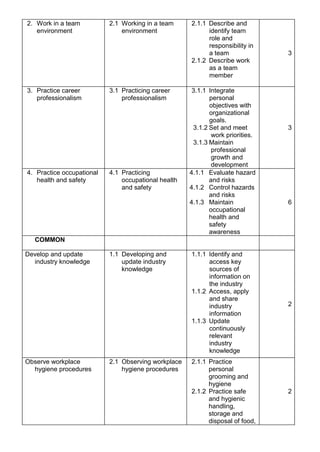
COURSE STRUCTURE:
UNIT OF
COMPETENCY
MODULE TITLE
LEARNING
OUTCOME
NO. OF
HOURS
BASIC
1. Participate in
workplace
communication
1.1 Participating in
workplace
communication
1.1.1 Obtain and
convey
workplace
information
1.1.2 Complete
relevant work
related
documents
1.1.3 Participate in
workplace
meeting and
discussion
6
2. Work in a team
environment
2.1 Working in a team
environment
2.1.1 Describe and
identify team
role and
responsibility in
a team
2.1.2 Describe work
as a team
member
3
3. Practice career
professionalism
3.1 Practicing career
professionalism
3.1.1 Integrate
personal
objectives with
organizational
goals.
3.1.2 Set and meet
work priorities.
3.1.3 Maintain
professional
growth and
development
3
4. Practice occupational
health and safety
4.1 Practicing
occupational health
and safety
4.1.1 Evaluate hazard
and risks
4.1.2 Control hazards
and risks
4.1.3 Maintain
occupational
health and
safety
awareness
6
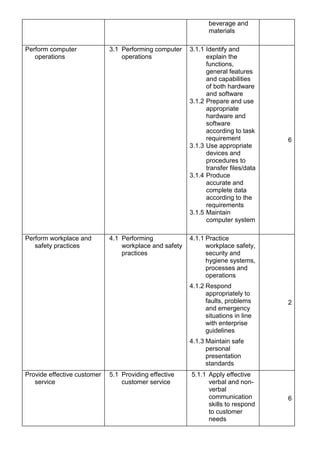
COMMON
Develop and update
industry knowledge
1.1 Developing and
update industry
knowledge
1.1.1 Identify and
access key
sources of
information on
the industry
1.1.2 Access, apply
and share
industry
information
1.1.3 Update
continuously
relevant
industry
knowledge
2
Observe workplace
hygiene procedures
2.1 Observing workplace
hygiene procedures
2.1.1 Practice
personal
grooming and
hygiene
2.1.2 Practice safe
and hygienic
handling,
storage and
disposal of food,
2
beverage and
materials
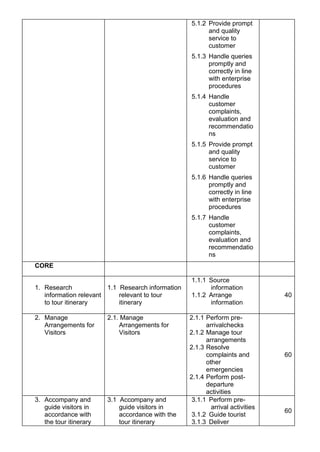
Perform computer
operations
3.1 Performing computer
operations
3.1.1 Identify and
explain the
functions,
general features
and capabilities
of both hardware
and software
3.1.2 Prepare and use
appropriate
hardware and
software
according to task
requirement
3.1.3 Use appropriate
devices and
procedures to
transfer files/data
3.1.4 Produce
accurate and
complete data
according to the
requirements
3.1.5 Maintain
computer system
6
Perform workplace and
safety practices
4.1 Performing
workplace and safety
practices
4.1.1 Practice
workplace safety,
security and
hygiene systems,
processes and
operations
4.1.2 Respond
appropriately to
faults, problems
and emergency
situations in line
with enterprise
guidelines
4.1.3 Maintain safe
personal
presentation
standards
2
Provide effective customer
service
5.1 Providing effective
customer service
5.1.1 Apply effective
verbal and non-
verbal
communication
skills to respond
to customer
needs
6
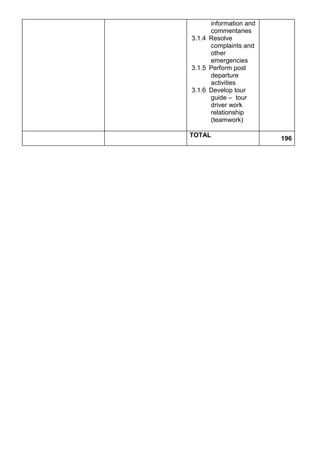
5.1.2 Provide prompt
and quality
service to
customer
5.1.3 Handle queries
promptly and
correctly in line
with enterprise
procedures
5.1.4 Handle
customer
complaints,
evaluation and
recommendatio
ns
5.1.5 Provide prompt
and quality
service to
customer
5.1.6 Handle queries
promptly and
correctly in line
with enterprise
procedures
5.1.7 Handle
customer
complaints,
evaluation and
recommendatio
ns
CORE
1. Research
information relevant
to tour itinerary
1.1 Research information
relevant to tour
itinerary
1.1.1 Source
information
1.1.2 Arrange
information
40
2. Manage
Arrangements for
Visitors
2.1. Manage
Arrangements for
Visitors
2.1.1 Perform pre-
arrivalchecks
2.1.2 Manage tour
arrangements
2.1.3 Resolve
complaints and
other
emergencies
2.1.4 Perform post-
departure
activities
60
3. Accompany and
guide visitors in
accordance with
the tour itinerary
3.1 Accompany and
guide visitors in
accordance with the
tour itinerary
3.1.1 Perform pre-
arrival activities
3.1.2 Guide tourist
3.1.3 Deliver
60
information and
commentaries
3.1.4 Resolve
complaints and
other
emergencies
3.1.5 Perform post
departure
activities
3.1.6 Develop tour
guide – tour
driver work
relationship
(teamwork)
TOTAL
196
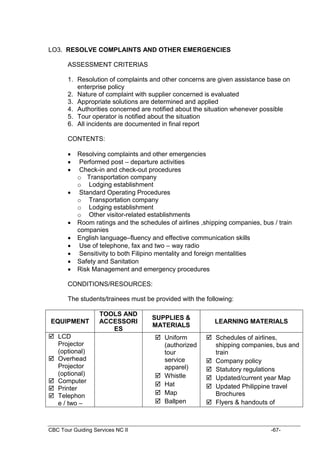
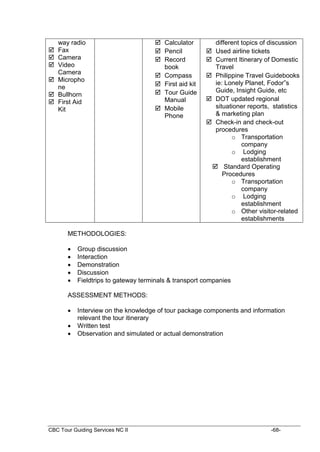
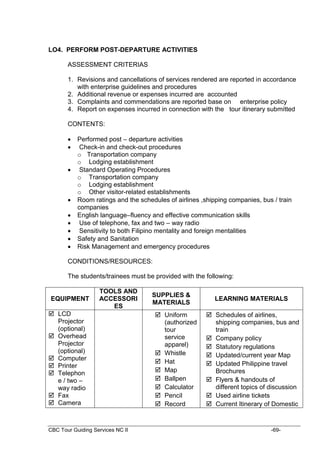
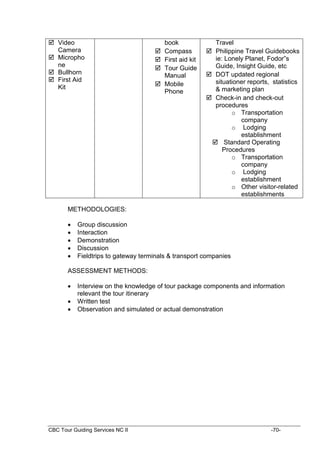
RESOURCES:
FACILITIES
 Workshop
 Laboratory
 Audio-visual room
 Lecture room
 Storage/stock room
EQUIPMENT
 2 units Vehicle*
 1 unit Computer with internet connection & LCD projector
 2 units Two-way radio
 1 unit Mobile phone
 1 unit Telephone
 1 unit Fax Machine
 1 unit Camera
 1 unit Video camera
 1 unit Microphone
 1 unit Bullhorn
 2 sets First aid kit
*NOTE: Implementation of the training program can be made possible through a MOA
between the Training school and Industry for the use of the facilities. This is
in response to the limitations of schools due to high cost of equipment. Air-
conditioned vehicles can be hired on a per trip basis subject to requirement.
SUPPLIES
 Uniform (authorized tour service apparel)
 Whistle
 Hat
 Map
 Ballpen
 Calculator
 Pencil
 Record book
 Compass
 First aid kit
 Tour Guide Manual
 Mobile Phone
RESOURCES/MANUALS
 Schedules of airlines, shipping companies, bus and train
 Company policy
 Statutory regulations
 Updated/current year Map
 Updated Philippine travel Brochures
 Flyers & handouts of different topics of discussion
 Used airline tickets
 Current Itinerary of Domestic Travel
 Philippine Travel Guidebooks ie: Lonely Planet, Fodor”s Guide, Insight Guide, etc
 DOT updated regional situationer reports, statistics & marketing plan
ASSESSMENT METHODS:
 Written examination
 Practical Demonstration
 Direct observation
 Hands-on
COURSE DELIVERY:
 Group Discussion
 Demonstration
 Film Viewing
 Modular instruction
 Practical application
 Reporting
 Industry immersion
 E-learning
TRAINER QUALIFICATION (TQ II)
 Must be a holder of NC III or equivalent relevant qualification
 Must have undergone training on Training Methodology II (TM II) or equivalent trainers’
training program
 Duly Licensed and DOT Accredited Tour Guide
 Must be computer-literate
 Must be physically and mentally fit
 *Must have at least 2 years job/industry experience
* Optional. Only when required by the hiring institution.
Reference: TESDA Board Resolution No. 2004 03
BASIC COMPETENCIES
TOUR GUIDING SERVICES NC II
CBC Tour Guiding Services NC II -1-
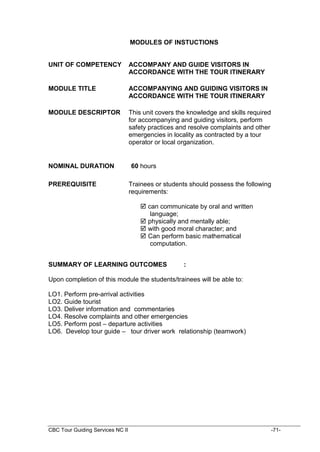
MODULES OF INSTUCTIONS
UNIT OF
COMPETENCY
PARTICIPATE IN WORKPLACE COMMUNICATION
CODE 500311105
MODULE TITLE PARTICIPATING IN WORKPLACE COMMUNICATION
MODULE DESCRIPTOR This module covers the knowledge, skills and attitudes
required to gather, interpret and convey information in
response to workplace requirements.
NOMINAL DURATION 6 hours
QUALIFICATION
LEVEL
NCII
PREREQUISITE Receive and Respond to workplace Communication.
(NCI)
SUMMARY OF LEARNING OUTCOMES :
Upon completion of this module the students/trainees will be able to:
LO1. Obtain and convey workplace information
LO2. Participate in workplace meetings and discussions
LO3. Complete relevant work related documents
CBC Tour Guiding Services NC II -2-
LO1. OBTAIN AND CONVEY WORKPLACE INFORMATION
ASSESSMENT CRITERIA
1. Specific and relevant information is accessed from appropriate sources
2. Effective questioning , active listening and speaking skills are used to gather
and convey information
3. Appropriate medium is used to transfer information and ideas
4. Appropriate non- verbal communication is used
5. Appropriate lines of communication with supervisors and colleagues are
identified and followed
6. Defined workplace procedures for the location and storage of information are
used
7. Personal interaction is carried out clearly and concisely
CONTENTS:
 Effective communication
 Different modes of communication
 Written communication
 Organizational policies
 Communication procedures and systems
 Technology relevant to the enterprise and the individual’s work responsibilities
 Follow simple spoken language
 Perform routine workplace duties following simple written notices
 Participate in workplace meetings and discussions
 Complete work related documents
 Ability to relate to people of social range in the workplace
 Gather and provide information in response to workplace requirements
CBC Tour Guiding Services NC II -3-
CONDITIONS/RESOURCES:
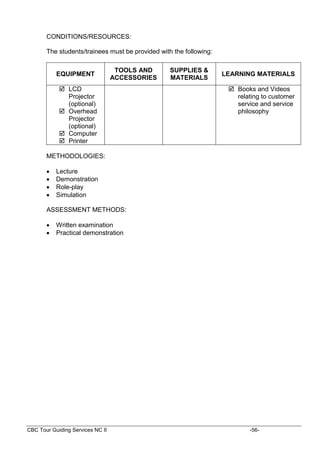
The students/trainees must be provided with the following:
EQUIPMENT
TOOLS AND
ACCESSORIES
SUPPLIES &
MATERIALS
LEARNING
MATERIALS
 LCD
Projector
(optional)
 Overhead
Projector
(optional)
 Computer
 Printer
 Suppliers
 Memorandum
 Circular
 Notice
 Information
discussion
Sample Storage:
 Manual filing
system
 Computer-based
filing system
 Personnel forms,
telephone
message forms,
safety reports
 Telephone
 Electronic and
two way radio
METHODOLOGIES:
Group discussion
Interaction
ASSESSMENT METHODS:
 Direct Observation
 Oral interview and written test
CBC Tour Guiding Services NC II -4-
LO2. PARTICIPATE IN WORKPLACE MEETINGS AND DISCUSSIONS
ASSESSMENT CRITERIA
1. Team meetings are attended on time
2. Own opinions are clearly expressed and those of others are listened to without
interruption
3. Meeting inputs are consistent with the meeting purpose and established
protocols
4. Workplace interactions are conducted in a courteous manner
5. Questions about simple routine workplace procedures and maters concerning
working conditions of employment are asked and responded to
6. Meetings outcomes are interpreted and implemented
CONTENTS:
 Effective communication
 Different modes of communication
 Written communication
 Organizational policies
 Communication procedures and systems
 Technology relevant to the enterprise and the individual’s work responsibilities
 Follow simple spoken language
 Ability to relate to people of social range in the workplace
 Gather and provide information in response to workplace requirements
CONDITIONS/RESOURCES:
The students/trainees must be provided with the following:
EQUIPMENT
TOOLS AND
ACCESSORIE
S
SUPPLIES &
MATERIALS
LEARNING
MATERIALS
 LCD
Projector
(optional)
 Overhead
Projector
(optional)
 Computer
 Printer
 Pen
 Paper
Books
relating to
conductin
g
meetings
CBC Tour Guiding Services NC II -5-
METHODOLOGIES:
 Group discussion
 Interaction
ASSESSMENT METHODS:
 Direct Observation
 Oral interview and written test
CBC Tour Guiding Services NC II -6-
LO3. COMPLETE RELEVANT WORK RELATED DOCUMENTS
ASSESSMENT CRITERIA
1. Range of forms relating to conditions of employment are completed accurately
and legibly
2. Workplace data is recorded on standard workplace forms and documents
3. Basic mathematical processes are used for routine calculations
4. Errors in recording information on forms/ documents are identified and properly
acted upon
5. Reporting requirements to supervisor are completed according to
organizational guidelines
CONTENTS:
 Effective communication
 Different modes of communication
 Written communication
 Organizational policies
 Communication procedures and systems
 Technology relevant to the enterprise and the individual’s work responsibilities
 Follow simple spoken language
 Perform routine workplace duties following simple written notices
 Participate in workplace meetings and discussions
 Complete work related documents
 Estimate, calculate and record routine workplace measures
 Basic mathematical processes of addition, subtraction, division and
multiplication
 Ability to relate to people of social range in the workplace
 Gather and provide information in response to workplace requirements
CBC Tour Guiding Services NC II -7-
CONDITIONS/RESOURCES:
The students/trainees must be provided with the following:
EQUIPMENT
TOOLS AND
ACCESSORIES
SUPPLIES &
MATERIALS
LEARNING
MATERIALS
 LCD
Projector
(optional)
 Overhead
Projector
(optional)
 Computer
 Printer
 Suppliers
 Memorandum
 Circular
 Notice
 Information
discussion
Sample Storage:
 Manual filing
system
 Computer-based
filing system
 Personnel forms,
telephone
message forms,
safety reports
 Telephone
 Electronic and
two way radio
METHODOLOGIES:
 Group discussion
 Interaction
ASSESSMENT METHODS:
 Direct Observation
 Oral interview and written test
CBC Tour Guiding Services NC II -8-
MODULES OF INSTUCTIONS
UNIT OF
COMPETENCY WORK IN TEAM ENVIRONMENT
MODULE TITLE
WORKING IN A TEAM ENVIRONMENT
MODULE DESCRIPTOR This module covers the skills, knowledge and attitudes to
identify role and responsibility as a member of a team.
NOMINAL DURATION 3 hours
PREREQUISITE Teamwork (NCI)
SUMMARY OF LEARNING OUTCOMES :
Upon completion of this module the students/trainees will be able to:
LO1: Describe team role and scope
LO2: Identify own role and responsibility within team
LO3: Work as a team member
CBC Tour Guiding Services NC II -9-
LO1. DESCRIBE TEAM ROLE AND SCOPE
ASSESSMENT CRITERIA:
1. The role and objective of the team is identified from available sources of
information
2. Team parameters, reporting relationships and responsibilities are identified from
team discussions and appropriate external sources
CONTENTS:
 Communication process
 Team structure
 Team roles
 Group planning and decision making
 Communicate appropriately, consistent with the culture of the workplace
CONDITIONS/RESOURCES:
The students/trainees must be provided with the following:
EQUIPMENT
TOOLS AND
ACCESSORIES
SUPPLIES &
MATERIALS
LEARNING
MATERIALS
 LCD
Projector
(optional)
 Overhead
Projector
(optional)
 Computer
 Printer
 Pen
 Paper
METHODOLOGIES:
 Group discussion
 Interaction
ASSESSMENT METHODS:
 Competency may be assessed in workplace or in a simulated
workplace setting
 Assessment shall be observed while task are being undertaken
whether individually or in group
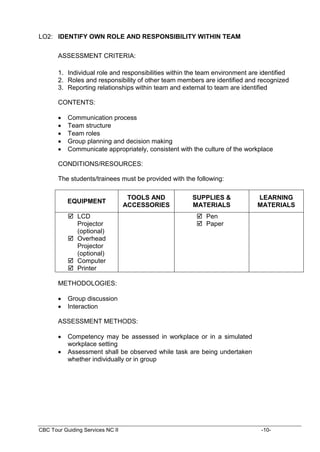
CBC Tour Guiding Services NC II -10-
LO2: IDENTIFY OWN ROLE AND RESPONSIBILITY WITHIN TEAM
ASSESSMENT CRITERIA:
1. Individual role and responsibilities within the team environment are identified
2. Roles and responsibility of other team members are identified and recognized
3. Reporting relationships within team and external to team are identified
CONTENTS:
 Communication process
 Team structure
 Team roles
 Group planning and decision making
 Communicate appropriately, consistent with the culture of the workplace
CONDITIONS/RESOURCES:
The students/trainees must be provided with the following:
EQUIPMENT
TOOLS AND
ACCESSORIES
SUPPLIES &
MATERIALS
LEARNING
MATERIALS
 LCD
Projector
(optional)
 Overhead
Projector
(optional)
 Computer
 Printer
 Pen
 Paper
METHODOLOGIES:
 Group discussion
 Interaction
ASSESSMENT METHODS:
 Competency may be assessed in workplace or in a simulated
workplace setting
 Assessment shall be observed while task are being undertaken
whether individually or in group
CBC Tour Guiding Services NC II -11-
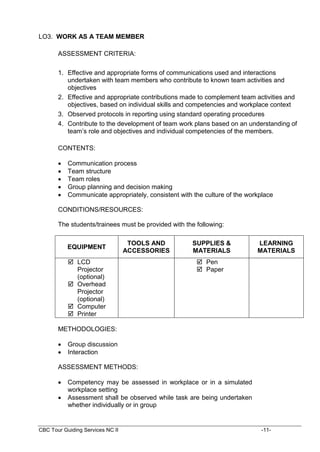
LO3. WORK AS A TEAM MEMBER
ASSESSMENT CRITERIA:
1. Effective and appropriate forms of communications used and interactions
undertaken with team members who contribute to known team activities and
objectives
2. Effective and appropriate contributions made to complement team activities and
objectives, based on individual skills and competencies and workplace context
3. Observed protocols in reporting using standard operating procedures
4. Contribute to the development of team work plans based on an understanding of
team’s role and objectives and individual competencies of the members.
CONTENTS:
 Communication process
 Team structure
 Team roles
 Group planning and decision making
 Communicate appropriately, consistent with the culture of the workplace
CONDITIONS/RESOURCES:
The students/trainees must be provided with the following:
EQUIPMENT
TOOLS AND
ACCESSORIES
SUPPLIES &
MATERIALS
LEARNING
MATERIALS
 LCD
Projector
(optional)
 Overhead
Projector
(optional)
 Computer
 Printer
 Pen
 Paper
METHODOLOGIES:
 Group discussion
 Interaction
ASSESSMENT METHODS:
 Competency may be assessed in workplace or in a simulated
workplace setting
 Assessment shall be observed while task are being undertaken
whether individually or in group
CBC Tour Guiding Services NC II -12-
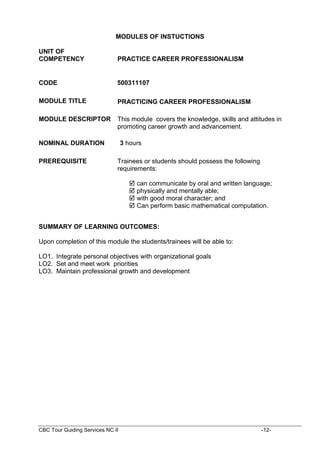
MODULES OF INSTUCTIONS
UNIT OF
COMPETENCY PRACTICE CAREER PROFESSIONALISM
CODE 500311107
MODULE TITLE PRACTICING CAREER PROFESSIONALISM
MODULE DESCRIPTOR This module covers the knowledge, skills and attitudes in
promoting career growth and advancement.
NOMINAL DURATION 3 hours
PREREQUISITE Trainees or students should possess the following
requirements:
 can communicate by oral and written language;
 physically and mentally able;
 with good moral character; and
 Can perform basic mathematical computation.
SUMMARY OF LEARNING OUTCOMES:
Upon completion of this module the students/trainees will be able to:
LO1. Integrate personal objectives with organizational goals
LO2. Set and meet work priorities
LO3. Maintain professional growth and development
CBC Tour Guiding Services NC II -13-
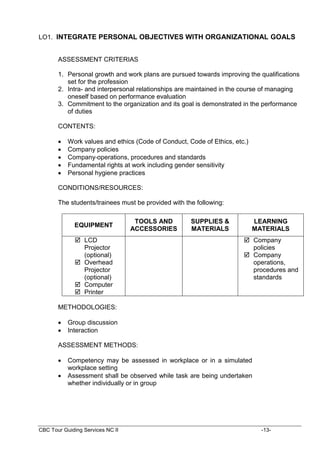
LO1. INTEGRATE PERSONAL OBJECTIVES WITH ORGANIZATIONAL GOALS
ASSESSMENT CRITERIAS
1. Personal growth and work plans are pursued towards improving the qualifications
set for the profession
2. Intra- and interpersonal relationships are maintained in the course of managing
oneself based on performance evaluation
3. Commitment to the organization and its goal is demonstrated in the performance
of duties
CONTENTS:
 Work values and ethics (Code of Conduct, Code of Ethics, etc.)
 Company policies
 Company operations, procedures and standards
 Fundamental rights at work including gender sensitivity
 Personal hygiene practices
CONDITIONS/RESOURCES:
The students/trainees must be provided with the following:
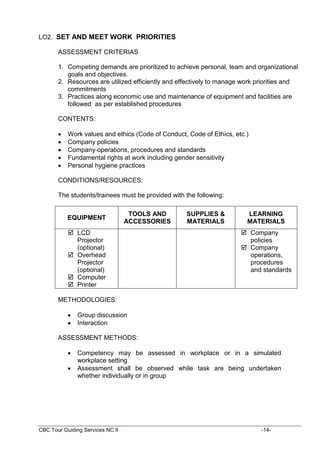
EQUIPMENT
TOOLS AND
ACCESSORIES
SUPPLIES &
MATERIALS
LEARNING
MATERIALS
 LCD
Projector
(optional)
 Overhead
Projector
(optional)
 Computer
 Printer
 Company
policies
 Company
operations,
procedures and
standards
METHODOLOGIES:
 Group discussion
 Interaction
ASSESSMENT METHODS:
 Competency may be assessed in workplace or in a simulated
workplace setting
 Assessment shall be observed while task are being undertaken
whether individually or in group
CBC Tour Guiding Services NC II -14-
LO2. SET AND MEET WORK PRIORITIES
ASSESSMENT CRITERIAS
1. Competing demands are prioritized to achieve personal, team and organizational
goals and objectives.
2. Resources are utilized efficiently and effectively to manage work priorities and
commitments
3. Practices along economic use and maintenance of equipment and facilities are
followed as per established procedures
CONTENTS:
 Work values and ethics (Code of Conduct, Code of Ethics, etc.)
 Company policies
 Company operations, procedures and standards
 Fundamental rights at work including gender sensitivity
 Personal hygiene practices
CONDITIONS/RESOURCES:
The students/trainees must be provided with the following:
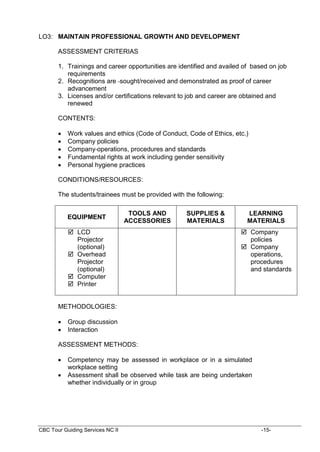
EQUIPMENT
TOOLS AND
ACCESSORIES
SUPPLIES &
MATERIALS
LEARNING
MATERIALS
 LCD
Projector
(optional)
 Overhead
Projector
(optional)
 Computer
 Printer
 Company
policies
 Company
operations,
procedures
and standards
METHODOLOGIES:
 Group discussion
 Interaction
ASSESSMENT METHODS:
 Competency may be assessed in workplace or in a simulated
workplace setting
 Assessment shall be observed while task are being undertaken
whether individually or in group
CBC Tour Guiding Services NC II -15-
LO3: MAINTAIN PROFESSIONAL GROWTH AND DEVELOPMENT
ASSESSMENT CRITERIAS
1. Trainings and career opportunities are identified and availed of based on job
requirements
2. Recognitions are sought/received and demonstrated as proof of career
advancement
3. Licenses and/or certifications relevant to job and career are obtained and
renewed
CONTENTS:
 Work values and ethics (Code of Conduct, Code of Ethics, etc.)
 Company policies
 Company operations, procedures and standards
 Fundamental rights at work including gender sensitivity
 Personal hygiene practices
CONDITIONS/RESOURCES:
The students/trainees must be provided with the following:
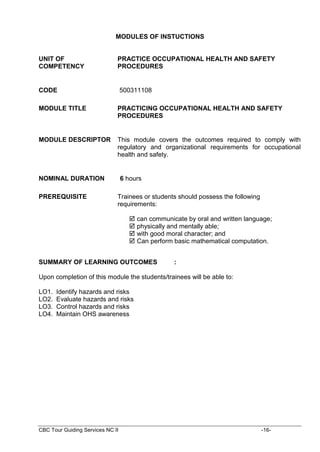
EQUIPMENT
TOOLS AND
ACCESSORIES
SUPPLIES &
MATERIALS
LEARNING
MATERIALS
 LCD
Projector
(optional)
 Overhead
Projector
(optional)
 Computer
 Printer
 Company
policies
 Company
operations,
procedures
and standards
METHODOLOGIES:
 Group discussion
 Interaction
ASSESSMENT METHODS:
 Competency may be assessed in workplace or in a simulated
workplace setting
 Assessment shall be observed while task are being undertaken
whether individually or in group
CBC Tour Guiding Services NC II -16-
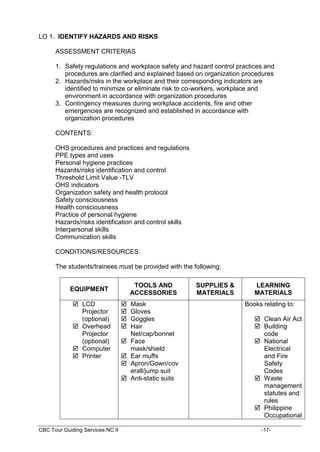
MODULES OF INSTUCTIONS
UNIT OF
COMPETENCY
PRACTICE OCCUPATIONAL HEALTH AND SAFETY
PROCEDURES
CODE 500311108
MODULE TITLE PRACTICING OCCUPATIONAL HEALTH AND SAFETY
PROCEDURES
MODULE DESCRIPTOR This module covers the outcomes required to comply with
regulatory and organizational requirements for occupational
health and safety.
NOMINAL DURATION 6 hours
PREREQUISITE Trainees or students should possess the following
requirements:
 can communicate by oral and written language;
 physically and mentally able;
 with good moral character; and
 Can perform basic mathematical computation.
SUMMARY OF LEARNING OUTCOMES :
Upon completion of this module the students/trainees will be able to:
LO1. Identify hazards and risks
LO2. Evaluate hazards and risks
LO3. Control hazards and risks
LO4. Maintain OHS awareness
CBC Tour Guiding Services NC II -17-
LO 1. IDENTIFY HAZARDS AND RISKS
ASSESSMENT CRITERIAS
1. Safety regulations and workplace safety and hazard control practices and
procedures are clarified and explained based on organization procedures
2. Hazards/risks in the workplace and their corresponding indicators are
identified to minimize or eliminate risk to co-workers, workplace and
environment in accordance with organization procedures
3. Contingency measures during workplace accidents, fire and other
emergencies are recognized and established in accordance with
organization procedures
CONTENTS:
OHS procedures and practices and regulations
PPE types and uses
Personal hygiene practices
Hazards/risks identification and control
Threshold Limit Value -TLV
OHS indicators
Organization safety and health protocol
Safety consciousness
Health consciousness
Practice of personal hygiene
Hazards/risks identification and control skills
Interpersonal skills
Communication skills
CONDITIONS/RESOURCES:
The students/trainees must be provided with the following:
EQUIPMENT
TOOLS AND
ACCESSORIES
SUPPLIES &
MATERIALS
LEARNING
MATERIALS
 LCD
Projector
(optional)
 Overhead
Projector
(optional)
 Computer
 Printer
 Mask
 Gloves
 Goggles
 Hair
Net/cap/bonnet
 Face
mask/shield
 Ear muffs
 Apron/Gown/cov
erall/jump suit
 Anti-static suits
Books relating to:
 Clean Air Act
 Building
code
 National
Electrical
and Fire
Safety
Codes
 Waste
management
statutes and
rules
 Philippine
Occupational
CBC Tour Guiding Services NC II -18-
Safety and
Health
Standards
 DOLE
regulations
on safety
legal
requirements
 ECC
regulations
 Standard
operating
procedures
of property
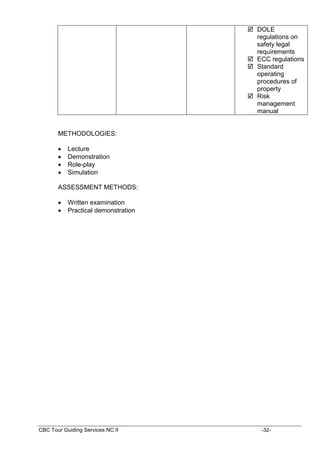
 Risk
management
manual
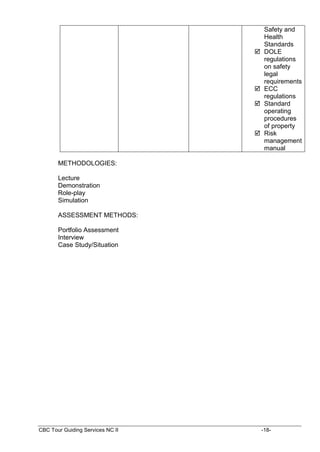
METHODOLOGIES:
Lecture
Demonstration
Role-play
Simulation
ASSESSMENT METHODS:
Portfolio Assessment
Interview
Case Study/Situation
CBC Tour Guiding Services NC II -19-
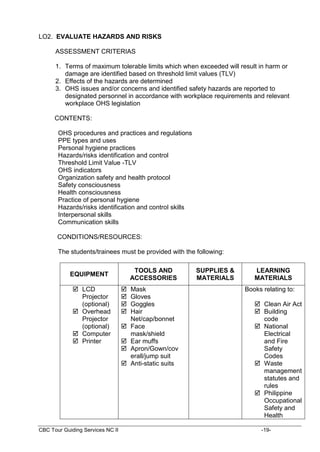
LO2. EVALUATE HAZARDS AND RISKS
ASSESSMENT CRITERIAS
1. Terms of maximum tolerable limits which when exceeded will result in harm or
damage are identified based on threshold limit values (TLV)
2. Effects of the hazards are determined
3. OHS issues and/or concerns and identified safety hazards are reported to
designated personnel in accordance with workplace requirements and relevant
workplace OHS legislation
CONTENTS:
OHS procedures and practices and regulations
PPE types and uses
Personal hygiene practices
Hazards/risks identification and control
Threshold Limit Value -TLV
OHS indicators
Organization safety and health protocol
Safety consciousness
Health consciousness
Practice of personal hygiene
Hazards/risks identification and control skills
Interpersonal skills
Communication skills
CONDITIONS/RESOURCES:
The students/trainees must be provided with the following:
EQUIPMENT
TOOLS AND
ACCESSORIES
SUPPLIES &
MATERIALS
LEARNING
MATERIALS
 LCD
Projector
(optional)
 Overhead
Projector
(optional)
 Computer
 Printer
 Mask
 Gloves
 Goggles
 Hair
Net/cap/bonnet
 Face
mask/shield
 Ear muffs
 Apron/Gown/cov
erall/jump suit
 Anti-static suits
Books relating to:
 Clean Air Act
 Building
code
 National
Electrical
and Fire
Safety
Codes
 Waste
management
statutes and
rules
 Philippine
Occupational
Safety and
Health
CBC Tour Guiding Services NC II -20-
Standards
 DOLE
regulations
on safety
legal
requirements
 ECC
regulations
 Standard
operating
procedures
of property
 Risk
management
manual
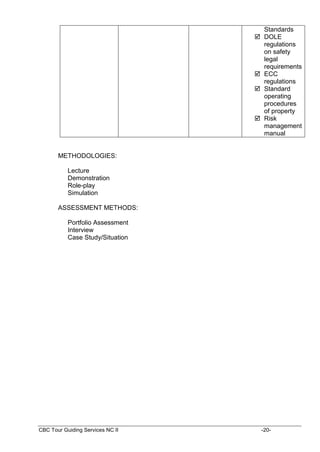
METHODOLOGIES:
Lecture
Demonstration
Role-play
Simulation
ASSESSMENT METHODS:
Portfolio Assessment
Interview
Case Study/Situation
CBC Tour Guiding Services NC II -21-
LO3. CONTROL HAZARDS AND RISKS
ASSESSMENT CRITERIAS
1. Occupational Health and Safety (OHS) procedures for controlling
hazards/risks in workplace are consistently followed
2. Procedures for dealing with workplace accidents, fire and emergencies are
followed in accordance with organization OHS policies
3. Personal protective equipment (PPE) is correctly used in accordance with
organization OHS procedures and practices
4. Appropriate assistance is provided in the event of a workplace emergency
in accordance with established organization protocol
CONTENTS:
OHS procedures and practices and regulations
PPE types and uses
Personal hygiene practices
Hazards/risks identification and control
Threshold Limit Value -TLV
OHS indicators
Organization safety and health protocol
Safety consciousness
Health consciousness
Practice of personal hygiene
Hazards/risks identification and control skills
Interpersonal skills
Communication skills
CBC Tour Guiding Services NC II -22-
CONDITIONS/RESOURCES:
The students/trainees must be provided with the following:
EQUIPMENT
TOOLS AND
ACCESSORIES
SUPPLIES &
MATERIALS
LEARNING
MATERIALS
 LCD
Projector
(optional)
 Overhead
Projector
(optional)
 Computer
 Printer
 Mask
 Gloves
 Goggles
 Hair
Net/cap/bonnet
 Face
mask/shield
 Ear muffs
 Apron/Gown/cov
erall/jump suit
 Anti-static suits
Books relating to:
 Clean Air Act
 Building code
 National
Electrical and
Fire Safety
Codes
 Waste
management
statutes and
rules
 Philippine
Occupational
Safety and
Health
Standards
 DOLE
regulations on
safety legal
requirements
 ECC
regulations
 Standard
operating
procedures of
property
 Risk
management
manual
METHODOLOGIES:
 Lecture
 Demonstration
 Role-play
 Simulation
ASSESSMENT METHODS:
 Portfolio Assessment
 Interview
 Case Study/Situation
CBC Tour Guiding Services NC II -23-
LO4. MAINTAIN OHS AWARENESS
ASSESSMENT CRITERIAS
1. Emergency-related drills and trainings are participated in as per established
organization guidelines and procedures
2. OHS personal records are completed and updated in accordance with workplace
requirements
CONTENTS:
 OHS procedures and practices and regulations
 PPE types and uses
 Personal hygiene practices
 Hazards/risks identification and control
 Threshold Limit Value -TLV
 OHS indicators
 Organization safety and health protocol
 Safety consciousness
 Health consciousness
 Practice of personal hygiene
 Hazards/risks identification and control skills
 Interpersonal skills
 Communication skills
CONDITIONS/RESOURCES:
The students/trainees must be provided with the following:
EQUIPMENT
TOOLS AND
ACCESSORIES
SUPPLIES &
MATERIALS
LEARNING
MATERIALS
 LCD
Projector
(optional)
 Overhead
Projector
(optional)
 Computer
 Printer
 Mask
 Gloves
 Goggles
 Hair
Net/cap/bonnet
 Face
mask/shield
 Ear muffs
 Apron/Gown/cov
erall/jump suit
 Anti-static suits
Books relating to:
 Clean Air Act
 Building code
 National
Electrical and
Fire Safety
Codes
 Waste
management
statutes and
rules
 Philippine
Occupational
Safety and
Health
Standards
 DOLE
regulations on
safety legal
requirements
CBC Tour Guiding Services NC II -24-
 ECC
regulations
 Standard
operating
procedures of
property
 Risk
management
manual
METHODOLOGIES:
 Lecture
 Demonstration
 Role-play
 Simulation
ASSESSMENT METHODS:
 Portfolio Assessment
 Interview
 Case Study/Situation
COMMON COMPETENCIES
TOUR GUIDING SERVICES NC II
CBC Tour Guiding Services NC II -25-
MODULES OF INSTUCTIONS
UNIT OF
COMPETENCY
DEVELOP AND UPDATE INDUSTRY KNOWLEDGE
CODE TRS311201
MODULE TITLE DEVELOPING AND UPDATING INDUSTRY KNOWLEDGE
MODULE DESCRIPTOR This module covers the outcomes required to comply with
regulatory and organizational requirements for occupational
health and safety.
NOMINAL DURATION 2 hours
PREREQUISITE Trainees or students should possess the following
requirements:
 can communicate by oral and written language;
 physically and mentally able;
 with good moral character; and
 Can perform basic mathematical computation.

SUMMARY OF LEARNING OUTCOMES :
Upon completion of this module the students/trainees will be able to:
LO1. Seek information on the industry
LO2. Update industry knowledge
CBC Tour Guiding Services NC II -26-
LO1. SEEK INFORMATION ON THE INDUSTRY
ASSESSMENT CRITERIAS
1 Sources of information on the industry are correctly identified and accessed
2 Information to assist effective work performance is obtained in line with job
requirements
3 Specific information on sector of work is accessed and updated
4 Industry information is correctly applied to day-to-day work activities
CONTENTS:
 Time management
 Ready skills needed to access industry information
 Basic competency skills needed to access the internet
 Overview of quality assurance in the industry
 Role of individual staff members
 Industry information sources
CONDITIONS/RESOURCES:
The students/trainees must be provided with the following:
EQUIPMENT
TOOLS AND
ACCESSORIES
SUPPLIES &
MATERIALS
LEARNING
MATERIALS
 LCD
Projector
(optional)
 Overhead
Projector
(optional)
 Computer
 Printer
 media
 reference books
 libraries
 unions
 industry
associations
 industry journals
 internet
 personal
observation and
experience
METHODOLOGIES:
 Lecture
 Group Discussion
 Individual/Group Assignment
ASSESSMENT METHODS:
 Interview/questions
 Practical demonstration
 Portfolio of industry information related to trainee’s work
CBC Tour Guiding Services NC II -27-
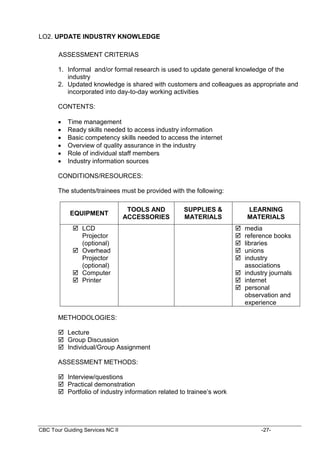
LO2. UPDATE INDUSTRY KNOWLEDGE
ASSESSMENT CRITERIAS
1. Informal and/or formal research is used to update general knowledge of the
industry
2. Updated knowledge is shared with customers and colleagues as appropriate and
incorporated into day-to-day working activities
CONTENTS:
 Time management
 Ready skills needed to access industry information
 Basic competency skills needed to access the internet
 Overview of quality assurance in the industry
 Role of individual staff members
 Industry information sources
CONDITIONS/RESOURCES:
The students/trainees must be provided with the following:
EQUIPMENT
TOOLS AND
ACCESSORIES
SUPPLIES &
MATERIALS
LEARNING
MATERIALS
 LCD
Projector
(optional)
 Overhead
Projector
(optional)
 Computer
 Printer
 media
 reference books
 libraries
 unions
 industry
associations
 industry journals
 internet
 personal
observation and
experience
METHODOLOGIES:
 Lecture
 Group Discussion
 Individual/Group Assignment
ASSESSMENT METHODS:
 Interview/questions
 Practical demonstration
 Portfolio of industry information related to trainee’s work
CBC Tour Guiding Services NC II -28-
MODULES OF INSTUCTIONS
UNIT OF
COMPETENCY
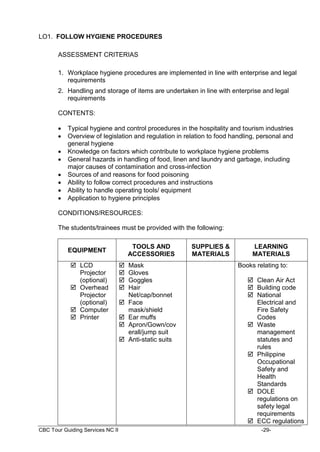
OBSERVE WORKPLACE HYGIENE PROCEDURES
CODE TRS311202
MODULE TITLE OBSERVE WORKPLACE HYGIENE PROCEDURES
MODULE DESCRIPTOR This module deals with the knowledge, skills and attitudes in
observing workplace hygiene procedures. It includes following
hygiene procedures and identifying and preventing hygiene
risks.
NOMINAL DURATION 2 hours
PREREQUISITE Trainees or students should possess the following
requirements:
 can communicate by oral and written language;
 physically and mentally able;
 with good moral character; and
 Can perform basic mathematical computation.
SUMMARY OF LEARNING OUTCOMES :
Upon completion of this module the students/trainees will be able to:
LO1. Follow hygiene procedures
LO2. Identify and prevent hygiene risks
CBC Tour Guiding Services NC II -29-
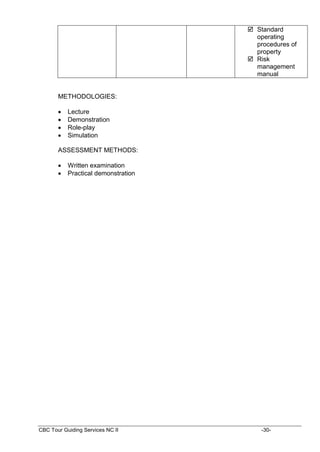
LO1. FOLLOW HYGIENE PROCEDURES
ASSESSMENT CRITERIAS
1. Workplace hygiene procedures are implemented in line with enterprise and legal
requirements
2. Handling and storage of items are undertaken in line with enterprise and legal
requirements
CONTENTS:
 Typical hygiene and control procedures in the hospitality and tourism industries
 Overview of legislation and regulation in relation to food handling, personal and
general hygiene
 Knowledge on factors which contribute to workplace hygiene problems
 General hazards in handling of food, linen and laundry and garbage, including
major causes of contamination and cross-infection
 Sources of and reasons for food poisoning
 Ability to follow correct procedures and instructions
 Ability to handle operating tools/ equipment
 Application to hygiene principles
CONDITIONS/RESOURCES:
The students/trainees must be provided with the following:
EQUIPMENT
TOOLS AND
ACCESSORIES
SUPPLIES &
MATERIALS
LEARNING
MATERIALS
 LCD
Projector
(optional)
 Overhead
Projector
(optional)
 Computer
 Printer
 Mask
 Gloves
 Goggles
 Hair
Net/cap/bonnet
 Face
mask/shield
 Ear muffs
 Apron/Gown/cov
erall/jump suit
 Anti-static suits
Books relating to:
 Clean Air Act
 Building code
 National
Electrical and
Fire Safety
Codes
 Waste
management
statutes and
rules
 Philippine
Occupational
Safety and
Health
Standards
 DOLE
regulations on
safety legal
requirements
 ECC regulations
CBC Tour Guiding Services NC II -30-
 Standard
operating
procedures of
property
 Risk
management
manual
METHODOLOGIES:
 Lecture
 Demonstration
 Role-play
 Simulation
ASSESSMENT METHODS:
 Written examination
 Practical demonstration
CBC Tour Guiding Services NC II -31-
LO2. IDENTIFY AND PREVENT HYGIENE RISKS
ASSESSMENT CRITERIAS
1. Potential hygiene risks are identified in line with enterprise procedures
2. Action to minimize and remove risks are taken within scope of individual
responsibility of enterprise/legal requirements
3. Hygiene risks beyond the control of individual staff members are reported to the
appropriate person for follow up
CONTENTS:
 Typical hygiene and control procedures in the hospitality and
tourism industries
 Overview of legislation and regulation in relation to food handling,
personal and general hygiene
 Knowledge on factors which contribute to workplace hygiene
problems
 General hazards in handling of food, linen and laundry and
garbage, including major causes of contamination and cross-
infection
 Sources of and reasons for food poisoning
 Ability to follow correct procedures and instructions
 Ability to handle operating tools/ equipment
 Application to hygiene principles
CONDITIONS/RESOURCES:
The students/trainees must be provided with the following:
EQUIPMENT
TOOLS AND
ACCESSORIES
SUPPLIES &
MATERIALS
LEARNING
MATERIALS
 LCD
Projector
(optional)
 Overhead
Projector
(optional)
 Computer
 Printer
 Mask
 Gloves
 Goggles
 Hair
Net/cap/bonnet
 Face
mask/shield
 Ear muffs
 Apron/Gown/cov
erall/jump suit
 Anti-static suits
Books relating to:
 Clean Air Act
 Building code
 National
Electrical and
Fire Safety
Codes
 Waste
management
statutes and
rules
 Philippine
Occupational
Safety and
Health
Standards
CBC Tour Guiding Services NC II -32-
 DOLE
regulations on
safety legal
requirements
 ECC regulations
 Standard
operating
procedures of
property
 Risk
management
manual
METHODOLOGIES:
 Lecture
 Demonstration
 Role-play
 Simulation
ASSESSMENT METHODS:
 Written examination
 Practical demonstration
CBC Tour Guiding Services NC II -33-
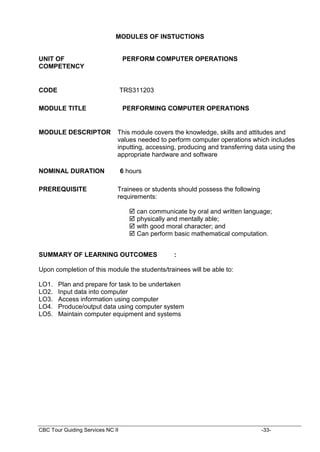
MODULES OF INSTUCTIONS
UNIT OF
COMPETENCY
PERFORM COMPUTER OPERATIONS
CODE TRS311203
MODULE TITLE PERFORMING COMPUTER OPERATIONS
MODULE DESCRIPTOR This module covers the knowledge, skills and attitudes and
values needed to perform computer operations which includes
inputting, accessing, producing and transferring data using the
appropriate hardware and software
NOMINAL DURATION 6 hours
PREREQUISITE Trainees or students should possess the following
requirements:
 can communicate by oral and written language;
 physically and mentally able;
 with good moral character; and
 Can perform basic mathematical computation.
SUMMARY OF LEARNING OUTCOMES :
Upon completion of this module the students/trainees will be able to:
LO1. Plan and prepare for task to be undertaken
LO2. Input data into computer
LO3. Access information using computer
LO4. Produce/output data using computer system
LO5. Maintain computer equipment and systems
CBC Tour Guiding Services NC II -34-
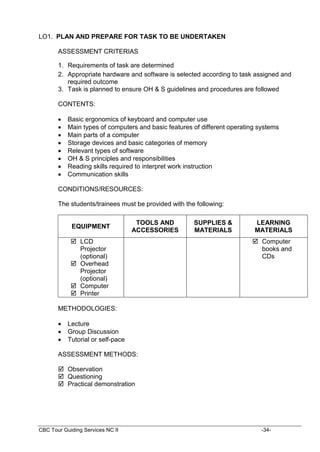
LO1. PLAN AND PREPARE FOR TASK TO BE UNDERTAKEN
ASSESSMENT CRITERIAS
1. Requirements of task are determined
2. Appropriate hardware and software is selected according to task assigned and
required outcome
3. Task is planned to ensure OH & S guidelines and procedures are followed
CONTENTS:
 Basic ergonomics of keyboard and computer use
 Main types of computers and basic features of different operating systems
 Main parts of a computer
 Storage devices and basic categories of memory
 Relevant types of software
 OH & S principles and responsibilities
 Reading skills required to interpret work instruction
 Communication skills
CONDITIONS/RESOURCES:
The students/trainees must be provided with the following:
EQUIPMENT
TOOLS AND
ACCESSORIES
SUPPLIES &
MATERIALS
LEARNING
MATERIALS
 LCD
Projector
(optional)
 Overhead
Projector
(optional)
 Computer
 Printer
 Computer
books and
CDs
METHODOLOGIES:
 Lecture
 Group Discussion
 Tutorial or self-pace
ASSESSMENT METHODS:
 Observation
 Questioning
 Practical demonstration
CBC Tour Guiding Services NC II -35-
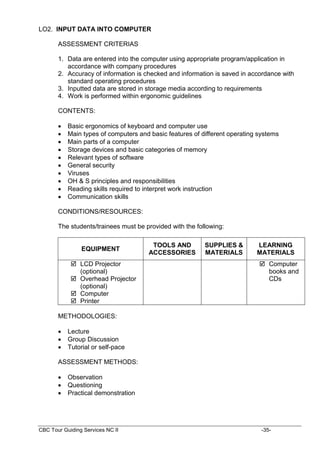
LO2. INPUT DATA INTO COMPUTER
ASSESSMENT CRITERIAS
1. Data are entered into the computer using appropriate program/application in
accordance with company procedures
2. Accuracy of information is checked and information is saved in accordance with
standard operating procedures
3. Inputted data are stored in storage media according to requirements
4. Work is performed within ergonomic guidelines
CONTENTS:
 Basic ergonomics of keyboard and computer use
 Main types of computers and basic features of different operating systems
 Main parts of a computer
 Storage devices and basic categories of memory
 Relevant types of software
 General security
 Viruses
 OH & S principles and responsibilities
 Reading skills required to interpret work instruction
 Communication skills
CONDITIONS/RESOURCES:
The students/trainees must be provided with the following:
EQUIPMENT
TOOLS AND
ACCESSORIES
SUPPLIES &
MATERIALS
LEARNING
MATERIALS
 LCD Projector
(optional)
 Overhead Projector
(optional)
 Computer
 Printer
 Computer
books and
CDs
METHODOLOGIES:
 Lecture
 Group Discussion
 Tutorial or self-pace
ASSESSMENT METHODS:
 Observation
 Questioning
 Practical demonstration
CBC Tour Guiding Services NC II -36-
LO3. ACCESS INFORMATION USING COMPUTER
ASSESSMENT CRITERIAS
1. Correct program/application is selected based on job requirements
2. Program/application containing the information required is accessed
according to company procedures
3. Desktop icons are correctly selected, opened and closed for navigation
purposes
4. Keyboard techniques are carried out in line with OH & S requirements for
safe use of keyboards
CONTENTS:
 Basic ergonomics of keyboard and computer use
 Main types of computers and basic features of different operating systems
 Main parts of a computer
 Storage devices and basic categories of memory
 Relevant types of software
 General security
 Viruses
 OH & S principles and responsibilities
 Calculating computer capacity
 Reading skills required to interpret work instruction
 Communication skills
CONDITIONS/RESOURCES:
The students/trainees must be provided with the following:
EQUIPMENT
TOOLS AND
ACCESSORIES
SUPPLIES &
MATERIALS
LEARNING
MATERIALS
 LCD Projector
(optional)
 Overhead Projector
(optional)
 Computer
 Printer
 Computer
books and
CDs
METHODOLOGIES:
 Lecture
 Group Discussion
 Tutorial or self-pace
ASSESSMENT METHODS:
 Observation
 Questioning
 Practical demonstration
CBC Tour Guiding Services NC II -37-
LO4. PRODUCE/OUTPUT DATA USING COMPUTER SYSTEM
ASSESSMENT CRITERIAS
1. Entered data are processed using appropriate software commands
2. Data are printed out as required using computer hardware/peripheral
devices in accordance with standard operating procedures
3. Files and data are transferred between compatible systems using
computer software, hardware/ peripheral devices in accordance with
standard operating procedures
CONTENTS:
 Basic ergonomics of keyboard and computer use
 Main types of computers and basic features of different operating systems
 Main parts of a computer
 Storage devices and basic categories of memory
 Relevant types of software
 General security
 Viruses
 OH & S principles and responsibilities
 Calculating computer capacity
 Reading skills required to interpret work instruction
 Communication skills
CONDITIONS/RESOURCES:
The students/trainees must be provided with the following:
METHODOLOGIES:
 Lecture
 Group Discussion
 Tutorial or self-pace
ASSESSMENT METHODS:
 Observation
 Questioning
 Practical demonstration
EQUIPMENT
TOOLS AND
ACCESSORIES
SUPPLIES &
MATERIALS
LEARNING
MATERIALS
 LCD Projector
(optional)
 Overhead Projector
(optional)
 Computer
 Printer
 Computer
books and
CDs
CBC Tour Guiding Services NC II -38-
LO5. MAINTAIN COMPUTER EQUIPMENT AND SYSTEMS
ASSESSMENT CRITERIAS
1. Systems for cleaning, minor maintenance and replacement of consumables are
implemented
2. Procedures for ensuring security of data, including regular back-ups and virus
checks are implemented in accordance with standard operating procedures
3. Basic file maintenance procedures are implemented in line with the standard
operating procedures
CONTENTS:
 Basic ergonomics of keyboard and computer use
 Main types of computers and basic features of different operating systems
 Main parts of a computer
 Storage devices and basic categories of memory
 Relevant types of software
 General security
 Viruses
 OH & S principles and responsibilities
 Calculating computer capacity
 Reading skills required to interpret work instruction
 Communication skills
CONDITIONS/RESOURCES:
The students/trainees must be provided with the following:
EQUIPMENT
TOOLS AND
ACCESSORIES
SUPPLIES &
MATERIALS
LEARNING
MATERIALS
 LCD Projector
(optional)
 Overhead
Projector
(optional)
 Computer
 Printer
 Computer
books and
CDs
METHODOLOGIES:
 Lecture
 Group Discussion
 Tutorial or self-pace
ASSESSMENT METHODS:
 Observation
 Questioning
 Practical demonstration
CBC Tour Guiding Services NC II -39-
MODULES OF INSTUCTIONS
UNIT OF
COMPETENCY
PERFORM WORKPLACE AND SAFETY PRACTICES
CODE TRS311204
MODULE TITLE PERFORMING WORKPLACE AND SAFETY PRACTICES
MODULE DESCRIPTOR This MODULE deals with the knowledge, skills and attitudes in
following health, safety and security practices. It includes
dealing with emergency situations and maintaining safe
personal presentation standards.
NOMINAL DURATION 2 HOURS
PREREQUISITE Trainees or students should possess the following
requirements:
 can communicate by oral and written language;
 physically and mentally able;
 with good moral character; and
 Can perform basic mathematical computation.
SUMMARY OF LEARNING OUTCOMES :
Upon completion of this module the students/trainees will be able to:
LO1. Follow workplace procedures for health, safety and security practices
LO2. Deal with emergency situations
LO3. Maintain safe personal presentation standards
CBC Tour Guiding Services NC II -40-
LO1. FOLLOW WORKPLACE PROCEDURES FOR HEALTH, SAFETY AND SECURITY
PRACTICES
ASSESSMENT CRITERIAS
1. Correct health, safety and security procedures are followed in line with legislation,
regulations and enterprise procedures
2. Breaches of health, safety and security procedures are identified and reported in
line with enterprise procedure
3. Suspicious behavior or unusual occurrence are reported in line with enterprise
procedure
CONTENTS:
 Interpersonal skills
 Good working attitude
 Workplace health, safety and security procedures
 Emergency procedures
 Personal presentation
 Safety Practices
 Proper disposal of garbage
 Practice safety measures
 5S Implementation
 Ability to make decision
 Time management
 Ability to offer alternative steps
 Care in handling and operating equipment
CONDITIONS/RESOURCES:
The students/trainees must be provided with the following:
EQUIPMENT
TOOLS AND
ACCESSORIES
SUPPLIES &
MATERIALS
LEARNING
MATERIALS
 LCD
Projector
(optional)
 Overhead
Projector
(optional)
 Computer
 Printer
 Computer
books and
CDs
CBC Tour Guiding Services NC II -41-
METHODOLOGIES:
 Lecture
 Group Discussion
 Tutorial or self-pace
ASSESSMENT METHODS:
 Observation
 Questioning
 Practical demonstration
CBC Tour Guiding Services NC II -42-
LO2. DEAL WITH EMERGENCY SITUATIONS
ASSESSMENT CRITERIAS
Emergency and potential emergency situations are recognized and appropriate
action are taken within individual’s scope of responsibility
Emergency procedures are followed in line with enterprise procedures
Assistance is sought from colleagues to resolve or respond to emergency situations
Details of emergency situations are reported in line with enterprise procedures
CONTENTS:
 Interpersonal skills
 Good working attitude
 Workplace health, safety and security procedures
 Emergency procedures
 Personal presentation
 Safety Practices
 Proper disposal of garbage
 Practice safety measures
 5S Implementation
 Ability to make decision
 Time management
 Ability to offer alternative steps
 Care in handling and operating equipment
CONDITIONS/RESOURCES:
The students/trainees must be provided with the following:
EQUIPMENT
TOOLS AND
ACCESSORIES
SUPPLIES &
MATERIALS
LEARNING
MATERIALS
 LCD
Projector
(optional)
 Overhead
Projector
(optional)
 Computer
 Printer
 Computer
books and
CDs
CBC Tour Guiding Services NC II -43-
METHODOLOGIES:
 Lecture
 Group Discussion
 Tutorial or self-pace
ASSESSMENT METHODS:
 Observation
 Questioning
 Practical demonstration
CBC Tour Guiding Services NC II -44-
LO 3. MAINTAIN SAFE PERSONAL PRESENTATION STANDARDS
ASSESSMENT CRITERIAS
1. Safe personal standards are identified and followed in line with enterprise
requirements
CONTENTS:
 Interpersonal skills
 Good working attitude
 Workplace health, safety and security procedures
 Emergency procedures
 Personal presentation
 Safety Practices
 Proper disposal of garbage
 Practice safety measures
 5S Implementation
 Ability to make decision
 Time management
 Ability to offer alternative steps
 Care in handling and operating equipment
CONDITIONS/RESOURCES:
The students/trainees must be provided with the following:
EQUIPMENT
TOOLS AND
ACCESSORIES
SUPPLIES &
MATERIALS
LEARNING
MATERIALS
 LCD
Projector
(optional)
 Overhead
Projector
(optional)
 Computer
 Printer
 Computer
books and
CDs
CBC Tour Guiding Services NC II -45-
METHODOLOGIES:
 Lecture
 Group Discussion
 Tutorial or self-pace
ASSESSMENT METHODS:
 Observation
 Questioning
 Practical demonstration
CBC Tour Guiding Services -46-
MODULES OF INSTUCTIONS
UNIT OF COMPETENCY PROVIDE EFFECTIVE CUSTOMER SERVICE
CODE TRS311205
MODULE TITLE PROVIDING EFFECTIVE CUSTOMER SERVICE
MODULE DESCRIPTOR This module deals with the knowledge, skills and attitudes in
providing effective customer service. It includes greeting customer,
identifying customer needs, delivering service to customer,
handling queries through telephone, fax machine, internet and
email and handling complaints, evaluation and recommendation.
NOMINAL DURATION 6 hours
PREREQUISITE Trainees or students should possess the following requirements:
 can communicate by oral and written language;
 physically and mentally able;
 with good moral character; and
 Can perform basic mathematical computation.
SUMMARY OF LEARNING OUTCOMES :
Upon completion of this module the students/trainees will be able to:
LO1. Greet customer
LO2. Identify customer needs
LO3. Deliver service to customer
LO4. Handle queries through telephone, fax machine, internet and email
LO5. Handle complaints, evaluation and recommendations
CBC Tour Guiding Services NC II -47-
LO1. GREET CUSTOMER
ASSESSMENT CRITERIA
1. Guests are greeted in line with enterprise procedure
2. Verbal and non-verbal communications are appropriate to the given situation
3. Non verbal communication of customer is observed responding to customer
4. Sensitivity to cultural and social differences is demonstrated
CONTENTS:
 Communication
 Interactive communication with others
 Interpersonal skills/ social graces with sincerity
 Safety Practices
 Safe work practices
 Personal hygiene
 Attitude
 Attentive, patient and cordial
 Eye-to-eye contact
 Maintain teamwork and cooperation
 Theory
 Selling/upselling techniques
 Interview techniques
 Conflict resolution
 Communication process
 Communication barriers
 Effective communication skills
 Non-verbal communication - body language
 Ability to work calmly and unobtrusively effectively
 Ability to handle telephone inquiries and conversations
 Correct procedure in handling telephone inquiries
 Proper way of handling complaints
CBC Tour Guiding Services NC II -48-
CONDITIONS/RESOURCES:
The students/trainees must be provided with the following:
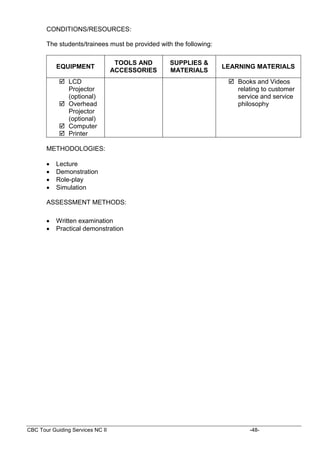
EQUIPMENT
TOOLS AND
ACCESSORIES
SUPPLIES &
MATERIALS
LEARNING MATERIALS
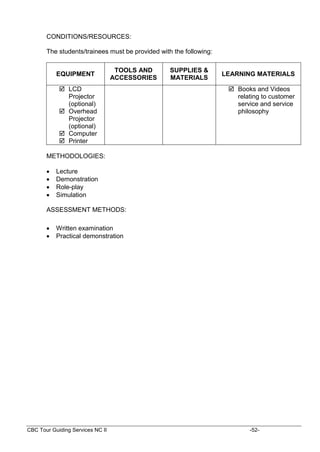
 LCD
Projector
(optional)
 Overhead
Projector
(optional)
 Computer
 Printer
 Books and Videos
relating to customer
service and service
philosophy
METHODOLOGIES:
 Lecture
 Demonstration
 Role-play
 Simulation
ASSESSMENT METHODS:
 Written examination
 Practical demonstration
CBC Tour Guiding Services NC II -49-
LO2. IDENTIFY CUSTOMER NEEDS
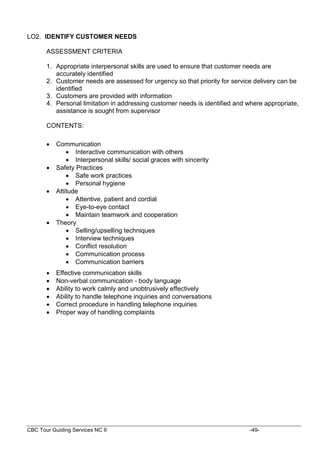
ASSESSMENT CRITERIA
1. Appropriate interpersonal skills are used to ensure that customer needs are
accurately identified
2. Customer needs are assessed for urgency so that priority for service delivery can be
identified
3. Customers are provided with information
4. Personal limitation in addressing customer needs is identified and where appropriate,
assistance is sought from supervisor
CONTENTS:
 Communication
 Interactive communication with others
 Interpersonal skills/ social graces with sincerity
 Safety Practices
 Safe work practices
 Personal hygiene
 Attitude
 Attentive, patient and cordial
 Eye-to-eye contact
 Maintain teamwork and cooperation
 Theory
 Selling/upselling techniques
 Interview techniques
 Conflict resolution
 Communication process
 Communication barriers
 Effective communication skills
 Non-verbal communication - body language
 Ability to work calmly and unobtrusively effectively
 Ability to handle telephone inquiries and conversations
 Correct procedure in handling telephone inquiries
 Proper way of handling complaints
CBC Tour Guiding Services NC II -50-
CONDITIONS/RESOURCES:
The students/trainees must be provided with the following:
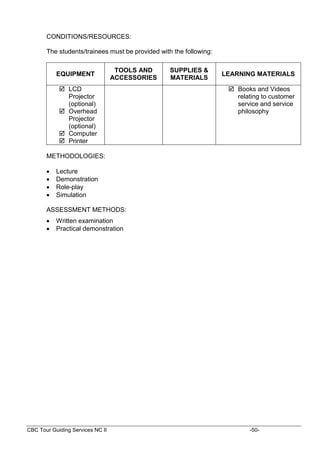
EQUIPMENT
TOOLS AND
ACCESSORIES
SUPPLIES &
MATERIALS
LEARNING MATERIALS
 LCD
Projector
(optional)
 Overhead
Projector
(optional)
 Computer
 Printer
 Books and Videos
relating to customer
service and service
philosophy
METHODOLOGIES:
 Lecture
 Demonstration
 Role-play
 Simulation
ASSESSMENT METHODS:
 Written examination
 Practical demonstration
CBC Tour Guiding Services NC II -51-
LO3. DELIVER SERVICE TO CUSTOMER
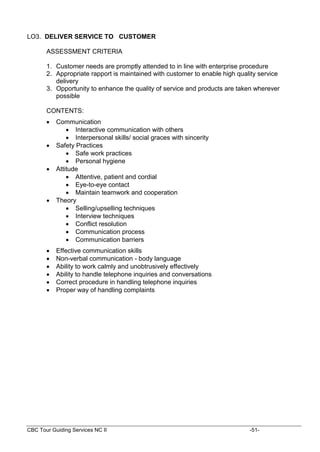
ASSESSMENT CRITERIA
1. Customer needs are promptly attended to in line with enterprise procedure
2. Appropriate rapport is maintained with customer to enable high quality service
delivery
3. Opportunity to enhance the quality of service and products are taken wherever
possible
CONTENTS:
 Communication
 Interactive communication with others
 Interpersonal skills/ social graces with sincerity
 Safety Practices
 Safe work practices
 Personal hygiene
 Attitude
 Attentive, patient and cordial
 Eye-to-eye contact
 Maintain teamwork and cooperation
 Theory
 Selling/upselling techniques
 Interview techniques
 Conflict resolution
 Communication process
 Communication barriers
 Effective communication skills
 Non-verbal communication - body language
 Ability to work calmly and unobtrusively effectively
 Ability to handle telephone inquiries and conversations
 Correct procedure in handling telephone inquiries
 Proper way of handling complaints
CBC Tour Guiding Services NC II -52-
CONDITIONS/RESOURCES:
The students/trainees must be provided with the following:
EQUIPMENT
TOOLS AND
ACCESSORIES
SUPPLIES &
MATERIALS
LEARNING MATERIALS
 LCD
Projector
(optional)
 Overhead
Projector
(optional)
 Computer
 Printer
 Books and Videos
relating to customer
service and service
philosophy
METHODOLOGIES:
 Lecture
 Demonstration
 Role-play
 Simulation
ASSESSMENT METHODS:
 Written examination
 Practical demonstration
CBC Tour Guiding Services NC II -53-
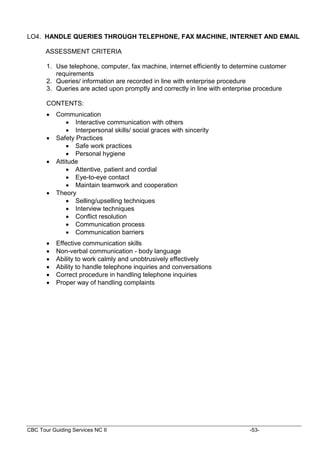
LO4. HANDLE QUERIES THROUGH TELEPHONE, FAX MACHINE, INTERNET AND EMAIL
ASSESSMENT CRITERIA
1. Use telephone, computer, fax machine, internet efficiently to determine customer
requirements
2. Queries/ information are recorded in line with enterprise procedure
3. Queries are acted upon promptly and correctly in line with enterprise procedure
CONTENTS:
 Communication
 Interactive communication with others
 Interpersonal skills/ social graces with sincerity
 Safety Practices
 Safe work practices
 Personal hygiene
 Attitude
 Attentive, patient and cordial
 Eye-to-eye contact
 Maintain teamwork and cooperation
 Theory
 Selling/upselling techniques
 Interview techniques
 Conflict resolution
 Communication process
 Communication barriers
 Effective communication skills
 Non-verbal communication - body language
 Ability to work calmly and unobtrusively effectively
 Ability to handle telephone inquiries and conversations
 Correct procedure in handling telephone inquiries
 Proper way of handling complaints
CBC Tour Guiding Services NC II -54-
CONDITIONS/RESOURCES:
The students/trainees must be provided with the following:
EQUIPMENT
TOOLS AND
ACCESSORIES
SUPPLIES &
MATERIALS
LEARNING MATERIALS
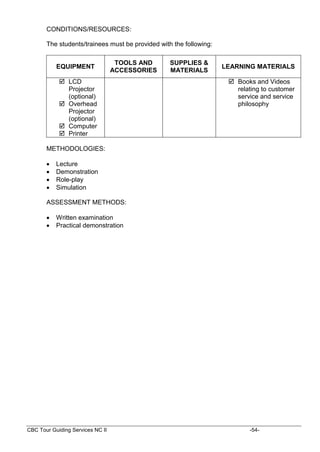
 LCD
Projector
(optional)
 Overhead
Projector
(optional)
 Computer
 Printer
 Books and Videos
relating to customer
service and service
philosophy
METHODOLOGIES:
 Lecture
 Demonstration
 Role-play
 Simulation
ASSESSMENT METHODS:
 Written examination
 Practical demonstration
CBC Tour Guiding Services NC II -55-
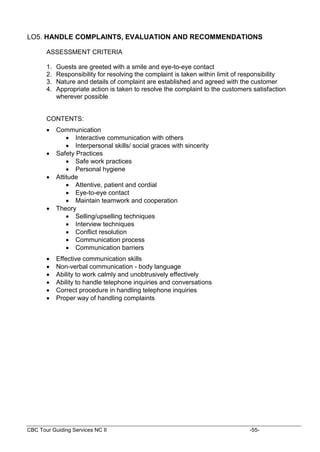
LO5. HANDLE COMPLAINTS, EVALUATION AND RECOMMENDATIONS
ASSESSMENT CRITERIA
1. Guests are greeted with a smile and eye-to-eye contact
2. Responsibility for resolving the complaint is taken within limit of responsibility
3. Nature and details of complaint are established and agreed with the customer
4. Appropriate action is taken to resolve the complaint to the customers satisfaction
wherever possible
CONTENTS:
 Communication
 Interactive communication with others
 Interpersonal skills/ social graces with sincerity
 Safety Practices
 Safe work practices
 Personal hygiene
 Attitude
 Attentive, patient and cordial
 Eye-to-eye contact
 Maintain teamwork and cooperation
 Theory
 Selling/upselling techniques
 Interview techniques
 Conflict resolution
 Communication process
 Communication barriers
 Effective communication skills
 Non-verbal communication - body language
 Ability to work calmly and unobtrusively effectively
 Ability to handle telephone inquiries and conversations
 Correct procedure in handling telephone inquiries
 Proper way of handling complaints
CBC Tour Guiding Services NC II -56-
CONDITIONS/RESOURCES:
The students/trainees must be provided with the following:
EQUIPMENT
TOOLS AND
ACCESSORIES
SUPPLIES &
MATERIALS
LEARNING MATERIALS
 LCD
Projector
(optional)
 Overhead
Projector
(optional)
 Computer
 Printer
 Books and Videos
relating to customer
service and service
philosophy
METHODOLOGIES:
 Lecture
 Demonstration
 Role-play
 Simulation
ASSESSMENT METHODS:
 Written examination
 Practical demonstration
CBC Tour Guiding Services NC II -57-
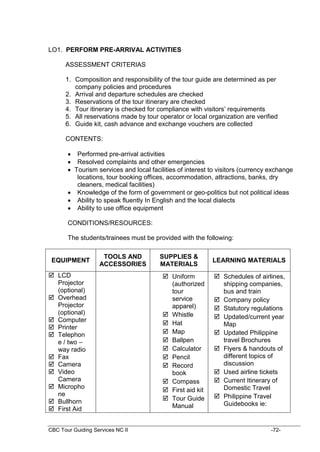
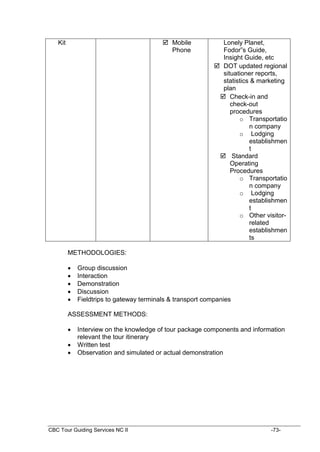
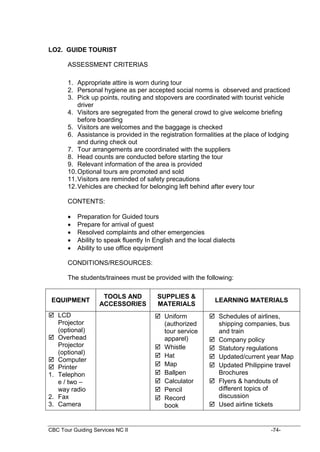
CORE COMPETENCIES
TOUR GUIDING SERVICES NC II
CBC Tour Guiding Services -57-
MODULES OF INSTUCTIONS
UNIT OF COMPETENCY
RESEARCH INFORMATION RELEVANT TO TOUR
ITINERARY
MODULE TITLE
RESEARCHING INFORMATION RELEVANT TO TOUR
ITINERARY
MODULE DESCRIPTOR This module deals with the knowledge, skills and attitudes
required to access and research information for developing and
completing the itinerary of the tour package. The tour guide
always undertakes this competency whenever the itinerary
includes extra-ordinary sites and sights
NOMINAL DURATION 40 hours
PREREQUISITE Trainees or students wishing to gain entry into this course
should possess the following requirements:
 can communicate by oral and written language;
 physically and mentally able;
 with good moral character; and
 Can perform basic mathematical computation.
SUMMARY OF LEARNING OUTCOMES :
Upon completion of this module the students/trainees will be able to:
LO1. Source information
LO2. Arrange information
CBC Tour Guiding Services NC II -58-
LO1. SOURCE INFORMATION
ASSESSMENT CRITERIAS
1. Sites and sights are identified in consultation with other tour guides, colleagues
and company officials
2. Research sources and appropriate methodologies are selected based on client
requirements
3. Sites and sights are assessed for visitor suitability including:
a. accessibility
b. features, benefits and significance
c. environmental impact; historical value
d. cost and profit potential and economic contribution
4. Appropriate commentary and tour scripts are prepared based on research
conducted.
5. Commentary and tour scripts that are acceptable to the visitors, without political
or religious attachments, are developed
CONTENTS:
 Knowledge of the components of a tour product
 Working knowledge of the visitor’s profile
 Local regulations and their impact on the tour itinerary
 Industry practices relevant to sites and sights
 Knowledge of the visitors’ interest in relation to the tour itinerary
 Industry practices in the packaging of tour products as appropriate to different
sectors
 Use of electronic resources for research
 Communication skills
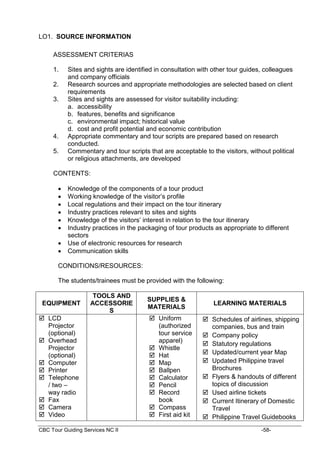
CONDITIONS/RESOURCES:
The students/trainees must be provided with the following:
EQUIPMENT
TOOLS AND
ACCESSORIE
S
SUPPLIES &
MATERIALS
LEARNING MATERIALS
 LCD
Projector
(optional)
 Overhead
Projector
(optional)
 Computer
 Printer
 Telephone
/ two –
way radio
 Fax
 Camera
 Video
 Uniform
(authorized
tour service
apparel)
 Whistle
 Hat
 Map
 Ballpen
 Calculator
 Pencil
 Record
book
 Compass
 First aid kit
 Schedules of airlines, shipping
companies, bus and train
 Company policy
 Statutory regulations
 Updated/current year Map
 Updated Philippine travel
Brochures
 Flyers & handouts of different
topics of discussion
 Used airline tickets
 Current Itinerary of Domestic
Travel
 Philippine Travel Guidebooks
CBC Tour Guiding Services NC II -59-
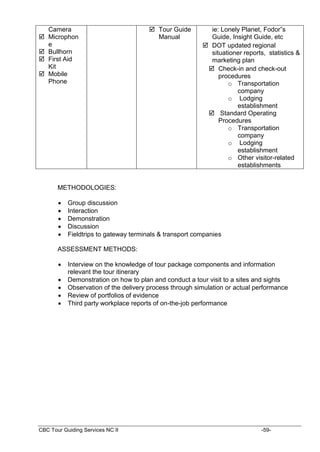
Camera
 Microphon
e
 Bullhorn
 First Aid
Kit
 Mobile
Phone
 Tour Guide
Manual
ie: Lonely Planet, Fodor”s
Guide, Insight Guide, etc
 DOT updated regional
situationer reports, statistics &
marketing plan
 Check-in and check-out
procedures
o Transportation
company
o Lodging
establishment
 Standard Operating
Procedures
o Transportation
company
o Lodging
establishment
o Other visitor-related
establishments
METHODOLOGIES:
 Group discussion
 Interaction
 Demonstration
 Discussion
 Fieldtrips to gateway terminals & transport companies
ASSESSMENT METHODS:
 Interview on the knowledge of tour package components and information
relevant the tour itinerary
 Demonstration on how to plan and conduct a tour visit to a sites and sights
 Observation of the delivery process through simulation or actual performance
 Review of portfolios of evidence
 Third party workplace reports of on-the-job performance
CBC Tour Guiding Services -60-
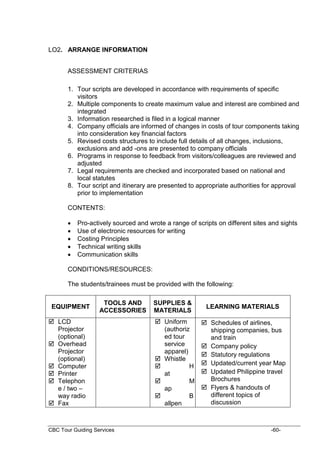
LO2. ARRANGE INFORMATION
ASSESSMENT CRITERIAS
1. Tour scripts are developed in accordance with requirements of specific
visitors
2. Multiple components to create maximum value and interest are combined and
integrated
3. Information researched is filed in a logical manner
4. Company officials are informed of changes in costs of tour components taking
into consideration key financial factors
5. Revised costs structures to include full details of all changes, inclusions,
exclusions and add -ons are presented to company officials
6. Programs in response to feedback from visitors/colleagues are reviewed and
adjusted
7. Legal requirements are checked and incorporated based on national and
local statutes
8. Tour script and itinerary are presented to appropriate authorities for approval
prior to implementation
CONTENTS:
 Pro-actively sourced and wrote a range of scripts on different sites and sights
 Use of electronic resources for writing
 Costing Principles
 Technical writing skills
 Communication skills
CONDITIONS/RESOURCES:
The students/trainees must be provided with the following:
EQUIPMENT
TOOLS AND
ACCESSORIES
SUPPLIES &
MATERIALS
LEARNING MATERIALS
 LCD
Projector
(optional)
 Overhead
Projector
(optional)
 Computer
 Printer
 Telephon
e / two –
way radio
 Fax
 Uniform
(authoriz
ed tour
service
apparel)
 Whistle
 H
at
 M
ap
 B
allpen
 Schedules of airlines,
shipping companies, bus
and train
 Company policy
 Statutory regulations
 Updated/current year Map
 Updated Philippine travel
Brochures
 Flyers & handouts of
different topics of
discussion
CBC Tour Guiding Services NC II -61-
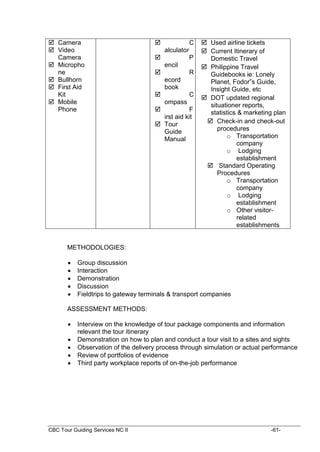
 Camera
 Video
Camera
 Micropho
ne
 Bullhorn
 First Aid
Kit
 Mobile
Phone
 C
alculator
 P
encil
 R
ecord
book
 C
ompass
 F
irst aid kit
 Tour
Guide
Manual
 Used airline tickets
 Current Itinerary of
Domestic Travel
 Philippine Travel
Guidebooks ie: Lonely
Planet, Fodor”s Guide,
Insight Guide, etc
 DOT updated regional
situationer reports,
statistics & marketing plan
 Check-in and check-out
procedures
o Transportation
company
o Lodging
establishment
 Standard Operating
Procedures
o Transportation
company
o Lodging
establishment
o Other visitor-
related
establishments
METHODOLOGIES:
 Group discussion
 Interaction
 Demonstration
 Discussion
 Fieldtrips to gateway terminals & transport companies
ASSESSMENT METHODS:
 Interview on the knowledge of tour package components and information
relevant the tour itinerary
 Demonstration on how to plan and conduct a tour visit to a sites and sights
 Observation of the delivery process through simulation or actual performance
 Review of portfolios of evidence
 Third party workplace reports of on-the-job performance
CBC Tour Guiding Services NC II -62-
MODULES OF INSTUCTIONS
UNIT OF
COMPETENCY MANAGE ARRANGEMENTS FOR VISITORS
MODULE TITLE
MANAGING ARRANGEMENTS FOR VISITORS
MODULE DESCRIPTOR This module covers the knowledge, skills, and attitude
required for managing the tour arrangements included
in the tour itinerary and making provisions for additional
changes and revisions as contracted by a tour operator
or tour organizer.
NOMINAL DURATION 60 hours
PREREQUISITE Trainees or students should possess the following
requirements:
 can communicate by oral and written language;
 physically and mentally able;
 with good moral character; and
 Can perform basic mathematical computation.
LEARNING OUTCOMES :
Upon completion of this module the students/trainees will be able to:
LO1. Perform pre-arrival checks
LO2. Manage tour arrangements
LO3. Resolve complaints and other emergencies
LO4. Perform post-departure activities
CBC Tour Guiding Services NC II -63-
LO1. PERFORM PRE-ARRIVAL CHECKS
ASSESSMENT CRITERIAS
1. Inclusions of the tour itinerary are determined as to client requirements
2. Tours components that are for the visitors’ personal account are determined
base on enterprise policy
3. Reserved tour components are verified and changes effected as necessary
CONTENTS:
 Pre – arrival checks
 Resolving complaints and other emergencies
 Check-in and check-out procedures
o Transportation company
o Lodging establishment
 Standard Operating Procedures
o Transportation company
o Lodging establishment
o Other visitor-related establishments
 Room ratings and the schedules of airlines ,shipping companies, bus / train
companies
 English language–fluency and effective communication skills
 Use of telephone, fax and two – way radio
 Sensitivity to both Filipino mentality and foreign mentalities
 Safety and Sanitation
 Risk Management and emergency procedures
CONDITIONS/RESOURCES:
The students/trainees must be provided with the following:
EQUIPMENT
TOOLS AND
ACCESSORIES
SUPPLIES &
MATERIALS
LEARNING MATERIALS
 LCD
Projector
(optional)
 Overhead
Projector
(optional)
 Computer
 Printer
 Telephon
e / two –
way radio
 Fax
 Camera
 Uniform
(authoriz
ed tour
service
apparel)
 Whistle
 Hat
 Map
 Ballpen
 Calculato
r
 Pencil
 Schedules of airlines,
shipping companies, bus
and train
 Company policy
 Statutory regulations
 Updated/current year
Map
 Updated Philippine travel
Brochures
 Flyers & handouts of
different topics of
discussion
CBC Tour Guiding Services NC II -64-
 Video
Camera
 Micropho
ne
 Bullhorn
 First Aid
Kit
 Record
book
 Compass
 First aid
kit
 Tour
Guide
Manual
 Mobile
Phone
 Used airline tickets
 Current Itinerary of
Domestic Travel
 Philippine Travel
Guidebooks ie: Lonely
Planet, Fodor”s Guide,
Insight Guide, etc
 DOT updated regional
situationer reports,
statistics & marketing
plan
 Check-in and check-out
procedures
o Transportation
company
o Lodging
establishment
 Standard Operating
Procedures
o Transportation
company
o Lodging
establishment
o Other visitor-
related
establishments
METHODOLOGIES:
 Group discussion
 Interaction
 Demonstration
 Discussion
 Fieldtrips to gateway terminals & transport companies
ASSESSMENT METHODS:
 Interview on the knowledge of tour package components and information relevant
the tour itinerary
 Written test
 Observation and simulated or actual demonstration
CBC Tour Guiding Services NC II -65-
LO2. MANAGE TOUR ARRANGEMENTS
ASSESSMENT CRITERIAS
1. Delivery of tour components are supervised in accordance with tour
arrangements
2. Compliance of suppliers of reserved tour components are checked
3. Proper accounting of money paid or accounts dues to and from visitors and/or
suppliers are conducted base on enterprise procedures
4. Relevant information on the suppliers services, amenities and facilities is
provided
5. Optional visitors’ request from the suppliers are facilitated
6. Visitors are politely reminded to pay for all expenses of a personal nature
CONTENTS:
 Managed tour arrangements
 Resolving complaints and other emergencies
 Check-in and check-out procedures
o Transportation company
o Lodging establishment
 Standard Operating Procedures
o Transportation company
o Lodging establishment
o Other visitor-related establishments
 Room ratings and the schedules of airlines ,shipping companies, bus / train
companies
 English language–fluency and effective communication skills
 Use of telephone, fax and two – way radio
 Sensitivity to both Filipino mentality and foreign mentalities
 Safety and Sanitation
 Risk Management and emergency procedures
CONDITIONS/RESOURCES:
The students/trainees must be provided with the following:
EQUIPMENT
TOOLS AND
ACCESSORI
ES
SUPPLIES &
MATERIALS
LEARNING MATERIALS
 LCD
Projector
(optional)
 Overhead
Projector
(optional)
 Computer
 Printer
 Uniform
(authorized
tour
service
apparel)
 Whistle
 Hat
 Map
 Schedules of airlines,
shipping companies, bus and
train
 Company policy
 Statutory regulations
 Updated/current year Map
 Updated Philippine travel
CBC Tour Guiding Services NC II -66-
 Telephon
e / two –
way radio
 Fax
 Camera
 Video
Camera
 Micropho
ne
 Bullhorn
 First Aid
Kit
 Ballpen
 Calculator
 Pencil
 Record
book
 Compass
 First aid kit
 Tour Guide
Manual
 Mobile
Phone
Brochures
 Flyers & handouts of
different topics of discussion
 Used airline tickets
 Current Itinerary of Domestic
Travel
 Philippine Travel Guidebooks
ie: Lonely Planet, Fodor”s
Guide, Insight Guide, etc
 DOT updated regional
situationer reports, statistics
& marketing plan
 Check-in and check-out
procedures
o Transportation
company
o Lodging
establishment
 Standard Operating
Procedures
o Transportation
company
o Lodging
establishment
o Other visitor-related
establishments
METHODOLOGIES:
 Group discussion
 Interaction
 Demonstration
 Discussion
 Fieldtrips to gateway terminals & transport companies
ASSESSMENT METHODS:
 Interview on the knowledge of tour package components and information
relevant the tour itinerary
 Written test
 Observation and simulated or actual demonstration
CBC Tour Guiding Services NC II -67-
LO3. RESOLVE COMPLAINTS AND OTHER EMERGENCIES
ASSESSMENT CRITERIAS
1. Resolution of complaints and other concerns are given assistance base on
enterprise policy
2. Nature of complaint with supplier concerned is evaluated
3. Appropriate solutions are determined and applied
4. Authorities concerned are notified about the situation whenever possible
5. Tour operator is notified about the situation
6. All incidents are documented in final report
CONTENTS:
 Resolving complaints and other emergencies
 Performed post – departure activities
 Check-in and check-out procedures
o Transportation company
o Lodging establishment
 Standard Operating Procedures
o Transportation company
o Lodging establishment
o Other visitor-related establishments
 Room ratings and the schedules of airlines ,shipping companies, bus / train
companies
 English language–fluency and effective communication skills
 Use of telephone, fax and two – way radio
 Sensitivity to both Filipino mentality and foreign mentalities
 Safety and Sanitation
 Risk Management and emergency procedures
CONDITIONS/RESOURCES:
The students/trainees must be provided with the following:
EQUIPMENT
TOOLS AND
ACCESSORI
ES
SUPPLIES &
MATERIALS
LEARNING MATERIALS
 LCD
Projector
(optional)
 Overhead
Projector
(optional)
 Computer
 Printer
 Telephon
e / two –
 Uniform
(authorized
tour
service
apparel)
 Whistle
 Hat
 Map
 Ballpen
 Schedules of airlines,
shipping companies, bus and
train
 Company policy
 Statutory regulations
 Updated/current year Map
 Updated Philippine travel
Brochures
 Flyers & handouts of
CBC Tour Guiding Services NC II -68-
way radio
 Fax
 Camera
 Video
Camera
 Micropho
ne
 Bullhorn
 First Aid
Kit
 Calculator
 Pencil
 Record
book
 Compass
 First aid kit
 Tour Guide
Manual
 Mobile
Phone
different topics of discussion
 Used airline tickets
 Current Itinerary of Domestic
Travel
 Philippine Travel Guidebooks
ie: Lonely Planet, Fodor”s
Guide, Insight Guide, etc
 DOT updated regional
situationer reports, statistics
& marketing plan
 Check-in and check-out
procedures
o Transportation
company
o Lodging
establishment
 Standard Operating
Procedures
o Transportation
company
o Lodging
establishment
o Other visitor-related
establishments
METHODOLOGIES:
 Group discussion
 Interaction
 Demonstration
 Discussion
 Fieldtrips to gateway terminals & transport companies
ASSESSMENT METHODS:
 Interview on the knowledge of tour package components and information
relevant the tour itinerary
 Written test
 Observation and simulated or actual demonstration
CBC Tour Guiding Services NC II -69-
LO4. PERFORM POST-DEPARTURE ACTIVITIES
ASSESSMENT CRITERIAS
1. Revisions and cancellations of services rendered are reported in accordance
with enterprise guidelines and procedures
2. Additional revenue or expenses incurred are accounted
3. Complaints and commendations are reported base on enterprise policy
4. Report on expenses incurred in connection with the tour itinerary submitted
CONTENTS:
 Performed post – departure activities
 Check-in and check-out procedures
o Transportation company
o Lodging establishment
 Standard Operating Procedures
o Transportation company
o Lodging establishment
o Other visitor-related establishments
 Room ratings and the schedules of airlines ,shipping companies, bus / train
companies
 English language–fluency and effective communication skills
 Use of telephone, fax and two – way radio
 Sensitivity to both Filipino mentality and foreign mentalities
 Safety and Sanitation
 Risk Management and emergency procedures
CONDITIONS/RESOURCES:
The students/trainees must be provided with the following:
EQUIPMENT
TOOLS AND
ACCESSORI
ES
SUPPLIES &
MATERIALS
LEARNING MATERIALS
 LCD
Projector
(optional)
 Overhead
Projector
(optional)
 Computer
 Printer
 Telephon
e / two –
way radio
 Fax
 Camera
 Uniform
(authorized
tour
service
apparel)
 Whistle
 Hat
 Map
 Ballpen
 Calculator
 Pencil
 Record
 Schedules of airlines,
shipping companies, bus and
train
 Company policy
 Statutory regulations
 Updated/current year Map
 Updated Philippine travel
Brochures
 Flyers & handouts of
different topics of discussion
 Used airline tickets
 Current Itinerary of Domestic
CBC Tour Guiding Services NC II -70-
 Video
Camera
 Micropho
ne
 Bullhorn
 First Aid
Kit
book
 Compass
 First aid kit
 Tour Guide
Manual
 Mobile
Phone
Travel
 Philippine Travel Guidebooks
ie: Lonely Planet, Fodor”s
Guide, Insight Guide, etc
 DOT updated regional
situationer reports, statistics
& marketing plan
 Check-in and check-out
procedures
o Transportation
company
o Lodging
establishment
 Standard Operating
Procedures
o Transportation
company
o Lodging
establishment
o Other visitor-related
establishments
METHODOLOGIES:
 Group discussion
 Interaction
 Demonstration
 Discussion
 Fieldtrips to gateway terminals & transport companies
ASSESSMENT METHODS:
 Interview on the knowledge of tour package components and information
relevant the tour itinerary
 Written test
 Observation and simulated or actual demonstration
CBC Tour Guiding Services NC II -71-
MODULES OF INSTUCTIONS
UNIT OF COMPETENCY ACCOMPANY AND GUIDE VISITORS IN
ACCORDANCE WITH THE TOUR ITINERARY
MODULE TITLE ACCOMPANYING AND GUIDING VISITORS IN
ACCORDANCE WITH THE TOUR ITINERARY
MODULE DESCRIPTOR This unit covers the knowledge and skills required
for accompanying and guiding visitors, perform
safety practices and resolve complaints and other
emergencies in locality as contracted by a tour
operator or local organization.
NOMINAL DURATION 60 hours
PREREQUISITE Trainees or students should possess the following
requirements:
 can communicate by oral and written
language;
 physically and mentally able;
 with good moral character; and
 Can perform basic mathematical
computation.
SUMMARY OF LEARNING OUTCOMES :
Upon completion of this module the students/trainees will be able to:
LO1. Perform pre-arrival activities
LO2. Guide tourist
LO3. Deliver information and commentaries
LO4. Resolve complaints and other emergencies
LO5. Perform post – departure activities
LO6. Develop tour guide – tour driver work relationship (teamwork)
CBC Tour Guiding Services NC II -72-
LO1. PERFORM PRE-ARRIVAL ACTIVITIES
ASSESSMENT CRITERIAS
1. Composition and responsibility of the tour guide are determined as per
company policies and procedures
2. Arrival and departure schedules are checked
3. Reservations of the tour itinerary are checked
4. Tour itinerary is checked for compliance with visitors’ requirements
5. All reservations made by tour operator or local organization are verified
6. Guide kit, cash advance and exchange vouchers are collected
CONTENTS:
 Performed pre-arrival activities
 Resolved complaints and other emergencies
 Tourism services and local facilities of interest to visitors (currency exchange
locations, tour booking offices, accommodation, attractions, banks, dry
cleaners, medical facilities)
 Knowledge of the form of government or geo-politics but not political ideas
 Ability to speak fluently In English and the local dialects
 Ability to use office equipment
CONDITIONS/RESOURCES:
The students/trainees must be provided with the following:
EQUIPMENT
TOOLS AND
ACCESSORIES
SUPPLIES &
MATERIALS
LEARNING MATERIALS
 LCD
Projector
(optional)
 Overhead
Projector
(optional)
 Computer
 Printer
 Telephon
e / two –
way radio
 Fax
 Camera
 Video
Camera
 Micropho
ne
 Bullhorn
 First Aid
 Uniform
(authorized
tour
service
apparel)
 Whistle
 Hat
 Map
 Ballpen
 Calculator
 Pencil
 Record
book
 Compass
 First aid kit
 Tour Guide
Manual
 Schedules of airlines,
shipping companies,
bus and train
 Company policy
 Statutory regulations
 Updated/current year
Map
 Updated Philippine
travel Brochures
 Flyers & handouts of
different topics of
discussion
 Used airline tickets
 Current Itinerary of
Domestic Travel
 Philippine Travel
Guidebooks ie:
CBC Tour Guiding Services NC II -73-
Kit  Mobile
Phone
Lonely Planet,
Fodor”s Guide,
Insight Guide, etc
 DOT updated regional
situationer reports,
statistics & marketing
plan
 Check-in and
check-out
procedures
o Transportatio
n company
o Lodging
establishmen
t
 Standard
Operating
Procedures
o Transportatio
n company
o Lodging
establishmen
t
o Other visitor-
related
establishmen
ts
METHODOLOGIES:
 Group discussion
 Interaction
 Demonstration
 Discussion
 Fieldtrips to gateway terminals & transport companies
ASSESSMENT METHODS:
 Interview on the knowledge of tour package components and information
relevant the tour itinerary
 Written test
 Observation and simulated or actual demonstration
CBC Tour Guiding Services NC II -74-
LO2. GUIDE TOURIST
ASSESSMENT CRITERIAS
1. Appropriate attire is worn during tour
2. Personal hygiene as per accepted social norms is observed and practiced
3. Pick up points, routing and stopovers are coordinated with tourist vehicle
driver
4. Visitors are segregated from the general crowd to give welcome briefing
before boarding
5. Visitors are welcomes and the baggage is checked
6. Assistance is provided in the registration formalities at the place of lodging
and during check out
7. Tour arrangements are coordinated with the suppliers
8. Head counts are conducted before starting the tour
9. Relevant information of the area is provided
10.Optional tours are promoted and sold
11.Visitors are reminded of safety precautions
12.Vehicles are checked for belonging left behind after every tour
CONTENTS:
 Preparation for Guided tours
 Prepare for arrival of guest
 Resolved complaints and other emergencies
 Ability to speak fluently In English and the local dialects
 Ability to use office equipment
CONDITIONS/RESOURCES:
The students/trainees must be provided with the following:
EQUIPMENT
TOOLS AND
ACCESSORIES
SUPPLIES &
MATERIALS
LEARNING MATERIALS
 LCD
Projector
(optional)
 Overhead
Projector
(optional)
 Computer
 Printer
1. Telephon
e / two –
way radio
2. Fax
3. Camera
 Uniform
(authorized
tour service
apparel)
 Whistle
 Hat
 Map
 Ballpen
 Calculator
 Pencil
 Record
book
 Schedules of airlines,
shipping companies, bus
and train
 Company policy
 Statutory regulations
 Updated/current year Map
 Updated Philippine travel
Brochures
 Flyers & handouts of
different topics of
discussion
 Used airline tickets
CBC Tour Guiding Services NC II -75-
4. Video
Camera
5. Micropho
ne
6. Bullhorn
7. First Aid
Kit
 Compass
 First aid kit
 Tour Guide
Manual
 Mobile
Phone
 Current Itinerary of
Domestic Travel
 Philippine Travel
Guidebooks ie: Lonely
Planet, Fodor”s Guide,
Insight Guide, etc
 DOT updated regional
situationer reports,
statistics & marketing plan
 Check-in and check-out
procedures
o Transportation
company
o Lodging
establishment
 Standard Operating
Procedures
o Transportation
company
o Lodging
establishment
o Other visitor-
related
establishments
METHODOLOGIES:
 Group discussion
 Interaction
 Demonstration
 Discussion
 Fieldtrips to gateway terminals & transport companies
ASSESSMENT METHODS:
 Interview on the knowledge of tour package components and information
relevant the tour itinerary
 Written test
 Observation and simulated or actual demonstration
CBC Tour Guiding Services NC II -76-
LO3. DELIVER INFORMATION AND COMMENTARIES
ASSESSMENT CRITERIA
1. Relevant and timely commentaries are provided
2. Relevant and timely instructions are provided as needed
3. Proper posture and position is assumed at all times
4. Commentaries are delivered with proper voice modulation and pronunciation
5. Appropriate terminologies and up-to-date information are used at all times
6. Positive interaction with visitors is developed and practiced
CONTENTS:
Resolved complaints and other emergencies
General knowledge of the Philippines and its regions including:
o Climate (weather patterns including any extreme conditions, impact of
climate on lifestyle, stories associated with climate in a local area)
o Geography and geology (major land formations/landmarks/natural
attractions and their key features for both Philippines and local region)
o History (historical development of Philippines and the local region, major
historical events and prominent individuals, key dates, overview of
Philippine indigenous history)
o Architecture (major styles and their proponents, key buildings and
structures both in Philippines and the local area)
o Cultural elements (overview of indigenous cultures within the Philippines,
different cultures within the Philippines and the local area, cultural
activities, local customs)
o Art, theatre, music and literature (key performers, writers and artists,
major works by the Filipinos, major cultural events)
o Religion (religious make-up for Filipinos and the local area, religious
practices)
o Natural environment and tourism (how the environment is a tourism
asset, impacts of tourism on the environment, land management in
Philippines including the role of National Parks).
o Flora and fauna (overview of native flora and fauna, their characteristics
and key locations)
o Government and politics (general structure, political parties, major
political figures, current political issues)
o Transport (main transport systems, usage of different forms of transport
across Philippines, historical development of different forms of transport)
o Agriculture (Philippines history as a primary producer, key products of the
Philippines, current issues)
o Science and technology (Philippine contribution both past and present,
prominent individuals, key discoveries)
o Sport (main Filipinos sporting activities, Philippines sporting record, local
sporting focus, sporting facilities, sporting comparisons with other
countries or areas)
o Economy (overview of current state of the economy, key features of the
local economy and local industry).
CBC Tour Guiding Services NC II -77-
o Trade (Philippines key exports and its main trading partners)
o Education (overview of school and higher education systems,
comparisons of systems to those of other countries)
o Food (Local dishes and produce)
o Local wines and spirits
o Lifestyle (key features of the day-to-day living patterns of Philippines and
local people, family and social customs)
o Shopping (key locations, local products)
o Tourism services and local facilities of interest to visitors (currency
exchange locations, tour booking offices, accommodation, attractions,
banks, dry cleaners, medical facilities)
o Current events in Philippines and the local region
Knowledge of the form of government or geo-politics but not political ideas
Ability to speak fluently In English and the local dialects
Ability to use office equipment
CONDITIONS/RESOURCES:
The students/trainees must be provided with the following:
EQUIPMENT
TOOLS AND
ACCESSORIES
SUPPLIES &
MATERIALS
LEARNING MATERIALS
 LCD
Projector
(optional)
 Overhead
Projector
(optional)
 Computer
 Printer
8. Telephon
e / two –
way radio
9. Fax
10.Camera
11.Video
Camera
12.Micropho
ne
13.Bullhorn
14.First Aid
Kit
 Uniform
(authorize
d tour
service
apparel)
 Whistle
 Hat
 Map
 Ballpen
 Calculator
 Pencil
 Record
book
 Compass
 First aid
kit
 Tour
Guide
Manual
 Mobile
Phone
 Schedules of airlines,
shipping companies, bus
and train
 Company policy
 Statutory regulations
 Updated/current year Map
 Updated Philippine travel
Brochures
 Flyers & handouts of
different topics of
discussion
 Used airline tickets
 Current Itinerary of
Domestic Travel
 Philippine Travel
Guidebooks ie: Lonely
Planet, Fodor”s Guide,
Insight Guide, etc
 DOT updated regional
situationer reports,
statistics & marketing plan
 Check-in and check-out
procedures
o Transportation
company
CBC Tour Guiding Services NC II -78-
o Lodging
establishment
 Standard Operating
Procedures
o Transportation
company
o Lodging
establishment
o Other visitor-
related
establishments
METHODOLOGIES:
 Group discussion
 Interaction
 Demonstration
 Discussion
 Fieldtrips to gateway terminals & transport companies
ASSESSMENT METHODS:
 Interview on the knowledge of tour package components and information
relevant the tour itinerary
 Written test
 Observation and simulated or actual demonstration
CBC Tour Guiding Services NC II -79-
LO4. RESOLVE COMPLAINTS AND OTHER EMERGENCIES
ASSESSMENT CRITERIAS
1. Complaints are addressed and referred to the person/s concerned
2. Visitors comfort is ensured during tour
3. Stress situations are avoided and handled tactfully
4. Damage control in abnormal situations is adopted
5. Tour operator is notified of the remedial measures in abnormal situations
6. Best solutions to abnormal situations are determined and applied with the
company’s approval
CONTENTS:
 Resolved complaints and other emergencies
 Ability to speak fluently In English and the local dialects
 Ability to use office equipment
CONDITIONS/RESOURCES:
The students/trainees must be provided with the following:
EQUIPMENT
TOOLS AND
ACCESSORIES
SUPPLIES &
MATERIALS
LEARNING MATERIALS
 LCD
Projector
(optional)
 Overhead
Projector
(optional)
 Computer
 Printer
15.Telephon
e / two –
way radio
16.Fax
17.Camera
18.Video
Camera
19.Micropho
ne
20.Bullhorn
21.First Aid
Kit
 Uniform
(authorize
d tour
service
apparel)
 Whistle
 Hat
 Map
 Ballpen
 Calculator
 Pencil
 Record
book
 Compass
 First aid
kit
 Tour
Guide
Manual
 Mobile
Phone
 Schedules of airlines,
shipping companies, bus
and train
 Company policy
 Statutory regulations
 Updated/current year Map
 Updated Philippine travel
Brochures
 Flyers & handouts of
different topics of
discussion
 Used airline tickets
 Current Itinerary of
Domestic Travel
 Philippine Travel
Guidebooks ie: Lonely
Planet, Fodor”s Guide,
Insight Guide, etc
 DOT updated regional
situationer reports,
statistics & marketing plan
 Check-in and check-out
CBC Tour Guiding Services NC II -80-
procedures
o Transportation
company
o Lodging
establishment
 Standard Operating
Procedures
o Transportation
company
o Lodging
establishment
o Other visitor-
related
establishments
METHODOLOGIES:
 Group discussion
 Interaction
 Demonstration
 Discussion
 Fieldtrips to gateway terminals & transport companies
ASSESSMENT METHODS:
 Interview on the knowledge of tour package components and information
relevant the tour itinerary
 Written test
 Observation and simulated or actual demonstration
CBC Tour Guiding Services NC II -81-
LO5. PERFORM POST – DEPARTURE ACTIVITIES
ASSESSMENT CRITERIA
1. Cash advance is liquidated in accordance with establishment procedures
2. Complaints, improvements and recommendations are written and sent to
management and concerned personnel
3. Optional tour collections are remitted in accordance with establishment
procedures
CONTENTS:
 Resolved complaints and other emergencies
 Performed departure and post-departure activities
 Ability to speak fluently In English and the local dialects
 Ability to use office equipment
CONDITIONS/RESOURCES:
The students/trainees must be provided with the following:
EQUIPMENT
TOOLS AND
ACCESSORIES
SUPPLIES &
MATERIALS
LEARNING MATERIALS
 LCD
Projector
(optional)
 Overhead
Projector
(optional)
 Computer
 Printer
22.Telephon
e / two –
way radio
23.Fax
24.Camera
25.Video
Camera
26.Micropho
ne
27.Bullhorn
28.First Aid
Kit
 Uniform
(authorize
d tour
service
apparel)
 Whistle
 Hat
 Map
 Ballpen
 Calculator
 Pencil
 Record
book
 Compass
 First aid
kit
 Tour
Guide
Manual
 Mobile
Phone
 Schedules of airlines,
shipping companies, bus
and train
 Company policy
 Statutory regulations
 Updated/current year Map
 Updated Philippine travel
Brochures
 Flyers & handouts of
different topics of
discussion
 Used airline tickets
 Current Itinerary of
Domestic Travel
 Philippine Travel
Guidebooks ie: Lonely
Planet, Fodor”s Guide,
Insight Guide, etc
 DOT updated regional
situationer reports,
statistics & marketing plan
 Check-in and check-out
procedures
CBC Tour Guiding Services NC II -82-
o Transportation
company
o Lodging
establishment
 Standard Operating
Procedures
o Transportation
company
o Lodging
establishment
o Other visitor-
related
establishments
METHODOLOGIES:
 Group discussion
 Interaction
 Demonstration
 Discussion
 Fieldtrips to gateway terminals & transport companies
ASSESSMENT METHODS:
 Interview on the knowledge of tour package components and information
relevant the tour itinerary
 Written test
 Observation and simulated or actual demonstration
CBC Tour Guiding Services NC II -83-
LO6. DEVELOP TOUR GUIDE – TOUR DRIVER WORK RELATIONSHIP
(TEAMWORK)
ASSESSMENT CRITERIAS
1. Coach current registration is checked
2. Driver’s complete name is sought and rapport is established before the tour
begins
3. Sound system (PA) and microphone are double checked
4. Cleanliness and condition of the coach are always checked, especially the
defective seats or armrest
5. Full loaded first aid kit in the coach and fire extinguisher are checked
6. Driver is made familiar with the given itinerary - routes and stopovers - before
the tour starts
7. Driver’s attitude and protocol to passengers is observed and corrected gently,
if driver has an attitude problem
8. Things left behind inside the coach after the tour are double checked
9. Driver’s meals and physical condition are checked, especially on long trips
10.Whenever applicable, assistance is provided to the driver when unexpected
developments occur(eg.,flat tires)
11.Due recognition is given to driver for a job well done
CONTENTS:
 Resolved complaints and other emergencies
 Ability to speak fluently In English and the local dialects
 Ability to use office equipment
 Coaching and Counseling
 Team building
CONDITIONS/RESOURCES:
The students/trainees must be provided with the following:
EQUIPMENT
TOOLS AND
ACCESSORIES
SUPPLIES &
MATERIALS
LEARNING MATERIALS
 LCD
Projector
(optional)
 Overhead
Projector
(optional)
 Computer
 Printer
29.Telephon
e / two –
way radio
30.Fax
 Uniform
(authorize
d tour
service
apparel)
 Whistle
 Hat
 Map
 Ballpen
 Calculator
 Pencil
 Schedules of airlines,
shipping companies, bus
and train
 Company policy
 Statutory regulations
 Updated/current year Map
 Updated Philippine travel
Brochures
 Flyers & handouts of
different topics of
discussion
CBC Tour Guiding Services NC II -84-
31.Camera
32.Video
Camera
33.Micropho
ne
34.Bullhorn
35.First Aid
Kit
 Record
book
 Compass
 First aid
kit
 Tour
Guide
Manual
 Mobile
Phone
 Used airline tickets
 Current Itinerary of
Domestic Travel
 Philippine Travel
Guidebooks ie: Lonely
Planet, Fodor”s Guide,
Insight Guide, etc
 DOT updated regional
situationer reports,
statistics & marketing plan
 Check-in and check-out
procedures
o Transportation
company
o Lodging
establishment
 Standard Operating
Procedures
o Transportation
company
o Lodging
establishment
o Other visitor-
related
establishments
METHODOLOGIES:
 Group discussion
 Interaction
 Demonstration
 Discussion
 Fieldtrips to gateway terminals & transport companies
ASSESSMENT METHODS:
 Interview on the knowledge of tour package components and information
relevant the tour itinerary
 Written test
 Observation and simulated or actual demonstration

Tour Guiding Services IT IS A BIG HELP A

  • 1.
    Sector: Tourism Qualification: TOUR GUIDING SERVICESNC II Technical Education and Skills Development Authority East Service Road, South Superhighway, Taguig, Metro Manila COMPETENCY-BASED CURRICULUM
  • 2.
  • 3.
    TABLE OF CONTENTS A.COURSE DESIGN B. MODULES OF ONSTRUCTION Basic Competencies Participate in Workplace Communication 1 Work in a Team Environment 8 Practice Career Professionalism 12 Practice Occupational Health and Safety 16 Common Competencies Develop and Update Industry Knowledge 25 Observe Workplace Hygiene Procedures 28 Perform Computer Operations 33 Perform Workplace and Safety Practices 39 Provide Effective Customer Service 46 Core Competencies Research information relevant to tour itinerary 57 Manage arrangements for visitors 62 Accompany and guide visitors in accordance with the tour itinerary 71
  • 4.
    COURSE DESIGN COURSE TITLE: TOUR GUIDING SERVICES – NC II NOMINAL DURATION : 196 hours QUALIFICATION : NC level II COURSE DESCRIPTION : This course is designed to enhance the knowledge, skills and attitudes of an individual in the field of TOUR GUIDING SERVICES NC II such as coordinating tour program/itinerary; guiding and accompanying tourist in a locality in accordance with industry standards. It covers It covers the basic, common and core competencies. ENTRY REQUIREMENTS : Trainees or students wishing to gain entry into this course should possess the following requirements:  can communicate by oral and written language;  physically and mentally able;  with good moral character; and  Can perform basic mathematical computation. This list does not include specific institutional requirements such as educational attainment, appropriate work experience, and others that may be required of the trainees by the school or training center delivering the TVET program. COURSE STRUCTURE: UNIT OF COMPETENCY MODULE TITLE LEARNING OUTCOME NO. OF HOURS BASIC 1. Participate in workplace communication 1.1 Participating in workplace communication 1.1.1 Obtain and convey workplace information 1.1.2 Complete relevant work related documents 1.1.3 Participate in workplace meeting and discussion 6
  • 5.
    2. Work ina team environment 2.1 Working in a team environment 2.1.1 Describe and identify team role and responsibility in a team 2.1.2 Describe work as a team member 3 3. Practice career professionalism 3.1 Practicing career professionalism 3.1.1 Integrate personal objectives with organizational goals. 3.1.2 Set and meet work priorities. 3.1.3 Maintain professional growth and development 3 4. Practice occupational health and safety 4.1 Practicing occupational health and safety 4.1.1 Evaluate hazard and risks 4.1.2 Control hazards and risks 4.1.3 Maintain occupational health and safety awareness 6 COMMON Develop and update industry knowledge 1.1 Developing and update industry knowledge 1.1.1 Identify and access key sources of information on the industry 1.1.2 Access, apply and share industry information 1.1.3 Update continuously relevant industry knowledge 2 Observe workplace hygiene procedures 2.1 Observing workplace hygiene procedures 2.1.1 Practice personal grooming and hygiene 2.1.2 Practice safe and hygienic handling, storage and disposal of food, 2
  • 6.
    beverage and materials Perform computer operations 3.1Performing computer operations 3.1.1 Identify and explain the functions, general features and capabilities of both hardware and software 3.1.2 Prepare and use appropriate hardware and software according to task requirement 3.1.3 Use appropriate devices and procedures to transfer files/data 3.1.4 Produce accurate and complete data according to the requirements 3.1.5 Maintain computer system 6 Perform workplace and safety practices 4.1 Performing workplace and safety practices 4.1.1 Practice workplace safety, security and hygiene systems, processes and operations 4.1.2 Respond appropriately to faults, problems and emergency situations in line with enterprise guidelines 4.1.3 Maintain safe personal presentation standards 2 Provide effective customer service 5.1 Providing effective customer service 5.1.1 Apply effective verbal and non- verbal communication skills to respond to customer needs 6
  • 7.
    5.1.2 Provide prompt andquality service to customer 5.1.3 Handle queries promptly and correctly in line with enterprise procedures 5.1.4 Handle customer complaints, evaluation and recommendatio ns 5.1.5 Provide prompt and quality service to customer 5.1.6 Handle queries promptly and correctly in line with enterprise procedures 5.1.7 Handle customer complaints, evaluation and recommendatio ns CORE 1. Research information relevant to tour itinerary 1.1 Research information relevant to tour itinerary 1.1.1 Source information 1.1.2 Arrange information 40 2. Manage Arrangements for Visitors 2.1. Manage Arrangements for Visitors 2.1.1 Perform pre- arrivalchecks 2.1.2 Manage tour arrangements 2.1.3 Resolve complaints and other emergencies 2.1.4 Perform post- departure activities 60 3. Accompany and guide visitors in accordance with the tour itinerary 3.1 Accompany and guide visitors in accordance with the tour itinerary 3.1.1 Perform pre- arrival activities 3.1.2 Guide tourist 3.1.3 Deliver 60
  • 8.
    information and commentaries 3.1.4 Resolve complaintsand other emergencies 3.1.5 Perform post departure activities 3.1.6 Develop tour guide – tour driver work relationship (teamwork) TOTAL 196
  • 9.
    RESOURCES: FACILITIES  Workshop  Laboratory Audio-visual room  Lecture room  Storage/stock room EQUIPMENT  2 units Vehicle*  1 unit Computer with internet connection & LCD projector  2 units Two-way radio  1 unit Mobile phone  1 unit Telephone  1 unit Fax Machine  1 unit Camera  1 unit Video camera  1 unit Microphone  1 unit Bullhorn  2 sets First aid kit *NOTE: Implementation of the training program can be made possible through a MOA between the Training school and Industry for the use of the facilities. This is in response to the limitations of schools due to high cost of equipment. Air- conditioned vehicles can be hired on a per trip basis subject to requirement. SUPPLIES  Uniform (authorized tour service apparel)  Whistle  Hat  Map  Ballpen  Calculator  Pencil  Record book  Compass  First aid kit  Tour Guide Manual  Mobile Phone RESOURCES/MANUALS  Schedules of airlines, shipping companies, bus and train  Company policy  Statutory regulations
  • 10.
     Updated/current yearMap  Updated Philippine travel Brochures  Flyers & handouts of different topics of discussion  Used airline tickets  Current Itinerary of Domestic Travel  Philippine Travel Guidebooks ie: Lonely Planet, Fodor”s Guide, Insight Guide, etc  DOT updated regional situationer reports, statistics & marketing plan ASSESSMENT METHODS:  Written examination  Practical Demonstration  Direct observation  Hands-on COURSE DELIVERY:  Group Discussion  Demonstration  Film Viewing  Modular instruction  Practical application  Reporting  Industry immersion  E-learning TRAINER QUALIFICATION (TQ II)  Must be a holder of NC III or equivalent relevant qualification  Must have undergone training on Training Methodology II (TM II) or equivalent trainers’ training program  Duly Licensed and DOT Accredited Tour Guide  Must be computer-literate  Must be physically and mentally fit  *Must have at least 2 years job/industry experience * Optional. Only when required by the hiring institution. Reference: TESDA Board Resolution No. 2004 03
  • 11.
  • 12.
    CBC Tour GuidingServices NC II -1- MODULES OF INSTUCTIONS UNIT OF COMPETENCY PARTICIPATE IN WORKPLACE COMMUNICATION CODE 500311105 MODULE TITLE PARTICIPATING IN WORKPLACE COMMUNICATION MODULE DESCRIPTOR This module covers the knowledge, skills and attitudes required to gather, interpret and convey information in response to workplace requirements. NOMINAL DURATION 6 hours QUALIFICATION LEVEL NCII PREREQUISITE Receive and Respond to workplace Communication. (NCI) SUMMARY OF LEARNING OUTCOMES : Upon completion of this module the students/trainees will be able to: LO1. Obtain and convey workplace information LO2. Participate in workplace meetings and discussions LO3. Complete relevant work related documents
  • 13.
    CBC Tour GuidingServices NC II -2- LO1. OBTAIN AND CONVEY WORKPLACE INFORMATION ASSESSMENT CRITERIA 1. Specific and relevant information is accessed from appropriate sources 2. Effective questioning , active listening and speaking skills are used to gather and convey information 3. Appropriate medium is used to transfer information and ideas 4. Appropriate non- verbal communication is used 5. Appropriate lines of communication with supervisors and colleagues are identified and followed 6. Defined workplace procedures for the location and storage of information are used 7. Personal interaction is carried out clearly and concisely CONTENTS:  Effective communication  Different modes of communication  Written communication  Organizational policies  Communication procedures and systems  Technology relevant to the enterprise and the individual’s work responsibilities  Follow simple spoken language  Perform routine workplace duties following simple written notices  Participate in workplace meetings and discussions  Complete work related documents  Ability to relate to people of social range in the workplace  Gather and provide information in response to workplace requirements
  • 14.
    CBC Tour GuidingServices NC II -3- CONDITIONS/RESOURCES: The students/trainees must be provided with the following: EQUIPMENT TOOLS AND ACCESSORIES SUPPLIES & MATERIALS LEARNING MATERIALS  LCD Projector (optional)  Overhead Projector (optional)  Computer  Printer  Suppliers  Memorandum  Circular  Notice  Information discussion Sample Storage:  Manual filing system  Computer-based filing system  Personnel forms, telephone message forms, safety reports  Telephone  Electronic and two way radio METHODOLOGIES: Group discussion Interaction ASSESSMENT METHODS:  Direct Observation  Oral interview and written test
  • 15.
    CBC Tour GuidingServices NC II -4- LO2. PARTICIPATE IN WORKPLACE MEETINGS AND DISCUSSIONS ASSESSMENT CRITERIA 1. Team meetings are attended on time 2. Own opinions are clearly expressed and those of others are listened to without interruption 3. Meeting inputs are consistent with the meeting purpose and established protocols 4. Workplace interactions are conducted in a courteous manner 5. Questions about simple routine workplace procedures and maters concerning working conditions of employment are asked and responded to 6. Meetings outcomes are interpreted and implemented CONTENTS:  Effective communication  Different modes of communication  Written communication  Organizational policies  Communication procedures and systems  Technology relevant to the enterprise and the individual’s work responsibilities  Follow simple spoken language  Ability to relate to people of social range in the workplace  Gather and provide information in response to workplace requirements CONDITIONS/RESOURCES: The students/trainees must be provided with the following: EQUIPMENT TOOLS AND ACCESSORIE S SUPPLIES & MATERIALS LEARNING MATERIALS  LCD Projector (optional)  Overhead Projector (optional)  Computer  Printer  Pen  Paper Books relating to conductin g meetings
  • 16.
    CBC Tour GuidingServices NC II -5- METHODOLOGIES:  Group discussion  Interaction ASSESSMENT METHODS:  Direct Observation  Oral interview and written test
  • 17.
    CBC Tour GuidingServices NC II -6- LO3. COMPLETE RELEVANT WORK RELATED DOCUMENTS ASSESSMENT CRITERIA 1. Range of forms relating to conditions of employment are completed accurately and legibly 2. Workplace data is recorded on standard workplace forms and documents 3. Basic mathematical processes are used for routine calculations 4. Errors in recording information on forms/ documents are identified and properly acted upon 5. Reporting requirements to supervisor are completed according to organizational guidelines CONTENTS:  Effective communication  Different modes of communication  Written communication  Organizational policies  Communication procedures and systems  Technology relevant to the enterprise and the individual’s work responsibilities  Follow simple spoken language  Perform routine workplace duties following simple written notices  Participate in workplace meetings and discussions  Complete work related documents  Estimate, calculate and record routine workplace measures  Basic mathematical processes of addition, subtraction, division and multiplication  Ability to relate to people of social range in the workplace  Gather and provide information in response to workplace requirements
  • 18.
    CBC Tour GuidingServices NC II -7- CONDITIONS/RESOURCES: The students/trainees must be provided with the following: EQUIPMENT TOOLS AND ACCESSORIES SUPPLIES & MATERIALS LEARNING MATERIALS  LCD Projector (optional)  Overhead Projector (optional)  Computer  Printer  Suppliers  Memorandum  Circular  Notice  Information discussion Sample Storage:  Manual filing system  Computer-based filing system  Personnel forms, telephone message forms, safety reports  Telephone  Electronic and two way radio METHODOLOGIES:  Group discussion  Interaction ASSESSMENT METHODS:  Direct Observation  Oral interview and written test
  • 19.
    CBC Tour GuidingServices NC II -8- MODULES OF INSTUCTIONS UNIT OF COMPETENCY WORK IN TEAM ENVIRONMENT MODULE TITLE WORKING IN A TEAM ENVIRONMENT MODULE DESCRIPTOR This module covers the skills, knowledge and attitudes to identify role and responsibility as a member of a team. NOMINAL DURATION 3 hours PREREQUISITE Teamwork (NCI) SUMMARY OF LEARNING OUTCOMES : Upon completion of this module the students/trainees will be able to: LO1: Describe team role and scope LO2: Identify own role and responsibility within team LO3: Work as a team member
  • 20.
    CBC Tour GuidingServices NC II -9- LO1. DESCRIBE TEAM ROLE AND SCOPE ASSESSMENT CRITERIA: 1. The role and objective of the team is identified from available sources of information 2. Team parameters, reporting relationships and responsibilities are identified from team discussions and appropriate external sources CONTENTS:  Communication process  Team structure  Team roles  Group planning and decision making  Communicate appropriately, consistent with the culture of the workplace CONDITIONS/RESOURCES: The students/trainees must be provided with the following: EQUIPMENT TOOLS AND ACCESSORIES SUPPLIES & MATERIALS LEARNING MATERIALS  LCD Projector (optional)  Overhead Projector (optional)  Computer  Printer  Pen  Paper METHODOLOGIES:  Group discussion  Interaction ASSESSMENT METHODS:  Competency may be assessed in workplace or in a simulated workplace setting  Assessment shall be observed while task are being undertaken whether individually or in group
  • 21.
    CBC Tour GuidingServices NC II -10- LO2: IDENTIFY OWN ROLE AND RESPONSIBILITY WITHIN TEAM ASSESSMENT CRITERIA: 1. Individual role and responsibilities within the team environment are identified 2. Roles and responsibility of other team members are identified and recognized 3. Reporting relationships within team and external to team are identified CONTENTS:  Communication process  Team structure  Team roles  Group planning and decision making  Communicate appropriately, consistent with the culture of the workplace CONDITIONS/RESOURCES: The students/trainees must be provided with the following: EQUIPMENT TOOLS AND ACCESSORIES SUPPLIES & MATERIALS LEARNING MATERIALS  LCD Projector (optional)  Overhead Projector (optional)  Computer  Printer  Pen  Paper METHODOLOGIES:  Group discussion  Interaction ASSESSMENT METHODS:  Competency may be assessed in workplace or in a simulated workplace setting  Assessment shall be observed while task are being undertaken whether individually or in group
  • 22.
    CBC Tour GuidingServices NC II -11- LO3. WORK AS A TEAM MEMBER ASSESSMENT CRITERIA: 1. Effective and appropriate forms of communications used and interactions undertaken with team members who contribute to known team activities and objectives 2. Effective and appropriate contributions made to complement team activities and objectives, based on individual skills and competencies and workplace context 3. Observed protocols in reporting using standard operating procedures 4. Contribute to the development of team work plans based on an understanding of team’s role and objectives and individual competencies of the members. CONTENTS:  Communication process  Team structure  Team roles  Group planning and decision making  Communicate appropriately, consistent with the culture of the workplace CONDITIONS/RESOURCES: The students/trainees must be provided with the following: EQUIPMENT TOOLS AND ACCESSORIES SUPPLIES & MATERIALS LEARNING MATERIALS  LCD Projector (optional)  Overhead Projector (optional)  Computer  Printer  Pen  Paper METHODOLOGIES:  Group discussion  Interaction ASSESSMENT METHODS:  Competency may be assessed in workplace or in a simulated workplace setting  Assessment shall be observed while task are being undertaken whether individually or in group
  • 23.
    CBC Tour GuidingServices NC II -12- MODULES OF INSTUCTIONS UNIT OF COMPETENCY PRACTICE CAREER PROFESSIONALISM CODE 500311107 MODULE TITLE PRACTICING CAREER PROFESSIONALISM MODULE DESCRIPTOR This module covers the knowledge, skills and attitudes in promoting career growth and advancement. NOMINAL DURATION 3 hours PREREQUISITE Trainees or students should possess the following requirements:  can communicate by oral and written language;  physically and mentally able;  with good moral character; and  Can perform basic mathematical computation. SUMMARY OF LEARNING OUTCOMES: Upon completion of this module the students/trainees will be able to: LO1. Integrate personal objectives with organizational goals LO2. Set and meet work priorities LO3. Maintain professional growth and development
  • 24.
    CBC Tour GuidingServices NC II -13- LO1. INTEGRATE PERSONAL OBJECTIVES WITH ORGANIZATIONAL GOALS ASSESSMENT CRITERIAS 1. Personal growth and work plans are pursued towards improving the qualifications set for the profession 2. Intra- and interpersonal relationships are maintained in the course of managing oneself based on performance evaluation 3. Commitment to the organization and its goal is demonstrated in the performance of duties CONTENTS:  Work values and ethics (Code of Conduct, Code of Ethics, etc.)  Company policies  Company operations, procedures and standards  Fundamental rights at work including gender sensitivity  Personal hygiene practices CONDITIONS/RESOURCES: The students/trainees must be provided with the following: EQUIPMENT TOOLS AND ACCESSORIES SUPPLIES & MATERIALS LEARNING MATERIALS  LCD Projector (optional)  Overhead Projector (optional)  Computer  Printer  Company policies  Company operations, procedures and standards METHODOLOGIES:  Group discussion  Interaction ASSESSMENT METHODS:  Competency may be assessed in workplace or in a simulated workplace setting  Assessment shall be observed while task are being undertaken whether individually or in group
  • 25.
    CBC Tour GuidingServices NC II -14- LO2. SET AND MEET WORK PRIORITIES ASSESSMENT CRITERIAS 1. Competing demands are prioritized to achieve personal, team and organizational goals and objectives. 2. Resources are utilized efficiently and effectively to manage work priorities and commitments 3. Practices along economic use and maintenance of equipment and facilities are followed as per established procedures CONTENTS:  Work values and ethics (Code of Conduct, Code of Ethics, etc.)  Company policies  Company operations, procedures and standards  Fundamental rights at work including gender sensitivity  Personal hygiene practices CONDITIONS/RESOURCES: The students/trainees must be provided with the following: EQUIPMENT TOOLS AND ACCESSORIES SUPPLIES & MATERIALS LEARNING MATERIALS  LCD Projector (optional)  Overhead Projector (optional)  Computer  Printer  Company policies  Company operations, procedures and standards METHODOLOGIES:  Group discussion  Interaction ASSESSMENT METHODS:  Competency may be assessed in workplace or in a simulated workplace setting  Assessment shall be observed while task are being undertaken whether individually or in group
  • 26.
    CBC Tour GuidingServices NC II -15- LO3: MAINTAIN PROFESSIONAL GROWTH AND DEVELOPMENT ASSESSMENT CRITERIAS 1. Trainings and career opportunities are identified and availed of based on job requirements 2. Recognitions are sought/received and demonstrated as proof of career advancement 3. Licenses and/or certifications relevant to job and career are obtained and renewed CONTENTS:  Work values and ethics (Code of Conduct, Code of Ethics, etc.)  Company policies  Company operations, procedures and standards  Fundamental rights at work including gender sensitivity  Personal hygiene practices CONDITIONS/RESOURCES: The students/trainees must be provided with the following: EQUIPMENT TOOLS AND ACCESSORIES SUPPLIES & MATERIALS LEARNING MATERIALS  LCD Projector (optional)  Overhead Projector (optional)  Computer  Printer  Company policies  Company operations, procedures and standards METHODOLOGIES:  Group discussion  Interaction ASSESSMENT METHODS:  Competency may be assessed in workplace or in a simulated workplace setting  Assessment shall be observed while task are being undertaken whether individually or in group
  • 27.
    CBC Tour GuidingServices NC II -16- MODULES OF INSTUCTIONS UNIT OF COMPETENCY PRACTICE OCCUPATIONAL HEALTH AND SAFETY PROCEDURES CODE 500311108 MODULE TITLE PRACTICING OCCUPATIONAL HEALTH AND SAFETY PROCEDURES MODULE DESCRIPTOR This module covers the outcomes required to comply with regulatory and organizational requirements for occupational health and safety. NOMINAL DURATION 6 hours PREREQUISITE Trainees or students should possess the following requirements:  can communicate by oral and written language;  physically and mentally able;  with good moral character; and  Can perform basic mathematical computation. SUMMARY OF LEARNING OUTCOMES : Upon completion of this module the students/trainees will be able to: LO1. Identify hazards and risks LO2. Evaluate hazards and risks LO3. Control hazards and risks LO4. Maintain OHS awareness
  • 28.
    CBC Tour GuidingServices NC II -17- LO 1. IDENTIFY HAZARDS AND RISKS ASSESSMENT CRITERIAS 1. Safety regulations and workplace safety and hazard control practices and procedures are clarified and explained based on organization procedures 2. Hazards/risks in the workplace and their corresponding indicators are identified to minimize or eliminate risk to co-workers, workplace and environment in accordance with organization procedures 3. Contingency measures during workplace accidents, fire and other emergencies are recognized and established in accordance with organization procedures CONTENTS: OHS procedures and practices and regulations PPE types and uses Personal hygiene practices Hazards/risks identification and control Threshold Limit Value -TLV OHS indicators Organization safety and health protocol Safety consciousness Health consciousness Practice of personal hygiene Hazards/risks identification and control skills Interpersonal skills Communication skills CONDITIONS/RESOURCES: The students/trainees must be provided with the following: EQUIPMENT TOOLS AND ACCESSORIES SUPPLIES & MATERIALS LEARNING MATERIALS  LCD Projector (optional)  Overhead Projector (optional)  Computer  Printer  Mask  Gloves  Goggles  Hair Net/cap/bonnet  Face mask/shield  Ear muffs  Apron/Gown/cov erall/jump suit  Anti-static suits Books relating to:  Clean Air Act  Building code  National Electrical and Fire Safety Codes  Waste management statutes and rules  Philippine Occupational
  • 29.
    CBC Tour GuidingServices NC II -18- Safety and Health Standards  DOLE regulations on safety legal requirements  ECC regulations  Standard operating procedures of property  Risk management manual METHODOLOGIES: Lecture Demonstration Role-play Simulation ASSESSMENT METHODS: Portfolio Assessment Interview Case Study/Situation
  • 30.
    CBC Tour GuidingServices NC II -19- LO2. EVALUATE HAZARDS AND RISKS ASSESSMENT CRITERIAS 1. Terms of maximum tolerable limits which when exceeded will result in harm or damage are identified based on threshold limit values (TLV) 2. Effects of the hazards are determined 3. OHS issues and/or concerns and identified safety hazards are reported to designated personnel in accordance with workplace requirements and relevant workplace OHS legislation CONTENTS: OHS procedures and practices and regulations PPE types and uses Personal hygiene practices Hazards/risks identification and control Threshold Limit Value -TLV OHS indicators Organization safety and health protocol Safety consciousness Health consciousness Practice of personal hygiene Hazards/risks identification and control skills Interpersonal skills Communication skills CONDITIONS/RESOURCES: The students/trainees must be provided with the following: EQUIPMENT TOOLS AND ACCESSORIES SUPPLIES & MATERIALS LEARNING MATERIALS  LCD Projector (optional)  Overhead Projector (optional)  Computer  Printer  Mask  Gloves  Goggles  Hair Net/cap/bonnet  Face mask/shield  Ear muffs  Apron/Gown/cov erall/jump suit  Anti-static suits Books relating to:  Clean Air Act  Building code  National Electrical and Fire Safety Codes  Waste management statutes and rules  Philippine Occupational Safety and Health
  • 31.
    CBC Tour GuidingServices NC II -20- Standards  DOLE regulations on safety legal requirements  ECC regulations  Standard operating procedures of property  Risk management manual METHODOLOGIES: Lecture Demonstration Role-play Simulation ASSESSMENT METHODS: Portfolio Assessment Interview Case Study/Situation
  • 32.
    CBC Tour GuidingServices NC II -21- LO3. CONTROL HAZARDS AND RISKS ASSESSMENT CRITERIAS 1. Occupational Health and Safety (OHS) procedures for controlling hazards/risks in workplace are consistently followed 2. Procedures for dealing with workplace accidents, fire and emergencies are followed in accordance with organization OHS policies 3. Personal protective equipment (PPE) is correctly used in accordance with organization OHS procedures and practices 4. Appropriate assistance is provided in the event of a workplace emergency in accordance with established organization protocol CONTENTS: OHS procedures and practices and regulations PPE types and uses Personal hygiene practices Hazards/risks identification and control Threshold Limit Value -TLV OHS indicators Organization safety and health protocol Safety consciousness Health consciousness Practice of personal hygiene Hazards/risks identification and control skills Interpersonal skills Communication skills
  • 33.
    CBC Tour GuidingServices NC II -22- CONDITIONS/RESOURCES: The students/trainees must be provided with the following: EQUIPMENT TOOLS AND ACCESSORIES SUPPLIES & MATERIALS LEARNING MATERIALS  LCD Projector (optional)  Overhead Projector (optional)  Computer  Printer  Mask  Gloves  Goggles  Hair Net/cap/bonnet  Face mask/shield  Ear muffs  Apron/Gown/cov erall/jump suit  Anti-static suits Books relating to:  Clean Air Act  Building code  National Electrical and Fire Safety Codes  Waste management statutes and rules  Philippine Occupational Safety and Health Standards  DOLE regulations on safety legal requirements  ECC regulations  Standard operating procedures of property  Risk management manual METHODOLOGIES:  Lecture  Demonstration  Role-play  Simulation ASSESSMENT METHODS:  Portfolio Assessment  Interview  Case Study/Situation
  • 34.
    CBC Tour GuidingServices NC II -23- LO4. MAINTAIN OHS AWARENESS ASSESSMENT CRITERIAS 1. Emergency-related drills and trainings are participated in as per established organization guidelines and procedures 2. OHS personal records are completed and updated in accordance with workplace requirements CONTENTS:  OHS procedures and practices and regulations  PPE types and uses  Personal hygiene practices  Hazards/risks identification and control  Threshold Limit Value -TLV  OHS indicators  Organization safety and health protocol  Safety consciousness  Health consciousness  Practice of personal hygiene  Hazards/risks identification and control skills  Interpersonal skills  Communication skills CONDITIONS/RESOURCES: The students/trainees must be provided with the following: EQUIPMENT TOOLS AND ACCESSORIES SUPPLIES & MATERIALS LEARNING MATERIALS  LCD Projector (optional)  Overhead Projector (optional)  Computer  Printer  Mask  Gloves  Goggles  Hair Net/cap/bonnet  Face mask/shield  Ear muffs  Apron/Gown/cov erall/jump suit  Anti-static suits Books relating to:  Clean Air Act  Building code  National Electrical and Fire Safety Codes  Waste management statutes and rules  Philippine Occupational Safety and Health Standards  DOLE regulations on safety legal requirements
  • 35.
    CBC Tour GuidingServices NC II -24-  ECC regulations  Standard operating procedures of property  Risk management manual METHODOLOGIES:  Lecture  Demonstration  Role-play  Simulation ASSESSMENT METHODS:  Portfolio Assessment  Interview  Case Study/Situation
  • 36.
  • 37.
    CBC Tour GuidingServices NC II -25- MODULES OF INSTUCTIONS UNIT OF COMPETENCY DEVELOP AND UPDATE INDUSTRY KNOWLEDGE CODE TRS311201 MODULE TITLE DEVELOPING AND UPDATING INDUSTRY KNOWLEDGE MODULE DESCRIPTOR This module covers the outcomes required to comply with regulatory and organizational requirements for occupational health and safety. NOMINAL DURATION 2 hours PREREQUISITE Trainees or students should possess the following requirements:  can communicate by oral and written language;  physically and mentally able;  with good moral character; and  Can perform basic mathematical computation. SUMMARY OF LEARNING OUTCOMES : Upon completion of this module the students/trainees will be able to: LO1. Seek information on the industry LO2. Update industry knowledge
  • 38.
    CBC Tour GuidingServices NC II -26- LO1. SEEK INFORMATION ON THE INDUSTRY ASSESSMENT CRITERIAS 1 Sources of information on the industry are correctly identified and accessed 2 Information to assist effective work performance is obtained in line with job requirements 3 Specific information on sector of work is accessed and updated 4 Industry information is correctly applied to day-to-day work activities CONTENTS:  Time management  Ready skills needed to access industry information  Basic competency skills needed to access the internet  Overview of quality assurance in the industry  Role of individual staff members  Industry information sources CONDITIONS/RESOURCES: The students/trainees must be provided with the following: EQUIPMENT TOOLS AND ACCESSORIES SUPPLIES & MATERIALS LEARNING MATERIALS  LCD Projector (optional)  Overhead Projector (optional)  Computer  Printer  media  reference books  libraries  unions  industry associations  industry journals  internet  personal observation and experience METHODOLOGIES:  Lecture  Group Discussion  Individual/Group Assignment ASSESSMENT METHODS:  Interview/questions  Practical demonstration  Portfolio of industry information related to trainee’s work
  • 39.
    CBC Tour GuidingServices NC II -27- LO2. UPDATE INDUSTRY KNOWLEDGE ASSESSMENT CRITERIAS 1. Informal and/or formal research is used to update general knowledge of the industry 2. Updated knowledge is shared with customers and colleagues as appropriate and incorporated into day-to-day working activities CONTENTS:  Time management  Ready skills needed to access industry information  Basic competency skills needed to access the internet  Overview of quality assurance in the industry  Role of individual staff members  Industry information sources CONDITIONS/RESOURCES: The students/trainees must be provided with the following: EQUIPMENT TOOLS AND ACCESSORIES SUPPLIES & MATERIALS LEARNING MATERIALS  LCD Projector (optional)  Overhead Projector (optional)  Computer  Printer  media  reference books  libraries  unions  industry associations  industry journals  internet  personal observation and experience METHODOLOGIES:  Lecture  Group Discussion  Individual/Group Assignment ASSESSMENT METHODS:  Interview/questions  Practical demonstration  Portfolio of industry information related to trainee’s work
  • 40.
    CBC Tour GuidingServices NC II -28- MODULES OF INSTUCTIONS UNIT OF COMPETENCY OBSERVE WORKPLACE HYGIENE PROCEDURES CODE TRS311202 MODULE TITLE OBSERVE WORKPLACE HYGIENE PROCEDURES MODULE DESCRIPTOR This module deals with the knowledge, skills and attitudes in observing workplace hygiene procedures. It includes following hygiene procedures and identifying and preventing hygiene risks. NOMINAL DURATION 2 hours PREREQUISITE Trainees or students should possess the following requirements:  can communicate by oral and written language;  physically and mentally able;  with good moral character; and  Can perform basic mathematical computation. SUMMARY OF LEARNING OUTCOMES : Upon completion of this module the students/trainees will be able to: LO1. Follow hygiene procedures LO2. Identify and prevent hygiene risks
  • 41.
    CBC Tour GuidingServices NC II -29- LO1. FOLLOW HYGIENE PROCEDURES ASSESSMENT CRITERIAS 1. Workplace hygiene procedures are implemented in line with enterprise and legal requirements 2. Handling and storage of items are undertaken in line with enterprise and legal requirements CONTENTS:  Typical hygiene and control procedures in the hospitality and tourism industries  Overview of legislation and regulation in relation to food handling, personal and general hygiene  Knowledge on factors which contribute to workplace hygiene problems  General hazards in handling of food, linen and laundry and garbage, including major causes of contamination and cross-infection  Sources of and reasons for food poisoning  Ability to follow correct procedures and instructions  Ability to handle operating tools/ equipment  Application to hygiene principles CONDITIONS/RESOURCES: The students/trainees must be provided with the following: EQUIPMENT TOOLS AND ACCESSORIES SUPPLIES & MATERIALS LEARNING MATERIALS  LCD Projector (optional)  Overhead Projector (optional)  Computer  Printer  Mask  Gloves  Goggles  Hair Net/cap/bonnet  Face mask/shield  Ear muffs  Apron/Gown/cov erall/jump suit  Anti-static suits Books relating to:  Clean Air Act  Building code  National Electrical and Fire Safety Codes  Waste management statutes and rules  Philippine Occupational Safety and Health Standards  DOLE regulations on safety legal requirements  ECC regulations
  • 42.
    CBC Tour GuidingServices NC II -30-  Standard operating procedures of property  Risk management manual METHODOLOGIES:  Lecture  Demonstration  Role-play  Simulation ASSESSMENT METHODS:  Written examination  Practical demonstration
  • 43.
    CBC Tour GuidingServices NC II -31- LO2. IDENTIFY AND PREVENT HYGIENE RISKS ASSESSMENT CRITERIAS 1. Potential hygiene risks are identified in line with enterprise procedures 2. Action to minimize and remove risks are taken within scope of individual responsibility of enterprise/legal requirements 3. Hygiene risks beyond the control of individual staff members are reported to the appropriate person for follow up CONTENTS:  Typical hygiene and control procedures in the hospitality and tourism industries  Overview of legislation and regulation in relation to food handling, personal and general hygiene  Knowledge on factors which contribute to workplace hygiene problems  General hazards in handling of food, linen and laundry and garbage, including major causes of contamination and cross- infection  Sources of and reasons for food poisoning  Ability to follow correct procedures and instructions  Ability to handle operating tools/ equipment  Application to hygiene principles CONDITIONS/RESOURCES: The students/trainees must be provided with the following: EQUIPMENT TOOLS AND ACCESSORIES SUPPLIES & MATERIALS LEARNING MATERIALS  LCD Projector (optional)  Overhead Projector (optional)  Computer  Printer  Mask  Gloves  Goggles  Hair Net/cap/bonnet  Face mask/shield  Ear muffs  Apron/Gown/cov erall/jump suit  Anti-static suits Books relating to:  Clean Air Act  Building code  National Electrical and Fire Safety Codes  Waste management statutes and rules  Philippine Occupational Safety and Health Standards
  • 44.
    CBC Tour GuidingServices NC II -32-  DOLE regulations on safety legal requirements  ECC regulations  Standard operating procedures of property  Risk management manual METHODOLOGIES:  Lecture  Demonstration  Role-play  Simulation ASSESSMENT METHODS:  Written examination  Practical demonstration
  • 45.
    CBC Tour GuidingServices NC II -33- MODULES OF INSTUCTIONS UNIT OF COMPETENCY PERFORM COMPUTER OPERATIONS CODE TRS311203 MODULE TITLE PERFORMING COMPUTER OPERATIONS MODULE DESCRIPTOR This module covers the knowledge, skills and attitudes and values needed to perform computer operations which includes inputting, accessing, producing and transferring data using the appropriate hardware and software NOMINAL DURATION 6 hours PREREQUISITE Trainees or students should possess the following requirements:  can communicate by oral and written language;  physically and mentally able;  with good moral character; and  Can perform basic mathematical computation. SUMMARY OF LEARNING OUTCOMES : Upon completion of this module the students/trainees will be able to: LO1. Plan and prepare for task to be undertaken LO2. Input data into computer LO3. Access information using computer LO4. Produce/output data using computer system LO5. Maintain computer equipment and systems
  • 46.
    CBC Tour GuidingServices NC II -34- LO1. PLAN AND PREPARE FOR TASK TO BE UNDERTAKEN ASSESSMENT CRITERIAS 1. Requirements of task are determined 2. Appropriate hardware and software is selected according to task assigned and required outcome 3. Task is planned to ensure OH & S guidelines and procedures are followed CONTENTS:  Basic ergonomics of keyboard and computer use  Main types of computers and basic features of different operating systems  Main parts of a computer  Storage devices and basic categories of memory  Relevant types of software  OH & S principles and responsibilities  Reading skills required to interpret work instruction  Communication skills CONDITIONS/RESOURCES: The students/trainees must be provided with the following: EQUIPMENT TOOLS AND ACCESSORIES SUPPLIES & MATERIALS LEARNING MATERIALS  LCD Projector (optional)  Overhead Projector (optional)  Computer  Printer  Computer books and CDs METHODOLOGIES:  Lecture  Group Discussion  Tutorial or self-pace ASSESSMENT METHODS:  Observation  Questioning  Practical demonstration
  • 47.
    CBC Tour GuidingServices NC II -35- LO2. INPUT DATA INTO COMPUTER ASSESSMENT CRITERIAS 1. Data are entered into the computer using appropriate program/application in accordance with company procedures 2. Accuracy of information is checked and information is saved in accordance with standard operating procedures 3. Inputted data are stored in storage media according to requirements 4. Work is performed within ergonomic guidelines CONTENTS:  Basic ergonomics of keyboard and computer use  Main types of computers and basic features of different operating systems  Main parts of a computer  Storage devices and basic categories of memory  Relevant types of software  General security  Viruses  OH & S principles and responsibilities  Reading skills required to interpret work instruction  Communication skills CONDITIONS/RESOURCES: The students/trainees must be provided with the following: EQUIPMENT TOOLS AND ACCESSORIES SUPPLIES & MATERIALS LEARNING MATERIALS  LCD Projector (optional)  Overhead Projector (optional)  Computer  Printer  Computer books and CDs METHODOLOGIES:  Lecture  Group Discussion  Tutorial or self-pace ASSESSMENT METHODS:  Observation  Questioning  Practical demonstration
  • 48.
    CBC Tour GuidingServices NC II -36- LO3. ACCESS INFORMATION USING COMPUTER ASSESSMENT CRITERIAS 1. Correct program/application is selected based on job requirements 2. Program/application containing the information required is accessed according to company procedures 3. Desktop icons are correctly selected, opened and closed for navigation purposes 4. Keyboard techniques are carried out in line with OH & S requirements for safe use of keyboards CONTENTS:  Basic ergonomics of keyboard and computer use  Main types of computers and basic features of different operating systems  Main parts of a computer  Storage devices and basic categories of memory  Relevant types of software  General security  Viruses  OH & S principles and responsibilities  Calculating computer capacity  Reading skills required to interpret work instruction  Communication skills CONDITIONS/RESOURCES: The students/trainees must be provided with the following: EQUIPMENT TOOLS AND ACCESSORIES SUPPLIES & MATERIALS LEARNING MATERIALS  LCD Projector (optional)  Overhead Projector (optional)  Computer  Printer  Computer books and CDs METHODOLOGIES:  Lecture  Group Discussion  Tutorial or self-pace ASSESSMENT METHODS:  Observation  Questioning  Practical demonstration
  • 49.
    CBC Tour GuidingServices NC II -37- LO4. PRODUCE/OUTPUT DATA USING COMPUTER SYSTEM ASSESSMENT CRITERIAS 1. Entered data are processed using appropriate software commands 2. Data are printed out as required using computer hardware/peripheral devices in accordance with standard operating procedures 3. Files and data are transferred between compatible systems using computer software, hardware/ peripheral devices in accordance with standard operating procedures CONTENTS:  Basic ergonomics of keyboard and computer use  Main types of computers and basic features of different operating systems  Main parts of a computer  Storage devices and basic categories of memory  Relevant types of software  General security  Viruses  OH & S principles and responsibilities  Calculating computer capacity  Reading skills required to interpret work instruction  Communication skills CONDITIONS/RESOURCES: The students/trainees must be provided with the following: METHODOLOGIES:  Lecture  Group Discussion  Tutorial or self-pace ASSESSMENT METHODS:  Observation  Questioning  Practical demonstration EQUIPMENT TOOLS AND ACCESSORIES SUPPLIES & MATERIALS LEARNING MATERIALS  LCD Projector (optional)  Overhead Projector (optional)  Computer  Printer  Computer books and CDs
  • 50.
    CBC Tour GuidingServices NC II -38- LO5. MAINTAIN COMPUTER EQUIPMENT AND SYSTEMS ASSESSMENT CRITERIAS 1. Systems for cleaning, minor maintenance and replacement of consumables are implemented 2. Procedures for ensuring security of data, including regular back-ups and virus checks are implemented in accordance with standard operating procedures 3. Basic file maintenance procedures are implemented in line with the standard operating procedures CONTENTS:  Basic ergonomics of keyboard and computer use  Main types of computers and basic features of different operating systems  Main parts of a computer  Storage devices and basic categories of memory  Relevant types of software  General security  Viruses  OH & S principles and responsibilities  Calculating computer capacity  Reading skills required to interpret work instruction  Communication skills CONDITIONS/RESOURCES: The students/trainees must be provided with the following: EQUIPMENT TOOLS AND ACCESSORIES SUPPLIES & MATERIALS LEARNING MATERIALS  LCD Projector (optional)  Overhead Projector (optional)  Computer  Printer  Computer books and CDs METHODOLOGIES:  Lecture  Group Discussion  Tutorial or self-pace ASSESSMENT METHODS:  Observation  Questioning  Practical demonstration
  • 51.
    CBC Tour GuidingServices NC II -39- MODULES OF INSTUCTIONS UNIT OF COMPETENCY PERFORM WORKPLACE AND SAFETY PRACTICES CODE TRS311204 MODULE TITLE PERFORMING WORKPLACE AND SAFETY PRACTICES MODULE DESCRIPTOR This MODULE deals with the knowledge, skills and attitudes in following health, safety and security practices. It includes dealing with emergency situations and maintaining safe personal presentation standards. NOMINAL DURATION 2 HOURS PREREQUISITE Trainees or students should possess the following requirements:  can communicate by oral and written language;  physically and mentally able;  with good moral character; and  Can perform basic mathematical computation. SUMMARY OF LEARNING OUTCOMES : Upon completion of this module the students/trainees will be able to: LO1. Follow workplace procedures for health, safety and security practices LO2. Deal with emergency situations LO3. Maintain safe personal presentation standards
  • 52.
    CBC Tour GuidingServices NC II -40- LO1. FOLLOW WORKPLACE PROCEDURES FOR HEALTH, SAFETY AND SECURITY PRACTICES ASSESSMENT CRITERIAS 1. Correct health, safety and security procedures are followed in line with legislation, regulations and enterprise procedures 2. Breaches of health, safety and security procedures are identified and reported in line with enterprise procedure 3. Suspicious behavior or unusual occurrence are reported in line with enterprise procedure CONTENTS:  Interpersonal skills  Good working attitude  Workplace health, safety and security procedures  Emergency procedures  Personal presentation  Safety Practices  Proper disposal of garbage  Practice safety measures  5S Implementation  Ability to make decision  Time management  Ability to offer alternative steps  Care in handling and operating equipment CONDITIONS/RESOURCES: The students/trainees must be provided with the following: EQUIPMENT TOOLS AND ACCESSORIES SUPPLIES & MATERIALS LEARNING MATERIALS  LCD Projector (optional)  Overhead Projector (optional)  Computer  Printer  Computer books and CDs
  • 53.
    CBC Tour GuidingServices NC II -41- METHODOLOGIES:  Lecture  Group Discussion  Tutorial or self-pace ASSESSMENT METHODS:  Observation  Questioning  Practical demonstration
  • 54.
    CBC Tour GuidingServices NC II -42- LO2. DEAL WITH EMERGENCY SITUATIONS ASSESSMENT CRITERIAS Emergency and potential emergency situations are recognized and appropriate action are taken within individual’s scope of responsibility Emergency procedures are followed in line with enterprise procedures Assistance is sought from colleagues to resolve or respond to emergency situations Details of emergency situations are reported in line with enterprise procedures CONTENTS:  Interpersonal skills  Good working attitude  Workplace health, safety and security procedures  Emergency procedures  Personal presentation  Safety Practices  Proper disposal of garbage  Practice safety measures  5S Implementation  Ability to make decision  Time management  Ability to offer alternative steps  Care in handling and operating equipment CONDITIONS/RESOURCES: The students/trainees must be provided with the following: EQUIPMENT TOOLS AND ACCESSORIES SUPPLIES & MATERIALS LEARNING MATERIALS  LCD Projector (optional)  Overhead Projector (optional)  Computer  Printer  Computer books and CDs
  • 55.
    CBC Tour GuidingServices NC II -43- METHODOLOGIES:  Lecture  Group Discussion  Tutorial or self-pace ASSESSMENT METHODS:  Observation  Questioning  Practical demonstration
  • 56.
    CBC Tour GuidingServices NC II -44- LO 3. MAINTAIN SAFE PERSONAL PRESENTATION STANDARDS ASSESSMENT CRITERIAS 1. Safe personal standards are identified and followed in line with enterprise requirements CONTENTS:  Interpersonal skills  Good working attitude  Workplace health, safety and security procedures  Emergency procedures  Personal presentation  Safety Practices  Proper disposal of garbage  Practice safety measures  5S Implementation  Ability to make decision  Time management  Ability to offer alternative steps  Care in handling and operating equipment CONDITIONS/RESOURCES: The students/trainees must be provided with the following: EQUIPMENT TOOLS AND ACCESSORIES SUPPLIES & MATERIALS LEARNING MATERIALS  LCD Projector (optional)  Overhead Projector (optional)  Computer  Printer  Computer books and CDs
  • 57.
    CBC Tour GuidingServices NC II -45- METHODOLOGIES:  Lecture  Group Discussion  Tutorial or self-pace ASSESSMENT METHODS:  Observation  Questioning  Practical demonstration
  • 58.
    CBC Tour GuidingServices -46- MODULES OF INSTUCTIONS UNIT OF COMPETENCY PROVIDE EFFECTIVE CUSTOMER SERVICE CODE TRS311205 MODULE TITLE PROVIDING EFFECTIVE CUSTOMER SERVICE MODULE DESCRIPTOR This module deals with the knowledge, skills and attitudes in providing effective customer service. It includes greeting customer, identifying customer needs, delivering service to customer, handling queries through telephone, fax machine, internet and email and handling complaints, evaluation and recommendation. NOMINAL DURATION 6 hours PREREQUISITE Trainees or students should possess the following requirements:  can communicate by oral and written language;  physically and mentally able;  with good moral character; and  Can perform basic mathematical computation. SUMMARY OF LEARNING OUTCOMES : Upon completion of this module the students/trainees will be able to: LO1. Greet customer LO2. Identify customer needs LO3. Deliver service to customer LO4. Handle queries through telephone, fax machine, internet and email LO5. Handle complaints, evaluation and recommendations
  • 59.
    CBC Tour GuidingServices NC II -47- LO1. GREET CUSTOMER ASSESSMENT CRITERIA 1. Guests are greeted in line with enterprise procedure 2. Verbal and non-verbal communications are appropriate to the given situation 3. Non verbal communication of customer is observed responding to customer 4. Sensitivity to cultural and social differences is demonstrated CONTENTS:  Communication  Interactive communication with others  Interpersonal skills/ social graces with sincerity  Safety Practices  Safe work practices  Personal hygiene  Attitude  Attentive, patient and cordial  Eye-to-eye contact  Maintain teamwork and cooperation  Theory  Selling/upselling techniques  Interview techniques  Conflict resolution  Communication process  Communication barriers  Effective communication skills  Non-verbal communication - body language  Ability to work calmly and unobtrusively effectively  Ability to handle telephone inquiries and conversations  Correct procedure in handling telephone inquiries  Proper way of handling complaints
  • 60.
    CBC Tour GuidingServices NC II -48- CONDITIONS/RESOURCES: The students/trainees must be provided with the following: EQUIPMENT TOOLS AND ACCESSORIES SUPPLIES & MATERIALS LEARNING MATERIALS  LCD Projector (optional)  Overhead Projector (optional)  Computer  Printer  Books and Videos relating to customer service and service philosophy METHODOLOGIES:  Lecture  Demonstration  Role-play  Simulation ASSESSMENT METHODS:  Written examination  Practical demonstration
  • 61.
    CBC Tour GuidingServices NC II -49- LO2. IDENTIFY CUSTOMER NEEDS ASSESSMENT CRITERIA 1. Appropriate interpersonal skills are used to ensure that customer needs are accurately identified 2. Customer needs are assessed for urgency so that priority for service delivery can be identified 3. Customers are provided with information 4. Personal limitation in addressing customer needs is identified and where appropriate, assistance is sought from supervisor CONTENTS:  Communication  Interactive communication with others  Interpersonal skills/ social graces with sincerity  Safety Practices  Safe work practices  Personal hygiene  Attitude  Attentive, patient and cordial  Eye-to-eye contact  Maintain teamwork and cooperation  Theory  Selling/upselling techniques  Interview techniques  Conflict resolution  Communication process  Communication barriers  Effective communication skills  Non-verbal communication - body language  Ability to work calmly and unobtrusively effectively  Ability to handle telephone inquiries and conversations  Correct procedure in handling telephone inquiries  Proper way of handling complaints
  • 62.
    CBC Tour GuidingServices NC II -50- CONDITIONS/RESOURCES: The students/trainees must be provided with the following: EQUIPMENT TOOLS AND ACCESSORIES SUPPLIES & MATERIALS LEARNING MATERIALS  LCD Projector (optional)  Overhead Projector (optional)  Computer  Printer  Books and Videos relating to customer service and service philosophy METHODOLOGIES:  Lecture  Demonstration  Role-play  Simulation ASSESSMENT METHODS:  Written examination  Practical demonstration
  • 63.
    CBC Tour GuidingServices NC II -51- LO3. DELIVER SERVICE TO CUSTOMER ASSESSMENT CRITERIA 1. Customer needs are promptly attended to in line with enterprise procedure 2. Appropriate rapport is maintained with customer to enable high quality service delivery 3. Opportunity to enhance the quality of service and products are taken wherever possible CONTENTS:  Communication  Interactive communication with others  Interpersonal skills/ social graces with sincerity  Safety Practices  Safe work practices  Personal hygiene  Attitude  Attentive, patient and cordial  Eye-to-eye contact  Maintain teamwork and cooperation  Theory  Selling/upselling techniques  Interview techniques  Conflict resolution  Communication process  Communication barriers  Effective communication skills  Non-verbal communication - body language  Ability to work calmly and unobtrusively effectively  Ability to handle telephone inquiries and conversations  Correct procedure in handling telephone inquiries  Proper way of handling complaints
  • 64.
    CBC Tour GuidingServices NC II -52- CONDITIONS/RESOURCES: The students/trainees must be provided with the following: EQUIPMENT TOOLS AND ACCESSORIES SUPPLIES & MATERIALS LEARNING MATERIALS  LCD Projector (optional)  Overhead Projector (optional)  Computer  Printer  Books and Videos relating to customer service and service philosophy METHODOLOGIES:  Lecture  Demonstration  Role-play  Simulation ASSESSMENT METHODS:  Written examination  Practical demonstration
  • 65.
    CBC Tour GuidingServices NC II -53- LO4. HANDLE QUERIES THROUGH TELEPHONE, FAX MACHINE, INTERNET AND EMAIL ASSESSMENT CRITERIA 1. Use telephone, computer, fax machine, internet efficiently to determine customer requirements 2. Queries/ information are recorded in line with enterprise procedure 3. Queries are acted upon promptly and correctly in line with enterprise procedure CONTENTS:  Communication  Interactive communication with others  Interpersonal skills/ social graces with sincerity  Safety Practices  Safe work practices  Personal hygiene  Attitude  Attentive, patient and cordial  Eye-to-eye contact  Maintain teamwork and cooperation  Theory  Selling/upselling techniques  Interview techniques  Conflict resolution  Communication process  Communication barriers  Effective communication skills  Non-verbal communication - body language  Ability to work calmly and unobtrusively effectively  Ability to handle telephone inquiries and conversations  Correct procedure in handling telephone inquiries  Proper way of handling complaints
  • 66.
    CBC Tour GuidingServices NC II -54- CONDITIONS/RESOURCES: The students/trainees must be provided with the following: EQUIPMENT TOOLS AND ACCESSORIES SUPPLIES & MATERIALS LEARNING MATERIALS  LCD Projector (optional)  Overhead Projector (optional)  Computer  Printer  Books and Videos relating to customer service and service philosophy METHODOLOGIES:  Lecture  Demonstration  Role-play  Simulation ASSESSMENT METHODS:  Written examination  Practical demonstration
  • 67.
    CBC Tour GuidingServices NC II -55- LO5. HANDLE COMPLAINTS, EVALUATION AND RECOMMENDATIONS ASSESSMENT CRITERIA 1. Guests are greeted with a smile and eye-to-eye contact 2. Responsibility for resolving the complaint is taken within limit of responsibility 3. Nature and details of complaint are established and agreed with the customer 4. Appropriate action is taken to resolve the complaint to the customers satisfaction wherever possible CONTENTS:  Communication  Interactive communication with others  Interpersonal skills/ social graces with sincerity  Safety Practices  Safe work practices  Personal hygiene  Attitude  Attentive, patient and cordial  Eye-to-eye contact  Maintain teamwork and cooperation  Theory  Selling/upselling techniques  Interview techniques  Conflict resolution  Communication process  Communication barriers  Effective communication skills  Non-verbal communication - body language  Ability to work calmly and unobtrusively effectively  Ability to handle telephone inquiries and conversations  Correct procedure in handling telephone inquiries  Proper way of handling complaints
  • 68.
    CBC Tour GuidingServices NC II -56- CONDITIONS/RESOURCES: The students/trainees must be provided with the following: EQUIPMENT TOOLS AND ACCESSORIES SUPPLIES & MATERIALS LEARNING MATERIALS  LCD Projector (optional)  Overhead Projector (optional)  Computer  Printer  Books and Videos relating to customer service and service philosophy METHODOLOGIES:  Lecture  Demonstration  Role-play  Simulation ASSESSMENT METHODS:  Written examination  Practical demonstration
  • 69.
    CBC Tour GuidingServices NC II -57- CORE COMPETENCIES TOUR GUIDING SERVICES NC II
  • 70.
    CBC Tour GuidingServices -57- MODULES OF INSTUCTIONS UNIT OF COMPETENCY RESEARCH INFORMATION RELEVANT TO TOUR ITINERARY MODULE TITLE RESEARCHING INFORMATION RELEVANT TO TOUR ITINERARY MODULE DESCRIPTOR This module deals with the knowledge, skills and attitudes required to access and research information for developing and completing the itinerary of the tour package. The tour guide always undertakes this competency whenever the itinerary includes extra-ordinary sites and sights NOMINAL DURATION 40 hours PREREQUISITE Trainees or students wishing to gain entry into this course should possess the following requirements:  can communicate by oral and written language;  physically and mentally able;  with good moral character; and  Can perform basic mathematical computation. SUMMARY OF LEARNING OUTCOMES : Upon completion of this module the students/trainees will be able to: LO1. Source information LO2. Arrange information
  • 71.
    CBC Tour GuidingServices NC II -58- LO1. SOURCE INFORMATION ASSESSMENT CRITERIAS 1. Sites and sights are identified in consultation with other tour guides, colleagues and company officials 2. Research sources and appropriate methodologies are selected based on client requirements 3. Sites and sights are assessed for visitor suitability including: a. accessibility b. features, benefits and significance c. environmental impact; historical value d. cost and profit potential and economic contribution 4. Appropriate commentary and tour scripts are prepared based on research conducted. 5. Commentary and tour scripts that are acceptable to the visitors, without political or religious attachments, are developed CONTENTS:  Knowledge of the components of a tour product  Working knowledge of the visitor’s profile  Local regulations and their impact on the tour itinerary  Industry practices relevant to sites and sights  Knowledge of the visitors’ interest in relation to the tour itinerary  Industry practices in the packaging of tour products as appropriate to different sectors  Use of electronic resources for research  Communication skills CONDITIONS/RESOURCES: The students/trainees must be provided with the following: EQUIPMENT TOOLS AND ACCESSORIE S SUPPLIES & MATERIALS LEARNING MATERIALS  LCD Projector (optional)  Overhead Projector (optional)  Computer  Printer  Telephone / two – way radio  Fax  Camera  Video  Uniform (authorized tour service apparel)  Whistle  Hat  Map  Ballpen  Calculator  Pencil  Record book  Compass  First aid kit  Schedules of airlines, shipping companies, bus and train  Company policy  Statutory regulations  Updated/current year Map  Updated Philippine travel Brochures  Flyers & handouts of different topics of discussion  Used airline tickets  Current Itinerary of Domestic Travel  Philippine Travel Guidebooks
  • 72.
    CBC Tour GuidingServices NC II -59- Camera  Microphon e  Bullhorn  First Aid Kit  Mobile Phone  Tour Guide Manual ie: Lonely Planet, Fodor”s Guide, Insight Guide, etc  DOT updated regional situationer reports, statistics & marketing plan  Check-in and check-out procedures o Transportation company o Lodging establishment  Standard Operating Procedures o Transportation company o Lodging establishment o Other visitor-related establishments METHODOLOGIES:  Group discussion  Interaction  Demonstration  Discussion  Fieldtrips to gateway terminals & transport companies ASSESSMENT METHODS:  Interview on the knowledge of tour package components and information relevant the tour itinerary  Demonstration on how to plan and conduct a tour visit to a sites and sights  Observation of the delivery process through simulation or actual performance  Review of portfolios of evidence  Third party workplace reports of on-the-job performance
  • 73.
    CBC Tour GuidingServices -60- LO2. ARRANGE INFORMATION ASSESSMENT CRITERIAS 1. Tour scripts are developed in accordance with requirements of specific visitors 2. Multiple components to create maximum value and interest are combined and integrated 3. Information researched is filed in a logical manner 4. Company officials are informed of changes in costs of tour components taking into consideration key financial factors 5. Revised costs structures to include full details of all changes, inclusions, exclusions and add -ons are presented to company officials 6. Programs in response to feedback from visitors/colleagues are reviewed and adjusted 7. Legal requirements are checked and incorporated based on national and local statutes 8. Tour script and itinerary are presented to appropriate authorities for approval prior to implementation CONTENTS:  Pro-actively sourced and wrote a range of scripts on different sites and sights  Use of electronic resources for writing  Costing Principles  Technical writing skills  Communication skills CONDITIONS/RESOURCES: The students/trainees must be provided with the following: EQUIPMENT TOOLS AND ACCESSORIES SUPPLIES & MATERIALS LEARNING MATERIALS  LCD Projector (optional)  Overhead Projector (optional)  Computer  Printer  Telephon e / two – way radio  Fax  Uniform (authoriz ed tour service apparel)  Whistle  H at  M ap  B allpen  Schedules of airlines, shipping companies, bus and train  Company policy  Statutory regulations  Updated/current year Map  Updated Philippine travel Brochures  Flyers & handouts of different topics of discussion
  • 74.
    CBC Tour GuidingServices NC II -61-  Camera  Video Camera  Micropho ne  Bullhorn  First Aid Kit  Mobile Phone  C alculator  P encil  R ecord book  C ompass  F irst aid kit  Tour Guide Manual  Used airline tickets  Current Itinerary of Domestic Travel  Philippine Travel Guidebooks ie: Lonely Planet, Fodor”s Guide, Insight Guide, etc  DOT updated regional situationer reports, statistics & marketing plan  Check-in and check-out procedures o Transportation company o Lodging establishment  Standard Operating Procedures o Transportation company o Lodging establishment o Other visitor- related establishments METHODOLOGIES:  Group discussion  Interaction  Demonstration  Discussion  Fieldtrips to gateway terminals & transport companies ASSESSMENT METHODS:  Interview on the knowledge of tour package components and information relevant the tour itinerary  Demonstration on how to plan and conduct a tour visit to a sites and sights  Observation of the delivery process through simulation or actual performance  Review of portfolios of evidence  Third party workplace reports of on-the-job performance
  • 75.
    CBC Tour GuidingServices NC II -62- MODULES OF INSTUCTIONS UNIT OF COMPETENCY MANAGE ARRANGEMENTS FOR VISITORS MODULE TITLE MANAGING ARRANGEMENTS FOR VISITORS MODULE DESCRIPTOR This module covers the knowledge, skills, and attitude required for managing the tour arrangements included in the tour itinerary and making provisions for additional changes and revisions as contracted by a tour operator or tour organizer. NOMINAL DURATION 60 hours PREREQUISITE Trainees or students should possess the following requirements:  can communicate by oral and written language;  physically and mentally able;  with good moral character; and  Can perform basic mathematical computation. LEARNING OUTCOMES : Upon completion of this module the students/trainees will be able to: LO1. Perform pre-arrival checks LO2. Manage tour arrangements LO3. Resolve complaints and other emergencies LO4. Perform post-departure activities
  • 76.
    CBC Tour GuidingServices NC II -63- LO1. PERFORM PRE-ARRIVAL CHECKS ASSESSMENT CRITERIAS 1. Inclusions of the tour itinerary are determined as to client requirements 2. Tours components that are for the visitors’ personal account are determined base on enterprise policy 3. Reserved tour components are verified and changes effected as necessary CONTENTS:  Pre – arrival checks  Resolving complaints and other emergencies  Check-in and check-out procedures o Transportation company o Lodging establishment  Standard Operating Procedures o Transportation company o Lodging establishment o Other visitor-related establishments  Room ratings and the schedules of airlines ,shipping companies, bus / train companies  English language–fluency and effective communication skills  Use of telephone, fax and two – way radio  Sensitivity to both Filipino mentality and foreign mentalities  Safety and Sanitation  Risk Management and emergency procedures CONDITIONS/RESOURCES: The students/trainees must be provided with the following: EQUIPMENT TOOLS AND ACCESSORIES SUPPLIES & MATERIALS LEARNING MATERIALS  LCD Projector (optional)  Overhead Projector (optional)  Computer  Printer  Telephon e / two – way radio  Fax  Camera  Uniform (authoriz ed tour service apparel)  Whistle  Hat  Map  Ballpen  Calculato r  Pencil  Schedules of airlines, shipping companies, bus and train  Company policy  Statutory regulations  Updated/current year Map  Updated Philippine travel Brochures  Flyers & handouts of different topics of discussion
  • 77.
    CBC Tour GuidingServices NC II -64-  Video Camera  Micropho ne  Bullhorn  First Aid Kit  Record book  Compass  First aid kit  Tour Guide Manual  Mobile Phone  Used airline tickets  Current Itinerary of Domestic Travel  Philippine Travel Guidebooks ie: Lonely Planet, Fodor”s Guide, Insight Guide, etc  DOT updated regional situationer reports, statistics & marketing plan  Check-in and check-out procedures o Transportation company o Lodging establishment  Standard Operating Procedures o Transportation company o Lodging establishment o Other visitor- related establishments METHODOLOGIES:  Group discussion  Interaction  Demonstration  Discussion  Fieldtrips to gateway terminals & transport companies ASSESSMENT METHODS:  Interview on the knowledge of tour package components and information relevant the tour itinerary  Written test  Observation and simulated or actual demonstration
  • 78.
    CBC Tour GuidingServices NC II -65- LO2. MANAGE TOUR ARRANGEMENTS ASSESSMENT CRITERIAS 1. Delivery of tour components are supervised in accordance with tour arrangements 2. Compliance of suppliers of reserved tour components are checked 3. Proper accounting of money paid or accounts dues to and from visitors and/or suppliers are conducted base on enterprise procedures 4. Relevant information on the suppliers services, amenities and facilities is provided 5. Optional visitors’ request from the suppliers are facilitated 6. Visitors are politely reminded to pay for all expenses of a personal nature CONTENTS:  Managed tour arrangements  Resolving complaints and other emergencies  Check-in and check-out procedures o Transportation company o Lodging establishment  Standard Operating Procedures o Transportation company o Lodging establishment o Other visitor-related establishments  Room ratings and the schedules of airlines ,shipping companies, bus / train companies  English language–fluency and effective communication skills  Use of telephone, fax and two – way radio  Sensitivity to both Filipino mentality and foreign mentalities  Safety and Sanitation  Risk Management and emergency procedures CONDITIONS/RESOURCES: The students/trainees must be provided with the following: EQUIPMENT TOOLS AND ACCESSORI ES SUPPLIES & MATERIALS LEARNING MATERIALS  LCD Projector (optional)  Overhead Projector (optional)  Computer  Printer  Uniform (authorized tour service apparel)  Whistle  Hat  Map  Schedules of airlines, shipping companies, bus and train  Company policy  Statutory regulations  Updated/current year Map  Updated Philippine travel
  • 79.
    CBC Tour GuidingServices NC II -66-  Telephon e / two – way radio  Fax  Camera  Video Camera  Micropho ne  Bullhorn  First Aid Kit  Ballpen  Calculator  Pencil  Record book  Compass  First aid kit  Tour Guide Manual  Mobile Phone Brochures  Flyers & handouts of different topics of discussion  Used airline tickets  Current Itinerary of Domestic Travel  Philippine Travel Guidebooks ie: Lonely Planet, Fodor”s Guide, Insight Guide, etc  DOT updated regional situationer reports, statistics & marketing plan  Check-in and check-out procedures o Transportation company o Lodging establishment  Standard Operating Procedures o Transportation company o Lodging establishment o Other visitor-related establishments METHODOLOGIES:  Group discussion  Interaction  Demonstration  Discussion  Fieldtrips to gateway terminals & transport companies ASSESSMENT METHODS:  Interview on the knowledge of tour package components and information relevant the tour itinerary  Written test  Observation and simulated or actual demonstration
  • 80.
    CBC Tour GuidingServices NC II -67- LO3. RESOLVE COMPLAINTS AND OTHER EMERGENCIES ASSESSMENT CRITERIAS 1. Resolution of complaints and other concerns are given assistance base on enterprise policy 2. Nature of complaint with supplier concerned is evaluated 3. Appropriate solutions are determined and applied 4. Authorities concerned are notified about the situation whenever possible 5. Tour operator is notified about the situation 6. All incidents are documented in final report CONTENTS:  Resolving complaints and other emergencies  Performed post – departure activities  Check-in and check-out procedures o Transportation company o Lodging establishment  Standard Operating Procedures o Transportation company o Lodging establishment o Other visitor-related establishments  Room ratings and the schedules of airlines ,shipping companies, bus / train companies  English language–fluency and effective communication skills  Use of telephone, fax and two – way radio  Sensitivity to both Filipino mentality and foreign mentalities  Safety and Sanitation  Risk Management and emergency procedures CONDITIONS/RESOURCES: The students/trainees must be provided with the following: EQUIPMENT TOOLS AND ACCESSORI ES SUPPLIES & MATERIALS LEARNING MATERIALS  LCD Projector (optional)  Overhead Projector (optional)  Computer  Printer  Telephon e / two –  Uniform (authorized tour service apparel)  Whistle  Hat  Map  Ballpen  Schedules of airlines, shipping companies, bus and train  Company policy  Statutory regulations  Updated/current year Map  Updated Philippine travel Brochures  Flyers & handouts of
  • 81.
    CBC Tour GuidingServices NC II -68- way radio  Fax  Camera  Video Camera  Micropho ne  Bullhorn  First Aid Kit  Calculator  Pencil  Record book  Compass  First aid kit  Tour Guide Manual  Mobile Phone different topics of discussion  Used airline tickets  Current Itinerary of Domestic Travel  Philippine Travel Guidebooks ie: Lonely Planet, Fodor”s Guide, Insight Guide, etc  DOT updated regional situationer reports, statistics & marketing plan  Check-in and check-out procedures o Transportation company o Lodging establishment  Standard Operating Procedures o Transportation company o Lodging establishment o Other visitor-related establishments METHODOLOGIES:  Group discussion  Interaction  Demonstration  Discussion  Fieldtrips to gateway terminals & transport companies ASSESSMENT METHODS:  Interview on the knowledge of tour package components and information relevant the tour itinerary  Written test  Observation and simulated or actual demonstration
  • 82.
    CBC Tour GuidingServices NC II -69- LO4. PERFORM POST-DEPARTURE ACTIVITIES ASSESSMENT CRITERIAS 1. Revisions and cancellations of services rendered are reported in accordance with enterprise guidelines and procedures 2. Additional revenue or expenses incurred are accounted 3. Complaints and commendations are reported base on enterprise policy 4. Report on expenses incurred in connection with the tour itinerary submitted CONTENTS:  Performed post – departure activities  Check-in and check-out procedures o Transportation company o Lodging establishment  Standard Operating Procedures o Transportation company o Lodging establishment o Other visitor-related establishments  Room ratings and the schedules of airlines ,shipping companies, bus / train companies  English language–fluency and effective communication skills  Use of telephone, fax and two – way radio  Sensitivity to both Filipino mentality and foreign mentalities  Safety and Sanitation  Risk Management and emergency procedures CONDITIONS/RESOURCES: The students/trainees must be provided with the following: EQUIPMENT TOOLS AND ACCESSORI ES SUPPLIES & MATERIALS LEARNING MATERIALS  LCD Projector (optional)  Overhead Projector (optional)  Computer  Printer  Telephon e / two – way radio  Fax  Camera  Uniform (authorized tour service apparel)  Whistle  Hat  Map  Ballpen  Calculator  Pencil  Record  Schedules of airlines, shipping companies, bus and train  Company policy  Statutory regulations  Updated/current year Map  Updated Philippine travel Brochures  Flyers & handouts of different topics of discussion  Used airline tickets  Current Itinerary of Domestic
  • 83.
    CBC Tour GuidingServices NC II -70-  Video Camera  Micropho ne  Bullhorn  First Aid Kit book  Compass  First aid kit  Tour Guide Manual  Mobile Phone Travel  Philippine Travel Guidebooks ie: Lonely Planet, Fodor”s Guide, Insight Guide, etc  DOT updated regional situationer reports, statistics & marketing plan  Check-in and check-out procedures o Transportation company o Lodging establishment  Standard Operating Procedures o Transportation company o Lodging establishment o Other visitor-related establishments METHODOLOGIES:  Group discussion  Interaction  Demonstration  Discussion  Fieldtrips to gateway terminals & transport companies ASSESSMENT METHODS:  Interview on the knowledge of tour package components and information relevant the tour itinerary  Written test  Observation and simulated or actual demonstration
  • 84.
    CBC Tour GuidingServices NC II -71- MODULES OF INSTUCTIONS UNIT OF COMPETENCY ACCOMPANY AND GUIDE VISITORS IN ACCORDANCE WITH THE TOUR ITINERARY MODULE TITLE ACCOMPANYING AND GUIDING VISITORS IN ACCORDANCE WITH THE TOUR ITINERARY MODULE DESCRIPTOR This unit covers the knowledge and skills required for accompanying and guiding visitors, perform safety practices and resolve complaints and other emergencies in locality as contracted by a tour operator or local organization. NOMINAL DURATION 60 hours PREREQUISITE Trainees or students should possess the following requirements:  can communicate by oral and written language;  physically and mentally able;  with good moral character; and  Can perform basic mathematical computation. SUMMARY OF LEARNING OUTCOMES : Upon completion of this module the students/trainees will be able to: LO1. Perform pre-arrival activities LO2. Guide tourist LO3. Deliver information and commentaries LO4. Resolve complaints and other emergencies LO5. Perform post – departure activities LO6. Develop tour guide – tour driver work relationship (teamwork)
  • 85.
    CBC Tour GuidingServices NC II -72- LO1. PERFORM PRE-ARRIVAL ACTIVITIES ASSESSMENT CRITERIAS 1. Composition and responsibility of the tour guide are determined as per company policies and procedures 2. Arrival and departure schedules are checked 3. Reservations of the tour itinerary are checked 4. Tour itinerary is checked for compliance with visitors’ requirements 5. All reservations made by tour operator or local organization are verified 6. Guide kit, cash advance and exchange vouchers are collected CONTENTS:  Performed pre-arrival activities  Resolved complaints and other emergencies  Tourism services and local facilities of interest to visitors (currency exchange locations, tour booking offices, accommodation, attractions, banks, dry cleaners, medical facilities)  Knowledge of the form of government or geo-politics but not political ideas  Ability to speak fluently In English and the local dialects  Ability to use office equipment CONDITIONS/RESOURCES: The students/trainees must be provided with the following: EQUIPMENT TOOLS AND ACCESSORIES SUPPLIES & MATERIALS LEARNING MATERIALS  LCD Projector (optional)  Overhead Projector (optional)  Computer  Printer  Telephon e / two – way radio  Fax  Camera  Video Camera  Micropho ne  Bullhorn  First Aid  Uniform (authorized tour service apparel)  Whistle  Hat  Map  Ballpen  Calculator  Pencil  Record book  Compass  First aid kit  Tour Guide Manual  Schedules of airlines, shipping companies, bus and train  Company policy  Statutory regulations  Updated/current year Map  Updated Philippine travel Brochures  Flyers & handouts of different topics of discussion  Used airline tickets  Current Itinerary of Domestic Travel  Philippine Travel Guidebooks ie:
  • 86.
    CBC Tour GuidingServices NC II -73- Kit  Mobile Phone Lonely Planet, Fodor”s Guide, Insight Guide, etc  DOT updated regional situationer reports, statistics & marketing plan  Check-in and check-out procedures o Transportatio n company o Lodging establishmen t  Standard Operating Procedures o Transportatio n company o Lodging establishmen t o Other visitor- related establishmen ts METHODOLOGIES:  Group discussion  Interaction  Demonstration  Discussion  Fieldtrips to gateway terminals & transport companies ASSESSMENT METHODS:  Interview on the knowledge of tour package components and information relevant the tour itinerary  Written test  Observation and simulated or actual demonstration
  • 87.
    CBC Tour GuidingServices NC II -74- LO2. GUIDE TOURIST ASSESSMENT CRITERIAS 1. Appropriate attire is worn during tour 2. Personal hygiene as per accepted social norms is observed and practiced 3. Pick up points, routing and stopovers are coordinated with tourist vehicle driver 4. Visitors are segregated from the general crowd to give welcome briefing before boarding 5. Visitors are welcomes and the baggage is checked 6. Assistance is provided in the registration formalities at the place of lodging and during check out 7. Tour arrangements are coordinated with the suppliers 8. Head counts are conducted before starting the tour 9. Relevant information of the area is provided 10.Optional tours are promoted and sold 11.Visitors are reminded of safety precautions 12.Vehicles are checked for belonging left behind after every tour CONTENTS:  Preparation for Guided tours  Prepare for arrival of guest  Resolved complaints and other emergencies  Ability to speak fluently In English and the local dialects  Ability to use office equipment CONDITIONS/RESOURCES: The students/trainees must be provided with the following: EQUIPMENT TOOLS AND ACCESSORIES SUPPLIES & MATERIALS LEARNING MATERIALS  LCD Projector (optional)  Overhead Projector (optional)  Computer  Printer 1. Telephon e / two – way radio 2. Fax 3. Camera  Uniform (authorized tour service apparel)  Whistle  Hat  Map  Ballpen  Calculator  Pencil  Record book  Schedules of airlines, shipping companies, bus and train  Company policy  Statutory regulations  Updated/current year Map  Updated Philippine travel Brochures  Flyers & handouts of different topics of discussion  Used airline tickets
  • 88.
    CBC Tour GuidingServices NC II -75- 4. Video Camera 5. Micropho ne 6. Bullhorn 7. First Aid Kit  Compass  First aid kit  Tour Guide Manual  Mobile Phone  Current Itinerary of Domestic Travel  Philippine Travel Guidebooks ie: Lonely Planet, Fodor”s Guide, Insight Guide, etc  DOT updated regional situationer reports, statistics & marketing plan  Check-in and check-out procedures o Transportation company o Lodging establishment  Standard Operating Procedures o Transportation company o Lodging establishment o Other visitor- related establishments METHODOLOGIES:  Group discussion  Interaction  Demonstration  Discussion  Fieldtrips to gateway terminals & transport companies ASSESSMENT METHODS:  Interview on the knowledge of tour package components and information relevant the tour itinerary  Written test  Observation and simulated or actual demonstration
  • 89.
    CBC Tour GuidingServices NC II -76- LO3. DELIVER INFORMATION AND COMMENTARIES ASSESSMENT CRITERIA 1. Relevant and timely commentaries are provided 2. Relevant and timely instructions are provided as needed 3. Proper posture and position is assumed at all times 4. Commentaries are delivered with proper voice modulation and pronunciation 5. Appropriate terminologies and up-to-date information are used at all times 6. Positive interaction with visitors is developed and practiced CONTENTS: Resolved complaints and other emergencies General knowledge of the Philippines and its regions including: o Climate (weather patterns including any extreme conditions, impact of climate on lifestyle, stories associated with climate in a local area) o Geography and geology (major land formations/landmarks/natural attractions and their key features for both Philippines and local region) o History (historical development of Philippines and the local region, major historical events and prominent individuals, key dates, overview of Philippine indigenous history) o Architecture (major styles and their proponents, key buildings and structures both in Philippines and the local area) o Cultural elements (overview of indigenous cultures within the Philippines, different cultures within the Philippines and the local area, cultural activities, local customs) o Art, theatre, music and literature (key performers, writers and artists, major works by the Filipinos, major cultural events) o Religion (religious make-up for Filipinos and the local area, religious practices) o Natural environment and tourism (how the environment is a tourism asset, impacts of tourism on the environment, land management in Philippines including the role of National Parks). o Flora and fauna (overview of native flora and fauna, their characteristics and key locations) o Government and politics (general structure, political parties, major political figures, current political issues) o Transport (main transport systems, usage of different forms of transport across Philippines, historical development of different forms of transport) o Agriculture (Philippines history as a primary producer, key products of the Philippines, current issues) o Science and technology (Philippine contribution both past and present, prominent individuals, key discoveries) o Sport (main Filipinos sporting activities, Philippines sporting record, local sporting focus, sporting facilities, sporting comparisons with other countries or areas) o Economy (overview of current state of the economy, key features of the local economy and local industry).
  • 90.
    CBC Tour GuidingServices NC II -77- o Trade (Philippines key exports and its main trading partners) o Education (overview of school and higher education systems, comparisons of systems to those of other countries) o Food (Local dishes and produce) o Local wines and spirits o Lifestyle (key features of the day-to-day living patterns of Philippines and local people, family and social customs) o Shopping (key locations, local products) o Tourism services and local facilities of interest to visitors (currency exchange locations, tour booking offices, accommodation, attractions, banks, dry cleaners, medical facilities) o Current events in Philippines and the local region Knowledge of the form of government or geo-politics but not political ideas Ability to speak fluently In English and the local dialects Ability to use office equipment CONDITIONS/RESOURCES: The students/trainees must be provided with the following: EQUIPMENT TOOLS AND ACCESSORIES SUPPLIES & MATERIALS LEARNING MATERIALS  LCD Projector (optional)  Overhead Projector (optional)  Computer  Printer 8. Telephon e / two – way radio 9. Fax 10.Camera 11.Video Camera 12.Micropho ne 13.Bullhorn 14.First Aid Kit  Uniform (authorize d tour service apparel)  Whistle  Hat  Map  Ballpen  Calculator  Pencil  Record book  Compass  First aid kit  Tour Guide Manual  Mobile Phone  Schedules of airlines, shipping companies, bus and train  Company policy  Statutory regulations  Updated/current year Map  Updated Philippine travel Brochures  Flyers & handouts of different topics of discussion  Used airline tickets  Current Itinerary of Domestic Travel  Philippine Travel Guidebooks ie: Lonely Planet, Fodor”s Guide, Insight Guide, etc  DOT updated regional situationer reports, statistics & marketing plan  Check-in and check-out procedures o Transportation company
  • 91.
    CBC Tour GuidingServices NC II -78- o Lodging establishment  Standard Operating Procedures o Transportation company o Lodging establishment o Other visitor- related establishments METHODOLOGIES:  Group discussion  Interaction  Demonstration  Discussion  Fieldtrips to gateway terminals & transport companies ASSESSMENT METHODS:  Interview on the knowledge of tour package components and information relevant the tour itinerary  Written test  Observation and simulated or actual demonstration
  • 92.
    CBC Tour GuidingServices NC II -79- LO4. RESOLVE COMPLAINTS AND OTHER EMERGENCIES ASSESSMENT CRITERIAS 1. Complaints are addressed and referred to the person/s concerned 2. Visitors comfort is ensured during tour 3. Stress situations are avoided and handled tactfully 4. Damage control in abnormal situations is adopted 5. Tour operator is notified of the remedial measures in abnormal situations 6. Best solutions to abnormal situations are determined and applied with the company’s approval CONTENTS:  Resolved complaints and other emergencies  Ability to speak fluently In English and the local dialects  Ability to use office equipment CONDITIONS/RESOURCES: The students/trainees must be provided with the following: EQUIPMENT TOOLS AND ACCESSORIES SUPPLIES & MATERIALS LEARNING MATERIALS  LCD Projector (optional)  Overhead Projector (optional)  Computer  Printer 15.Telephon e / two – way radio 16.Fax 17.Camera 18.Video Camera 19.Micropho ne 20.Bullhorn 21.First Aid Kit  Uniform (authorize d tour service apparel)  Whistle  Hat  Map  Ballpen  Calculator  Pencil  Record book  Compass  First aid kit  Tour Guide Manual  Mobile Phone  Schedules of airlines, shipping companies, bus and train  Company policy  Statutory regulations  Updated/current year Map  Updated Philippine travel Brochures  Flyers & handouts of different topics of discussion  Used airline tickets  Current Itinerary of Domestic Travel  Philippine Travel Guidebooks ie: Lonely Planet, Fodor”s Guide, Insight Guide, etc  DOT updated regional situationer reports, statistics & marketing plan  Check-in and check-out
  • 93.
    CBC Tour GuidingServices NC II -80- procedures o Transportation company o Lodging establishment  Standard Operating Procedures o Transportation company o Lodging establishment o Other visitor- related establishments METHODOLOGIES:  Group discussion  Interaction  Demonstration  Discussion  Fieldtrips to gateway terminals & transport companies ASSESSMENT METHODS:  Interview on the knowledge of tour package components and information relevant the tour itinerary  Written test  Observation and simulated or actual demonstration
  • 94.
    CBC Tour GuidingServices NC II -81- LO5. PERFORM POST – DEPARTURE ACTIVITIES ASSESSMENT CRITERIA 1. Cash advance is liquidated in accordance with establishment procedures 2. Complaints, improvements and recommendations are written and sent to management and concerned personnel 3. Optional tour collections are remitted in accordance with establishment procedures CONTENTS:  Resolved complaints and other emergencies  Performed departure and post-departure activities  Ability to speak fluently In English and the local dialects  Ability to use office equipment CONDITIONS/RESOURCES: The students/trainees must be provided with the following: EQUIPMENT TOOLS AND ACCESSORIES SUPPLIES & MATERIALS LEARNING MATERIALS  LCD Projector (optional)  Overhead Projector (optional)  Computer  Printer 22.Telephon e / two – way radio 23.Fax 24.Camera 25.Video Camera 26.Micropho ne 27.Bullhorn 28.First Aid Kit  Uniform (authorize d tour service apparel)  Whistle  Hat  Map  Ballpen  Calculator  Pencil  Record book  Compass  First aid kit  Tour Guide Manual  Mobile Phone  Schedules of airlines, shipping companies, bus and train  Company policy  Statutory regulations  Updated/current year Map  Updated Philippine travel Brochures  Flyers & handouts of different topics of discussion  Used airline tickets  Current Itinerary of Domestic Travel  Philippine Travel Guidebooks ie: Lonely Planet, Fodor”s Guide, Insight Guide, etc  DOT updated regional situationer reports, statistics & marketing plan  Check-in and check-out procedures
  • 95.
    CBC Tour GuidingServices NC II -82- o Transportation company o Lodging establishment  Standard Operating Procedures o Transportation company o Lodging establishment o Other visitor- related establishments METHODOLOGIES:  Group discussion  Interaction  Demonstration  Discussion  Fieldtrips to gateway terminals & transport companies ASSESSMENT METHODS:  Interview on the knowledge of tour package components and information relevant the tour itinerary  Written test  Observation and simulated or actual demonstration
  • 96.
    CBC Tour GuidingServices NC II -83- LO6. DEVELOP TOUR GUIDE – TOUR DRIVER WORK RELATIONSHIP (TEAMWORK) ASSESSMENT CRITERIAS 1. Coach current registration is checked 2. Driver’s complete name is sought and rapport is established before the tour begins 3. Sound system (PA) and microphone are double checked 4. Cleanliness and condition of the coach are always checked, especially the defective seats or armrest 5. Full loaded first aid kit in the coach and fire extinguisher are checked 6. Driver is made familiar with the given itinerary - routes and stopovers - before the tour starts 7. Driver’s attitude and protocol to passengers is observed and corrected gently, if driver has an attitude problem 8. Things left behind inside the coach after the tour are double checked 9. Driver’s meals and physical condition are checked, especially on long trips 10.Whenever applicable, assistance is provided to the driver when unexpected developments occur(eg.,flat tires) 11.Due recognition is given to driver for a job well done CONTENTS:  Resolved complaints and other emergencies  Ability to speak fluently In English and the local dialects  Ability to use office equipment  Coaching and Counseling  Team building CONDITIONS/RESOURCES: The students/trainees must be provided with the following: EQUIPMENT TOOLS AND ACCESSORIES SUPPLIES & MATERIALS LEARNING MATERIALS  LCD Projector (optional)  Overhead Projector (optional)  Computer  Printer 29.Telephon e / two – way radio 30.Fax  Uniform (authorize d tour service apparel)  Whistle  Hat  Map  Ballpen  Calculator  Pencil  Schedules of airlines, shipping companies, bus and train  Company policy  Statutory regulations  Updated/current year Map  Updated Philippine travel Brochures  Flyers & handouts of different topics of discussion
  • 97.
    CBC Tour GuidingServices NC II -84- 31.Camera 32.Video Camera 33.Micropho ne 34.Bullhorn 35.First Aid Kit  Record book  Compass  First aid kit  Tour Guide Manual  Mobile Phone  Used airline tickets  Current Itinerary of Domestic Travel  Philippine Travel Guidebooks ie: Lonely Planet, Fodor”s Guide, Insight Guide, etc  DOT updated regional situationer reports, statistics & marketing plan  Check-in and check-out procedures o Transportation company o Lodging establishment  Standard Operating Procedures o Transportation company o Lodging establishment o Other visitor- related establishments METHODOLOGIES:  Group discussion  Interaction  Demonstration  Discussion  Fieldtrips to gateway terminals & transport companies ASSESSMENT METHODS:  Interview on the knowledge of tour package components and information relevant the tour itinerary  Written test  Observation and simulated or actual demonstration