WEEK 11
FIELD OPERATIONS
Introduction
 This Power Point Presentation is intended to have you
learners of 3rd year to evaluate and monitor the field
operations, such as positioning of field personnel,
equipment and other service providers.
 At the end of this Power Point Presentation, you are
expected to:
 1. Discuss what is field operations and the responsibilities of
Field Operation supervisor and Operations Manager;
 2. Explain the contents of the log book and its importance in
monitoring field operations;
 3. Illustrate and describe some of the situation that may
arise in field operations and recommend concrete solution.
Field Operations
 Cover the actual of services, and all
activities of the travelers from the moment
of arrival to the time of departure.
 Field Operations Supervisor – Over all
coordinator of all activities undertaken in the
field while
 Field operations managers – are responsible
for executing and improving their company's
field marketing, sales, and merchandising
initiatives.
Key Players in the Field
 1. Tour Guide / Tour Escort
 2. Tour Coordinator / Airport
Representatives
 3. Tour Drivers
Two Division of Field Activities
 Transfer – Picking up guest from the
gateway or airport and delivering them to
place of lodging.
 Tours – Arranged trip from point of origin
to one or more place and back.
 These must always be coordinated, planned and
scheduled.
 The basic rule and key to profitability is to provide
the most services, with the least staff and
equipment, without compromising the clients’
comfort, convenience, safety, and the quality of
the service.
The Log Book
 The Logbook is the basic working tool of
field operation.
 It contains an up-to-date record of all
activities and services scheduled on a day-
to-day basis.
 Includes who should be responsible for the
delivery of each activity and service.
…Continuation
Reservations
Officer fills out
as many boxes
in the Booking
Card for Tours
Passed to the Field for
Recording
If there are changes to
the booking
Field
Supervisor
records in the
Log Book, each
activity and
service to be
provided
Arrival Transfer/Transfer-in – shows how many clients are due to arrive, on a specific date, the
arrival flight or vessel, in which hotel they are scheduled to stay, who will meet them at the gateway,
who will be their tour guide, and what vehicles will be used.
Departure Transfer/Transfer-Out – shows how many clients are due to leave, on what date and the
like.
Tour, or Sightseeing – indicates who and how many are going on a particular sightseeing tour, on
what day, who is the assigned guide, which vehicle they will use and where they are scheduled to
dine, and the like.
Preparing the Log Book
1. DAY/DATE – this indicates the date and the day of the
week; it is important as the weekend days have lighter
traffic within city limits and heavy traffic in the outskirts
and provincial road.
2. REF – abbreviation for Reference. Normally, it is the
assigned number to the transaction (i.e. tour file
number)
3. PAX NAMES – it refers to the passenger’s name. In case
of groups, the group name is normally written.
4. PAX – short term for passenger/s indicates the number
of passengers to be serviced.
5. SERVICE/TRIP – assigned schedule of trip, service or
activity
6. HOTEL/PLACE – write the name of the accommodations
establishment where the clients are billeted or the place
from where they will be picked up.
… Continuation
7. P/TIME – short for “Pick-up Time”, shows the scheduled
time the clients are scheduled to be picked up.
8. FLIGHT – refers to applicable flight. This is filled out in
cases of arrival or departure transfers.
9. ETA-ETD – Estimated Time of Arrival (ETA) and Estimated
Time of Departure (ETD)
10. GUIDE – write the name, nickname or code name of the
tour guide assigned.
11. COORD. – short for “Coordinator”, refers to the name of
the assigned tour coordinator or airport representative.
12. VEHICLE – write the description (Bus, Mini Van, Coaster,
Car, etc.) and body or plate number of the vehicle.
The Log Book
 DATE / DAY:
Making Reservations Land Transportation Equipment
and Other Entertainment Establishments
 When making reservations with tourist
transport companies providing cars, vans,
minibuses, or full-size motor coaches, the
following information must be required:
1. Scheduled Trip / Tour
2. Desired Type of Vehicle
3. Date, Reporting Time and Place
4. Tour Guide’s Name
5. Passenger/s or Group Name
… Continuation
 When making reservations with night clubs
or other entertainment establishments,
with or without a show, the following
information are required:
1. Passenger/s Group Name and number of
covers
2. Scheduled Show (if applicable)
3. Number of Tables
4. Form of Payment
5. Tour Guide’s Name
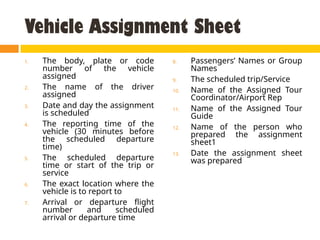
Vehicle Assignment Sheet
1. The body, plate or code
number of the vehicle
assigned
2. The name of the driver
assigned
3. Date and day the assignment
is scheduled
4. The reporting time of the
vehicle (30 minutes before
the scheduled departure
time)
5. The scheduled departure
time or start of the trip or
service
6. The exact location where the
vehicle is to report to
7. Arrival or departure flight
number and scheduled
arrival or departure time
8. Passengers’ Names or Group
Names
9. The scheduled trip/Service
10. Name of the Assigned Tour
Coordinator/Airport Rep
11. Name of the Assigned Tour
Guide
12. Name of the person who
prepared the assignment
sheet1
13. Date the assignment sheet
was prepared
Vehicle Assignment Sheet
(1) Vehicle No. ________ (2) Driver’s Name (3) Date and Day: _______
(4) Report
Time
(5) Depart
Time
(6) Pick – Up
Time
(7) Flight
Time
(8) Pax
Names and
Number
(9) Trip /
Service
(10) Rep
Name
(11) Guide
Name
(12) Prepared by: (13) Date Prepared:
Assigning Tour Guides and Coordinators
 When booking the services of a tour guide,
the tour guide must receive the following
information before hand:
1. Name and Number
2. Itinerary
3. Hotel Name and Rooming List
4. Optional Tours
5. Additional Information
…Continuation
 Name and Number: Provide the name of the tour group
and the number of participants
 Itinerary: Give the detailed technical and descriptive
itinerary and indicate meals outside the hotel.
 Hotel Name and Rooming List: Provide the name of the
hotel and passengers’ rooming configuration and
rooming list or name list whichever is applicable and/or
available.
 Optional Tours: Give the list of optional tours available
for sale, corresponding rates, and preferred date of
operation.
 Additional Information: Provide relevant information
that will assist the tour guide in the handling of the
clients.
Tour Guide’s Assignment Sheet
 It enables the tour guide to have all the
information needed to properly manage a
group of tourists. The sheet can be divided
into 4 sections:
 Arrival Activities – meet and assist and check -
in
 In – Town Activities – touring and sight seeing
 Departure Activities – send off and check out
 Others – any activity not included in the tour
package
Arrival Section
 Provides all the information regarding the arrival of the
guests and the information needed regarding the hotel
arrangement:
1. Date
2. Reference
3. Tour Guide assigned
4. Groups Name
5. No. of Passenger
6. Tour Escorts name
7. Hotel’s Name
8. Inclusive Date
9. Room Breakdown
In-Town Section
 Provide day – to – day information
10. Arrival Information
11. Departure Information
12. Coordinator
13. Day/Date
14. Trip/Activity
15. Vehicle
16. Meals
17. Arrival Information
18. Departure Information
19. Coordinator
Departure Section
 Provides all the information regarding
the guests’ departure and the
information needed regarding the
hotel check out arrangement.
20. Name/s of hotel concerned
21. Wake up call time
22. Baggage Collection
23. Baggage Pick Up time
24. Hotel Departure Time
Optional Tours Section
 Details the optional tours available
for sale to the guests
25. Optional Tours
26. Inclusions & Duration
27. Date
28. Rate
29. Prepared by
30. Approved by
Tour Guide’s Assignment Sheet
Tour Coordinator/Airport
Representative’s Assignment Sheet
 Tour coordinators must also be properly
endorsed and well-informed. As mentioned,
field operations supervisor can also be the
tour coordinator. Other companies have
airport representatives on behalf of the tour
coordinator. Anyone of them must know
how to properly accomplish this form.
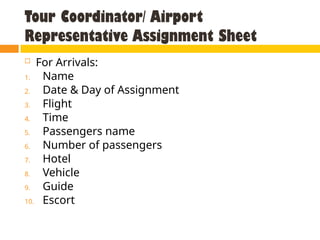
Tour Coordinator/ Airport
Representative Assignment Sheet
 For Arrivals:
1. Name
2. Date & Day of Assignment
3. Flight
4. Time
5. Passengers name
6. Number of passengers
7. Hotel
8. Vehicle
9. Guide
10. Escort
Tour Coordinator/ Airport
Representative Assignment Sheet
 For departures:
1. Hotel
2. Time
3. Passengers name
4. Pax
5. Flight
6. F/Time
7. Guide
8. Vehicle
9. Prepared by
10. Date prepared
Tour Coordinator/Airport
Representative’s Assignment Sheet
Monitoring Field Operations
 A good field supervisor makes an effort to
know any deviation, change, accident,
mishap or anything outside of what is
planned, when it happens, or as soon as
possible after it.
 As the overall coordinator, the field
supervisor’s decisions are crucial and thus
can make or break the profitability of the
company.
Following are some of the situations
that may arise
1. No Equipment Available
2. No Foreign Language
3. Equipment Breakdown
4. Guide is No-Show
5. Accidents
6. Death of a client
Following are some of the situations that may
arise, and the recommended solution:
7. Theft
8. Snatching/Pick Pockets
9. No Reservations
10. Incomplete Reservation
11. Road/Bridge Breakdown
12. Complaints
13. Cancelled or delayed
TOURISM'S TEN COMMANDMENTS
 1. ALWAYS STICK TO THE ITINERARY
 This may seem obvious, but it is still
important. People have paid for
certain things and expect to
see/experience them.
 While it is fun to go off the beaten
track occasionally to do something
extra, this should never be at the
expense of what is included.
 An itinerary is a kind of contract
between passenger and operator
and the guide should not deviate
from it for personal glory (or greed)
…Continuation
 2. APOLOGISE RATHER THAN
EXPLAIN
 If things go wrong - and they
will - a simple apology is far
better than a convoluted
explanation, which ends up
sounding liking an
unconvincing excuse.
 Admitting that things have
gone wrong and
acknowledging peoples'
disappointment over a poor
hotel/meal/visit is the first step
to rectifying the problem and
winning back credibility.
Explanations can come later.
…Continuation
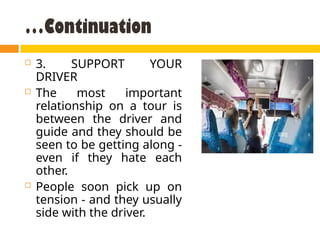
 3. SUPPORT YOUR
DRIVER
 The most important
relationship on a tour is
between the driver and
guide and they should be
seen to be getting along -
even if they hate each
other.
 People soon pick up on
tension - and they usually
side with the driver.
…Continuation
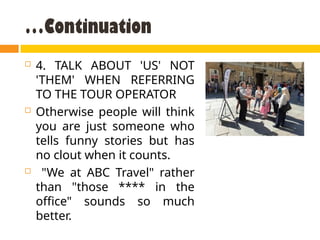
 4. TALK ABOUT 'US' NOT
'THEM' WHEN REFERRING
TO THE TOUR OPERATOR
 Otherwise people will think
you are just someone who
tells funny stories but has
no clout when it counts.
 "We at ABC Travel" rather
than "those **** in the
office" sounds so much
better.
…Continuation
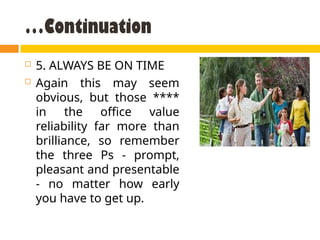
 5. ALWAYS BE ON TIME
 Again this may seem
obvious, but those ****
in the office value
reliability far more than
brilliance, so remember
the three Ps - prompt,
pleasant and presentable
- no matter how early
you have to get up.
…Continuation
 6. GEOGRAPHY IS MORE
IMPORTANT THAN HISTORY
 You may know all about
medieval battles or Gothic
architecture, but you have to
know which turning off the
B6318 to take to reach the
Scottish border from Hadrian's
Wall and (roughly) how long it
will take you to get there.
 You are allowed a few senior
moments but there are few
things worse than having fifty
people behind you when you
have no idea where you are.
…Continuation
 7. YOU ALWAYS LOSE THE
ARGUMENT
 Even if people are being
unreasonable, they are still
paying your mortgage, so never
try to prove them wrong and
make them feel small.
 Say sorry (see three), accept the
criticism and move on. In the
long run, a disgruntled tourist
can be your worst enemy.
 One whose hurt has been
acknowledged (and rectified) can
turn out to be your best friend.
…Continuation
 8. TELLING JOKES IS NOT
THE SAME AS HAVING
FUN
 My idea of hell on earth is
non-stop stand up. You
do not need to make jokes
to hold peoples' attention
but, if you go through a
two week or two hour
tour and no-one smiles
during that time, you
might need to lighten up
a bit - or consider a new
career.
…Continuation
 9. WHAT OTHERS THINK OF YOU
COUNTS MORE THAN WHAT YOU
THINK OF YOURSELF
 You may have all the
academic/professional
qualifications in the world and
have been in the business for
years (decades) but you have to
reinvent yourself for every tour
and every group.
 People have a good antenna for
someone going through the
motions who no longer cares
about their passengers.
 Experience is important but it is no
substitute for enthusiasm.
…Continuation
 10. IT IS A LIVING, NOT
A LIFE
 No matter how much of
a buzz you get from a
good tour (and it can be
quite a high) it is over
soon enough, so don't
neglect the important
people in you life -
friends and family.
<End of Week 11>
References:
 1. Book/Ebook:
 2. Web Page:
 The Log Book: Field Operations Field Operations
Supervisor Plays The Role of The Overall retrieved from:
https://www.scribd.com/document/544674906/TPPP6
 A Tour Guide Assignment Sheet: A Valuable Tool For Tour
Guides And Participants retrieved from:
https://www.cambodia-travel.com/a-tour-guide-assignme
nt-sheet-a-valuable-tool-for-tour-guides-and-participants/
 Tourism’s Ten Commandments retrieved from:
https://diaryofatouristguide.blogspot.com/2012/05/touris
ms-ten-commandments.html
 3. Media:
Reflective Journal for Week 11
 Answer the following questions based on your understanding about the recent
discussion. Explain your answer in details
 1. What were the two or three main idea/concepts I found useful in today’s
session, and why?
 2. What beliefs of mine have changed about teaching and learning as a result of
this session?
 3. One thing I learned in this session that I may be able to use in the future is…
 4. Issues that interested me a lot, and that I would like to study in more detail.
 5. I am still unsure about
 6. What did we not cover that I expected we should?
 7. What strategies have I used in the past were reinforced by this session; Have I
been discouraged from any others?
 8. Miscellaneous interesting facts I learned in this session…

Adapted from: Learning Journals http://www.audiencedialogue.net/journal.html
Assignment
 Group Activity/Role Playing with Video
Presentation (6 in a group)
 Act the proper management of crisis situation
assigned to your group.
 Group 1 – No Equipment Available
 Group 2 – Equipment Breakdown
 Group 3 – Accidents
 Group 4 – Death of a client
 Group 5 – Snatching / Pick pockets
 Group 6 – Road/ Bridge Breakdown
 Group 7 – Complaints
 Group 8 – Cancelled (or delayed)
Tour Guide Assessment and Presentation,,

Tour Guide Assessment and Presentation,,

  • 1.
  • 2.
    Introduction  This PowerPoint Presentation is intended to have you learners of 3rd year to evaluate and monitor the field operations, such as positioning of field personnel, equipment and other service providers.  At the end of this Power Point Presentation, you are expected to:  1. Discuss what is field operations and the responsibilities of Field Operation supervisor and Operations Manager;  2. Explain the contents of the log book and its importance in monitoring field operations;  3. Illustrate and describe some of the situation that may arise in field operations and recommend concrete solution.
  • 3.
    Field Operations  Coverthe actual of services, and all activities of the travelers from the moment of arrival to the time of departure.  Field Operations Supervisor – Over all coordinator of all activities undertaken in the field while  Field operations managers – are responsible for executing and improving their company's field marketing, sales, and merchandising initiatives.
  • 4.
    Key Players inthe Field  1. Tour Guide / Tour Escort  2. Tour Coordinator / Airport Representatives  3. Tour Drivers
  • 5.
    Two Division ofField Activities  Transfer – Picking up guest from the gateway or airport and delivering them to place of lodging.  Tours – Arranged trip from point of origin to one or more place and back.  These must always be coordinated, planned and scheduled.  The basic rule and key to profitability is to provide the most services, with the least staff and equipment, without compromising the clients’ comfort, convenience, safety, and the quality of the service.
  • 6.
    The Log Book The Logbook is the basic working tool of field operation.  It contains an up-to-date record of all activities and services scheduled on a day- to-day basis.  Includes who should be responsible for the delivery of each activity and service.
  • 7.
    …Continuation Reservations Officer fills out asmany boxes in the Booking Card for Tours Passed to the Field for Recording If there are changes to the booking Field Supervisor records in the Log Book, each activity and service to be provided Arrival Transfer/Transfer-in – shows how many clients are due to arrive, on a specific date, the arrival flight or vessel, in which hotel they are scheduled to stay, who will meet them at the gateway, who will be their tour guide, and what vehicles will be used. Departure Transfer/Transfer-Out – shows how many clients are due to leave, on what date and the like. Tour, or Sightseeing – indicates who and how many are going on a particular sightseeing tour, on what day, who is the assigned guide, which vehicle they will use and where they are scheduled to dine, and the like.
  • 8.
    Preparing the LogBook 1. DAY/DATE – this indicates the date and the day of the week; it is important as the weekend days have lighter traffic within city limits and heavy traffic in the outskirts and provincial road. 2. REF – abbreviation for Reference. Normally, it is the assigned number to the transaction (i.e. tour file number) 3. PAX NAMES – it refers to the passenger’s name. In case of groups, the group name is normally written. 4. PAX – short term for passenger/s indicates the number of passengers to be serviced. 5. SERVICE/TRIP – assigned schedule of trip, service or activity 6. HOTEL/PLACE – write the name of the accommodations establishment where the clients are billeted or the place from where they will be picked up.
  • 9.
    … Continuation 7. P/TIME– short for “Pick-up Time”, shows the scheduled time the clients are scheduled to be picked up. 8. FLIGHT – refers to applicable flight. This is filled out in cases of arrival or departure transfers. 9. ETA-ETD – Estimated Time of Arrival (ETA) and Estimated Time of Departure (ETD) 10. GUIDE – write the name, nickname or code name of the tour guide assigned. 11. COORD. – short for “Coordinator”, refers to the name of the assigned tour coordinator or airport representative. 12. VEHICLE – write the description (Bus, Mini Van, Coaster, Car, etc.) and body or plate number of the vehicle.
  • 10.
    The Log Book DATE / DAY:
  • 11.
    Making Reservations LandTransportation Equipment and Other Entertainment Establishments  When making reservations with tourist transport companies providing cars, vans, minibuses, or full-size motor coaches, the following information must be required: 1. Scheduled Trip / Tour 2. Desired Type of Vehicle 3. Date, Reporting Time and Place 4. Tour Guide’s Name 5. Passenger/s or Group Name
  • 12.
    … Continuation  Whenmaking reservations with night clubs or other entertainment establishments, with or without a show, the following information are required: 1. Passenger/s Group Name and number of covers 2. Scheduled Show (if applicable) 3. Number of Tables 4. Form of Payment 5. Tour Guide’s Name
  • 13.
    Vehicle Assignment Sheet 1.The body, plate or code number of the vehicle assigned 2. The name of the driver assigned 3. Date and day the assignment is scheduled 4. The reporting time of the vehicle (30 minutes before the scheduled departure time) 5. The scheduled departure time or start of the trip or service 6. The exact location where the vehicle is to report to 7. Arrival or departure flight number and scheduled arrival or departure time 8. Passengers’ Names or Group Names 9. The scheduled trip/Service 10. Name of the Assigned Tour Coordinator/Airport Rep 11. Name of the Assigned Tour Guide 12. Name of the person who prepared the assignment sheet1 13. Date the assignment sheet was prepared
  • 14.
    Vehicle Assignment Sheet (1)Vehicle No. ________ (2) Driver’s Name (3) Date and Day: _______ (4) Report Time (5) Depart Time (6) Pick – Up Time (7) Flight Time (8) Pax Names and Number (9) Trip / Service (10) Rep Name (11) Guide Name (12) Prepared by: (13) Date Prepared:
  • 15.
    Assigning Tour Guidesand Coordinators  When booking the services of a tour guide, the tour guide must receive the following information before hand: 1. Name and Number 2. Itinerary 3. Hotel Name and Rooming List 4. Optional Tours 5. Additional Information
  • 16.
    …Continuation  Name andNumber: Provide the name of the tour group and the number of participants  Itinerary: Give the detailed technical and descriptive itinerary and indicate meals outside the hotel.  Hotel Name and Rooming List: Provide the name of the hotel and passengers’ rooming configuration and rooming list or name list whichever is applicable and/or available.  Optional Tours: Give the list of optional tours available for sale, corresponding rates, and preferred date of operation.  Additional Information: Provide relevant information that will assist the tour guide in the handling of the clients.
  • 17.
    Tour Guide’s AssignmentSheet  It enables the tour guide to have all the information needed to properly manage a group of tourists. The sheet can be divided into 4 sections:  Arrival Activities – meet and assist and check - in  In – Town Activities – touring and sight seeing  Departure Activities – send off and check out  Others – any activity not included in the tour package
  • 18.
    Arrival Section  Providesall the information regarding the arrival of the guests and the information needed regarding the hotel arrangement: 1. Date 2. Reference 3. Tour Guide assigned 4. Groups Name 5. No. of Passenger 6. Tour Escorts name 7. Hotel’s Name 8. Inclusive Date 9. Room Breakdown
  • 19.
    In-Town Section  Provideday – to – day information 10. Arrival Information 11. Departure Information 12. Coordinator 13. Day/Date 14. Trip/Activity 15. Vehicle 16. Meals 17. Arrival Information 18. Departure Information 19. Coordinator
  • 20.
    Departure Section  Providesall the information regarding the guests’ departure and the information needed regarding the hotel check out arrangement. 20. Name/s of hotel concerned 21. Wake up call time 22. Baggage Collection 23. Baggage Pick Up time 24. Hotel Departure Time
  • 21.
    Optional Tours Section Details the optional tours available for sale to the guests 25. Optional Tours 26. Inclusions & Duration 27. Date 28. Rate 29. Prepared by 30. Approved by
  • 22.
  • 23.
    Tour Coordinator/Airport Representative’s AssignmentSheet  Tour coordinators must also be properly endorsed and well-informed. As mentioned, field operations supervisor can also be the tour coordinator. Other companies have airport representatives on behalf of the tour coordinator. Anyone of them must know how to properly accomplish this form.
  • 24.
    Tour Coordinator/ Airport RepresentativeAssignment Sheet  For Arrivals: 1. Name 2. Date & Day of Assignment 3. Flight 4. Time 5. Passengers name 6. Number of passengers 7. Hotel 8. Vehicle 9. Guide 10. Escort
  • 25.
    Tour Coordinator/ Airport RepresentativeAssignment Sheet  For departures: 1. Hotel 2. Time 3. Passengers name 4. Pax 5. Flight 6. F/Time 7. Guide 8. Vehicle 9. Prepared by 10. Date prepared
  • 26.
  • 27.
    Monitoring Field Operations A good field supervisor makes an effort to know any deviation, change, accident, mishap or anything outside of what is planned, when it happens, or as soon as possible after it.  As the overall coordinator, the field supervisor’s decisions are crucial and thus can make or break the profitability of the company.
  • 28.
    Following are someof the situations that may arise 1. No Equipment Available 2. No Foreign Language 3. Equipment Breakdown 4. Guide is No-Show 5. Accidents 6. Death of a client
  • 29.
    Following are someof the situations that may arise, and the recommended solution: 7. Theft 8. Snatching/Pick Pockets 9. No Reservations 10. Incomplete Reservation 11. Road/Bridge Breakdown 12. Complaints 13. Cancelled or delayed
  • 30.
    TOURISM'S TEN COMMANDMENTS 1. ALWAYS STICK TO THE ITINERARY  This may seem obvious, but it is still important. People have paid for certain things and expect to see/experience them.  While it is fun to go off the beaten track occasionally to do something extra, this should never be at the expense of what is included.  An itinerary is a kind of contract between passenger and operator and the guide should not deviate from it for personal glory (or greed)
  • 31.
    …Continuation  2. APOLOGISERATHER THAN EXPLAIN  If things go wrong - and they will - a simple apology is far better than a convoluted explanation, which ends up sounding liking an unconvincing excuse.  Admitting that things have gone wrong and acknowledging peoples' disappointment over a poor hotel/meal/visit is the first step to rectifying the problem and winning back credibility. Explanations can come later.
  • 32.
    …Continuation  3. SUPPORTYOUR DRIVER  The most important relationship on a tour is between the driver and guide and they should be seen to be getting along - even if they hate each other.  People soon pick up on tension - and they usually side with the driver.
  • 33.
    …Continuation  4. TALKABOUT 'US' NOT 'THEM' WHEN REFERRING TO THE TOUR OPERATOR  Otherwise people will think you are just someone who tells funny stories but has no clout when it counts.  "We at ABC Travel" rather than "those **** in the office" sounds so much better.
  • 34.
    …Continuation  5. ALWAYSBE ON TIME  Again this may seem obvious, but those **** in the office value reliability far more than brilliance, so remember the three Ps - prompt, pleasant and presentable - no matter how early you have to get up.
  • 35.
    …Continuation  6. GEOGRAPHYIS MORE IMPORTANT THAN HISTORY  You may know all about medieval battles or Gothic architecture, but you have to know which turning off the B6318 to take to reach the Scottish border from Hadrian's Wall and (roughly) how long it will take you to get there.  You are allowed a few senior moments but there are few things worse than having fifty people behind you when you have no idea where you are.
  • 36.
    …Continuation  7. YOUALWAYS LOSE THE ARGUMENT  Even if people are being unreasonable, they are still paying your mortgage, so never try to prove them wrong and make them feel small.  Say sorry (see three), accept the criticism and move on. In the long run, a disgruntled tourist can be your worst enemy.  One whose hurt has been acknowledged (and rectified) can turn out to be your best friend.

  • 37.
    …Continuation  8. TELLINGJOKES IS NOT THE SAME AS HAVING FUN  My idea of hell on earth is non-stop stand up. You do not need to make jokes to hold peoples' attention but, if you go through a two week or two hour tour and no-one smiles during that time, you might need to lighten up a bit - or consider a new career.
  • 38.
    …Continuation  9. WHATOTHERS THINK OF YOU COUNTS MORE THAN WHAT YOU THINK OF YOURSELF  You may have all the academic/professional qualifications in the world and have been in the business for years (decades) but you have to reinvent yourself for every tour and every group.  People have a good antenna for someone going through the motions who no longer cares about their passengers.  Experience is important but it is no substitute for enthusiasm.
  • 39.
    …Continuation  10. ITIS A LIVING, NOT A LIFE  No matter how much of a buzz you get from a good tour (and it can be quite a high) it is over soon enough, so don't neglect the important people in you life - friends and family. <End of Week 11>
  • 40.
    References:  1. Book/Ebook: 2. Web Page:  The Log Book: Field Operations Field Operations Supervisor Plays The Role of The Overall retrieved from: https://www.scribd.com/document/544674906/TPPP6  A Tour Guide Assignment Sheet: A Valuable Tool For Tour Guides And Participants retrieved from: https://www.cambodia-travel.com/a-tour-guide-assignme nt-sheet-a-valuable-tool-for-tour-guides-and-participants/  Tourism’s Ten Commandments retrieved from: https://diaryofatouristguide.blogspot.com/2012/05/touris ms-ten-commandments.html  3. Media:
  • 41.
    Reflective Journal forWeek 11  Answer the following questions based on your understanding about the recent discussion. Explain your answer in details  1. What were the two or three main idea/concepts I found useful in today’s session, and why?  2. What beliefs of mine have changed about teaching and learning as a result of this session?  3. One thing I learned in this session that I may be able to use in the future is…  4. Issues that interested me a lot, and that I would like to study in more detail.  5. I am still unsure about  6. What did we not cover that I expected we should?  7. What strategies have I used in the past were reinforced by this session; Have I been discouraged from any others?  8. Miscellaneous interesting facts I learned in this session…  Adapted from: Learning Journals http://www.audiencedialogue.net/journal.html
  • 42.
    Assignment  Group Activity/RolePlaying with Video Presentation (6 in a group)  Act the proper management of crisis situation assigned to your group.  Group 1 – No Equipment Available  Group 2 – Equipment Breakdown  Group 3 – Accidents  Group 4 – Death of a client  Group 5 – Snatching / Pick pockets  Group 6 – Road/ Bridge Breakdown  Group 7 – Complaints  Group 8 – Cancelled (or delayed)