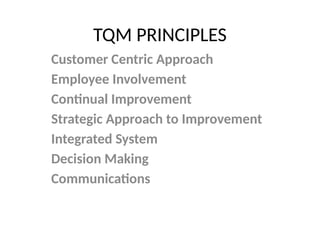
TQM PRINCIPLES
Customer Centric Approach
Employee Involvement
Continual Improvement
Strategic Approach to Improvement
Integrated System
Decision Making
Communications
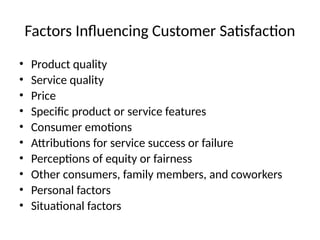
Factors Influencing Customer Satisfaction
• Product quality
• Service quality
• Price
• Specific product or service features
• Consumer emotions
• Attributions for service success or failure
• Perceptions of equity or fairness
• Other consumers, family members, and coworkers
• Personal factors
• Situational factors
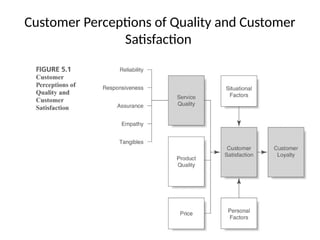
Customer Perceptions of Quality and Customer
Satisfaction
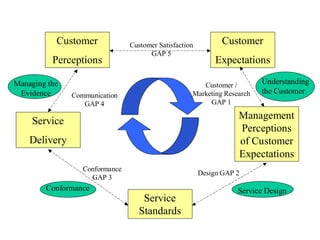
Customer
Perceptions
Customer
Expectations
Service
Delivery
Service
Standards
Management
Perceptions
of Customer
Expectations
Managing the
Evidence
Conformance Service Design
Understanding
the Customer
Customer Satisfaction
GAP 5
Customer /
Marketing Research
GAP 1
Conformance
GAP 3
Communication
GAP 4
Design GAP 2
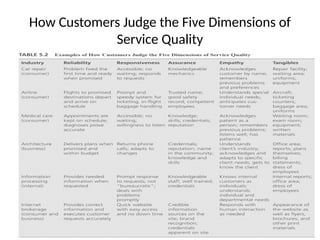
How Customers Judge the Five Dimensions of
Service Quality
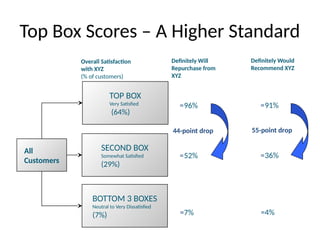
BOTTOM 3 BOXES
Neutral to Very Dissatisfied
(7%)
Overall Satisfaction
with XYZ
(% of customers)
=
=
=
TOP BOX
Very Satisfied
(64%)
SECOND BOX
Somewhat Satisfied
(29%)
Definitely Will
Repurchase from
XYZ
96%
52%
7%
All
Customers
Top Box Scores – A Higher Standard
44-point drop
=
=
=
Definitely Would
Recommend XYZ
91%
36%
4%
55-point drop
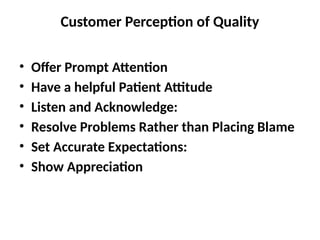
Customer Perception of Quality
• Offer Prompt Attention
• Have a helpful Patient Attitude
• Listen and Acknowledge:
• Resolve Problems Rather than Placing Blame
• Set Accurate Expectations:
• Show Appreciation
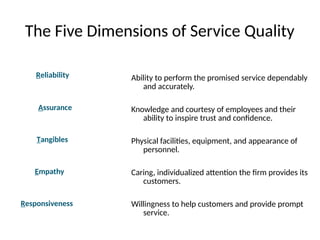
The Five Dimensions of Service Quality
Ability to perform the promised service dependably
and accurately.
Knowledge and courtesy of employees and their
ability to inspire trust and confidence.
Physical facilities, equipment, and appearance of
personnel.
Caring, individualized attention the firm provides its
customers.
Willingness to help customers and provide prompt
service.
Tangibles
Reliability
Responsiveness
Assurance
Empathy
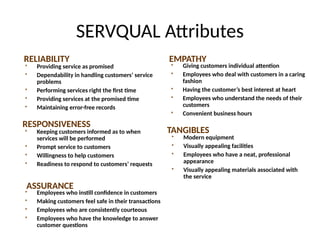
 Providing service as promised
 Dependability in handling customers’ service
problems
 Performing services right the first time
 Providing services at the promised time
 Maintaining error-free records
 Keeping customers informed as to when
services will be performed
 Prompt service to customers
 Willingness to help customers
 Readiness to respond to customers’ requests
RELIABILITY
RESPONSIVENESS
 Employees who instill confidence in customers
 Making customers feel safe in their transactions
 Employees who are consistently courteous
 Employees who have the knowledge to answer
customer questions
ASSURANCE
 Giving customers individual attention
 Employees who deal with customers in a caring
fashion
 Having the customer’s best interest at heart
 Employees who understand the needs of their
customers
 Convenient business hours
EMPATHY
 Modern equipment
 Visually appealing facilities
 Employees who have a neat, professional
appearance
 Visually appealing materials associated with
the service
TANGIBLES
SERVQUAL Attributes
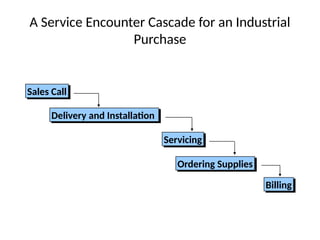
Sales Call
Ordering Supplies
Billing
Delivery and Installation
Servicing
A Service Encounter Cascade for an Industrial
Purchase
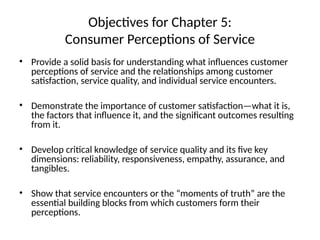
Objectives for Chapter 5:
Consumer Perceptions of Service
• Provide a solid basis for understanding what influences customer
perceptions of service and the relationships among customer
satisfaction, service quality, and individual service encounters.
• Demonstrate the importance of customer satisfaction—what it is,
the factors that influence it, and the significant outcomes resulting
from it.
• Develop critical knowledge of service quality and its five key
dimensions: reliability, responsiveness, empathy, assurance, and
tangibles.
• Show that service encounters or the “moments of truth” are the
essential building blocks from which customers form their
perceptions.
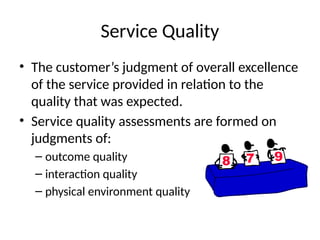
Service Quality
• The customer’s judgment of overall excellence
of the service provided in relation to the
quality that was expected.
• Service quality assessments are formed on
judgments of:
– outcome quality
– interaction quality
– physical environment quality
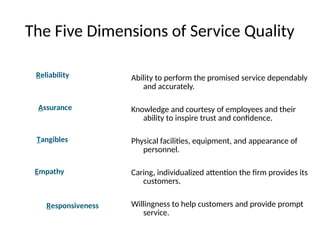
The Five Dimensions of Service Quality
Ability to perform the promised service dependably
and accurately.
Knowledge and courtesy of employees and their
ability to inspire trust and confidence.
Physical facilities, equipment, and appearance of
personnel.
Caring, individualized attention the firm provides its
customers.
Willingness to help customers and provide prompt
service.
Tangibles
Reliability
Responsiveness
Assurance
Empathy
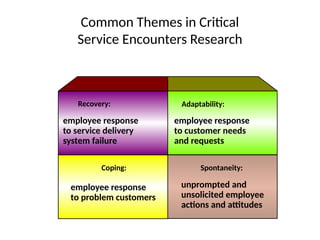
Common Themes in Critical
Service Encounters Research
Recovery: Adaptability:
Spontaneity:
Coping:
employee response
to service delivery
system failure
employee response
to customer needs
and requests
employee response
to problem customers
unprompted and
unsolicited employee
actions and attitudes
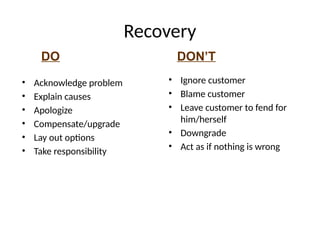
DO DON’T
Recovery
• Acknowledge problem
• Explain causes
• Apologize
• Compensate/upgrade
• Lay out options
• Take responsibility
• Ignore customer
• Blame customer
• Leave customer to fend for
him/herself
• Downgrade
• Act as if nothing is wrong
DO DON’T
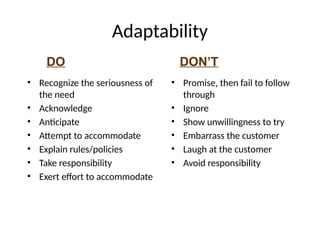
Adaptability
• Recognize the seriousness of
the need
• Acknowledge
• Anticipate
• Attempt to accommodate
• Explain rules/policies
• Take responsibility
• Exert effort to accommodate
• Promise, then fail to follow
through
• Ignore
• Show unwillingness to try
• Embarrass the customer
• Laugh at the customer
• Avoid responsibility
DO DON’T
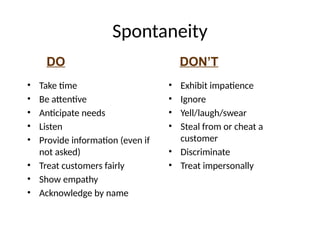
Spontaneity
• Take time
• Be attentive
• Anticipate needs
• Listen
• Provide information (even if
not asked)
• Treat customers fairly
• Show empathy
• Acknowledge by name
• Exhibit impatience
• Ignore
• Yell/laugh/swear
• Steal from or cheat a
customer
• Discriminate
• Treat impersonally
DO DON’T
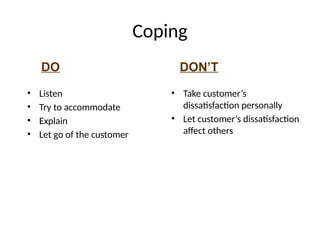
Coping
• Listen
• Try to accommodate
• Explain
• Let go of the customer
• Take customer’s
dissatisfaction personally
• Let customer’s dissatisfaction
affect others

Total Quality Management: Core Principles and Effective Implementation

  • 3.
    TQM PRINCIPLES Customer CentricApproach Employee Involvement Continual Improvement Strategic Approach to Improvement Integrated System Decision Making Communications
  • 4.
    Factors Influencing CustomerSatisfaction • Product quality • Service quality • Price • Specific product or service features • Consumer emotions • Attributions for service success or failure • Perceptions of equity or fairness • Other consumers, family members, and coworkers • Personal factors • Situational factors
  • 5.
    Customer Perceptions ofQuality and Customer Satisfaction
  • 6.
    Customer Perceptions Customer Expectations Service Delivery Service Standards Management Perceptions of Customer Expectations Managing the Evidence ConformanceService Design Understanding the Customer Customer Satisfaction GAP 5 Customer / Marketing Research GAP 1 Conformance GAP 3 Communication GAP 4 Design GAP 2
  • 7.
    How Customers Judgethe Five Dimensions of Service Quality
  • 8.
    BOTTOM 3 BOXES Neutralto Very Dissatisfied (7%) Overall Satisfaction with XYZ (% of customers) = = = TOP BOX Very Satisfied (64%) SECOND BOX Somewhat Satisfied (29%) Definitely Will Repurchase from XYZ 96% 52% 7% All Customers Top Box Scores – A Higher Standard 44-point drop = = = Definitely Would Recommend XYZ 91% 36% 4% 55-point drop
  • 9.
    Customer Perception ofQuality • Offer Prompt Attention • Have a helpful Patient Attitude • Listen and Acknowledge: • Resolve Problems Rather than Placing Blame • Set Accurate Expectations: • Show Appreciation
  • 10.
    The Five Dimensionsof Service Quality Ability to perform the promised service dependably and accurately. Knowledge and courtesy of employees and their ability to inspire trust and confidence. Physical facilities, equipment, and appearance of personnel. Caring, individualized attention the firm provides its customers. Willingness to help customers and provide prompt service. Tangibles Reliability Responsiveness Assurance Empathy
  • 11.
     Providing serviceas promised  Dependability in handling customers’ service problems  Performing services right the first time  Providing services at the promised time  Maintaining error-free records  Keeping customers informed as to when services will be performed  Prompt service to customers  Willingness to help customers  Readiness to respond to customers’ requests RELIABILITY RESPONSIVENESS  Employees who instill confidence in customers  Making customers feel safe in their transactions  Employees who are consistently courteous  Employees who have the knowledge to answer customer questions ASSURANCE  Giving customers individual attention  Employees who deal with customers in a caring fashion  Having the customer’s best interest at heart  Employees who understand the needs of their customers  Convenient business hours EMPATHY  Modern equipment  Visually appealing facilities  Employees who have a neat, professional appearance  Visually appealing materials associated with the service TANGIBLES SERVQUAL Attributes
  • 12.
    Sales Call Ordering Supplies Billing Deliveryand Installation Servicing A Service Encounter Cascade for an Industrial Purchase
  • 13.
    Objectives for Chapter5: Consumer Perceptions of Service • Provide a solid basis for understanding what influences customer perceptions of service and the relationships among customer satisfaction, service quality, and individual service encounters. • Demonstrate the importance of customer satisfaction—what it is, the factors that influence it, and the significant outcomes resulting from it. • Develop critical knowledge of service quality and its five key dimensions: reliability, responsiveness, empathy, assurance, and tangibles. • Show that service encounters or the “moments of truth” are the essential building blocks from which customers form their perceptions.
  • 14.
    Service Quality • Thecustomer’s judgment of overall excellence of the service provided in relation to the quality that was expected. • Service quality assessments are formed on judgments of: – outcome quality – interaction quality – physical environment quality
  • 15.
    The Five Dimensionsof Service Quality Ability to perform the promised service dependably and accurately. Knowledge and courtesy of employees and their ability to inspire trust and confidence. Physical facilities, equipment, and appearance of personnel. Caring, individualized attention the firm provides its customers. Willingness to help customers and provide prompt service. Tangibles Reliability Responsiveness Assurance Empathy
  • 16.
    Common Themes inCritical Service Encounters Research Recovery: Adaptability: Spontaneity: Coping: employee response to service delivery system failure employee response to customer needs and requests employee response to problem customers unprompted and unsolicited employee actions and attitudes
  • 17.
    DO DON’T Recovery • Acknowledgeproblem • Explain causes • Apologize • Compensate/upgrade • Lay out options • Take responsibility • Ignore customer • Blame customer • Leave customer to fend for him/herself • Downgrade • Act as if nothing is wrong
  • 18.
    DO DON’T Adaptability • Recognizethe seriousness of the need • Acknowledge • Anticipate • Attempt to accommodate • Explain rules/policies • Take responsibility • Exert effort to accommodate • Promise, then fail to follow through • Ignore • Show unwillingness to try • Embarrass the customer • Laugh at the customer • Avoid responsibility
  • 19.
    DO DON’T Spontaneity • Taketime • Be attentive • Anticipate needs • Listen • Provide information (even if not asked) • Treat customers fairly • Show empathy • Acknowledge by name • Exhibit impatience • Ignore • Yell/laugh/swear • Steal from or cheat a customer • Discriminate • Treat impersonally
  • 20.
    DO DON’T Coping • Listen •Try to accommodate • Explain • Let go of the customer • Take customer’s dissatisfaction personally • Let customer’s dissatisfaction affect others