The Top 10 Technology Trends To Watch: 2016
To 2018
The Age Of The Customer Will Drive Firms To Increase Their Investments In End-To-End
Technology Solutions
by Brian Hopkins and Bobby Cameron
September 8, 2015
FOR ENTERPRISE ARCHITECTURE PROFESSIONALS
FORRESTER.COM
Key Takeaways
Customer-Obsessed Firms Need End-To-End
Solutions To Create New Customer Value
Standalone investments in customer experience
(CX) are creating market success. But as more
competitors understand the CX opportunity,
leading firms are making broad investments
that span the journeys of the enterprise and its
partners and customers and apply to the entire
customer life cycle -- from end to end.
Investments Are Shifting From Point Solutions
To End-To-End Solutions In Three Phases
In the dawning phase, visionaries experiment
with point solutions to drive innovation. Their
success launches the awareness phase, during
which firms begin to innovate more broadly and
discover the limitations of point solutions. In the
acceptance phase, investments accelerate as
most firms recognize the need for end-to-end
solutions to stay competitive.
Help Your Firm Scale As It Invests
Today’s top technology trends open up huge
opportunities, but they also pose challenges in terms
of organization, culture, and maturity --especially
as firms scale. Enterprise architecture (EA)
professionals are uniquely suited to help their firms
address these challenges through their business
technology (BT) agenda.
Why Read This Report
Five years into the age of the customer,
investments in mobile, cloud, big data, predictive
analytics, and social technologies are booming.
But unlike previous technology cycles, tech
investments will continue to grow rather than
diminish throughout the refinement period. This
year’s top 10 tech trends demonstrate why; a shift
is underway from cyclical, invention-led spending
on point solutions to investments targeting
customer-driven, end-to-end value. Enterprise
architects should read this report to understand
the trends that are enabling continuous customer
value innovation from end to end — across
journeys, channels, and the enterprise.
2
5
7
11
22
29
30
31
© 2015 Forrester Research, Inc. Opinions reflect judgment at the time and are subject to change. Forrester®
,
Technographics®
, Forrester Wave, RoleView, TechRadar, and Total Economic Impact are trademarks of Forrester
Research, Inc. All other trademarks are the property of their respective companies. Unauthorized copying or
distributing is a violation of copyright law. Citations@forrester.com or +1 866-367-7378
Forrester Research, Inc., 60 Acorn Park Drive, Cambridge, MA 02140 USA
+1 617-613-6000 | Fax: +1 617-613-5000 | forrester.com
Table Of Contents
The Age Of The Customer Changes How
Firms Invest In Technology
Forrester’s Top Technology Trends To Watch:
2016 To 2018
Visionaries Invest In Point Solutions In The
Dawning Phase
Accelerators’ Point Solution Investments
Peak In The Awareness Phase
Mainstream Firms Use End-To-End
Solutions In The Acceptance Phase
Recommendations
Help End-To-End Customer Experiences
Scale
What It Means
Acceptance Of End-To-End Solutions Will
Redefine The Tech Sector
Supplemental Material
Notes & Resources
Forrester interviewed IBM, KPMG, MIT, and
Sogeti in the course of this research.
Related Research Documents
The Top 10 Technology Trends EA Should Watch:
2012 To 2014
The Top Emerging Technologies To Watch: Now
Through 2020
Top Technology Trends To Watch: 2014 To 2016
FOR ENTERPRISE ARCHITECTURE PROFESSIONALS
The Top 10 Technology Trends To Watch: 2016 To 2018
The Age Of The Customer Will Drive Firms To Increase Their Investments In End-To-End
Technology Solutions
by Brian Hopkins and Bobby Cameron
with Gene Leganza, Kyle McNabb, Sharyn Leaver, Peter Burris, Leslie Owens, Rachael Klehm, and
Bill Nagel
September 8, 2015
FOR ENTERPRISE ARCHITECTURE PROFESSIONALS
The Top 10 Technology Trends To Watch: 2016 To 2018
September 8, 2015
© 2015 Forrester Research, Inc. Unauthorized copying or distributing is a violation of copyright law.
Citations@forrester.com or +1 866-367-7378
2
The Age Of The Customer Will Drive Firms To Increase Their Investments In End-To-End
Technology Solutions
The Age Of The Customer Changes How Firms Invest In Technology
Five years into the age of the customer, companies are changing their business strategy to respond
to the billions of people with wireless broadband, mobile devices, and access to the Internet’s wealth
of information and social networks. Growth and customer experience (CX) improvement top firms’
business priorities, leading to large-scale digital or CX transformation initiatives. This phenomenon
affects all types of organizations: business-to-consumer (B2C), business-to-business (B2B), and
government-to-citizen. As a result, technology leaders are:
›› Continuing to bet big on BT to win, serve, and retain customers. In 2009, Forrester foresaw a
classic technology cycle: a wave of innovation and growth between 2008 and 2016 followed by
a period of refinement and design from 2016 to 2024.1
BT spending has indeed boomed and will
increase by 10% in both 2015 and 2016.2
In previous cycles, periods of heavy tech investment
were followed by time to digest the advances. But this time is different; complex engagement and
continuous customer innovation mean that your business can’t afford to slow down to digest and
rationalize new technology.
›› Moving beyond point solutions by investing in end-to-end technologies. Spending remains
strong, but the nature of that investment is changing. Early in the age of the customer, firms
met their needs quickly and cheaply with point solutions. But relentless competitive pressure is
exposing the cracks in this strategy. For example, manufacturers pursuing connected products
are often not prepared for the associated tech support costs. Through 2018, firms will increasingly
recognize the need for end-to-end solutions that connect customer experiences throughout the
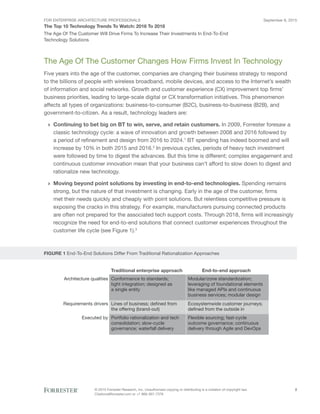
customer life cycle (see Figure 1).3
FIGURE 1 End-To-End Solutions Differ From Traditional Rationalization Approaches
Traditional enterprise approach End-to-end approach
Executed by
Conformance to standards;
tight integration; designed as
a single entity
Modular/zone standardization;
leveraging of foundational elements
like managed APIs and continuous
business services; modular design
Architecture qualities
Portfolio rationalization and tech
consolidation; slow-cycle
governance; waterfall delivery
Flexible sourcing; fast-cycle
outcome governance; continuous
delivery through Agile and DevOps
Requirements drivers Lines of business; defined from
the offering (brand-out)
Ecosystemwide customer journeys;
defined from the outside in
FOR ENTERPRISE ARCHITECTURE PROFESSIONALS
The Top 10 Technology Trends To Watch: 2016 To 2018
September 8, 2015
© 2015 Forrester Research, Inc. Unauthorized copying or distributing is a violation of copyright law.
Citations@forrester.com or +1 866-367-7378
3
The Age Of The Customer Will Drive Firms To Increase Their Investments In End-To-End
Technology Solutions
Technology Investments Shift Toward End-To-End Solutions In Three Phases
Falling hardware costs, increasing connectivity, and the relentless march of Moore’s Law and its
spinoffs continue to supply the raw materials to meet the strong technology demands of the age of
the customer. The result: a maelstrom of inventions and trends that Forrester has been tracking since
2009.4
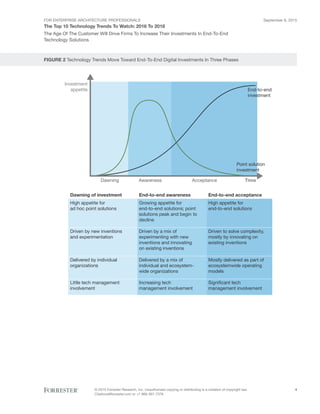
But in this new, end-to-end stage of the age of the customer, technology trends will mature in
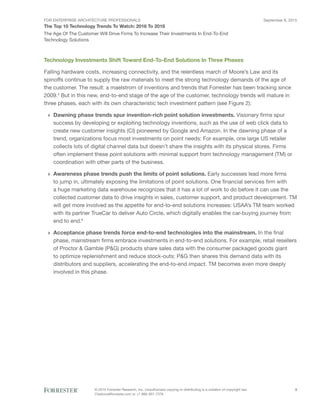
three phases, each with its own characteristic tech investment pattern (see Figure 2):
›› Dawning phase trends spur invention-rich point solution investments. Visionary firms spur
success by developing or exploiting technology inventions, such as the use of web click data to
create new customer insights (CI) pioneered by Google and Amazon. In the dawning phase of a
trend, organizations focus most investments on point needs: For example, one large US retailer
collects lots of digital channel data but doesn’t share the insights with its physical stores. Firms
often implement these point solutions with minimal support from technology management (TM) or
coordination with other parts of the business.
›› Awareness phase trends push the limits of point solutions. Early successes lead more firms
to jump in, ultimately exposing the limitations of point solutions. One financial services firm with
a huge marketing data warehouse recognizes that it has a lot of work to do before it can use the
collected customer data to drive insights in sales, customer support, and product development. TM
will get more involved as the appetite for end-to-end solutions increases: USAA’s TM team worked
with its partner TrueCar to deliver Auto Circle, which digitally enables the car-buying journey from
end to end.5
›› Acceptance phase trends force end-to-end technologies into the mainstream. In the final
phase, mainstream firms embrace investments in end-to-end solutions. For example, retail resellers
of Proctor & Gamble (P&G) products share sales data with the consumer packaged goods giant
to optimize replenishment and reduce stock-outs; P&G then shares this demand data with its
distributors and suppliers, accelerating the end-to-end impact. TM becomes even more deeply
involved in this phase.
FOR ENTERPRISE ARCHITECTURE PROFESSIONALS
The Top 10 Technology Trends To Watch: 2016 To 2018
September 8, 2015
© 2015 Forrester Research, Inc. Unauthorized copying or distributing is a violation of copyright law.
Citations@forrester.com or +1 866-367-7378
4
The Age Of The Customer Will Drive Firms To Increase Their Investments In End-To-End
Technology Solutions
FIGURE 2 Technology Trends Move Toward End-To-End Digital Investments In Three Phases
End-to-end
investment
Point solution
investment
Investment
appetite
TimeDawning Awareness Acceptance
Dawning of investment
High appetite for
ad hoc point solutions
Driven by new inventions
and experimentation
Delivered by individual
organizations
Little tech management
involvement
End-to-end awareness
Growing appetite for
end-to-end solutions; point
solutions peak and begin to
decline
Driven by a mix of
experimenting with new
inventions and innovating
on existing inventions
Delivered by a mix of
individual and ecosystem-
wide organizations
Increasing tech
management involvement
End-to-end acceptance
High appetite for
end-to-end solutions
Driven to solve complexity,
mostly by innovating on
existing inventions
Mostly delivered as part of
ecosystemwide operating
models
Significant tech
management involvement
FOR ENTERPRISE ARCHITECTURE PROFESSIONALS
The Top 10 Technology Trends To Watch: 2016 To 2018
September 8, 2015
© 2015 Forrester Research, Inc. Unauthorized copying or distributing is a violation of copyright law.
Citations@forrester.com or +1 866-367-7378
5
The Age Of The Customer Will Drive Firms To Increase Their Investments In End-To-End
Technology Solutions
Forrester’s Top Technology Trends To Watch: 2016 To 2018
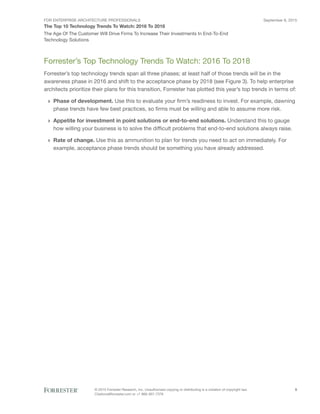
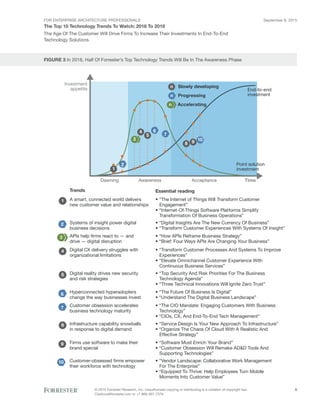
Forrester’s top technology trends span all three phases; at least half of those trends will be in the
awareness phase in 2016 and shift to the acceptance phase by 2018 (see Figure 3). To help enterprise
architects prioritize their plans for this transition, Forrester has plotted this year’s top trends in terms of:
›› Phase of development. Use this to evaluate your firm’s readiness to invest. For example, dawning
phase trends have few best practices, so firms must be willing and able to assume more risk.
›› Appetite for investment in point solutions or end-to-end solutions. Understand this to gauge
how willing your business is to solve the difficult problems that end-to-end solutions always raise.
›› Rate of change. Use this as ammunition to plan for trends you need to act on immediately. For
example, acceptance phase trends should be something you have already addressed.
FOR ENTERPRISE ARCHITECTURE PROFESSIONALS
The Top 10 Technology Trends To Watch: 2016 To 2018
September 8, 2015
© 2015 Forrester Research, Inc. Unauthorized copying or distributing is a violation of copyright law.
Citations@forrester.com or +1 866-367-7378
6
The Age Of The Customer Will Drive Firms To Increase Their Investments In End-To-End
Technology Solutions
FIGURE 3 In 2016, Half Of Forrester’s Top Technology Trends Will Be In The Awareness Phase
End-to-end
investment
Point solution
investment
Investment
appetite
TimeDawning Awareness Acceptance
n
n
n
Slowly developing
Progressing
Accelerating
6
7
8 9 103
4
5
2
1
Digital reality drives new security
and risk strategies
1
4
5
A smart, connected world delivers
new customer value and relationships
Systems of insight power digital
business decisions
APIs help firms react to — and
drive — digital disruption
Digital CX delivery struggles with
organizational limitations
Trends Essential reading
Customer-obsessed firms empower
their workforce with technology
8
9
Hyperconnected hyperadopters
change the way businesses invest
Customer obsession accelerates
business technology maturity
Infrastructure capability snowballs
in response to digital demand
Firms use software to make their
brand special
• “The Internet of Things Will Transform Customer
Engagement”
• “Internet-Of-Things Software Platforms Simplify
Transformation Of Business Operations”
• “Digital Insights Are The New Currency Of Business”
• “Transform Customer Experiences With Systems Of Insight”
• “How APIs Reframe Business Strategy”
• “Brief: Four Ways APIs Are Changing Your Business”
• “Transform Customer Processes And Systems To Improve
Experiences”
• “Elevate Omnichannel Customer Experience With
Continuous Business Services”
• “Top Security And Risk Priorities For The Business
Technology Agenda”
• “Three Technical Innovations Will Ignite Zero Trust”
• “The Future Of Business Is Digital”
• “Understand The Digital Business Landscape”
• “The CIO Mandate: Engaging Customers With Business
Technology”
• “CIOs, CX, And End-To-End Tech Management”
• “Service Design Is Your New Approach To Infrastructure”
• “Organize The Chaos Of Cloud With A Realistic And
Effective Strategy”
• “Software Must Enrich Your Brand”
• “Customer Obsession Will Remake AD&D Tools And
Supporting Technologies”
• “Vendor Landscape: Collaborative Work Management
For The Enterprise”
• “Equipped To Thrive: Help Employees Turn Mobile
Moments Into Customer Value”
2
3
6
7
10
FOR ENTERPRISE ARCHITECTURE PROFESSIONALS
The Top 10 Technology Trends To Watch: 2016 To 2018
September 8, 2015
© 2015 Forrester Research, Inc. Unauthorized copying or distributing is a violation of copyright law.
Citations@forrester.com or +1 866-367-7378
7
The Age Of The Customer Will Drive Firms To Increase Their Investments In End-To-End
Technology Solutions
Visionaries Invest In Point Solutions In The Dawning Phase
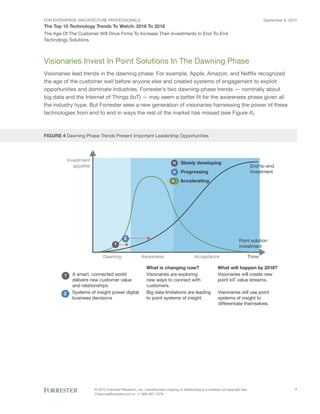
Visionaries lead trends in the dawning phase. For example, Apple, Amazon, and Netflix recognized
the age of the customer well before anyone else and created systems of engagement to exploit
opportunities and dominate industries. Forrester’s two dawning-phase trends — nominally about
big data and the Internet of Things (IoT) — may seem a better fit for the awareness phase given all
the industry hype. But Forrester sees a new generation of visionaries harnessing the power of these
technologies from end to end in ways the rest of the market has missed (see Figure 4).
FIGURE 4 Dawning Phase Trends Present Important Leadership Opportunities
End-to-end
investment
Point solution
investment
Investment
appetite
TimeDawning Awareness Acceptance
1
2
2
1 A smart, connected world
delivers new customer value
and relationships
What is changing now? What will happen by 2018?
Visionaries are exploring
new ways to connect with
customers.
Visionaries will create new
point IoT value streams.
Big data limitations are leading
to point systems of insight.
Visionaries will use point
systems of insight to
differentiate themselves.
Systems of insight power digital
business decisions
n
n
n
Slowly developing
Progressing
Accelerating
FOR ENTERPRISE ARCHITECTURE PROFESSIONALS
The Top 10 Technology Trends To Watch: 2016 To 2018
September 8, 2015
© 2015 Forrester Research, Inc. Unauthorized copying or distributing is a violation of copyright law.
Citations@forrester.com or +1 866-367-7378
8
The Age Of The Customer Will Drive Firms To Increase Their Investments In End-To-End
Technology Solutions
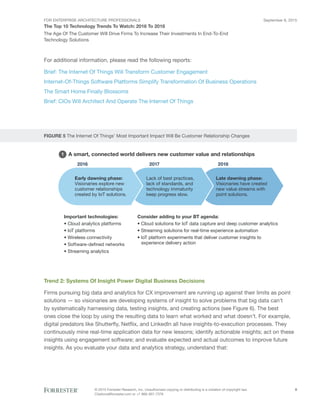
Trend 1: A Smart, Connected World Delivers New Customer Value And Relationships
Sensor-enabled smart products are transforming the relationship between companies and buyers;
businesses and consumers expect more interactive, value-added experiences from everything they
buy. But it’s early in the dawning phase of the IoT, and most firms don’t yet understand that smart
connected objects create ongoing customer relationships rather than one-time transactions (see Figure
5).6
Firms can no longer “sell and forget.” Visionary firms will disrupt industries as they create two-
way relationships that offer more value and yield deeper insights into customer needs. Tesla Motors
regularly improves CX via over-the-air software updates to its Model S car. We see that:
›› Firms are creating smart connected products. Industrial firms like General Electric (GE) and
John Deere are making or retrofitting machinery and assets to use the IoT to improve efficiency and
reduce downtime.7
Consumer goods manufacturers such as Crock-Pot and Nest offer products
that transform the user experience with convenience and service.8
›› Marketing, CX, and sales seek deeper insights from device data. Early in the dawning phase
of the IoT, most front-office execs remain deeply mired in organizational issues around more basic
digital initiatives. While they vaguely sense the opportunity, they cannot imagine how to turn high-
velocity device data into real-time customer insights in an effective way throughout the customer
life cycle.
›› Visionary firms will innovate to find new value in end-to-end IoT solutions. IoT projects can get
bogged down in operational issues with connected devices. Visionaries will solve these problems
by recognizing the potential in end-to-end solutions and making well-timed investments. For
example, Tesla will have a valuable digital asset when it learns how to use data from connected
cars to upsell at trade-in time.
EA Must Help With The Business Plan To Deal With End-To-End IoT Complexity
The market will remain in the dawning phase of this trend for the next three years, but enterprise
architects can help push their business ahead by:
›› Engaging with the product and operations organizations. Data and insights from devices
need to flow into enterprise systems and vice versa. EA can create insights services and add
connectivity and insight to customer support software to meet rising customer expectations.
›› Framing end-to-end benefits in terms of age-of-the-customer priorities. Help business leaders
justify investments in end-to-end IoT solutions by focusing on customer benefits. Use revenue,
growth, and CX improvements as levers to keep projects from stalling due to operational problems
such as unanticipated tech support needs for connected products.
›› Finding customer data capture and insight opportunities. Take apart your firm’s IoT plans and
identify points for capturing customer data and inserting insights. Use these to guide technology
decisions that take customer knowledge into account and improve CX.
FOR ENTERPRISE ARCHITECTURE PROFESSIONALS
The Top 10 Technology Trends To Watch: 2016 To 2018
September 8, 2015
© 2015 Forrester Research, Inc. Unauthorized copying or distributing is a violation of copyright law.
Citations@forrester.com or +1 866-367-7378
9
The Age Of The Customer Will Drive Firms To Increase Their Investments In End-To-End
Technology Solutions
Trend 2: Systems Of Insight Power Digital Business Decisions
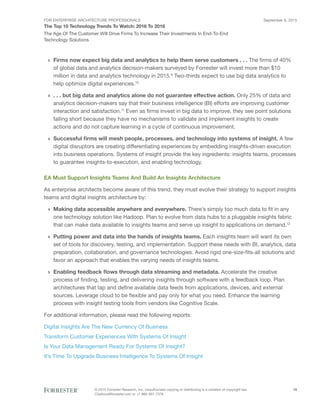
Firms pursuing big data and analytics for CX improvement are running up against their limits as point
solutions — so visionaries are developing systems of insight to solve problems that big data can’t
by systematically harnessing data, testing insights, and creating actions (see Figure 6). The best
ones close the loop by using the resulting data to learn what worked and what doesn’t. For example,
digital predators like Shutterfly, Netflix, and LinkedIn all have insights-to-execution processes. They
continuously mine real-time application data for new lessons; identify actionable insights; act on these
insights using engagement software; and evaluate expected and actual outcomes to improve future
insights. As you evaluate your data and analytics strategy, understand that:
For additional information, please read the following reports:
Brief: The Internet Of Things Will Transform Customer Engagement
Internet-Of-Things Software Platforms Simplify Transformation Of Business Operations
The Smart Home Finally Blossoms
Brief: CIOs Will Architect And Operate The Internet Of Things
FIGURE 5 The Internet Of Things’ Most Important Impact Will Be Customer Relationship Changes
A smart, connected world delivers new customer value and relationships
2016 2017 2018
Early dawning phase:
Visionaries explore new
customer relationships
created by IoT solutions.
Lack of best practices,
lack of standards, and
technology immaturity
keep progress slow.
Late dawning phase:
Visionaries have created
new value streams with
point solutions.
Important technologies:
• Cloud analytics platforms
• IoT platforms
• Wireless connectivity
• Software-defined networks
• Streaming analytics
Consider adding to your BT agenda:
• Cloud solutions for IoT data capture and deep customer analytics
• Streaming solutions for real-time experience automation
• IoT platform experiments that deliver customer insights to
experience delivery action
1
FOR ENTERPRISE ARCHITECTURE PROFESSIONALS
The Top 10 Technology Trends To Watch: 2016 To 2018
September 8, 2015
© 2015 Forrester Research, Inc. Unauthorized copying or distributing is a violation of copyright law.
Citations@forrester.com or +1 866-367-7378
10
The Age Of The Customer Will Drive Firms To Increase Their Investments In End-To-End
Technology Solutions
›› Firms now expect big data and analytics to help them serve customers . . . The firms of 40%
of global data and analytics decision-makers surveyed by Forrester will invest more than $10
million in data and analytics technology in 2015.9
Two-thirds expect to use big data analytics to
help optimize digital experiences.10
›› . . . but big data and analytics alone do not guarantee effective action. Only 25% of data and
analytics decision-makers say that their business intelligence (BI) efforts are improving customer
interaction and satisfaction.11
Even as firms invest in big data to improve, they see point solutions
falling short because they have no mechanisms to validate and implement insights to create
actions and do not capture learning in a cycle of continuous improvement.
›› Successful firms will mesh people, processes, and technology into systems of insight. A few
digital disruptors are creating differentiating experiences by embedding insights-driven execution
into business operations. Systems of insight provide the key ingredients: insights teams, processes
to guarantee insights-to-execution, and enabling technology.
EA Must Support Insights Teams And Build An Insights Architecture
As enterprise architects become aware of this trend, they must evolve their strategy to support insights
teams and digital insights architecture by:
›› Making data accessible anywhere and everywhere. There’s simply too much data to fit in any
one technology solution like Hadoop. Plan to evolve from data hubs to a pluggable insights fabric
that can make data available to insights teams and serve up insight to applications on demand.12
›› Putting power and data into the hands of insights teams. Each insights team will want its own
set of tools for discovery, testing, and implementation. Support these needs with BI, analytics, data
preparation, collaboration, and governance technologies. Avoid rigid one-size-fits-all solutions and
favor an approach that enables the varying needs of insights teams.
›› Enabling feedback flows through data streaming and metadata. Accelerate the creative
process of finding, testing, and delivering insights through software with a feedback loop. Plan
architectures that tap and define available data feeds from applications, devices, and external
sources. Leverage cloud to be flexible and pay only for what you need. Enhance the learning
process with insight testing tools from vendors like Cognitive Scale.
For additional information, please read the following reports:
Digital Insights Are The New Currency Of Business
Transform Customer Experiences With Systems Of Insight
Is Your Data Management Ready For Systems Of Insight?
It’s Time To Upgrade Business Intelligence To Systems Of Insight
FOR ENTERPRISE ARCHITECTURE PROFESSIONALS
The Top 10 Technology Trends To Watch: 2016 To 2018
September 8, 2015
© 2015 Forrester Research, Inc. Unauthorized copying or distributing is a violation of copyright law.
Citations@forrester.com or +1 866-367-7378
11
The Age Of The Customer Will Drive Firms To Increase Their Investments In End-To-End
Technology Solutions
FIGURE 6 Firms Will Turns To Systems Of Insight To Overcome Big Data Limitations
Systems of insight power digital business decisions
2016 2017 2018
Late dawning phase:
Firms reach the limits of
siloed big data and analytics.
Visionaries build point
systems of insight.
Visionary firms
demonstrate disruption
and drive more digital
business decisions with
real-time insight.
Mid-awareness phase:
Point solutions peak as a
lack of coordination works
against enterprise strategy.
Important technologies:
• Predictive analytics
• Big data management, data hubs
• Data virtualization
• APIs for insights services
• Business rules engines
• Streaming analytics
Consider adding to your BT agenda:
• Building an insights fabric
• Creating a set of insights services
• Enabling a data science workbench and plugging into a data lake
• Piloting the insights team concept to impact CX outcomes
• Cross-training agile DevOps and data science teams
2
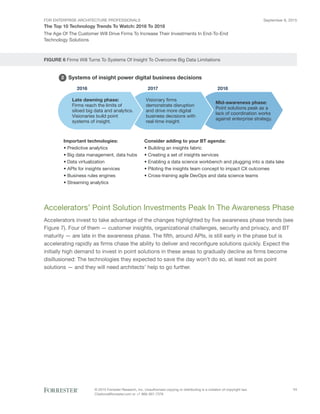
Accelerators’ Point Solution Investments Peak In The Awareness Phase
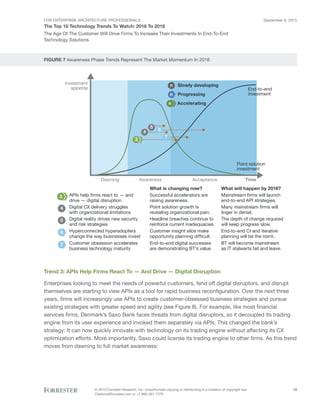
Accelerators invest to take advantage of the changes highlighted by five awareness phase trends (see
Figure 7). Four of them — customer insights, organizational challenges, security and privacy, and BT
maturity — are late in the awareness phase. The fifth, around APIs, is still early in the phase but is
accelerating rapidly as firms chase the ability to deliver and reconfigure solutions quickly. Expect the
initially high demand to invest in point solutions in these areas to gradually decline as firms become
disillusioned: The technologies they expected to save the day won’t do so, at least not as point
solutions — and they will need architects’ help to go further.
FOR ENTERPRISE ARCHITECTURE PROFESSIONALS
The Top 10 Technology Trends To Watch: 2016 To 2018
September 8, 2015
© 2015 Forrester Research, Inc. Unauthorized copying or distributing is a violation of copyright law.
Citations@forrester.com or +1 866-367-7378
12
The Age Of The Customer Will Drive Firms To Increase Their Investments In End-To-End
Technology Solutions
FIGURE 7 Awareness Phase Trends Represent The Market Momentum In 2016
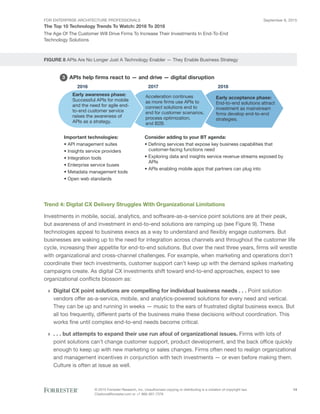
Trend 3: APIs Help Firms React To — And Drive — Digital Disruption
Enterprises looking to meet the needs of powerful customers, fend off digital disruptors, and disrupt
themselves are starting to view APIs as a tool for rapid business reconfiguration. Over the next three
years, firms will increasingly use APIs to create customer-obsessed business strategies and pursue
existing strategies with greater speed and agility (see Figure 8). For example, like most financial
services firms, Denmark’s Saxo Bank faces threats from digital disruptors, so it decoupled its trading
engine from its user experience and invoked them separately via APIs. This changed the bank’s
strategy: It can now quickly innovate with technology on its trading engine without affecting its CX
optimization efforts. More importantly, Saxo could license its trading engine to other firms. As this trend
moves from dawning to full market awareness:
End-to-end
investment
Point solution
investment
Investment
appetite
TimeDawning Awareness Acceptance
What is changing now? What will happen by 2018?
Successful accelerators are
raising awareness.
Mainstream firms will launch
end-to-end API strategies.
Point solution growth is
revealing organizational pain.
Many mainstream firms will
linger in denial.
Digital CX delivery struggles
with organizational limitations
APIs help firms react to — and
drive — digital disruption
4
5
Hyperconnected hyperadopters
change the way businesses invest
Digital reality drives new security
and risk strategies
Customer obsession accelerates
business technology maturity
Customer insight silos make
opportunity planning difficult.
End-to-end digital successes
are demonstrating BT’s value.
Headline breaches continue to
reinforce current inadequacies.
The depth of change required
will keep progress slow.
End-to-end CI and iterative
planning will be the norm.
BT will become mainstream
as IT stalwarts fail and leave.
3
3
4 6
7
5
6
7
n
n
n
Slowly developing
Progressing
Accelerating
FOR ENTERPRISE ARCHITECTURE PROFESSIONALS
The Top 10 Technology Trends To Watch: 2016 To 2018
September 8, 2015
© 2015 Forrester Research, Inc. Unauthorized copying or distributing is a violation of copyright law.
Citations@forrester.com or +1 866-367-7378
13
The Age Of The Customer Will Drive Firms To Increase Their Investments In End-To-End
Technology Solutions
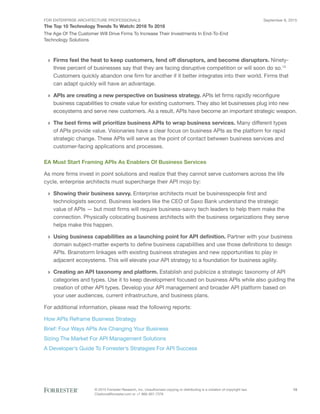
›› Firms feel the heat to keep customers, fend off disruptors, and become disruptors. Ninety-
three percent of businesses say that they are facing disruptive competition or will soon do so.13
Customers quickly abandon one firm for another if it better integrates into their world. Firms that
can adapt quickly will have an advantage.
›› APIs are creating a new perspective on business strategy. APIs let firms rapidly reconfigure
business capabilities to create value for existing customers. They also let businesses plug into new
ecosystems and serve new customers. As a result, APIs have become an important strategic weapon.
›› The best firms will prioritize business APIs to wrap business services. Many different types
of APIs provide value. Visionaries have a clear focus on business APIs as the platform for rapid
strategic change. These APIs will serve as the point of contact between business services and
customer-facing applications and processes.
EA Must Start Framing APIs As Enablers Of Business Services
As more firms invest in point solutions and realize that they cannot serve customers across the life
cycle, enterprise architects must supercharge their API mojo by:
›› Showing their business savvy. Enterprise architects must be businesspeople first and
technologists second. Business leaders like the CEO of Saxo Bank understand the strategic
value of APIs — but most firms will require business-savvy tech leaders to help them make the
connection. Physically colocating business architects with the business organizations they serve
helps make this happen.
›› Using business capabilities as a launching point for API definition. Partner with your business
domain subject-matter experts to define business capabilities and use those definitions to design
APIs. Brainstorm linkages with existing business strategies and new opportunities to play in
adjacent ecosystems. This will elevate your API strategy to a foundation for business agility.
›› Creating an API taxonomy and platform. Establish and publicize a strategic taxonomy of API
categories and types. Use it to keep development focused on business APIs while also guiding the
creation of other API types. Develop your API management and broader API platform based on
your user audiences, current infrastructure, and business plans.
For additional information, please read the following reports:
How APIs Reframe Business Strategy
Brief: Four Ways APIs Are Changing Your Business
Sizing The Market For API Management Solutions
A Developer’s Guide To Forrester’s Strategies For API Success
FOR ENTERPRISE ARCHITECTURE PROFESSIONALS
The Top 10 Technology Trends To Watch: 2016 To 2018
September 8, 2015
© 2015 Forrester Research, Inc. Unauthorized copying or distributing is a violation of copyright law.
Citations@forrester.com or +1 866-367-7378
14
The Age Of The Customer Will Drive Firms To Increase Their Investments In End-To-End
Technology Solutions
FIGURE 8 APIs Are No Longer Just A Technology Enabler — They Enable Business Strategy
APIs help firms react to — and drive — digital disruption3
2016 2017 2018
Early awareness phase:
Successful APIs for mobile
and the need for agile end-
to-end customer service
raises the awareness of
APIs as a strategy.
Acceleration continues
as more firms use APIs to
connect solutions end to
end for customer scenarios,
process optimization,
and B2B.
Early acceptance phase:
End-to-end solutions attract
investment as mainstream
firms develop end-to-end
strategies.
Important technologies:
• API management suites
• Insights service providers
• Integration tools
• Enterprise service buses
• Metadata management tools
• Open web standards
Consider adding to your BT agenda:
• Defining services that expose key business capabilities that
customer-facing functions need
• Exploring data and insights service revenue streams exposed by
APIs
• APIs enabling mobile apps that partners can plug into
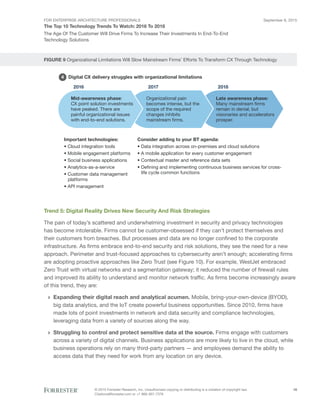
Trend 4: Digital CX Delivery Struggles With Organizational Limitations
Investments in mobile, social, analytics, and software-as-a-service point solutions are at their peak,
but awareness of and investment in end-to-end solutions are ramping up (see Figure 9). These
technologies appeal to business execs as a way to understand and flexibly engage customers. But
businesses are waking up to the need for integration across channels and throughout the customer life
cycle, increasing their appetite for end-to-end solutions. But over the next three years, firms will wrestle
with organizational and cross-channel challenges. For example, when marketing and operations don’t
coordinate their tech investments, customer support can’t keep up with the demand spikes marketing
campaigns create. As digital CX investments shift toward end-to-end approaches, expect to see
organizational conflicts blossom as:
›› Digital CX point solutions are compelling for individual business needs . . . Point solution
vendors offer as-a-service, mobile, and analytics-powered solutions for every need and vertical.
They can be up and running in weeks — music to the ears of frustrated digital business execs. But
all too frequently, different parts of the business make these decisions without coordination. This
works fine until complex end-to-end needs become critical.
›› . . . but attempts to expand their use run afoul of organizational issues. Firms with lots of
point solutions can’t change customer support, product development, and the back office quickly
enough to keep up with new marketing or sales changes. Firms often need to realign organizational
and management incentives in conjunction with tech investments — or even before making them.
Culture is often at issue as well.
FOR ENTERPRISE ARCHITECTURE PROFESSIONALS
The Top 10 Technology Trends To Watch: 2016 To 2018
September 8, 2015
© 2015 Forrester Research, Inc. Unauthorized copying or distributing is a violation of copyright law.
Citations@forrester.com or +1 866-367-7378
15
The Age Of The Customer Will Drive Firms To Increase Their Investments In End-To-End
Technology Solutions
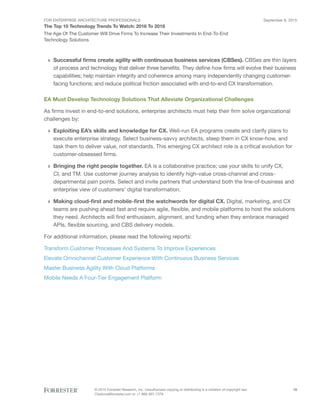
›› Successful firms create agility with continuous business services (CBSes). CBSes are thin layers
of process and technology that deliver three benefits. They define how firms will evolve their business
capabilities; help maintain integrity and coherence among many independently changing customer-
facing functions; and reduce political friction associated with end-to-end CX transformation.
EA Must Develop Technology Solutions That Alleviate Organizational Challenges
As firms invest in end-to-end solutions, enterprise architects must help their firm solve organizational
challenges by:
›› Exploiting EA’s skills and knowledge for CX. Well-run EA programs create and clarify plans to
execute enterprise strategy. Select business-savvy architects, steep them in CX know-how, and
task them to deliver value, not standards. This emerging CX architect role is a critical evolution for
customer-obsessed firms.
›› Bringing the right people together. EA is a collaborative practice; use your skills to unify CX,
CI, and TM. Use customer journey analysis to identify high-value cross-channel and cross-
departmental pain points. Select and invite partners that understand both the line-of-business and
enterprise view of customers’ digital transformation.
›› Making cloud-first and mobile-first the watchwords for digital CX. Digital, marketing, and CX
teams are pushing ahead fast and require agile, flexible, and mobile platforms to host the solutions
they need. Architects will find enthusiasm, alignment, and funding when they embrace managed
APIs, flexible sourcing, and CBS delivery models.
For additional information, please read the following reports:
Transform Customer Processes And Systems To Improve Experiences
Elevate Omnichannel Customer Experience With Continuous Business Services
Master Business Agility With Cloud Platforms
Mobile Needs A Four-Tier Engagement Platform
FOR ENTERPRISE ARCHITECTURE PROFESSIONALS
The Top 10 Technology Trends To Watch: 2016 To 2018
September 8, 2015
© 2015 Forrester Research, Inc. Unauthorized copying or distributing is a violation of copyright law.
Citations@forrester.com or +1 866-367-7378
16
The Age Of The Customer Will Drive Firms To Increase Their Investments In End-To-End
Technology Solutions
FIGURE 9 Organizational Limitations Will Slow Mainstream Firms’ Efforts To Transform CX Through Technology
5
2016 2017 2018
Mid-awareness phase:
CX point solution investments
have peaked. There are
painful organizational issues
with end-to-end solutions.
Organizational pain
becomes intense, but the
scope of the required
changes inhibits
mainstream firms.
Late awareness phase:
Many mainstream firms
remain in denial, but
visionaries and accelerators
prosper.
Important technologies:
• Cloud integration tools
• Mobile engagement platforms
• Social business applications
• Analytics-as-a-service
• Customer data management
platforms
• API management
Consider adding to your BT agenda:
• Data integration across on-premises and cloud solutions
• A mobile application for every customer engagement
• Contextual master and reference data sets
• Defining and implementing continuous business services for cross-
life cycle common functions
4 Digital CX delivery struggles with organizational limitations
Trend 5: Digital Reality Drives New Security And Risk Strategies
The pain of today’s scattered and underwhelming investment in security and privacy technologies
has become intolerable. Firms cannot be customer-obsessed if they can’t protect themselves and
their customers from breaches. But processes and data are no longer confined to the corporate
infrastructure. As firms embrace end-to-end security and risk solutions, they see the need for a new
approach. Perimeter and trust-focused approaches to cybersecurity aren’t enough; accelerating firms
are adopting proactive approaches like Zero Trust (see Figure 10). For example, WestJet embraced
Zero Trust with virtual networks and a segmentation gateway; it reduced the number of firewall rules
and improved its ability to understand and monitor network traffic. As firms become increasingly aware
of this trend, they are:
›› Expanding their digital reach and analytical acumen. Mobile, bring-your-own-device (BYOD),
big data analytics, and the IoT create powerful business opportunities. Since 2010, firms have
made lots of point investments in network and data security and compliance technologies,
leveraging data from a variety of sources along the way.
›› Struggling to control and protect sensitive data at the source. Firms engage with customers
across a variety of digital channels. Business applications are more likely to live in the cloud, while
business operations rely on many third-party partners — and employees demand the ability to
access data that they need for work from any location on any device.
FOR ENTERPRISE ARCHITECTURE PROFESSIONALS
The Top 10 Technology Trends To Watch: 2016 To 2018
September 8, 2015
© 2015 Forrester Research, Inc. Unauthorized copying or distributing is a violation of copyright law.
Citations@forrester.com or +1 866-367-7378
17
The Age Of The Customer Will Drive Firms To Increase Their Investments In End-To-End
Technology Solutions
›› Embracing metrics that focus on data use and culture. Firms can’t afford to view security and
privacy in terms of risk reduction, cost reduction, and regulatory compliance anymore. Leaders
view it as a competitive differentiator and aspire to monitor everything, trust nothing, and intercept
problems in real time. They also embrace cultural change by positioning security and privacy as a
corporate social responsibility.
EA Must Develop A Zero Trust Road Map
As firms move to embrace data protection as a corporate social responsibility and treat data security
and privacy as a competitive differentiator, enterprise architects must understand and prepare for the
depth of change required by:
›› Architecting networks based on Zero Trust concepts. Forrester’s Zero Trust model of
information security eliminates the idea of a trusted internal network and an untrusted external
network.14
Today, it’s easier to build a Zero Trust network thanks to three tech innovations: next-
generation firewalls, virtual network infrastructure, and network orchestration solutions.15
›› Defining your firm’s sensitive data. Data-centric controls and the Zero Trust model start with the
data. You cannot expect to protect data if you don’t know what data exists, where it resides, who
can use it, and what value it has to the organization. Data discovery and classification is not an
effort for EA alone — it’s an organizationwide initiative.16
›› Understanding that technology and compliance alone is not enough. A firm that meets security
compliance requirements is not necessarily secure.17
Data security can exist without privacy, but
privacy cannot exist without security.18
Data governance and stewardship are just as important as
technology controls for data protection.
For additional information, please read the following reports:
Top Security And Risk Priorities For The Business Technology Agenda
Three Technical Innovations Will Ignite Zero Trust
Top 11 Trends S&R Pros Should Watch: 2015
The Future Of Mobile Security: Securing The Mobile Moment
FOR ENTERPRISE ARCHITECTURE PROFESSIONALS
The Top 10 Technology Trends To Watch: 2016 To 2018
September 8, 2015
© 2015 Forrester Research, Inc. Unauthorized copying or distributing is a violation of copyright law.
Citations@forrester.com or +1 866-367-7378
18
The Age Of The Customer Will Drive Firms To Increase Their Investments In End-To-End
Technology Solutions
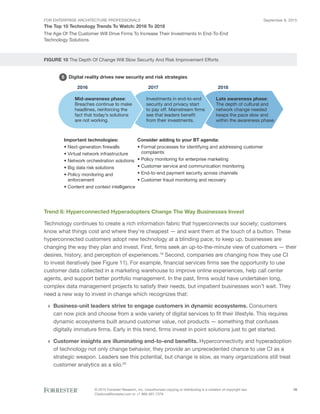
FIGURE 10 The Depth Of Change Will Slow Security And Risk Improvement Efforts
5
2016 2018
Mid-awareness phase:
Breaches continue to make
headlines, reinforcing the
fact that today’s solutions
are not working.
Investments in end-to-end
security and privacy start
to pay off. Mainstream firms
see that leaders benefit
from their investments.
Late awareness phase:
The depth of cultural and
network change needed
keeps the pace slow and
within the awareness phase.
Important technologies:
• Next-generation firewalls
• Virtual network infrastructure
• Network orchestration solutions
• Big data risk solutions
• Policy monitoring and
enforcement
• Content and context intelligence
Consider adding to your BT agenda:
• Formal processes for identifying and addressing customer
complaints
• Policy monitoring for enterprise marketing
• Customer service and communication monitoring
• End-to-end payment security across channels
• Customer fraud monitoring and recovery
2 Digital reality drives new security and risk strategies5
2017
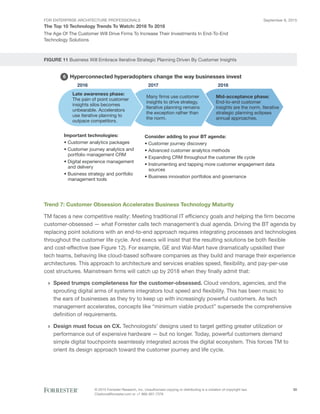
Trend 6: Hyperconnected Hyperadopters Change The Way Businesses Invest
Technology continues to create a rich information fabric that hyperconnects our society; customers
know what things cost and where they’re cheapest — and want them at the touch of a button. These
hyperconnected customers adopt new technology at a blinding pace; to keep up, businesses are
changing the way they plan and invest. First, firms seek an up-to-the-minute view of customers — their
desires, history, and perception of experiences.19
Second, companies are changing how they use CI
to invest iteratively (see Figure 11). For example, financial services firms see the opportunity to use
customer data collected in a marketing warehouse to improve online experiences, help call center
agents, and support better portfolio management. In the past, firms would have undertaken long,
complex data management projects to satisfy their needs, but impatient businesses won’t wait. They
need a new way to invest in change which recognizes that:
›› Business-unit leaders strive to engage customers in dynamic ecosystems. Consumers
can now pick and choose from a wide variety of digital services to fit their lifestyle. This requires
dynamic ecosystems built around customer value, not products — something that confuses
digitally immature firms. Early in this trend, firms invest in point solutions just to get started.
›› Customer insights are illuminating end-to-end benefits. Hyperconnectivity and hyperadoption
of technology not only change behavior, they provide an unprecedented chance to use CI as a
strategic weapon. Leaders see this potential, but change is slow, as many organizations still treat
customer analytics as a silo.20
FOR ENTERPRISE ARCHITECTURE PROFESSIONALS
The Top 10 Technology Trends To Watch: 2016 To 2018
September 8, 2015
© 2015 Forrester Research, Inc. Unauthorized copying or distributing is a violation of copyright law.
Citations@forrester.com or +1 866-367-7378
19
The Age Of The Customer Will Drive Firms To Increase Their Investments In End-To-End
Technology Solutions
›› Leaders will disrupt their planning and investment. As this trend progresses, firms will abandon
rigid annual planning and organizational silos to respond to changing customer needs. They will
quickly iterate on opportunities that deliver end-to-end customer value and use up-to-the-minute
CI to better understand which initiatives deliver value — so they can more easily abandon the less
valuable ones.
EA Must Make Customer Insight And Agile Planning The Centerpiece Of Strategy
As businesses demand more end-to-end capabilities to participate in evolving ecosystems with deep,
rich CI, enterprise architects must flip their point of view from inside-out to outside-in by:
›› Mapping business capabilities to current- and future-state customer journeys. Business
capability maps are a common tool for architecture planning, but they can create inside-out
strategies. Journey maps create an outside-in view, but tend to focus on the current state. Help
your firm define future-state journey maps and use business capabilities to define enterprise gaps.
›› Helping extend CI across the customer life cycle. Traditional approaches to customer analytics
focus on specific inside-out objectives — like marketing campaign ROI. But a new breed of CI
professionals is driving rich insights throughout the customer life cycle, shifting focus to customer
value and profitability.
›› Elevating portfolio management to iterative strategic business planning. Technology managers
have been managing tech investment and innovation portfolios for years. Now is the time to apply
these skills and technologies to help your business manage its end-to-end digital investments.
For additional information, please read the following reports:
The Future Of Business Is Digital
Understand The Digital Business Landscape
Revamp Strategic Planning From The Outside In
Turn Data Into Intelligence With Customer Analytics
FOR ENTERPRISE ARCHITECTURE PROFESSIONALS
The Top 10 Technology Trends To Watch: 2016 To 2018
September 8, 2015
© 2015 Forrester Research, Inc. Unauthorized copying or distributing is a violation of copyright law.
Citations@forrester.com or +1 866-367-7378
20
The Age Of The Customer Will Drive Firms To Increase Their Investments In End-To-End
Technology Solutions
FIGURE 11 Business Will Embrace Iterative Strategic Planning Driven By Customer Insights
Hyperconnected hyperadopters change the way businesses invest
2016 2017 2018
Late awareness phase:
The pain of point customer
insights silos becomes
unbearable. Accelerators
use iterative planning to
outpace competitors.
Many firms use customer
insights to drive strategy.
Iterative planning remains
the exception rather than
the norm.
Mid-acceptance phase:
End-to-end customer
insights are the norm. Iterative
strategic planning eclipses
annual approaches.
Important technologies:
• Customer analytics packages
• Customer journey analytics and
portfolio management CRM
• Digital experience management
and delivery
• Business strategy and portfolio
management tools
Consider adding to your BT agenda:
• Customer journey discovery
• Advanced customer analytics methods
• Expanding CRM throughout the customer life cycle
• Instrumenting and tapping more customer engagement data
sources
• Business innovation portfolios and governance
6
Trend 7: Customer Obsession Accelerates Business Technology Maturity
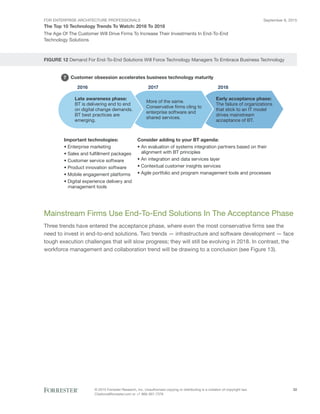
TM faces a new competitive reality: Meeting traditional IT efficiency goals and helping the firm become
customer-obsessed — what Forrester calls tech management’s dual agenda. Driving the BT agenda by
replacing point solutions with an end-to-end approach requires integrating processes and technologies
throughout the customer life cycle. And execs will insist that the resulting solutions be both flexible
and cost-effective (see Figure 12). For example, GE and Wal-Mart have dramatically upskilled their
tech teams, behaving like cloud-based software companies as they build and manage their experience
architectures. This approach to architecture and services enables speed, flexibility, and pay-per-use
cost structures. Mainstream firms will catch up by 2018 when they finally admit that:
›› Speed trumps completeness for the customer-obsessed. Cloud vendors, agencies, and the
sprouting digital arms of systems integrators tout speed and flexibility. This has been music to
the ears of businesses as they try to keep up with increasingly powerful customers. As tech
management accelerates, concepts like “minimum viable product” supersede the comprehensive
definition of requirements.
›› Design must focus on CX. Technologists’ designs used to target getting greater utilization or
performance out of expensive hardware — but no longer. Today, powerful customers demand
simple digital touchpoints seamlessly integrated across the digital ecosystem. This forces TM to
orient its design approach toward the customer journey and life cycle.
FOR ENTERPRISE ARCHITECTURE PROFESSIONALS
The Top 10 Technology Trends To Watch: 2016 To 2018
September 8, 2015
© 2015 Forrester Research, Inc. Unauthorized copying or distributing is a violation of copyright law.
Citations@forrester.com or +1 866-367-7378
21
The Age Of The Customer Will Drive Firms To Increase Their Investments In End-To-End
Technology Solutions
›› The BT agenda provides the systems and processes for customer obsession. To win in the
age of the customer, firms must adopt new capabilities such as customer-in design, continuous
delivery, fast-cycle governance, outcome management, and business service management. These
BT agenda items will help firms respond rapidly to changing customer and market realities.
EA Must Start From The Customer And Work Back To The Architecture
As firms’ ability to execute the BT agenda improves, enterprise architects must learn to deliver
customer value quickly by:
›› Using engagement patterns to fuel innovation pipelines. Look for patterns of customer
engagement across journey maps and mobile platforms. Use your firm’s insight into customer
habits and translate these into ideas for testing in innovation programs.
›› Designing and prototyping a combination of CBSes and APIs. Prove that APIs and CBSes
can work together as a power tool to deliver customer obsession. Identify a common capability
that serves several customer engagement scenarios. Prototype the delivery of functions as a
CBS sitting atop business APIs. Show how to easily reconfigure systems of engagement without
touching core systems of record.
›› Using customer life cycles and journey maps to build your technology watchlist. Use your
firm’s customer life cycle and journey maps to identify new technologies for your BT agenda
instead of traditional IT taxonomies. Discuss opportunities to solve customer pain points or
connect experiences across journeys.
For additional information, please read the following reports:
The CIO Mandate: Engaging Customers With Business Technology
CIOs, CX, And End-To-End Tech Management
Time For Integrated Strategic Planning
Re-Architect Your Business Capabilities To Win In The Age Of The Customer
FOR ENTERPRISE ARCHITECTURE PROFESSIONALS
The Top 10 Technology Trends To Watch: 2016 To 2018
September 8, 2015
© 2015 Forrester Research, Inc. Unauthorized copying or distributing is a violation of copyright law.
Citations@forrester.com or +1 866-367-7378
22
The Age Of The Customer Will Drive Firms To Increase Their Investments In End-To-End
Technology Solutions
FIGURE 12 Demand For End-To-End Solutions Will Force Technology Managers To Embrace Business Technology
2016 2017 2018
Late awareness phase:
BT is delivering end to end
on digital change demands.
BT best practices are
emerging.
More of the same.
Conservative firms cling to
enterprise software and
shared services.
Early acceptance phase:
The failure of organizations
that stick to an IT model
drives mainstream
acceptance of BT.
Important technologies:
• Enterprise marketing
• Sales and fulfillment packages
• Customer service software
• Product innovation software
• Mobile engagement platforms
• Digital experience delivery and
management tools
Consider adding to your BT agenda:
• An evaluation of systems integration partners based on their
alignment with BT principles
• An integration and data services layer
• Contextual customer insights services
• Agile portfolio and program management tools and processes
Customer obsession accelerates business technology maturity7
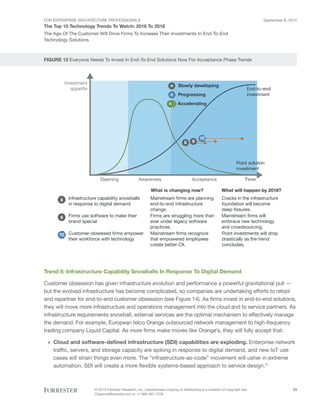
Mainstream Firms Use End-To-End Solutions In The Acceptance Phase
Three trends have entered the acceptance phase, where even the most conservative firms see the
need to invest in end-to-end solutions. Two trends — infrastructure and software development — face
tough execution challenges that will slow progress; they will still be evolving in 2018. In contrast, the
workforce management and collaboration trend will be drawing to a conclusion (see Figure 13).
FOR ENTERPRISE ARCHITECTURE PROFESSIONALS
The Top 10 Technology Trends To Watch: 2016 To 2018
September 8, 2015
© 2015 Forrester Research, Inc. Unauthorized copying or distributing is a violation of copyright law.
Citations@forrester.com or +1 866-367-7378
23
The Age Of The Customer Will Drive Firms To Increase Their Investments In End-To-End
Technology Solutions
FIGURE 13 Everyone Needs To Invest In End-To-End Solutions Now For Acceptance Phase Trends
Trend 8: Infrastructure Capability Snowballs In Response To Digital Demand
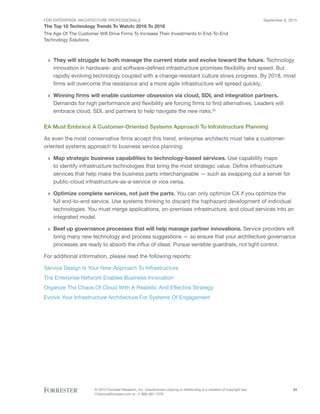
Customer obsession has given infrastructure evolution and performance a powerful gravitational pull —
but the evolved infrastructure has become complicated, so companies are undertaking efforts to retool
and repartner for end-to-end customer obsession (see Figure 14). As firms invest in end-to-end solutions,
they will move more infrastructure and operations management into the cloud and to service partners. As
infrastructure requirements snowball, external services are the optimal mechanism to effectively manage
the demand. For example, European telco Orange outsourced network management to high-frequency
trading company Liquid Capital. As more firms make moves like Orange’s, they will fully accept that:
›› Cloud and software-defined infrastructure (SDI) capabilities are exploding. Enterprise network
traffic, servers, and storage capacity are spiking in response to digital demand, and new IoT use
cases will strain things even more. The “infrastructure-as-code” movement will usher in extreme
automation. SDI will create a more flexible systems-based approach to service design.21
End-to-end
investment
Point solution
investment
Investment
appetite
TimeDawning Awareness Acceptance
What is changing now? What will happen by 2018?
Mainstream firms are planning
end-to-end infrastructure
change.
Cracks in the infrastructure
foundation will become
deep fissures.
Firms are struggling more than
ever under legacy software
practices.
Mainstream firms will
embrace new technology
and crowdsourcing.
Infrastructure capability snowballs
in response to digital demand
10
8
9 Firms use software to make their
brand special
Customer-obsessed firms empower
their workforce with technology
Mainstream firms recognize
that empowered employees
create better CX.
Point investments will drop
drastically as the trend
concludes.
10
8 9
n
n
n
Slowly developing
Progressing
Accelerating
FOR ENTERPRISE ARCHITECTURE PROFESSIONALS
The Top 10 Technology Trends To Watch: 2016 To 2018
September 8, 2015
© 2015 Forrester Research, Inc. Unauthorized copying or distributing is a violation of copyright law.
Citations@forrester.com or +1 866-367-7378
24
The Age Of The Customer Will Drive Firms To Increase Their Investments In End-To-End
Technology Solutions
›› They will struggle to both manage the current state and evolve toward the future. Technology
innovation in hardware- and software-defined infrastructure promises flexibility and speed. But
rapidly evolving technology coupled with a change-resistant culture slows progress. By 2018, most
firms will overcome this resistance and a more agile infrastructure will spread quickly.
›› Winning firms will enable customer obsession via cloud, SDI, and integration partners.
Demands for high performance and flexibility are forcing firms to find alternatives. Leaders will
embrace cloud, SDI, and partners to help navigate the new risks.22
EA Must Embrace A Customer-Oriented Systems Approach To Infrastructure Planning
As even the most conservative firms accept this trend, enterprise architects must take a customer-
oriented systems approach to business service planning:
›› Map strategic business capabilities to technology-based services. Use capability maps
to identify infrastructure technologies that bring the most strategic value. Define infrastructure
services that help make the business parts interchangeable — such as swapping out a server for
public-cloud infrastructure-as-a-service or vice versa.
›› Optimize complete services, not just the parts. You can only optimize CX if you optimize the
full end-to-end service. Use systems thinking to discard the haphazard development of individual
technologies. You must merge applications, on-premises infrastructure, and cloud services into an
integrated model.
›› Beef up governance processes that will help manage partner innovations. Service providers will
bring many new technology and process suggestions — so ensure that your architecture governance
processes are ready to absorb the influx of ideas. Pursue sensible guardrails, not tight control.
For additional information, please read the following reports:
Service Design Is Your New Approach To Infrastructure
The Enterprise Network Enables Business Innovation
Organize The Chaos Of Cloud With A Realistic And Effective Strategy
Evolve Your Infrastructure Architecture For Systems Of Engagement
FOR ENTERPRISE ARCHITECTURE PROFESSIONALS
The Top 10 Technology Trends To Watch: 2016 To 2018
September 8, 2015
© 2015 Forrester Research, Inc. Unauthorized copying or distributing is a violation of copyright law.
Citations@forrester.com or +1 866-367-7378
25
The Age Of The Customer Will Drive Firms To Increase Their Investments In End-To-End
Technology Solutions
FIGURE 14 Overly Conservative Firms Will Sink Under The Weight Of Their Infrastructure
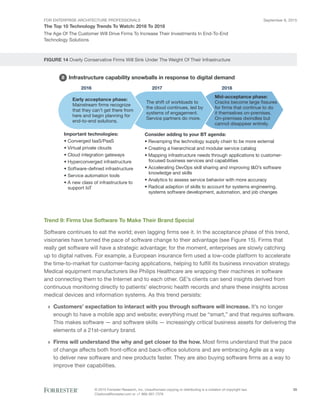
Trend 9: Firms Use Software To Make Their Brand Special
Software continues to eat the world; even lagging firms see it. In the acceptance phase of this trend,
visionaries have turned the pace of software change to their advantage (see Figure 15). Firms that
really get software will have a strategic advantage; for the moment, enterprises are slowly catching
up to digital natives. For example, a European insurance firm used a low-code platform to accelerate
the time-to-market for customer-facing applications, helping to fulfill its business innovation strategy.
Medical equipment manufacturers like Philips Healthcare are wrapping their machines in software
and connecting them to the Internet and to each other. GE’s clients can send insights derived from
continuous monitoring directly to patients’ electronic health records and share these insights across
medical devices and information systems. As this trend persists:
›› Customers’ expectation to interact with you through software will increase. It’s no longer
enough to have a mobile app and website; everything must be “smart,” and that requires software.
This makes software — and software skills — increasingly critical business assets for delivering the
elements of a 21st-century brand.
›› Firms will understand the why and get closer to the how. Most firms understand that the pace
of change affects both front-office and back-office solutions and are embracing Agile as a way
to deliver new software and new products faster. They are also buying software firms as a way to
improve their capabilities.
Infrastructure capability snowballs in response to digital demand
2016 2017 2018
Early acceptance phase:
Mainstream firms recognize
that they can’t get there from
here and begin planning for
end-to-end solutions.
The shift of workloads to
the cloud continues, led by
systems of engagement.
Service partners do more.
Mid-acceptance phase:
Cracks become large fissures
for firms that continue to do
it themselves on-premises.
On-premises dwindles but
cannot disappear entirely.
Important technologies:
• Converged IaaS/PaaS
• Virtual private clouds
• Cloud integration gateways
• Hyperconverged infrastructure
• Software-defined infrastructure
• Service automation tools
• A new class of infrastructure to
support IoT
Consider adding to your BT agenda:
• Revamping the technology supply chain to be more external
• Creating a hierarchical and modular service catalog
• Mapping infrastructure needs through applications to customer-
focused business services and capabilities
• Accelerating DevOps skill sharing and improving I&O’s software
knowledge and skills
• Analytics to assess service behavior with more accuracy
• Radical adaption of skills to account for systems engineering,
systems software development, automation, and job changes
8
FOR ENTERPRISE ARCHITECTURE PROFESSIONALS
The Top 10 Technology Trends To Watch: 2016 To 2018
September 8, 2015
© 2015 Forrester Research, Inc. Unauthorized copying or distributing is a violation of copyright law.
Citations@forrester.com or +1 866-367-7378
26
The Age Of The Customer Will Drive Firms To Increase Their Investments In End-To-End
Technology Solutions
›› Winners will use software to make their brands special. Software has the potential to make
your brand trusted, remarkable, unmistakable, and most importantly essential. But only if you have
the advanced software capabilities of the best firms. Digital leaders can release software 30 times a
day — a huge advantage for rapidly responding to customer needs.
EA Must Plan The Foundation For Continuous Delivery And Software Excellence
As mainstream companies continue to struggle, enterprise architects must help their firms break
out. Consider:
›› Defining the architecture of new business paradigms. Using software to enrich your brand is
not business as usual. For example, you will need new data-centric business models and more
granularly defined processes. Use your design skills to create artifacts that describe a compelling
future state.
›› Using Agile-plus-Architecture for effective implementation. Development teams need both
agility and strategic alignment, but this only works if firms embed architecture practices into their
Agile processes — what Forrester calls Agile-plus-Architecture. Aligning rapidly changing customer
strategies and budgets will take strong, flexible portfolio management.
›› Driving foundational investments in new development tools and talent. Firms that succeed
make process changes, but they also add new tooling. Low-code platforms, API management, and
Agile development tools will help your firm succeed. You will also need software talent in product
and service design.
For additional information, please read the following reports:
Software Must Enrich Your Brand
Customer Obsession Will Remake AD&D Tools And Supporting Technologies
Agile-Plus-Architecture: Embrace The Oxymoron
TechRadar™: Continuous Software Delivery, Q2 2015
New Development Platforms Emerge For Customer-Facing Applications
FOR ENTERPRISE ARCHITECTURE PROFESSIONALS
The Top 10 Technology Trends To Watch: 2016 To 2018
September 8, 2015
© 2015 Forrester Research, Inc. Unauthorized copying or distributing is a violation of copyright law.
Citations@forrester.com or +1 866-367-7378
27
The Age Of The Customer Will Drive Firms To Increase Their Investments In End-To-End
Technology Solutions
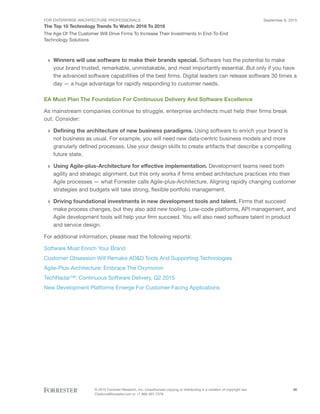
FIGURE 15 Mainstream Firms Will Make Slow Progress As New Technologies Come On Line
Firms use software to make their brand special5
2016 2017 2018
Early acceptance phase:
Firms struggle under the
burden of legacy software
practices, but change is very
painful.
Firms reinvent their
technology stack and
experiment with
continuous delivery.
Mid/late acceptance phase:
New API management, low-
code platforms, and
crowdsourcing help firms
make slow progress.
Important technologies:
• Continuous integration
• Application release automation
• Life-cycle integration
• Low-code platforms
• API management tools
Consider adding to your BT agenda:
• A platform featuring curated APIs for customer-facing application
functionality
• A low-code platform for customer-oriented innovation
• More SaaS and PaaS to reduce the burden associated with testing
customer-facing software
9
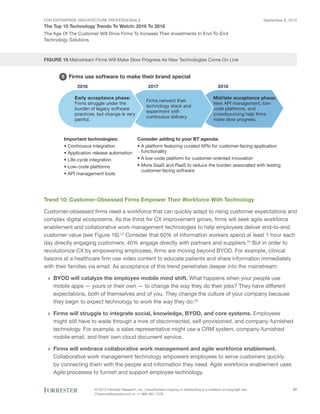
Trend 10: Customer-Obsessed Firms Empower Their Workforce With Technology
Customer-obsessed firms need a workforce that can quickly adapt to rising customer expectations and
complex digital ecosystems. As the thirst for CX improvement grows, firms will seek agile workforce
enablement and collaborative work management technologies to help employees deliver end-to-end
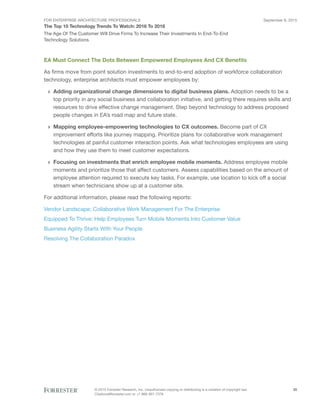
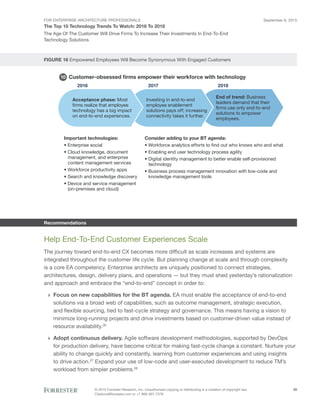
customer value (see Figure 16).23
Consider that 60% of information workers spend at least 1 hour each
day directly engaging customers; 40% engage directly with partners and suppliers.24
But in order to
revolutionize CX by empowering employees, firms are moving beyond BYOD. For example, clinical
liaisons at a healthcare firm use video content to educate patients and share information immediately
with their families via email. As acceptance of this trend penetrates deeper into the mainstream:
›› BYOD will catalyze the employee mobile mind shift. What happens when your people use
mobile apps — yours or their own — to change the way they do their jobs? They have different
expectations, both of themselves and of you. They change the culture of your company because
they begin to expect technology to work the way they do.25
›› Firms will struggle to integrate social, knowledge, BYOD, and core systems. Employees
might still have to wade through a mire of disconnected, self-provisioned, and company-furnished
technology. For example, a sales representative might use a CRM system, company-furnished
mobile email, and their own cloud document service.
›› Firms will embrace collaborative work management and agile workforce enablement.
Collaborative work management technology empowers employees to serve customers quickly
by connecting them with the people and information they need. Agile workforce enablement uses
Agile processes to furnish and support employee technology.
FOR ENTERPRISE ARCHITECTURE PROFESSIONALS
The Top 10 Technology Trends To Watch: 2016 To 2018
September 8, 2015
© 2015 Forrester Research, Inc. Unauthorized copying or distributing is a violation of copyright law.
Citations@forrester.com or +1 866-367-7378
28
The Age Of The Customer Will Drive Firms To Increase Their Investments In End-To-End
Technology Solutions
EA Must Connect The Dots Between Empowered Employees And CX Benefits
As firms move from point solution investments to end-to-end adoption of workforce collaboration
technology, enterprise architects must empower employees by:
›› Adding organizational change dimensions to digital business plans. Adoption needs to be a
top priority in any social business and collaboration initiative, and getting there requires skills and
resources to drive effective change management. Step beyond technology to address proposed
people changes in EA’s road map and future state.
›› Mapping employee-empowering technologies to CX outcomes. Become part of CX
improvement efforts like journey mapping. Prioritize plans for collaborative work management
technologies at painful customer interaction points. Ask what technologies employees are using
and how they use them to meet customer expectations.
›› Focusing on investments that enrich employee mobile moments. Address employee mobile
moments and prioritize those that affect customers. Assess capabilities based on the amount of
employee attention required to execute key tasks. For example, use location to kick off a social
stream when technicians show up at a customer site.
For additional information, please read the following reports:
Vendor Landscape: Collaborative Work Management For The Enterprise
Equipped To Thrive: Help Employees Turn Mobile Moments Into Customer Value
Business Agility Starts With Your People
Resolving The Collaboration Paradox
FOR ENTERPRISE ARCHITECTURE PROFESSIONALS
The Top 10 Technology Trends To Watch: 2016 To 2018
September 8, 2015
© 2015 Forrester Research, Inc. Unauthorized copying or distributing is a violation of copyright law.
Citations@forrester.com or +1 866-367-7378
29
The Age Of The Customer Will Drive Firms To Increase Their Investments In End-To-End
Technology Solutions
FIGURE 16 Empowered Employees Will Become Synonymous With Engaged Customers
Recommendations
Help End-To-End Customer Experiences Scale
The journey toward end-to-end CX becomes more difficult as scale increases and systems are
integrated throughout the customer life cycle. But planning change at scale and through complexity
is a core EA competency. Enterprise architects are uniquely positioned to connect strategies,
architectures, design, delivery plans, and operations — but they must shed yesterday’s rationalization
and approach and embrace the “end-to-end” concept in order to:
›› Focus on new capabilities for the BT agenda. EA must enable the acceptance of end-to-end
solutions via a broad web of capabilities, such as outcome management, strategic execution,
and flexible sourcing, tied to fast-cycle strategy and governance. This means having a vision to
minimize long-running projects and drive investments based on customer-driven value instead of
resource availability.26
›› Adopt continuous delivery. Agile software development methodologies, supported by DevOps
for production delivery, have become critical for making fast-cycle change a constant. Nurture your
ability to change quickly and constantly, learning from customer experiences and using insights
to drive action.27
Expand your use of low-code and user-executed development to reduce TM’s
workload from simpler problems.28
Customer-obsessed firms empower their workforce with technology
2016 2017 2018
Acceptance phase: Most
firms realize that employee
technology has a big impact
on end-to-end experiences.
Investing in end-to-end
employee enablement
solutions pays off; increasing
connectivity takes it further.
End of trend: Business
leaders demand that their
firms use only end-to-end
solutions to empower
employees.
Important technologies:
• Enterprise social
• Cloud knowledge, document
management, and enterprise
content management services
• Workforce productivity apps
• Search and knowledge discovery
• Device and service management
(on-premises and cloud)
Consider adding to your BT agenda:
• Workforce analytics efforts to find out who knows who and what
• Enabling end user technology process agility
• Digital identity management to better enable self-provisioned
technology
• Business process management innovation with low-code and
knowledge management tools
10
FOR ENTERPRISE ARCHITECTURE PROFESSIONALS
The Top 10 Technology Trends To Watch: 2016 To 2018
September 8, 2015
© 2015 Forrester Research, Inc. Unauthorized copying or distributing is a violation of copyright law.
Citations@forrester.com or +1 866-367-7378
30
The Age Of The Customer Will Drive Firms To Increase Their Investments In End-To-End
Technology Solutions
›› Deliver platforms that enable end-to-end integration. Standards must emerge even as you build
the foundation for end-to-end integration — like managed APIs and new data insight strategies
through revised master data management. Design and delivery methodologies must respond to
specific solution needs — like fast-cycle changes in systems of engagement and systems of insight
or more measured changes in systems of record.
What It Means
Acceptance Of End-To-End Solutions Will Redefine The Tech Sector
As firms broaden their digital investments, key changes will occur in the technology sector:
›› Successful point solution vendors must become end-to-end players. Technologies often come
to market as point solutions, but users’ appetite for end-to-end solutions and willingness to roll
their own solutions will force vendors to adopt richer, broader platforms — much like the explosion
of enterprise resource planning (ERP) suites in the ’90s. As they mature, successful vendors will
componentize their systems to avoid replicating yesterday’s expensive, bloated “enterprise”
software packages, which buyers will increasingly shun.
›› Markets for prebuilt end-to-end services will prosper. KPMG now offers an end-to-end
employee onboarding solution that stretches across multiple systems including HR, finance,
facilities, and TM. Packaged as a CBS, KPMG will manage the ongoing sprint to maintain end-to-
end integration. And IBM offers 20 prebuilt industry-specific, behavior-based predictive analytics
templates — interactive and role-specific — that pull data from a variety of systems.
›› Emerging technologies will create new value propositions. Even as acceptance of end-to-end
solutions grows, individual technologies continue to advance and proliferate at a furious pace. This
is creating new investment curves and value propositions like 3D printing, the IoT, and the network
as a platform for Agile development. These emerging technologies will leverage new inventions,
delivered as point solutions by individual organizations, and drive new cycles of dawning,
awareness, and acceptance.
FOR ENTERPRISE ARCHITECTURE PROFESSIONALS
The Top 10 Technology Trends To Watch: 2016 To 2018
September 8, 2015
© 2015 Forrester Research, Inc. Unauthorized copying or distributing is a violation of copyright law.
Citations@forrester.com or +1 866-367-7378
31
The Age Of The Customer Will Drive Firms To Increase Their Investments In End-To-End
Technology Solutions
Engage With An Analyst
Gain greater confidence in your decisions by working with Forrester thought leaders to apply our
research to your specific business and technology initiatives.
Analyst Inquiry
Ask a question related to our research; a
Forrester analyst will help you put it into
practice and take the next step. Schedule
a 30-minute phone session with the analyst
or opt for a response via email.
Learn more about inquiry, including tips for
getting the most out of your discussion.
Analyst Advisory
Put research into practice with in-depth
analysis of your specific business and
technology challenges. Engagements
include custom advisory calls, strategy
days, workshops, speeches, and webinars.
Learn about interactive advisory sessions
and how we can support your initiatives.
Supplemental Material
Survey Methodology
Forrester’s Global Business Technographics®
Data And Analytics Survey, 2015
We conducted Forrester’s Global Business Technographics Data And Analytics Survey, 2015, in
January through March 2015 of 3,005 business and technology decision-makers located in Australia,
Brazil, Canada, China, France, Germany, India, New Zealand, the UK, and the US from companies with
100 or more employees.
Forrester’s Business Technographics Global Data And Analytics Survey, 2014
Forrester’s Business Technographics Global Data And Analytics Survey, 2014, was fielded to 1,658
business and technology decision-makers located in Australia, Brazil, Canada, China, France,
Germany, India, New Zealand, the UK, and the US from SMB and enterprise companies with 100
or more employees. This survey is part of Forrester’s Business Technographics and was fielded
from January 2014 to March 2014. Research Now fielded this survey on behalf of Forrester. Survey
respondent incentives include points redeemable for gift certificates. We have provided exact sample
sizes in this report on a question-by-question basis.
FOR ENTERPRISE ARCHITECTURE PROFESSIONALS
The Top 10 Technology Trends To Watch: 2016 To 2018
September 8, 2015
© 2015 Forrester Research, Inc. Unauthorized copying or distributing is a violation of copyright law.
Citations@forrester.com or +1 866-367-7378
32
The Age Of The Customer Will Drive Firms To Increase Their Investments In End-To-End
Technology Solutions
Forrester’s Business Technographics Global Priorities And Journey Survey, 2015
Forrester’s Business Technographics Global Priorities And Journey Survey, 2015, was fielded to
14,596 business and technology decision-makers located in Australia, Brazil, Canada, China, France,
Germany, India, New Zealand, the UK, and the US from SMB and enterprise companies with two or
more employees. This survey is part of Forrester’s Business Technographics and was fielded from
December 2014 to March 2015. Research Now fielded this survey on behalf of Forrester. Survey
respondent incentives include points redeemable for gift certificates. We have provided exact sample
sizes in this report on a question-by-question basis.
Forrester’s Global Business Technographics Telecommunications And Mobility Workforce
Survey, 2015
Forrester conducted an online survey fielded in January 2015 of 7,238 information workers located
in Australia/New Zealand, Brazil, Canada, China, France, Germany, India, the UK, and the US from
companies with two or more employees.
Each calendar year, Forrester’s Business Technographics fields business-to-business technology
studies in 10 countries spanning North America, Latin America, Europe, and Asia Pacific. For quality
control, we carefully screen respondents according to job title and function. Forrester’s Business
Technographics ensures that the final survey population contains only those employed adults who use
a computing device at least 1 hour per day as part of their job. Additionally, we set quotas for age,
gender, and job function as a means of controlling the data distribution. Business Technographics uses
only superior data sources and advanced data-cleaning techniques to ensure the highest data quality.
Forrester/Russell Reynolds 2014 Digital Business Online Survey
The Forrester/Russell Reynolds 2014 Digital Business Online Survey was fielded to 1,591 Russell
Reynolds Associates contacts. However, only a portion of survey results are illustrated in this
document. For quality assurance, we screened respondents to ensure they met certain standards in
terms of job responsibilities and the size of their organizations.
Forrester fielded the survey from November 2013 to January 2014. Respondent incentives included
a summary of the survey results. Exact sample sizes are provided in this report on a question-by-
question basis. This survey used a self-selected group of respondents (executives who have interacted
with Russell Reynolds Associates) and is therefore not random. The survey was fielded only in English.
Among the respondents, 38% work in North America, 53% work in Europe, and 9% work in the rest
of the world. This data is not guaranteed to be representative of the population, and, unless otherwise
noted, statistical data is intended to be used for descriptive and not inferential purposes. While
nonrandom, the survey is still a valuable tool for understanding where business executives are today
and where the market is headed.
FOR ENTERPRISE ARCHITECTURE PROFESSIONALS
The Top 10 Technology Trends To Watch: 2016 To 2018
September 8, 2015
© 2015 Forrester Research, Inc. Unauthorized copying or distributing is a violation of copyright law.
Citations@forrester.com or +1 866-367-7378
33
The Age Of The Customer Will Drive Firms To Increase Their Investments In End-To-End
Technology Solutions
Companies Interviewed For This Report
IBM
KPMG
MIT
Sogeti
Forrester Analysts Interviewed For This Report
Alex Cullen
Andras Cser
Andre Kindness
Boris Evelson
Christopher Mines
Clay Richardson
Craig Le Clair
Dan Bieler
David K. Johnson
Deanna Laufer
Diego Lo Giudice
Duncan Jones
Fatemeh Khatibloo
Frank E. Gillett
Glenn O’Donnell
Gordon Barnett
Heidi Shey
Ian Jacobs
Jeffrey Hammond
Jennifer Belissent, Ph.D.
Joana van den Brink-Quintanilha
John C. McCarthy
John Kindervag
John R. Rymer
Jost Hoppermann
Julie A. Ask
Kate Leggett
Kurt Bittner
Kyle McNabb
Margo Visitacion
Martin Gill
Martha Bennett
Michael Facemire
Michele Goetz
Michele Pelino
Mike Gualtieri
Nate Elliott
Nick Hayes
Nigel Fenwick
Noel Yuhanna
Peter Burris
Richard Fichera
Randy Heffner
Srividya Sridharan
Stephen Powers
Sucharita Mulpuru
FOR ENTERPRISE ARCHITECTURE PROFESSIONALS
The Top 10 Technology Trends To Watch: 2016 To 2018
September 8, 2015
© 2015 Forrester Research, Inc. Unauthorized copying or distributing is a violation of copyright law.
Citations@forrester.com or +1 866-367-7378
34
The Age Of The Customer Will Drive Firms To Increase Their Investments In End-To-End
Technology Solutions
Ted Schadler
Tony Costa
Tyler McDaniel
Tyler Shields
Endnotes
1
	 Forrester has described the fourth wave of IT as “IT everywhere” and projected innovation and growth between 2008
and 2016, followed by a refinement and design period between 2016 and 2024. See the “The Top 15 Technology
Trends EA Should Watch” Forrester report.
2
	 Forrester estimates a 10.3% spending increase in 2015 on BT: technology that helps firms win, serve, and retain
customers. This is more than double the overall US tech spending increase of 5%. Forrester projects that BT spending
will grow by 9.5% in 2016. See the “US Tech Market Outlook For 2015 And 2016: The BT Agenda Powers Steady
Expansion” Forrester report.
3
	 Forrester further defines “end-to-end” solutions as those that are omnichannel, insight-driven, and consistent across
customer journeys. The easiest way to understand the difference between traditional and end-to-end solutions: The
latter starts with the customer and works back into the required integration and insights. See the “CIOs, CX, And End-
To-End Tech Management” Forrester report.
4
	 For more on the previous top technologies and technology trends, see the “The Top 15 Technology Trends EA Should
Watch” Forrester report, see the “The Top 15 Technology Trends EA Should Watch: 2011 To 2013” Forrester report,
see the “The Top 10 Technology Trends EA Should Watch: 2012 To 2014” Forrester report, see the “The Top 10
Business Technology Trends EA Should Watch: 2012 To 2014” Forrester report, and see the “Top Technology Trends
To Watch: 2014 To 2016” Forrester report.
5
	 As firms intensify their focus on CX, CIOs are increasingly drawn into the heart of a key CX challenge: how to add
digital to the CX mix. CX investments in systems of engagement have been expanding beyond mobile apps and
websites to include systems of record and systems of insight. This expansion to end-to-end CX is shaping decisions
across the enterprise and its partners. It demands the design, delivery, and operations skills that the tech management
team brings to the table, and it’s the CIO’s job to see that these demands are met. See the “CIOs, CX, And End-To-
End Tech Management” Forrester report.
6
	 Designers are building sensors and software control into products large and small, enabling radical new ways for
their companies to win, serve, and retain customers. IoT technologies enable firms to strengthen eight dimensions
of engagement and retention across the customer life cycle. Putting IoT systems into action in service of customers
will require CIOs to work in new ways across the company, partnering with teams in product engineering, operations,
marketing, and support. See the “Brief: The Internet Of Things Will Transform Customer Engagement” Forrester report.
7
	 A technology revolution is brewing that uses sensors, networks, and analytics software to connect physical objects
and infrastructure to computing systems, providing an unprecedented view into the status, location, and activities of
products, assets, and people. By understanding the landscape of the connected world, business technology leaders
can prepare their firms for the implications — positive and negative — of optimizing assets, differentiating products and
services, and transforming customer relationships. See the “Mapping The Connected World” Forrester report.
8
	 After decades of poorly executed home automation systems and gadgets, startups are taking advantage of mobile
tech advances to deliver slick smart home devices that support a wide range of activities in the home. These products
will shake up large established markets and customer relationships in home insurance, food and grocery, healthcare,
energy, and water utilities. This report outlines how the smart home will emerge, what the 13 core activities of the
smart home are, and how the battle between web giants, startups, and incumbents will play out for control of the
customer relationship. We outline five actions that CIOs need to take to prepare for the long-awaited arrival of the
smart home. See the “The Smart Home Finally Blossoms” Forrester report.
FOR ENTERPRISE ARCHITECTURE PROFESSIONALS
The Top 10 Technology Trends To Watch: 2016 To 2018
September 8, 2015
© 2015 Forrester Research, Inc. Unauthorized copying or distributing is a violation of copyright law.
Citations@forrester.com or +1 866-367-7378
35
The Age Of The Customer Will Drive Firms To Increase Their Investments In End-To-End
Technology Solutions
9
	 Source: Forrester’s Global Business Technographics Data And Analytics Survey, 2015.
10
	Source: Forrester’s Global Business Technographics Data And Analytics Survey, 2014.
11
	Source: Forrester’s Global Business Technographics Data And Analytics Survey, 2015.
12
	Enterprises face growing challenges in bridging disparate sources of data to fuel analytics, predictive analytics, real-
time insights, and applications. The data explosion is also exacerbating integration, security, performance, quality,
and availability issues. Business users need reliable information fast (in real time) to make business decisions, while
IT needs to lower costs, minimize complexity, and improve operational efficiency. Eight years ago, Forrester invented
the category of data virtualization with our vision of the “information fabric”; these solutions continue to evolve to
address the pressing problem of delivering comprehensive capabilities to enable dynamic, real-time data services. In
updating our information fabric reference architecture to version 3.0, we reflect these new business requirements to
accommodate new technology enhancements supporting big data, cloud, mobility, distributed in-memory caching,
and dynamic services. Use information fabric 3.0 to inform and guide your data virtualization strategy. See the
“Information Fabric 3.0” Forrester report.
13
	Source: Forrester/Russell Reynolds 2014 Digital Business Online Survey.
14
	Three concepts underpin Zero Trust: 1) Verify and secure all resources regardless of location; 2) limit and strictly
enforce access control across all user populations, devices/channels, and hosting models; and 3) log and inspect all
traffic, both internal and external.
15
	In just a few short years, Zero Trust has grown from conceptual theory to implemented reality as vendors have
developed technologies that make adopting a Zero Trust architecture more and more feasible and available to almost
all organizations. Vendors have even banded together to create partnerships which essentially offer off-the-shelf Zero
Trust solutions. See the “Three Technical Innovations Will Ignite Zero Trust” Forrester report.
16
	Defining data via data discovery and classification is an often overlooked, yet critical, component of data security and
control. This report outlines processes, best practices, and approaches to defining your data. See the “Rethinking
Data Discovery And Data Classification” Forrester report.
17
	This is evident in the data breaches that we see today. For example, Sony Pictures was SOX-, PCI-, and ISO
27000-compliant and had a long-standing risk management program. When you implement SOX, PCI, or even ISO
27000, you can do so in a very limited scope, creating what is essentially a checklist approach to securing your data. See
the “Quick Take: Sony Breach — A Sad Tale Of Epic Failure That Could Have Been Avoided” Forrester report.
18
	Security is just one of the components of privacy. The Organisation for Economic Co-operation and Development
(OECD), a group focused on economic data and social policy, has divided privacy into eight internationally accepted
principles. See the “Identify And Influence Data Security And Privacy Stakeholders” Forrester report.
19
	Luciano Floridi argues that explosive developments in information and communication technologies are changing the
answers to fundamental questions about who are we and how we relate to each other. This change spills over into how
business will succeed in the future. Forrester saw this shift and named it “the age of the customer” in 2010. Source:
Luciano Floridi, The 4th Revolution: How the Infosphere is Reshaping Human Reality, Oxford University Press, 2014.
20
	Forty-five percent of global data and analytics decision-makers say their firms run customer intelligence separate from
their other BI capabilities; a further 11% don’t know. Source: Forrester’s Business Technographics Global Data And
Analytics Survey, 2014.
21
	Forrester has addressed the high-level revolution in infrastructure development. Systems engineering will prevail to
optimize the entire service rather than individual components. See the “Service Design Is Your New Approach To
Infrastructure” Forrester report.
22
	Forrester has outlined how cloud is fueling a new economy of services, allowing cloud consumers to also become
cloud service providers. See the “Cloud Evolves From Point Solution To Strategic Enabler Of The New Connected
Economy” Forrester report.
FOR ENTERPRISE ARCHITECTURE PROFESSIONALS
The Top 10 Technology Trends To Watch: 2016 To 2018
September 8, 2015
© 2015 Forrester Research, Inc. Unauthorized copying or distributing is a violation of copyright law.
Citations@forrester.com or +1 866-367-7378
36
The Age Of The Customer Will Drive Firms To Increase Their Investments In End-To-End
Technology Solutions
23
	Business execs we surveyed said that improving CX was their top priority in 2015. Source: Forrester’s Business
Technographics Global Priorities And Journey Survey, 2015.
24
	Source: Forrester’s Global Business Technographics Telecommunications And Mobility Workforce Survey, 2015.
25
	Source: Ted Schadler, Josh Bernoff, and Julie Ask, The Mobile Mind Shift: Engineer Your Business to Win in the Mobile
Moment, Groundswell Press, 2014.
26
	According to Jeanne Ross, director and principal research scientist at the MIT Center for Information Systems
Research, “Digital capabilities accrue to those that are focused and clear about what they’re doing.”
27
	Improving delivery speed requires not only automating your delivery pipeline, but also changing the way you engage
the business and customers, charter initiatives, and manage workflow. Once the business realizes it can deliver
faster, direct feedback from your customers lays the foundation for continuous delivery and continuous improvement.
Forrester’s framework for continuous delivery improvement and accompanying assessment tool frames the essential
questions you need to ask yourself to improve your ability to deliver business value through software. See the “Use
Forrester’s Continuous Delivery Assessment Model To Increase Delivery Speed” Forrester report.
28
	Low-code platforms are an important strategy to speed delivery of software to win, serve, and retain customers.
Because application development and delivery professionals adopt low-code platforms by starting small and then
growing, the question of whether these platforms will scale to support large apps and high numbers of apps is crucial.
Low-code platforms will scale up as vendors architect them to do so. Look for product architectures designed to
support high scale, features to coordinate the efforts of multiple development teams, fully expressive tools, support
for governing large portfolios of applications, and flexible pricing models. See the “Low-Code Platforms Deliver
Customer-Facing Apps Fast, But Will They Scale Up?” Forrester report.
Enterprise architects, in particular business process architects, face a new frontier for driving process change.
Business process management (BPM) has always focused on improving and automating business operations. But
customer expectations and the accelerating pace of competition is forcing a sea change in how enterprise architects
adopt and implement BPM into their change strategies. Delivering better customer experiences demands greater
process flexibility and contextual awareness, placing a bright spotlight on the need for unstructured business
processes and dynamic case management, as well as the need to support mobile solutions. See the “Prepare For
2015’s Shifting BPM Landscape” Forrester report.
We work with business and technology leaders to develop
customer-obsessed strategies that drive growth.
PRODUCTS AND SERVICES
›› Core research and tools
›› Data and analytics
›› Peer collaboration
›› Analyst engagement
›› Consulting
›› Events
Forrester Research (Nasdaq: FORR) is one of the most influential research and advisory firms in the world. We work with
business and technology leaders to develop customer-obsessed strategies that drive growth. Through proprietary
research, data, custom consulting, exclusive executive peer groups, and events, the Forrester experience is about a
singular and powerful purpose: to challenge the thinking of our clients to help them lead change in their organizations.
For more information, visit forrester.com.
CLIENT SUPPORT
For information on hard-copy or electronic reprints, please contact Client Support at
+1 866-367-7378, +1 617-613-5730, or clientsupport@forrester.com. We offer quantity
discounts and special pricing for academic and nonprofit institutions.
Forrester’s research and insights are tailored to your role and
critical business initiatives.
ROLES WE SERVE
Marketing & Strategy
Professionals
CMO
B2B Marketing
B2C Marketing
Customer Experience
Customer Insights
eBusiness & Channel
Strategy
Technology Management
Professionals
CIO
Application Development
& Delivery
›› Enterprise Architecture
Infrastructure & Operations
Security & Risk
Sourcing & Vendor
Management
Technology Industry
Professionals
Analyst Relations
120075

Top trends 2016 2018 forrester

  • 1.
    The Top 10Technology Trends To Watch: 2016 To 2018 The Age Of The Customer Will Drive Firms To Increase Their Investments In End-To-End Technology Solutions by Brian Hopkins and Bobby Cameron September 8, 2015 FOR ENTERPRISE ARCHITECTURE PROFESSIONALS FORRESTER.COM Key Takeaways Customer-Obsessed Firms Need End-To-End Solutions To Create New Customer Value Standalone investments in customer experience (CX) are creating market success. But as more competitors understand the CX opportunity, leading firms are making broad investments that span the journeys of the enterprise and its partners and customers and apply to the entire customer life cycle -- from end to end. Investments Are Shifting From Point Solutions To End-To-End Solutions In Three Phases In the dawning phase, visionaries experiment with point solutions to drive innovation. Their success launches the awareness phase, during which firms begin to innovate more broadly and discover the limitations of point solutions. In the acceptance phase, investments accelerate as most firms recognize the need for end-to-end solutions to stay competitive. Help Your Firm Scale As It Invests Today’s top technology trends open up huge opportunities, but they also pose challenges in terms of organization, culture, and maturity --especially as firms scale. Enterprise architecture (EA) professionals are uniquely suited to help their firms address these challenges through their business technology (BT) agenda. Why Read This Report Five years into the age of the customer, investments in mobile, cloud, big data, predictive analytics, and social technologies are booming. But unlike previous technology cycles, tech investments will continue to grow rather than diminish throughout the refinement period. This year’s top 10 tech trends demonstrate why; a shift is underway from cyclical, invention-led spending on point solutions to investments targeting customer-driven, end-to-end value. Enterprise architects should read this report to understand the trends that are enabling continuous customer value innovation from end to end — across journeys, channels, and the enterprise.
  • 2.
    2 5 7 11 22 29 30 31 © 2015 ForresterResearch, Inc. Opinions reflect judgment at the time and are subject to change. Forrester® , Technographics® , Forrester Wave, RoleView, TechRadar, and Total Economic Impact are trademarks of Forrester Research, Inc. All other trademarks are the property of their respective companies. Unauthorized copying or distributing is a violation of copyright law. Citations@forrester.com or +1 866-367-7378 Forrester Research, Inc., 60 Acorn Park Drive, Cambridge, MA 02140 USA +1 617-613-6000 | Fax: +1 617-613-5000 | forrester.com Table Of Contents The Age Of The Customer Changes How Firms Invest In Technology Forrester’s Top Technology Trends To Watch: 2016 To 2018 Visionaries Invest In Point Solutions In The Dawning Phase Accelerators’ Point Solution Investments Peak In The Awareness Phase Mainstream Firms Use End-To-End Solutions In The Acceptance Phase Recommendations Help End-To-End Customer Experiences Scale What It Means Acceptance Of End-To-End Solutions Will Redefine The Tech Sector Supplemental Material Notes & Resources Forrester interviewed IBM, KPMG, MIT, and Sogeti in the course of this research. Related Research Documents The Top 10 Technology Trends EA Should Watch: 2012 To 2014 The Top Emerging Technologies To Watch: Now Through 2020 Top Technology Trends To Watch: 2014 To 2016 FOR ENTERPRISE ARCHITECTURE PROFESSIONALS The Top 10 Technology Trends To Watch: 2016 To 2018 The Age Of The Customer Will Drive Firms To Increase Their Investments In End-To-End Technology Solutions by Brian Hopkins and Bobby Cameron with Gene Leganza, Kyle McNabb, Sharyn Leaver, Peter Burris, Leslie Owens, Rachael Klehm, and Bill Nagel September 8, 2015
  • 3.
    FOR ENTERPRISE ARCHITECTUREPROFESSIONALS The Top 10 Technology Trends To Watch: 2016 To 2018 September 8, 2015 © 2015 Forrester Research, Inc. Unauthorized copying or distributing is a violation of copyright law. Citations@forrester.com or +1 866-367-7378 2 The Age Of The Customer Will Drive Firms To Increase Their Investments In End-To-End Technology Solutions The Age Of The Customer Changes How Firms Invest In Technology Five years into the age of the customer, companies are changing their business strategy to respond to the billions of people with wireless broadband, mobile devices, and access to the Internet’s wealth of information and social networks. Growth and customer experience (CX) improvement top firms’ business priorities, leading to large-scale digital or CX transformation initiatives. This phenomenon affects all types of organizations: business-to-consumer (B2C), business-to-business (B2B), and government-to-citizen. As a result, technology leaders are: ›› Continuing to bet big on BT to win, serve, and retain customers. In 2009, Forrester foresaw a classic technology cycle: a wave of innovation and growth between 2008 and 2016 followed by a period of refinement and design from 2016 to 2024.1 BT spending has indeed boomed and will increase by 10% in both 2015 and 2016.2 In previous cycles, periods of heavy tech investment were followed by time to digest the advances. But this time is different; complex engagement and continuous customer innovation mean that your business can’t afford to slow down to digest and rationalize new technology. ›› Moving beyond point solutions by investing in end-to-end technologies. Spending remains strong, but the nature of that investment is changing. Early in the age of the customer, firms met their needs quickly and cheaply with point solutions. But relentless competitive pressure is exposing the cracks in this strategy. For example, manufacturers pursuing connected products are often not prepared for the associated tech support costs. Through 2018, firms will increasingly recognize the need for end-to-end solutions that connect customer experiences throughout the customer life cycle (see Figure 1).3 FIGURE 1 End-To-End Solutions Differ From Traditional Rationalization Approaches Traditional enterprise approach End-to-end approach Executed by Conformance to standards; tight integration; designed as a single entity Modular/zone standardization; leveraging of foundational elements like managed APIs and continuous business services; modular design Architecture qualities Portfolio rationalization and tech consolidation; slow-cycle governance; waterfall delivery Flexible sourcing; fast-cycle outcome governance; continuous delivery through Agile and DevOps Requirements drivers Lines of business; defined from the offering (brand-out) Ecosystemwide customer journeys; defined from the outside in
  • 4.
    FOR ENTERPRISE ARCHITECTUREPROFESSIONALS The Top 10 Technology Trends To Watch: 2016 To 2018 September 8, 2015 © 2015 Forrester Research, Inc. Unauthorized copying or distributing is a violation of copyright law. Citations@forrester.com or +1 866-367-7378 3 The Age Of The Customer Will Drive Firms To Increase Their Investments In End-To-End Technology Solutions Technology Investments Shift Toward End-To-End Solutions In Three Phases Falling hardware costs, increasing connectivity, and the relentless march of Moore’s Law and its spinoffs continue to supply the raw materials to meet the strong technology demands of the age of the customer. The result: a maelstrom of inventions and trends that Forrester has been tracking since 2009.4 But in this new, end-to-end stage of the age of the customer, technology trends will mature in three phases, each with its own characteristic tech investment pattern (see Figure 2): ›› Dawning phase trends spur invention-rich point solution investments. Visionary firms spur success by developing or exploiting technology inventions, such as the use of web click data to create new customer insights (CI) pioneered by Google and Amazon. In the dawning phase of a trend, organizations focus most investments on point needs: For example, one large US retailer collects lots of digital channel data but doesn’t share the insights with its physical stores. Firms often implement these point solutions with minimal support from technology management (TM) or coordination with other parts of the business. ›› Awareness phase trends push the limits of point solutions. Early successes lead more firms to jump in, ultimately exposing the limitations of point solutions. One financial services firm with a huge marketing data warehouse recognizes that it has a lot of work to do before it can use the collected customer data to drive insights in sales, customer support, and product development. TM will get more involved as the appetite for end-to-end solutions increases: USAA’s TM team worked with its partner TrueCar to deliver Auto Circle, which digitally enables the car-buying journey from end to end.5 ›› Acceptance phase trends force end-to-end technologies into the mainstream. In the final phase, mainstream firms embrace investments in end-to-end solutions. For example, retail resellers of Proctor & Gamble (P&G) products share sales data with the consumer packaged goods giant to optimize replenishment and reduce stock-outs; P&G then shares this demand data with its distributors and suppliers, accelerating the end-to-end impact. TM becomes even more deeply involved in this phase.
  • 5.
    FOR ENTERPRISE ARCHITECTUREPROFESSIONALS The Top 10 Technology Trends To Watch: 2016 To 2018 September 8, 2015 © 2015 Forrester Research, Inc. Unauthorized copying or distributing is a violation of copyright law. Citations@forrester.com or +1 866-367-7378 4 The Age Of The Customer Will Drive Firms To Increase Their Investments In End-To-End Technology Solutions FIGURE 2 Technology Trends Move Toward End-To-End Digital Investments In Three Phases End-to-end investment Point solution investment Investment appetite TimeDawning Awareness Acceptance Dawning of investment High appetite for ad hoc point solutions Driven by new inventions and experimentation Delivered by individual organizations Little tech management involvement End-to-end awareness Growing appetite for end-to-end solutions; point solutions peak and begin to decline Driven by a mix of experimenting with new inventions and innovating on existing inventions Delivered by a mix of individual and ecosystem- wide organizations Increasing tech management involvement End-to-end acceptance High appetite for end-to-end solutions Driven to solve complexity, mostly by innovating on existing inventions Mostly delivered as part of ecosystemwide operating models Significant tech management involvement
  • 6.
    FOR ENTERPRISE ARCHITECTUREPROFESSIONALS The Top 10 Technology Trends To Watch: 2016 To 2018 September 8, 2015 © 2015 Forrester Research, Inc. Unauthorized copying or distributing is a violation of copyright law. Citations@forrester.com or +1 866-367-7378 5 The Age Of The Customer Will Drive Firms To Increase Their Investments In End-To-End Technology Solutions Forrester’s Top Technology Trends To Watch: 2016 To 2018 Forrester’s top technology trends span all three phases; at least half of those trends will be in the awareness phase in 2016 and shift to the acceptance phase by 2018 (see Figure 3). To help enterprise architects prioritize their plans for this transition, Forrester has plotted this year’s top trends in terms of: ›› Phase of development. Use this to evaluate your firm’s readiness to invest. For example, dawning phase trends have few best practices, so firms must be willing and able to assume more risk. ›› Appetite for investment in point solutions or end-to-end solutions. Understand this to gauge how willing your business is to solve the difficult problems that end-to-end solutions always raise. ›› Rate of change. Use this as ammunition to plan for trends you need to act on immediately. For example, acceptance phase trends should be something you have already addressed.
  • 7.
    FOR ENTERPRISE ARCHITECTUREPROFESSIONALS The Top 10 Technology Trends To Watch: 2016 To 2018 September 8, 2015 © 2015 Forrester Research, Inc. Unauthorized copying or distributing is a violation of copyright law. Citations@forrester.com or +1 866-367-7378 6 The Age Of The Customer Will Drive Firms To Increase Their Investments In End-To-End Technology Solutions FIGURE 3 In 2016, Half Of Forrester’s Top Technology Trends Will Be In The Awareness Phase End-to-end investment Point solution investment Investment appetite TimeDawning Awareness Acceptance n n n Slowly developing Progressing Accelerating 6 7 8 9 103 4 5 2 1 Digital reality drives new security and risk strategies 1 4 5 A smart, connected world delivers new customer value and relationships Systems of insight power digital business decisions APIs help firms react to — and drive — digital disruption Digital CX delivery struggles with organizational limitations Trends Essential reading Customer-obsessed firms empower their workforce with technology 8 9 Hyperconnected hyperadopters change the way businesses invest Customer obsession accelerates business technology maturity Infrastructure capability snowballs in response to digital demand Firms use software to make their brand special • “The Internet of Things Will Transform Customer Engagement” • “Internet-Of-Things Software Platforms Simplify Transformation Of Business Operations” • “Digital Insights Are The New Currency Of Business” • “Transform Customer Experiences With Systems Of Insight” • “How APIs Reframe Business Strategy” • “Brief: Four Ways APIs Are Changing Your Business” • “Transform Customer Processes And Systems To Improve Experiences” • “Elevate Omnichannel Customer Experience With Continuous Business Services” • “Top Security And Risk Priorities For The Business Technology Agenda” • “Three Technical Innovations Will Ignite Zero Trust” • “The Future Of Business Is Digital” • “Understand The Digital Business Landscape” • “The CIO Mandate: Engaging Customers With Business Technology” • “CIOs, CX, And End-To-End Tech Management” • “Service Design Is Your New Approach To Infrastructure” • “Organize The Chaos Of Cloud With A Realistic And Effective Strategy” • “Software Must Enrich Your Brand” • “Customer Obsession Will Remake AD&D Tools And Supporting Technologies” • “Vendor Landscape: Collaborative Work Management For The Enterprise” • “Equipped To Thrive: Help Employees Turn Mobile Moments Into Customer Value” 2 3 6 7 10
  • 8.
    FOR ENTERPRISE ARCHITECTUREPROFESSIONALS The Top 10 Technology Trends To Watch: 2016 To 2018 September 8, 2015 © 2015 Forrester Research, Inc. Unauthorized copying or distributing is a violation of copyright law. Citations@forrester.com or +1 866-367-7378 7 The Age Of The Customer Will Drive Firms To Increase Their Investments In End-To-End Technology Solutions Visionaries Invest In Point Solutions In The Dawning Phase Visionaries lead trends in the dawning phase. For example, Apple, Amazon, and Netflix recognized the age of the customer well before anyone else and created systems of engagement to exploit opportunities and dominate industries. Forrester’s two dawning-phase trends — nominally about big data and the Internet of Things (IoT) — may seem a better fit for the awareness phase given all the industry hype. But Forrester sees a new generation of visionaries harnessing the power of these technologies from end to end in ways the rest of the market has missed (see Figure 4). FIGURE 4 Dawning Phase Trends Present Important Leadership Opportunities End-to-end investment Point solution investment Investment appetite TimeDawning Awareness Acceptance 1 2 2 1 A smart, connected world delivers new customer value and relationships What is changing now? What will happen by 2018? Visionaries are exploring new ways to connect with customers. Visionaries will create new point IoT value streams. Big data limitations are leading to point systems of insight. Visionaries will use point systems of insight to differentiate themselves. Systems of insight power digital business decisions n n n Slowly developing Progressing Accelerating
  • 9.
    FOR ENTERPRISE ARCHITECTUREPROFESSIONALS The Top 10 Technology Trends To Watch: 2016 To 2018 September 8, 2015 © 2015 Forrester Research, Inc. Unauthorized copying or distributing is a violation of copyright law. Citations@forrester.com or +1 866-367-7378 8 The Age Of The Customer Will Drive Firms To Increase Their Investments In End-To-End Technology Solutions Trend 1: A Smart, Connected World Delivers New Customer Value And Relationships Sensor-enabled smart products are transforming the relationship between companies and buyers; businesses and consumers expect more interactive, value-added experiences from everything they buy. But it’s early in the dawning phase of the IoT, and most firms don’t yet understand that smart connected objects create ongoing customer relationships rather than one-time transactions (see Figure 5).6 Firms can no longer “sell and forget.” Visionary firms will disrupt industries as they create two- way relationships that offer more value and yield deeper insights into customer needs. Tesla Motors regularly improves CX via over-the-air software updates to its Model S car. We see that: ›› Firms are creating smart connected products. Industrial firms like General Electric (GE) and John Deere are making or retrofitting machinery and assets to use the IoT to improve efficiency and reduce downtime.7 Consumer goods manufacturers such as Crock-Pot and Nest offer products that transform the user experience with convenience and service.8 ›› Marketing, CX, and sales seek deeper insights from device data. Early in the dawning phase of the IoT, most front-office execs remain deeply mired in organizational issues around more basic digital initiatives. While they vaguely sense the opportunity, they cannot imagine how to turn high- velocity device data into real-time customer insights in an effective way throughout the customer life cycle. ›› Visionary firms will innovate to find new value in end-to-end IoT solutions. IoT projects can get bogged down in operational issues with connected devices. Visionaries will solve these problems by recognizing the potential in end-to-end solutions and making well-timed investments. For example, Tesla will have a valuable digital asset when it learns how to use data from connected cars to upsell at trade-in time. EA Must Help With The Business Plan To Deal With End-To-End IoT Complexity The market will remain in the dawning phase of this trend for the next three years, but enterprise architects can help push their business ahead by: ›› Engaging with the product and operations organizations. Data and insights from devices need to flow into enterprise systems and vice versa. EA can create insights services and add connectivity and insight to customer support software to meet rising customer expectations. ›› Framing end-to-end benefits in terms of age-of-the-customer priorities. Help business leaders justify investments in end-to-end IoT solutions by focusing on customer benefits. Use revenue, growth, and CX improvements as levers to keep projects from stalling due to operational problems such as unanticipated tech support needs for connected products. ›› Finding customer data capture and insight opportunities. Take apart your firm’s IoT plans and identify points for capturing customer data and inserting insights. Use these to guide technology decisions that take customer knowledge into account and improve CX.
  • 10.
    FOR ENTERPRISE ARCHITECTUREPROFESSIONALS The Top 10 Technology Trends To Watch: 2016 To 2018 September 8, 2015 © 2015 Forrester Research, Inc. Unauthorized copying or distributing is a violation of copyright law. Citations@forrester.com or +1 866-367-7378 9 The Age Of The Customer Will Drive Firms To Increase Their Investments In End-To-End Technology Solutions Trend 2: Systems Of Insight Power Digital Business Decisions Firms pursuing big data and analytics for CX improvement are running up against their limits as point solutions — so visionaries are developing systems of insight to solve problems that big data can’t by systematically harnessing data, testing insights, and creating actions (see Figure 6). The best ones close the loop by using the resulting data to learn what worked and what doesn’t. For example, digital predators like Shutterfly, Netflix, and LinkedIn all have insights-to-execution processes. They continuously mine real-time application data for new lessons; identify actionable insights; act on these insights using engagement software; and evaluate expected and actual outcomes to improve future insights. As you evaluate your data and analytics strategy, understand that: For additional information, please read the following reports: Brief: The Internet Of Things Will Transform Customer Engagement Internet-Of-Things Software Platforms Simplify Transformation Of Business Operations The Smart Home Finally Blossoms Brief: CIOs Will Architect And Operate The Internet Of Things FIGURE 5 The Internet Of Things’ Most Important Impact Will Be Customer Relationship Changes A smart, connected world delivers new customer value and relationships 2016 2017 2018 Early dawning phase: Visionaries explore new customer relationships created by IoT solutions. Lack of best practices, lack of standards, and technology immaturity keep progress slow. Late dawning phase: Visionaries have created new value streams with point solutions. Important technologies: • Cloud analytics platforms • IoT platforms • Wireless connectivity • Software-defined networks • Streaming analytics Consider adding to your BT agenda: • Cloud solutions for IoT data capture and deep customer analytics • Streaming solutions for real-time experience automation • IoT platform experiments that deliver customer insights to experience delivery action 1
  • 11.
    FOR ENTERPRISE ARCHITECTUREPROFESSIONALS The Top 10 Technology Trends To Watch: 2016 To 2018 September 8, 2015 © 2015 Forrester Research, Inc. Unauthorized copying or distributing is a violation of copyright law. Citations@forrester.com or +1 866-367-7378 10 The Age Of The Customer Will Drive Firms To Increase Their Investments In End-To-End Technology Solutions ›› Firms now expect big data and analytics to help them serve customers . . . The firms of 40% of global data and analytics decision-makers surveyed by Forrester will invest more than $10 million in data and analytics technology in 2015.9 Two-thirds expect to use big data analytics to help optimize digital experiences.10 ›› . . . but big data and analytics alone do not guarantee effective action. Only 25% of data and analytics decision-makers say that their business intelligence (BI) efforts are improving customer interaction and satisfaction.11 Even as firms invest in big data to improve, they see point solutions falling short because they have no mechanisms to validate and implement insights to create actions and do not capture learning in a cycle of continuous improvement. ›› Successful firms will mesh people, processes, and technology into systems of insight. A few digital disruptors are creating differentiating experiences by embedding insights-driven execution into business operations. Systems of insight provide the key ingredients: insights teams, processes to guarantee insights-to-execution, and enabling technology. EA Must Support Insights Teams And Build An Insights Architecture As enterprise architects become aware of this trend, they must evolve their strategy to support insights teams and digital insights architecture by: ›› Making data accessible anywhere and everywhere. There’s simply too much data to fit in any one technology solution like Hadoop. Plan to evolve from data hubs to a pluggable insights fabric that can make data available to insights teams and serve up insight to applications on demand.12 ›› Putting power and data into the hands of insights teams. Each insights team will want its own set of tools for discovery, testing, and implementation. Support these needs with BI, analytics, data preparation, collaboration, and governance technologies. Avoid rigid one-size-fits-all solutions and favor an approach that enables the varying needs of insights teams. ›› Enabling feedback flows through data streaming and metadata. Accelerate the creative process of finding, testing, and delivering insights through software with a feedback loop. Plan architectures that tap and define available data feeds from applications, devices, and external sources. Leverage cloud to be flexible and pay only for what you need. Enhance the learning process with insight testing tools from vendors like Cognitive Scale. For additional information, please read the following reports: Digital Insights Are The New Currency Of Business Transform Customer Experiences With Systems Of Insight Is Your Data Management Ready For Systems Of Insight? It’s Time To Upgrade Business Intelligence To Systems Of Insight
  • 12.
    FOR ENTERPRISE ARCHITECTUREPROFESSIONALS The Top 10 Technology Trends To Watch: 2016 To 2018 September 8, 2015 © 2015 Forrester Research, Inc. Unauthorized copying or distributing is a violation of copyright law. Citations@forrester.com or +1 866-367-7378 11 The Age Of The Customer Will Drive Firms To Increase Their Investments In End-To-End Technology Solutions FIGURE 6 Firms Will Turns To Systems Of Insight To Overcome Big Data Limitations Systems of insight power digital business decisions 2016 2017 2018 Late dawning phase: Firms reach the limits of siloed big data and analytics. Visionaries build point systems of insight. Visionary firms demonstrate disruption and drive more digital business decisions with real-time insight. Mid-awareness phase: Point solutions peak as a lack of coordination works against enterprise strategy. Important technologies: • Predictive analytics • Big data management, data hubs • Data virtualization • APIs for insights services • Business rules engines • Streaming analytics Consider adding to your BT agenda: • Building an insights fabric • Creating a set of insights services • Enabling a data science workbench and plugging into a data lake • Piloting the insights team concept to impact CX outcomes • Cross-training agile DevOps and data science teams 2 Accelerators’ Point Solution Investments Peak In The Awareness Phase Accelerators invest to take advantage of the changes highlighted by five awareness phase trends (see Figure 7). Four of them — customer insights, organizational challenges, security and privacy, and BT maturity — are late in the awareness phase. The fifth, around APIs, is still early in the phase but is accelerating rapidly as firms chase the ability to deliver and reconfigure solutions quickly. Expect the initially high demand to invest in point solutions in these areas to gradually decline as firms become disillusioned: The technologies they expected to save the day won’t do so, at least not as point solutions — and they will need architects’ help to go further.
  • 13.
    FOR ENTERPRISE ARCHITECTUREPROFESSIONALS The Top 10 Technology Trends To Watch: 2016 To 2018 September 8, 2015 © 2015 Forrester Research, Inc. Unauthorized copying or distributing is a violation of copyright law. Citations@forrester.com or +1 866-367-7378 12 The Age Of The Customer Will Drive Firms To Increase Their Investments In End-To-End Technology Solutions FIGURE 7 Awareness Phase Trends Represent The Market Momentum In 2016 Trend 3: APIs Help Firms React To — And Drive — Digital Disruption Enterprises looking to meet the needs of powerful customers, fend off digital disruptors, and disrupt themselves are starting to view APIs as a tool for rapid business reconfiguration. Over the next three years, firms will increasingly use APIs to create customer-obsessed business strategies and pursue existing strategies with greater speed and agility (see Figure 8). For example, like most financial services firms, Denmark’s Saxo Bank faces threats from digital disruptors, so it decoupled its trading engine from its user experience and invoked them separately via APIs. This changed the bank’s strategy: It can now quickly innovate with technology on its trading engine without affecting its CX optimization efforts. More importantly, Saxo could license its trading engine to other firms. As this trend moves from dawning to full market awareness: End-to-end investment Point solution investment Investment appetite TimeDawning Awareness Acceptance What is changing now? What will happen by 2018? Successful accelerators are raising awareness. Mainstream firms will launch end-to-end API strategies. Point solution growth is revealing organizational pain. Many mainstream firms will linger in denial. Digital CX delivery struggles with organizational limitations APIs help firms react to — and drive — digital disruption 4 5 Hyperconnected hyperadopters change the way businesses invest Digital reality drives new security and risk strategies Customer obsession accelerates business technology maturity Customer insight silos make opportunity planning difficult. End-to-end digital successes are demonstrating BT’s value. Headline breaches continue to reinforce current inadequacies. The depth of change required will keep progress slow. End-to-end CI and iterative planning will be the norm. BT will become mainstream as IT stalwarts fail and leave. 3 3 4 6 7 5 6 7 n n n Slowly developing Progressing Accelerating
  • 14.
    FOR ENTERPRISE ARCHITECTUREPROFESSIONALS The Top 10 Technology Trends To Watch: 2016 To 2018 September 8, 2015 © 2015 Forrester Research, Inc. Unauthorized copying or distributing is a violation of copyright law. Citations@forrester.com or +1 866-367-7378 13 The Age Of The Customer Will Drive Firms To Increase Their Investments In End-To-End Technology Solutions ›› Firms feel the heat to keep customers, fend off disruptors, and become disruptors. Ninety- three percent of businesses say that they are facing disruptive competition or will soon do so.13 Customers quickly abandon one firm for another if it better integrates into their world. Firms that can adapt quickly will have an advantage. ›› APIs are creating a new perspective on business strategy. APIs let firms rapidly reconfigure business capabilities to create value for existing customers. They also let businesses plug into new ecosystems and serve new customers. As a result, APIs have become an important strategic weapon. ›› The best firms will prioritize business APIs to wrap business services. Many different types of APIs provide value. Visionaries have a clear focus on business APIs as the platform for rapid strategic change. These APIs will serve as the point of contact between business services and customer-facing applications and processes. EA Must Start Framing APIs As Enablers Of Business Services As more firms invest in point solutions and realize that they cannot serve customers across the life cycle, enterprise architects must supercharge their API mojo by: ›› Showing their business savvy. Enterprise architects must be businesspeople first and technologists second. Business leaders like the CEO of Saxo Bank understand the strategic value of APIs — but most firms will require business-savvy tech leaders to help them make the connection. Physically colocating business architects with the business organizations they serve helps make this happen. ›› Using business capabilities as a launching point for API definition. Partner with your business domain subject-matter experts to define business capabilities and use those definitions to design APIs. Brainstorm linkages with existing business strategies and new opportunities to play in adjacent ecosystems. This will elevate your API strategy to a foundation for business agility. ›› Creating an API taxonomy and platform. Establish and publicize a strategic taxonomy of API categories and types. Use it to keep development focused on business APIs while also guiding the creation of other API types. Develop your API management and broader API platform based on your user audiences, current infrastructure, and business plans. For additional information, please read the following reports: How APIs Reframe Business Strategy Brief: Four Ways APIs Are Changing Your Business Sizing The Market For API Management Solutions A Developer’s Guide To Forrester’s Strategies For API Success
  • 15.
    FOR ENTERPRISE ARCHITECTUREPROFESSIONALS The Top 10 Technology Trends To Watch: 2016 To 2018 September 8, 2015 © 2015 Forrester Research, Inc. Unauthorized copying or distributing is a violation of copyright law. Citations@forrester.com or +1 866-367-7378 14 The Age Of The Customer Will Drive Firms To Increase Their Investments In End-To-End Technology Solutions FIGURE 8 APIs Are No Longer Just A Technology Enabler — They Enable Business Strategy APIs help firms react to — and drive — digital disruption3 2016 2017 2018 Early awareness phase: Successful APIs for mobile and the need for agile end- to-end customer service raises the awareness of APIs as a strategy. Acceleration continues as more firms use APIs to connect solutions end to end for customer scenarios, process optimization, and B2B. Early acceptance phase: End-to-end solutions attract investment as mainstream firms develop end-to-end strategies. Important technologies: • API management suites • Insights service providers • Integration tools • Enterprise service buses • Metadata management tools • Open web standards Consider adding to your BT agenda: • Defining services that expose key business capabilities that customer-facing functions need • Exploring data and insights service revenue streams exposed by APIs • APIs enabling mobile apps that partners can plug into Trend 4: Digital CX Delivery Struggles With Organizational Limitations Investments in mobile, social, analytics, and software-as-a-service point solutions are at their peak, but awareness of and investment in end-to-end solutions are ramping up (see Figure 9). These technologies appeal to business execs as a way to understand and flexibly engage customers. But businesses are waking up to the need for integration across channels and throughout the customer life cycle, increasing their appetite for end-to-end solutions. But over the next three years, firms will wrestle with organizational and cross-channel challenges. For example, when marketing and operations don’t coordinate their tech investments, customer support can’t keep up with the demand spikes marketing campaigns create. As digital CX investments shift toward end-to-end approaches, expect to see organizational conflicts blossom as: ›› Digital CX point solutions are compelling for individual business needs . . . Point solution vendors offer as-a-service, mobile, and analytics-powered solutions for every need and vertical. They can be up and running in weeks — music to the ears of frustrated digital business execs. But all too frequently, different parts of the business make these decisions without coordination. This works fine until complex end-to-end needs become critical. ›› . . . but attempts to expand their use run afoul of organizational issues. Firms with lots of point solutions can’t change customer support, product development, and the back office quickly enough to keep up with new marketing or sales changes. Firms often need to realign organizational and management incentives in conjunction with tech investments — or even before making them. Culture is often at issue as well.
  • 16.
    FOR ENTERPRISE ARCHITECTUREPROFESSIONALS The Top 10 Technology Trends To Watch: 2016 To 2018 September 8, 2015 © 2015 Forrester Research, Inc. Unauthorized copying or distributing is a violation of copyright law. Citations@forrester.com or +1 866-367-7378 15 The Age Of The Customer Will Drive Firms To Increase Their Investments In End-To-End Technology Solutions ›› Successful firms create agility with continuous business services (CBSes). CBSes are thin layers of process and technology that deliver three benefits. They define how firms will evolve their business capabilities; help maintain integrity and coherence among many independently changing customer- facing functions; and reduce political friction associated with end-to-end CX transformation. EA Must Develop Technology Solutions That Alleviate Organizational Challenges As firms invest in end-to-end solutions, enterprise architects must help their firm solve organizational challenges by: ›› Exploiting EA’s skills and knowledge for CX. Well-run EA programs create and clarify plans to execute enterprise strategy. Select business-savvy architects, steep them in CX know-how, and task them to deliver value, not standards. This emerging CX architect role is a critical evolution for customer-obsessed firms. ›› Bringing the right people together. EA is a collaborative practice; use your skills to unify CX, CI, and TM. Use customer journey analysis to identify high-value cross-channel and cross- departmental pain points. Select and invite partners that understand both the line-of-business and enterprise view of customers’ digital transformation. ›› Making cloud-first and mobile-first the watchwords for digital CX. Digital, marketing, and CX teams are pushing ahead fast and require agile, flexible, and mobile platforms to host the solutions they need. Architects will find enthusiasm, alignment, and funding when they embrace managed APIs, flexible sourcing, and CBS delivery models. For additional information, please read the following reports: Transform Customer Processes And Systems To Improve Experiences Elevate Omnichannel Customer Experience With Continuous Business Services Master Business Agility With Cloud Platforms Mobile Needs A Four-Tier Engagement Platform
  • 17.
    FOR ENTERPRISE ARCHITECTUREPROFESSIONALS The Top 10 Technology Trends To Watch: 2016 To 2018 September 8, 2015 © 2015 Forrester Research, Inc. Unauthorized copying or distributing is a violation of copyright law. Citations@forrester.com or +1 866-367-7378 16 The Age Of The Customer Will Drive Firms To Increase Their Investments In End-To-End Technology Solutions FIGURE 9 Organizational Limitations Will Slow Mainstream Firms’ Efforts To Transform CX Through Technology 5 2016 2017 2018 Mid-awareness phase: CX point solution investments have peaked. There are painful organizational issues with end-to-end solutions. Organizational pain becomes intense, but the scope of the required changes inhibits mainstream firms. Late awareness phase: Many mainstream firms remain in denial, but visionaries and accelerators prosper. Important technologies: • Cloud integration tools • Mobile engagement platforms • Social business applications • Analytics-as-a-service • Customer data management platforms • API management Consider adding to your BT agenda: • Data integration across on-premises and cloud solutions • A mobile application for every customer engagement • Contextual master and reference data sets • Defining and implementing continuous business services for cross- life cycle common functions 4 Digital CX delivery struggles with organizational limitations Trend 5: Digital Reality Drives New Security And Risk Strategies The pain of today’s scattered and underwhelming investment in security and privacy technologies has become intolerable. Firms cannot be customer-obsessed if they can’t protect themselves and their customers from breaches. But processes and data are no longer confined to the corporate infrastructure. As firms embrace end-to-end security and risk solutions, they see the need for a new approach. Perimeter and trust-focused approaches to cybersecurity aren’t enough; accelerating firms are adopting proactive approaches like Zero Trust (see Figure 10). For example, WestJet embraced Zero Trust with virtual networks and a segmentation gateway; it reduced the number of firewall rules and improved its ability to understand and monitor network traffic. As firms become increasingly aware of this trend, they are: ›› Expanding their digital reach and analytical acumen. Mobile, bring-your-own-device (BYOD), big data analytics, and the IoT create powerful business opportunities. Since 2010, firms have made lots of point investments in network and data security and compliance technologies, leveraging data from a variety of sources along the way. ›› Struggling to control and protect sensitive data at the source. Firms engage with customers across a variety of digital channels. Business applications are more likely to live in the cloud, while business operations rely on many third-party partners — and employees demand the ability to access data that they need for work from any location on any device.
  • 18.
    FOR ENTERPRISE ARCHITECTUREPROFESSIONALS The Top 10 Technology Trends To Watch: 2016 To 2018 September 8, 2015 © 2015 Forrester Research, Inc. Unauthorized copying or distributing is a violation of copyright law. Citations@forrester.com or +1 866-367-7378 17 The Age Of The Customer Will Drive Firms To Increase Their Investments In End-To-End Technology Solutions ›› Embracing metrics that focus on data use and culture. Firms can’t afford to view security and privacy in terms of risk reduction, cost reduction, and regulatory compliance anymore. Leaders view it as a competitive differentiator and aspire to monitor everything, trust nothing, and intercept problems in real time. They also embrace cultural change by positioning security and privacy as a corporate social responsibility. EA Must Develop A Zero Trust Road Map As firms move to embrace data protection as a corporate social responsibility and treat data security and privacy as a competitive differentiator, enterprise architects must understand and prepare for the depth of change required by: ›› Architecting networks based on Zero Trust concepts. Forrester’s Zero Trust model of information security eliminates the idea of a trusted internal network and an untrusted external network.14 Today, it’s easier to build a Zero Trust network thanks to three tech innovations: next- generation firewalls, virtual network infrastructure, and network orchestration solutions.15 ›› Defining your firm’s sensitive data. Data-centric controls and the Zero Trust model start with the data. You cannot expect to protect data if you don’t know what data exists, where it resides, who can use it, and what value it has to the organization. Data discovery and classification is not an effort for EA alone — it’s an organizationwide initiative.16 ›› Understanding that technology and compliance alone is not enough. A firm that meets security compliance requirements is not necessarily secure.17 Data security can exist without privacy, but privacy cannot exist without security.18 Data governance and stewardship are just as important as technology controls for data protection. For additional information, please read the following reports: Top Security And Risk Priorities For The Business Technology Agenda Three Technical Innovations Will Ignite Zero Trust Top 11 Trends S&R Pros Should Watch: 2015 The Future Of Mobile Security: Securing The Mobile Moment
  • 19.
    FOR ENTERPRISE ARCHITECTUREPROFESSIONALS The Top 10 Technology Trends To Watch: 2016 To 2018 September 8, 2015 © 2015 Forrester Research, Inc. Unauthorized copying or distributing is a violation of copyright law. Citations@forrester.com or +1 866-367-7378 18 The Age Of The Customer Will Drive Firms To Increase Their Investments In End-To-End Technology Solutions FIGURE 10 The Depth Of Change Will Slow Security And Risk Improvement Efforts 5 2016 2018 Mid-awareness phase: Breaches continue to make headlines, reinforcing the fact that today’s solutions are not working. Investments in end-to-end security and privacy start to pay off. Mainstream firms see that leaders benefit from their investments. Late awareness phase: The depth of cultural and network change needed keeps the pace slow and within the awareness phase. Important technologies: • Next-generation firewalls • Virtual network infrastructure • Network orchestration solutions • Big data risk solutions • Policy monitoring and enforcement • Content and context intelligence Consider adding to your BT agenda: • Formal processes for identifying and addressing customer complaints • Policy monitoring for enterprise marketing • Customer service and communication monitoring • End-to-end payment security across channels • Customer fraud monitoring and recovery 2 Digital reality drives new security and risk strategies5 2017 Trend 6: Hyperconnected Hyperadopters Change The Way Businesses Invest Technology continues to create a rich information fabric that hyperconnects our society; customers know what things cost and where they’re cheapest — and want them at the touch of a button. These hyperconnected customers adopt new technology at a blinding pace; to keep up, businesses are changing the way they plan and invest. First, firms seek an up-to-the-minute view of customers — their desires, history, and perception of experiences.19 Second, companies are changing how they use CI to invest iteratively (see Figure 11). For example, financial services firms see the opportunity to use customer data collected in a marketing warehouse to improve online experiences, help call center agents, and support better portfolio management. In the past, firms would have undertaken long, complex data management projects to satisfy their needs, but impatient businesses won’t wait. They need a new way to invest in change which recognizes that: ›› Business-unit leaders strive to engage customers in dynamic ecosystems. Consumers can now pick and choose from a wide variety of digital services to fit their lifestyle. This requires dynamic ecosystems built around customer value, not products — something that confuses digitally immature firms. Early in this trend, firms invest in point solutions just to get started. ›› Customer insights are illuminating end-to-end benefits. Hyperconnectivity and hyperadoption of technology not only change behavior, they provide an unprecedented chance to use CI as a strategic weapon. Leaders see this potential, but change is slow, as many organizations still treat customer analytics as a silo.20
  • 20.
    FOR ENTERPRISE ARCHITECTUREPROFESSIONALS The Top 10 Technology Trends To Watch: 2016 To 2018 September 8, 2015 © 2015 Forrester Research, Inc. Unauthorized copying or distributing is a violation of copyright law. Citations@forrester.com or +1 866-367-7378 19 The Age Of The Customer Will Drive Firms To Increase Their Investments In End-To-End Technology Solutions ›› Leaders will disrupt their planning and investment. As this trend progresses, firms will abandon rigid annual planning and organizational silos to respond to changing customer needs. They will quickly iterate on opportunities that deliver end-to-end customer value and use up-to-the-minute CI to better understand which initiatives deliver value — so they can more easily abandon the less valuable ones. EA Must Make Customer Insight And Agile Planning The Centerpiece Of Strategy As businesses demand more end-to-end capabilities to participate in evolving ecosystems with deep, rich CI, enterprise architects must flip their point of view from inside-out to outside-in by: ›› Mapping business capabilities to current- and future-state customer journeys. Business capability maps are a common tool for architecture planning, but they can create inside-out strategies. Journey maps create an outside-in view, but tend to focus on the current state. Help your firm define future-state journey maps and use business capabilities to define enterprise gaps. ›› Helping extend CI across the customer life cycle. Traditional approaches to customer analytics focus on specific inside-out objectives — like marketing campaign ROI. But a new breed of CI professionals is driving rich insights throughout the customer life cycle, shifting focus to customer value and profitability. ›› Elevating portfolio management to iterative strategic business planning. Technology managers have been managing tech investment and innovation portfolios for years. Now is the time to apply these skills and technologies to help your business manage its end-to-end digital investments. For additional information, please read the following reports: The Future Of Business Is Digital Understand The Digital Business Landscape Revamp Strategic Planning From The Outside In Turn Data Into Intelligence With Customer Analytics
  • 21.
    FOR ENTERPRISE ARCHITECTUREPROFESSIONALS The Top 10 Technology Trends To Watch: 2016 To 2018 September 8, 2015 © 2015 Forrester Research, Inc. Unauthorized copying or distributing is a violation of copyright law. Citations@forrester.com or +1 866-367-7378 20 The Age Of The Customer Will Drive Firms To Increase Their Investments In End-To-End Technology Solutions FIGURE 11 Business Will Embrace Iterative Strategic Planning Driven By Customer Insights Hyperconnected hyperadopters change the way businesses invest 2016 2017 2018 Late awareness phase: The pain of point customer insights silos becomes unbearable. Accelerators use iterative planning to outpace competitors. Many firms use customer insights to drive strategy. Iterative planning remains the exception rather than the norm. Mid-acceptance phase: End-to-end customer insights are the norm. Iterative strategic planning eclipses annual approaches. Important technologies: • Customer analytics packages • Customer journey analytics and portfolio management CRM • Digital experience management and delivery • Business strategy and portfolio management tools Consider adding to your BT agenda: • Customer journey discovery • Advanced customer analytics methods • Expanding CRM throughout the customer life cycle • Instrumenting and tapping more customer engagement data sources • Business innovation portfolios and governance 6 Trend 7: Customer Obsession Accelerates Business Technology Maturity TM faces a new competitive reality: Meeting traditional IT efficiency goals and helping the firm become customer-obsessed — what Forrester calls tech management’s dual agenda. Driving the BT agenda by replacing point solutions with an end-to-end approach requires integrating processes and technologies throughout the customer life cycle. And execs will insist that the resulting solutions be both flexible and cost-effective (see Figure 12). For example, GE and Wal-Mart have dramatically upskilled their tech teams, behaving like cloud-based software companies as they build and manage their experience architectures. This approach to architecture and services enables speed, flexibility, and pay-per-use cost structures. Mainstream firms will catch up by 2018 when they finally admit that: ›› Speed trumps completeness for the customer-obsessed. Cloud vendors, agencies, and the sprouting digital arms of systems integrators tout speed and flexibility. This has been music to the ears of businesses as they try to keep up with increasingly powerful customers. As tech management accelerates, concepts like “minimum viable product” supersede the comprehensive definition of requirements. ›› Design must focus on CX. Technologists’ designs used to target getting greater utilization or performance out of expensive hardware — but no longer. Today, powerful customers demand simple digital touchpoints seamlessly integrated across the digital ecosystem. This forces TM to orient its design approach toward the customer journey and life cycle.
  • 22.
    FOR ENTERPRISE ARCHITECTUREPROFESSIONALS The Top 10 Technology Trends To Watch: 2016 To 2018 September 8, 2015 © 2015 Forrester Research, Inc. Unauthorized copying or distributing is a violation of copyright law. Citations@forrester.com or +1 866-367-7378 21 The Age Of The Customer Will Drive Firms To Increase Their Investments In End-To-End Technology Solutions ›› The BT agenda provides the systems and processes for customer obsession. To win in the age of the customer, firms must adopt new capabilities such as customer-in design, continuous delivery, fast-cycle governance, outcome management, and business service management. These BT agenda items will help firms respond rapidly to changing customer and market realities. EA Must Start From The Customer And Work Back To The Architecture As firms’ ability to execute the BT agenda improves, enterprise architects must learn to deliver customer value quickly by: ›› Using engagement patterns to fuel innovation pipelines. Look for patterns of customer engagement across journey maps and mobile platforms. Use your firm’s insight into customer habits and translate these into ideas for testing in innovation programs. ›› Designing and prototyping a combination of CBSes and APIs. Prove that APIs and CBSes can work together as a power tool to deliver customer obsession. Identify a common capability that serves several customer engagement scenarios. Prototype the delivery of functions as a CBS sitting atop business APIs. Show how to easily reconfigure systems of engagement without touching core systems of record. ›› Using customer life cycles and journey maps to build your technology watchlist. Use your firm’s customer life cycle and journey maps to identify new technologies for your BT agenda instead of traditional IT taxonomies. Discuss opportunities to solve customer pain points or connect experiences across journeys. For additional information, please read the following reports: The CIO Mandate: Engaging Customers With Business Technology CIOs, CX, And End-To-End Tech Management Time For Integrated Strategic Planning Re-Architect Your Business Capabilities To Win In The Age Of The Customer
  • 23.
    FOR ENTERPRISE ARCHITECTUREPROFESSIONALS The Top 10 Technology Trends To Watch: 2016 To 2018 September 8, 2015 © 2015 Forrester Research, Inc. Unauthorized copying or distributing is a violation of copyright law. Citations@forrester.com or +1 866-367-7378 22 The Age Of The Customer Will Drive Firms To Increase Their Investments In End-To-End Technology Solutions FIGURE 12 Demand For End-To-End Solutions Will Force Technology Managers To Embrace Business Technology 2016 2017 2018 Late awareness phase: BT is delivering end to end on digital change demands. BT best practices are emerging. More of the same. Conservative firms cling to enterprise software and shared services. Early acceptance phase: The failure of organizations that stick to an IT model drives mainstream acceptance of BT. Important technologies: • Enterprise marketing • Sales and fulfillment packages • Customer service software • Product innovation software • Mobile engagement platforms • Digital experience delivery and management tools Consider adding to your BT agenda: • An evaluation of systems integration partners based on their alignment with BT principles • An integration and data services layer • Contextual customer insights services • Agile portfolio and program management tools and processes Customer obsession accelerates business technology maturity7 Mainstream Firms Use End-To-End Solutions In The Acceptance Phase Three trends have entered the acceptance phase, where even the most conservative firms see the need to invest in end-to-end solutions. Two trends — infrastructure and software development — face tough execution challenges that will slow progress; they will still be evolving in 2018. In contrast, the workforce management and collaboration trend will be drawing to a conclusion (see Figure 13).
  • 24.
    FOR ENTERPRISE ARCHITECTUREPROFESSIONALS The Top 10 Technology Trends To Watch: 2016 To 2018 September 8, 2015 © 2015 Forrester Research, Inc. Unauthorized copying or distributing is a violation of copyright law. Citations@forrester.com or +1 866-367-7378 23 The Age Of The Customer Will Drive Firms To Increase Their Investments In End-To-End Technology Solutions FIGURE 13 Everyone Needs To Invest In End-To-End Solutions Now For Acceptance Phase Trends Trend 8: Infrastructure Capability Snowballs In Response To Digital Demand Customer obsession has given infrastructure evolution and performance a powerful gravitational pull — but the evolved infrastructure has become complicated, so companies are undertaking efforts to retool and repartner for end-to-end customer obsession (see Figure 14). As firms invest in end-to-end solutions, they will move more infrastructure and operations management into the cloud and to service partners. As infrastructure requirements snowball, external services are the optimal mechanism to effectively manage the demand. For example, European telco Orange outsourced network management to high-frequency trading company Liquid Capital. As more firms make moves like Orange’s, they will fully accept that: ›› Cloud and software-defined infrastructure (SDI) capabilities are exploding. Enterprise network traffic, servers, and storage capacity are spiking in response to digital demand, and new IoT use cases will strain things even more. The “infrastructure-as-code” movement will usher in extreme automation. SDI will create a more flexible systems-based approach to service design.21 End-to-end investment Point solution investment Investment appetite TimeDawning Awareness Acceptance What is changing now? What will happen by 2018? Mainstream firms are planning end-to-end infrastructure change. Cracks in the infrastructure foundation will become deep fissures. Firms are struggling more than ever under legacy software practices. Mainstream firms will embrace new technology and crowdsourcing. Infrastructure capability snowballs in response to digital demand 10 8 9 Firms use software to make their brand special Customer-obsessed firms empower their workforce with technology Mainstream firms recognize that empowered employees create better CX. Point investments will drop drastically as the trend concludes. 10 8 9 n n n Slowly developing Progressing Accelerating
  • 25.
    FOR ENTERPRISE ARCHITECTUREPROFESSIONALS The Top 10 Technology Trends To Watch: 2016 To 2018 September 8, 2015 © 2015 Forrester Research, Inc. Unauthorized copying or distributing is a violation of copyright law. Citations@forrester.com or +1 866-367-7378 24 The Age Of The Customer Will Drive Firms To Increase Their Investments In End-To-End Technology Solutions ›› They will struggle to both manage the current state and evolve toward the future. Technology innovation in hardware- and software-defined infrastructure promises flexibility and speed. But rapidly evolving technology coupled with a change-resistant culture slows progress. By 2018, most firms will overcome this resistance and a more agile infrastructure will spread quickly. ›› Winning firms will enable customer obsession via cloud, SDI, and integration partners. Demands for high performance and flexibility are forcing firms to find alternatives. Leaders will embrace cloud, SDI, and partners to help navigate the new risks.22 EA Must Embrace A Customer-Oriented Systems Approach To Infrastructure Planning As even the most conservative firms accept this trend, enterprise architects must take a customer- oriented systems approach to business service planning: ›› Map strategic business capabilities to technology-based services. Use capability maps to identify infrastructure technologies that bring the most strategic value. Define infrastructure services that help make the business parts interchangeable — such as swapping out a server for public-cloud infrastructure-as-a-service or vice versa. ›› Optimize complete services, not just the parts. You can only optimize CX if you optimize the full end-to-end service. Use systems thinking to discard the haphazard development of individual technologies. You must merge applications, on-premises infrastructure, and cloud services into an integrated model. ›› Beef up governance processes that will help manage partner innovations. Service providers will bring many new technology and process suggestions — so ensure that your architecture governance processes are ready to absorb the influx of ideas. Pursue sensible guardrails, not tight control. For additional information, please read the following reports: Service Design Is Your New Approach To Infrastructure The Enterprise Network Enables Business Innovation Organize The Chaos Of Cloud With A Realistic And Effective Strategy Evolve Your Infrastructure Architecture For Systems Of Engagement
  • 26.
    FOR ENTERPRISE ARCHITECTUREPROFESSIONALS The Top 10 Technology Trends To Watch: 2016 To 2018 September 8, 2015 © 2015 Forrester Research, Inc. Unauthorized copying or distributing is a violation of copyright law. Citations@forrester.com or +1 866-367-7378 25 The Age Of The Customer Will Drive Firms To Increase Their Investments In End-To-End Technology Solutions FIGURE 14 Overly Conservative Firms Will Sink Under The Weight Of Their Infrastructure Trend 9: Firms Use Software To Make Their Brand Special Software continues to eat the world; even lagging firms see it. In the acceptance phase of this trend, visionaries have turned the pace of software change to their advantage (see Figure 15). Firms that really get software will have a strategic advantage; for the moment, enterprises are slowly catching up to digital natives. For example, a European insurance firm used a low-code platform to accelerate the time-to-market for customer-facing applications, helping to fulfill its business innovation strategy. Medical equipment manufacturers like Philips Healthcare are wrapping their machines in software and connecting them to the Internet and to each other. GE’s clients can send insights derived from continuous monitoring directly to patients’ electronic health records and share these insights across medical devices and information systems. As this trend persists: ›› Customers’ expectation to interact with you through software will increase. It’s no longer enough to have a mobile app and website; everything must be “smart,” and that requires software. This makes software — and software skills — increasingly critical business assets for delivering the elements of a 21st-century brand. ›› Firms will understand the why and get closer to the how. Most firms understand that the pace of change affects both front-office and back-office solutions and are embracing Agile as a way to deliver new software and new products faster. They are also buying software firms as a way to improve their capabilities. Infrastructure capability snowballs in response to digital demand 2016 2017 2018 Early acceptance phase: Mainstream firms recognize that they can’t get there from here and begin planning for end-to-end solutions. The shift of workloads to the cloud continues, led by systems of engagement. Service partners do more. Mid-acceptance phase: Cracks become large fissures for firms that continue to do it themselves on-premises. On-premises dwindles but cannot disappear entirely. Important technologies: • Converged IaaS/PaaS • Virtual private clouds • Cloud integration gateways • Hyperconverged infrastructure • Software-defined infrastructure • Service automation tools • A new class of infrastructure to support IoT Consider adding to your BT agenda: • Revamping the technology supply chain to be more external • Creating a hierarchical and modular service catalog • Mapping infrastructure needs through applications to customer- focused business services and capabilities • Accelerating DevOps skill sharing and improving I&O’s software knowledge and skills • Analytics to assess service behavior with more accuracy • Radical adaption of skills to account for systems engineering, systems software development, automation, and job changes 8
  • 27.
    FOR ENTERPRISE ARCHITECTUREPROFESSIONALS The Top 10 Technology Trends To Watch: 2016 To 2018 September 8, 2015 © 2015 Forrester Research, Inc. Unauthorized copying or distributing is a violation of copyright law. Citations@forrester.com or +1 866-367-7378 26 The Age Of The Customer Will Drive Firms To Increase Their Investments In End-To-End Technology Solutions ›› Winners will use software to make their brands special. Software has the potential to make your brand trusted, remarkable, unmistakable, and most importantly essential. But only if you have the advanced software capabilities of the best firms. Digital leaders can release software 30 times a day — a huge advantage for rapidly responding to customer needs. EA Must Plan The Foundation For Continuous Delivery And Software Excellence As mainstream companies continue to struggle, enterprise architects must help their firms break out. Consider: ›› Defining the architecture of new business paradigms. Using software to enrich your brand is not business as usual. For example, you will need new data-centric business models and more granularly defined processes. Use your design skills to create artifacts that describe a compelling future state. ›› Using Agile-plus-Architecture for effective implementation. Development teams need both agility and strategic alignment, but this only works if firms embed architecture practices into their Agile processes — what Forrester calls Agile-plus-Architecture. Aligning rapidly changing customer strategies and budgets will take strong, flexible portfolio management. ›› Driving foundational investments in new development tools and talent. Firms that succeed make process changes, but they also add new tooling. Low-code platforms, API management, and Agile development tools will help your firm succeed. You will also need software talent in product and service design. For additional information, please read the following reports: Software Must Enrich Your Brand Customer Obsession Will Remake AD&D Tools And Supporting Technologies Agile-Plus-Architecture: Embrace The Oxymoron TechRadar™: Continuous Software Delivery, Q2 2015 New Development Platforms Emerge For Customer-Facing Applications
  • 28.
    FOR ENTERPRISE ARCHITECTUREPROFESSIONALS The Top 10 Technology Trends To Watch: 2016 To 2018 September 8, 2015 © 2015 Forrester Research, Inc. Unauthorized copying or distributing is a violation of copyright law. Citations@forrester.com or +1 866-367-7378 27 The Age Of The Customer Will Drive Firms To Increase Their Investments In End-To-End Technology Solutions FIGURE 15 Mainstream Firms Will Make Slow Progress As New Technologies Come On Line Firms use software to make their brand special5 2016 2017 2018 Early acceptance phase: Firms struggle under the burden of legacy software practices, but change is very painful. Firms reinvent their technology stack and experiment with continuous delivery. Mid/late acceptance phase: New API management, low- code platforms, and crowdsourcing help firms make slow progress. Important technologies: • Continuous integration • Application release automation • Life-cycle integration • Low-code platforms • API management tools Consider adding to your BT agenda: • A platform featuring curated APIs for customer-facing application functionality • A low-code platform for customer-oriented innovation • More SaaS and PaaS to reduce the burden associated with testing customer-facing software 9 Trend 10: Customer-Obsessed Firms Empower Their Workforce With Technology Customer-obsessed firms need a workforce that can quickly adapt to rising customer expectations and complex digital ecosystems. As the thirst for CX improvement grows, firms will seek agile workforce enablement and collaborative work management technologies to help employees deliver end-to-end customer value (see Figure 16).23 Consider that 60% of information workers spend at least 1 hour each day directly engaging customers; 40% engage directly with partners and suppliers.24 But in order to revolutionize CX by empowering employees, firms are moving beyond BYOD. For example, clinical liaisons at a healthcare firm use video content to educate patients and share information immediately with their families via email. As acceptance of this trend penetrates deeper into the mainstream: ›› BYOD will catalyze the employee mobile mind shift. What happens when your people use mobile apps — yours or their own — to change the way they do their jobs? They have different expectations, both of themselves and of you. They change the culture of your company because they begin to expect technology to work the way they do.25 ›› Firms will struggle to integrate social, knowledge, BYOD, and core systems. Employees might still have to wade through a mire of disconnected, self-provisioned, and company-furnished technology. For example, a sales representative might use a CRM system, company-furnished mobile email, and their own cloud document service. ›› Firms will embrace collaborative work management and agile workforce enablement. Collaborative work management technology empowers employees to serve customers quickly by connecting them with the people and information they need. Agile workforce enablement uses Agile processes to furnish and support employee technology.
  • 29.
    FOR ENTERPRISE ARCHITECTUREPROFESSIONALS The Top 10 Technology Trends To Watch: 2016 To 2018 September 8, 2015 © 2015 Forrester Research, Inc. Unauthorized copying or distributing is a violation of copyright law. Citations@forrester.com or +1 866-367-7378 28 The Age Of The Customer Will Drive Firms To Increase Their Investments In End-To-End Technology Solutions EA Must Connect The Dots Between Empowered Employees And CX Benefits As firms move from point solution investments to end-to-end adoption of workforce collaboration technology, enterprise architects must empower employees by: ›› Adding organizational change dimensions to digital business plans. Adoption needs to be a top priority in any social business and collaboration initiative, and getting there requires skills and resources to drive effective change management. Step beyond technology to address proposed people changes in EA’s road map and future state. ›› Mapping employee-empowering technologies to CX outcomes. Become part of CX improvement efforts like journey mapping. Prioritize plans for collaborative work management technologies at painful customer interaction points. Ask what technologies employees are using and how they use them to meet customer expectations. ›› Focusing on investments that enrich employee mobile moments. Address employee mobile moments and prioritize those that affect customers. Assess capabilities based on the amount of employee attention required to execute key tasks. For example, use location to kick off a social stream when technicians show up at a customer site. For additional information, please read the following reports: Vendor Landscape: Collaborative Work Management For The Enterprise Equipped To Thrive: Help Employees Turn Mobile Moments Into Customer Value Business Agility Starts With Your People Resolving The Collaboration Paradox
  • 30.
    FOR ENTERPRISE ARCHITECTUREPROFESSIONALS The Top 10 Technology Trends To Watch: 2016 To 2018 September 8, 2015 © 2015 Forrester Research, Inc. Unauthorized copying or distributing is a violation of copyright law. Citations@forrester.com or +1 866-367-7378 29 The Age Of The Customer Will Drive Firms To Increase Their Investments In End-To-End Technology Solutions FIGURE 16 Empowered Employees Will Become Synonymous With Engaged Customers Recommendations Help End-To-End Customer Experiences Scale The journey toward end-to-end CX becomes more difficult as scale increases and systems are integrated throughout the customer life cycle. But planning change at scale and through complexity is a core EA competency. Enterprise architects are uniquely positioned to connect strategies, architectures, design, delivery plans, and operations — but they must shed yesterday’s rationalization and approach and embrace the “end-to-end” concept in order to: ›› Focus on new capabilities for the BT agenda. EA must enable the acceptance of end-to-end solutions via a broad web of capabilities, such as outcome management, strategic execution, and flexible sourcing, tied to fast-cycle strategy and governance. This means having a vision to minimize long-running projects and drive investments based on customer-driven value instead of resource availability.26 ›› Adopt continuous delivery. Agile software development methodologies, supported by DevOps for production delivery, have become critical for making fast-cycle change a constant. Nurture your ability to change quickly and constantly, learning from customer experiences and using insights to drive action.27 Expand your use of low-code and user-executed development to reduce TM’s workload from simpler problems.28 Customer-obsessed firms empower their workforce with technology 2016 2017 2018 Acceptance phase: Most firms realize that employee technology has a big impact on end-to-end experiences. Investing in end-to-end employee enablement solutions pays off; increasing connectivity takes it further. End of trend: Business leaders demand that their firms use only end-to-end solutions to empower employees. Important technologies: • Enterprise social • Cloud knowledge, document management, and enterprise content management services • Workforce productivity apps • Search and knowledge discovery • Device and service management (on-premises and cloud) Consider adding to your BT agenda: • Workforce analytics efforts to find out who knows who and what • Enabling end user technology process agility • Digital identity management to better enable self-provisioned technology • Business process management innovation with low-code and knowledge management tools 10
  • 31.
    FOR ENTERPRISE ARCHITECTUREPROFESSIONALS The Top 10 Technology Trends To Watch: 2016 To 2018 September 8, 2015 © 2015 Forrester Research, Inc. Unauthorized copying or distributing is a violation of copyright law. Citations@forrester.com or +1 866-367-7378 30 The Age Of The Customer Will Drive Firms To Increase Their Investments In End-To-End Technology Solutions ›› Deliver platforms that enable end-to-end integration. Standards must emerge even as you build the foundation for end-to-end integration — like managed APIs and new data insight strategies through revised master data management. Design and delivery methodologies must respond to specific solution needs — like fast-cycle changes in systems of engagement and systems of insight or more measured changes in systems of record. What It Means Acceptance Of End-To-End Solutions Will Redefine The Tech Sector As firms broaden their digital investments, key changes will occur in the technology sector: ›› Successful point solution vendors must become end-to-end players. Technologies often come to market as point solutions, but users’ appetite for end-to-end solutions and willingness to roll their own solutions will force vendors to adopt richer, broader platforms — much like the explosion of enterprise resource planning (ERP) suites in the ’90s. As they mature, successful vendors will componentize their systems to avoid replicating yesterday’s expensive, bloated “enterprise” software packages, which buyers will increasingly shun. ›› Markets for prebuilt end-to-end services will prosper. KPMG now offers an end-to-end employee onboarding solution that stretches across multiple systems including HR, finance, facilities, and TM. Packaged as a CBS, KPMG will manage the ongoing sprint to maintain end-to- end integration. And IBM offers 20 prebuilt industry-specific, behavior-based predictive analytics templates — interactive and role-specific — that pull data from a variety of systems. ›› Emerging technologies will create new value propositions. Even as acceptance of end-to-end solutions grows, individual technologies continue to advance and proliferate at a furious pace. This is creating new investment curves and value propositions like 3D printing, the IoT, and the network as a platform for Agile development. These emerging technologies will leverage new inventions, delivered as point solutions by individual organizations, and drive new cycles of dawning, awareness, and acceptance.
  • 32.
    FOR ENTERPRISE ARCHITECTUREPROFESSIONALS The Top 10 Technology Trends To Watch: 2016 To 2018 September 8, 2015 © 2015 Forrester Research, Inc. Unauthorized copying or distributing is a violation of copyright law. Citations@forrester.com or +1 866-367-7378 31 The Age Of The Customer Will Drive Firms To Increase Their Investments In End-To-End Technology Solutions Engage With An Analyst Gain greater confidence in your decisions by working with Forrester thought leaders to apply our research to your specific business and technology initiatives. Analyst Inquiry Ask a question related to our research; a Forrester analyst will help you put it into practice and take the next step. Schedule a 30-minute phone session with the analyst or opt for a response via email. Learn more about inquiry, including tips for getting the most out of your discussion. Analyst Advisory Put research into practice with in-depth analysis of your specific business and technology challenges. Engagements include custom advisory calls, strategy days, workshops, speeches, and webinars. Learn about interactive advisory sessions and how we can support your initiatives. Supplemental Material Survey Methodology Forrester’s Global Business Technographics® Data And Analytics Survey, 2015 We conducted Forrester’s Global Business Technographics Data And Analytics Survey, 2015, in January through March 2015 of 3,005 business and technology decision-makers located in Australia, Brazil, Canada, China, France, Germany, India, New Zealand, the UK, and the US from companies with 100 or more employees. Forrester’s Business Technographics Global Data And Analytics Survey, 2014 Forrester’s Business Technographics Global Data And Analytics Survey, 2014, was fielded to 1,658 business and technology decision-makers located in Australia, Brazil, Canada, China, France, Germany, India, New Zealand, the UK, and the US from SMB and enterprise companies with 100 or more employees. This survey is part of Forrester’s Business Technographics and was fielded from January 2014 to March 2014. Research Now fielded this survey on behalf of Forrester. Survey respondent incentives include points redeemable for gift certificates. We have provided exact sample sizes in this report on a question-by-question basis.
  • 33.
    FOR ENTERPRISE ARCHITECTUREPROFESSIONALS The Top 10 Technology Trends To Watch: 2016 To 2018 September 8, 2015 © 2015 Forrester Research, Inc. Unauthorized copying or distributing is a violation of copyright law. Citations@forrester.com or +1 866-367-7378 32 The Age Of The Customer Will Drive Firms To Increase Their Investments In End-To-End Technology Solutions Forrester’s Business Technographics Global Priorities And Journey Survey, 2015 Forrester’s Business Technographics Global Priorities And Journey Survey, 2015, was fielded to 14,596 business and technology decision-makers located in Australia, Brazil, Canada, China, France, Germany, India, New Zealand, the UK, and the US from SMB and enterprise companies with two or more employees. This survey is part of Forrester’s Business Technographics and was fielded from December 2014 to March 2015. Research Now fielded this survey on behalf of Forrester. Survey respondent incentives include points redeemable for gift certificates. We have provided exact sample sizes in this report on a question-by-question basis. Forrester’s Global Business Technographics Telecommunications And Mobility Workforce Survey, 2015 Forrester conducted an online survey fielded in January 2015 of 7,238 information workers located in Australia/New Zealand, Brazil, Canada, China, France, Germany, India, the UK, and the US from companies with two or more employees. Each calendar year, Forrester’s Business Technographics fields business-to-business technology studies in 10 countries spanning North America, Latin America, Europe, and Asia Pacific. For quality control, we carefully screen respondents according to job title and function. Forrester’s Business Technographics ensures that the final survey population contains only those employed adults who use a computing device at least 1 hour per day as part of their job. Additionally, we set quotas for age, gender, and job function as a means of controlling the data distribution. Business Technographics uses only superior data sources and advanced data-cleaning techniques to ensure the highest data quality. Forrester/Russell Reynolds 2014 Digital Business Online Survey The Forrester/Russell Reynolds 2014 Digital Business Online Survey was fielded to 1,591 Russell Reynolds Associates contacts. However, only a portion of survey results are illustrated in this document. For quality assurance, we screened respondents to ensure they met certain standards in terms of job responsibilities and the size of their organizations. Forrester fielded the survey from November 2013 to January 2014. Respondent incentives included a summary of the survey results. Exact sample sizes are provided in this report on a question-by- question basis. This survey used a self-selected group of respondents (executives who have interacted with Russell Reynolds Associates) and is therefore not random. The survey was fielded only in English. Among the respondents, 38% work in North America, 53% work in Europe, and 9% work in the rest of the world. This data is not guaranteed to be representative of the population, and, unless otherwise noted, statistical data is intended to be used for descriptive and not inferential purposes. While nonrandom, the survey is still a valuable tool for understanding where business executives are today and where the market is headed.
  • 34.
    FOR ENTERPRISE ARCHITECTUREPROFESSIONALS The Top 10 Technology Trends To Watch: 2016 To 2018 September 8, 2015 © 2015 Forrester Research, Inc. Unauthorized copying or distributing is a violation of copyright law. Citations@forrester.com or +1 866-367-7378 33 The Age Of The Customer Will Drive Firms To Increase Their Investments In End-To-End Technology Solutions Companies Interviewed For This Report IBM KPMG MIT Sogeti Forrester Analysts Interviewed For This Report Alex Cullen Andras Cser Andre Kindness Boris Evelson Christopher Mines Clay Richardson Craig Le Clair Dan Bieler David K. Johnson Deanna Laufer Diego Lo Giudice Duncan Jones Fatemeh Khatibloo Frank E. Gillett Glenn O’Donnell Gordon Barnett Heidi Shey Ian Jacobs Jeffrey Hammond Jennifer Belissent, Ph.D. Joana van den Brink-Quintanilha John C. McCarthy John Kindervag John R. Rymer Jost Hoppermann Julie A. Ask Kate Leggett Kurt Bittner Kyle McNabb Margo Visitacion Martin Gill Martha Bennett Michael Facemire Michele Goetz Michele Pelino Mike Gualtieri Nate Elliott Nick Hayes Nigel Fenwick Noel Yuhanna Peter Burris Richard Fichera Randy Heffner Srividya Sridharan Stephen Powers Sucharita Mulpuru
  • 35.
    FOR ENTERPRISE ARCHITECTUREPROFESSIONALS The Top 10 Technology Trends To Watch: 2016 To 2018 September 8, 2015 © 2015 Forrester Research, Inc. Unauthorized copying or distributing is a violation of copyright law. Citations@forrester.com or +1 866-367-7378 34 The Age Of The Customer Will Drive Firms To Increase Their Investments In End-To-End Technology Solutions Ted Schadler Tony Costa Tyler McDaniel Tyler Shields Endnotes 1 Forrester has described the fourth wave of IT as “IT everywhere” and projected innovation and growth between 2008 and 2016, followed by a refinement and design period between 2016 and 2024. See the “The Top 15 Technology Trends EA Should Watch” Forrester report. 2 Forrester estimates a 10.3% spending increase in 2015 on BT: technology that helps firms win, serve, and retain customers. This is more than double the overall US tech spending increase of 5%. Forrester projects that BT spending will grow by 9.5% in 2016. See the “US Tech Market Outlook For 2015 And 2016: The BT Agenda Powers Steady Expansion” Forrester report. 3 Forrester further defines “end-to-end” solutions as those that are omnichannel, insight-driven, and consistent across customer journeys. The easiest way to understand the difference between traditional and end-to-end solutions: The latter starts with the customer and works back into the required integration and insights. See the “CIOs, CX, And End- To-End Tech Management” Forrester report. 4 For more on the previous top technologies and technology trends, see the “The Top 15 Technology Trends EA Should Watch” Forrester report, see the “The Top 15 Technology Trends EA Should Watch: 2011 To 2013” Forrester report, see the “The Top 10 Technology Trends EA Should Watch: 2012 To 2014” Forrester report, see the “The Top 10 Business Technology Trends EA Should Watch: 2012 To 2014” Forrester report, and see the “Top Technology Trends To Watch: 2014 To 2016” Forrester report. 5 As firms intensify their focus on CX, CIOs are increasingly drawn into the heart of a key CX challenge: how to add digital to the CX mix. CX investments in systems of engagement have been expanding beyond mobile apps and websites to include systems of record and systems of insight. This expansion to end-to-end CX is shaping decisions across the enterprise and its partners. It demands the design, delivery, and operations skills that the tech management team brings to the table, and it’s the CIO’s job to see that these demands are met. See the “CIOs, CX, And End-To- End Tech Management” Forrester report. 6 Designers are building sensors and software control into products large and small, enabling radical new ways for their companies to win, serve, and retain customers. IoT technologies enable firms to strengthen eight dimensions of engagement and retention across the customer life cycle. Putting IoT systems into action in service of customers will require CIOs to work in new ways across the company, partnering with teams in product engineering, operations, marketing, and support. See the “Brief: The Internet Of Things Will Transform Customer Engagement” Forrester report. 7 A technology revolution is brewing that uses sensors, networks, and analytics software to connect physical objects and infrastructure to computing systems, providing an unprecedented view into the status, location, and activities of products, assets, and people. By understanding the landscape of the connected world, business technology leaders can prepare their firms for the implications — positive and negative — of optimizing assets, differentiating products and services, and transforming customer relationships. See the “Mapping The Connected World” Forrester report. 8 After decades of poorly executed home automation systems and gadgets, startups are taking advantage of mobile tech advances to deliver slick smart home devices that support a wide range of activities in the home. These products will shake up large established markets and customer relationships in home insurance, food and grocery, healthcare, energy, and water utilities. This report outlines how the smart home will emerge, what the 13 core activities of the smart home are, and how the battle between web giants, startups, and incumbents will play out for control of the customer relationship. We outline five actions that CIOs need to take to prepare for the long-awaited arrival of the smart home. See the “The Smart Home Finally Blossoms” Forrester report.
  • 36.
    FOR ENTERPRISE ARCHITECTUREPROFESSIONALS The Top 10 Technology Trends To Watch: 2016 To 2018 September 8, 2015 © 2015 Forrester Research, Inc. Unauthorized copying or distributing is a violation of copyright law. Citations@forrester.com or +1 866-367-7378 35 The Age Of The Customer Will Drive Firms To Increase Their Investments In End-To-End Technology Solutions 9 Source: Forrester’s Global Business Technographics Data And Analytics Survey, 2015. 10 Source: Forrester’s Global Business Technographics Data And Analytics Survey, 2014. 11 Source: Forrester’s Global Business Technographics Data And Analytics Survey, 2015. 12 Enterprises face growing challenges in bridging disparate sources of data to fuel analytics, predictive analytics, real- time insights, and applications. The data explosion is also exacerbating integration, security, performance, quality, and availability issues. Business users need reliable information fast (in real time) to make business decisions, while IT needs to lower costs, minimize complexity, and improve operational efficiency. Eight years ago, Forrester invented the category of data virtualization with our vision of the “information fabric”; these solutions continue to evolve to address the pressing problem of delivering comprehensive capabilities to enable dynamic, real-time data services. In updating our information fabric reference architecture to version 3.0, we reflect these new business requirements to accommodate new technology enhancements supporting big data, cloud, mobility, distributed in-memory caching, and dynamic services. Use information fabric 3.0 to inform and guide your data virtualization strategy. See the “Information Fabric 3.0” Forrester report. 13 Source: Forrester/Russell Reynolds 2014 Digital Business Online Survey. 14 Three concepts underpin Zero Trust: 1) Verify and secure all resources regardless of location; 2) limit and strictly enforce access control across all user populations, devices/channels, and hosting models; and 3) log and inspect all traffic, both internal and external. 15 In just a few short years, Zero Trust has grown from conceptual theory to implemented reality as vendors have developed technologies that make adopting a Zero Trust architecture more and more feasible and available to almost all organizations. Vendors have even banded together to create partnerships which essentially offer off-the-shelf Zero Trust solutions. See the “Three Technical Innovations Will Ignite Zero Trust” Forrester report. 16 Defining data via data discovery and classification is an often overlooked, yet critical, component of data security and control. This report outlines processes, best practices, and approaches to defining your data. See the “Rethinking Data Discovery And Data Classification” Forrester report. 17 This is evident in the data breaches that we see today. For example, Sony Pictures was SOX-, PCI-, and ISO 27000-compliant and had a long-standing risk management program. When you implement SOX, PCI, or even ISO 27000, you can do so in a very limited scope, creating what is essentially a checklist approach to securing your data. See the “Quick Take: Sony Breach — A Sad Tale Of Epic Failure That Could Have Been Avoided” Forrester report. 18 Security is just one of the components of privacy. The Organisation for Economic Co-operation and Development (OECD), a group focused on economic data and social policy, has divided privacy into eight internationally accepted principles. See the “Identify And Influence Data Security And Privacy Stakeholders” Forrester report. 19 Luciano Floridi argues that explosive developments in information and communication technologies are changing the answers to fundamental questions about who are we and how we relate to each other. This change spills over into how business will succeed in the future. Forrester saw this shift and named it “the age of the customer” in 2010. Source: Luciano Floridi, The 4th Revolution: How the Infosphere is Reshaping Human Reality, Oxford University Press, 2014. 20 Forty-five percent of global data and analytics decision-makers say their firms run customer intelligence separate from their other BI capabilities; a further 11% don’t know. Source: Forrester’s Business Technographics Global Data And Analytics Survey, 2014. 21 Forrester has addressed the high-level revolution in infrastructure development. Systems engineering will prevail to optimize the entire service rather than individual components. See the “Service Design Is Your New Approach To Infrastructure” Forrester report. 22 Forrester has outlined how cloud is fueling a new economy of services, allowing cloud consumers to also become cloud service providers. See the “Cloud Evolves From Point Solution To Strategic Enabler Of The New Connected Economy” Forrester report.
  • 37.
    FOR ENTERPRISE ARCHITECTUREPROFESSIONALS The Top 10 Technology Trends To Watch: 2016 To 2018 September 8, 2015 © 2015 Forrester Research, Inc. Unauthorized copying or distributing is a violation of copyright law. Citations@forrester.com or +1 866-367-7378 36 The Age Of The Customer Will Drive Firms To Increase Their Investments In End-To-End Technology Solutions 23 Business execs we surveyed said that improving CX was their top priority in 2015. Source: Forrester’s Business Technographics Global Priorities And Journey Survey, 2015. 24 Source: Forrester’s Global Business Technographics Telecommunications And Mobility Workforce Survey, 2015. 25 Source: Ted Schadler, Josh Bernoff, and Julie Ask, The Mobile Mind Shift: Engineer Your Business to Win in the Mobile Moment, Groundswell Press, 2014. 26 According to Jeanne Ross, director and principal research scientist at the MIT Center for Information Systems Research, “Digital capabilities accrue to those that are focused and clear about what they’re doing.” 27 Improving delivery speed requires not only automating your delivery pipeline, but also changing the way you engage the business and customers, charter initiatives, and manage workflow. Once the business realizes it can deliver faster, direct feedback from your customers lays the foundation for continuous delivery and continuous improvement. Forrester’s framework for continuous delivery improvement and accompanying assessment tool frames the essential questions you need to ask yourself to improve your ability to deliver business value through software. See the “Use Forrester’s Continuous Delivery Assessment Model To Increase Delivery Speed” Forrester report. 28 Low-code platforms are an important strategy to speed delivery of software to win, serve, and retain customers. Because application development and delivery professionals adopt low-code platforms by starting small and then growing, the question of whether these platforms will scale to support large apps and high numbers of apps is crucial. Low-code platforms will scale up as vendors architect them to do so. Look for product architectures designed to support high scale, features to coordinate the efforts of multiple development teams, fully expressive tools, support for governing large portfolios of applications, and flexible pricing models. See the “Low-Code Platforms Deliver Customer-Facing Apps Fast, But Will They Scale Up?” Forrester report. Enterprise architects, in particular business process architects, face a new frontier for driving process change. Business process management (BPM) has always focused on improving and automating business operations. But customer expectations and the accelerating pace of competition is forcing a sea change in how enterprise architects adopt and implement BPM into their change strategies. Delivering better customer experiences demands greater process flexibility and contextual awareness, placing a bright spotlight on the need for unstructured business processes and dynamic case management, as well as the need to support mobile solutions. See the “Prepare For 2015’s Shifting BPM Landscape” Forrester report.
  • 38.
    We work withbusiness and technology leaders to develop customer-obsessed strategies that drive growth. PRODUCTS AND SERVICES ›› Core research and tools ›› Data and analytics ›› Peer collaboration ›› Analyst engagement ›› Consulting ›› Events Forrester Research (Nasdaq: FORR) is one of the most influential research and advisory firms in the world. We work with business and technology leaders to develop customer-obsessed strategies that drive growth. Through proprietary research, data, custom consulting, exclusive executive peer groups, and events, the Forrester experience is about a singular and powerful purpose: to challenge the thinking of our clients to help them lead change in their organizations. For more information, visit forrester.com. CLIENT SUPPORT For information on hard-copy or electronic reprints, please contact Client Support at +1 866-367-7378, +1 617-613-5730, or clientsupport@forrester.com. We offer quantity discounts and special pricing for academic and nonprofit institutions. Forrester’s research and insights are tailored to your role and critical business initiatives. ROLES WE SERVE Marketing & Strategy Professionals CMO B2B Marketing B2C Marketing Customer Experience Customer Insights eBusiness & Channel Strategy Technology Management Professionals CIO Application Development & Delivery ›› Enterprise Architecture Infrastructure & Operations Security & Risk Sourcing & Vendor Management Technology Industry Professionals Analyst Relations 120075