Introduction to Modern Web
Development
In today's digital landscape, web development has become a
critical skill for businesses and individuals alike. The rise of
modern web frameworks has revolutionized the way we approach
building dynamic, responsive, and feature-rich websites and web
applications. This introduction will provide an overview of some of
the top frontend frameworks that have emerged as the go-to tools
for modern web development.
React.js
Component-based Architecture
React.js is a JavaScript library for
building user interfaces. Its
component-based approach
allows developers to create
reusable UI elements, making the
development process more
efficient and scalable.
Virtual DOM
React's Virtual DOM (Document
Object Model) provides a
lightweight and efficient way to
manage updates to the user
interface, improving performance
and responsiveness.
Ecosystem and Community
React has a thriving ecosystem of
third-party libraries and tools, as
well as a large and active
community of developers who
contribute to its growth and
development.
Angular
1 Comprehensive Framework
Angular is a complete, batteries-
included framework for building
web applications, providing a
robust set of tools and features
out of the box.
2 Typescript Support
Angular is built on top of
TypeScript, a superset of
JavaScript that provides static
typing and other advanced
features, improving code quality
and maintainability.
3 Dependency Injection
Angular's powerful dependency
injection system makes it easier
to manage complex application
architectures and promotes
modular, testable code.
4 Large Enterprise Adoption
Angular is widely used in
enterprise-level applications,
making it a popular choice for
businesses seeking a robust and
scalable web development
solution.
Vue.js
Lightweight and Approachable
Vue.js is a progressive JavaScript framework that is
known for its simplicity and ease of use, making it a great
choice for developers of all skill levels.
Reactive Data Binding
Vue.js provides a reactive data binding system, allowing
developers to build responsive and dynamic user
interfaces with minimal code.
Flexible and Modular
Vue.js is highly flexible and modular, allowing developers
to easily integrate it into existing projects or build entire
applications from scratch.
Growing Ecosystem
While smaller than React or Angular, Vue.js has a rapidly
growing ecosystem of third-party libraries and tools,
making it a viable choice for a wide range of web
development projects.
Ember.js
Convention over Configuration
Ember.js follows the "convention over
configuration" principle, which means it
provides sensible defaults and best
practices out of the box, reducing the
amount of boilerplate code developers need
to write.
Two-way Data Binding
Ember.js features a powerful two-way data
binding system, allowing changes in the
model to be automatically reflected in the UI
and vice versa.
Robust Routing System
Ember.js has a comprehensive routing
system that makes it easy to manage the
navigation and state of a web application,
even in complex scenarios.
Supportive Community
Ember.js has a dedicated and supportive
community that contributes to its growth and
development, providing a wealth of
resources and support for developers.
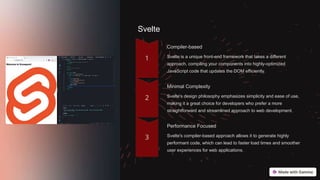
Svelte
Compiler-based
Svelte is a unique front-end framework that takes a different
approach, compiling your components into highly-optimized
JavaScript code that updates the DOM efficiently.
Minimal Complexity
Svelte's design philosophy emphasizes simplicity and ease of use,
making it a great choice for developers who prefer a more
straightforward and streamlined approach to web development.
Performance Focused
Svelte's compiler-based approach allows it to generate highly
performant code, which can lead to faster load times and smoother
user experiences for web applications.
Gatsby
Static Site Generation Gatsby is a React-based framework that
generates static HTML files, which can then
be served efficiently by a CDN, improving
the performance and load times of web
applications.
Plugin Ecosystem Gatsby has a rich plugin ecosystem that
provides a wide range of functionality, from
image optimization to API integration,
making it easier to build complex web
applications.
Hybrid Approach Gatsby supports a hybrid approach, allowing
developers to combine static content with
dynamic, server-rendered pages, providing
the best of both worlds.
Developer Experience Gatsby is known for its excellent developer
experience, with features like hot reloading
and a powerful GraphQL-based data layer
that simplify the development process.
Conclusion and Key Takeaways
The frontend frameworks explored in this presentation represent
some of the most prominent and widely-used tools in modern web
development. Each framework offers unique strengths and caters
to different development needs, from the comprehensive
approach of Angular to the performance-focused design of Svelte.
As the web development landscape continues to evolve,
understanding these frameworks and their respective capabilities
will be crucial for building successful, feature-rich, and scalable
web applications.

Top Frontend Frameworks to Know for Modern Web Development.pptx

  • 1.
    Introduction to ModernWeb Development In today's digital landscape, web development has become a critical skill for businesses and individuals alike. The rise of modern web frameworks has revolutionized the way we approach building dynamic, responsive, and feature-rich websites and web applications. This introduction will provide an overview of some of the top frontend frameworks that have emerged as the go-to tools for modern web development.
  • 2.
    React.js Component-based Architecture React.js isa JavaScript library for building user interfaces. Its component-based approach allows developers to create reusable UI elements, making the development process more efficient and scalable. Virtual DOM React's Virtual DOM (Document Object Model) provides a lightweight and efficient way to manage updates to the user interface, improving performance and responsiveness. Ecosystem and Community React has a thriving ecosystem of third-party libraries and tools, as well as a large and active community of developers who contribute to its growth and development.
  • 3.
    Angular 1 Comprehensive Framework Angularis a complete, batteries- included framework for building web applications, providing a robust set of tools and features out of the box. 2 Typescript Support Angular is built on top of TypeScript, a superset of JavaScript that provides static typing and other advanced features, improving code quality and maintainability. 3 Dependency Injection Angular's powerful dependency injection system makes it easier to manage complex application architectures and promotes modular, testable code. 4 Large Enterprise Adoption Angular is widely used in enterprise-level applications, making it a popular choice for businesses seeking a robust and scalable web development solution.
  • 4.
    Vue.js Lightweight and Approachable Vue.jsis a progressive JavaScript framework that is known for its simplicity and ease of use, making it a great choice for developers of all skill levels. Reactive Data Binding Vue.js provides a reactive data binding system, allowing developers to build responsive and dynamic user interfaces with minimal code. Flexible and Modular Vue.js is highly flexible and modular, allowing developers to easily integrate it into existing projects or build entire applications from scratch. Growing Ecosystem While smaller than React or Angular, Vue.js has a rapidly growing ecosystem of third-party libraries and tools, making it a viable choice for a wide range of web development projects.
  • 5.
    Ember.js Convention over Configuration Ember.jsfollows the "convention over configuration" principle, which means it provides sensible defaults and best practices out of the box, reducing the amount of boilerplate code developers need to write. Two-way Data Binding Ember.js features a powerful two-way data binding system, allowing changes in the model to be automatically reflected in the UI and vice versa. Robust Routing System Ember.js has a comprehensive routing system that makes it easy to manage the navigation and state of a web application, even in complex scenarios. Supportive Community Ember.js has a dedicated and supportive community that contributes to its growth and development, providing a wealth of resources and support for developers.
  • 6.
    Svelte Compiler-based Svelte is aunique front-end framework that takes a different approach, compiling your components into highly-optimized JavaScript code that updates the DOM efficiently. Minimal Complexity Svelte's design philosophy emphasizes simplicity and ease of use, making it a great choice for developers who prefer a more straightforward and streamlined approach to web development. Performance Focused Svelte's compiler-based approach allows it to generate highly performant code, which can lead to faster load times and smoother user experiences for web applications.
  • 7.
    Gatsby Static Site GenerationGatsby is a React-based framework that generates static HTML files, which can then be served efficiently by a CDN, improving the performance and load times of web applications. Plugin Ecosystem Gatsby has a rich plugin ecosystem that provides a wide range of functionality, from image optimization to API integration, making it easier to build complex web applications. Hybrid Approach Gatsby supports a hybrid approach, allowing developers to combine static content with dynamic, server-rendered pages, providing the best of both worlds. Developer Experience Gatsby is known for its excellent developer experience, with features like hot reloading and a powerful GraphQL-based data layer that simplify the development process.
  • 8.
    Conclusion and KeyTakeaways The frontend frameworks explored in this presentation represent some of the most prominent and widely-used tools in modern web development. Each framework offers unique strengths and caters to different development needs, from the comprehensive approach of Angular to the performance-focused design of Svelte. As the web development landscape continues to evolve, understanding these frameworks and their respective capabilities will be crucial for building successful, feature-rich, and scalable web applications.