Top 5 backend frameworks for web development in 2023
What is the backend in web development?
The technologies used in conjunction with backend programming languages to develop
the logic and functionality of a software application are known as backend frameworks.
Best Backend frameworks support the behind-the-scenes magic that enables an
application to function as intended even while it is invisible to the end user. Best Backend
frameworks, often known as "server-side frameworks," provide you with more control
over the functions that your app or website performs.
On the other hand, the front end, often known as the client side, describes what people see
when they use a website or software application. Frontend programming languages and
technologies manage every aspect of a software application that is visible to the user,
including the way controls are organized, the colors and animations they utilize, and how
responsive it is.
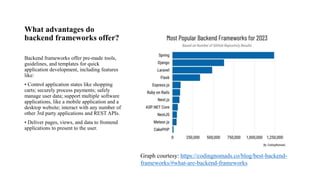
What advantages do
backend frameworks offer?
Backend frameworks offer pre-made tools,
guidelines, and templates for quick
application development, including features
like:
• Control application states like shopping
carts; securely process payments; safely
manage user data; support multiple software
applications, like a mobile application and a
desktop website; interact with any number of
other 3rd party applications and REST APIs.
• Deliver pages, views, and data to frontend
applications to present to the user.
Graph courtesy: https://codingnomads.co/blog/best-backend-
frameworks/#what-are-backend-frameworks
The top 5 backend frameworks in 2023
1.Django
A high-level web framework called Django enables the effective creation of quick, secure online applications in
Python. Model-view-template (MVT), a variant of the model-view-controller (MVC) pattern, is the paradigm that
Django employs. You can keep your code logically organized into layers by using Django's MVT model. Many of
the model's controller components are handled by the Django framework, allowing you to specify the data view
and presentation templates.
Advantages of Django
• Django promotes best practices in programming and permits developers to operate entirely within the framework,
which might be advantageous for newer programmers.
• Because Python is the most popular programming language, Django has a strong developer community that can be
a resource while you create your project.
• Django is the best choice for your project if you're working with relational data and prefer an all-in-one framework
with a dependable integrated ORM. You can get started with Django and expand your application later without
having to add to the framework thanks to the batteries-included philosophy. Additionally, you won't need to be
concerned about compatibility problems with other libraries.
2. Laravel
Model-view-controller (MVC) web application development is made easier with the help of the cross-platform PHP
framework Laravel. Laravel is based on PHP, one of the first server-side web scripting languages that has existed for almost
as long as the internet.
Despite the fact that PHP is no longer the most popular programming language, it continues to be utilized in over 80% of
websites due to legacy code.
ADVANTAGES OF LARAVEL
• Since PHP has been around for almost as long as the web, Laravel enables you to take advantage of its expertise and
community support network.
• Sail, a Docker-based installation that you can customize, makes it simple to install Laravel. • Modern web application
capabilities are built-in, allowing you to concentrate more on code than configuration.
3. Ruby on Rails
Do you need a backend framework that is packed with different components to create iOS or Android applications? then
Ruby on Rail is a great option to think about.
Its improbably effective backend architecture for creating online and mobile applications. This framework features a sizable
and vibrant community and is quick to construct.
With a selection of pre-packaged Ruby applications, this backend framework streamlines, improves accessibility, and
expedites the development process. Developers were freed from the tiresome portions of coding by using the Ruby on Rails
approach to application development, which allowed them to concentrate on the crucial functions and business logic. It also
increases productivity and facilitates the rapid development of apps.
Some noteworthy traits of Ruby on Rails include the following:
Advantages include convention over configuration, scalability, active record, automated deployment, a clear testing tool,
interpretable scripting language, and quick and simple code. Several websites, including Basecamp, Dribbble, and Airbnb,
run on Ruby on Rails.
4. Express.js
As it enables programmers to create an application with JavaScript on the backend for the first time, Express.js delivers
JavaScript’s newfound backend functionality. This compact framework offers built-in web app functionality and the Express
API to developers.
Express, which is based on Node JS, serves as middleware to manage your servers and routes.
Users of the Express API can set up routes for sending and receiving requests between the front end and the database.
Numerous other template engines and packages, including Moustache, Pug, EJS, and many others, are also supported by the
express framework.
You can create enterprise-size apps with top-notch performance because of its great scalability.
Express.js has the following benefits over other backend frameworks:
Low learning curve, quick app development, I/O request processing, open-source community, and simple integration of
third-party services & middleware. Fully customisable. Standard for NodeJS web middleware.
MySpace, LearnBoost, and County are a few examples of websites that use Express.js.
5. Next.js
Using the Next.js framework, static websites may be created quickly and effectively. Although Next.js is regarded as a simple
framework, it nonetheless has all the functionality required to build a high-performing React application.
Benefits of Next.js
• Because of its out-of-the-box components and basic design, Next.js is excellent for quickly developing a minimal
viable product (MVP). • Next.js' powerful pre-rendering features provide better site performance, which benefits SEO
and search rankings.
• Next has a large support community because it is one of the most widely used React frameworks for building server-
side rendering web apps.

Top 5 backend frameworks for web development in.pptx

  • 1.
    Top 5 backendframeworks for web development in 2023
  • 2.
    What is thebackend in web development? The technologies used in conjunction with backend programming languages to develop the logic and functionality of a software application are known as backend frameworks. Best Backend frameworks support the behind-the-scenes magic that enables an application to function as intended even while it is invisible to the end user. Best Backend frameworks, often known as "server-side frameworks," provide you with more control over the functions that your app or website performs. On the other hand, the front end, often known as the client side, describes what people see when they use a website or software application. Frontend programming languages and technologies manage every aspect of a software application that is visible to the user, including the way controls are organized, the colors and animations they utilize, and how responsive it is.
  • 3.
    What advantages do backendframeworks offer? Backend frameworks offer pre-made tools, guidelines, and templates for quick application development, including features like: • Control application states like shopping carts; securely process payments; safely manage user data; support multiple software applications, like a mobile application and a desktop website; interact with any number of other 3rd party applications and REST APIs. • Deliver pages, views, and data to frontend applications to present to the user. Graph courtesy: https://codingnomads.co/blog/best-backend- frameworks/#what-are-backend-frameworks
  • 4.
    The top 5backend frameworks in 2023
  • 5.
    1.Django A high-level webframework called Django enables the effective creation of quick, secure online applications in Python. Model-view-template (MVT), a variant of the model-view-controller (MVC) pattern, is the paradigm that Django employs. You can keep your code logically organized into layers by using Django's MVT model. Many of the model's controller components are handled by the Django framework, allowing you to specify the data view and presentation templates. Advantages of Django • Django promotes best practices in programming and permits developers to operate entirely within the framework, which might be advantageous for newer programmers. • Because Python is the most popular programming language, Django has a strong developer community that can be a resource while you create your project. • Django is the best choice for your project if you're working with relational data and prefer an all-in-one framework with a dependable integrated ORM. You can get started with Django and expand your application later without having to add to the framework thanks to the batteries-included philosophy. Additionally, you won't need to be concerned about compatibility problems with other libraries.
  • 6.
    2. Laravel Model-view-controller (MVC)web application development is made easier with the help of the cross-platform PHP framework Laravel. Laravel is based on PHP, one of the first server-side web scripting languages that has existed for almost as long as the internet. Despite the fact that PHP is no longer the most popular programming language, it continues to be utilized in over 80% of websites due to legacy code. ADVANTAGES OF LARAVEL • Since PHP has been around for almost as long as the web, Laravel enables you to take advantage of its expertise and community support network. • Sail, a Docker-based installation that you can customize, makes it simple to install Laravel. • Modern web application capabilities are built-in, allowing you to concentrate more on code than configuration.
  • 7.
    3. Ruby onRails Do you need a backend framework that is packed with different components to create iOS or Android applications? then Ruby on Rail is a great option to think about. Its improbably effective backend architecture for creating online and mobile applications. This framework features a sizable and vibrant community and is quick to construct. With a selection of pre-packaged Ruby applications, this backend framework streamlines, improves accessibility, and expedites the development process. Developers were freed from the tiresome portions of coding by using the Ruby on Rails approach to application development, which allowed them to concentrate on the crucial functions and business logic. It also increases productivity and facilitates the rapid development of apps. Some noteworthy traits of Ruby on Rails include the following: Advantages include convention over configuration, scalability, active record, automated deployment, a clear testing tool, interpretable scripting language, and quick and simple code. Several websites, including Basecamp, Dribbble, and Airbnb, run on Ruby on Rails.
  • 8.
    4. Express.js As itenables programmers to create an application with JavaScript on the backend for the first time, Express.js delivers JavaScript’s newfound backend functionality. This compact framework offers built-in web app functionality and the Express API to developers. Express, which is based on Node JS, serves as middleware to manage your servers and routes. Users of the Express API can set up routes for sending and receiving requests between the front end and the database. Numerous other template engines and packages, including Moustache, Pug, EJS, and many others, are also supported by the express framework. You can create enterprise-size apps with top-notch performance because of its great scalability. Express.js has the following benefits over other backend frameworks: Low learning curve, quick app development, I/O request processing, open-source community, and simple integration of third-party services & middleware. Fully customisable. Standard for NodeJS web middleware. MySpace, LearnBoost, and County are a few examples of websites that use Express.js.
  • 9.
    5. Next.js Using theNext.js framework, static websites may be created quickly and effectively. Although Next.js is regarded as a simple framework, it nonetheless has all the functionality required to build a high-performing React application. Benefits of Next.js • Because of its out-of-the-box components and basic design, Next.js is excellent for quickly developing a minimal viable product (MVP). • Next.js' powerful pre-rendering features provide better site performance, which benefits SEO and search rankings. • Next has a large support community because it is one of the most widely used React frameworks for building server- side rendering web apps.