
Top 10 Web Application Development
Frameworks 2016
Introduction
• Web application frameworks are developed to support the
developers for building interactive applications using a single
programming language.
• A range of frameworks is introduced in the market with
varied framework architecture.
• Developers can formulate the feature rich web applications
by learning the web application Frameworks.
• The top 10 development Framework introduction, positive
and negative aspects are clearly mentioned.
Ruby on Rails
• The top most web application Framework which follows
push-based MVC architecture.
• Ruby on Rails is considered as the General purpose website
Framework.
• A large number of applications are built through this
framework.
• Pay nothing to use this software & any web developer is free
to add the smart code from his/her end & make it wealthy.
Positive aspects:
• Availability of fantastic tools to formulate feature centric
apps easily
• Easily obtainable Library & the best code quality
• Supports the Test Automation to deliver flawless software
Limitations:
• Boot speed of Rails Framework
• Some IO libraries do not support multithreading
AngularJS
• An open source framework that is maintained by Google &
other development communities.
• Developers choose this framework as it allows the
developers to extend HTML vocabulary for website
development.
• AngularJS is one of the most popular Javascript Frameworks.
Positive aspects:
• The fast loading time
• Lightweight framework
• Expressive framework
• Easy testability
• Two way data binding
• Extends HTML
Limitations:
• For affluent results, sheer knowledge about framework is necessary
• Router has limitations
• Using the directives is somewhat difficult
• Code debugging is a tough task
Ember.js
• This is the best platform defined for building the
ambitious web applications.
• Developers try their hands with Ember.js for developing
scalable single-page web applications.
• Numerous tools are there that offer flexible and standard
application structure.
Positive aspects:
• Strong built-in router
• Simple web components
• Offers a complete development stack
• Stability without stagnation
Limitations:
• Getters & setters are used for the testing. Web app comes out
with the bugs when you forget to use getters & setters.
CakePHP
• One of the most popular open-source platforms which is
written in PHP.
• Web app development companiestell that, by using this
framework, development becomes faster & simpler.
• The interactive web apps can be built with less coding.
Positive aspects:
• Budget friendly web app development
• Scaffolding code generation
• fast & flexible templating system
• Trustable security constraints
• MVC coding pattern
Limitations:
• One-way routing
• Documentation requires a good effort
• To create fancy URLs, one need to update default route
Phalcon
• It is the open source framework following MVC pattern.
• This is a PHP framework delivered as the C-extension.
• Phalcon is introduced as the fastest PHP framework.
• Phalcon has the innovative architecture & lowest overhead
for MVC based application.
Positive aspects:
• Boosted execution speed
• Reduces the usage of resource
• High performance
• Featured to handle more HTTP requests comparatively
Limitations:
• Root/Administrative access is required
• Compiled extension
Zend
• The object oriented web application framework which
supports a wide range of database systems.
Positive Aspects:
• Flexible caching sub system
• Extensible MVC implementation supporting layouts
• Modular framework
• Extensible & easy to adapt
Limitations:
• Shared objects are loaded each time the script is executed
• External additional files clutter up the disk
• A call to dl() is required each time to use external module's
functionality
ASP.net
• A web app development platform for building the robust
desktop & mobile applications.
• ASP.net works for the HTTP protocol & optimizes HTTP
commands.
• This framework is built using Common Language Runtime
(CLR).
Positive Aspects:
• Large apps can be developed with less coding
• Safe & secure environment
• Easy to write & maintain source code
• Easy deployment
• Memory leaks, infinite loops are destroyed quickly
Limitations:
• Coding becomes somewhat complex for customization
• For silverlight, data access is limited
• Direct call is restricted via ADO.NET
Symfony
• A PHP web develoment framework that is launched to
speed up the development process.
• A set of reusable PHP components Symfony is utilized for
building robust application.
• Absolutely customized web apps are crafted with the
developers having total control over the configuration.
Positive Aspects:
• Multiple developers can smoothly manage a Symfony project
• Adds the security constraints for user authentication
• Incorporate the advance features easily
• Performance testing is a core of Symfony
Limitations:
• A steep learning curve
• Developers need a good time for implementing accustomed
requirements
Express
• Express is a Node.js web application server framework.
• This platform is flexible enough to build single page, multi-
page and even the thriving hybrid web applications.
Positive Aspects:
• Fast & minimalist framework
• Robust set of features for web and mobile apps
• Developer friendly support to create API
• Supports the concurrency
Limitations:
• To understand the code structure is not a cup of tea for each
developer
• Lacking of NodeJS libraries & ExpressJS middlewares in some cases
Codeigniter
• The powerful PHP framework offers a simple & elegant toolkit
for creating feature pack web applications.
• This framework is identified for clear documentation & small
footprint among the developer community.
Positive Aspects:
• Compatibility with standard hosting
• Use the coding & naming conventions without restriction
• Lightweight & extensive
• Well defined Possessed Libraries
Limitations:
• Company driven framework
• Irregular releases
• Framework itself has no built-in ORM
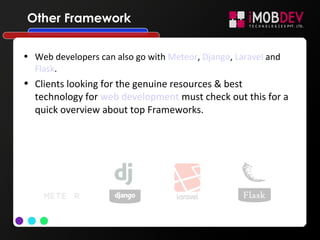
Other Framework
• Web developers can also go with Meteor, Django, Laravel and
Flask.
• Clients looking for the genuine resources & best
technology for web development must check out this for a
quick overview about top Frameworks.
Website : www.imobdevtech.com
Call : +1 (908) 301-6001
Skype : sales.imobdev
Email : sales@imobdevtech.com
Top 10 web application development frameworks 2016

Top 10 web application development frameworks 2016

  • 1.
    Top 10 WebApplication Development Frameworks 2016
  • 2.
    Introduction • Web applicationframeworks are developed to support the developers for building interactive applications using a single programming language. • A range of frameworks is introduced in the market with varied framework architecture. • Developers can formulate the feature rich web applications by learning the web application Frameworks. • The top 10 development Framework introduction, positive and negative aspects are clearly mentioned.
  • 3.
    Ruby on Rails •The top most web application Framework which follows push-based MVC architecture. • Ruby on Rails is considered as the General purpose website Framework. • A large number of applications are built through this framework. • Pay nothing to use this software & any web developer is free to add the smart code from his/her end & make it wealthy.
  • 4.
    Positive aspects: • Availabilityof fantastic tools to formulate feature centric apps easily • Easily obtainable Library & the best code quality • Supports the Test Automation to deliver flawless software Limitations: • Boot speed of Rails Framework • Some IO libraries do not support multithreading
  • 5.
    AngularJS • An opensource framework that is maintained by Google & other development communities. • Developers choose this framework as it allows the developers to extend HTML vocabulary for website development. • AngularJS is one of the most popular Javascript Frameworks.
  • 6.
    Positive aspects: • Thefast loading time • Lightweight framework • Expressive framework • Easy testability • Two way data binding • Extends HTML Limitations: • For affluent results, sheer knowledge about framework is necessary • Router has limitations • Using the directives is somewhat difficult • Code debugging is a tough task
  • 7.
    Ember.js • This isthe best platform defined for building the ambitious web applications. • Developers try their hands with Ember.js for developing scalable single-page web applications. • Numerous tools are there that offer flexible and standard application structure.
  • 8.
    Positive aspects: • Strongbuilt-in router • Simple web components • Offers a complete development stack • Stability without stagnation Limitations: • Getters & setters are used for the testing. Web app comes out with the bugs when you forget to use getters & setters.
  • 9.
    CakePHP • One ofthe most popular open-source platforms which is written in PHP. • Web app development companiestell that, by using this framework, development becomes faster & simpler. • The interactive web apps can be built with less coding.
  • 10.
    Positive aspects: • Budgetfriendly web app development • Scaffolding code generation • fast & flexible templating system • Trustable security constraints • MVC coding pattern Limitations: • One-way routing • Documentation requires a good effort • To create fancy URLs, one need to update default route
  • 11.
    Phalcon • It isthe open source framework following MVC pattern. • This is a PHP framework delivered as the C-extension. • Phalcon is introduced as the fastest PHP framework. • Phalcon has the innovative architecture & lowest overhead for MVC based application.
  • 12.
    Positive aspects: • Boostedexecution speed • Reduces the usage of resource • High performance • Featured to handle more HTTP requests comparatively Limitations: • Root/Administrative access is required • Compiled extension
  • 13.
    Zend • The objectoriented web application framework which supports a wide range of database systems. Positive Aspects: • Flexible caching sub system • Extensible MVC implementation supporting layouts • Modular framework • Extensible & easy to adapt
  • 14.
    Limitations: • Shared objectsare loaded each time the script is executed • External additional files clutter up the disk • A call to dl() is required each time to use external module's functionality
  • 15.
    ASP.net • A webapp development platform for building the robust desktop & mobile applications. • ASP.net works for the HTTP protocol & optimizes HTTP commands. • This framework is built using Common Language Runtime (CLR).
  • 16.
    Positive Aspects: • Largeapps can be developed with less coding • Safe & secure environment • Easy to write & maintain source code • Easy deployment • Memory leaks, infinite loops are destroyed quickly Limitations: • Coding becomes somewhat complex for customization • For silverlight, data access is limited • Direct call is restricted via ADO.NET
  • 17.
    Symfony • A PHPweb develoment framework that is launched to speed up the development process. • A set of reusable PHP components Symfony is utilized for building robust application. • Absolutely customized web apps are crafted with the developers having total control over the configuration.
  • 18.
    Positive Aspects: • Multipledevelopers can smoothly manage a Symfony project • Adds the security constraints for user authentication • Incorporate the advance features easily • Performance testing is a core of Symfony Limitations: • A steep learning curve • Developers need a good time for implementing accustomed requirements
  • 19.
    Express • Express isa Node.js web application server framework. • This platform is flexible enough to build single page, multi- page and even the thriving hybrid web applications. Positive Aspects: • Fast & minimalist framework • Robust set of features for web and mobile apps • Developer friendly support to create API • Supports the concurrency
  • 20.
    Limitations: • To understandthe code structure is not a cup of tea for each developer • Lacking of NodeJS libraries & ExpressJS middlewares in some cases
  • 21.
    Codeigniter • The powerfulPHP framework offers a simple & elegant toolkit for creating feature pack web applications. • This framework is identified for clear documentation & small footprint among the developer community. Positive Aspects: • Compatibility with standard hosting • Use the coding & naming conventions without restriction • Lightweight & extensive • Well defined Possessed Libraries
  • 22.
    Limitations: • Company drivenframework • Irregular releases • Framework itself has no built-in ORM
  • 23.
    Other Framework • Webdevelopers can also go with Meteor, Django, Laravel and Flask. • Clients looking for the genuine resources & best technology for web development must check out this for a quick overview about top Frameworks.
  • 24.
    Website : www.imobdevtech.com Call: +1 (908) 301-6001 Skype : sales.imobdev Email : sales@imobdevtech.com