


TOMs
Measures
Handbook

TOMS HANDBOOK 2021 2
Important Notice
The Measures Handbook is designed as a supplementary guide for the
National TOMs and the other measurement frameworks within the TOMs
“family”, including the publicly available Plug-ins for the National TOMs
and the TOMs frameworks designed expressly for the use of specific
customers or groups of customers of the Social Value Portal.
While every effort has been made to ensure consistency within this
Handbook with the National TOMs, it should be noted that the National
TOMs Framework is made publicly available with accompanying guidance
and that, in the event of an inconsistency between this Handbook and the
Framework, the latter takes precedence.
This Handbook will be updated on a regular basis to keep pace with the
development of the National TOMs and Social Value Portal welcomes
corrections and suggestions for improvement from users as part of that
process. Any such suggestions can be shared with your contacts at the
Social Value Portal or by email to info@socialvalueportal.com.
This Measures Handbook is made publicly available as guidance only and
no responsibility can be accepted by Social Value Portal for any
consequences arising from implementation of the guidance in the
Handbook. If further clarification is required, please contact the Social
Value Portal or your expert advisers.
Contents
TOMS HANDBOOK 2021 3
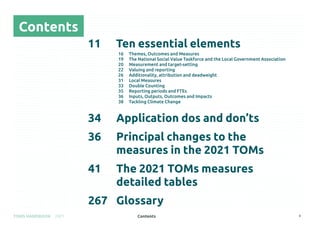
11	
Ten essential elements
Contents
34 Application dos and don’ts
36	
Principal changes to the
measures in the 2021 TOMs
41	
The 2021 TOMs measures
detailed tables
267 Glossary
16 Themes, Outcomes and Measures
19	
The National Social Value Taskforce and the Local Government Association
20 Measurement and target-setting
22 Valuing and reporting
26	
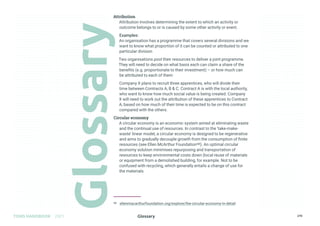
Additionality, attribution and deadweight
31 Local Measures
33 Double Counting
35 Reporting periods and FTEs
36	
Inputs, Outputs, Outcomes and Impacts
38 Tackling Climate Change
Contents
TOMS HANDBOOK 2021 4
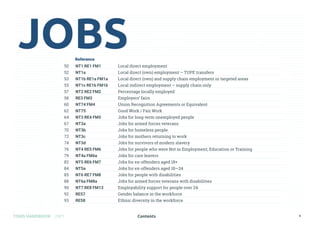
50 NT1 RE1 FM1 Local direct employment
52 NT1a Local direct (own) employment – TUPE transfers
53 NT1b RE1a FM1a Local direct (own) and supply chain employment in targeted areas
55 NT1c RE1b FM1b Local indirect employment – supply chain only
57 NT2 RE2 FM2 Percentage locally employed
58 RE3 FM3 Employers’ fairs
60 NT74 FM4 Union Recognition Agreements or Equivalent
62 NT75 Good Work / Fair Work
64 NT3 RE4 FM5 Jobs for long-term unemployed people
67 NT3a Jobs for armed forces veterans
70 NT3b Jobs for homeless people
72 NT3c Jobs for mothers returning to work
74 NT3d Jobs for survivors of modern slavery
76 NT4 RE5 FM6 Jobs for people who were Not in Employment, Education or Training
79 NT4a FM6a Jobs for care leavers
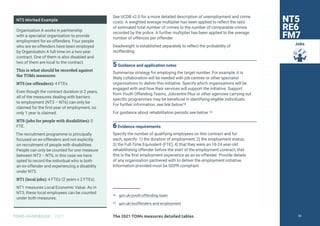
82 NT5 RE6 FM7 Jobs for ex-offenders aged 18+
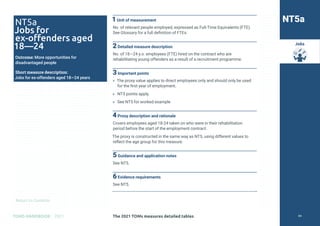
84 NT5a Jobs for ex-offenders aged 18—24
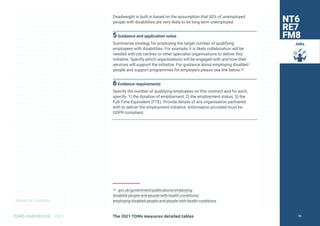
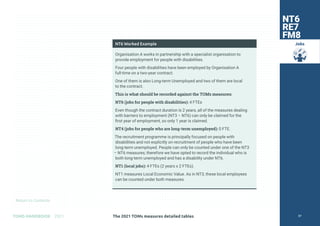
85 NT6 RE7 FM8 Jobs for people with disabilities
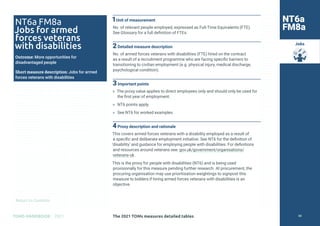
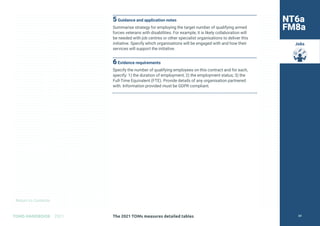
88 NT6a FM8a Jobs for armed forces veterans with disabilities
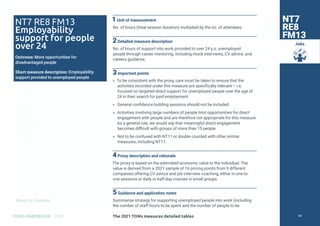
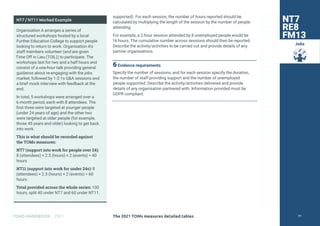
90 NT7 RE8 FM13 Employability support for people over 24
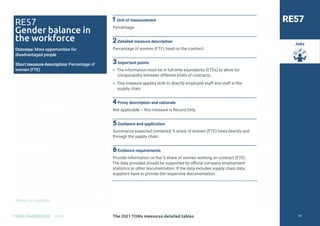
92 RE57 Gender balance in the workforce
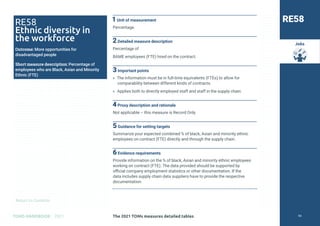
93 RE58 Ethnic diversity in the workforce
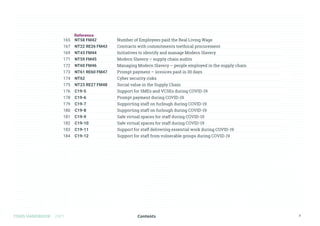
Reference
Contents
TOMS HANDBOOK 2021 5
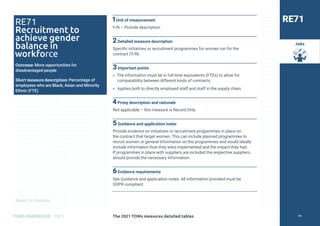
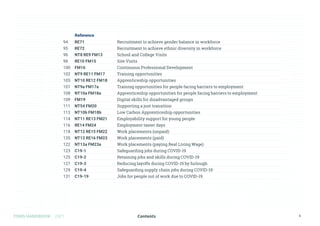
94 RE71 Recruitment to achieve gender balance in workforce
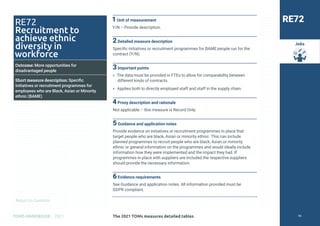
95 RE72 Recruitment to achieve ethnic diversity in workforce
96 NT8 RE9 FM13 School and College Visits
98 RE10 FM15 Site Visits
100 FM16 Continuous Professional Development
102 NT9 RE11 FM17 Training opportunities
105 NT10 RE12 FM18 Apprenticeship opportunities
107 NT9a FM17a Training opportunities for people facing barriers to employment
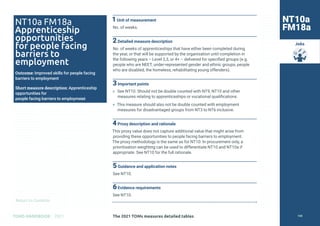
108 NT10a FM18a Apprenticeship opportunities for people facing barriers to employment
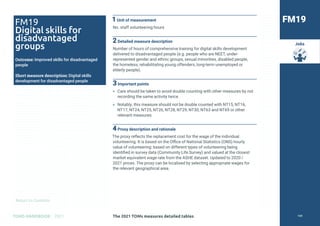
109 FM19 Digital skills for disadvantaged groups
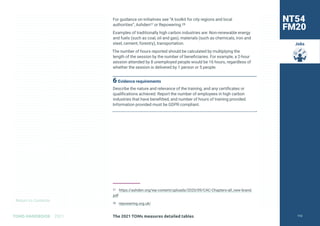
111 NT54 FM20 Supporting a just transition
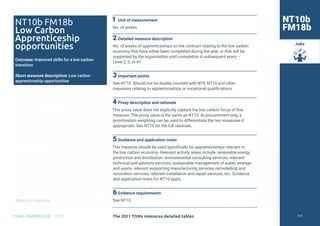
113 NT10b FM18b Low Carbon Apprenticeship opportunities
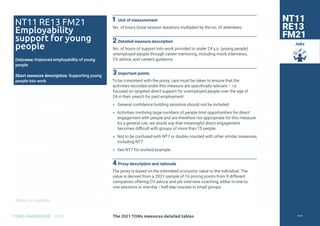
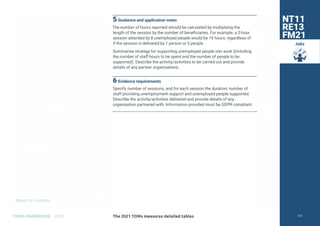
114 NT11 RE13 FM21 Employability support for young people
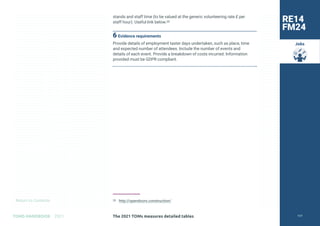
116 RE14 FM24 Employment taster days
118 NT12 RE15 FM22 Work placements (unpaid)
120 NT13 RE16 FM23 Work placements (paid)
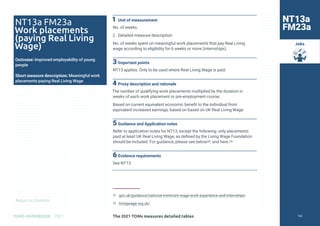
122 NT13a FM23a Work placements (paying Real Living Wage)
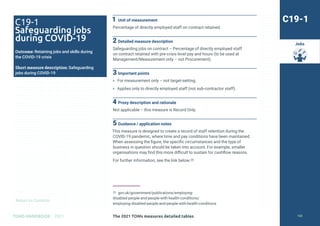
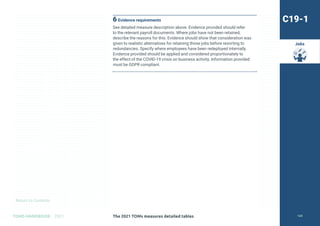
123 C19-1 Safeguarding jobs during COVID-19
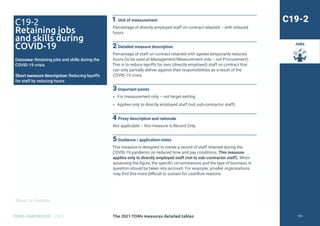
125 C19-2 Retaining jobs and skills during COVID-19
127 C19-3 Reducing layoffs during COVID-19 by furlough
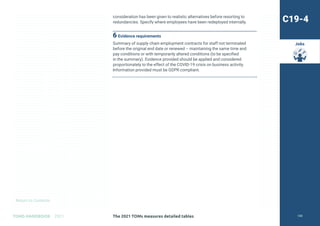
129 C19-4 Safeguarding supply chain jobs during COVID-19
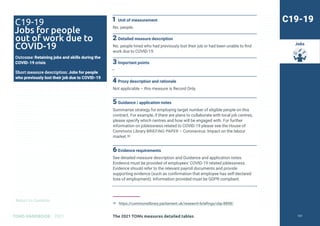
131 C19-19 Jobs for people out of work due to COVID-19
Reference
Contents
TOMS HANDBOOK 2021 6
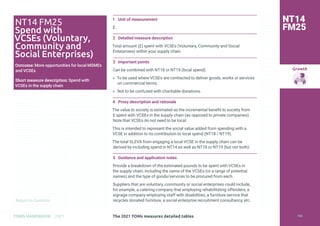
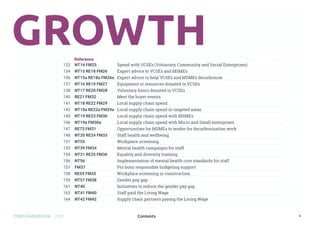
132 NT14 FM25 Spend with VCSEs (Voluntary, Community and Social Enterprises)
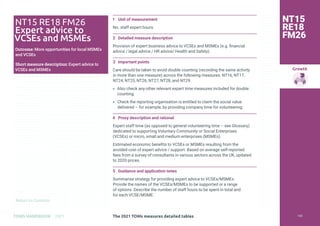
134 NT15 RE18 FM26 Expert advice to VCSEs and MSMEs
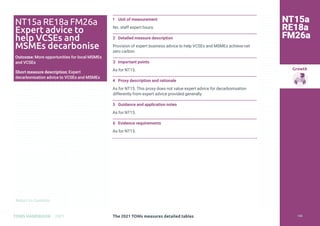
136 NT15a RE18a FM26a Expert advice to help VCSEs and MSMEs decarbonise
137 NT16 RE19 FM27 Equipment or resources donated to VCSEs
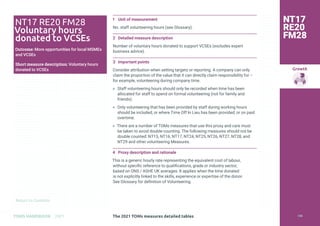
138 NT17 RE20 FM28 Voluntary hours donated to VCSEs
140 RE21 FM32 Meet the buyer events
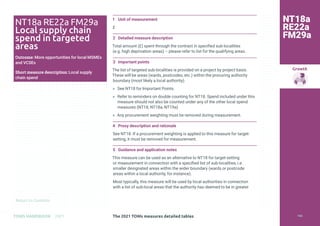
141 NT18 RE22 FM29 Local supply chain spend
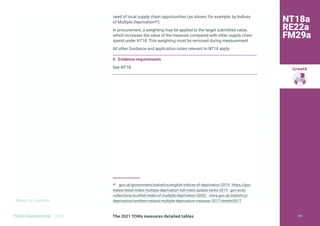
143 NT18a RE22a FM29a Local supply chain spend in targeted areas
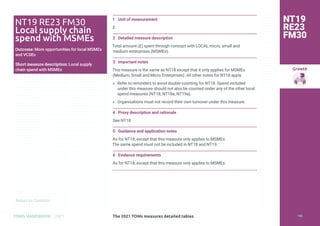
145 NT19 RE23 FM30 Local supply chain spend with MSMEs
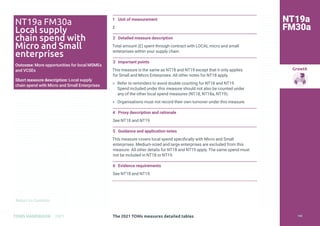
146 NT19a FM30a Local supply chain spend with Micro and Small enterprises
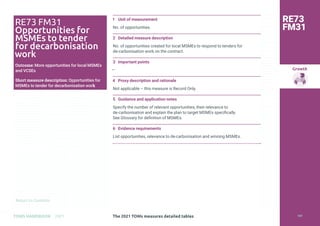
147 RE73 FM31 Opportunities for MSMEs to tender for decarbonisation work
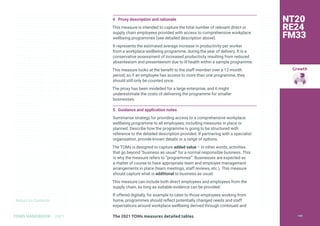
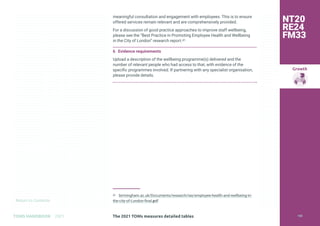
148 NT20 RE24 FM33 Staff health and wellbeing
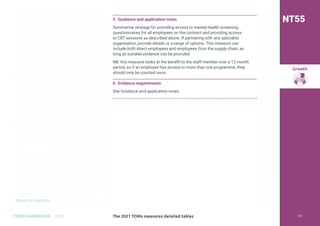
151 NT55 Workplace screening
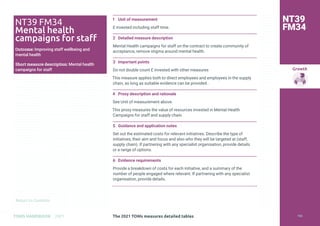
153 NT39 FM34 Mental health campaigns for staff
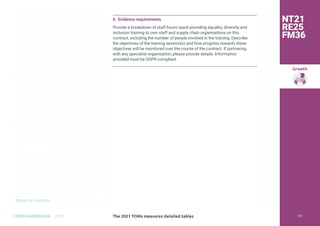
154 NT21 RE25 FM36 Equality and diversity training
156 NT56 Implementation of mental health core standards for staff
157 FM37 Pro bono responsible budgeting support
158 RE59 FM35 Workplace screening in construction
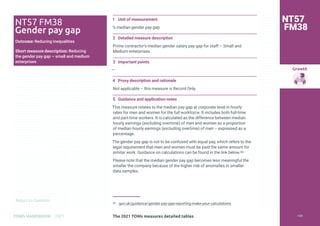
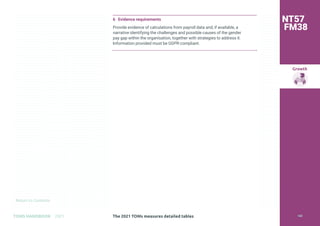
159 NT57 FM38 Gender pay gap
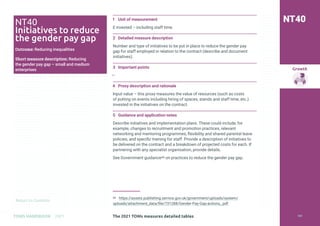
161 NT40 Initiatives to reduce the gender pay gap
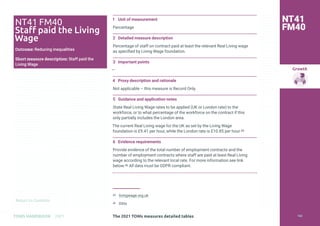
163 NT41 FM40 Staff paid the Living Wage
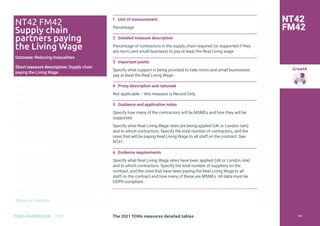
164 NT42 FM42 Supply chain partners paying the Living Wage
Reference
Contents
TOMS HANDBOOK 2021 7
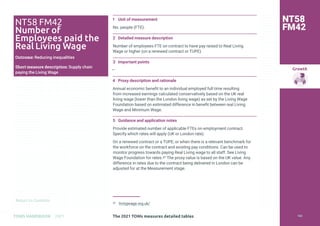
165 NT58 FM42 Number of Employees paid the Real Living Wage
167 NT22 RE26 FM43 Contracts with commitments toethical procurement
169 NT43 FM44 Initiatives to identify and manage Modern Slavery
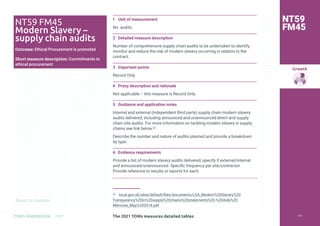
171 NT59 FM45 Modern Slavery – supply chain audits
172 NT60 FM46 Managing Modern Slavery – people employed in the supply chain
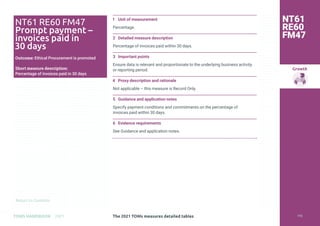
173 NT61 RE60 FM47 Prompt payment – invoices paid in 30 days
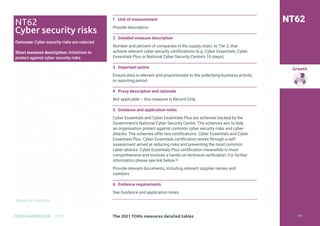
174 NT62 Cyber security risks
175 NT23 RE27 FM48 Social value in the Supply Chain
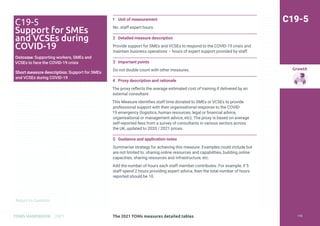
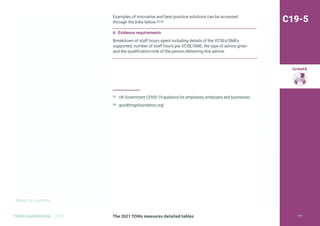
176 C19-5 Support for SMEs and VCSEs during COVID-19
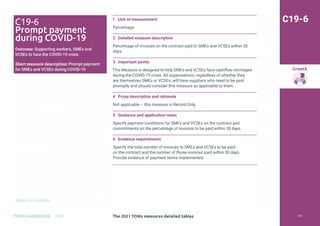
178 C19-6 Prompt payment during COVID-19
179 C19-7 Supporting staff on furlough during COVID-19
180 C19-8 Supporting staff on furlough during COVID-19
181 C19-9 Safe virtual spaces for staff during COVID-19
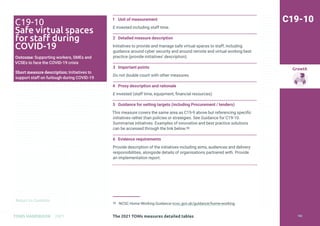
182 C19-10 Safe virtual spaces for staff during COVID-19
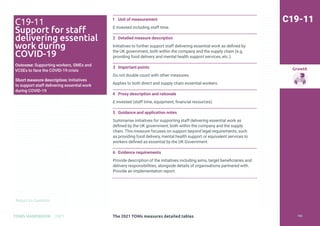
183 C19-11 Support for staff delivering essential work during COVID-19
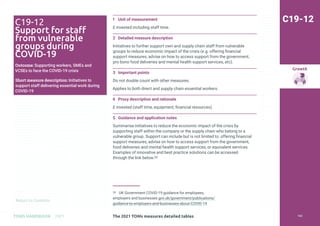
184 C19-12 Support for staff from vulnerable groups during COVID-19
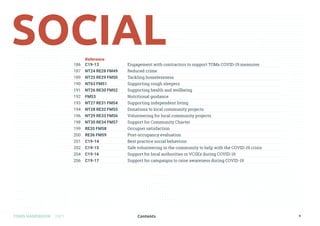
Reference
Contents
TOMS HANDBOOK 2021 8
186 C19-13 Engagement with contractors to support TOMs COVID-19 measures
187 NT24 RE28 FM49 Reduced crime
189 NT25 RE29 FM50 Tackling homelessness
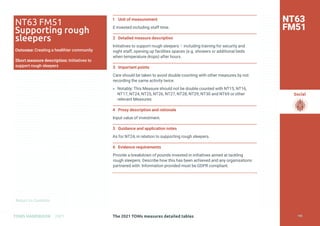
190 NT63 FM51 Supporting rough sleepers
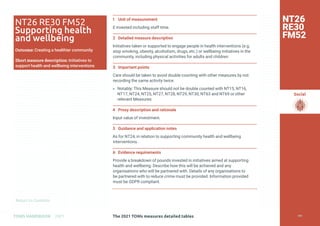
191 NT26 RE30 FM52 Supporting health and wellbeing
192 FM53 Nutritional guidance
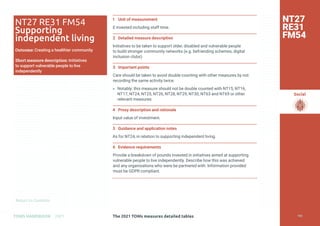
193 NT27 RE31 FM54 Supporting independent living
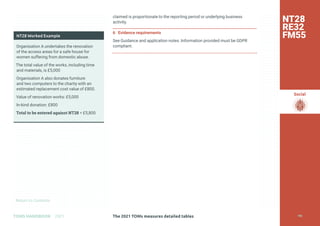
194 NT28 RE32 FM55 Donations to local community projects
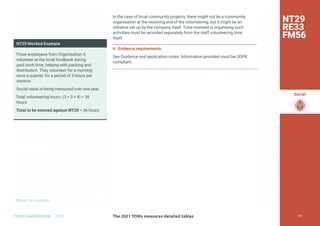
196 NT29 RE33 FM56 Volunteering for local community projects
198 NT30 RE34 FM57 Support for Community Charter
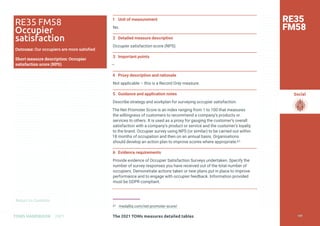
199 RE35 FM58 Occupier satisfaction
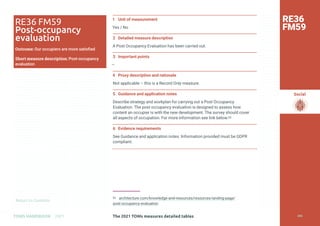
200 RE36 FM59 Post-occupancy evaluation
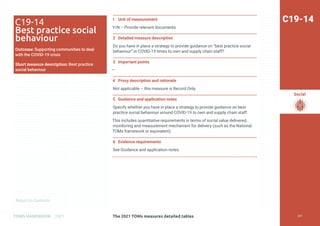
201 C19-14 Best practice social behaviour
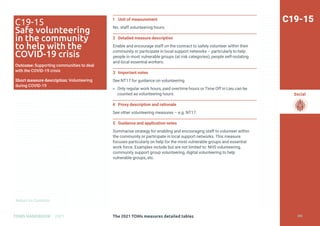
202 C19-15 Safe volunteering in the community to help with the COVID-19 crisis
204 C19-16 Support for local authorities or VCSEs during COVID-19
206 C19-17 Support for campaigns to raise awareness during COVID-19
Reference
Contents
TOMS HANDBOOK 2021 9
Reference
208 C19-20 Initiatives to redesign space to address COVID-19 risks
210 NT31 FM30 Carbon emissions are reduced
213 NT44 FM61 Programme to achieve net zero carbon by 2030
214 NT64 FM62 Contribution to own carbon offset fund by 2030
216 NT45 FM65 Carbon certification
217 RE37 FM66 Carbon reduction from energy efficiency — building operations
219 RE37a Carbon reduction from Increased renewable energy – building operations
220 RE38 FM67 Buildings meeting energy efficiency target
221 RE39 Carbon reduction from reduced energy use and energy efficiency measures
222 RE39a Carbon reduction from increased renewable energy – on site
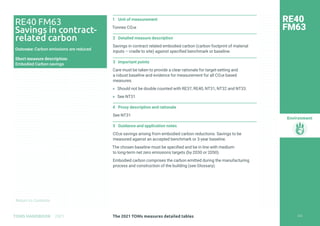
223 RE40 FM63 Savings in contract-related carbon
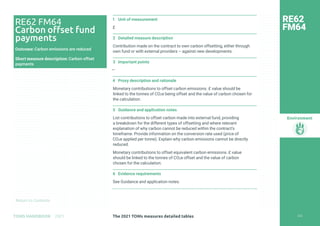
225 RE62 FM64 Carbon offset fund payments
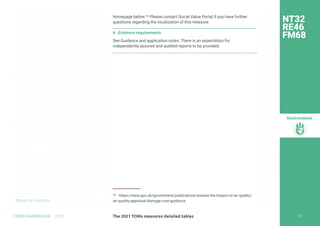
226 NT32 RE46 FM68 Car miles saved
229 NT33 RE47 FM69 (Low emission) car miles driven
231 NT46 FM70 Corporate travel schemes
232 NT65 RE63 FM71 % Fleet at least Euro 6 or LEV
233 NT66 RE64 FM72 Fleet emissions programme
234 FM73 Air quality regulations
235 NT67 FM77 Investments in environmental initiatives
236 NT47 FM78 Investments in sustainable reforestation
237 RE65 Offsets or mitigation initiatives on biodiversity
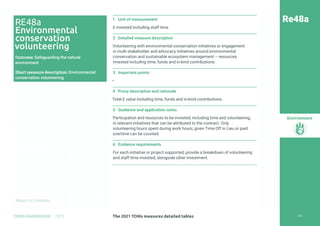
238 RE48a Environmental conservation volunteering
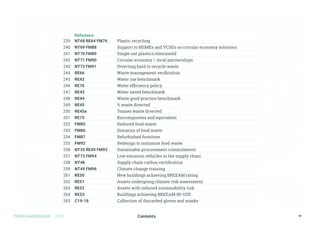
Contents
TOMS HANDBOOK 2021 10
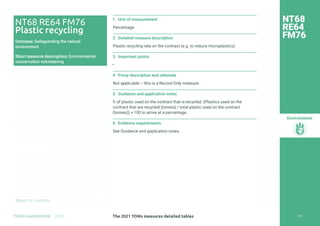
239 NT68 RE64 FM76 Plastic recycling
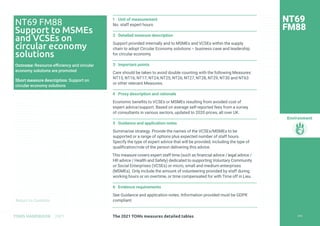
240 NT69 FM88 Support to MSMEs and VCSEs on circular economy solutions
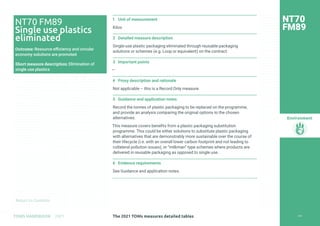
241 NT70 FM89 Single use plastics eliminated
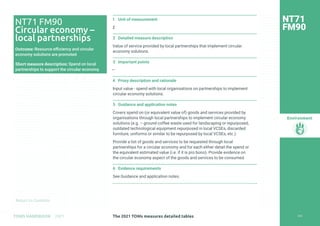
242 NT71 FM90 Circular economy – local partnerships
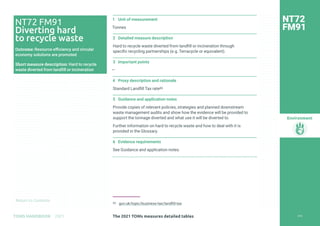
243 NT72 FM91 Diverting hard to recycle waste
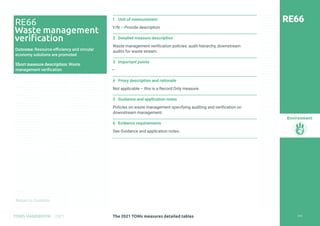
244 RE66 Waste management verification
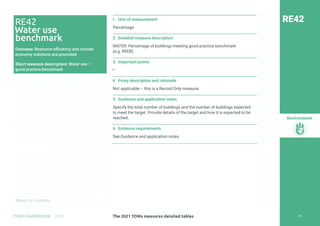
245 RE42 Water use benchmark
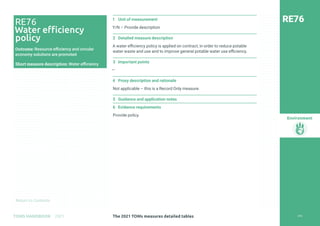
246 RE76 Water efficiency policy
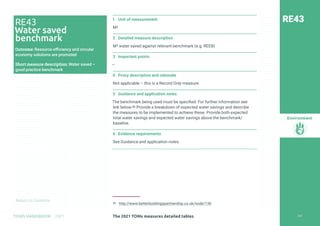
247 RE43 Water saved benchmark
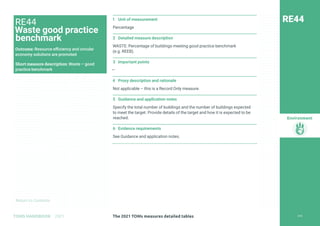
248 RE44 Waste good practice benchmark
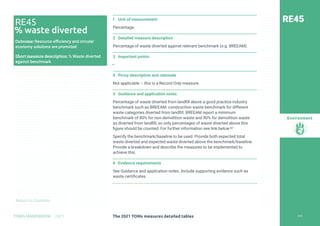
249 RE45 % waste diverted
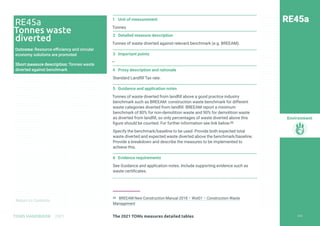
250 RE45a Tonnes waste diverted
251 RE75 Biocomposites and equivalent
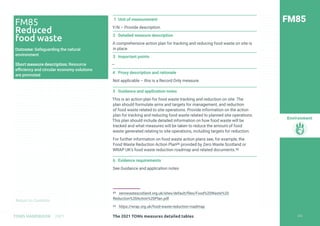
252 FM85 Reduced food waste
253 FM86 Donation of food waste
254 FM87 Refurbished furniture
255 FM92 Redesign to minimise food waste
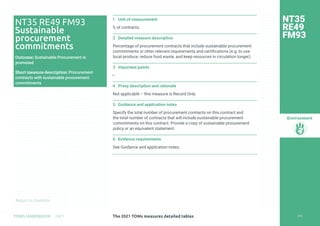
256 NT35 RE49 FM93 Sustainable procurement commitments
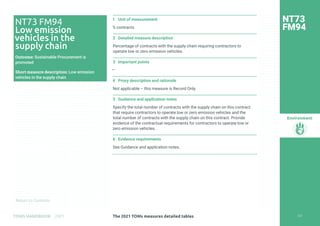
257 NT73 FM94 Low emission vehicles in the supply chain
258 NT48 Supply chain carbon certification
259 NT49 FM96 Climate change training
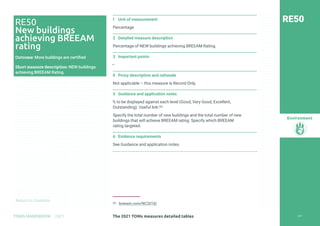
261 RE50 New buildings achieving BREEAM rating
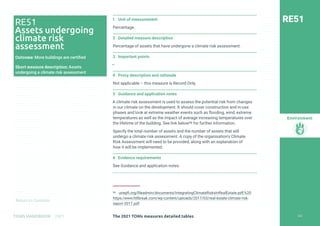
262 RE51 Assets undergoing climate risk assessment
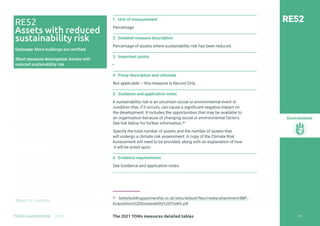
263 RE52 Assets with reduced sustainability risk
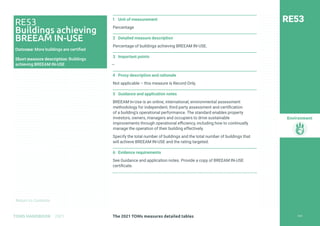
264 RE53 Buildings achieving BREEAM IN-USE
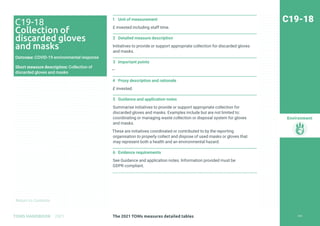
265 C19-18 Collection of discarded gloves and masks
Reference
Contents 11
TOMS HANDBOOK —2021
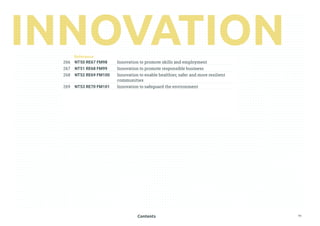
266 NT50 RE67 FM98 Innovation to promote skills and employment
267 NT51 RE68 FM99 Innovation to promote responsible business
268 NT52 RE69 FM100 Innovation to enable healthier, safer and more resilient
communities
269 NT53 RE70 FM101 Innovation to safeguard the environment
Reference
Contents
TOMS HANDBOOK 2021 12
T
he widespread adoption of the National TOMs in little over three
years since the first version was issued in November 2017 validates
this original vision – not just in procurement, but increasingly
in other areas of public sector activity such as planning and economic
development, as well as by corporates for their own CSR purposes.
While the idea is simple, as the TOMs goes wider and deeper, the complexity
creeps in. With a long list of measures, each with its own rules, there is
a danger we find it hard to see the wood for the trees. Social value is a
complex, multi-faceted and often uncertain area. That is just the way it is,
and it is bound to become more complex as our understanding matures and
we see how different aspects of social value intersect.
What the TOMs should be doing is making this complexity manageable and
easier to understand – and translating it into a form that can be used to
deliver positive action and bring new actors into play to share the load. That
is why, for instance, the measures have financial values. Like it or not, the
society we live in uses money as a vector.
But we’ve set ourselves a difficult challenge. We want to simplify and
translate social value into clearly defined activities through the TOMs,
but we also want to “show the workings” – to explain how and why the
measures in the TOMs are the way they are. There is good reason for this
– we know that the only way to achieve widespread adoption of a standard
approach to social value measurement and management is to show people
how we have got to the answer.
The TOMs framework is a simple concept devised
to drive the adoption of social value, initially so the
public sector could get more value from its business
relationships. It was designed to be practical, credible
and intelligible.
TOMS HANDBOOK 2021 13
Over the years, guidance and explanations have been layered into
successive editions of the TOMs, supported by the National Social
Taskforce1, training, working groups, plug-ins, etc. and the sheer volume
of supporting information is making the framework increasingly difficult to
navigate.
At its heart, the TOMs is still quite simple. But to get to this simplicity, a
lot of complex work is needed behind the scenes, and we have taken the
opportunity to restructure how this is all explained to users.
This Measures Handbook mainly aims to distil previous guidance into a
clearer, more readable form, but focusing on the measures themselves
– and specifically the measures in the National TOMs, the Real Estate
Plug-in, the COVID-19 Plug-in and the FM Plug-in (further Plug-ins may be
incorporated into later editions). There is enough on methodology to give
some context, but we have not attempted to put everything into a single
volume.
The plan is for a sister volume later this year that will focus more on the
TOMs methodology and implementation tools.
This volume focuses on application and evidence. It provides most of what
you need to know about the measures themselves when using them to set
targets or report social value activities.
A final word on data. Ultimately, social value reporting stands and falls on
the quality of the data. Notwithstanding the intricacies of some of the TOMs
measures, if what you report is and can be delivered by you, is supported
by good quality evidence and demonstrably creates additional, wider social
and environmental benefits – and errs on the side of caution, you won’t go
too far wrong.
1 nationalsocialvaluetaskforce.org
14
TOMS HANDBOOK 2021
Ten essential elements
TOMS HANDBOOK 2021 15

Ten essential elements
This section sets out ten essential principles that apply
across the TOMs framework. The TOMs framework is
continually evolving and not everything can be codified –
there will inevitably be areas of uncertainty, through unusual
circumstances, imperfect data, lack of clarity in the measure
itself, etc. This can be managed if users approach the process
of target-setting and reporting social value with caution
and consistency.
While it is possible to use the specific guidance for each measure without
reading this section, it provides a methodological overview that we believe
most users of the framework will find helpful. We recommend that people
new to social value reporting and experienced practitioners alike read this
short section in its entirety before moving to the detail.
Ten essential elements
TOMS HANDBOOK 2021 16
The acronym “TOMs” stands for Themes, Outcomes and Measures.
The founding principle of the TOMs is to provide the connection between
a broad vision for social improvement (“Themes”) with strategic objectives
(“Outcomes”), which in turn can then be expressed as measurable
activities (“Measures”).
This conceptual approach enables meaningful direct action to be steered both
by local need and by the overarching strategic aims of the organisation aiming
to deliver social value. Implemented effectively, the TOMs framework then
creates a mutually reinforcing link between strategy
and delivery.
Where the supporting evidence is available, measures in the TOMs framework
are assigned generalising values (“proxy values”) that apply whenever the
TOMs framework is used. As the name suggests, a “financial proxy” is a
reasoned approximation expressed in monetary terms (drawing on relevant
evidence) of the benefit created by the activity relating to a particular measure.
Proxies are generalised unit values that make a range of assumptions and
are designed to be robust and conservative, to follow best practice for socio-
economic evaluation and analysis and be consistent with key government
guidance documents such as the Treasury Green Book.
Certain measures in the TOMs framework must be localised to make them
meaningful (that is, they must incorporate data specific to the locality to
which the process of measurement applies – see Local Measures below).
For other measures, localising the values is an option that can make the
proxy more closely aligned to the socio-economic context of a particular
area. A third group of measures only have UK-level datasets to support them,
so cannot be localised.
Themes, Outcomes
and Measures
Ten essential elements
TOMS HANDBOOK 2021 17
Using the proxy values in the TOMs to produce a quantified social value
analysis can be a powerful measurement tool but should not be taken as the
sole and exclusive description of social value for any organisation or project.
Organisations using the TOMs framework should always take into account:
» The Seven Principles of Social Value (including stakeholder engagement) –
for further information, see Social Value UK2;
» Qualitative supporting descriptions and narrative;
» The context for target-setting and measurement – e.g. in terms of local need.
2 socialvalueuk.org/what-is-social-value/the-principles-of-social-value
Ten essential elements
TOMS HANDBOOK 2021 18
The Seven Principles of Social Value:
Involve stakeholders Inform what gets measured and how this
is measured and valued in an account of social value by involving
stakeholders.
Understand what changes Articulate how change is created and
evaluate this through evidence gathered, recognising positive and
negative changes as well as those that are intended and unintended.
Value the things that matter Making decisions about allocating
resources between different options needs to recognise the values
of stakeholders. Value refers to the relative importance of different
outcomes. It is informed by stakeholders’ preferences.
Only include what is material Determine what information and
evidence must be included in the accounts to give a true and fair picture,
such that stakeholders can draw reasonable conclusions about impact.
Do not over-claim Only claim the value that activities are responsible
for creating.
Be transparent Demonstrate the basis on which the analysis may
be considered accurate and honest and show that it will be reported
to and discussed with stakeholders.
Verify the result Ensure appropriate independent assurance.
Ten essential elements
TOMS HANDBOOK 2021 19
The National Social Value Taskforce was founded in February 2016 to
establish a best practice Framework for the integration of the Public
Services (Social Value) Act 2012 into public sector commissioning and
procurement. It is responsible for the oversight of the National TOMs,
which is the open-source version of the TOMs measurement framework.
The Taskforce is an open network and welcomes any organisation that wants
to get involved and is willing to share good practice.
The Taskforce aims to bridge the gap between the public and private sectors,
recognising that it is only through collaboration and partnership that success
will be achieved.
The Taskforce’s mission is to develop a Social Value best practice Framework
in an open and collaborative forum that allows social value to be more widely
adopted across all sectors and organisations. It believes that this Framework
is essential to enabling the Social Value Act to make an increasingly
meaningful contribution to the creation of healthy, thriving and resilient
communities.
In delivering its mission, the Taskforce recognises that every organisation
will start its social value journey from a different place. There is no single
right answer, but there is strength in working together.
Presently the Taskforce has 40 active members representing 35 organisations.
Since its inception, the National TOMs and the Taskforce have been strongly
supported by the Local Government Association (LGA) in a number of ways,
including active participation in the Taskforce, contributing to development
of the framework and co-hosting the annual National Social Value Conference
with the Social Value Portal, as well as providing research and development
funding. The LGA has therefore been crucial to the successful rollout of the
measurement framework. Further information provided by LGA on the TOMs
can be found here.

The National Social Value
Taskforce and the Local
Government Association
Ten essential elements
TOMS HANDBOOK 2021 20
The TOMs framework is used in two main ways:
» Procurement and setting targets for delivery of social value. Where the
targets themselves constitute a distinct quantitative component of the
evaluation, the procuring authority will typically invite bidders to set their
own targets as part of the tender process, perhaps designating or
prioritising particular measures, but targets are also set outside
procurement for a number of reasons, for example by companies for their
business units.
» Measuring and reporting social value delivery, either against targets
that have previously been set and are now being measured as part of the
contract management process, or without targets.
The TOMs framework is designed to work on a “whole life” basis. It can
be used for strategy development and project planning, implementation,
monitoring and management and retrospective measurement, precisely so
that people can follow up on their social value plans and measure how they
have been put into practice. More detail is provided below.
Design and target-setting
The framework is adapted to organisational or project requirements and
used to quantify social value, in the form of specific targets. This includes
procurement, where the TOMs are now widely used by procuring authorities
as part of the tender process (see above). Targets can, of course, be set
for other purposes. Organisations set targets for themselves or for their
business units to meet. Developers set targets as part of their planning
applications to demonstrate their willingness to deliver social value, and so
on.
Measurement
Organisations also use the TOMs framework to report on social value
delivery. In some cases, targets will have been set previously. In other
cases, reporting will take place without targets having previously been set.
Most measures are suitable both for target-setting and measurement –
where this is not the case, this is clearly indicated in the detailed measure
description.
Measurement
and target-setting
Ten essential elements
TOMS HANDBOOK 2021 21
As explained in the section on additionality, attribution and deadweight
below, the key principle to keep in mind is that the social value targeted
or reported must be relevant and proportionate to the underlying activity
that takes place. In some cases, this will mean adjusting the target or
actual figures to allocate the right proportion of social value to a particular
organisational agent or a sub-set of the activity which an activity covers
more widely.
Ten essential elements
TOMS HANDBOOK 2021 22
The reason for allocating financial values to TOMs measures
Using proxies that are expressed in monetary terms does not mean that
the TOMs framework is aiming to reduce all social value to a financial
equivalent. It does not mean, either, that the calculated value of a particular
measure can be “cashed in” as a form of financial exchange. In any case,
numerous measures in the TOMs are not quantifiable or monetisable,
because elements of social value are difficult to quantify robustly at a
generic level.
Reporting on social value should be designed with purpose, context and
audience in mind. Expressing social value in financial terms is a powerful
tool to ensure that social value considerations are not disregarded when
financial decisions are made – in procurement, investments, planning, grant
funding, etc.
The TOMs exists to promote positive social change. Promoters and users
of the TOMs framework believe that creating equivalence for social value
with established economic and financial reporting mechanisms – both in
the public and private sectors – is the best way of embedding social value
as ‘business as usual’.
Financial value equivalents or proxies should never be used out of context.
They may also need to be adapted to align effectively with strategic
objectives when setting targets.
To reflect this, the TOMs has built in a prioritisation mechanism to enable
the relative importance of different measures to be varied according to
strategic priorities when setting targets, for instance, in procurement.
The prioritisation mechanism in effect changes the underlying value of the
proxies by applying a multiplier. The mechanism enables the user to apply
a multiplier (usually 2x or 3x) to financial proxies or highlight measures that
would not otherwise be valued at all. Financial proxies and prioritisation
weightings are tools that can be used to provide the most appropriate
account of value for the particular purpose or stakeholders involved.
Applying a multiplier is a departure from the underlying financial value
equivalent in the proxy and a clear rationale needs to be established and
documented for justifying this approach.
Valuing and reporting
Ten essential elements
TOMS HANDBOOK 2021 23
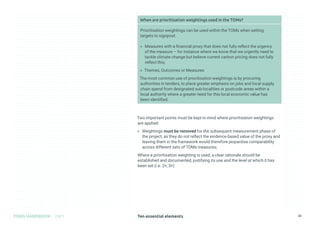
When are prioritisation weightings used in the TOMs?
Prioritisation weightings can be used within the TOMs when setting
targets to signpost:
» Measures with a financial proxy that does not fully reflect the urgency
of the measure – for instance where we know that we urgently need to
tackle climate change but believe current carbon pricing does not fully
reflect this;
» Themes, Outcomes or Measures
The most common use of prioritisation weightings is by procuring
authorities in tenders, to place greater emphasis on jobs and local supply
chain spend from designated sub-localities or postcode areas within a
local authority where a greater need for this local economic value has
been identified.
Two important points must be kept in mind where prioritisation weightings
are applied:
» Weightings must be removed for the subsequent measurement phase of
the project, as they do not reflect the evidence-based value of the proxy and
leaving them in the framework would therefore jeopardise comparability
across different sets of TOMs measures;
Where a prioritisation weighting is used, a clear rationale should be
established and documented, justifying its use and the level at which it has
been set (i.e. 2×, 3×)
Ten essential elements
TOMS HANDBOOK 2021 24
Quantitative and Qualitative measurement
The TOMs framework helps organisations to standardise the
measurement of social value. Quantitative measurement is standardised
through use of common units of measurement.
Measurement does not necessarily entail valuation, and social value
unlocked can simply be reported by using the units as indicators where
appropriate.
Qualitative measurement is more difficult to standardise. The TOMs
framework aims to ensure that all activities delivered and reported
through the measure satisfy some minimum qualitative requirements. To
do so they include additional qualitative requirements on what can be
reported as social valued within the guidance and through requirement of
specific evidence.
Organisations can and should specify additional qualitative
characteristics to be measured where these are important. As social
value measurement evolves, the need to establish clear standards for
qualitative measurement of social value will progressively become
more important, both through the introduction of social value evaluation
frameworks focused on qualitative assessment (for example, through
UK Central Government implementation of social value) and the need to
ensure that numerical social value metrics are properly contextualised.
Valuation
There are, in effect, four principal stages in the social value measurement
process:
Recording the data: The data might be real (what actually happened) or
theoretical (what is projected to happen or set as targets).
Measuring change through the data: To measure change, we need
standard units of measurement to help us describe the social value in a
way that allows us to compare between projects, organisations, sectors
Ten essential elements
TOMS HANDBOOK 2021 25
and localities. We also need a clear understanding of what these standard
units entail, and therefore what is capable of being measured. Importantly,
a standard way of measuring enables us to describe what has changed as
a result of particular activities or interventions, or between one time period
and another. Measuring social value quantitatively without putting a “value”
to it is often still a useful exercise.
Valuing change: If we stop at there, we can only compare similar types
of social value activities, in other words, those with the same units of
measurement (hours of volunteering, tonnes of CO2 saved, etc.). We will
struggle to form an overall view of the aggregate social value delivered and
set it alongside economic and other financially expressed outcomes.
Valuation therefore enhances our ability to contextualise social value data
and understand its significance. When valuation includes monetisation it
allows us to compare bundles of different interventions (e.g. bids within
procurement, alternative investment opportunities or competing planning
submissions) through a common metric.
Evidencing change: To ensure that the social value delivered complies
with qualitative requirements, is verifiable and can be communicated
transparently to the relevant audiences, evidence must be gathered
consistently. Each measure in the TOMs includes specific evidencing
requirements that can be adapted to the needs of a project but should
be communicated from the very beginning of the process to ensure that
evidence collection does not become an unmanageable “add on” but is
rather a key part of the process.
Ten essential elements
TOMS HANDBOOK 2021 26
Additionality, attribution
and deadweight
The TOMs framework is designed to capture social value added. This
means that whatever is recorded under the framework must be both
additional and directly relevant to the wider activity within which the social
value will take place or is planned. The first of these two factors is known
as ‘additionality’ and the second ‘attribution’. An essential related concept
for understanding additionality and attribution is ‘deadweight’.
Although these seem somewhat technical terms, the basic principle is
simple: in social value measurement (just as in economic appraisal), we
mustn’t claim for something that was already happening before we got
involved and we must only claim what is proportionate to our intervention..
» Deadweight is what would have happened anyway (without the measure or
intervention)
» Additionality is the opposite – what wouldn’t have happened if we hadn’t
undertaken the measure or intervention (So Additionality = Impact minus
Deadweight)
» Attribution is how much of a result can be credited to – for example –
a particular intervention or organisation.
For certain TOMs measures, additionality is built into the measure because
a generalised assessment of ‘deadweight’ is incorporated in their proxies.
An example of this is the measure representing the employment of
ex-offenders (NT5).
Other measures, however, require further steps to work out additionality,
according to the circumstances – including leakage, displacement,
substitution or drop-off effects.
Ten essential elements
TOMS HANDBOOK 2021 27
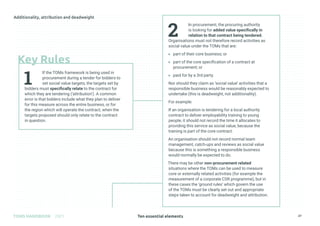
2
In procurement, the procuring authority
is looking for added value specifically in
relation to that contract being tendered.
Organisations must not therefore record activities as
social value under the TOMs that are:
» part of their core business; or
» part of the core specification of a contract at
procurement; or
» paid for by a 3rd party.
Nor should they claim as ‘social value’ activities that a
responsible business would be reasonably expected to
undertake (this is deadweight, not additionality).
For example:
If an organisation is tendering for a local authority
contract to deliver employability training to young
people, it should not record the time it allocates to
providing this service as social value, because the
training is part of the core contract.
An organisation should not record normal team
management, catch-ups and reviews as social value
because this is something a responsible business
would normally be expected to do.
There may be other non-procurement related
situations where the TOMs can be used to measure
core or externally related activities (for example the
measurement of a corporate CSR programme), but in
these cases the ‘ground rules’ which govern the use
of the TOMs must be clearly set out and appropriate
steps taken to account for deadweight and attribution.
1
If the TOMs framework is being used in
procurement during a tender for bidders to
set social value targets, the targets set by
bidders must specifically relate to the contract for
which they are tendering (‘attribution’). A common
error is that bidders include what they plan to deliver
for this measure across the entire business, or for
the region which will operate the contract, when the
targets proposed should only relate to the contract
in question.
Key Rules
Ten essential elements
TOMS HANDBOOK 2021 28
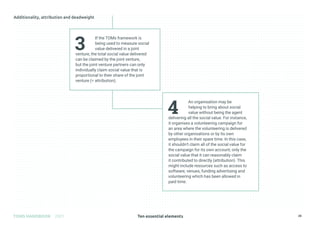
4
An organisation may be
helping to bring about social
value without being the agent
delivering all the social value. For instance,
it organises a volunteering campaign for
an area where the volunteering is delivered
by other organisations or by its own
employees in their spare time. In this case,
it shouldn’t claim all of the social value for
the campaign for its own account; only the
social value that it can reasonably claim
it contributed to directly (attribution). This
might include resources such as access to
software, venues, funding advertising and
volunteering which has been allowed in
paid time.
3
If the TOMs framework is
being used to measure social
value delivered in a joint
venture, the total social value delivered
can be claimed by the joint venture,
but the joint venture partners can only
individually claim social value that is
proportional to their share of the joint
venture (= attribution).
Ten essential elements
TOMS HANDBOOK 2021 29
The key point in all of this is always not to overclaim.
The guidance to the TOMs framework generally makes reference to a
“contract”. This can give rise to confusion when the TOMs is being used
for situations where a specific contract is not involved – for instance, for
corporate level measurement.
In the Measures Handbook, we have chosen to use the term “underlying
[business] activity” to describe more generally the commercial activity that
the social value must be connected to. This is interchangeable with the
term ‘contract’ for measurement purposes.
Whether reporting against a specific contract or for a business, there has
to be a direct relationship between the social value delivered and whatever
activity is being reported on more broadly. There is not always a direct
contract – in which case, we need to identify some other point of reference
for the social value being reported.
Establishing this point of reference is vital to determining attribution.
To summarise, here are some examples to help determine attribution:
» When bidding for (or reporting on) a contract, only attribute the social value
activities that arise directly as a result of that contract. If the programme
goes wider than the one contract, attribute the relevant proportion of the
wider programme, based on the size of the contract relative to the overall
coverage of the programme.
» For instance, a contract might represent 10% of a business’s total turnover
in a region. If a social value programme spans that region, it would be
reasonable to attribute 10% of the programme to this contract.
» When reporting on social value for a specific division in a business, only
attribute the social value activities that are directly attributable to that
division.
» For instance, the division might represent 20% of the business’s total
turnover. If a social value programme spans the entire business, it would
be reasonable to attribute 20% of the programme to this division.
Ten essential elements
TOMS HANDBOOK 2021 30
» When reporting on social value for a contract with multiple participants
or a joint venture and the participants are reporting their own social value
delivered, they should only take credit for social value delivered that is
proportionate to their participation.
» For instance, in an equal three-way joint venture, the participants should
each take credit for a third of social value delivered under the contract.
The essential principle remains the same – social value reported must be
relevant, specific and proportionate to the underlying business activity that
is taking place. This is the principle of ‘attribution’.
Ten essential elements
TOMS HANDBOOK 2021 31
Local Measures
The TOMs is designed to report added social value. The commercial or
financial value of the activity (the value of the contract being tendered, the
turnover of the business division, etc.) is not included in the social value
reported figure, because we are only interested in what is additional to this
underlying commercial or financial value.
For this reason, the TOMs framework makes a clear distinction between
local economic and social value, because local economic value is only
demonstrably value added for the area in which it occurs, while social value
is value added for society as a whole.
In order to ensure that the TOMs methodology remains consistent with
standard practice in socio-economic evaluation, it needs to factor in
displacement. This refers to the assumption that economic activity in
one location means that activity can’t (by definition) then take place in
another, so that at a UK level the fact that spend is local to one area is not
(considering other areas where the spend didn’t take place) beneficial to
the UK as a whole. The value of these local economic components is only
deemed to be felt by the people in that area, not by society. This is why local
economic and social value are treated separately in the TOMs.
Arguably there are other reasons why ‘local’ may be beneficial to society
as a whole (stronger business clusters, reduced movement of goods and
people, for instance, leading to lower emissions), but these benefits are not
easily generalisable and cannot therefore be factored into the standardised
proxies used for the local measures in the TOMs.
Which TOMs measures are Local Economic Value?
These are the measures that cover the local element of the commercial
value of the contract, namely: value reported under NT1 (local jobs) and
related measures (NT1a, NT1b, NT1c) and NT18/NT19 (local supply
chain spend) and related measures (NT2, NT18a NT19aRE3, RE21, and
C-1 to C-4.). These measures are included in the framework because they
are vital contributors to local social value. Local economic prosperity is
therefore a prerequisite for sustained positive social change.
Ten essential elements
TOMS HANDBOOK 2021 32
That said, as the local economic measures in the TOMs tend to carry a
high financial weight, as experience of social value measurement develops,
people will want to interrogate more deeply the benefits of local jobs and
local supply chain spend on a case-by-case basis, particularly for larger
projects.
True local value created will vary, for instance, according to the type of
local business. One business with skilled local labour as its principal cost
overhead may be creating more local value (because it is putting more
money into local people’s pockets for every £ it receives) than another
business whose main local spend items consist of materials bought in
from elsewhere and purchased from the local branch of a national builders’
merchants chain.
More experienced users of the TOMs may therefore wish to consider
starting to gather more data on local supply chains so that these questions
can be examined in more detail and a more nuanced picture of local value
created.
Ten essential elements
TOMS HANDBOOK 2021 33
The TOMs methodology aggregates the results from all of the different
measures in the Framework to come to an overall figure. Within groups
of similar measures there are choices to be made about where to record
a particular activity. Consequently, we need to make sure that nothing
is inadvertently included more than once, which is why such a strong
emphasis is placed on avoiding double counting in the TOMs guidance.
We try to highlight where double counting risks are likely to arise; the
detailed measures section contains extensive double counting notifications
on a measure-by-measure basis. However, ultimately it is for the
organisation reporting its social value to ensure that there is no double
counting in the figures. If in doubt, organisations should always take a
prudent approach and report less, rather than risk over-claiming.
The general rule is that an individual, an hour of time, a carbon saving, an
economic benefit or a financial or in-kind donation can all only be reported
once in the TOMs. If this general rule is observed, then most of the double-
counting risk will be eliminated.
It might be argued that a single intervention could have multiple benefits,
which is true, but the need to classify each activity as a single reported
benefit is one of the essential compromises needed to create a generalised
working social value framework. We would always encourage, where
appropriate, suitably validated analysis based on primary project data
to explore the interactions between activities and outcomes, as a way of
generating a richer picture of the social value delivered on a case-by-case
basis.
The Measures Handbook highlights by measure in the detailed section that
follows where double counting can occur.
Double Counting
Ten essential elements
TOMS HANDBOOK 2021 34
Main areas of double counting risk in the TOMs
Local supply chain spend (NT18 / NT19 and related measures)
The same spend must not be reported more than once. For example,
if total projected supply chain spend is £10m of which £3m is with
medium-sized and smaller businesses, £7m must be entered against
NT18 and £3m against NT19.
Volunteering hours and donations to charities The same hour of
volunteering and the same £ donation must only be claimed once.
Employment of individuals from disadvantaged groups (NT3 –
NT6) An individual may not, for example, be reported under the TOMs
both as NEET and having a disability. It might be the case that the
individual concerned does fall under both of these categories, but
because of the overlap in the underlying datasets and the way proxies
have had to be developed, it is not possible to add two proxies in this
group of measures together.
Local employment and local supply chain spend (NT1, NT1b and
NT1c and NT18 / NT19 and related measures) Local supply chain
spend finances the sub-contractor’s costs, including local labour.
It follows that if supply chain labour is also included in the local
employment measures at NT1, NT1b and NT1c, this element has in
effect been counted twice. In practice, the double counting occurs
most often when respondents include local supply chain labour in
NT1, so this is the key error to avoid.
Ten essential elements
TOMS HANDBOOK 2021 35
Reporting against the TOMs, just as for financial accounts, is time-based.
This means that any social value reported under the framework must be
aligned with the reporting period in which it is reported.
Companies will typically want their main social value report annually, but
with interim reporting each quarter or at the six-month stage to make sure
they are on track. On the other hand, projects and contracts could be for a
matter of weeks or for many years. The overriding consideration is to make
sure that the social value reported is comparable between reporting periods
of different lengths.
All time-based measures in the TOMs are expressed in units that allow
this comparison to happen. The TOMs doesn’t count the number of jobs
– it counts the number of Full-Time Equivalents (FTEs). It doesn’t count
the number of apprenticeships – it counts the number of weeks that
the underlying business activity has supported the apprenticeships. It
doesn’t count the number of volunteers – it counts the number of hours
volunteering time, and so on.
It follows, for example, that if an organisation is bidding for a contract that
is 3 years in duration and plans to employ 10 local people full-time every
year (reported under NT1), then it should submit 30 FTEs as its target.
By the same token, an organisation bidding for a contract that is 3 months
in duration and planning to employ 10 local people full-time on this contract
would submit 2.5 FTEs as its target (10 × 0.25 (= 3 months / 1 year)).
However, while the jobs measures for individuals facing barriers to the jobs
market (NT3 – NT6 inclusive) are also expressed in FTEs, these measures
should only be used for the first year of the individual’s employment,
because of the way the measure is designed. For further information see
the detailed measures section.
A company reporting annually but collating data on a quarterly basis to
check how everything is progressing will need to decide how to spread the
data over the 12-month period to ensure that an accurate figure is included
in the annual summary.
Reporting periods
and FTEs
Why are FTEs important for the TOMs?
The TOMs framework makes extensive
use of “Full-time Equivalents” (FTEs) as
the unit to count employment. This is
because jobs need to be equalised in time
terms to make comparisons between
different initiatives and projects. While
there is no fixed definition of full-time
employment, an FTE of 1.0 corresponds
to having one person employed on a
full-time basis for a period of 12 months.
For different FTE numbers or durations
of employment, this can simply be
adjusted pro rata. For example, two people
employed full time for six months would
equal 1.0 FTE. One person employed
full-time for six months would equal 0.5
FTE. For the TOMs, we define full time
employment as working at least 35 hours
per week.
Ten essential elements
TOMS HANDBOOK 2021 36
Inputs, Outputs,
Outcomes and Impacts
Reflecting the different types of evidence gathered for each measure,
there are basically four different categories of units and proxies within the
TOMs framework: Inputs, Outputs, Outcomes and Impacts.
An “input” does no more than say what resources have been invested. It
says nothing about the result of the investment. The result is an “impact”. In
theory, all inputs lead to impacts. In practice, it will not always be possible to
trace this progression from the evidence.
Inputs, Outputs, Outcomes and Impacts in the TOMs
Inputs units and proxies that are expressed in terms of what it costs the
organisation to deliver the measure. For example, a charitable donation
of £5,000 is an ‘input’.
Outputs units and proxies that are expressed in terms of the financial
value created for the beneficiary, but without considering the benefit
created. For example, a measure recording the transfer of skills from
a business to a community organisation using the “expert time” proxy
estimates what it would otherwise have cost this organisation to procure
this expertise from elsewhere.
Outcomes units and proxies that are expressed in terms of the
direct change experienced by the beneficiaries. Structured training
programmes and qualifications, for instance, are TOMs measures that
are measured and valued as outcomes.
Impacts units and proxies that have been identified as capturing both
how the recipient of the activity benefits from the measure in the long
term and how this in turn benefits other stakeholders. Only a limited
range of measures in the TOMs have Impact units and proxies, because
without extensive detailed, specific research it is very difficult to
extrapolate from standardised interventions to measurable impacts. The
benefit of most general measures to individuals and communities will
vary according to specific circumstances.
Ten essential elements
TOMS HANDBOOK 2021 37
While we may think our primary goal is to measure social impact, as we
move away from measuring inputs towards measuring impacts, the effects
become wider but the causal link between the activity and the financial
proxy becomes less certain. In other words, while an output is easier
to quantify, we can be less sure that the financial proxy is a reasonable
reflection of the actual benefit.
On the other hand, it is difficult to frame impacts as standardised
interventions. If we want to know exactly what effect an intervention has
had on a group of people, we need to do the primary research (such as
surveys of beneficiaries) with this specific group of people.
The TOMs measures are designed to function as a comparative framework
– comparing different time periods, different projects, different localities and
so on. The Impact proxies in the TOMs have been researched to a degree
that provides robust comparative analysis. What the TOMs framework does
is provide a solid evidence and methodological base which can support
primary research if needed.
In summary, the TOMs framework is a “hybrid” of these four types of effect,
based on a pragmatic assessment of the available evidence. Which of
them has been applied to any given measure depends on the research and
evidence available to support that particular measure.
Ten essential elements
TOMS HANDBOOK 2021 38
Tackling Climate Change
As we write, the existential crisis posed by climate change looms ever
larger. We have to change everything we do to maximise our chances of
driving down carbon emissions to limit the catastrophic effects of global
warming.
As we have seen, the purpose of the TOMs is to report added value. In
environmental terms, this means going above and beyond the minimum
required, and to support initiatives that help the world to decarbonise as
quickly as possible. It also means pushing for a “green normal”, rather than
treating environmental outcomes as a bolt-on or an afterthought.
This determines how we establish the baseline requirements for carbon
reduction measures in the TOMs, which adopts the minimum targets
identified by the UN, the UK Government, and the scientific community;
namely that to keep global temperature rises as close to 1.5 degrees
Celsius as possible, it is necessary to achieve net zero carbon emissions by
2050 (“NZC 2050”).
The commitment to NZC 2050 is enshrined in law – the UK passed
legislation to require greenhouse gases to be brought to net zero by 2050 in
June 20193.
While the TOMs adopts this minimum target to 2050 as the baseline, it
follows that “added value” in measurement terms should come from the
voluntary adoption of targets that exceed minimum requirements. More
ambitious targets such as net zero by 2030, embraced by over 100 local
authorities across the UK, are becoming increasingly widespread and
provide greater scope to mitigate Climate Change than NZC 2050.
In principle, therefore, target emissions levels should be set by users of the
TOMs to aim for an earlier target – say net zero by 2030, to demonstrate
additionality. In practice, it may be difficult to determine how this translates
3 See: gov.uk/government/news/
uk-becomes-first-major-economy-to-pass-net-zero-emissions-law
Ten essential elements
TOMS HANDBOOK 2021 39
on a project-by-project basis, and users will be required to apply their
judgement to set targets that demonstrate this additionality.
In some cases, a more demanding emissions requirement than NZC 2050
may have been set at a localised level with legal / regulatory effect – for
example through planning regulations. In which case, this should be used as
the baseline.
To establish a target, a base year needs to be set, from which the target is to
be achieved. Any savings in CO2 emissions have to be set against this base
year and, as explained above, do more than simply track target reductions
needed to reach net zero by 2050 on a linear trend.
Ten essential elements 40
TOMS HANDBOOK 2021
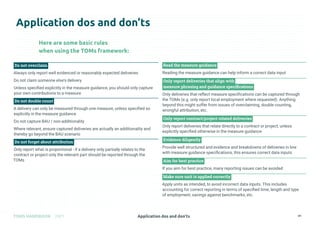
Application dos and don’ts
TOMS HANDBOOK 2021 41
Application dos and don’ts
Do not overclaim
Always only report well evidenced or reasonably expected deliveries
Do not claim someone else's delivery
Unless specified explicitly in the measure guidance, you should only capture
your own contributions to a measure
Do not double count
A delivery can only be measured through one measure, unless specified so
explicitly in the measure guidance
Do not capture BAU / non-additionality
Where relevant, ensure captured deliveries are actually an additionality and
thereby go beyond the BAU scenario
Do not forget about attribution
Only report what is proportional - if a delivery only partially relates to the
contract or project only the relevant part should be reported through the
TOMs
Read the measure guidance
Reading the measure guidance can help inform a correct data input
Only report deliveries that align with
measure phrasing and guidance specifications
Only deliveries that reflect measure specifications can be captured through
the TOMs (e.g. only report local employment where requested). Anything
beyond this might suffer from issues of overclaiming, double counting,
wrongful attribution, etc.
Only report contract/project related deliveries
Only report deliveries that relate directly to a contract or project, unless
explicitly specified otherwise in the measure guidance
Evidence diligently
Provide well structured and evidence and breakdowns of deliveries in line
with measure guidance specifications, this ensures correct data inputs
Aim for best practice
If you aim for best practice, many reporting issues can be avoided
Make sure unit is applied correctly
Apply units as intended, to avoid incorrect data inputs. This includes
accounting for correct reporting in terms of specified time, length and type
of employment, savings against benchmarks, etc.
Here are some basic rules
when using the TOMs framework:
42
TOMS HANDBOOK 2021
Principal changes to the measures in the 2021 TOMs
TOMS HANDBOOK 2021 43
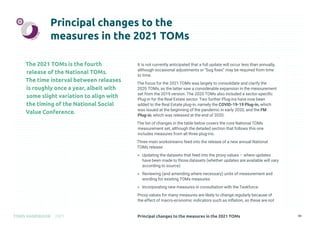
Principal changes to the
measures in the 2021 TOMs
The 2021 TOMs is the fourth
release of the National TOMs.
The time interval between releases
is roughly once a year, albeit with
some slight variation to align with
the timing of the National Social
Value Conference.
It is not currently anticipated that a full update will occur less than annually,
although occasional adjustments or “bug fixes” may be required from time
to time.
The focus for the 2021 TOMs was largely to consolidate and clarify the
2020 TOMs, as the latter saw a considerable expansion in the measurement
set from the 2019 version. The 2020 TOMs also included a sector-specific
Plug-in for the Real Estate sector. Two further Plug-ins have now been
added to the Real Estate plug-in, namely the COVID-19-19 Plug-in, which
was issued at the beginning of the pandemic in early 2020, and the FM
Plug-in, which was released at the end of 2020.
The list of changes in the table below covers the core National TOMs
measurement set, although the detailed section that follows this one
includes measures from all three plug-ins.
Three main workstreams feed into the release of a new annual National
TOMs release:
» Updating the datasets that feed into the proxy values – where updates
have been made to those datasets (whether updates are available will vary
according to source)
» Reviewing (and amending where necessary) units of measurement and
wording for existing TOMs measures
» Incorporating new measures in consultation with the Taskforce.
Proxy values for many measures are likely to change regularly because of
the effect of macro-economic indicators such as inflation, so these are not
Principal changes to the measures in the 2021 TOMs
TOMS HANDBOOK 2021 44
recorded as “principal changes”. It is recommended that users retain the
proxy values for the year in question (rather than, for example, updating a
prior year’s set of figures with current values) and that material variances
are taken into account in the way the figures are reported. In some limited
cases there may be a need to change the unit of measurement itself in
updates, in which case this is highlighted in the Principal Changes Table and
a further adjustment may be needed by the user for like-for-like comparison.
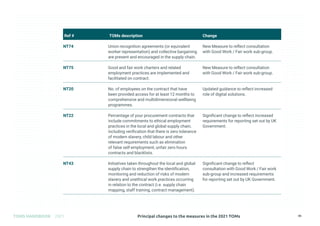
The principal changes within the 2021 TOMs framework from the 2020
TOMs are described in the table below.
Principal changes to the measures in the 2021 TOMs
TOMS HANDBOOK 2021 45
Ref # TOMs description Change
NT74 Union recognition agreements (or equivalent
worker representation) and collective bargaining
are present and encouraged in the supply chain.
New Measure to reflect consultation
with Good Work / Fair work sub-group.
NT75 Good and fair work charters and related
employment practices are implemented and
facilitated on contract.
New Measure to reflect consultation
with Good Work / Fair work sub-group.
NT20 No. of employees on the contract that have
been provided access for at least 12 months to
comprehensive and multidimensional wellbeing
programmes.
Updated guidance to reflect increased
role of digital solutions.
NT22 Percentage of your procurement contracts that
include commitments to ethical employment
practices in the local and global supply chain,
including verification that there is zero tolerance
of modern slavery, child labour and other
relevant requirements such as elimination
of false self-employment, unfair zero hours
contracts and blacklists.
Significant change to reflect increased
requirements for reporting set out by UK
Government.
NT43 Initiatives taken throughout the local and global
supply chain to strengthen the identification,
monitoring and reduction of risks of modern
slavery and unethical work practices occurring
in relation to the contract (i.e. supply chain
mapping, staff training, contract management).
Significant change to reflect
consultation with Good Work / Fair work
sub-group and increased requirements
for reporting set out by UK Government.
Principal changes to the measures in the 2021 TOMs
TOMS HANDBOOK 2021 46
Ref # TOMs description Change
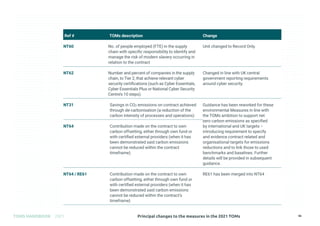
NT60 No. of people employed (FTE) in the supply
chain with specific responsibility to identify and
manage the risk of modern slavery occurring in
relation to the contract
Unit changed to Record Only.
NT62 Number and percent of companies in the supply
chain, to Tier 2, that achieve relevant cyber
security certifications (such as Cyber Essentials,
Cyber Essentials Plus or National Cyber Security
Centre’s 10 steps).
Changed in line with UK central
government reporting requirements
around cyber security.
NT31 Savings in CO2 emissions on contract achieved
through de-carbonisation (a reduction of the
carbon intensity of processes and operations)
Guidance has been reworked for these
environmental Measures in line with
the TOMs ambition to support net
zero carbon emissions as specified
by international and UK targets –
introducing requirement to specify
and evidence contract related and
organisational targets for emissions
reductions and to link those to used
benchmarks and baselines. Further
details will be provided in subsequent
guidance.
NT64 Contribution made on the contract to own
carbon offsetting, either through own fund or
with certified external providers (when it has
been demonstrated said carbon emissions
cannot be reduced within the contract
timeframe).
NT64 / RE61 Contribution made on the contract to own
carbon offsetting, either through own fund or
with certified external providers (when it has
been demonstrated said carbon emissions
cannot be reduced within the contract’s
timeframe)
RE61 has been merged into NT64
Principal changes to the measures in the 2021 TOMs
TOMS HANDBOOK 2021 47
Ref # TOMs description Change
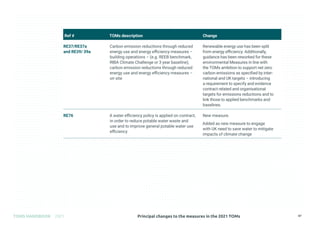
RE37/RE37a
and RE39/ 39a
Carbon emission reductions through reduced
energy use and energy efficiency measures –
building operations – (e.g. REEB benchmark,
RIBA Climate Challenge or 3 year baseline);
carbon emission reductions through reduced
energy use and energy efficiency measures –
on site
Renewable energy use has been split
from energy efficiency. Additionally,
guidance has been reworked for these
environmental Measures in line with
the TOMs ambition to support net zero
carbon emissions as specified by inter-
national and UK targets – introducing
a requirement to specify and evidence
contract related and organisational
targets for emissions reductions and to
link those to applied benchmarks and
baselines.
RE76 A water efficiency policy is applied on contract,
in order to reduce potable water waste and
use and to improve general potable water use
efficiency
New measure.
Added as new measure to engage
with UK need to save water to mitigate
impacts of climate change
48
TOMS HANDBOOK 2021

The 2021 TOMs measures
detailed tables
The 2021 TOMs measures detailed tables
TOMS HANDBOOK 2021 49
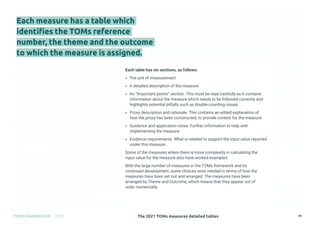
Each measure has a table which
identifies the TOMs reference
number, the theme and the outcome
to which the measure is assigned.
Each table has six sections, as follows:
» The unit of measurement.
» A detailed description of the measure.
» An “Important points” section. This must be read carefully as it contains
information about the measure which needs to be followed correctly and
highlights potential pitfalls such as double-counting issues.
» Proxy description and rationale. This contains an edited explanation of
how the proxy has been constructed, to provide context for the measure.
» Guidance and application notes. Further information to help with
implementing the measure.
» Evidence requirements. What is needed to support the input value reported
under this measure.
Some of the measures where there is more complexity in calculating the
input value for the measure also have worked examples.
With the large number of measures in the TOMs framework and its
continued development, some choices were needed in terms of how the
measures have been set out and arranged. The measures have been
arranged by Theme and Outcome, which means that they appear out of
order numerically.
Return to Contents
TOMS HANDBOOK 2021
Jobs
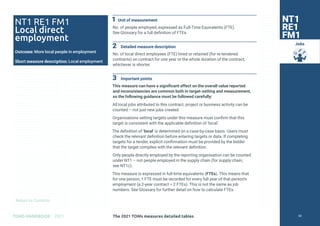
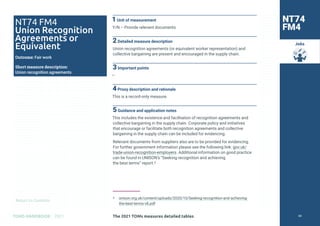
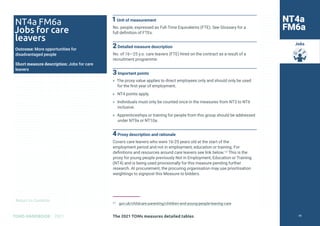
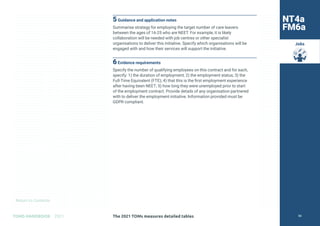
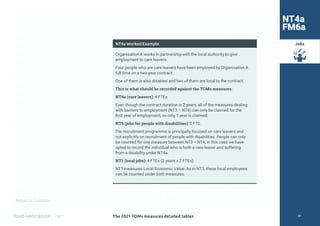
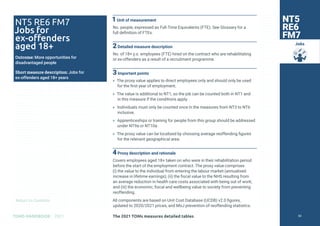
1 Unit of measurement
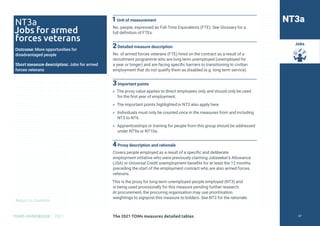
No. of people employed, expressed as Full-Time Equivalents (FTE).
See Glossary for a full definition of FTEs.
2 Detailed measure description
No. of local direct employees (FTE) hired or retained (for re-tendered
contracts) on contract for one year or the whole duration of the contract,
whichever is shorter.
3 Important points
This measure can have a significant effect on the overall value reported
and inconsistencies are common both in target-setting and measurement,
so the following guidance must be followed carefully:
All local jobs attributed to this contract, project or business activity can be
counted – not just new jobs created.
Organisations setting targets under this measure must confirm that this
target is consistent with the applicable definition of ‘local’.
The definition of ‘local’ is determined on a case-by-case basis. Users must
check the relevant definition before entering targets or data. If completing
targets for a tender, explicit confirmation must be provided by the bidder
that the target complies with the relevant definition.
Only people directly employed by the reporting organisation can be counted
under NT1 – not people employed in the supply chain (for supply chain,
see NT1c).
This measure is expressed in full-time equivalents (FTEs). This means that
for one person, 1 FTE must be recorded for every full year of that person’s
employment (a 2-year contract = 2 FTEs). This is not the same as job
numbers. See Glossary for further detail on how to calculate FTEs.
NT1 RE1 FM1
Local direct
employment
Outcome: More local people in employment
Short measure description: Local employment
NT1
RE1
FM1
The 2021 TOMs measures detailed tables 50
Return to Contents
TOMS HANDBOOK 2021
Jobs
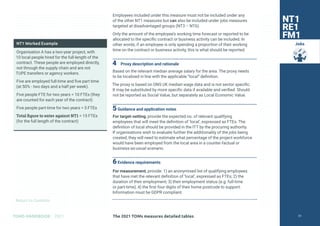
Employees included under this measure must not be included under any
of the other NT1 measures but can also be included under jobs measures
targeted at disadvantaged groups (NT3 – NT6).
Only the amount of the employee’s working time forecast or reported to be
allocated to the specific contract or business activity can be included. In
other words, if an employee is only spending a proportion of their working
time on the contract or business activity, this is what should be reported.
4 Proxy description and rationale
Based on the relevant median average salary for the area. The proxy needs
to be localised in line with the applicable “local” definition.
The proxy is based on ONS UK median wage data and is not sector specific.
It may be substituted by more specific data if available and verified. Should
not be reported as Social Value, but separately as Local Economic Value.
5Guidance and application notes
For target-setting, provide the expected no. of relevant qualifying
employees that will meet the definition of ‘local’, expressed as FTEs. The
definition of local should be provided in the ITT by the procuring authority.
If organisations wish to evaluate further the additionality of the jobs being
created, they will need to estimate what percentage of the project workforce
would have been employed from the local area in a counter-factual or
business-as-usual scenario.
6Evidence requirements
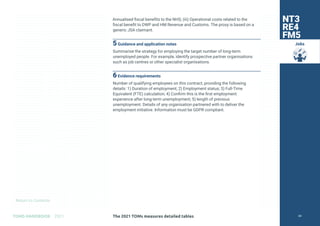
For measurement, provide: 1) an anonymised list of qualifying employees
that have met the relevant definition of ‘local’, expressed as FTEs; 2) the
duration of their employment; 3) their employment status (e.g. full-time
or part-time); 4) the first four digits of their home postcode to support.
Information must be GDPR compliant.
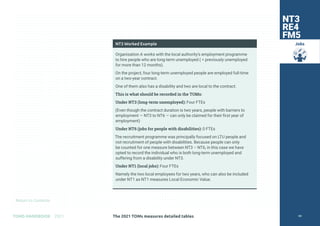
NT1 Worked Example
Organisation A has a two-year project, with
10 local people hired for the full-length of the
contract. These people are employed directly,
not through the supply chain and are not
TUPE transfers or agency workers.
Five are employed full-time and five part time
(at 50% - two days and a half per week).
Five people FTE for two years = 10 FTEs (they
are counted for each year of the contract)
Five people part-time for two years = 5 FTEs
Total figure to enter against NT1 = 15 FTEs
(for the full length of the contract)
NT1
RE1
FM1
The 2021 TOMs measures detailed tables 51
Return to Contents
TOMS HANDBOOK 2021
Jobs
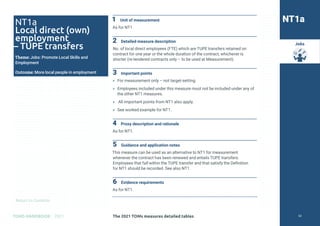
NT1a
Local direct (own)
employment
– TUPE transfers
Theme: Jobs: Promote Local Skills and
Employment
Outcome: More local people in employment
1 Unit of measurement
As for NT1
2 Detailed measure description
No. of local direct employees (FTE) which are TUPE transfers retained on
contract for one year or the whole duration of the contract, whichever is
shorter (re-tendered contracts only – to be used at Measurement).
3 Important points
» For measurement only – not target-setting.
» Employees included under this measure must not be included under any of
the other NT1 measures.
» All important points from NT1 also apply.
» See worked example for NT1.
4 Proxy description and rationale
As for NT1.
5 Guidance and application notes
This measure can be used as an alternative to NT1 for measurement
whenever the contract has been renewed and entails TUPE transfers.
Employees that fall within the TUPE transfer and that satisfy the Definition
for NT1 should be recorded. See also NT1.
6 Evidence requirements
As for NT1.
NT1a
The 2021 TOMs measures detailed tables 52
Return to Contents
TOMS HANDBOOK 2021
Jobs
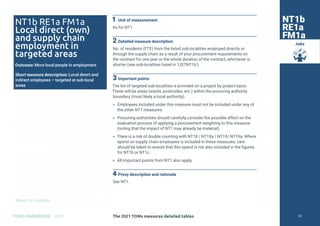
NT1b RE1a FM1a
Local direct (own)
and supply chain
employment in
targeted areas
Outcome: More local people in employment
Short measure description: Local direct and
indirect employees – targeted at sub-local
areas
NT1b
RE1a
FM1a
1 Unit of measurement
As for NT1.
2 Detailed measure description
No. of residents (FTE) from the listed sub-localities employed directly or
through the supply chain as a result of your procurement requirements on
the contract for one year or the whole duration of the contract, whichever is
shorter (see sub-localities listed in ‘LISTNT1b’).
3 Important points
The list of targeted sub-localities is provided on a project by project basis.
These will be areas (wards, postcodes, etc.) within the procuring authority
boundary (most likely a local authority).
» Employees included under this measure must not be included under any of
the other NT1 measures.
» Procuring authorities should carefully consider the possible effect on the
evaluation process of applying a procurement weighting to this measure
(noting that the impact of NT1 may already be material).
» There is a risk of double counting with NT18 / NT18a / NT19/ NT19a. Where
spend on supply chain employees is included in these measures, care
should be taken to ensure that this spend is not also included in the figures
for NT1b or NT1c.
» All important points from NT1 also apply.
4 Proxy description and rationale
See NT1.
The 2021 TOMs measures detailed tables 53
Return to Contents
TOMS HANDBOOK 2021
Jobs
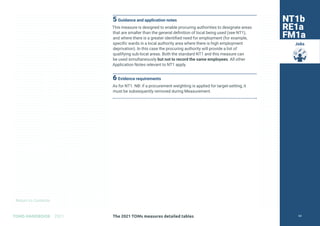
5 Guidance and application notes
This measure is designed to enable procuring authorities to designate areas
that are smaller than the general definition of local being used (see NT1),
and where there is a greater identified need for employment (for example,
specific wards in a local authority area where there is high employment
deprivation). In this case the procuring authority will provide a list of
qualifying sub-local areas. Both the standard NT1 and this measure can
be used simultaneously but not to record the same employees. All other
Application Notes relevant to NT1 apply.
6 Evidence requirements
As for NT1. NB: if a procurement weighting is applied for target-setting, it
must be subsequently removed during Measurement.
NT1b
RE1a
FM1a
The 2021 TOMs measures detailed tables 54
Return to Contents
TOMS HANDBOOK 2021
Jobs
NT1c RE1b FM1b
Local indirect
employment –
supply chain only
Outcome: More local people in employment
Short measure description: Local supply
chain employment
NT1c
RE1b
FM1b
1Unit of measurement
As for NT1.
2Detailed measure description
No. of local people (FTE) on contract for one year or the whole duration of
the contract, whichever is shorter, employed through the supply chain as a
result of your procurement requirements.
3Important points
» Employees included under this measure must not be included under any
of the other NT1 measures.
» There is a high risk of double counting between this measure and NT18 /
NT18a / NT19 / NT19a. See example below. This measure can therefore
only be used with the proxy if there is evidence provided that no double
counting risk exists with these measures.
4Proxy description and rationale
See NT1.
5Guidance and application notes
All Application Notes relevant to NT1 apply.
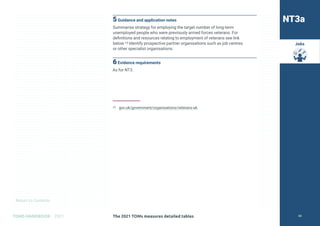
Summarise plans to secure local employment through the supply chain and
their strategy for securing the target number of local people to be employed.
For example, their strategy for how they plan to advertise locally such as
where and how frequently. Or if they plan to cooperate with a specific local
job centre, and their engagement strategy for this etc.
6Evidence requirements
As for NT1.
The 2021 TOMs measures detailed tables 55
Return to Contents
TOMS HANDBOOK 2021
Jobs
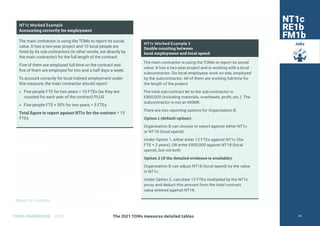
NT1c Worked Example
Accounting correctly for employment
The main contractor is using the TOMs to report its social
value. It has a two-year project and 10 local people are
hired by its sub-contractors (in other words, not directly by
the main contractor) for the full length of the contract.
Five of them are employed full-time on the contract and
five of them are employed for two and a half days a week.
To account correctly for local indirect employment under
this measure, the main contractor should report:
» Five people FTE for two years = 10 FTEs (as they are
counted for each year of the contract) PLUS
» Five people FTE × 50% for two years = 5 FTEs
Total figure to report against NT1c for the contract = 15
FTEs
NT1c Worked Example 2
Double counting between
local employment and local spend
The main contractor is using the TOMs to report its social
value. It has a two-year project and is working with a local
subcontractor. Six local employees work on site, employed
by the subcontractor. All of them are working full-time for
the length of the project.
The total sub-contract let to the sub-contractor is
£800,000 (including materials, overheads, profit, etc.). The
subcontractor is not an MSME.
There are two reporting options for Organisation B:
Option 1 (default option):
Organisation B can choose to report against either NT1c
or NT18 (local spend).
Under Option 1, either enter 12 FTEs against NT1c (Six
FTE × 2 years); OR enter £800,000 against NT18 (local
spend), but not both
Option 2 (if the detailed evidence is available):
Organisation B can adjust NT18 (local spend) by the value
in NT1c.
Under Option 2, calculate 12 FTEs multiplied by the NT1c
proxy and deduct this amount from the total contract
value entered against NT18.
NT1c
RE1b
FM1b
The 2021 TOMs measures detailed tables 56
Return to Contents
TOMS HANDBOOK 2021
Jobs
1Unit of measurement
Percentage.
2Detailed measure description
Percentage of local employees (FTE) on contract.
3Important points
» Definition of “local” must be consistent with NT1
» This covers both direct employees and employees in the supply chain.
» If an organisation has reported against several NT1 measures such as
NT1a, NT1b and NT1c, it needs to ensure it accounts for all types of people
employed to calculate the overall percentage for this measure.
4Proxy description / rationale
This is a record-only measure.
5Guidance and application notes
State expected no. qualifying employees that will meet the relevant definition
of “local”, expressed as FTEs.
Summarise existing or planned requirements for the supply chain to secure
local employment and their strategy for employing the target number of
local people on this contract. For example, their strategy for how they plan
to advertise locally such as where and how frequently. Or if they plan to
cooperate with a specific local job centre, and their engagement strategy for
this etc.
6Evidence requirements
As for NT1.
NT2
RE2
FM2
NT2 RE2 FM2
Percentage locally
employed
Outcome: More local people in employment
Short measure description: Percentage
locally employed
NT2 Worked Example
Contract duration: One year.
Total of people employed (FTEs) on the
contract, for the length of the contract: 48
Organisation A:
» Directly employees 3 FTE for the length of
the contract (NT1)
» There is no TUPE transfer (NT1a)
» Has a supply chain which employs 14.5 FTE
for the length of the contract (NT1c)
» No targeted areas of deprivation have been
defined, so NT1b is not used
Total local people employed FTE = 17.5
Total people employed (local and non-local)
FTE = 48
Percentage to be entered in NT2 = 36%
The 2021 TOMs measures detailed tables 57
Return to Contents
TOMS HANDBOOK 2021
Jobs
RE3 FM3
Employers’ fairs
Outcome: More local people in employment
Short measure description: Employer’s fairs
RE3
FM3
1Unit of measurement
£ invested including staff time.
2Detailed measure description
Employers’ fairs held to encourage local employment in the area.
3Important points
» The definition of “Local” must be consistent with NT1. See NT1 for further
details.
» Double count risk: this measure should not be double counted with career
fairs, taster days or career support workshops. This has to be an event
aimed at recruiting local people on the contract, not advising people around
career development.
4Proxy description and rationale
Costs incurred. This proxy captures the cost of resources pledged to
Employers’ fairs.
5Guidance and application notes
An Employer’s fair is designed to showcase potential new jobs to local
people – the “Employer” in this case being the organisation responsible for
creating the employment opportunity.
The event(s) should be organised in conjunction with an employment
partner, such as the local authority. Such events are appropriate during both
the construction and in-use phases and should include as many parts of the
supply chain as appropriate for the stage.
The event should be held in a place that is accessible to local people, there
should be suitable notification of the event to the local community via
relevant communication channels such as social media and the local press.
An event would be expected to last for half – 1 day.
The 2021 TOMs measures detailed tables 58
Return to Contents
TOMS HANDBOOK 2021
Jobs
Include the costs of putting on the event(s) including hiring of spaces,
stands and staff time. Include the number of events and details of each in
the description. Useful links below.4
6Evidence requirements
See Guidance and application notes. Provide details of each event, such as
place, time and number of attendees. Information must be GDPR compliant.
4 
jobmonkey.com/jobfairs/career-events
founders4schools.org.uk/educators/careers-fair
RE3 Worked Example
Organisation A participates in an
employment fair organised by the local
authority.
The overall cost of employees participating in
the fair is calculated as follows:
Two members of staff each for four
hours, which is equivalent to £128.72
(2×4×[£16.09]).
Cost of flyers to be distributed on the day:
£243.
Total to be entered against RE3: £371.72
RE3
FM3
The 2021 TOMs measures detailed tables 59
Return to Contents
TOMS HANDBOOK 2021
Jobs
NT74 FM4
Union Recognition
Agreements or
Equivalent
Outcome: Fair work
Short measure description:
Union recognition agreements
NT74
FM4
1Unit of measurement
Y/N – Provide relevant documents
2Detailed measure description
Union recognition agreements (or equivalent worker representation) and
collective bargaining are present and encouraged in the supply chain.
3Important points
—
4Proxy description and rationale
This is a record-only measure.
5Guidance and application notes
This includes the existence and facilitation of recognition agreements and
collective bargaining in the supply chain. Corporate policy and initiatives
that encourage or facilitate both recognition agreements and collective
bargaining in the supply chain can be included for evidencing.
Relevant documents from suppliers also are to be provided for evidencing.
For further government information please see the following link: gov.uk/
trade-union-recognition-employers. Additional information on good practice
can be found in UNISON’s “Seeking recognition and achieving
the best terms” report.5
5 
unison.org.uk/content/uploads/2020/10/Seeking-recognition-and-achieving-
the-best-terms-v8.pdf
The 2021 TOMs measures detailed tables 60
Return to Contents
TOMS HANDBOOK 2021
Jobs
Provide information on the existence of union recognition agreements
or equivalent worker representation, as well as collective bargaining
in the supply chain and how such engagement has been encouraged.
Documentation and evidencing are to be provided. This can include among
other things: supply chain data, past experiences, existing union recognition
agreements or documentation that provides proof
of equivalent worker representation, etc.
6Evidence requirements
See Guidance and application notes. Information must be GDPR compliant.
NT74
FM4
The 2021 TOMs measures detailed tables 61
Return to Contents
TOMS HANDBOOK 2021
Jobs
NT75
Good Work
/ Fair Work
Outcome: Fair work
Short measure description: Implementation
of Good Work or Fair Work practices
NT75
1Unit of measurement
Y/N – Provide relevant documents.
2Detailed measure description
Good and fair work charters and related employment practices are
implemented and facilitated on contract.
3Important points
—
4Proxy description and rationale
This is a record-only measure.
5Guidance and application notes
This is the implementation and facilitation of “good” or “fair” work practices
and related charters on the contract. Such charters set out guidelines
around what is understood as good practice with regard to fair work and
how it can be facilitated.
Examples for comprehensive good practice charters or comparable
documents include, but are not limited to:
» The Scottish Fair Work Convention / Framework / Action Plan6
» The Welsh Government Fair Work Commission7
6 https://www.gov.scot/publications/fair-work-action-plan
7 gov.wales/fair-work-commission
The 2021 TOMs measures detailed tables 62
Return to Contents
TOMS HANDBOOK 2021
Jobs
» The Mayor of London’s Good Work Standard8
» Greater Manchester Combined Authority Good Employment Charter9
» OECD Job Quality Framework / International Labour Organisation.
Summarise the plan to adopt and facilitate employment practices guided
by “good” and “fair” work charters on contract. This includes providing
information on any organisations to be partnered with, as well evidence of
how the good / fair work practices are expected to be integrated into the
relevant contract related operations and how they will impact the workforce
on contract.
Also identify how the proposed practices relate to best practice examples
outlined in comprehensive “good” or “fair” work charters.
6Evidence requirements
See Guidance and application notes. Information must be GDPR compliant.
8 
london.gov.uk/what-we-do/business-and-economy/supporting-business/
what-mayors-good-work-standard
9 oecd.org/statistics/job-quality.htm
NT75
The 2021 TOMs measures detailed tables 63
Return to Contents
TOMS HANDBOOK 2021
Jobs
NT3 RE4 FM5
Jobs for long-term
unemployed people
Outcome: More opportunities for
disadvantaged people
Short measure description:
Jobs for long-term unemployed people
NT3
RE4
FM5
1Unit of measurement
No. people, expressed as Full-Time Equivalents (FTE). See Glossary for a
full definition of FTEs.
2Detailed measure description
No. of employees (FTE) hired on the contract who are long term
unemployed (unemployed for a year or longer) as a result of a recruitment
programme.
3Important points
» The proxy value applies to direct employees only and should only be used
for the first year of employment.
» The value is additional to NT1 and one job can be counted both under NT1
and NT3.
» Individuals must only be counted once in the measures from and including
NT3 to NT6.
» Apprenticeships or training for people from this group should be addressed
under NT9a or NT10a.
» Employees must have a contract duration of at least one year or their
contract must last for at least the full duration of the contract if this is
shorter than one year.
4Proxy description and rationale
Covers people employed as a result of a specific and deliberate
employment initiative who were previously claiming Jobseeker’s Allowance
(JSA) or Universal Credit unemployment benefits for at least the 12 months
preceding the start of the employment contract and recruited as a result of
a specific and deliberate employment initiative.
The proxy is derived from a combination of: (i) the average annualised
increase in economic benefits to the individual over their lifetime; (ii)
The 2021 TOMs measures detailed tables 64
Return to Contents
TOMS HANDBOOK 2021
Jobs
Annualised fiscal benefits to the NHS; (iii) Operational costs related to the
fiscal benefit to DWP and HM Revenue and Customs. The proxy is based on a
generic JSA claimant.
5Guidance and application notes
Summarise the strategy for employing the target number of long-term
unemployed people. For example, identify prospective partner organisations
such as job centres or other specialist organisations.
6Evidence requirements
Number of qualifying employees on this contract, providing the following
details: 1) Duration of employment; 2) Employment status; 3) Full-Time
Equivalent (FTE) calculation; 4) Confirm this is the first employment
experience after long-term unemployment; 5) length of previous
unemployment. Details of any organisation partnered with to deliver the
employment initiative. Information must be GDPR compliant.
NT3
RE4
FM5
The 2021 TOMs measures detailed tables 65
Return to Contents
TOMS HANDBOOK 2021
Jobs
NT3 Worked Example
Organisation A works with the local authority’s employment programme
to hire people who are long-term unemployed ( = previously unemployed
for more than 12 months).
On the project, four long-term unemployed people are employed full-time
on a two-year contract.
One of them also has a disability and two are local to the contract.
This is what should be recorded in the TOMs:
Under NT3 (long-term unemployed): Four FTEs
(Even though the contract duration is two years, people with barriers to
employment — NT3 to NT6 — can only be claimed for their first year of
employment)
Under NT6 (jobs for people with disabilities): 0 FTEs
The recruitment programme was principally focused on LTU people and
not recruitment of people with disabilities. Because people can only
be counted for one measure between NT3 – NT6, in this case we have
opted to record the individual who is both long-term unemployed and
suffering from a disability under NT3.
Under NT1 (local jobs): Four FTEs
Namely the two local employees for two years, who can also be included
under NT1 as NT1 measures Local Economic Value.
NT3
RE4
FM5
The 2021 TOMs measures detailed tables 66
Return to Contents
TOMS HANDBOOK 2021
Jobs
NT3a
Jobs for armed
forces veterans
Outcome: More opportunities for
disadvantaged people
Short measure description: Jobs for armed
forces veterans
NT3a
1Unit of measurement
No. people, expressed as Full-Time Equivalents (FTE). See Glossary for a
full definition of FTEs.
2Detailed measure description
No. of armed forces veterans (FTE) hired on the contract as a result of a
recruitment programme who are long term unemployed (unemployed for
a year or longer) and are facing specific barriers to transitioning to civilian
employment that do not qualify them as disabled (e.g. long term service).
3Important points
» The proxy value applies to direct employees only and should only be used
for the first year of employment.
» The important points highlighted in NT3 also apply here.
» Individuals must only be counted once in the measures from and including
NT3 to NT6.
» Apprenticeships or training for people from this group should be addressed
under NT9a or NT10a.
4Proxy description and rationale
Covers people employed as a result of a specific and deliberate
employment initiative who were previously claiming Jobseeker’s Allowance
(JSA) or Universal Credit unemployment benefits for at least the 12 months
preceding the start of the employment contract who are also armed forces
veterans.
This is the proxy for long-term unemployed people employed (NT3) and
is being used provisionally for this measure pending further research.
At procurement, the procuring organisation may use prioritisation
weightings to signpost this measure to bidders. See NT3 for the rationale.
The 2021 TOMs measures detailed tables 67
Return to Contents
TOMS HANDBOOK 2021
Jobs
5Guidance and application notes
Summarise strategy for employing the target number of long-term
unemployed people who were previously armed forces veterans. For
definitions and resources relating to employment of veterans see link
below.10 Identify prospective partner organisations such as job centres
or other specialist organisations.
6Evidence requirements
As for NT3.
10 gov.uk/government/organisations/veterans-uk.
NT3a
The 2021 TOMs measures detailed tables 68
Return to Contents
TOMS HANDBOOK 2021
Jobs
NT3a Worked Example
Organisation A works in partnership with a charity supporting armed
forces veterans back into work, hiring veterans that have also been
long-term unemployed (with a period of unemployment greater than 12
months) but not with a qualifying disability.
Through partnership with the charity, four people have been employed by
Organisation A full time on a two-year contract.
One of them is also disabled and two of them are local to the contract.
This is what should be recorded against the TOMs measures:
NT3a (jobs for armed forces veterans who are long-term
unemployed): Three FTEs
Even though the contract duration is two years, all of the measures
dealing with barriers to employment (NT3 – NT6) can only be claimed for
the first year of employment, so only one year is claimed.
NT6a (jobs for veterans with disabilities): One FTE
NT6a should be used to record the veteran with a disability because
NT3a is designed for barriers to employment that do not qualify veterans
as disabled.
NT1 (local jobs): Four FTEs (Two years × two FTEs).
NT1 measures Local Economic Value. As in NT3, these local employees
can be counted under both measures.
NT3a
The 2021 TOMs measures detailed tables 69
Return to Contents
TOMS HANDBOOK 2021
Jobs
1Unit of measurement
No. people, expressed as Full-Time Equivalents (FTE). See Glossary for a
full definition of FTEs.
2Detailed measure description
No. of homeless employees (FTE) hired on the contract as a result of a
recruitment programme.
3Important points
» The proxy value applies to direct employees only and should only be used
for the first year of employment.
» The provisions for NT3 apply.
» Individuals must only be counted once in the measures from NT3 to NT6
inclusive.
» Apprenticeships or training for people from this group should be addressed
under NT9a or NT10a.
» See worked examples for NT3 and NT3a.
4Proxy description and rationale
Covers people employed as a result of a specific and deliberate
employment initiative who were previously claiming Jobseeker’s Allowance
(JSA) or Universal Credit unemployment benefits for at least the 12 months
preceding the start of the employment contract who are also homeless.
This is the proxy for long-term unemployed people employed (NT3) and
is being used provisionally for this measure pending further research. At
procurement, the procuring organisation may use prioritisation weightings
to signpost this measure to bidders. See NT3 for the rationale.
NT3b
NT3b
Jobs for homeless
people
Outcome: More opportunities for
disadvantaged people
Short measure description: Jobs for homeless
people
The 2021 TOMs measures detailed tables 70
Return to Contents
TOMS HANDBOOK 2021
Jobs
5Guidance and application notes
Summarise strategy for employing the target number of long-term
unemployed people on this contract who are homeless. For example,
identify prospective partner organisations such as job centres or other
specialist organisations. For definitions and some resources, see links
below.11
6Evidence requirements
As for NT3.
11 
crisis.org.uk/ending-homelessness/benefits-and-employment/employment-
support/ | homeless.org.uk/our-work ; shelter.org.uk
NT3b
The 2021 TOMs measures detailed tables 71
Return to Contents
TOMS HANDBOOK 2021
Jobs
1Unit of measurement
No. people, expressed as Full-Time Equivalents (FTE). See Glossary for a
full definition of FTEs.
2Detailed measure description
No. of mothers returning to work (FTE) hired on the contract as a result of a
recruitment programme who are long-term unemployed (unemployed for a
year or longer) – (when the mother is the primary carer).
3Important points
» The proxy value applies to direct employees only and should only be used
for the first year of employment.
» The provisions for NT3 apply.
» Individuals must only be counted once in the measures from NT3 to NT6
inclusive.
» Apprenticeships or training for people from this group should be addressed
under NT9a or NT10a.
» See worked examples for NT3 and NT3a.
4Proxy description and rationale
Covers people employed as a result of a specific and deliberate
employment initiative who were previously claiming Jobseeker’s Allowance
(JSA) or Universal Credit unemployment benefits for at least the 12 months
preceding the start of the employment contract who are also mothers
returning to work.
The measure is directed at mothers – and not parents more generally – as
it is aimed at redressing gender inequalities in the labour market resulting
from the distribution of childcare responsibilities between parents.
NT3c
Jobs for mothers
returning to work
Outcome: More opportunities for
disadvantaged people
Short measure description: Jobs for mothers
returning to work
NT3c
The 2021 TOMs measures detailed tables 72
Return to Contents
TOMS HANDBOOK 2021
Jobs
This is the proxy for long-term unemployed people employed (NT3)
and is being used provisionally for this measure pending further research.
At procurement, the procuring organisation may use prioritisation
weightings to signpost this measure to bidders. See NT3 for the rationale.
5Guidance and application notes
Summarise strategy for employing the target number of long-term
unemployed people on this contract who are mothers returning to work.
For example, identify prospective partner organisations such as job centres
or other specialist organisations.
For further information, see link below.12
6Evidence requirements
As for NT3.
12 assets.publishing.service.gov.uk/government/uploads/system/uploads/
attachment_data/file/705898/Return_to_work-parental_decision_making.pdf
NT3c
The 2021 TOMs measures detailed tables 73
Return to Contents
TOMS HANDBOOK 2021
Jobs
1Unit of measurement
No. people, expressed as Full-Time Equivalents (FTE). See Glossary for a
full definition of FTEs.
2Detailed measure description
No. of survivors of modern slavery employees (FTE) hired on the contract
as a result of a recruitment programme.
3Important points
» The proxy value applies to direct employees only and should only be used
for the first year of employment.
» The provisions for NT3 apply.
» Individuals must only be counted once in the measures from NT3 to NT6
inclusive.
» Apprenticeships or training for people from this group should be addressed
under NT9a or NT10a.
» See worked examples for NT3 and NT3a.
4Proxy description and rationale
Covers people employed as a result of a specific and deliberate
employment initiative who were previously claiming Jobseeker’s Allowance
(JSA) or Universal Credit unemployment benefits for at least the 12 months
preceding the start of the employment contract who are survivors of
modern slavery.
This is the proxy for long-term unemployed people employed (NT3) and
is being used provisionally for this measure pending further research. At
procurement, the procuring organisation may use prioritisation weightings
to signpost this measure to bidders. See NT3 for the rationale.
NT3d
Jobs for survivors of
modern slavery
Outcome: More opportunities for
disadvantaged people
Short measure description: Jobs for survivors
of modern slavery
NT3d
The 2021 TOMs measures detailed tables 74
Return to Contents
TOMS HANDBOOK 2021
Jobs
5Guidance and application notes
Summarise strategy for employing the target number of long-term
unemployed people on this contract who are survivors of modern slavery.
For example, identify prospective partner organisations such as job centres
or other specialist organisations.
For examples of programmes see link below.13 For further information
on Modern Slavery see link below.14 gov.uk/government/collections/
modern-slavery
6Evidence requirements
As for NT3.
13 https://cityhearts.global/bright-future
14 gov.uk/government/collections/modern-slavery
NT3d
The 2021 TOMs measures detailed tables 75
Return to Contents
TOMS HANDBOOK 2021
Jobs
1Unit of measurement
No. people, expressed as Full-Time Equivalents (FTE). See Glossary for a
full definition of FTEs.
2Detailed measure description
No. of employees (FTE) hired on the contract who are Not in Employment,
Education, or Training (NEETs) as a result of a recruitment programme.
3Important points
» The proxy value applies to direct employees only and should only be
used for the first year of employment. For example, if someone who was
previously NEET is taken on to work for a three-year contract, they can only
be counted under this measure in the first year.
» This measure cannot be used for people who have been in employment,
education or training before the start of the measurement period, whether
through the organisation or elsewhere.
» The value is additional to NT1, so that the job can be counted both as NT1
and in this measure if the conditions apply.
» Individuals must only be counted once in the measures from NT3 to NT6
inclusive.
» Apprenticeships or training for people from this group should be addressed
under NT9a or NT10a.
4Proxy description and rationale
Covers people aged 18-24 and 16-17 who are Not in Education, Employment
or Training (NEET). The measure reflects costs and forgone benefits
associated with being NEET, as follows: (i) the loss of earnings to the
young person whilst NEET; (ii) benefit payments (worklessness and
housing benefits) and foregone tax and national insurance receipts for the
NT4
RE5
FM6
NT4 RE5 FM6
Jobs for people
who were Not
in Employment,
Education or
Training
Outcome: More opportunities for
disadvantaged people
Short measure description: Jobs for people
Not in Employment, Education or Training
(NEET)
The 2021 TOMs measures detailed tables 76
Return to Contents
TOMS HANDBOOK 2021
Jobs
government. See below15 for further information. Deadweight combines
NEETs being unemployed with the benefits of coming off Job Seekers
Allowance and / or Universal Credit SA-benefit for 18—24-year-old and for
16—17-year-old NEETs respectively. The employment data is sourced from
Stat-Xplore16
5Guidance and application notes
Summarise strategy for employing the target number of long-term
unemployed people on this contract who are NEET. For example, identify
prospective partner organisations such as job centres or other specialist
organisations.
6Evidence requirements
Specify the number of qualifying employees on this contract and for each,
specify: 1) the duration of employment; 2) the employment status; 3) the
Full-Time Equivalent (FTE); 4) that this is the first employment experience
after having been NEET; 5) how long they were NEET prior to start of the
employment contract. Provide details of any organisation partnered with
to deliver the employment initiative. Information provided must be GDPR
compliant.
15 ONS Young People Not in Education, Employment or Training, May 2020
16 https://stat-xplore.dwp.gov.uk/
NT4
RE5
FM6
The 2021 TOMs measures detailed tables 77
Return to Contents
TOMS HANDBOOK 2021
Jobs
NT4 Worked Example
Organisation A works with the local authority’s employment programme
to hire people who are Not in Employment Education or Training (NEET)
(unemployed for more than 12 months).
Four people who are NEET have been employed by Organisation A full time
on a two-year contract.
One of them is also disabled and two of them are local to the contract.
This is what should be recorded against the TOMs measures:
NT4: 4 FTEs
Even though the contract duration is 2 years, all of the measures dealing
with barriers to employment (NT3 – NT6) can only be claimed for the first
year of employment, so only 1 year is claimed.
NT6 (jobs for people with disabilities): 0 FTE.
The recruitment programme is principally focused on people who are NEET
and not recruitment of people with disabilities. Because people can only be
counted for one measure between NT3 – NT6, in this case we have opted
to record the individual who is both Not in Employment, Education and
Training and experiencing a disability under NT4.
NT1 (local jobs): 4 FTEs (2 years x 2 FTEs).
NT1 measures Local Economic Value. As in NT3, these local employees
can be counted under both measures.
NT4
RE5
FM6
The 2021 TOMs measures detailed tables 78
Return to Contents
TOMS HANDBOOK 2021
Jobs
1Unit of measurement
No. people, expressed as Full-Time Equivalents (FTE). See Glossary for a
full definition of FTEs.
2Detailed measure description
No. of 16—25 y.o. care leavers (FTE) hired on the contract as a result of a
recruitment programme.
3Important points
» The proxy value applies to direct employees only and should only be used
for the first year of employment.
» NT4 points apply.
» Individuals must only be counted once in the measures from NT3 to NT6
inclusive.
» Apprenticeships or training for people from this group should be addressed
under NT9a or NT10a.
4Proxy description and rationale
Covers care leavers who were 16-25 years old at the start of the
employment period and not in employment, education or training. For
definitions and resources around care leavers see link below.17 This is the
proxy for young people previously Not in Employment, Education or Training
(NT4) and is being used provisionally for this measure pending further
research. At procurement, the procuring organisation may use prioritisation
weightings to signpost this Measure to bidders.
17 gov.uk/childcare-parenting/children-and-young-people-leaving-care
NT4a FM6a
Jobs for care
leavers
Outcome: More opportunities for
disadvantaged people
Short measure description: Jobs for care
leavers
NT4a
FM6a
The 2021 TOMs measures detailed tables 79
Return to Contents
TOMS HANDBOOK 2021
Jobs
5Guidance and application notes
Summarise strategy for employing the target number of care leavers
between the ages of 16-25 who are NEET. For example, it is likely
collaboration will be needed with job centres or other specialist
organisations to deliver this initiative. Specify which organisations will be
engaged with and how their services will support the initiative.
6Evidence requirements
Specify the number of qualifying employees on this contract and for each,
specify: 1) the duration of employment; 2) the employment status; 3) the
Full-Time Equivalent (FTE); 4) that this is the first employment experience
after having been NEET; 5) how long they were unemployed prior to start
of the employment contract. Provide details of any organisation partnered
with to deliver the employment initiative. Information provided must be
GDPR compliant.
NT4a
FM6a
The 2021 TOMs measures detailed tables 80
Return to Contents
TOMS HANDBOOK 2021
Jobs
NT4a Worked Example
Organisation A works in partnership with the local authority to give
employment to care leavers.
Four people who are care leavers have been employed by Organisation A
full time on a two-year contract.
One of them is also disabled and two of them are local to the contract.
This is what should be recorded against the TOMs measures:
NT4a (care leavers): 4 FTEs
Even though the contract duration is 2 years, all of the measures dealing
with barriers to employment (NT3 – NT6) can only be claimed for the
first year of employment, so only 1 year is claimed.
NT6 (jobs for people with disabilities): 0 FTE.
The recruitment programme is principally focused on care leavers and
not explicitly on recruitment of people with disabilities. People can only
be counted for one measure between NT3 – NT6, in this case we have
opted to record the individual who is both a care leaver and suffering
from a disability under NT4a.
NT1 (local jobs): 4 FTEs (2 years x 2 FTEs).
NT1 measures Local Economic Value. As in NT3, these local employees
can be counted under both measures.
NT4a
FM6a
The 2021 TOMs measures detailed tables 81
Return to Contents
TOMS HANDBOOK 2021
Jobs
1Unit of measurement
No. people, expressed as Full-Time Equivalents (FTE). See Glossary for a
full definition of FTEs.
2Detailed measure description
No. of 18+ y.o. employees (FTE) hired on the contract who are rehabilitating
or ex-offenders as a result of a recruitment programme.
3Important points
» The proxy value applies to direct employees only and should only be used
for the first year of employment.
» The value is additional to NT1, so the job can be counted both in NT1 and
in this measure if the conditions apply.
» Individuals must only be counted once in the measures from NT3 to NT6
inclusive.
» Apprenticeships or training for people from this group should be addressed
under NT9a or NT10a.
» The proxy value can be localised by choosing average reoffending figures
for the relevant geographical area.
4Proxy description and rationale
Covers employees aged 18+ taken on who were in their rehabilitation period
before the start of the employment contract. The proxy value comprises
(i) the value to the individual from entering the labour market (annualised
increase in lifetime earnings); (ii) the fiscal value to the NHS resulting from
an average reduction in health care costs associated with being out of work;
and (iii) the economic, fiscal and wellbeing value to society from preventing
reoffending.
All components are based on Unit Cost Database (UCDB) v2.0 figures,
updated to 2020/2021 prices, and MoJ prevention of reoffending statistics.
NT5
RE6
FM7
NT5 RE6 FM7
Jobs for
ex-offenders
aged 18+
Outcome: More opportunities for
disadvantaged people
Short measure description: Jobs for
ex-offenders aged 18+ years
The 2021 TOMs measures detailed tables 82
Return to Contents
TOMS HANDBOOK 2021
Jobs
See UCDB v2.0 for a more detailed description of unemployment and crime
costs. A weighted average multiplier has been applied to reflect the ratio
of estimated total number of crimes to the number of comparable crimes
recorded by the police. A further multiplier has been applied to the average
number of offences per offender.
Deadweight is established separately to reflect the probability of
reoffending.
5Guidance and application notes
Summarise strategy for employing the target number. For example, it is
likely collaboration will be needed with job centres or other specialist
organisations to deliver this initiative. Specify which organisations will be
engaged with and how their services will support the initiative. Support
from Youth Offending Teams, Jobcentre Plus or other agencies carrying out
specific programmes may be beneficial in identifying eligible individuals.
For further information, see link below18
For guidance about rehabilitation periods see below.19
6Evidence requirements
Specify the number of qualifying employees on this contract and for
each, specify: 1) the duration of employment; 2) the employment status;
3) the Full-Time Equivalent (FTE); 4) that they were an 18-24 year-old
rehabilitating offender before the start of the employment contract; that
this is the first employment experience as an ex-offender. Provide details
of any organisation partnered with to deliver the employment initiative.
Information provided must be GDPR compliant.
18 gov.uk/youth-offending-team
19 gov.uk/exoffenders-and-employment
NT5 Worked Example
Organisation A works in partnership
with a specialist organisation to provide
employment for ex-offenders. Four people
who are ex-offenders have been employed
by Organisation A full time on a two-year
contract. One of them is also disabled and
two of them are local to the contract.
This is what should be recorded against
the TOMs measures:
NT5 (ex-offenders): 4 FTEs
Even though the contract duration is 2 years,
all of the measures dealing with barriers
to employment (NT3 – NT6) can only be
claimed for the first year of employment, so
only 1 year is claimed.
NT6 (jobs for people with disabilities): 0
FTE.
The recruitment programme is principally
focused on ex-offenders and not explicitly
on recruitment of people with disabilities.
People can only be counted for one measure
between NT3 – NT6, in this case we have
opted to record the individual who is both
an ex-offender and experiencing a disability
under NT5.
NT1 (local jobs): 4 FTEs (2 years x 2 FTEs).
NT1 measures Local Economic Value. As in
NT3, these local employees can be counted
under both measures.
NT5
RE6
FM7
The 2021 TOMs measures detailed tables 83
Return to Contents
TOMS HANDBOOK 2021
Jobs
NT5a
Jobs for
ex-offenders aged
18—24
Outcome: More opportunities for
disadvantaged people
Short measure description:
Jobs for ex-offenders aged 18—24 years
NT5a
1Unit of measurement
No. of relevant people employed, expressed as Full-Time Equivalents (FTE).
See Glossary for a full definition of FTEs.
2Detailed measure description
No. of 18—24 y.o. employees (FTE) hired on the contract who are
rehabilitating young offenders as a result of a recruitment programme.
3Important points
» The proxy value applies to direct employees only and should only be used
for the first year of employment.
» NT5 points apply.
» See NT5 for worked example
4Proxy description and rationale
Covers employees aged 18-24 taken on who were in their rehabilitation
period before the start of the employment contract.
The proxy is constructed in the same way as NT5, using different values to
reflect the age group for this measure.
5Guidance and application notes
See NT5.
6Evidence requirements
See NT5.
The 2021 TOMs measures detailed tables 84
Return to Contents
TOMS HANDBOOK 2021
Jobs
NT6 RE7 FM8
Jobs for people with
disabilities
Outcome: More opportunities for
disadvantaged people
Short measure description: Jobs for people
with disabilities
NT6
RE7
FM8
1Unit of measurement
No. people, expressed as Full-Time Equivalents (FTE). See Glossary for a
full definition of FTEs.
2Detailed measure description
No. of disabled employees (FTE) hired on the contract as a result of a
recruitment programme.
3Important points
» The proxy value applies to direct employees only and should only be
used for the first year of employment. For example, if someone who was
previously long-term unemployed is taken on to work for a three-year
contract, they can only be counted under this measure in the first year.
» The value is additional to NT1, so that the job can be counted both as NT1
and in this measure in the first year.
» Individuals must only be counted once in the measures from NT3 to NT6
inclusive.
» Apprenticeships or training for people from this group should be addressed
under NT9a or NT10a.
4Proxy description and rationale
Covers people with a disability employed as a result of a specific and
deliberate employment initiative. A disability is defined for the TOMs as “a
physical or mental impairment that has a ‘substantial’ and ‘long-term’ effect
on their ability to do normal daily activities” (Equality Act 2010). Based on
Unit Cost Database v2.0, updated to 2020/2021 prices. See UCDB v2.0 for a
more detailed description. The value to the individual comprises increased
earnings as a result of entering employment. The value to the government
includes savings to the NHS related to a reduction in health care costs
associated with being out of work. Fiscal benefits to the DWP have been
excluded.
The 2021 TOMs measures detailed tables 85
Return to Contents
TOMS HANDBOOK 2021
Jobs
Deadweight is built in based on the assumption that 50% of unemployed
people with disabilities are very likely to be long term unemployed.
5Guidance and application notes
Summarise strategy for employing the target number of qualifying
employees with disabilities. For example, it is likely collaboration will be
needed with job centres or other specialist organisations to deliver this
initiative. Specify which organisations will be engaged with and how their
services will support the initiative. For guidance about employing disabled
people and support programmes for employers please see link below.20
6Evidence requirements
Specify the number of qualifying employees on this contract and for each,
specify: 1) the duration of employment; 2) the employment status; 3) the
Full-Time Equivalent (FTE). Provide details of any organisation partnered
with to deliver the employment initiative. Information provided must be
GDPR compliant.
20 gov.uk/government/publications/employing-
disabled-people-and-people-with-health-conditions/
employing-disabled-people-and-people-with-health-conditions
NT6
RE7
FM8
The 2021 TOMs measures detailed tables 86
Return to Contents
TOMS HANDBOOK 2021
Jobs
NT6 Worked Example
Organisation A works in partnership with a specialist organisation to
provide employment for people with disabilities.
Four people with disabilities have been employed by Organisation A
full-time on a two-year contract.
One of them is also Long-term Unemployed and two of them are local
to the contract.
This is what should be recorded against the TOMs measures:
NT6 (jobs for people with disabilities): 4 FTEs
Even though the contract duration is 2 years, all of the measures dealing
with barriers to employment (NT3 – NT6) can only be claimed for the
first year of employment, so only 1 year is claimed.
NT4 (jobs for people who are long-term unemployed): 0 FTE.
The recruitment programme is principally focused on people with
disabilities and not explicitly on recruitment of people who have been
long-term unemployed. People can only be counted under one of the NT3
– NT6 measures; therefore we have opted to record the individual who is
both long-term unemployed and has a disability under NT6.
NT1 (local jobs): 4 FTEs (2 years x 2 FTEs).
NT1 measures Local Economic Value. As in NT3, these local employees
can be counted under both measures.
NT6
RE7
FM8
The 2021 TOMs measures detailed tables 87
Return to Contents
TOMS HANDBOOK 2021
Jobs
1Unit of measurement
No. of relevant people employed, expressed as Full-Time Equivalents (FTE).
See Glossary for a full definition of FTEs.
2Detailed measure description
No. of armed forces veterans with disabilities (FTE) hired on the contract
as a result of a recruitment programme who are facing specific barriers to
transitioning to civilian employment (e.g. physical injury, medical discharge,
psychological condition).
3Important points
» The proxy value applies to direct employees only and should only be used for
the first year of employment.
» NT6 points apply.
» See NT6 for worked examples.
4Proxy description and rationale
This covers armed forces veterans with a disability employed as a result of
a specific and deliberate employment initiative. See NT6 for the definition of
‘disability’ and guidance for employing people with disabilities. For definitions
and resources around veterans see: gov.uk/government/organisations/
veterans-uk .
This is the proxy for people with disabilities (NT6) and is being used
provisionally for this measure pending further research. At procurement, the
procuring organisation may use prioritisation weightings to signpost this
measure to bidders if hiring armed forces veterans with disabilities is an
objective.
NT6a
FM8a
NT6a FM8a
Jobs for armed
forces veterans
with disabilities
Outcome: More opportunities for
disadvantaged people
Short measure description: Jobs for armed
forces veterans with disabilities
The 2021 TOMs measures detailed tables 88
Return to Contents
TOMS HANDBOOK 2021
Jobs
5Guidance and application notes
Summarise strategy for employing the target number of qualifying armed
forces veterans with disabilities. For example, it is likely collaboration will
be needed with job centres or other specialist organisations to deliver this
initiative. Specify which organisations will be engaged with and how their
services will support the initiative.
6Evidence requirements
Specify the number of qualifying employees on this contract and for each,
specify: 1) the duration of employment; 2) the employment status; 3) the
Full-Time Equivalent (FTE). Provide details of any organisation partnered
with. Information provided must be GDPR compliant.
NT6a
FM8a
The 2021 TOMs measures detailed tables 89
Return to Contents
TOMS HANDBOOK 2021
Jobs
1Unit of measurement
No. of hours (total session duration) multiplied by the no. of attendees.
2Detailed measure description
No. of hours of support into work provided to over 24 y.o. unemployed
people through career mentoring, including mock interviews, CV advice, and
careers guidance.
3Important points
» To be consistent with the proxy, care must be taken to ensure that the
activities recorded under this measure are specifically relevant – i.e.
focused on targeted direct support for unemployed people over the age of
24 in their search for paid employment.
» General confidence building sessions should not be included.
» Activities involving large numbers of people limit opportunities for direct
engagement with people and are therefore not appropriate for this measure.
As a general rule, we would say that meaningful direct engagement
becomes difficult with groups of more than 15 people.
» Not to be confused with NT11 or double counted with other similar
measures, including NT11.
4Proxy description and rationale
The proxy is based on the estimated economic value to the individual. The
value is derived from a 2021 sample of 16 pricing points from 9 different
companies offering CV advice and job interview coaching, either in one-to-
one sessions or daily or half-day courses in small groups.
5Guidance and application notes
Summarise strategy for supporting unemployed people into work (including
the number of staff hours to be spent and the number of people to be
NT7
RE8
FM13
NT7 RE8 FM13
Employability
support for people
over 24
Outcome: More opportunities for
disadvantaged people
Short measure description: Employability
support provided to unemployed people
The 2021 TOMs measures detailed tables 90
Return to Contents
TOMS HANDBOOK 2021
Jobs
supported). For each session, the number of hours reported should be
calculated by multiplying the length of the session by the number of people
attending.
For example, a 2-hour session attended by 8 unemployed people would be
16 hours. The cumulative number across sessions should then be reported.
Describe the activity/activities to be carried out and provide details of any
partner organisations.
6Evidence requirements
Specify the number of sessions, and for each session specify the duration,
the number of staff providing support and the number of unemployed
people supported. Describe the activity/activities delivered and provide
details of any organisation partnered with. Information provided must be
GDPR compliant.
NT7 / NT11 Worked Example
Organisation A arranges a series of
structured workshops hosted by a local
Further Education College to support people
looking to return to work. Organisation A’s
staff members volunteer (and are given
Time Off in Lieu (TOIL)) to participate. The
workshops last for two and a half hours and
consist of a one-hour talk providing general
guidance about re-engaging with the jobs
market, followed by 1-2-1s QA sessions and
a brief mock interview with feedback at the
end.
In total, 5 workshops were arranged over a
6-month period, each with 8 attendees. The
first three were targeted at younger people
(under 24 years of age) and the other two
were targeted at older people (for example,
those 45 years and older) looking to get back
into work.
This is what should be recorded against
the TOMs measures:
NT7 (support into work for people over 24):
8 (attendees) × 2.5 (hours) × 2 (events) = 40
hours
NT11 (support into work for under 24s): 8
(attendees) × 2.5 (hours) × 2 (events) = 60
hours
Total provided across the whole series: 100
hours, split 40 under NT7 and 60 under NT11.
NT7
RE8
FM13
The 2021 TOMs measures detailed tables 91
Return to Contents
TOMS HANDBOOK 2021
Jobs
1Unit of measurement
Percentage.
2Detailed measure description
Percentage of women (FTE) hired on the contract.
3Important points
» The information must be in full-time equivalents (FTEs) to allow for
comparability between different kinds of contracts.
» This measure applies both to directly employed staff and staff in the
supply chain
4Proxy description and rationale
Not applicable – this measure is Record Only
5Guidance and application
Summarize expected combined % share of women (FTE) hired directly and
through the supply chain.
6Evidence requirements
Provide information on the % share of women working on contract (FTE).
The data provided should be supported by official company employment
statistics or other documentation. If the data includes supply chain data,
suppliers have to provide the respective documentation.
RE57
Gender balance in
the workforce
Outcome: More opportunities for
disadvantaged people
Short measure description: Percentage of
women (FTE)
RE57
The 2021 TOMs measures detailed tables 92
Return to Contents
TOMS HANDBOOK 2021
Jobs
1Unit of measurement
Percentage.
2Detailed measure description
Percentage of
BAME employees (FTE) hired on the contract.
3Important points
» The information must be in full-time equivalents (FTEs) to allow for
comparability between different kinds of contracts.
» Applies both to directly employed staff and staff in the supply chain.
4Proxy description and rationale
Not applicable – this measure is Record Only.
5Guidance for setting targets
Summarize your expected combined % of black, Asian and minority ethnic
employees on contract (FTE) directly and through the supply chain.
6Evidence requirements
Provide information on the % of black, Asian and minority ethnic employees
working on contract (FTE). The data provided should be supported by
official company employment statistics or other documentation. If the
data includes supply chain data suppliers have to provide the respective
documentation.
RE58
RE58
Ethnic diversity in
the workforce
Outcome: More opportunities for
disadvantaged people
Short measure description: Percentage of
employees who are Black, Asian and Minority
Ethnic (FTE)
The 2021 TOMs measures detailed tables 93
Return to Contents
TOMS HANDBOOK 2021
Jobs
1Unit of measurement
Y/N – Provide description.
2Detailed measure description
Specific initiatives or recruitment programmes for women run for the
contract (Y/N)
3Important points
» The information must be in full-time equivalents (FTEs) to allow for
comparability between different kinds of contracts.
» Applies both to directly employed staff and staff in the supply chain.
4Proxy description and rationale
Not applicable – this measure is Record Only.
5Guidance and application notes
Provide evidence on initiatives or recruitment programmes in place on
the contract that target women. This can include planned programmes to
recruit women or general information on the programmes and would ideally
include information how they were implemented and the impact they had.
If programmes in place with suppliers are included the respective suppliers
should provide the necessary information.
6Evidence requirements
See Guidance and application notes. All information provided must be
GDPR compliant.
RE71
RE71
Recruitment to
achieve gender
balance in
workforce
Outcome: More opportunities for
disadvantaged people
Short measure description: Percentage of
employees who are Black, Asian and Minority
Ethnic (FTE)
The 2021 TOMs measures detailed tables 94
Return to Contents
TOMS HANDBOOK 2021
Jobs
1Unit of measurement
Y/N – Provide description.
2Detailed measure description
Specific initiatives or recruitment programmes for BAME people run for the
contract (Y/N).
3Important points
» The data must be provided in FTEs to allow for comparability between
different kinds of contracts.
» Applies both to directly employed staff and staff in the supply chain.
4Proxy description and rationale
Not applicable – this measure is Record Only.
5Guidance and application notes
Provide evidence on initiatives or recruitment programmes in place that
target people who are black, Asian or minority ethnic. This can include
planned programmes to recruit people who are black, Asian or minority
ethnic or general information on the programmes and would ideally include
information how they were implemented and the impact they had. If
programmes in place with suppliers are included the respective suppliers
should provide the necessary information.
6Evidence requirements
See Guidance and application notes. All information provided must be
GDPR compliant.
RE72
RE72
Recruitment to
achieve ethnic
diversity in
workforce
Outcome: More opportunities for
disadvantaged people
Short measure description: Specific
initiatives or recruitment programmes for
employees who are Black, Asian or Minority
ethnic (BAME)
The 2021 TOMs measures detailed tables 95
Return to Contents
TOMS HANDBOOK 2021
Jobs
1Unit of measurement
No. staff hours
2Detailed measure description
No. of staff hours spent on local school and college visits e.g. delivering
career talks, curriculum support, literacy support, safety talks (including
preparation time).
3Important points
Support provided under this measure is treated as non-expert because
it uses the general volunteering proxy –rather than being an expert time
measure based on any specific qualifications.
4Proxy description and rationale
The proxy covers the value of the time provided by the person providing
support and is based on a generic replacement cost for the wage of the
individual volunteering.
This is drawn from the Office of National Statistics (ONS) hourly value of
volunteering and based on different types of volunteering being identified
in survey data (Community Life Survey) and valued at the closest market
equivalent wage rate from the ASHE dataset. Updated to 2020 / 2021 prices.
5Guidance and application notes
Summarise workplan for delivering the target number of local school and
college visits. Provide a breakdown of the number of staff hours to be spent
on each visit (preparation and delivery).
Example: if 10 staff have spent 3 hours each, then the total number of hours
reported should be 30.
NT8
RE9
FM13
NT8 RE9 FM13
School and
College Visits
Outcome: Improved skills
Short measure description: Employability
support provided to unemployed people
The 2021 TOMs measures detailed tables 96
Return to Contents
TOMS HANDBOOK 2021
Jobs
6Evidence requirements
Names of the schools/colleges visited and a breakdown of the number of
staff hours spent on each visit (including time spent preparing and then
delivering the session). Description of the visits and the activities delivered
with supporting information, such as a confirmation from the school/
college after the visit. Information provided must be GDPR compliant.
NT8
RE9
FM13
The 2021 TOMs measures detailed tables 97
Return to Contents
TOMS HANDBOOK 2021
Jobs
1Unit of measurement
No. of visits.
2Detailed measure description
No. site visits for school children or local residents.
3Important points
—
4Proxy description and rationale
Visits are assumed to be 30—60 minutes each.
Based on staff involvement for a given duration of visit, the proxy reflects
the generic replacement cost for the wage of the individual volunteering.
This is drawn from the Office of National Statistics (ONS) hourly value of
volunteering and based on different types of volunteering being identified
in survey data (Community Life Survey) and valued at the closest market
equivalent wage rate from the ASHE dataset. Updated to 2020 / 2021 prices.
5Guidance and application notes
Summarise strategy for delivering target number of site visits for school
children or local residents.
Provide details of the site visits including the number of visits, duration and
expected number of attendees per visit, together with the names of the
schools/colleges that will be involved.
Site visits for local school children should be organised in tandem with local
schools. They should last at least approximately 30—60m ins and include a
short presentation about the new building and how it will benefit the area.
RE10
FM15
RE10 FM15
Site Visits
Outcome: Improved skills
Short measure description: Site visits
The 2021 TOMs measures detailed tables 98
Return to Contents
TOMS HANDBOOK 2021
Jobs
The primary objective of the event is to encourage young people to consider
a career in construction including an overview of the variety of roles and
possible career options for students, even if they are young students.
6Evidence requirements
Provide details of each site visit, including the duration and the number
of school children or local residents attending each site visit. Information
provided must be GDPR compliant
RE10
FM15
The 2021 TOMs measures detailed tables 99
Return to Contents
TOMS HANDBOOK 2021
Jobs
1Unit of measurement
Y/N – Provide relevant documents.
2Detailed measure description
Company and supply chain policies in place that encourage and record
staff engagement in Continuing Professional Development (CPD) activities
based on individual interests, needs and priorities.
3Important points
The measure applies both to direct and supply chain employees.
4Proxy description and rationale
Not applicable – this message is Record Only.
5Guidance and application notes
The measure aims to facilitate and record direct and supply chain staff
engagement with Continuing Professional Development (CPD) activities
based on individual interests, needs and priorities. The aim is to enable and
encourage staff to participate in activities relating to personal professional
development.
This means that staff participation in CPD activities should be centred
around professional development that facilitates skills development
based on individual interests, needs and priorities, thereby going beyond
company needs.
This measure can include both direct employees and employees from the
supply chain, as long as suitable evidence can be provided.
Outline whether your company and/or your supply chain plan to put in place
a policy that aims to facilitate and record staff engagement in Continuing
Professional Development (CPD) activities. This can include working with
FM16
FM16
Continuous
Professional
Development
Outcome: Improved skills
Short measure description: Continuous
professional development
The 2021 TOMs measures detailed tables 100
Return to Contents
TOMS HANDBOOK 2021
Jobs
specific CPD providers or offering CPD related workshops, seminars or
courses to staff.
Provide information on how own and supply chain staff on contract are
projected to benefit from and access any CPD opportunities on offer and
how you ensure staff participation in CPD activities is centred around staff
interests, needs and priorities. For further information see link below.21
6Evidence requirements
Provide information on whether any policy is in place at company level and/
or in the supply chain. Please evidence how any contract related staff, own
and supply chain, benefitted from this policy in terms of CPD.
21 cpduk.co.uk/explained
FM16
The 2021 TOMs measures detailed tables 101
Return to Contents
TOMS HANDBOOK 2021
Jobs
1Unit of measurement
No. of weeks.
2Detailed measure description
No. of weeks of training opportunities on the contract (BTEC, City  Guilds,
NVQ, HNC) that have either been completed during the year, or that will
be supported by the organisation until completion in the following years –
Level 2,3, or 4+.
3Important points
» Only training with registered qualifications (see application notes below)
should be included.
» The time spent on the contract can be counted, provided that this is part of
the vocational training programme, with the qualification being progressed
in parallel with work.
» Not to be double counted with NT10 and other measures relating to
apprenticeships or vocational qualifications.
» Not to be double counted with NT1 – an earnings assumption is already
built into the proxy for NT9.
» The measure is designed for new, not existing employees, on the grounds
that businesses are expected to upskill their existing workforce for
commercial reasons.
» The training can already be running when the reporting under this measure
starts, provided that the trainee was new to the organisation when the
training commenced.
» Only training supported to completion should be counted, although
completion can occur after the end of the reporting period or contract.
NT9
RE11
FM17
NT9 RE11 FM17
Training
opportunities
Outcome: Improved skills
Short measure description: Training
opportunities
The 2021 TOMs measures detailed tables 102
Return to Contents
TOMS HANDBOOK 2021
Jobs
4Proxy description and rationale
The proxy value has been based on the current economic benefit to the
individual and the annualised future lifetime value to society of achieving
the qualification (based on Unit Cost Database (UCDB) v2.0 updated to
2020/2021 prices.
The value to the individual includes the expected current earnings uplift for
the individual and the annualised value of future increased earnings from
achieving the qualification. The proxy reflects an assumption that 50% of
the employment benefit is attributed to the qualification (see UCDB v2.0
for details).
The weekly calculation assumes that each week equally contributes to
achieving the benefits of the qualification.
5Guidance and application notes
Summarise strategy for target number of training weeks for vocational
qualifications on this contract, including details of how completion of
the qualifications will be supported. If possible, provide details of the
accredited training provider, the type and the level of the outcomes to be
achieved as well as the resulting qualification. For a description of the
qualification levels see link below.22
To find registered qualifications see below.23
22 gov.uk/what-different-qualification-levels-mean/overview
23 gov.uk/find-a-regulated-qualification
NT9
RE11
FM17
The 2021 TOMs measures detailed tables 103
Return to Contents
TOMS HANDBOOK 2021
Jobs
6Evidence requirements
Specify the number of people in vocational qualification training and the
number of weeks of training per person. Provide details of the accredited
training provider, the type and the level of the outcomes achieved as well
as the resulting training qualification. Information provided must be GDPR
compliant.
NT9 Worked Example
Organisation A has hired a new employee
who is starting an NVQ qualification at the
same time as joining. She will be working
on the contract for 12 months and after that
Organisation A plans to move her to another
contract and she will continue her NVQ to
completion with Organisation A.
The employee will undertake the qualification
in parallel with her job on site, going to the
local FE college on day release. The College
academic year runs for 40 weeks of the year,
from September to the end of June.
This is what should be recorded against the
TOMs measure:
NT9 (vocational training): 40 weeks
NT9
RE11
FM17
The 2021 TOMs measures detailed tables 104
Return to Contents
TOMS HANDBOOK 2021
Jobs
1Unit of measurement
No. of weeks.
2Detailed measure description
No. of weeks of apprenticeships on the contract that have either been
completed during the year, or that will be supported by the organisation until
completion in the following years – Level 2,3, or 4+.
3Important points
» Only apprenticeships with registered qualifications (see application notes
below) should be included.
» The time spent on the contract can be counted, provided that this is part of
the vocational training programme, with the qualification being progressed
in parallel with work.
» Not to be double counted with NT9 and other measures relating to
vocational qualifications.
» Not to be double counted with NT1 – an earnings assumption is already
built into the proxy for NT10.
» The measure is designed for new, not existing employees, on the grounds
that businesses are expected to upskill their existing workforce for
commercial reasons.
» The apprenticeship can already be running when the reporting under this
measure starts, provided that the trainee was new to the organisation when
the training commenced.
» Only apprenticeships supported to completion should be counted, although
completion can occur after the end of the reporting period or contract.
4Proxy description and rationale
The same approach has been adopted to developing the proxy as for NT9.
NT10
RE12
FM18
NT10 RE12 FM18
Apprenticeship
opportunities
Outcome: Improved skills
Short measure description:
Apprenticeship opportunities
The 2021 TOMs measures detailed tables 105
Return to Contents
TOMS HANDBOOK 2021
Jobs
5Guidance and application notes
Summarise strategy for target number of weeks of apprenticeships on this
contract, including details of how completion of the qualifications will be
supported. If possible, provide details of the accredited training provider, the
type and the level of the outcomes to be achieved as well as the resulting
qualification.
For a description of the qualification levels see below.24 To find registered
qualifications see below.25
6Evidence requirements
Specify the number of people on apprenticeships on this contract and the
number of weeks of training per person. Provide details of the accredited
training provider, the type and the level of the outcomes achieved as well
as the resulting training qualification. Information provided must be GDPR
compliant.
24 gov.uk/what-different-qualification-levels-mean/overview
25 gov.uk/find-a-regulated-qualification
NT10 Worked Example
Organisation A creates an apprenticeship
for two years and hires a new employee for
this opportunity. In Year 1, the apprentice
will be working full-time on the project for
12 months (52 weeks). She will be working
on the contract for a further six months
(26 weeks) before moving onto another
project not covered by this social value
report. Organisation A plans to continue her
employment for at least the length of her
apprenticeship, if not longer.
This is what should be recorded against
the TOMs measure:
NT10 (vocational training): 78 weeks
NT10
RE12
FM18
The 2021 TOMs measures detailed tables 106
Return to Contents
TOMS HANDBOOK 2021
Jobs
1Unit of measurement
No. of weeks.
2Detailed measure description
No. of weeks of training opportunities on the contract (BTEC, City  Guilds,
NVQ, HNC) that have either been completed during the year, or that will
be supported by the organisation until completion in the following years –
Level 2,3, or 4+ – delivered for specified groups (e.g. people who are NEET,
under-represented gender and ethnic groups, people who are disabled, the
homeless, rehabilitating young offenders).
3Important points
» See NT9. Should not be double counted with NT9, NT10 and other
measures relating to apprenticeships or vocational qualifications.
» This measure should also not be double counted with employment
measures for disadvantaged groups from NT3 to NT6 inclusive.
» See examples at NT9.
4Proxy description and rationale
This proxy value does not capture additional value that might arise from
providing these opportunities to people facing barriers to employment.
The proxy methodology is the same as for NT9. In procurement only, a
prioritisation weighting can be used to differentiate NT9 and NT9a if
appropriate. See NT9 for the full rationale.
5Guidance and application notes
See NT9.
6Evidence requirements
See NT9.
NT9a
FM17a
NT9a FM17a
Training
opportunities
for people facing
barriers to
employment
Outcome: Improved skills for people facing
barriers to employment
Short measure description: Apprenticeship
opportunities for people facing barriers to
employment
The 2021 TOMs measures detailed tables 107
Return to Contents
TOMS HANDBOOK 2021
Jobs
1Unit of measurement
No. of weeks.
2Detailed measure description
No. of weeks of apprenticeships that have either been completed during
the year, or that will be supported by the organisation until completion in
the following years – Level 2,3, or 4+ – delivered for specified groups (e.g.
people who are NEET, under-represented gender and ethnic groups, people
who are disabled, the homeless, rehabilitating young offenders).
3Important points
» See NT10. Should not be double counted with NT9, NT10 and other
measures relating to apprenticeships or vocational qualifications.
» This measure should also not be double counted with employment
measures for disadvantaged groups from NT3 to NT6 inclusive.
4Proxy description and rationale
This proxy value does not capture additional value that might arise from
providing these opportunities to people facing barriers to employment.
The proxy methodology is the same as for NT10. In procurement only, a
prioritisation weighting can be used to differentiate NT10 and NT10a if
appropriate. See NT10 for the full rationale.
5Guidance and application notes
See NT10.
6Evidence requirements
See NT10.
NT10a
FM18a
NT10a FM18a
Apprenticeship
opportunities
for people facing
barriers to
employment
Outcome: Improved skills for people facing
barriers to employment
Short measure description: Apprenticeship
opportunities for
people facing barriers to employment
The 2021 TOMs measures detailed tables 108
Return to Contents
TOMS HANDBOOK 2021
Jobs
1Unit of measurement
No. staff volunteering hours
2Detailed measure description
Number of hours of comprehensive training for digital skills development
delivered to disadvantaged people (e.g. people who are NEET, under-
represented gender and ethnic groups, sexual minorities, disabled people,
the homeless, rehabilitating young offenders, long-term unemployed or
elderly people).
3Important points
» Care should be taken to avoid double counting with other measures by not
recording the same activity twice.
» Notably: this measure should not be double counted with NT15, NT16,
NT17, NT24, NT25, NT26, NT28, NT29, NT30, NT63 and NT69 or other
relevant measures.
4Proxy description and rationale
The proxy reflects the replacement cost for the wage of the individual
volunteering. It is based on the Office of National Statistics (ONS) hourly
value of volunteering: based on different types of volunteering being
identified in survey data (Community Life Survey) and valued at the closest
market equivalent wage rate from the ASHE dataset. Updated to 2020 /
2021 prices. The proxy can be localised by selecting appropriate wages for
the relevant geographical area.
FM19
FM19
Digital skills for
disadvantaged
groups
Outcome: Improved skills for disadvantaged
people
Short measure description: Digital skills
development for disadvantaged people
The 2021 TOMs measures detailed tables 109
Return to Contents
TOMS HANDBOOK 2021
Jobs
5Guidance and application notes
Digital skills can include a range of technical and operational, as well as
higher order cognitive, social and attitudinal, skills and abilities, as specified
by DBIS in their January 2016 Digital Skills for the Economy report.26
In practice this includes IT, Computer, Media, and Digital literacy that
enable a person to consume and produce products in a way that allows
and facilitates societal and economic participation. This refers to training
provided by staff during paid staff hours.
Provide information on the expected structure, content, and target audience
of the training for digital skills development to be provided. Describe how
the structure and content will enable attendees to expand their digital skills
and provide information on how skills development will be tracked. Provide
information on the disadvantaged people you plan to work with, including
information on your specific targeting, participant eligibility, outreach, and
engagement strategy. Also provide information on any organisation you
plan to partner with to develop this training, as well as the number of staff
work hours expected to be spent providing this training.
6Evidence requirements
Provide a breakdown of pounds invested in initiatives aimed at supporting
vulnerable people to live independently. Describe how this was achieved
and any organisations who were be partnered with. Information provided
must be GDPR compliant.
26 https://assets.publishing.service.gov.uk/government/uploads/system/
uploads/attachment_data/file/492889/DCMSDigitalSkillsReportJan2016.pdf
FM19
The 2021 TOMs measures detailed tables 110
Return to Contents
TOMS HANDBOOK 2021
Jobs
1 Unit of measurement
No. of hours (total session duration) multiplied by the no. of attendees.
2 Detailed measure description
Support a ‘just transition’ for workers by supporting those in ‘traditional’
high carbon industries to retrain.
3 Important points
See Important points for NT7 and worked example.
4 Proxy description and rationale
Based on the economic value to the individual. Applies a 2020 sample
of 16 pricing points from 9 different companies offering CV advice and
job interview coaching, either in one-to-one sessions or daily or half-day
courses in small groups.
5 Guidance and application notes
Describe the planned programme, the number of people from traditional
high carbon industries expected to benefit and the number of hours of
training planned for each participant.
Describe any certificates or qualifications that will be achieved.
Training programmes for people to acquire skills for the low carbon
economy and renewable technologies (such as technical feasibility analysis,
solar system design, solar panel installation, energy efficiency, community
engagement).
NT54
FM20
NT54 FM20
Supporting a just
transition
Outcome: Improved skills for a low carbon
transition
Short measure description: Reskilling for a
just transition
The 2021 TOMs measures detailed tables 111
Return to Contents
TOMS HANDBOOK 2021
Jobs
For guidance on initiatives see “A toolkit for city regions and local
authorities”, Ashden27 or Repowering.28
Examples of traditionally high carbon industries are: Non-renewable energy
and fuels (such as coal, oil and gas), materials (such as chemicals, iron and
steel, cement, forestry), transportation.
The number of hours reported should be calculated by multiplying the
length of the session by the number of beneficiaries. For example, a 2-hour
session attended by 8 unemployed people would be 16 hours, regardless of
whether the session is delivered by 1 person or 5 people.
6 Evidence requirements
Describe the nature and relevance of the training, and any certificates or
qualifications achieved. Report the number of employees in high carbon
industries that have benefitted, and number of hours of training provided.
Information provided must be GDPR compliant.
27 https://ashden.org/wp-content/uploads/2020/09/CAC-Chapters-all_new-brand.
pdf
28 repowering.org.uk/
NT54
FM20
The 2021 TOMs measures detailed tables 112
Return to Contents
TOMS HANDBOOK 2021
Jobs
1 Unit of measurement
No. of weeks.
2 Detailed measure description
No. of weeks of apprenticeships on the contract relating to the low carbon
economy that have either been completed during the year, or that will be
supported by the organisation until completion in subsequent years –
Level 2, 3, or 4+.
3 Important points
See NT10. Should not be double counted with NT9, NT10 and other
measures relating to apprenticeships or vocational qualifications.
4 Proxy description and rationale
This proxy value does not explicitly capture the low carbon focus of this
measure. The proxy value is the same as NT10. At procurement only, a
prioritisation weighting can be used to differentiate the two measures if
appropriate. See NT10 for the full rationale.
5 Guidance and application notes
This measure should be used specifically for apprenticeships relevant to
the low carbon economy. Relevant activity areas include: renewable energy
production and distribution; environmental consulting services; relevant
technical and advisory services; sustainable management of water, sewage
and waste, relevant supporting manufacturing services, remodelling and
renovation services, relevant installation and repair services, etc. Guidance
and application notes for NT10 apply.
6 Evidence requirements
See NT10
NT10b
FM18b
NT10b FM18b
Low Carbon
Apprenticeship
opportunities
Outcome: Improved skills for a low carbon
transition
Short measure description: Low carbon
apprenticeship opportunities
The 2021 TOMs measures detailed tables 113
Return to Contents
TOMS HANDBOOK 2021
Jobs
1 Unit of measurement
No. of hours (total session duration) multiplied by the no. of attendees.
2 Detailed measure description
No. of hours of support into work provided to under 24 y.o. (young people)
unemployed people through career mentoring, including mock interviews,
CV advice, and careers guidance.
3 Important points
To be consistent with the proxy, care must be taken to ensure that the
activities recorded under this measure are specifically relevant – i.e.
focused on targeted direct support for unemployed people over the age of
24 in their search for paid employment.
» General confidence building sessions should not be included.
» Activities involving large numbers of people limit opportunities for direct
engagement with people and are therefore not appropriate for this measure.
As a general rule, we would say that meaningful direct engagement
becomes difficult with groups of more than 15 people.
» Not to be confused with NT7 or double counted with other similar measures,
including NT7.
» See NT7 for worked example.
4 Proxy description and rationale
The proxy is based on the estimated economic value to the individual. The
value is derived from a 2021 sample of 16 pricing points from 9 different
companies offering CV advice and job interview coaching, either in one-to-
one sessions or one-day / half-day courses in small groups.
NT11
RE13
FM21
NT11 RE13 FM21
Employability
support for young
people
Outcome: Improved employability of young
people
Short measure description: Supporting young
people into work
The 2021 TOMs measures detailed tables 114
Return to Contents
TOMS HANDBOOK 2021
Jobs
5 Guidance and application notes
The number of hours reported should be calculated by multiplying the
length of the session by the number of beneficiaries. For example, a 2-hour
session attended by 8 unemployed people would be 16 hours, regardless of
if the session is delivered by 1 person or 5 people.
Summarise strategy for supporting unemployed people into work (including
the number of staff hours to be spent and the number of people to be
supported). Describe the activity/activities to be carried out and provide
details of any partner organisations.
6 Evidence requirements
Specify number of sessions, and for each session the duration, number of
staff providing unemployment support and unemployed people supported.
Describe the activity/activities delivered and provide details of any
organisation partnered with. Information provided must be GDPR compliant.
NT11
RE13
FM21
The 2021 TOMs measures detailed tables 115
Return to Contents
TOMS HANDBOOK 2021
Jobs
RE14
FM24
1 Unit of measurement
£ invested including staff time
2 Detailed measure description
Employment taster days for those interested in working in the primary
project industry or sector, such as real estate, construction, or facilities
management
3 Important points
—
4 Proxy description and rationale
£ invested including staff time. This proxy captures the cost of resources
(e.g. costs of organising events including hiring of spaces and staff time).
5 Guidance and application notes
Provide details of upcoming employment taster days, e.g. place, time and
expected number of attendees. Include the number of events and details of
each event. Provide a breakdown of expected costs.
Aimed at anyone (school or college pupils, local residents) interested in
entering into the real estate and construction industry.
They should include taster days across all professions within the sector,
including construction, design and building management. May be organised
by any member of the professional team. The day needs to be properly
managed with opportunities for young people to get a view of all aspects of
the industry. Insert costs of putting on the events including hiring of spaces,
RE14 FM24
Employment
taster days
Outcome: Improved employability of young
people
Short measure description: Employment
taster days
The 2021 TOMs measures detailed tables 116
Return to Contents
TOMS HANDBOOK 2021
Jobs
stands and staff time (to be valued at the generic volunteering rate £ per
staff hour). Useful link below.29
6 Evidence requirements
Provide details of employment taster days undertaken, such as place, time
and expected number of attendees. Include the number of events and
details of each event. Provide a breakdown of costs incurred. Information
provided must be GDPR compliant.
29 http://opendoors.construction/
RE14
FM24
The 2021 TOMs measures detailed tables 117
Return to Contents
TOMS HANDBOOK 2021
Jobs
1 Unit of measurement
No. of weeks.
2 Detailed measure description
No. of weeks spent on meaningful work placements or pre-employment
course; 1-6 weeks student placements (unpaid).
3 Important points
Placements should be a minimum of 1 week and a maximum to 6 weeks
in duration.
» If the placement lasts for more than 6 weeks, it needs to be paid to be
counted (see NT13)
» Do not double count with other work placement measures.
4 Proxy description and rationale
Calculated from the number of qualifying work placements (only student
placements between 1-6 weeks).
Multiplied by the duration in weeks of each work placement or pre-
employment course.
Based on current equivalent economic benefit to the individual from
equivalent increased earnings, based on minimum pay, given the
distribution of apprenticeships achievements by age.
5 Guidance and application notes
Summarise strategy for providing target number of weeks of work
placements. Specify the type of student work placements or/and pre-
employment courses that will be provided, including what kind of industry-
based experience they will result in and how. Specify which schools,
colleges or universities, will be partnered with and how.
NT12
RE15
FM22
NT12 RE15 FM22
Work placements
(unpaid)
Outcome: Improved employability of young
people
Short measure description: Meaningful work
placements (unpaid)
The 2021 TOMs measures detailed tables 118
Return to Contents
TOMS HANDBOOK 2021
Jobs
Work placements indicate temporary work experience within a company, for
example working on junior-level tasks for the purpose of gaining experience
and insight into the industry, or a more skill-specific graduate position.
Only work placements for students with a duration of 1 to 6 weeks (typically
unpaid) should be registered under this measure. The cumulative number
of weeks (from 1 to 6 weeks for each student work placement) should be
recorded. For guidance see below.30
6 Evidence requirements
Specify the number of people in student work placements or pre-
employment courses on this contract, and for each person specify: the
duration in weeks and type of the work placement or pre-employment
course. Describe the industry-based experience gained and provide details
of the school, college or university partnered with. Information provided
must be GDPR compliant.
30 gov.uk/guidance/national-minimum-wage-work-experience-and-internships
NT12
RE15
FM22
The 2021 TOMs measures detailed tables 119
Return to Contents
TOMS HANDBOOK 2021
Jobs
1 Unit of measurement
No. of weeks.
2 Detailed measure description
No. of weeks spent on meaningful work placements that pay Minimum
or National Living wage according to eligibility for 6 weeks or more
(internships).
3 Important points
Placements should be for more than 6 weeks and paid the minimum wage.
» Unpaid internships of more than 6 weeks’ duration should not be included.
» Do not double count with other work placement measures.
4 Proxy description and rationale
Calculated from the number of qualifying work placements multiplied by the
duration in weeks of each work placement or pre-employment course.
Based on current equivalent economic benefit to the individual from
equivalent increased earnings, based on minimum pay given the distribution
of apprenticeships achievements by age.
5 Guidance and application notes
Summarise strategy for providing target number of positions and weeks of
paid work placements. Specify the type of work placements (as well as pay
type, i.e. minimum wage, national living wage or higher wage) that will be
provided, including what kind of industry-based experience they will result in
and how. Specify which schools, colleges or universities, will be partnered
with and how.
Include cumulative number of total placement weeks on the contract (only
placements over 6 weeks).
NT13
RE16
FM23
NT13 RE16 FM23
Work placements
(paid)
Outcome: Improved employability of young
people
Short measure description: Meaningful work
placements (paid)
The 2021 TOMs measures detailed tables 120
Return to Contents
TOMS HANDBOOK 2021
Jobs
Work placements provide temporary work experience within a company, for
example working on junior-level tasks for the purpose of gaining experience
and insight into the industry, or a more skill specific graduate position.
Only placements paying at least minimum or national living wage, as per
government regulations, should be included. For guidance please see
here.31 and here.32
6 Evidence requirements
Specify the number of people in work placements, and for each person
specify: the duration in weeks and type (including pay type, whether
minimum wage, national living wage, higher wage) of the work placement.
Describe the industry-based experience gained and provide details of any
organisation, school, college or university partnered with. Information
provided must be GDPR compliant.
31 gov.uk/guidance/national-minimum-wage-work-experience-and-internships
32 gov.uk/national-minimum-wage-rates
NT13
RE16
FM23
The 2021 TOMs measures detailed tables 121
Return to Contents
TOMS HANDBOOK 2021
Jobs
NT13a
FM23a
1 Unit of measurement
No. of weeks.
2 Detailed measure description
No. of weeks spent on meaningful work placements that pay Real Living
wage according to eligibility for 6 weeks or more (internships).
3 Important points
NT13 applies. Only to be used where Real Living Wage is paid.
4 Proxy description and rationale
The number of qualifying work placements multiplied by the duration in
weeks of each work placement or pre-employment course.
Based on current equivalent economic benefit to the individual from
equivalent increased earnings, based on based on UK Real Living Wage.
5 Guidance and Application notes
Refer to application notes for NT13, except the following: only placements
paid at least UK Real Living Wage, as defined by the Living Wage Foundation
should be included. For guidance, please see below33; and here.34
6 Evidence requirements
See NT13.
33 gov.uk/guidance/national-minimum-wage-work-experience-and-internships
34 livingwage.org.uk/
NT13a FM23a
Work placements
(paying Real Living
Wage)
Outcome: Improved employability of young
people
Short measure description: Meaningful work
placements paying Real Living Wage
The 2021 TOMs measures detailed tables 122
Return to Contents
TOMS HANDBOOK 2021
Jobs
1 Unit of measurement
Percentage of directly employed staff on contract retained.
2 Detailed measure description
Safeguarding jobs on contract – Percentage of directly employed staff
on contract retained with pre-crisis level pay and hours (to be used at
Management/Measurement only – not Procurement).
3 Important points
» For measurement only – not target-setting.
» Applies only to directly employed staff (not sub-contractor staff).
4 Proxy description and rationale
Not applicable – this measure is Record Only.
5 Guidance / application notes
This measure is designed to create a record of staff retention during the
COVID-19 pandemic, where time and pay conditions have been maintained.
When assessing the figure, the specific circumstances and the type of
business in question should be taken into account. For example, smaller
organisations may find this more difficult to sustain for cashflow reasons.
For further information, see the link below.35
35 gov.uk/government/publications/employing-
disabled-people-and-people-with-health-conditions/
employing-disabled-people-and-people-with-health-conditions
C19-1
C19-1
Safeguarding jobs
during COVID-19
Outcome: Retaining jobs and skills during
the COVID-19 crisis
Short measure description: Safeguarding
jobs during COVID-19
The 2021 TOMs measures detailed tables 123
Return to Contents
TOMS HANDBOOK 2021
Jobs
6 Evidence requirements
See detailed measure description above. Evidence provided should refer
to the relevant payroll documents. Where jobs have not been retained,
describe the reasons for this. Evidence should show that consideration was
given to realistic alternatives for retaining those jobs before resorting to
redundancies. Specify where employees have been redeployed internally.
Evidence provided should be applied and considered proportionately to
the effect of the COVID-19 crisis on business activity. Information provided
must be GDPR compliant.
C19-1
The 2021 TOMs measures detailed tables 124
Return to Contents
TOMS HANDBOOK 2021
Jobs
1 Unit of measurement
Percentage of directly employed staff on contract retained – with reduced
hours.
2 Detailed measure description
Percentage of staff on contract retained with agreed temporarily reduced
hours (to be used at Management/Measurement only – not Procurement).
This is to reduce layoffs for own (directly employed) staff on contract that
can only partially deliver against their responsibilities as a result of the
COVID-19 crisis.
3 Important points
» For measurement only – not target-setting
» Applies only to directly employed staff (not sub-contractor staff).
4 Proxy description and rationale
Not applicable – this measure is Record Only.
5 Guidance / application notes
This measure is designed to create a record of staff retained during the
COVID-19 pandemic on reduced time and pay conditions. This measure
applies only to directly employed staff (not to sub-contractor staff). When
assessing the figure, the specific circumstances and the type of business in
question should be taken into account. For example, smaller organisations
may find this more difficult to sustain for cashflow reasons.
C19-2
C19-2
Retaining jobs
and skills during
COVID-19
Outcome: Retaining jobs and skills during the
COVID-19 crisis
Short measure description: Reducing layoffs
for staff by reducing hours
The 2021 TOMs measures detailed tables 125
Return to Contents
TOMS HANDBOOK 2021
Jobs
6 Evidence requirements
See detailed measure description and Guidance and application notes.
Describe the contract alterations (such as percentage of reduction in time
or pay) and refer to the relevant payroll documents. Evidence should show
that consideration was given to realistic alternatives for retaining those
jobs before resorting to redundancies. Specify where employees have been
redeployed internally. Evidence provided should be applied and considered
proportionately to the effect of the COVID-19 crisis on business activity.
Information provided must be GDPR compliant.
C19-2
The 2021 TOMs measures detailed tables 126
Return to Contents
TOMS HANDBOOK 2021
Jobs
1 Unit of measurement
Percentage of directly employed staff on contract furloughed.
2 Detailed measure description
Reducing layoffs for directly employed staff on contract who can no
longer work as a result of the COVID-19 crisis – Percentage of staff on
contract furloughed (to be used at Management / Measurement only – not
Procurement).
3 Important points
» For measurement only – not target-setting.
» Applies only to directly employed staff (not sub-contractor staff).
4 Proxy description and rationale
Not applicable – this measure is Record Only.
5 Guidance / application notes
This measure is designed to create a record of staff retention during the
COVID-19 pandemic on furlough conditions. For further information on the
furlough scheme, see Glossary.
» This measure applies only to directly employed staff (not sub-contractor
staff).
» When assessing the figure, the specific circumstances and the type of
business in question should be taken into account. For example, smaller
organisations may find this more difficult to sustain for cashflow reasons.
C19-3
Reducing layoffs
during COVID-19
by furlough
Outcome: Retaining jobs and skills
during the COVID-19 crisis
Short measure description: Reducing
layoffs for staff by furlough
C19-3
The 2021 TOMs measures detailed tables 127
Return to Contents
TOMS HANDBOOK 2021
Jobs
6 Evidence requirements
Where staff on the contract have been furloughed, an explanation of the
circumstances that affected those jobs should be provided, together with
evidence that they have given due consideration to realistic alternatives
(such as reduced time and pay). Evidence should show that consideration
was given to realistic alternatives for retaining those jobs before resorting
to redundancies. Specify where employees have been redeployed internally.
Evidence provided should be applied and considered proportionately to
the effect of the COVID-19 crisis on business activity. Information provided
must be GDPR compliant.
C19-3
The 2021 TOMs measures detailed tables 128
Return to Contents
TOMS HANDBOOK 2021
Jobs
1 Unit of measurement
Percentage of supply chain staff on contract retained.
2 Detailed measure description
Safeguarding supply chain jobs on contract – Percentage of supply chain
staff on contract retained either at pre-crisis level pay and hours or with
temporarily altered conditions (e.g. reduced time and pay, to be specified) –
(to be used at Management/Measurement only – not Procurement).
3 Important points
» For measurement only – not target-setting.
» Applies only to sub-contractor staff (not directly employed staff).
4 Proxy description and rationale
Not applicable – this measure is Record Only.
5 Guidance and application notes
This measure is designed to create a record of staff retention in the supply
chain either on pre-COVID-19 conditions or with reduced time and pay
conditions.
» This measure does not apply to directly employed staff.
» When applying this Measure, due consideration should be given to the
circumstances of the contract and the type of business in question. For
example, smaller organisations may find this more difficult to sustain for
cashflow reasons.
Where supply chain jobs have been prematurely terminated or where pay
and time conditions have been reduced, the reporting organisation should
provide an explanation of the circumstances and provide evidence that due
C19-4
Safeguarding supply
chain jobs during
COVID-19
Outcome: Retaining jobs and skills during the
COVID-19 crisis
Short measure description: Safeguarding
supply chain jobs
C19-4
The 2021 TOMs measures detailed tables 129
Return to Contents
TOMS HANDBOOK 2021
Jobs
consideration has been given to realistic alternatives before resorting to
redundancies. Specify where employees have been redeployed internally.
6 Evidence requirements
Summary of supply chain employment contracts for staff not terminated
before the original end date or renewed – maintaining the same time and
pay conditions or with temporarily altered conditions (to be specified
in the summary). Evidence provided should be applied and considered
proportionately to the effect of the COVID-19 crisis on business activity.
Information provided must be GDPR compliant.
C19-4
The 2021 TOMs measures detailed tables 130
Return to Contents
TOMS HANDBOOK 2021
Jobs
1 Unit of measurement
No. people.
2 Detailed measure description
No. people hired who had previously lost their job or had been unable to find
work due to COVID-19.
3 Important points
—
4 Proxy description and rationale
Not applicable – this measure is Record Only.
5 Guidance / application notes
Summarise strategy for employing target number of eligible people on this
contract. For example, if there are plans to collaborate with local job centres,
please specify which centres and how will be engaged with. For further
information on joblessness related to COVID-19 please see the House of
Commons Library BRIEFING PAPER – Coronavirus: Impact on the labour
market.36
6 Evidence requirements
See detailed measure description and Guidance and application notes.
Evidence must be provided of employees’ COVID-19 related joblessness.
Evidence should refer to the relevant payroll documents and provide
supporting evidence (such as confirmation that employee has self-declared
loss of employment). Information provided must be GDPR compliant.
36 https://commonslibrary.parliament.uk/research-briefings/cbp-8898/
C19-19
C19-19
Jobs for people
out of work due to
COVID-19
Outcome: Retaining jobs and skills during the
COVID-19 crisis
Short measure description: Jobs for people
who previously lost their job due to COVID-19
The 2021 TOMs measures detailed tables 131
Return to Contents
Growth
Return to Contents
TOMS HANDBOOK 2021
1 Unit of measurement
£.
2 Detailed measure description
Total amount (£) spent with VCSEs (Voluntary, Community and Social
Enterprises) within your supply chain.
3 Important points
Can be combined with NT18 or NT19 (local spend)
» To be used where VCSEs are contracted to deliver goods, works or services
on commercial terms.
» Not to be confused with charitable donations.
4 Proxy description and rationale
The value to society is estimated as the incremental benefit to society from
£ spent with VCSEs in the supply chain (as opposed to private companies).
Note that VCSEs do not need to be local.
This is intended to represent the social value added from spending with a
VCSE in addition to its contribution to local spend (NT18 / NT19).
The total SLEVA from engaging a local VCSE in the supply chain can be
derived by including spend in NT14 as well as NT18 or NT19 (but not both).
5 Guidance and application notes
Provide a breakdown of the estimated pounds to be spent with VCSEs in
the supply chain, including the name of the VCSEs (or a range of potential
names) and the type of goods/services to be procured from each.
Suppliers that are voluntary, community or social enterprises could include,
for example, a catering company that employing rehabilitating offenders, a
signage company employing staff with disabilities, a furniture service that
recycles donated furniture, a social enterprise recruitment consultancy, etc.
NT14
FM25
NT14 FM25
Spend with
VCSEs (Voluntary,
Community and
Social Enterprises)
Outcome: More opportunities for local MSMEs
and VCSEs
Short measure description: Spend with
VCSEs in the supply chain
The 2021 TOMs measures detailed tables 132
Return to Contents
Growth
Return to Contents
TOMS HANDBOOK 2021
Social Enterprise UK have a useful tool to identify member social
enterprises by location.37 The economic development team in the local
council may also be able to identify potential local partners.
6 Evidence requirements
Provide a breakdown of pounds spent with VCSEs within the supply chain
on this contract, including the name of the VCSEs and the type of goods/
services procured from each.
37 socialenterprise.org.uk
NT14 Worked Example
NT14 can be used in conjunction with NT18
or NT19.
Organisation A spends £1,000 with a small
local VCSE.
This is what should be recorded against
the TOMs measures:
NT14 (VCSE spend): £1,000
NT19 (spend with local MSMEs): £1,000
NT14
FM25
The 2021 TOMs measures detailed tables 133
Return to Contents
Growth
Return to Contents
TOMS HANDBOOK 2021
1 Unit of measurement
No. staff expert hours.
2 Detailed measure description
Provision of expert business advice to VCSEs and MSMEs (e.g. financial
advice / legal advice / HR advice/ Health and Safety).
3 Important points
Care should be taken to avoid double counting (recording the same activity
in more than one measure) across the following measures: NT16, NT17,
NT24, NT25, NT26, NT27, NT28, and NT29.
» Also check any other relevant expert time measures included for double
counting.
» Check the reporting organisation is entitled to claim the social value
delivered – for example, by providing company time for volunteering.
4 Proxy description and rational
Expert staff time (as opposed to general volunteering time – see Glossary)
dedicated to supporting Voluntary Community or Social Enterprises
(VCSEs) or micro, small and medium enterprises (MSMEs).
Estimated economic benefits to VCSEs or MSMEs resulting from the
avoided cost of expert advice / support. Based on average self-reported
fees from a survey of consultants in various sectors across the UK, updated
to 2020 prices.
5 Guidance and application notes
Summarise strategy for providing expert advice to VCSEs/MSMEs.
Provide the names of the VCSEs/MSMEs to be supported or a range
of options. Describe the number of staff hours to be spent in total and
for each VCSE/MSME.
NT15
RE18
FM26
NT15 RE18 FM26
Expert advice to
VCSEs and MSMEs
Outcome: More opportunities for local MSMEs
and VCSEs
Short measure description: Expert advice to
VCSEs and MSMEs
The 2021 TOMs measures detailed tables 134
Return to Contents
Growth
Return to Contents
TOMS HANDBOOK 2021
Specify the type of expert advice that will be provided, including the type of
qualification/role of the person delivering this advice.
Include only volunteering that has been provided by staff during working
hours, or where Time Off In Lieu has been provided, or on paid overtime.
Example: if 5 staff spend 2 hours providing expert advice, then the total
number of hours reported should be 10.
See Glossary for a definition of MSMEs.
6 Evidence requirements
See Guidance and application notes above. Information provided must be
GDPR compliant.
NT15
RE18
FM26
The 2021 TOMs measures detailed tables 135
Return to Contents
Growth
Return to Contents
TOMS HANDBOOK 2021
1 Unit of measurement
No. staff expert hours.
2 Detailed measure description
Provision of expert business advice to help VCSEs and MSMEs achieve net
zero carbon.
3 Important points
As for NT15.
4 Proxy description and rationale
As for NT15. This proxy does not value expert advice for decarbonisation
differently from expert advice provided generally.
5 Guidance and application notes
As for NT15.
6 Evidence requirements
As for NT15.
NT15a
RE18a
FM26a
NT15a RE18a FM26a
Expert advice to
help VCSEs and
MSMEs decarbonise
Outcome: More opportunities for local MSMEs
and VCSEs
Short measure description: Expert
decarbonisation advice to VCSEs and MSMEs
The 2021 TOMs measures detailed tables 136
Return to Contents
Growth
Return to Contents
TOMS HANDBOOK 2021
1 Unit of measurement
£
2 Detailed measure description
Equipment or resources donated to VCSEs (£ equivalent value).
3 Important points
Do not double count with other measures.
4 Proxy description and rationale
Value of resources donated as an estimate of the economic value to the
VCSEs. This proxy will be based on primary data provided by the respondent.
A general pre-determined value cannot be set. The value given should
normally be a reasonable estimate of the equivalent cost (after allowing for
depreciation, wear and tear, etc.) of the equipment or resources donated.
5 Guidance and application notes
Provide a list of VCSEs already identified or a range of options, together
with a breakdown of the equivalent value of resources and/or equipment
to be donated.
Items could include, for example, donating a van to a community
organisation, computer equipment, or the use of office accommodation, etc.
A resource-specific valuation exercise of the assets should be carried out
and accurately described.
6 Evidence requirements
See Guidance and application notes above.
NT16
RE19
FM27
NT16 RE19 FM27
Equipment or
resources donated
to VCSEs
Outcome: More opportunities for local MSMEs
and VCSEs
Short measure description: Equipment or
resources donated to VCSEs
The 2021 TOMs measures detailed tables 137
Return to Contents
Growth
Return to Contents
TOMS HANDBOOK 2021
1 Unit of measurement
No. staff volunteering hours (see Glossary).
2 Detailed measure description
Number of voluntary hours donated to support VCSEs (excludes expert
business advice).
3 Important points
Consider attribution when setting targets or reporting. A company can only
claim the proportion of the value that it can directly claim responsibility for –
for example, volunteering during company time.
» Staff volunteering hours should only be recorded when time has been
allocated for staff to spend on formal volunteering (not for family and
friends).
» Only volunteering that has been provided by staff during working hours
should be included, or where Time Off In Lieu has been provided, or on paid
overtime.
» There are a number of TOMs measures that use this proxy and care must
be taken to avoid double-counting. The following measures should not be
double counted: NT15, NT16, NT17, NT24, NT25, NT26, NT27, NT28, and
NT29 and other volunteering Measures.
4 Proxy description and rationale
This is a generic hourly rate representing the equivalent cost of labour,
without specific reference to qualifications, grade or industry sector,
based on ONS / ASHE UK averages. It applies when the time donated
is not explicitly linked to the skills, experience or expertise of the donor.
See Glossary for definition of Volunteering.
NT17
RE20
FM28
NT17 RE20 FM28
Voluntary hours
donated to VCSEs
Outcome: More opportunities for local MSMEs
and VCSEs
Short measure description: Voluntary hours
donated to VCSEs
The 2021 TOMs measures detailed tables 138
Return to Contents
Growth
Return to Contents
TOMS HANDBOOK 2021
5 Guidance and application notes
Specify the list of VCSEs that are going to be supported and describe the
volunteering activities to be delivered and their intended purposes. Provide
a breakdown of staff volunteering hours to be delivered to VCSEs.
If 10 staff each volunteer for 3 hours, then the total reported should be 30.
6 Evidence requirements
Specify the name of the VCSEs supported, the volunteering activities
delivered and their intended purposes. Provide a breakdown of staff
volunteering hours delivered to VCSEs. Information provided must be GDPR
compliant.
NT17
RE20
FM28
The 2021 TOMs measures detailed tables 139
Return to Contents
Growth
Return to Contents
TOMS HANDBOOK 2021
1 Unit of measurement
£ invested including staff time.
2 Detailed measure description
Meet the buyer events held to highlight local supply chain opportunities.
3 Important points
—
4 Proxy description and rationale
See above. This proxy captures the cost of resources (such as costs of
putting on the events including hiring of spaces, stands and staff time).
5 Guidance and application notes
Provide a breakdown of expected costs for Meet the Buyer events to be
held, details of upcoming event(s) (if available), for example place, time
and expected number of attendees, together with names of supply chain
organisations expected to attend. Providers should ensure that the event
is properly advertised and that specific opportunities have been identified
and where possible invite local suppliers whom they think may benefit.
Advice about how to tender successfully should be made available.
Useful link below.38
6 Evidence requirements
See Guidance and application notes above. Information provided must be
GDPR compliant.
38 cips.org/en-GB/supply-management/opinion/2014/november/
how-to-revitalise-your-meet-the-buyer-events/
RE21
FM32
RE21 FM32
Meet the buyer
events
Outcome: More opportunities for local MSMEs
and VCSEs
Short measure description: ‘Meet the buyer’
events
The 2021 TOMs measures detailed tables 140
Return to Contents
Growth
Return to Contents
TOMS HANDBOOK 2021
1 Unit of measurement
£
2 Detailed measure description
Total amount (£) spent in LOCAL supply chain through the contract.
3 Important points
This measure is suitable for all local spend, regardless of the size of the
companies in the supply chain, while NT19 is only suitable for MSMEs
(see NT19 below).
» The multiplier in the proxy needs to be customised by industry and local
area. The proxy must be appropriate both to the relevant sector and the
locality. This will need to be determined on a case-by-case basis.
» Take care to avoid double counting. Double counting within the NT18 /
NT18a / NT19 / NT19a cluster of measures is common both target-setting
and measurement. Supply chain spend must only be recorded once across
the four local spend measures: NT18, NT18a, NT19, NT19a.
» There is also a risk of double counting with the NT1 measures. This can
happen if the jobs element of the local supply chain spend is also included
in one of the NT1 measures.
» NT1 is for direct employment so if used correctly, will not be a double count
with NT18. However, NT1b allows both direct employment and supply chain
employment, so if NT1b is used and includes indirect employment, NT18
must be adjusted accordingly using the proxy value for NT1b to remove this
element of local supply chain spend.
» Similarly, NT1c also records supply chain employment and must not
therefore be used in conjunction with any of the following measures:
NT18, NT18a, NT19, NT19a unless double counting is accounted for as
described above, because this spend also includes employment costs.
» Organisations must not record their own turnover under this measure.
This is capturing the multiplier effect of spend with other organisations.
NT18
RE22
FM29
NT18 RE22 FM29
Local supply chain
spend
Outcome: More opportunities for
local MSMEs and VCSEs
Short measure description:
Local supply chain spend
The 2021 TOMs measures detailed tables 141
Return to Contents
Growth
Return to Contents
TOMS HANDBOOK 2021
4 Proxy description and rationale
This is intended to be a measure of economic value to the local area
resulting from local spend. The proxy is based on a GVA Type I Multiplier
(see Glossary). The multiplier should be made industry specific by selecting
the appropriate Industry Type I Multiplier and localised by referencing the
relevant geographical GVA figures. See link below39 for further information.
The multipliers developed by Social Value Portal have a default assumption
for leakage of 20% (see Glossary).
This measure should not be reported as Social Value, but separately as
Local Economic Value. Please contact the Social Value Portal for further
guidance.
5 Guidance and application notes
Consistent definitions of “local” must be used for NT1, NT18 and NT19.
Local spend is the cumulative spend with suppliers based within the
designated local area.
Provide an estimated breakdown in £ of expected spend with local
organisations in the supply chain. Specify the name of each eligible supplier
if this is available, including the category/industry of goods/services to be
procured from each as well as their postcode.
6 Evidence requirements
See Guidance and application notes above.
39 ons.gov.uk/economy/grossvalueaddedgva
NT18
RE22
FM29
The 2021 TOMs measures detailed tables 142
Return to Contents
Growth
Return to Contents
TOMS HANDBOOK 2021
1 Unit of measurement
£
2 Detailed measure description
Total amount (£) spent through the contract in specified sub-localities
(e.g. high deprivation areas) – please refer to list for the qualifying areas.
3 Important points
The list of targeted sub-localities is provided on a project by project basis.
These will be areas (wards, postcodes, etc.) within the procuring authority
boundary (most likely a local authority).
» See NT18 for Important Points.
» Refer to reminders on double counting for NT18. Spend included under this
measure should not also be counted under any of the other local spend
measures (NT18, NT18a, NT19a)
» Any procurement weighting must be removed during measurement.
4 Proxy description and rationale
See NT18. If a procurement weighting is applied to this measure for target-
setting, it must be removed for measurement.
5 Guidance and application notes
This measure can be used as an alternative to NT18 for target-setting
or measurement in connection with a specified list of sub-localities, i.e.
smaller designated areas within the wider boundary (wards or postcode
areas within a local authority, for instance).
Most typically, this measure will be used by local authorities in connection
with a list of sub-local areas that the authority has deemed to be in greater
NT18a RE22a FM29a
Local supply chain
spend in targeted
areas
Outcome: More opportunities for local MSMEs
and VCSEs
Short measure description: Local supply
chain spend
The 2021 TOMs measures detailed tables 143
NT18a
RE22a
FM29a
Return to Contents
Growth
Return to Contents
TOMS HANDBOOK 2021
need of local supply chain opportunities (as shown, for example, by Indices
of Multiple Deprivation40).
In procurement, a weighting may be applied to the target submitted value,
which increases the value of the measure compared with other supply chain
spend under NT18. This weighting must be removed during measurement.
All other Guidance and application notes relevant to NT18 apply.
6 Evidence requirements
See NT18
40 gov.uk/government/statistics/english-indices-of-deprivation-2019 ; https://gov.
wales/welsh-index-multiple-deprivation-full-index-update-ranks-2019 ; gov.scot/
collections/scottish-index-of-multiple-deprivation-2020/ ; nisra.gov.uk/statistics/
deprivation/northern-ireland-multiple-deprivation-measure-2017-nimdm2017
The 2021 TOMs measures detailed tables 144
NT18a
RE22a
FM29a
Return to Contents
Growth
Return to Contents
TOMS HANDBOOK 2021
1 Unit of measurement
£
2 Detailed measure description
Total amount (£) spent through contract with LOCAL micro, small and
medium enterprises (MSMEs).
3 Important notes
This measure is the same as NT18 except that it only applies for MSMEs
(Medium, Small and Micro Enterprises). All other notes for NT18 apply.
» Refer to reminders to avoid double counting for NT18. Spend included
under this measure should not also be counted under any of the other local
spend measures (NT18, NT18a, NT19a).
» Organisations must not record their own turnover under this measure.
4 Proxy description and rationale
See NT18.
5 Guidance and application notes
As for NT18, except that this measure only applies to MSMEs.
The same spend must not be included in NT18 and NT19.
6 Evidence requirements
As for NT18, except that this measure only applies to MSMEs.
NT19 RE23 FM30
Local supply chain
spend with MSMEs
Outcome: More opportunities for local MSMEs
and VCSEs
Short measure description: Local supply
chain spend with MSMEs
The 2021 TOMs measures detailed tables 145
NT19
RE23
FM30
Return to Contents
Growth
Return to Contents
TOMS HANDBOOK 2021
1 Unit of measurement
£
2 Detailed measure description
Total amount (£) spent through contract with LOCAL micro and small
enterprises within your supply chain.
3 Important points
This measure is the same as NT18 and NT19 except that it only applies
for Small and Micro Enterprises. All other notes for NT18 apply.
» Refer to reminders to avoid double counting for NT18 and NT19.
Spend included under this measure should not also be counted under
any of the other local spend measures (NT18, NT18a, NT19).
» Organisations must not record their own turnover under this measure.
4 Proxy description and rationale
See NT18 and NT19.
5 Guidance and application notes
This measure covers local spend specifically with Micro and Small
enterprises. Medium-sized and large enterprises are excluded from this
measure. All other details for NT18 and NT19 apply. The same spend must
not be included in NT18 or NT19.
6 Evidence requirements
See NT18 and NT19.
NT19a FM30a
Local supply
chain spend with
Micro and Small
enterprises
Outcome: More opportunities for local MSMEs
and VCSEs
Short measure description: Local supply
chain spend with Micro and Small Enterprises
The 2021 TOMs measures detailed tables 146
NT19a
FM30a
Return to Contents
Growth
Return to Contents
TOMS HANDBOOK 2021
1 Unit of measurement
No. of opportunities.
2 Detailed measure description
No. of opportunities created for local MSMEs to respond to tenders for
de-carbonisation work on the contract.
3 Important points
—
4 Proxy description and rationale
Not applicable – this measure is Record Only.
5 Guidance and application notes
Specify the number of relevant opportunities, their relevance to
de-carbonisation and explain the plan to target MSMEs specifically.
See Glossary for definition of MSMEs.
6 Evidence requirements
List opportunities, relevance to de-carbonisation and winning MSMEs.
RE73
FM31
RE73 FM31
Opportunities for
MSMEs to tender
for decarbonisation
work
Outcome: More opportunities for local MSMEs
and VCSEs
Short measure description: Opportunities for
MSMEs to tender for decarbonisation work
The 2021 TOMs measures detailed tables 147
Return to Contents
Growth
Return to Contents
TOMS HANDBOOK 2021
1 Unit of measurement
No. employees provided access.
2 Detailed measure description
No. of employees on the contract that have been provided access for
at least 12 months to comprehensive and multidimensional wellbeing
programmes.
3 Important points
» Only count each employee once in a year
» Do not include activities that can be considered ‘business as usual’ for a
responsible business.
» A qualifying programme needs to be engaging, well managed, focused on
employee benefits and readily accessible.
» Common over-counting errors on this measure include:
» Counting activities that do not qualify as added social value
» Counting a wider group of people than is relevant for this specific target-
setting or reporting activity.
» Care is needed to ensure that only relevant employees are included in this
measure.
For example, if targets are being set or activity is being reported relative
to a contract, only the employees on the contract should be reported.
Or if reporting is for a specific division of the business, only the
employees from this division should be counted.
» For further guidance on relevance, see section on additionality, attribution
and deadweight in “10 Essential Principles” above.
» The measure applies both to direct and supply chain employees.
NT20
RE24
FM33
NT20 RE24 FM33
Staff health and
wellbeing
Outcome: Improving staff wellbeing and
mental health
Short measure description: Programmes
to improve staff health and wellbeing
The 2021 TOMs measures detailed tables 148
Return to Contents
Growth
Return to Contents
TOMS HANDBOOK 2021
4 Proxy description and rationale
This measure is intended to capture the total number of relevant direct or
supply chain employees provided with access to comprehensive workplace
wellbeing programmes (see detailed description above).
It represents the estimated average increase in productivity per worker
from a workplace wellbeing programme, during the year of delivery. It is a
conservative assessment of increased productivity resulting from reduced
absenteeism and presenteeism due to ill health within a sample programme.
This measure looks at the benefit to the staff member over a 12-month
period, so if an employee has access to more than one programme, they
should still only be counted once.
The proxy has been modelled for a large enterprise, and it might
underestimate the costs of delivering the programme for smaller
businesses.
5 Guidance and application notes
Summarise strategy for providing access to a comprehensive workplace
wellbeing programme to all employees, including measures in place or
planned. Describe how the programme is going to be structured with
reference to the detailed description provided. If partnering with a specialist
organisation, provide known details or a range of options.
The TOMs is designed to capture added value – in other words, activities
that go beyond “business as usual” for a normal responsible business. This
is why the measure refers to “programmes”. Businesses are expected as
a matter of course to have appropriate team and employee management
arrangements in place (team meetings, staff reviews, etc.). This measure
should capture what is additional to business as usual.
This measure can include both direct employees and employees from the
supply chain, as long as suitable evidence can be provided.
If offered digitally, for example to cater to those employees working from
home, programmes should reflect potentially changed needs and staff
expectations around workplace wellbeing derived through continued and
NT20
RE24
FM33
The 2021 TOMs measures detailed tables 149
Return to Contents
Growth
Return to Contents
TOMS HANDBOOK 2021
meaningful consultation and engagement with employees. This is to ensure
offered services remain relevant and are comprehensively provided.
For a discussion of good practice approaches to improve staff wellbeing,
please see the “Best Practice in Promoting Employee Health and Wellbeing
in the City of London” research report.41
6 Evidence requirements
Upload a description of the wellbeing programme(s) delivered and the
number of relevant people who had access to that, with evidence of the
specific programmes involved. If partnering with any specialist organisation,
please provide details.
41 birmingham.ac.uk/Documents/research/ias/employee-health-and-wellbeing-in-
the-city-of-London-final.pdf
NT20
RE24
FM33
The 2021 TOMs measures detailed tables 150
Return to Contents
Growth
Return to Contents
TOMS HANDBOOK 2021
1 Unit of measurement
No. employees provided access.
2 Detailed measure description
No. of employees provided with workplace screening (through a
questionnaire) and support (at least six session of Cognitive Behavioural
Therapy (CBT)) for anxiety and depression.
3 Important points
Only count each employee once in a year.
» Only count relevant employees.
4 Proxy description and rationale
This measure covers relevant direct or supply chain employees who have
having been screened through a mental health survey.
Enhanced care for depression based in the workplace consists of
completion by employees of a screening questionnaire, followed by care
management for those found to be suffering from, or at risk of developing,
depression and/or anxiety disorders. Those identified as being at risk
of depression or anxiety disorders are offered a course of cognitive
behavioural therapy (CBT) delivered in six sessions over 12 weeks. This
intervention has been shown in a number of studies to be effective in
tackling depression and reducing productivity loss in various workplaces.
The proxy measures the average annualized economic benefit per person
resulting from access to mental health screening and CBT (cognitive
behavioural therapy) for workers. The calculation is based on per person
fiscal savings to the NHS and local authority, and additional earnings for
employees suffering from depression and/or anxiety and being treated; the
benefit is averaged out for an entire workforce.
NT55
NT55
Workplace screening
Outcome: Improving staff wellbeing and
mental health
Short measure description: Staff health and
wellbeing
The 2021 TOMs measures detailed tables 151
Return to Contents
Growth
Return to Contents
TOMS HANDBOOK 2021
5 Guidance and application notes
Summarise strategy for providing access to mental health screening
questionnaires for all employees on the contract and providing access
to CBT sessions as described above. If partnering with any specialist
organisation, provide details or a range of options. This measure can
include both direct employees and employees from the supply chain, as
long as suitable evidence can be provided.
NB: this measure looks at the benefit to the staff member over a 12-month
period, so if an employee has access to more than one programme, they
should only be counted once.
6 Evidence requirements
See Guidance and application notes.
NT55
The 2021 TOMs measures detailed tables 152
Return to Contents
Growth
Return to Contents
TOMS HANDBOOK 2021
1 Unit of measurement
£ invested including staff time.
2 Detailed measure description
Mental Health campaigns for staff on the contract to create community of
acceptance, remove stigma around mental health.
3 Important points
Do not double count £ invested with other measures
This measure applies both to direct employees and employees in the supply
chain, as long as suitable evidence can be provided. .
4 Proxy description and rationale
See Unit of measurement above.
This proxy measures the value of resources invested in Mental Health
Campaigns for staff and supply chain.
5 Guidance and application notes
Set out the estimated costs for relevant initiatives. Describe the type of
initiatives, their aim and focus and also who they will be targeted at (staff,
supply chain). If partnering with any specialist organisation, provide details
or a range of options.
6 Evidence requirements
Provide a breakdown of costs for each initiative, and a summary of the
number of people engaged where relevant. If partnering with any specialist
organisation, provide details.
NT39
FM34
NT39 FM34
Mental health
campaigns for staff
Outcome: Improving staff wellbeing and
mental health
Short measure description: Mental health
campaigns for staff
The 2021 TOMs measures detailed tables 153
Return to Contents
Growth
Return to Contents
TOMS HANDBOOK 2021
1 Unit of measurement
No. of hours (total session duration) multiplied by the no. of attendees.
2 Detailed measure description
Equality, diversity and inclusion training, provided both for direct employees
and supply chain staff.
3 Important points
Should not be double counted with NT20 or any other training measures.
4 Proxy description and rationale
This covers training provided to own staff, Tier 1 supply chain and
subcontractors specifically around equality, diversity and inclusion.
The proxy reflects the average estimated cost of training if delivered by an
external consultant. Based on average self-reported fees from a survey of
consultants in various sectors across the UK, updated to 2020 / 2021 prices.
5 Guidance and application notes
Describe strategy for delivering equality and diversity training to own staff
and supply chain (provided this is provided at no cost to the supply chain)
on this contract. Provide a workplan, including number of staff hours that
will be spent and the number of people that will be involved in the training
both from own organisation and from those in the supply chain. Explain
the objectives of the training session/s and how progress towards these
objectives will be monitored over the course of the contract.
The number of hours reported should be calculated by multiplying the
length of the session by the number of beneficiaries. For example, a 2-hour
session attended by 8 people would be 16 hours, regardless of whether the
session is delivered by 1 person or 5 people.
NT21
RE25
FM36
NT21 RE25 FM36
Equality and
diversity training
Outcome: Improving staff wellbeing and
mental health
Short measure description: Equality and
diversity training
The 2021 TOMs measures detailed tables 154
Return to Contents
Growth
Return to Contents
TOMS HANDBOOK 2021
6 Evidence requirements
Provide a breakdown of staff hours spent providing equality, diversity and
inclusion training to own staff and supply chain organisations on this
contract, including the number of people involved in the training. Describe
the objectives of the training session(s) and how progress towards these
objectives will be monitored over the course of the contract. If partnering
with any specialist organisation, please provide details. Information
provided must be GDPR compliant.
NT21
RE25
FM36
The 2021 TOMs measures detailed tables 155
Return to Contents
Growth
Return to Contents
TOMS HANDBOOK 2021
1 Unit of measurement
Percentage.
2 Detailed measure description
Percentage of suppliers up to and including Tier 2 in the supply chain
(including the prime contractor) that will implement the mental health core
standards for all companies and the mental health enhanced standards for
companies with more than 500 employees, as set out in Thriving at Work:
the Stevenson Farmer Review on Mental Health and Employers.42
3 Important points
—
4 Proxy description and rationale
Not applicable – this measure is Record Only.
5 Guidance and application notes
This measure can include both direct employees and employees from the
supply chain (to Tier 2), as long as suitable evidence can be provided.
6 Evidence requirements
Provide suitable evidence to show mental health core standards have
been applied.
42 https://assets.publishing.service.gov.uk/government/uploads/system/
uploads/attachment_data/file/658145/thriving-at-work-stevenson-farmer-review.
pdf
NT56
NT56
Implementation of
mental health core
standards for staff
Outcome: Improving staff wellbeing and
mental health
Short measure description: Mental health
campaigns for staff
The 2021 TOMs measures detailed tables 156
Return to Contents
Growth
Return to Contents
TOMS HANDBOOK 2021
1 Unit of measurement
No. hrs (total session duration) × no. attendees
2 Detailed measure description
Offering pro bono responsible budgeting support to employees through a
registered debt management provider (e.g. running internal programmes).
3 Important points
The following Measures should not be double counted: NT15, NT16, NT17,
NT24, NT25, NT26, NT27, NT28, and NT29.
» Also check other relevant expert time Measures included.
4 Proxy description and rationale
Expert staff time (as opposed to general volunteering time – see Glossary).
Based on average self-reported fees from a survey of consultants in various
sectors across the UK, updated to 2020 / 2021 prices.
5 Guidance and application notes
This is the number of hours dedicated to individual or group pro bono
responsible budgeting support for employees through a registered debt
management provider (e.g. running internal programmes). Only training
provided to staff at no cost to them should be included. This Measure
requires support to be targeted and focussed on the participating
individuals. Group sessions should therefore be of a size that allows for
individuals to be supported based on their specific needs.
6 Evidence requirements
See Guidance and application notes. Provide a breakdown of the pro bono
responsible budgeting support offered to employees. Provide the name(s)
of the registered debt management provider(s) partnered with. Describe the
number of staff hours spent in total and in partnership with each provider.
Information provided must be GDPR compliant.
FM37
FM37
Pro bono
responsible
budgeting support
Outcome: Improving staff wellbeing and
mental health
Short measure description: Responsible
budgeting support
The 2021 TOMs measures detailed tables 157
Return to Contents
Growth
Return to Contents
TOMS HANDBOOK 2021
1 Unit of measurement
No. employees provided access.
2 Detailed measure description
No. of employees provided with workplace screening (through a
questionnaire) and support (at least six session of Cognitive Behavioural
Therapy (CBT)) for anxiety and depression.
3 Important points
—
4 Proxy description and rationale
As for NT55.
5 Guidance and application notes
As for NT55. Employees will have been screened through a mental health
survey. Those employees identified as suffering from or at risk of depression
and/or anxiety and interested in treatment have to be provided with access to
a minimum of 6 sessions of CBT (Cognitive Behavioural Therapy) to address
their mental health problems.
6 Evidence requirements
As for NT55.
RE59
FM35
RE59 FM35
Workplace screening
in construction
Outcome: Improving staff wellbeing and
mental health
Short measure description: Staff health and
wellbeing
The 2021 TOMs measures detailed tables 158
Return to Contents
Growth
Return to Contents
TOMS HANDBOOK 2021
1 Unit of measurement
% median gender pay gap
2 Detailed measure description
Prime contractor’s median gender salary pay gap for staff – Small and
Medium enterprises.
3 Important points
—
4 Proxy description and rationale
Not applicable – this measure is Record Only.
5 Guidance and application notes
This measure relates to the median pay gap at corporate level in hourly
rates for men and women for the full workforce. It includes both full-time
and part-time workers. It is calculated as the difference between median
hourly earnings (excluding overtime) of men and women as a proportion
of median hourly earnings (excluding overtime) of men – expressed as a
percentage.
The gender pay gap is not to be confused with equal pay, which refers to the
legal requirement that men and women must be paid the same amount for
similar work. Guidance on calculations can be found in the link below.43
Please note that the median gender pay gap becomes less meaningful the
smaller the company because of the higher risk of anomalies in smaller
data samples.
43 gov.uk/guidance/gender-pay-gap-reporting-make-your-calculations
NT57
FM38
NT57 FM38
Gender pay gap
Outcome: Reducing inequalities
Short measure description: Reducing
the gender pay gap – small and medium
enterprises
The 2021 TOMs measures detailed tables 159
Return to Contents
Growth
Return to Contents
TOMS HANDBOOK 2021
6 Evidence requirements
Provide evidence of calculations from payroll data and, if available, a
narrative identifying the challenges and possible causes of the gender
pay gap within the organisation, together with strategies to address it.
Information provided must be GDPR compliant.
NT57
FM38
The 2021 TOMs measures detailed tables 160
Return to Contents
Growth
Return to Contents
TOMS HANDBOOK 2021
1 Unit of measurement
£ invested – including staff time.
2 Detailed measure description
Number and type of initiatives to be put in place to reduce the gender pay
gap for staff employed in relation to the contract (describe and document
initiatives).
3 Important points
—
4 Proxy description and rationale
Input value – this proxy measures the value of resources (such as costs
of putting on events including hiring of spaces, stands and staff time, etc.)
invested in the initiatives on the contract.
5 Guidance and application notes
Describe initiatives and implementation plans. These could include, for
example, changes to recruitment and promotion practices, relevant
networking and mentoring programmes, flexibility and shared parental leave
policies, and specific training for staff. Provide a description of initiatives to
be delivered on the contract and a breakdown of projected costs for each. If
partnering with any specialist organisation, provide details.
See Government guidance44 on practices to reduce the gender pay gap.
44 https://assets.publishing.service.gov.uk/government/uploads/system/
uploads/attachment_data/file/731288/Gender-Pay-Gap-actions_.pdf
NT40
NT40
Initiatives to reduce
the gender pay gap
Outcome: Reducing inequalities
Short measure description: Reducing
the gender pay gap – small and medium
enterprises
The 2021 TOMs measures detailed tables 161
Return to Contents
Growth
Return to Contents
TOMS HANDBOOK 2021
6 Evidence requirements
See Guidance and application notes. For each initiative, provide a
breakdown of the £ invested.
NT40
The 2021 TOMs measures detailed tables 162
Return to Contents
Growth
Return to Contents
TOMS HANDBOOK 2021
1 Unit of measurement
Percentage
2 Detailed measure description
Percentage of staff on contract paid at least the relevant Real Living wage
as specified by Living Wage foundation.
3 Important points
—
4 Proxy description and rationale
Not applicable – this measure is Record Only.
5 Guidance and application notes
State Real Living Wage rates to be applied (UK or London rate) to the
workforce, or to what percentage of the workforce on the contract if this
only partially includes the London area.
The current Real Living wage for the UK as set by the Living Wage
foundation is £9.41 per hour, while the London rate is £10.85 per hour.45
6 Evidence requirements
Provide evidence of the total number of employment contracts and the
number of employment contracts where staff are paid at least Real Living
wage according to the relevant local rate. For more information see link
below.46 All data must be GDPR compliant.
45 livingwage.org.uk
46 Ditto
NT41 FM40
Staff paid the Living
Wage
Outcome: Reducing inequalities
Short measure description: Staff paid the
Living Wage
NT41
FM40
The 2021 TOMs measures detailed tables 163
Return to Contents
Growth
Return to Contents
TOMS HANDBOOK 2021
1 Unit of measurement
Percentage
2 Detailed measure description
Percentage of contractors in the supply chain required (or supported if they
are micro and small business) to pay at least the Real Living wage.
3 Important points
Specify what support is being provided to help micro and small businesses
pay at least the Real Living Wage.
4 Proxy description and rationale
Not applicable – this measure is Record Only.
5 Guidance and application notes
Specify how many of the contractors will be MSMEs and how they will be
supported.
Specify what Real Living Wage rates are being applied (UK or London rate)
and to which contractors. Specify the total number of contractors, and the
ones that will be paying Real Living Wage to all staff on the contract. See
NT41.
6 Evidence requirements
Specify what Real Living Wage rates have been applied (UK or London rate)
and to which contractors. Specify the total number of suppliers on the
contract, and the ones that have been paying the Real Living Wage to all
staff on the contract and how many of these are MSMEs. All data must be
GDPR compliant.
NT42
FM42
NT42 FM42
Supply chain
partners paying
the Living Wage
Outcome: Reducing inequalities
Short measure description: Supply chain
paying the Living Wage
The 2021 TOMs measures detailed tables 164
Return to Contents
Growth
Return to Contents
TOMS HANDBOOK 2021
1 Unit of measurement
No. people (FTE).
2 Detailed measure description
Number of employees FTE on contract to have pay raised to Real Living
Wage or higher (on a renewed contract or TUPE).
3 Important points
—
4 Proxy description and rationale
Annual economic benefit to an individual employed full time resulting
from increased earnings calculated conservatively based on the UK real
living wage (lower than the London living wage) as set by the Living Wage
Foundation based on estimated difference in benefit between real Living
Wage and Minimum Wage.
5 Guidance and application notes
Provide estimated number of applicable FTEs on employment contract.
Specify which rates will apply (UK or London rate).
On a renewed contract or a TUPE, or when there is a relevant benchmark for
the workforce on the contract and existing pay conditions. Can be used to
monitor progress towards paying Real Living wage to all staff. See Living
Wage Foundation for rates.47 The proxy value is based on the UK value. Any
difference in rates due to the contract being delivered in London can be
adjusted for at the Measurement stage.
47 livingwage.org.uk/
NT58
FM42
NT58 FM42
Number of
Employees paid the
Real Living Wage
Outcome: Reducing inequalities
Short measure description: Supply chain
paying the Living Wage
The 2021 TOMs measures detailed tables 165
Return to Contents
Growth
Return to Contents
TOMS HANDBOOK 2021
6 Evidence requirements
Provide evidence of the total number of renewed or retained employment
contracts the wage has been raised to Real Living wage. Please specify
which rates have been applied. All data must be GDPR compliant.
NT58
FM42
The 2021 TOMs measures detailed tables 166
Return to Contents
Growth
Return to Contents
TOMS HANDBOOK 2021
1 Unit of measurement
Percentage
2 Detailed measure description
Percentage of your procurement contracts that include commitments to
ethical employment practices in the local and global supply chain, including
verification that there is zero tolerance of modern slavery, child labour and
other relevant requirements such as elimination of false self-employment,
unfair zero hours contracts and blacklists.
3 Important points
—
4 Proxy description and rationale
Not applicable – this measure is Record Only.
5 Guidance and application notes
Percentage of contracts within the supply chain that include commitments
to ethical employment practices in the local and global supply chain,
including requirements to ensure the supply chains are free from slavery
and that encourage effective and transparent reporting. Please refer
to the link below.48 Specify the total number of relevant procurement
contracts and the proportion of these that will include commitments to
ethical procurement. If possible and applicable, provide a copy of ethical
procurement policy and modern slavery statement.
48 antislaverycommissioner.co.uk/media/1329/independent-anti-slavery-
commissioners-strategic-plan-19-21-screen-readable.pdf
NT22
RE26
FM43
NT22 RE26 FM43
Contracts with
commitments to
ethical procurement
Outcome: Ethical Procurement is promoted
Short measure description: Commitments to
ethical procurement
The 2021 TOMs measures detailed tables 167
Return to Contents
Growth
Return to Contents
TOMS HANDBOOK 2021
Percentage of contracts within the supply chain that include requirements
to ensure that supply chains are free from slavery and to encourage
effective and transparent reporting.49
6 Evidence requirements
See Guidance and application notes.
NT22
RE26
FM43
The 2021 TOMs measures detailed tables 168
Return to Contents
Growth
Return to Contents
TOMS HANDBOOK 2021
1 Unit of measurement
£ invested including staff time.
2 Detailed measure description
Initiatives taken throughout the local and global supply chain to strengthen
the identification, monitoring and reduction of risks of modern slavery and
unethical work practices occurring in relation to the contract (i.e. supply
chain mapping, staff training, contract management).
3 Important points
—
4 Proxy description and rationale
£ invested. This proxy measures the value of resources invested in the
initiatives.
5 Guidance and application notes
These are initiatives run by your organisations to strengthen the identifica-
tion, monitoring and reduction of risks of modern slavery and unethical work
practices occurring within the supply chain for the contract. Initiatives might
include supply chain mapping, staff training, robust checking processes
for recruitment and agency workers (such as right to work checks, bank
account checks, address checks), engagement programmes with the sup-
ply chain to communicate expectations and requirements around modern
slavery and to offer support to solve challenges, etc. Specify the percentage
of contracts within the supply chain that include requirements to ensure
that supply chains are free from slavery and to encourage effective and
transparent reporting.50
50 http://www.antislaverycommissioner.co.uk/priorities/
priority-4-private-sector-engagement/
NT43
FM44
NT43 FM44
Initiatives to
identify and manage
Modern Slavery
Outcome: Ethical Procurement is promoted
Short measure description: Modern slavery in
the supply chain
The 2021 TOMs measures detailed tables 169
Return to Contents
Growth
Return to Contents
TOMS HANDBOOK 2021
6 Evidence requirements
See Guidance and application notes. Provide a breakdown (of costs) as to
what initiatives have been undertaken to reduce the risk of modern slavery
occurring on the contract.
NT43
FM44
The 2021 TOMs measures detailed tables 170
Return to Contents
Growth
Return to Contents
TOMS HANDBOOK 2021
1 Unit of measurement
No. audits.
2 Detailed measure description
Number of comprehensive supply chain audits to be undertaken to identify,
monitor and reduce the risk of modern slavery occurring in relation to the
contract.
3 Important points
Record Only.
4 Proxy description and rationale
Not applicable – this measure is Record Only.
5 Guidance and application notes
Internal and external (independent third party) supply chain modern slavery
audits delivered, including announced and unannounced direct and supply
chain site audits. For more information on tackling modern slavery in supply
chains see link below.51
Describe the number and nature of audits planned and provide a breakdown
by type.
6 Evidence requirements
Provide a list of modern slavery audits delivered, specify if external/internal
and announced/unannounced. Specific frequency per site/contractor.
Provide reference to results or reports for each.
51 local.gov.uk/sites/default/files/documents/LGA_Modern%20Slavery%20
Transparency%20in%20supply%20chains%20statements%20-%20Aide%20
Memoire_May%202018.pdf
NT59
FM45
NT59 FM45
Modern Slavery –
supply chain audits
Outcome: Ethical Procurement is promoted
Short measure description: Commitments to
ethical procurement
The 2021 TOMs measures detailed tables 171
Return to Contents
Growth
Return to Contents
TOMS HANDBOOK 2021
1 Unit of measurement
No. people FTE.
2 Detailed measure description
Number of people employed (FTE) in the supply chain to identify and
manage the risk of modern slavery occurring in the supply chain.
3 Important points
—
4 Proxy description and rationale
Not applicable – this measure is Record Only.
5 Guidance and application notes
This covers the people employed at corporate level with specific
responsibilities for understanding and managing the risks of modern
slavery. Qualifying direct employees and people employed through the
supply chain can be claimed, as long as the relevant positions in the supply
chains are required by contractual agreements with the prime contractor
and only in relation to the proportion of time relevant to the underlying
business activity or reporting period.
Identify number of people and specify modern slavery responsibilities on
the contract for each.
6 Evidence requirements
Provide an anonymised list of relevant employees and their specific modern
slavery related responsibilities. Provide information on their modern slavery
related qualifications. Information provided must be GDPR compliant.
NT60
FM46
NT60 FM46
Managing Modern
Slavery – people
employed in the
supply chain
Outcome: Ethical Procurement is promoted
Short measure description: People employed
to manage modern slavery in the supply chain
The 2021 TOMs measures detailed tables 172
Return to Contents
Growth
Return to Contents
TOMS HANDBOOK 2021
1 Unit of measurement
Percentage.
2 Detailed measure description
Percentage of invoices paid within 30 days.
3 Important points
Ensure data is relevant and proportionate to the underlying business activity
or reporting period.
4 Proxy description and rationale
Not applicable – this measure is Record Only.
5 Guidance and application notes
Specify payment conditions and commitments on the percentage of
invoices paid within 30 days.
6 Evidence requirements
See Guidance and application notes.
NT61
RE60
FM47
NT61 RE60 FM47
Prompt payment –
invoices paid in
30 days
Outcome: Ethical Procurement is promoted
Short measure description:
Percentage of invoices paid in 30 days
The 2021 TOMs measures detailed tables 173
Return to Contents
Growth
Return to Contents
TOMS HANDBOOK 2021
1 Unit of measurement
Provide description
2 Detailed measure description
Number and percent of companies in the supply chain, to Tier 2, that
achieve relevant cyber security certifications (e.g. Cyber Essentials, Cyber
Essentials Plus or National Cyber Security Centre’s 10 steps).
3 Important points
Ensure data is relevant and proportionate to the underlying business activity
or reporting period.
4 Proxy description and rationale
Not applicable – this measure is Record Only.
5 Guidance and application notes
Cyber Essentials and Cyber Essentials Plus are schemes backed by the
Government’s National Cyber Security Centre. The schemes aim to help
an organisation protect against common cyber security risks and cyber-
attacks. The schemes offer two certifications: Cyber Essentials and Cyber
Essentials Plus. Cyber Essentials certification works through a self-
assessment aimed at reducing risks and preventing the most common
cyber attacks. Cyber Essentials Plus certification meanwhile is more
comprehensive and involves a hands-on technical verification. For further
information please see link below.52
Provide relevant documents, including relevant supplier names and
numbers
6 Evidence requirements
See Guidance and application notes.
NT62
NT62
Cyber security risks
Outcome: Cyber security risks are reduced
Short measure description: Initiatives to
protect against cyber security risks
The 2021 TOMs measures detailed tables 174
Return to Contents
Growth
Return to Contents
TOMS HANDBOOK 2021
1 Unit of measurement
Percentage.
2 Detailed measure description
Percentage of contracts with the supply chain on which Social Value
commitments, measurement and monitoring are required.
3 Important points
—
4 Proxy description and rationale
Not applicable – this measure is Record Only.
5 Guidance and application notes
Specify the proportion of total relevant contracts on this contract that
will include commitments to deliver social value. Explain how this will be
monitored and measured, including how the supply chain will be engaged with
to promote social value.
This includes quantitative requirements in terms of social value delivered,
monitoring and measurement mechanism for delivery (such as the National
TOMs framework or equivalent).
6 Evidence requirements
See Guidance and application notes.
NT23
RE27
FM48
NT23 RE27 FM48
Social value in the
Supply Chain
Outcome: Ethical Procurement is promoted
Short measure description: Contracts with
social value commitments
The 2021 TOMs measures detailed tables 175
Return to Contents
Growth
Return to Contents
TOMS HANDBOOK 2021
1 Unit of measurement
No. staff expert hours.
2 Detailed measure description
Provide support for SMEs and VCSEs to respond to the COVID-19 crisis and
maintain business operations – hours of expert support provided by staff.
3 Important points
Do not double count with other measures.
4 Proxy description and rationale
The proxy reflects the average estimated cost of training if delivered by an
external consultant.
This Measure identifies staff time donated to SMEs or VCSEs to provide
professional support with their organisational response to the COVID-
19 emergency (logistics, human resources, legal or financial advice,
organisational or management advice, etc). The proxy is based on average
self-reported fees from a survey of consultants in various sectors across
the UK, updated to 2020 / 2021 prices.
5 Guidance and application notes
Summarise strategy for achieving this measure. Examples could include but
are not limited to: sharing online resources and capabilities, building online
capacities, sharing resources and infrastructure, etc.
Add the number of hours each staff member contributes. For example, if 5
staff spend 2 hours providing expert advice, then the total number of hours
reported should be 10.
C19-5
C19-5
Support for SMEs
and VCSEs during
COVID-19
Outcome: Supporting workers, SMEs and
VCSEs to face the COVID-19 crisis
Short measure description: Support for SMEs
and VCSEs during COVID-19
The 2021 TOMs measures detailed tables 176
Return to Contents
Growth
Return to Contents
TOMS HANDBOOK 2021
Examples of innovative and best practice solutions can be accessed
through the links below.53,54
6 Evidence requirements
Breakdown of staff hours spent including details of the VCSEs/SMEs
supported, number of staff hours per VCSE/SME, the type of advice given
and the qualification/role of the person delivering this advice.
53 UK Government COVID-19-guidance for employees, employers and businesses
54 goodthingsfoundation.org/
C19-5
The 2021 TOMs measures detailed tables 177
Return to Contents
Growth
Return to Contents
TOMS HANDBOOK 2021
1 Unit of measurement
Percentage.
2 Detailed measure description
Percentage of invoices on the contract paid to SMEs and VCSEs within 30
days.
3 Important points
This Measure is designed to help SMEs and VCSEs face cashflow shortages
during the COVID-19 crisis. All organisations, regardless of whether they
are themselves SMEs or VCSEs, will have suppliers who need to be paid
promptly and should consider this measure as applicable to them.
4 Proxy description and rationale
Not applicable – this measure is Record Only.
5 Guidance and application notes
Specify payment conditions for SMEs and VCSEs on the contract and
commitments on the percentage of invoices to be paid within 30 days.
6 Evidence requirements
Specify the total number of invoices to SMEs and VCSEs to be paid
on the contract and the number of those invoices paid within 30 days.
Provide evidence of payment terms implemented.
C19-6
C19-6
Prompt payment
during COVID-19
Outcome: Supporting workers, SMEs and
VCSEs to face the COVID-19 crisis
Short measure description: Prompt payment
for SMEs and VCSEs during COVID-19
The 2021 TOMs measures detailed tables 178
Return to Contents
Growth
Return to Contents
TOMS HANDBOOK 2021
1 Unit of measurement
Y/N – Provide relevant documents
2 Detailed measure description
Do you have a policy or a strategy to provide support to staff working
remotely or on furlough around mental health and wellbeing?
3 Important points
4 Proxy description and rationale
Not applicable – this measure is Record Only.
5 Guidance and application notes
This measure is about setting up virtual support screening and channels for
staff working remotely, to help with mental health and wellbeing.
Specify whether you have a policy or strategy to provide mental health and
wellbeing support to staff working remotely as well as to staff on furlough.
A strategy could (for example) specify the main purpose and who will be
targeted, as well as the scope of the guidance, distribution channels and
delivery or enforcement responsibilities.
Examples of innovative and best practice solutions can be accessed
through the links below:55
6 Evidence requirements
Provide relevant documentation outlining your policy or strategy on how you
will support staff on furlough.
55 Protect home workers hse.gov.uk/toolbox/workers/home.htm ; Mental Health
in the workplace acas.org.uk/supporting-mental-health-workplace ; Working from
home (acas.org.uk/working-from-home
C19-7
C19-7
Supporting staff
on furlough during
COVID-19
Outcome: Supporting workers, SMEs and
VCSEs to face the COVID-19 crisis
Short measure description: Policies to
support staff on furlough during COVID-19
The 2021 TOMs measures detailed tables 179
Return to Contents
Growth
Return to Contents
TOMS HANDBOOK 2021
1 Unit of measurement
£ invested including staff time.
2 Detailed measure description
Initiatives to provide support to staff working remotely or on furlough
around mental health and wellbeing.
3 Important points
Do not double count with other measures.
4 Proxy description and rationale
£ invested (staff time, equipment, financial resources).
5 Guidance and application notes
This measure covers the same area as C19-7 above but referencing specific
initiatives rather than policies or strategies. Summarise initiatives for
providing mental health and wellbeing support to staff working remotely as
well as to staff on furlough.
See C19-7. Additionally, see link below.56
6 Evidence requirements
Provide breakdown of cost and description of the initiatives including aims,
who has been targeted and delivery responsibilities, alongside details of
organisations partnered with. Provide an implementation report.
56 https://homeworkingsurveydemo.leesmanindex.co.uk/
FnjaCDant8XCGoJZ?mc_cid=3efac67cc4mc_eid=9abc6bd76a
C19-8
C19-8
Supporting staff
on furlough during
COVID-19
Outcome: Supporting workers, SMEs and
VCSEs to face the COVID-19 crisis
Short measure description: Initiatives to
support staff on furlough during COVID-19
The 2021 TOMs measures detailed tables 180
Return to Contents
Growth
Return to Contents
TOMS HANDBOOK 2021
1 Unit of measurement
Y/N – Provide relevant documents.
2 Detailed measure description
Do you have a policy or a strategy to provide and manage safe virtual
spaces to staff, including guidance around cyber security and around
remote and virtual working best practice (Provide strategy or policy
document).
3 Important points
—
4 Proxy description and rationale
Not applicable – this measure is Record Only.
5 Guidance and application notes
Specify whether there is a policy or strategy to provide safe virtual spaces
to staff, including guidance around cyber security and around remote and
virtual working best practice.
Examples could include but are not limited to: Building, expanding and
streamlining company online capabilities and capacities (for example,
using MSTeams, Zoom, Teamviewer etc. for safe internal communication).
Examples of innovative and best practice solutions can be accessed
through the link below.57
6 Evidence requirements
See Guidance and application notes. Provide relevant documents.
57 NCSC Home Working Guidance ncsc.gov.uk/guidance/home-working
C19-9
C19-9
Safe virtual spaces
for staff during
COVID-19
Outcome: Supporting workers, SMEs and
VCSEs to face the COVID-19 crisis
Short measure description: Policies to
support staff on furlough during COVID-19
The 2021 TOMs measures detailed tables 181
Return to Contents
Growth
Return to Contents
TOMS HANDBOOK 2021
1 Unit of measurement
£ invested including staff time.
2 Detailed measure description
Initiatives to provide and manage safe virtual spaces to staff, including
guidance around cyber security and around remote and virtual working best
practice (provide initiatives’ description).
3 Important points
Do not double count with other measures.
4 Proxy description and rationale
£ invested (staff time, equipment, financial resources).
5 Guidance for setting targets (including Procurement / tenders)
This measure covers the same area as C19-9 above but referencing specific
initiatives rather than policies or strategies. See Guidance for C19-10.
Summarise initiatives. Examples of innovative and best practice solutions
can be accessed through the link below.58
6 Evidence requirements
Provide description of the initiatives including aims, audiences and delivery
responsibilities, alongside details of organisations partnered with. Provide
an implementation report.
58 NCSC Home Working Guidance ncsc.gov.uk/guidance/home-working
C19-10
C19-10
Safe virtual spaces
for staff during
COVID-19
Outcome: Supporting workers, SMEs and
VCSEs to face the COVID-19 crisis
Short measure description: Initiatives to
support staff on furlough during COVID-19
The 2021 TOMs measures detailed tables 182
Return to Contents
Growth
Return to Contents
TOMS HANDBOOK 2021
1 Unit of measurement
£ invested including staff time.
2 Detailed measure description
Initiatives to further support staff delivering essential work as defined by
the UK government, both within the company and the supply chain (e.g.
providing food delivery and mental health support services, etc.).
3 Important points
Do not double count with other measures.
Applies to both direct and supply chain essential workers.
4 Proxy description and rationale
£ invested (staff time, equipment, financial resources).
5 Guidance and application notes
Summarise initiatives for supporting staff delivering essential work as
defined by the UK government, both within the company and the supply
chain. This measure focuses on support beyond legal requirements, such
as providing food delivery, mental health support or equivalent services to
workers defined as essential by the UK Government.
6 Evidence requirements
Provide description of the initiatives including aims, target beneficiaries and
delivery responsibilities, alongside details of organisations partnered with.
Provide an implementation report.
C19-11
C19-11
Support for staff
delivering essential
work during
COVID-19
Outcome: Supporting workers, SMEs and
VCSEs to face the COVID-19 crisis
Short measure description: Initiatives
to support staff delivering essential work
during COVID-19
The 2021 TOMs measures detailed tables 183
Return to Contents
Growth
Return to Contents
TOMS HANDBOOK 2021
1 Unit of measurement
£ invested including staff time.
2 Detailed measure description
Initiatives to further support own and supply chain staff from vulnerable
groups to reduce economic impact of the crisis (e.g. offering financial
support measures, advise on how to access support from the government,
pro bono food deliveries and mental health support services, etc).
3 Important points
Do not double count with other measures.
Applies to both direct and supply chain essential workers.
4 Proxy description and rationale
£ invested (staff time, equipment, financial resources).
5 Guidance and application notes
Summarise initiatives to reduce the economic impact of the crisis by
supporting staff within the company or the supply chain who belong to a
vulnerable group. Support can include but is not limited to: offering financial
support measures, advise on how to access support from the government,
food deliveries and mental health support services, or equivalent services.
Examples of innovative and best practice solutions can be accessed
through the link below.59
59 UK Government COVID-19 guidance for employees,
employers and businesses gov.uk/government/publications/
guidance-to-employers-and-businesses-about-COVID-19
C19-12
C19-12
Support for staff
from vulnerable
groups during
COVID-19
Outcome: Supporting workers, SMEs and
VCSEs to face the COVID-19 crisis
Short measure description: Initiatives to
support staff delivering essential work during
COVID-19
The 2021 TOMs measures detailed tables 184
Return to Contents
Growth
Return to Contents
TOMS HANDBOOK 2021
6 Evidence requirements
Provide description of the initiatives including aims, target beneficiaries and
delivery responsibilities, alongside details of organisations partnered with.
Provide an implementation report.
The 2021 TOMs measures detailed tables 185
Return to Contents
Growth
Return to Contents
TOMS HANDBOOK 2021
1 Unit of measurement
% of contractors within the contract’s supply chain
2 Detailed measure description
Percentage of contractors engaged with to implement COVID-19 response
measures as outlined in the TOMs 2020 COVID-19 Plug-In and contract
management notes.
3 Important points
—
4 Proxy description and rationale
Not applicable – this measure is Record Only.
5 Guidance and application notes
Summarise the proportion of contractors engaged with to implement the
COVID-19 response measures. Examples of engagement include but are
not limited to: Providing guidance and information around COVID-19, best
practice social behaviour, etc. to contractors and their staff.
6 Evidence requirements
Provide details of supply chain partners that have committed to deliver C19
TOMs Measures or equivalent.
C19-13
C19-13
Engagement with
contractors to
support TOMs
COVID-19 measures
Outcome: Supporting workers, SMEs and
VCSEs to face the COVID-19 crisis
Short measure description: Percentage of
contractors engaged with to support COVID-19
response
The 2021 TOMs measures detailed tables 186
Return to Contents
Social
Return to Contents
The 2021 TOMs measures detailed tables
TOMS HANDBOOK 2021
1 Unit of measurement
£ invested including staff time.
2 Detailed measure description
Initiatives aimed at reducing crime (such as support for local youth groups,
lighting for public spaces, etc.).
3 Important points
The TOMs framework is about added value. Care should be taken not to
include initiatives that are part of normal business activity (such as security
cameras or paid for security to protect the site). NT24 is intended to capture
social value and community benefits.
» Care should be taken to avoid double counting with other measures by not
recording the same activity twice.
» Notably, this Measure should not be double counted with NT15, NT16, NT17,
NT25, NT26, NT27, NT28, NT29, NT30, NT63 and NT69 or other relevant
Measures.
4 Proxy description and rationale
Input value of investment.
5 Guidance and application notes
Provide a breakdown of pounds to be invested in initiatives aimed at
reducing crime. Describe what type of crime will be reduced. Details of any
organisations to be partnered with to reduce crime must be provided.
Calculate the equivalent pound value of resources invested – including
cash, equipment, use of assets (e.g. space) and staff time. Equivalent cost
of equipment and volunteering hours should be recorded separately in the
appropriate categories.
This could be run in partnership with a VCSE or as part of a company
programme. A detailed description of the relevant initiatives should be
NT24
RE28
FM49
NT24 RE28 FM49
Reduced crime
Outcome: Crime is reduced
Short measure description: Initiatives aimed
at reducing crime
187
Return to Contents
Social
Return to Contents
The 2021 TOMs measures detailed tables
TOMS HANDBOOK 2021
provided, together with a method statement and a workplan. When support
is being provided as part of a wider company programme (such as a
nationwide initiative or collaboration with a charity) attribution should be
taken into account so that the social value claimed is proportionate to the
underlying business activity and reporting period.
There is an expectation for independently assured and audited reports to be
provided.
6 Evidence requirements
Provide a breakdown of pounds invested. Describe what type of crime the
initiatives have aimed to reduce, including how and where this has been
achieved. Provide details of any organisations you have partnered with.
Information provided must be GDPR compliant.
NT24
RE28
FM49
NT24 Worked Example
Organisation A decides to work with a local
charity using sport to divert young people
away from crime and anti-social behaviour.
Two employees will be supporting the charity
one morning for 4 hours (during working
hours).
Organisation A will also donate £1,500,
plus two computers to the charity. Their
equivalent price value is £800.
Staff time should be valued using the proxy
value.
Volunteering hours: £128.72 (2×4×16.36)
Cash donation: £1,500
In-kind donation: £800
Total to be entered against NT24 =
£2,428.72
188
Return to Contents
Social
Return to Contents
The 2021 TOMs measures detailed tables
TOMS HANDBOOK 2021
1 Unit of measurement
£ invested including staff time.
2 Detailed measure description
Initiatives to be taken to tackle homelessness (supporting temporary
housing schemes, etc.).
3 Important points
Care should be taken to avoid double counting with other measures by not
recording the same activity twice.
» Notably: this measure should not be double counted with NT15, NT16,
NT17, NT24, NT26, NT27, NT28, NT29, NT30, NT63 and NT69 or other
relevant measures.
4 Proxy description and rationale
Input value of investment.
5 Guidance and application notes
As for NT24, in relation to tackling homelessness.
6 Evidence requirements
See Guidance and application notes. Information provided must be GDPR
compliant.
NT25
RE29
FM50
NT25 RE29 FM50
Tackling
homelessness
Outcome: Creating a healthier community
Short measure description: Initiatives aimed
at tackling homelessness
189
Return to Contents
Social
Return to Contents
The 2021 TOMs measures detailed tables
TOMS HANDBOOK 2021
1 Unit of measurement
£ invested including staff time.
2 Detailed measure description
Initiatives to support rough sleepers – including training for security and
night staff, opening up facilities spaces (e.g. showers or additional beds
when temperature drops) after hours.
3 Important points
Care should be taken to avoid double counting with other measures by not
recording the same activity twice.
» Notably: This Measure should not be double counted with NT15, NT16,
NT17, NT24, NT25, NT26, NT27, NT28, NT29, NT30 and NT69 or other
relevant Measures.
4 Proxy description and rationale
Input value of investment.
5 Guidance and application notes
As for NT24, in relation to supporting rough sleepers.
6 Evidence requirements
Provide a breakdown of pounds invested in initiatives aimed at tackling
rough sleepers. Describe how this has been achieved and any organisations
partnered with. Information provided must be GDPR compliant.
NT63
FM51
NT63 FM51
Supporting rough
sleepers
Outcome: Creating a healthier community
Short measure description: Initiatives to
support rough sleepers
190
Return to Contents
Social
Return to Contents
The 2021 TOMs measures detailed tables
TOMS HANDBOOK 2021
1 Unit of measurement
£ invested including staff time.
2 Detailed measure description
Initiatives taken or supported to engage people in health interventions (e.g.
stop smoking, obesity, alcoholism, drugs, etc.) or wellbeing initiatives in the
community, including physical activities for adults and children.
3 Important points
Care should be taken to avoid double counting with other measures by not
recording the same activity twice.
» Notably: This Measure should not be double counted with NT15, NT16,
NT17, NT24, NT25, NT27, NT28, NT29, NT30, NT63 and NT69 or other
relevant Measures.
4 Proxy description and rationale
Input value of investment.
5 Guidance and application notes
As for NT24, in relation to supporting community health and wellbeing
interventions.
6 Evidence requirements
Provide a breakdown of pounds invested in initiatives aimed at supporting
health and wellbeing. Describe how this will be achieved and any
organisations who will be partnered with. Details of any organisations to
be partnered with to reduce crime must be provided. Information provided
must be GDPR compliant.
NT26
RE30
FM52
NT26 RE30 FM52
Supporting health
and wellbeing
Outcome: Creating a healthier community
Short measure description: Initiatives to
support health and wellbeing interventions
191
Return to Contents
Social
Return to Contents
The 2021 TOMs measures detailed tables
TOMS HANDBOOK 2021
1 Unit of measurement
Percentage
2 Detailed measure description
Percentage of catering contracts including requirements around nutritional
content to reduce obesity and lifestyle disease and outreach campaigns to
engage and inform people on the benefits of healthy food and eating.
3 Important points
—
4 Proxy description and rationale
Not applicable – this measure is record only.
5 Guidance and application notes
This is the percentage of catering contracts that include requirements
around nutritional content to reduce obesity and lifestyle disease and
outreach campaigns to engage and inform people on the benefits of healthy
food and eating. For further information see link below.60
6 Evidence requirements
Provide information on the percentage of catering contracts on contract
that include requirements around nutritional content and outreach
campaigns to engage and inform people on the benefits of healthy food
and eating, with the aim of reducing obesity and lifestyle diseases.
Outline how these requirements helped reduce obesity and lifestyle
diseases and how they differ from traditional catering options.
Please provide information on any organisations you partnered with.
60 https://assets.publishing.service.gov.uk/government/uploads/system/
uploads/attachment_data/file/604909/Encouraging_healthier_out_of_home_food_
provision_toolkit_annexes.pdf
FM53
FM53
Nutritional guidance
Outcome: Creating a healthier community
Short measure description: Initiatives to
support health interventions
192
Return to Contents
Social
Return to Contents
The 2021 TOMs measures detailed tables
TOMS HANDBOOK 2021
1 Unit of measurement
£ invested including staff time.
2 Detailed measure description
Initiatives to be taken to support older, disabled and vulnerable people
to build stronger community networks (e.g. befriending schemes, digital
inclusion clubs).
3 Important points
Care should be taken to avoid double counting with other measures by not
recording the same activity twice.
» Notably: this measure should not be double counted with NT15, NT16,
NT17, NT24, NT25, NT26, NT28, NT29, NT30, NT63 and NT69 or other
relevant measures.
4 Proxy description and rationale
Input value of investment.
5 Guidance and application notes
As for NT24, in relation to supporting independent living.
6 Evidence requirements
Provide a breakdown of pounds invested in initiatives aimed at supporting
vulnerable people to live independently. Describe how this was achieved
and any organisations who were be partnered with. Information provided
must be GDPR compliant.
NT27
RE31
FM54
NT27 RE31 FM54
Supporting
independent living
Outcome: Creating a healthier community
Short measure description: Initiatives
to support vulnerable people to live
independently
193
Return to Contents
Social
Return to Contents
The 2021 TOMs measures detailed tables
TOMS HANDBOOK 2021
1 Unit of measurement
£ value.
2 Detailed measure description
Donations or in-kind contributions to local community projects
(£  materials).
3 Important points
Care should be taken to avoid double counting with other measures by not
recording the same activity twice.
» Staff time should not be included in this measure.
» Notably: This Measure should not be double counted with NT15, NT16,
NT17, NT24, NT25, NT26, NT27, NT29, NT30, NT63 and NT69 or other
relevant Measures.
4 Proxy description and rationale
Input value of investment.
This proxy measures the value of resources pledged to support, fund or
finance existing initiatives in the community.
5 Guidance and application notes
Provide a breakdown of the pound equivalent value of donations and/
or in-kind contributions that will be donated to local community projects.
Describe the local community projects that are expected to receive support
and details of any expected partner organisations.
This could be a cash donation or the equivalent value of in-kind
contributions made for a specific community project, such as the donation
of a van to a community organisation (in which case, the written down
value should be used). The equivalent £ value should be calculated and
assumptions and details about the calculation should be made explicit.
Attribution might need to be taken into account to ensure that the value
NT28
RE32
FM55
NT28 RE32 FM55
Donations to local
community projects
Outcome: More working with the community
Short measure description: Donations to local
community projects
194
Return to Contents
Social
Return to Contents
The 2021 TOMs measures detailed tables
TOMS HANDBOOK 2021
claimed is proportionate to the reporting period or underlying business
activity.
6 Evidence requirements
See Guidance and application notes. Information provided must be GDPR
compliant.
NT28 Worked Example
Organisation A undertakes the renovation
of the access areas for a safe house for
women suffering from domestic abuse.
The total value of the works, including time
and materials, is £5,000
Organisation A also donates furniture
and two computers to the charity with an
estimated replacement cost value of £800.
Value of renovation works: £5,000
In-kind donation: £800
Total to be entered against NT28 = £5,800
NT28
RE32
FM55
195
Return to Contents
Social
Return to Contents
The 2021 TOMs measures detailed tables
TOMS HANDBOOK 2021
1 Unit of measurement
No. staff volunteering hours.
2 Detailed measure description
No. of hours volunteering time provided to support local community
projects.
3 Important points
This Measure should not be double counted with NT15, NT16, NT17, NT24,
NT25, NT26, NT27, NT28, NT30, NT63 and NT69 or other relevant Measures.
» Only staff volunteering hours should be recorded when time has been
allocated for staff to spend on formal volunteering.
» Include only the amount of volunteering that has been provided by staff
during working hours, or where time off in lieu or overtime is provided.
» If volunteering takes place out of normal working hours and the
organisation allows a compensating amount of time off, then the
organisation can count the time in its social value reporting.
» On the other hand, if volunteering takes place during the volunteer’s
personal time and the organisation does not allow a compensating amount
of time off, it cannot be counted by the organisation.
4 Proxy description and rationale
No. staff volunteering hours (see NT17).
5 Guidance and application notes
Describe the volunteering activity/activities to be delivered, a breakdown of
staff volunteering time and the local community projects to be supported.
Provide details of potential partner organisations.
Refer to the definition of the local area specified for NT1. See Glossary for
definition of volunteering.
NT29
RE33
FM56
NT29 RE33 FM56
Volunteering for
local community
projects
Outcome: More working with the community
Short measure description:
Volunteering for local community projects
196
Return to Contents
Social
Return to Contents
The 2021 TOMs measures detailed tables
TOMS HANDBOOK 2021
In the case of local community projects, there might not be a community
organisation at the receiving end of the volunteering, but it might be an
initiative set up by the company itself. Time invested in organising such
activities must be recorded separately from the staff volunteering time
itself.
6 Evidence requirements
See Guidance and application notes. Information provided must be GDPR
compliant.
NT29 Worked Example
Three employees from Organisation A
volunteer at the local foodbank during
paid work time, helping with packing and
distribution. They volunteer for a morning
once a quarter, for a period of 3 hours per
session.
Social value is being measured over one year.
Total volunteering hours: (3 × 3 × 4) = 36
hours
Total to be entered against NT29 = 36 hours
NT29
RE33
FM56
197
Return to Contents
Social
Return to Contents
The 2021 TOMs measures detailed tables
TOMS HANDBOOK 2021
1 Unit of measurement
£ invested including staff time.
2 Detailed measure description
Support provided to help local community draw up their own Community
Charter or Stakeholder Plan.
3 Important points
This Measure should not be double counted with NT15, NT16, NT17, NT24,
NT25, NT26, NT27, NT28, NT29, NT63 and NT69 or other relevant Measures.
4 Proxy description and rationale
Input value – this proxy measures the value of resources (e.g. costs of
putting on events including hiring of spaces, stands and staff time, etc.)
invested in the initiatives on the contract.
5 Guidance and application notes
Please refer to the definition of the local area specified for NT1.
A Community Charter is a document designed by the community that
identifies needs and opportunities and directs businesses that can help
towards specific deliverables.
This could be provided through funding of a local community coordinator
or a third party to facilitate the process. Supporting a local community
coordinator means agreeing to be a sponsor and sign up to the initiatives,
for instance by directing staff volunteers towards them.
6 Evidence requirements
See Guidance and application notes. For each initiative, provide a
breakdown of the £ invested.
NT30
RE34
FM57
NT30 RE34 FM57
Support for
Community Charter
Outcome: More working with the community
Short measure description: Support for
community charter
198
Return to Contents
Social
Return to Contents
The 2021 TOMs measures detailed tables
TOMS HANDBOOK 2021
1 Unit of measurement
No.
2 Detailed measure description
Occupier satisfaction score (NPS).
3 Important points
—
4 Proxy description and rationale
Not applicable – this is a Record Only measure.
5 Guidance and application notes
Describe strategy and workplan for surveying occupier satisfaction.
The Net Promoter Score is an index ranging from 1 to 100 that measures
the willingness of customers to recommend a company’s products or
services to others. It is used as a proxy for gauging the customer’s overall
satisfaction with a company’s product or service and the customer’s loyalty
to the brand. Occupier survey using NPS (or similar) to be carried out within
18 months of occupation and then on an annual basis. Organisations
should develop an action plan to improve scores where appropriate.61
6 Evidence requirements
Provide evidence of Occupier Satisfaction Surveys undertaken. Specify the
number of survey responses you have received out of the total number of
occupiers. Demonstrate actions taken or new plans put in place to improve
performance and to engage with occupier feedback. Information provided
must be GDPR compliant.
61 medallia.com/net-promoter-score/
RE35
FM58
RE35 FM58
Occupier
satisfaction
Outcome: Our occupiers are more satisfied
Short measure description: Occupier
satisfaction score (NPS)
199
Return to Contents
Social
Return to Contents
The 2021 TOMs measures detailed tables
TOMS HANDBOOK 2021
1 Unit of measurement
Yes / No
2 Detailed measure description
A Post Occupancy Evaluation has been carried out.
3 Important points
—
4 Proxy description and rationale
Not applicable – this is a Record Only measure.
5 Guidance and application notes
Describe strategy and workplan for carrying out a Post Occupancy
Evaluation. The post occupancy evaluation is designed to assess how
content an occupier is with the new development. The survey should cover
all aspects of occupation. For more information see link below.62
6 Evidence requirements
See Guidance and application notes. Information provided must be GDPR
compliant.
62 architecture.com/knowledge-and-resources/resources-landing-page/
post-occupancy-evaluation
RE36
FM59
RE36 FM59
Post-occupancy
evaluation
Outcome: Our occupiers are more satisfied
Short measure description: Post-occupancy
evaluation
200
Return to Contents
Social
Return to Contents
The 2021 TOMs measures detailed tables
TOMS HANDBOOK 2021
1 Unit of measurement
Y/N – Provide relevant documents
2 Detailed measure description
Do you have in place a strategy to provide guidance on “best practice social
behaviour” in COVID-19 times to own and supply chain staff?
3 Important points
—
4 Proxy description and rationale
Not applicable – this measure is Record Only.
5 Guidance and application notes
Specify whether you have in place a strategy to provide guidance on best
practice social behaviour around COVID-19 to own and supply chain staff.
This includes quantitative requirements in terms of social value delivered,
monitoring and measurement mechanism for delivery (such as the National
TOMs framework or equivalent).
6 Evidence requirements
See Guidance and application notes.
C19-14
C19-14
Best practice social
behaviour
Outcome: Supporting communities to deal
with the COVID-19 crisis
Short measure description: Best practice
social behaviour
201
Return to Contents
Social
Return to Contents
The 2021 TOMs measures detailed tables
TOMS HANDBOOK 2021
1 Unit of measurement
No. staff volunteering hours.
2 Detailed measure description
Enable and encourage staff on the contract to safely volunteer within their
community or participate in local support networks – particularly to help
people in most vulnerable groups (at risk categories), people self-isolating
and local essential workers.
3 Important notes
See NT17 for guidance on volunteering.
» Only regular work hours, paid overtime hours or Time Off in Lieu can be
counted as volunteering hours.
4 Proxy description and rationale
See other volunteering measures – e.g. NT17.
5 Guidance and application notes
Summarise strategy for enabling and encouraging staff to volunteer within
the community or participate in local support networks. This measure
focuses particularly on help for the most vulnerable groups and essential
work force. Examples include but are not limited to: NHS volunteering,
community support group volunteering, digital volunteering to help
vulnerable groups, etc.
C19-15
C19-15
Safe volunteering
in the community
to help with the
COVID-19 crisis
Outcome: Supporting communities to deal
with the COVID-19 crisis
Short measure description: Volunteering
during COVID-19
202
Return to Contents
Social
Return to Contents
The 2021 TOMs measures detailed tables
TOMS HANDBOOK 2021
Examples can be accessed through the links below.63
Volunteering activities should be organised as safely as possible so that
they do not constitute an additional risk of exposure for the volunteers.
6 Evidence requirements
Describe the volunteering activity/activities specified as qualifying, and if
available the support they have provided, including details of organisations
they have volunteered with. Information provided must be GDPR compliant.
63 Goodsam – NHS volunteer responder goodsamapp.org/
NHSvolunteerresponders ; COVID-19-19 Mutual Aid UK – network and lists of
community support initiatives focussed on COVID-19 response https://COVID-
19mutualaid.org/ ; Silverline – telephone support for old people thesilverline.
org.uk/what-we-do/ Protecting most vulnerable guidance: gov.uk/government/
publications/guidance-on-shielding-and-protecting-extremely-vulnerable-persons-
from-COVID-19-19/guidance-on-shielding-and-protecting-extremely-vulnerable-
persons-from-COVID-19-19
C19-15
203
Return to Contents
Social
Return to Contents
The 2021 TOMs measures detailed tables
TOMS HANDBOOK 2021
1 Unit of measurement
£ invested including staff time (either volunteering or expert time).
2 Detailed measure description
Direct support to local authorities or VCSEs in the local area for the contract
to deliver the services to support people in most vulnerable groups (at risk
categories), people self-isolating and local essential work force – (food
delivery, mental health support, etc.).
3 Important points
Do not double count staff volunteering time (C19-15) or claim the same
initiatives (value) across multiple contracts in the same area without
attributing a share of the overall value to each contract.
4 Proxy description and rationale
Input value of resources. This measure is designed to identify and value
commitments made at organisational level rather than staff volunteering in
their own communities (C19-15).
5 Guidance for setting targets (including Procurement / tenders)
This is the overall value of resources invested in initiatives to support
programmes of organisations in the local area for the contract that are
tackling the emergency (NHS, local authorities, charities and other third
sector organisations) particularly supporting the identified categories.
Specify initiatives for supporting local authorities or VCSEs with delivering
services to support people isolating in the local area for the contract.
These services could include: food delivery, mental health support or
equivalent measures; donating resources to NHS or encouraging staff to
volunteer during paid work hours.
C19-16
C19-16
Support for local
authorities or
VCSEs during
COVID-19
Outcome: Supporting communities to deal
with the COVID-19 crisis
Short measure description: Support for local
authorities or VCSEs during COVID-19
204
Return to Contents
Social
Return to Contents
The 2021 TOMs measures detailed tables
TOMS HANDBOOK 2021
Examples of innovative and best practice solutions can be accessed
through the link below.64
6 Evidence requirements
Provide a breakdown or report of the organisations and programmes
supported within the local area. A breakdown of pounds invested per
type of investment – e.g. cash, staff time volunteering, staff time expert
advice, equipment or equivalent value of other assets should be provided.
Information provided must be GDPR compliant.
64 Goodsam – NHS volunteer responder (goodsamapp.org/
NHSvolunteerresponders
Age UK: ageuk.org.uk/scotland/information-advice/health-and-wellbeing/
coronavirus/
C19-16
205
Return to Contents
Social
Return to Contents
The 2021 TOMs measures detailed tables
TOMS HANDBOOK 2021
1 Unit of measurement
£ invested including staff time.
2 Detailed measure description
Funding of campaigns to increase the understanding of the importance
of following behavioural norms as specified by the government and public
health institutions, recognition and appreciation of the social value provided
by essential services (NHS, food retail, transportation, etc.) – targeted
towards staff and the general public.
3 Important points
Do not double count staff volunteering time (C19-15) or claim the same
initiatives (value) across multiple contracts in the same area without
attributing a share of the overall value to each contract.
4 Proxy description and rationale
Input value of investment.
5 Guidance and application notes
This could be campaigns directly organised or supported for own and
supply chain staff or communities that are local.
Summarise information and campaigns provided to increase the
understanding, recognition and appreciation of the social value provided by
essential services (NHS, food retail, transportation, etc.) among own
or supply chain staff and the general public.
C19-17
C19-17
Support for
campaigns to raise
awareness during
COVID-19
Outcome: Supporting communities to deal
with the COVID-19 crisis
Short measure description: Support for
awareness-raising during COVID-19
206
Return to Contents
Social
Return to Contents
The 2021 TOMs measures detailed tables
TOMS HANDBOOK 2021
Examples of innovative and best practice solutions can be accessed
through the link below.65
6 Evidence requirements
Provide description and references to the campaign organised or funded,
a list of any organisations partnered with and a breakdown of resources
invested.
65 Campaigns resources from Public Health England: https://campaignresources.
phe.gov.uk/resources/campaigns/101-coronavirus-/resources
C19-17
207
Return to Contents
Social
Return to Contents
The 2021 TOMs measures detailed tables
TOMS HANDBOOK 2021
1 Unit of measurement
£ invested including staff time.
2 Detailed measure description
Initiatives to redesign spaces to address any COVID-19 related risks and
impacts on staff and work.
3 Important points
Do not double count staff volunteering time (C19-15) or claim the same
initiatives (= value) across multiple contracts in the same area without
attributing a share of the overall value to each contract.
4 Proxy description and rationale
Input value of resources. This measure is designed to identify and value
commitments made at organisational level rather than staff volunteering
in their own communities (C19-15).
5 Guidance for setting targets (including Procurement / tenders)
This could be any initiatives for redesigning spaces aimed at reducing
COVID-19 risks and impacts for work and staff. Relevant initiatives are
also expected to go beyond regulatory requirements, meaning they provide
an additional to the BAU scenario. Attribution should be applied where
appropriate, to account for wider impacts of any initiatives.
Examples could include but are not limited to: Improving capacities and
availability for COVID-19 risk reducing hygiene options, redesigning office
spaces to allow for safe and socially distanced work. Given the current
crisis, innovation, creativity and best practice solutions are encouraged.
Examples for innovative and best practice solutions can be accessed
through the following links: Croner-i article on proposed innovative
C19-20
C19-20
Initiatives to
redesign space to
address COVID-19
risks
Outcome: Supporting communities to deal
with the COVID-19 crisis
Short measure description: Initiatives
to redesign space for COVID-19 risks
208
Return to Contents
Social
Return to Contents
The 2021 TOMs measures detailed tables
TOMS HANDBOOK 2021
measures to address COVID-19 related risks and impacts for the
workplace66; IWFM COVID-19 guidance: returning to work.67
6 Evidence requirements
Initiatives recorded must provide information on the specific COVID-19
risks and impacts they aim to address. Information provided must be
GDPR compliant.
66 https://app.croneri.co.uk/feature-articles/
creating-distance-redesigning-office-coronavirus-safety
67 iwfm.org.uk/coronavirus-resources/COVID-19-guidance-returning-to-work.html
C19-20
209
Return to Contents
Environment
Return to Contents
1 Unit of measurement
Tonnes CO2e
2 Detailed measure description
Savings in CO2 emissions on contract achieved through de-carbonisation
(i.e. a reduction of the carbon intensity of processes and operations, specify
how these are to be achieved).
3 Important points
All measures based on savings or reductions in resource use require a
baseline.
» A baseline is the point of reference for determining the amount of true
savings that have been made. It is the “business as usual scenario”, or what
would have happened if the intervention had not taken place.
» With effect from June 2019, the UK has a legislative commitment to reach
net zero carbon by 2050 under the Climate Change Act.68 Added social
value involves going above and beyond the minimum legal requirements,
so it follows that social value should only be recorded to the extent that it
exceeds the legal requirement and contributes to bringing the net zero date
forward. Savings generated should therefore be captured using a specified
benchmark, namely a reduction target measured against the baseline used.
» This may be difficult to determine project by project or even company by
company. Users will need to continue looking for appropriate relevant
benchmarks and make a judgement on additionality on a case-by-case
basis.
» SVP will also be developing additional resources to assist with baselining in
the coming months.
68 See: theccc.org.uk/about/our-expertise/the-benefits-of-the-climate-change-act/
NT31
FM30
NT31 FM30
Carbon emissions
are reduced
Outcome: Carbon emissions are reduced
Short measure description: Reduced carbon
emissions
210
The 2021 TOMs measures detailed tables
TOMS HANDBOOK 2021
Return to Contents
Environment
Return to Contents
» The measure requires the following supporting data: a baseline level of
emissions without the reduction programme; the year of the baseline (e.g.
based on emission levels in 2018); total emissions from the project as a
result of the reduction programme; and the relevant emission reduction
policy (e.g. net zero by 2050 or earlier).
» Care must be taken to provide a clear rationale for target-setting in line with
or beyond UK legislative commitments and a robust baseline and evidence
for measurement for all CO2e based measures.
» Should not be double counted with RE37, RE39, RE40, NT32 and NT33.
4 Proxy description and rationale
The proxy value is based on the abatement costs, i.e. the economic cost
of mitigating a unit cost of carbon, to meet specific emissions reduction
targets (HM Green Book, Central Government Guidance on Appraisal
Evaluation)69 and BEIS’s DECC/HM Treasury Green Book supplementary
appraisal guidance on valuing energy use and greenhouse gas (GHG)
emissions:70
5 Guidance and application notes
These savings could result, for example, from a deliberate programme
aimed at changing processes or from de-carbonisation work.
This category does not include transport related savings resulting from car
miles saved (such as cycling to work or carpooling initiatives for employees
– NT32) or from low emission vehicles – NT33.
69 gov.uk/government/collections/
the-green-book-and-accompanying-guidance-and-documents
70 gov.uk/government/publications/
valuation-of-energy-use-and-greenhouse-gas-emissions-for-appraisal
NT31
FM30
211
The 2021 TOMs measures detailed tables
TOMS HANDBOOK 2021
Return to Contents
Environment
Return to Contents
Reduction should be measured against a pre-existing baseline that is at a
minimum in line with a net zero greenhouse gas emissions target.
Information on the applied baseline must be provided, including how it
relates to medium – to long-term net zero emissions targets.
Installations that participate within the EU ETS and grid electricity should be
recorded and valued separately as per BEIS Supplementary Guidance to
HM Green Book 2017.71
Describe the programmes or initiatives that will be put in place to achieve
the identified savings in CO2 emissions on the contract, including
timeframes. See application notes above. Specify and evidence the pre-
existing baseline that will be used to measure savings/reductions.
6 Evidence requirements
Carbon reductions should be evidenced through an independent and
verifiable process (such as Planet Mark72 Certification or equivalent).
There is an expectation for independently assured and audited reports
to be provided.
Specify and evidence the pre-existing baseline that has been used to
measure savings/reductions and ensure the baseline is deducted from the
figures reported.
71 Ditto
72 planetmark.com/
NT31
FM30
212
The 2021 TOMs measures detailed tables
TOMS HANDBOOK 2021
Return to Contents
Environment
Return to Contents
1 Unit of measurement
Y/N – Provide relevant documents.
2 Detailed measure description
Policy and programme to achieve net zero carbon by 2030 including
monitoring plan with specific milestones.
3 Important points
—
4 Proxy description and rationale
Not applicable – this is a Record Only measure.
5 Guidance and application notes
Corporate level measure. This will be the existing policy, strategy and/or
plan of action to achieve, evidence and monitor net zero carbon by 2030.
If this has not been published but the plan is to do so, provide a statement
including scope and expected publication date. In line with international
ambitions, the advice is to aim for a reduction of emissions to net zero as
early as possible, with 2050 being considered a minimum target, while more
ambitious targets are strongly encouraged especially for sectors where this
is becoming more common.
6 Evidence requirements
See Guidance and application notes. Provide a copy of the Net Zero Carbon
policy/programme documentation or please provide a statement including
scope and expected publication date.
NT44
FM61
NT44 FM61
Programme to
achieve net zero
carbon by 2030
Outcome: Carbon emissions are reduced
Short measure description: Net Zero Carbon
by 2030
213
The 2021 TOMs measures detailed tables
TOMS HANDBOOK 2021
Return to Contents
Environment
Return to Contents
1 Unit of measurement
£
2 Detailed measure description
Contribution made on the contract to the organisation’s own carbon offset
fund (when it has been demonstrated said carbon emissions cannot be
reduced within the contract timeframe).
3 Important points
Ensure the figure stated is proportionate and relevant to the underlying
business activity and the reporting period.
» Carbon offsetting should only be used to the extent that direct emissions
reductions cannot be achieved.
» Contributions should be calculated based on the tonnes CO2e and
multiplied by the per tonne value of carbon adopted on the fund.
CO2e savings refer to CO2 equivalent emissions savings.
4 Proxy description and rationale
Monetary contributions to offset carbon emissions. £ value should be
linked to the tonnes of CO2e being offset and the value of carbon chosen
for the calculation.
5 Guidance and application notes
List contributions, providing a breakdown for the different types of
offsetting and explanation of why carbon cannot be reduced within the
contract’s timeframe. Provide information on the conversion rate used
(price of CO2e applied per tonne).
This measure is intended to capture monetary contributions to offset
equivalent tonnes of carbon, where carbon emissions cannot be reduced
directly within the required timeframe. Explanation on why carbon
emissions cannot be reduced must be provided.
NT64
FM62
NT64 FM62
Contribution to own
carbon offset fund
by 2030
Outcome: Carbon emissions are reduced
Short measure description: Contribution to
own carbon offset fund
214
The 2021 TOMs measures detailed tables
TOMS HANDBOOK 2021
Return to Contents
Environment
Return to Contents
6 Evidence requirements
See Guidance and application notes.
215
The 2021 TOMs measures detailed tables
TOMS HANDBOOK 2021
Return to Contents
Environment
Return to Contents
1 Unit of measurement
Y/N – Provide relevant documents
2 Detailed measure description
Carbon Certification (Carbon Trust Standard, Planet Mark or equivalent
independently verified) – achieved or to achieve for current year.
3 Important points
—
4 Proxy description and rationale
Not applicable – this is a Record Only measure.
5 Guidance and application notes
List certifications achieved or to be achieved for the reporting year.
See Planet Mark,73 Carbon Trust (Carbon Neutral Certification,
Carbon Standard)74 – or equivalent.
6 Evidence requirements
See Guidance and application notes. Provide a copy of any certification
achieved to date or outline the proposed certifications to be achieved
and how.
73 https://theplanetmark.com/certification/
74 carbontrust.com/client-services/certification/assurance-certification/
NT45
FM65
NT45 FM65
Carbon certification
Outcome: Carbon emissions are reduced
Short measure description: Carbon
certification achieved
216
The 2021 TOMs measures detailed tables
TOMS HANDBOOK 2021
Return to Contents
Environment
Return to Contents
1 Unit of measurement
Tonnes CO2e.
2 Detailed measure description
Carbon emission reductions through reduced energy use and energy
efficiency measures – building operations – (e.g. REEB benchmark,
RIBA Climate Challenge).
3 Important points
Care must be taken to provide a clear rationale for target-setting and
a robust baseline and evidence for measurement for all CO2e based
measures.
» Should not be double counted with RE37a, RE39, RE39a, RE40, NT31,
NT32 and NT33.
» See NT31
4 Proxy description and rationale
See NT31
5 Guidance and application notes
Total energy savings related tonnes of CO2 emissions reductions made
against a relevant benchmark (e.g. REEB or RIBA) .
The chosen baseline must be specified and be in line with medium- to long-
term net zero emissions targets (by 2030 or 2050). This covers energy used
during in-use.
RE37
FM66
RE37 FM66
Carbon reduction
from energy
efficiency —
building operations
Outcome: Carbon emissions are reduced
Short measure description: Carbon reduction
from building operations
217
The 2021 TOMs measures detailed tables
TOMS HANDBOOK 2021
Return to Contents
Environment
Return to Contents
Energy savings should be measured against a relevant industry benchmark
(evidence to be provided) or metering data or statement from Energy
Manager.75
Specify the benchmark / baseline to be used. Provide a breakdown of
expected CO2e reductions related to reduced energy use and energy
efficiency and describe the energy reduction measures to be implemented.
Provide both expected total energy reductions and expected energy
reductions above the benchmark/baseline. Evidence for the chosen
benchmark or baseline being in line with medium – or long-term net zero
emissions targets must further be provided.
6 Evidence requirements
Specify the total number of buildings and the number of buildings that met
the energy savings target. Provide details of the target and clarify how it
was achieved.
RE37
FM66
218
The 2021 TOMs measures detailed tables
TOMS HANDBOOK 2021
Return to Contents
Environment
Return to Contents
1 Unit of measurement
Tonnes CO2e.
2 Detailed measure description
Carbon emission reductions through reduced energy use and energy
efficiency measures – building operations – (e.g. REEB benchmark, RIBA
Climate Challenge).
3 Important points
Care must be taken to provide a clear rationale for target-setting and
a robust baseline and evidence for measurement for all CO2e based
measures.
» Should not be double counted with RE37, RE39, RE37, RE40, NT31, NT32
and NT33.
» See NT31
4 Proxy description and rationale
See NT31.
5 Guidance and application notes
See RE37 for guidance on setting a baseline.
6 Evidence requirements
Specify the total number of buildings and the number of buildings that met
the energy savings target. Provide details of the target and clarify how it
was achieved.
RE37a
RE37a
Carbon reduction
from Increased
renewable energy –
building operations
Outcome: Carbon emissions are reduced
Short measure description: Increased
renewable energy from building operations
219
The 2021 TOMs measures detailed tables
TOMS HANDBOOK 2021
Return to Contents
Environment
Return to Contents
1 Unit of measurement
Percentage
2 Detailed measure description
Percentage of buildings meeting target (Buildings use less energy and are
more energy efficient).
3 Important points
—
4 Proxy description and rationale
Not applicable – this is a Record Only measure.
5 Guidance and application notes
Specify the total number of buildings and the number of buildings expected
to meet the energy savings target. Provide details of the target and clarify
how it will be achieved.
The number of buildings meeting the energy savings target over the total
number of buildings. The energy savings target should be set in relation to
the relevant benchmark or baseline specified for RE37.
6 Evidence requirements
See Guidance and application notes.
RE38
FM67
RE38 FM67
Buildings meeting
energy efficiency
target
Outcome: Carbon emissions are reduced
Short measure description: Buildings
meeting target
220
The 2021 TOMs measures detailed tables
TOMS HANDBOOK 2021
Return to Contents
Environment
Return to Contents
1 Unit of measurement
Tonnes CO2e.
2 Detailed measure description
Carbon emission reductions through reduced energy use and energy
efficiency measures – on site.
3 Important points
Care must be taken to provide a clear rationale for target-setting and
a robust baseline and evidence for measurement for all CO2e based
measures.
» Should not be double counted with RE37, RE37a, RE39a, RE40, NT31, NT32
and NT33
» See NT31
4 Proxy description and rationale
See NT31.
5 Guidance and application notes
See RE37 for guidance on setting a baseline.
6 Evidence requirements
Specify the total number of buildings and the number of buildings that met
the energy savings target. Provide details of the target and clarify how it
was achieved.
RE39
RE39
Carbon reduction
from reduced
energy use and
energy efficiency
measures
Outcome: Carbon emissions are reduced
Short measure description: Carbon reduction
on site
221
The 2021 TOMs measures detailed tables
TOMS HANDBOOK 2021
Return to Contents
Environment
Return to Contents
1 Unit of measurement
Tonnes CO2e
2 Detailed measure description
Carbon emission reductions through reduced energy use and energy
efficiency measures – building operations – (e.g. REEB benchmark, RIBA
Climate Challenge or 3 year baseline).
3 Important points
Care must be taken to provide a clear rationale for target-setting and
a robust baseline and evidence for measurement for all CO2e based
measures.
» Should not be double counted with RE37, RE37a, RE39, RE40, NT31, NT32
and NT33.
» See NT31
4 Proxy description and rationale
See NT31
5 Guidance and application notes
See RE37 for guidance on setting a baseline.
6 Evidence requirements
See Guidance and application notes.
RE39a
RE39a
Carbon reduction
from increased
renewable energy –
on site
Outcome: Carbon emissions are reduced
Short measure description: Increased
renewable energy from building operations
222
The 2021 TOMs measures detailed tables
TOMS HANDBOOK 2021
Return to Contents
Environment
Return to Contents
1 Unit of measurement
Tonnes CO2e
2 Detailed measure description
Savings in contract related embodied carbon (carbon footprint of material
inputs – cradle to site) against specified benchmark or baseline.
3 Important points
Care must be taken to provide a clear rationale for target-setting and
a robust baseline and evidence for measurement for all CO2e based
measures.
» Should not be double counted with RE37, RE40, NT31, NT32 and NT33.
» See NT31
4 Proxy description and rationale
See NT31
5 Guidance and application notes
CO2e savings arising from embodied carbon reductions. Savings to be
measured against an accepted benchmark or 3-year baseline.
The chosen baseline must be specified and be in line with medium-
to long-term net zero emissions targets (by 2030 or 2050).
Embodied carbon comprises the carbon emitted during the manufacturing
process and construction of the building (see Glossary).
RE40
FM63
RE40 FM63
Savings in contract-
related carbon
Outcome: Carbon emissions are reduced
Short measure description:
Embodied Carbon savings
223
The 2021 TOMs measures detailed tables
TOMS HANDBOOK 2021
Return to Contents
Environment
Return to Contents
A carbon assessment should be carried out according to BS EN 15978:2011.
For further information see link below.76
Additional information on embodied carbon can be accessed through the
ICE (Inventory of Carbon and Energy)77 and the Government conversion
factors for company reporting of greenhouse gas emissions.78
Specify the benchmark/baseline to be used. Provide a breakdown of your
expected CO2e savings from reductions in embodied carbon. Note that a
carbon assessment must be carried out according to BS EN 15978: 2011
and a copy must be provided of this assessment. Evidence for the chosen
benchmark or baseline being in line with medium – or long-term net zero
emissions targets must further be provided.
6 Evidence requirements
See Guidance and application notes.
76 rics.org/globalassets/rics-website/media/upholding-professional-standards/
sector-standards/building-surveying/whole-life-carbon-assessment-for-the-built-
environment-1st-edition-rics.pdf
77 https://circularecology.com/embodied-carbon-footprint-database.html#.XKX_
oJhKhPY )
78 gov.uk/government/collections/
government-conversion-factors-for-company-reporting
RE40
FM63
224
The 2021 TOMs measures detailed tables
TOMS HANDBOOK 2021
Return to Contents
Environment
Return to Contents
1 Unit of measurement
£
2 Detailed measure description
Contribution made on the contract to own carbon offsetting, either through
own fund or with external providers – against new developments.
3 Important points
—
4 Proxy description and rationale
Monetary contributions to offset carbon emissions. £ value should be
linked to the tonnes of CO2e being offset and the value of carbon chosen for
the calculation.
5 Guidance and application notes
List contributions to offset carbon made into external fund, providing
a breakdown for the different types of offsetting and where relevant
explanation of why carbon cannot be reduced within the contract’s
timeframe. Provide information on the conversion rate used (price of
CO2e applied per tonne). Explain why carbon emissions cannot be directly
reduced.
Monetary contributions to offset equivalent carbon emissions. £ value
should be linked to the tonnes of CO2e offset and the value of carbon
chosen for the calculation.
6 Evidence requirements
See Guidance and application notes.
RE62
FM64
RE62 FM64
Carbon offset fund
payments
Outcome: Carbon emissions are reduced
Short measure description: Carbon offset
payments
225
The 2021 TOMs measures detailed tables
TOMS HANDBOOK 2021
Return to Contents
Environment
Return to Contents
1 Unit of measurement
Miles saved
2 Detailed measure description
Car miles saved on the project as a result of a green transport programme
or equivalent (e.g. cycle to work programmes, public transport or car
pooling programmes, etc.).
3 Important points
The unit for this measure was previously in hundreds of miles.
» Care must be taken to provide a clear rationale for target-setting and
a robust baseline and evidence for measurement for all CO2e based
measures.
4 Proxy description and rationale
Carbon cost of CO2 emissions and social cost (including health costs) of
PM2.5 and NOx for emissions from road transport by cars (ref. fleet 2019).
The carbon and social cost are from a variety of UK Government data
sources and updated to 2020 / 2021 prices.
5 Guidance and application notes
Provide details on the programme to be implemented to reduce passenger
car miles driven, including a breakdown of the number of car miles to be
saved and how the car miles will be saved. Specify the baseline to be used
(i.e. the car miles that would have been driven without the programme) and
the full calculation methodology.
Miles can be saved on contract or through direct contract related
commuting/travel. These benefits are expected to be delivered as a result of
transport programmes. This measure can be localized if desired. For further
information please see pages 9—11 in the DEFRA “Air quality damage cost
guidance January 2019” document which can be downloaded from the
NT32
RE46
FM68
NT32 RE46 FM68
Car miles saved
Outcome: Air pollution is reduced
Short measure description: Car miles saved
226
The 2021 TOMs measures detailed tables
TOMS HANDBOOK 2021
Return to Contents
Environment
Return to Contents
homepage below.79 Please contact Social Value Portal if you have further
questions regarding the localization of this measure.
6 Evidence requirements
See Guidance and application notes. There is an expectation for
independently assured and audited reports to be provided.
79 https://www.gov.uk/government/publications/assess-the-impact-of-air-quality/
air-quality-appraisal-damage-cost-guidance
NT32
RE46
FM68
227
The 2021 TOMs measures detailed tables
TOMS HANDBOOK 2021
Return to Contents
Environment
Return to Contents
NT32
RE46
FM68
NT32 Worked Example
Organisation A is bidding for a major new urban
infrastructure project. It knows that it can source around
50% of its forecast workforce of 200 FTEs from within
a radius of 10 miles of the site. The average journey for
these employees is estimated at five miles (10 miles to
and from work). The other 50% of the workforce will come
from within 30 miles of the site as it has a maximum 1-hour
drive to work policy in its recruitment. The average journey
for the employees travelling from between 30 miles and 10
miles is 20 miles (40 miles to and from work).
The contract is two year’s in length. There are 256 working
days in a year, less 25 days’ paid holiday and an expected
average of 3 days’ sick leave per employee, leaving
228 working days per year, or 456 days in total over the
contract period.
Organisation A estimates that without any action on its
part, 90% of the employees living between 30 miles and 10
miles of the site will drive to work (90 FTEs) and 10% will
use public transport (10 FTEs), while within 10 miles, 50%
will drive to work (50 FTEs), 45% (45 FTEs) will use public
transport, 3% will walk to work and 2% will cycle. This is the
baseline against which the benefits will be measured.
It plans an integrated green transport strategy, comprising
the extension of its corporate cycling scheme to the
project and a package of incentives designed to encourage
car sharing and greater use of public transport.
The analysis is as follows:
Total workforce 200
Within 10
miles
10–30
miles Total
Total 100 100 200
Average journey
(to and from work) 10 40
Number of
working days 456 456 912
Baseline driver
numbers 50 90 140
Total baseline
mileage 228,000 1,641,600 1,869,600
Car sharing -20
Increased public
transport -20 -10
Increased cycling -7
Revised driver
numbers 23 60 83
Total adjusted
mileage 104,880 1,094,400 1,199,280
Car miles saved 670,320
228
The 2021 TOMs measures detailed tables
TOMS HANDBOOK 2021
Return to Contents
Environment
Return to Contents
1 Unit of measurement
Miles driven
2 Detailed measure description
Car miles driven using low or no emission staff vehicles included on project
as a result of a green transport programme.
3 Important points
Care must be taken to provide a clear rationale for target-setting and
a robust baseline and evidence for measurement for all CO2e based
measures.
4 Proxy description and rationale
CO2, PM2.5 and NOx emissions saved by Low Emission Vehicles (LEV)
(defined by emissions 75mg/km). Carbon cost of CO2 emissions and
social cost (including health costs) of PM2.5 and NOx for emissions
from road transport by cars (ref. fleet 2019). The carbon and social cost
are from a variety of UK Government data sources and updated to 2020 /
2021 prices.
5 Guidance and application notes
Provide details on the programme to be implemented. When in addition to
data on the miles driven additional data on the location is collected, this
measure can further be localised if desired. For further information please
see pages 9—11 in the DEFRA “Air quality damage cost guidance January
2019” document which can be downloaded from the homepage below.80
Please contact Social Value Portal if you have questions regarding the
localisation of this measure.
80 gov.uk/guidance/air-quality-economic-analysis
NT33
RE47
FM69
NT33 RE47 FM69
(Low emission)
car miles driven
Outcome: Air pollution is reduced
Short measure description: (Low emission)
car miles driven
229
The 2021 TOMs measures detailed tables
TOMS HANDBOOK 2021
Return to Contents
Environment
Return to Contents
These benefits are expected to be delivered as a result of transport
programmes. Examples of evidence would be fleet reports or mileage logs.
There is an expectation for independently assured and audited reports to be
provided.
6 Evidence requirements
See Guidance and application notes. Fleet report and mileage log required.
There is an expectation for independently assured and audited reports to be
provided.
NT33
RE47
FM69
230
The 2021 TOMs measures detailed tables
TOMS HANDBOOK 2021
Return to Contents
Environment
Return to Contents
1 Unit of measurement
Y/N – Provide description
2 Detailed measure description
Corporate travel schemes available to employees on the contract
(subsidised public transport, subsidised cycling schemes and storage,
sustainable corporate transport such as electric bus from public station to
corporate facilities).
3 Important points
—
4 Proxy description and rationale
Not applicable – this is a Record Only measure.
5 Guidance and application notes
These sustainable transport incentivisation schemes for employees can
include but are not limited to: subsidies for use of public transport, cycle
buying scheme, cycle infrastructure provision such as storage, corporate
carpooling options and incentivisation, corporate bus service, etc.
Summarise the nature of the corporate travel scheme and the strategy
for providing access to it. This can include but is not limited to subsidies
for use of public transport, cycle buying scheme, cycle infrastructure
provision such as storage, corporate carpooling options and incentivisation,
corporate bus service.
6 Evidence requirements
See Guidance and application notes.
NT46
FM70
NT46 FM70
Corporate travel
schemes
Outcome: Air pollution is reduced
Short measure description: Corporate travel
schemes
231
The 2021 TOMs measures detailed tables
TOMS HANDBOOK 2021
Return to Contents
Environment
Return to Contents
1 Unit of measurement
Percentage.
2 Detailed measure description
Percentage of fleet or construction vehicles on the contract that is at Least
Euro 6 or LEV.
3 Important points
—
4 Proxy description and rationale
Not applicable – this is a Record Only measure.
5 Guidance and application notes
Provide information on % of relevant proportion of fleet to be used directly
in relation to the underlying business activity which is compliant with EURO
681 emissions standards (including all sub-categories of EURO 6) or LEV.
This includes passenger cars, light commercial vehicles and heavy trucks.
6 Evidence requirements
See Guidance and application notes.
81 https://theicct.org/sites/default/files/publications/ICCT_Euro6-VI_briefing_
jun2016.pdf
NT65
RE63
FM71
NT65 RE63 FM71
% Fleet at least
Euro 6 or LEV
Outcome: Air pollution is reduced
Short measure description: Fleet Euro 6 or
LEV
232
The 2021 TOMs measures detailed tables
TOMS HANDBOOK 2021
Return to Contents
Environment
Return to Contents
1 Unit of measurement
Y/N – Provide description
2 Detailed measure description
Fleet emissions monitoring programme on the contract, including data
collection (miles, type of vehicle, engine type, emission standard).
3 Important points
—
4 Proxy description and rationale
Not applicable – this is a Record Only measure. Data collection programme
can be monetised through value of emissions savings generated from total
project related transportation. Emissions savings are calculated through
the use of a modern low emissions vehicle fleet versus a baseline vehicle
fleet.
5 Guidance and application notes
Describe planned fleet emissions monitoring programme for collecting data
on each vehicle to be used. Data should be collected for each vehicle on:
distance travelled for contract in miles, type of vehicle, engine type, EURO
emissions standard of vehicle. This measure can further be localized if
desired. For further information please see the DEFRA “Air quality damage
cost guidance July 2020” document.82 Please contact Social Value Portal if
you have further questions regarding the localization of this measure.
6 Evidence requirements
See Guidance and application notes.
82 gov.uk/guidance/air-quality-economic-analysis
NT66
RE64
FM72
NT66 RE64 FM72
Fleet emissions
programme
Outcome: Safeguarding the environment
Short measure description: Fleet emissions
monitoring programme
233
The 2021 TOMs measures detailed tables
TOMS HANDBOOK 2021
Return to Contents
Environment
Return to Contents
1 Unit of measurement
Y/N – Provide description
2 Detailed measure description
Internal air quality regulations and continuous monitoring policies are in
place, to reduce pollution related negative health and productivity impacts.
3 Important points
—
4 Proxy description and rationale
Not applicable – this is a Record Only measure.
5 Guidance and application notes
Regulations, monitoring and evaluation policies on internal air quality
specifying desired air quality impact, auditing, and verification, with the
aim of monitoring and reducing negative health and productivity impacts
of indoor air pollution. For further information please see BRE Guidance
Document on Ensuring Good Air Quality in buildings83 and other relevant
documents.
6 Evidence requirements
Upload policies and results from measures aimed at regulating internal air
quality, including results with a focus on improvements.
83 bregroup.com/bretrust/wp-content/uploads/sites/12/2019/03/Ensuring-Good-
IAQ-in-Buildings-Trust-report_compressed-2.pdf
FM73
FM73
Air quality
regulations
Outcome: Air pollution is reduced
Short measure description: Corporate travel
schemes
234
The 2021 TOMs measures detailed tables
TOMS HANDBOOK 2021
Return to Contents
Environment
Return to Contents
1 Unit of measurement
£
2 Detailed measure description
Donations or investments towards initiatives aimed at environmental and
biodiversity conservation and sustainable management projects for both
marine and terrestrial ecosystems.
3 Important points
Avoid double-counting with other £ invested measures (for example, RE48a).
4 Proxy description and rationale
Input value – record investments. Can be combined with an independently
calculated impact multiplier if a dedicated impact assessment has been
carried out.
5 Guidance and application notes
Provide a list of donations and projects to be supported on the contract,
together with anticipated impacts and an explanation of the Monitoring and
Evaluation processes to be put in place.
These are donations or investments attributable to the contract geared
towards environmental and biodiversity conservation and towards
sustainable management projects for both marine and terrestrial
ecosystems.
6 Evidence requirements
See Guidance and application notes.
NT67
FM77
NT67 FM77
Investments in
environmental
initiatives
Outcome: Safeguarding the natural
environment
Short measure description: Investments in
environment and biodiversity
235
The 2021 TOMs measures detailed tables
TOMS HANDBOOK 2021
Return to Contents
Environment
Return to Contents
1 Unit of measurement
£
2 Detailed measure description
Donations or investments towards expert designed sustainable
reforestation or afforestation initiatives.
3 Important points
—
4 Proxy description and rationale
Input value – record investments. Can be combined with an independently
calculated impact multiplier if a dedicated impact assessment has been
carried out.
5 Guidance and application notes
Provide a list of donations and projects to be supported on the contract,
together with anticipated impacts and an explanation of the Monitoring and
Evaluation processes to be put in place. Specify a list of areas expected to
be impacted by the reforestation or afforestation projects.
These are intended to cover donations or investments attributable to
the contract. Reforestation or afforestation initiatives must be designed
by experts to take into account, among other aspects, placement on
different types of land, alternative use, climate change effects, biodiversity
implications, etc.
6 Evidence requirements
See Guidance and application notes.
NT47
FM78
NT47 FM78
Investments
in sustainable
reforestation
Outcome: Safeguarding the natural
environment
Short measure description: Investments in
reforestation
236
The 2021 TOMs measures detailed tables
TOMS HANDBOOK 2021
Return to Contents
Environment
Return to Contents
1 Unit of measurement
£
2 Detailed measure description
Offsets or mitigation initiatives on biodiversity delivered whenever
restoration is not available, and when implemented beyond legislative or
regulatory requirements: Natural Capital Approach carbon sequestration
and air quality benefits.
3 Important points
Activity only to be recorded in the TOMs to the extent that it goes beyond
legislative or regulatory requirements.
4 Proxy description and rationale
The proxy allows value of independently calculated natural capital benefits
to be recorded.
5 Guidance and application notes
Expected Natural Capital benefits to be monetised through independent
analysis.
Biodiversity loss offset or mitigation initiatives’ benefits calculated through
an independent Natural Capital assessment. See link below.84
6 Evidence requirements
See Guidance and application notes.
84 https://naturalcapitalcoalition.org/natural-capital-2/
RE65
RE65
Offsets or mitigation
initiatives on
biodiversity
Outcome: Safeguarding the natural
environment
Short measure description: Offsets or
mitigation initiatives on biodiversity
237
The 2021 TOMs measures detailed tables
TOMS HANDBOOK 2021
Return to Contents
Environment
Return to Contents
1 Unit of measurement
£ invested including staff time
2 Detailed measure description
Volunteering with environmental conservation initiatives or engagement
in multi-stakeholder and advocacy initiatives around environmental
conservation and sustainable ecosystem management – resources
invested including time, funds and in-kind contributions.
3 Important points
—
4 Proxy description and rationale
Total £ value including time, funds and in-kind contributions.
5 Guidance and application notes
Participation and resources to be invested, including time and volunteering,
in relevant initiatives that can be attributed to the contract. Only
volunteering hours spent during work hours, given Time Off in Lieu or paid
overtime can be counted.
6 Evidence requirements
For each initiative or project supported, provide a breakdown of volunteering
and staff time invested, alongside other investment.
Re48a
RE48a
Environmental
conservation
volunteering
Outcome: Safeguarding the natural
environment
Short measure description: Environmental
conservation volunteering
238
The 2021 TOMs measures detailed tables
TOMS HANDBOOK 2021
Return to Contents
Environment
Return to Contents
1 Unit of measurement
Percentage.
2 Detailed measure description
Plastic recycling rate on the contract (e.g. to reduce microplastics).
3 Important points
—
4 Proxy description and rationale
Not applicable – this is a Record Only measure.
5 Guidance and application notes
% of plastic used on the contract that is recycled. (Plastics used on the
contract that are recycled (tonnes) / total plastic used on the contract
(tonnes)) × 100 to arrive at a percentage.
6 Evidence requirements
See Guidance and application notes.
NT68
RE64
FM76
NT68 RE64 FM76
Plastic recycling
Outcome: Safeguarding the natural
environment
Short measure description: Environmental
conservation volunteering
239
The 2021 TOMs measures detailed tables
TOMS HANDBOOK 2021
Return to Contents
Environment
Return to Contents
1 Unit of measurement
No. staff expert hours
2 Detailed measure description
Support provided internally and to MSMEs and VCSEs within the supply
chain to adopt Circular Economy solutions – business case and leadership
for circular economy.
3 Important points
Care should be taken to avoid double counting with the following Measures:
NT15, NT16, NT17, NT24, NT25, NT26, NT27, NT28, NT29, NT30 and NT63
or other relevant Measures.
4 Proxy description and rationale
Economic benefits to VCSEs or MSMEs resulting from avoided cost of
expert advice/support. Based on average self-reported fees from a survey
of consultants in various sectors, updated to 2020 prices, all over UK.
5 Guidance and application notes
Summarise strategy. Provide the names of the VCSEs/MSMEs to be
supported or a range of options plus expected number of staff hours.
Specify the type of expert advice that will be provided, including the type of
qualification/role of the person delivering this advice.
This measure covers expert staff time (such as financial advice / legal advice /
HR advice / Health and Safety) dedicated to supporting Voluntary Community
or Social Enterprises (VCSEs) or micro, small and medium enterprises
(MSMEs). Only include the amount of volunteering provided by staff during
working hours or on overtime, or time compensated for with Time off in Lieu.
6 Evidence requirements
See Guidance and application notes. Information provided must be GDPR
compliant.
NT69
FM88
NT69 FM88
Support to MSMEs
and VCSEs on
circular economy
solutions
Outcome: Resource efficiency and circular
economy solutions are promoted
Short measure description: Support on
circular economy solutions
240
The 2021 TOMs measures detailed tables
TOMS HANDBOOK 2021
Return to Contents
Environment
Return to Contents
1 Unit of measurement
Kilos
2 Detailed measure description
Single-use plastic packaging eliminated through reusable packaging
solutions or schemes (e.g. Loop or equivalent) on the contract.
3 Important points
—
4 Proxy description and rationale
Not applicable – this is a Record Only measure.
5 Guidance and application notes
Record the tonnes of plastic packaging to be replaced on the programme,
and provide an analysis comparing the original options to the chosen
alternatives.
This measure covers benefits from a plastic packaging substitution
programme. This could be either solutions to substitute plastic packaging
with alternatives that are demonstrably more sustainable over the course of
their lifecycle (i.e. with an overall lower carbon footprint and not leading to
collateral pollution issues), or “milkman” type schemes where products are
delivered in reusable packaging as opposed to single use.
6 Evidence requirements
See Guidance and application notes.
NT70
FM89
NT70 FM89
Single use plastics
eliminated
Outcome: Resource efficiency and circular
economy solutions are promoted
Short measure description: Elimination of
single use plastics
241
The 2021 TOMs measures detailed tables
TOMS HANDBOOK 2021
Return to Contents
Environment
Return to Contents
1 Unit of measurement
£
2 Detailed measure description
Value of service provided by local partnerships that implement circular
economy solutions.
3 Important points
—
4 Proxy description and rationale
Input value - spend with local organisations on partnerships to implement
circular economy solutions.
5 Guidance and application notes
Covers spend on (or equivalent value of) goods and services provided by
organisations through local partnerships to implement circular economy
solutions (e.g. – ground coffee waste used for landscaping or repurposed,
outdated technological equipment repurposed in local VCSEs, discarded
furniture, uniforms or similar to be repurposed by local VCSEs, etc.).
Provide a list of goods and services to be requested through local
partnerships for a circular economy and for each either detail the spend or
the equivalent estimated value (i.e. if it is pro bono). Provide evidence on
the circular economy aspect of the goods and services to be consumed.
6 Evidence requirements
See Guidance and application notes.
NT71
FM90
NT71 FM90
Circular economy –
local partnerships
Outcome: Resource efficiency and circular
economy solutions are promoted
Short measure description: Spend on local
partnerships to support the circular economy
242
The 2021 TOMs measures detailed tables
TOMS HANDBOOK 2021
Return to Contents
Environment
Return to Contents
1 Unit of measurement
Tonnes
2 Detailed measure description
Hard to recycle waste diverted from landfill or incineration through
specific recycling partnerships (e.g. Terracycle or equivalent).
3 Important points
—
4 Proxy description and rationale
Standard Landfill Tax rate85
5 Guidance and application notes
Provide copies of relevant policies, strategies and planned downstream
waste management audits and show how the evidence will be provided to
support the tonnage diverted and what use it will be diverted to.
Further information on hard to recycle waste and how to deal with it is
provided in the Glossary.
6 Evidence requirements
See Guidance and application notes.
85 gov.uk/topic/business-tax/landfill-tax
NT72
FM91
NT72 FM91
Diverting hard
to recycle waste
Outcome: Resource efficiency and circular
economy solutions are promoted
Short measure description: Hard to recycle
waste diverted from landfill or incineration
243
The 2021 TOMs measures detailed tables
TOMS HANDBOOK 2021
Return to Contents
Environment
Return to Contents
1 Unit of measurement
Y/N – Provide description
2 Detailed measure description
Waste management verification policies: audit hierarchy, downstream
audits for waste stream.
3 Important points
—
4 Proxy description and rationale
Not applicable – this is a Record Only measure.
5 Guidance and application notes
Policies on waste management specifying auditing and verification on
downstream management.
6 Evidence requirements
See Guidance and application notes.
RE66
RE66
Waste management
verification
Outcome: Resource efficiency and circular
economy solutions are promoted
Short measure description: Waste
management verification
244
The 2021 TOMs measures detailed tables
TOMS HANDBOOK 2021
Return to Contents
Environment
Return to Contents
1 Unit of measurement
Percentage
2 Detailed measure description
WATER: Percentage of buildings meeting good practice benchmark
(e.g. REEB).
3 Important points
—
4 Proxy description and rationale
Not applicable – this is a Record Only measure.
5 Guidance and application notes
Specify the total number of buildings and the number of buildings expected
to meet the target. Provide details of the target and how it is expected to be
reached.
6 Evidence requirements
See Guidance and application notes.
RE42
RE42
Water use
benchmark
Outcome: Resource efficiency and circular
economy solutions are promoted
Short measure description: Water use –
good practice benchmark
245
The 2021 TOMs measures detailed tables
TOMS HANDBOOK 2021
Return to Contents
Environment
Return to Contents
1 Unit of measurement
Y/N – Provide description
2 Detailed measure description
A water efficiency policy is applied on contract, in order to reduce potable
water waste and use and to improve general potable water use efficiency.
3 Important points
—
4 Proxy description and rationale
Not applicable – this is a Record Only measure.
5 Guidance and application notes
6 Evidence requirements
Provide policy.
RE76
RE76
Water efficiency
policy
Outcome: Resource efficiency and circular
economy solutions are promoted
Short measure description: Water efficiency
246
The 2021 TOMs measures detailed tables
TOMS HANDBOOK 2021
Return to Contents
Environment
Return to Contents
1 Unit of measurement
M3
2 Detailed measure description
M3 water saved against relevant benchmark (e.g. REEB)
3 Important points
—
4 Proxy description and rationale
Not applicable – this is a Record Only measure.
5 Guidance and application notes
The benchmark being used must be specified. For further information see
link below.86 Provide a breakdown of expected water savings and describe
the measures to be implemented to achieve these. Provide both expected
total water savings and expected water savings above the benchmark/
baseline.
6 Evidence requirements
See Guidance and application notes.
86 http://www.betterbuildingspartnership.co.uk/node/130
RE43
RE43
Water saved
benchmark
Outcome: Resource efficiency and circular
economy solutions are promoted
Short measure description: Water saved –
good practice benchmark
247
The 2021 TOMs measures detailed tables
TOMS HANDBOOK 2021
Return to Contents
Environment
Return to Contents
1 Unit of measurement
Percentage
2 Detailed measure description
WASTE: Percentage of buildings meeting good practice benchmark
(e.g. REEB).
3 Important points
—
4 Proxy description and rationale
Not applicable – this is a Record Only measure.
5 Guidance and application notes
Specify the total number of buildings and the number of buildings expected
to meet the target. Provide details of the target and how it is expected to be
reached.
6 Evidence requirements
See Guidance and application notes.
RE44
RE44
Waste good practice
benchmark
Outcome: Resource efficiency and circular
economy solutions are promoted
Short measure description: Waste – good
practice benchmark
248
The 2021 TOMs measures detailed tables
TOMS HANDBOOK 2021
Return to Contents
Environment
Return to Contents
1 Unit of measurement
Percentage.
2 Detailed measure description
Percentage of waste diverted against relevant benchmark (e.g. BREEAM)
3 Important points
—
4 Proxy description and rationale
Not applicable – this is a Record Only measure.
5 Guidance and application notes
Percentage of waste diverted from landfill above a good practice industry
benchmark such as BREEAM: construction waste benchmark for different
waste categories diverted from landfill. BREEAM report a minimum
benchmark of 80% for non-demolition waste and 90% for demolition waste
as diverted from landfill, so only percentages of waste diverted above this
figure should be counted. For further information see link below.87
Specify the benchmark/baseline to be used. Provide both expected total
waste diverted and expected waste diverted above the benchmark/baseline.
Provide a breakdown and describe the measures to be implemented to
achieve this.
6 Evidence requirements
See Guidance and application notes. Include supporting evidence such as
waste certificates.
RE45
RE45
% waste diverted
Outcome: Resource efficiency and circular
economy solutions are promoted
Short measure description: % Waste diverted
against benchmark
249
The 2021 TOMs measures detailed tables
TOMS HANDBOOK 2021
Return to Contents
Environment
Return to Contents
1 Unit of measurement
Tonnes
2 Detailed measure description
Tonnes of waste diverted against relevant benchmark (e.g. BREEAM).
3 Important points
—
4 Proxy description and rationale
Standard Landfill Tax rate.
5 Guidance and application notes
Tonnes of waste diverted from landfill above a good practice industry
benchmark such as BREEAM: construction waste benchmark for different
waste categories diverted from landfill. BREEAM report a minimum
benchmark of 80% for non-demolition waste and 90% for demolition waste
as diverted from landfill, so only percentages of waste diverted above this
figure should be counted. For further information see link below.88
Specify the benchmark/baseline to be used. Provide both expected total
waste diverted and expected waste diverted above the benchmark/baseline.
Provide a breakdown and describe the measures to be implemented to
achieve this.
6 Evidence requirements
See Guidance and application notes. Include supporting evidence such as
waste certificates.
88 BREEAM New Construction Manual 2018 – Wst01 – Construction Waste
Management
RE45a
RE45a
Tonnes waste
diverted
Outcome: Resource efficiency and circular
economy solutions are promoted
Short measure description: Tonnes waste
diverted against benchmark
250
The 2021 TOMs measures detailed tables
TOMS HANDBOOK 2021
Return to Contents
Environment
Return to Contents
1 Unit of measurement
Percentage
2 Detailed measure description
Percentage of biocomposites and equivalent materials.
3 Important points
—
4 Proxy description and rationale
Not applicable – this measure is Record Only.
5 Guidance and application notes
% of biocomposites and equivalent materials used as part of the project,
such as for building materials. This can include supplier information.
6 Evidence requirements
See Guidance and application notes.
RE75
RE75
Biocomposites
and equivalent
Outcome: Resource efficiency and circular
economy solutions are promoted
Short measure description: Biocomposites
and equivalent materials
251
The 2021 TOMs measures detailed tables
TOMS HANDBOOK 2021
Return to Contents
Environment
Return to Contents
1 Unit of measurement
Y/N – Provide description.
2 Detailed measure description
A comprehensive action plan for tracking and reducing food waste on site is
in place.
3 Important points
—
4 Proxy description and rationale
Not applicable – this is a Record Only measure.
5 Guidance and application notes
This is an action plan for food waste tracking and reduction on site. The
plan should formulate aims and targets for management, and reduction
of food waste related to site operations. Provide information on the action
plan for tracking and reducing food waste related to planned site operations.
This plan should include detailed information on how food waste will be
tracked and what measures will be taken to reduce the amount of food
waste generated relating to site operations, including targets for reduction.
For further information on food waste action plans see, for example, the
Food Waste Reduction Action Plan89 provided by Zero Waste Scotland or
WRAP UK’s food waste reduction roadmap and related documents.90
6 Evidence requirements
See Guidance and application notes
89 zerowastescotland.org.uk/sites/default/files/Food%20Waste%20
Reduction%20Action%20Plan.pdf
90 https://wrap.org.uk/food-waste-reduction-roadmap
FM85
FM85
Reduced
food waste
Outcome: Safeguarding the natural
environment
Short measure description: Resource
efficiency and circular economy solutions
are promoted
252
The 2021 TOMs measures detailed tables
TOMS HANDBOOK 2021
Return to Contents
Environment
Return to Contents
1 Unit of measurement
£
2 Detailed measure description
Reduction of food waste through donation of leftover food to local charities.
3 Important points
—
4 Proxy description and rationale
£ value of sum of donated food based on initial purchasing price of food, its
ingredients, or ready meals. For further information see, for instance, WRAP
UK’s food waste reduction roadmap and related documents.91
5 Guidance and application notes
Provide information on whether any food “waste” will be donated on the
contract. Provide information on the type of food that will be donated, who
it will be donated to and how the recipients benefit from the food donation.
If you plan to work with partner organisations, please provide information
on those. Also provide information on the expected quantity (e.g. kg, litres
or numbers) and the £ value of the donated food based on the initial
purchasing price.
6 Evidence requirements
See Guidance and application notes
91 See FM85 above
FM86
FM86
Donation
of food waste
Outcome: Safeguarding the natural
environment
Short measure description: Resource
efficiency and circular economy solutions are
promoted
253
The 2021 TOMs measures detailed tables
TOMS HANDBOOK 2021
Return to Contents
Environment
Return to Contents
1 Unit of measurement
£
2 Detailed measure description
Furniture procured on the contract which is refurbished instead of new.
3 Important points
—
4 Proxy description and rationale
Input value – spend with local organisations or local circular economy
partnerships providing locally sourced furniture.
5 Guidance and application notes
Spend on furniture procured on the contract which is refurbished instead
of new. Also report the total % of furniture procured on the contract that is
refurbished instead of new.
Provide information on the expected types and price of refurbished furniture
to be procured as part of the contract, including the expected percentage of
all procured furniture that is recycled. Provide information on the source of
furniture to be procured, evidence for the furniture having been refurbished
and the price of the furniture.
6 Evidence requirements
See Guidance and application notes
FM87
FM87
Refurbished
furniture
Outcome: Safeguarding the natural
environment
Short measure description: Resource
efficiency and circular economy solutions
are promoted
254
The 2021 TOMs measures detailed tables
TOMS HANDBOOK 2021
Return to Contents
Environment
Return to Contents
1 Unit of measurement
£
2 Detailed measure description
Initiatives to redesign spaces to improve recycling practices (e.g.
redesigning kitchens to minimise food waste).
3 Important points
This Measure should not be double counted: NT15, NT16, NT17, NT24,
NT25, NT26, NT28, NT29, NT30, NT63 and NT69 or other relevant Measures.
4 Proxy description and rationale
The cumulative cash value should be recorded for organising and running
such initiatives. Equivalent cost of equipment and volunteering hours
should be recorded separately in the appropriate categories.
5 Guidance and application notes
This could be run in partnership with a VCSE or as part of a company
programme. A detailed description of the relevant initiatives should be
provided, together with a method statement and a workplan. When support
is being provided as part of a wider company programme (such as a
nationwide initiative or collaboration with a charity) attribution should be
taken into account (see the toolkit guidance document for worked out
examples on attribution). Provide a £ breakdown to be invested in initiatives
aimed at redesigning spaces to improve recycling practices (such as
kitchens to minimise food waste) including number of staff hours valued
at the general value for volunteering. Describe the activities to be delivered.
Details of any organisations partnered with must be provided.
6 Evidence requirements
See Guidance and application notes
FM92
FM92
Redesign
to minimise
food waste
Outcome: Safeguarding the natural
environment
Short measure description: Resource
efficiency and circular economy solutions are
promoted
255
The 2021 TOMs measures detailed tables
TOMS HANDBOOK 2021
Return to Contents
Environment
Return to Contents
1 Unit of measurement
% of contracts.
2 Detailed measure description
Percentage of procurement contracts that include sustainable procurement
commitments or other relevant requirements and certifications (e.g. to use
local produce, reduce food waste, and keep resources in circulation longer).
3 Important points
—
4 Proxy description and rationale
Not applicable – this measure is Record Only.
5 Guidance and application notes
Specify the total number of procurement contracts on this contract and
the total number of contracts that will include sustainable procurement
commitments on this contract. Provide a copy of sustainable procurement
policy or an equivalent statement.
6 Evidence requirements
See Guidance and application notes.
NT35
RE49
FM93
NT35 RE49 FM93
Sustainable
procurement
commitments
Outcome: Sustainable Procurement is
promoted
Short measure description: Procurement
contracts with sustainable procurement
commitments
256
The 2021 TOMs measures detailed tables
TOMS HANDBOOK 2021
Return to Contents
Environment
Return to Contents
1 Unit of measurement
% contracts
2 Detailed measure description
Percentage of contracts with the supply chain requiring contractors to
operate low or zero emission vehicles.
3 Important points
—
4 Proxy description and rationale
Not applicable – this measure is Record Only.
5 Guidance and application notes
Specify the total number of contracts with the supply chain on this contract
that require contractors to operate low or zero emission vehicles and the
total number of contracts with the supply chain on this contract. Provide
evidence of the contractual requirements for contractors to operate low or
zero emission vehicles.
6 Evidence requirements
See Guidance and application notes.
NT73
FM94
NT73 FM94
Low emission
vehicles in the
supply chain
Outcome: Sustainable Procurement is
promoted
Short measure description: Low emission
vehicles in the supply chain
257
The 2021 TOMs measures detailed tables
TOMS HANDBOOK 2021
Return to Contents
Environment
Return to Contents
1 Unit of measurement
Y/N – Provide Certification
2 Detailed measure description
Supply Chain Carbon Certification (Carbon Trust Standard for Supply
Chain or equivalent independently verified) – achieved or to achieve for
current year.
3 Important points
4 Proxy description and rationale
Not applicable – this measure is Record Only.
5 Guidance and application notes
See Carbon Trust Standard for Supply chain or equivalent.92 Specify
certifications achieved or planned within the current year.
6 Evidence requirements
See Guidance and application notes. Provide a copy of any supply chain
carbon certification achieved to date or outline the proposed certifications
to be achieved and how.
92 carbontrust.com/client-services/certification/carbon-trust-
standard/?kw=+carbon-+certificates-Broadgclid=EAIaIQobChMI_
ISkqaCS5wIVhrHtCh0ChwyqEAAYASAAEgLXUvD_BwE
NT48
NT48
Supply chain carbon
certification
Outcome: Sustainable Procurement is
promoted
Short measure description: Supply chain
carbon certification
258
The 2021 TOMs measures detailed tables
TOMS HANDBOOK 2021
Return to Contents
Environment
Return to Contents
1 Unit of measurement
No. hrs (total session duration) × no. attendees
2 Detailed measure description
Requirements or support (for Micro or Small enterprises) for suppliers
to demonstrate climate change and carbon reduction training for all
staff – such as SDGs Academy Courses (NTs), or (e.g. RE) Supply Chain
Sustainability School bronze or higher, or equivalent
3 Important points
—
4 Proxy description and rationale
Economic benefits to Micro and Small enterprises resulting from avoided
cost of expert advice/support. Based on average self-reported fees from
a survey of consultants in various sectors, updated to 2020/2021 prices,
across the UK.
5 Guidance and application notes
Training programmes on climate change and decarbonisation for all staff in
the supply chain – sponsored for Micro and Small enterprises or required
from contractors. Provide a description of what type of training you are
requiring or supporting contractors to deliver to staff. Also provide the
number of people receiving the training together with the overall duration.
For examples of training and courses see SDG Academy courses93 or –
in the Real Estate sector – the Supply chain sustainability school.94
93 https://sdgacademy.org
94 supplychainschool.co.uk
NT49
FM96
NT49 FM96
Climate change
training
Outcome: Sustainable Procurement is
promoted
Short measure description: Climate change
and carbon reduction training
259
The 2021 TOMs measures detailed tables
TOMS HANDBOOK 2021
Return to Contents
Environment
Return to Contents
6 Evidence requirements
See Guidance and application notes.
NT49
FM96
260
The 2021 TOMs measures detailed tables
TOMS HANDBOOK 2021
Return to Contents
Environment
Return to Contents
1 Unit of measurement
Percentage
2 Detailed measure description
Percentage of NEW buildings achieving BREEAM Rating.
3 Important points
—
4 Proxy description and rationale
Not applicable – this measure is Record Only.
5 Guidance and application notes
% to be displayed against each level (Good, Very Good, Excellent,
Outstanding). Useful link:95
Specify the total number of new buildings and the total number of new
buildings that will achieve BREEAM rating. Specify which BREEAM
rating targeted.
6 Evidence requirements
See Guidance and application notes.
95 breeam.com/NC2018/
RE50
RE50
New buildings
achieving BREEAM
rating
Outcome: More buildings are certified
Short measure description: NEW buildings
achieving BREEAM Rating
261
The 2021 TOMs measures detailed tables
TOMS HANDBOOK 2021
Return to Contents
Environment
Return to Contents
1 Unit of measurement
Percentage.
2 Detailed measure description
Percentage of assets that have undergone a climate risk assessment.
3 Important points
—
4 Proxy description and rationale
Not applicable – this measure is Record Only.
5 Guidance and application notes
A climate risk assessment is used to assess the potential risk from changes
in our climate on the development. It should cover construction and in-use
phases and look at extreme weather events such as flooding, wind, extreme
temperatures as well as the impact of average increasing temperatures over
the lifetime of the building. See link below96 for further information.
Specify the total number of assets and the number of assets that will
undergo a climate risk assessment. A copy of the organisation’s Climate
Risk Assessment will need to be provided, along with an explanation of
how it will be implemented.
6 Evidence requirements
See Guidance and application notes.
96 unepfi.org/fileadmin/documents/IntegratingClimateRisksInRealEstate.pdf;%20
https:/www.hillbreak.com/wp-content/uploads/2017/03/real-estate-climate-risk-
report-2017.pdf
RE51
RE51
Assets undergoing
climate risk
assessment
Outcome: More buildings are certified
Short measure description: Assets
undergoing a climate risk assessment
262
The 2021 TOMs measures detailed tables
TOMS HANDBOOK 2021
Return to Contents
Environment
Return to Contents
1 Unit of measurement
Percentage
2 Detailed measure description
Percentage of assets where sustainability risk has been reduced.
3 Important points
—
4 Proxy description and rationale
Not applicable – this measure is Record Only.
5 Guidance and application notes
A sustainability risk is an uncertain social or environmental event or
condition that, if it occurs, can cause a significant negative impact on
the development. It includes the opportunities that may be available to
an organisation because of changing social or environmental factors.
See link below for further information.97
Specify the total number of assets and the number of assets that
will undergo a climate risk assessment. A copy of the Climate Risk
Assessment will need to be provided, along with an explanation of how
it will be acted upon.
6 Evidence requirements
See Guidance and application notes.
97 betterbuildingspartnership.co.uk/sites/default/files/media/attachment/BBP_
Acquisitions%20Sustainability%20Toolkit.pdf
RE52
RE52
Assets with reduced
sustainability risk
Outcome: More buildings are certified
Short measure description: Assets with
reduced sustainability risk
263
The 2021 TOMs measures detailed tables
TOMS HANDBOOK 2021
Return to Contents
Environment
Return to Contents
1 Unit of measurement
Percentage
2 Detailed measure description
Percentage of buildings achieving BREEAM IN-USE.
3 Important points
—
4 Proxy description and rationale
Not applicable – this measure is Record Only.
5 Guidance and application notes
BREEAM In-Use is an online, international, environmental assessment
methodology for independent, third party assessment and certification
of a building’s operational performance. The standard enables property
investors, owners, managers and occupiers to drive sustainable
improvements through operational efficiency, including how to continually
manage the operation of their building effectively.
Specify the total number of buildings and the total number of buildings that
will achieve BREEAM IN-USE and the rating targeted.
6 Evidence requirements
See Guidance and application notes. Provide a copy of BREEAM IN-USE
certificate.
RE53
RE53
Buildings achieving
BREEAM IN-USE
Outcome: More buildings are certified
Short measure description: Buildings
achieving BREEAM IN-USE
264
The 2021 TOMs measures detailed tables
TOMS HANDBOOK 2021
Return to Contents
Environment
Return to Contents
C19-18
1 Unit of measurement
£ invested including staff time.
2 Detailed measure description
Initiatives to provide or support appropriate collection for discarded gloves
and masks.
3 Important points
—
4 Proxy description and rationale
£ invested.
5 Guidance and application notes
Summarise initiatives to provide or support appropriate collection for
discarded gloves and masks. Examples include but are not limited to:
coordinating or managing waste collection or disposal system for gloves
and masks.
These are initiatives coordinated or contributed to by the reporting
organisation to properly collect and dispose of used masks or gloves that
may represent both a health and an environmental hazard.
6 Evidence requirements
See Guidance and application notes. Information provided must be
GDPR compliant.
C19-18
Collection of
discarded gloves
and masks
Outcome: COVID-19 environmental response
Short measure description: Collection of
discarded gloves and masks
265
The 2021 TOMs measures detailed tables
TOMS HANDBOOK 2021
Return to Contents
Innovation
Return to Contents
1 Unit of measurement
£ invested – including staff time (volunteering or expert time) and materials,
equipment or other resources.
2 Detailed measure description
Innovative measures to promote local skills and employment to be delivered
on the contract – these could be e.g. co-designed with stakeholders or
communities, or aiming at delivering benefits while minimising carbon
footprint from initiatives, etc.
3 Important points
Follow applied definition of “local”.
Consider whether volunteering time proxy or expert time should be used for
valuing time input.
Take care to avoid double counting with other measures
4 Proxy description and rationale
Input proxy – this proxy measures the value of resources pledged to
support, fund or finance existing initiatives in the community. For the
specific rationale for the general volunteering rate see NT17; for the hourly
rate for expert support provided see NT14.
5 Guidance and application notes
Describe the initiatives and their relevance to the Measure. A financial
breakdown should be provided. Provide details of planned partner
organisations and how the costs will be shared (only include your own
share).
6 Evidence requirements
See Guidance and application notes.
NT50
RE67
FM98
NT50 RE67 FM98
Innovation to
promote skills and
employment
Outcome: Social innovation to create local
skills and employment
Short measure description: Innovative
measures to promote local skills and
employment
The 2021 TOMs measures detailed tables 266
TOMS HANDBOOK 2021
Return to Contents
Innovation
Return to Contents
NT51
RE68
FM99
1 Unit of measurement
£ invested – including staff time (volunteering or expert time) and materials,
equipment or other resources.
2 Detailed measure description
Innovative measures to promote and support responsible business
to be delivered on the contract – these could be e.g. co-designed with
stakeholders or communities, or aiming at delivering benefits while
minimising carbon footprint from initiatives, etc.
3 Important points
As for NT50
4 Proxy description and rationale
As for NT50
5 Guidance and application notes
As for NT50
6 Evidence requirements
As for NT50.
NT51 RE68 FM99
Innovation
to promote
responsible
business
Outcome: Social innovation to support
responsible business
Short measure description: Innovative
measures to promote responsible business
The 2021 TOMs measures detailed tables 267
TOMS HANDBOOK 2021
Return to Contents
Innovation
Return to Contents
1 Unit of measurement
£ invested – including staff time (volunteering or expert time) and materials,
equipment or other resources.
2 Detailed measure description
Innovative measures to enable healthier, safer and more resilient
communities to be delivered on the contract – these could be e.g.
co-designed with stakeholders or communities, or aiming at delivering
benefits while minimising carbon footprint from initiatives, etc.
3 Important points
As for NT50
4 Proxy description and rationale
As for NT50
5 Guidance and application notes
As for NT50
6 Evidence requirements
As for NT50
NT52
RE69
FM100
NT52 RE69 FM100
Innovation to
enable healthier,
safer and
more resilient
communities
Outcome: Social innovation to support
responsible business
Short measure description: Innovative
measures to enable healthier, safer and more
resilient communities
The 2021 TOMs measures detailed tables 268
TOMS HANDBOOK 2021
Return to Contents
Innovation
Return to Contents
1 Unit of measurement
£ invested – including staff time (volunteering or expert time) and materials,
equipment or other resources.
2 Detailed measure description
Innovative measures to safeguard the environment and respond to the
climate emergency to be delivered on the contract – these could be e.g.
co-designed with stakeholders or communities, or aiming at delivering
benefits while minimising carbon footprint from initiatives, etc.
3 Important points
As for NT50
4 Proxy description and rationale
As for NT50
5 Guidance and application notes
As for NT50
6 Evidence requirements
As for NT50
NT53
RE70
FM101
NT53 RE70 FM101
Innovation to
safeguard the
environment
Outcome: Social innovation to support
responsible business
Short measure description: Innovative
measures to safeguard the environment
The 2021 TOMs measures detailed tables 269
TOMS HANDBOOK 2021
Glossary
TOMS HANDBOOK 2021 270
Attribution
Attribution involves determining the extent to which an activity or
outcome belongs to or is caused by some other activity or event.
Examples:
An organisation has a programme that covers several divisions and we
want to know what proportion of it can be counted or attributed to one
particular division
Two organisations pool their resources to deliver a joint programme.
They will need to decide on what basis each can claim a share of the
benefits (e.g. proportionate to their investment) – or how much can
be attributed to each of them
Company X plans to recruit three apprentices, who will divide their
time between Contracts A, B  C. Contract A is with the local authority,
who want to know how much social value is being created. Company
X will need to work out the attribution of these apprentices to Contract
A, based on how much of their time is expected to be on this contract
compared with the others.
Circular economy
A circular economy is an economic system aimed at eliminating waste
and the continual use of resources. In contrast to the ‘take-make-
waste’ linear model, a circular economy is designed to be regenerative
and aims to gradually decouple growth from the consumption of finite
resources (see Ellen McArthur Foundation98). An optimal circular
economy solution minimises repurposing and transportation of
resources to keep environmental costs down (local reuse of materials
or equipment from a demolished building, for example. Not to be
confused with recycling, which generally entails a change of use for
the materials.
98 ellenmacarthurfoundation.org/explore/the-circular-economy-in-detail
Glossary
The 2021 TOMs measures detailed tables
TOMS HANDBOOK 2021 271
CO2e
The measure used for emissions of greenhouse gases (= “carbon
dioxide equivalent”). Includes all greenhouse gases (including, for
instance, methane) adjusted for the relative strength of their warming
effect.Carbon dioxide is often referred to as “carbon” for short.
Deadweight
The likelihood of an event or action occurring, irrespective of a specific
intervention. For example, the likelihood of an individual finding a
job without the specific programme sponsored by the organisation
committing or delivering against TOMs Measures.
Decarbonisation
Decarbonisation is the term used for the process of removing or
reducing the carbon dioxide (CO2) output of a country’s economy.
Direct employment
Employed directly by the organisation committing or delivering
against TOMs Measures. This therefore excludes employment by the
organisation’s supply chain / sub-contractors and self-employment
contracts.
Disadvantaged groups
Disadvantaged groups is a collective term used in association with the
TOMs to describe people by reference to an identified barrier that they
face, particularly in relation to their ability to secure employment. It
covers TOMs measures NT3 – NT6 inclusive. Clearly these should not
be treated as defining characteristics of the people involved; the sole
purpose of the specific terms and the general term is to assist with
the identification of relevant interventions and their associated proxy
values.
Double counting
The act of counting social value promised or delivered or related
financial or non-financial impacts more than once – this leads to
an overclaiming of social value delivery and an overstatement of
social value.
The 2021 TOMs measures detailed tables
TOMS HANDBOOK 2021 272
Embodied carbon
Embodied carbon means all the CO2 emitted in producing materials.
It is estimated from the energy used to extract and transport raw
materials as well as emissions from manufacturing processes.
The embodied carbon of a building can include all the emissions
from the construction materials, the building process, all the fixtures
and fittings inside as well as from deconstructing and disposing of it
at the end of its lifetime.99
Expert staff time
Voluntary time donated by individuals who have a specific qualification
or competence to support the activity. For example, a Health  Safety
officer delivering health and safety training or an accountant helping
with the accounts of a charity.
Fair Work
Fair work is defined by the Fair Work Commission (Wales) as “where
workers are fairly rewarded, heard and represented, secure and able
to progress in a healthy, inclusive environment where rights are
respected.”100 Fair Work and Good Work are broadly interchangeable
terms; Fair Work has been adopted as the preferred term in Wales and
Scotland, while Good Work has been adopted as the preferred term in
England.
Full-time Equivalent (FTE)
A full-time equivalent, abbreviated to “FTE”, is a unit to
measure employed persons in a way that makes them comparable,
although they may work different numbers of hours per week.
99 See: ucl.ac.uk/engineering-exchange/sites/engineering-exchange/files/fact-
sheet-embodied-carbon-social-housing.pdf
100 https://gov.wales/sites/default/files/publications/2019-05/fair-work-wales.
pdf
The 2021 TOMs measures detailed tables
TOMS HANDBOOK 2021 273
An annualised full-time equivalent means the equivalent of one
person working full-time for a year. 1 annualised FTE could be made
up of more people working for the same length of time with a shorter
working week, or a sum of people working for different periods, or a
mixture of these.
If the target-setting or measurement is on a specific contract and
people are not exclusively working on that particular calculation, an
FTE calculation will need to be used to work out how much of their
time can be allocated to that specific contract (see Attribution above).
Therefore, the number of jobs is in most cases not going to be
the same as the number of annualised FTEs. It is essential that
wherever the TOMs specifies FTEs as the unit of measurement, that a
calculation is carried out to give the correct figure.
For example, where people are employed part-time, or if the duration
of the contract is shorter than one year, the number of employees
should be adjusted to calculate the full time equivalent (FTE) number
of employees for the year. An FTE of 1.0 = one person employed on a
full – time basis for a period of 12 months. One person employed full
time for six months would equal 0.5 FTE.
Equally, if the target-setting or reporting period is longer than 1 year,
the FTE may be more than 1. For example, a full-time employee
committed full-time to a 5-year contract would represent a target of 5.
Furlough
Under the Coronavirus Job Retention Scheme, all UK employers with
a PAYE scheme will be able to access support to continue paying part
of their employees’ salary for those that would otherwise have been
laid off during this crisis. This applies to employees who have been
asked to stop working but who are being kept on the payroll, otherwise
described as ‘furloughed workers’. HMRC will reimburse 80% of their
wages, up to £2,500 per month to safeguard workers from being made
redundant.
The 2021 TOMs measures detailed tables
TOMS HANDBOOK 2021 274
GDPR
GDPR stands for General Data Protection Regulation. This is the extensive suite
of legal provisions covering the protection of personal data in the UK. Breach of
GDPR regulations can have very serious consequences for the offending party.
All organisations will have staff responsible for ensuring compliance and should be
consulted if clarification is required. In social value reporting, the most significant
GDPR risks occur in relation to reporting on individuals involved. The evidence
requirements for the TOMs explicitly do not require personal data to be provided
and GDPR compliance should not be difficult to achieve provided care is taken to
ensure reporting data is anonymised.
Good work
“Good work” and “fair work” are largely interchangeable concepts. The TUC says
“Good work is not just about ensuring that jobs do not make people ill (although in
many cases that would be a big improvement in itself). It is about organising work
in a way that actually promotes good physical and mental health”.101
GVA
GVA stands for Gross Value Added. ONS says “Regional gross value added is the
value generated by any unit engaged in the production of goods and services. GVA
per head is a useful way of comparing regions of different sizes. It is not, however,
a measure of regional productivity”.102 In simple terms, it is a form of economic
activity indicator. In the TOMs, it is used in developing the proxy values for the local
spend measures NT18, NT18a, NT19 and NT19a.
GVA Type I Multiplier
Type 1 multipliers cover “direct” and “indirect” effects of economic activity only.
They estimate the impact on the supply chain resulting from a producer of a certain
product increasing their output to meet additional demand. In order to meet the
additional demand, the producer must in turn increase the goods and/or services
they purchase from their suppliers to produce the product in question. These
suppliers in turn increase their demands for goods and services and so on down
101 See tuc.org.uk/sites/default/files/extras/goodwork.pdf
102 ons.gov.uk/economy/grossvalueaddedgva
The 2021 TOMs measures detailed tables
TOMS HANDBOOK 2021 275
the supply chain. These Type 1 multipliers are also referred to as direct and
indirect effects. Type 1 multipliers are considered to underestimate the effect on
the economy as they do not estimate “induced” effects – consequential spending in
the economy beyond the supply chain – spending by the households of employees
of a contractor and its supply chain, for instance.
Hard to Recycle waste
Hard to Recycle waste exists across a number of product types, including:
» Card and Paper
» Hazardous waste
» Miscellaneous
» Organic
» Plastic
» Textiles
For further information, see WRAP.103
Inputs, Outputs, Outcomes and Impacts
These are the four different descriptors of units and proxies in the TOMs framework
– according to whether the describe the investment cost or avoided cost associated
with the activity or the benefit that is has on the people and places involved. For
more detail, see section entitled “10 Essential principles” at the beginning of the
Handbook.
kWh
A kilowatt-hour is a unit of energy that is equal to the energy provided by a thousand
watts in one hour
Leakage
Leakage is a concept in economics theory which describes how value escapes from
a supposedly closed system. In practice it is used for the evaluation of economic
impact in a defined area (a region, for example) to adjust the gross economic
value by reference to the components of value that “leak” out of the area and out
of the country. For example, the value of a major construction project to a region
103 https://wrap.org.uk/resources/report/difficult-recycle-products-and-materials
The 2021 TOMs measures detailed tables
TOMS HANDBOOK 2021 276
and to the country would be reduced by the value of the specialist steel imported
from outside the UK. The TOMs uses a standard 20% leakage assumption in the
calculation of GVA-based proxies for NT18 / NT18a / NT19 and NT19a.
LEV
LEV stands for Low Emission Vehicle, also known as Ultra Low Emission vehicles.
These are usually defined (and this is the definition that applies in the TOMs)
as vehicles that emit less than 75g of CO2 per kilometre travelled. The trend is
now towards zero emission vehicles, as shown by the change of name in the UK
Government body responsible from OLEV to OZEV104. Care should be taken when
reporting hybrids as LEV, as some are above and some below the 75g threshold.
Long-term unemployed
For the TOMs, this is defined as people who were previously claiming Jobseeker’s
Allowance (JSA) or Universal Credit unemployment benefits for at least the 12
months preceding the start of the employment contract. For a definition of long
– term unemployment see: gov.uk/government/publications/predicting-likelihood-
of-long-term-unemployment-the-development-of-a-uk-jobseekers-classification-
instrument-wp116.
MSMEs
MSMEs are Medium, Small and Micro Enterprises. In the UK these categories are
defined as – Micro (0-9 employees), Small (10-49 employees), Medium (50-249
employees), so MSMEs overall can have anything between 0 – 250 employees.
Net zero carbon
A “net-zero” target refers to the objective of reaching a position where any
continuing carbon emissions are balanced out by “negative emissions”, i.e.
initiatives that remove carbon dioxide, so this makes it different from an absolute
zero carbon target, where there are no carbon emissions at all. Where zero carbon
cannot be achieved, offsetting through carbon credits or sequestration through
rewilding or carbon capture and storage can in theory to be utilised. At a global
level, achieving net zero carbon depends on a combination of rapid decarbonisation,
sequestration strategies and as yet unproven carbon absorption technologies.
104 See gov.uk/government/organisations/office-for-zero-emission-vehicles
The 2021 TOMs measures detailed tables
TOMS HANDBOOK 2021 277
The UK has committed in law (through the Climate Change Act) to net
zero carbon by 2050, but this is increasingly thought to be inadequate
to avoid catastrophic climate change and the trend in decarbonisation
commitments appears to be bringing this deadline forward – to 2030,
for example.
Procurement
Procurement is defined by Investopedia105 as “the act of obtaining
goods or services, typically for business purposes…. Procurement
is most commonly associated with businesses because companies
need to solicit services or purchase goods, usually on a relatively large
scale.
Procurement generally refers to the final act of purchasing but it can
also include the procurement process overall which can be critically
important for companies leading up to their final purchasing decision.”
Proxy
In the TOMs framework, a proxy is a generalised value, expressed in
monetary terms, that can be applied to a defined unit of activity in a
measure.
Record Only
“Record Only” refers to measures which do not have proxies and their
effects cannot therefore be quantified.
SLEVA
Social and Local Economic Value Add. The combination of social and
local economic value recorded under the TOMs, expressed as a % or in
£ terms. See the section “10 Essential Principles” at the beginning of
the Handbook.
SROI
Social Return on Investment. Specific technique for social value
measurement that relies on primary data (e.g. surveys) to work out
105 investopedia.com/terms/p/procurement.asp
The 2021 TOMs measures detailed tables
TOMS HANDBOOK 2021 278
SROI for a defined project or programme. Because of the reliance
on primary data, SROI findings cannot easily be extrapolated from
one project to another.
Sub-localities
In the TOMs framework, “sub-localities” refer to areas within local
authority boundaries, identified because the intention is to have
a geographically targeted approach to social value delivery. Sub-
localities could be council wards, defined postcodes, Low-level
Super Output Areas, etc.
Supply chain
A supply chain is defined as the entire process of making and selling
commercial goods, including every stage from the supply of materials
and the manufacture of the goods through to their distribution and
sale.106 By extension, it is also taken to mean the companies that
deliver the elements of these processes.
TUPE
Employees may be protected under the Transfer of Undertakings
(Protection of Employment) regulations (TUPE) where there is a
business transfer or a change of service provision. When TUPE
applies, the employees’ jobs usually transfer over to the new company,
their employment terms and conditions transfer and continuity of
employment is maintained.
Change of service provision is when a service provided in-house
(e.g. cleaning, workplace catering) is awarded to a contractor; a
contract ends and is given to a new contractor or a contract ends
and the work is transferred in-house by the former customer.107
106 supplychaindigital.com/supply-chain-2/what-supply-chain-definitive-guide
107 See gov.uk/transfers-takeovers for further information
The 2021 TOMs measures detailed tables
TOMS HANDBOOK 2021 279
VCSEs
VCSEs stands for Voluntary, Community and Social Enterprises.
This definition includes charities. Sometimes the term Third Sector is
also used.
Volunteering
Volunteering is defined by the International Labour Organisation
(2001) as ‘unpaid non-compulsory work; that is, time individuals give
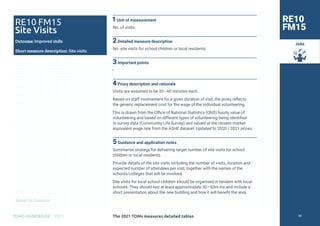
without pay to activities performed either through an organisation or
directly for others outside of the household’.
info@socialvalueportal.com | socialvalueportal.com

TOMs HANDBOOK and TOMS Framework

  • 1.
  • 2.
     TOMS HANDBOOK 20212 Important Notice The Measures Handbook is designed as a supplementary guide for the National TOMs and the other measurement frameworks within the TOMs “family”, including the publicly available Plug-ins for the National TOMs and the TOMs frameworks designed expressly for the use of specific customers or groups of customers of the Social Value Portal. While every effort has been made to ensure consistency within this Handbook with the National TOMs, it should be noted that the National TOMs Framework is made publicly available with accompanying guidance and that, in the event of an inconsistency between this Handbook and the Framework, the latter takes precedence. This Handbook will be updated on a regular basis to keep pace with the development of the National TOMs and Social Value Portal welcomes corrections and suggestions for improvement from users as part of that process. Any such suggestions can be shared with your contacts at the Social Value Portal or by email to info@socialvalueportal.com. This Measures Handbook is made publicly available as guidance only and no responsibility can be accepted by Social Value Portal for any consequences arising from implementation of the guidance in the Handbook. If further clarification is required, please contact the Social Value Portal or your expert advisers.
  • 3.
    Contents TOMS HANDBOOK 20213 11 Ten essential elements Contents 34 Application dos and don’ts 36 Principal changes to the measures in the 2021 TOMs 41 The 2021 TOMs measures detailed tables 267 Glossary 16 Themes, Outcomes and Measures 19 The National Social Value Taskforce and the Local Government Association 20 Measurement and target-setting 22 Valuing and reporting 26 Additionality, attribution and deadweight 31 Local Measures 33 Double Counting 35 Reporting periods and FTEs 36 Inputs, Outputs, Outcomes and Impacts 38 Tackling Climate Change
  • 4.
    Contents TOMS HANDBOOK 20214 50 NT1 RE1 FM1 Local direct employment 52 NT1a Local direct (own) employment – TUPE transfers 53 NT1b RE1a FM1a Local direct (own) and supply chain employment in targeted areas 55 NT1c RE1b FM1b Local indirect employment – supply chain only 57 NT2 RE2 FM2 Percentage locally employed 58 RE3 FM3 Employers’ fairs 60 NT74 FM4 Union Recognition Agreements or Equivalent 62 NT75 Good Work / Fair Work 64 NT3 RE4 FM5 Jobs for long-term unemployed people 67 NT3a Jobs for armed forces veterans 70 NT3b Jobs for homeless people 72 NT3c Jobs for mothers returning to work 74 NT3d Jobs for survivors of modern slavery 76 NT4 RE5 FM6 Jobs for people who were Not in Employment, Education or Training 79 NT4a FM6a Jobs for care leavers 82 NT5 RE6 FM7 Jobs for ex-offenders aged 18+ 84 NT5a Jobs for ex-offenders aged 18—24 85 NT6 RE7 FM8 Jobs for people with disabilities 88 NT6a FM8a Jobs for armed forces veterans with disabilities 90 NT7 RE8 FM13 Employability support for people over 24 92 RE57 Gender balance in the workforce 93 RE58 Ethnic diversity in the workforce Reference
  • 5.
    Contents TOMS HANDBOOK 20215 94 RE71 Recruitment to achieve gender balance in workforce 95 RE72 Recruitment to achieve ethnic diversity in workforce 96 NT8 RE9 FM13 School and College Visits 98 RE10 FM15 Site Visits 100 FM16 Continuous Professional Development 102 NT9 RE11 FM17 Training opportunities 105 NT10 RE12 FM18 Apprenticeship opportunities 107 NT9a FM17a Training opportunities for people facing barriers to employment 108 NT10a FM18a Apprenticeship opportunities for people facing barriers to employment 109 FM19 Digital skills for disadvantaged groups 111 NT54 FM20 Supporting a just transition 113 NT10b FM18b Low Carbon Apprenticeship opportunities 114 NT11 RE13 FM21 Employability support for young people 116 RE14 FM24 Employment taster days 118 NT12 RE15 FM22 Work placements (unpaid) 120 NT13 RE16 FM23 Work placements (paid) 122 NT13a FM23a Work placements (paying Real Living Wage) 123 C19-1 Safeguarding jobs during COVID-19 125 C19-2 Retaining jobs and skills during COVID-19 127 C19-3 Reducing layoffs during COVID-19 by furlough 129 C19-4 Safeguarding supply chain jobs during COVID-19 131 C19-19 Jobs for people out of work due to COVID-19 Reference
  • 6.
    Contents TOMS HANDBOOK 20216 132 NT14 FM25 Spend with VCSEs (Voluntary, Community and Social Enterprises) 134 NT15 RE18 FM26 Expert advice to VCSEs and MSMEs 136 NT15a RE18a FM26a Expert advice to help VCSEs and MSMEs decarbonise 137 NT16 RE19 FM27 Equipment or resources donated to VCSEs 138 NT17 RE20 FM28 Voluntary hours donated to VCSEs 140 RE21 FM32 Meet the buyer events 141 NT18 RE22 FM29 Local supply chain spend 143 NT18a RE22a FM29a Local supply chain spend in targeted areas 145 NT19 RE23 FM30 Local supply chain spend with MSMEs 146 NT19a FM30a Local supply chain spend with Micro and Small enterprises 147 RE73 FM31 Opportunities for MSMEs to tender for decarbonisation work 148 NT20 RE24 FM33 Staff health and wellbeing 151 NT55 Workplace screening 153 NT39 FM34 Mental health campaigns for staff 154 NT21 RE25 FM36 Equality and diversity training 156 NT56 Implementation of mental health core standards for staff 157 FM37 Pro bono responsible budgeting support 158 RE59 FM35 Workplace screening in construction 159 NT57 FM38 Gender pay gap 161 NT40 Initiatives to reduce the gender pay gap 163 NT41 FM40 Staff paid the Living Wage 164 NT42 FM42 Supply chain partners paying the Living Wage Reference
  • 7.
    Contents TOMS HANDBOOK 20217 165 NT58 FM42 Number of Employees paid the Real Living Wage 167 NT22 RE26 FM43 Contracts with commitments toethical procurement 169 NT43 FM44 Initiatives to identify and manage Modern Slavery 171 NT59 FM45 Modern Slavery – supply chain audits 172 NT60 FM46 Managing Modern Slavery – people employed in the supply chain 173 NT61 RE60 FM47 Prompt payment – invoices paid in 30 days 174 NT62 Cyber security risks 175 NT23 RE27 FM48 Social value in the Supply Chain 176 C19-5 Support for SMEs and VCSEs during COVID-19 178 C19-6 Prompt payment during COVID-19 179 C19-7 Supporting staff on furlough during COVID-19 180 C19-8 Supporting staff on furlough during COVID-19 181 C19-9 Safe virtual spaces for staff during COVID-19 182 C19-10 Safe virtual spaces for staff during COVID-19 183 C19-11 Support for staff delivering essential work during COVID-19 184 C19-12 Support for staff from vulnerable groups during COVID-19 Reference
  • 8.
    Contents TOMS HANDBOOK 20218 186 C19-13 Engagement with contractors to support TOMs COVID-19 measures 187 NT24 RE28 FM49 Reduced crime 189 NT25 RE29 FM50 Tackling homelessness 190 NT63 FM51 Supporting rough sleepers 191 NT26 RE30 FM52 Supporting health and wellbeing 192 FM53 Nutritional guidance 193 NT27 RE31 FM54 Supporting independent living 194 NT28 RE32 FM55 Donations to local community projects 196 NT29 RE33 FM56 Volunteering for local community projects 198 NT30 RE34 FM57 Support for Community Charter 199 RE35 FM58 Occupier satisfaction 200 RE36 FM59 Post-occupancy evaluation 201 C19-14 Best practice social behaviour 202 C19-15 Safe volunteering in the community to help with the COVID-19 crisis 204 C19-16 Support for local authorities or VCSEs during COVID-19 206 C19-17 Support for campaigns to raise awareness during COVID-19 Reference
  • 9.
    Contents TOMS HANDBOOK 20219 Reference 208 C19-20 Initiatives to redesign space to address COVID-19 risks 210 NT31 FM30 Carbon emissions are reduced 213 NT44 FM61 Programme to achieve net zero carbon by 2030 214 NT64 FM62 Contribution to own carbon offset fund by 2030 216 NT45 FM65 Carbon certification 217 RE37 FM66 Carbon reduction from energy efficiency — building operations 219 RE37a Carbon reduction from Increased renewable energy – building operations 220 RE38 FM67 Buildings meeting energy efficiency target 221 RE39 Carbon reduction from reduced energy use and energy efficiency measures 222 RE39a Carbon reduction from increased renewable energy – on site 223 RE40 FM63 Savings in contract-related carbon 225 RE62 FM64 Carbon offset fund payments 226 NT32 RE46 FM68 Car miles saved 229 NT33 RE47 FM69 (Low emission) car miles driven 231 NT46 FM70 Corporate travel schemes 232 NT65 RE63 FM71 % Fleet at least Euro 6 or LEV 233 NT66 RE64 FM72 Fleet emissions programme 234 FM73 Air quality regulations 235 NT67 FM77 Investments in environmental initiatives 236 NT47 FM78 Investments in sustainable reforestation 237 RE65 Offsets or mitigation initiatives on biodiversity 238 RE48a Environmental conservation volunteering
  • 10.
    Contents TOMS HANDBOOK 202110 239 NT68 RE64 FM76 Plastic recycling 240 NT69 FM88 Support to MSMEs and VCSEs on circular economy solutions 241 NT70 FM89 Single use plastics eliminated 242 NT71 FM90 Circular economy – local partnerships 243 NT72 FM91 Diverting hard to recycle waste 244 RE66 Waste management verification 245 RE42 Water use benchmark 246 RE76 Water efficiency policy 247 RE43 Water saved benchmark 248 RE44 Waste good practice benchmark 249 RE45 % waste diverted 250 RE45a Tonnes waste diverted 251 RE75 Biocomposites and equivalent 252 FM85 Reduced food waste 253 FM86 Donation of food waste 254 FM87 Refurbished furniture 255 FM92 Redesign to minimise food waste 256 NT35 RE49 FM93 Sustainable procurement commitments 257 NT73 FM94 Low emission vehicles in the supply chain 258 NT48 Supply chain carbon certification 259 NT49 FM96 Climate change training 261 RE50 New buildings achieving BREEAM rating 262 RE51 Assets undergoing climate risk assessment 263 RE52 Assets with reduced sustainability risk 264 RE53 Buildings achieving BREEAM IN-USE 265 C19-18 Collection of discarded gloves and masks Reference
  • 11.
    Contents 11 TOMS HANDBOOK—2021 266 NT50 RE67 FM98 Innovation to promote skills and employment 267 NT51 RE68 FM99 Innovation to promote responsible business 268 NT52 RE69 FM100 Innovation to enable healthier, safer and more resilient communities 269 NT53 RE70 FM101 Innovation to safeguard the environment Reference
  • 12.
    Contents TOMS HANDBOOK 202112 T he widespread adoption of the National TOMs in little over three years since the first version was issued in November 2017 validates this original vision – not just in procurement, but increasingly in other areas of public sector activity such as planning and economic development, as well as by corporates for their own CSR purposes. While the idea is simple, as the TOMs goes wider and deeper, the complexity creeps in. With a long list of measures, each with its own rules, there is a danger we find it hard to see the wood for the trees. Social value is a complex, multi-faceted and often uncertain area. That is just the way it is, and it is bound to become more complex as our understanding matures and we see how different aspects of social value intersect. What the TOMs should be doing is making this complexity manageable and easier to understand – and translating it into a form that can be used to deliver positive action and bring new actors into play to share the load. That is why, for instance, the measures have financial values. Like it or not, the society we live in uses money as a vector. But we’ve set ourselves a difficult challenge. We want to simplify and translate social value into clearly defined activities through the TOMs, but we also want to “show the workings” – to explain how and why the measures in the TOMs are the way they are. There is good reason for this – we know that the only way to achieve widespread adoption of a standard approach to social value measurement and management is to show people how we have got to the answer. The TOMs framework is a simple concept devised to drive the adoption of social value, initially so the public sector could get more value from its business relationships. It was designed to be practical, credible and intelligible.
  • 13.
    TOMS HANDBOOK 202113 Over the years, guidance and explanations have been layered into successive editions of the TOMs, supported by the National Social Taskforce1, training, working groups, plug-ins, etc. and the sheer volume of supporting information is making the framework increasingly difficult to navigate. At its heart, the TOMs is still quite simple. But to get to this simplicity, a lot of complex work is needed behind the scenes, and we have taken the opportunity to restructure how this is all explained to users. This Measures Handbook mainly aims to distil previous guidance into a clearer, more readable form, but focusing on the measures themselves – and specifically the measures in the National TOMs, the Real Estate Plug-in, the COVID-19 Plug-in and the FM Plug-in (further Plug-ins may be incorporated into later editions). There is enough on methodology to give some context, but we have not attempted to put everything into a single volume. The plan is for a sister volume later this year that will focus more on the TOMs methodology and implementation tools. This volume focuses on application and evidence. It provides most of what you need to know about the measures themselves when using them to set targets or report social value activities. A final word on data. Ultimately, social value reporting stands and falls on the quality of the data. Notwithstanding the intricacies of some of the TOMs measures, if what you report is and can be delivered by you, is supported by good quality evidence and demonstrably creates additional, wider social and environmental benefits – and errs on the side of caution, you won’t go too far wrong. 1 nationalsocialvaluetaskforce.org
  • 14.
  • 15.
    Ten essential elements TOMSHANDBOOK 2021 15 Ten essential elements This section sets out ten essential principles that apply across the TOMs framework. The TOMs framework is continually evolving and not everything can be codified – there will inevitably be areas of uncertainty, through unusual circumstances, imperfect data, lack of clarity in the measure itself, etc. This can be managed if users approach the process of target-setting and reporting social value with caution and consistency. While it is possible to use the specific guidance for each measure without reading this section, it provides a methodological overview that we believe most users of the framework will find helpful. We recommend that people new to social value reporting and experienced practitioners alike read this short section in its entirety before moving to the detail.
  • 16.
    Ten essential elements TOMSHANDBOOK 2021 16 The acronym “TOMs” stands for Themes, Outcomes and Measures. The founding principle of the TOMs is to provide the connection between a broad vision for social improvement (“Themes”) with strategic objectives (“Outcomes”), which in turn can then be expressed as measurable activities (“Measures”). This conceptual approach enables meaningful direct action to be steered both by local need and by the overarching strategic aims of the organisation aiming to deliver social value. Implemented effectively, the TOMs framework then creates a mutually reinforcing link between strategy and delivery. Where the supporting evidence is available, measures in the TOMs framework are assigned generalising values (“proxy values”) that apply whenever the TOMs framework is used. As the name suggests, a “financial proxy” is a reasoned approximation expressed in monetary terms (drawing on relevant evidence) of the benefit created by the activity relating to a particular measure. Proxies are generalised unit values that make a range of assumptions and are designed to be robust and conservative, to follow best practice for socio- economic evaluation and analysis and be consistent with key government guidance documents such as the Treasury Green Book. Certain measures in the TOMs framework must be localised to make them meaningful (that is, they must incorporate data specific to the locality to which the process of measurement applies – see Local Measures below). For other measures, localising the values is an option that can make the proxy more closely aligned to the socio-economic context of a particular area. A third group of measures only have UK-level datasets to support them, so cannot be localised. Themes, Outcomes and Measures
  • 17.
    Ten essential elements TOMSHANDBOOK 2021 17 Using the proxy values in the TOMs to produce a quantified social value analysis can be a powerful measurement tool but should not be taken as the sole and exclusive description of social value for any organisation or project. Organisations using the TOMs framework should always take into account: » The Seven Principles of Social Value (including stakeholder engagement) – for further information, see Social Value UK2; » Qualitative supporting descriptions and narrative; » The context for target-setting and measurement – e.g. in terms of local need. 2 socialvalueuk.org/what-is-social-value/the-principles-of-social-value
  • 18.
    Ten essential elements TOMSHANDBOOK 2021 18 The Seven Principles of Social Value: Involve stakeholders Inform what gets measured and how this is measured and valued in an account of social value by involving stakeholders. Understand what changes Articulate how change is created and evaluate this through evidence gathered, recognising positive and negative changes as well as those that are intended and unintended. Value the things that matter Making decisions about allocating resources between different options needs to recognise the values of stakeholders. Value refers to the relative importance of different outcomes. It is informed by stakeholders’ preferences. Only include what is material Determine what information and evidence must be included in the accounts to give a true and fair picture, such that stakeholders can draw reasonable conclusions about impact. Do not over-claim Only claim the value that activities are responsible for creating. Be transparent Demonstrate the basis on which the analysis may be considered accurate and honest and show that it will be reported to and discussed with stakeholders. Verify the result Ensure appropriate independent assurance.
  • 19.
    Ten essential elements TOMSHANDBOOK 2021 19 The National Social Value Taskforce was founded in February 2016 to establish a best practice Framework for the integration of the Public Services (Social Value) Act 2012 into public sector commissioning and procurement. It is responsible for the oversight of the National TOMs, which is the open-source version of the TOMs measurement framework. The Taskforce is an open network and welcomes any organisation that wants to get involved and is willing to share good practice. The Taskforce aims to bridge the gap between the public and private sectors, recognising that it is only through collaboration and partnership that success will be achieved. The Taskforce’s mission is to develop a Social Value best practice Framework in an open and collaborative forum that allows social value to be more widely adopted across all sectors and organisations. It believes that this Framework is essential to enabling the Social Value Act to make an increasingly meaningful contribution to the creation of healthy, thriving and resilient communities. In delivering its mission, the Taskforce recognises that every organisation will start its social value journey from a different place. There is no single right answer, but there is strength in working together. Presently the Taskforce has 40 active members representing 35 organisations. Since its inception, the National TOMs and the Taskforce have been strongly supported by the Local Government Association (LGA) in a number of ways, including active participation in the Taskforce, contributing to development of the framework and co-hosting the annual National Social Value Conference with the Social Value Portal, as well as providing research and development funding. The LGA has therefore been crucial to the successful rollout of the measurement framework. Further information provided by LGA on the TOMs can be found here. The National Social Value Taskforce and the Local Government Association
  • 20.
    Ten essential elements TOMSHANDBOOK 2021 20 The TOMs framework is used in two main ways: » Procurement and setting targets for delivery of social value. Where the targets themselves constitute a distinct quantitative component of the evaluation, the procuring authority will typically invite bidders to set their own targets as part of the tender process, perhaps designating or prioritising particular measures, but targets are also set outside procurement for a number of reasons, for example by companies for their business units. » Measuring and reporting social value delivery, either against targets that have previously been set and are now being measured as part of the contract management process, or without targets. The TOMs framework is designed to work on a “whole life” basis. It can be used for strategy development and project planning, implementation, monitoring and management and retrospective measurement, precisely so that people can follow up on their social value plans and measure how they have been put into practice. More detail is provided below. Design and target-setting The framework is adapted to organisational or project requirements and used to quantify social value, in the form of specific targets. This includes procurement, where the TOMs are now widely used by procuring authorities as part of the tender process (see above). Targets can, of course, be set for other purposes. Organisations set targets for themselves or for their business units to meet. Developers set targets as part of their planning applications to demonstrate their willingness to deliver social value, and so on. Measurement Organisations also use the TOMs framework to report on social value delivery. In some cases, targets will have been set previously. In other cases, reporting will take place without targets having previously been set. Most measures are suitable both for target-setting and measurement – where this is not the case, this is clearly indicated in the detailed measure description. Measurement and target-setting
  • 21.
    Ten essential elements TOMSHANDBOOK 2021 21 As explained in the section on additionality, attribution and deadweight below, the key principle to keep in mind is that the social value targeted or reported must be relevant and proportionate to the underlying activity that takes place. In some cases, this will mean adjusting the target or actual figures to allocate the right proportion of social value to a particular organisational agent or a sub-set of the activity which an activity covers more widely.
  • 22.
    Ten essential elements TOMSHANDBOOK 2021 22 The reason for allocating financial values to TOMs measures Using proxies that are expressed in monetary terms does not mean that the TOMs framework is aiming to reduce all social value to a financial equivalent. It does not mean, either, that the calculated value of a particular measure can be “cashed in” as a form of financial exchange. In any case, numerous measures in the TOMs are not quantifiable or monetisable, because elements of social value are difficult to quantify robustly at a generic level. Reporting on social value should be designed with purpose, context and audience in mind. Expressing social value in financial terms is a powerful tool to ensure that social value considerations are not disregarded when financial decisions are made – in procurement, investments, planning, grant funding, etc. The TOMs exists to promote positive social change. Promoters and users of the TOMs framework believe that creating equivalence for social value with established economic and financial reporting mechanisms – both in the public and private sectors – is the best way of embedding social value as ‘business as usual’. Financial value equivalents or proxies should never be used out of context. They may also need to be adapted to align effectively with strategic objectives when setting targets. To reflect this, the TOMs has built in a prioritisation mechanism to enable the relative importance of different measures to be varied according to strategic priorities when setting targets, for instance, in procurement. The prioritisation mechanism in effect changes the underlying value of the proxies by applying a multiplier. The mechanism enables the user to apply a multiplier (usually 2x or 3x) to financial proxies or highlight measures that would not otherwise be valued at all. Financial proxies and prioritisation weightings are tools that can be used to provide the most appropriate account of value for the particular purpose or stakeholders involved. Applying a multiplier is a departure from the underlying financial value equivalent in the proxy and a clear rationale needs to be established and documented for justifying this approach. Valuing and reporting
  • 23.
    Ten essential elements TOMSHANDBOOK 2021 23 When are prioritisation weightings used in the TOMs? Prioritisation weightings can be used within the TOMs when setting targets to signpost: » Measures with a financial proxy that does not fully reflect the urgency of the measure – for instance where we know that we urgently need to tackle climate change but believe current carbon pricing does not fully reflect this; » Themes, Outcomes or Measures The most common use of prioritisation weightings is by procuring authorities in tenders, to place greater emphasis on jobs and local supply chain spend from designated sub-localities or postcode areas within a local authority where a greater need for this local economic value has been identified. Two important points must be kept in mind where prioritisation weightings are applied: » Weightings must be removed for the subsequent measurement phase of the project, as they do not reflect the evidence-based value of the proxy and leaving them in the framework would therefore jeopardise comparability across different sets of TOMs measures; Where a prioritisation weighting is used, a clear rationale should be established and documented, justifying its use and the level at which it has been set (i.e. 2×, 3×)
  • 24.
    Ten essential elements TOMSHANDBOOK 2021 24 Quantitative and Qualitative measurement The TOMs framework helps organisations to standardise the measurement of social value. Quantitative measurement is standardised through use of common units of measurement. Measurement does not necessarily entail valuation, and social value unlocked can simply be reported by using the units as indicators where appropriate. Qualitative measurement is more difficult to standardise. The TOMs framework aims to ensure that all activities delivered and reported through the measure satisfy some minimum qualitative requirements. To do so they include additional qualitative requirements on what can be reported as social valued within the guidance and through requirement of specific evidence. Organisations can and should specify additional qualitative characteristics to be measured where these are important. As social value measurement evolves, the need to establish clear standards for qualitative measurement of social value will progressively become more important, both through the introduction of social value evaluation frameworks focused on qualitative assessment (for example, through UK Central Government implementation of social value) and the need to ensure that numerical social value metrics are properly contextualised. Valuation There are, in effect, four principal stages in the social value measurement process: Recording the data: The data might be real (what actually happened) or theoretical (what is projected to happen or set as targets). Measuring change through the data: To measure change, we need standard units of measurement to help us describe the social value in a way that allows us to compare between projects, organisations, sectors
  • 25.
    Ten essential elements TOMSHANDBOOK 2021 25 and localities. We also need a clear understanding of what these standard units entail, and therefore what is capable of being measured. Importantly, a standard way of measuring enables us to describe what has changed as a result of particular activities or interventions, or between one time period and another. Measuring social value quantitatively without putting a “value” to it is often still a useful exercise. Valuing change: If we stop at there, we can only compare similar types of social value activities, in other words, those with the same units of measurement (hours of volunteering, tonnes of CO2 saved, etc.). We will struggle to form an overall view of the aggregate social value delivered and set it alongside economic and other financially expressed outcomes. Valuation therefore enhances our ability to contextualise social value data and understand its significance. When valuation includes monetisation it allows us to compare bundles of different interventions (e.g. bids within procurement, alternative investment opportunities or competing planning submissions) through a common metric. Evidencing change: To ensure that the social value delivered complies with qualitative requirements, is verifiable and can be communicated transparently to the relevant audiences, evidence must be gathered consistently. Each measure in the TOMs includes specific evidencing requirements that can be adapted to the needs of a project but should be communicated from the very beginning of the process to ensure that evidence collection does not become an unmanageable “add on” but is rather a key part of the process.
  • 26.
    Ten essential elements TOMSHANDBOOK 2021 26 Additionality, attribution and deadweight The TOMs framework is designed to capture social value added. This means that whatever is recorded under the framework must be both additional and directly relevant to the wider activity within which the social value will take place or is planned. The first of these two factors is known as ‘additionality’ and the second ‘attribution’. An essential related concept for understanding additionality and attribution is ‘deadweight’. Although these seem somewhat technical terms, the basic principle is simple: in social value measurement (just as in economic appraisal), we mustn’t claim for something that was already happening before we got involved and we must only claim what is proportionate to our intervention.. » Deadweight is what would have happened anyway (without the measure or intervention) » Additionality is the opposite – what wouldn’t have happened if we hadn’t undertaken the measure or intervention (So Additionality = Impact minus Deadweight) » Attribution is how much of a result can be credited to – for example – a particular intervention or organisation. For certain TOMs measures, additionality is built into the measure because a generalised assessment of ‘deadweight’ is incorporated in their proxies. An example of this is the measure representing the employment of ex-offenders (NT5). Other measures, however, require further steps to work out additionality, according to the circumstances – including leakage, displacement, substitution or drop-off effects.
  • 27.
    Ten essential elements TOMSHANDBOOK 2021 27 2 In procurement, the procuring authority is looking for added value specifically in relation to that contract being tendered. Organisations must not therefore record activities as social value under the TOMs that are: » part of their core business; or » part of the core specification of a contract at procurement; or » paid for by a 3rd party. Nor should they claim as ‘social value’ activities that a responsible business would be reasonably expected to undertake (this is deadweight, not additionality). For example: If an organisation is tendering for a local authority contract to deliver employability training to young people, it should not record the time it allocates to providing this service as social value, because the training is part of the core contract. An organisation should not record normal team management, catch-ups and reviews as social value because this is something a responsible business would normally be expected to do. There may be other non-procurement related situations where the TOMs can be used to measure core or externally related activities (for example the measurement of a corporate CSR programme), but in these cases the ‘ground rules’ which govern the use of the TOMs must be clearly set out and appropriate steps taken to account for deadweight and attribution. 1 If the TOMs framework is being used in procurement during a tender for bidders to set social value targets, the targets set by bidders must specifically relate to the contract for which they are tendering (‘attribution’). A common error is that bidders include what they plan to deliver for this measure across the entire business, or for the region which will operate the contract, when the targets proposed should only relate to the contract in question. Key Rules
  • 28.
    Ten essential elements TOMSHANDBOOK 2021 28 4 An organisation may be helping to bring about social value without being the agent delivering all the social value. For instance, it organises a volunteering campaign for an area where the volunteering is delivered by other organisations or by its own employees in their spare time. In this case, it shouldn’t claim all of the social value for the campaign for its own account; only the social value that it can reasonably claim it contributed to directly (attribution). This might include resources such as access to software, venues, funding advertising and volunteering which has been allowed in paid time. 3 If the TOMs framework is being used to measure social value delivered in a joint venture, the total social value delivered can be claimed by the joint venture, but the joint venture partners can only individually claim social value that is proportional to their share of the joint venture (= attribution).
  • 29.
    Ten essential elements TOMSHANDBOOK 2021 29 The key point in all of this is always not to overclaim. The guidance to the TOMs framework generally makes reference to a “contract”. This can give rise to confusion when the TOMs is being used for situations where a specific contract is not involved – for instance, for corporate level measurement. In the Measures Handbook, we have chosen to use the term “underlying [business] activity” to describe more generally the commercial activity that the social value must be connected to. This is interchangeable with the term ‘contract’ for measurement purposes. Whether reporting against a specific contract or for a business, there has to be a direct relationship between the social value delivered and whatever activity is being reported on more broadly. There is not always a direct contract – in which case, we need to identify some other point of reference for the social value being reported. Establishing this point of reference is vital to determining attribution. To summarise, here are some examples to help determine attribution: » When bidding for (or reporting on) a contract, only attribute the social value activities that arise directly as a result of that contract. If the programme goes wider than the one contract, attribute the relevant proportion of the wider programme, based on the size of the contract relative to the overall coverage of the programme. » For instance, a contract might represent 10% of a business’s total turnover in a region. If a social value programme spans that region, it would be reasonable to attribute 10% of the programme to this contract. » When reporting on social value for a specific division in a business, only attribute the social value activities that are directly attributable to that division. » For instance, the division might represent 20% of the business’s total turnover. If a social value programme spans the entire business, it would be reasonable to attribute 20% of the programme to this division.
  • 30.
    Ten essential elements TOMSHANDBOOK 2021 30 » When reporting on social value for a contract with multiple participants or a joint venture and the participants are reporting their own social value delivered, they should only take credit for social value delivered that is proportionate to their participation. » For instance, in an equal three-way joint venture, the participants should each take credit for a third of social value delivered under the contract. The essential principle remains the same – social value reported must be relevant, specific and proportionate to the underlying business activity that is taking place. This is the principle of ‘attribution’.
  • 31.
    Ten essential elements TOMSHANDBOOK 2021 31 Local Measures The TOMs is designed to report added social value. The commercial or financial value of the activity (the value of the contract being tendered, the turnover of the business division, etc.) is not included in the social value reported figure, because we are only interested in what is additional to this underlying commercial or financial value. For this reason, the TOMs framework makes a clear distinction between local economic and social value, because local economic value is only demonstrably value added for the area in which it occurs, while social value is value added for society as a whole. In order to ensure that the TOMs methodology remains consistent with standard practice in socio-economic evaluation, it needs to factor in displacement. This refers to the assumption that economic activity in one location means that activity can’t (by definition) then take place in another, so that at a UK level the fact that spend is local to one area is not (considering other areas where the spend didn’t take place) beneficial to the UK as a whole. The value of these local economic components is only deemed to be felt by the people in that area, not by society. This is why local economic and social value are treated separately in the TOMs. Arguably there are other reasons why ‘local’ may be beneficial to society as a whole (stronger business clusters, reduced movement of goods and people, for instance, leading to lower emissions), but these benefits are not easily generalisable and cannot therefore be factored into the standardised proxies used for the local measures in the TOMs. Which TOMs measures are Local Economic Value? These are the measures that cover the local element of the commercial value of the contract, namely: value reported under NT1 (local jobs) and related measures (NT1a, NT1b, NT1c) and NT18/NT19 (local supply chain spend) and related measures (NT2, NT18a NT19aRE3, RE21, and C-1 to C-4.). These measures are included in the framework because they are vital contributors to local social value. Local economic prosperity is therefore a prerequisite for sustained positive social change.
  • 32.
    Ten essential elements TOMSHANDBOOK 2021 32 That said, as the local economic measures in the TOMs tend to carry a high financial weight, as experience of social value measurement develops, people will want to interrogate more deeply the benefits of local jobs and local supply chain spend on a case-by-case basis, particularly for larger projects. True local value created will vary, for instance, according to the type of local business. One business with skilled local labour as its principal cost overhead may be creating more local value (because it is putting more money into local people’s pockets for every £ it receives) than another business whose main local spend items consist of materials bought in from elsewhere and purchased from the local branch of a national builders’ merchants chain. More experienced users of the TOMs may therefore wish to consider starting to gather more data on local supply chains so that these questions can be examined in more detail and a more nuanced picture of local value created.
  • 33.
    Ten essential elements TOMSHANDBOOK 2021 33 The TOMs methodology aggregates the results from all of the different measures in the Framework to come to an overall figure. Within groups of similar measures there are choices to be made about where to record a particular activity. Consequently, we need to make sure that nothing is inadvertently included more than once, which is why such a strong emphasis is placed on avoiding double counting in the TOMs guidance. We try to highlight where double counting risks are likely to arise; the detailed measures section contains extensive double counting notifications on a measure-by-measure basis. However, ultimately it is for the organisation reporting its social value to ensure that there is no double counting in the figures. If in doubt, organisations should always take a prudent approach and report less, rather than risk over-claiming. The general rule is that an individual, an hour of time, a carbon saving, an economic benefit or a financial or in-kind donation can all only be reported once in the TOMs. If this general rule is observed, then most of the double- counting risk will be eliminated. It might be argued that a single intervention could have multiple benefits, which is true, but the need to classify each activity as a single reported benefit is one of the essential compromises needed to create a generalised working social value framework. We would always encourage, where appropriate, suitably validated analysis based on primary project data to explore the interactions between activities and outcomes, as a way of generating a richer picture of the social value delivered on a case-by-case basis. The Measures Handbook highlights by measure in the detailed section that follows where double counting can occur. Double Counting
  • 34.
    Ten essential elements TOMSHANDBOOK 2021 34 Main areas of double counting risk in the TOMs Local supply chain spend (NT18 / NT19 and related measures) The same spend must not be reported more than once. For example, if total projected supply chain spend is £10m of which £3m is with medium-sized and smaller businesses, £7m must be entered against NT18 and £3m against NT19. Volunteering hours and donations to charities The same hour of volunteering and the same £ donation must only be claimed once. Employment of individuals from disadvantaged groups (NT3 – NT6) An individual may not, for example, be reported under the TOMs both as NEET and having a disability. It might be the case that the individual concerned does fall under both of these categories, but because of the overlap in the underlying datasets and the way proxies have had to be developed, it is not possible to add two proxies in this group of measures together. Local employment and local supply chain spend (NT1, NT1b and NT1c and NT18 / NT19 and related measures) Local supply chain spend finances the sub-contractor’s costs, including local labour. It follows that if supply chain labour is also included in the local employment measures at NT1, NT1b and NT1c, this element has in effect been counted twice. In practice, the double counting occurs most often when respondents include local supply chain labour in NT1, so this is the key error to avoid.
  • 35.
    Ten essential elements TOMSHANDBOOK 2021 35 Reporting against the TOMs, just as for financial accounts, is time-based. This means that any social value reported under the framework must be aligned with the reporting period in which it is reported. Companies will typically want their main social value report annually, but with interim reporting each quarter or at the six-month stage to make sure they are on track. On the other hand, projects and contracts could be for a matter of weeks or for many years. The overriding consideration is to make sure that the social value reported is comparable between reporting periods of different lengths. All time-based measures in the TOMs are expressed in units that allow this comparison to happen. The TOMs doesn’t count the number of jobs – it counts the number of Full-Time Equivalents (FTEs). It doesn’t count the number of apprenticeships – it counts the number of weeks that the underlying business activity has supported the apprenticeships. It doesn’t count the number of volunteers – it counts the number of hours volunteering time, and so on. It follows, for example, that if an organisation is bidding for a contract that is 3 years in duration and plans to employ 10 local people full-time every year (reported under NT1), then it should submit 30 FTEs as its target. By the same token, an organisation bidding for a contract that is 3 months in duration and planning to employ 10 local people full-time on this contract would submit 2.5 FTEs as its target (10 × 0.25 (= 3 months / 1 year)). However, while the jobs measures for individuals facing barriers to the jobs market (NT3 – NT6 inclusive) are also expressed in FTEs, these measures should only be used for the first year of the individual’s employment, because of the way the measure is designed. For further information see the detailed measures section. A company reporting annually but collating data on a quarterly basis to check how everything is progressing will need to decide how to spread the data over the 12-month period to ensure that an accurate figure is included in the annual summary. Reporting periods and FTEs Why are FTEs important for the TOMs? The TOMs framework makes extensive use of “Full-time Equivalents” (FTEs) as the unit to count employment. This is because jobs need to be equalised in time terms to make comparisons between different initiatives and projects. While there is no fixed definition of full-time employment, an FTE of 1.0 corresponds to having one person employed on a full-time basis for a period of 12 months. For different FTE numbers or durations of employment, this can simply be adjusted pro rata. For example, two people employed full time for six months would equal 1.0 FTE. One person employed full-time for six months would equal 0.5 FTE. For the TOMs, we define full time employment as working at least 35 hours per week.
  • 36.
    Ten essential elements TOMSHANDBOOK 2021 36 Inputs, Outputs, Outcomes and Impacts Reflecting the different types of evidence gathered for each measure, there are basically four different categories of units and proxies within the TOMs framework: Inputs, Outputs, Outcomes and Impacts. An “input” does no more than say what resources have been invested. It says nothing about the result of the investment. The result is an “impact”. In theory, all inputs lead to impacts. In practice, it will not always be possible to trace this progression from the evidence. Inputs, Outputs, Outcomes and Impacts in the TOMs Inputs units and proxies that are expressed in terms of what it costs the organisation to deliver the measure. For example, a charitable donation of £5,000 is an ‘input’. Outputs units and proxies that are expressed in terms of the financial value created for the beneficiary, but without considering the benefit created. For example, a measure recording the transfer of skills from a business to a community organisation using the “expert time” proxy estimates what it would otherwise have cost this organisation to procure this expertise from elsewhere. Outcomes units and proxies that are expressed in terms of the direct change experienced by the beneficiaries. Structured training programmes and qualifications, for instance, are TOMs measures that are measured and valued as outcomes. Impacts units and proxies that have been identified as capturing both how the recipient of the activity benefits from the measure in the long term and how this in turn benefits other stakeholders. Only a limited range of measures in the TOMs have Impact units and proxies, because without extensive detailed, specific research it is very difficult to extrapolate from standardised interventions to measurable impacts. The benefit of most general measures to individuals and communities will vary according to specific circumstances.
  • 37.
    Ten essential elements TOMSHANDBOOK 2021 37 While we may think our primary goal is to measure social impact, as we move away from measuring inputs towards measuring impacts, the effects become wider but the causal link between the activity and the financial proxy becomes less certain. In other words, while an output is easier to quantify, we can be less sure that the financial proxy is a reasonable reflection of the actual benefit. On the other hand, it is difficult to frame impacts as standardised interventions. If we want to know exactly what effect an intervention has had on a group of people, we need to do the primary research (such as surveys of beneficiaries) with this specific group of people. The TOMs measures are designed to function as a comparative framework – comparing different time periods, different projects, different localities and so on. The Impact proxies in the TOMs have been researched to a degree that provides robust comparative analysis. What the TOMs framework does is provide a solid evidence and methodological base which can support primary research if needed. In summary, the TOMs framework is a “hybrid” of these four types of effect, based on a pragmatic assessment of the available evidence. Which of them has been applied to any given measure depends on the research and evidence available to support that particular measure.
  • 38.
    Ten essential elements TOMSHANDBOOK 2021 38 Tackling Climate Change As we write, the existential crisis posed by climate change looms ever larger. We have to change everything we do to maximise our chances of driving down carbon emissions to limit the catastrophic effects of global warming. As we have seen, the purpose of the TOMs is to report added value. In environmental terms, this means going above and beyond the minimum required, and to support initiatives that help the world to decarbonise as quickly as possible. It also means pushing for a “green normal”, rather than treating environmental outcomes as a bolt-on or an afterthought. This determines how we establish the baseline requirements for carbon reduction measures in the TOMs, which adopts the minimum targets identified by the UN, the UK Government, and the scientific community; namely that to keep global temperature rises as close to 1.5 degrees Celsius as possible, it is necessary to achieve net zero carbon emissions by 2050 (“NZC 2050”). The commitment to NZC 2050 is enshrined in law – the UK passed legislation to require greenhouse gases to be brought to net zero by 2050 in June 20193. While the TOMs adopts this minimum target to 2050 as the baseline, it follows that “added value” in measurement terms should come from the voluntary adoption of targets that exceed minimum requirements. More ambitious targets such as net zero by 2030, embraced by over 100 local authorities across the UK, are becoming increasingly widespread and provide greater scope to mitigate Climate Change than NZC 2050. In principle, therefore, target emissions levels should be set by users of the TOMs to aim for an earlier target – say net zero by 2030, to demonstrate additionality. In practice, it may be difficult to determine how this translates 3 See: gov.uk/government/news/ uk-becomes-first-major-economy-to-pass-net-zero-emissions-law
  • 39.
    Ten essential elements TOMSHANDBOOK 2021 39 on a project-by-project basis, and users will be required to apply their judgement to set targets that demonstrate this additionality. In some cases, a more demanding emissions requirement than NZC 2050 may have been set at a localised level with legal / regulatory effect – for example through planning regulations. In which case, this should be used as the baseline. To establish a target, a base year needs to be set, from which the target is to be achieved. Any savings in CO2 emissions have to be set against this base year and, as explained above, do more than simply track target reductions needed to reach net zero by 2050 on a linear trend.
  • 40.
    Ten essential elements40 TOMS HANDBOOK 2021
  • 41.
    Application dos anddon’ts TOMS HANDBOOK 2021 41 Application dos and don’ts Do not overclaim Always only report well evidenced or reasonably expected deliveries Do not claim someone else's delivery Unless specified explicitly in the measure guidance, you should only capture your own contributions to a measure Do not double count A delivery can only be measured through one measure, unless specified so explicitly in the measure guidance Do not capture BAU / non-additionality Where relevant, ensure captured deliveries are actually an additionality and thereby go beyond the BAU scenario Do not forget about attribution Only report what is proportional - if a delivery only partially relates to the contract or project only the relevant part should be reported through the TOMs Read the measure guidance Reading the measure guidance can help inform a correct data input Only report deliveries that align with measure phrasing and guidance specifications Only deliveries that reflect measure specifications can be captured through the TOMs (e.g. only report local employment where requested). Anything beyond this might suffer from issues of overclaiming, double counting, wrongful attribution, etc. Only report contract/project related deliveries Only report deliveries that relate directly to a contract or project, unless explicitly specified otherwise in the measure guidance Evidence diligently Provide well structured and evidence and breakdowns of deliveries in line with measure guidance specifications, this ensures correct data inputs Aim for best practice If you aim for best practice, many reporting issues can be avoided Make sure unit is applied correctly Apply units as intended, to avoid incorrect data inputs. This includes accounting for correct reporting in terms of specified time, length and type of employment, savings against benchmarks, etc. Here are some basic rules when using the TOMs framework:
  • 42.
  • 43.
    Principal changes tothe measures in the 2021 TOMs TOMS HANDBOOK 2021 43 Principal changes to the measures in the 2021 TOMs The 2021 TOMs is the fourth release of the National TOMs. The time interval between releases is roughly once a year, albeit with some slight variation to align with the timing of the National Social Value Conference. It is not currently anticipated that a full update will occur less than annually, although occasional adjustments or “bug fixes” may be required from time to time. The focus for the 2021 TOMs was largely to consolidate and clarify the 2020 TOMs, as the latter saw a considerable expansion in the measurement set from the 2019 version. The 2020 TOMs also included a sector-specific Plug-in for the Real Estate sector. Two further Plug-ins have now been added to the Real Estate plug-in, namely the COVID-19-19 Plug-in, which was issued at the beginning of the pandemic in early 2020, and the FM Plug-in, which was released at the end of 2020. The list of changes in the table below covers the core National TOMs measurement set, although the detailed section that follows this one includes measures from all three plug-ins. Three main workstreams feed into the release of a new annual National TOMs release: » Updating the datasets that feed into the proxy values – where updates have been made to those datasets (whether updates are available will vary according to source) » Reviewing (and amending where necessary) units of measurement and wording for existing TOMs measures » Incorporating new measures in consultation with the Taskforce. Proxy values for many measures are likely to change regularly because of the effect of macro-economic indicators such as inflation, so these are not
  • 44.
    Principal changes tothe measures in the 2021 TOMs TOMS HANDBOOK 2021 44 recorded as “principal changes”. It is recommended that users retain the proxy values for the year in question (rather than, for example, updating a prior year’s set of figures with current values) and that material variances are taken into account in the way the figures are reported. In some limited cases there may be a need to change the unit of measurement itself in updates, in which case this is highlighted in the Principal Changes Table and a further adjustment may be needed by the user for like-for-like comparison. The principal changes within the 2021 TOMs framework from the 2020 TOMs are described in the table below.
  • 45.
    Principal changes tothe measures in the 2021 TOMs TOMS HANDBOOK 2021 45 Ref # TOMs description Change NT74 Union recognition agreements (or equivalent worker representation) and collective bargaining are present and encouraged in the supply chain. New Measure to reflect consultation with Good Work / Fair work sub-group. NT75 Good and fair work charters and related employment practices are implemented and facilitated on contract. New Measure to reflect consultation with Good Work / Fair work sub-group. NT20 No. of employees on the contract that have been provided access for at least 12 months to comprehensive and multidimensional wellbeing programmes. Updated guidance to reflect increased role of digital solutions. NT22 Percentage of your procurement contracts that include commitments to ethical employment practices in the local and global supply chain, including verification that there is zero tolerance of modern slavery, child labour and other relevant requirements such as elimination of false self-employment, unfair zero hours contracts and blacklists. Significant change to reflect increased requirements for reporting set out by UK Government. NT43 Initiatives taken throughout the local and global supply chain to strengthen the identification, monitoring and reduction of risks of modern slavery and unethical work practices occurring in relation to the contract (i.e. supply chain mapping, staff training, contract management). Significant change to reflect consultation with Good Work / Fair work sub-group and increased requirements for reporting set out by UK Government.
  • 46.
    Principal changes tothe measures in the 2021 TOMs TOMS HANDBOOK 2021 46 Ref # TOMs description Change NT60 No. of people employed (FTE) in the supply chain with specific responsibility to identify and manage the risk of modern slavery occurring in relation to the contract Unit changed to Record Only. NT62 Number and percent of companies in the supply chain, to Tier 2, that achieve relevant cyber security certifications (such as Cyber Essentials, Cyber Essentials Plus or National Cyber Security Centre’s 10 steps). Changed in line with UK central government reporting requirements around cyber security. NT31 Savings in CO2 emissions on contract achieved through de-carbonisation (a reduction of the carbon intensity of processes and operations) Guidance has been reworked for these environmental Measures in line with the TOMs ambition to support net zero carbon emissions as specified by international and UK targets – introducing requirement to specify and evidence contract related and organisational targets for emissions reductions and to link those to used benchmarks and baselines. Further details will be provided in subsequent guidance. NT64 Contribution made on the contract to own carbon offsetting, either through own fund or with certified external providers (when it has been demonstrated said carbon emissions cannot be reduced within the contract timeframe). NT64 / RE61 Contribution made on the contract to own carbon offsetting, either through own fund or with certified external providers (when it has been demonstrated said carbon emissions cannot be reduced within the contract’s timeframe) RE61 has been merged into NT64
  • 47.
    Principal changes tothe measures in the 2021 TOMs TOMS HANDBOOK 2021 47 Ref # TOMs description Change RE37/RE37a and RE39/ 39a Carbon emission reductions through reduced energy use and energy efficiency measures – building operations – (e.g. REEB benchmark, RIBA Climate Challenge or 3 year baseline); carbon emission reductions through reduced energy use and energy efficiency measures – on site Renewable energy use has been split from energy efficiency. Additionally, guidance has been reworked for these environmental Measures in line with the TOMs ambition to support net zero carbon emissions as specified by inter- national and UK targets – introducing a requirement to specify and evidence contract related and organisational targets for emissions reductions and to link those to applied benchmarks and baselines. RE76 A water efficiency policy is applied on contract, in order to reduce potable water waste and use and to improve general potable water use efficiency New measure. Added as new measure to engage with UK need to save water to mitigate impacts of climate change
  • 48.
    48 TOMS HANDBOOK 2021 The2021 TOMs measures detailed tables
  • 49.
    The 2021 TOMsmeasures detailed tables TOMS HANDBOOK 2021 49 Each measure has a table which identifies the TOMs reference number, the theme and the outcome to which the measure is assigned. Each table has six sections, as follows: » The unit of measurement. » A detailed description of the measure. » An “Important points” section. This must be read carefully as it contains information about the measure which needs to be followed correctly and highlights potential pitfalls such as double-counting issues. » Proxy description and rationale. This contains an edited explanation of how the proxy has been constructed, to provide context for the measure. » Guidance and application notes. Further information to help with implementing the measure. » Evidence requirements. What is needed to support the input value reported under this measure. Some of the measures where there is more complexity in calculating the input value for the measure also have worked examples. With the large number of measures in the TOMs framework and its continued development, some choices were needed in terms of how the measures have been set out and arranged. The measures have been arranged by Theme and Outcome, which means that they appear out of order numerically.
  • 50.
    Return to Contents TOMSHANDBOOK 2021 Jobs 1 Unit of measurement No. of people employed, expressed as Full-Time Equivalents (FTE). See Glossary for a full definition of FTEs. 2 Detailed measure description No. of local direct employees (FTE) hired or retained (for re-tendered contracts) on contract for one year or the whole duration of the contract, whichever is shorter. 3 Important points This measure can have a significant effect on the overall value reported and inconsistencies are common both in target-setting and measurement, so the following guidance must be followed carefully: All local jobs attributed to this contract, project or business activity can be counted – not just new jobs created. Organisations setting targets under this measure must confirm that this target is consistent with the applicable definition of ‘local’. The definition of ‘local’ is determined on a case-by-case basis. Users must check the relevant definition before entering targets or data. If completing targets for a tender, explicit confirmation must be provided by the bidder that the target complies with the relevant definition. Only people directly employed by the reporting organisation can be counted under NT1 – not people employed in the supply chain (for supply chain, see NT1c). This measure is expressed in full-time equivalents (FTEs). This means that for one person, 1 FTE must be recorded for every full year of that person’s employment (a 2-year contract = 2 FTEs). This is not the same as job numbers. See Glossary for further detail on how to calculate FTEs. NT1 RE1 FM1 Local direct employment Outcome: More local people in employment Short measure description: Local employment NT1 RE1 FM1 The 2021 TOMs measures detailed tables 50
  • 51.
    Return to Contents TOMSHANDBOOK 2021 Jobs Employees included under this measure must not be included under any of the other NT1 measures but can also be included under jobs measures targeted at disadvantaged groups (NT3 – NT6). Only the amount of the employee’s working time forecast or reported to be allocated to the specific contract or business activity can be included. In other words, if an employee is only spending a proportion of their working time on the contract or business activity, this is what should be reported. 4 Proxy description and rationale Based on the relevant median average salary for the area. The proxy needs to be localised in line with the applicable “local” definition. The proxy is based on ONS UK median wage data and is not sector specific. It may be substituted by more specific data if available and verified. Should not be reported as Social Value, but separately as Local Economic Value. 5Guidance and application notes For target-setting, provide the expected no. of relevant qualifying employees that will meet the definition of ‘local’, expressed as FTEs. The definition of local should be provided in the ITT by the procuring authority. If organisations wish to evaluate further the additionality of the jobs being created, they will need to estimate what percentage of the project workforce would have been employed from the local area in a counter-factual or business-as-usual scenario. 6Evidence requirements For measurement, provide: 1) an anonymised list of qualifying employees that have met the relevant definition of ‘local’, expressed as FTEs; 2) the duration of their employment; 3) their employment status (e.g. full-time or part-time); 4) the first four digits of their home postcode to support. Information must be GDPR compliant. NT1 Worked Example Organisation A has a two-year project, with 10 local people hired for the full-length of the contract. These people are employed directly, not through the supply chain and are not TUPE transfers or agency workers. Five are employed full-time and five part time (at 50% - two days and a half per week). Five people FTE for two years = 10 FTEs (they are counted for each year of the contract) Five people part-time for two years = 5 FTEs Total figure to enter against NT1 = 15 FTEs (for the full length of the contract) NT1 RE1 FM1 The 2021 TOMs measures detailed tables 51
  • 52.
    Return to Contents TOMSHANDBOOK 2021 Jobs NT1a Local direct (own) employment – TUPE transfers Theme: Jobs: Promote Local Skills and Employment Outcome: More local people in employment 1 Unit of measurement As for NT1 2 Detailed measure description No. of local direct employees (FTE) which are TUPE transfers retained on contract for one year or the whole duration of the contract, whichever is shorter (re-tendered contracts only – to be used at Measurement). 3 Important points » For measurement only – not target-setting. » Employees included under this measure must not be included under any of the other NT1 measures. » All important points from NT1 also apply. » See worked example for NT1. 4 Proxy description and rationale As for NT1. 5 Guidance and application notes This measure can be used as an alternative to NT1 for measurement whenever the contract has been renewed and entails TUPE transfers. Employees that fall within the TUPE transfer and that satisfy the Definition for NT1 should be recorded. See also NT1. 6 Evidence requirements As for NT1. NT1a The 2021 TOMs measures detailed tables 52
  • 53.
    Return to Contents TOMSHANDBOOK 2021 Jobs NT1b RE1a FM1a Local direct (own) and supply chain employment in targeted areas Outcome: More local people in employment Short measure description: Local direct and indirect employees – targeted at sub-local areas NT1b RE1a FM1a 1 Unit of measurement As for NT1. 2 Detailed measure description No. of residents (FTE) from the listed sub-localities employed directly or through the supply chain as a result of your procurement requirements on the contract for one year or the whole duration of the contract, whichever is shorter (see sub-localities listed in ‘LISTNT1b’). 3 Important points The list of targeted sub-localities is provided on a project by project basis. These will be areas (wards, postcodes, etc.) within the procuring authority boundary (most likely a local authority). » Employees included under this measure must not be included under any of the other NT1 measures. » Procuring authorities should carefully consider the possible effect on the evaluation process of applying a procurement weighting to this measure (noting that the impact of NT1 may already be material). » There is a risk of double counting with NT18 / NT18a / NT19/ NT19a. Where spend on supply chain employees is included in these measures, care should be taken to ensure that this spend is not also included in the figures for NT1b or NT1c. » All important points from NT1 also apply. 4 Proxy description and rationale See NT1. The 2021 TOMs measures detailed tables 53
  • 54.
    Return to Contents TOMSHANDBOOK 2021 Jobs 5 Guidance and application notes This measure is designed to enable procuring authorities to designate areas that are smaller than the general definition of local being used (see NT1), and where there is a greater identified need for employment (for example, specific wards in a local authority area where there is high employment deprivation). In this case the procuring authority will provide a list of qualifying sub-local areas. Both the standard NT1 and this measure can be used simultaneously but not to record the same employees. All other Application Notes relevant to NT1 apply. 6 Evidence requirements As for NT1. NB: if a procurement weighting is applied for target-setting, it must be subsequently removed during Measurement. NT1b RE1a FM1a The 2021 TOMs measures detailed tables 54
  • 55.
    Return to Contents TOMSHANDBOOK 2021 Jobs NT1c RE1b FM1b Local indirect employment – supply chain only Outcome: More local people in employment Short measure description: Local supply chain employment NT1c RE1b FM1b 1Unit of measurement As for NT1. 2Detailed measure description No. of local people (FTE) on contract for one year or the whole duration of the contract, whichever is shorter, employed through the supply chain as a result of your procurement requirements. 3Important points » Employees included under this measure must not be included under any of the other NT1 measures. » There is a high risk of double counting between this measure and NT18 / NT18a / NT19 / NT19a. See example below. This measure can therefore only be used with the proxy if there is evidence provided that no double counting risk exists with these measures. 4Proxy description and rationale See NT1. 5Guidance and application notes All Application Notes relevant to NT1 apply. Summarise plans to secure local employment through the supply chain and their strategy for securing the target number of local people to be employed. For example, their strategy for how they plan to advertise locally such as where and how frequently. Or if they plan to cooperate with a specific local job centre, and their engagement strategy for this etc. 6Evidence requirements As for NT1. The 2021 TOMs measures detailed tables 55
  • 56.
    Return to Contents TOMSHANDBOOK 2021 Jobs NT1c Worked Example Accounting correctly for employment The main contractor is using the TOMs to report its social value. It has a two-year project and 10 local people are hired by its sub-contractors (in other words, not directly by the main contractor) for the full length of the contract. Five of them are employed full-time on the contract and five of them are employed for two and a half days a week. To account correctly for local indirect employment under this measure, the main contractor should report: » Five people FTE for two years = 10 FTEs (as they are counted for each year of the contract) PLUS » Five people FTE × 50% for two years = 5 FTEs Total figure to report against NT1c for the contract = 15 FTEs NT1c Worked Example 2 Double counting between local employment and local spend The main contractor is using the TOMs to report its social value. It has a two-year project and is working with a local subcontractor. Six local employees work on site, employed by the subcontractor. All of them are working full-time for the length of the project. The total sub-contract let to the sub-contractor is £800,000 (including materials, overheads, profit, etc.). The subcontractor is not an MSME. There are two reporting options for Organisation B: Option 1 (default option): Organisation B can choose to report against either NT1c or NT18 (local spend). Under Option 1, either enter 12 FTEs against NT1c (Six FTE × 2 years); OR enter £800,000 against NT18 (local spend), but not both Option 2 (if the detailed evidence is available): Organisation B can adjust NT18 (local spend) by the value in NT1c. Under Option 2, calculate 12 FTEs multiplied by the NT1c proxy and deduct this amount from the total contract value entered against NT18. NT1c RE1b FM1b The 2021 TOMs measures detailed tables 56
  • 57.
    Return to Contents TOMSHANDBOOK 2021 Jobs 1Unit of measurement Percentage. 2Detailed measure description Percentage of local employees (FTE) on contract. 3Important points » Definition of “local” must be consistent with NT1 » This covers both direct employees and employees in the supply chain. » If an organisation has reported against several NT1 measures such as NT1a, NT1b and NT1c, it needs to ensure it accounts for all types of people employed to calculate the overall percentage for this measure. 4Proxy description / rationale This is a record-only measure. 5Guidance and application notes State expected no. qualifying employees that will meet the relevant definition of “local”, expressed as FTEs. Summarise existing or planned requirements for the supply chain to secure local employment and their strategy for employing the target number of local people on this contract. For example, their strategy for how they plan to advertise locally such as where and how frequently. Or if they plan to cooperate with a specific local job centre, and their engagement strategy for this etc. 6Evidence requirements As for NT1. NT2 RE2 FM2 NT2 RE2 FM2 Percentage locally employed Outcome: More local people in employment Short measure description: Percentage locally employed NT2 Worked Example Contract duration: One year. Total of people employed (FTEs) on the contract, for the length of the contract: 48 Organisation A: » Directly employees 3 FTE for the length of the contract (NT1) » There is no TUPE transfer (NT1a) » Has a supply chain which employs 14.5 FTE for the length of the contract (NT1c) » No targeted areas of deprivation have been defined, so NT1b is not used Total local people employed FTE = 17.5 Total people employed (local and non-local) FTE = 48 Percentage to be entered in NT2 = 36% The 2021 TOMs measures detailed tables 57
  • 58.
    Return to Contents TOMSHANDBOOK 2021 Jobs RE3 FM3 Employers’ fairs Outcome: More local people in employment Short measure description: Employer’s fairs RE3 FM3 1Unit of measurement £ invested including staff time. 2Detailed measure description Employers’ fairs held to encourage local employment in the area. 3Important points » The definition of “Local” must be consistent with NT1. See NT1 for further details. » Double count risk: this measure should not be double counted with career fairs, taster days or career support workshops. This has to be an event aimed at recruiting local people on the contract, not advising people around career development. 4Proxy description and rationale Costs incurred. This proxy captures the cost of resources pledged to Employers’ fairs. 5Guidance and application notes An Employer’s fair is designed to showcase potential new jobs to local people – the “Employer” in this case being the organisation responsible for creating the employment opportunity. The event(s) should be organised in conjunction with an employment partner, such as the local authority. Such events are appropriate during both the construction and in-use phases and should include as many parts of the supply chain as appropriate for the stage. The event should be held in a place that is accessible to local people, there should be suitable notification of the event to the local community via relevant communication channels such as social media and the local press. An event would be expected to last for half – 1 day. The 2021 TOMs measures detailed tables 58
  • 59.
    Return to Contents TOMSHANDBOOK 2021 Jobs Include the costs of putting on the event(s) including hiring of spaces, stands and staff time. Include the number of events and details of each in the description. Useful links below.4 6Evidence requirements See Guidance and application notes. Provide details of each event, such as place, time and number of attendees. Information must be GDPR compliant. 4 jobmonkey.com/jobfairs/career-events founders4schools.org.uk/educators/careers-fair RE3 Worked Example Organisation A participates in an employment fair organised by the local authority. The overall cost of employees participating in the fair is calculated as follows: Two members of staff each for four hours, which is equivalent to £128.72 (2×4×[£16.09]). Cost of flyers to be distributed on the day: £243. Total to be entered against RE3: £371.72 RE3 FM3 The 2021 TOMs measures detailed tables 59
  • 60.
    Return to Contents TOMSHANDBOOK 2021 Jobs NT74 FM4 Union Recognition Agreements or Equivalent Outcome: Fair work Short measure description: Union recognition agreements NT74 FM4 1Unit of measurement Y/N – Provide relevant documents 2Detailed measure description Union recognition agreements (or equivalent worker representation) and collective bargaining are present and encouraged in the supply chain. 3Important points — 4Proxy description and rationale This is a record-only measure. 5Guidance and application notes This includes the existence and facilitation of recognition agreements and collective bargaining in the supply chain. Corporate policy and initiatives that encourage or facilitate both recognition agreements and collective bargaining in the supply chain can be included for evidencing. Relevant documents from suppliers also are to be provided for evidencing. For further government information please see the following link: gov.uk/ trade-union-recognition-employers. Additional information on good practice can be found in UNISON’s “Seeking recognition and achieving the best terms” report.5 5 unison.org.uk/content/uploads/2020/10/Seeking-recognition-and-achieving- the-best-terms-v8.pdf The 2021 TOMs measures detailed tables 60
  • 61.
    Return to Contents TOMSHANDBOOK 2021 Jobs Provide information on the existence of union recognition agreements or equivalent worker representation, as well as collective bargaining in the supply chain and how such engagement has been encouraged. Documentation and evidencing are to be provided. This can include among other things: supply chain data, past experiences, existing union recognition agreements or documentation that provides proof of equivalent worker representation, etc. 6Evidence requirements See Guidance and application notes. Information must be GDPR compliant. NT74 FM4 The 2021 TOMs measures detailed tables 61
  • 62.
    Return to Contents TOMSHANDBOOK 2021 Jobs NT75 Good Work / Fair Work Outcome: Fair work Short measure description: Implementation of Good Work or Fair Work practices NT75 1Unit of measurement Y/N – Provide relevant documents. 2Detailed measure description Good and fair work charters and related employment practices are implemented and facilitated on contract. 3Important points — 4Proxy description and rationale This is a record-only measure. 5Guidance and application notes This is the implementation and facilitation of “good” or “fair” work practices and related charters on the contract. Such charters set out guidelines around what is understood as good practice with regard to fair work and how it can be facilitated. Examples for comprehensive good practice charters or comparable documents include, but are not limited to: » The Scottish Fair Work Convention / Framework / Action Plan6 » The Welsh Government Fair Work Commission7 6 https://www.gov.scot/publications/fair-work-action-plan 7 gov.wales/fair-work-commission The 2021 TOMs measures detailed tables 62
  • 63.
    Return to Contents TOMSHANDBOOK 2021 Jobs » The Mayor of London’s Good Work Standard8 » Greater Manchester Combined Authority Good Employment Charter9 » OECD Job Quality Framework / International Labour Organisation. Summarise the plan to adopt and facilitate employment practices guided by “good” and “fair” work charters on contract. This includes providing information on any organisations to be partnered with, as well evidence of how the good / fair work practices are expected to be integrated into the relevant contract related operations and how they will impact the workforce on contract. Also identify how the proposed practices relate to best practice examples outlined in comprehensive “good” or “fair” work charters. 6Evidence requirements See Guidance and application notes. Information must be GDPR compliant. 8 london.gov.uk/what-we-do/business-and-economy/supporting-business/ what-mayors-good-work-standard 9 oecd.org/statistics/job-quality.htm NT75 The 2021 TOMs measures detailed tables 63
  • 64.
    Return to Contents TOMSHANDBOOK 2021 Jobs NT3 RE4 FM5 Jobs for long-term unemployed people Outcome: More opportunities for disadvantaged people Short measure description: Jobs for long-term unemployed people NT3 RE4 FM5 1Unit of measurement No. people, expressed as Full-Time Equivalents (FTE). See Glossary for a full definition of FTEs. 2Detailed measure description No. of employees (FTE) hired on the contract who are long term unemployed (unemployed for a year or longer) as a result of a recruitment programme. 3Important points » The proxy value applies to direct employees only and should only be used for the first year of employment. » The value is additional to NT1 and one job can be counted both under NT1 and NT3. » Individuals must only be counted once in the measures from and including NT3 to NT6. » Apprenticeships or training for people from this group should be addressed under NT9a or NT10a. » Employees must have a contract duration of at least one year or their contract must last for at least the full duration of the contract if this is shorter than one year. 4Proxy description and rationale Covers people employed as a result of a specific and deliberate employment initiative who were previously claiming Jobseeker’s Allowance (JSA) or Universal Credit unemployment benefits for at least the 12 months preceding the start of the employment contract and recruited as a result of a specific and deliberate employment initiative. The proxy is derived from a combination of: (i) the average annualised increase in economic benefits to the individual over their lifetime; (ii) The 2021 TOMs measures detailed tables 64
  • 65.
    Return to Contents TOMSHANDBOOK 2021 Jobs Annualised fiscal benefits to the NHS; (iii) Operational costs related to the fiscal benefit to DWP and HM Revenue and Customs. The proxy is based on a generic JSA claimant. 5Guidance and application notes Summarise the strategy for employing the target number of long-term unemployed people. For example, identify prospective partner organisations such as job centres or other specialist organisations. 6Evidence requirements Number of qualifying employees on this contract, providing the following details: 1) Duration of employment; 2) Employment status; 3) Full-Time Equivalent (FTE) calculation; 4) Confirm this is the first employment experience after long-term unemployment; 5) length of previous unemployment. Details of any organisation partnered with to deliver the employment initiative. Information must be GDPR compliant. NT3 RE4 FM5 The 2021 TOMs measures detailed tables 65
  • 66.
    Return to Contents TOMSHANDBOOK 2021 Jobs NT3 Worked Example Organisation A works with the local authority’s employment programme to hire people who are long-term unemployed ( = previously unemployed for more than 12 months). On the project, four long-term unemployed people are employed full-time on a two-year contract. One of them also has a disability and two are local to the contract. This is what should be recorded in the TOMs: Under NT3 (long-term unemployed): Four FTEs (Even though the contract duration is two years, people with barriers to employment — NT3 to NT6 — can only be claimed for their first year of employment) Under NT6 (jobs for people with disabilities): 0 FTEs The recruitment programme was principally focused on LTU people and not recruitment of people with disabilities. Because people can only be counted for one measure between NT3 – NT6, in this case we have opted to record the individual who is both long-term unemployed and suffering from a disability under NT3. Under NT1 (local jobs): Four FTEs Namely the two local employees for two years, who can also be included under NT1 as NT1 measures Local Economic Value. NT3 RE4 FM5 The 2021 TOMs measures detailed tables 66
  • 67.
    Return to Contents TOMSHANDBOOK 2021 Jobs NT3a Jobs for armed forces veterans Outcome: More opportunities for disadvantaged people Short measure description: Jobs for armed forces veterans NT3a 1Unit of measurement No. people, expressed as Full-Time Equivalents (FTE). See Glossary for a full definition of FTEs. 2Detailed measure description No. of armed forces veterans (FTE) hired on the contract as a result of a recruitment programme who are long term unemployed (unemployed for a year or longer) and are facing specific barriers to transitioning to civilian employment that do not qualify them as disabled (e.g. long term service). 3Important points » The proxy value applies to direct employees only and should only be used for the first year of employment. » The important points highlighted in NT3 also apply here. » Individuals must only be counted once in the measures from and including NT3 to NT6. » Apprenticeships or training for people from this group should be addressed under NT9a or NT10a. 4Proxy description and rationale Covers people employed as a result of a specific and deliberate employment initiative who were previously claiming Jobseeker’s Allowance (JSA) or Universal Credit unemployment benefits for at least the 12 months preceding the start of the employment contract who are also armed forces veterans. This is the proxy for long-term unemployed people employed (NT3) and is being used provisionally for this measure pending further research. At procurement, the procuring organisation may use prioritisation weightings to signpost this measure to bidders. See NT3 for the rationale. The 2021 TOMs measures detailed tables 67
  • 68.
    Return to Contents TOMSHANDBOOK 2021 Jobs 5Guidance and application notes Summarise strategy for employing the target number of long-term unemployed people who were previously armed forces veterans. For definitions and resources relating to employment of veterans see link below.10 Identify prospective partner organisations such as job centres or other specialist organisations. 6Evidence requirements As for NT3. 10 gov.uk/government/organisations/veterans-uk. NT3a The 2021 TOMs measures detailed tables 68
  • 69.
    Return to Contents TOMSHANDBOOK 2021 Jobs NT3a Worked Example Organisation A works in partnership with a charity supporting armed forces veterans back into work, hiring veterans that have also been long-term unemployed (with a period of unemployment greater than 12 months) but not with a qualifying disability. Through partnership with the charity, four people have been employed by Organisation A full time on a two-year contract. One of them is also disabled and two of them are local to the contract. This is what should be recorded against the TOMs measures: NT3a (jobs for armed forces veterans who are long-term unemployed): Three FTEs Even though the contract duration is two years, all of the measures dealing with barriers to employment (NT3 – NT6) can only be claimed for the first year of employment, so only one year is claimed. NT6a (jobs for veterans with disabilities): One FTE NT6a should be used to record the veteran with a disability because NT3a is designed for barriers to employment that do not qualify veterans as disabled. NT1 (local jobs): Four FTEs (Two years × two FTEs). NT1 measures Local Economic Value. As in NT3, these local employees can be counted under both measures. NT3a The 2021 TOMs measures detailed tables 69
  • 70.
    Return to Contents TOMSHANDBOOK 2021 Jobs 1Unit of measurement No. people, expressed as Full-Time Equivalents (FTE). See Glossary for a full definition of FTEs. 2Detailed measure description No. of homeless employees (FTE) hired on the contract as a result of a recruitment programme. 3Important points » The proxy value applies to direct employees only and should only be used for the first year of employment. » The provisions for NT3 apply. » Individuals must only be counted once in the measures from NT3 to NT6 inclusive. » Apprenticeships or training for people from this group should be addressed under NT9a or NT10a. » See worked examples for NT3 and NT3a. 4Proxy description and rationale Covers people employed as a result of a specific and deliberate employment initiative who were previously claiming Jobseeker’s Allowance (JSA) or Universal Credit unemployment benefits for at least the 12 months preceding the start of the employment contract who are also homeless. This is the proxy for long-term unemployed people employed (NT3) and is being used provisionally for this measure pending further research. At procurement, the procuring organisation may use prioritisation weightings to signpost this measure to bidders. See NT3 for the rationale. NT3b NT3b Jobs for homeless people Outcome: More opportunities for disadvantaged people Short measure description: Jobs for homeless people The 2021 TOMs measures detailed tables 70
  • 71.
    Return to Contents TOMSHANDBOOK 2021 Jobs 5Guidance and application notes Summarise strategy for employing the target number of long-term unemployed people on this contract who are homeless. For example, identify prospective partner organisations such as job centres or other specialist organisations. For definitions and some resources, see links below.11 6Evidence requirements As for NT3. 11 crisis.org.uk/ending-homelessness/benefits-and-employment/employment- support/ | homeless.org.uk/our-work ; shelter.org.uk NT3b The 2021 TOMs measures detailed tables 71
  • 72.
    Return to Contents TOMSHANDBOOK 2021 Jobs 1Unit of measurement No. people, expressed as Full-Time Equivalents (FTE). See Glossary for a full definition of FTEs. 2Detailed measure description No. of mothers returning to work (FTE) hired on the contract as a result of a recruitment programme who are long-term unemployed (unemployed for a year or longer) – (when the mother is the primary carer). 3Important points » The proxy value applies to direct employees only and should only be used for the first year of employment. » The provisions for NT3 apply. » Individuals must only be counted once in the measures from NT3 to NT6 inclusive. » Apprenticeships or training for people from this group should be addressed under NT9a or NT10a. » See worked examples for NT3 and NT3a. 4Proxy description and rationale Covers people employed as a result of a specific and deliberate employment initiative who were previously claiming Jobseeker’s Allowance (JSA) or Universal Credit unemployment benefits for at least the 12 months preceding the start of the employment contract who are also mothers returning to work. The measure is directed at mothers – and not parents more generally – as it is aimed at redressing gender inequalities in the labour market resulting from the distribution of childcare responsibilities between parents. NT3c Jobs for mothers returning to work Outcome: More opportunities for disadvantaged people Short measure description: Jobs for mothers returning to work NT3c The 2021 TOMs measures detailed tables 72
  • 73.
    Return to Contents TOMSHANDBOOK 2021 Jobs This is the proxy for long-term unemployed people employed (NT3) and is being used provisionally for this measure pending further research. At procurement, the procuring organisation may use prioritisation weightings to signpost this measure to bidders. See NT3 for the rationale. 5Guidance and application notes Summarise strategy for employing the target number of long-term unemployed people on this contract who are mothers returning to work. For example, identify prospective partner organisations such as job centres or other specialist organisations. For further information, see link below.12 6Evidence requirements As for NT3. 12 assets.publishing.service.gov.uk/government/uploads/system/uploads/ attachment_data/file/705898/Return_to_work-parental_decision_making.pdf NT3c The 2021 TOMs measures detailed tables 73
  • 74.
    Return to Contents TOMSHANDBOOK 2021 Jobs 1Unit of measurement No. people, expressed as Full-Time Equivalents (FTE). See Glossary for a full definition of FTEs. 2Detailed measure description No. of survivors of modern slavery employees (FTE) hired on the contract as a result of a recruitment programme. 3Important points » The proxy value applies to direct employees only and should only be used for the first year of employment. » The provisions for NT3 apply. » Individuals must only be counted once in the measures from NT3 to NT6 inclusive. » Apprenticeships or training for people from this group should be addressed under NT9a or NT10a. » See worked examples for NT3 and NT3a. 4Proxy description and rationale Covers people employed as a result of a specific and deliberate employment initiative who were previously claiming Jobseeker’s Allowance (JSA) or Universal Credit unemployment benefits for at least the 12 months preceding the start of the employment contract who are survivors of modern slavery. This is the proxy for long-term unemployed people employed (NT3) and is being used provisionally for this measure pending further research. At procurement, the procuring organisation may use prioritisation weightings to signpost this measure to bidders. See NT3 for the rationale. NT3d Jobs for survivors of modern slavery Outcome: More opportunities for disadvantaged people Short measure description: Jobs for survivors of modern slavery NT3d The 2021 TOMs measures detailed tables 74
  • 75.
    Return to Contents TOMSHANDBOOK 2021 Jobs 5Guidance and application notes Summarise strategy for employing the target number of long-term unemployed people on this contract who are survivors of modern slavery. For example, identify prospective partner organisations such as job centres or other specialist organisations. For examples of programmes see link below.13 For further information on Modern Slavery see link below.14 gov.uk/government/collections/ modern-slavery 6Evidence requirements As for NT3. 13 https://cityhearts.global/bright-future 14 gov.uk/government/collections/modern-slavery NT3d The 2021 TOMs measures detailed tables 75
  • 76.
    Return to Contents TOMSHANDBOOK 2021 Jobs 1Unit of measurement No. people, expressed as Full-Time Equivalents (FTE). See Glossary for a full definition of FTEs. 2Detailed measure description No. of employees (FTE) hired on the contract who are Not in Employment, Education, or Training (NEETs) as a result of a recruitment programme. 3Important points » The proxy value applies to direct employees only and should only be used for the first year of employment. For example, if someone who was previously NEET is taken on to work for a three-year contract, they can only be counted under this measure in the first year. » This measure cannot be used for people who have been in employment, education or training before the start of the measurement period, whether through the organisation or elsewhere. » The value is additional to NT1, so that the job can be counted both as NT1 and in this measure if the conditions apply. » Individuals must only be counted once in the measures from NT3 to NT6 inclusive. » Apprenticeships or training for people from this group should be addressed under NT9a or NT10a. 4Proxy description and rationale Covers people aged 18-24 and 16-17 who are Not in Education, Employment or Training (NEET). The measure reflects costs and forgone benefits associated with being NEET, as follows: (i) the loss of earnings to the young person whilst NEET; (ii) benefit payments (worklessness and housing benefits) and foregone tax and national insurance receipts for the NT4 RE5 FM6 NT4 RE5 FM6 Jobs for people who were Not in Employment, Education or Training Outcome: More opportunities for disadvantaged people Short measure description: Jobs for people Not in Employment, Education or Training (NEET) The 2021 TOMs measures detailed tables 76
  • 77.
    Return to Contents TOMSHANDBOOK 2021 Jobs government. See below15 for further information. Deadweight combines NEETs being unemployed with the benefits of coming off Job Seekers Allowance and / or Universal Credit SA-benefit for 18—24-year-old and for 16—17-year-old NEETs respectively. The employment data is sourced from Stat-Xplore16 5Guidance and application notes Summarise strategy for employing the target number of long-term unemployed people on this contract who are NEET. For example, identify prospective partner organisations such as job centres or other specialist organisations. 6Evidence requirements Specify the number of qualifying employees on this contract and for each, specify: 1) the duration of employment; 2) the employment status; 3) the Full-Time Equivalent (FTE); 4) that this is the first employment experience after having been NEET; 5) how long they were NEET prior to start of the employment contract. Provide details of any organisation partnered with to deliver the employment initiative. Information provided must be GDPR compliant. 15 ONS Young People Not in Education, Employment or Training, May 2020 16 https://stat-xplore.dwp.gov.uk/ NT4 RE5 FM6 The 2021 TOMs measures detailed tables 77
  • 78.
    Return to Contents TOMSHANDBOOK 2021 Jobs NT4 Worked Example Organisation A works with the local authority’s employment programme to hire people who are Not in Employment Education or Training (NEET) (unemployed for more than 12 months). Four people who are NEET have been employed by Organisation A full time on a two-year contract. One of them is also disabled and two of them are local to the contract. This is what should be recorded against the TOMs measures: NT4: 4 FTEs Even though the contract duration is 2 years, all of the measures dealing with barriers to employment (NT3 – NT6) can only be claimed for the first year of employment, so only 1 year is claimed. NT6 (jobs for people with disabilities): 0 FTE. The recruitment programme is principally focused on people who are NEET and not recruitment of people with disabilities. Because people can only be counted for one measure between NT3 – NT6, in this case we have opted to record the individual who is both Not in Employment, Education and Training and experiencing a disability under NT4. NT1 (local jobs): 4 FTEs (2 years x 2 FTEs). NT1 measures Local Economic Value. As in NT3, these local employees can be counted under both measures. NT4 RE5 FM6 The 2021 TOMs measures detailed tables 78
  • 79.
    Return to Contents TOMSHANDBOOK 2021 Jobs 1Unit of measurement No. people, expressed as Full-Time Equivalents (FTE). See Glossary for a full definition of FTEs. 2Detailed measure description No. of 16—25 y.o. care leavers (FTE) hired on the contract as a result of a recruitment programme. 3Important points » The proxy value applies to direct employees only and should only be used for the first year of employment. » NT4 points apply. » Individuals must only be counted once in the measures from NT3 to NT6 inclusive. » Apprenticeships or training for people from this group should be addressed under NT9a or NT10a. 4Proxy description and rationale Covers care leavers who were 16-25 years old at the start of the employment period and not in employment, education or training. For definitions and resources around care leavers see link below.17 This is the proxy for young people previously Not in Employment, Education or Training (NT4) and is being used provisionally for this measure pending further research. At procurement, the procuring organisation may use prioritisation weightings to signpost this Measure to bidders. 17 gov.uk/childcare-parenting/children-and-young-people-leaving-care NT4a FM6a Jobs for care leavers Outcome: More opportunities for disadvantaged people Short measure description: Jobs for care leavers NT4a FM6a The 2021 TOMs measures detailed tables 79
  • 80.
    Return to Contents TOMSHANDBOOK 2021 Jobs 5Guidance and application notes Summarise strategy for employing the target number of care leavers between the ages of 16-25 who are NEET. For example, it is likely collaboration will be needed with job centres or other specialist organisations to deliver this initiative. Specify which organisations will be engaged with and how their services will support the initiative. 6Evidence requirements Specify the number of qualifying employees on this contract and for each, specify: 1) the duration of employment; 2) the employment status; 3) the Full-Time Equivalent (FTE); 4) that this is the first employment experience after having been NEET; 5) how long they were unemployed prior to start of the employment contract. Provide details of any organisation partnered with to deliver the employment initiative. Information provided must be GDPR compliant. NT4a FM6a The 2021 TOMs measures detailed tables 80
  • 81.
    Return to Contents TOMSHANDBOOK 2021 Jobs NT4a Worked Example Organisation A works in partnership with the local authority to give employment to care leavers. Four people who are care leavers have been employed by Organisation A full time on a two-year contract. One of them is also disabled and two of them are local to the contract. This is what should be recorded against the TOMs measures: NT4a (care leavers): 4 FTEs Even though the contract duration is 2 years, all of the measures dealing with barriers to employment (NT3 – NT6) can only be claimed for the first year of employment, so only 1 year is claimed. NT6 (jobs for people with disabilities): 0 FTE. The recruitment programme is principally focused on care leavers and not explicitly on recruitment of people with disabilities. People can only be counted for one measure between NT3 – NT6, in this case we have opted to record the individual who is both a care leaver and suffering from a disability under NT4a. NT1 (local jobs): 4 FTEs (2 years x 2 FTEs). NT1 measures Local Economic Value. As in NT3, these local employees can be counted under both measures. NT4a FM6a The 2021 TOMs measures detailed tables 81
  • 82.
    Return to Contents TOMSHANDBOOK 2021 Jobs 1Unit of measurement No. people, expressed as Full-Time Equivalents (FTE). See Glossary for a full definition of FTEs. 2Detailed measure description No. of 18+ y.o. employees (FTE) hired on the contract who are rehabilitating or ex-offenders as a result of a recruitment programme. 3Important points » The proxy value applies to direct employees only and should only be used for the first year of employment. » The value is additional to NT1, so the job can be counted both in NT1 and in this measure if the conditions apply. » Individuals must only be counted once in the measures from NT3 to NT6 inclusive. » Apprenticeships or training for people from this group should be addressed under NT9a or NT10a. » The proxy value can be localised by choosing average reoffending figures for the relevant geographical area. 4Proxy description and rationale Covers employees aged 18+ taken on who were in their rehabilitation period before the start of the employment contract. The proxy value comprises (i) the value to the individual from entering the labour market (annualised increase in lifetime earnings); (ii) the fiscal value to the NHS resulting from an average reduction in health care costs associated with being out of work; and (iii) the economic, fiscal and wellbeing value to society from preventing reoffending. All components are based on Unit Cost Database (UCDB) v2.0 figures, updated to 2020/2021 prices, and MoJ prevention of reoffending statistics. NT5 RE6 FM7 NT5 RE6 FM7 Jobs for ex-offenders aged 18+ Outcome: More opportunities for disadvantaged people Short measure description: Jobs for ex-offenders aged 18+ years The 2021 TOMs measures detailed tables 82
  • 83.
    Return to Contents TOMSHANDBOOK 2021 Jobs See UCDB v2.0 for a more detailed description of unemployment and crime costs. A weighted average multiplier has been applied to reflect the ratio of estimated total number of crimes to the number of comparable crimes recorded by the police. A further multiplier has been applied to the average number of offences per offender. Deadweight is established separately to reflect the probability of reoffending. 5Guidance and application notes Summarise strategy for employing the target number. For example, it is likely collaboration will be needed with job centres or other specialist organisations to deliver this initiative. Specify which organisations will be engaged with and how their services will support the initiative. Support from Youth Offending Teams, Jobcentre Plus or other agencies carrying out specific programmes may be beneficial in identifying eligible individuals. For further information, see link below18 For guidance about rehabilitation periods see below.19 6Evidence requirements Specify the number of qualifying employees on this contract and for each, specify: 1) the duration of employment; 2) the employment status; 3) the Full-Time Equivalent (FTE); 4) that they were an 18-24 year-old rehabilitating offender before the start of the employment contract; that this is the first employment experience as an ex-offender. Provide details of any organisation partnered with to deliver the employment initiative. Information provided must be GDPR compliant. 18 gov.uk/youth-offending-team 19 gov.uk/exoffenders-and-employment NT5 Worked Example Organisation A works in partnership with a specialist organisation to provide employment for ex-offenders. Four people who are ex-offenders have been employed by Organisation A full time on a two-year contract. One of them is also disabled and two of them are local to the contract. This is what should be recorded against the TOMs measures: NT5 (ex-offenders): 4 FTEs Even though the contract duration is 2 years, all of the measures dealing with barriers to employment (NT3 – NT6) can only be claimed for the first year of employment, so only 1 year is claimed. NT6 (jobs for people with disabilities): 0 FTE. The recruitment programme is principally focused on ex-offenders and not explicitly on recruitment of people with disabilities. People can only be counted for one measure between NT3 – NT6, in this case we have opted to record the individual who is both an ex-offender and experiencing a disability under NT5. NT1 (local jobs): 4 FTEs (2 years x 2 FTEs). NT1 measures Local Economic Value. As in NT3, these local employees can be counted under both measures. NT5 RE6 FM7 The 2021 TOMs measures detailed tables 83
  • 84.
    Return to Contents TOMSHANDBOOK 2021 Jobs NT5a Jobs for ex-offenders aged 18—24 Outcome: More opportunities for disadvantaged people Short measure description: Jobs for ex-offenders aged 18—24 years NT5a 1Unit of measurement No. of relevant people employed, expressed as Full-Time Equivalents (FTE). See Glossary for a full definition of FTEs. 2Detailed measure description No. of 18—24 y.o. employees (FTE) hired on the contract who are rehabilitating young offenders as a result of a recruitment programme. 3Important points » The proxy value applies to direct employees only and should only be used for the first year of employment. » NT5 points apply. » See NT5 for worked example 4Proxy description and rationale Covers employees aged 18-24 taken on who were in their rehabilitation period before the start of the employment contract. The proxy is constructed in the same way as NT5, using different values to reflect the age group for this measure. 5Guidance and application notes See NT5. 6Evidence requirements See NT5. The 2021 TOMs measures detailed tables 84
  • 85.
    Return to Contents TOMSHANDBOOK 2021 Jobs NT6 RE7 FM8 Jobs for people with disabilities Outcome: More opportunities for disadvantaged people Short measure description: Jobs for people with disabilities NT6 RE7 FM8 1Unit of measurement No. people, expressed as Full-Time Equivalents (FTE). See Glossary for a full definition of FTEs. 2Detailed measure description No. of disabled employees (FTE) hired on the contract as a result of a recruitment programme. 3Important points » The proxy value applies to direct employees only and should only be used for the first year of employment. For example, if someone who was previously long-term unemployed is taken on to work for a three-year contract, they can only be counted under this measure in the first year. » The value is additional to NT1, so that the job can be counted both as NT1 and in this measure in the first year. » Individuals must only be counted once in the measures from NT3 to NT6 inclusive. » Apprenticeships or training for people from this group should be addressed under NT9a or NT10a. 4Proxy description and rationale Covers people with a disability employed as a result of a specific and deliberate employment initiative. A disability is defined for the TOMs as “a physical or mental impairment that has a ‘substantial’ and ‘long-term’ effect on their ability to do normal daily activities” (Equality Act 2010). Based on Unit Cost Database v2.0, updated to 2020/2021 prices. See UCDB v2.0 for a more detailed description. The value to the individual comprises increased earnings as a result of entering employment. The value to the government includes savings to the NHS related to a reduction in health care costs associated with being out of work. Fiscal benefits to the DWP have been excluded. The 2021 TOMs measures detailed tables 85
  • 86.
    Return to Contents TOMSHANDBOOK 2021 Jobs Deadweight is built in based on the assumption that 50% of unemployed people with disabilities are very likely to be long term unemployed. 5Guidance and application notes Summarise strategy for employing the target number of qualifying employees with disabilities. For example, it is likely collaboration will be needed with job centres or other specialist organisations to deliver this initiative. Specify which organisations will be engaged with and how their services will support the initiative. For guidance about employing disabled people and support programmes for employers please see link below.20 6Evidence requirements Specify the number of qualifying employees on this contract and for each, specify: 1) the duration of employment; 2) the employment status; 3) the Full-Time Equivalent (FTE). Provide details of any organisation partnered with to deliver the employment initiative. Information provided must be GDPR compliant. 20 gov.uk/government/publications/employing- disabled-people-and-people-with-health-conditions/ employing-disabled-people-and-people-with-health-conditions NT6 RE7 FM8 The 2021 TOMs measures detailed tables 86
  • 87.
    Return to Contents TOMSHANDBOOK 2021 Jobs NT6 Worked Example Organisation A works in partnership with a specialist organisation to provide employment for people with disabilities. Four people with disabilities have been employed by Organisation A full-time on a two-year contract. One of them is also Long-term Unemployed and two of them are local to the contract. This is what should be recorded against the TOMs measures: NT6 (jobs for people with disabilities): 4 FTEs Even though the contract duration is 2 years, all of the measures dealing with barriers to employment (NT3 – NT6) can only be claimed for the first year of employment, so only 1 year is claimed. NT4 (jobs for people who are long-term unemployed): 0 FTE. The recruitment programme is principally focused on people with disabilities and not explicitly on recruitment of people who have been long-term unemployed. People can only be counted under one of the NT3 – NT6 measures; therefore we have opted to record the individual who is both long-term unemployed and has a disability under NT6. NT1 (local jobs): 4 FTEs (2 years x 2 FTEs). NT1 measures Local Economic Value. As in NT3, these local employees can be counted under both measures. NT6 RE7 FM8 The 2021 TOMs measures detailed tables 87
  • 88.
    Return to Contents TOMSHANDBOOK 2021 Jobs 1Unit of measurement No. of relevant people employed, expressed as Full-Time Equivalents (FTE). See Glossary for a full definition of FTEs. 2Detailed measure description No. of armed forces veterans with disabilities (FTE) hired on the contract as a result of a recruitment programme who are facing specific barriers to transitioning to civilian employment (e.g. physical injury, medical discharge, psychological condition). 3Important points » The proxy value applies to direct employees only and should only be used for the first year of employment. » NT6 points apply. » See NT6 for worked examples. 4Proxy description and rationale This covers armed forces veterans with a disability employed as a result of a specific and deliberate employment initiative. See NT6 for the definition of ‘disability’ and guidance for employing people with disabilities. For definitions and resources around veterans see: gov.uk/government/organisations/ veterans-uk . This is the proxy for people with disabilities (NT6) and is being used provisionally for this measure pending further research. At procurement, the procuring organisation may use prioritisation weightings to signpost this measure to bidders if hiring armed forces veterans with disabilities is an objective. NT6a FM8a NT6a FM8a Jobs for armed forces veterans with disabilities Outcome: More opportunities for disadvantaged people Short measure description: Jobs for armed forces veterans with disabilities The 2021 TOMs measures detailed tables 88
  • 89.
    Return to Contents TOMSHANDBOOK 2021 Jobs 5Guidance and application notes Summarise strategy for employing the target number of qualifying armed forces veterans with disabilities. For example, it is likely collaboration will be needed with job centres or other specialist organisations to deliver this initiative. Specify which organisations will be engaged with and how their services will support the initiative. 6Evidence requirements Specify the number of qualifying employees on this contract and for each, specify: 1) the duration of employment; 2) the employment status; 3) the Full-Time Equivalent (FTE). Provide details of any organisation partnered with. Information provided must be GDPR compliant. NT6a FM8a The 2021 TOMs measures detailed tables 89
  • 90.
    Return to Contents TOMSHANDBOOK 2021 Jobs 1Unit of measurement No. of hours (total session duration) multiplied by the no. of attendees. 2Detailed measure description No. of hours of support into work provided to over 24 y.o. unemployed people through career mentoring, including mock interviews, CV advice, and careers guidance. 3Important points » To be consistent with the proxy, care must be taken to ensure that the activities recorded under this measure are specifically relevant – i.e. focused on targeted direct support for unemployed people over the age of 24 in their search for paid employment. » General confidence building sessions should not be included. » Activities involving large numbers of people limit opportunities for direct engagement with people and are therefore not appropriate for this measure. As a general rule, we would say that meaningful direct engagement becomes difficult with groups of more than 15 people. » Not to be confused with NT11 or double counted with other similar measures, including NT11. 4Proxy description and rationale The proxy is based on the estimated economic value to the individual. The value is derived from a 2021 sample of 16 pricing points from 9 different companies offering CV advice and job interview coaching, either in one-to- one sessions or daily or half-day courses in small groups. 5Guidance and application notes Summarise strategy for supporting unemployed people into work (including the number of staff hours to be spent and the number of people to be NT7 RE8 FM13 NT7 RE8 FM13 Employability support for people over 24 Outcome: More opportunities for disadvantaged people Short measure description: Employability support provided to unemployed people The 2021 TOMs measures detailed tables 90
  • 91.
    Return to Contents TOMSHANDBOOK 2021 Jobs supported). For each session, the number of hours reported should be calculated by multiplying the length of the session by the number of people attending. For example, a 2-hour session attended by 8 unemployed people would be 16 hours. The cumulative number across sessions should then be reported. Describe the activity/activities to be carried out and provide details of any partner organisations. 6Evidence requirements Specify the number of sessions, and for each session specify the duration, the number of staff providing support and the number of unemployed people supported. Describe the activity/activities delivered and provide details of any organisation partnered with. Information provided must be GDPR compliant. NT7 / NT11 Worked Example Organisation A arranges a series of structured workshops hosted by a local Further Education College to support people looking to return to work. Organisation A’s staff members volunteer (and are given Time Off in Lieu (TOIL)) to participate. The workshops last for two and a half hours and consist of a one-hour talk providing general guidance about re-engaging with the jobs market, followed by 1-2-1s QA sessions and a brief mock interview with feedback at the end. In total, 5 workshops were arranged over a 6-month period, each with 8 attendees. The first three were targeted at younger people (under 24 years of age) and the other two were targeted at older people (for example, those 45 years and older) looking to get back into work. This is what should be recorded against the TOMs measures: NT7 (support into work for people over 24): 8 (attendees) × 2.5 (hours) × 2 (events) = 40 hours NT11 (support into work for under 24s): 8 (attendees) × 2.5 (hours) × 2 (events) = 60 hours Total provided across the whole series: 100 hours, split 40 under NT7 and 60 under NT11. NT7 RE8 FM13 The 2021 TOMs measures detailed tables 91
  • 92.
    Return to Contents TOMSHANDBOOK 2021 Jobs 1Unit of measurement Percentage. 2Detailed measure description Percentage of women (FTE) hired on the contract. 3Important points » The information must be in full-time equivalents (FTEs) to allow for comparability between different kinds of contracts. » This measure applies both to directly employed staff and staff in the supply chain 4Proxy description and rationale Not applicable – this measure is Record Only 5Guidance and application Summarize expected combined % share of women (FTE) hired directly and through the supply chain. 6Evidence requirements Provide information on the % share of women working on contract (FTE). The data provided should be supported by official company employment statistics or other documentation. If the data includes supply chain data, suppliers have to provide the respective documentation. RE57 Gender balance in the workforce Outcome: More opportunities for disadvantaged people Short measure description: Percentage of women (FTE) RE57 The 2021 TOMs measures detailed tables 92
  • 93.
    Return to Contents TOMSHANDBOOK 2021 Jobs 1Unit of measurement Percentage. 2Detailed measure description Percentage of BAME employees (FTE) hired on the contract. 3Important points » The information must be in full-time equivalents (FTEs) to allow for comparability between different kinds of contracts. » Applies both to directly employed staff and staff in the supply chain. 4Proxy description and rationale Not applicable – this measure is Record Only. 5Guidance for setting targets Summarize your expected combined % of black, Asian and minority ethnic employees on contract (FTE) directly and through the supply chain. 6Evidence requirements Provide information on the % of black, Asian and minority ethnic employees working on contract (FTE). The data provided should be supported by official company employment statistics or other documentation. If the data includes supply chain data suppliers have to provide the respective documentation. RE58 RE58 Ethnic diversity in the workforce Outcome: More opportunities for disadvantaged people Short measure description: Percentage of employees who are Black, Asian and Minority Ethnic (FTE) The 2021 TOMs measures detailed tables 93
  • 94.
    Return to Contents TOMSHANDBOOK 2021 Jobs 1Unit of measurement Y/N – Provide description. 2Detailed measure description Specific initiatives or recruitment programmes for women run for the contract (Y/N) 3Important points » The information must be in full-time equivalents (FTEs) to allow for comparability between different kinds of contracts. » Applies both to directly employed staff and staff in the supply chain. 4Proxy description and rationale Not applicable – this measure is Record Only. 5Guidance and application notes Provide evidence on initiatives or recruitment programmes in place on the contract that target women. This can include planned programmes to recruit women or general information on the programmes and would ideally include information how they were implemented and the impact they had. If programmes in place with suppliers are included the respective suppliers should provide the necessary information. 6Evidence requirements See Guidance and application notes. All information provided must be GDPR compliant. RE71 RE71 Recruitment to achieve gender balance in workforce Outcome: More opportunities for disadvantaged people Short measure description: Percentage of employees who are Black, Asian and Minority Ethnic (FTE) The 2021 TOMs measures detailed tables 94
  • 95.
    Return to Contents TOMSHANDBOOK 2021 Jobs 1Unit of measurement Y/N – Provide description. 2Detailed measure description Specific initiatives or recruitment programmes for BAME people run for the contract (Y/N). 3Important points » The data must be provided in FTEs to allow for comparability between different kinds of contracts. » Applies both to directly employed staff and staff in the supply chain. 4Proxy description and rationale Not applicable – this measure is Record Only. 5Guidance and application notes Provide evidence on initiatives or recruitment programmes in place that target people who are black, Asian or minority ethnic. This can include planned programmes to recruit people who are black, Asian or minority ethnic or general information on the programmes and would ideally include information how they were implemented and the impact they had. If programmes in place with suppliers are included the respective suppliers should provide the necessary information. 6Evidence requirements See Guidance and application notes. All information provided must be GDPR compliant. RE72 RE72 Recruitment to achieve ethnic diversity in workforce Outcome: More opportunities for disadvantaged people Short measure description: Specific initiatives or recruitment programmes for employees who are Black, Asian or Minority ethnic (BAME) The 2021 TOMs measures detailed tables 95
  • 96.
    Return to Contents TOMSHANDBOOK 2021 Jobs 1Unit of measurement No. staff hours 2Detailed measure description No. of staff hours spent on local school and college visits e.g. delivering career talks, curriculum support, literacy support, safety talks (including preparation time). 3Important points Support provided under this measure is treated as non-expert because it uses the general volunteering proxy –rather than being an expert time measure based on any specific qualifications. 4Proxy description and rationale The proxy covers the value of the time provided by the person providing support and is based on a generic replacement cost for the wage of the individual volunteering. This is drawn from the Office of National Statistics (ONS) hourly value of volunteering and based on different types of volunteering being identified in survey data (Community Life Survey) and valued at the closest market equivalent wage rate from the ASHE dataset. Updated to 2020 / 2021 prices. 5Guidance and application notes Summarise workplan for delivering the target number of local school and college visits. Provide a breakdown of the number of staff hours to be spent on each visit (preparation and delivery). Example: if 10 staff have spent 3 hours each, then the total number of hours reported should be 30. NT8 RE9 FM13 NT8 RE9 FM13 School and College Visits Outcome: Improved skills Short measure description: Employability support provided to unemployed people The 2021 TOMs measures detailed tables 96
  • 97.
    Return to Contents TOMSHANDBOOK 2021 Jobs 6Evidence requirements Names of the schools/colleges visited and a breakdown of the number of staff hours spent on each visit (including time spent preparing and then delivering the session). Description of the visits and the activities delivered with supporting information, such as a confirmation from the school/ college after the visit. Information provided must be GDPR compliant. NT8 RE9 FM13 The 2021 TOMs measures detailed tables 97
  • 98.
    Return to Contents TOMSHANDBOOK 2021 Jobs 1Unit of measurement No. of visits. 2Detailed measure description No. site visits for school children or local residents. 3Important points — 4Proxy description and rationale Visits are assumed to be 30—60 minutes each. Based on staff involvement for a given duration of visit, the proxy reflects the generic replacement cost for the wage of the individual volunteering. This is drawn from the Office of National Statistics (ONS) hourly value of volunteering and based on different types of volunteering being identified in survey data (Community Life Survey) and valued at the closest market equivalent wage rate from the ASHE dataset. Updated to 2020 / 2021 prices. 5Guidance and application notes Summarise strategy for delivering target number of site visits for school children or local residents. Provide details of the site visits including the number of visits, duration and expected number of attendees per visit, together with the names of the schools/colleges that will be involved. Site visits for local school children should be organised in tandem with local schools. They should last at least approximately 30—60m ins and include a short presentation about the new building and how it will benefit the area. RE10 FM15 RE10 FM15 Site Visits Outcome: Improved skills Short measure description: Site visits The 2021 TOMs measures detailed tables 98
  • 99.
    Return to Contents TOMSHANDBOOK 2021 Jobs The primary objective of the event is to encourage young people to consider a career in construction including an overview of the variety of roles and possible career options for students, even if they are young students. 6Evidence requirements Provide details of each site visit, including the duration and the number of school children or local residents attending each site visit. Information provided must be GDPR compliant RE10 FM15 The 2021 TOMs measures detailed tables 99
  • 100.
    Return to Contents TOMSHANDBOOK 2021 Jobs 1Unit of measurement Y/N – Provide relevant documents. 2Detailed measure description Company and supply chain policies in place that encourage and record staff engagement in Continuing Professional Development (CPD) activities based on individual interests, needs and priorities. 3Important points The measure applies both to direct and supply chain employees. 4Proxy description and rationale Not applicable – this message is Record Only. 5Guidance and application notes The measure aims to facilitate and record direct and supply chain staff engagement with Continuing Professional Development (CPD) activities based on individual interests, needs and priorities. The aim is to enable and encourage staff to participate in activities relating to personal professional development. This means that staff participation in CPD activities should be centred around professional development that facilitates skills development based on individual interests, needs and priorities, thereby going beyond company needs. This measure can include both direct employees and employees from the supply chain, as long as suitable evidence can be provided. Outline whether your company and/or your supply chain plan to put in place a policy that aims to facilitate and record staff engagement in Continuing Professional Development (CPD) activities. This can include working with FM16 FM16 Continuous Professional Development Outcome: Improved skills Short measure description: Continuous professional development The 2021 TOMs measures detailed tables 100
  • 101.
    Return to Contents TOMSHANDBOOK 2021 Jobs specific CPD providers or offering CPD related workshops, seminars or courses to staff. Provide information on how own and supply chain staff on contract are projected to benefit from and access any CPD opportunities on offer and how you ensure staff participation in CPD activities is centred around staff interests, needs and priorities. For further information see link below.21 6Evidence requirements Provide information on whether any policy is in place at company level and/ or in the supply chain. Please evidence how any contract related staff, own and supply chain, benefitted from this policy in terms of CPD. 21 cpduk.co.uk/explained FM16 The 2021 TOMs measures detailed tables 101
  • 102.
    Return to Contents TOMSHANDBOOK 2021 Jobs 1Unit of measurement No. of weeks. 2Detailed measure description No. of weeks of training opportunities on the contract (BTEC, City Guilds, NVQ, HNC) that have either been completed during the year, or that will be supported by the organisation until completion in the following years – Level 2,3, or 4+. 3Important points » Only training with registered qualifications (see application notes below) should be included. » The time spent on the contract can be counted, provided that this is part of the vocational training programme, with the qualification being progressed in parallel with work. » Not to be double counted with NT10 and other measures relating to apprenticeships or vocational qualifications. » Not to be double counted with NT1 – an earnings assumption is already built into the proxy for NT9. » The measure is designed for new, not existing employees, on the grounds that businesses are expected to upskill their existing workforce for commercial reasons. » The training can already be running when the reporting under this measure starts, provided that the trainee was new to the organisation when the training commenced. » Only training supported to completion should be counted, although completion can occur after the end of the reporting period or contract. NT9 RE11 FM17 NT9 RE11 FM17 Training opportunities Outcome: Improved skills Short measure description: Training opportunities The 2021 TOMs measures detailed tables 102
  • 103.
    Return to Contents TOMSHANDBOOK 2021 Jobs 4Proxy description and rationale The proxy value has been based on the current economic benefit to the individual and the annualised future lifetime value to society of achieving the qualification (based on Unit Cost Database (UCDB) v2.0 updated to 2020/2021 prices. The value to the individual includes the expected current earnings uplift for the individual and the annualised value of future increased earnings from achieving the qualification. The proxy reflects an assumption that 50% of the employment benefit is attributed to the qualification (see UCDB v2.0 for details). The weekly calculation assumes that each week equally contributes to achieving the benefits of the qualification. 5Guidance and application notes Summarise strategy for target number of training weeks for vocational qualifications on this contract, including details of how completion of the qualifications will be supported. If possible, provide details of the accredited training provider, the type and the level of the outcomes to be achieved as well as the resulting qualification. For a description of the qualification levels see link below.22 To find registered qualifications see below.23 22 gov.uk/what-different-qualification-levels-mean/overview 23 gov.uk/find-a-regulated-qualification NT9 RE11 FM17 The 2021 TOMs measures detailed tables 103
  • 104.
    Return to Contents TOMSHANDBOOK 2021 Jobs 6Evidence requirements Specify the number of people in vocational qualification training and the number of weeks of training per person. Provide details of the accredited training provider, the type and the level of the outcomes achieved as well as the resulting training qualification. Information provided must be GDPR compliant. NT9 Worked Example Organisation A has hired a new employee who is starting an NVQ qualification at the same time as joining. She will be working on the contract for 12 months and after that Organisation A plans to move her to another contract and she will continue her NVQ to completion with Organisation A. The employee will undertake the qualification in parallel with her job on site, going to the local FE college on day release. The College academic year runs for 40 weeks of the year, from September to the end of June. This is what should be recorded against the TOMs measure: NT9 (vocational training): 40 weeks NT9 RE11 FM17 The 2021 TOMs measures detailed tables 104
  • 105.
    Return to Contents TOMSHANDBOOK 2021 Jobs 1Unit of measurement No. of weeks. 2Detailed measure description No. of weeks of apprenticeships on the contract that have either been completed during the year, or that will be supported by the organisation until completion in the following years – Level 2,3, or 4+. 3Important points » Only apprenticeships with registered qualifications (see application notes below) should be included. » The time spent on the contract can be counted, provided that this is part of the vocational training programme, with the qualification being progressed in parallel with work. » Not to be double counted with NT9 and other measures relating to vocational qualifications. » Not to be double counted with NT1 – an earnings assumption is already built into the proxy for NT10. » The measure is designed for new, not existing employees, on the grounds that businesses are expected to upskill their existing workforce for commercial reasons. » The apprenticeship can already be running when the reporting under this measure starts, provided that the trainee was new to the organisation when the training commenced. » Only apprenticeships supported to completion should be counted, although completion can occur after the end of the reporting period or contract. 4Proxy description and rationale The same approach has been adopted to developing the proxy as for NT9. NT10 RE12 FM18 NT10 RE12 FM18 Apprenticeship opportunities Outcome: Improved skills Short measure description: Apprenticeship opportunities The 2021 TOMs measures detailed tables 105
  • 106.
    Return to Contents TOMSHANDBOOK 2021 Jobs 5Guidance and application notes Summarise strategy for target number of weeks of apprenticeships on this contract, including details of how completion of the qualifications will be supported. If possible, provide details of the accredited training provider, the type and the level of the outcomes to be achieved as well as the resulting qualification. For a description of the qualification levels see below.24 To find registered qualifications see below.25 6Evidence requirements Specify the number of people on apprenticeships on this contract and the number of weeks of training per person. Provide details of the accredited training provider, the type and the level of the outcomes achieved as well as the resulting training qualification. Information provided must be GDPR compliant. 24 gov.uk/what-different-qualification-levels-mean/overview 25 gov.uk/find-a-regulated-qualification NT10 Worked Example Organisation A creates an apprenticeship for two years and hires a new employee for this opportunity. In Year 1, the apprentice will be working full-time on the project for 12 months (52 weeks). She will be working on the contract for a further six months (26 weeks) before moving onto another project not covered by this social value report. Organisation A plans to continue her employment for at least the length of her apprenticeship, if not longer. This is what should be recorded against the TOMs measure: NT10 (vocational training): 78 weeks NT10 RE12 FM18 The 2021 TOMs measures detailed tables 106
  • 107.
    Return to Contents TOMSHANDBOOK 2021 Jobs 1Unit of measurement No. of weeks. 2Detailed measure description No. of weeks of training opportunities on the contract (BTEC, City Guilds, NVQ, HNC) that have either been completed during the year, or that will be supported by the organisation until completion in the following years – Level 2,3, or 4+ – delivered for specified groups (e.g. people who are NEET, under-represented gender and ethnic groups, people who are disabled, the homeless, rehabilitating young offenders). 3Important points » See NT9. Should not be double counted with NT9, NT10 and other measures relating to apprenticeships or vocational qualifications. » This measure should also not be double counted with employment measures for disadvantaged groups from NT3 to NT6 inclusive. » See examples at NT9. 4Proxy description and rationale This proxy value does not capture additional value that might arise from providing these opportunities to people facing barriers to employment. The proxy methodology is the same as for NT9. In procurement only, a prioritisation weighting can be used to differentiate NT9 and NT9a if appropriate. See NT9 for the full rationale. 5Guidance and application notes See NT9. 6Evidence requirements See NT9. NT9a FM17a NT9a FM17a Training opportunities for people facing barriers to employment Outcome: Improved skills for people facing barriers to employment Short measure description: Apprenticeship opportunities for people facing barriers to employment The 2021 TOMs measures detailed tables 107
  • 108.
    Return to Contents TOMSHANDBOOK 2021 Jobs 1Unit of measurement No. of weeks. 2Detailed measure description No. of weeks of apprenticeships that have either been completed during the year, or that will be supported by the organisation until completion in the following years – Level 2,3, or 4+ – delivered for specified groups (e.g. people who are NEET, under-represented gender and ethnic groups, people who are disabled, the homeless, rehabilitating young offenders). 3Important points » See NT10. Should not be double counted with NT9, NT10 and other measures relating to apprenticeships or vocational qualifications. » This measure should also not be double counted with employment measures for disadvantaged groups from NT3 to NT6 inclusive. 4Proxy description and rationale This proxy value does not capture additional value that might arise from providing these opportunities to people facing barriers to employment. The proxy methodology is the same as for NT10. In procurement only, a prioritisation weighting can be used to differentiate NT10 and NT10a if appropriate. See NT10 for the full rationale. 5Guidance and application notes See NT10. 6Evidence requirements See NT10. NT10a FM18a NT10a FM18a Apprenticeship opportunities for people facing barriers to employment Outcome: Improved skills for people facing barriers to employment Short measure description: Apprenticeship opportunities for people facing barriers to employment The 2021 TOMs measures detailed tables 108
  • 109.
    Return to Contents TOMSHANDBOOK 2021 Jobs 1Unit of measurement No. staff volunteering hours 2Detailed measure description Number of hours of comprehensive training for digital skills development delivered to disadvantaged people (e.g. people who are NEET, under- represented gender and ethnic groups, sexual minorities, disabled people, the homeless, rehabilitating young offenders, long-term unemployed or elderly people). 3Important points » Care should be taken to avoid double counting with other measures by not recording the same activity twice. » Notably: this measure should not be double counted with NT15, NT16, NT17, NT24, NT25, NT26, NT28, NT29, NT30, NT63 and NT69 or other relevant measures. 4Proxy description and rationale The proxy reflects the replacement cost for the wage of the individual volunteering. It is based on the Office of National Statistics (ONS) hourly value of volunteering: based on different types of volunteering being identified in survey data (Community Life Survey) and valued at the closest market equivalent wage rate from the ASHE dataset. Updated to 2020 / 2021 prices. The proxy can be localised by selecting appropriate wages for the relevant geographical area. FM19 FM19 Digital skills for disadvantaged groups Outcome: Improved skills for disadvantaged people Short measure description: Digital skills development for disadvantaged people The 2021 TOMs measures detailed tables 109
  • 110.
    Return to Contents TOMSHANDBOOK 2021 Jobs 5Guidance and application notes Digital skills can include a range of technical and operational, as well as higher order cognitive, social and attitudinal, skills and abilities, as specified by DBIS in their January 2016 Digital Skills for the Economy report.26 In practice this includes IT, Computer, Media, and Digital literacy that enable a person to consume and produce products in a way that allows and facilitates societal and economic participation. This refers to training provided by staff during paid staff hours. Provide information on the expected structure, content, and target audience of the training for digital skills development to be provided. Describe how the structure and content will enable attendees to expand their digital skills and provide information on how skills development will be tracked. Provide information on the disadvantaged people you plan to work with, including information on your specific targeting, participant eligibility, outreach, and engagement strategy. Also provide information on any organisation you plan to partner with to develop this training, as well as the number of staff work hours expected to be spent providing this training. 6Evidence requirements Provide a breakdown of pounds invested in initiatives aimed at supporting vulnerable people to live independently. Describe how this was achieved and any organisations who were be partnered with. Information provided must be GDPR compliant. 26 https://assets.publishing.service.gov.uk/government/uploads/system/ uploads/attachment_data/file/492889/DCMSDigitalSkillsReportJan2016.pdf FM19 The 2021 TOMs measures detailed tables 110
  • 111.
    Return to Contents TOMSHANDBOOK 2021 Jobs 1 Unit of measurement No. of hours (total session duration) multiplied by the no. of attendees. 2 Detailed measure description Support a ‘just transition’ for workers by supporting those in ‘traditional’ high carbon industries to retrain. 3 Important points See Important points for NT7 and worked example. 4 Proxy description and rationale Based on the economic value to the individual. Applies a 2020 sample of 16 pricing points from 9 different companies offering CV advice and job interview coaching, either in one-to-one sessions or daily or half-day courses in small groups. 5 Guidance and application notes Describe the planned programme, the number of people from traditional high carbon industries expected to benefit and the number of hours of training planned for each participant. Describe any certificates or qualifications that will be achieved. Training programmes for people to acquire skills for the low carbon economy and renewable technologies (such as technical feasibility analysis, solar system design, solar panel installation, energy efficiency, community engagement). NT54 FM20 NT54 FM20 Supporting a just transition Outcome: Improved skills for a low carbon transition Short measure description: Reskilling for a just transition The 2021 TOMs measures detailed tables 111
  • 112.
    Return to Contents TOMSHANDBOOK 2021 Jobs For guidance on initiatives see “A toolkit for city regions and local authorities”, Ashden27 or Repowering.28 Examples of traditionally high carbon industries are: Non-renewable energy and fuels (such as coal, oil and gas), materials (such as chemicals, iron and steel, cement, forestry), transportation. The number of hours reported should be calculated by multiplying the length of the session by the number of beneficiaries. For example, a 2-hour session attended by 8 unemployed people would be 16 hours, regardless of whether the session is delivered by 1 person or 5 people. 6 Evidence requirements Describe the nature and relevance of the training, and any certificates or qualifications achieved. Report the number of employees in high carbon industries that have benefitted, and number of hours of training provided. Information provided must be GDPR compliant. 27 https://ashden.org/wp-content/uploads/2020/09/CAC-Chapters-all_new-brand. pdf 28 repowering.org.uk/ NT54 FM20 The 2021 TOMs measures detailed tables 112
  • 113.
    Return to Contents TOMSHANDBOOK 2021 Jobs 1 Unit of measurement No. of weeks. 2 Detailed measure description No. of weeks of apprenticeships on the contract relating to the low carbon economy that have either been completed during the year, or that will be supported by the organisation until completion in subsequent years – Level 2, 3, or 4+. 3 Important points See NT10. Should not be double counted with NT9, NT10 and other measures relating to apprenticeships or vocational qualifications. 4 Proxy description and rationale This proxy value does not explicitly capture the low carbon focus of this measure. The proxy value is the same as NT10. At procurement only, a prioritisation weighting can be used to differentiate the two measures if appropriate. See NT10 for the full rationale. 5 Guidance and application notes This measure should be used specifically for apprenticeships relevant to the low carbon economy. Relevant activity areas include: renewable energy production and distribution; environmental consulting services; relevant technical and advisory services; sustainable management of water, sewage and waste, relevant supporting manufacturing services, remodelling and renovation services, relevant installation and repair services, etc. Guidance and application notes for NT10 apply. 6 Evidence requirements See NT10 NT10b FM18b NT10b FM18b Low Carbon Apprenticeship opportunities Outcome: Improved skills for a low carbon transition Short measure description: Low carbon apprenticeship opportunities The 2021 TOMs measures detailed tables 113
  • 114.
    Return to Contents TOMSHANDBOOK 2021 Jobs 1 Unit of measurement No. of hours (total session duration) multiplied by the no. of attendees. 2 Detailed measure description No. of hours of support into work provided to under 24 y.o. (young people) unemployed people through career mentoring, including mock interviews, CV advice, and careers guidance. 3 Important points To be consistent with the proxy, care must be taken to ensure that the activities recorded under this measure are specifically relevant – i.e. focused on targeted direct support for unemployed people over the age of 24 in their search for paid employment. » General confidence building sessions should not be included. » Activities involving large numbers of people limit opportunities for direct engagement with people and are therefore not appropriate for this measure. As a general rule, we would say that meaningful direct engagement becomes difficult with groups of more than 15 people. » Not to be confused with NT7 or double counted with other similar measures, including NT7. » See NT7 for worked example. 4 Proxy description and rationale The proxy is based on the estimated economic value to the individual. The value is derived from a 2021 sample of 16 pricing points from 9 different companies offering CV advice and job interview coaching, either in one-to- one sessions or one-day / half-day courses in small groups. NT11 RE13 FM21 NT11 RE13 FM21 Employability support for young people Outcome: Improved employability of young people Short measure description: Supporting young people into work The 2021 TOMs measures detailed tables 114
  • 115.
    Return to Contents TOMSHANDBOOK 2021 Jobs 5 Guidance and application notes The number of hours reported should be calculated by multiplying the length of the session by the number of beneficiaries. For example, a 2-hour session attended by 8 unemployed people would be 16 hours, regardless of if the session is delivered by 1 person or 5 people. Summarise strategy for supporting unemployed people into work (including the number of staff hours to be spent and the number of people to be supported). Describe the activity/activities to be carried out and provide details of any partner organisations. 6 Evidence requirements Specify number of sessions, and for each session the duration, number of staff providing unemployment support and unemployed people supported. Describe the activity/activities delivered and provide details of any organisation partnered with. Information provided must be GDPR compliant. NT11 RE13 FM21 The 2021 TOMs measures detailed tables 115
  • 116.
    Return to Contents TOMSHANDBOOK 2021 Jobs RE14 FM24 1 Unit of measurement £ invested including staff time 2 Detailed measure description Employment taster days for those interested in working in the primary project industry or sector, such as real estate, construction, or facilities management 3 Important points — 4 Proxy description and rationale £ invested including staff time. This proxy captures the cost of resources (e.g. costs of organising events including hiring of spaces and staff time). 5 Guidance and application notes Provide details of upcoming employment taster days, e.g. place, time and expected number of attendees. Include the number of events and details of each event. Provide a breakdown of expected costs. Aimed at anyone (school or college pupils, local residents) interested in entering into the real estate and construction industry. They should include taster days across all professions within the sector, including construction, design and building management. May be organised by any member of the professional team. The day needs to be properly managed with opportunities for young people to get a view of all aspects of the industry. Insert costs of putting on the events including hiring of spaces, RE14 FM24 Employment taster days Outcome: Improved employability of young people Short measure description: Employment taster days The 2021 TOMs measures detailed tables 116
  • 117.
    Return to Contents TOMSHANDBOOK 2021 Jobs stands and staff time (to be valued at the generic volunteering rate £ per staff hour). Useful link below.29 6 Evidence requirements Provide details of employment taster days undertaken, such as place, time and expected number of attendees. Include the number of events and details of each event. Provide a breakdown of costs incurred. Information provided must be GDPR compliant. 29 http://opendoors.construction/ RE14 FM24 The 2021 TOMs measures detailed tables 117
  • 118.
    Return to Contents TOMSHANDBOOK 2021 Jobs 1 Unit of measurement No. of weeks. 2 Detailed measure description No. of weeks spent on meaningful work placements or pre-employment course; 1-6 weeks student placements (unpaid). 3 Important points Placements should be a minimum of 1 week and a maximum to 6 weeks in duration. » If the placement lasts for more than 6 weeks, it needs to be paid to be counted (see NT13) » Do not double count with other work placement measures. 4 Proxy description and rationale Calculated from the number of qualifying work placements (only student placements between 1-6 weeks). Multiplied by the duration in weeks of each work placement or pre- employment course. Based on current equivalent economic benefit to the individual from equivalent increased earnings, based on minimum pay, given the distribution of apprenticeships achievements by age. 5 Guidance and application notes Summarise strategy for providing target number of weeks of work placements. Specify the type of student work placements or/and pre- employment courses that will be provided, including what kind of industry- based experience they will result in and how. Specify which schools, colleges or universities, will be partnered with and how. NT12 RE15 FM22 NT12 RE15 FM22 Work placements (unpaid) Outcome: Improved employability of young people Short measure description: Meaningful work placements (unpaid) The 2021 TOMs measures detailed tables 118
  • 119.
    Return to Contents TOMSHANDBOOK 2021 Jobs Work placements indicate temporary work experience within a company, for example working on junior-level tasks for the purpose of gaining experience and insight into the industry, or a more skill-specific graduate position. Only work placements for students with a duration of 1 to 6 weeks (typically unpaid) should be registered under this measure. The cumulative number of weeks (from 1 to 6 weeks for each student work placement) should be recorded. For guidance see below.30 6 Evidence requirements Specify the number of people in student work placements or pre- employment courses on this contract, and for each person specify: the duration in weeks and type of the work placement or pre-employment course. Describe the industry-based experience gained and provide details of the school, college or university partnered with. Information provided must be GDPR compliant. 30 gov.uk/guidance/national-minimum-wage-work-experience-and-internships NT12 RE15 FM22 The 2021 TOMs measures detailed tables 119
  • 120.
    Return to Contents TOMSHANDBOOK 2021 Jobs 1 Unit of measurement No. of weeks. 2 Detailed measure description No. of weeks spent on meaningful work placements that pay Minimum or National Living wage according to eligibility for 6 weeks or more (internships). 3 Important points Placements should be for more than 6 weeks and paid the minimum wage. » Unpaid internships of more than 6 weeks’ duration should not be included. » Do not double count with other work placement measures. 4 Proxy description and rationale Calculated from the number of qualifying work placements multiplied by the duration in weeks of each work placement or pre-employment course. Based on current equivalent economic benefit to the individual from equivalent increased earnings, based on minimum pay given the distribution of apprenticeships achievements by age. 5 Guidance and application notes Summarise strategy for providing target number of positions and weeks of paid work placements. Specify the type of work placements (as well as pay type, i.e. minimum wage, national living wage or higher wage) that will be provided, including what kind of industry-based experience they will result in and how. Specify which schools, colleges or universities, will be partnered with and how. Include cumulative number of total placement weeks on the contract (only placements over 6 weeks). NT13 RE16 FM23 NT13 RE16 FM23 Work placements (paid) Outcome: Improved employability of young people Short measure description: Meaningful work placements (paid) The 2021 TOMs measures detailed tables 120
  • 121.
    Return to Contents TOMSHANDBOOK 2021 Jobs Work placements provide temporary work experience within a company, for example working on junior-level tasks for the purpose of gaining experience and insight into the industry, or a more skill specific graduate position. Only placements paying at least minimum or national living wage, as per government regulations, should be included. For guidance please see here.31 and here.32 6 Evidence requirements Specify the number of people in work placements, and for each person specify: the duration in weeks and type (including pay type, whether minimum wage, national living wage, higher wage) of the work placement. Describe the industry-based experience gained and provide details of any organisation, school, college or university partnered with. Information provided must be GDPR compliant. 31 gov.uk/guidance/national-minimum-wage-work-experience-and-internships 32 gov.uk/national-minimum-wage-rates NT13 RE16 FM23 The 2021 TOMs measures detailed tables 121
  • 122.
    Return to Contents TOMSHANDBOOK 2021 Jobs NT13a FM23a 1 Unit of measurement No. of weeks. 2 Detailed measure description No. of weeks spent on meaningful work placements that pay Real Living wage according to eligibility for 6 weeks or more (internships). 3 Important points NT13 applies. Only to be used where Real Living Wage is paid. 4 Proxy description and rationale The number of qualifying work placements multiplied by the duration in weeks of each work placement or pre-employment course. Based on current equivalent economic benefit to the individual from equivalent increased earnings, based on based on UK Real Living Wage. 5 Guidance and Application notes Refer to application notes for NT13, except the following: only placements paid at least UK Real Living Wage, as defined by the Living Wage Foundation should be included. For guidance, please see below33; and here.34 6 Evidence requirements See NT13. 33 gov.uk/guidance/national-minimum-wage-work-experience-and-internships 34 livingwage.org.uk/ NT13a FM23a Work placements (paying Real Living Wage) Outcome: Improved employability of young people Short measure description: Meaningful work placements paying Real Living Wage The 2021 TOMs measures detailed tables 122
  • 123.
    Return to Contents TOMSHANDBOOK 2021 Jobs 1 Unit of measurement Percentage of directly employed staff on contract retained. 2 Detailed measure description Safeguarding jobs on contract – Percentage of directly employed staff on contract retained with pre-crisis level pay and hours (to be used at Management/Measurement only – not Procurement). 3 Important points » For measurement only – not target-setting. » Applies only to directly employed staff (not sub-contractor staff). 4 Proxy description and rationale Not applicable – this measure is Record Only. 5 Guidance / application notes This measure is designed to create a record of staff retention during the COVID-19 pandemic, where time and pay conditions have been maintained. When assessing the figure, the specific circumstances and the type of business in question should be taken into account. For example, smaller organisations may find this more difficult to sustain for cashflow reasons. For further information, see the link below.35 35 gov.uk/government/publications/employing- disabled-people-and-people-with-health-conditions/ employing-disabled-people-and-people-with-health-conditions C19-1 C19-1 Safeguarding jobs during COVID-19 Outcome: Retaining jobs and skills during the COVID-19 crisis Short measure description: Safeguarding jobs during COVID-19 The 2021 TOMs measures detailed tables 123
  • 124.
    Return to Contents TOMSHANDBOOK 2021 Jobs 6 Evidence requirements See detailed measure description above. Evidence provided should refer to the relevant payroll documents. Where jobs have not been retained, describe the reasons for this. Evidence should show that consideration was given to realistic alternatives for retaining those jobs before resorting to redundancies. Specify where employees have been redeployed internally. Evidence provided should be applied and considered proportionately to the effect of the COVID-19 crisis on business activity. Information provided must be GDPR compliant. C19-1 The 2021 TOMs measures detailed tables 124
  • 125.
    Return to Contents TOMSHANDBOOK 2021 Jobs 1 Unit of measurement Percentage of directly employed staff on contract retained – with reduced hours. 2 Detailed measure description Percentage of staff on contract retained with agreed temporarily reduced hours (to be used at Management/Measurement only – not Procurement). This is to reduce layoffs for own (directly employed) staff on contract that can only partially deliver against their responsibilities as a result of the COVID-19 crisis. 3 Important points » For measurement only – not target-setting » Applies only to directly employed staff (not sub-contractor staff). 4 Proxy description and rationale Not applicable – this measure is Record Only. 5 Guidance / application notes This measure is designed to create a record of staff retained during the COVID-19 pandemic on reduced time and pay conditions. This measure applies only to directly employed staff (not to sub-contractor staff). When assessing the figure, the specific circumstances and the type of business in question should be taken into account. For example, smaller organisations may find this more difficult to sustain for cashflow reasons. C19-2 C19-2 Retaining jobs and skills during COVID-19 Outcome: Retaining jobs and skills during the COVID-19 crisis Short measure description: Reducing layoffs for staff by reducing hours The 2021 TOMs measures detailed tables 125
  • 126.
    Return to Contents TOMSHANDBOOK 2021 Jobs 6 Evidence requirements See detailed measure description and Guidance and application notes. Describe the contract alterations (such as percentage of reduction in time or pay) and refer to the relevant payroll documents. Evidence should show that consideration was given to realistic alternatives for retaining those jobs before resorting to redundancies. Specify where employees have been redeployed internally. Evidence provided should be applied and considered proportionately to the effect of the COVID-19 crisis on business activity. Information provided must be GDPR compliant. C19-2 The 2021 TOMs measures detailed tables 126
  • 127.
    Return to Contents TOMSHANDBOOK 2021 Jobs 1 Unit of measurement Percentage of directly employed staff on contract furloughed. 2 Detailed measure description Reducing layoffs for directly employed staff on contract who can no longer work as a result of the COVID-19 crisis – Percentage of staff on contract furloughed (to be used at Management / Measurement only – not Procurement). 3 Important points » For measurement only – not target-setting. » Applies only to directly employed staff (not sub-contractor staff). 4 Proxy description and rationale Not applicable – this measure is Record Only. 5 Guidance / application notes This measure is designed to create a record of staff retention during the COVID-19 pandemic on furlough conditions. For further information on the furlough scheme, see Glossary. » This measure applies only to directly employed staff (not sub-contractor staff). » When assessing the figure, the specific circumstances and the type of business in question should be taken into account. For example, smaller organisations may find this more difficult to sustain for cashflow reasons. C19-3 Reducing layoffs during COVID-19 by furlough Outcome: Retaining jobs and skills during the COVID-19 crisis Short measure description: Reducing layoffs for staff by furlough C19-3 The 2021 TOMs measures detailed tables 127
  • 128.
    Return to Contents TOMSHANDBOOK 2021 Jobs 6 Evidence requirements Where staff on the contract have been furloughed, an explanation of the circumstances that affected those jobs should be provided, together with evidence that they have given due consideration to realistic alternatives (such as reduced time and pay). Evidence should show that consideration was given to realistic alternatives for retaining those jobs before resorting to redundancies. Specify where employees have been redeployed internally. Evidence provided should be applied and considered proportionately to the effect of the COVID-19 crisis on business activity. Information provided must be GDPR compliant. C19-3 The 2021 TOMs measures detailed tables 128
  • 129.
    Return to Contents TOMSHANDBOOK 2021 Jobs 1 Unit of measurement Percentage of supply chain staff on contract retained. 2 Detailed measure description Safeguarding supply chain jobs on contract – Percentage of supply chain staff on contract retained either at pre-crisis level pay and hours or with temporarily altered conditions (e.g. reduced time and pay, to be specified) – (to be used at Management/Measurement only – not Procurement). 3 Important points » For measurement only – not target-setting. » Applies only to sub-contractor staff (not directly employed staff). 4 Proxy description and rationale Not applicable – this measure is Record Only. 5 Guidance and application notes This measure is designed to create a record of staff retention in the supply chain either on pre-COVID-19 conditions or with reduced time and pay conditions. » This measure does not apply to directly employed staff. » When applying this Measure, due consideration should be given to the circumstances of the contract and the type of business in question. For example, smaller organisations may find this more difficult to sustain for cashflow reasons. Where supply chain jobs have been prematurely terminated or where pay and time conditions have been reduced, the reporting organisation should provide an explanation of the circumstances and provide evidence that due C19-4 Safeguarding supply chain jobs during COVID-19 Outcome: Retaining jobs and skills during the COVID-19 crisis Short measure description: Safeguarding supply chain jobs C19-4 The 2021 TOMs measures detailed tables 129
  • 130.
    Return to Contents TOMSHANDBOOK 2021 Jobs consideration has been given to realistic alternatives before resorting to redundancies. Specify where employees have been redeployed internally. 6 Evidence requirements Summary of supply chain employment contracts for staff not terminated before the original end date or renewed – maintaining the same time and pay conditions or with temporarily altered conditions (to be specified in the summary). Evidence provided should be applied and considered proportionately to the effect of the COVID-19 crisis on business activity. Information provided must be GDPR compliant. C19-4 The 2021 TOMs measures detailed tables 130
  • 131.
    Return to Contents TOMSHANDBOOK 2021 Jobs 1 Unit of measurement No. people. 2 Detailed measure description No. people hired who had previously lost their job or had been unable to find work due to COVID-19. 3 Important points — 4 Proxy description and rationale Not applicable – this measure is Record Only. 5 Guidance / application notes Summarise strategy for employing target number of eligible people on this contract. For example, if there are plans to collaborate with local job centres, please specify which centres and how will be engaged with. For further information on joblessness related to COVID-19 please see the House of Commons Library BRIEFING PAPER – Coronavirus: Impact on the labour market.36 6 Evidence requirements See detailed measure description and Guidance and application notes. Evidence must be provided of employees’ COVID-19 related joblessness. Evidence should refer to the relevant payroll documents and provide supporting evidence (such as confirmation that employee has self-declared loss of employment). Information provided must be GDPR compliant. 36 https://commonslibrary.parliament.uk/research-briefings/cbp-8898/ C19-19 C19-19 Jobs for people out of work due to COVID-19 Outcome: Retaining jobs and skills during the COVID-19 crisis Short measure description: Jobs for people who previously lost their job due to COVID-19 The 2021 TOMs measures detailed tables 131
  • 132.
    Return to Contents Growth Returnto Contents TOMS HANDBOOK 2021 1 Unit of measurement £. 2 Detailed measure description Total amount (£) spent with VCSEs (Voluntary, Community and Social Enterprises) within your supply chain. 3 Important points Can be combined with NT18 or NT19 (local spend) » To be used where VCSEs are contracted to deliver goods, works or services on commercial terms. » Not to be confused with charitable donations. 4 Proxy description and rationale The value to society is estimated as the incremental benefit to society from £ spent with VCSEs in the supply chain (as opposed to private companies). Note that VCSEs do not need to be local. This is intended to represent the social value added from spending with a VCSE in addition to its contribution to local spend (NT18 / NT19). The total SLEVA from engaging a local VCSE in the supply chain can be derived by including spend in NT14 as well as NT18 or NT19 (but not both). 5 Guidance and application notes Provide a breakdown of the estimated pounds to be spent with VCSEs in the supply chain, including the name of the VCSEs (or a range of potential names) and the type of goods/services to be procured from each. Suppliers that are voluntary, community or social enterprises could include, for example, a catering company that employing rehabilitating offenders, a signage company employing staff with disabilities, a furniture service that recycles donated furniture, a social enterprise recruitment consultancy, etc. NT14 FM25 NT14 FM25 Spend with VCSEs (Voluntary, Community and Social Enterprises) Outcome: More opportunities for local MSMEs and VCSEs Short measure description: Spend with VCSEs in the supply chain The 2021 TOMs measures detailed tables 132
  • 133.
    Return to Contents Growth Returnto Contents TOMS HANDBOOK 2021 Social Enterprise UK have a useful tool to identify member social enterprises by location.37 The economic development team in the local council may also be able to identify potential local partners. 6 Evidence requirements Provide a breakdown of pounds spent with VCSEs within the supply chain on this contract, including the name of the VCSEs and the type of goods/ services procured from each. 37 socialenterprise.org.uk NT14 Worked Example NT14 can be used in conjunction with NT18 or NT19. Organisation A spends £1,000 with a small local VCSE. This is what should be recorded against the TOMs measures: NT14 (VCSE spend): £1,000 NT19 (spend with local MSMEs): £1,000 NT14 FM25 The 2021 TOMs measures detailed tables 133
  • 134.
    Return to Contents Growth Returnto Contents TOMS HANDBOOK 2021 1 Unit of measurement No. staff expert hours. 2 Detailed measure description Provision of expert business advice to VCSEs and MSMEs (e.g. financial advice / legal advice / HR advice/ Health and Safety). 3 Important points Care should be taken to avoid double counting (recording the same activity in more than one measure) across the following measures: NT16, NT17, NT24, NT25, NT26, NT27, NT28, and NT29. » Also check any other relevant expert time measures included for double counting. » Check the reporting organisation is entitled to claim the social value delivered – for example, by providing company time for volunteering. 4 Proxy description and rational Expert staff time (as opposed to general volunteering time – see Glossary) dedicated to supporting Voluntary Community or Social Enterprises (VCSEs) or micro, small and medium enterprises (MSMEs). Estimated economic benefits to VCSEs or MSMEs resulting from the avoided cost of expert advice / support. Based on average self-reported fees from a survey of consultants in various sectors across the UK, updated to 2020 prices. 5 Guidance and application notes Summarise strategy for providing expert advice to VCSEs/MSMEs. Provide the names of the VCSEs/MSMEs to be supported or a range of options. Describe the number of staff hours to be spent in total and for each VCSE/MSME. NT15 RE18 FM26 NT15 RE18 FM26 Expert advice to VCSEs and MSMEs Outcome: More opportunities for local MSMEs and VCSEs Short measure description: Expert advice to VCSEs and MSMEs The 2021 TOMs measures detailed tables 134
  • 135.
    Return to Contents Growth Returnto Contents TOMS HANDBOOK 2021 Specify the type of expert advice that will be provided, including the type of qualification/role of the person delivering this advice. Include only volunteering that has been provided by staff during working hours, or where Time Off In Lieu has been provided, or on paid overtime. Example: if 5 staff spend 2 hours providing expert advice, then the total number of hours reported should be 10. See Glossary for a definition of MSMEs. 6 Evidence requirements See Guidance and application notes above. Information provided must be GDPR compliant. NT15 RE18 FM26 The 2021 TOMs measures detailed tables 135
  • 136.
    Return to Contents Growth Returnto Contents TOMS HANDBOOK 2021 1 Unit of measurement No. staff expert hours. 2 Detailed measure description Provision of expert business advice to help VCSEs and MSMEs achieve net zero carbon. 3 Important points As for NT15. 4 Proxy description and rationale As for NT15. This proxy does not value expert advice for decarbonisation differently from expert advice provided generally. 5 Guidance and application notes As for NT15. 6 Evidence requirements As for NT15. NT15a RE18a FM26a NT15a RE18a FM26a Expert advice to help VCSEs and MSMEs decarbonise Outcome: More opportunities for local MSMEs and VCSEs Short measure description: Expert decarbonisation advice to VCSEs and MSMEs The 2021 TOMs measures detailed tables 136
  • 137.
    Return to Contents Growth Returnto Contents TOMS HANDBOOK 2021 1 Unit of measurement £ 2 Detailed measure description Equipment or resources donated to VCSEs (£ equivalent value). 3 Important points Do not double count with other measures. 4 Proxy description and rationale Value of resources donated as an estimate of the economic value to the VCSEs. This proxy will be based on primary data provided by the respondent. A general pre-determined value cannot be set. The value given should normally be a reasonable estimate of the equivalent cost (after allowing for depreciation, wear and tear, etc.) of the equipment or resources donated. 5 Guidance and application notes Provide a list of VCSEs already identified or a range of options, together with a breakdown of the equivalent value of resources and/or equipment to be donated. Items could include, for example, donating a van to a community organisation, computer equipment, or the use of office accommodation, etc. A resource-specific valuation exercise of the assets should be carried out and accurately described. 6 Evidence requirements See Guidance and application notes above. NT16 RE19 FM27 NT16 RE19 FM27 Equipment or resources donated to VCSEs Outcome: More opportunities for local MSMEs and VCSEs Short measure description: Equipment or resources donated to VCSEs The 2021 TOMs measures detailed tables 137
  • 138.
    Return to Contents Growth Returnto Contents TOMS HANDBOOK 2021 1 Unit of measurement No. staff volunteering hours (see Glossary). 2 Detailed measure description Number of voluntary hours donated to support VCSEs (excludes expert business advice). 3 Important points Consider attribution when setting targets or reporting. A company can only claim the proportion of the value that it can directly claim responsibility for – for example, volunteering during company time. » Staff volunteering hours should only be recorded when time has been allocated for staff to spend on formal volunteering (not for family and friends). » Only volunteering that has been provided by staff during working hours should be included, or where Time Off In Lieu has been provided, or on paid overtime. » There are a number of TOMs measures that use this proxy and care must be taken to avoid double-counting. The following measures should not be double counted: NT15, NT16, NT17, NT24, NT25, NT26, NT27, NT28, and NT29 and other volunteering Measures. 4 Proxy description and rationale This is a generic hourly rate representing the equivalent cost of labour, without specific reference to qualifications, grade or industry sector, based on ONS / ASHE UK averages. It applies when the time donated is not explicitly linked to the skills, experience or expertise of the donor. See Glossary for definition of Volunteering. NT17 RE20 FM28 NT17 RE20 FM28 Voluntary hours donated to VCSEs Outcome: More opportunities for local MSMEs and VCSEs Short measure description: Voluntary hours donated to VCSEs The 2021 TOMs measures detailed tables 138
  • 139.
    Return to Contents Growth Returnto Contents TOMS HANDBOOK 2021 5 Guidance and application notes Specify the list of VCSEs that are going to be supported and describe the volunteering activities to be delivered and their intended purposes. Provide a breakdown of staff volunteering hours to be delivered to VCSEs. If 10 staff each volunteer for 3 hours, then the total reported should be 30. 6 Evidence requirements Specify the name of the VCSEs supported, the volunteering activities delivered and their intended purposes. Provide a breakdown of staff volunteering hours delivered to VCSEs. Information provided must be GDPR compliant. NT17 RE20 FM28 The 2021 TOMs measures detailed tables 139
  • 140.
    Return to Contents Growth Returnto Contents TOMS HANDBOOK 2021 1 Unit of measurement £ invested including staff time. 2 Detailed measure description Meet the buyer events held to highlight local supply chain opportunities. 3 Important points — 4 Proxy description and rationale See above. This proxy captures the cost of resources (such as costs of putting on the events including hiring of spaces, stands and staff time). 5 Guidance and application notes Provide a breakdown of expected costs for Meet the Buyer events to be held, details of upcoming event(s) (if available), for example place, time and expected number of attendees, together with names of supply chain organisations expected to attend. Providers should ensure that the event is properly advertised and that specific opportunities have been identified and where possible invite local suppliers whom they think may benefit. Advice about how to tender successfully should be made available. Useful link below.38 6 Evidence requirements See Guidance and application notes above. Information provided must be GDPR compliant. 38 cips.org/en-GB/supply-management/opinion/2014/november/ how-to-revitalise-your-meet-the-buyer-events/ RE21 FM32 RE21 FM32 Meet the buyer events Outcome: More opportunities for local MSMEs and VCSEs Short measure description: ‘Meet the buyer’ events The 2021 TOMs measures detailed tables 140
  • 141.
    Return to Contents Growth Returnto Contents TOMS HANDBOOK 2021 1 Unit of measurement £ 2 Detailed measure description Total amount (£) spent in LOCAL supply chain through the contract. 3 Important points This measure is suitable for all local spend, regardless of the size of the companies in the supply chain, while NT19 is only suitable for MSMEs (see NT19 below). » The multiplier in the proxy needs to be customised by industry and local area. The proxy must be appropriate both to the relevant sector and the locality. This will need to be determined on a case-by-case basis. » Take care to avoid double counting. Double counting within the NT18 / NT18a / NT19 / NT19a cluster of measures is common both target-setting and measurement. Supply chain spend must only be recorded once across the four local spend measures: NT18, NT18a, NT19, NT19a. » There is also a risk of double counting with the NT1 measures. This can happen if the jobs element of the local supply chain spend is also included in one of the NT1 measures. » NT1 is for direct employment so if used correctly, will not be a double count with NT18. However, NT1b allows both direct employment and supply chain employment, so if NT1b is used and includes indirect employment, NT18 must be adjusted accordingly using the proxy value for NT1b to remove this element of local supply chain spend. » Similarly, NT1c also records supply chain employment and must not therefore be used in conjunction with any of the following measures: NT18, NT18a, NT19, NT19a unless double counting is accounted for as described above, because this spend also includes employment costs. » Organisations must not record their own turnover under this measure. This is capturing the multiplier effect of spend with other organisations. NT18 RE22 FM29 NT18 RE22 FM29 Local supply chain spend Outcome: More opportunities for local MSMEs and VCSEs Short measure description: Local supply chain spend The 2021 TOMs measures detailed tables 141
  • 142.
    Return to Contents Growth Returnto Contents TOMS HANDBOOK 2021 4 Proxy description and rationale This is intended to be a measure of economic value to the local area resulting from local spend. The proxy is based on a GVA Type I Multiplier (see Glossary). The multiplier should be made industry specific by selecting the appropriate Industry Type I Multiplier and localised by referencing the relevant geographical GVA figures. See link below39 for further information. The multipliers developed by Social Value Portal have a default assumption for leakage of 20% (see Glossary). This measure should not be reported as Social Value, but separately as Local Economic Value. Please contact the Social Value Portal for further guidance. 5 Guidance and application notes Consistent definitions of “local” must be used for NT1, NT18 and NT19. Local spend is the cumulative spend with suppliers based within the designated local area. Provide an estimated breakdown in £ of expected spend with local organisations in the supply chain. Specify the name of each eligible supplier if this is available, including the category/industry of goods/services to be procured from each as well as their postcode. 6 Evidence requirements See Guidance and application notes above. 39 ons.gov.uk/economy/grossvalueaddedgva NT18 RE22 FM29 The 2021 TOMs measures detailed tables 142
  • 143.
    Return to Contents Growth Returnto Contents TOMS HANDBOOK 2021 1 Unit of measurement £ 2 Detailed measure description Total amount (£) spent through the contract in specified sub-localities (e.g. high deprivation areas) – please refer to list for the qualifying areas. 3 Important points The list of targeted sub-localities is provided on a project by project basis. These will be areas (wards, postcodes, etc.) within the procuring authority boundary (most likely a local authority). » See NT18 for Important Points. » Refer to reminders on double counting for NT18. Spend included under this measure should not also be counted under any of the other local spend measures (NT18, NT18a, NT19a) » Any procurement weighting must be removed during measurement. 4 Proxy description and rationale See NT18. If a procurement weighting is applied to this measure for target- setting, it must be removed for measurement. 5 Guidance and application notes This measure can be used as an alternative to NT18 for target-setting or measurement in connection with a specified list of sub-localities, i.e. smaller designated areas within the wider boundary (wards or postcode areas within a local authority, for instance). Most typically, this measure will be used by local authorities in connection with a list of sub-local areas that the authority has deemed to be in greater NT18a RE22a FM29a Local supply chain spend in targeted areas Outcome: More opportunities for local MSMEs and VCSEs Short measure description: Local supply chain spend The 2021 TOMs measures detailed tables 143 NT18a RE22a FM29a
  • 144.
    Return to Contents Growth Returnto Contents TOMS HANDBOOK 2021 need of local supply chain opportunities (as shown, for example, by Indices of Multiple Deprivation40). In procurement, a weighting may be applied to the target submitted value, which increases the value of the measure compared with other supply chain spend under NT18. This weighting must be removed during measurement. All other Guidance and application notes relevant to NT18 apply. 6 Evidence requirements See NT18 40 gov.uk/government/statistics/english-indices-of-deprivation-2019 ; https://gov. wales/welsh-index-multiple-deprivation-full-index-update-ranks-2019 ; gov.scot/ collections/scottish-index-of-multiple-deprivation-2020/ ; nisra.gov.uk/statistics/ deprivation/northern-ireland-multiple-deprivation-measure-2017-nimdm2017 The 2021 TOMs measures detailed tables 144 NT18a RE22a FM29a
  • 145.
    Return to Contents Growth Returnto Contents TOMS HANDBOOK 2021 1 Unit of measurement £ 2 Detailed measure description Total amount (£) spent through contract with LOCAL micro, small and medium enterprises (MSMEs). 3 Important notes This measure is the same as NT18 except that it only applies for MSMEs (Medium, Small and Micro Enterprises). All other notes for NT18 apply. » Refer to reminders to avoid double counting for NT18. Spend included under this measure should not also be counted under any of the other local spend measures (NT18, NT18a, NT19a). » Organisations must not record their own turnover under this measure. 4 Proxy description and rationale See NT18. 5 Guidance and application notes As for NT18, except that this measure only applies to MSMEs. The same spend must not be included in NT18 and NT19. 6 Evidence requirements As for NT18, except that this measure only applies to MSMEs. NT19 RE23 FM30 Local supply chain spend with MSMEs Outcome: More opportunities for local MSMEs and VCSEs Short measure description: Local supply chain spend with MSMEs The 2021 TOMs measures detailed tables 145 NT19 RE23 FM30
  • 146.
    Return to Contents Growth Returnto Contents TOMS HANDBOOK 2021 1 Unit of measurement £ 2 Detailed measure description Total amount (£) spent through contract with LOCAL micro and small enterprises within your supply chain. 3 Important points This measure is the same as NT18 and NT19 except that it only applies for Small and Micro Enterprises. All other notes for NT18 apply. » Refer to reminders to avoid double counting for NT18 and NT19. Spend included under this measure should not also be counted under any of the other local spend measures (NT18, NT18a, NT19). » Organisations must not record their own turnover under this measure. 4 Proxy description and rationale See NT18 and NT19. 5 Guidance and application notes This measure covers local spend specifically with Micro and Small enterprises. Medium-sized and large enterprises are excluded from this measure. All other details for NT18 and NT19 apply. The same spend must not be included in NT18 or NT19. 6 Evidence requirements See NT18 and NT19. NT19a FM30a Local supply chain spend with Micro and Small enterprises Outcome: More opportunities for local MSMEs and VCSEs Short measure description: Local supply chain spend with Micro and Small Enterprises The 2021 TOMs measures detailed tables 146 NT19a FM30a
  • 147.
    Return to Contents Growth Returnto Contents TOMS HANDBOOK 2021 1 Unit of measurement No. of opportunities. 2 Detailed measure description No. of opportunities created for local MSMEs to respond to tenders for de-carbonisation work on the contract. 3 Important points — 4 Proxy description and rationale Not applicable – this measure is Record Only. 5 Guidance and application notes Specify the number of relevant opportunities, their relevance to de-carbonisation and explain the plan to target MSMEs specifically. See Glossary for definition of MSMEs. 6 Evidence requirements List opportunities, relevance to de-carbonisation and winning MSMEs. RE73 FM31 RE73 FM31 Opportunities for MSMEs to tender for decarbonisation work Outcome: More opportunities for local MSMEs and VCSEs Short measure description: Opportunities for MSMEs to tender for decarbonisation work The 2021 TOMs measures detailed tables 147
  • 148.
    Return to Contents Growth Returnto Contents TOMS HANDBOOK 2021 1 Unit of measurement No. employees provided access. 2 Detailed measure description No. of employees on the contract that have been provided access for at least 12 months to comprehensive and multidimensional wellbeing programmes. 3 Important points » Only count each employee once in a year » Do not include activities that can be considered ‘business as usual’ for a responsible business. » A qualifying programme needs to be engaging, well managed, focused on employee benefits and readily accessible. » Common over-counting errors on this measure include: » Counting activities that do not qualify as added social value » Counting a wider group of people than is relevant for this specific target- setting or reporting activity. » Care is needed to ensure that only relevant employees are included in this measure. For example, if targets are being set or activity is being reported relative to a contract, only the employees on the contract should be reported. Or if reporting is for a specific division of the business, only the employees from this division should be counted. » For further guidance on relevance, see section on additionality, attribution and deadweight in “10 Essential Principles” above. » The measure applies both to direct and supply chain employees. NT20 RE24 FM33 NT20 RE24 FM33 Staff health and wellbeing Outcome: Improving staff wellbeing and mental health Short measure description: Programmes to improve staff health and wellbeing The 2021 TOMs measures detailed tables 148
  • 149.
    Return to Contents Growth Returnto Contents TOMS HANDBOOK 2021 4 Proxy description and rationale This measure is intended to capture the total number of relevant direct or supply chain employees provided with access to comprehensive workplace wellbeing programmes (see detailed description above). It represents the estimated average increase in productivity per worker from a workplace wellbeing programme, during the year of delivery. It is a conservative assessment of increased productivity resulting from reduced absenteeism and presenteeism due to ill health within a sample programme. This measure looks at the benefit to the staff member over a 12-month period, so if an employee has access to more than one programme, they should still only be counted once. The proxy has been modelled for a large enterprise, and it might underestimate the costs of delivering the programme for smaller businesses. 5 Guidance and application notes Summarise strategy for providing access to a comprehensive workplace wellbeing programme to all employees, including measures in place or planned. Describe how the programme is going to be structured with reference to the detailed description provided. If partnering with a specialist organisation, provide known details or a range of options. The TOMs is designed to capture added value – in other words, activities that go beyond “business as usual” for a normal responsible business. This is why the measure refers to “programmes”. Businesses are expected as a matter of course to have appropriate team and employee management arrangements in place (team meetings, staff reviews, etc.). This measure should capture what is additional to business as usual. This measure can include both direct employees and employees from the supply chain, as long as suitable evidence can be provided. If offered digitally, for example to cater to those employees working from home, programmes should reflect potentially changed needs and staff expectations around workplace wellbeing derived through continued and NT20 RE24 FM33 The 2021 TOMs measures detailed tables 149
  • 150.
    Return to Contents Growth Returnto Contents TOMS HANDBOOK 2021 meaningful consultation and engagement with employees. This is to ensure offered services remain relevant and are comprehensively provided. For a discussion of good practice approaches to improve staff wellbeing, please see the “Best Practice in Promoting Employee Health and Wellbeing in the City of London” research report.41 6 Evidence requirements Upload a description of the wellbeing programme(s) delivered and the number of relevant people who had access to that, with evidence of the specific programmes involved. If partnering with any specialist organisation, please provide details. 41 birmingham.ac.uk/Documents/research/ias/employee-health-and-wellbeing-in- the-city-of-London-final.pdf NT20 RE24 FM33 The 2021 TOMs measures detailed tables 150
  • 151.
    Return to Contents Growth Returnto Contents TOMS HANDBOOK 2021 1 Unit of measurement No. employees provided access. 2 Detailed measure description No. of employees provided with workplace screening (through a questionnaire) and support (at least six session of Cognitive Behavioural Therapy (CBT)) for anxiety and depression. 3 Important points Only count each employee once in a year. » Only count relevant employees. 4 Proxy description and rationale This measure covers relevant direct or supply chain employees who have having been screened through a mental health survey. Enhanced care for depression based in the workplace consists of completion by employees of a screening questionnaire, followed by care management for those found to be suffering from, or at risk of developing, depression and/or anxiety disorders. Those identified as being at risk of depression or anxiety disorders are offered a course of cognitive behavioural therapy (CBT) delivered in six sessions over 12 weeks. This intervention has been shown in a number of studies to be effective in tackling depression and reducing productivity loss in various workplaces. The proxy measures the average annualized economic benefit per person resulting from access to mental health screening and CBT (cognitive behavioural therapy) for workers. The calculation is based on per person fiscal savings to the NHS and local authority, and additional earnings for employees suffering from depression and/or anxiety and being treated; the benefit is averaged out for an entire workforce. NT55 NT55 Workplace screening Outcome: Improving staff wellbeing and mental health Short measure description: Staff health and wellbeing The 2021 TOMs measures detailed tables 151
  • 152.
    Return to Contents Growth Returnto Contents TOMS HANDBOOK 2021 5 Guidance and application notes Summarise strategy for providing access to mental health screening questionnaires for all employees on the contract and providing access to CBT sessions as described above. If partnering with any specialist organisation, provide details or a range of options. This measure can include both direct employees and employees from the supply chain, as long as suitable evidence can be provided. NB: this measure looks at the benefit to the staff member over a 12-month period, so if an employee has access to more than one programme, they should only be counted once. 6 Evidence requirements See Guidance and application notes. NT55 The 2021 TOMs measures detailed tables 152
  • 153.
    Return to Contents Growth Returnto Contents TOMS HANDBOOK 2021 1 Unit of measurement £ invested including staff time. 2 Detailed measure description Mental Health campaigns for staff on the contract to create community of acceptance, remove stigma around mental health. 3 Important points Do not double count £ invested with other measures This measure applies both to direct employees and employees in the supply chain, as long as suitable evidence can be provided. . 4 Proxy description and rationale See Unit of measurement above. This proxy measures the value of resources invested in Mental Health Campaigns for staff and supply chain. 5 Guidance and application notes Set out the estimated costs for relevant initiatives. Describe the type of initiatives, their aim and focus and also who they will be targeted at (staff, supply chain). If partnering with any specialist organisation, provide details or a range of options. 6 Evidence requirements Provide a breakdown of costs for each initiative, and a summary of the number of people engaged where relevant. If partnering with any specialist organisation, provide details. NT39 FM34 NT39 FM34 Mental health campaigns for staff Outcome: Improving staff wellbeing and mental health Short measure description: Mental health campaigns for staff The 2021 TOMs measures detailed tables 153
  • 154.
    Return to Contents Growth Returnto Contents TOMS HANDBOOK 2021 1 Unit of measurement No. of hours (total session duration) multiplied by the no. of attendees. 2 Detailed measure description Equality, diversity and inclusion training, provided both for direct employees and supply chain staff. 3 Important points Should not be double counted with NT20 or any other training measures. 4 Proxy description and rationale This covers training provided to own staff, Tier 1 supply chain and subcontractors specifically around equality, diversity and inclusion. The proxy reflects the average estimated cost of training if delivered by an external consultant. Based on average self-reported fees from a survey of consultants in various sectors across the UK, updated to 2020 / 2021 prices. 5 Guidance and application notes Describe strategy for delivering equality and diversity training to own staff and supply chain (provided this is provided at no cost to the supply chain) on this contract. Provide a workplan, including number of staff hours that will be spent and the number of people that will be involved in the training both from own organisation and from those in the supply chain. Explain the objectives of the training session/s and how progress towards these objectives will be monitored over the course of the contract. The number of hours reported should be calculated by multiplying the length of the session by the number of beneficiaries. For example, a 2-hour session attended by 8 people would be 16 hours, regardless of whether the session is delivered by 1 person or 5 people. NT21 RE25 FM36 NT21 RE25 FM36 Equality and diversity training Outcome: Improving staff wellbeing and mental health Short measure description: Equality and diversity training The 2021 TOMs measures detailed tables 154
  • 155.
    Return to Contents Growth Returnto Contents TOMS HANDBOOK 2021 6 Evidence requirements Provide a breakdown of staff hours spent providing equality, diversity and inclusion training to own staff and supply chain organisations on this contract, including the number of people involved in the training. Describe the objectives of the training session(s) and how progress towards these objectives will be monitored over the course of the contract. If partnering with any specialist organisation, please provide details. Information provided must be GDPR compliant. NT21 RE25 FM36 The 2021 TOMs measures detailed tables 155
  • 156.
    Return to Contents Growth Returnto Contents TOMS HANDBOOK 2021 1 Unit of measurement Percentage. 2 Detailed measure description Percentage of suppliers up to and including Tier 2 in the supply chain (including the prime contractor) that will implement the mental health core standards for all companies and the mental health enhanced standards for companies with more than 500 employees, as set out in Thriving at Work: the Stevenson Farmer Review on Mental Health and Employers.42 3 Important points — 4 Proxy description and rationale Not applicable – this measure is Record Only. 5 Guidance and application notes This measure can include both direct employees and employees from the supply chain (to Tier 2), as long as suitable evidence can be provided. 6 Evidence requirements Provide suitable evidence to show mental health core standards have been applied. 42 https://assets.publishing.service.gov.uk/government/uploads/system/ uploads/attachment_data/file/658145/thriving-at-work-stevenson-farmer-review. pdf NT56 NT56 Implementation of mental health core standards for staff Outcome: Improving staff wellbeing and mental health Short measure description: Mental health campaigns for staff The 2021 TOMs measures detailed tables 156
  • 157.
    Return to Contents Growth Returnto Contents TOMS HANDBOOK 2021 1 Unit of measurement No. hrs (total session duration) × no. attendees 2 Detailed measure description Offering pro bono responsible budgeting support to employees through a registered debt management provider (e.g. running internal programmes). 3 Important points The following Measures should not be double counted: NT15, NT16, NT17, NT24, NT25, NT26, NT27, NT28, and NT29. » Also check other relevant expert time Measures included. 4 Proxy description and rationale Expert staff time (as opposed to general volunteering time – see Glossary). Based on average self-reported fees from a survey of consultants in various sectors across the UK, updated to 2020 / 2021 prices. 5 Guidance and application notes This is the number of hours dedicated to individual or group pro bono responsible budgeting support for employees through a registered debt management provider (e.g. running internal programmes). Only training provided to staff at no cost to them should be included. This Measure requires support to be targeted and focussed on the participating individuals. Group sessions should therefore be of a size that allows for individuals to be supported based on their specific needs. 6 Evidence requirements See Guidance and application notes. Provide a breakdown of the pro bono responsible budgeting support offered to employees. Provide the name(s) of the registered debt management provider(s) partnered with. Describe the number of staff hours spent in total and in partnership with each provider. Information provided must be GDPR compliant. FM37 FM37 Pro bono responsible budgeting support Outcome: Improving staff wellbeing and mental health Short measure description: Responsible budgeting support The 2021 TOMs measures detailed tables 157
  • 158.
    Return to Contents Growth Returnto Contents TOMS HANDBOOK 2021 1 Unit of measurement No. employees provided access. 2 Detailed measure description No. of employees provided with workplace screening (through a questionnaire) and support (at least six session of Cognitive Behavioural Therapy (CBT)) for anxiety and depression. 3 Important points — 4 Proxy description and rationale As for NT55. 5 Guidance and application notes As for NT55. Employees will have been screened through a mental health survey. Those employees identified as suffering from or at risk of depression and/or anxiety and interested in treatment have to be provided with access to a minimum of 6 sessions of CBT (Cognitive Behavioural Therapy) to address their mental health problems. 6 Evidence requirements As for NT55. RE59 FM35 RE59 FM35 Workplace screening in construction Outcome: Improving staff wellbeing and mental health Short measure description: Staff health and wellbeing The 2021 TOMs measures detailed tables 158
  • 159.
    Return to Contents Growth Returnto Contents TOMS HANDBOOK 2021 1 Unit of measurement % median gender pay gap 2 Detailed measure description Prime contractor’s median gender salary pay gap for staff – Small and Medium enterprises. 3 Important points — 4 Proxy description and rationale Not applicable – this measure is Record Only. 5 Guidance and application notes This measure relates to the median pay gap at corporate level in hourly rates for men and women for the full workforce. It includes both full-time and part-time workers. It is calculated as the difference between median hourly earnings (excluding overtime) of men and women as a proportion of median hourly earnings (excluding overtime) of men – expressed as a percentage. The gender pay gap is not to be confused with equal pay, which refers to the legal requirement that men and women must be paid the same amount for similar work. Guidance on calculations can be found in the link below.43 Please note that the median gender pay gap becomes less meaningful the smaller the company because of the higher risk of anomalies in smaller data samples. 43 gov.uk/guidance/gender-pay-gap-reporting-make-your-calculations NT57 FM38 NT57 FM38 Gender pay gap Outcome: Reducing inequalities Short measure description: Reducing the gender pay gap – small and medium enterprises The 2021 TOMs measures detailed tables 159
  • 160.
    Return to Contents Growth Returnto Contents TOMS HANDBOOK 2021 6 Evidence requirements Provide evidence of calculations from payroll data and, if available, a narrative identifying the challenges and possible causes of the gender pay gap within the organisation, together with strategies to address it. Information provided must be GDPR compliant. NT57 FM38 The 2021 TOMs measures detailed tables 160
  • 161.
    Return to Contents Growth Returnto Contents TOMS HANDBOOK 2021 1 Unit of measurement £ invested – including staff time. 2 Detailed measure description Number and type of initiatives to be put in place to reduce the gender pay gap for staff employed in relation to the contract (describe and document initiatives). 3 Important points — 4 Proxy description and rationale Input value – this proxy measures the value of resources (such as costs of putting on events including hiring of spaces, stands and staff time, etc.) invested in the initiatives on the contract. 5 Guidance and application notes Describe initiatives and implementation plans. These could include, for example, changes to recruitment and promotion practices, relevant networking and mentoring programmes, flexibility and shared parental leave policies, and specific training for staff. Provide a description of initiatives to be delivered on the contract and a breakdown of projected costs for each. If partnering with any specialist organisation, provide details. See Government guidance44 on practices to reduce the gender pay gap. 44 https://assets.publishing.service.gov.uk/government/uploads/system/ uploads/attachment_data/file/731288/Gender-Pay-Gap-actions_.pdf NT40 NT40 Initiatives to reduce the gender pay gap Outcome: Reducing inequalities Short measure description: Reducing the gender pay gap – small and medium enterprises The 2021 TOMs measures detailed tables 161
  • 162.
    Return to Contents Growth Returnto Contents TOMS HANDBOOK 2021 6 Evidence requirements See Guidance and application notes. For each initiative, provide a breakdown of the £ invested. NT40 The 2021 TOMs measures detailed tables 162
  • 163.
    Return to Contents Growth Returnto Contents TOMS HANDBOOK 2021 1 Unit of measurement Percentage 2 Detailed measure description Percentage of staff on contract paid at least the relevant Real Living wage as specified by Living Wage foundation. 3 Important points — 4 Proxy description and rationale Not applicable – this measure is Record Only. 5 Guidance and application notes State Real Living Wage rates to be applied (UK or London rate) to the workforce, or to what percentage of the workforce on the contract if this only partially includes the London area. The current Real Living wage for the UK as set by the Living Wage foundation is £9.41 per hour, while the London rate is £10.85 per hour.45 6 Evidence requirements Provide evidence of the total number of employment contracts and the number of employment contracts where staff are paid at least Real Living wage according to the relevant local rate. For more information see link below.46 All data must be GDPR compliant. 45 livingwage.org.uk 46 Ditto NT41 FM40 Staff paid the Living Wage Outcome: Reducing inequalities Short measure description: Staff paid the Living Wage NT41 FM40 The 2021 TOMs measures detailed tables 163
  • 164.
    Return to Contents Growth Returnto Contents TOMS HANDBOOK 2021 1 Unit of measurement Percentage 2 Detailed measure description Percentage of contractors in the supply chain required (or supported if they are micro and small business) to pay at least the Real Living wage. 3 Important points Specify what support is being provided to help micro and small businesses pay at least the Real Living Wage. 4 Proxy description and rationale Not applicable – this measure is Record Only. 5 Guidance and application notes Specify how many of the contractors will be MSMEs and how they will be supported. Specify what Real Living Wage rates are being applied (UK or London rate) and to which contractors. Specify the total number of contractors, and the ones that will be paying Real Living Wage to all staff on the contract. See NT41. 6 Evidence requirements Specify what Real Living Wage rates have been applied (UK or London rate) and to which contractors. Specify the total number of suppliers on the contract, and the ones that have been paying the Real Living Wage to all staff on the contract and how many of these are MSMEs. All data must be GDPR compliant. NT42 FM42 NT42 FM42 Supply chain partners paying the Living Wage Outcome: Reducing inequalities Short measure description: Supply chain paying the Living Wage The 2021 TOMs measures detailed tables 164
  • 165.
    Return to Contents Growth Returnto Contents TOMS HANDBOOK 2021 1 Unit of measurement No. people (FTE). 2 Detailed measure description Number of employees FTE on contract to have pay raised to Real Living Wage or higher (on a renewed contract or TUPE). 3 Important points — 4 Proxy description and rationale Annual economic benefit to an individual employed full time resulting from increased earnings calculated conservatively based on the UK real living wage (lower than the London living wage) as set by the Living Wage Foundation based on estimated difference in benefit between real Living Wage and Minimum Wage. 5 Guidance and application notes Provide estimated number of applicable FTEs on employment contract. Specify which rates will apply (UK or London rate). On a renewed contract or a TUPE, or when there is a relevant benchmark for the workforce on the contract and existing pay conditions. Can be used to monitor progress towards paying Real Living wage to all staff. See Living Wage Foundation for rates.47 The proxy value is based on the UK value. Any difference in rates due to the contract being delivered in London can be adjusted for at the Measurement stage. 47 livingwage.org.uk/ NT58 FM42 NT58 FM42 Number of Employees paid the Real Living Wage Outcome: Reducing inequalities Short measure description: Supply chain paying the Living Wage The 2021 TOMs measures detailed tables 165
  • 166.
    Return to Contents Growth Returnto Contents TOMS HANDBOOK 2021 6 Evidence requirements Provide evidence of the total number of renewed or retained employment contracts the wage has been raised to Real Living wage. Please specify which rates have been applied. All data must be GDPR compliant. NT58 FM42 The 2021 TOMs measures detailed tables 166
  • 167.
    Return to Contents Growth Returnto Contents TOMS HANDBOOK 2021 1 Unit of measurement Percentage 2 Detailed measure description Percentage of your procurement contracts that include commitments to ethical employment practices in the local and global supply chain, including verification that there is zero tolerance of modern slavery, child labour and other relevant requirements such as elimination of false self-employment, unfair zero hours contracts and blacklists. 3 Important points — 4 Proxy description and rationale Not applicable – this measure is Record Only. 5 Guidance and application notes Percentage of contracts within the supply chain that include commitments to ethical employment practices in the local and global supply chain, including requirements to ensure the supply chains are free from slavery and that encourage effective and transparent reporting. Please refer to the link below.48 Specify the total number of relevant procurement contracts and the proportion of these that will include commitments to ethical procurement. If possible and applicable, provide a copy of ethical procurement policy and modern slavery statement. 48 antislaverycommissioner.co.uk/media/1329/independent-anti-slavery- commissioners-strategic-plan-19-21-screen-readable.pdf NT22 RE26 FM43 NT22 RE26 FM43 Contracts with commitments to ethical procurement Outcome: Ethical Procurement is promoted Short measure description: Commitments to ethical procurement The 2021 TOMs measures detailed tables 167
  • 168.
    Return to Contents Growth Returnto Contents TOMS HANDBOOK 2021 Percentage of contracts within the supply chain that include requirements to ensure that supply chains are free from slavery and to encourage effective and transparent reporting.49 6 Evidence requirements See Guidance and application notes. NT22 RE26 FM43 The 2021 TOMs measures detailed tables 168
  • 169.
    Return to Contents Growth Returnto Contents TOMS HANDBOOK 2021 1 Unit of measurement £ invested including staff time. 2 Detailed measure description Initiatives taken throughout the local and global supply chain to strengthen the identification, monitoring and reduction of risks of modern slavery and unethical work practices occurring in relation to the contract (i.e. supply chain mapping, staff training, contract management). 3 Important points — 4 Proxy description and rationale £ invested. This proxy measures the value of resources invested in the initiatives. 5 Guidance and application notes These are initiatives run by your organisations to strengthen the identifica- tion, monitoring and reduction of risks of modern slavery and unethical work practices occurring within the supply chain for the contract. Initiatives might include supply chain mapping, staff training, robust checking processes for recruitment and agency workers (such as right to work checks, bank account checks, address checks), engagement programmes with the sup- ply chain to communicate expectations and requirements around modern slavery and to offer support to solve challenges, etc. Specify the percentage of contracts within the supply chain that include requirements to ensure that supply chains are free from slavery and to encourage effective and transparent reporting.50 50 http://www.antislaverycommissioner.co.uk/priorities/ priority-4-private-sector-engagement/ NT43 FM44 NT43 FM44 Initiatives to identify and manage Modern Slavery Outcome: Ethical Procurement is promoted Short measure description: Modern slavery in the supply chain The 2021 TOMs measures detailed tables 169
  • 170.
    Return to Contents Growth Returnto Contents TOMS HANDBOOK 2021 6 Evidence requirements See Guidance and application notes. Provide a breakdown (of costs) as to what initiatives have been undertaken to reduce the risk of modern slavery occurring on the contract. NT43 FM44 The 2021 TOMs measures detailed tables 170
  • 171.
    Return to Contents Growth Returnto Contents TOMS HANDBOOK 2021 1 Unit of measurement No. audits. 2 Detailed measure description Number of comprehensive supply chain audits to be undertaken to identify, monitor and reduce the risk of modern slavery occurring in relation to the contract. 3 Important points Record Only. 4 Proxy description and rationale Not applicable – this measure is Record Only. 5 Guidance and application notes Internal and external (independent third party) supply chain modern slavery audits delivered, including announced and unannounced direct and supply chain site audits. For more information on tackling modern slavery in supply chains see link below.51 Describe the number and nature of audits planned and provide a breakdown by type. 6 Evidence requirements Provide a list of modern slavery audits delivered, specify if external/internal and announced/unannounced. Specific frequency per site/contractor. Provide reference to results or reports for each. 51 local.gov.uk/sites/default/files/documents/LGA_Modern%20Slavery%20 Transparency%20in%20supply%20chains%20statements%20-%20Aide%20 Memoire_May%202018.pdf NT59 FM45 NT59 FM45 Modern Slavery – supply chain audits Outcome: Ethical Procurement is promoted Short measure description: Commitments to ethical procurement The 2021 TOMs measures detailed tables 171
  • 172.
    Return to Contents Growth Returnto Contents TOMS HANDBOOK 2021 1 Unit of measurement No. people FTE. 2 Detailed measure description Number of people employed (FTE) in the supply chain to identify and manage the risk of modern slavery occurring in the supply chain. 3 Important points — 4 Proxy description and rationale Not applicable – this measure is Record Only. 5 Guidance and application notes This covers the people employed at corporate level with specific responsibilities for understanding and managing the risks of modern slavery. Qualifying direct employees and people employed through the supply chain can be claimed, as long as the relevant positions in the supply chains are required by contractual agreements with the prime contractor and only in relation to the proportion of time relevant to the underlying business activity or reporting period. Identify number of people and specify modern slavery responsibilities on the contract for each. 6 Evidence requirements Provide an anonymised list of relevant employees and their specific modern slavery related responsibilities. Provide information on their modern slavery related qualifications. Information provided must be GDPR compliant. NT60 FM46 NT60 FM46 Managing Modern Slavery – people employed in the supply chain Outcome: Ethical Procurement is promoted Short measure description: People employed to manage modern slavery in the supply chain The 2021 TOMs measures detailed tables 172
  • 173.
    Return to Contents Growth Returnto Contents TOMS HANDBOOK 2021 1 Unit of measurement Percentage. 2 Detailed measure description Percentage of invoices paid within 30 days. 3 Important points Ensure data is relevant and proportionate to the underlying business activity or reporting period. 4 Proxy description and rationale Not applicable – this measure is Record Only. 5 Guidance and application notes Specify payment conditions and commitments on the percentage of invoices paid within 30 days. 6 Evidence requirements See Guidance and application notes. NT61 RE60 FM47 NT61 RE60 FM47 Prompt payment – invoices paid in 30 days Outcome: Ethical Procurement is promoted Short measure description: Percentage of invoices paid in 30 days The 2021 TOMs measures detailed tables 173
  • 174.
    Return to Contents Growth Returnto Contents TOMS HANDBOOK 2021 1 Unit of measurement Provide description 2 Detailed measure description Number and percent of companies in the supply chain, to Tier 2, that achieve relevant cyber security certifications (e.g. Cyber Essentials, Cyber Essentials Plus or National Cyber Security Centre’s 10 steps). 3 Important points Ensure data is relevant and proportionate to the underlying business activity or reporting period. 4 Proxy description and rationale Not applicable – this measure is Record Only. 5 Guidance and application notes Cyber Essentials and Cyber Essentials Plus are schemes backed by the Government’s National Cyber Security Centre. The schemes aim to help an organisation protect against common cyber security risks and cyber- attacks. The schemes offer two certifications: Cyber Essentials and Cyber Essentials Plus. Cyber Essentials certification works through a self- assessment aimed at reducing risks and preventing the most common cyber attacks. Cyber Essentials Plus certification meanwhile is more comprehensive and involves a hands-on technical verification. For further information please see link below.52 Provide relevant documents, including relevant supplier names and numbers 6 Evidence requirements See Guidance and application notes. NT62 NT62 Cyber security risks Outcome: Cyber security risks are reduced Short measure description: Initiatives to protect against cyber security risks The 2021 TOMs measures detailed tables 174
  • 175.
    Return to Contents Growth Returnto Contents TOMS HANDBOOK 2021 1 Unit of measurement Percentage. 2 Detailed measure description Percentage of contracts with the supply chain on which Social Value commitments, measurement and monitoring are required. 3 Important points — 4 Proxy description and rationale Not applicable – this measure is Record Only. 5 Guidance and application notes Specify the proportion of total relevant contracts on this contract that will include commitments to deliver social value. Explain how this will be monitored and measured, including how the supply chain will be engaged with to promote social value. This includes quantitative requirements in terms of social value delivered, monitoring and measurement mechanism for delivery (such as the National TOMs framework or equivalent). 6 Evidence requirements See Guidance and application notes. NT23 RE27 FM48 NT23 RE27 FM48 Social value in the Supply Chain Outcome: Ethical Procurement is promoted Short measure description: Contracts with social value commitments The 2021 TOMs measures detailed tables 175
  • 176.
    Return to Contents Growth Returnto Contents TOMS HANDBOOK 2021 1 Unit of measurement No. staff expert hours. 2 Detailed measure description Provide support for SMEs and VCSEs to respond to the COVID-19 crisis and maintain business operations – hours of expert support provided by staff. 3 Important points Do not double count with other measures. 4 Proxy description and rationale The proxy reflects the average estimated cost of training if delivered by an external consultant. This Measure identifies staff time donated to SMEs or VCSEs to provide professional support with their organisational response to the COVID- 19 emergency (logistics, human resources, legal or financial advice, organisational or management advice, etc). The proxy is based on average self-reported fees from a survey of consultants in various sectors across the UK, updated to 2020 / 2021 prices. 5 Guidance and application notes Summarise strategy for achieving this measure. Examples could include but are not limited to: sharing online resources and capabilities, building online capacities, sharing resources and infrastructure, etc. Add the number of hours each staff member contributes. For example, if 5 staff spend 2 hours providing expert advice, then the total number of hours reported should be 10. C19-5 C19-5 Support for SMEs and VCSEs during COVID-19 Outcome: Supporting workers, SMEs and VCSEs to face the COVID-19 crisis Short measure description: Support for SMEs and VCSEs during COVID-19 The 2021 TOMs measures detailed tables 176
  • 177.
    Return to Contents Growth Returnto Contents TOMS HANDBOOK 2021 Examples of innovative and best practice solutions can be accessed through the links below.53,54 6 Evidence requirements Breakdown of staff hours spent including details of the VCSEs/SMEs supported, number of staff hours per VCSE/SME, the type of advice given and the qualification/role of the person delivering this advice. 53 UK Government COVID-19-guidance for employees, employers and businesses 54 goodthingsfoundation.org/ C19-5 The 2021 TOMs measures detailed tables 177
  • 178.
    Return to Contents Growth Returnto Contents TOMS HANDBOOK 2021 1 Unit of measurement Percentage. 2 Detailed measure description Percentage of invoices on the contract paid to SMEs and VCSEs within 30 days. 3 Important points This Measure is designed to help SMEs and VCSEs face cashflow shortages during the COVID-19 crisis. All organisations, regardless of whether they are themselves SMEs or VCSEs, will have suppliers who need to be paid promptly and should consider this measure as applicable to them. 4 Proxy description and rationale Not applicable – this measure is Record Only. 5 Guidance and application notes Specify payment conditions for SMEs and VCSEs on the contract and commitments on the percentage of invoices to be paid within 30 days. 6 Evidence requirements Specify the total number of invoices to SMEs and VCSEs to be paid on the contract and the number of those invoices paid within 30 days. Provide evidence of payment terms implemented. C19-6 C19-6 Prompt payment during COVID-19 Outcome: Supporting workers, SMEs and VCSEs to face the COVID-19 crisis Short measure description: Prompt payment for SMEs and VCSEs during COVID-19 The 2021 TOMs measures detailed tables 178
  • 179.
    Return to Contents Growth Returnto Contents TOMS HANDBOOK 2021 1 Unit of measurement Y/N – Provide relevant documents 2 Detailed measure description Do you have a policy or a strategy to provide support to staff working remotely or on furlough around mental health and wellbeing? 3 Important points 4 Proxy description and rationale Not applicable – this measure is Record Only. 5 Guidance and application notes This measure is about setting up virtual support screening and channels for staff working remotely, to help with mental health and wellbeing. Specify whether you have a policy or strategy to provide mental health and wellbeing support to staff working remotely as well as to staff on furlough. A strategy could (for example) specify the main purpose and who will be targeted, as well as the scope of the guidance, distribution channels and delivery or enforcement responsibilities. Examples of innovative and best practice solutions can be accessed through the links below:55 6 Evidence requirements Provide relevant documentation outlining your policy or strategy on how you will support staff on furlough. 55 Protect home workers hse.gov.uk/toolbox/workers/home.htm ; Mental Health in the workplace acas.org.uk/supporting-mental-health-workplace ; Working from home (acas.org.uk/working-from-home C19-7 C19-7 Supporting staff on furlough during COVID-19 Outcome: Supporting workers, SMEs and VCSEs to face the COVID-19 crisis Short measure description: Policies to support staff on furlough during COVID-19 The 2021 TOMs measures detailed tables 179
  • 180.
    Return to Contents Growth Returnto Contents TOMS HANDBOOK 2021 1 Unit of measurement £ invested including staff time. 2 Detailed measure description Initiatives to provide support to staff working remotely or on furlough around mental health and wellbeing. 3 Important points Do not double count with other measures. 4 Proxy description and rationale £ invested (staff time, equipment, financial resources). 5 Guidance and application notes This measure covers the same area as C19-7 above but referencing specific initiatives rather than policies or strategies. Summarise initiatives for providing mental health and wellbeing support to staff working remotely as well as to staff on furlough. See C19-7. Additionally, see link below.56 6 Evidence requirements Provide breakdown of cost and description of the initiatives including aims, who has been targeted and delivery responsibilities, alongside details of organisations partnered with. Provide an implementation report. 56 https://homeworkingsurveydemo.leesmanindex.co.uk/ FnjaCDant8XCGoJZ?mc_cid=3efac67cc4mc_eid=9abc6bd76a C19-8 C19-8 Supporting staff on furlough during COVID-19 Outcome: Supporting workers, SMEs and VCSEs to face the COVID-19 crisis Short measure description: Initiatives to support staff on furlough during COVID-19 The 2021 TOMs measures detailed tables 180
  • 181.
    Return to Contents Growth Returnto Contents TOMS HANDBOOK 2021 1 Unit of measurement Y/N – Provide relevant documents. 2 Detailed measure description Do you have a policy or a strategy to provide and manage safe virtual spaces to staff, including guidance around cyber security and around remote and virtual working best practice (Provide strategy or policy document). 3 Important points — 4 Proxy description and rationale Not applicable – this measure is Record Only. 5 Guidance and application notes Specify whether there is a policy or strategy to provide safe virtual spaces to staff, including guidance around cyber security and around remote and virtual working best practice. Examples could include but are not limited to: Building, expanding and streamlining company online capabilities and capacities (for example, using MSTeams, Zoom, Teamviewer etc. for safe internal communication). Examples of innovative and best practice solutions can be accessed through the link below.57 6 Evidence requirements See Guidance and application notes. Provide relevant documents. 57 NCSC Home Working Guidance ncsc.gov.uk/guidance/home-working C19-9 C19-9 Safe virtual spaces for staff during COVID-19 Outcome: Supporting workers, SMEs and VCSEs to face the COVID-19 crisis Short measure description: Policies to support staff on furlough during COVID-19 The 2021 TOMs measures detailed tables 181
  • 182.
    Return to Contents Growth Returnto Contents TOMS HANDBOOK 2021 1 Unit of measurement £ invested including staff time. 2 Detailed measure description Initiatives to provide and manage safe virtual spaces to staff, including guidance around cyber security and around remote and virtual working best practice (provide initiatives’ description). 3 Important points Do not double count with other measures. 4 Proxy description and rationale £ invested (staff time, equipment, financial resources). 5 Guidance for setting targets (including Procurement / tenders) This measure covers the same area as C19-9 above but referencing specific initiatives rather than policies or strategies. See Guidance for C19-10. Summarise initiatives. Examples of innovative and best practice solutions can be accessed through the link below.58 6 Evidence requirements Provide description of the initiatives including aims, audiences and delivery responsibilities, alongside details of organisations partnered with. Provide an implementation report. 58 NCSC Home Working Guidance ncsc.gov.uk/guidance/home-working C19-10 C19-10 Safe virtual spaces for staff during COVID-19 Outcome: Supporting workers, SMEs and VCSEs to face the COVID-19 crisis Short measure description: Initiatives to support staff on furlough during COVID-19 The 2021 TOMs measures detailed tables 182
  • 183.
    Return to Contents Growth Returnto Contents TOMS HANDBOOK 2021 1 Unit of measurement £ invested including staff time. 2 Detailed measure description Initiatives to further support staff delivering essential work as defined by the UK government, both within the company and the supply chain (e.g. providing food delivery and mental health support services, etc.). 3 Important points Do not double count with other measures. Applies to both direct and supply chain essential workers. 4 Proxy description and rationale £ invested (staff time, equipment, financial resources). 5 Guidance and application notes Summarise initiatives for supporting staff delivering essential work as defined by the UK government, both within the company and the supply chain. This measure focuses on support beyond legal requirements, such as providing food delivery, mental health support or equivalent services to workers defined as essential by the UK Government. 6 Evidence requirements Provide description of the initiatives including aims, target beneficiaries and delivery responsibilities, alongside details of organisations partnered with. Provide an implementation report. C19-11 C19-11 Support for staff delivering essential work during COVID-19 Outcome: Supporting workers, SMEs and VCSEs to face the COVID-19 crisis Short measure description: Initiatives to support staff delivering essential work during COVID-19 The 2021 TOMs measures detailed tables 183
  • 184.
    Return to Contents Growth Returnto Contents TOMS HANDBOOK 2021 1 Unit of measurement £ invested including staff time. 2 Detailed measure description Initiatives to further support own and supply chain staff from vulnerable groups to reduce economic impact of the crisis (e.g. offering financial support measures, advise on how to access support from the government, pro bono food deliveries and mental health support services, etc). 3 Important points Do not double count with other measures. Applies to both direct and supply chain essential workers. 4 Proxy description and rationale £ invested (staff time, equipment, financial resources). 5 Guidance and application notes Summarise initiatives to reduce the economic impact of the crisis by supporting staff within the company or the supply chain who belong to a vulnerable group. Support can include but is not limited to: offering financial support measures, advise on how to access support from the government, food deliveries and mental health support services, or equivalent services. Examples of innovative and best practice solutions can be accessed through the link below.59 59 UK Government COVID-19 guidance for employees, employers and businesses gov.uk/government/publications/ guidance-to-employers-and-businesses-about-COVID-19 C19-12 C19-12 Support for staff from vulnerable groups during COVID-19 Outcome: Supporting workers, SMEs and VCSEs to face the COVID-19 crisis Short measure description: Initiatives to support staff delivering essential work during COVID-19 The 2021 TOMs measures detailed tables 184
  • 185.
    Return to Contents Growth Returnto Contents TOMS HANDBOOK 2021 6 Evidence requirements Provide description of the initiatives including aims, target beneficiaries and delivery responsibilities, alongside details of organisations partnered with. Provide an implementation report. The 2021 TOMs measures detailed tables 185
  • 186.
    Return to Contents Growth Returnto Contents TOMS HANDBOOK 2021 1 Unit of measurement % of contractors within the contract’s supply chain 2 Detailed measure description Percentage of contractors engaged with to implement COVID-19 response measures as outlined in the TOMs 2020 COVID-19 Plug-In and contract management notes. 3 Important points — 4 Proxy description and rationale Not applicable – this measure is Record Only. 5 Guidance and application notes Summarise the proportion of contractors engaged with to implement the COVID-19 response measures. Examples of engagement include but are not limited to: Providing guidance and information around COVID-19, best practice social behaviour, etc. to contractors and their staff. 6 Evidence requirements Provide details of supply chain partners that have committed to deliver C19 TOMs Measures or equivalent. C19-13 C19-13 Engagement with contractors to support TOMs COVID-19 measures Outcome: Supporting workers, SMEs and VCSEs to face the COVID-19 crisis Short measure description: Percentage of contractors engaged with to support COVID-19 response The 2021 TOMs measures detailed tables 186
  • 187.
    Return to Contents Social Returnto Contents The 2021 TOMs measures detailed tables TOMS HANDBOOK 2021 1 Unit of measurement £ invested including staff time. 2 Detailed measure description Initiatives aimed at reducing crime (such as support for local youth groups, lighting for public spaces, etc.). 3 Important points The TOMs framework is about added value. Care should be taken not to include initiatives that are part of normal business activity (such as security cameras or paid for security to protect the site). NT24 is intended to capture social value and community benefits. » Care should be taken to avoid double counting with other measures by not recording the same activity twice. » Notably, this Measure should not be double counted with NT15, NT16, NT17, NT25, NT26, NT27, NT28, NT29, NT30, NT63 and NT69 or other relevant Measures. 4 Proxy description and rationale Input value of investment. 5 Guidance and application notes Provide a breakdown of pounds to be invested in initiatives aimed at reducing crime. Describe what type of crime will be reduced. Details of any organisations to be partnered with to reduce crime must be provided. Calculate the equivalent pound value of resources invested – including cash, equipment, use of assets (e.g. space) and staff time. Equivalent cost of equipment and volunteering hours should be recorded separately in the appropriate categories. This could be run in partnership with a VCSE or as part of a company programme. A detailed description of the relevant initiatives should be NT24 RE28 FM49 NT24 RE28 FM49 Reduced crime Outcome: Crime is reduced Short measure description: Initiatives aimed at reducing crime 187
  • 188.
    Return to Contents Social Returnto Contents The 2021 TOMs measures detailed tables TOMS HANDBOOK 2021 provided, together with a method statement and a workplan. When support is being provided as part of a wider company programme (such as a nationwide initiative or collaboration with a charity) attribution should be taken into account so that the social value claimed is proportionate to the underlying business activity and reporting period. There is an expectation for independently assured and audited reports to be provided. 6 Evidence requirements Provide a breakdown of pounds invested. Describe what type of crime the initiatives have aimed to reduce, including how and where this has been achieved. Provide details of any organisations you have partnered with. Information provided must be GDPR compliant. NT24 RE28 FM49 NT24 Worked Example Organisation A decides to work with a local charity using sport to divert young people away from crime and anti-social behaviour. Two employees will be supporting the charity one morning for 4 hours (during working hours). Organisation A will also donate £1,500, plus two computers to the charity. Their equivalent price value is £800. Staff time should be valued using the proxy value. Volunteering hours: £128.72 (2×4×16.36) Cash donation: £1,500 In-kind donation: £800 Total to be entered against NT24 = £2,428.72 188
  • 189.
    Return to Contents Social Returnto Contents The 2021 TOMs measures detailed tables TOMS HANDBOOK 2021 1 Unit of measurement £ invested including staff time. 2 Detailed measure description Initiatives to be taken to tackle homelessness (supporting temporary housing schemes, etc.). 3 Important points Care should be taken to avoid double counting with other measures by not recording the same activity twice. » Notably: this measure should not be double counted with NT15, NT16, NT17, NT24, NT26, NT27, NT28, NT29, NT30, NT63 and NT69 or other relevant measures. 4 Proxy description and rationale Input value of investment. 5 Guidance and application notes As for NT24, in relation to tackling homelessness. 6 Evidence requirements See Guidance and application notes. Information provided must be GDPR compliant. NT25 RE29 FM50 NT25 RE29 FM50 Tackling homelessness Outcome: Creating a healthier community Short measure description: Initiatives aimed at tackling homelessness 189
  • 190.
    Return to Contents Social Returnto Contents The 2021 TOMs measures detailed tables TOMS HANDBOOK 2021 1 Unit of measurement £ invested including staff time. 2 Detailed measure description Initiatives to support rough sleepers – including training for security and night staff, opening up facilities spaces (e.g. showers or additional beds when temperature drops) after hours. 3 Important points Care should be taken to avoid double counting with other measures by not recording the same activity twice. » Notably: This Measure should not be double counted with NT15, NT16, NT17, NT24, NT25, NT26, NT27, NT28, NT29, NT30 and NT69 or other relevant Measures. 4 Proxy description and rationale Input value of investment. 5 Guidance and application notes As for NT24, in relation to supporting rough sleepers. 6 Evidence requirements Provide a breakdown of pounds invested in initiatives aimed at tackling rough sleepers. Describe how this has been achieved and any organisations partnered with. Information provided must be GDPR compliant. NT63 FM51 NT63 FM51 Supporting rough sleepers Outcome: Creating a healthier community Short measure description: Initiatives to support rough sleepers 190
  • 191.
    Return to Contents Social Returnto Contents The 2021 TOMs measures detailed tables TOMS HANDBOOK 2021 1 Unit of measurement £ invested including staff time. 2 Detailed measure description Initiatives taken or supported to engage people in health interventions (e.g. stop smoking, obesity, alcoholism, drugs, etc.) or wellbeing initiatives in the community, including physical activities for adults and children. 3 Important points Care should be taken to avoid double counting with other measures by not recording the same activity twice. » Notably: This Measure should not be double counted with NT15, NT16, NT17, NT24, NT25, NT27, NT28, NT29, NT30, NT63 and NT69 or other relevant Measures. 4 Proxy description and rationale Input value of investment. 5 Guidance and application notes As for NT24, in relation to supporting community health and wellbeing interventions. 6 Evidence requirements Provide a breakdown of pounds invested in initiatives aimed at supporting health and wellbeing. Describe how this will be achieved and any organisations who will be partnered with. Details of any organisations to be partnered with to reduce crime must be provided. Information provided must be GDPR compliant. NT26 RE30 FM52 NT26 RE30 FM52 Supporting health and wellbeing Outcome: Creating a healthier community Short measure description: Initiatives to support health and wellbeing interventions 191
  • 192.
    Return to Contents Social Returnto Contents The 2021 TOMs measures detailed tables TOMS HANDBOOK 2021 1 Unit of measurement Percentage 2 Detailed measure description Percentage of catering contracts including requirements around nutritional content to reduce obesity and lifestyle disease and outreach campaigns to engage and inform people on the benefits of healthy food and eating. 3 Important points — 4 Proxy description and rationale Not applicable – this measure is record only. 5 Guidance and application notes This is the percentage of catering contracts that include requirements around nutritional content to reduce obesity and lifestyle disease and outreach campaigns to engage and inform people on the benefits of healthy food and eating. For further information see link below.60 6 Evidence requirements Provide information on the percentage of catering contracts on contract that include requirements around nutritional content and outreach campaigns to engage and inform people on the benefits of healthy food and eating, with the aim of reducing obesity and lifestyle diseases. Outline how these requirements helped reduce obesity and lifestyle diseases and how they differ from traditional catering options. Please provide information on any organisations you partnered with. 60 https://assets.publishing.service.gov.uk/government/uploads/system/ uploads/attachment_data/file/604909/Encouraging_healthier_out_of_home_food_ provision_toolkit_annexes.pdf FM53 FM53 Nutritional guidance Outcome: Creating a healthier community Short measure description: Initiatives to support health interventions 192
  • 193.
    Return to Contents Social Returnto Contents The 2021 TOMs measures detailed tables TOMS HANDBOOK 2021 1 Unit of measurement £ invested including staff time. 2 Detailed measure description Initiatives to be taken to support older, disabled and vulnerable people to build stronger community networks (e.g. befriending schemes, digital inclusion clubs). 3 Important points Care should be taken to avoid double counting with other measures by not recording the same activity twice. » Notably: this measure should not be double counted with NT15, NT16, NT17, NT24, NT25, NT26, NT28, NT29, NT30, NT63 and NT69 or other relevant measures. 4 Proxy description and rationale Input value of investment. 5 Guidance and application notes As for NT24, in relation to supporting independent living. 6 Evidence requirements Provide a breakdown of pounds invested in initiatives aimed at supporting vulnerable people to live independently. Describe how this was achieved and any organisations who were be partnered with. Information provided must be GDPR compliant. NT27 RE31 FM54 NT27 RE31 FM54 Supporting independent living Outcome: Creating a healthier community Short measure description: Initiatives to support vulnerable people to live independently 193
  • 194.
    Return to Contents Social Returnto Contents The 2021 TOMs measures detailed tables TOMS HANDBOOK 2021 1 Unit of measurement £ value. 2 Detailed measure description Donations or in-kind contributions to local community projects (£ materials). 3 Important points Care should be taken to avoid double counting with other measures by not recording the same activity twice. » Staff time should not be included in this measure. » Notably: This Measure should not be double counted with NT15, NT16, NT17, NT24, NT25, NT26, NT27, NT29, NT30, NT63 and NT69 or other relevant Measures. 4 Proxy description and rationale Input value of investment. This proxy measures the value of resources pledged to support, fund or finance existing initiatives in the community. 5 Guidance and application notes Provide a breakdown of the pound equivalent value of donations and/ or in-kind contributions that will be donated to local community projects. Describe the local community projects that are expected to receive support and details of any expected partner organisations. This could be a cash donation or the equivalent value of in-kind contributions made for a specific community project, such as the donation of a van to a community organisation (in which case, the written down value should be used). The equivalent £ value should be calculated and assumptions and details about the calculation should be made explicit. Attribution might need to be taken into account to ensure that the value NT28 RE32 FM55 NT28 RE32 FM55 Donations to local community projects Outcome: More working with the community Short measure description: Donations to local community projects 194
  • 195.
    Return to Contents Social Returnto Contents The 2021 TOMs measures detailed tables TOMS HANDBOOK 2021 claimed is proportionate to the reporting period or underlying business activity. 6 Evidence requirements See Guidance and application notes. Information provided must be GDPR compliant. NT28 Worked Example Organisation A undertakes the renovation of the access areas for a safe house for women suffering from domestic abuse. The total value of the works, including time and materials, is £5,000 Organisation A also donates furniture and two computers to the charity with an estimated replacement cost value of £800. Value of renovation works: £5,000 In-kind donation: £800 Total to be entered against NT28 = £5,800 NT28 RE32 FM55 195
  • 196.
    Return to Contents Social Returnto Contents The 2021 TOMs measures detailed tables TOMS HANDBOOK 2021 1 Unit of measurement No. staff volunteering hours. 2 Detailed measure description No. of hours volunteering time provided to support local community projects. 3 Important points This Measure should not be double counted with NT15, NT16, NT17, NT24, NT25, NT26, NT27, NT28, NT30, NT63 and NT69 or other relevant Measures. » Only staff volunteering hours should be recorded when time has been allocated for staff to spend on formal volunteering. » Include only the amount of volunteering that has been provided by staff during working hours, or where time off in lieu or overtime is provided. » If volunteering takes place out of normal working hours and the organisation allows a compensating amount of time off, then the organisation can count the time in its social value reporting. » On the other hand, if volunteering takes place during the volunteer’s personal time and the organisation does not allow a compensating amount of time off, it cannot be counted by the organisation. 4 Proxy description and rationale No. staff volunteering hours (see NT17). 5 Guidance and application notes Describe the volunteering activity/activities to be delivered, a breakdown of staff volunteering time and the local community projects to be supported. Provide details of potential partner organisations. Refer to the definition of the local area specified for NT1. See Glossary for definition of volunteering. NT29 RE33 FM56 NT29 RE33 FM56 Volunteering for local community projects Outcome: More working with the community Short measure description: Volunteering for local community projects 196
  • 197.
    Return to Contents Social Returnto Contents The 2021 TOMs measures detailed tables TOMS HANDBOOK 2021 In the case of local community projects, there might not be a community organisation at the receiving end of the volunteering, but it might be an initiative set up by the company itself. Time invested in organising such activities must be recorded separately from the staff volunteering time itself. 6 Evidence requirements See Guidance and application notes. Information provided must be GDPR compliant. NT29 Worked Example Three employees from Organisation A volunteer at the local foodbank during paid work time, helping with packing and distribution. They volunteer for a morning once a quarter, for a period of 3 hours per session. Social value is being measured over one year. Total volunteering hours: (3 × 3 × 4) = 36 hours Total to be entered against NT29 = 36 hours NT29 RE33 FM56 197
  • 198.
    Return to Contents Social Returnto Contents The 2021 TOMs measures detailed tables TOMS HANDBOOK 2021 1 Unit of measurement £ invested including staff time. 2 Detailed measure description Support provided to help local community draw up their own Community Charter or Stakeholder Plan. 3 Important points This Measure should not be double counted with NT15, NT16, NT17, NT24, NT25, NT26, NT27, NT28, NT29, NT63 and NT69 or other relevant Measures. 4 Proxy description and rationale Input value – this proxy measures the value of resources (e.g. costs of putting on events including hiring of spaces, stands and staff time, etc.) invested in the initiatives on the contract. 5 Guidance and application notes Please refer to the definition of the local area specified for NT1. A Community Charter is a document designed by the community that identifies needs and opportunities and directs businesses that can help towards specific deliverables. This could be provided through funding of a local community coordinator or a third party to facilitate the process. Supporting a local community coordinator means agreeing to be a sponsor and sign up to the initiatives, for instance by directing staff volunteers towards them. 6 Evidence requirements See Guidance and application notes. For each initiative, provide a breakdown of the £ invested. NT30 RE34 FM57 NT30 RE34 FM57 Support for Community Charter Outcome: More working with the community Short measure description: Support for community charter 198
  • 199.
    Return to Contents Social Returnto Contents The 2021 TOMs measures detailed tables TOMS HANDBOOK 2021 1 Unit of measurement No. 2 Detailed measure description Occupier satisfaction score (NPS). 3 Important points — 4 Proxy description and rationale Not applicable – this is a Record Only measure. 5 Guidance and application notes Describe strategy and workplan for surveying occupier satisfaction. The Net Promoter Score is an index ranging from 1 to 100 that measures the willingness of customers to recommend a company’s products or services to others. It is used as a proxy for gauging the customer’s overall satisfaction with a company’s product or service and the customer’s loyalty to the brand. Occupier survey using NPS (or similar) to be carried out within 18 months of occupation and then on an annual basis. Organisations should develop an action plan to improve scores where appropriate.61 6 Evidence requirements Provide evidence of Occupier Satisfaction Surveys undertaken. Specify the number of survey responses you have received out of the total number of occupiers. Demonstrate actions taken or new plans put in place to improve performance and to engage with occupier feedback. Information provided must be GDPR compliant. 61 medallia.com/net-promoter-score/ RE35 FM58 RE35 FM58 Occupier satisfaction Outcome: Our occupiers are more satisfied Short measure description: Occupier satisfaction score (NPS) 199
  • 200.
    Return to Contents Social Returnto Contents The 2021 TOMs measures detailed tables TOMS HANDBOOK 2021 1 Unit of measurement Yes / No 2 Detailed measure description A Post Occupancy Evaluation has been carried out. 3 Important points — 4 Proxy description and rationale Not applicable – this is a Record Only measure. 5 Guidance and application notes Describe strategy and workplan for carrying out a Post Occupancy Evaluation. The post occupancy evaluation is designed to assess how content an occupier is with the new development. The survey should cover all aspects of occupation. For more information see link below.62 6 Evidence requirements See Guidance and application notes. Information provided must be GDPR compliant. 62 architecture.com/knowledge-and-resources/resources-landing-page/ post-occupancy-evaluation RE36 FM59 RE36 FM59 Post-occupancy evaluation Outcome: Our occupiers are more satisfied Short measure description: Post-occupancy evaluation 200
  • 201.
    Return to Contents Social Returnto Contents The 2021 TOMs measures detailed tables TOMS HANDBOOK 2021 1 Unit of measurement Y/N – Provide relevant documents 2 Detailed measure description Do you have in place a strategy to provide guidance on “best practice social behaviour” in COVID-19 times to own and supply chain staff? 3 Important points — 4 Proxy description and rationale Not applicable – this measure is Record Only. 5 Guidance and application notes Specify whether you have in place a strategy to provide guidance on best practice social behaviour around COVID-19 to own and supply chain staff. This includes quantitative requirements in terms of social value delivered, monitoring and measurement mechanism for delivery (such as the National TOMs framework or equivalent). 6 Evidence requirements See Guidance and application notes. C19-14 C19-14 Best practice social behaviour Outcome: Supporting communities to deal with the COVID-19 crisis Short measure description: Best practice social behaviour 201
  • 202.
    Return to Contents Social Returnto Contents The 2021 TOMs measures detailed tables TOMS HANDBOOK 2021 1 Unit of measurement No. staff volunteering hours. 2 Detailed measure description Enable and encourage staff on the contract to safely volunteer within their community or participate in local support networks – particularly to help people in most vulnerable groups (at risk categories), people self-isolating and local essential workers. 3 Important notes See NT17 for guidance on volunteering. » Only regular work hours, paid overtime hours or Time Off in Lieu can be counted as volunteering hours. 4 Proxy description and rationale See other volunteering measures – e.g. NT17. 5 Guidance and application notes Summarise strategy for enabling and encouraging staff to volunteer within the community or participate in local support networks. This measure focuses particularly on help for the most vulnerable groups and essential work force. Examples include but are not limited to: NHS volunteering, community support group volunteering, digital volunteering to help vulnerable groups, etc. C19-15 C19-15 Safe volunteering in the community to help with the COVID-19 crisis Outcome: Supporting communities to deal with the COVID-19 crisis Short measure description: Volunteering during COVID-19 202
  • 203.
    Return to Contents Social Returnto Contents The 2021 TOMs measures detailed tables TOMS HANDBOOK 2021 Examples can be accessed through the links below.63 Volunteering activities should be organised as safely as possible so that they do not constitute an additional risk of exposure for the volunteers. 6 Evidence requirements Describe the volunteering activity/activities specified as qualifying, and if available the support they have provided, including details of organisations they have volunteered with. Information provided must be GDPR compliant. 63 Goodsam – NHS volunteer responder goodsamapp.org/ NHSvolunteerresponders ; COVID-19-19 Mutual Aid UK – network and lists of community support initiatives focussed on COVID-19 response https://COVID- 19mutualaid.org/ ; Silverline – telephone support for old people thesilverline. org.uk/what-we-do/ Protecting most vulnerable guidance: gov.uk/government/ publications/guidance-on-shielding-and-protecting-extremely-vulnerable-persons- from-COVID-19-19/guidance-on-shielding-and-protecting-extremely-vulnerable- persons-from-COVID-19-19 C19-15 203
  • 204.
    Return to Contents Social Returnto Contents The 2021 TOMs measures detailed tables TOMS HANDBOOK 2021 1 Unit of measurement £ invested including staff time (either volunteering or expert time). 2 Detailed measure description Direct support to local authorities or VCSEs in the local area for the contract to deliver the services to support people in most vulnerable groups (at risk categories), people self-isolating and local essential work force – (food delivery, mental health support, etc.). 3 Important points Do not double count staff volunteering time (C19-15) or claim the same initiatives (value) across multiple contracts in the same area without attributing a share of the overall value to each contract. 4 Proxy description and rationale Input value of resources. This measure is designed to identify and value commitments made at organisational level rather than staff volunteering in their own communities (C19-15). 5 Guidance for setting targets (including Procurement / tenders) This is the overall value of resources invested in initiatives to support programmes of organisations in the local area for the contract that are tackling the emergency (NHS, local authorities, charities and other third sector organisations) particularly supporting the identified categories. Specify initiatives for supporting local authorities or VCSEs with delivering services to support people isolating in the local area for the contract. These services could include: food delivery, mental health support or equivalent measures; donating resources to NHS or encouraging staff to volunteer during paid work hours. C19-16 C19-16 Support for local authorities or VCSEs during COVID-19 Outcome: Supporting communities to deal with the COVID-19 crisis Short measure description: Support for local authorities or VCSEs during COVID-19 204
  • 205.
    Return to Contents Social Returnto Contents The 2021 TOMs measures detailed tables TOMS HANDBOOK 2021 Examples of innovative and best practice solutions can be accessed through the link below.64 6 Evidence requirements Provide a breakdown or report of the organisations and programmes supported within the local area. A breakdown of pounds invested per type of investment – e.g. cash, staff time volunteering, staff time expert advice, equipment or equivalent value of other assets should be provided. Information provided must be GDPR compliant. 64 Goodsam – NHS volunteer responder (goodsamapp.org/ NHSvolunteerresponders Age UK: ageuk.org.uk/scotland/information-advice/health-and-wellbeing/ coronavirus/ C19-16 205
  • 206.
    Return to Contents Social Returnto Contents The 2021 TOMs measures detailed tables TOMS HANDBOOK 2021 1 Unit of measurement £ invested including staff time. 2 Detailed measure description Funding of campaigns to increase the understanding of the importance of following behavioural norms as specified by the government and public health institutions, recognition and appreciation of the social value provided by essential services (NHS, food retail, transportation, etc.) – targeted towards staff and the general public. 3 Important points Do not double count staff volunteering time (C19-15) or claim the same initiatives (value) across multiple contracts in the same area without attributing a share of the overall value to each contract. 4 Proxy description and rationale Input value of investment. 5 Guidance and application notes This could be campaigns directly organised or supported for own and supply chain staff or communities that are local. Summarise information and campaigns provided to increase the understanding, recognition and appreciation of the social value provided by essential services (NHS, food retail, transportation, etc.) among own or supply chain staff and the general public. C19-17 C19-17 Support for campaigns to raise awareness during COVID-19 Outcome: Supporting communities to deal with the COVID-19 crisis Short measure description: Support for awareness-raising during COVID-19 206
  • 207.
    Return to Contents Social Returnto Contents The 2021 TOMs measures detailed tables TOMS HANDBOOK 2021 Examples of innovative and best practice solutions can be accessed through the link below.65 6 Evidence requirements Provide description and references to the campaign organised or funded, a list of any organisations partnered with and a breakdown of resources invested. 65 Campaigns resources from Public Health England: https://campaignresources. phe.gov.uk/resources/campaigns/101-coronavirus-/resources C19-17 207
  • 208.
    Return to Contents Social Returnto Contents The 2021 TOMs measures detailed tables TOMS HANDBOOK 2021 1 Unit of measurement £ invested including staff time. 2 Detailed measure description Initiatives to redesign spaces to address any COVID-19 related risks and impacts on staff and work. 3 Important points Do not double count staff volunteering time (C19-15) or claim the same initiatives (= value) across multiple contracts in the same area without attributing a share of the overall value to each contract. 4 Proxy description and rationale Input value of resources. This measure is designed to identify and value commitments made at organisational level rather than staff volunteering in their own communities (C19-15). 5 Guidance for setting targets (including Procurement / tenders) This could be any initiatives for redesigning spaces aimed at reducing COVID-19 risks and impacts for work and staff. Relevant initiatives are also expected to go beyond regulatory requirements, meaning they provide an additional to the BAU scenario. Attribution should be applied where appropriate, to account for wider impacts of any initiatives. Examples could include but are not limited to: Improving capacities and availability for COVID-19 risk reducing hygiene options, redesigning office spaces to allow for safe and socially distanced work. Given the current crisis, innovation, creativity and best practice solutions are encouraged. Examples for innovative and best practice solutions can be accessed through the following links: Croner-i article on proposed innovative C19-20 C19-20 Initiatives to redesign space to address COVID-19 risks Outcome: Supporting communities to deal with the COVID-19 crisis Short measure description: Initiatives to redesign space for COVID-19 risks 208
  • 209.
    Return to Contents Social Returnto Contents The 2021 TOMs measures detailed tables TOMS HANDBOOK 2021 measures to address COVID-19 related risks and impacts for the workplace66; IWFM COVID-19 guidance: returning to work.67 6 Evidence requirements Initiatives recorded must provide information on the specific COVID-19 risks and impacts they aim to address. Information provided must be GDPR compliant. 66 https://app.croneri.co.uk/feature-articles/ creating-distance-redesigning-office-coronavirus-safety 67 iwfm.org.uk/coronavirus-resources/COVID-19-guidance-returning-to-work.html C19-20 209
  • 210.
    Return to Contents Environment Returnto Contents 1 Unit of measurement Tonnes CO2e 2 Detailed measure description Savings in CO2 emissions on contract achieved through de-carbonisation (i.e. a reduction of the carbon intensity of processes and operations, specify how these are to be achieved). 3 Important points All measures based on savings or reductions in resource use require a baseline. » A baseline is the point of reference for determining the amount of true savings that have been made. It is the “business as usual scenario”, or what would have happened if the intervention had not taken place. » With effect from June 2019, the UK has a legislative commitment to reach net zero carbon by 2050 under the Climate Change Act.68 Added social value involves going above and beyond the minimum legal requirements, so it follows that social value should only be recorded to the extent that it exceeds the legal requirement and contributes to bringing the net zero date forward. Savings generated should therefore be captured using a specified benchmark, namely a reduction target measured against the baseline used. » This may be difficult to determine project by project or even company by company. Users will need to continue looking for appropriate relevant benchmarks and make a judgement on additionality on a case-by-case basis. » SVP will also be developing additional resources to assist with baselining in the coming months. 68 See: theccc.org.uk/about/our-expertise/the-benefits-of-the-climate-change-act/ NT31 FM30 NT31 FM30 Carbon emissions are reduced Outcome: Carbon emissions are reduced Short measure description: Reduced carbon emissions 210 The 2021 TOMs measures detailed tables TOMS HANDBOOK 2021
  • 211.
    Return to Contents Environment Returnto Contents » The measure requires the following supporting data: a baseline level of emissions without the reduction programme; the year of the baseline (e.g. based on emission levels in 2018); total emissions from the project as a result of the reduction programme; and the relevant emission reduction policy (e.g. net zero by 2050 or earlier). » Care must be taken to provide a clear rationale for target-setting in line with or beyond UK legislative commitments and a robust baseline and evidence for measurement for all CO2e based measures. » Should not be double counted with RE37, RE39, RE40, NT32 and NT33. 4 Proxy description and rationale The proxy value is based on the abatement costs, i.e. the economic cost of mitigating a unit cost of carbon, to meet specific emissions reduction targets (HM Green Book, Central Government Guidance on Appraisal Evaluation)69 and BEIS’s DECC/HM Treasury Green Book supplementary appraisal guidance on valuing energy use and greenhouse gas (GHG) emissions:70 5 Guidance and application notes These savings could result, for example, from a deliberate programme aimed at changing processes or from de-carbonisation work. This category does not include transport related savings resulting from car miles saved (such as cycling to work or carpooling initiatives for employees – NT32) or from low emission vehicles – NT33. 69 gov.uk/government/collections/ the-green-book-and-accompanying-guidance-and-documents 70 gov.uk/government/publications/ valuation-of-energy-use-and-greenhouse-gas-emissions-for-appraisal NT31 FM30 211 The 2021 TOMs measures detailed tables TOMS HANDBOOK 2021
  • 212.
    Return to Contents Environment Returnto Contents Reduction should be measured against a pre-existing baseline that is at a minimum in line with a net zero greenhouse gas emissions target. Information on the applied baseline must be provided, including how it relates to medium – to long-term net zero emissions targets. Installations that participate within the EU ETS and grid electricity should be recorded and valued separately as per BEIS Supplementary Guidance to HM Green Book 2017.71 Describe the programmes or initiatives that will be put in place to achieve the identified savings in CO2 emissions on the contract, including timeframes. See application notes above. Specify and evidence the pre- existing baseline that will be used to measure savings/reductions. 6 Evidence requirements Carbon reductions should be evidenced through an independent and verifiable process (such as Planet Mark72 Certification or equivalent). There is an expectation for independently assured and audited reports to be provided. Specify and evidence the pre-existing baseline that has been used to measure savings/reductions and ensure the baseline is deducted from the figures reported. 71 Ditto 72 planetmark.com/ NT31 FM30 212 The 2021 TOMs measures detailed tables TOMS HANDBOOK 2021
  • 213.
    Return to Contents Environment Returnto Contents 1 Unit of measurement Y/N – Provide relevant documents. 2 Detailed measure description Policy and programme to achieve net zero carbon by 2030 including monitoring plan with specific milestones. 3 Important points — 4 Proxy description and rationale Not applicable – this is a Record Only measure. 5 Guidance and application notes Corporate level measure. This will be the existing policy, strategy and/or plan of action to achieve, evidence and monitor net zero carbon by 2030. If this has not been published but the plan is to do so, provide a statement including scope and expected publication date. In line with international ambitions, the advice is to aim for a reduction of emissions to net zero as early as possible, with 2050 being considered a minimum target, while more ambitious targets are strongly encouraged especially for sectors where this is becoming more common. 6 Evidence requirements See Guidance and application notes. Provide a copy of the Net Zero Carbon policy/programme documentation or please provide a statement including scope and expected publication date. NT44 FM61 NT44 FM61 Programme to achieve net zero carbon by 2030 Outcome: Carbon emissions are reduced Short measure description: Net Zero Carbon by 2030 213 The 2021 TOMs measures detailed tables TOMS HANDBOOK 2021
  • 214.
    Return to Contents Environment Returnto Contents 1 Unit of measurement £ 2 Detailed measure description Contribution made on the contract to the organisation’s own carbon offset fund (when it has been demonstrated said carbon emissions cannot be reduced within the contract timeframe). 3 Important points Ensure the figure stated is proportionate and relevant to the underlying business activity and the reporting period. » Carbon offsetting should only be used to the extent that direct emissions reductions cannot be achieved. » Contributions should be calculated based on the tonnes CO2e and multiplied by the per tonne value of carbon adopted on the fund. CO2e savings refer to CO2 equivalent emissions savings. 4 Proxy description and rationale Monetary contributions to offset carbon emissions. £ value should be linked to the tonnes of CO2e being offset and the value of carbon chosen for the calculation. 5 Guidance and application notes List contributions, providing a breakdown for the different types of offsetting and explanation of why carbon cannot be reduced within the contract’s timeframe. Provide information on the conversion rate used (price of CO2e applied per tonne). This measure is intended to capture monetary contributions to offset equivalent tonnes of carbon, where carbon emissions cannot be reduced directly within the required timeframe. Explanation on why carbon emissions cannot be reduced must be provided. NT64 FM62 NT64 FM62 Contribution to own carbon offset fund by 2030 Outcome: Carbon emissions are reduced Short measure description: Contribution to own carbon offset fund 214 The 2021 TOMs measures detailed tables TOMS HANDBOOK 2021
  • 215.
    Return to Contents Environment Returnto Contents 6 Evidence requirements See Guidance and application notes. 215 The 2021 TOMs measures detailed tables TOMS HANDBOOK 2021
  • 216.
    Return to Contents Environment Returnto Contents 1 Unit of measurement Y/N – Provide relevant documents 2 Detailed measure description Carbon Certification (Carbon Trust Standard, Planet Mark or equivalent independently verified) – achieved or to achieve for current year. 3 Important points — 4 Proxy description and rationale Not applicable – this is a Record Only measure. 5 Guidance and application notes List certifications achieved or to be achieved for the reporting year. See Planet Mark,73 Carbon Trust (Carbon Neutral Certification, Carbon Standard)74 – or equivalent. 6 Evidence requirements See Guidance and application notes. Provide a copy of any certification achieved to date or outline the proposed certifications to be achieved and how. 73 https://theplanetmark.com/certification/ 74 carbontrust.com/client-services/certification/assurance-certification/ NT45 FM65 NT45 FM65 Carbon certification Outcome: Carbon emissions are reduced Short measure description: Carbon certification achieved 216 The 2021 TOMs measures detailed tables TOMS HANDBOOK 2021
  • 217.
    Return to Contents Environment Returnto Contents 1 Unit of measurement Tonnes CO2e. 2 Detailed measure description Carbon emission reductions through reduced energy use and energy efficiency measures – building operations – (e.g. REEB benchmark, RIBA Climate Challenge). 3 Important points Care must be taken to provide a clear rationale for target-setting and a robust baseline and evidence for measurement for all CO2e based measures. » Should not be double counted with RE37a, RE39, RE39a, RE40, NT31, NT32 and NT33. » See NT31 4 Proxy description and rationale See NT31 5 Guidance and application notes Total energy savings related tonnes of CO2 emissions reductions made against a relevant benchmark (e.g. REEB or RIBA) . The chosen baseline must be specified and be in line with medium- to long- term net zero emissions targets (by 2030 or 2050). This covers energy used during in-use. RE37 FM66 RE37 FM66 Carbon reduction from energy efficiency — building operations Outcome: Carbon emissions are reduced Short measure description: Carbon reduction from building operations 217 The 2021 TOMs measures detailed tables TOMS HANDBOOK 2021
  • 218.
    Return to Contents Environment Returnto Contents Energy savings should be measured against a relevant industry benchmark (evidence to be provided) or metering data or statement from Energy Manager.75 Specify the benchmark / baseline to be used. Provide a breakdown of expected CO2e reductions related to reduced energy use and energy efficiency and describe the energy reduction measures to be implemented. Provide both expected total energy reductions and expected energy reductions above the benchmark/baseline. Evidence for the chosen benchmark or baseline being in line with medium – or long-term net zero emissions targets must further be provided. 6 Evidence requirements Specify the total number of buildings and the number of buildings that met the energy savings target. Provide details of the target and clarify how it was achieved. RE37 FM66 218 The 2021 TOMs measures detailed tables TOMS HANDBOOK 2021
  • 219.
    Return to Contents Environment Returnto Contents 1 Unit of measurement Tonnes CO2e. 2 Detailed measure description Carbon emission reductions through reduced energy use and energy efficiency measures – building operations – (e.g. REEB benchmark, RIBA Climate Challenge). 3 Important points Care must be taken to provide a clear rationale for target-setting and a robust baseline and evidence for measurement for all CO2e based measures. » Should not be double counted with RE37, RE39, RE37, RE40, NT31, NT32 and NT33. » See NT31 4 Proxy description and rationale See NT31. 5 Guidance and application notes See RE37 for guidance on setting a baseline. 6 Evidence requirements Specify the total number of buildings and the number of buildings that met the energy savings target. Provide details of the target and clarify how it was achieved. RE37a RE37a Carbon reduction from Increased renewable energy – building operations Outcome: Carbon emissions are reduced Short measure description: Increased renewable energy from building operations 219 The 2021 TOMs measures detailed tables TOMS HANDBOOK 2021
  • 220.
    Return to Contents Environment Returnto Contents 1 Unit of measurement Percentage 2 Detailed measure description Percentage of buildings meeting target (Buildings use less energy and are more energy efficient). 3 Important points — 4 Proxy description and rationale Not applicable – this is a Record Only measure. 5 Guidance and application notes Specify the total number of buildings and the number of buildings expected to meet the energy savings target. Provide details of the target and clarify how it will be achieved. The number of buildings meeting the energy savings target over the total number of buildings. The energy savings target should be set in relation to the relevant benchmark or baseline specified for RE37. 6 Evidence requirements See Guidance and application notes. RE38 FM67 RE38 FM67 Buildings meeting energy efficiency target Outcome: Carbon emissions are reduced Short measure description: Buildings meeting target 220 The 2021 TOMs measures detailed tables TOMS HANDBOOK 2021
  • 221.
    Return to Contents Environment Returnto Contents 1 Unit of measurement Tonnes CO2e. 2 Detailed measure description Carbon emission reductions through reduced energy use and energy efficiency measures – on site. 3 Important points Care must be taken to provide a clear rationale for target-setting and a robust baseline and evidence for measurement for all CO2e based measures. » Should not be double counted with RE37, RE37a, RE39a, RE40, NT31, NT32 and NT33 » See NT31 4 Proxy description and rationale See NT31. 5 Guidance and application notes See RE37 for guidance on setting a baseline. 6 Evidence requirements Specify the total number of buildings and the number of buildings that met the energy savings target. Provide details of the target and clarify how it was achieved. RE39 RE39 Carbon reduction from reduced energy use and energy efficiency measures Outcome: Carbon emissions are reduced Short measure description: Carbon reduction on site 221 The 2021 TOMs measures detailed tables TOMS HANDBOOK 2021
  • 222.
    Return to Contents Environment Returnto Contents 1 Unit of measurement Tonnes CO2e 2 Detailed measure description Carbon emission reductions through reduced energy use and energy efficiency measures – building operations – (e.g. REEB benchmark, RIBA Climate Challenge or 3 year baseline). 3 Important points Care must be taken to provide a clear rationale for target-setting and a robust baseline and evidence for measurement for all CO2e based measures. » Should not be double counted with RE37, RE37a, RE39, RE40, NT31, NT32 and NT33. » See NT31 4 Proxy description and rationale See NT31 5 Guidance and application notes See RE37 for guidance on setting a baseline. 6 Evidence requirements See Guidance and application notes. RE39a RE39a Carbon reduction from increased renewable energy – on site Outcome: Carbon emissions are reduced Short measure description: Increased renewable energy from building operations 222 The 2021 TOMs measures detailed tables TOMS HANDBOOK 2021
  • 223.
    Return to Contents Environment Returnto Contents 1 Unit of measurement Tonnes CO2e 2 Detailed measure description Savings in contract related embodied carbon (carbon footprint of material inputs – cradle to site) against specified benchmark or baseline. 3 Important points Care must be taken to provide a clear rationale for target-setting and a robust baseline and evidence for measurement for all CO2e based measures. » Should not be double counted with RE37, RE40, NT31, NT32 and NT33. » See NT31 4 Proxy description and rationale See NT31 5 Guidance and application notes CO2e savings arising from embodied carbon reductions. Savings to be measured against an accepted benchmark or 3-year baseline. The chosen baseline must be specified and be in line with medium- to long-term net zero emissions targets (by 2030 or 2050). Embodied carbon comprises the carbon emitted during the manufacturing process and construction of the building (see Glossary). RE40 FM63 RE40 FM63 Savings in contract- related carbon Outcome: Carbon emissions are reduced Short measure description: Embodied Carbon savings 223 The 2021 TOMs measures detailed tables TOMS HANDBOOK 2021
  • 224.
    Return to Contents Environment Returnto Contents A carbon assessment should be carried out according to BS EN 15978:2011. For further information see link below.76 Additional information on embodied carbon can be accessed through the ICE (Inventory of Carbon and Energy)77 and the Government conversion factors for company reporting of greenhouse gas emissions.78 Specify the benchmark/baseline to be used. Provide a breakdown of your expected CO2e savings from reductions in embodied carbon. Note that a carbon assessment must be carried out according to BS EN 15978: 2011 and a copy must be provided of this assessment. Evidence for the chosen benchmark or baseline being in line with medium – or long-term net zero emissions targets must further be provided. 6 Evidence requirements See Guidance and application notes. 76 rics.org/globalassets/rics-website/media/upholding-professional-standards/ sector-standards/building-surveying/whole-life-carbon-assessment-for-the-built- environment-1st-edition-rics.pdf 77 https://circularecology.com/embodied-carbon-footprint-database.html#.XKX_ oJhKhPY ) 78 gov.uk/government/collections/ government-conversion-factors-for-company-reporting RE40 FM63 224 The 2021 TOMs measures detailed tables TOMS HANDBOOK 2021
  • 225.
    Return to Contents Environment Returnto Contents 1 Unit of measurement £ 2 Detailed measure description Contribution made on the contract to own carbon offsetting, either through own fund or with external providers – against new developments. 3 Important points — 4 Proxy description and rationale Monetary contributions to offset carbon emissions. £ value should be linked to the tonnes of CO2e being offset and the value of carbon chosen for the calculation. 5 Guidance and application notes List contributions to offset carbon made into external fund, providing a breakdown for the different types of offsetting and where relevant explanation of why carbon cannot be reduced within the contract’s timeframe. Provide information on the conversion rate used (price of CO2e applied per tonne). Explain why carbon emissions cannot be directly reduced. Monetary contributions to offset equivalent carbon emissions. £ value should be linked to the tonnes of CO2e offset and the value of carbon chosen for the calculation. 6 Evidence requirements See Guidance and application notes. RE62 FM64 RE62 FM64 Carbon offset fund payments Outcome: Carbon emissions are reduced Short measure description: Carbon offset payments 225 The 2021 TOMs measures detailed tables TOMS HANDBOOK 2021
  • 226.
    Return to Contents Environment Returnto Contents 1 Unit of measurement Miles saved 2 Detailed measure description Car miles saved on the project as a result of a green transport programme or equivalent (e.g. cycle to work programmes, public transport or car pooling programmes, etc.). 3 Important points The unit for this measure was previously in hundreds of miles. » Care must be taken to provide a clear rationale for target-setting and a robust baseline and evidence for measurement for all CO2e based measures. 4 Proxy description and rationale Carbon cost of CO2 emissions and social cost (including health costs) of PM2.5 and NOx for emissions from road transport by cars (ref. fleet 2019). The carbon and social cost are from a variety of UK Government data sources and updated to 2020 / 2021 prices. 5 Guidance and application notes Provide details on the programme to be implemented to reduce passenger car miles driven, including a breakdown of the number of car miles to be saved and how the car miles will be saved. Specify the baseline to be used (i.e. the car miles that would have been driven without the programme) and the full calculation methodology. Miles can be saved on contract or through direct contract related commuting/travel. These benefits are expected to be delivered as a result of transport programmes. This measure can be localized if desired. For further information please see pages 9—11 in the DEFRA “Air quality damage cost guidance January 2019” document which can be downloaded from the NT32 RE46 FM68 NT32 RE46 FM68 Car miles saved Outcome: Air pollution is reduced Short measure description: Car miles saved 226 The 2021 TOMs measures detailed tables TOMS HANDBOOK 2021
  • 227.
    Return to Contents Environment Returnto Contents homepage below.79 Please contact Social Value Portal if you have further questions regarding the localization of this measure. 6 Evidence requirements See Guidance and application notes. There is an expectation for independently assured and audited reports to be provided. 79 https://www.gov.uk/government/publications/assess-the-impact-of-air-quality/ air-quality-appraisal-damage-cost-guidance NT32 RE46 FM68 227 The 2021 TOMs measures detailed tables TOMS HANDBOOK 2021
  • 228.
    Return to Contents Environment Returnto Contents NT32 RE46 FM68 NT32 Worked Example Organisation A is bidding for a major new urban infrastructure project. It knows that it can source around 50% of its forecast workforce of 200 FTEs from within a radius of 10 miles of the site. The average journey for these employees is estimated at five miles (10 miles to and from work). The other 50% of the workforce will come from within 30 miles of the site as it has a maximum 1-hour drive to work policy in its recruitment. The average journey for the employees travelling from between 30 miles and 10 miles is 20 miles (40 miles to and from work). The contract is two year’s in length. There are 256 working days in a year, less 25 days’ paid holiday and an expected average of 3 days’ sick leave per employee, leaving 228 working days per year, or 456 days in total over the contract period. Organisation A estimates that without any action on its part, 90% of the employees living between 30 miles and 10 miles of the site will drive to work (90 FTEs) and 10% will use public transport (10 FTEs), while within 10 miles, 50% will drive to work (50 FTEs), 45% (45 FTEs) will use public transport, 3% will walk to work and 2% will cycle. This is the baseline against which the benefits will be measured. It plans an integrated green transport strategy, comprising the extension of its corporate cycling scheme to the project and a package of incentives designed to encourage car sharing and greater use of public transport. The analysis is as follows: Total workforce 200 Within 10 miles 10–30 miles Total Total 100 100 200 Average journey (to and from work) 10 40 Number of working days 456 456 912 Baseline driver numbers 50 90 140 Total baseline mileage 228,000 1,641,600 1,869,600 Car sharing -20 Increased public transport -20 -10 Increased cycling -7 Revised driver numbers 23 60 83 Total adjusted mileage 104,880 1,094,400 1,199,280 Car miles saved 670,320 228 The 2021 TOMs measures detailed tables TOMS HANDBOOK 2021
  • 229.
    Return to Contents Environment Returnto Contents 1 Unit of measurement Miles driven 2 Detailed measure description Car miles driven using low or no emission staff vehicles included on project as a result of a green transport programme. 3 Important points Care must be taken to provide a clear rationale for target-setting and a robust baseline and evidence for measurement for all CO2e based measures. 4 Proxy description and rationale CO2, PM2.5 and NOx emissions saved by Low Emission Vehicles (LEV) (defined by emissions 75mg/km). Carbon cost of CO2 emissions and social cost (including health costs) of PM2.5 and NOx for emissions from road transport by cars (ref. fleet 2019). The carbon and social cost are from a variety of UK Government data sources and updated to 2020 / 2021 prices. 5 Guidance and application notes Provide details on the programme to be implemented. When in addition to data on the miles driven additional data on the location is collected, this measure can further be localised if desired. For further information please see pages 9—11 in the DEFRA “Air quality damage cost guidance January 2019” document which can be downloaded from the homepage below.80 Please contact Social Value Portal if you have questions regarding the localisation of this measure. 80 gov.uk/guidance/air-quality-economic-analysis NT33 RE47 FM69 NT33 RE47 FM69 (Low emission) car miles driven Outcome: Air pollution is reduced Short measure description: (Low emission) car miles driven 229 The 2021 TOMs measures detailed tables TOMS HANDBOOK 2021
  • 230.
    Return to Contents Environment Returnto Contents These benefits are expected to be delivered as a result of transport programmes. Examples of evidence would be fleet reports or mileage logs. There is an expectation for independently assured and audited reports to be provided. 6 Evidence requirements See Guidance and application notes. Fleet report and mileage log required. There is an expectation for independently assured and audited reports to be provided. NT33 RE47 FM69 230 The 2021 TOMs measures detailed tables TOMS HANDBOOK 2021
  • 231.
    Return to Contents Environment Returnto Contents 1 Unit of measurement Y/N – Provide description 2 Detailed measure description Corporate travel schemes available to employees on the contract (subsidised public transport, subsidised cycling schemes and storage, sustainable corporate transport such as electric bus from public station to corporate facilities). 3 Important points — 4 Proxy description and rationale Not applicable – this is a Record Only measure. 5 Guidance and application notes These sustainable transport incentivisation schemes for employees can include but are not limited to: subsidies for use of public transport, cycle buying scheme, cycle infrastructure provision such as storage, corporate carpooling options and incentivisation, corporate bus service, etc. Summarise the nature of the corporate travel scheme and the strategy for providing access to it. This can include but is not limited to subsidies for use of public transport, cycle buying scheme, cycle infrastructure provision such as storage, corporate carpooling options and incentivisation, corporate bus service. 6 Evidence requirements See Guidance and application notes. NT46 FM70 NT46 FM70 Corporate travel schemes Outcome: Air pollution is reduced Short measure description: Corporate travel schemes 231 The 2021 TOMs measures detailed tables TOMS HANDBOOK 2021
  • 232.
    Return to Contents Environment Returnto Contents 1 Unit of measurement Percentage. 2 Detailed measure description Percentage of fleet or construction vehicles on the contract that is at Least Euro 6 or LEV. 3 Important points — 4 Proxy description and rationale Not applicable – this is a Record Only measure. 5 Guidance and application notes Provide information on % of relevant proportion of fleet to be used directly in relation to the underlying business activity which is compliant with EURO 681 emissions standards (including all sub-categories of EURO 6) or LEV. This includes passenger cars, light commercial vehicles and heavy trucks. 6 Evidence requirements See Guidance and application notes. 81 https://theicct.org/sites/default/files/publications/ICCT_Euro6-VI_briefing_ jun2016.pdf NT65 RE63 FM71 NT65 RE63 FM71 % Fleet at least Euro 6 or LEV Outcome: Air pollution is reduced Short measure description: Fleet Euro 6 or LEV 232 The 2021 TOMs measures detailed tables TOMS HANDBOOK 2021
  • 233.
    Return to Contents Environment Returnto Contents 1 Unit of measurement Y/N – Provide description 2 Detailed measure description Fleet emissions monitoring programme on the contract, including data collection (miles, type of vehicle, engine type, emission standard). 3 Important points — 4 Proxy description and rationale Not applicable – this is a Record Only measure. Data collection programme can be monetised through value of emissions savings generated from total project related transportation. Emissions savings are calculated through the use of a modern low emissions vehicle fleet versus a baseline vehicle fleet. 5 Guidance and application notes Describe planned fleet emissions monitoring programme for collecting data on each vehicle to be used. Data should be collected for each vehicle on: distance travelled for contract in miles, type of vehicle, engine type, EURO emissions standard of vehicle. This measure can further be localized if desired. For further information please see the DEFRA “Air quality damage cost guidance July 2020” document.82 Please contact Social Value Portal if you have further questions regarding the localization of this measure. 6 Evidence requirements See Guidance and application notes. 82 gov.uk/guidance/air-quality-economic-analysis NT66 RE64 FM72 NT66 RE64 FM72 Fleet emissions programme Outcome: Safeguarding the environment Short measure description: Fleet emissions monitoring programme 233 The 2021 TOMs measures detailed tables TOMS HANDBOOK 2021
  • 234.
    Return to Contents Environment Returnto Contents 1 Unit of measurement Y/N – Provide description 2 Detailed measure description Internal air quality regulations and continuous monitoring policies are in place, to reduce pollution related negative health and productivity impacts. 3 Important points — 4 Proxy description and rationale Not applicable – this is a Record Only measure. 5 Guidance and application notes Regulations, monitoring and evaluation policies on internal air quality specifying desired air quality impact, auditing, and verification, with the aim of monitoring and reducing negative health and productivity impacts of indoor air pollution. For further information please see BRE Guidance Document on Ensuring Good Air Quality in buildings83 and other relevant documents. 6 Evidence requirements Upload policies and results from measures aimed at regulating internal air quality, including results with a focus on improvements. 83 bregroup.com/bretrust/wp-content/uploads/sites/12/2019/03/Ensuring-Good- IAQ-in-Buildings-Trust-report_compressed-2.pdf FM73 FM73 Air quality regulations Outcome: Air pollution is reduced Short measure description: Corporate travel schemes 234 The 2021 TOMs measures detailed tables TOMS HANDBOOK 2021
  • 235.
    Return to Contents Environment Returnto Contents 1 Unit of measurement £ 2 Detailed measure description Donations or investments towards initiatives aimed at environmental and biodiversity conservation and sustainable management projects for both marine and terrestrial ecosystems. 3 Important points Avoid double-counting with other £ invested measures (for example, RE48a). 4 Proxy description and rationale Input value – record investments. Can be combined with an independently calculated impact multiplier if a dedicated impact assessment has been carried out. 5 Guidance and application notes Provide a list of donations and projects to be supported on the contract, together with anticipated impacts and an explanation of the Monitoring and Evaluation processes to be put in place. These are donations or investments attributable to the contract geared towards environmental and biodiversity conservation and towards sustainable management projects for both marine and terrestrial ecosystems. 6 Evidence requirements See Guidance and application notes. NT67 FM77 NT67 FM77 Investments in environmental initiatives Outcome: Safeguarding the natural environment Short measure description: Investments in environment and biodiversity 235 The 2021 TOMs measures detailed tables TOMS HANDBOOK 2021
  • 236.
    Return to Contents Environment Returnto Contents 1 Unit of measurement £ 2 Detailed measure description Donations or investments towards expert designed sustainable reforestation or afforestation initiatives. 3 Important points — 4 Proxy description and rationale Input value – record investments. Can be combined with an independently calculated impact multiplier if a dedicated impact assessment has been carried out. 5 Guidance and application notes Provide a list of donations and projects to be supported on the contract, together with anticipated impacts and an explanation of the Monitoring and Evaluation processes to be put in place. Specify a list of areas expected to be impacted by the reforestation or afforestation projects. These are intended to cover donations or investments attributable to the contract. Reforestation or afforestation initiatives must be designed by experts to take into account, among other aspects, placement on different types of land, alternative use, climate change effects, biodiversity implications, etc. 6 Evidence requirements See Guidance and application notes. NT47 FM78 NT47 FM78 Investments in sustainable reforestation Outcome: Safeguarding the natural environment Short measure description: Investments in reforestation 236 The 2021 TOMs measures detailed tables TOMS HANDBOOK 2021
  • 237.
    Return to Contents Environment Returnto Contents 1 Unit of measurement £ 2 Detailed measure description Offsets or mitigation initiatives on biodiversity delivered whenever restoration is not available, and when implemented beyond legislative or regulatory requirements: Natural Capital Approach carbon sequestration and air quality benefits. 3 Important points Activity only to be recorded in the TOMs to the extent that it goes beyond legislative or regulatory requirements. 4 Proxy description and rationale The proxy allows value of independently calculated natural capital benefits to be recorded. 5 Guidance and application notes Expected Natural Capital benefits to be monetised through independent analysis. Biodiversity loss offset or mitigation initiatives’ benefits calculated through an independent Natural Capital assessment. See link below.84 6 Evidence requirements See Guidance and application notes. 84 https://naturalcapitalcoalition.org/natural-capital-2/ RE65 RE65 Offsets or mitigation initiatives on biodiversity Outcome: Safeguarding the natural environment Short measure description: Offsets or mitigation initiatives on biodiversity 237 The 2021 TOMs measures detailed tables TOMS HANDBOOK 2021
  • 238.
    Return to Contents Environment Returnto Contents 1 Unit of measurement £ invested including staff time 2 Detailed measure description Volunteering with environmental conservation initiatives or engagement in multi-stakeholder and advocacy initiatives around environmental conservation and sustainable ecosystem management – resources invested including time, funds and in-kind contributions. 3 Important points — 4 Proxy description and rationale Total £ value including time, funds and in-kind contributions. 5 Guidance and application notes Participation and resources to be invested, including time and volunteering, in relevant initiatives that can be attributed to the contract. Only volunteering hours spent during work hours, given Time Off in Lieu or paid overtime can be counted. 6 Evidence requirements For each initiative or project supported, provide a breakdown of volunteering and staff time invested, alongside other investment. Re48a RE48a Environmental conservation volunteering Outcome: Safeguarding the natural environment Short measure description: Environmental conservation volunteering 238 The 2021 TOMs measures detailed tables TOMS HANDBOOK 2021
  • 239.
    Return to Contents Environment Returnto Contents 1 Unit of measurement Percentage. 2 Detailed measure description Plastic recycling rate on the contract (e.g. to reduce microplastics). 3 Important points — 4 Proxy description and rationale Not applicable – this is a Record Only measure. 5 Guidance and application notes % of plastic used on the contract that is recycled. (Plastics used on the contract that are recycled (tonnes) / total plastic used on the contract (tonnes)) × 100 to arrive at a percentage. 6 Evidence requirements See Guidance and application notes. NT68 RE64 FM76 NT68 RE64 FM76 Plastic recycling Outcome: Safeguarding the natural environment Short measure description: Environmental conservation volunteering 239 The 2021 TOMs measures detailed tables TOMS HANDBOOK 2021
  • 240.
    Return to Contents Environment Returnto Contents 1 Unit of measurement No. staff expert hours 2 Detailed measure description Support provided internally and to MSMEs and VCSEs within the supply chain to adopt Circular Economy solutions – business case and leadership for circular economy. 3 Important points Care should be taken to avoid double counting with the following Measures: NT15, NT16, NT17, NT24, NT25, NT26, NT27, NT28, NT29, NT30 and NT63 or other relevant Measures. 4 Proxy description and rationale Economic benefits to VCSEs or MSMEs resulting from avoided cost of expert advice/support. Based on average self-reported fees from a survey of consultants in various sectors, updated to 2020 prices, all over UK. 5 Guidance and application notes Summarise strategy. Provide the names of the VCSEs/MSMEs to be supported or a range of options plus expected number of staff hours. Specify the type of expert advice that will be provided, including the type of qualification/role of the person delivering this advice. This measure covers expert staff time (such as financial advice / legal advice / HR advice / Health and Safety) dedicated to supporting Voluntary Community or Social Enterprises (VCSEs) or micro, small and medium enterprises (MSMEs). Only include the amount of volunteering provided by staff during working hours or on overtime, or time compensated for with Time off in Lieu. 6 Evidence requirements See Guidance and application notes. Information provided must be GDPR compliant. NT69 FM88 NT69 FM88 Support to MSMEs and VCSEs on circular economy solutions Outcome: Resource efficiency and circular economy solutions are promoted Short measure description: Support on circular economy solutions 240 The 2021 TOMs measures detailed tables TOMS HANDBOOK 2021
  • 241.
    Return to Contents Environment Returnto Contents 1 Unit of measurement Kilos 2 Detailed measure description Single-use plastic packaging eliminated through reusable packaging solutions or schemes (e.g. Loop or equivalent) on the contract. 3 Important points — 4 Proxy description and rationale Not applicable – this is a Record Only measure. 5 Guidance and application notes Record the tonnes of plastic packaging to be replaced on the programme, and provide an analysis comparing the original options to the chosen alternatives. This measure covers benefits from a plastic packaging substitution programme. This could be either solutions to substitute plastic packaging with alternatives that are demonstrably more sustainable over the course of their lifecycle (i.e. with an overall lower carbon footprint and not leading to collateral pollution issues), or “milkman” type schemes where products are delivered in reusable packaging as opposed to single use. 6 Evidence requirements See Guidance and application notes. NT70 FM89 NT70 FM89 Single use plastics eliminated Outcome: Resource efficiency and circular economy solutions are promoted Short measure description: Elimination of single use plastics 241 The 2021 TOMs measures detailed tables TOMS HANDBOOK 2021
  • 242.
    Return to Contents Environment Returnto Contents 1 Unit of measurement £ 2 Detailed measure description Value of service provided by local partnerships that implement circular economy solutions. 3 Important points — 4 Proxy description and rationale Input value - spend with local organisations on partnerships to implement circular economy solutions. 5 Guidance and application notes Covers spend on (or equivalent value of) goods and services provided by organisations through local partnerships to implement circular economy solutions (e.g. – ground coffee waste used for landscaping or repurposed, outdated technological equipment repurposed in local VCSEs, discarded furniture, uniforms or similar to be repurposed by local VCSEs, etc.). Provide a list of goods and services to be requested through local partnerships for a circular economy and for each either detail the spend or the equivalent estimated value (i.e. if it is pro bono). Provide evidence on the circular economy aspect of the goods and services to be consumed. 6 Evidence requirements See Guidance and application notes. NT71 FM90 NT71 FM90 Circular economy – local partnerships Outcome: Resource efficiency and circular economy solutions are promoted Short measure description: Spend on local partnerships to support the circular economy 242 The 2021 TOMs measures detailed tables TOMS HANDBOOK 2021
  • 243.
    Return to Contents Environment Returnto Contents 1 Unit of measurement Tonnes 2 Detailed measure description Hard to recycle waste diverted from landfill or incineration through specific recycling partnerships (e.g. Terracycle or equivalent). 3 Important points — 4 Proxy description and rationale Standard Landfill Tax rate85 5 Guidance and application notes Provide copies of relevant policies, strategies and planned downstream waste management audits and show how the evidence will be provided to support the tonnage diverted and what use it will be diverted to. Further information on hard to recycle waste and how to deal with it is provided in the Glossary. 6 Evidence requirements See Guidance and application notes. 85 gov.uk/topic/business-tax/landfill-tax NT72 FM91 NT72 FM91 Diverting hard to recycle waste Outcome: Resource efficiency and circular economy solutions are promoted Short measure description: Hard to recycle waste diverted from landfill or incineration 243 The 2021 TOMs measures detailed tables TOMS HANDBOOK 2021
  • 244.
    Return to Contents Environment Returnto Contents 1 Unit of measurement Y/N – Provide description 2 Detailed measure description Waste management verification policies: audit hierarchy, downstream audits for waste stream. 3 Important points — 4 Proxy description and rationale Not applicable – this is a Record Only measure. 5 Guidance and application notes Policies on waste management specifying auditing and verification on downstream management. 6 Evidence requirements See Guidance and application notes. RE66 RE66 Waste management verification Outcome: Resource efficiency and circular economy solutions are promoted Short measure description: Waste management verification 244 The 2021 TOMs measures detailed tables TOMS HANDBOOK 2021
  • 245.
    Return to Contents Environment Returnto Contents 1 Unit of measurement Percentage 2 Detailed measure description WATER: Percentage of buildings meeting good practice benchmark (e.g. REEB). 3 Important points — 4 Proxy description and rationale Not applicable – this is a Record Only measure. 5 Guidance and application notes Specify the total number of buildings and the number of buildings expected to meet the target. Provide details of the target and how it is expected to be reached. 6 Evidence requirements See Guidance and application notes. RE42 RE42 Water use benchmark Outcome: Resource efficiency and circular economy solutions are promoted Short measure description: Water use – good practice benchmark 245 The 2021 TOMs measures detailed tables TOMS HANDBOOK 2021
  • 246.
    Return to Contents Environment Returnto Contents 1 Unit of measurement Y/N – Provide description 2 Detailed measure description A water efficiency policy is applied on contract, in order to reduce potable water waste and use and to improve general potable water use efficiency. 3 Important points — 4 Proxy description and rationale Not applicable – this is a Record Only measure. 5 Guidance and application notes 6 Evidence requirements Provide policy. RE76 RE76 Water efficiency policy Outcome: Resource efficiency and circular economy solutions are promoted Short measure description: Water efficiency 246 The 2021 TOMs measures detailed tables TOMS HANDBOOK 2021
  • 247.
    Return to Contents Environment Returnto Contents 1 Unit of measurement M3 2 Detailed measure description M3 water saved against relevant benchmark (e.g. REEB) 3 Important points — 4 Proxy description and rationale Not applicable – this is a Record Only measure. 5 Guidance and application notes The benchmark being used must be specified. For further information see link below.86 Provide a breakdown of expected water savings and describe the measures to be implemented to achieve these. Provide both expected total water savings and expected water savings above the benchmark/ baseline. 6 Evidence requirements See Guidance and application notes. 86 http://www.betterbuildingspartnership.co.uk/node/130 RE43 RE43 Water saved benchmark Outcome: Resource efficiency and circular economy solutions are promoted Short measure description: Water saved – good practice benchmark 247 The 2021 TOMs measures detailed tables TOMS HANDBOOK 2021
  • 248.
    Return to Contents Environment Returnto Contents 1 Unit of measurement Percentage 2 Detailed measure description WASTE: Percentage of buildings meeting good practice benchmark (e.g. REEB). 3 Important points — 4 Proxy description and rationale Not applicable – this is a Record Only measure. 5 Guidance and application notes Specify the total number of buildings and the number of buildings expected to meet the target. Provide details of the target and how it is expected to be reached. 6 Evidence requirements See Guidance and application notes. RE44 RE44 Waste good practice benchmark Outcome: Resource efficiency and circular economy solutions are promoted Short measure description: Waste – good practice benchmark 248 The 2021 TOMs measures detailed tables TOMS HANDBOOK 2021
  • 249.
    Return to Contents Environment Returnto Contents 1 Unit of measurement Percentage. 2 Detailed measure description Percentage of waste diverted against relevant benchmark (e.g. BREEAM) 3 Important points — 4 Proxy description and rationale Not applicable – this is a Record Only measure. 5 Guidance and application notes Percentage of waste diverted from landfill above a good practice industry benchmark such as BREEAM: construction waste benchmark for different waste categories diverted from landfill. BREEAM report a minimum benchmark of 80% for non-demolition waste and 90% for demolition waste as diverted from landfill, so only percentages of waste diverted above this figure should be counted. For further information see link below.87 Specify the benchmark/baseline to be used. Provide both expected total waste diverted and expected waste diverted above the benchmark/baseline. Provide a breakdown and describe the measures to be implemented to achieve this. 6 Evidence requirements See Guidance and application notes. Include supporting evidence such as waste certificates. RE45 RE45 % waste diverted Outcome: Resource efficiency and circular economy solutions are promoted Short measure description: % Waste diverted against benchmark 249 The 2021 TOMs measures detailed tables TOMS HANDBOOK 2021
  • 250.
    Return to Contents Environment Returnto Contents 1 Unit of measurement Tonnes 2 Detailed measure description Tonnes of waste diverted against relevant benchmark (e.g. BREEAM). 3 Important points — 4 Proxy description and rationale Standard Landfill Tax rate. 5 Guidance and application notes Tonnes of waste diverted from landfill above a good practice industry benchmark such as BREEAM: construction waste benchmark for different waste categories diverted from landfill. BREEAM report a minimum benchmark of 80% for non-demolition waste and 90% for demolition waste as diverted from landfill, so only percentages of waste diverted above this figure should be counted. For further information see link below.88 Specify the benchmark/baseline to be used. Provide both expected total waste diverted and expected waste diverted above the benchmark/baseline. Provide a breakdown and describe the measures to be implemented to achieve this. 6 Evidence requirements See Guidance and application notes. Include supporting evidence such as waste certificates. 88 BREEAM New Construction Manual 2018 – Wst01 – Construction Waste Management RE45a RE45a Tonnes waste diverted Outcome: Resource efficiency and circular economy solutions are promoted Short measure description: Tonnes waste diverted against benchmark 250 The 2021 TOMs measures detailed tables TOMS HANDBOOK 2021
  • 251.
    Return to Contents Environment Returnto Contents 1 Unit of measurement Percentage 2 Detailed measure description Percentage of biocomposites and equivalent materials. 3 Important points — 4 Proxy description and rationale Not applicable – this measure is Record Only. 5 Guidance and application notes % of biocomposites and equivalent materials used as part of the project, such as for building materials. This can include supplier information. 6 Evidence requirements See Guidance and application notes. RE75 RE75 Biocomposites and equivalent Outcome: Resource efficiency and circular economy solutions are promoted Short measure description: Biocomposites and equivalent materials 251 The 2021 TOMs measures detailed tables TOMS HANDBOOK 2021
  • 252.
    Return to Contents Environment Returnto Contents 1 Unit of measurement Y/N – Provide description. 2 Detailed measure description A comprehensive action plan for tracking and reducing food waste on site is in place. 3 Important points — 4 Proxy description and rationale Not applicable – this is a Record Only measure. 5 Guidance and application notes This is an action plan for food waste tracking and reduction on site. The plan should formulate aims and targets for management, and reduction of food waste related to site operations. Provide information on the action plan for tracking and reducing food waste related to planned site operations. This plan should include detailed information on how food waste will be tracked and what measures will be taken to reduce the amount of food waste generated relating to site operations, including targets for reduction. For further information on food waste action plans see, for example, the Food Waste Reduction Action Plan89 provided by Zero Waste Scotland or WRAP UK’s food waste reduction roadmap and related documents.90 6 Evidence requirements See Guidance and application notes 89 zerowastescotland.org.uk/sites/default/files/Food%20Waste%20 Reduction%20Action%20Plan.pdf 90 https://wrap.org.uk/food-waste-reduction-roadmap FM85 FM85 Reduced food waste Outcome: Safeguarding the natural environment Short measure description: Resource efficiency and circular economy solutions are promoted 252 The 2021 TOMs measures detailed tables TOMS HANDBOOK 2021
  • 253.
    Return to Contents Environment Returnto Contents 1 Unit of measurement £ 2 Detailed measure description Reduction of food waste through donation of leftover food to local charities. 3 Important points — 4 Proxy description and rationale £ value of sum of donated food based on initial purchasing price of food, its ingredients, or ready meals. For further information see, for instance, WRAP UK’s food waste reduction roadmap and related documents.91 5 Guidance and application notes Provide information on whether any food “waste” will be donated on the contract. Provide information on the type of food that will be donated, who it will be donated to and how the recipients benefit from the food donation. If you plan to work with partner organisations, please provide information on those. Also provide information on the expected quantity (e.g. kg, litres or numbers) and the £ value of the donated food based on the initial purchasing price. 6 Evidence requirements See Guidance and application notes 91 See FM85 above FM86 FM86 Donation of food waste Outcome: Safeguarding the natural environment Short measure description: Resource efficiency and circular economy solutions are promoted 253 The 2021 TOMs measures detailed tables TOMS HANDBOOK 2021
  • 254.
    Return to Contents Environment Returnto Contents 1 Unit of measurement £ 2 Detailed measure description Furniture procured on the contract which is refurbished instead of new. 3 Important points — 4 Proxy description and rationale Input value – spend with local organisations or local circular economy partnerships providing locally sourced furniture. 5 Guidance and application notes Spend on furniture procured on the contract which is refurbished instead of new. Also report the total % of furniture procured on the contract that is refurbished instead of new. Provide information on the expected types and price of refurbished furniture to be procured as part of the contract, including the expected percentage of all procured furniture that is recycled. Provide information on the source of furniture to be procured, evidence for the furniture having been refurbished and the price of the furniture. 6 Evidence requirements See Guidance and application notes FM87 FM87 Refurbished furniture Outcome: Safeguarding the natural environment Short measure description: Resource efficiency and circular economy solutions are promoted 254 The 2021 TOMs measures detailed tables TOMS HANDBOOK 2021
  • 255.
    Return to Contents Environment Returnto Contents 1 Unit of measurement £ 2 Detailed measure description Initiatives to redesign spaces to improve recycling practices (e.g. redesigning kitchens to minimise food waste). 3 Important points This Measure should not be double counted: NT15, NT16, NT17, NT24, NT25, NT26, NT28, NT29, NT30, NT63 and NT69 or other relevant Measures. 4 Proxy description and rationale The cumulative cash value should be recorded for organising and running such initiatives. Equivalent cost of equipment and volunteering hours should be recorded separately in the appropriate categories. 5 Guidance and application notes This could be run in partnership with a VCSE or as part of a company programme. A detailed description of the relevant initiatives should be provided, together with a method statement and a workplan. When support is being provided as part of a wider company programme (such as a nationwide initiative or collaboration with a charity) attribution should be taken into account (see the toolkit guidance document for worked out examples on attribution). Provide a £ breakdown to be invested in initiatives aimed at redesigning spaces to improve recycling practices (such as kitchens to minimise food waste) including number of staff hours valued at the general value for volunteering. Describe the activities to be delivered. Details of any organisations partnered with must be provided. 6 Evidence requirements See Guidance and application notes FM92 FM92 Redesign to minimise food waste Outcome: Safeguarding the natural environment Short measure description: Resource efficiency and circular economy solutions are promoted 255 The 2021 TOMs measures detailed tables TOMS HANDBOOK 2021
  • 256.
    Return to Contents Environment Returnto Contents 1 Unit of measurement % of contracts. 2 Detailed measure description Percentage of procurement contracts that include sustainable procurement commitments or other relevant requirements and certifications (e.g. to use local produce, reduce food waste, and keep resources in circulation longer). 3 Important points — 4 Proxy description and rationale Not applicable – this measure is Record Only. 5 Guidance and application notes Specify the total number of procurement contracts on this contract and the total number of contracts that will include sustainable procurement commitments on this contract. Provide a copy of sustainable procurement policy or an equivalent statement. 6 Evidence requirements See Guidance and application notes. NT35 RE49 FM93 NT35 RE49 FM93 Sustainable procurement commitments Outcome: Sustainable Procurement is promoted Short measure description: Procurement contracts with sustainable procurement commitments 256 The 2021 TOMs measures detailed tables TOMS HANDBOOK 2021
  • 257.
    Return to Contents Environment Returnto Contents 1 Unit of measurement % contracts 2 Detailed measure description Percentage of contracts with the supply chain requiring contractors to operate low or zero emission vehicles. 3 Important points — 4 Proxy description and rationale Not applicable – this measure is Record Only. 5 Guidance and application notes Specify the total number of contracts with the supply chain on this contract that require contractors to operate low or zero emission vehicles and the total number of contracts with the supply chain on this contract. Provide evidence of the contractual requirements for contractors to operate low or zero emission vehicles. 6 Evidence requirements See Guidance and application notes. NT73 FM94 NT73 FM94 Low emission vehicles in the supply chain Outcome: Sustainable Procurement is promoted Short measure description: Low emission vehicles in the supply chain 257 The 2021 TOMs measures detailed tables TOMS HANDBOOK 2021
  • 258.
    Return to Contents Environment Returnto Contents 1 Unit of measurement Y/N – Provide Certification 2 Detailed measure description Supply Chain Carbon Certification (Carbon Trust Standard for Supply Chain or equivalent independently verified) – achieved or to achieve for current year. 3 Important points 4 Proxy description and rationale Not applicable – this measure is Record Only. 5 Guidance and application notes See Carbon Trust Standard for Supply chain or equivalent.92 Specify certifications achieved or planned within the current year. 6 Evidence requirements See Guidance and application notes. Provide a copy of any supply chain carbon certification achieved to date or outline the proposed certifications to be achieved and how. 92 carbontrust.com/client-services/certification/carbon-trust- standard/?kw=+carbon-+certificates-Broadgclid=EAIaIQobChMI_ ISkqaCS5wIVhrHtCh0ChwyqEAAYASAAEgLXUvD_BwE NT48 NT48 Supply chain carbon certification Outcome: Sustainable Procurement is promoted Short measure description: Supply chain carbon certification 258 The 2021 TOMs measures detailed tables TOMS HANDBOOK 2021
  • 259.
    Return to Contents Environment Returnto Contents 1 Unit of measurement No. hrs (total session duration) × no. attendees 2 Detailed measure description Requirements or support (for Micro or Small enterprises) for suppliers to demonstrate climate change and carbon reduction training for all staff – such as SDGs Academy Courses (NTs), or (e.g. RE) Supply Chain Sustainability School bronze or higher, or equivalent 3 Important points — 4 Proxy description and rationale Economic benefits to Micro and Small enterprises resulting from avoided cost of expert advice/support. Based on average self-reported fees from a survey of consultants in various sectors, updated to 2020/2021 prices, across the UK. 5 Guidance and application notes Training programmes on climate change and decarbonisation for all staff in the supply chain – sponsored for Micro and Small enterprises or required from contractors. Provide a description of what type of training you are requiring or supporting contractors to deliver to staff. Also provide the number of people receiving the training together with the overall duration. For examples of training and courses see SDG Academy courses93 or – in the Real Estate sector – the Supply chain sustainability school.94 93 https://sdgacademy.org 94 supplychainschool.co.uk NT49 FM96 NT49 FM96 Climate change training Outcome: Sustainable Procurement is promoted Short measure description: Climate change and carbon reduction training 259 The 2021 TOMs measures detailed tables TOMS HANDBOOK 2021
  • 260.
    Return to Contents Environment Returnto Contents 6 Evidence requirements See Guidance and application notes. NT49 FM96 260 The 2021 TOMs measures detailed tables TOMS HANDBOOK 2021
  • 261.
    Return to Contents Environment Returnto Contents 1 Unit of measurement Percentage 2 Detailed measure description Percentage of NEW buildings achieving BREEAM Rating. 3 Important points — 4 Proxy description and rationale Not applicable – this measure is Record Only. 5 Guidance and application notes % to be displayed against each level (Good, Very Good, Excellent, Outstanding). Useful link:95 Specify the total number of new buildings and the total number of new buildings that will achieve BREEAM rating. Specify which BREEAM rating targeted. 6 Evidence requirements See Guidance and application notes. 95 breeam.com/NC2018/ RE50 RE50 New buildings achieving BREEAM rating Outcome: More buildings are certified Short measure description: NEW buildings achieving BREEAM Rating 261 The 2021 TOMs measures detailed tables TOMS HANDBOOK 2021
  • 262.
    Return to Contents Environment Returnto Contents 1 Unit of measurement Percentage. 2 Detailed measure description Percentage of assets that have undergone a climate risk assessment. 3 Important points — 4 Proxy description and rationale Not applicable – this measure is Record Only. 5 Guidance and application notes A climate risk assessment is used to assess the potential risk from changes in our climate on the development. It should cover construction and in-use phases and look at extreme weather events such as flooding, wind, extreme temperatures as well as the impact of average increasing temperatures over the lifetime of the building. See link below96 for further information. Specify the total number of assets and the number of assets that will undergo a climate risk assessment. A copy of the organisation’s Climate Risk Assessment will need to be provided, along with an explanation of how it will be implemented. 6 Evidence requirements See Guidance and application notes. 96 unepfi.org/fileadmin/documents/IntegratingClimateRisksInRealEstate.pdf;%20 https:/www.hillbreak.com/wp-content/uploads/2017/03/real-estate-climate-risk- report-2017.pdf RE51 RE51 Assets undergoing climate risk assessment Outcome: More buildings are certified Short measure description: Assets undergoing a climate risk assessment 262 The 2021 TOMs measures detailed tables TOMS HANDBOOK 2021
  • 263.
    Return to Contents Environment Returnto Contents 1 Unit of measurement Percentage 2 Detailed measure description Percentage of assets where sustainability risk has been reduced. 3 Important points — 4 Proxy description and rationale Not applicable – this measure is Record Only. 5 Guidance and application notes A sustainability risk is an uncertain social or environmental event or condition that, if it occurs, can cause a significant negative impact on the development. It includes the opportunities that may be available to an organisation because of changing social or environmental factors. See link below for further information.97 Specify the total number of assets and the number of assets that will undergo a climate risk assessment. A copy of the Climate Risk Assessment will need to be provided, along with an explanation of how it will be acted upon. 6 Evidence requirements See Guidance and application notes. 97 betterbuildingspartnership.co.uk/sites/default/files/media/attachment/BBP_ Acquisitions%20Sustainability%20Toolkit.pdf RE52 RE52 Assets with reduced sustainability risk Outcome: More buildings are certified Short measure description: Assets with reduced sustainability risk 263 The 2021 TOMs measures detailed tables TOMS HANDBOOK 2021
  • 264.
    Return to Contents Environment Returnto Contents 1 Unit of measurement Percentage 2 Detailed measure description Percentage of buildings achieving BREEAM IN-USE. 3 Important points — 4 Proxy description and rationale Not applicable – this measure is Record Only. 5 Guidance and application notes BREEAM In-Use is an online, international, environmental assessment methodology for independent, third party assessment and certification of a building’s operational performance. The standard enables property investors, owners, managers and occupiers to drive sustainable improvements through operational efficiency, including how to continually manage the operation of their building effectively. Specify the total number of buildings and the total number of buildings that will achieve BREEAM IN-USE and the rating targeted. 6 Evidence requirements See Guidance and application notes. Provide a copy of BREEAM IN-USE certificate. RE53 RE53 Buildings achieving BREEAM IN-USE Outcome: More buildings are certified Short measure description: Buildings achieving BREEAM IN-USE 264 The 2021 TOMs measures detailed tables TOMS HANDBOOK 2021
  • 265.
    Return to Contents Environment Returnto Contents C19-18 1 Unit of measurement £ invested including staff time. 2 Detailed measure description Initiatives to provide or support appropriate collection for discarded gloves and masks. 3 Important points — 4 Proxy description and rationale £ invested. 5 Guidance and application notes Summarise initiatives to provide or support appropriate collection for discarded gloves and masks. Examples include but are not limited to: coordinating or managing waste collection or disposal system for gloves and masks. These are initiatives coordinated or contributed to by the reporting organisation to properly collect and dispose of used masks or gloves that may represent both a health and an environmental hazard. 6 Evidence requirements See Guidance and application notes. Information provided must be GDPR compliant. C19-18 Collection of discarded gloves and masks Outcome: COVID-19 environmental response Short measure description: Collection of discarded gloves and masks 265 The 2021 TOMs measures detailed tables TOMS HANDBOOK 2021
  • 266.
    Return to Contents Innovation Returnto Contents 1 Unit of measurement £ invested – including staff time (volunteering or expert time) and materials, equipment or other resources. 2 Detailed measure description Innovative measures to promote local skills and employment to be delivered on the contract – these could be e.g. co-designed with stakeholders or communities, or aiming at delivering benefits while minimising carbon footprint from initiatives, etc. 3 Important points Follow applied definition of “local”. Consider whether volunteering time proxy or expert time should be used for valuing time input. Take care to avoid double counting with other measures 4 Proxy description and rationale Input proxy – this proxy measures the value of resources pledged to support, fund or finance existing initiatives in the community. For the specific rationale for the general volunteering rate see NT17; for the hourly rate for expert support provided see NT14. 5 Guidance and application notes Describe the initiatives and their relevance to the Measure. A financial breakdown should be provided. Provide details of planned partner organisations and how the costs will be shared (only include your own share). 6 Evidence requirements See Guidance and application notes. NT50 RE67 FM98 NT50 RE67 FM98 Innovation to promote skills and employment Outcome: Social innovation to create local skills and employment Short measure description: Innovative measures to promote local skills and employment The 2021 TOMs measures detailed tables 266 TOMS HANDBOOK 2021
  • 267.
    Return to Contents Innovation Returnto Contents NT51 RE68 FM99 1 Unit of measurement £ invested – including staff time (volunteering or expert time) and materials, equipment or other resources. 2 Detailed measure description Innovative measures to promote and support responsible business to be delivered on the contract – these could be e.g. co-designed with stakeholders or communities, or aiming at delivering benefits while minimising carbon footprint from initiatives, etc. 3 Important points As for NT50 4 Proxy description and rationale As for NT50 5 Guidance and application notes As for NT50 6 Evidence requirements As for NT50. NT51 RE68 FM99 Innovation to promote responsible business Outcome: Social innovation to support responsible business Short measure description: Innovative measures to promote responsible business The 2021 TOMs measures detailed tables 267 TOMS HANDBOOK 2021
  • 268.
    Return to Contents Innovation Returnto Contents 1 Unit of measurement £ invested – including staff time (volunteering or expert time) and materials, equipment or other resources. 2 Detailed measure description Innovative measures to enable healthier, safer and more resilient communities to be delivered on the contract – these could be e.g. co-designed with stakeholders or communities, or aiming at delivering benefits while minimising carbon footprint from initiatives, etc. 3 Important points As for NT50 4 Proxy description and rationale As for NT50 5 Guidance and application notes As for NT50 6 Evidence requirements As for NT50 NT52 RE69 FM100 NT52 RE69 FM100 Innovation to enable healthier, safer and more resilient communities Outcome: Social innovation to support responsible business Short measure description: Innovative measures to enable healthier, safer and more resilient communities The 2021 TOMs measures detailed tables 268 TOMS HANDBOOK 2021
  • 269.
    Return to Contents Innovation Returnto Contents 1 Unit of measurement £ invested – including staff time (volunteering or expert time) and materials, equipment or other resources. 2 Detailed measure description Innovative measures to safeguard the environment and respond to the climate emergency to be delivered on the contract – these could be e.g. co-designed with stakeholders or communities, or aiming at delivering benefits while minimising carbon footprint from initiatives, etc. 3 Important points As for NT50 4 Proxy description and rationale As for NT50 5 Guidance and application notes As for NT50 6 Evidence requirements As for NT50 NT53 RE70 FM101 NT53 RE70 FM101 Innovation to safeguard the environment Outcome: Social innovation to support responsible business Short measure description: Innovative measures to safeguard the environment The 2021 TOMs measures detailed tables 269 TOMS HANDBOOK 2021
  • 270.
    Glossary TOMS HANDBOOK 2021270 Attribution Attribution involves determining the extent to which an activity or outcome belongs to or is caused by some other activity or event. Examples: An organisation has a programme that covers several divisions and we want to know what proportion of it can be counted or attributed to one particular division Two organisations pool their resources to deliver a joint programme. They will need to decide on what basis each can claim a share of the benefits (e.g. proportionate to their investment) – or how much can be attributed to each of them Company X plans to recruit three apprentices, who will divide their time between Contracts A, B C. Contract A is with the local authority, who want to know how much social value is being created. Company X will need to work out the attribution of these apprentices to Contract A, based on how much of their time is expected to be on this contract compared with the others. Circular economy A circular economy is an economic system aimed at eliminating waste and the continual use of resources. In contrast to the ‘take-make- waste’ linear model, a circular economy is designed to be regenerative and aims to gradually decouple growth from the consumption of finite resources (see Ellen McArthur Foundation98). An optimal circular economy solution minimises repurposing and transportation of resources to keep environmental costs down (local reuse of materials or equipment from a demolished building, for example. Not to be confused with recycling, which generally entails a change of use for the materials. 98 ellenmacarthurfoundation.org/explore/the-circular-economy-in-detail Glossary
  • 271.
    The 2021 TOMsmeasures detailed tables TOMS HANDBOOK 2021 271 CO2e The measure used for emissions of greenhouse gases (= “carbon dioxide equivalent”). Includes all greenhouse gases (including, for instance, methane) adjusted for the relative strength of their warming effect.Carbon dioxide is often referred to as “carbon” for short. Deadweight The likelihood of an event or action occurring, irrespective of a specific intervention. For example, the likelihood of an individual finding a job without the specific programme sponsored by the organisation committing or delivering against TOMs Measures. Decarbonisation Decarbonisation is the term used for the process of removing or reducing the carbon dioxide (CO2) output of a country’s economy. Direct employment Employed directly by the organisation committing or delivering against TOMs Measures. This therefore excludes employment by the organisation’s supply chain / sub-contractors and self-employment contracts. Disadvantaged groups Disadvantaged groups is a collective term used in association with the TOMs to describe people by reference to an identified barrier that they face, particularly in relation to their ability to secure employment. It covers TOMs measures NT3 – NT6 inclusive. Clearly these should not be treated as defining characteristics of the people involved; the sole purpose of the specific terms and the general term is to assist with the identification of relevant interventions and their associated proxy values. Double counting The act of counting social value promised or delivered or related financial or non-financial impacts more than once – this leads to an overclaiming of social value delivery and an overstatement of social value.
  • 272.
    The 2021 TOMsmeasures detailed tables TOMS HANDBOOK 2021 272 Embodied carbon Embodied carbon means all the CO2 emitted in producing materials. It is estimated from the energy used to extract and transport raw materials as well as emissions from manufacturing processes. The embodied carbon of a building can include all the emissions from the construction materials, the building process, all the fixtures and fittings inside as well as from deconstructing and disposing of it at the end of its lifetime.99 Expert staff time Voluntary time donated by individuals who have a specific qualification or competence to support the activity. For example, a Health Safety officer delivering health and safety training or an accountant helping with the accounts of a charity. Fair Work Fair work is defined by the Fair Work Commission (Wales) as “where workers are fairly rewarded, heard and represented, secure and able to progress in a healthy, inclusive environment where rights are respected.”100 Fair Work and Good Work are broadly interchangeable terms; Fair Work has been adopted as the preferred term in Wales and Scotland, while Good Work has been adopted as the preferred term in England. Full-time Equivalent (FTE) A full-time equivalent, abbreviated to “FTE”, is a unit to measure employed persons in a way that makes them comparable, although they may work different numbers of hours per week. 99 See: ucl.ac.uk/engineering-exchange/sites/engineering-exchange/files/fact- sheet-embodied-carbon-social-housing.pdf 100 https://gov.wales/sites/default/files/publications/2019-05/fair-work-wales. pdf
  • 273.
    The 2021 TOMsmeasures detailed tables TOMS HANDBOOK 2021 273 An annualised full-time equivalent means the equivalent of one person working full-time for a year. 1 annualised FTE could be made up of more people working for the same length of time with a shorter working week, or a sum of people working for different periods, or a mixture of these. If the target-setting or measurement is on a specific contract and people are not exclusively working on that particular calculation, an FTE calculation will need to be used to work out how much of their time can be allocated to that specific contract (see Attribution above). Therefore, the number of jobs is in most cases not going to be the same as the number of annualised FTEs. It is essential that wherever the TOMs specifies FTEs as the unit of measurement, that a calculation is carried out to give the correct figure. For example, where people are employed part-time, or if the duration of the contract is shorter than one year, the number of employees should be adjusted to calculate the full time equivalent (FTE) number of employees for the year. An FTE of 1.0 = one person employed on a full – time basis for a period of 12 months. One person employed full time for six months would equal 0.5 FTE. Equally, if the target-setting or reporting period is longer than 1 year, the FTE may be more than 1. For example, a full-time employee committed full-time to a 5-year contract would represent a target of 5. Furlough Under the Coronavirus Job Retention Scheme, all UK employers with a PAYE scheme will be able to access support to continue paying part of their employees’ salary for those that would otherwise have been laid off during this crisis. This applies to employees who have been asked to stop working but who are being kept on the payroll, otherwise described as ‘furloughed workers’. HMRC will reimburse 80% of their wages, up to £2,500 per month to safeguard workers from being made redundant.
  • 274.
    The 2021 TOMsmeasures detailed tables TOMS HANDBOOK 2021 274 GDPR GDPR stands for General Data Protection Regulation. This is the extensive suite of legal provisions covering the protection of personal data in the UK. Breach of GDPR regulations can have very serious consequences for the offending party. All organisations will have staff responsible for ensuring compliance and should be consulted if clarification is required. In social value reporting, the most significant GDPR risks occur in relation to reporting on individuals involved. The evidence requirements for the TOMs explicitly do not require personal data to be provided and GDPR compliance should not be difficult to achieve provided care is taken to ensure reporting data is anonymised. Good work “Good work” and “fair work” are largely interchangeable concepts. The TUC says “Good work is not just about ensuring that jobs do not make people ill (although in many cases that would be a big improvement in itself). It is about organising work in a way that actually promotes good physical and mental health”.101 GVA GVA stands for Gross Value Added. ONS says “Regional gross value added is the value generated by any unit engaged in the production of goods and services. GVA per head is a useful way of comparing regions of different sizes. It is not, however, a measure of regional productivity”.102 In simple terms, it is a form of economic activity indicator. In the TOMs, it is used in developing the proxy values for the local spend measures NT18, NT18a, NT19 and NT19a. GVA Type I Multiplier Type 1 multipliers cover “direct” and “indirect” effects of economic activity only. They estimate the impact on the supply chain resulting from a producer of a certain product increasing their output to meet additional demand. In order to meet the additional demand, the producer must in turn increase the goods and/or services they purchase from their suppliers to produce the product in question. These suppliers in turn increase their demands for goods and services and so on down 101 See tuc.org.uk/sites/default/files/extras/goodwork.pdf 102 ons.gov.uk/economy/grossvalueaddedgva
  • 275.
    The 2021 TOMsmeasures detailed tables TOMS HANDBOOK 2021 275 the supply chain. These Type 1 multipliers are also referred to as direct and indirect effects. Type 1 multipliers are considered to underestimate the effect on the economy as they do not estimate “induced” effects – consequential spending in the economy beyond the supply chain – spending by the households of employees of a contractor and its supply chain, for instance. Hard to Recycle waste Hard to Recycle waste exists across a number of product types, including: » Card and Paper » Hazardous waste » Miscellaneous » Organic » Plastic » Textiles For further information, see WRAP.103 Inputs, Outputs, Outcomes and Impacts These are the four different descriptors of units and proxies in the TOMs framework – according to whether the describe the investment cost or avoided cost associated with the activity or the benefit that is has on the people and places involved. For more detail, see section entitled “10 Essential principles” at the beginning of the Handbook. kWh A kilowatt-hour is a unit of energy that is equal to the energy provided by a thousand watts in one hour Leakage Leakage is a concept in economics theory which describes how value escapes from a supposedly closed system. In practice it is used for the evaluation of economic impact in a defined area (a region, for example) to adjust the gross economic value by reference to the components of value that “leak” out of the area and out of the country. For example, the value of a major construction project to a region 103 https://wrap.org.uk/resources/report/difficult-recycle-products-and-materials
  • 276.
    The 2021 TOMsmeasures detailed tables TOMS HANDBOOK 2021 276 and to the country would be reduced by the value of the specialist steel imported from outside the UK. The TOMs uses a standard 20% leakage assumption in the calculation of GVA-based proxies for NT18 / NT18a / NT19 and NT19a. LEV LEV stands for Low Emission Vehicle, also known as Ultra Low Emission vehicles. These are usually defined (and this is the definition that applies in the TOMs) as vehicles that emit less than 75g of CO2 per kilometre travelled. The trend is now towards zero emission vehicles, as shown by the change of name in the UK Government body responsible from OLEV to OZEV104. Care should be taken when reporting hybrids as LEV, as some are above and some below the 75g threshold. Long-term unemployed For the TOMs, this is defined as people who were previously claiming Jobseeker’s Allowance (JSA) or Universal Credit unemployment benefits for at least the 12 months preceding the start of the employment contract. For a definition of long – term unemployment see: gov.uk/government/publications/predicting-likelihood- of-long-term-unemployment-the-development-of-a-uk-jobseekers-classification- instrument-wp116. MSMEs MSMEs are Medium, Small and Micro Enterprises. In the UK these categories are defined as – Micro (0-9 employees), Small (10-49 employees), Medium (50-249 employees), so MSMEs overall can have anything between 0 – 250 employees. Net zero carbon A “net-zero” target refers to the objective of reaching a position where any continuing carbon emissions are balanced out by “negative emissions”, i.e. initiatives that remove carbon dioxide, so this makes it different from an absolute zero carbon target, where there are no carbon emissions at all. Where zero carbon cannot be achieved, offsetting through carbon credits or sequestration through rewilding or carbon capture and storage can in theory to be utilised. At a global level, achieving net zero carbon depends on a combination of rapid decarbonisation, sequestration strategies and as yet unproven carbon absorption technologies. 104 See gov.uk/government/organisations/office-for-zero-emission-vehicles
  • 277.
    The 2021 TOMsmeasures detailed tables TOMS HANDBOOK 2021 277 The UK has committed in law (through the Climate Change Act) to net zero carbon by 2050, but this is increasingly thought to be inadequate to avoid catastrophic climate change and the trend in decarbonisation commitments appears to be bringing this deadline forward – to 2030, for example. Procurement Procurement is defined by Investopedia105 as “the act of obtaining goods or services, typically for business purposes…. Procurement is most commonly associated with businesses because companies need to solicit services or purchase goods, usually on a relatively large scale. Procurement generally refers to the final act of purchasing but it can also include the procurement process overall which can be critically important for companies leading up to their final purchasing decision.” Proxy In the TOMs framework, a proxy is a generalised value, expressed in monetary terms, that can be applied to a defined unit of activity in a measure. Record Only “Record Only” refers to measures which do not have proxies and their effects cannot therefore be quantified. SLEVA Social and Local Economic Value Add. The combination of social and local economic value recorded under the TOMs, expressed as a % or in £ terms. See the section “10 Essential Principles” at the beginning of the Handbook. SROI Social Return on Investment. Specific technique for social value measurement that relies on primary data (e.g. surveys) to work out 105 investopedia.com/terms/p/procurement.asp
  • 278.
    The 2021 TOMsmeasures detailed tables TOMS HANDBOOK 2021 278 SROI for a defined project or programme. Because of the reliance on primary data, SROI findings cannot easily be extrapolated from one project to another. Sub-localities In the TOMs framework, “sub-localities” refer to areas within local authority boundaries, identified because the intention is to have a geographically targeted approach to social value delivery. Sub- localities could be council wards, defined postcodes, Low-level Super Output Areas, etc. Supply chain A supply chain is defined as the entire process of making and selling commercial goods, including every stage from the supply of materials and the manufacture of the goods through to their distribution and sale.106 By extension, it is also taken to mean the companies that deliver the elements of these processes. TUPE Employees may be protected under the Transfer of Undertakings (Protection of Employment) regulations (TUPE) where there is a business transfer or a change of service provision. When TUPE applies, the employees’ jobs usually transfer over to the new company, their employment terms and conditions transfer and continuity of employment is maintained. Change of service provision is when a service provided in-house (e.g. cleaning, workplace catering) is awarded to a contractor; a contract ends and is given to a new contractor or a contract ends and the work is transferred in-house by the former customer.107 106 supplychaindigital.com/supply-chain-2/what-supply-chain-definitive-guide 107 See gov.uk/transfers-takeovers for further information
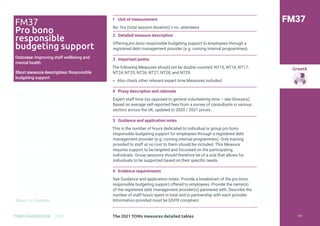
  • 279.
    The 2021 TOMsmeasures detailed tables TOMS HANDBOOK 2021 279 VCSEs VCSEs stands for Voluntary, Community and Social Enterprises. This definition includes charities. Sometimes the term Third Sector is also used. Volunteering Volunteering is defined by the International Labour Organisation (2001) as ‘unpaid non-compulsory work; that is, time individuals give without pay to activities performed either through an organisation or directly for others outside of the household’.

  • 280.