Tokenization of Real-World Asset - A Complete Guide.pdf
Since more projects aim to tokenize a wide range of assets, including currency, commodities, real estate, and much more, tokenized RWAs are a developing market niche in the digital asset business.
Tokenization of Real-World Asset - A Complete Guide.pdf
1.
1/12
April 29, 2024
Tokenizationof Real-World Asset - A Complete Guide
solulab.com/real-world-asset-tokenization-guide
The recent upswing in the cryptocurrency market has directed a substantial amount of
wealth, which helped in the development of a strong worldwide decentralized framework.
With a potential market size in the hundreds of billions of dollars, real-world asset (RWA)
tokenization is one of the biggest market opportunities in the blockchain sector. Anything
valuable might theoretically be tokenized and added to the chain.
Since more projects aim to tokenize a wide range of assets, including currency,
commodities, real estate, and much more, tokenized RWAs are a developing market
niche in the digital asset business.
According to projections from the Boston Consulting Group, global clearing and
settlement costs alone may save as much as $20 billion a year through the tokenization
of assets. Looking ahead to 2030, there’s a chance to get into the $16 trillion market for
tokenized illiquid assets, which makes up only a tiny portion of the total notional value of
holdings in both the public and private domains.
In this blog, we will provide a comprehensive and authorized source to help readers
understand the complex environment of asset tokenization. This comprehensive guide
demonstrates the conceptual, blockchain development technology, and practical elements
of token development for real-world assets on the blockchain development company.
What are Real-World Assets (RWA)?
2.
2/12
Tokenized real-world assets(RWAs) are powered by blockchain digital tokens that reflect
tangible and traditional financial assets, including cash, commodities, stocks, credit,
bonds, artwork, and intellectual property. The tokenization of real world assets represents
a major change in how these assets can be used, exchanged, and managed, opening up
a plethora of fresh prospects for both blockchain-powered investment services and a wide
range of non-financial use cases based on cryptography and decentralized consensus.
Asset tokenization is one of the most promising applications for blockchain technology,
featuring an estimated market size that includes practically all of humanity’s economic
activities. The future of finance is onchain, with hundreds of blockchains sustaining
trillions of dollars in tokenized RWAs on a shared substrate made up of blockchain and
distributed ledger technologically driven networks linked by a universal interoperability
protocol.
Different Types of Real-World Assets
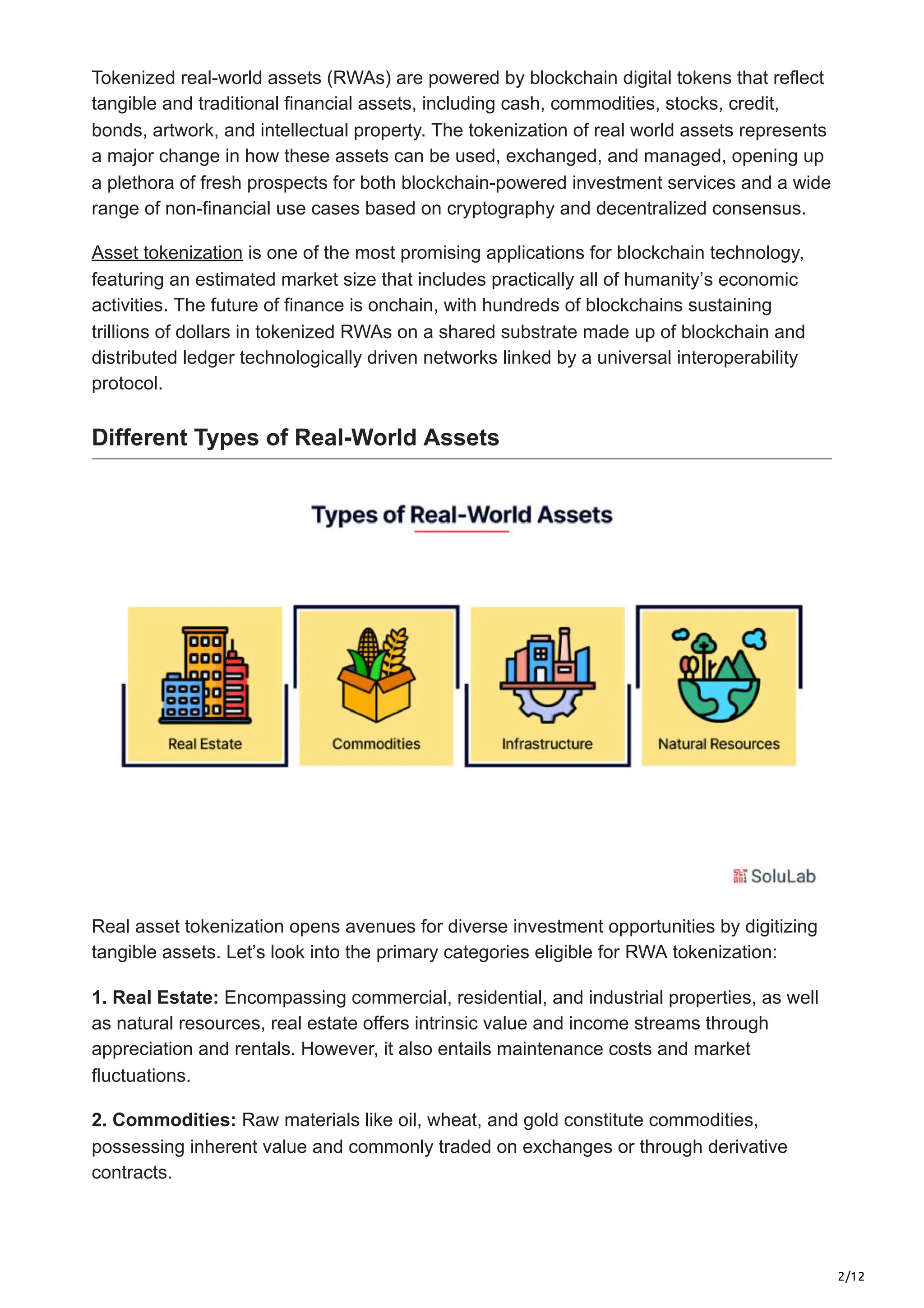
Real asset tokenization opens avenues for diverse investment opportunities by digitizing
tangible assets. Let’s look into the primary categories eligible for RWA tokenization:
1. Real Estate: Encompassing commercial, residential, and industrial properties, as well
as natural resources, real estate offers intrinsic value and income streams through
appreciation and rentals. However, it also entails maintenance costs and market
fluctuations.
2. Commodities: Raw materials like oil, wheat, and gold constitute commodities,
possessing inherent value and commonly traded on exchanges or through derivative
contracts.
3.
3/12
3. Infrastructure: Criticalfor economic activities, infrastructure comprises transportation
systems, public utilities, and facilities like roads, power plants, and water treatment plants.
These assets provide essential services to both businesses and communities.
4. Natural Resources: Essential for economic development and human survival, natural
resources include renewable and non-renewable assets such as forests, minerals, and
wind. These resources are pivotal for sustaining various industries and ecosystems.
Real-world asset tokenization revolutionizes investment landscapes, offering fractional
ownership and liquidity to investors while streamlining processes and enhancing
accessibility to traditionally illiquid assets.
Tokenizing Real-World Assets
Real-world assets are tokenized by embodying their ownership rights as onchain tokens.
This technique generates a digital copy of the underlying asset, allowing for on-chain
administration of the asset’s ownership rights and bridging the gap between physical and
digital assets.
Tokenized assets provide more liquidity, greater access, transparent onchain
administration, and lower transactional friction than traditional assets. In the context of
financial assets, tokenizing RWAs also integrates the distribution, trading, clearing,
settlement, and safeguarding processes into a single layer, resulting in a more simplified
onchain financial system with lower counterparty risk as well as better capital
mobilization.
Process of Tokenizing Real-World Assets
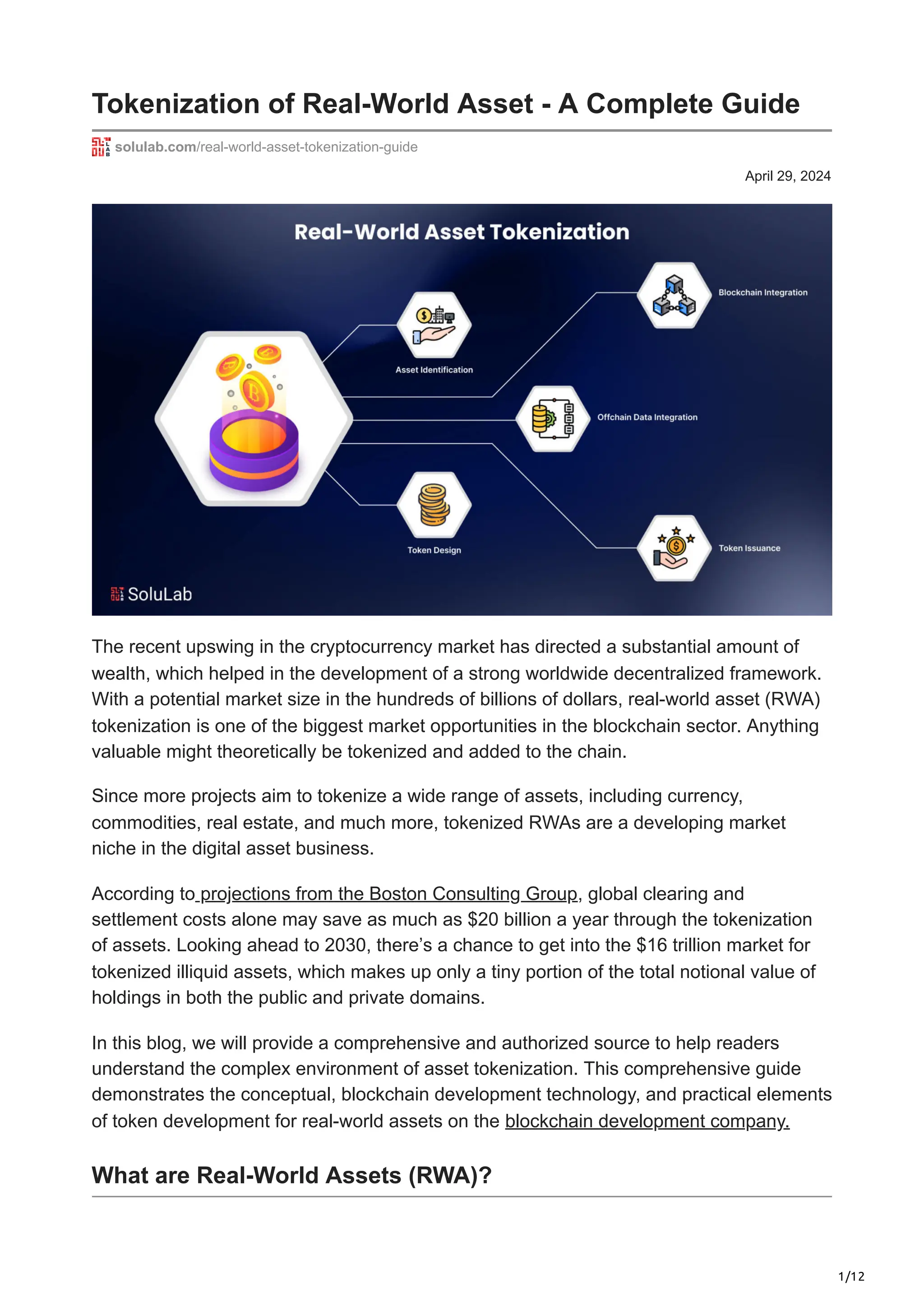
Tokenizing real-world assets involves a structured process with distinct stages:
1. Asset Identification
Selecting the real-world asset for tokenization, considering its market value, potential
liquidity, and regulatory compliance.
2. Token Design
Defining the characteristics of the token, such as whether it’s fungible or non-fungible,
and determining the token standard to be followed, such as ERC20 or ERC721. These
specifications lay the foundation for the token’s functionality and interoperability.
3. Blockchain Integration
Choosing a suitable blockchain network, whether public or private, for issuing the tokens.
Integration with protocols like Chainlink Cross-Chain Interoperability Protocol (CCIP)
enhances the token’s accessibility across different blockchain platforms.
4. Offchain Data Integration
4.
4/12
Leveraging high-quality offchaindata from trusted sources like Chainlink oracles to
ensure the accuracy and reliability of information related to the tokenized asset.
Verification services such as Chainlink Proof of Reserve (PoR) can be utilized to uphold
transparency regarding the assets backing the tokens.
5. Token Issuance
Deploying smart contracts on the selected blockchain network, minting the tokens
according to the predefined specifications, and making them available for trading or
utilization. This step marks the culmination of the tokenization process, providing
stakeholders with access to fractional ownership and liquidity of the real-world asset.
Advantages of Real-World Asset Tokenization
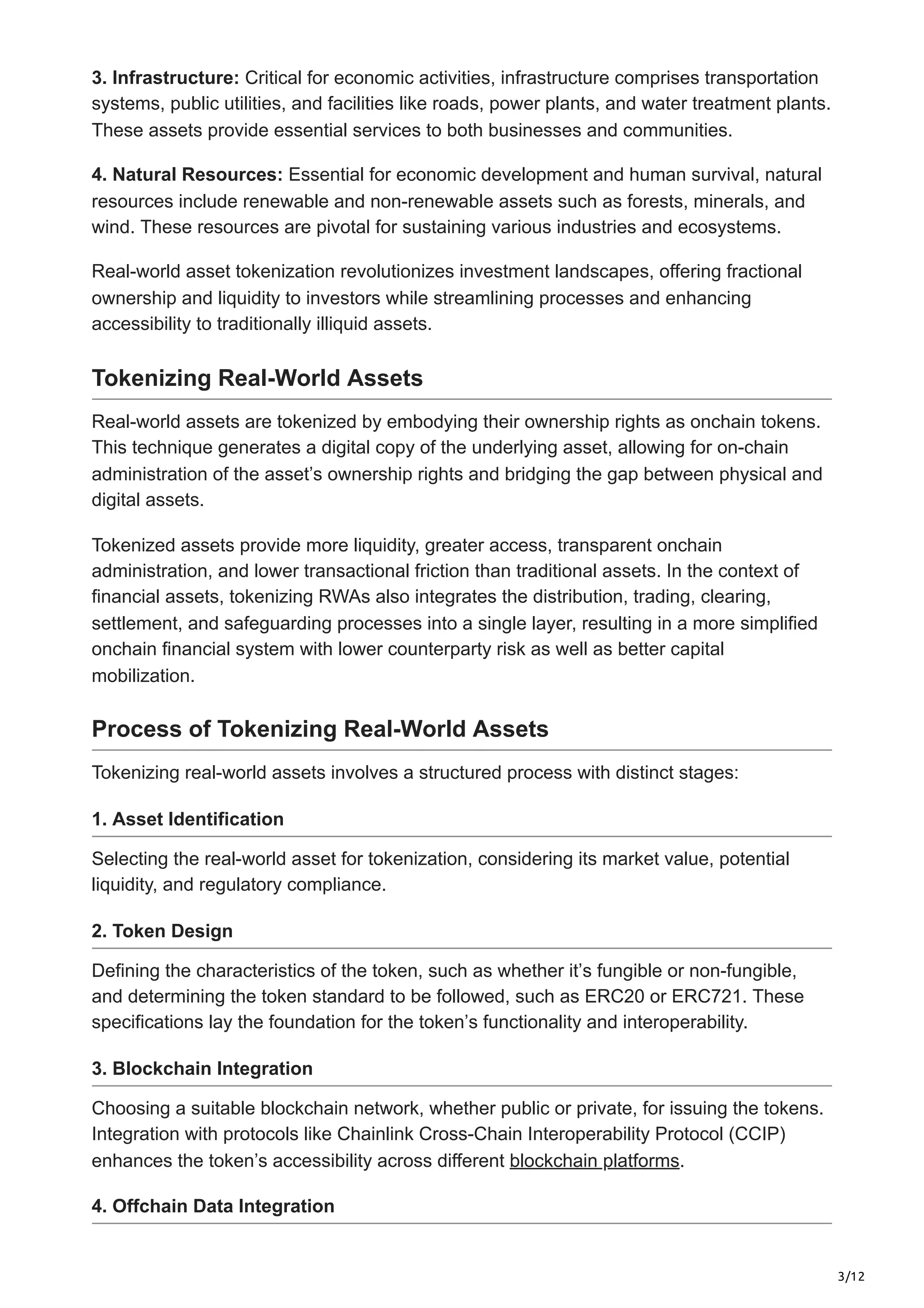
Tokenizing real-world assets yields several advantages:
1. Enhanced Liquidity: Tokenization facilitates increased market liquidity for traditionally
illiquid assets by providing globally accessible liquidity conditions through blockchain
ecosystems. Chainlink’s Cross-Chain Interoperability Protocol (CCIP) further supports
cross-chain activity, bolstering liquidity.
2. Improved Transparency: Tokenized assets, being represented on the blockchain,
ensure transparency and auditable asset management. This transparency reduces
systemic risks by accurately determining the level of leverage and risk within the system.
3. Increased Accessibility: Tokenized real-world assets expand the potential user base
by simplifying access through blockchain-based applications. Fractional ownership
enables a broader set of users to utilize assets that would otherwise be inaccessible to
them, fostering greater inclusivity in asset ownership.
5.
5/12
4. Cost Efficiency:Tokenization of real-world assets reduces transaction costs
associated with traditional asset trading and management. Smart contracts streamline
processes such as transfer of ownership, dividend distribution, and asset management,
resulting in cost savings for investors and asset owners.
5. Fractional Ownership: Tokenization allows for the division of ownership into smaller,
more affordable fractions. This democratizes investment opportunities, enabling
individuals with limited capital to participate in asset ownership and diversify their
investment portfolios.
6. 24/7 Market Access: Tokenized assets provide round-the-clock market access,
allowing investors to trade assets anytime, anywhere. This eliminates the constraints of
traditional market hours and geographical barriers, fostering a more dynamic and
inclusive investment environment.
Challenges and Risks in Real-World Asset Tokenization
Tokenizing real-world assets comes with several risks and challenges that must be
addressed for seamless buying, selling, and trading experiences. Here are some of them:
Regulatory Ambiguity: The evolving regulatory landscape governing tokenized
assets creates uncertainty and compliance challenges. Varying regulations across
jurisdictions can impede token issuance, trading, and ownership.
Standardization Deficiency: The absence of standardized practices and protocols
for real-world asset tokenization can hinder interoperability, liquidity, and market
adoption. This lack of standardization may result in inefficiencies, fragmentation,
and limitations in scalability and accessibility.
Security Vulnerabilities: Blockchain-based systems are susceptible to fraud,
cybercrimes, and security breaches. The irreversible nature of blockchain
transactions exacerbates the impact of security incidents, posing risks to asset
ownership.
Market Illiquidity: Despite potential liquidity enhancements, asset tokenization may
face market illiquidity due to limited investor demand, technological constraints, and
regulatory issues. This may lead to price volatility and challenges in trade execution.
Custody and Asset Management Challenges: Robust custody and asset
management solutions are essential to safeguard tokenized assets against theft,
fraud, and unauthorized access while ensuring regulatory compliance.
Implementing such solutions may present operational and technological hurdles.
Market Fluctuations: The market for tokenized assets may be susceptible to
fluctuations or manipulations through bots or algorithms. Inadequate management
or monitoring of these entities can lead to market manipulation.
6.
6/12
Technological Risks: Limitedtechnology access and technical failures can result
in network congestion, scalability issues, and interoperability challenges, disrupting
the asset tokenization platform and causing financial losses.
Valuation Complexity: Determining the fair market value of tokenized assets,
particularly real estate or artifacts, can be challenging. Varied valuation
methodologies may lead to pricing discrepancies, complicating asset pricing.
Use Cases and Real-World Examples
Here are some real-world examples of how RWA tokenization has been used to transform
businesses:
USDT (Tether): The pioneering and most thriving example of currency tokenization
to date. This project serves as a universal currency standard within the
cryptocurrency realm.
Lofty: Through tokenization, residential real estate, including houses and condos,
becomes more accessible for investment, enabling individuals to participate in the
real estate market with greater ease.
Carbcoin: Our company’s successful carbon credit tokenization case. 4IRE
designed a marketplace dedicated to carbon credits and created a native token to
facilitate efficient and standardized trading.
Agrotoken: This project allows farmers to tokenize their harvest, such as grains, to
exchange these digital assets for money, services, and other goods on digital
exchanges. Tokenized grain is also accepted as collateral for loans.
Blockchain Protocols for Real-World Asset Tokenization
Due to varying features, selecting the appropriate blockchain protocol is critical when
tokenizing real-world assets like real estate, commodities, and loans. Here are several
options to consider:
1. Ethereum
Renowned for its robust smart contract functionality, Ethereum is a popular choice for
real-world asset tokenization. It enables the seamless creation of programmable digital
assets using blockchain. The ERC-20 standard is widely utilized for its interoperability
and compatibility.
2. Hyperledger Fabric
With its modular architecture, Hyperledger Fabric is widely adopted for asset tokenization.
It offers a range of privacy features and access controls, making it suitable for compliant
asset tokenization solutions in domains such as finance and logistics.
3. Stellar
7.
7/12
Stellar blockchain isfavored for real-world assets with high transaction volumes or
liquidity requirements. It facilitates fast and cost-effective transactions, supported by a
built-in decentralized exchange for seamless asset trading.
4. R3 Corda
Designed primarily for enterprise applications, Corda by R3 emphasizes data security and
privacy. It is well-suited for tokenizing assets like intellectual properties and real estate,
particularly in sectors where regulatory compliance is crucial.
5. Tezos
Tezos stands out for its on-chain governance and strong verification capabilities, ensuring
security and flexibility in asset tokenization. Its self-amending protocol supports the
evolution of networks, offering long-term stability and compatibility for asset tokenization
endeavors.
Factors to Take into Account Before Beginning the Token
Economy
Before accessing the token development market, consider creating a solid business
model aligned with tokenomics. Evaluate the smooth integration of tokens into your
blockchain platform, assuring user-friendly interfaces. Prioritize cybersecurity steps to
prevent attacks. Navigating regulatory compliance, including securities legislation, AML,
and KYC standards, is critical for legal acceptability and user confidence.
1. Business Model
Establishing a robust business model is crucial when joining the token development
market. It is critical to identify how tokens will be used inside your ecosystem, whether as
a utility or a security, as well as comprehend the economic incentives for token holders.
Assessing tokenomics’ feasibility assures alignment with corporate objectives, user
engagement, and long-term sustainability. A well-defined business model establishes the
foundation for a successful token development economy.
2. Platform Integration Process
The easy integration of tokens into your blockchain platform is an important factor.
Assessing technical elements, such as selecting the proper blockchain and token
standards, assures compatibility and functioning. The integration procedure should be
consistent with the entire user experience and blockchain platform requirements. Strong
technological infrastructure and user-friendly interfaces help to provide an easy transition
into the token market, increasing user adoption and engagement.
Related: Key Trends in Asset Tokenization
3. Cybersecurity
8.
8/12
Cybersecurity is acritical consideration while engaging in the token economy. Token-
based systems become ideal targets for cyber threats and assaults. Adopting robust
cybersecurity measures, such as secure smart contract development, encryption, and
frequent audits, is required to protect both the blockchain platform and user assets. A
proactive approach to cybersecurity builds confidence among users while mitigating the
dangers associated with any flaws in the token ecosystem.
4. Compliances
Before diving into the token economy, it is critical to understand the regulatory
environment. Understanding and embracing applicable local and international legislation
guarantees legal conformity. This includes resolving concerns such as securities laws,
anti-money laundering rules, and Know Your Customer obligations. Collaborating with
legal specialists to handle the complicated regulatory environment reduces legal risks and
lays the groundwork for a safe and compliant presence in the token development
economy.
Real-World Asset Trends for 2025
Given the increased demand and popularity of real-world assets in recent years, it is safe
to assume that their future seems quite positive. Here are seven RWA trends to watch in
2025:
1. Stablecoin Surge
The rising demand for stablecoins continues to reshape the landscape, offering stability
and flexibility in cross-border payments and trading. This trend revolutionizes financial
transactions, providing a reliable alternative to traditional currencies.
2. Tokenized Treasuries
9.
9/12
Bridging the gapbetween conventional and decentralized finance, tokenized treasuries
present new investment opportunities. These initiatives expand avenues for investment
diversification and provide innovative solutions for capital allocation.
3. Private Credit Revolution
SMEs gain unprecedented access to debt capital through private credit solutions,
transforming the financing landscape. This trend democratizes borrowing, allowing
businesses to tap into various funding sources beyond traditional avenues.
4. Backed Non-Fungible Tokens (NFTs)
Collectible financing experiences a paradigm shift with the introduction of backed NFTs,
enabling borrowing and lending against assets like art, coins, and stamps. This innovation
brings tangible assets onto the blockchain, unlocking new avenues for asset-backed
lending.
5. Consumer Brand NFTs
Engaging consumers through gamification elements and immersive experiences,
consumer brand NFTs redefine customer interaction. Integration with the metaverse
enhances brand loyalty and fosters unique digital experiences for consumers.
6. Climate and Regenerative Finance
Blockchain technology facilitates transparency and accountability in addressing
environmental, social, and governance (ESG) concerns. Initiatives in climate and
regenerative finance leverage blockchain’s capabilities to promote sustainability and drive
positive social impact.
7. Tokenized Deposits and Bank Settlements
Tokenized deposits and wholesale bank settlements revolutionize banking operations,
enhancing efficiency in managing transactions and cross-border settlements. This trend
streamlines banking processes and fosters greater interoperability in the financial sector.
How to Make Profits from RWA Tokenization?
The real world asset tokenization sector is flourishing rapidly due to its distinctive
advantages and prospects for non-fungible asset owners. Tokenizing assets allows these
owners to unlock the liquidity of their unique belongings, enabling them to allocate funds
to investment projects and potentially earn substantial returns on investment (ROI). By
partnering with a reliable asset tokenization company like 4IRE, RWA owners can
maximize profits from their precious assets in the decentralized finance (DeFi) landscape.
On the other hand, buyers of RWA tokens gain access to an array of earning
opportunities, including:
10.
10/12
1. Fractional Ownership:RWA tokens offer investors the unique opportunity to own a
fraction of high-value assets such as real estate, gold, or fine art at a reasonable cost.
Diversifying your portfolio with these rare and tangible assets can be a rewarding
experience.
2. Rental Income: Investing in RWA tokens backed by rental properties grants you the
right to a portion of the rental income generated by the building’s owner. This steady
stream of passive income can provide financial stability and long-term growth.
3. Trading Opportunities: For crypto enthusiasts, RWA tokens present a lucrative
trading opportunity. By monitoring market trends and executing timely trades on various
exchange platforms, investors can capitalize on the volatile prices of these tokens and
generate substantial profits.
4. Crowdfunding Projects: RWA tokens enable crowdfunding for exclusive purchases
that might otherwise be inaccessible due to financial limitations. By pooling resources,
investors can collectively acquire fractional ownership of high-value assets, participating
in deals that offer significant return potential.
5. Staking and Yield Farming: Certain RWA assets can be deposited into liquidity pools
in exchange for an attractive annual percentage yield (APY). This staking and yield
farming option provides a stable and passive income stream, allowing investors to earn
rewards without actively trading.
By owning RWA tokens, individuals gain access to a tangible earning opportunity. This
presents an excellent chance to diversify investment portfolios and venture into
specialized niches that typically have high entry thresholds, making them inaccessible to
retail investors with limited budgets.
The Bottom Line
Finally, real-world asset tokenization based on blockchain development is an important
moment in finance and ownership. This comprehensive guide highlights the diverse
surroundings, including the philosophical underpinnings, technological complexities, and
practical applications of asset token creation. The developing trends and advances in this
field offer more accessibility, transparency, and efficiency. However, concerns like as
security threats and regulatory difficulties necessitate careful thought. As blockchain
development companies accept fractional ownership, decentralized finance, and diverse
tokenized assets, key takeaways highlight the importance of a strategic business model,
effortless blockchain platform integration, robust cybersecurity measures, and steadfast
regulatory compliance. Successfully managing these factors assures a future in which
real-world asset tokenization challenges existing frameworks, creating new possibilities
for investors and changing global financial ecosystems.
Being a top real-world asset tokenization company, SoluLab empowers businesses in this
sector by providing comprehensive solutions tailored to their needs. Utilizing expertise in
blockchain technology, SoluLab assists clients in defining robust tokenization strategies,
11.
11/12
ensuring seamless integration,and navigating regulatory compliance. With a focus on
cybersecurity and user experience, SoluLab enables clients to mitigate risks and enhance
trust among stakeholders. Contact us today to start your journey towards unlocking the
potential of real-world asset tokenization.
FAQs
1. What is real-world asset tokenization?
Real-world asset tokenization refers to the process of digitizing tangible assets, such as
real estate, commodities, and artwork, by representing them as blockchain-based tokens.
These tokens are backed by the underlying assets and can be traded or transferred
electronically, offering benefits like fractional ownership and increased liquidity.
2. How does real-world asset tokenization work?
Real-world asset tokenization involves several steps, including asset selection, token
specification, blockchain integration, off-chain data connection, and issuance. Assets are
selected based on their intrinsic value and potential for tokenization. Tokens are then
created according to predefined specifications and deployed on a blockchain network,
ensuring transparency and security.
3. What are the benefits of real-world asset tokenization?
Real-world asset tokenization offers numerous benefits, including increased liquidity,
fractional ownership opportunities, enhanced transparency, and accessibility to
traditionally illiquid assets. It also streamlines processes like asset management and
trading, while reducing transaction costs and minimizing barriers to entry for investors.
4. What are the challenges associated with real-world asset tokenization?
Challenges in real-world asset tokenization include regulatory uncertainty, lack of
standardization, security vulnerabilities, market illiquidity, and complexities in custody and
asset management. Navigating these challenges requires careful consideration of legal,
technical, and operational aspects to ensure compliance and mitigate risks.
5. Is real-world asset tokenization suitable for all types of assets?
While real-world asset tokenization can be applied to a wide range of assets, not all
assets may be suitable for tokenization. Factors such as regulatory compliance, asset
divisibility, and market demand need to be considered before initiating the tokenization
process. Assets with clear ownership rights, intrinsic value, and potential for liquidity are
generally more conducive to tokenization.
6. How can SoluLab help businesses with real-world asset tokenization?
SoluLab offers comprehensive solutions to businesses seeking to tokenize real-world
assets. Our expertise in blockchain technology enables us to assist clients in defining
robust tokenization strategies, ensuring seamless integration, and navigating regulatory
12.
12/12
compliance. From assetselection to token issuance, SoluLab guides clients through
every step of the process, using our technical prowess and industry experience to unlock
the potential of tokenized assets. With a focus on security, transparency, and usability,
SoluLab empowers businesses to harness the benefits of real-world asset tokenization
and drive innovation in their respective industries.


![Coded Agents – with UiPath SDK + LangGraph [Virtual Hands-on Workshop]](https://cdn.slidesharecdn.com/ss_thumbnails/codedagentsdeck-251215155422-5497c599-thumbnail.jpg?width=640&height=640&fit=bounds)


![Vibe Coding vs. Spec-Driven Development [Free Meetup]](https://cdn.slidesharecdn.com/ss_thumbnails/vibecodingvsspecdrivendevelopment-251209105622-43f455e7-thumbnail.jpg?width=640&height=640&fit=bounds)

