Group 2
Salubre, Yvonne S.
Toriaga, Ernest P.
Milana, Jona Marie A.
Regidor, Jonna U.
Paňa, Jovelyn S.
Yeke, Kathleen Anne M.
Salinas, Kimberly M.
Salado, Lea D.
Linao, Rendy Boy C.
Venus, Shiena Mae P.
Cristuta et al. (2019) emphasized that proper nutrition is
essential for students' academic success. With over 1.8 million
undernourished Filipino pupils reported in 2019, and the Philippines
ranking among the lowest in international assessments, their review
found that 6 out of 10 studies confirmed a significant link between
good nutrition and improved academic performance.
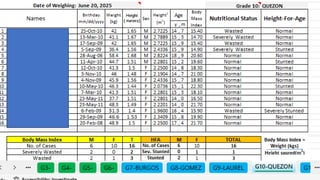
Based on the data from NASECO Integrated School Nutritional
Status the school exhibits a high malnutrition rate among learners.
This concerning trend prompted the conduct of a Training Needs
Assessment (TNA) to identify gaps in knowledge, skills, and practices
related to nutrition. The results will inform the development of
targeted interventions to address the issue and promote the overall
well-being of students.
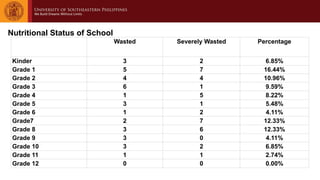
Wasted Severely Wasted Percentage
Kinder 3 2 6.85%
Grade 1 5 7 16.44%
Grade 2 4 4 10.96%
Grade 3 6 1 9.59%
Grade 4 1 5 8.22%
Grade 5 3 1 5.48%
Grade 6 1 2 4.11%
Grade7 2 7 12.33%
Grade 8 3 6 12.33%
Grade 9 3 0 4.11%
Grade 10 3 2 6.85%
Grade 11 1 1 2.74%
Grade 12 0 0 0.00%
Nutritional Status of School
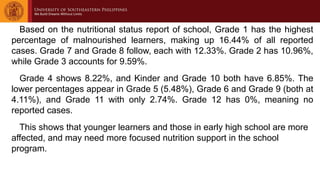
Based on the nutritional status report of school, Grade 1 has the highest
percentage of malnourished learners, making up 16.44% of all reported
cases. Grade 7 and Grade 8 follow, each with 12.33%. Grade 2 has 10.96%,
while Grade 3 accounts for 9.59%.
Grade 4 shows 8.22%, and Kinder and Grade 10 both have 6.85%. The
lower percentages appear in Grade 5 (5.48%), Grade 6 and Grade 9 (both at
4.11%), and Grade 11 with only 2.74%. Grade 12 has 0%, meaning no
reported cases.
This shows that younger learners and those in early high school are more
affected, and may need more focused nutrition support in the school
program.
TRAINING
NEEDS
ASSESSMEN
T
The study by Sharma et al. (2013) is our training needs assessment
because it assessed teachers’ knowledge, attitudes, and behaviors related
to nutrition. It showed that many teachers lacked nutrition knowledge even
though they knew it was important. This supports our inclusion of
Knowledge of Nutrition as a core competency. The study also implies the
need for strong Communication Skills, as teachers must explain healthy
eating to students and families. Lastly, it highlights the importance of
Program Planning, since the authors recommend professional development
and structured nutrition programs for teachers.
Sharma, S., Dortch, K. S., Byrd-Williams, C., Truxillio, J. B., Rahman, G. A., Bonsu, P., & Hoelscher, D. (2013). Nutrition-related
knowledge, attitudes, and dietary behaviors among Head Start teachers in Texas: A cross-sectional study.
Dear Respondents:
The purpose of this survey is to identify the training needs of teachers and parents addressing student
malnutrition in an educational setting. This information will allow for the development of training programs to
improve the ability of teachers and parents to deal with the issues of malnutrition and encourage students to
engage in healthy eating behavior.
Please answer the following questions honestly based on your own observations, experiences and/or
information related to your current competencies and needs, the survey will take between 30 to 45 minutes
of your time.
All your responses will be kept strictly confidential and will not be used to assess your performance. Your
feedback is important for us in creating appropriate and practical capacity building activities for teachers.
Thank you for your time and participation!
Demographic Data
Name(optional): _____________________ Position/Designation:_______________
Section/Division:___ No. of years in current position: ___
No. of training/programs/seminars attended for the past two years:__________
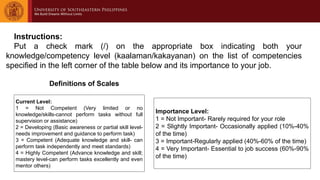
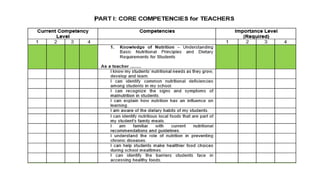
Current Level:
1 = Not Competent (Very limited or no
knowledge/skills-cannot perform tasks without full
supervision or assistance)
2 = Developing (Basic awareness or partial skill level-
needs improvement and guidance to perform task)
3 = Competent (Adequate knowledge and skill- can
perform task independently and meet standards)
4 = Highly Competent (Advance knowledge and skill;
mastery level-can perform tasks excellently and even
mentor others)
Importance Level:
1 = Not Important- Rarely required for your role
2 = Slightly Important- Occasionally applied (10%-40%
of the time)
3 = Important-Regularly applied (40%-60% of the time)
4 = Very Important- Essential to job success (60%-90%
of the time)
Instructions:
Put a check mark (/) on the appropriate box indicating both your
knowledge/competency level (kaalaman/kakayanan) on the list of competencies
specified in the left corner of the table below and its importance to your job.
Definitions of Scales
Minahal nga mga Respondente:
Ang katuyoan sa kini nga survey mao ang pag-ila sa mga panginahanglanon sa pagbansay sa mga magtutudlo ug
mga ginikanan nga nagtubag sa malnutrisyon sa estudyante sa usa ka kahimtang sa edukasyon. Kini nga
impormasyon magtugot alang sa pagpalambo sa mga programa sa pagbansay aron sa pagpalambo sa abilidad sa
mga magtutudlo ug mga ginikanan sa pag-atubang sa mga isyu sa malnutrisyon ug pagdasig sa mga estudyante sa
paghimo sa himsog nga pamatasan sa pagkaon.
Palihog tubaga ang mosunod nga mga pangutana nga matinud-anon base sa imong kaugalingong mga
obserbasyon, mga kasinatian ug/o impormasyon nga may kalabutan sa imong kasamtangan nga mga kahanas ug mga
panginahanglan, ang survey molungtad tali sa 30 ngadto sa 45 ka minuto sa imong oras.
Ang tanan nimong mga tubag tipigan nga kompidensyal ug dili gamiton sa pagsusi sa imong pasundayag. Ang imong
feedback importante alang kanamo sa paghimo og angay ug praktikal nga mga kalihokan sa pagpatubo sa kapasidad
para sa mga magtutudlo. Salamat sa imong oras ug partisipasyon!
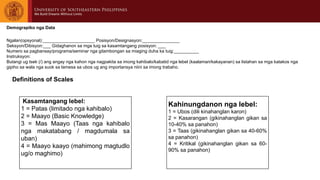
Kasamtangang lebel:
1 = Patas (limitado nga kahibalo)
2 = Maayo (Basic Knowledge)
3 = Mas Maayo (Taas nga kahibalo
nga makatabang / magdumala sa
uban)
4 = Maayo kaayo (mahimong magtudlo
ug/o maghimo)
Kahinungdanon nga lebel:
1 = Ubos (dili kinahanglan karon)
2 = Kasarangan (gikinahanglan gikan sa
10-40% sa panahon)
3 = Taas (gikinahanglan gikan sa 40-60%
sa panahon)
4 = Kritikal (gikinahanglan gikan sa 60-
90% sa panahon)
Demograpiko nga Data
Ngalan(opsyonal):_____________________ Posisyon/Designasyon:_______________
Seksyon/Dibisyon:___ Gidaghanon sa mga tuig sa kasamtangang posisyon: ___
Numero sa pagbansay/programa/seminar nga gitambongan sa miaging duha ka tuig:__________
Instruksyon:
Butangi ug tsek (/) ang angay nga kahon nga nagpakita sa imong kahibalo/kabatid nga lebel (kaalaman/kakayanan) sa listahan sa mga katakos nga
gipiho sa wala nga suok sa lamesa sa ubos ug ang importansya niini sa imong trabaho.
Definitions of Scales
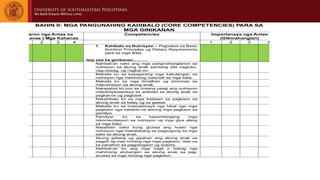
BAHIN II: MGA PANGUNAHING KAHIBALO (CORE COMPETENCIES) PARA SA
MGA GINIKANAN
Karon nga Antas sa
Kahanas | Mga Kahanas
Competencies Importansya nga Antas
(Gikinahanglan)
1 2 3 4 1 2 3 4
1. Kahibalo sa Nutrisyon – Pagsabot sa Basic
Nutrition Principles ug Dietary Requirements
para sa mga Bata
Isip usa ka ginikanan...…….
Nahibal-an nako ang mga panginahanglanon sa
nutrisyon sa akong anak samtang sila nagtubo,
nag-uswag, ug nagkat-on.
Makaila ko sa kasagarang mga kakulangan sa
nutrisyon nga mahimong masinati sa mga bata.
Makaila ko sa mga timailhan ug sintomas sa
malnutrisyon sa akong anak.
Nakasabot ko kon sa unsang paagi ang nutrisyon
makaimpluwensya sa abilidad sa akong anak sa
pagkat-on ug pagtutok.
Nakahibalo ko sa mga batasan sa pagkaon sa
akong anak sa balay ug sa gawas.
Makaila ko sa masustansya nga lokal nga mga
pagkaon nga kabahin sa among mga pagkaon sa
pamilya.
Pamilyar ko sa kasamtangang mga
rekomendasyon sa nutrisyon ug mga giya alang
sa mga bata.
Nasabtan nako kung giunsa ang husto nga
nutrisyon nga makatabang sa pagpugong sa mga
sakit sa akong anak.
Akong gidasig ug giyahan ang akong anak sa
pagpili og mas himsog nga mga pagkaon, ilabi na
sa panahon sa pagpangaon ug snacks.
Nahibal-an ko ang mga hagit o babag nga
mahimong atubangon sa akong anak sa pag-
access sa mga himsog nga pagkaon.
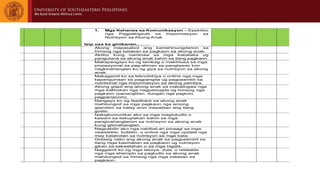
1. Mga Kahanas sa Komunikasyon – Epektibo
nga Pagpakigsulti sa Impormasyon sa
Nutrisyon sa Akong Anak
Isip usa ka ginikanan..……
Akong mapasabot ang kamahinungdanon sa
himsog nga batasan sa pagkaon sa akong anak.
Aktibo kong naminaw sa mga kabalaka ug
pangutana sa akong anak bahin sa ilang pagkaon.
Makapangayo ko og tambag o makihiusa sa mga
propesyonal sa pag-atiman sa panglawas kon
nagkinahanglan ko og giya sa nutrisyon sa akong
anak.
Makagamit ko sa teknolohiya o online nga mga
kapanguhaan sa pagpangita ug pagpaambit sa
nutritional nga impormasyon sa akong pamilya.
Akong giapil ang akong anak sa makalingaw nga
mga kalihokan nga nagpasiugda og himsog nga
pagkaon (pananglitan, dungan nga pagluto,
pagpananom).
Nangayo ko og feedback sa akong anak
mahitungod sa mga pagkaon nga among
giandam sa balay aron masabtan ang ilang
gusto.
Nakigkomunikar ako sa mga magtutudlo o
kawani sa eskuylahan bahin sa mga
panginahanglanon sa nutrisyon sa akong anak
kung gikinahanglan.
Nagpabilin ako nga nahibal-an pinaagi sa mga
newsletter, bulletin, o online nga mga update nga
may kalabotan sa nutrisyon sa mga bata.
Gidasig nako ang akong anak sa pagpaambit sa
ilang mga kasinatian sa pagkaon ug nutrisyon
gikan sa eskwelahan o sa mga higala.
Naggamit ko og mga istorya, dula, o relatable
nga mga ehemplo sa pagtudlo sa akong anak
mahitungod sa himsog nga mga batasan sa
pagkaon.
Needs
Assessmen
t Report
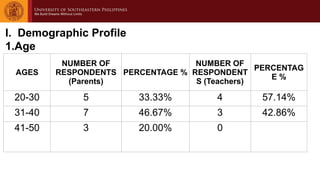
AGES
NUMBER OF
RESPONDENTS
(Parents)
PERCENTAGE %
NUMBER OF
RESPONDENT
S (Teachers)
PERCENTAG
E %
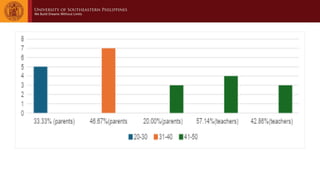
20-30 5 33.33% 4 57.14%
31-40 7 46.67% 3 42.86%
41-50 3 20.00% 0
I. Demographic Profile
1.Age
Most of the parents (7 out of 15 or 46.67%) are aged 31–40
years old. This means many of them are in their mid-adult
years. Five parents (33.33%) are younger, aged 20–30. Only
three parents (20%) are aged 41–50. This shows that most
parents involved are either young or in their early middle age.
On the other hand, most of the teachers (4 out of 7 or
57.14%) are between 20 and 30 years old, making up more
than half of the group. The rest (42.86%) are in their 30s, while
none are above 40.
SEX
NUMBER OF
RESPONDENTS
(parents)
PERCENTAGE %
NUMBER OF
RESPONDENTS
(teachers)
PERCENTAGE %
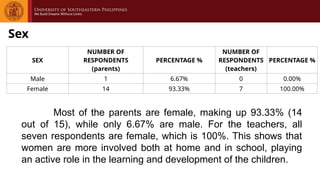
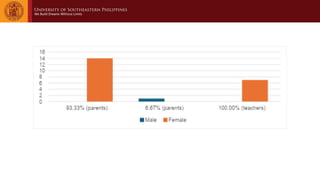
Male 1 6.67% 0 0.00%
Female 14 93.33% 7 100.00%
Sex
Most of the parents are female, making up 93.33% (14
out of 15), while only 6.67% are male. For the teachers, all
seven respondents are female, which is 100%. This shows that
women are more involved both at home and in school, playing
an active role in the learning and development of the children.
TEACHERS/PARENT
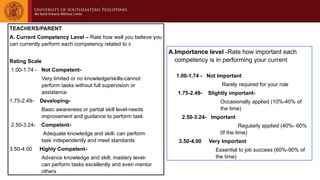
A. Current Competency Level – Rate how well you believe you
can currently perform each competency related to c
Rating Scale
1.00-1.74 - Not Competent-
Very limited or no knowledge/skills-cannot
perform tasks without full supervision or
assistance
1.75-2.49- Developing-
Basic awareness or partial skill level-needs
improvement and guidance to perform task
2.50-3.24- Competent-
Adequate knowledge and skill- can perform
task independently and meet standards
3.50-4.00 Highly Competent-
Advance knowledge and skill; mastery level-
can perform tasks excellently and even mentor
others
A.Importance level -Rate how important each
competency is in performing your current
1.00-1.74 - Not Important
Rarely required for your role
1.75-2.49- Slightly important-
Occasionally applied (10%-40% of
the time)
2.50-3.24- Important
Regularly applied (40%- 60%
0f the time)
3.50-4.00 Very Important
Essential to job success (60%-90% of
the time)
7 Teachers-Results
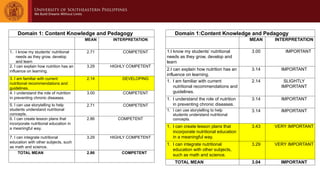
Domain 1: Content Knowledge and Pedagogy
MEAN INTERPRETATION
1. I know my students’ nutritional
needs as they grow, develop
and learn
2.71 COMPETENT
2. I can explain how nutrition has an
influence on learning.
3.29 HIGHLY COMPETENT
3. I am familiar with current
nutritional recommendations and
guidelines.
2.14 DEVELOPING
4. I understand the role of nutrition
in preventing chronic diseases.
3.00 COMPETENT
5. I can use storytelling to help
students understand nutritional
concepts.
2.71 COMPETENT
6. I can create lesson plans that
incorporate nutritional education in
a meaningful way.
2.86 COMPETENT
7. I can integrate nutritional
education with other subjects, such
as math and science.
3.29 HIGHLY COMPETENT
TOTAL MEAN 2.86 COMPETENT
Domain 1:Content Knowledge and Pedagogy
MEAN INTERPRETATION
1.I know my students’ nutritional
needs as they grow, develop and
learn
3.00 IMPORTANT
2.I can explain how nutrition has an
influence on learning.
3.14 IMPORTANT
1. I am familiar with current
nutritional recommendations and
guidelines.
2.14 SLIGHTLY
IMPORTANT
1. I understand the role of nutrition
in preventing chronic diseases.
3.14 IMPORTANT
1. I can use storytelling to help
students understand nutritional
concepts.
3.14 IMPORTANT
1. I can create lesson plans that
incorporate nutritional education
in a meaningful way.
3.43 VERY IMPORTANT
1. I can integrate nutritional
education with other subjects,
such as math and science.
3.29 VERY IMPORTANT
TOTAL MEAN 3.04 IMPORTANT
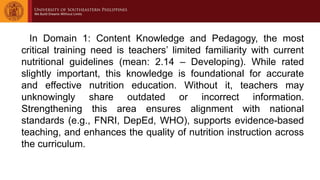
In Domain 1: Content Knowledge and Pedagogy, the most
critical training need is teachers’ limited familiarity with current
nutritional guidelines (mean: 2.14 – Developing). While rated
slightly important, this knowledge is foundational for accurate
and effective nutrition education. Without it, teachers may
unknowingly share outdated or incorrect information.
Strengthening this area ensures alignment with national
standards (e.g., FNRI, DepEd, WHO), supports evidence-based
teaching, and enhances the quality of nutrition instruction across
the curriculum.
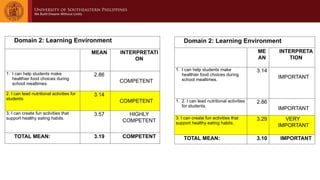
Domain 2: Learning Environment
MEAN INTERPRETATI
ON
1. I can help students make
healthier food choices during
school mealtimes.
2.86
COMPETENT
2. I can lead nutritional activities for
students.
3.14
COMPETENT
3. I can create fun activities that
support healthy eating habits.
3.57 HIGHLY
COMPETENT
TOTAL MEAN: 3.19 COMPETENT
Domain 2: Learning Environment
ME
AN
INTERPRETA
TION
1. I can help students make
healthier food choices during
school mealtimes.
3.14
IMPORTANT
1. 2. I can lead nutritional activities
for students.
2.86
IMPORTANT
3. I can create fun activities that
support healthy eating habits.
3.29 VERY
IMPORTANT
TOTAL MEAN: 3.10 IMPORTANT
Among the indicators under Domain 2: Learning Environment, the
need to help students make healthier food choices during school
mealtimes should be prioritized. This indicator received the lowest
competency mean score (2.86) compared to leading nutritional activities
(3.14) and creating fun nutrition-related activities (3.57). Although all
indicators fall within the "competent" level, the gap suggests that teachers
feel less confident in guiding students during actual mealtimes, which is a
critical moment to reinforce healthy eating habits. Furthermore, this skill
directly influences students’ daily behavior, making it a practical and
impactful area for intervention. Addressing this need can strengthen the
connection between nutrition knowledge and real-life choices, promoting a
healthier school environment.
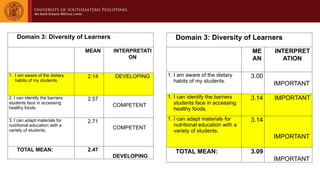
Domain 3: Diversity of Learners
MEAN INTERPRETATI
ON
1. I am aware of the dietary
habits of my students.
2.14 DEVELOPING
2. I can identify the barriers
students face in accessing
healthy foods.
2.57
COMPETENT
3. I can adapt materials for
nutritional education with a
variety of students.
2.71
COMPETENT
TOTAL MEAN: 2.47
DEVELOPING
Domain 3: Diversity of Learners
ME
AN
INTERPRET
ATION
1. I am aware of the dietary
habits of my students.
3.00
IMPORTANT
1. I can identify the barriers
students face in accessing
healthy foods.
3.14 IMPORTANT
1. I can adapt materials for
nutritional education with a
variety of students.
3.14
IMPORTANT
TOTAL MEAN: 3.09
IMPORTANT
In Domain 3: Diversity of Learners, the indicator “I am aware
of the dietary habits of my students” stands out as the most critical
training need. While the importance rating is consistent across
indicators (mean of 3.00 or higher, indicating “important”), this
specific item has the lowest competency level at 2.14
(“developing”), compared to the other indicators which are at the
“competent” level. This gap highlights a pressing need to enhance
teachers' understanding of students’ actual eating behaviors, which
is foundational to effectively identifying barriers and adapting
instructional materials. Addressing this need will ensure that
nutrition education is more responsive, inclusive, and tailored to the
learners' real-life contexts.
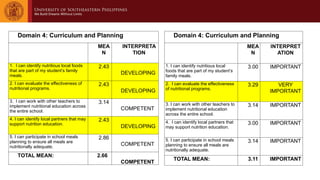
Domain 4: Curriculum and Planning
MEA
N
INTERPRETA
TION
1. I can identify nutritious local foods
that are part of my student’s family
meals.
2.43
DEVELOPING
2. I can evaluate the effectiveness of
nutritional programs.
2.43
DEVELOPING
3. I can work with other teachers to
implement nutritional education across
the entire school.
3.14
COMPETENT
4. I can identify local partners that may
support nutrition education.
2.43
DEVELOPING
5. I can participate in school meals
planning to ensure all meals are
nutritionally adequate.
2.86
COMPETENT
TOTAL MEAN: 2.66
COMPETENT
Domain 4: Curriculum and Planning
MEA
N
INTERPRET
ATION
1. I can identify nutritious local
foods that are part of my student’s
family meals.
3.00 IMPORTANT
2. I can evaluate the effectiveness
of nutritional programs.
3.29 VERY
IMPORTANT
3. I can work with other teachers to
implement nutritional education
across the entire school.
3.14 IMPORTANT
4. I can identify local partners that
may support nutrition education.
3.00 IMPORTANT
5. I can participate in school meals
planning to ensure all meals are
nutritionally adequate.
3.14 IMPORTANT
TOTAL MEAN: 3.11 IMPORTANT
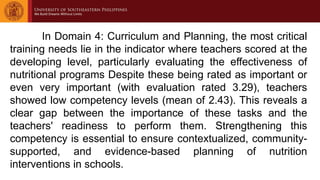
In Domain 4: Curriculum and Planning, the most critical
training needs lie in the indicator where teachers scored at the
developing level, particularly evaluating the effectiveness of
nutritional programs Despite these being rated as important or
even very important (with evaluation rated 3.29), teachers
showed low competency levels (mean of 2.43). This reveals a
clear gap between the importance of these tasks and the
teachers' readiness to perform them. Strengthening this
competency is essential to ensure contextualized, community-
supported, and evidence-based planning of nutrition
interventions in schools.
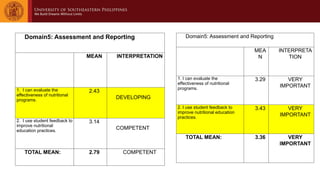
Domain5: Assessment and Reporting
MEAN INTERPRETATION
1. I can evaluate the
effectiveness of nutritional
programs.
2.43
DEVELOPING
2. I use student feedback to
improve nutritional
education practices.
3.14
COMPETENT
TOTAL MEAN: 2.79 COMPETENT
Domain5: Assessment and Reporting
MEA
N
INTERPRETA
TION
1. I can evaluate the
effectiveness of nutritional
programs.
3.29 VERY
IMPORTANT
2. I use student feedback to
improve nutritional education
practices.
3.43 VERY
IMPORTANT
TOTAL MEAN: 3.36 VERY
IMPORTANT
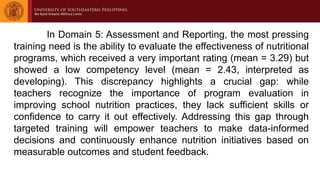
In Domain 5: Assessment and Reporting, the most pressing
training need is the ability to evaluate the effectiveness of nutritional
programs, which received a very important rating (mean = 3.29) but
showed a low competency level (mean = 2.43, interpreted as
developing). This discrepancy highlights a crucial gap: while
teachers recognize the importance of program evaluation in
improving school nutrition practices, they lack sufficient skills or
confidence to carry it out effectively. Addressing this gap through
targeted training will empower teachers to make data-informed
decisions and continuously enhance nutrition initiatives based on
measurable outcomes and student feedback.
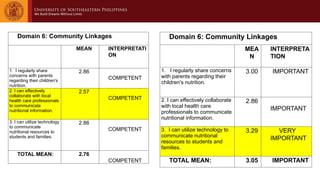
Domain 6: Community Linkages
MEAN INTERPRETATI
ON
1. I regularly share
concerns with parents
regarding their children's
nutrition.
2.86
COMPETENT
2. I can effectively
collaborate with local
health care professionals
to communicate
nutritional information.
2.57
COMPETENT
3. I can utilize technology
to communicate
nutritional resources to
students and families.
2.86
COMPETENT
TOTAL MEAN: 2.76
COMPETENT
Domain 6: Community Linkages
MEA
N
INTERPRETA
TION
1. I regularly share concerns
with parents regarding their
children's nutrition.
3.00 IMPORTANT
2. I can effectively collaborate
with local health care
professionals to communicate
nutritional information.
2.86
IMPORTANT
3. I can utilize technology to
communicate nutritional
resources to students and
families.
3.29 VERY
IMPORTANT
TOTAL MEAN: 3.05 IMPORTANT
In Domain 6: Community Linkages, although all indicators are
rated as important to very important, the competency levels remain
only at the competent level, with none reaching highly competent.
The most critical need lies in the use of technology to
communicate nutritional resources to families, which was rated
very important (mean = 3.29) but only achieved a competent rating
(mean = 2.86). This suggests a gap between the recognized
importance of digital communication and teachers’ ability to utilize
it effectively. Strengthening this area through training on digital
platforms and communication strategies would enhance
collaboration between schools, families, and health professionals
in promoting proper nutrition.
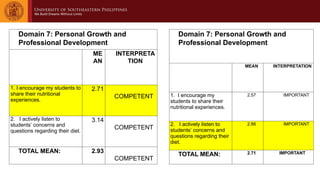
Domain 7: Personal Growth and
Professional Development
ME
AN
INTERPRETA
TION
1. I encourage my students to
share their nutritional
experiences.
2.71
COMPETENT
2. I actively listen to
students’ concerns and
questions regarding their diet.
3.14
COMPETENT
TOTAL MEAN: 2.93
COMPETENT
Domain 7: Personal Growth and
Professional Development
MEAN INTERPRETATION
1. I encourage my
students to share their
nutritional experiences.
2.57 IMPORTANT
2. I actively listen to
students’ concerns and
questions regarding their
diet.
2.86 IMPORTANT
TOTAL MEAN: 2.71 IMPORTANT
In Domain 7: Personal Growth and Professional
Development, the overall competency level is competent (mean =
2.93), while the importance level is also rated as important (mean =
2.71). However, the indicator “I actively listen to students’ concerns
and questions regarding their diet” shows a relatively higher
importance (mean = 2.86) compared to its competency level. This
suggests that while teachers acknowledge the value of open,
supportive communication about nutrition, there is still room to
enhance their reflective practice and responsiveness to students’
individual needs. Addressing this through training on active listening
and student-centered communication can help foster a more
nurturing environment that supports both health and learning.
15 Parents-Results
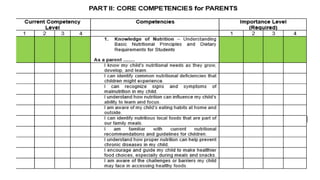
1. Content Knowledge and Pedagogy (Adapted)
INTERPRETATION I
MEAN
INTERPRETATION
1. I know my child’s nutritional needs as
they grow, develop, and learn.
2.27 Developing
1. I can identify common nutritional
deficiencies that children might
experience.
2.53
Competent
3. I can recognize signs and symptoms
of malnutrition in my child. 2.53
Competent
4. I understand how nutrition can
influence my child’s ability to learn
and focus.
3.13 Competent
4. I am familiar with current nutritional
recommendations and guidelines for
children.
2.4 Developing
6.I understand how proper nutrition can
help prevent chronic diseases in my
child.
2.8 Developing
TOTAL MEAN 2.61 Competent
1. Content Knowledge and Pedagogy (Adapted)
INTERPRETATION I
MEAN INTERPRETATION
1. I know my child’s nutritional needs as
they grow, develop, and learn.
2.27 Slightly important
2. I can identify common nutritional
deficiencies that children might experience.
2.47 Slightly important
3. I can recognize signs and symptoms of
malnutrition in my child.
2.20
Slightly important
4. I understand how nutrition can influence
my child’s ability to learn and focus.
2.21 Slightly important
5. I am familiar with current nutritional
recommendations and guidelines for
children.
2.20 Slightly important
6.I understand how proper nutrition can
help prevent chronic diseases in my child.
2.40
Slightly important
TOTAL MEAN
2.29 Slightly
important
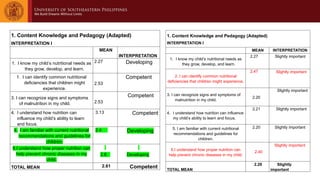
In Domain 1: Content Knowledge and Pedagogy, the competency level of parents is
rated as competent overall (mean = 2.61), but the importance level they assign to the
indicators is only slightly important (mean = 2.29). This disparity suggests that although
parents demonstrate an adequate level of nutritional understanding, they may undervalue the
critical role of nutrition in their children's learning, development, and long-term health. For
example, while parents are competent in identifying nutritional deficiencies and understanding
how nutrition impacts focus and learning, their low importance ratings on items like
recognizing malnutrition symptoms, knowing nutritional guidelines, and understanding chronic
disease prevention highlight a potential lack of awareness about the broader impacts of poor
nutrition.
This training need should be addressed to raise parents’ awareness of the significance
of nutritional knowledge and its impact on their children’s academic performance and lifelong
well-being. Empowering parents with both information and the motivation to act on it is
essential to create a supportive home-school nutrition partnership.
Domain 2 Learning Environment (Adapted)
MEAN INTERPRETATIO
N
1. I encourage and guide my child to
make healthier food choices,
especially during meals and
snacks.
3.00 Competent
1. I engage my child in fun activities
that promote healthy eating (e.g.,
cooking together, gardening).
2.87
Competent
TOTAL MEAN
2.93 Competent
Domain 2 Learning Environment (Adapted)
MMMMM
M
MEAN
INTERPRETATION
INTERPRETATION
1. I encourage and guide my child to
make healthier food choices,
especially during meals and snacks.
2.6 Slightly
important
1. I engage my child in fun activities
that promote healthy eating (e.g.,
cooking together, gardening).
2.2 Slightly
important
TOTAL MEAN
2.4 Slightly
important
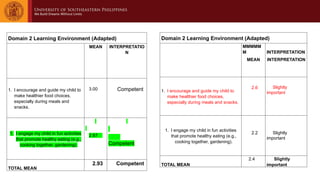
In Domain 2: Learning Environment, parents rated themselves as competent
(mean = 2.93) in encouraging healthier food choices and engaging their children in
activities that promote healthy eating. However, the perceived importance level of
these practices remains slightly important (mean = 2.40). This reveals a key
training gap: although parents are capable of supporting healthy eating behaviors,
they do not fully appreciate the value or long-term impact of these actions on their
children’s health and learning.
The low importance scores may reflect a lack of awareness of the role the
home environment plays in shaping children’s food choices and habits. As a result,
training should focus on strengthening parents’ understanding of their influence
and equipping them with strategies to make nutrition education at home more
meaningful and engaging. Raising this awareness will help ensure that their
competencies are effectively applied and sustained in daily routines.
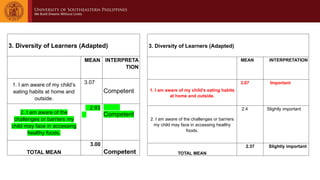
3. Diversity of Learners (Adapted)
MEAN INTERPRETA
TION
1. I am aware of my child’s
eating habits at home and
outside.
3.07
Competent
2. I am aware of the
challenges or barriers my
child may face in accessing
healthy foods.
2.93
Competent
TOTAL MEAN
3.00
Competent
3. Diversity of Learners (Adapted)
MEAN INTERPRETATION
1. I am aware of my child’s eating habits
at home and outside.
3.07 Important
2. I am aware of the challenges or barriers
my child may face in accessing healthy
foods.
2.4 Slightly important
TOTAL MEAN
2.37 Slightly important
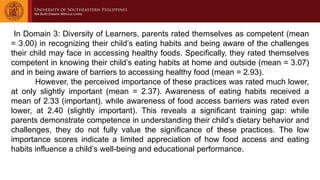
In Domain 3: Diversity of Learners, parents rated themselves as competent (mean
= 3.00) in recognizing their child’s eating habits and being aware of the challenges
their child may face in accessing healthy foods. Specifically, they rated themselves
competent in knowing their child’s eating habits at home and outside (mean = 3.07)
and in being aware of barriers to accessing healthy food (mean = 2.93).
However, the perceived importance of these practices was rated much lower,
at only slightly important (mean = 2.37). Awareness of eating habits received a
mean of 2.33 (important), while awareness of food access barriers was rated even
lower, at 2.40 (slightly important). This reveals a significant training gap: while
parents demonstrate competence in understanding their child’s dietary behavior and
challenges, they do not fully value the significance of these practices. The low
importance scores indicate a limited appreciation of how food access and eating
habits influence a child’s well-being and educational performance.
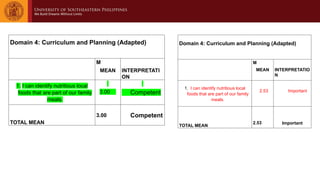
Domain 4: Curriculum and Planning (Adapted)
M
MEAN INTERPRETATI
ON
1. I can identify nutritious local
foods that are part of our family
meals.
3.00 Competent
TOTAL MEAN
3.00 Competent
Domain 4: Curriculum and Planning (Adapted)
M
MEAN INTERPRETATIO
N
1. I can identify nutritious local
foods that are part of our family
meals.
2.53 Important
TOTAL MEAN
2.53 Important
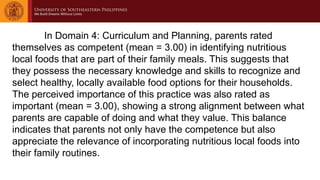
In Domain 4: Curriculum and Planning, parents rated
themselves as competent (mean = 3.00) in identifying nutritious
local foods that are part of their family meals. This suggests that
they possess the necessary knowledge and skills to recognize and
select healthy, locally available food options for their households.
The perceived importance of this practice was also rated as
important (mean = 3.00), showing a strong alignment between what
parents are capable of doing and what they value. This balance
indicates that parents not only have the competence but also
appreciate the relevance of incorporating nutritious local foods into
their family routines.
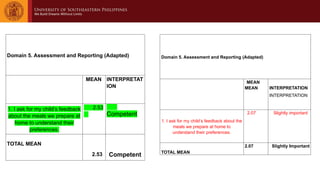
Domain 5. Assessment and Reporting (Adapted)
MEAN INTERPRETAT
ION
1. I ask for my child’s feedback
about the meals we prepare at
home to understand their
preferences.
2.53
Competent
TOTAL MEAN
2.53 Competent
Domain 5. Assessment and Reporting (Adapted)
MEAN
MEAN INTERPRETATION
INTERPRETATION
1. I ask for my child’s feedback about the
meals we prepare at home to
understand their preferences.
2.07 Slightly important
TOTAL MEAN
2.07 Slightly Important
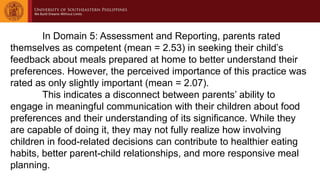
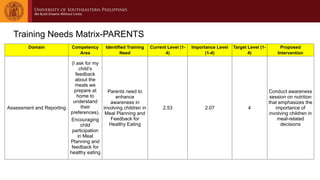
In Domain 5: Assessment and Reporting, parents rated
themselves as competent (mean = 2.53) in seeking their child’s
feedback about meals prepared at home to better understand their
preferences. However, the perceived importance of this practice was
rated as only slightly important (mean = 2.07).
This indicates a disconnect between parents’ ability to
engage in meaningful communication with their children about food
preferences and their understanding of its significance. While they
are capable of doing it, they may not fully realize how involving
children in food-related decisions can contribute to healthier eating
habits, better parent-child relationships, and more responsive meal
planning.
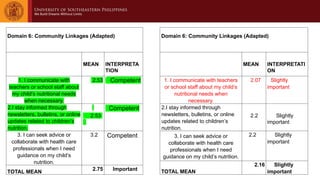
Domain 6: Community Linkages (Adapted)
MEAN INTERPRETA
TION
1. I communicate with
teachers or school staff about
my child’s nutritional needs
when necessary.
2.53 Competent
2.I stay informed through
newsletters, bulletins, or online
updates related to children’s
nutrition.
2.53
Competent
3. I can seek advice or
collaborate with health care
professionals when I need
guidance on my child’s
nutrition.
3.2 Competent
TOTAL MEAN
2.75 Important
Domain 6: Community Linkages (Adapted)
MEAN INTERPRETATI
ON
1. I communicate with teachers
or school staff about my child’s
nutritional needs when
necessary.
2.07 Slightly
important
2.I stay informed through
newsletters, bulletins, or online
updates related to children’s
nutrition.
2.2 Slightly
important
3. I can seek advice or
collaborate with health care
professionals when I need
guidance on my child’s nutrition.
2.2 Slightly
important
TOTAL MEAN
2.16 Slightly
important
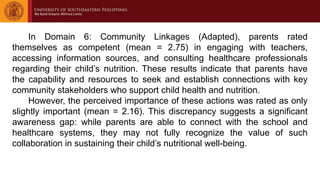
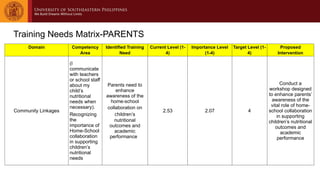
In Domain 6: Community Linkages (Adapted), parents rated
themselves as competent (mean = 2.75) in engaging with teachers,
accessing information sources, and consulting healthcare professionals
regarding their child’s nutrition. These results indicate that parents have
the capability and resources to seek and establish connections with key
community stakeholders who support child health and nutrition.
However, the perceived importance of these actions was rated as only
slightly important (mean = 2.16). This discrepancy suggests a significant
awareness gap: while parents are able to connect with the school and
healthcare systems, they may not fully recognize the value of such
collaboration in sustaining their child’s nutritional well-being.
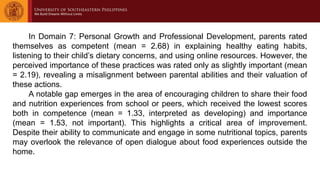
Domain 7: Personal Growth and Professional Development (Adapted)
MEA
MEAN
INTERPRETATION
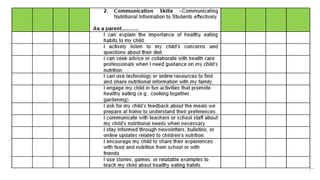
1.I can explain the importance of healthy
eating habits to my child.
2.73 Competent
2. I actively listen to my child's concerns
and questions about their diet.
2.87 Competent
3. I use stories, games, or relatable
examples to teach my child about healthy
eating habits.
2.6 Developing
4. . I encourage my child to share their
experiences with food and nutrition from
school or with friends.
33. Developing
5. I can use technology or online
resources to find and share nutritional
information with my family.
2.87
Competent
TOTAL MEAN
2.68
Important
Domain 7: Personal Growth and Professional Development (Adapted)
MEA
MEAN
INTERPRETATION
1.I can explain the importance of healthy
eating habits to my child.
2.27 Slightly important
2. I actively listen to my child's concerns
and questions about their diet.
2.53 Important
1. I use stories, games, or relatable
examples to teach my child about
healthy eating habits.
2.53 Important
1. . I encourage my child to share their
experiences with food and nutrition
from school or with friends.
1.53 Not Important
1. I can use technology or online
resources to find and share nutritional
information with my family.
2.07 Slightly
important
TOTAL MEAN
2
2.19 Slightly
important
In Domain 7: Personal Growth and Professional Development, parents rated
themselves as competent (mean = 2.68) in explaining healthy eating habits,
listening to their child’s dietary concerns, and using online resources. However, the
perceived importance of these practices was rated only as slightly important (mean
= 2.19), revealing a misalignment between parental abilities and their valuation of
these actions.
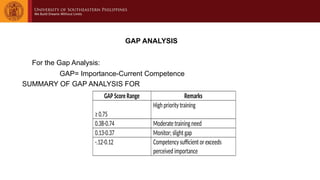
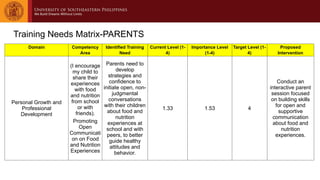
A notable gap emerges in the area of encouraging children to share their food
and nutrition experiences from school or peers, which received the lowest scores
both in competence (mean = 1.33, interpreted as developing) and importance
(mean = 1.53, not important). This highlights a critical area of improvement.
Despite their ability to communicate and engage in some nutritional topics, parents
may overlook the relevance of open dialogue about food experiences outside the
home.
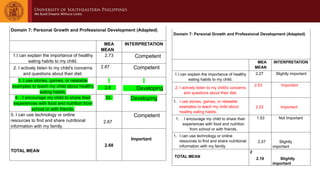
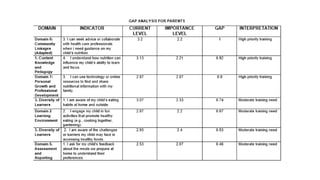
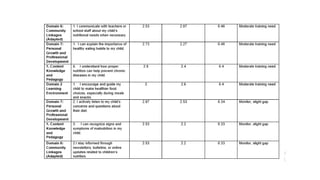
GAP ANALYSIS
For the Gap Analysis:
GAP= Importance-Current Competence
SUMMARY OF GAP ANALYSIS FOR
GAP Score Range Remarks
≥ 0.75
High priority training
0.38-0.74 Moderate training need
0.13-0.37 Monitor; slight gap
-.12-0.12 Competency sufficient or exceeds
perceived importance
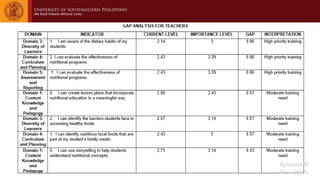
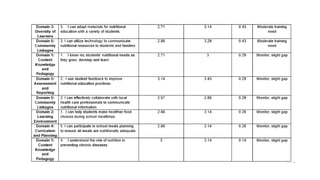
Based on the results of the Training Needs Analysis (TNA)
among teachers, the data reveal a diverse range of competency gaps
across various domains of the Philippine Professional Standards for
Teachers (PPST), particularly in the context of nutrition education. The
GAP score, calculated as the difference between the Importance Level
and Current Competency Level, provides a reliable basis for determining
the level of training need. Three indicators, each with a GAP score of
0.86, emerged as high-priority areas, primarily under Domains 3
(Diversity of Learners), 4 (Curriculum and Planning), and 5 (Assessment
and Reporting). These areas emphasize the teachers' limited capacity to
assess nutritional programs and understand the dietary needs of
learners, thus necessitating urgent and targeted capacity-building
interventions.
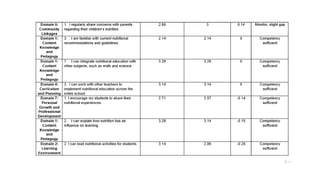
Furthermore, moderate training needs were identified in seven
indicators, with GAP scores ranging from 0.43 to 0.57. These indicators
cover competencies such as designing lesson plans with integrated
nutrition content, identifying nutrition-related barriers among students, and
adapting instructional materials. These findings suggest a need for focused
professional development to strengthen teachers' pedagogical and
contextual knowledge. Meanwhile, eight indicators exhibited slight
competency gaps, falling between 0.14 and 0.29. These are related to
collaboration with stakeholders, leveraging technology, and utilizing
student feedback, which may be addressed through coaching, monitoring,
or low-intensity training programs.
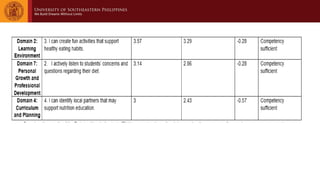
Notably, nine indicators revealed zero or negative GAP scores,
indicating that teachers perceive themselves to be sufficiently competent or
even exceeding expectations. These competencies involve integrating
nutrition with other subjects, engaging students in participatory learning,
and collaborating with local partners, areas that can serve as strengths for
peer mentoring or the development of professional learning communities
(PLCs). Overall, the analysis highlights the need for a differentiated
approach to professional development. Aligning with the principles of
evidence-based and competency-focused training (Guskey, 2002; OECD,
2020), these findings call for prioritizing high- and moderate-gap areas
while sustaining strengths through reflective practice and collaborative
learning environment.
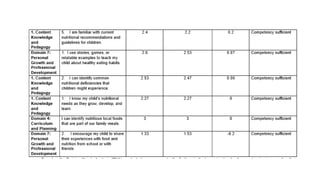
Based on the Training Needs Analysis (TNA) conducted among
parents, the findings indicate varying levels of competencies in promoting
their children's nutrition and supporting healthy eating behaviors at home.
The analysis utilized GAP scores, calculated as the difference between the
perceived importance level and current competency level for each indicator.
A holistic interpretation of the data reveals that several areas require
targeted support, while others show competency sufficiency. Three
indicators showed high-priority training needs with GAP scores ranging from
0.80 to 1.00. These are primarily under Domains 6 (Community Linkages), 7
(Personal Growth and Professional Development), and 1 (Content
Knowledge and Pedagogy), which indicate parents' limited capacity to
collaborate with healthcare professionals, utilize technology for nutrition
information, and understand how nutrition influences learning.
These results underscore the urgent need to design
capacity-building programs that empower parents with
knowledge and skills to support their children’s nutritional
development and academic performance. Meanwhile,
moderate training needs were evident in eight indicators, with
GAP scores between 0.40 and 0.74. These span across
Domains 2, 3, 5, 6, and 7, and reflect parents’ partial
awareness of eating habits, challenges in healthy food access,
and efforts in promoting nutritional practices through engaging
activities and family routines.
Finally, seven indicators revealed no gap or negative GAP scores, indicating
competency sufficiency. These are mostly clustered in Domain 1 (Content
Knowledge and Pedagogy) and Domain 7 (Personal Growth and Professional
Development), suggesting that parents already possess the required knowledge
in areas such as nutritional guidelines, recognizing deficiencies, and encouraging
food-related discussions with their children. These strengths can serve as a
foundation for peer-sharing or model parenting practices within school-community
initiatives.
Overall, the TNA results highlight the need for a differentiated and data-
driven approach to parent education. Training programs should prioritize critical
and moderate gaps, while maintaining strengths through community engagement,
reinforcement strategies, and family-centered nutrition education. This approach
aligns with contemporary principles of inclusive and participatory capacity-
building, ensuring that parents are effectively equipped to support the health and
learning outcomes of their children.
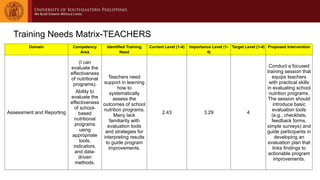
Training Needs Matrix-TEACHERS
Domain Competency
Area
Identified Training
Need
Current Level (1-4) Importance Level (1-
4)
Target Level (1-4) Proposed Intervention
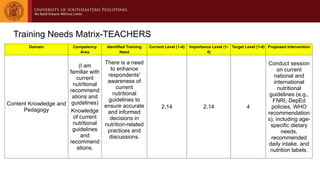
Content Knowledge and
Pedagogy
(I am
familiar with
current
nutritional
recommend
ations and
guidelines)
Knowledge
of current
nutritional
guidelines
and
recommend
ations.
There is a need
to enhance
respondents'
awareness of
current
nutritional
guidelines to
ensure accurate
and informed
decisions in
nutrition-related
practices and
discussions.
2.14 2.14 4
Conduct session
on current
national and
international
nutritional
guidelines (e.g.,
FNRI, DepEd
policies, WHO
recommendation
s), including age-
specific dietary
needs,
recommended
daily intake, and
nutrition labels.
Training Needs Matrix-TEACHERS
Domain Competency
Area
Identified Training
Need
Current Level (1-4) Importance Level (1-
4)
Target Level (1-4) Proposed Intervention
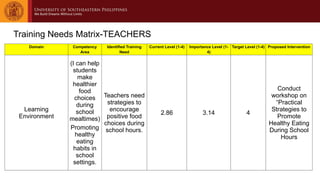
Learning
Environment
(I can help
students
make
healthier
food
choices
during
school
mealtimes)
Promoting
healthy
eating
habits in
school
settings.
Teachers need
strategies to
encourage
positive food
choices during
school hours.
2.86 3.14 4
Conduct
workshop on
“Practical
Strategies to
Promote
Healthy Eating
During School
Hours
Training Needs Matrix-TEACHERS
Domain Competency
Area
Identified Training
Need
Current Level (1-4) Importance Level (1-
4)
Target Level (1-4) Proposed Intervention
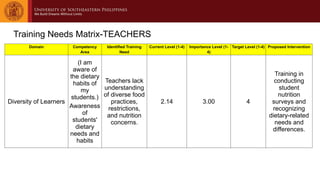
Diversity of Learners
(I am
aware of
the dietary
habits of
my
students.)
Awareness
of
students'
dietary
needs and
habits
Teachers lack
understanding
of diverse food
practices,
restrictions,
and nutrition
concerns.
2.14 3.00 4
Training in
conducting
student
nutrition
surveys and
recognizing
dietary-related
needs and
differences.
Training Needs Matrix-TEACHERS
Domain Competency
Area
Identified Training
Need
Current Level (1-4) Importance Level (1-
4)
Target Level (1-4) Proposed Intervention
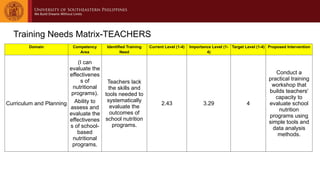
Curriculum and Planning
(I can
evaluate the
effectivenes
s of
nutritional
programs).
Ability to
assess and
evaluate the
effectivenes
s of school-
based
nutritional
programs.
Teachers lack
the skills and
tools needed to
systematically
evaluate the
outcomes of
school nutrition
programs.
2.43 3.29 4
Conduct a
practical training
workshop that
builds teachers'
capacity to
evaluate school
nutrition
programs using
simple tools and
data analysis
methods.
Training Needs Matrix-TEACHERS
Domain Competency
Area
Identified Training
Need
Current Level (1-4) Importance Level (1-
4)
Target Level (1-4) Proposed Intervention
Assessment and Reporting
(I can
evaluate the
effectiveness
of nutritional
programs).
Ability to
evaluate the
effectiveness
of school-
based
nutritional
programs
using
appropriate
tools,
indicators,
and data-
driven
methods.
Teachers need
support in learning
how to
systematically
assess the
outcomes of school
nutrition programs.
Many lack
familiarity with
evaluation tools
and strategies for
interpreting results
to guide program
improvements.
2.43 3.29 4
Conduct a focused
training session that
equips teachers
with practical skills
in evaluating school
nutrition programs.
The session should
introduce basic
evaluation tools
(e.g., checklists,
feedback forms,
simple surveys) and
guide participants in
developing an
evaluation plan that
links findings to
actionable program
improvements.
Training Needs Matrix-TEACHERS
Domain Competency
Area
Identified Training
Need
Current Level (1-4) Importance Level (1-
4)
Target Level (1-4) Proposed Intervention
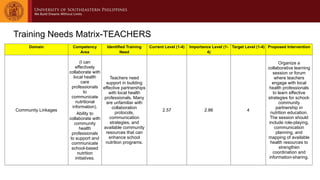
Community Linkages
(I can
effectively
collaborate with
local health
care
professionals
to
communicate
nutritional
information).
Ability to
collaborate with
community
health
professionals
to support and
communicate
school-based
nutrition
initiatives.
Teachers need
support in building
effective partnerships
with local health
professionals. Many
are unfamiliar with
collaboration
protocols,
communication
strategies, and
available community
resources that can
enhance school
nutrition programs.
2.57 2.86 4
Organize a
collaborative learning
session or forum
where teachers
engage with local
health professionals
to learn effective
strategies for school-
community
partnership in
nutrition education.
The session should
include role-playing,
communication
planning, and
mapping of available
health resources to
strengthen
coordination and
information-sharing.
Training Needs Matrix-TEACHERS
Domain Competency
Area
Identified Training
Need
Current Level (1-4) Importance Level (1-
4)
Target Level (1-4) Proposed Intervention
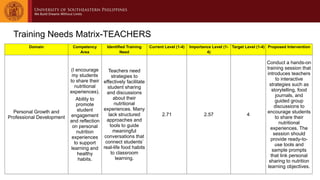
Personal Growth and
Professional Development
(I encourage
my students
to share their
nutritional
experiences).
Ability to
promote
student
engagement
and reflection
on personal
nutrition
experiences
to support
learning and
healthy
habits.
Teachers need
strategies to
effectively facilitate
student sharing
and discussions
about their
nutritional
experiences. Many
lack structured
approaches and
tools to guide
meaningful
conversations that
connect students’
real-life food habits
to classroom
learning.
2.71 2.57 4
Conduct a hands-on
training session that
introduces teachers
to interactive
strategies such as
storytelling, food
journals, and
guided group
discussions to
encourage students
to share their
nutritional
experiences. The
session should
provide ready-to-
use tools and
sample prompts
that link personal
sharing to nutrition
learning objectives.
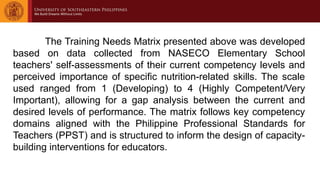
The Training Needs Matrix presented above was developed
based on data collected from NASECO Elementary School
teachers' self-assessments of their current competency levels and
perceived importance of specific nutrition-related skills. The scale
used ranged from 1 (Developing) to 4 (Highly Competent/Very
Important), allowing for a gap analysis between the current and
desired levels of performance. The matrix follows key competency
domains aligned with the Philippine Professional Standards for
Teachers (PPST) and is structured to inform the design of capacity-
building interventions for educators.
The first identified gap lies in teachers' knowledge of current
nutritional guidelines and recommendations, such as those issued by
FNRI, WHO, and DepEd. Teachers rated themselves at a mean
competency level of 2.14, which reflects a Developing status. Notably, the
same score was recorded for the importance level, indicating an
underappreciation of the role this knowledge plays in classroom practice.
However, expert consensus and curriculum frameworks support its critical
role in shaping accurate and meaningful nutrition education. Therefore, a
session on national and international guidelines is proposed to address
this foundational gap, improve confidence, and correct misconceptions.
In the area of promoting healthy eating habits in school
settings, teachers scored a competency level of 2.86
(Competent), with an importance rating of 3.14, suggesting a
moderate discrepancy. While teachers perceive themselves as
fairly capable, the increased importance rating indicates that this
is a priority area for instructional support. A workshop focused on
“Practical Strategies to Promote Healthy Eating During School
Hours” is recommended to reinforce skills in influencing student
food choices, especially during key mealtimes such as recess
and lunch breaks.
Teachers’ ability to address the dietary habits and
needs of diverse learners was rated 2.14 (Developing) in
competence, with an importance rating of 3.00 (Important).
This reflects a critical gap, particularly given the rising
nutritional concerns among learners and the diversity of food
restrictions (religious, cultural, or medical) in schools. To
bridge this gap, training on conducting student nutrition
surveys and recognizing dietary-related needs is proposed.
Such training would equip teachers with culturally responsive
practices and tools for inclusive nutrition education.
The competency of evaluating the effectiveness
of nutritional programs was also marked Developing
(2.43), with a notably high importance rating of 3.29.
Teachers highlighted the need for tools and skills to
systematically assess nutrition programs implemented
in schools, such as feeding programs or awareness
campaigns. A practical training workshop on evaluation
skills is recommended, focusing on indicator
development, data collection, and analysis.
Closely related to the previous domain, teachers also
indicated a need for support in assessment and reporting of
nutrition program outcomes. With both the competence and
importance levels matching those in Domain 4 (2.43 and 3.29,
respectively), this reaffirms the criticality of equipping
educators with basic monitoring and evaluation (M&E) skills. A
focused training session is proposed, offering hands-on
exposure to evaluation tools such as checklists, feedback
forms, and surveys, as well as guidance on linking data to
actionable improvements.
Teachers scored 2.57 (Developing to Competent) in
their ability to collaborate with local health professionals, with
an importance level of 2.86, signaling a modest yet notable
gap. Given the relevance of community partnerships in
promoting learner well-being, this finding supports the need
for a collaborative learning forum that brings together
educators and health professionals. This session would
focus on communication strategies, coordination protocols,
and identification of local nutrition resources to support
school-based initiatives.
Lastly, the domain of promoting student engagement
through reflection on nutrition experiences revealed a slight
gap, with a competence level of 2.71 and an importance level
of 2.57. While the importance level is somewhat lower than
others, the competency score still suggests room for
improvement. A hands-on training session that introduces
interactive methods such as storytelling, food journals, and
guided sharing prompts is proposed to help teachers create
opportunities for meaningful learner reflection
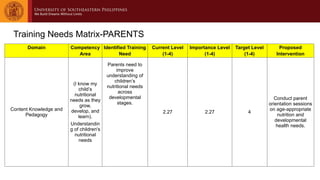
Training Needs Matrix-PARENTS
Domain Competency
Area
Identified Training
Need
Current Level
(1-4)
Importance Level
(1-4)
Target Level
(1-4)
Proposed
Intervention
Content Knowledge and
Pedagogy
(I know my
child’s
nutritional
needs as they
grow,
develop, and
learn).
Understandin
g of children's
nutritional
needs
Parents need to
improve
understanding of
children’s
nutritional needs
across
developmental
stages.
2.27 2.27 4
Conduct parent
orientation sessions
on age-appropriate
nutrition and
developmental
health needs.
Training Needs Matrix-PARENTS
Domain Competency
Area
Identified Training
Need
Current Level
(1-4)
Importance Level
(1-4)
Target Level
(1-4)
Proposed
Intervention
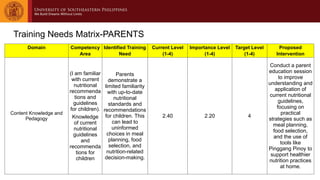
Content Knowledge and
Pedagogy
(I am familiar
with current
nutritional
recommenda
tions and
guidelines
for children).
Knowledge
of current
nutritional
guidelines
and
recommenda
tions for
children
Parents
demonstrate a
limited familiarity
with up-to-date
nutritional
standards and
recommendations
for children. This
can lead to
uninformed
choices in meal
planning, food
selection, and
nutrition-related
decision-making.
2.40 2.20 4
Conduct a parent
education session
to improve
understanding and
application of
current nutritional
guidelines,
focusing on
practical
strategies such as
meal planning,
food selection,
and the use of
tools like
Pinggang Pinoy to
support healthier
nutrition practices
at home.
Training Needs Matrix-PARENTS
Domain Competency
Area
Identified Training
Need
Current Level (1-
4)
Importance Level
(1-4)
Target Level (1-
4)
Proposed
Intervention
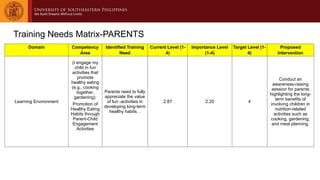
Learning Environment
(I engage my
child in fun
activities that
promote
healthy eating
(e.g., cooking
together,
gardening).
Promotion of
Healthy Eating
Habits through
Parent-Child
Engagement
Activities
Parents need to fully
appreciate the value
of fun -activities in
developing long-term
healthy habits. .
2.87 2.20 4
Conduct an
awareness-raising
session for parents
highlighting the long-
term benefits of
involving children in
nutrition-related
activities such as
cooking, gardening,
and meal planning.
Training Needs Matrix-PARENTS
Domain Competency
Area
Identified Training
Need
Current Level (1-
4)
Importance Level
(1-4)
Target Level (1-
4)
Proposed
Intervention
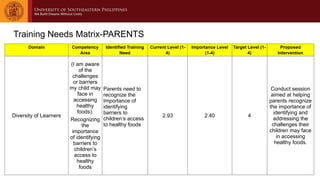
Diversity of Learners
(I am aware
of the
challenges
or barriers
my child may
face in
accessing
healthy
foods).
Recognizing
the
importance
of identifying
barriers to
children’s
access to
healthy
foods
Parents need to
recognize the
Importance of
identifying
barriers to
children’s access
to healthy foods
2.93 2.40 4
Conduct session
aimed at helping
parents recognize
the importance of
identifying and
addressing the
challenges their
children may face
in accessing
healthy foods.
Training Needs Matrix-PARENTS
Domain Competency
Area
Identified Training
Need
Current Level (1-
4)
Importance Level
(1-4)
Target Level (1-
4)
Proposed
Intervention
Diversity of Learners
(I am aware
of the
challenges
or barriers
my child may
face in
accessing
healthy
foods).
Recognizing
the
importance
of identifying
barriers to
children’s
access to
healthy
foods
Parents need to
recognize the
Importance of
identifying
barriers to
children’s access
to healthy foods
2.93 2.40 4
Conduct session
aimed at helping
parents recognize
the importance of
identifying and
addressing the
challenges their
children may face
in accessing
healthy foods.
Training Needs Matrix-PARENTS
Domain Competency
Area
Identified Training
Need
Current Level (1-
4)
Importance Level
(1-4)
Target Level (1-
4)
Proposed
Intervention
Assessment and Reporting
(I ask for my
child’s
feedback
about the
meals we
prepare at
home to
understand
their
preferences).
Encouraging
child
participation
in Meal
Planning and
feedback for
healthy eating
Parents need to
enhance
awareness in
involving children in
Meal Planning and
Feedback for
Healthy Eating
2.53 2.07 4
Conduct awareness
session on nutrition
that emphasizes the
importance of
involving children in
meal-related
decisions
Training Needs Matrix-PARENTS
Domain Competency
Area
Identified Training
Need
Current Level (1-
4)
Importance Level
(1-4)
Target Level (1-
4)
Proposed
Intervention
Community Linkages
(I
communicate
with teachers
or school staff
about my
child’s
nutritional
needs when
necessary).
Recognizing
the
importance of
Home-School
collaboration
in supporting
children’s
nutritional
needs
Parents need to
enhance
awareness of the
home-school
collaboration on
children’s
nutritional
outcomes and
academic
performance
2.53 2.07 4
Conduct a
workshop designed
to enhance parents’
awareness of the
vital role of home-
school collaboration
in supporting
children’s nutritional
outcomes and
academic
performance
Training Needs Matrix-PARENTS
Domain Competency
Area
Identified Training
Need
Current Level (1-
4)
Importance Level
(1-4)
Target Level (1-
4)
Proposed
Intervention
Personal Growth and
Professional
Development
(I encourage
my child to
share their
experiences
with food
and nutrition
from school
or with
friends).
Promoting
Open
Communicati
on on Food
and Nutrition
Experiences
Parents need to
develop
strategies and
confidence to
initiate open, non-
judgmental
conversations
with their children
about food and
nutrition
experiences at
school and with
peers, to better
guide healthy
attitudes and
behavior.
1.33 1.53 4
Conduct an
interactive parent
session focused
on building skills
for open and
supportive
communication
about food and
nutrition
experiences.
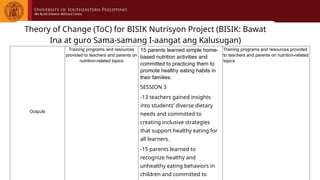
Theory of Change (ToC) for BISIK Nutrisyon Project (BISIK: Bawat
Ina at guro Sama-samang I-aangat ang Kalusugan)
Level Description Indicators Means of Verification
Impact Long-term improvement in student
nutrition and well-being
- Decrease in student malnutrition rate -School health records
- Nutrition and academic performance
reports
Outcomes
Increased knowledge and
engagement of teachers and
parents in promoting student
nutrition
- 80% of teachers demonstrate improved
integration of nutrition in lessons
- 75% of parents apply healthy eating
practices at home
Increased knowledge and engagement of
teachers and parents in promoting student
nutrition
Outputs
Training programs and resources
provided to teachers and parents on
nutrition-related topics
SESSION 1
- 13 teachers can design a lesson
that meet curriculum goals while
promoting healthy eating habits
for students’ holistic
Training programs and resources provided
to teachers and parents on nutrition-related
topics
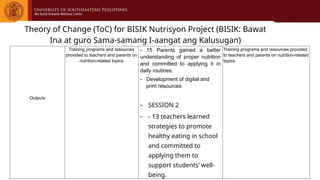
Theory of Change (ToC) for BISIK Nutrisyon Project (BISIK: Bawat
Ina at guro Sama-samang I-aangat ang Kalusugan)
Outputs
Training programs and resources
provided to teachers and parents on
nutrition-related topics
- 15 Parents gained a better
understanding of proper nutrition
and committed to applying it in
daily routines.
- Development of digital and
print resources
- SESSION 2
- - 13 teachers learned
strategies to promote
healthy eating in school
and committed to
applying them to
support students’ well-
being.
Training programs and resources provided
to teachers and parents on nutrition-related
topics
Theory of Change (ToC) for BISIK Nutrisyon Project (BISIK: Bawat
Ina at guro Sama-samang I-aangat ang Kalusugan)
Outputs
Training programs and resources
provided to teachers and parents on
nutrition-related topics
15 parents learned simple home-
based nutrition activities and
committed to practicing them to
promote healthy eating habits in
their families.
SESSION 3
-13 teachers gained insights
into students’ diverse dietary
needs and committed to
creating inclusive strategies
that support healthy eating for
all learners.
-15 parents learned to
recognize healthy and
unhealthy eating behaviors in
children and committed to
Training programs and resources provided
to teachers and parents on nutrition-related
topics
Theory of Change (ToC) for BISIK Nutrisyon Project (BISIK: Bawat
Ina at guro Sama-samang I-aangat ang Kalusugan)
Outputs
Training programs and resources
provided to teachers and parents on
nutrition-related topics
SESSION 4
- parents and teachers co-
planned nutrition initiatives to
promote healthy eating at home
and in school.
SESSION 5
- parents and teachers engaged
in a mock dialogue to enhance
communication strategies for
promoting proper nutrition among
students.
Training programs and resources provided
to teachers and parents on nutrition-related
topics
Theory of Change (ToC) for BISIK Nutrisyon Project (BISIK: Bawat
Ina at guro Sama-samang I-aangat ang Kalusugan)
Outputs
Training programs and resources
provided to teachers and parents on
nutrition-related topics
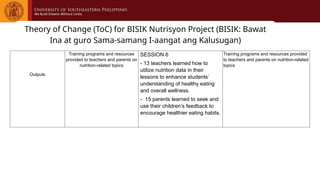
SESSION 6
- 13 teachers learned how to
utilize nutrition data in their
lessons to enhance students’
understanding of healthy eating
and overall wellness.
- 15 parents learned to seek and
use their children’s feedback to
encourage healthier eating habits.
Training programs and resources provided
to teachers and parents on nutrition-related
topics
Theory of Change (ToC) for BISIK Nutrisyon Project (BISIK: Bawat
Ina at guro Sama-samang I-aangat ang Kalusugan)
Outputs
Training programs and resources
provided to teachers and parents on
nutrition-related topics
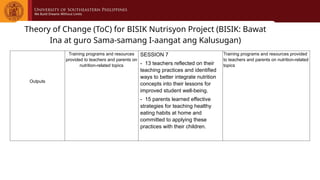
SESSION 7
- 13 teachers reflected on their
teaching practices and identified
ways to better integrate nutrition
concepts into their lessons for
improved student well-being.
- 15 parents learned effective
strategies for teaching healthy
eating habits at home and
committed to applying these
practices with their children.
Training programs and resources provided
to teachers and parents on nutrition-related
topics
Theory of Change (ToC) for BISIK Nutrisyon Project (BISIK: Bawat
Ina at guro Sama-samang I-aangat ang Kalusugan)
Outputs
Training programs and resources
provided to teachers and parents on
nutrition-related topics
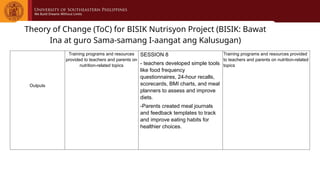
SESSION 8
- teachers developed simple tools
like food frequency
questionnaires, 24-hour recalls,
scorecards, BMI charts, and meal
planners to assess and improve
diets.
-Parents created meal journals
and feedback templates to track
and improve eating habits for
healthier choices.
Training programs and resources provided
to teachers and parents on nutrition-related
topics
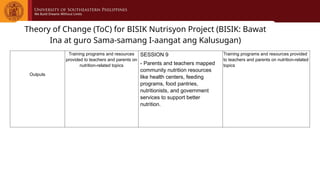
Theory of Change (ToC) for BISIK Nutrisyon Project (BISIK: Bawat
Ina at guro Sama-samang I-aangat ang Kalusugan)
Outputs
Training programs and resources
provided to teachers and parents on
nutrition-related topics
SESSION 9
- Parents and teachers mapped
community nutrition resources
like health centers, feeding
programs, food pantries,
nutritionists, and government
services to support better
nutrition.
Training programs and resources provided
to teachers and parents on nutrition-related
topics
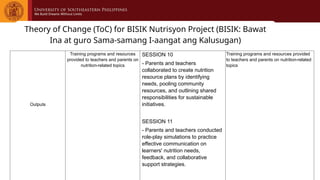
Theory of Change (ToC) for BISIK Nutrisyon Project (BISIK: Bawat
Ina at guro Sama-samang I-aangat ang Kalusugan)
Outputs
Training programs and resources
provided to teachers and parents on
nutrition-related topics
SESSION 10
- Parents and teachers
collaborated to create nutrition
resource plans by identifying
needs, pooling community
resources, and outlining shared
responsibilities for sustainable
initiatives.
SESSION 11
- Parents and teachers conducted
role-play simulations to practice
effective communication on
learners' nutrition needs,
feedback, and collaborative
support strategies.
Training programs and resources provided
to teachers and parents on nutrition-related
topics
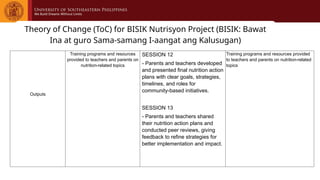
Theory of Change (ToC) for BISIK Nutrisyon Project (BISIK: Bawat
Ina at guro Sama-samang I-aangat ang Kalusugan)
Outputs
Training programs and resources
provided to teachers and parents on
nutrition-related topics
SESSION 12
- Parents and teachers developed
and presented final nutrition action
plans with clear goals, strategies,
timelines, and roles for
community-based initiatives.
SESSION 13
- Parents and teachers shared
their nutrition action plans and
conducted peer reviews, giving
feedback to refine strategies for
better implementation and impact.
Training programs and resources provided
to teachers and parents on nutrition-related
topics
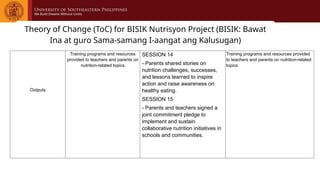
Theory of Change (ToC) for BISIK Nutrisyon Project (BISIK: Bawat
Ina at guro Sama-samang I-aangat ang Kalusugan)
Outputs
Training programs and resources
provided to teachers and parents on
nutrition-related topics
SESSION 14
- Parents shared stories on
nutrition challenges, successes,
and lessons learned to inspire
action and raise awareness on
healthy eating.
SESSION 15
- Parents and teachers signed a
joint commitment pledge to
implement and sustain
collaborative nutrition initiatives in
schools and communities.
Training programs and resources provided
to teachers and parents on nutrition-related
topics
TRAINING DESIGN
BISIK Nutrisyon Project(BISIK:
Bawat Ina at guro Sama-samang
I-aangat ang Kalusugan)
In line with Sustainable Development Goal (SDG) 2-
Zero Hunger; the Philippine Education recognizes
malnutrition not only as a health issue but also as a social
and academic concern. Learners who are undernourished
are at a disadvantage in terms of school performance,
cognitive development, and long-term productivity. Despite
government efforts to improve nutrition outcomes, there are
still a significant number of under-nourished school-aged
children across the Philippines.
RATIONALE
For instance, there was a 2021 Expanded National Nutrition
Survey (FNRI-DOST, 2022) showing that 26.7% of children aged 5
to 10 are stunted, while 25.5% are underweight. This highlights
the significant need for responsive measures at the community
and educational level. While the School-Based Feeding Program
(SBFP) as mandated by DepEd Order No. 13, s. 2017 and other
nutrition-sensitive initiatives under the Philippine Plan of Action for
Nutrition (PPAN) 2023–2028 provide a strong policy foundation,
the effectiveness of these programs centers largely on the
capabilities and collaboration of teachers and parents.
RATIONALE
Based on the results of the Training Needs Assessment (TNA),
teachers demonstrated low competency levels in several domains related to
nutrition education. In Domain 2, Learning Environment, teachers showed
limited awareness of their students' dietary habits and had difficulty leading
school-based nutritional activities. In Domain 3, Diversity of Learners, they
lacked sufficient understanding of how students' diverse backgrounds
influence their eating habits. In Domain 4, Curriculum and Planning, teachers
faced challenges in identifying nutritious local foods commonly included in
students’ family meals, evaluating the effectiveness of nutrition-related
programs, and recognizing potential local partners to support nutrition
education. In Domain 5, Assessment and Reporting, many teachers were
unsure how to assess the success of existing nutrition initiatives. In Domain
6, Community Linkages, teachers struggled to collaborate effectively with
local health professionals to share nutritional information with students.
Lastly, in Domain 7, Personal Growth and Professional Development, teachers
needed support in encouraging students to reflect on and share their personal nutrition
experiences.
Despite these gaps, teachers recognized the high level of importance of nutrition-related
competencies across all domains. In Domain 1: Content Knowledge and Pedagogy, they
emphasized the importance of designing lesson plans that meaningfully incorporate nutrition
education and integrating it with other subjects such as math and science. In Domain 2, they
valued the ability to create engaging and enjoyable activities that promote healthy eating
habits. In Domain 3, teachers recognized the need to identify barriers that limit students’
access to healthy foods. For Domain 4, evaluating the impact and effectiveness of nutritional
programs was viewed as essential. In Domain 5, the importance of using student feedback to
improve teaching strategies on nutrition was strongly highlighted. In Domain 6, teachers
acknowledged the need to utilize digital tools to share nutritional resources with students and
families. Finally, in Domain 7, they underscored the importance of actively listening to
students’ concerns about their diets as part of their ongoing professional development.
Malnourished children often struggle with concentration,
experience fatigue, and are prone to illness, all of which hinder
their capacity to learn and thrive in the classroom. These
realities not only affect individual learners but also impact the
broader educational goals of the school and community.
Training programs are therefore essential in building the
competencies of educators to integrate nutrition-sensitive
strategies into teaching practices, and in equipping parents
with practical knowledge on proper feeding and care using
available local resources.
Especially, such training fosters a shared responsibility between home
and school in addressing malnutrition, promoting child well-being, and
sustaining culturally responsive interventions such as school gardens,
feeding initiatives, and health monitoring systems. By bridging the
knowledge and practice gaps identified in the TNA, this intervention will not
only improve the nutritional status of learners but also enhance their
readiness to learn and their opportunity to succeed academically.
There is a need to provide training because teachers see nutrition
education as important but lack the skills to apply it. They struggle with
planning lessons, identifying healthy local foods, assessing nutrition
programs, and working with health partners. Training will help them build
the knowledge and confidence to teach nutrition effectively and support
students’ health, especially in communities with high rates of malnutrition.
Further, the Training Needs Assessment (TNA) performed at
NASECO Elementary School revealed that many teachers are not
confident in recognizing symptoms of malnutrition, how to integrate
nutrition issues within the curriculum or how to implement child centered
wellness practices. Teachers know their role involves holistic development
but indicated they also need more training and confidence in implementing
this role. At the same time, parents, especially caregivers of
undernourished children, expressed a strong interest in improving their
knowledge of child nutrition, food preparation, and utilizing local food
resources but did not have access to formal structured support, nor
collaborative opportunities for other caregivers experiencing similar
challenges.
As a result, this training program entitled " BISIK Nutrisyon Project (BISIK:
Bawat Ina at guro Sama-samang I-aangat ang Kalusugan)", is developed as an
integrated and participatory response to both teacher and parent perspectives. The
training intends to cultivate teacher leadership in nutrition education and empower
parents to harness their skills in providing nutritious food for their children. It will
also create systems of cooperation such as feedback loops, collaborative planning,
and community-initiated nutrition activities, and begin the process of formalizing
partnerships across agencies that sustain learner health and educational
achievement. This training will run for four (4) weeks, scheduled for every Saturday,
to ensure consistent participation while accommodating the regular responsibilities
of teachers and parents. A total of thirteen (13) sessions is included in the training,
with Day 1 and Day 2 dedicated to teachers only, while the third Saturday (Day 3)
involves both teachers and parents in joint activities.
As the PPST guides teachers' development and in line with
the DepEd’s MATATAG strategy which emphasizes the welfare of
learners, the training will employ participatory, experiential, and
punctuated methods such as plenary talks, co-planning, gardening,
and cooking exhibitions for learners and guardians. These methods
are not only intended to build competencies but are intended to
support trust, common accountability, and a caring culture across
school and home contexts.
Ultimately, this initiative reframes the fight against malnutrition as a
collective and community-owned mission where schools, families,
and local partners work together to ensure that no child is left
behind in health, dignity, or educational opportunity.
OBJECTIVES
1. By the end of Week 1, 100% of teacher and parent participants will be
able to identify at least three national and international nutritional
guidelines (e.g., FNRI, Pinggang Pinoy, WHO) and explain how these
can be applied in the classroom and at home, as measured by a short
quiz or practical sharing activity.
2. Within Week 2, teacher and parent participants will demonstrate at least
two strategies for promoting healthy eating habits during school and home
mealtimes through workshop sessions.
OBJECTIVES
3. By the end of Week 2, participants will be able to list common dietary
challenges learners face and propose one context-specific solution to
promote inclusive and equitable nutrition, based on role-play or situational
tasks.
4. By the end of Week 3, 80% of teacher participants will design a simple
nutrition program evaluation tool (e.g., checklist, feedback form), and 80%
of parents will describe how they plan to involve their children in meal
feedback and food choices, evaluated through submitted outputs.
OBJECTIVES
5. By Week 4, teacher and parent participants will identify at least two
local health resources or stakeholders they can collaborate with to
improve nutrition education and services, as evidenced by a community
resource mapping output or action plan.
6. By the conclusion of the training, all participants will demonstrate how
to facilitate reflective conversations on nutrition experiences with
children/students by sharing at least one concrete communication strategy
during the action planning session.
PARTICIPANTS
- NASECO Elementary School Teachers - 13
- NASECO Elementary School Select Parents - 15
- MAED 207 Students - Department of Education Teachers - 33
PARTICIPANTS
- NASECO Elementary School Teachers - 13
- NASECO Elementary School Select Parents - 15
- MAED 207 Students - Department of Education Teachers - 33
Tentative Total Number of Participants – 61
METHODOLOGY
To achieve the expected outputs, the following methods will be employed:
1. Plenary Talk
2. Open Forum
3. Workshops
Materials and Equipment
a) Programme
b) Laptop
c) PPT Presentations
d) Venue
e) Projector and Projector Board/Screen
f) Cooking Materials and Ingredients
Monitoring and Evaluation Plan
The success of the training program BISIK Nutrisyon Project(BISIK: Bawat Ina at
guro Sama-samang I-aangat ang Kalusugan) " will be monitored and evaluated
using both formative and summative strategies to ensure that the training objectives
are met, feedback is gathered, and sustainable follow-up actions are encouraged.
Activity Method Responsible Person Timeline
Pre-training Coordination Meeting Briefing with facilitators, review of
program flow and logistics
MAED 207 Students & Professor 1 day before the training
Attendance Monitoring Attendance sheets signed at start of
each session
MAED 207 Students Start of each session
Observation of Participation Use of observation checklist to assess
participant engagement.
Assigned Observers (MAED 207
Students)
Throughout the sessions
Session Checkpoints Use of reflection prompts, open forum
questions, and workshop outputs
Resource Speakers &
Facilitators
End of each session
Monitoring Activities (Before and During the Training)
Activity Method Responsible Person Timeline
Post-Session Quiz /
Reflection
Short written quiz and
reflection aligned with
session objectives
MAED 207 Students Immediately after each
session
Workshop Output
Evaluation
Review of group work
(meal plans,) against
rubric
Facilitators End of Every Session
Feedback Form /
Evaluation
Sheet
Participant feedback on
training relevance,
delivery, content, and
10 logistics
MAED 207 Students After the closing
program
Evaluation Activities (After the Training)
Sustainability and Follow-Up Plan
to ensure that the training program creates lasting impact and drives
long-term improvements in addressing malnutrition, he following
sustainability and follow-up strategies will be implemented:
1. Post-Training Action Plans
• Teachers and parent participants will be encouraged to
collaboratively draft simple action plans (e.g., school-based
gardening, meal preparation guides nutrition talks
• These plans will be submitted to the School Head and reviewed
monthly during PTA or staff meetings.
2. Integration in School Activities
• Teachers will integrate key learnings on
nutrition into their classroom instruction,
especially in Science, Araling Panlipunan, and
EPP subjects.
• Parents will be encouraged to practice and
share local, healthy, and affordable food practices
during school events such as Nutrition Month.
3. Formation of a School Nutrition Task Group
• A task group composed of select teachers,
parents, and a school health coordinator will be
established to monitor the progress of nutrition-
related initiatives.
• This group will spearhead quarterly community
activities, such as cooking demos, feeding
programs, and gardening showcases.
4. Continuous Support and Coaching
• MAED 207 students, as part of their practicum or
course extension, may conduct periodic follow-ups
(virtual or face-to-face) to provide technical assistance,
coaching, or mini-workshops as needed.
• Ongoing peer coaching among teachers will be
encouraged to support integration of nutrition topics
across learning areas.
5. Monitoring Progress
• Follow-up surveys will be conducted 1–2 months after the
training to assess:
o Implementation of home or school-based nutrition activities
o Challenges encountered
o Additional support needed
• School leadership will track improvement through
attendance, health records, and student performance
indicators.
6. Partnership Strengthening
• Strengthen ties with local health units
(Barangay Health Workers, Municipal Health
Office) and agricultural partners (DA, local
farmers) for possible technical or material support
(e.g., seedlings, food packs).

INDICATIVE PROGRAM
Week 1- July 26, 2025
TNA_Presentation-1-Final(SAVE)) (1).pptx

TNA_Presentation-1-Final(SAVE)) (1).pptx

  • 1.
    Group 2 Salubre, YvonneS. Toriaga, Ernest P. Milana, Jona Marie A. Regidor, Jonna U. Paňa, Jovelyn S. Yeke, Kathleen Anne M. Salinas, Kimberly M. Salado, Lea D. Linao, Rendy Boy C. Venus, Shiena Mae P.
  • 2.
    Cristuta et al.(2019) emphasized that proper nutrition is essential for students' academic success. With over 1.8 million undernourished Filipino pupils reported in 2019, and the Philippines ranking among the lowest in international assessments, their review found that 6 out of 10 studies confirmed a significant link between good nutrition and improved academic performance. Based on the data from NASECO Integrated School Nutritional Status the school exhibits a high malnutrition rate among learners. This concerning trend prompted the conduct of a Training Needs Assessment (TNA) to identify gaps in knowledge, skills, and practices related to nutrition. The results will inform the development of targeted interventions to address the issue and promote the overall well-being of students.
  • 3.
    Wasted Severely WastedPercentage Kinder 3 2 6.85% Grade 1 5 7 16.44% Grade 2 4 4 10.96% Grade 3 6 1 9.59% Grade 4 1 5 8.22% Grade 5 3 1 5.48% Grade 6 1 2 4.11% Grade7 2 7 12.33% Grade 8 3 6 12.33% Grade 9 3 0 4.11% Grade 10 3 2 6.85% Grade 11 1 1 2.74% Grade 12 0 0 0.00% Nutritional Status of School
  • 4.
    Based on thenutritional status report of school, Grade 1 has the highest percentage of malnourished learners, making up 16.44% of all reported cases. Grade 7 and Grade 8 follow, each with 12.33%. Grade 2 has 10.96%, while Grade 3 accounts for 9.59%. Grade 4 shows 8.22%, and Kinder and Grade 10 both have 6.85%. The lower percentages appear in Grade 5 (5.48%), Grade 6 and Grade 9 (both at 4.11%), and Grade 11 with only 2.74%. Grade 12 has 0%, meaning no reported cases. This shows that younger learners and those in early high school are more affected, and may need more focused nutrition support in the school program.
  • 6.
  • 7.
    The study bySharma et al. (2013) is our training needs assessment because it assessed teachers’ knowledge, attitudes, and behaviors related to nutrition. It showed that many teachers lacked nutrition knowledge even though they knew it was important. This supports our inclusion of Knowledge of Nutrition as a core competency. The study also implies the need for strong Communication Skills, as teachers must explain healthy eating to students and families. Lastly, it highlights the importance of Program Planning, since the authors recommend professional development and structured nutrition programs for teachers. Sharma, S., Dortch, K. S., Byrd-Williams, C., Truxillio, J. B., Rahman, G. A., Bonsu, P., & Hoelscher, D. (2013). Nutrition-related knowledge, attitudes, and dietary behaviors among Head Start teachers in Texas: A cross-sectional study.
  • 8.
    Dear Respondents: The purposeof this survey is to identify the training needs of teachers and parents addressing student malnutrition in an educational setting. This information will allow for the development of training programs to improve the ability of teachers and parents to deal with the issues of malnutrition and encourage students to engage in healthy eating behavior. Please answer the following questions honestly based on your own observations, experiences and/or information related to your current competencies and needs, the survey will take between 30 to 45 minutes of your time. All your responses will be kept strictly confidential and will not be used to assess your performance. Your feedback is important for us in creating appropriate and practical capacity building activities for teachers. Thank you for your time and participation! Demographic Data Name(optional): _____________________ Position/Designation:_______________ Section/Division:___ No. of years in current position: ___ No. of training/programs/seminars attended for the past two years:__________
  • 9.
    Current Level: 1 =Not Competent (Very limited or no knowledge/skills-cannot perform tasks without full supervision or assistance) 2 = Developing (Basic awareness or partial skill level- needs improvement and guidance to perform task) 3 = Competent (Adequate knowledge and skill- can perform task independently and meet standards) 4 = Highly Competent (Advance knowledge and skill; mastery level-can perform tasks excellently and even mentor others) Importance Level: 1 = Not Important- Rarely required for your role 2 = Slightly Important- Occasionally applied (10%-40% of the time) 3 = Important-Regularly applied (40%-60% of the time) 4 = Very Important- Essential to job success (60%-90% of the time) Instructions: Put a check mark (/) on the appropriate box indicating both your knowledge/competency level (kaalaman/kakayanan) on the list of competencies specified in the left corner of the table below and its importance to your job. Definitions of Scales
  • 15.
    Minahal nga mgaRespondente: Ang katuyoan sa kini nga survey mao ang pag-ila sa mga panginahanglanon sa pagbansay sa mga magtutudlo ug mga ginikanan nga nagtubag sa malnutrisyon sa estudyante sa usa ka kahimtang sa edukasyon. Kini nga impormasyon magtugot alang sa pagpalambo sa mga programa sa pagbansay aron sa pagpalambo sa abilidad sa mga magtutudlo ug mga ginikanan sa pag-atubang sa mga isyu sa malnutrisyon ug pagdasig sa mga estudyante sa paghimo sa himsog nga pamatasan sa pagkaon. Palihog tubaga ang mosunod nga mga pangutana nga matinud-anon base sa imong kaugalingong mga obserbasyon, mga kasinatian ug/o impormasyon nga may kalabutan sa imong kasamtangan nga mga kahanas ug mga panginahanglan, ang survey molungtad tali sa 30 ngadto sa 45 ka minuto sa imong oras. Ang tanan nimong mga tubag tipigan nga kompidensyal ug dili gamiton sa pagsusi sa imong pasundayag. Ang imong feedback importante alang kanamo sa paghimo og angay ug praktikal nga mga kalihokan sa pagpatubo sa kapasidad para sa mga magtutudlo. Salamat sa imong oras ug partisipasyon!
  • 16.
    Kasamtangang lebel: 1 =Patas (limitado nga kahibalo) 2 = Maayo (Basic Knowledge) 3 = Mas Maayo (Taas nga kahibalo nga makatabang / magdumala sa uban) 4 = Maayo kaayo (mahimong magtudlo ug/o maghimo) Kahinungdanon nga lebel: 1 = Ubos (dili kinahanglan karon) 2 = Kasarangan (gikinahanglan gikan sa 10-40% sa panahon) 3 = Taas (gikinahanglan gikan sa 40-60% sa panahon) 4 = Kritikal (gikinahanglan gikan sa 60- 90% sa panahon) Demograpiko nga Data Ngalan(opsyonal):_____________________ Posisyon/Designasyon:_______________ Seksyon/Dibisyon:___ Gidaghanon sa mga tuig sa kasamtangang posisyon: ___ Numero sa pagbansay/programa/seminar nga gitambongan sa miaging duha ka tuig:__________ Instruksyon: Butangi ug tsek (/) ang angay nga kahon nga nagpakita sa imong kahibalo/kabatid nga lebel (kaalaman/kakayanan) sa listahan sa mga katakos nga gipiho sa wala nga suok sa lamesa sa ubos ug ang importansya niini sa imong trabaho. Definitions of Scales
  • 17.
    BAHIN II: MGAPANGUNAHING KAHIBALO (CORE COMPETENCIES) PARA SA MGA GINIKANAN Karon nga Antas sa Kahanas | Mga Kahanas Competencies Importansya nga Antas (Gikinahanglan) 1 2 3 4 1 2 3 4 1. Kahibalo sa Nutrisyon – Pagsabot sa Basic Nutrition Principles ug Dietary Requirements para sa mga Bata Isip usa ka ginikanan...……. Nahibal-an nako ang mga panginahanglanon sa nutrisyon sa akong anak samtang sila nagtubo, nag-uswag, ug nagkat-on. Makaila ko sa kasagarang mga kakulangan sa nutrisyon nga mahimong masinati sa mga bata. Makaila ko sa mga timailhan ug sintomas sa malnutrisyon sa akong anak. Nakasabot ko kon sa unsang paagi ang nutrisyon makaimpluwensya sa abilidad sa akong anak sa pagkat-on ug pagtutok. Nakahibalo ko sa mga batasan sa pagkaon sa akong anak sa balay ug sa gawas. Makaila ko sa masustansya nga lokal nga mga pagkaon nga kabahin sa among mga pagkaon sa pamilya. Pamilyar ko sa kasamtangang mga rekomendasyon sa nutrisyon ug mga giya alang sa mga bata. Nasabtan nako kung giunsa ang husto nga nutrisyon nga makatabang sa pagpugong sa mga sakit sa akong anak. Akong gidasig ug giyahan ang akong anak sa pagpili og mas himsog nga mga pagkaon, ilabi na sa panahon sa pagpangaon ug snacks. Nahibal-an ko ang mga hagit o babag nga mahimong atubangon sa akong anak sa pag- access sa mga himsog nga pagkaon.
  • 18.
    1. Mga Kahanassa Komunikasyon – Epektibo nga Pagpakigsulti sa Impormasyon sa Nutrisyon sa Akong Anak Isip usa ka ginikanan..…… Akong mapasabot ang kamahinungdanon sa himsog nga batasan sa pagkaon sa akong anak. Aktibo kong naminaw sa mga kabalaka ug pangutana sa akong anak bahin sa ilang pagkaon. Makapangayo ko og tambag o makihiusa sa mga propesyonal sa pag-atiman sa panglawas kon nagkinahanglan ko og giya sa nutrisyon sa akong anak. Makagamit ko sa teknolohiya o online nga mga kapanguhaan sa pagpangita ug pagpaambit sa nutritional nga impormasyon sa akong pamilya. Akong giapil ang akong anak sa makalingaw nga mga kalihokan nga nagpasiugda og himsog nga pagkaon (pananglitan, dungan nga pagluto, pagpananom). Nangayo ko og feedback sa akong anak mahitungod sa mga pagkaon nga among giandam sa balay aron masabtan ang ilang gusto. Nakigkomunikar ako sa mga magtutudlo o kawani sa eskuylahan bahin sa mga panginahanglanon sa nutrisyon sa akong anak kung gikinahanglan. Nagpabilin ako nga nahibal-an pinaagi sa mga newsletter, bulletin, o online nga mga update nga may kalabotan sa nutrisyon sa mga bata. Gidasig nako ang akong anak sa pagpaambit sa ilang mga kasinatian sa pagkaon ug nutrisyon gikan sa eskwelahan o sa mga higala. Naggamit ko og mga istorya, dula, o relatable nga mga ehemplo sa pagtudlo sa akong anak mahitungod sa himsog nga mga batasan sa pagkaon.
  • 19.
  • 20.
    AGES NUMBER OF RESPONDENTS (Parents) PERCENTAGE % NUMBEROF RESPONDENT S (Teachers) PERCENTAG E % 20-30 5 33.33% 4 57.14% 31-40 7 46.67% 3 42.86% 41-50 3 20.00% 0 I. Demographic Profile 1.Age
  • 21.
    Most of theparents (7 out of 15 or 46.67%) are aged 31–40 years old. This means many of them are in their mid-adult years. Five parents (33.33%) are younger, aged 20–30. Only three parents (20%) are aged 41–50. This shows that most parents involved are either young or in their early middle age. On the other hand, most of the teachers (4 out of 7 or 57.14%) are between 20 and 30 years old, making up more than half of the group. The rest (42.86%) are in their 30s, while none are above 40.
  • 23.
    SEX NUMBER OF RESPONDENTS (parents) PERCENTAGE % NUMBEROF RESPONDENTS (teachers) PERCENTAGE % Male 1 6.67% 0 0.00% Female 14 93.33% 7 100.00% Sex Most of the parents are female, making up 93.33% (14 out of 15), while only 6.67% are male. For the teachers, all seven respondents are female, which is 100%. This shows that women are more involved both at home and in school, playing an active role in the learning and development of the children.
  • 25.
    TEACHERS/PARENT A. Current CompetencyLevel – Rate how well you believe you can currently perform each competency related to c Rating Scale 1.00-1.74 - Not Competent- Very limited or no knowledge/skills-cannot perform tasks without full supervision or assistance 1.75-2.49- Developing- Basic awareness or partial skill level-needs improvement and guidance to perform task 2.50-3.24- Competent- Adequate knowledge and skill- can perform task independently and meet standards 3.50-4.00 Highly Competent- Advance knowledge and skill; mastery level- can perform tasks excellently and even mentor others A.Importance level -Rate how important each competency is in performing your current 1.00-1.74 - Not Important Rarely required for your role 1.75-2.49- Slightly important- Occasionally applied (10%-40% of the time) 2.50-3.24- Important Regularly applied (40%- 60% 0f the time) 3.50-4.00 Very Important Essential to job success (60%-90% of the time)
  • 26.
  • 27.
    Domain 1: ContentKnowledge and Pedagogy MEAN INTERPRETATION 1. I know my students’ nutritional needs as they grow, develop and learn 2.71 COMPETENT 2. I can explain how nutrition has an influence on learning. 3.29 HIGHLY COMPETENT 3. I am familiar with current nutritional recommendations and guidelines. 2.14 DEVELOPING 4. I understand the role of nutrition in preventing chronic diseases. 3.00 COMPETENT 5. I can use storytelling to help students understand nutritional concepts. 2.71 COMPETENT 6. I can create lesson plans that incorporate nutritional education in a meaningful way. 2.86 COMPETENT 7. I can integrate nutritional education with other subjects, such as math and science. 3.29 HIGHLY COMPETENT TOTAL MEAN 2.86 COMPETENT Domain 1:Content Knowledge and Pedagogy MEAN INTERPRETATION 1.I know my students’ nutritional needs as they grow, develop and learn 3.00 IMPORTANT 2.I can explain how nutrition has an influence on learning. 3.14 IMPORTANT 1. I am familiar with current nutritional recommendations and guidelines. 2.14 SLIGHTLY IMPORTANT 1. I understand the role of nutrition in preventing chronic diseases. 3.14 IMPORTANT 1. I can use storytelling to help students understand nutritional concepts. 3.14 IMPORTANT 1. I can create lesson plans that incorporate nutritional education in a meaningful way. 3.43 VERY IMPORTANT 1. I can integrate nutritional education with other subjects, such as math and science. 3.29 VERY IMPORTANT TOTAL MEAN 3.04 IMPORTANT
  • 28.
    In Domain 1:Content Knowledge and Pedagogy, the most critical training need is teachers’ limited familiarity with current nutritional guidelines (mean: 2.14 – Developing). While rated slightly important, this knowledge is foundational for accurate and effective nutrition education. Without it, teachers may unknowingly share outdated or incorrect information. Strengthening this area ensures alignment with national standards (e.g., FNRI, DepEd, WHO), supports evidence-based teaching, and enhances the quality of nutrition instruction across the curriculum.
  • 29.
    Domain 2: LearningEnvironment MEAN INTERPRETATI ON 1. I can help students make healthier food choices during school mealtimes. 2.86 COMPETENT 2. I can lead nutritional activities for students. 3.14 COMPETENT 3. I can create fun activities that support healthy eating habits. 3.57 HIGHLY COMPETENT TOTAL MEAN: 3.19 COMPETENT Domain 2: Learning Environment ME AN INTERPRETA TION 1. I can help students make healthier food choices during school mealtimes. 3.14 IMPORTANT 1. 2. I can lead nutritional activities for students. 2.86 IMPORTANT 3. I can create fun activities that support healthy eating habits. 3.29 VERY IMPORTANT TOTAL MEAN: 3.10 IMPORTANT
  • 30.
    Among the indicatorsunder Domain 2: Learning Environment, the need to help students make healthier food choices during school mealtimes should be prioritized. This indicator received the lowest competency mean score (2.86) compared to leading nutritional activities (3.14) and creating fun nutrition-related activities (3.57). Although all indicators fall within the "competent" level, the gap suggests that teachers feel less confident in guiding students during actual mealtimes, which is a critical moment to reinforce healthy eating habits. Furthermore, this skill directly influences students’ daily behavior, making it a practical and impactful area for intervention. Addressing this need can strengthen the connection between nutrition knowledge and real-life choices, promoting a healthier school environment.
  • 31.
    Domain 3: Diversityof Learners MEAN INTERPRETATI ON 1. I am aware of the dietary habits of my students. 2.14 DEVELOPING 2. I can identify the barriers students face in accessing healthy foods. 2.57 COMPETENT 3. I can adapt materials for nutritional education with a variety of students. 2.71 COMPETENT TOTAL MEAN: 2.47 DEVELOPING Domain 3: Diversity of Learners ME AN INTERPRET ATION 1. I am aware of the dietary habits of my students. 3.00 IMPORTANT 1. I can identify the barriers students face in accessing healthy foods. 3.14 IMPORTANT 1. I can adapt materials for nutritional education with a variety of students. 3.14 IMPORTANT TOTAL MEAN: 3.09 IMPORTANT
  • 32.
    In Domain 3:Diversity of Learners, the indicator “I am aware of the dietary habits of my students” stands out as the most critical training need. While the importance rating is consistent across indicators (mean of 3.00 or higher, indicating “important”), this specific item has the lowest competency level at 2.14 (“developing”), compared to the other indicators which are at the “competent” level. This gap highlights a pressing need to enhance teachers' understanding of students’ actual eating behaviors, which is foundational to effectively identifying barriers and adapting instructional materials. Addressing this need will ensure that nutrition education is more responsive, inclusive, and tailored to the learners' real-life contexts.
  • 33.
    Domain 4: Curriculumand Planning MEA N INTERPRETA TION 1. I can identify nutritious local foods that are part of my student’s family meals. 2.43 DEVELOPING 2. I can evaluate the effectiveness of nutritional programs. 2.43 DEVELOPING 3. I can work with other teachers to implement nutritional education across the entire school. 3.14 COMPETENT 4. I can identify local partners that may support nutrition education. 2.43 DEVELOPING 5. I can participate in school meals planning to ensure all meals are nutritionally adequate. 2.86 COMPETENT TOTAL MEAN: 2.66 COMPETENT Domain 4: Curriculum and Planning MEA N INTERPRET ATION 1. I can identify nutritious local foods that are part of my student’s family meals. 3.00 IMPORTANT 2. I can evaluate the effectiveness of nutritional programs. 3.29 VERY IMPORTANT 3. I can work with other teachers to implement nutritional education across the entire school. 3.14 IMPORTANT 4. I can identify local partners that may support nutrition education. 3.00 IMPORTANT 5. I can participate in school meals planning to ensure all meals are nutritionally adequate. 3.14 IMPORTANT TOTAL MEAN: 3.11 IMPORTANT
  • 34.
    In Domain 4:Curriculum and Planning, the most critical training needs lie in the indicator where teachers scored at the developing level, particularly evaluating the effectiveness of nutritional programs Despite these being rated as important or even very important (with evaluation rated 3.29), teachers showed low competency levels (mean of 2.43). This reveals a clear gap between the importance of these tasks and the teachers' readiness to perform them. Strengthening this competency is essential to ensure contextualized, community- supported, and evidence-based planning of nutrition interventions in schools.
  • 35.
    Domain5: Assessment andReporting MEAN INTERPRETATION 1. I can evaluate the effectiveness of nutritional programs. 2.43 DEVELOPING 2. I use student feedback to improve nutritional education practices. 3.14 COMPETENT TOTAL MEAN: 2.79 COMPETENT Domain5: Assessment and Reporting MEA N INTERPRETA TION 1. I can evaluate the effectiveness of nutritional programs. 3.29 VERY IMPORTANT 2. I use student feedback to improve nutritional education practices. 3.43 VERY IMPORTANT TOTAL MEAN: 3.36 VERY IMPORTANT
  • 36.
    In Domain 5:Assessment and Reporting, the most pressing training need is the ability to evaluate the effectiveness of nutritional programs, which received a very important rating (mean = 3.29) but showed a low competency level (mean = 2.43, interpreted as developing). This discrepancy highlights a crucial gap: while teachers recognize the importance of program evaluation in improving school nutrition practices, they lack sufficient skills or confidence to carry it out effectively. Addressing this gap through targeted training will empower teachers to make data-informed decisions and continuously enhance nutrition initiatives based on measurable outcomes and student feedback.
  • 37.
    Domain 6: CommunityLinkages MEAN INTERPRETATI ON 1. I regularly share concerns with parents regarding their children's nutrition. 2.86 COMPETENT 2. I can effectively collaborate with local health care professionals to communicate nutritional information. 2.57 COMPETENT 3. I can utilize technology to communicate nutritional resources to students and families. 2.86 COMPETENT TOTAL MEAN: 2.76 COMPETENT Domain 6: Community Linkages MEA N INTERPRETA TION 1. I regularly share concerns with parents regarding their children's nutrition. 3.00 IMPORTANT 2. I can effectively collaborate with local health care professionals to communicate nutritional information. 2.86 IMPORTANT 3. I can utilize technology to communicate nutritional resources to students and families. 3.29 VERY IMPORTANT TOTAL MEAN: 3.05 IMPORTANT
  • 38.
    In Domain 6:Community Linkages, although all indicators are rated as important to very important, the competency levels remain only at the competent level, with none reaching highly competent. The most critical need lies in the use of technology to communicate nutritional resources to families, which was rated very important (mean = 3.29) but only achieved a competent rating (mean = 2.86). This suggests a gap between the recognized importance of digital communication and teachers’ ability to utilize it effectively. Strengthening this area through training on digital platforms and communication strategies would enhance collaboration between schools, families, and health professionals in promoting proper nutrition.
  • 39.
    Domain 7: PersonalGrowth and Professional Development ME AN INTERPRETA TION 1. I encourage my students to share their nutritional experiences. 2.71 COMPETENT 2. I actively listen to students’ concerns and questions regarding their diet. 3.14 COMPETENT TOTAL MEAN: 2.93 COMPETENT Domain 7: Personal Growth and Professional Development MEAN INTERPRETATION 1. I encourage my students to share their nutritional experiences. 2.57 IMPORTANT 2. I actively listen to students’ concerns and questions regarding their diet. 2.86 IMPORTANT TOTAL MEAN: 2.71 IMPORTANT
  • 40.
    In Domain 7:Personal Growth and Professional Development, the overall competency level is competent (mean = 2.93), while the importance level is also rated as important (mean = 2.71). However, the indicator “I actively listen to students’ concerns and questions regarding their diet” shows a relatively higher importance (mean = 2.86) compared to its competency level. This suggests that while teachers acknowledge the value of open, supportive communication about nutrition, there is still room to enhance their reflective practice and responsiveness to students’ individual needs. Addressing this through training on active listening and student-centered communication can help foster a more nurturing environment that supports both health and learning.
  • 41.
  • 42.
    1. Content Knowledgeand Pedagogy (Adapted) INTERPRETATION I MEAN INTERPRETATION 1. I know my child’s nutritional needs as they grow, develop, and learn. 2.27 Developing 1. I can identify common nutritional deficiencies that children might experience. 2.53 Competent 3. I can recognize signs and symptoms of malnutrition in my child. 2.53 Competent 4. I understand how nutrition can influence my child’s ability to learn and focus. 3.13 Competent 4. I am familiar with current nutritional recommendations and guidelines for children. 2.4 Developing 6.I understand how proper nutrition can help prevent chronic diseases in my child. 2.8 Developing TOTAL MEAN 2.61 Competent 1. Content Knowledge and Pedagogy (Adapted) INTERPRETATION I MEAN INTERPRETATION 1. I know my child’s nutritional needs as they grow, develop, and learn. 2.27 Slightly important 2. I can identify common nutritional deficiencies that children might experience. 2.47 Slightly important 3. I can recognize signs and symptoms of malnutrition in my child. 2.20 Slightly important 4. I understand how nutrition can influence my child’s ability to learn and focus. 2.21 Slightly important 5. I am familiar with current nutritional recommendations and guidelines for children. 2.20 Slightly important 6.I understand how proper nutrition can help prevent chronic diseases in my child. 2.40 Slightly important TOTAL MEAN 2.29 Slightly important
  • 43.
    In Domain 1:Content Knowledge and Pedagogy, the competency level of parents is rated as competent overall (mean = 2.61), but the importance level they assign to the indicators is only slightly important (mean = 2.29). This disparity suggests that although parents demonstrate an adequate level of nutritional understanding, they may undervalue the critical role of nutrition in their children's learning, development, and long-term health. For example, while parents are competent in identifying nutritional deficiencies and understanding how nutrition impacts focus and learning, their low importance ratings on items like recognizing malnutrition symptoms, knowing nutritional guidelines, and understanding chronic disease prevention highlight a potential lack of awareness about the broader impacts of poor nutrition. This training need should be addressed to raise parents’ awareness of the significance of nutritional knowledge and its impact on their children’s academic performance and lifelong well-being. Empowering parents with both information and the motivation to act on it is essential to create a supportive home-school nutrition partnership.
  • 44.
    Domain 2 LearningEnvironment (Adapted) MEAN INTERPRETATIO N 1. I encourage and guide my child to make healthier food choices, especially during meals and snacks. 3.00 Competent 1. I engage my child in fun activities that promote healthy eating (e.g., cooking together, gardening). 2.87 Competent TOTAL MEAN 2.93 Competent Domain 2 Learning Environment (Adapted) MMMMM M MEAN INTERPRETATION INTERPRETATION 1. I encourage and guide my child to make healthier food choices, especially during meals and snacks. 2.6 Slightly important 1. I engage my child in fun activities that promote healthy eating (e.g., cooking together, gardening). 2.2 Slightly important TOTAL MEAN 2.4 Slightly important
  • 45.
    In Domain 2:Learning Environment, parents rated themselves as competent (mean = 2.93) in encouraging healthier food choices and engaging their children in activities that promote healthy eating. However, the perceived importance level of these practices remains slightly important (mean = 2.40). This reveals a key training gap: although parents are capable of supporting healthy eating behaviors, they do not fully appreciate the value or long-term impact of these actions on their children’s health and learning. The low importance scores may reflect a lack of awareness of the role the home environment plays in shaping children’s food choices and habits. As a result, training should focus on strengthening parents’ understanding of their influence and equipping them with strategies to make nutrition education at home more meaningful and engaging. Raising this awareness will help ensure that their competencies are effectively applied and sustained in daily routines.
  • 46.
    3. Diversity ofLearners (Adapted) MEAN INTERPRETA TION 1. I am aware of my child’s eating habits at home and outside. 3.07 Competent 2. I am aware of the challenges or barriers my child may face in accessing healthy foods. 2.93 Competent TOTAL MEAN 3.00 Competent 3. Diversity of Learners (Adapted) MEAN INTERPRETATION 1. I am aware of my child’s eating habits at home and outside. 3.07 Important 2. I am aware of the challenges or barriers my child may face in accessing healthy foods. 2.4 Slightly important TOTAL MEAN 2.37 Slightly important
  • 47.
    In Domain 3:Diversity of Learners, parents rated themselves as competent (mean = 3.00) in recognizing their child’s eating habits and being aware of the challenges their child may face in accessing healthy foods. Specifically, they rated themselves competent in knowing their child’s eating habits at home and outside (mean = 3.07) and in being aware of barriers to accessing healthy food (mean = 2.93). However, the perceived importance of these practices was rated much lower, at only slightly important (mean = 2.37). Awareness of eating habits received a mean of 2.33 (important), while awareness of food access barriers was rated even lower, at 2.40 (slightly important). This reveals a significant training gap: while parents demonstrate competence in understanding their child’s dietary behavior and challenges, they do not fully value the significance of these practices. The low importance scores indicate a limited appreciation of how food access and eating habits influence a child’s well-being and educational performance.
  • 48.
    Domain 4: Curriculumand Planning (Adapted) M MEAN INTERPRETATI ON 1. I can identify nutritious local foods that are part of our family meals. 3.00 Competent TOTAL MEAN 3.00 Competent Domain 4: Curriculum and Planning (Adapted) M MEAN INTERPRETATIO N 1. I can identify nutritious local foods that are part of our family meals. 2.53 Important TOTAL MEAN 2.53 Important
  • 49.
    In Domain 4:Curriculum and Planning, parents rated themselves as competent (mean = 3.00) in identifying nutritious local foods that are part of their family meals. This suggests that they possess the necessary knowledge and skills to recognize and select healthy, locally available food options for their households. The perceived importance of this practice was also rated as important (mean = 3.00), showing a strong alignment between what parents are capable of doing and what they value. This balance indicates that parents not only have the competence but also appreciate the relevance of incorporating nutritious local foods into their family routines.
  • 50.
    Domain 5. Assessmentand Reporting (Adapted) MEAN INTERPRETAT ION 1. I ask for my child’s feedback about the meals we prepare at home to understand their preferences. 2.53 Competent TOTAL MEAN 2.53 Competent Domain 5. Assessment and Reporting (Adapted) MEAN MEAN INTERPRETATION INTERPRETATION 1. I ask for my child’s feedback about the meals we prepare at home to understand their preferences. 2.07 Slightly important TOTAL MEAN 2.07 Slightly Important
  • 51.
    In Domain 5:Assessment and Reporting, parents rated themselves as competent (mean = 2.53) in seeking their child’s feedback about meals prepared at home to better understand their preferences. However, the perceived importance of this practice was rated as only slightly important (mean = 2.07). This indicates a disconnect between parents’ ability to engage in meaningful communication with their children about food preferences and their understanding of its significance. While they are capable of doing it, they may not fully realize how involving children in food-related decisions can contribute to healthier eating habits, better parent-child relationships, and more responsive meal planning.
  • 52.
    Domain 6: CommunityLinkages (Adapted) MEAN INTERPRETA TION 1. I communicate with teachers or school staff about my child’s nutritional needs when necessary. 2.53 Competent 2.I stay informed through newsletters, bulletins, or online updates related to children’s nutrition. 2.53 Competent 3. I can seek advice or collaborate with health care professionals when I need guidance on my child’s nutrition. 3.2 Competent TOTAL MEAN 2.75 Important Domain 6: Community Linkages (Adapted) MEAN INTERPRETATI ON 1. I communicate with teachers or school staff about my child’s nutritional needs when necessary. 2.07 Slightly important 2.I stay informed through newsletters, bulletins, or online updates related to children’s nutrition. 2.2 Slightly important 3. I can seek advice or collaborate with health care professionals when I need guidance on my child’s nutrition. 2.2 Slightly important TOTAL MEAN 2.16 Slightly important
  • 53.
    In Domain 6:Community Linkages (Adapted), parents rated themselves as competent (mean = 2.75) in engaging with teachers, accessing information sources, and consulting healthcare professionals regarding their child’s nutrition. These results indicate that parents have the capability and resources to seek and establish connections with key community stakeholders who support child health and nutrition. However, the perceived importance of these actions was rated as only slightly important (mean = 2.16). This discrepancy suggests a significant awareness gap: while parents are able to connect with the school and healthcare systems, they may not fully recognize the value of such collaboration in sustaining their child’s nutritional well-being.
  • 54.
    Domain 7: PersonalGrowth and Professional Development (Adapted) MEA MEAN INTERPRETATION 1.I can explain the importance of healthy eating habits to my child. 2.73 Competent 2. I actively listen to my child's concerns and questions about their diet. 2.87 Competent 3. I use stories, games, or relatable examples to teach my child about healthy eating habits. 2.6 Developing 4. . I encourage my child to share their experiences with food and nutrition from school or with friends. 33. Developing 5. I can use technology or online resources to find and share nutritional information with my family. 2.87 Competent TOTAL MEAN 2.68 Important Domain 7: Personal Growth and Professional Development (Adapted) MEA MEAN INTERPRETATION 1.I can explain the importance of healthy eating habits to my child. 2.27 Slightly important 2. I actively listen to my child's concerns and questions about their diet. 2.53 Important 1. I use stories, games, or relatable examples to teach my child about healthy eating habits. 2.53 Important 1. . I encourage my child to share their experiences with food and nutrition from school or with friends. 1.53 Not Important 1. I can use technology or online resources to find and share nutritional information with my family. 2.07 Slightly important TOTAL MEAN 2 2.19 Slightly important
  • 55.
    In Domain 7:Personal Growth and Professional Development, parents rated themselves as competent (mean = 2.68) in explaining healthy eating habits, listening to their child’s dietary concerns, and using online resources. However, the perceived importance of these practices was rated only as slightly important (mean = 2.19), revealing a misalignment between parental abilities and their valuation of these actions. A notable gap emerges in the area of encouraging children to share their food and nutrition experiences from school or peers, which received the lowest scores both in competence (mean = 1.33, interpreted as developing) and importance (mean = 1.53, not important). This highlights a critical area of improvement. Despite their ability to communicate and engage in some nutritional topics, parents may overlook the relevance of open dialogue about food experiences outside the home.
  • 56.
    GAP ANALYSIS For theGap Analysis: GAP= Importance-Current Competence SUMMARY OF GAP ANALYSIS FOR GAP Score Range Remarks ≥ 0.75 High priority training 0.38-0.74 Moderate training need 0.13-0.37 Monitor; slight gap -.12-0.12 Competency sufficient or exceeds perceived importance
  • 61.
    Based on theresults of the Training Needs Analysis (TNA) among teachers, the data reveal a diverse range of competency gaps across various domains of the Philippine Professional Standards for Teachers (PPST), particularly in the context of nutrition education. The GAP score, calculated as the difference between the Importance Level and Current Competency Level, provides a reliable basis for determining the level of training need. Three indicators, each with a GAP score of 0.86, emerged as high-priority areas, primarily under Domains 3 (Diversity of Learners), 4 (Curriculum and Planning), and 5 (Assessment and Reporting). These areas emphasize the teachers' limited capacity to assess nutritional programs and understand the dietary needs of learners, thus necessitating urgent and targeted capacity-building interventions.
  • 62.
    Furthermore, moderate trainingneeds were identified in seven indicators, with GAP scores ranging from 0.43 to 0.57. These indicators cover competencies such as designing lesson plans with integrated nutrition content, identifying nutrition-related barriers among students, and adapting instructional materials. These findings suggest a need for focused professional development to strengthen teachers' pedagogical and contextual knowledge. Meanwhile, eight indicators exhibited slight competency gaps, falling between 0.14 and 0.29. These are related to collaboration with stakeholders, leveraging technology, and utilizing student feedback, which may be addressed through coaching, monitoring, or low-intensity training programs.
  • 63.
    Notably, nine indicatorsrevealed zero or negative GAP scores, indicating that teachers perceive themselves to be sufficiently competent or even exceeding expectations. These competencies involve integrating nutrition with other subjects, engaging students in participatory learning, and collaborating with local partners, areas that can serve as strengths for peer mentoring or the development of professional learning communities (PLCs). Overall, the analysis highlights the need for a differentiated approach to professional development. Aligning with the principles of evidence-based and competency-focused training (Guskey, 2002; OECD, 2020), these findings call for prioritizing high- and moderate-gap areas while sustaining strengths through reflective practice and collaborative learning environment.
  • 67.
    Based on theTraining Needs Analysis (TNA) conducted among parents, the findings indicate varying levels of competencies in promoting their children's nutrition and supporting healthy eating behaviors at home. The analysis utilized GAP scores, calculated as the difference between the perceived importance level and current competency level for each indicator. A holistic interpretation of the data reveals that several areas require targeted support, while others show competency sufficiency. Three indicators showed high-priority training needs with GAP scores ranging from 0.80 to 1.00. These are primarily under Domains 6 (Community Linkages), 7 (Personal Growth and Professional Development), and 1 (Content Knowledge and Pedagogy), which indicate parents' limited capacity to collaborate with healthcare professionals, utilize technology for nutrition information, and understand how nutrition influences learning.
  • 68.
    These results underscorethe urgent need to design capacity-building programs that empower parents with knowledge and skills to support their children’s nutritional development and academic performance. Meanwhile, moderate training needs were evident in eight indicators, with GAP scores between 0.40 and 0.74. These span across Domains 2, 3, 5, 6, and 7, and reflect parents’ partial awareness of eating habits, challenges in healthy food access, and efforts in promoting nutritional practices through engaging activities and family routines.
  • 69.
    Finally, seven indicatorsrevealed no gap or negative GAP scores, indicating competency sufficiency. These are mostly clustered in Domain 1 (Content Knowledge and Pedagogy) and Domain 7 (Personal Growth and Professional Development), suggesting that parents already possess the required knowledge in areas such as nutritional guidelines, recognizing deficiencies, and encouraging food-related discussions with their children. These strengths can serve as a foundation for peer-sharing or model parenting practices within school-community initiatives. Overall, the TNA results highlight the need for a differentiated and data- driven approach to parent education. Training programs should prioritize critical and moderate gaps, while maintaining strengths through community engagement, reinforcement strategies, and family-centered nutrition education. This approach aligns with contemporary principles of inclusive and participatory capacity- building, ensuring that parents are effectively equipped to support the health and learning outcomes of their children.
  • 70.
    Training Needs Matrix-TEACHERS DomainCompetency Area Identified Training Need Current Level (1-4) Importance Level (1- 4) Target Level (1-4) Proposed Intervention Content Knowledge and Pedagogy (I am familiar with current nutritional recommend ations and guidelines) Knowledge of current nutritional guidelines and recommend ations. There is a need to enhance respondents' awareness of current nutritional guidelines to ensure accurate and informed decisions in nutrition-related practices and discussions. 2.14 2.14 4 Conduct session on current national and international nutritional guidelines (e.g., FNRI, DepEd policies, WHO recommendation s), including age- specific dietary needs, recommended daily intake, and nutrition labels.
  • 71.
    Training Needs Matrix-TEACHERS DomainCompetency Area Identified Training Need Current Level (1-4) Importance Level (1- 4) Target Level (1-4) Proposed Intervention Learning Environment (I can help students make healthier food choices during school mealtimes) Promoting healthy eating habits in school settings. Teachers need strategies to encourage positive food choices during school hours. 2.86 3.14 4 Conduct workshop on “Practical Strategies to Promote Healthy Eating During School Hours
  • 72.
    Training Needs Matrix-TEACHERS DomainCompetency Area Identified Training Need Current Level (1-4) Importance Level (1- 4) Target Level (1-4) Proposed Intervention Diversity of Learners (I am aware of the dietary habits of my students.) Awareness of students' dietary needs and habits Teachers lack understanding of diverse food practices, restrictions, and nutrition concerns. 2.14 3.00 4 Training in conducting student nutrition surveys and recognizing dietary-related needs and differences.
  • 73.
    Training Needs Matrix-TEACHERS DomainCompetency Area Identified Training Need Current Level (1-4) Importance Level (1- 4) Target Level (1-4) Proposed Intervention Curriculum and Planning (I can evaluate the effectivenes s of nutritional programs). Ability to assess and evaluate the effectivenes s of school- based nutritional programs. Teachers lack the skills and tools needed to systematically evaluate the outcomes of school nutrition programs. 2.43 3.29 4 Conduct a practical training workshop that builds teachers' capacity to evaluate school nutrition programs using simple tools and data analysis methods.
  • 74.
    Training Needs Matrix-TEACHERS DomainCompetency Area Identified Training Need Current Level (1-4) Importance Level (1- 4) Target Level (1-4) Proposed Intervention Assessment and Reporting (I can evaluate the effectiveness of nutritional programs). Ability to evaluate the effectiveness of school- based nutritional programs using appropriate tools, indicators, and data- driven methods. Teachers need support in learning how to systematically assess the outcomes of school nutrition programs. Many lack familiarity with evaluation tools and strategies for interpreting results to guide program improvements. 2.43 3.29 4 Conduct a focused training session that equips teachers with practical skills in evaluating school nutrition programs. The session should introduce basic evaluation tools (e.g., checklists, feedback forms, simple surveys) and guide participants in developing an evaluation plan that links findings to actionable program improvements.
  • 75.
    Training Needs Matrix-TEACHERS DomainCompetency Area Identified Training Need Current Level (1-4) Importance Level (1- 4) Target Level (1-4) Proposed Intervention Community Linkages (I can effectively collaborate with local health care professionals to communicate nutritional information). Ability to collaborate with community health professionals to support and communicate school-based nutrition initiatives. Teachers need support in building effective partnerships with local health professionals. Many are unfamiliar with collaboration protocols, communication strategies, and available community resources that can enhance school nutrition programs. 2.57 2.86 4 Organize a collaborative learning session or forum where teachers engage with local health professionals to learn effective strategies for school- community partnership in nutrition education. The session should include role-playing, communication planning, and mapping of available health resources to strengthen coordination and information-sharing.
  • 76.
    Training Needs Matrix-TEACHERS DomainCompetency Area Identified Training Need Current Level (1-4) Importance Level (1- 4) Target Level (1-4) Proposed Intervention Personal Growth and Professional Development (I encourage my students to share their nutritional experiences). Ability to promote student engagement and reflection on personal nutrition experiences to support learning and healthy habits. Teachers need strategies to effectively facilitate student sharing and discussions about their nutritional experiences. Many lack structured approaches and tools to guide meaningful conversations that connect students’ real-life food habits to classroom learning. 2.71 2.57 4 Conduct a hands-on training session that introduces teachers to interactive strategies such as storytelling, food journals, and guided group discussions to encourage students to share their nutritional experiences. The session should provide ready-to- use tools and sample prompts that link personal sharing to nutrition learning objectives.
  • 77.
    The Training NeedsMatrix presented above was developed based on data collected from NASECO Elementary School teachers' self-assessments of their current competency levels and perceived importance of specific nutrition-related skills. The scale used ranged from 1 (Developing) to 4 (Highly Competent/Very Important), allowing for a gap analysis between the current and desired levels of performance. The matrix follows key competency domains aligned with the Philippine Professional Standards for Teachers (PPST) and is structured to inform the design of capacity- building interventions for educators.
  • 78.
    The first identifiedgap lies in teachers' knowledge of current nutritional guidelines and recommendations, such as those issued by FNRI, WHO, and DepEd. Teachers rated themselves at a mean competency level of 2.14, which reflects a Developing status. Notably, the same score was recorded for the importance level, indicating an underappreciation of the role this knowledge plays in classroom practice. However, expert consensus and curriculum frameworks support its critical role in shaping accurate and meaningful nutrition education. Therefore, a session on national and international guidelines is proposed to address this foundational gap, improve confidence, and correct misconceptions.
  • 79.
    In the areaof promoting healthy eating habits in school settings, teachers scored a competency level of 2.86 (Competent), with an importance rating of 3.14, suggesting a moderate discrepancy. While teachers perceive themselves as fairly capable, the increased importance rating indicates that this is a priority area for instructional support. A workshop focused on “Practical Strategies to Promote Healthy Eating During School Hours” is recommended to reinforce skills in influencing student food choices, especially during key mealtimes such as recess and lunch breaks.
  • 80.
    Teachers’ ability toaddress the dietary habits and needs of diverse learners was rated 2.14 (Developing) in competence, with an importance rating of 3.00 (Important). This reflects a critical gap, particularly given the rising nutritional concerns among learners and the diversity of food restrictions (religious, cultural, or medical) in schools. To bridge this gap, training on conducting student nutrition surveys and recognizing dietary-related needs is proposed. Such training would equip teachers with culturally responsive practices and tools for inclusive nutrition education.
  • 81.
    The competency ofevaluating the effectiveness of nutritional programs was also marked Developing (2.43), with a notably high importance rating of 3.29. Teachers highlighted the need for tools and skills to systematically assess nutrition programs implemented in schools, such as feeding programs or awareness campaigns. A practical training workshop on evaluation skills is recommended, focusing on indicator development, data collection, and analysis.
  • 82.
    Closely related tothe previous domain, teachers also indicated a need for support in assessment and reporting of nutrition program outcomes. With both the competence and importance levels matching those in Domain 4 (2.43 and 3.29, respectively), this reaffirms the criticality of equipping educators with basic monitoring and evaluation (M&E) skills. A focused training session is proposed, offering hands-on exposure to evaluation tools such as checklists, feedback forms, and surveys, as well as guidance on linking data to actionable improvements.
  • 83.
    Teachers scored 2.57(Developing to Competent) in their ability to collaborate with local health professionals, with an importance level of 2.86, signaling a modest yet notable gap. Given the relevance of community partnerships in promoting learner well-being, this finding supports the need for a collaborative learning forum that brings together educators and health professionals. This session would focus on communication strategies, coordination protocols, and identification of local nutrition resources to support school-based initiatives.
  • 84.
    Lastly, the domainof promoting student engagement through reflection on nutrition experiences revealed a slight gap, with a competence level of 2.71 and an importance level of 2.57. While the importance level is somewhat lower than others, the competency score still suggests room for improvement. A hands-on training session that introduces interactive methods such as storytelling, food journals, and guided sharing prompts is proposed to help teachers create opportunities for meaningful learner reflection
  • 85.
    Training Needs Matrix-PARENTS DomainCompetency Area Identified Training Need Current Level (1-4) Importance Level (1-4) Target Level (1-4) Proposed Intervention Content Knowledge and Pedagogy (I know my child’s nutritional needs as they grow, develop, and learn). Understandin g of children's nutritional needs Parents need to improve understanding of children’s nutritional needs across developmental stages. 2.27 2.27 4 Conduct parent orientation sessions on age-appropriate nutrition and developmental health needs.
  • 86.
    Training Needs Matrix-PARENTS DomainCompetency Area Identified Training Need Current Level (1-4) Importance Level (1-4) Target Level (1-4) Proposed Intervention Content Knowledge and Pedagogy (I am familiar with current nutritional recommenda tions and guidelines for children). Knowledge of current nutritional guidelines and recommenda tions for children Parents demonstrate a limited familiarity with up-to-date nutritional standards and recommendations for children. This can lead to uninformed choices in meal planning, food selection, and nutrition-related decision-making. 2.40 2.20 4 Conduct a parent education session to improve understanding and application of current nutritional guidelines, focusing on practical strategies such as meal planning, food selection, and the use of tools like Pinggang Pinoy to support healthier nutrition practices at home.
  • 87.
    Training Needs Matrix-PARENTS DomainCompetency Area Identified Training Need Current Level (1- 4) Importance Level (1-4) Target Level (1- 4) Proposed Intervention Learning Environment (I engage my child in fun activities that promote healthy eating (e.g., cooking together, gardening). Promotion of Healthy Eating Habits through Parent-Child Engagement Activities Parents need to fully appreciate the value of fun -activities in developing long-term healthy habits. . 2.87 2.20 4 Conduct an awareness-raising session for parents highlighting the long- term benefits of involving children in nutrition-related activities such as cooking, gardening, and meal planning.
  • 88.
    Training Needs Matrix-PARENTS DomainCompetency Area Identified Training Need Current Level (1- 4) Importance Level (1-4) Target Level (1- 4) Proposed Intervention Diversity of Learners (I am aware of the challenges or barriers my child may face in accessing healthy foods). Recognizing the importance of identifying barriers to children’s access to healthy foods Parents need to recognize the Importance of identifying barriers to children’s access to healthy foods 2.93 2.40 4 Conduct session aimed at helping parents recognize the importance of identifying and addressing the challenges their children may face in accessing healthy foods.
  • 89.
    Training Needs Matrix-PARENTS DomainCompetency Area Identified Training Need Current Level (1- 4) Importance Level (1-4) Target Level (1- 4) Proposed Intervention Diversity of Learners (I am aware of the challenges or barriers my child may face in accessing healthy foods). Recognizing the importance of identifying barriers to children’s access to healthy foods Parents need to recognize the Importance of identifying barriers to children’s access to healthy foods 2.93 2.40 4 Conduct session aimed at helping parents recognize the importance of identifying and addressing the challenges their children may face in accessing healthy foods.
  • 90.
    Training Needs Matrix-PARENTS DomainCompetency Area Identified Training Need Current Level (1- 4) Importance Level (1-4) Target Level (1- 4) Proposed Intervention Assessment and Reporting (I ask for my child’s feedback about the meals we prepare at home to understand their preferences). Encouraging child participation in Meal Planning and feedback for healthy eating Parents need to enhance awareness in involving children in Meal Planning and Feedback for Healthy Eating 2.53 2.07 4 Conduct awareness session on nutrition that emphasizes the importance of involving children in meal-related decisions
  • 91.
    Training Needs Matrix-PARENTS DomainCompetency Area Identified Training Need Current Level (1- 4) Importance Level (1-4) Target Level (1- 4) Proposed Intervention Community Linkages (I communicate with teachers or school staff about my child’s nutritional needs when necessary). Recognizing the importance of Home-School collaboration in supporting children’s nutritional needs Parents need to enhance awareness of the home-school collaboration on children’s nutritional outcomes and academic performance 2.53 2.07 4 Conduct a workshop designed to enhance parents’ awareness of the vital role of home- school collaboration in supporting children’s nutritional outcomes and academic performance
  • 92.
    Training Needs Matrix-PARENTS DomainCompetency Area Identified Training Need Current Level (1- 4) Importance Level (1-4) Target Level (1- 4) Proposed Intervention Personal Growth and Professional Development (I encourage my child to share their experiences with food and nutrition from school or with friends). Promoting Open Communicati on on Food and Nutrition Experiences Parents need to develop strategies and confidence to initiate open, non- judgmental conversations with their children about food and nutrition experiences at school and with peers, to better guide healthy attitudes and behavior. 1.33 1.53 4 Conduct an interactive parent session focused on building skills for open and supportive communication about food and nutrition experiences.
  • 93.
    Theory of Change(ToC) for BISIK Nutrisyon Project (BISIK: Bawat Ina at guro Sama-samang I-aangat ang Kalusugan) Level Description Indicators Means of Verification Impact Long-term improvement in student nutrition and well-being - Decrease in student malnutrition rate -School health records - Nutrition and academic performance reports Outcomes Increased knowledge and engagement of teachers and parents in promoting student nutrition - 80% of teachers demonstrate improved integration of nutrition in lessons - 75% of parents apply healthy eating practices at home Increased knowledge and engagement of teachers and parents in promoting student nutrition Outputs Training programs and resources provided to teachers and parents on nutrition-related topics SESSION 1 - 13 teachers can design a lesson that meet curriculum goals while promoting healthy eating habits for students’ holistic Training programs and resources provided to teachers and parents on nutrition-related topics
  • 94.
    Theory of Change(ToC) for BISIK Nutrisyon Project (BISIK: Bawat Ina at guro Sama-samang I-aangat ang Kalusugan) Outputs Training programs and resources provided to teachers and parents on nutrition-related topics - 15 Parents gained a better understanding of proper nutrition and committed to applying it in daily routines. - Development of digital and print resources - SESSION 2 - - 13 teachers learned strategies to promote healthy eating in school and committed to applying them to support students’ well- being. Training programs and resources provided to teachers and parents on nutrition-related topics
  • 95.
    Theory of Change(ToC) for BISIK Nutrisyon Project (BISIK: Bawat Ina at guro Sama-samang I-aangat ang Kalusugan) Outputs Training programs and resources provided to teachers and parents on nutrition-related topics 15 parents learned simple home- based nutrition activities and committed to practicing them to promote healthy eating habits in their families. SESSION 3 -13 teachers gained insights into students’ diverse dietary needs and committed to creating inclusive strategies that support healthy eating for all learners. -15 parents learned to recognize healthy and unhealthy eating behaviors in children and committed to Training programs and resources provided to teachers and parents on nutrition-related topics
  • 96.
    Theory of Change(ToC) for BISIK Nutrisyon Project (BISIK: Bawat Ina at guro Sama-samang I-aangat ang Kalusugan) Outputs Training programs and resources provided to teachers and parents on nutrition-related topics SESSION 4 - parents and teachers co- planned nutrition initiatives to promote healthy eating at home and in school. SESSION 5 - parents and teachers engaged in a mock dialogue to enhance communication strategies for promoting proper nutrition among students. Training programs and resources provided to teachers and parents on nutrition-related topics
  • 97.
    Theory of Change(ToC) for BISIK Nutrisyon Project (BISIK: Bawat Ina at guro Sama-samang I-aangat ang Kalusugan) Outputs Training programs and resources provided to teachers and parents on nutrition-related topics SESSION 6 - 13 teachers learned how to utilize nutrition data in their lessons to enhance students’ understanding of healthy eating and overall wellness. - 15 parents learned to seek and use their children’s feedback to encourage healthier eating habits. Training programs and resources provided to teachers and parents on nutrition-related topics
  • 98.
    Theory of Change(ToC) for BISIK Nutrisyon Project (BISIK: Bawat Ina at guro Sama-samang I-aangat ang Kalusugan) Outputs Training programs and resources provided to teachers and parents on nutrition-related topics SESSION 7 - 13 teachers reflected on their teaching practices and identified ways to better integrate nutrition concepts into their lessons for improved student well-being. - 15 parents learned effective strategies for teaching healthy eating habits at home and committed to applying these practices with their children. Training programs and resources provided to teachers and parents on nutrition-related topics
  • 99.
    Theory of Change(ToC) for BISIK Nutrisyon Project (BISIK: Bawat Ina at guro Sama-samang I-aangat ang Kalusugan) Outputs Training programs and resources provided to teachers and parents on nutrition-related topics SESSION 8 - teachers developed simple tools like food frequency questionnaires, 24-hour recalls, scorecards, BMI charts, and meal planners to assess and improve diets. -Parents created meal journals and feedback templates to track and improve eating habits for healthier choices. Training programs and resources provided to teachers and parents on nutrition-related topics
  • 100.
    Theory of Change(ToC) for BISIK Nutrisyon Project (BISIK: Bawat Ina at guro Sama-samang I-aangat ang Kalusugan) Outputs Training programs and resources provided to teachers and parents on nutrition-related topics SESSION 9 - Parents and teachers mapped community nutrition resources like health centers, feeding programs, food pantries, nutritionists, and government services to support better nutrition. Training programs and resources provided to teachers and parents on nutrition-related topics
  • 101.
    Theory of Change(ToC) for BISIK Nutrisyon Project (BISIK: Bawat Ina at guro Sama-samang I-aangat ang Kalusugan) Outputs Training programs and resources provided to teachers and parents on nutrition-related topics SESSION 10 - Parents and teachers collaborated to create nutrition resource plans by identifying needs, pooling community resources, and outlining shared responsibilities for sustainable initiatives. SESSION 11 - Parents and teachers conducted role-play simulations to practice effective communication on learners' nutrition needs, feedback, and collaborative support strategies. Training programs and resources provided to teachers and parents on nutrition-related topics
  • 102.
    Theory of Change(ToC) for BISIK Nutrisyon Project (BISIK: Bawat Ina at guro Sama-samang I-aangat ang Kalusugan) Outputs Training programs and resources provided to teachers and parents on nutrition-related topics SESSION 12 - Parents and teachers developed and presented final nutrition action plans with clear goals, strategies, timelines, and roles for community-based initiatives. SESSION 13 - Parents and teachers shared their nutrition action plans and conducted peer reviews, giving feedback to refine strategies for better implementation and impact. Training programs and resources provided to teachers and parents on nutrition-related topics
  • 103.
    Theory of Change(ToC) for BISIK Nutrisyon Project (BISIK: Bawat Ina at guro Sama-samang I-aangat ang Kalusugan) Outputs Training programs and resources provided to teachers and parents on nutrition-related topics SESSION 14 - Parents shared stories on nutrition challenges, successes, and lessons learned to inspire action and raise awareness on healthy eating. SESSION 15 - Parents and teachers signed a joint commitment pledge to implement and sustain collaborative nutrition initiatives in schools and communities. Training programs and resources provided to teachers and parents on nutrition-related topics
  • 104.
    TRAINING DESIGN BISIK NutrisyonProject(BISIK: Bawat Ina at guro Sama-samang I-aangat ang Kalusugan)
  • 105.
    In line withSustainable Development Goal (SDG) 2- Zero Hunger; the Philippine Education recognizes malnutrition not only as a health issue but also as a social and academic concern. Learners who are undernourished are at a disadvantage in terms of school performance, cognitive development, and long-term productivity. Despite government efforts to improve nutrition outcomes, there are still a significant number of under-nourished school-aged children across the Philippines. RATIONALE
  • 106.
    For instance, therewas a 2021 Expanded National Nutrition Survey (FNRI-DOST, 2022) showing that 26.7% of children aged 5 to 10 are stunted, while 25.5% are underweight. This highlights the significant need for responsive measures at the community and educational level. While the School-Based Feeding Program (SBFP) as mandated by DepEd Order No. 13, s. 2017 and other nutrition-sensitive initiatives under the Philippine Plan of Action for Nutrition (PPAN) 2023–2028 provide a strong policy foundation, the effectiveness of these programs centers largely on the capabilities and collaboration of teachers and parents. RATIONALE
  • 107.
    Based on theresults of the Training Needs Assessment (TNA), teachers demonstrated low competency levels in several domains related to nutrition education. In Domain 2, Learning Environment, teachers showed limited awareness of their students' dietary habits and had difficulty leading school-based nutritional activities. In Domain 3, Diversity of Learners, they lacked sufficient understanding of how students' diverse backgrounds influence their eating habits. In Domain 4, Curriculum and Planning, teachers faced challenges in identifying nutritious local foods commonly included in students’ family meals, evaluating the effectiveness of nutrition-related programs, and recognizing potential local partners to support nutrition education. In Domain 5, Assessment and Reporting, many teachers were unsure how to assess the success of existing nutrition initiatives. In Domain 6, Community Linkages, teachers struggled to collaborate effectively with local health professionals to share nutritional information with students.
  • 108.
    Lastly, in Domain7, Personal Growth and Professional Development, teachers needed support in encouraging students to reflect on and share their personal nutrition experiences. Despite these gaps, teachers recognized the high level of importance of nutrition-related competencies across all domains. In Domain 1: Content Knowledge and Pedagogy, they emphasized the importance of designing lesson plans that meaningfully incorporate nutrition education and integrating it with other subjects such as math and science. In Domain 2, they valued the ability to create engaging and enjoyable activities that promote healthy eating habits. In Domain 3, teachers recognized the need to identify barriers that limit students’ access to healthy foods. For Domain 4, evaluating the impact and effectiveness of nutritional programs was viewed as essential. In Domain 5, the importance of using student feedback to improve teaching strategies on nutrition was strongly highlighted. In Domain 6, teachers acknowledged the need to utilize digital tools to share nutritional resources with students and families. Finally, in Domain 7, they underscored the importance of actively listening to students’ concerns about their diets as part of their ongoing professional development.
  • 109.
    Malnourished children oftenstruggle with concentration, experience fatigue, and are prone to illness, all of which hinder their capacity to learn and thrive in the classroom. These realities not only affect individual learners but also impact the broader educational goals of the school and community. Training programs are therefore essential in building the competencies of educators to integrate nutrition-sensitive strategies into teaching practices, and in equipping parents with practical knowledge on proper feeding and care using available local resources.
  • 110.
    Especially, such trainingfosters a shared responsibility between home and school in addressing malnutrition, promoting child well-being, and sustaining culturally responsive interventions such as school gardens, feeding initiatives, and health monitoring systems. By bridging the knowledge and practice gaps identified in the TNA, this intervention will not only improve the nutritional status of learners but also enhance their readiness to learn and their opportunity to succeed academically. There is a need to provide training because teachers see nutrition education as important but lack the skills to apply it. They struggle with planning lessons, identifying healthy local foods, assessing nutrition programs, and working with health partners. Training will help them build the knowledge and confidence to teach nutrition effectively and support students’ health, especially in communities with high rates of malnutrition.
  • 111.
    Further, the TrainingNeeds Assessment (TNA) performed at NASECO Elementary School revealed that many teachers are not confident in recognizing symptoms of malnutrition, how to integrate nutrition issues within the curriculum or how to implement child centered wellness practices. Teachers know their role involves holistic development but indicated they also need more training and confidence in implementing this role. At the same time, parents, especially caregivers of undernourished children, expressed a strong interest in improving their knowledge of child nutrition, food preparation, and utilizing local food resources but did not have access to formal structured support, nor collaborative opportunities for other caregivers experiencing similar challenges.
  • 112.
    As a result,this training program entitled " BISIK Nutrisyon Project (BISIK: Bawat Ina at guro Sama-samang I-aangat ang Kalusugan)", is developed as an integrated and participatory response to both teacher and parent perspectives. The training intends to cultivate teacher leadership in nutrition education and empower parents to harness their skills in providing nutritious food for their children. It will also create systems of cooperation such as feedback loops, collaborative planning, and community-initiated nutrition activities, and begin the process of formalizing partnerships across agencies that sustain learner health and educational achievement. This training will run for four (4) weeks, scheduled for every Saturday, to ensure consistent participation while accommodating the regular responsibilities of teachers and parents. A total of thirteen (13) sessions is included in the training, with Day 1 and Day 2 dedicated to teachers only, while the third Saturday (Day 3) involves both teachers and parents in joint activities.
  • 113.
    As the PPSTguides teachers' development and in line with the DepEd’s MATATAG strategy which emphasizes the welfare of learners, the training will employ participatory, experiential, and punctuated methods such as plenary talks, co-planning, gardening, and cooking exhibitions for learners and guardians. These methods are not only intended to build competencies but are intended to support trust, common accountability, and a caring culture across school and home contexts. Ultimately, this initiative reframes the fight against malnutrition as a collective and community-owned mission where schools, families, and local partners work together to ensure that no child is left behind in health, dignity, or educational opportunity.
  • 114.
    OBJECTIVES 1. By theend of Week 1, 100% of teacher and parent participants will be able to identify at least three national and international nutritional guidelines (e.g., FNRI, Pinggang Pinoy, WHO) and explain how these can be applied in the classroom and at home, as measured by a short quiz or practical sharing activity. 2. Within Week 2, teacher and parent participants will demonstrate at least two strategies for promoting healthy eating habits during school and home mealtimes through workshop sessions.
  • 115.
    OBJECTIVES 3. By theend of Week 2, participants will be able to list common dietary challenges learners face and propose one context-specific solution to promote inclusive and equitable nutrition, based on role-play or situational tasks. 4. By the end of Week 3, 80% of teacher participants will design a simple nutrition program evaluation tool (e.g., checklist, feedback form), and 80% of parents will describe how they plan to involve their children in meal feedback and food choices, evaluated through submitted outputs.
  • 116.
    OBJECTIVES 5. By Week4, teacher and parent participants will identify at least two local health resources or stakeholders they can collaborate with to improve nutrition education and services, as evidenced by a community resource mapping output or action plan. 6. By the conclusion of the training, all participants will demonstrate how to facilitate reflective conversations on nutrition experiences with children/students by sharing at least one concrete communication strategy during the action planning session.
  • 117.
    PARTICIPANTS - NASECO ElementarySchool Teachers - 13 - NASECO Elementary School Select Parents - 15 - MAED 207 Students - Department of Education Teachers - 33
  • 118.
    PARTICIPANTS - NASECO ElementarySchool Teachers - 13 - NASECO Elementary School Select Parents - 15 - MAED 207 Students - Department of Education Teachers - 33 Tentative Total Number of Participants – 61
  • 119.
    METHODOLOGY To achieve theexpected outputs, the following methods will be employed: 1. Plenary Talk 2. Open Forum 3. Workshops Materials and Equipment a) Programme b) Laptop c) PPT Presentations d) Venue e) Projector and Projector Board/Screen f) Cooking Materials and Ingredients
  • 120.
    Monitoring and EvaluationPlan The success of the training program BISIK Nutrisyon Project(BISIK: Bawat Ina at guro Sama-samang I-aangat ang Kalusugan) " will be monitored and evaluated using both formative and summative strategies to ensure that the training objectives are met, feedback is gathered, and sustainable follow-up actions are encouraged. Activity Method Responsible Person Timeline Pre-training Coordination Meeting Briefing with facilitators, review of program flow and logistics MAED 207 Students & Professor 1 day before the training Attendance Monitoring Attendance sheets signed at start of each session MAED 207 Students Start of each session Observation of Participation Use of observation checklist to assess participant engagement. Assigned Observers (MAED 207 Students) Throughout the sessions Session Checkpoints Use of reflection prompts, open forum questions, and workshop outputs Resource Speakers & Facilitators End of each session Monitoring Activities (Before and During the Training)
  • 121.
    Activity Method ResponsiblePerson Timeline Post-Session Quiz / Reflection Short written quiz and reflection aligned with session objectives MAED 207 Students Immediately after each session Workshop Output Evaluation Review of group work (meal plans,) against rubric Facilitators End of Every Session Feedback Form / Evaluation Sheet Participant feedback on training relevance, delivery, content, and 10 logistics MAED 207 Students After the closing program Evaluation Activities (After the Training)
  • 122.
    Sustainability and Follow-UpPlan to ensure that the training program creates lasting impact and drives long-term improvements in addressing malnutrition, he following sustainability and follow-up strategies will be implemented: 1. Post-Training Action Plans • Teachers and parent participants will be encouraged to collaboratively draft simple action plans (e.g., school-based gardening, meal preparation guides nutrition talks • These plans will be submitted to the School Head and reviewed monthly during PTA or staff meetings.
  • 123.
    2. Integration inSchool Activities • Teachers will integrate key learnings on nutrition into their classroom instruction, especially in Science, Araling Panlipunan, and EPP subjects. • Parents will be encouraged to practice and share local, healthy, and affordable food practices during school events such as Nutrition Month.
  • 124.
    3. Formation ofa School Nutrition Task Group • A task group composed of select teachers, parents, and a school health coordinator will be established to monitor the progress of nutrition- related initiatives. • This group will spearhead quarterly community activities, such as cooking demos, feeding programs, and gardening showcases.
  • 125.
    4. Continuous Supportand Coaching • MAED 207 students, as part of their practicum or course extension, may conduct periodic follow-ups (virtual or face-to-face) to provide technical assistance, coaching, or mini-workshops as needed. • Ongoing peer coaching among teachers will be encouraged to support integration of nutrition topics across learning areas.
  • 126.
    5. Monitoring Progress •Follow-up surveys will be conducted 1–2 months after the training to assess: o Implementation of home or school-based nutrition activities o Challenges encountered o Additional support needed • School leadership will track improvement through attendance, health records, and student performance indicators.
  • 127.
    6. Partnership Strengthening •Strengthen ties with local health units (Barangay Health Workers, Municipal Health Office) and agricultural partners (DA, local farmers) for possible technical or material support (e.g., seedlings, food packs).
  • 128.