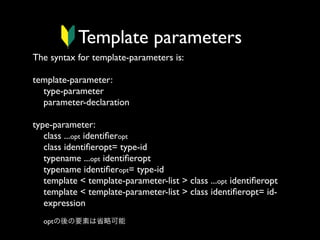
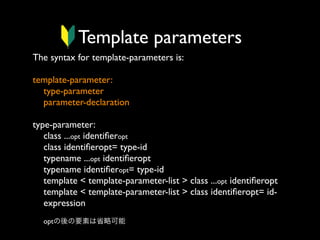
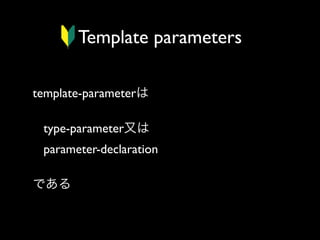
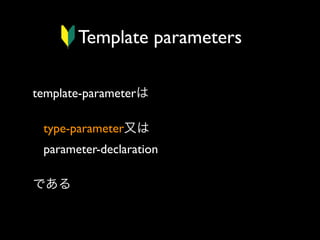
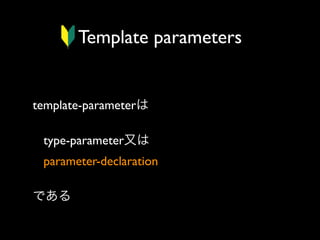
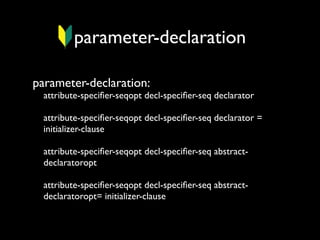
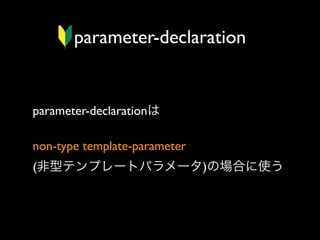
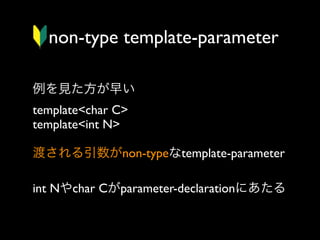
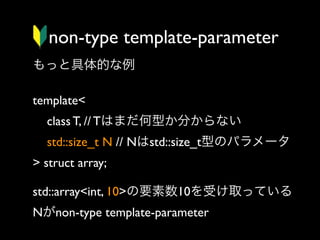
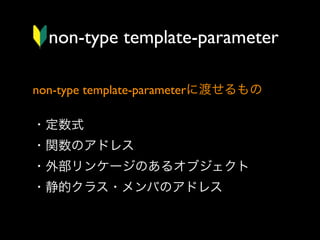
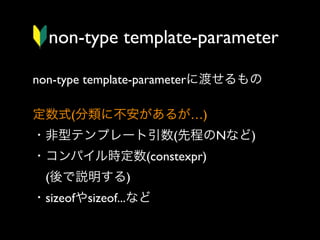
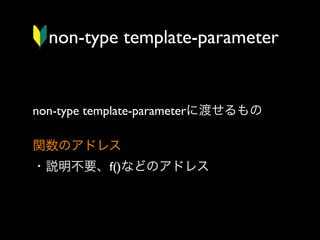
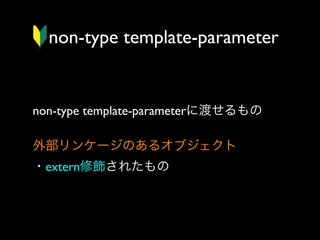
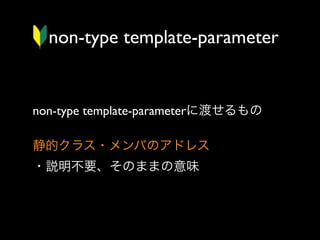
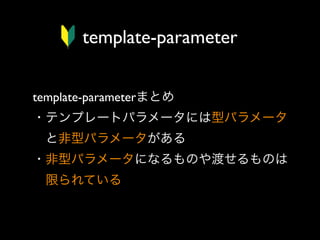
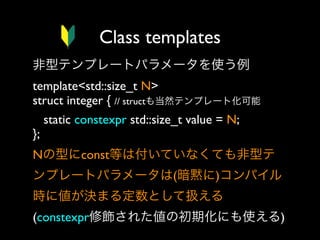
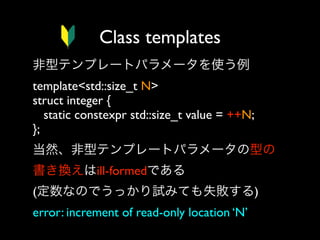
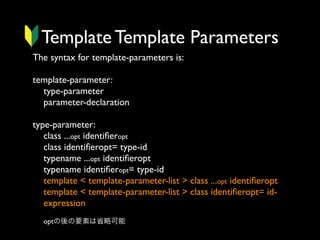
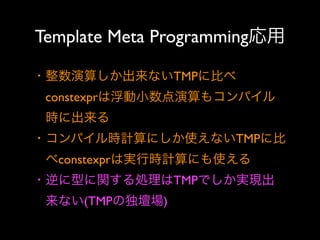
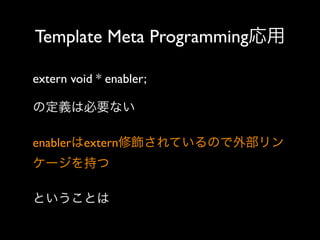
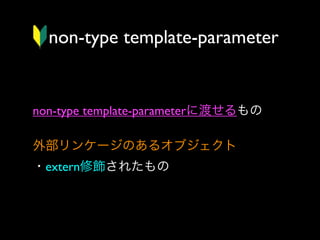
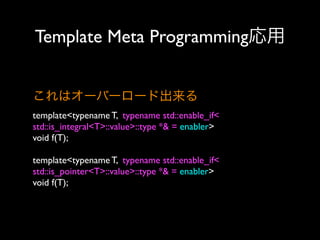
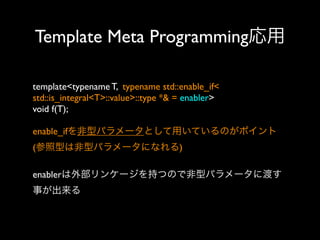
non-type template-parameter
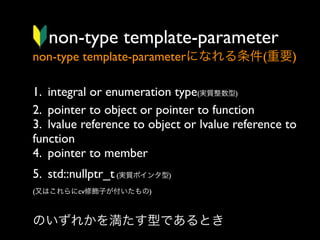
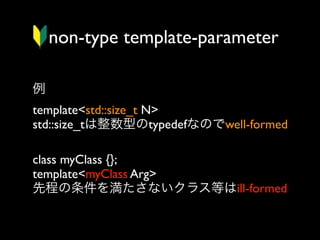
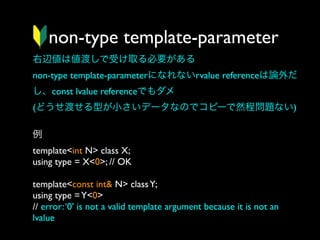
non-type template-parameterになれる条件(重要)
1.integral or enumeration type(実質整数型)
2. pointer to object or pointer to function
3. lvalue reference to object or lvalue reference to
function
4. pointer to member
5. std::nullptr_t (実質ポインタ型)
(又はこれらにcv修飾子が付いたもの)
のいずれかを満たす型であるとき
non-type template-parameter
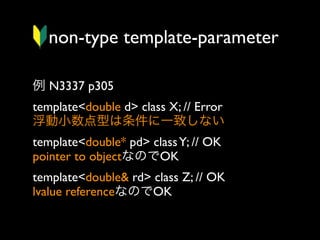
例 N3337p305
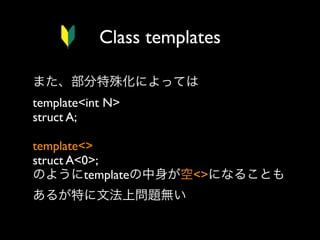
template<double d> class X; // Error
浮動小数点型は条件に一致しない
template<double* pd> class Y; // OK
pointer to objectなのでOK
template<double& rd> class Z; // OK
lvalue referenceなのでOK
Class templates
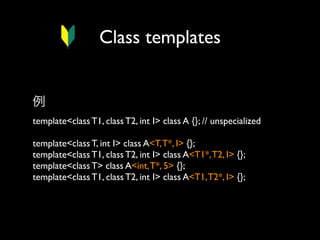
例
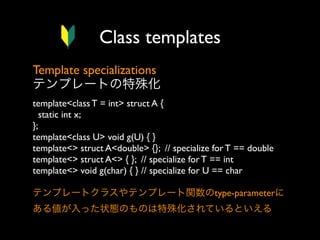
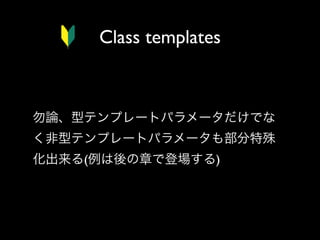
template<class T1,class T2, int I> class A {}; // unspecialized
template<class T, int I> class A<T, T*, I> {};
template<class T1, class T2, int I> class A<T1*, T2, I> {};
template<class T> class A<int, T*, 5> {};
template<class T1, class T2, int I> class A<T1, T2*, I> {};
84.
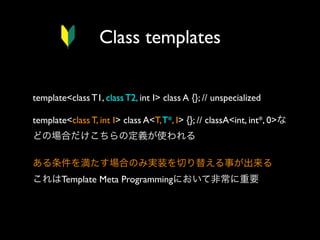
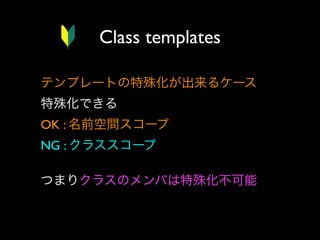
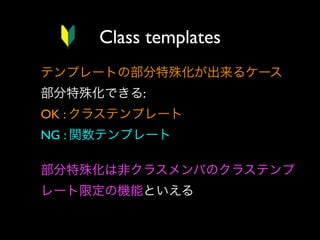
Class templates
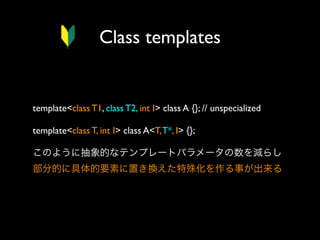
template<class T1,class T2, int I> class A {}; // unspecialized
template<class T, int I> class A<T, T*, I> {};
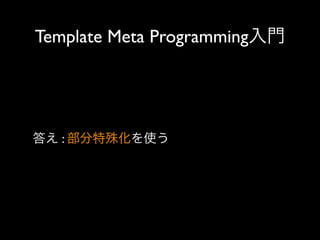
このように抽象的なテンプレートパラメータの数を減らし
部分的に具体的要素に置き換えた特殊化を作る事が出来る
85.
Class templates
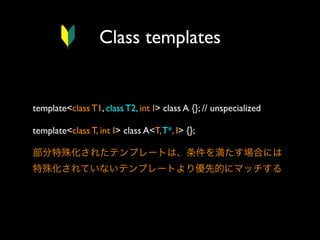
template<class T1,class T2, int I> class A {}; // unspecialized
template<class T, int I> class A<T, T*, I> {};
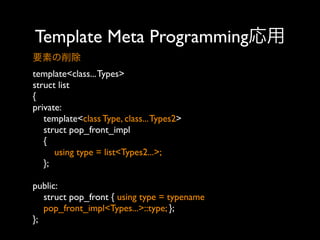
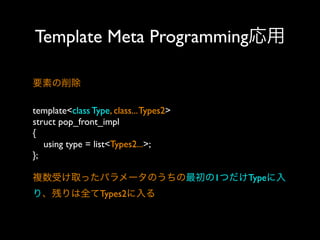
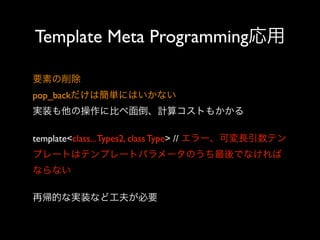
部分特殊化されたテンプレートは、条件を満たす場合には
特殊化されていないテンプレートより優先的にマッチする
86.
Class templates
template<class T1,class T2, int I> class A {}; // unspecialized
template<class T, int I> class A<T, T*, I> {}; // classA<int, int*, 0>な
どの場合だけこちらの定義が使われる
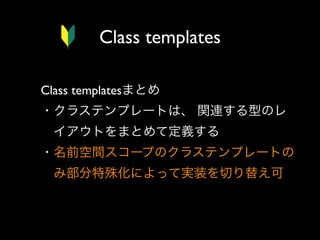
ある条件を満たす場合のみ実装を切り替える事が出来る
これはTemplate Meta Programmingにおいて非常に重要
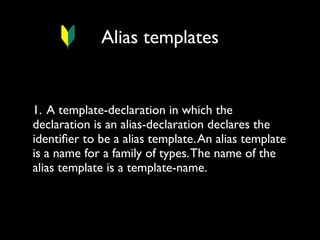
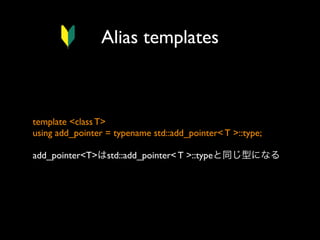
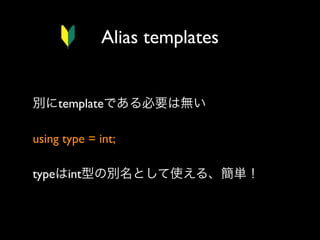
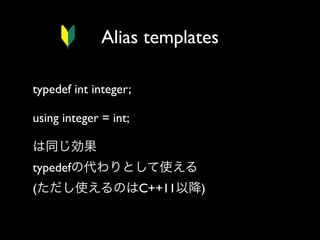
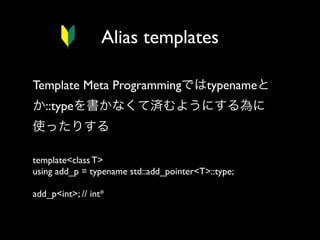
Alias templates
1. Atemplate-declaration in which the
declaration is an alias-declaration declares the
identifier to be a alias template. An alias template
is a name for a family of types. The name of the
alias template is a template-name.
118.
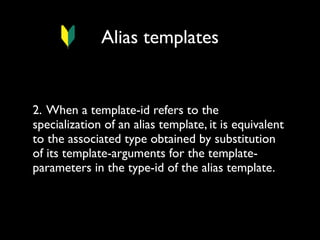
Alias templates
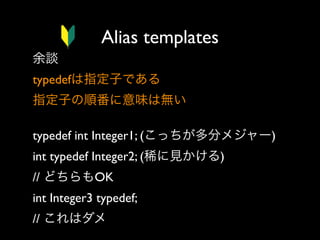
2. Whena template-id refers to the
specialization of an alias template, it is equivalent
to the associated type obtained by substitution
of its template-arguments for the templateparameters in the type-id of the alias template.
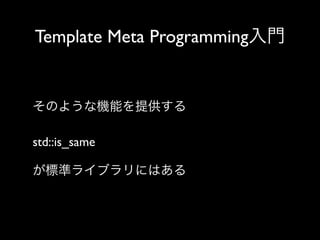
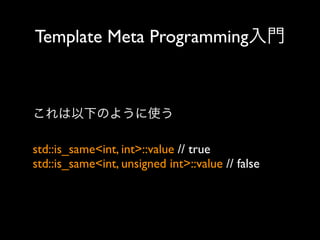
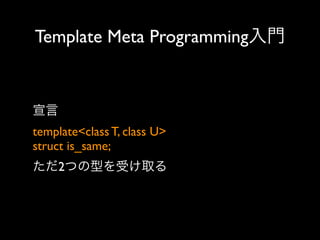
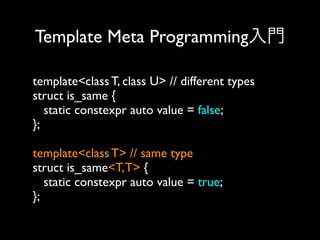
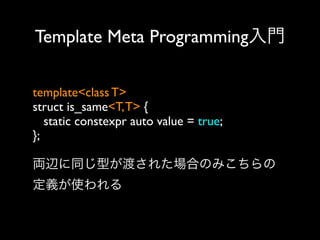
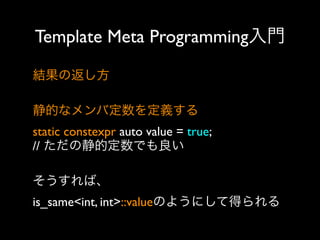
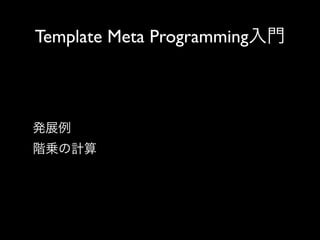
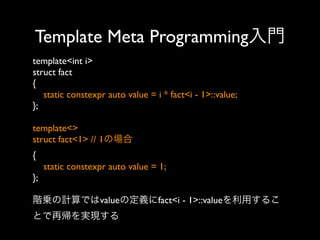
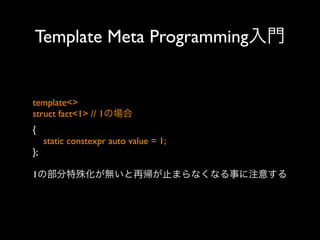
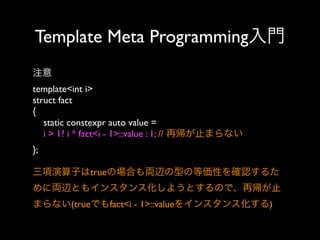
Template Meta Programming入門
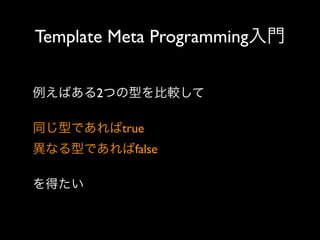
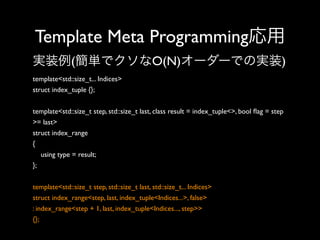
template<classT, class U> // different types
struct is_same {
static constexpr auto value = false;
};
template<class T> // same type
struct is_same<T, T> {
static constexpr auto value = true;
};
Template Meta Programming入門
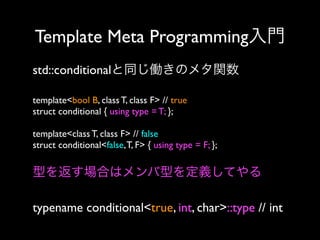
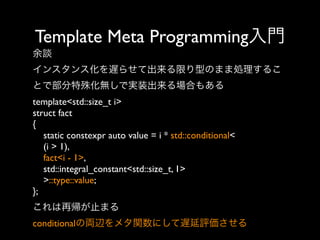
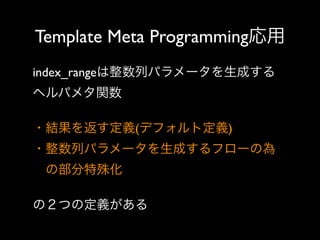
std::conditionalと同じ働きのメタ関数
template<boolB, class T, class F> // true
struct conditional { using type = T; };
template<class T, class F> // false
struct conditional<false, T, F> { using type = F; };
型を返す場合はメンバ型を定義してやる
typename conditional<true, int, char>::type // int
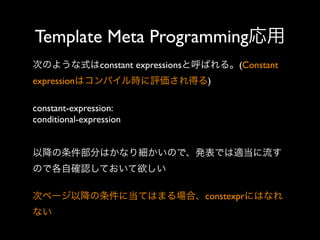
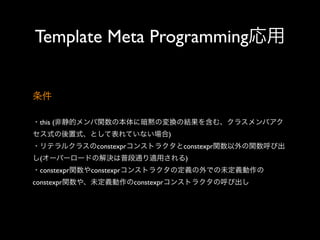
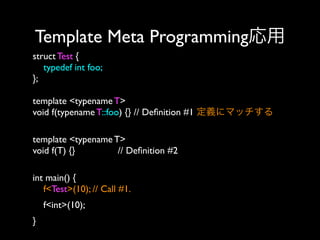
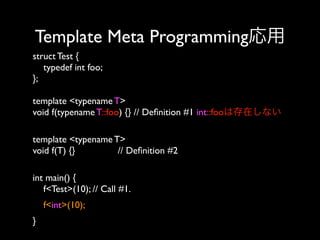
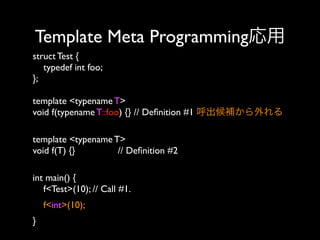
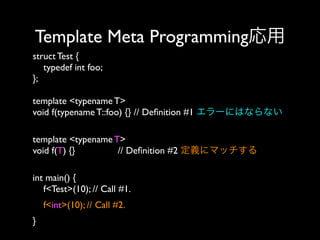
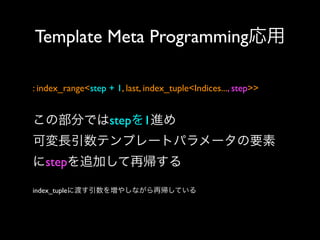
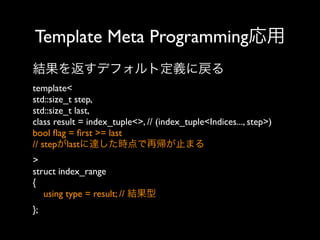
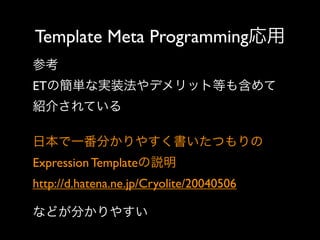
Template Meta Programming応用
条件
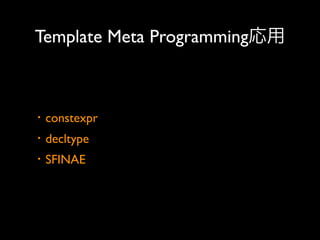
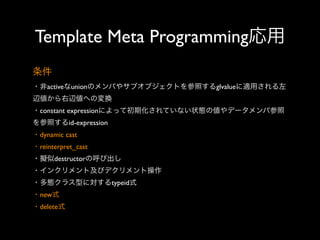
・this(非静的メンバ関数の本体に暗黙の変換の結果を含む、クラスメンバアク
セス式の後置式、として表れていない場合)
・リテラルクラスのconstexprコンストラクタとconstexpr関数以外の関数呼び出
し(オーバーロードの解決は普段通り適用される)
・constexpr関数やconstexprコンストラクタの定義の外での未定義動作の
constexpr関数や、未定義動作のconstexprコンストラクタの呼び出し
222.
Template Meta Programming応用
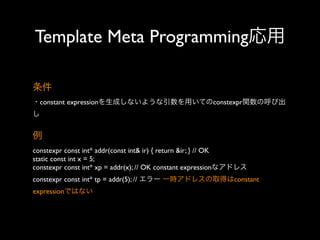
条件
・constantexpressionを生成しないような引数を用いてのconstexpr関数の呼び出
し
例
constexpr const int* addr(const int& ir) { return &ir; } // OK
static const int x = 5;
constexpr const int* xp = addr(x); // OK constant expressionなアドレス
constexpr const int* tp = addr(5); // エラー 一時アドレスの取得はconstant
expressionではない
223.
Template Meta Programming応用
条件
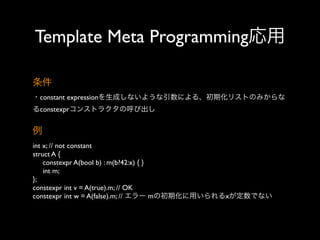
・constantexpressionを生成しないような引数による、初期化リストのみからな
るconstexprコンストラクタの呼び出し
例
int x; // not constant
struct A {
constexpr A(bool b) : m(b?42:x) { }
int m;
};
constexpr int v = A(true).m; // OK
constexpr int w = A(false).m; // エラー mの初期化に用いられるxが定数でない
Template Meta Programming応用
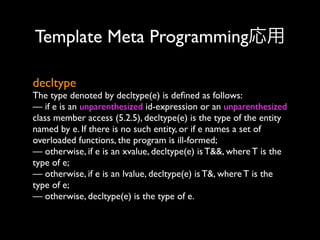
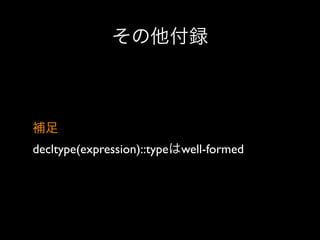
decltype
Thetype denoted by decltype(e) is defined as follows:
— if e is an unparenthesized id-expression or an unparenthesized
class member access (5.2.5), decltype(e) is the type of the entity
named by e. If there is no such entity, or if e names a set of
overloaded functions, the program is ill-formed;
— otherwise, if e is an xvalue, decltype(e) is T&&, where T is the
type of e;
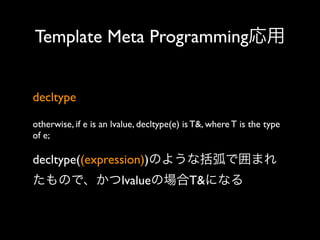
— otherwise, if e is an lvalue, decltype(e) is T&, where T is the
type of e;
— otherwise, decltype(e) is the type of e.
233.
Template Meta Programming応用
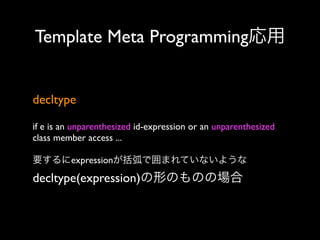
decltype
ife is an unparenthesized id-expression or an unparenthesized
class member access ...
要するにexpressionが括弧で囲まれていないような
decltype(expression)の形のものの場合
234.
Template Meta Programming応用
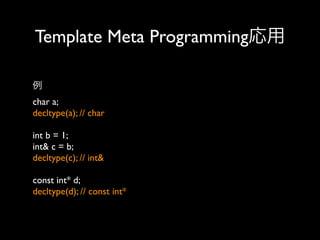
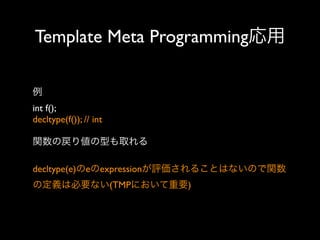
例
chara;
decltype(a); // char
int b = 1;
int& c = b;
decltype(c); // int&
const int* d;
decltype(d); // const int*
235.
Template Meta Programming応用
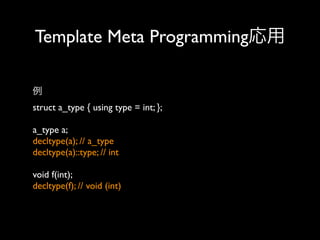
例
structa_type { using type = int; };
a_type a;
decltype(a); // a_type
decltype(a)::type; // int
void f(int);
decltype(f); // void (int)
Template Meta Programming応用
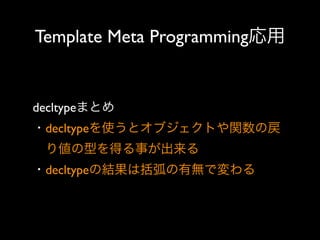
decltype
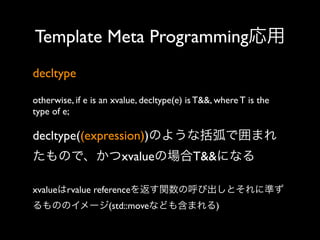
otherwise,if e is an xvalue, decltype(e) is T&&, where T is the
type of e;
decltype((expression))のような括弧で囲まれ
たもので、かつxvalueの場合T&&になる
xvalueはrvalue referenceを返す関数の呼び出しとそれに準ず
るもののイメージ(std::moveなども含まれる)
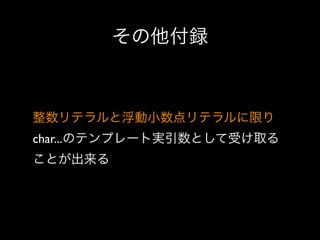
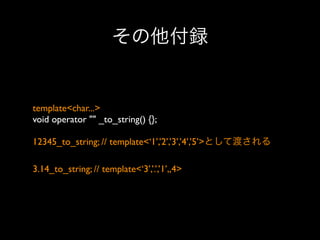
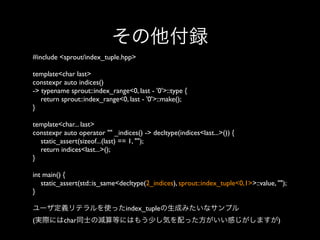
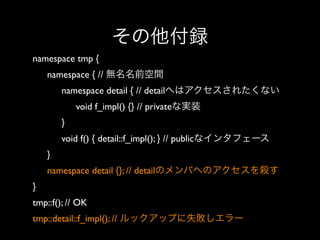
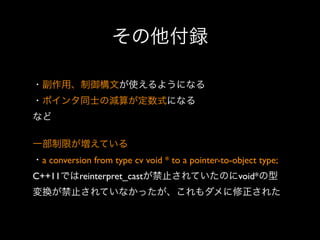
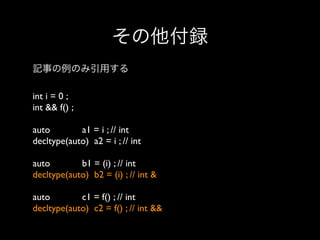
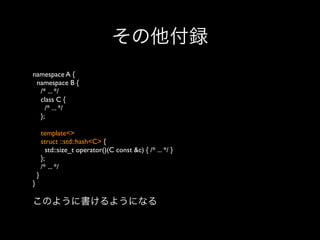
その他付録
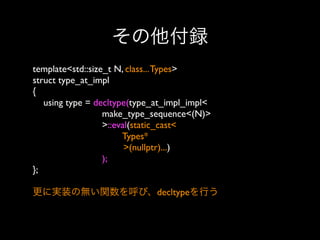
記事の例のみ引用する
int i =0 ;
int && f() ;
auto
a1 = i ; // int
decltype(auto) a2 = i ; // int
auto
b1 = (i) ; // int
decltype(auto) b2 = (i) ; // int &
auto
c1 = f() ; // int
decltype(auto) c2 = f() ; // int &&
343.
その他付録
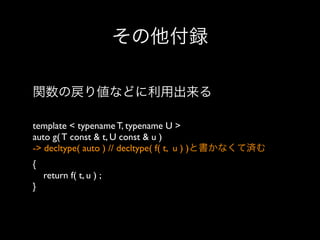
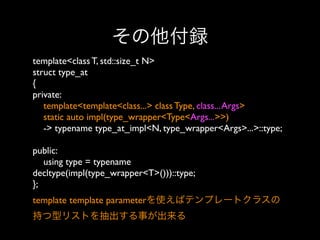
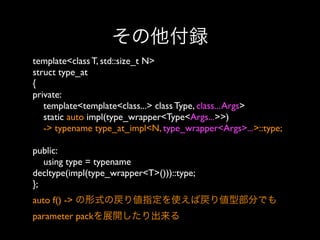
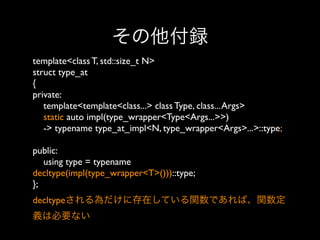
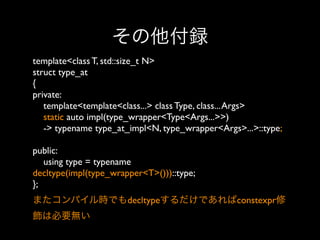
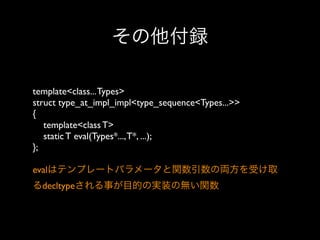
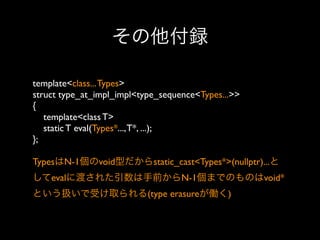
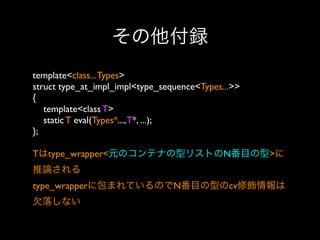
関数の戻り値などに利用出来る
template < typenameT, typename U >
auto g( T const & t, U const & u )
-> decltype( auto ) // decltype( f( t, u ) )と書かなくて済む
{
return f( t, u ) ;
}









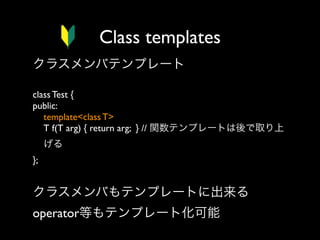
;
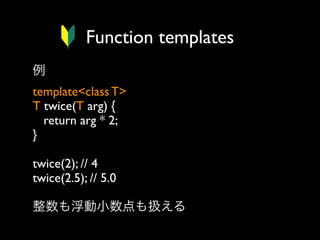
T& elem(int i) { return v[i]; }
};
Array<int>やArray<char>は渡した型を扱える](https://image.slidesharecdn.com/tmpweb-131110050002-phpapp02/85/Template-Meta-Programming-75-320.jpg)
![Function templates
例外1
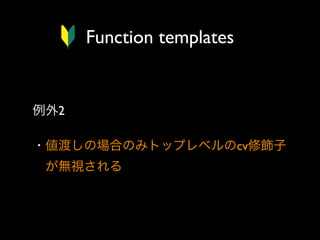
・配列型(T[N])はポインタ(T*)に変換される
・関数型(R(Args...))は関数ポインタ
(R(*(Args...))に変換される](https://image.slidesharecdn.com/tmpweb-131110050002-phpapp02/85/Template-Meta-Programming-101-320.jpg)
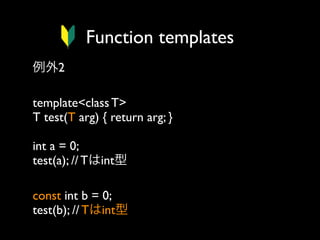
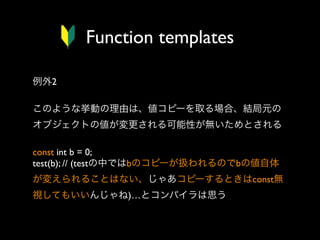
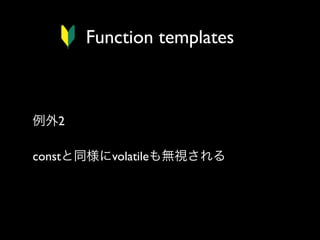
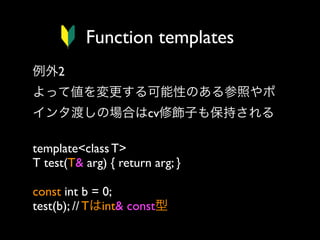
![Template Meta Programming応用
条件
・constexpr関数又はconstexprコンストラクタの再帰呼び出しが処理系の定義す
る制限を超える場合(Annex Bを参照)
Annex BにおいてRecursive constexpr function invocations [512].と定義されている
・数学上定義されないような値、又は特定の型で扱える範囲外のその型の値。
・ラムダ式
・次の場合を除く左辺値から右辺値への変換
・constant expressionで事前に初期化された非volatileなconstオブジェクトを参
照する整数型のglvalue又はenum
・constexpr修飾で定義された、非volatileのオブジェクトかそのようなサブオ
ブジェクトを参照するリテラル型のglvalue
・constant expressionで初期化された寿命の尽きていない一時オブジェクトを
参照するリテラル型のglvalue](https://image.slidesharecdn.com/tmpweb-131110050002-phpapp02/85/Template-Meta-Programming-224-320.jpg)
![Template Meta Programming応用
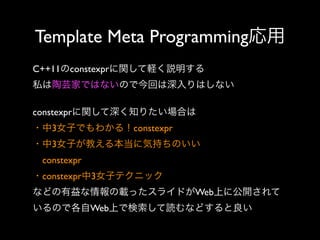
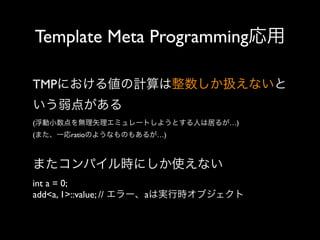
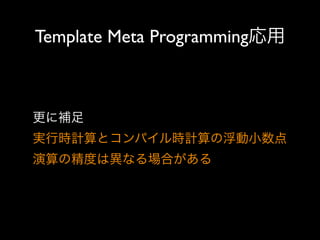
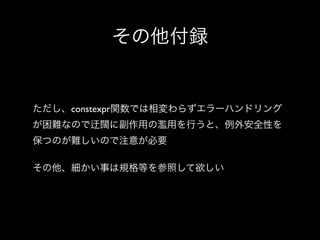
規格では浮動小数点の演算精度に関して制限を課さないの
で、コンパイル時と実行時における同じ式の浮動小数点演
算の結果が同じである保証は無い
(N3337 5.19 Constant expressions)
bool f() {
char array[1 + int(1 + 0.2 - 0.1 - 0.1)]; // 必ずコンパイル時に計算される
int size = 1 + int(1 + 0.2 - 0.1 - 0.1); // 実行時に計算されるかもしれない
return sizeof(array) == size;
}
f()の結果がtrueであるかfalseであるかは未定義である。](https://image.slidesharecdn.com/tmpweb-131110050002-phpapp02/85/Template-Meta-Programming-228-320.jpg)
![Template Meta Programming応用
decltype
otherwise, decltype(e) is the type of e.
それ以外(prvalue等)はeの型
例
decltype(1); // int
decltype("hello,world"); // const char[12]](https://image.slidesharecdn.com/tmpweb-131110050002-phpapp02/85/Template-Meta-Programming-241-320.jpg)
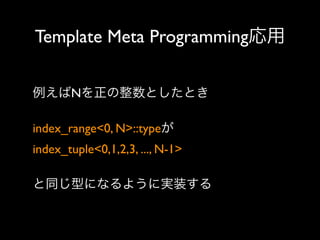
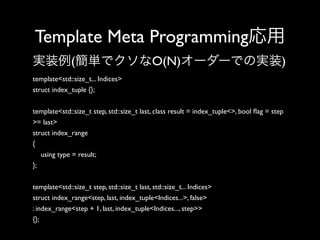
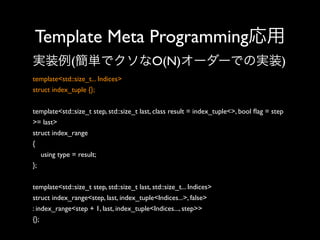
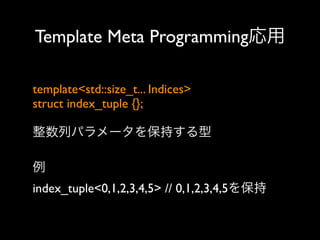
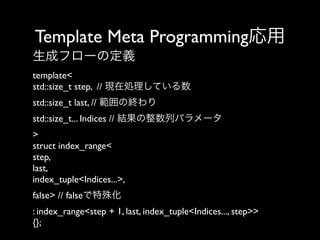
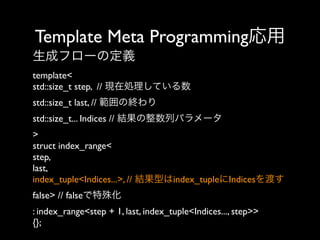
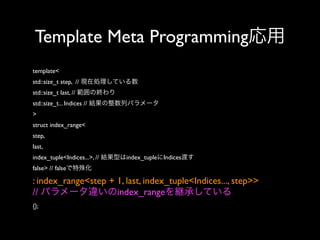
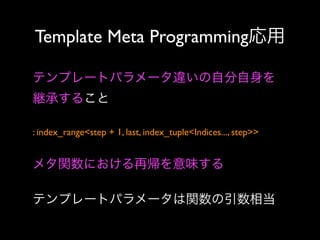
![Template Meta Programming応用
配列クラスと値nを受けとり、全要素にnを加えた値の要素を持つ配列クラスを
返す関数iota
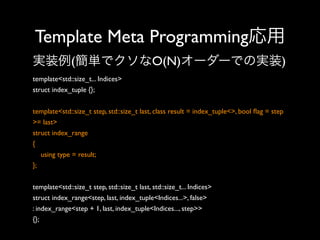
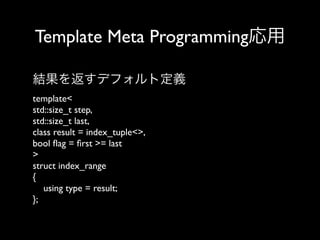
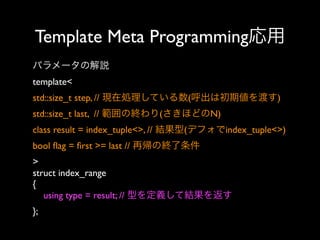
template<class T, std::size_t N, std::size_t... Indices>
constexpr auto iota_impl(const array<T, N> arr, const T n, index_tuple<Indices...>)
-> array<T, N> {
return array<T, N>{{(arr[Indices] + n)...}};
}
template<class T, std::size_t N>
constexpr auto iota(const array<T, N> arr, const T n) -> array<T, N> {
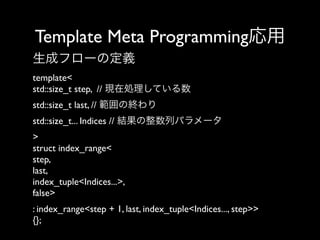
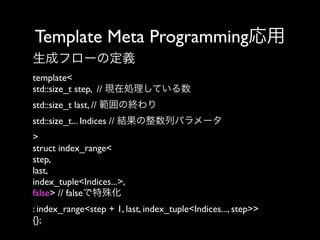
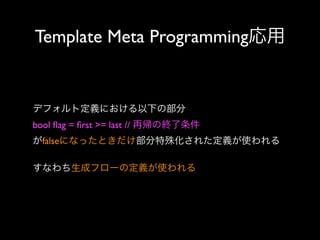
return iota_impl(arr, n, typename index_range<0, N>::type());
}
constexpr array<int, 9> arr1{{1,2,3,4,5,6,7,8,9}}; // 配列クラスのオブジェクト
constexpr auto arr2 = iota(arr1, 1);
// iotaには配列クラスのオブジェクトと値nを渡してやる
//結果としてarray<int, 9>{{2,3,4,5,6,7,8,9,10}}が欲しい](https://image.slidesharecdn.com/tmpweb-131110050002-phpapp02/85/Template-Meta-Programming-301-320.jpg)
![Template Meta Programming応用
template<class T, std::size_t N, std::size_t... Indices>
constexpr auto iota_impl(const array<T, N> arr, const T n, index_tuple<Indices...>)
-> array<T, N> {
return array<T, N>{{(arr[Indices] + n)...}};
}
template<class T, std::size_t N>
constexpr auto iota(const array<T, N> arr, const T n) -> array<T, N> {
return iota_impl(arr, n, typename index_range<0, N>::type());
}
constexpr array<int, 9> arr1{{1,2,3,4,5,6,7,8,9}};
constexpr auto arr2 = iota(arr1, 1); // array<int, 9>{{2,3,4,5,6,7,8,9,10}}
Tはintに、Nは9に推論される](https://image.slidesharecdn.com/tmpweb-131110050002-phpapp02/85/Template-Meta-Programming-302-320.jpg)
![Template Meta Programming応用
template<class T, std::size_t N, std::size_t... Indices>
constexpr auto iota_impl(const array<T, N> arr, const T n, index_tuple<Indices...>)
-> array<T, N> {
return array<T, N>{{(arr[Indices] + n)...}};
}
template<class T, std::size_t N>
constexpr auto iota(const array<T, N> arr, const T n) -> array<T, N> {
return iota_impl(arr, n, typename index_range<0, N>::type());
}
constexpr array<int, 9> arr1{{1,2,3,4,5,6,7,8,9}};
constexpr auto arr2 = iota(arr1, 1); // array<int, 9>{{2,3,4,5,6,7,8,9,10}}
この場合N = 9であるからindex_range<0, 9>::typeになる](https://image.slidesharecdn.com/tmpweb-131110050002-phpapp02/85/Template-Meta-Programming-303-320.jpg)
![Template Meta Programming応用
template<class T, std::size_t N, std::size_t... Indices>
constexpr auto iota_impl(const array<T, N> arr, const T n, index_tuple<Indices...>)
-> array<T, N> {
return array<T, N>{{(arr[Indices] + n)...}};
}
template<class T, std::size_t N>
constexpr auto iota(const array<T, N> arr, const T n) -> array<T, N> {
return iota_impl(arr, n, typename index_range<0, N>::type());
}
constexpr array<int, 9> arr1{{1,2,3,4,5,6,7,8,9}};
constexpr auto arr2 = iota(arr1, 1); // array<int, 9>{{2,3,4,5,6,7,8,9,10}}
index_range<0, 9>::typeはindex_tuple<0,1,2,3,4,5,6,7,8>である](https://image.slidesharecdn.com/tmpweb-131110050002-phpapp02/85/Template-Meta-Programming-304-320.jpg)
![Template Meta Programming応用
template<class T, std::size_t N, std::size_t... Indices>
constexpr auto iota_impl(const array<T, N> arr, const T n, index_tuple<Indices...>)
-> array<T, N> {
return array<T, N>{{(arr[Indices] + n)...}};
}
template<class T, std::size_t N>
constexpr auto iota(const array<T, N> arr, const T n) -> array<T, N> {
return iota_impl(arr, n, typename index_range<0, N>::type());
}
constexpr array<int, 9> arr1{{1,2,3,4,5,6,7,8,9}};
constexpr auto arr2 = iota(arr1, 1); // array<int, 9>{{2,3,4,5,6,7,8,9,10}}
結果としてindex_tuple<0,1,2,3,4,5,6,7,8>()がiota_implの引数
として渡される](https://image.slidesharecdn.com/tmpweb-131110050002-phpapp02/85/Template-Meta-Programming-305-320.jpg)
![Template Meta Programming応用
template<class T, std::size_t N, std::size_t... Indices> // Indices is 0,1,2,3,4,5,6,7,8
constexpr auto iota_impl(const array<T, N> arr, const T n, index_tuple<Indices...>)
-> array<T, N> {
return array<T, N>{{(arr[Indices] + n)...}};
}
template<class T, std::size_t N>
constexpr auto iota(const array<T, N> arr, const T n) -> array<T, N> {
return iota_impl(arr, n, typename index_range<0, N>::type());
}
constexpr array<int, 9> arr1{{1,2,3,4,5,6,7,8,9}};
constexpr auto arr2 = iota(arr1, 1); // array<int, 9>{{2,3,4,5,6,7,8,9,10}}
このときIndicesは0,1,2,3,4,5,6,7,8に推論される](https://image.slidesharecdn.com/tmpweb-131110050002-phpapp02/85/Template-Meta-Programming-306-320.jpg)
![Template Meta Programming応用
template<class T, std::size_t N, std::size_t... Indices> // Indices is 0,1,2,3,4,5,6,7,8
constexpr auto iota_impl(const array<T, N> arr, const T n, index_tuple<Indices...>)
-> array<T, N> {
return array<T, N>{{(arr[Indices] + n)...}};
}
template<class T, std::size_t N>
constexpr auto iota(const array<T, N> arr, const T n) -> array<T, N> {
return iota_impl(arr, n, typename index_range<0, N>::type());
}
constexpr array<int, 9> arr1{{1,2,3,4,5,6,7,8,9}};
constexpr auto arr2 = iota(arr1, 1); // array<int, 9>{{2,3,4,5,6,7,8,9,10}}
最終的にarray<T, N>{{(arr[Indices] + n)...}}の部分は
array<int, 9>{{arr[0] + n, arr[1] + n, (中略)..., arr[8] + n}}
という風に展開される](https://image.slidesharecdn.com/tmpweb-131110050002-phpapp02/85/Template-Meta-Programming-307-320.jpg)







![その他付録
ラムダ式もテンプレート化出来る
auto NumElements = []<int N>(auto (&a)[N]) { return N; };](https://image.slidesharecdn.com/tmpweb-131110050002-phpapp02/85/Template-Meta-Programming-345-320.jpg)




![その他付録
struct C {
constexpr C(int v) : v(v) { }
int v;
};
template<C c> // !?
struct X {
int array[c.v];
};
int main()
{
X<C(42)> x;
}
C++の世界の法則が乱れる完全にヤバい提案](https://image.slidesharecdn.com/tmpweb-131110050002-phpapp02/85/Template-Meta-Programming-366-320.jpg)




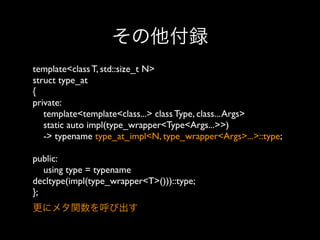
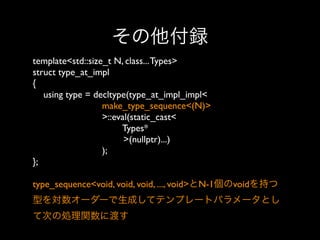
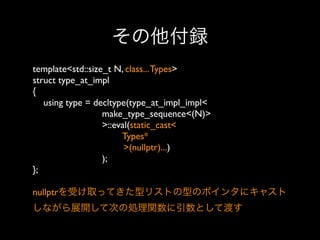
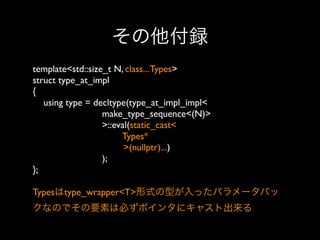








![[読会]A critical review of lasso and its derivatives for variable selection und...](https://cdn.slidesharecdn.com/ss_thumbnails/acriticalreviewoflassoanditsderivativesforvariableselectionunderdependenceamongcovariates-211229094859-thumbnail.jpg?width=640&height=640&fit=bounds)


![[ICLR2017読み会 @ DeNA] ICLR2017紹介](https://cdn.slidesharecdn.com/ss_thumbnails/iclr2017denaiclr2017-170616173153-thumbnail.jpg?width=640&height=640&fit=bounds)


