MANAGING
FARM WASTE
TLE 7 Q2 W4
COT
Presented by Teacher
Manuel
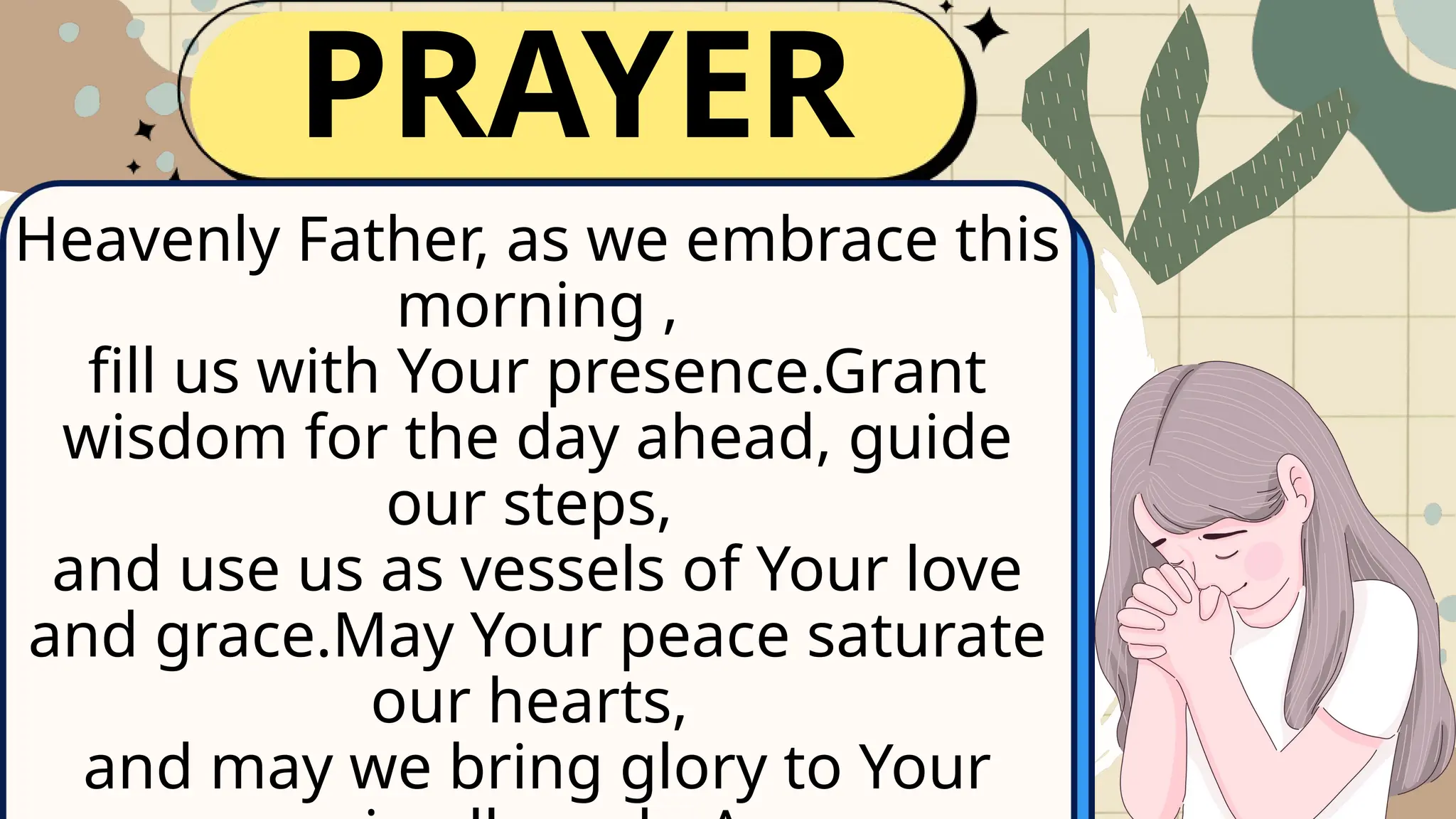
Heavenly Father, as we embrace this
morning ,
fill us with Your presence.Grant
wisdom for the day ahead, guide
our steps,
and use us as vessels of Your love
and grace.May Your peace saturate
our hearts,
and may we bring glory to Your
PRAYER
ATTENDANCE
Ice Breaker:
Mini Squid
Games
1.Today, we will
play a fun ice
breaker called Mini
Squid Games!
Instructions for
Students:
2.There are a
total of 6 mini
games.
Instructions for
Students:
3.Press the
spinner to
select a game
Instructions for
Students:
4.Each game will
have its own
rules and
Instructions for
Students:
5.The winner(s)
of each game
will receive a
Instructions for
Students:
6.Always play
fair, be
respectful, and
Instructions for
Students:
Class before we proceed
to our lesson for today,
who can recall what we
had taken up yesterday?
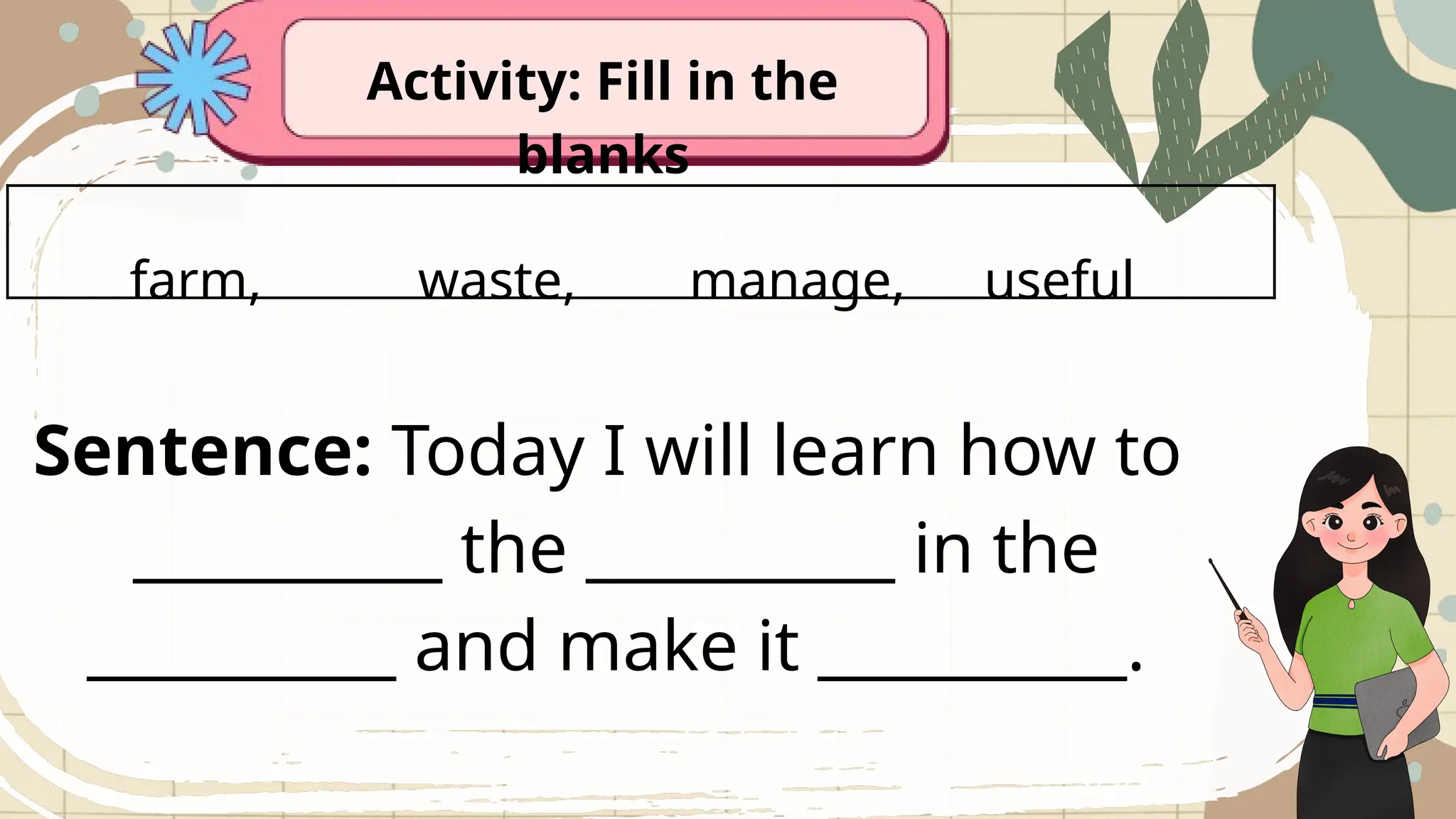
Activity: Fill in the
blanks
farm, waste, manage, useful
Sentence: Today I will learn how to
__________ the __________ in the
__________ and make it __________.
1.What do you
see in the
picture?
Guiding Questions:
2.Which of these
wastes can still be
useful?
Guiding Questions:
3.What do you
think we will
learn today?
Guiding Questions:
WASTE
MANAGEMENT IN
THE FARM
Waste in the Farm- is one
of the major concerns in the
farm. Waste- is defined as
any substance, debris ,
leftovers that was produced
during agricultural works
WASTE MANAGEMENT Ecological Solid
Waste Management Act of 2000 (RA
9003)- an act providing for an ecological
solid waste management program ,
creating the necessary institutional
mechanism and incentives, declaring
certain acts prohibited and providing
penalties, appropriating funds,
Teacher emphasizes: Not all
waste is useless. Some can
help the soil (compost), some
can be sold (junk shop), while
others must be properly
disposed of to avoid harm.
“Why do you think
we should not just
throw all wastes
anywhere?”
Short Q&A:
Provide each group with
mixed pictures of farm
wastes (plastic bottles,
banana peel, twigs,
pesticide container, grass
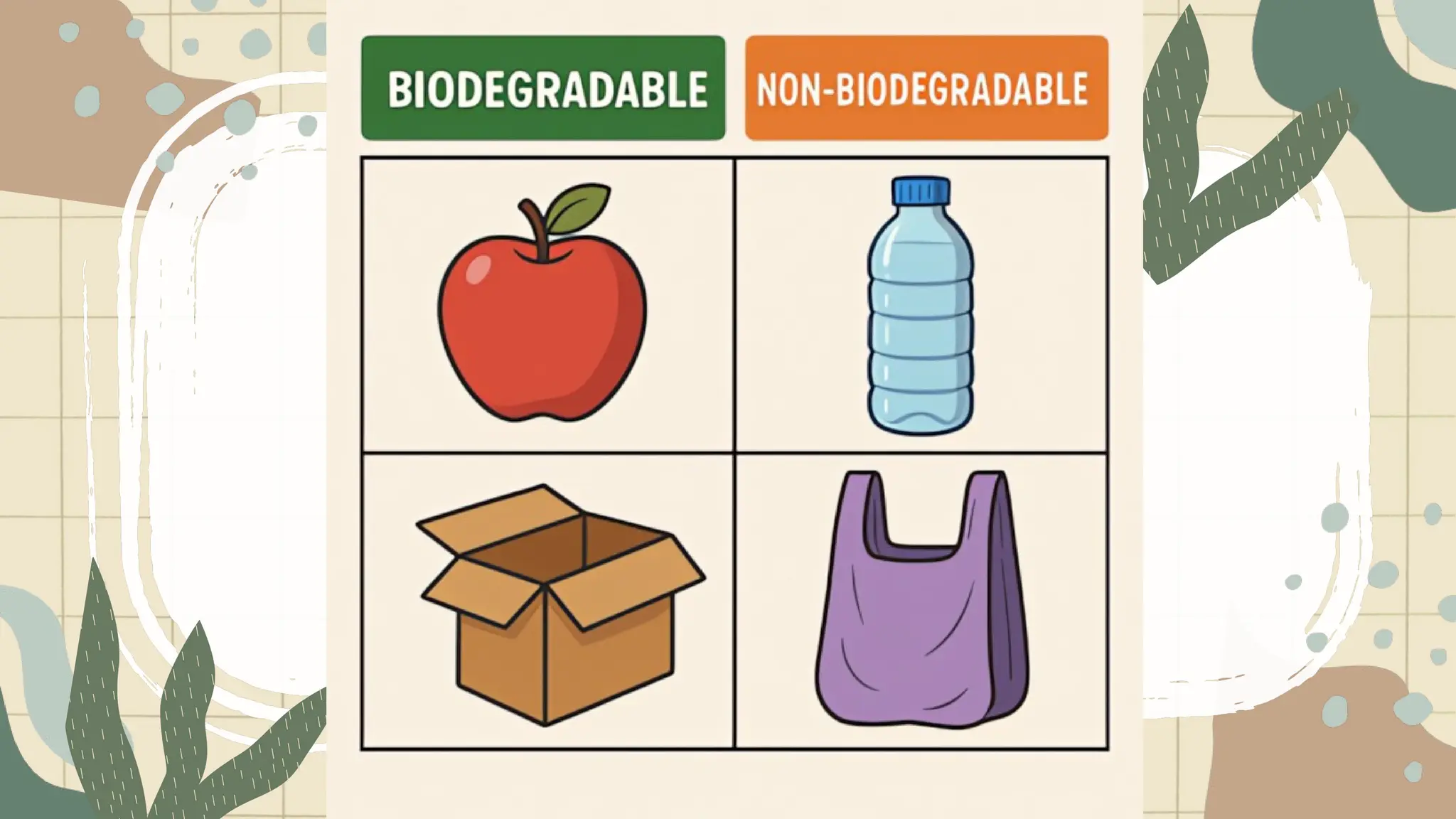
Activity: Sort It Right!
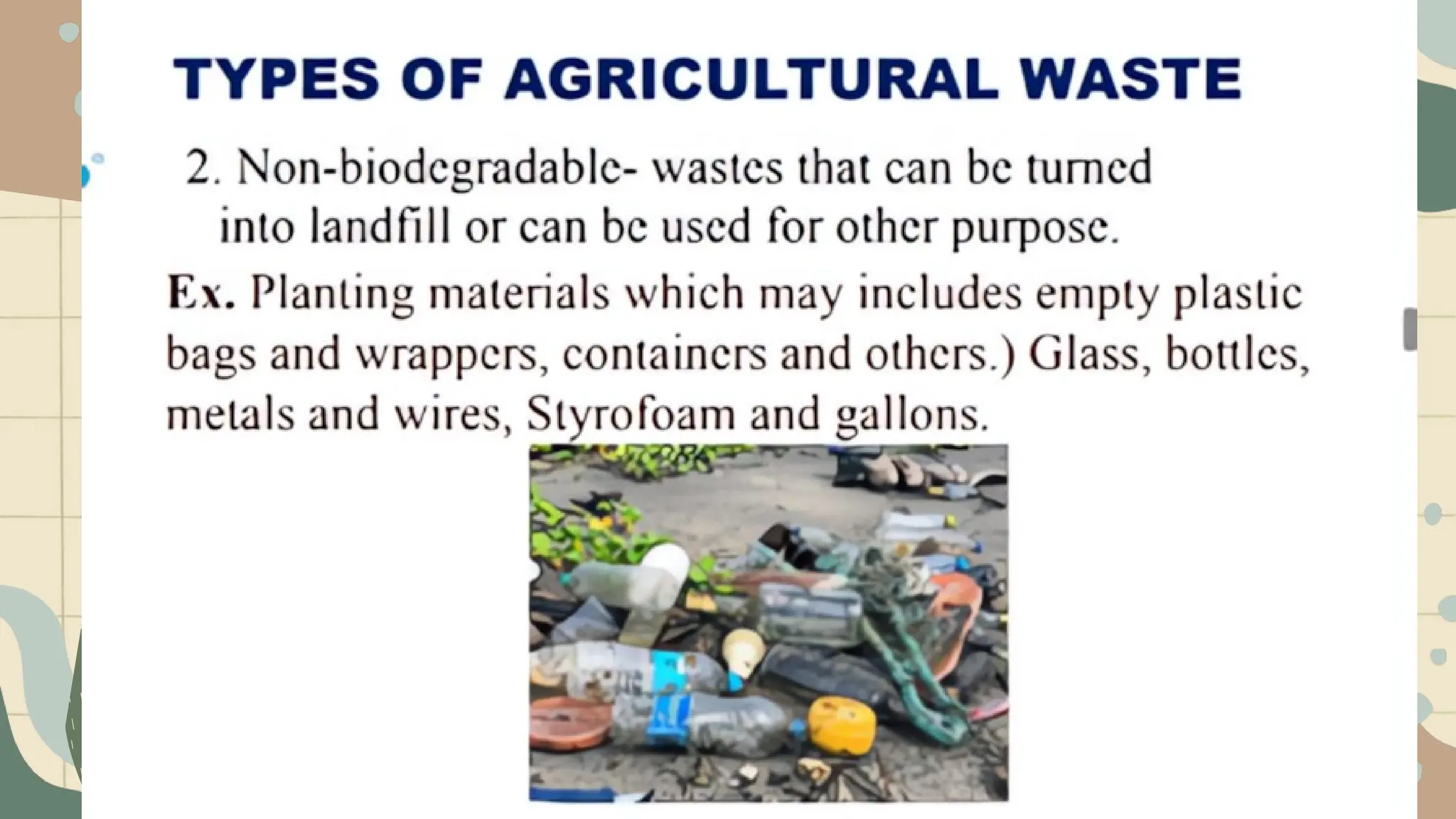
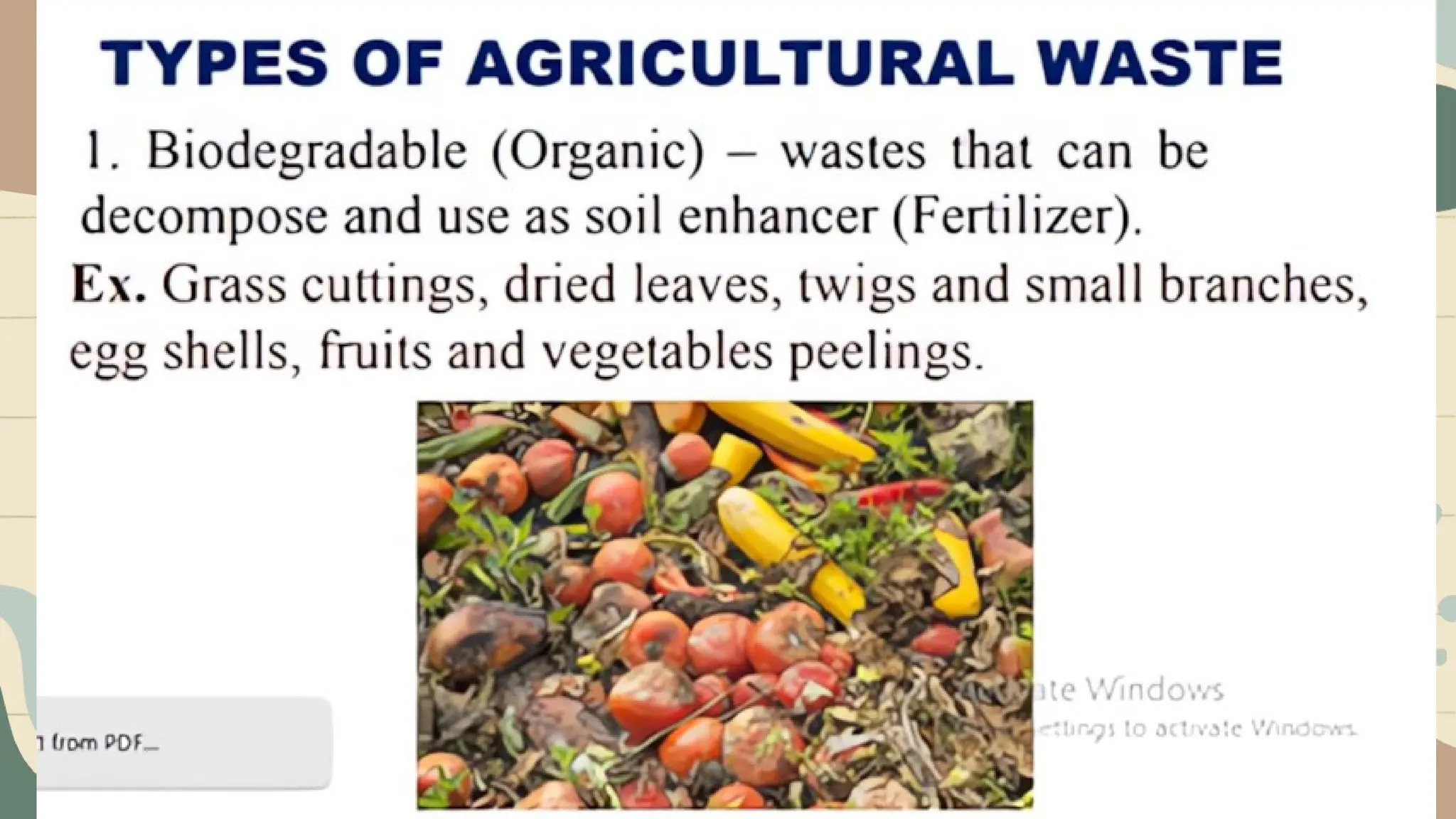
Task: Sort into 3
categories:
Biodegradable, Non-
biodegradable,
Activity: Sort It Right!
For learners
with
disabilities:
Activity: Sort It Right!
Visual difficulty
– partner reads
aloud the
Activity: Sort It Right!
Motor difficulty –
partner pastes
items while learner
gives instructions.
Activity: Sort It Right!
“At home or in school,
how can you reduce,
reuse, and recycle
waste?”
Ask:
Learners share simple
actions like:
composting fruit peels,
reusing plastic bags, or
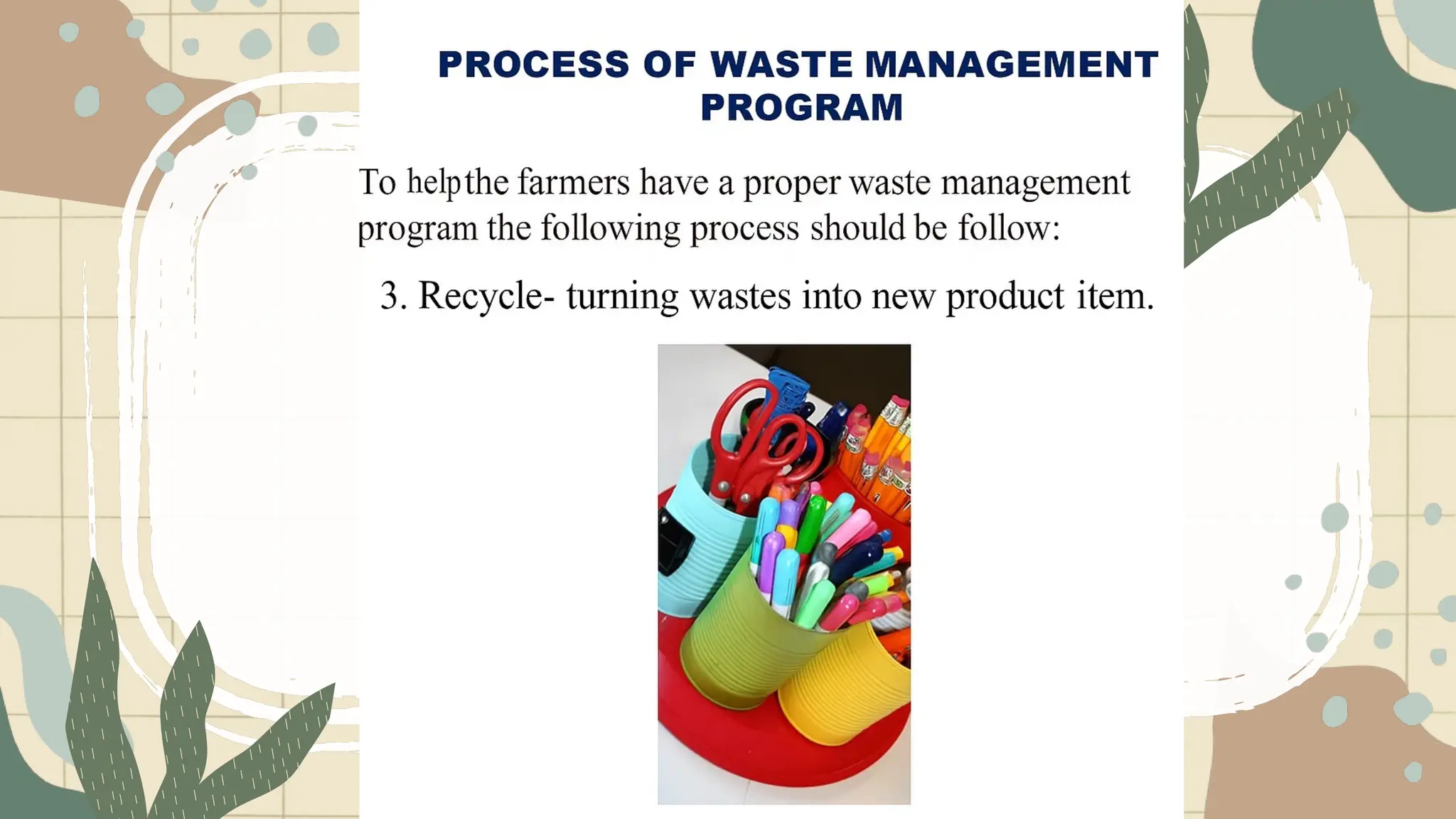
recycling bottles.
Situation: You see a
classmate throwing
plastic wrappers in the
garden.
What would you
do in this
situation?
Questions:
How would you feel
if waste is scattered
everywhere?
Questions:
What lesson did you
learn about caring
for waste?
Questions:
What can you do
better next time to
protect the
environment?
Questions:
Evaluation
Time
Choose the letter of
the correct answer.
Write the letter on the
blank.
Directions:
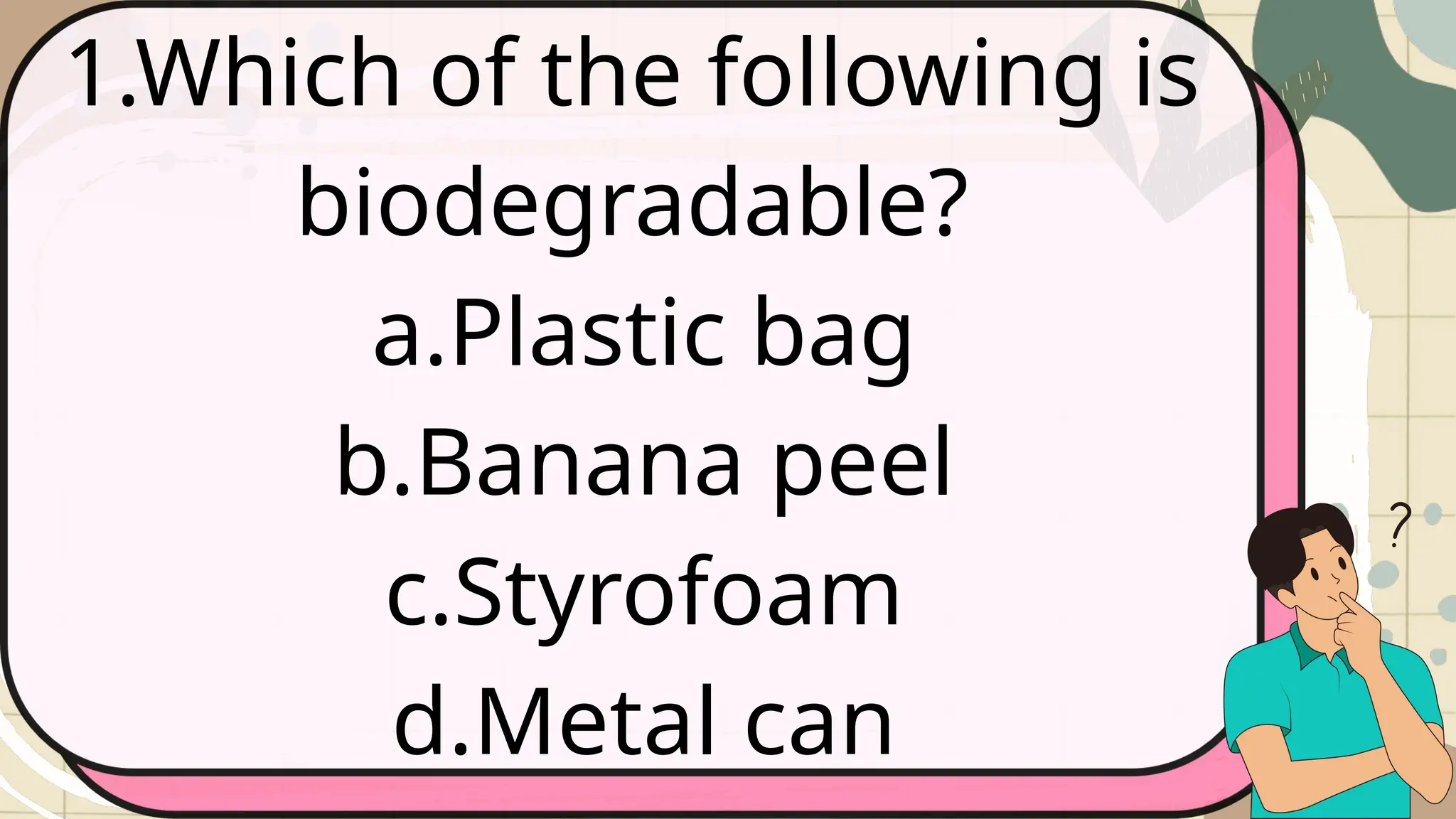
1.Which of the following is
biodegradable?
a.Plastic bag
b.Banana peel
c.Styrofoam
d.Metal can
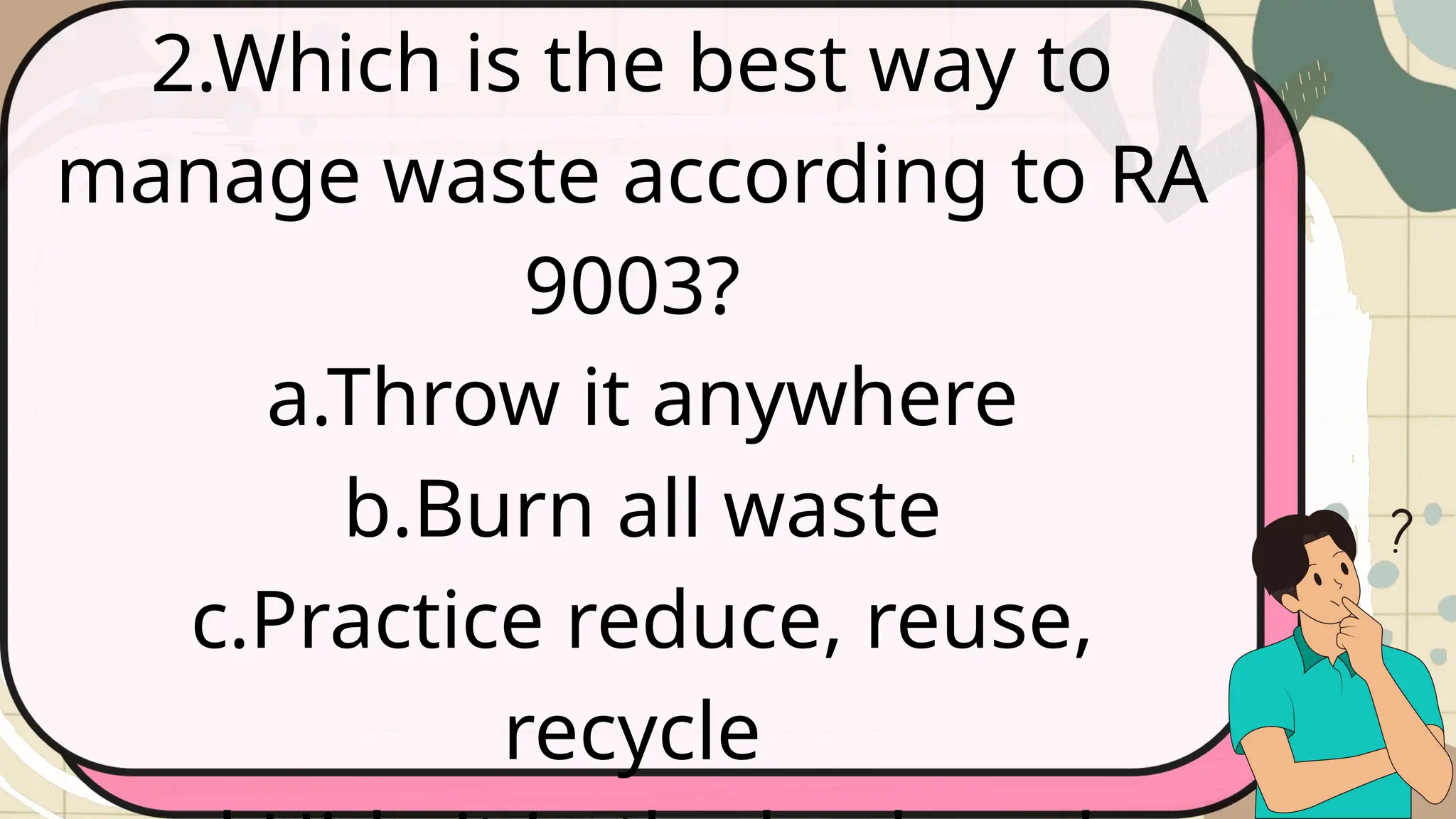
2.Which is the best way to
manage waste according to RA
9003?
a.Throw it anywhere
b.Burn all waste
c.Practice reduce, reuse,
recycle
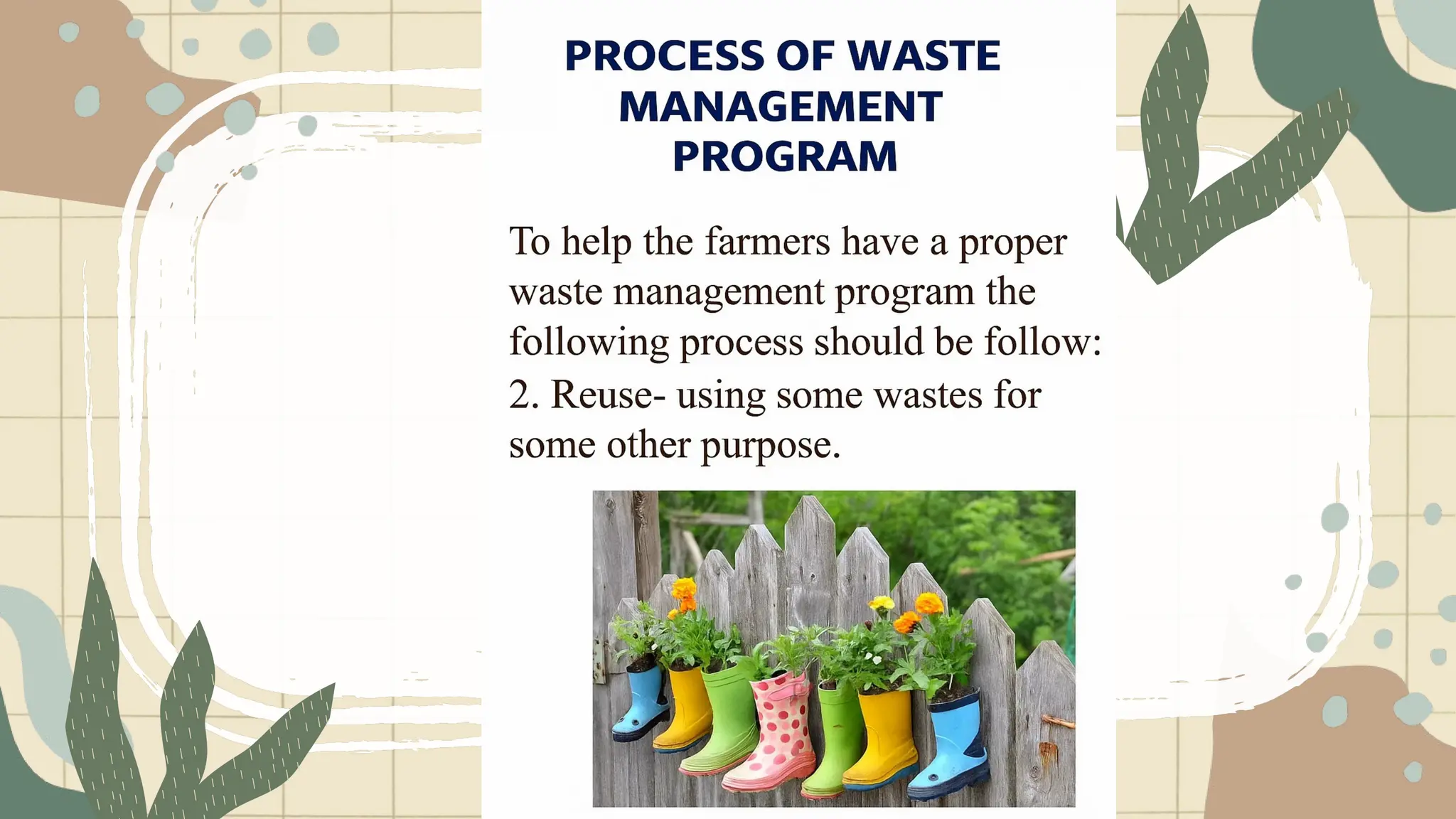
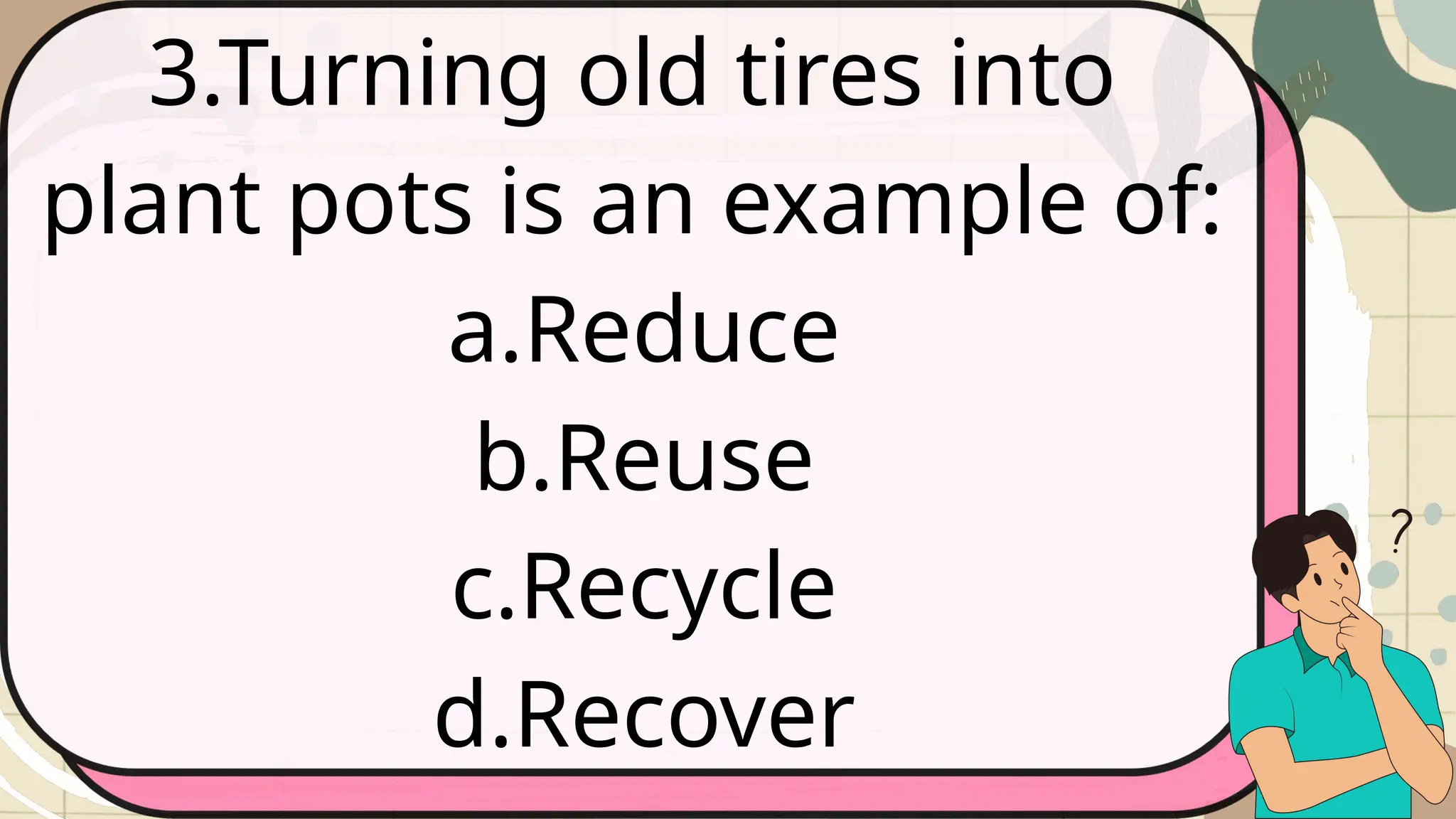
3.Turning old tires into
plant pots is an example of:
a.Reduce
b.Reuse
c.Recycle
d.Recover
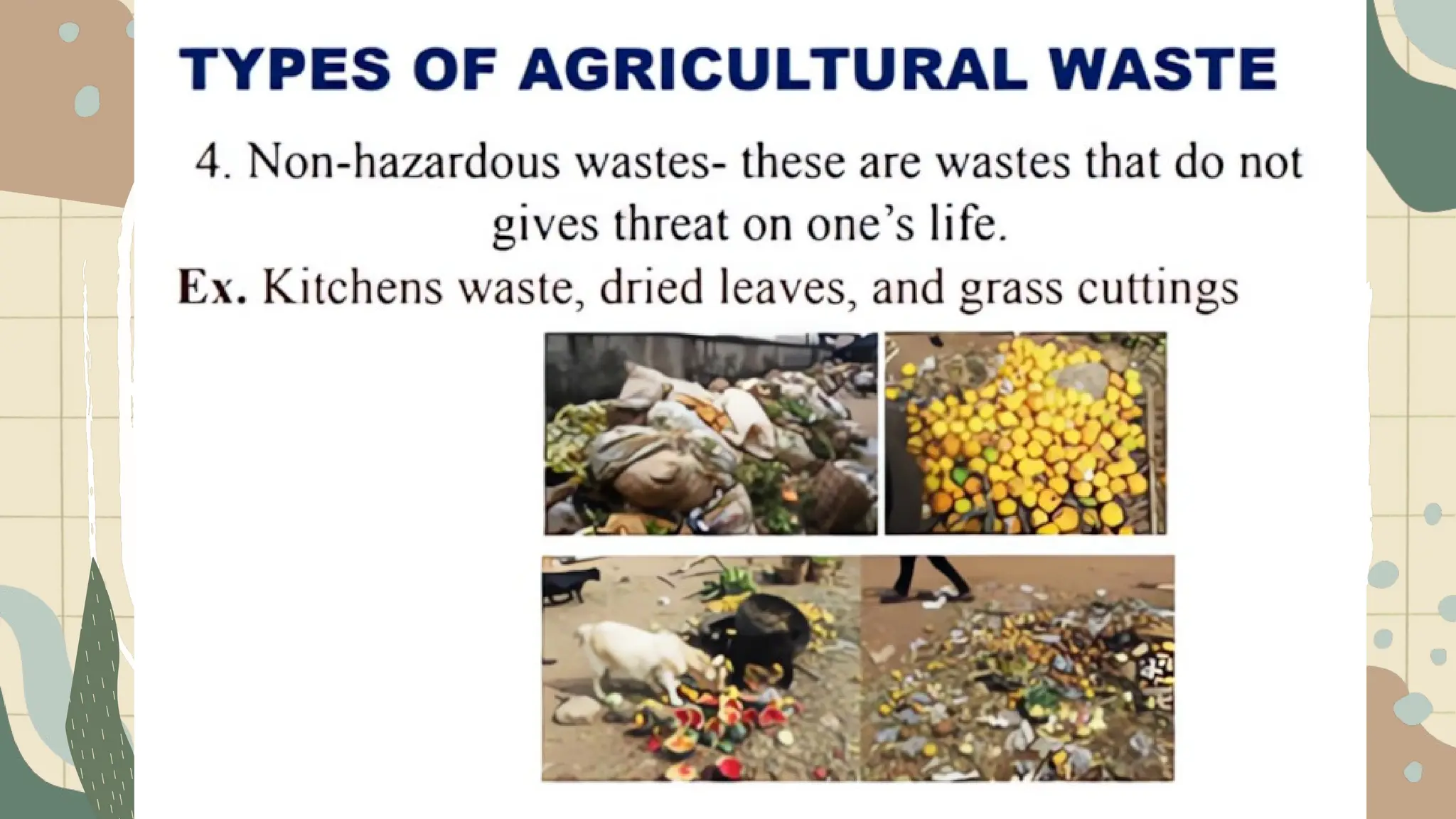
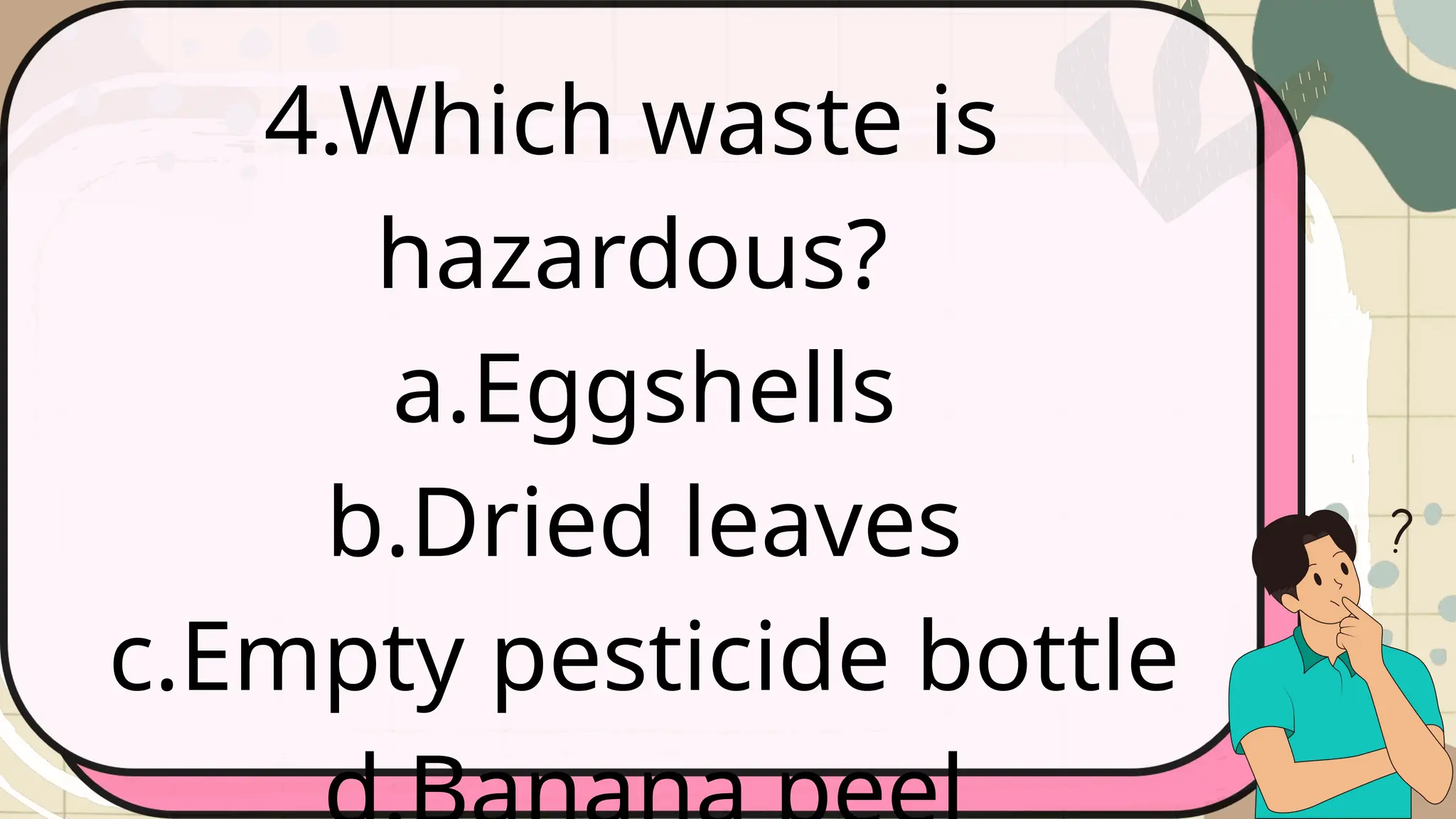
4.Which waste is
hazardous?
a.Eggshells
b.Dried leaves
c.Empty pesticide bottle
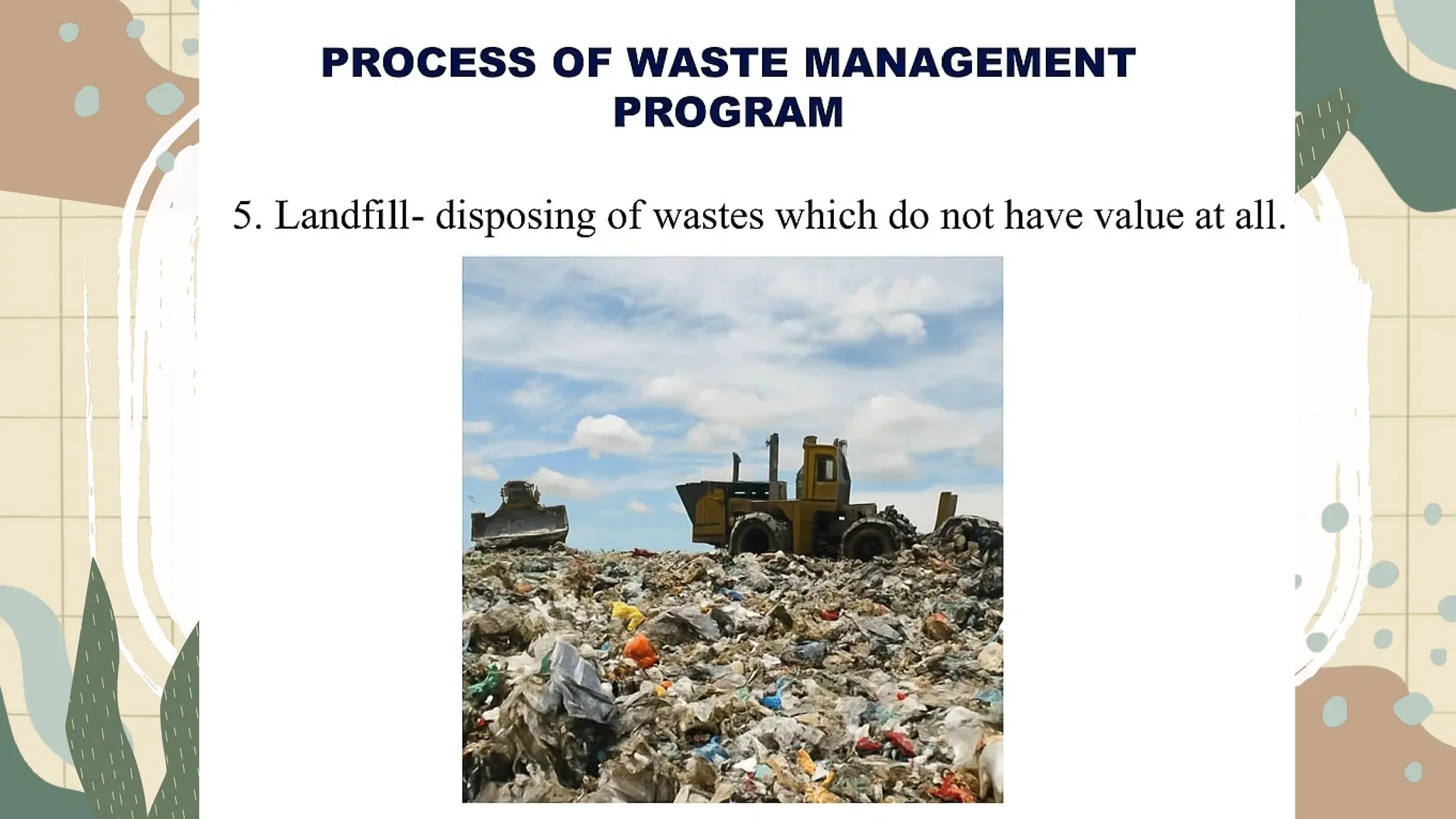
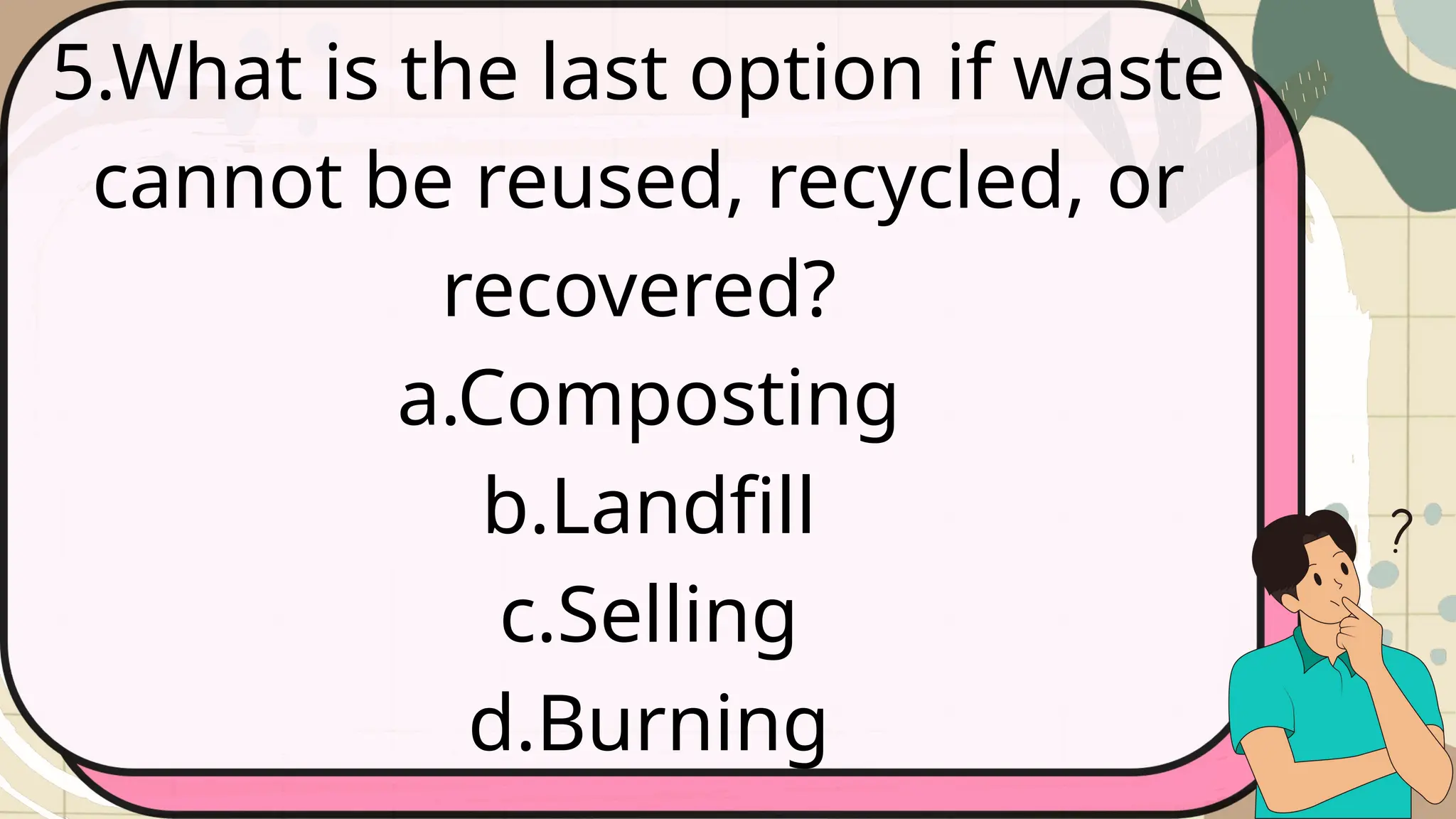
5.What is the last option if waste
cannot be reused, recycled, or
recovered?
a.Composting
b.Landfill
c.Selling
d.Burning
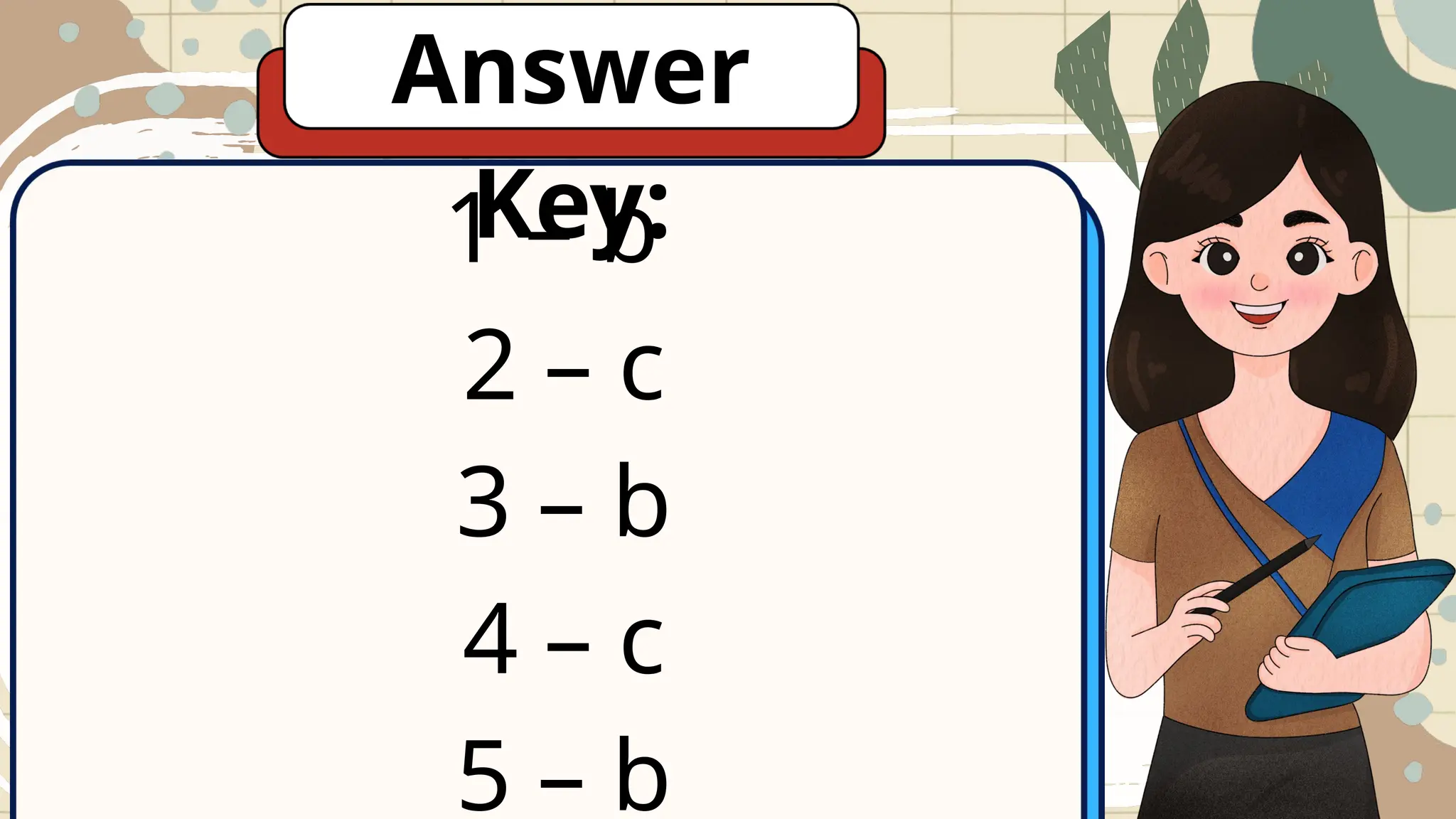
1 – b
2 – c
3 – b
4 – c
5 – b
Answer
Key:
THANK YOU

TLE 7 Q2 W4 COT-1 PowerPointpresentation