Tips for
Reading and Understanding
Legal Documents
This short presentation is designed to
visually reinforce the concepts related to
comprehension of legal documents.
We will start by referencing an actual case –
Brady vs. Maryland.
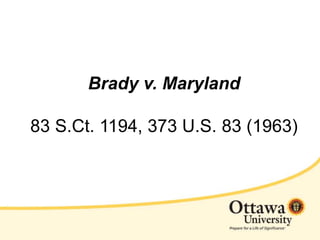
Brady v. Maryland
83 S.Ct. 1194, 373 U.S. 83 (1963)
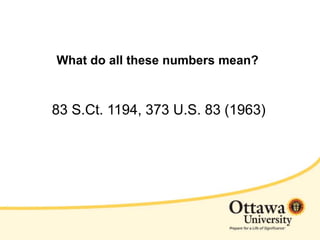
What do all these numbers mean?
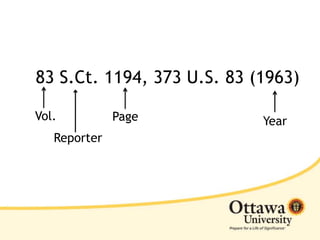
83 S.Ct. 1194, 373 U.S. 83 (1963)
Vol. Page
Reporter
Year
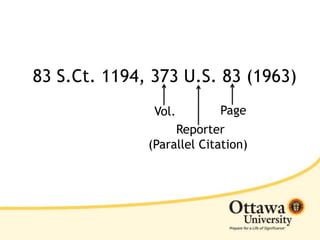
83 S.Ct. 1194, 373 U.S. 83 (1963)
Vol. Page
Reporter
(Parallel Citation)
Here are some examples. . .
Remember to master “legalese” too!
It’s not just numbers…
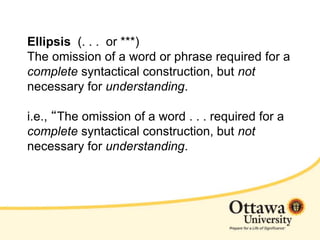
Ellipsis (. . . or ***)
The omission of a word or phrase required for a
complete syntactical construction, but not
necessary for understanding.
i.e., “The omission of a word . . . required for a
complete syntactical construction, but not
necessary for understanding.
Bracket [ ]
A pair of symbols used to enclose written or
printed material which has been changed from its
original writing or printing. i.e.,
For example, “[a] pair of symbols [which are] used
to [surround words] which ha[ve] been changed
from [their] original [format].”
Sic
Used in written texts to indicate that a
surprising or paradoxical word, phrase, or
fact is not a mistake and is to be read as it
stands.
i.e., “Holy s***! (sic),” exclaimed Sergeant
Furr, “Did you see what he wrote in that
report?”
Headnotes
A summary of the points decided in the case,
which are placed at the beginning of the report
(and refer to like-numbered sections in the body of
the case).
Note: You can not quote from headnotes.
Syllabus
A brief statement of the facts, combined
with the rulings of the court upon the point,
or points, decided in the case.
Note: Sometimes written by the court, but
usually written by a Westlaw attorney. You
can not quote from the syllabus.
Opinion
The official written statement by a judge or court of
the decision reached in regard to a cause tried or
argued before them, expounding the law as
applied to the case, and detailing the reasons
upon which the judgment is based.
Note: You can quote from any part of the opinion.
Understanding legal writing is not easy at
first, but it gets easier with practice.
Read a few case opinions, and refer to
these tips when needed!

Tips for Reading and Understanding Legal Documents

  • 1.
    Tips for Reading andUnderstanding Legal Documents
  • 2.
    This short presentationis designed to visually reinforce the concepts related to comprehension of legal documents. We will start by referencing an actual case – Brady vs. Maryland.
  • 3.
    Brady v. Maryland 83S.Ct. 1194, 373 U.S. 83 (1963)
  • 4.
    What do allthese numbers mean? 83 S.Ct. 1194, 373 U.S. 83 (1963)
  • 5.
    83 S.Ct. 1194,373 U.S. 83 (1963) Vol. Page Reporter Year
  • 6.
    83 S.Ct. 1194,373 U.S. 83 (1963) Vol. Page Reporter (Parallel Citation)
  • 7.
    Here are someexamples. . . Remember to master “legalese” too! It’s not just numbers…
  • 8.
    Ellipsis (. .. or ***) The omission of a word or phrase required for a complete syntactical construction, but not necessary for understanding. i.e., “The omission of a word . . . required for a complete syntactical construction, but not necessary for understanding.
  • 9.
    Bracket [ ] Apair of symbols used to enclose written or printed material which has been changed from its original writing or printing. i.e., For example, “[a] pair of symbols [which are] used to [surround words] which ha[ve] been changed from [their] original [format].”
  • 10.
    Sic Used in writtentexts to indicate that a surprising or paradoxical word, phrase, or fact is not a mistake and is to be read as it stands. i.e., “Holy s***! (sic),” exclaimed Sergeant Furr, “Did you see what he wrote in that report?”
  • 11.
    Headnotes A summary ofthe points decided in the case, which are placed at the beginning of the report (and refer to like-numbered sections in the body of the case). Note: You can not quote from headnotes.
  • 12.
    Syllabus A brief statementof the facts, combined with the rulings of the court upon the point, or points, decided in the case. Note: Sometimes written by the court, but usually written by a Westlaw attorney. You can not quote from the syllabus.
  • 13.
    Opinion The official writtenstatement by a judge or court of the decision reached in regard to a cause tried or argued before them, expounding the law as applied to the case, and detailing the reasons upon which the judgment is based. Note: You can quote from any part of the opinion.
  • 14.
    Understanding legal writingis not easy at first, but it gets easier with practice. Read a few case opinions, and refer to these tips when needed!