CST-20363-Intro-to-CS
Session 1.1
“something called
Computer Science”
“The computer was born to solve problems
that did not exist before.”
— Bill Gates
Computers and software
are changing everything…
…but the majority of schools don’t
teach computer science
Source: Access Report
Source:
Change the Equation
Even when students enjoy computer
science and the arts the most
Our students should
learn to code…
Some may think:
Our students should
learn to code…
Our schools should teach
computer science
Computer science is just
about learning technology
Some may think:
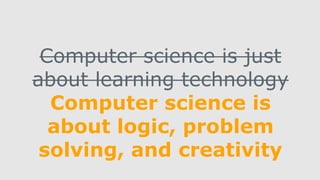
Computer science is just
about learning technology
Computer science is
about logic, problem
solving, and creativity
First computer: 1943
Ada Lovelace
First computer program: 1843
Computer science is
vocational
Some may think:
Computer science is
vocational
Computer science is
foundational
Technology affects every field
Every 21st century student should
have a chance to learn about
algorithms, how to make apps,
and how the internet works.
The tech industry is
desperately trying to hire
computer programmers in
U.S
Some may think:
The tech every industry is
desperately trying to hire
computer programmers in
U.S. worldwide
believe offering computer science is more or
equally as important as any required course.
83% of parents and 64% of
principals in rural and small towns
Source: Brookings
The value of a computer science
education
500,000 current
openings:
These jobs are in
every industry and
every state, and
they’re projected to
grow at twice the rate
of all other jobs.
Computing jobs are the #1 source
of new wages in the United States
This problem is
about “STEM”
(Science, Technology,
Engineering, and Math)…
Some may think:
Sources: Bureau of Labor Statistics, National Center for Education Statistics
The STEM problem is in computer
science
Our state policies can
help fix this picture…
Only 37 states have
created computer
science standards.
Momentum is building,
but we still have a
long way to go.
States with CS
standards
States without CS
standards
The state of computer
science standards
Source: Access Report
But fundamentally, this is the
picture we need to solve
CST-20363-Session 1.1-Something Called CS

CST-20363-Session 1.1-Something Called CS

Editor's Notes

  • #3 Let’s talk about getting computer science But let’s start by talking about dreams Opportunities for you Opportunities for your community And most importantly, an opportunity to create something The beauty of computer science is that imagination and creation lie at the heart of the field This smart phone I have here or the laptop driving this presentation are innovation platforms They allow dreamers, idealists and entrepreneurs anywhere in world to bring their ideas into reality IF they know how to write the software that drives our modern world
  • #4 But the reality of our education system today is that it is not set up for everyone to participate in the new American economy and opportunity Computer science isn’t widely taught in our schools A recently released comprehensive Gallup survey of parents and school administrators shows the stark gap between what parents want and what is happening in our schools 9 out of 10 parents surveyed WANT their child to learn computer science But according to our Access Report, just 45% of high schools teach computer science courses Our education system clearly needs to evolve to bring computer science to students that want to learn this subject And this evolution isn’t something the tech industry wants, it is clearly something that parents and students want
  • #6 Let’s address a few misconceptions and themes we consistently hear from our advocacy for students across the country The first is that we should be teaching our kids to code
  • #7 Our view is that schools should be teaching computer science Coding is an important TOOL for computer science but it is a bit like arithmetic is a TOOL for doing mathematics, and words are a TOOL for English Coding creates software, but computer science is a broad field encompassing deep concepts that go well beyond coding. And all students should have access to computer science courses in their schools.
  • #8 When people hear the term computer science, they often simply think of the technology it creates What they don’t realize is that the beauty of computer science lies in the process to create that technology
  • #9 The reality is that computer science is about logic, problem solving, and creativity It teaches students how to think differently about problems they are trying to solve in any context It teaches kids how to create digital artifacts and how those artifacts impact the world around them by looking at issues such as privacy and security A very simple way to think about this is CS teaches kids how to CREATE new technologies instead of just being consumers of technology Just as important as recognizing what computer science is, is recognizing what it is not It is not basic HTML design, it is not learning to use applications or a photoshop course Many of these thing CAN be part of a computer science course, but they are not the foundation of the curriculum We can do better than simple technology literacy – we can make kids creators of technology
  • #10 For example, consider the fact that the first computer was built in 1943….
  • #11 …but the first computer program was written in 1843, by Ada Lovelace. Writing a computer program is about using logic to creatively solve a problem... Not just about the technology that carries out that program.
  • #12 We hear a lot about the number of computing jobs in the US economy And many view computer science as simply vocational, That learning computer science is just about getting a great job
  • #13 The right way to think about computer science in our education system is that it is foundational
  • #14 The reality is that technology affects every field of commerce In healthcare – computing is part of operating rooms every day and it is enabling breakthroughs like these contact lenses that detect levels of insulin for people with diabetes In space – we are depending on a generation of robots to explore where humans cannot now In our homes -- we are automating everyday things like our heating systems On our roads – we depend on navigation systems to get us home and now we are experimenting with bringing self-driving cars into our everyday lives In entertainment – blockbuster movies depend on computer science to bring new characters to life and provide us new completely animated worlds And every single day this trend is growing across every single industry
  • #15 So let’s take a little audience pop-quiz How many of you can answer these questions? What is photosynthesis? Or what is H2O? These are all things that we expect kids to graduate high school knowing Every 21st century student should also have a chance to learn about algorithms, how to make an app, or how the internet works. Right now there’s no expectation in our schools that students will even have a basic understanding of these concepts, even though they are driving a large part of our society. It is equally important that students understand what a “for loop” is and how it is used and how to design algorithms is as it is that they understand how to solve an equation or how plants live The main reason that computer science is now foundational knowledge necessary in every school is because it will allow students to think about problems differently Students will gain computational thinking skills, which embody a more robust way to think about problems And the problem solving process can be applied to any field of study and to any problem If you are facing a big, ambiguous project at home or at work, computational thinking and problem solving processes can help you break this problem into smaller chunks. Recognizing what’s important and what needs to be solved first are critical thinking skills that are valuable in ANY context
  • #16 There’s a temptation to think that this is only about the IT industry That only Google, Microsoft, Facebook, Twitter are participating in this new opportunity
  • #17 But in fact, computer programmers are needed in every industry and across the country. So what will a career look like in 2030? It will be a workforce that is very data driven, that leverages technology to bring new ideas into the marketplace Employers will need workers that understand not only how to use technology, but how to create and manipulate it Just being facile with technology will NOT be enough Simply put, our students will need to be innovators and creators And to do this they need opportunities to learn CS
  • #18 When giving this presentation, update the stats and localize to wherever you’re presenting using data from fact-sheets at http://code.org/promote
  • #20 A computer science major can earn 40% more than the college average.
  • #21 And there are job openings across all industries and in every state. There are more than 500,000 open jobs in computing right now, representing the #1 source of new wages in the United States, and these jobs are projected to grow at twice the rate of all other jobs.
  • #22 Everywhere from the President of the US to local school boards have identified STEM education as a major issue in facing the US
  • #23 What I’d suggest is that we have a major computer science problem when it comes the alignment between access to K-12 CS science education and opportunities in our modern economy. This chart shows the projected STEM jobs in our US economy broken out by computing jobs and all other STEM jobs And this chart shows students graduating with STEM degrees broken out by CS versus all other math/science subjects These graphs generally speak for themselves – we clearly have a disconnect in our education system
  • #24 Often, the reason that students don’t take computer science is that they don’t have access to it. We need to think differently about the diversity problem in tech And that needs to start with exposing all students early on to CS, by starting in the FORMAL education space
  • #26 Education today has numerous controversial topics But computer science isn’t one of them At a time that we are fighting about what should or shouldn’t be taught in our schools, 90% of parents are asking for computer science in their schools We have momentum We have grassroots support What we need now is schools to put two things into place: First, high-quality, rigorous curriculum and courses Second, we need to prepare teachers to teach our students We need states to launch initiatives build on these two goals and focused on improving access to CS education