Relevance and meaning: Interplay
between objective and subjective
Timo Honkela
Aalto University
(former Helsinki University of Technology)
Department of Information and Computer Science
Cognitive Systems research group
Professori Kalervo Järvelinin 60-vuotisjuhlaseminaari 30.8.2013
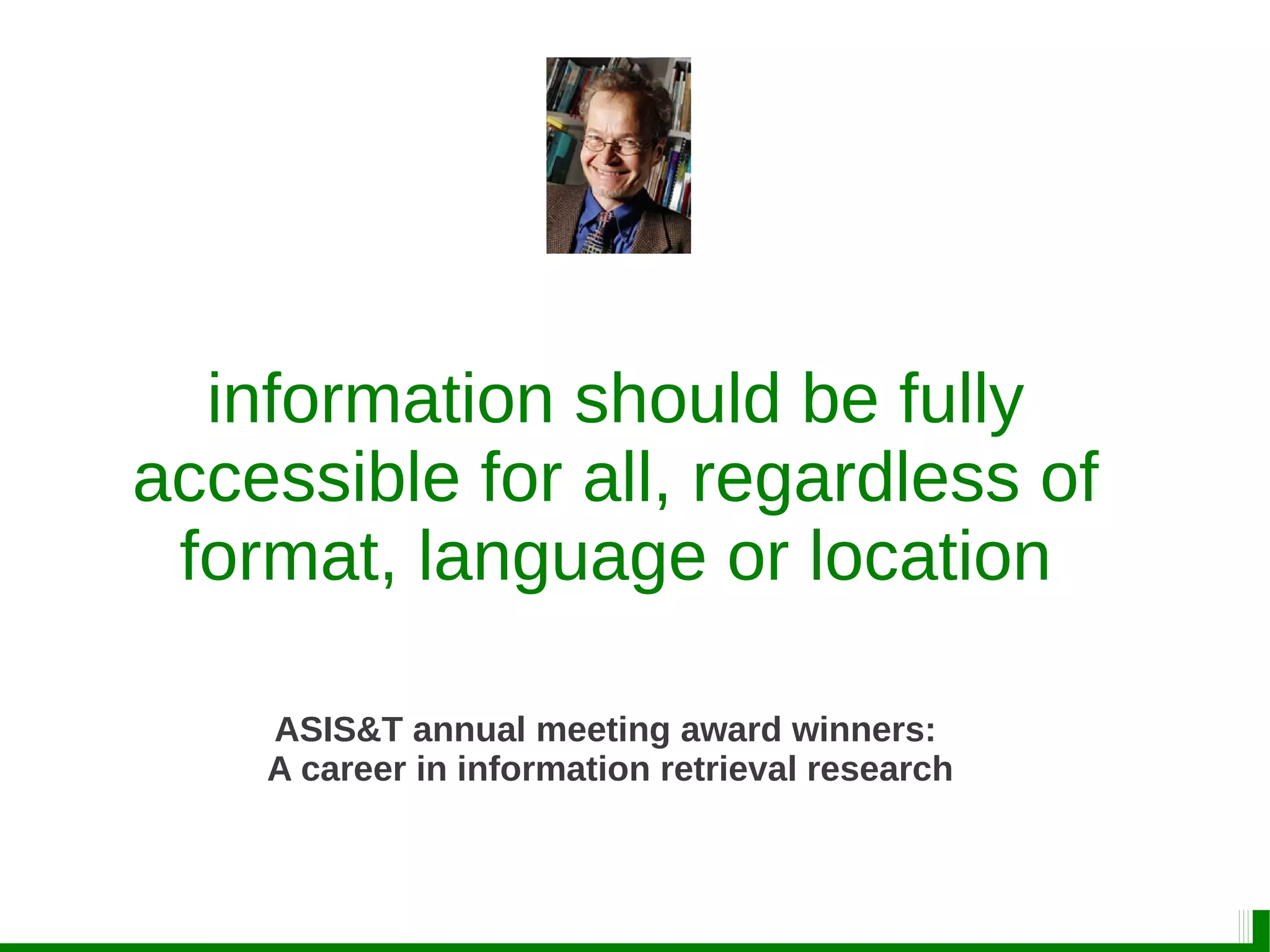
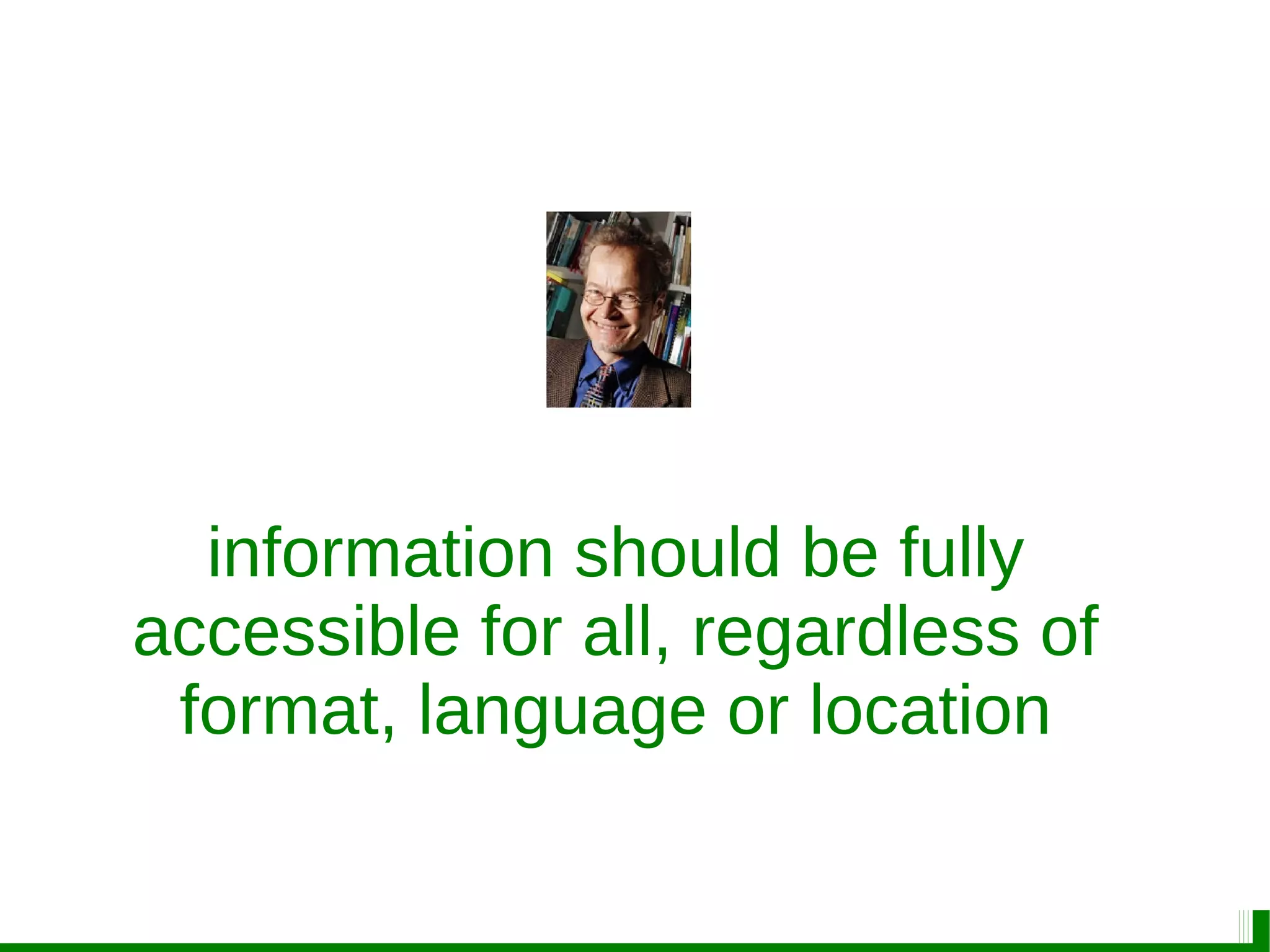
information should be fully
accessible for all, regardless of
format, language or location
ASIS&T annual meeting award winners:
A career in information retrieval research
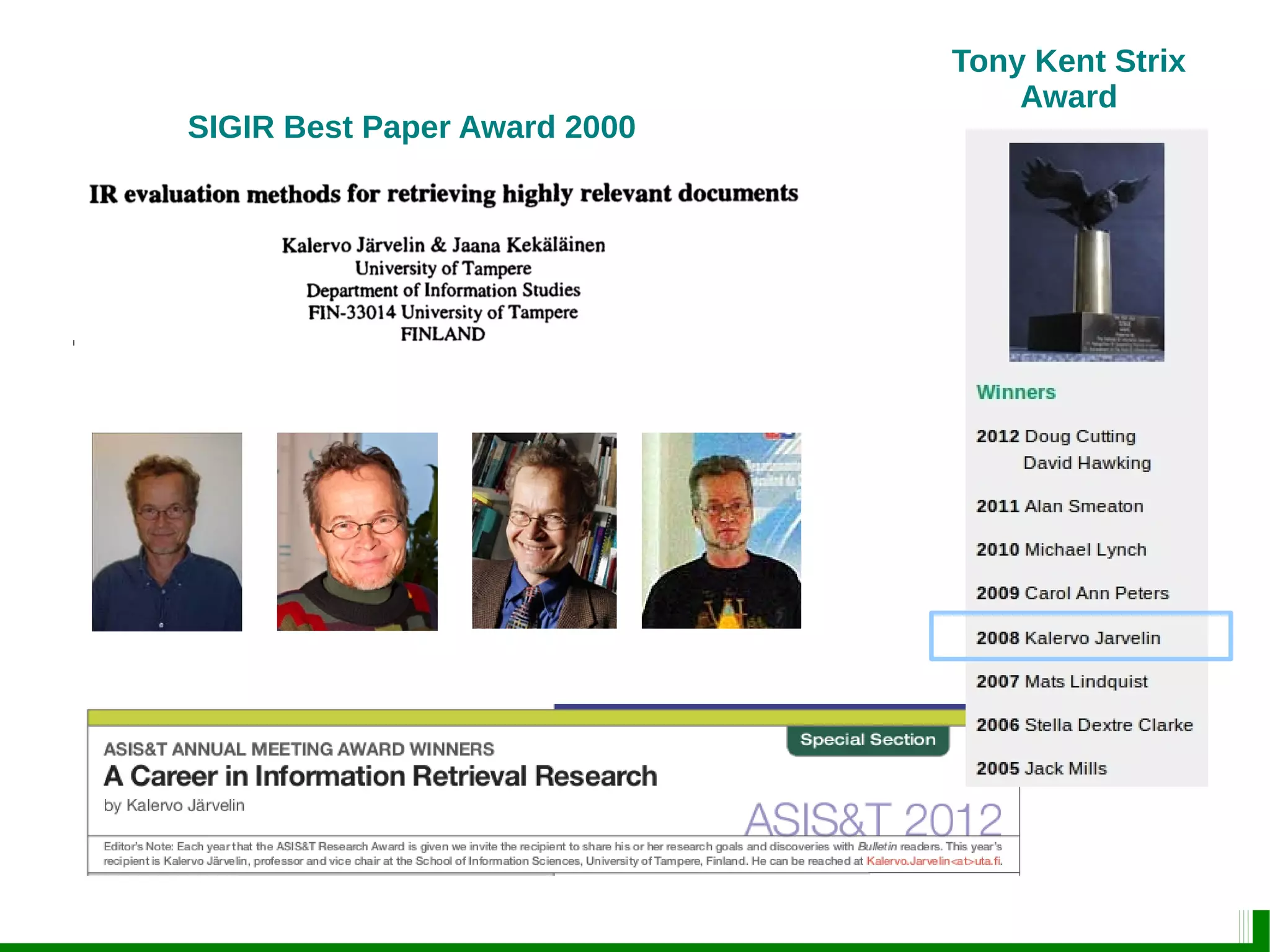
SIGIR Best Paper Award 2000
Kalervo Järvelin & Jaana Kekäläinen:
IR evaluation methods for retrieving
highly relevant documents.
Tony Kent Strix
Award
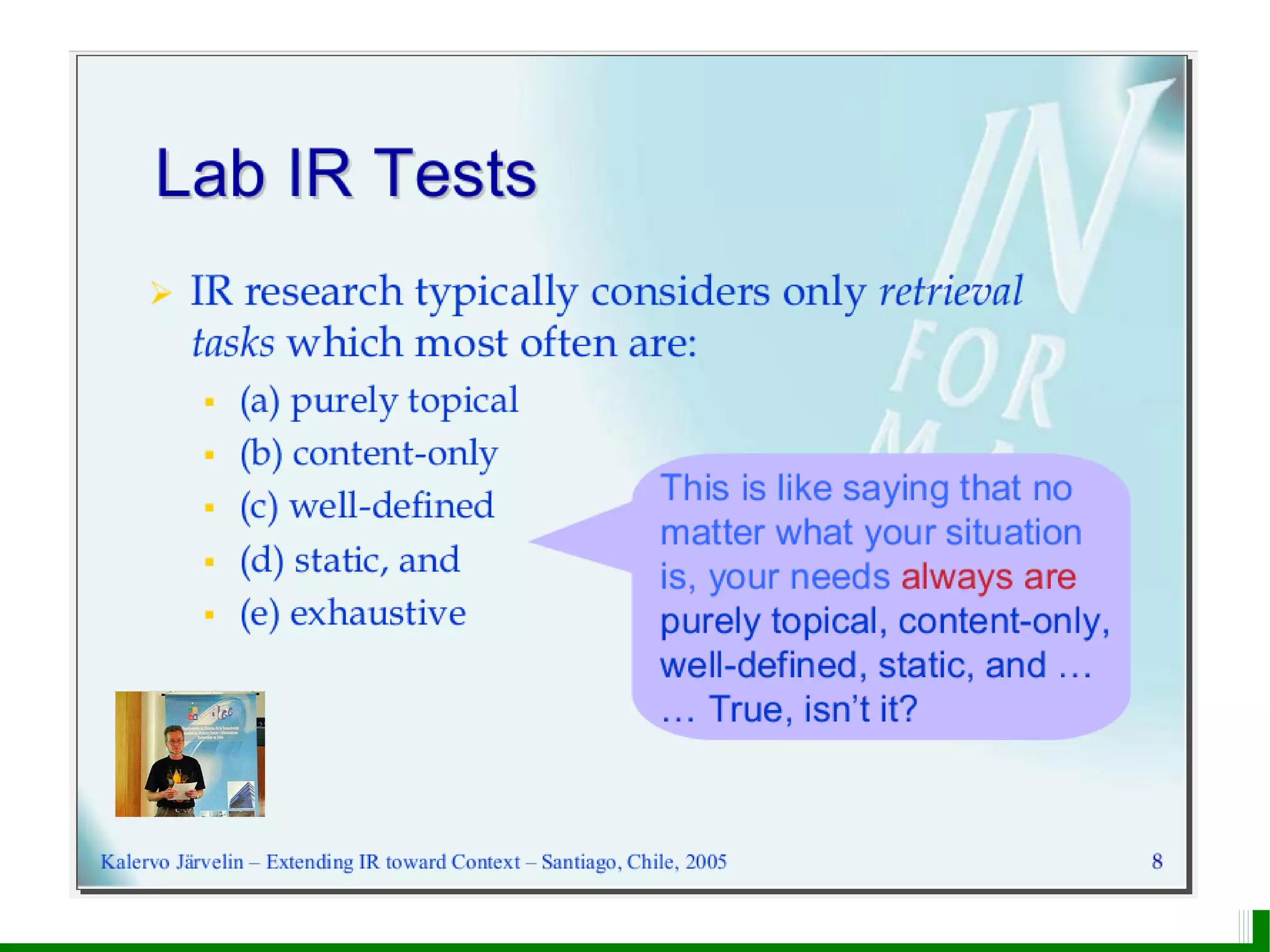
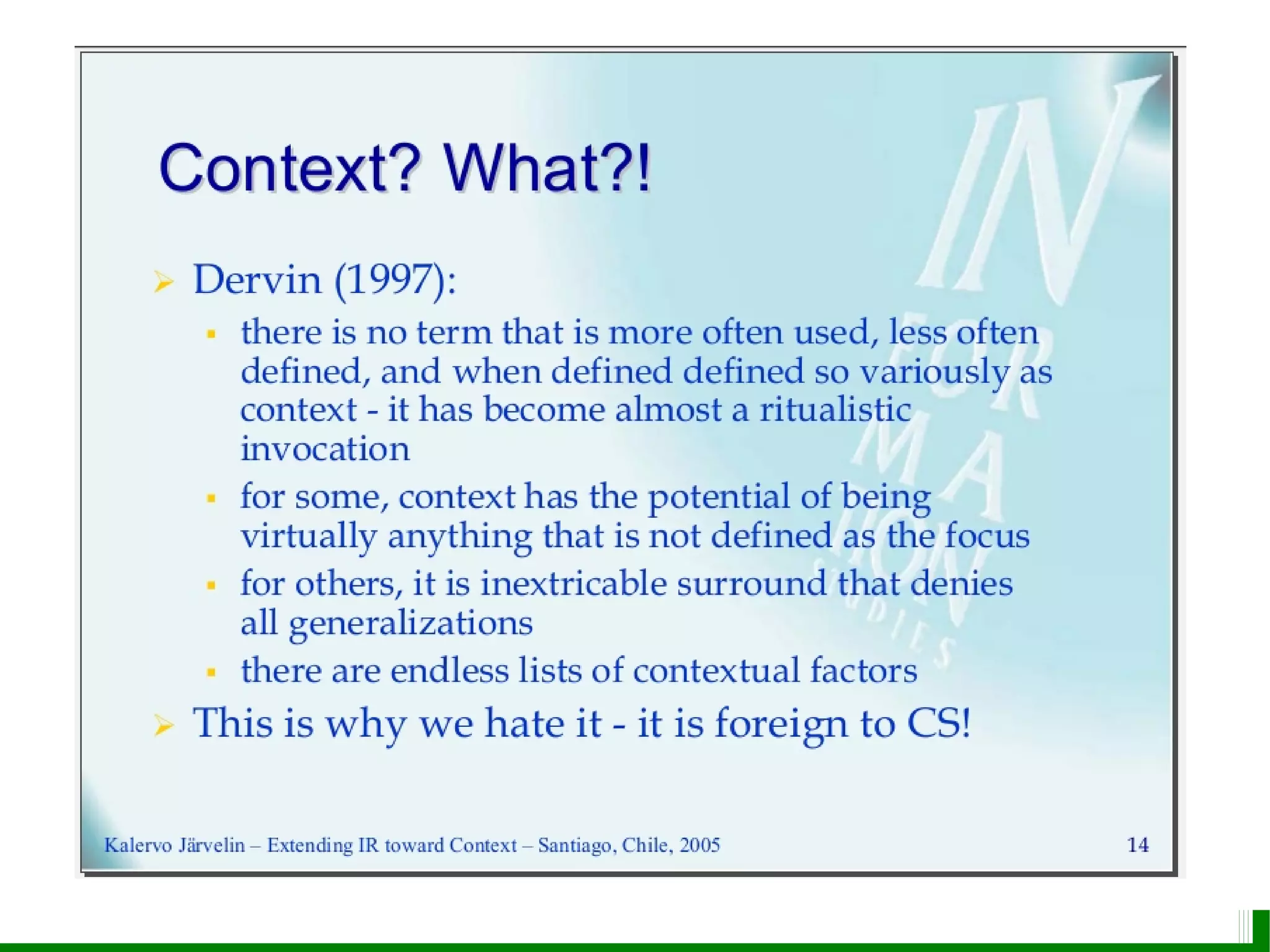
Each individual user has
a different cognitive composition
and behavioral disposition.
Users vary according to all sorts of factors including
how much they know about particular topics,
how motivated they are to search,
how much they know about searching,
how much they know about the particular work or
search task they need to complete, [...]
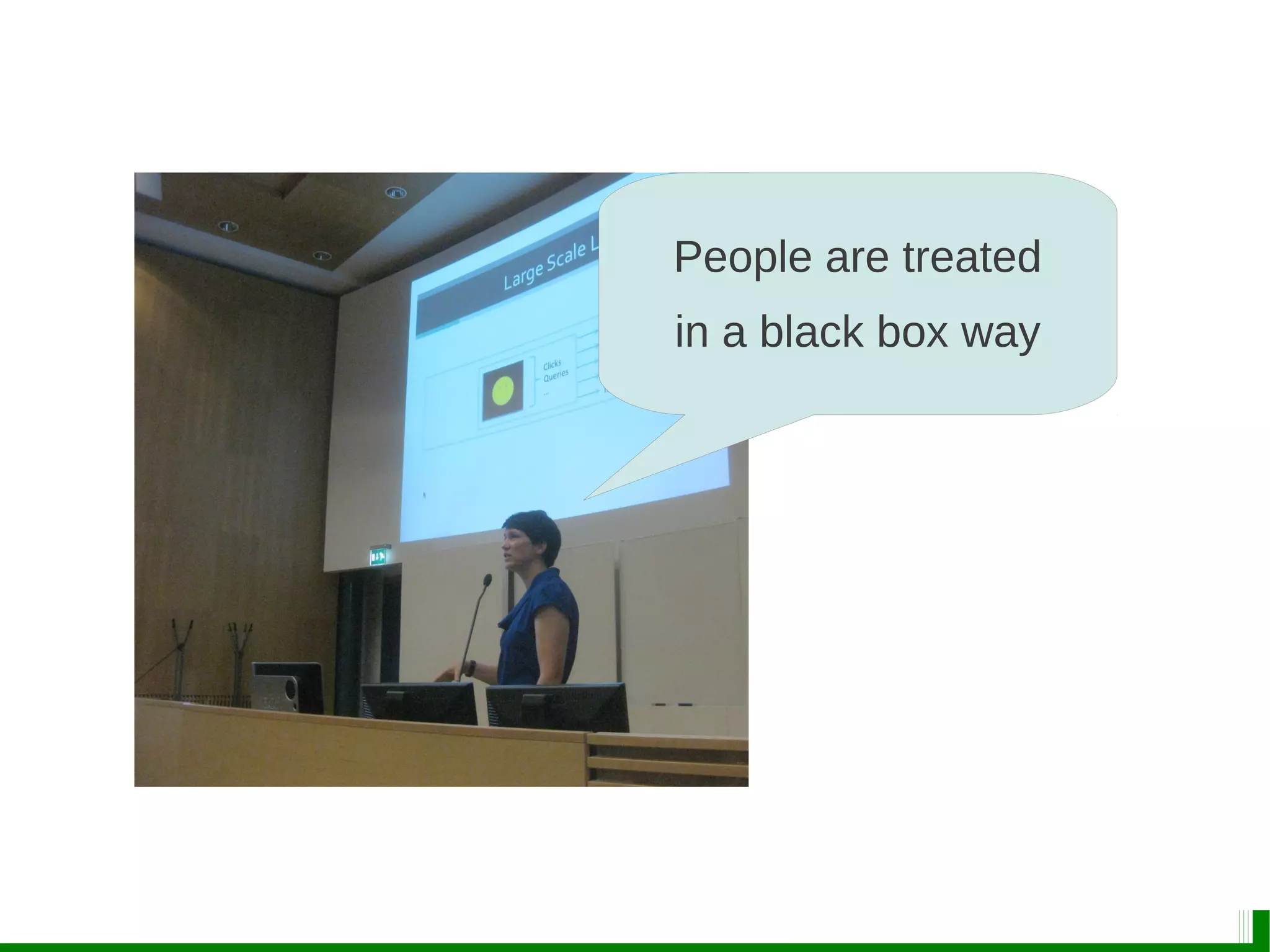
Kelly (2009):
People are treated
in a black box way
A side step
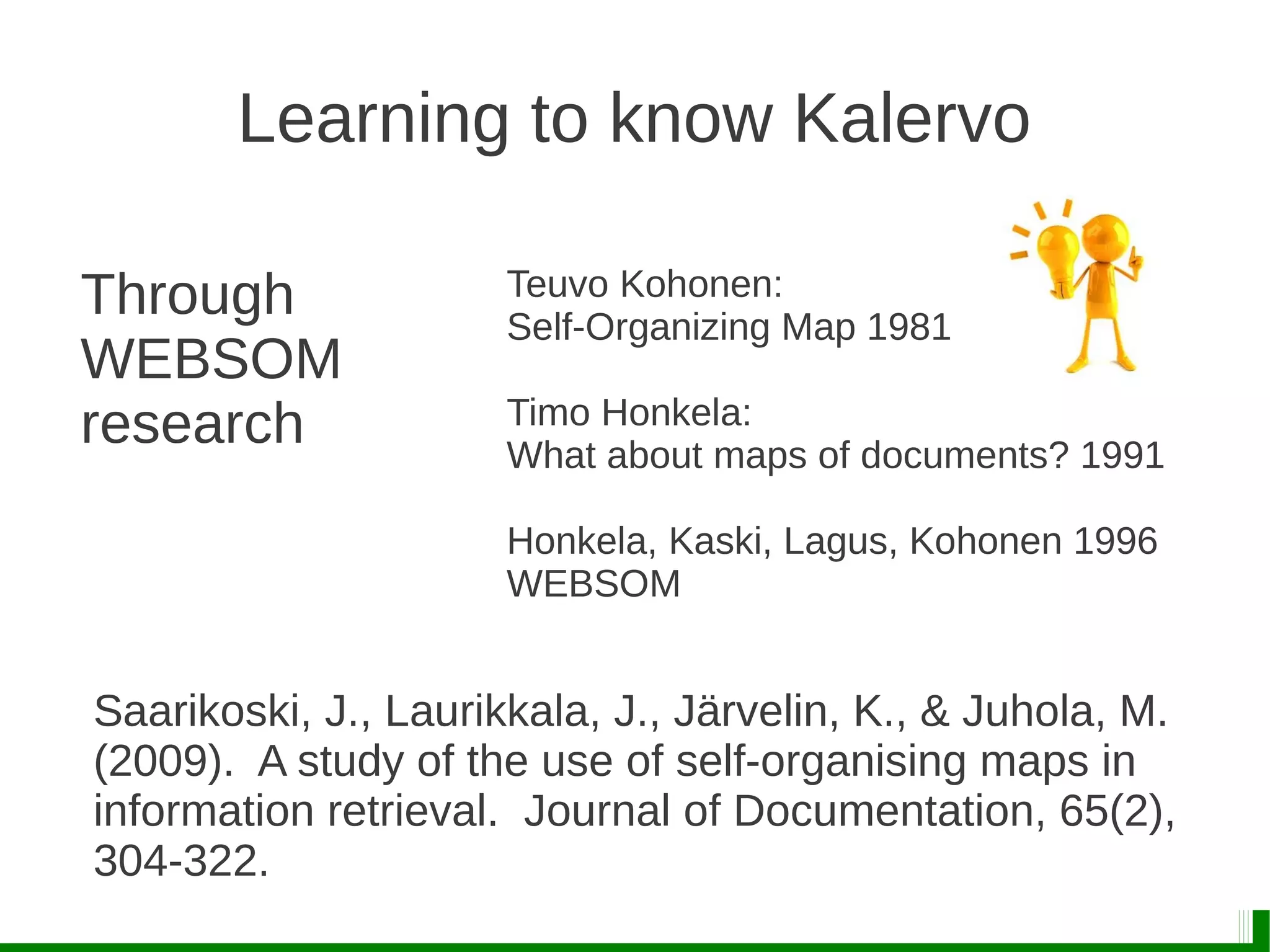
Learning to know Kalervo
Through
WEBSOM
research
Teuvo Kohonen:
Self-Organizing Map 1981
Timo Honkela:
What about maps of documents? 1991
Honkela, Kaski, Lagus, Kohonen 1996
WEBSOM
Saarikoski, J., Laurikkala, J., Järvelin, K., & Juhola, M.
(2009). A study of the use of self-organising maps in
information retrieval. Journal of Documentation, 65(2),
304-322.
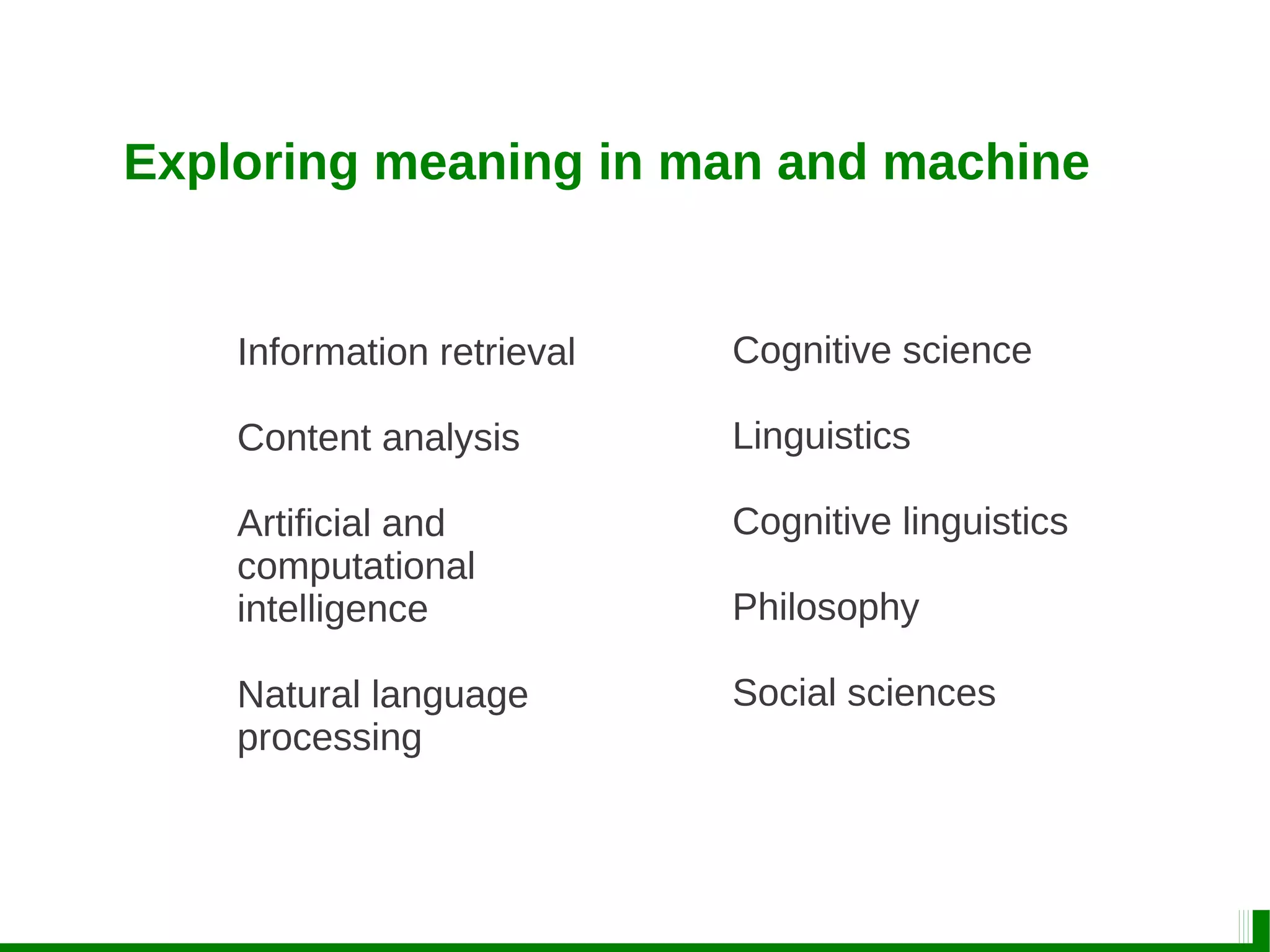
Exploring meaning in man and machine
Information retrieval
Content analysis
Artificial and
computational
intelligence
Natural language
processing
Cognitive science
Linguistics
Cognitive linguistics
Philosophy
Social sciences
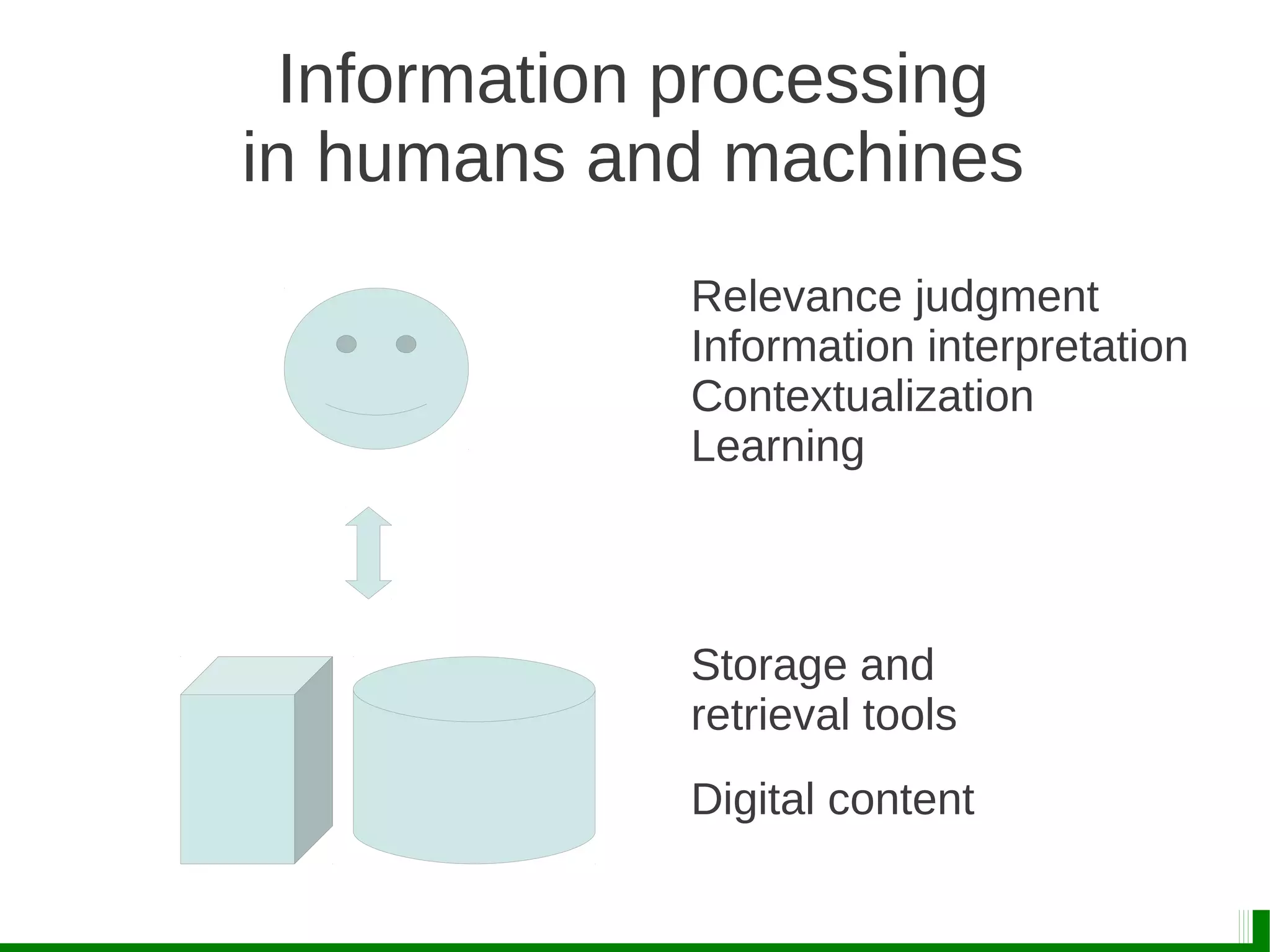
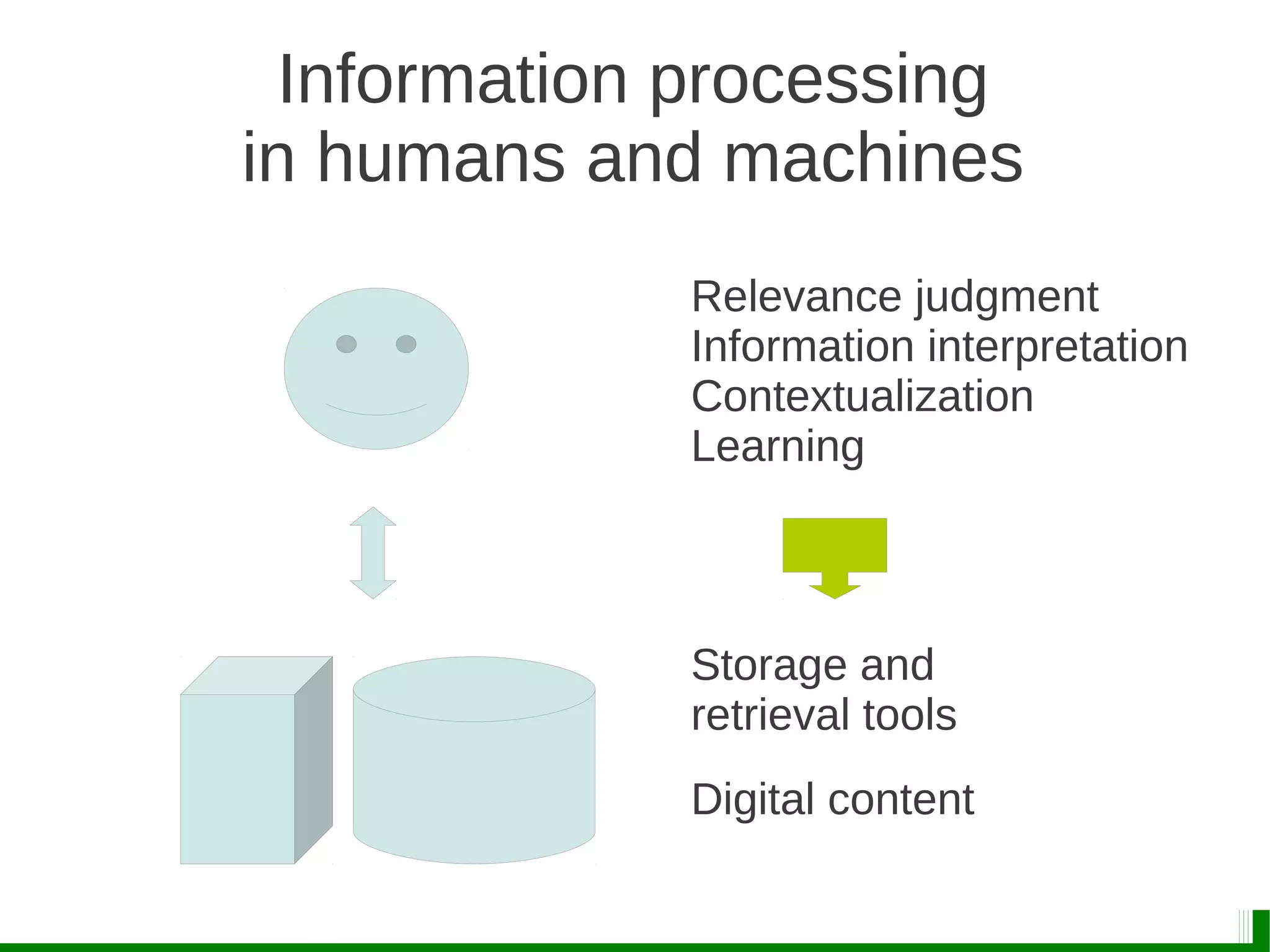
Information processing
in humans and machines
Digital content
Storage and
retrieval tools
Relevance judgment
Information interpretation
Contextualization
Learning
Information processing
in humans and machines
Digital content
Storage and
retrieval tools
Relevance judgment
Information interpretation
Contextualization
Learning
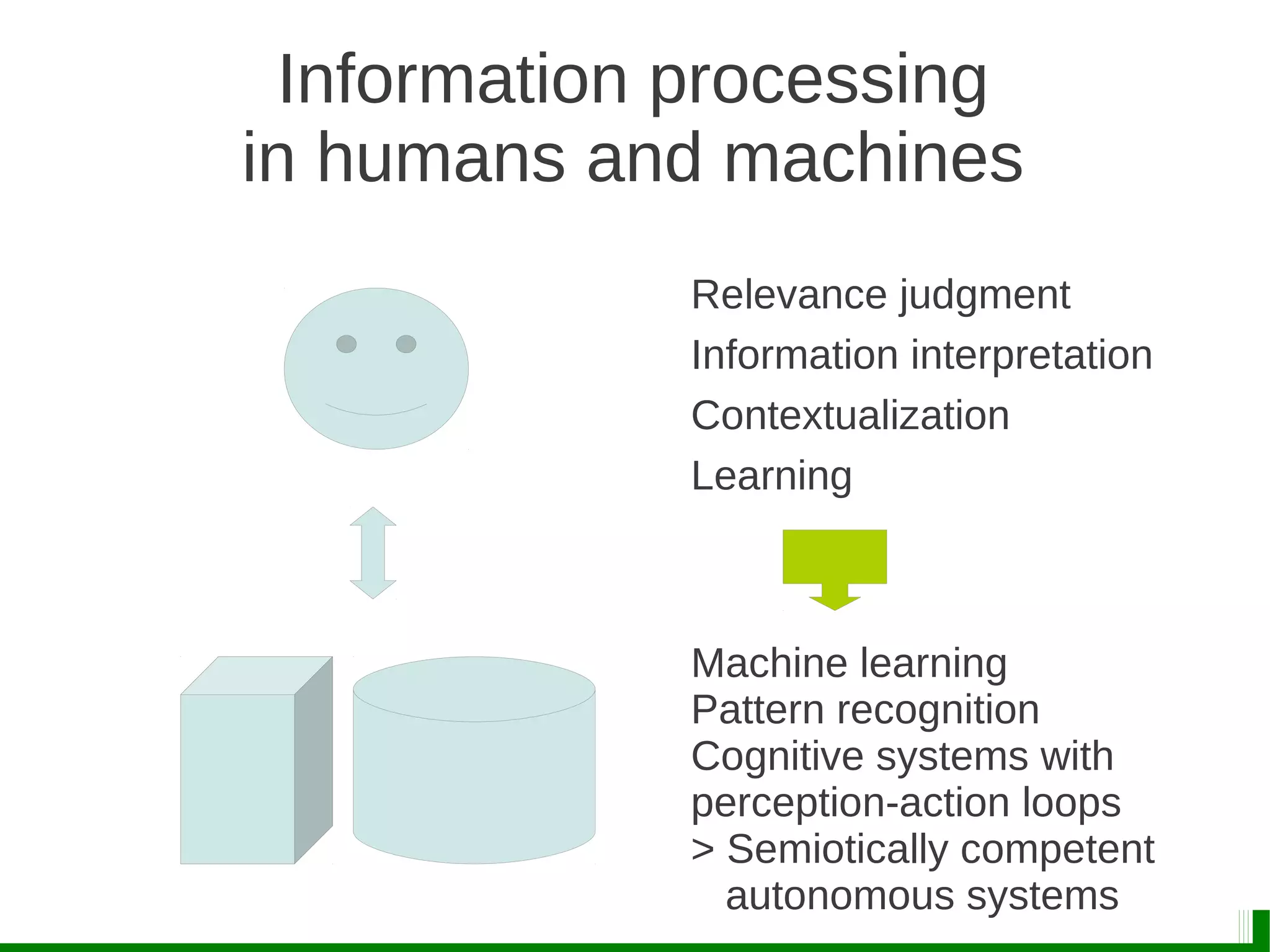
Information processing
in humans and machines
Machine learning
Pattern recognition
Cognitive systems with
perception-action loops
> Semiotically competent
autonomous systems
Relevance judgment
Information interpretation
Contextualization
Learning
Steps towards
human-like
content analysis
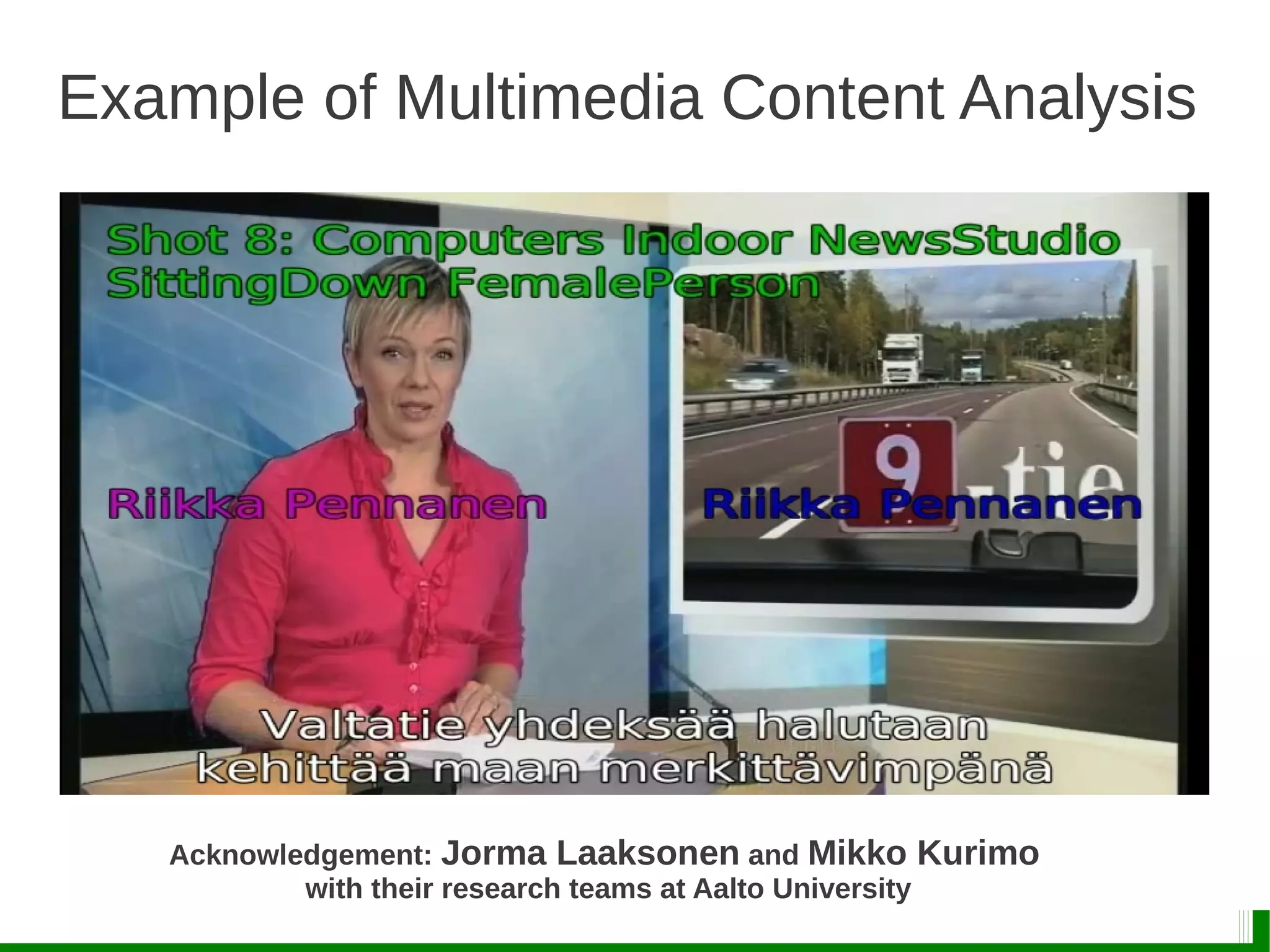
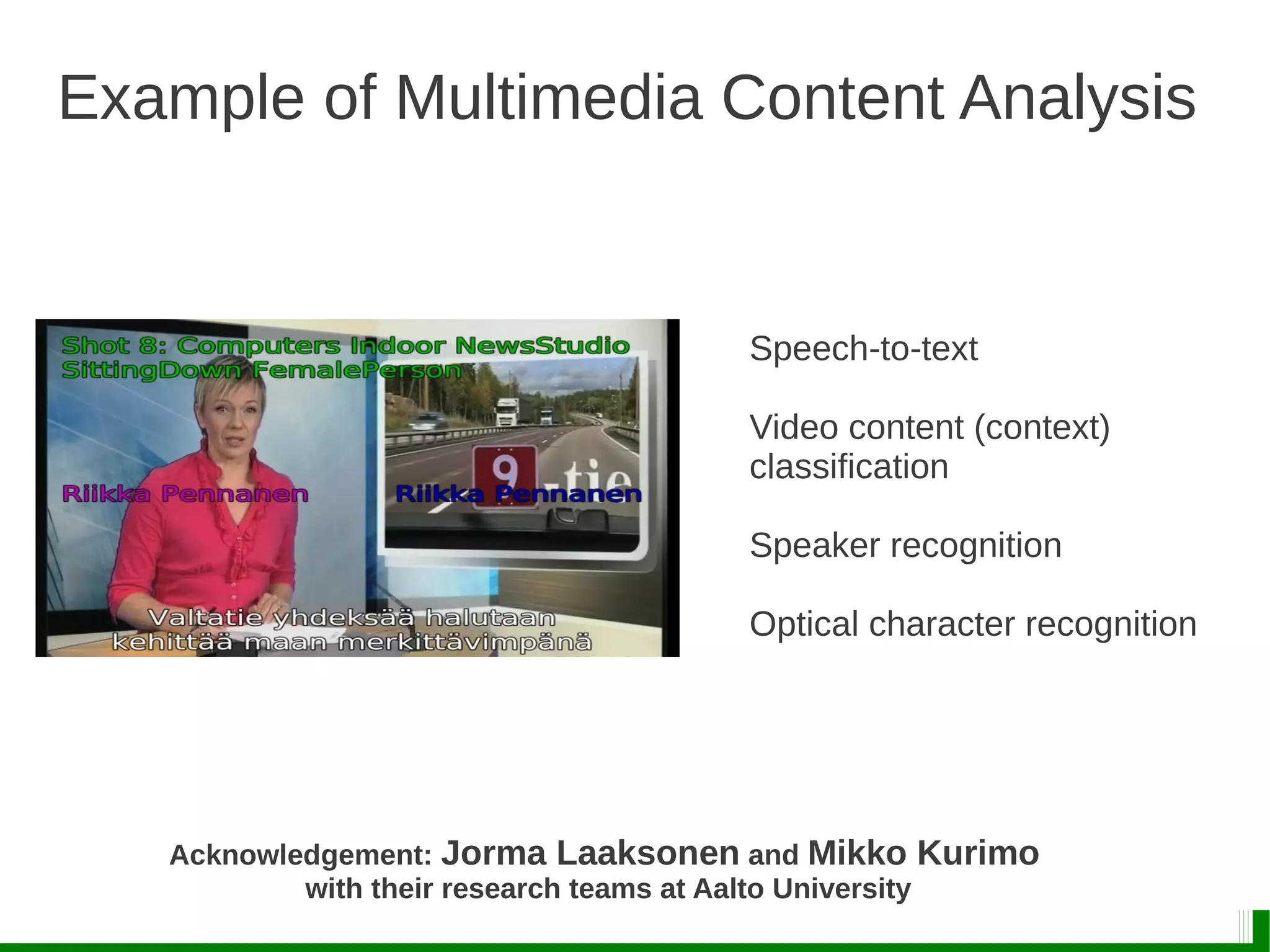
Example of Multimedia Content Analysis
Acknowledgement: Jorma Laaksonen and Mikko Kurimo
with their research teams at Aalto University
Example of Multimedia Content Analysis
Acknowledgement: Jorma Laaksonen and Mikko Kurimo
with their research teams at Aalto University
Speech-to-text
Video content (context)
classification
Speaker recognition
Optical character recognition
Being-in-the-world:
Perception and
Movement
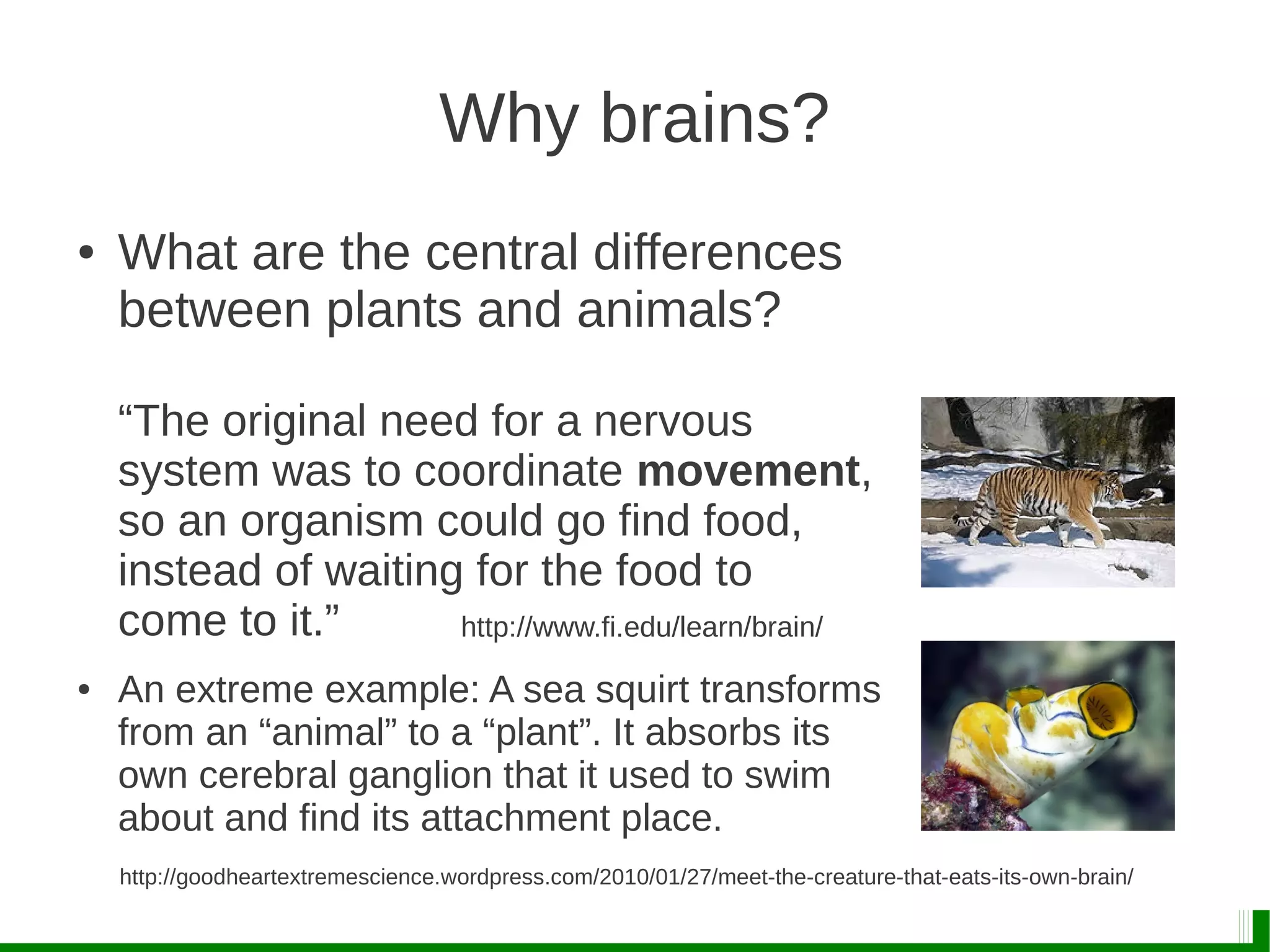
Why brains?
● What are the central differences
between plants and animals?
“The original need for a nervous
system was to coordinate movement,
so an organism could go find food,
instead of waiting for the food to
come to it.”
● An extreme example: A sea squirt transforms
from an “animal” to a “plant”. It absorbs its
own cerebral ganglion that it used to swim
about and find its attachment place.
http://goodheartextremescience.wordpress.com/2010/01/27/meet-the-creature-that-eats-its-own-brain/
http://www.fi.edu/learn/brain/
Point of view from
cognitive linguistics
● The meaning of linguistic symbols in the mind of the
language users derives from the users' sensory
perceptions, their actions with the world and with each
other.
● For example: the meaning of the word 'walk' involves
● what walking looks like
● what it feels like to walk and after having walked
● how the world looks when walking
(e.g. objects approach at a certain speed, etc.).
● ...
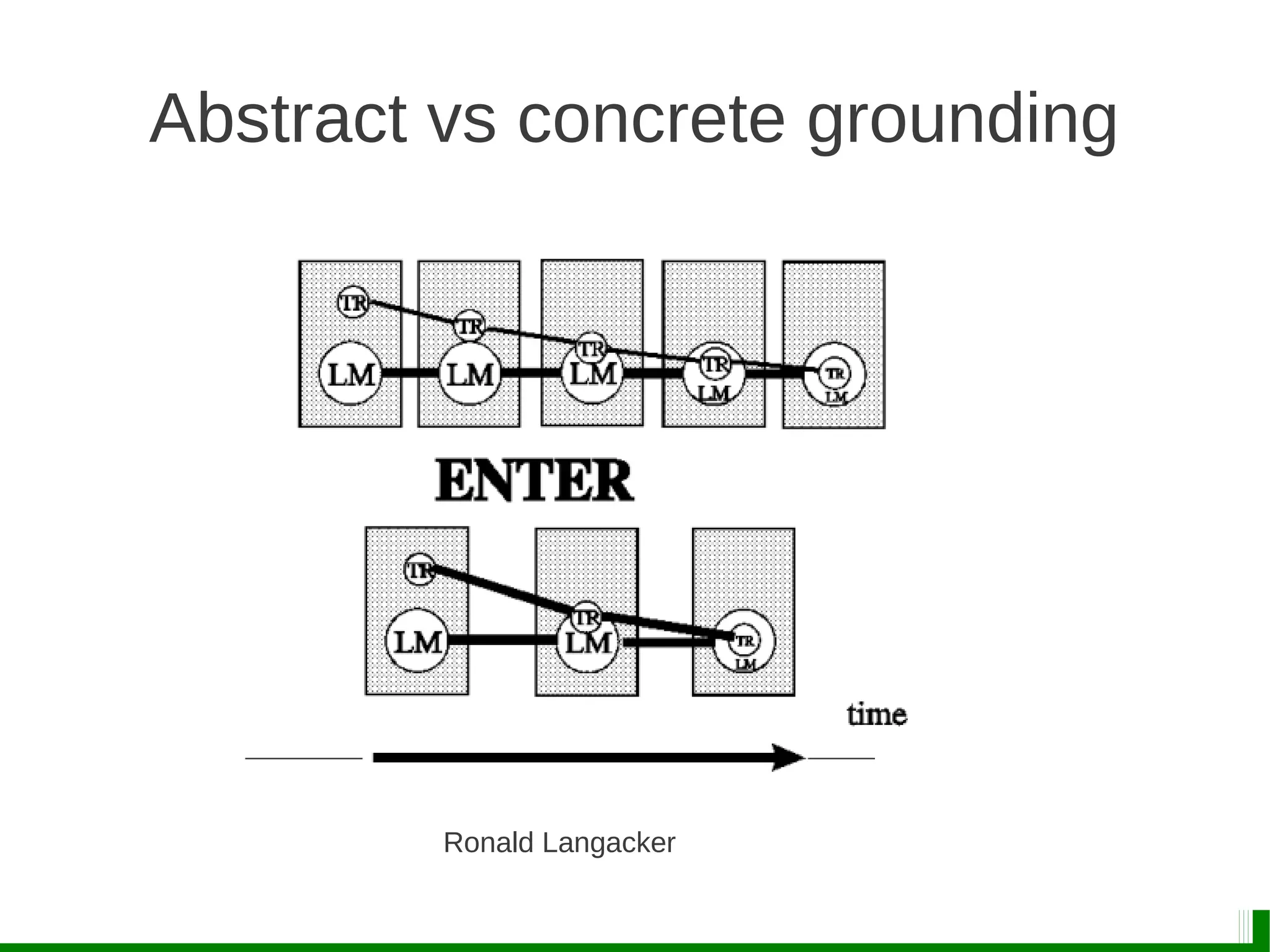
Abstract vs concrete grounding
Ronald Langacker
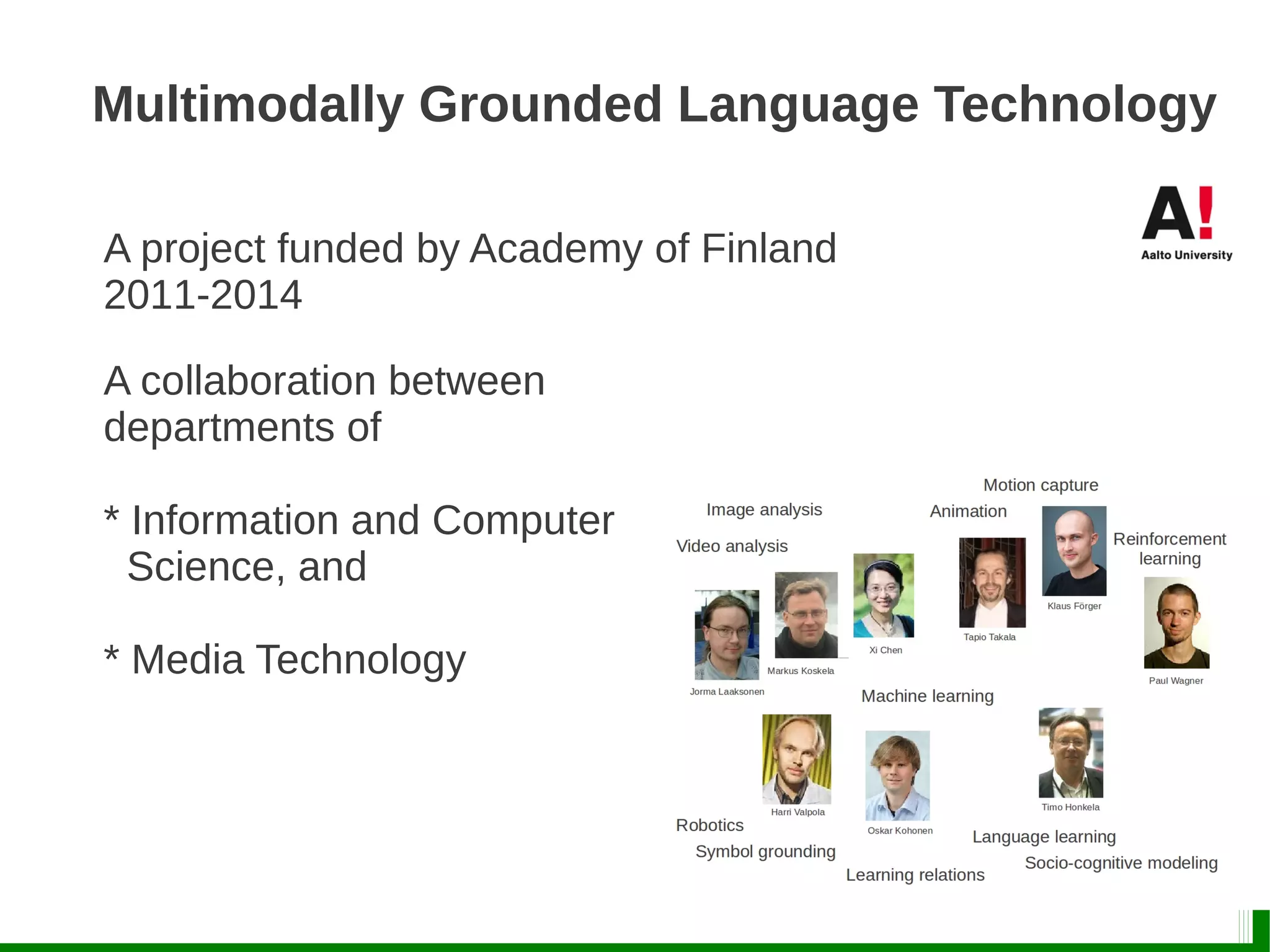
Multimodally Grounded Language Technology
A project funded by Academy of Finland
2011-2014
A collaboration between
departments of
* Information and Computer
Science, and
* Media Technology
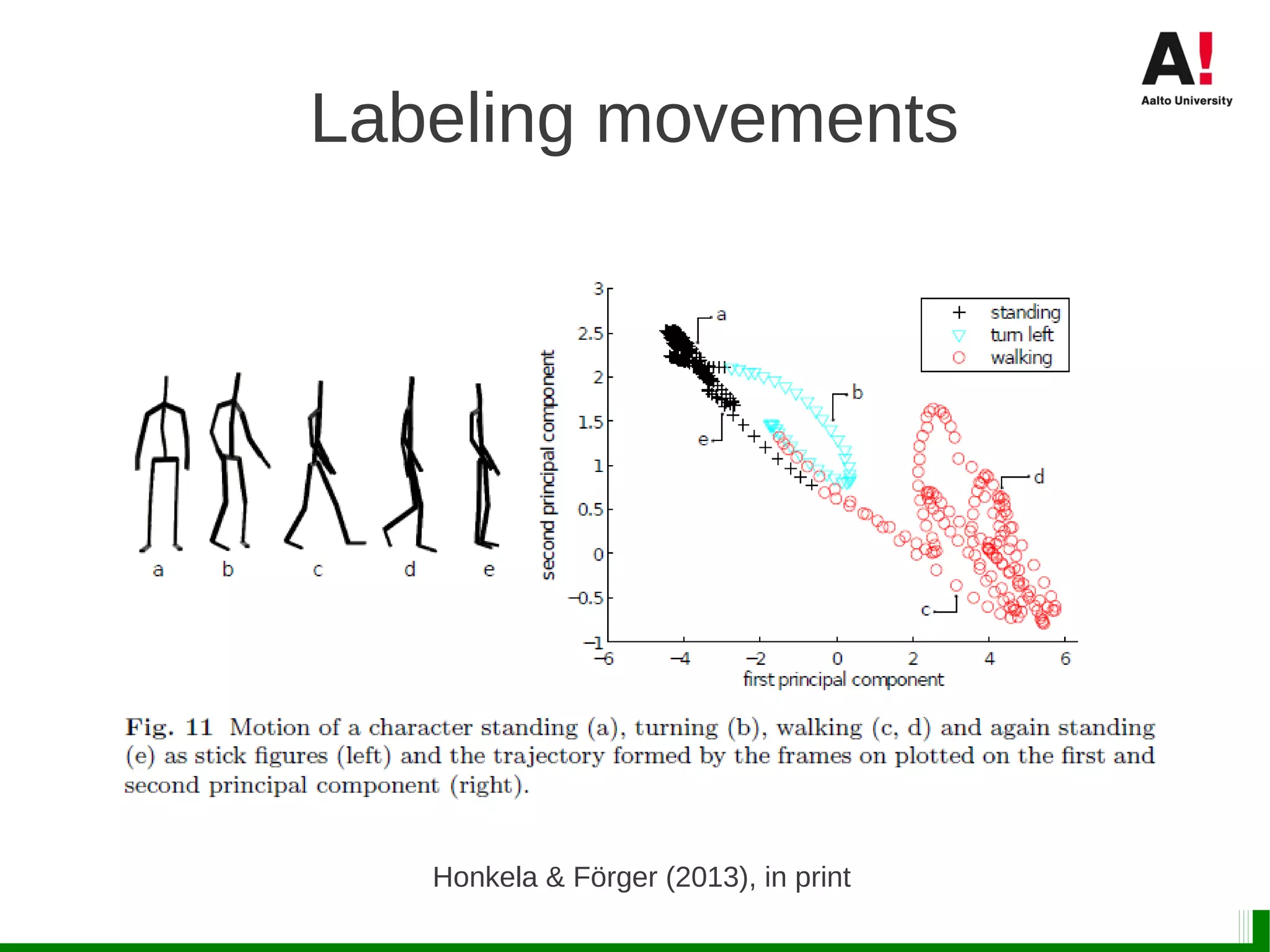
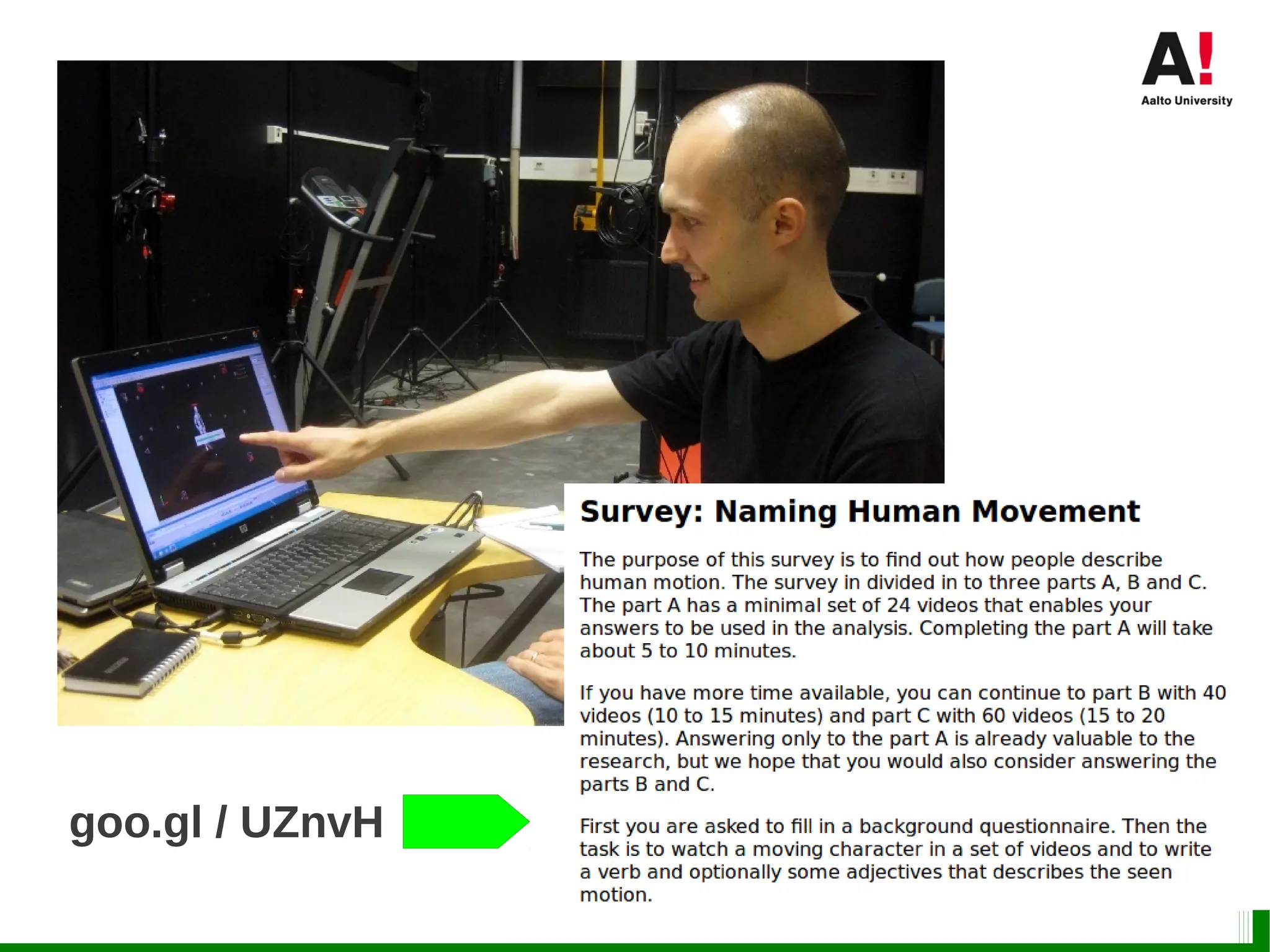
Labeling movements
Honkela & Förger (2013), in print
Contextuality and
Subjectivity of
Understanding
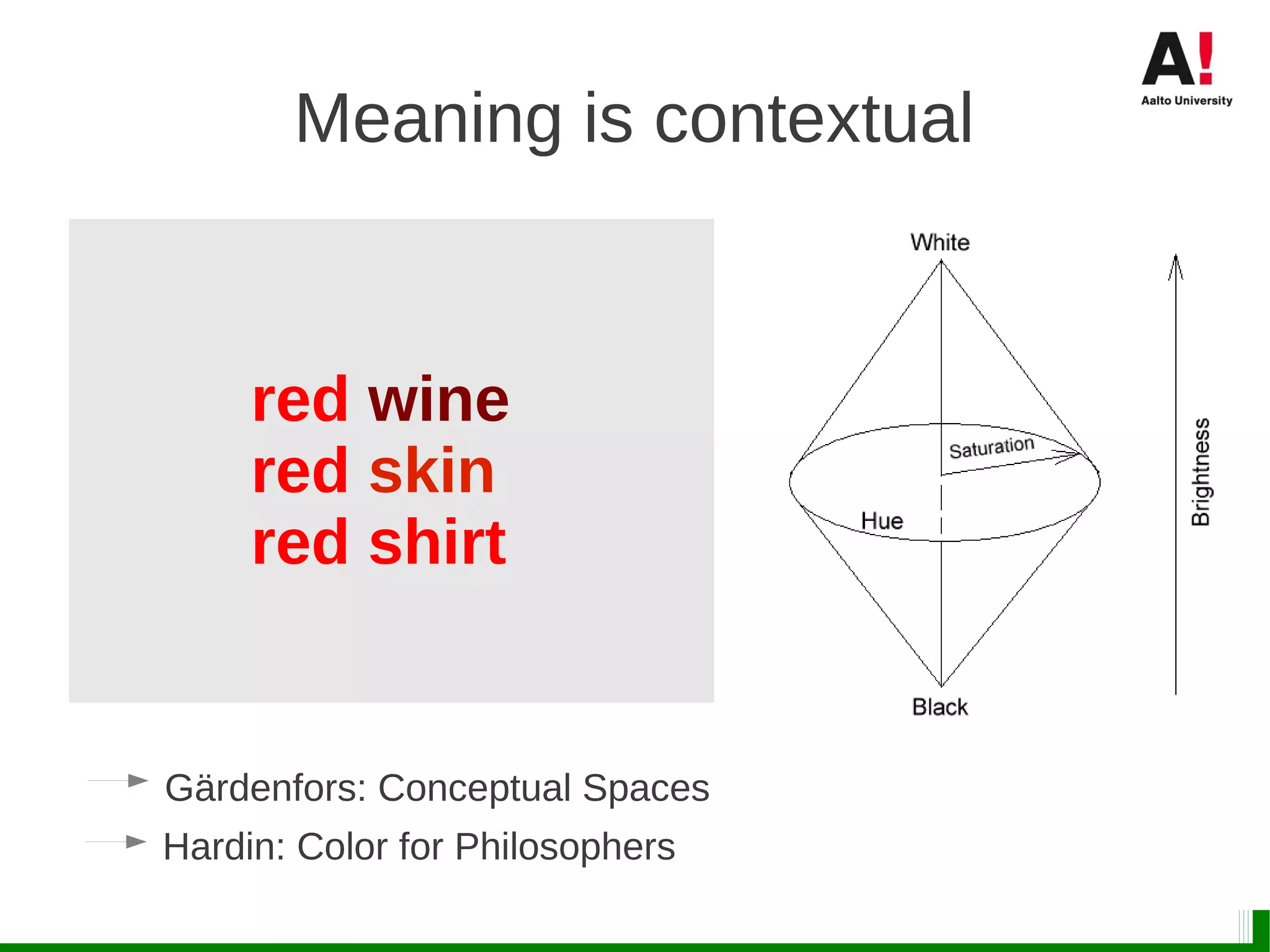
Meaning is contextual
red wine
red skin
red shirt
Gärdenfors: Conceptual Spaces
Hardin: Color for Philosophers
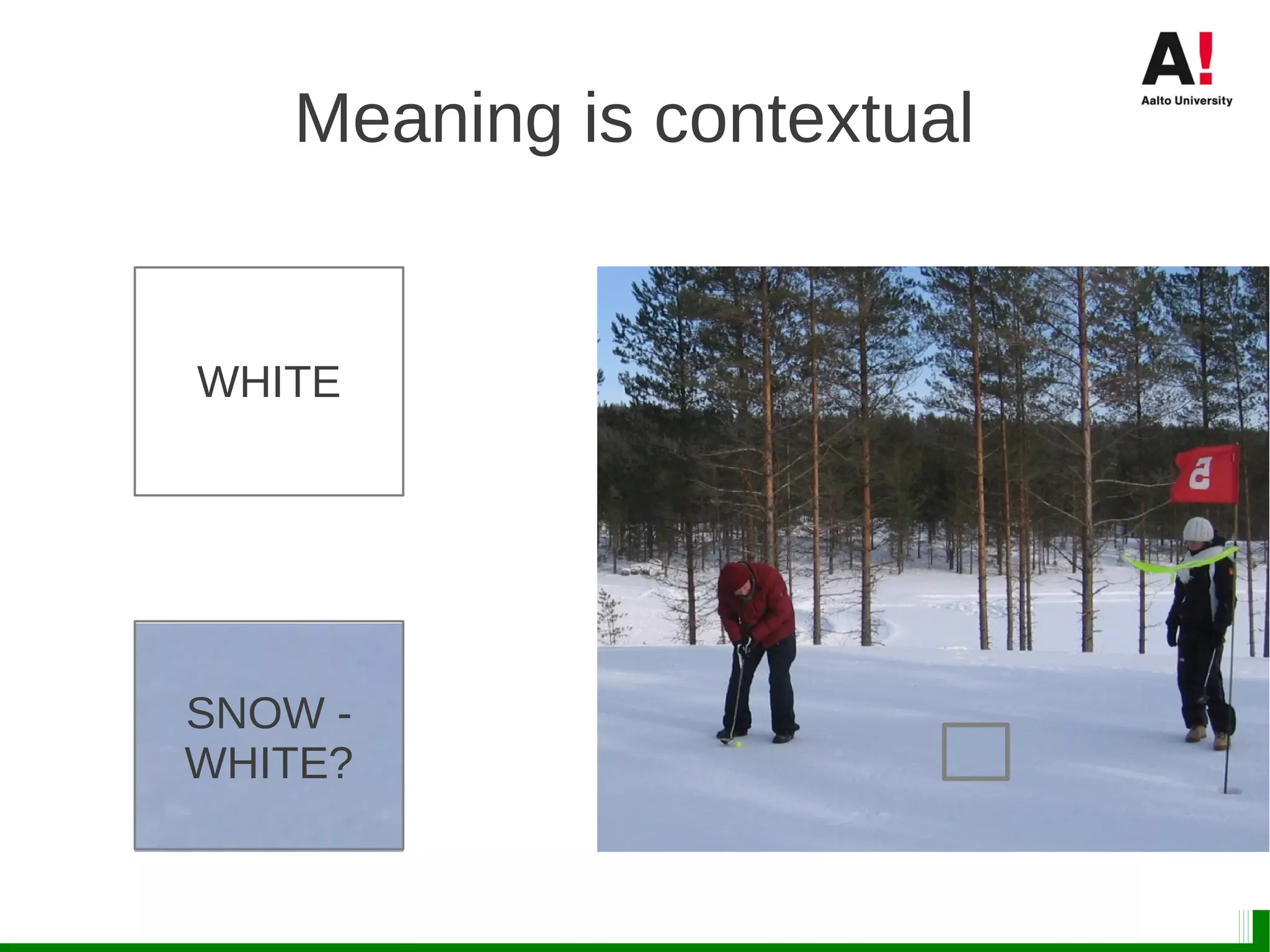
Meaning is contextual
SNOW -
WHITE?
WHITE
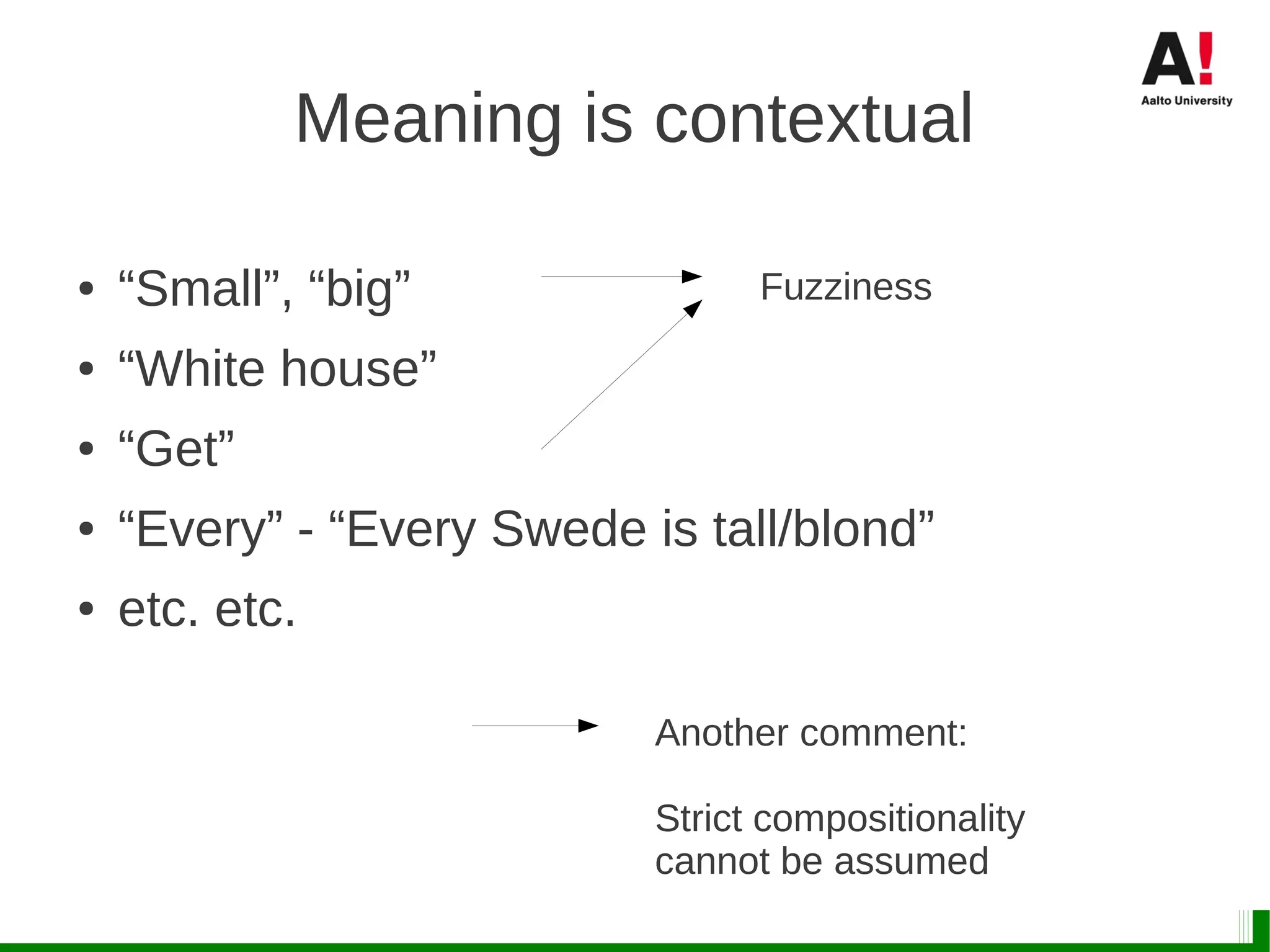
Meaning is contextual
● “Small”, “big”
● “White house”
● “Get”
● “Every” - “Every Swede is tall/blond”
● etc. etc.
Another comment:
Strict compositionality
cannot be assumed
Fuzziness
Learning meaning from context
● Self-Organizing Semantic Maps
● Latent Semantic Analysis
● Latent Dirichlet Allocation
● WordICA
● etc. etc.
Meaning is subjective
● Good
● Fair
● Useful
● Scientific
● Democratic
● Sustainable
● etc.
A proper theory of
meaning has to take
this into account
Measuring
Subjectivity of
Understanding
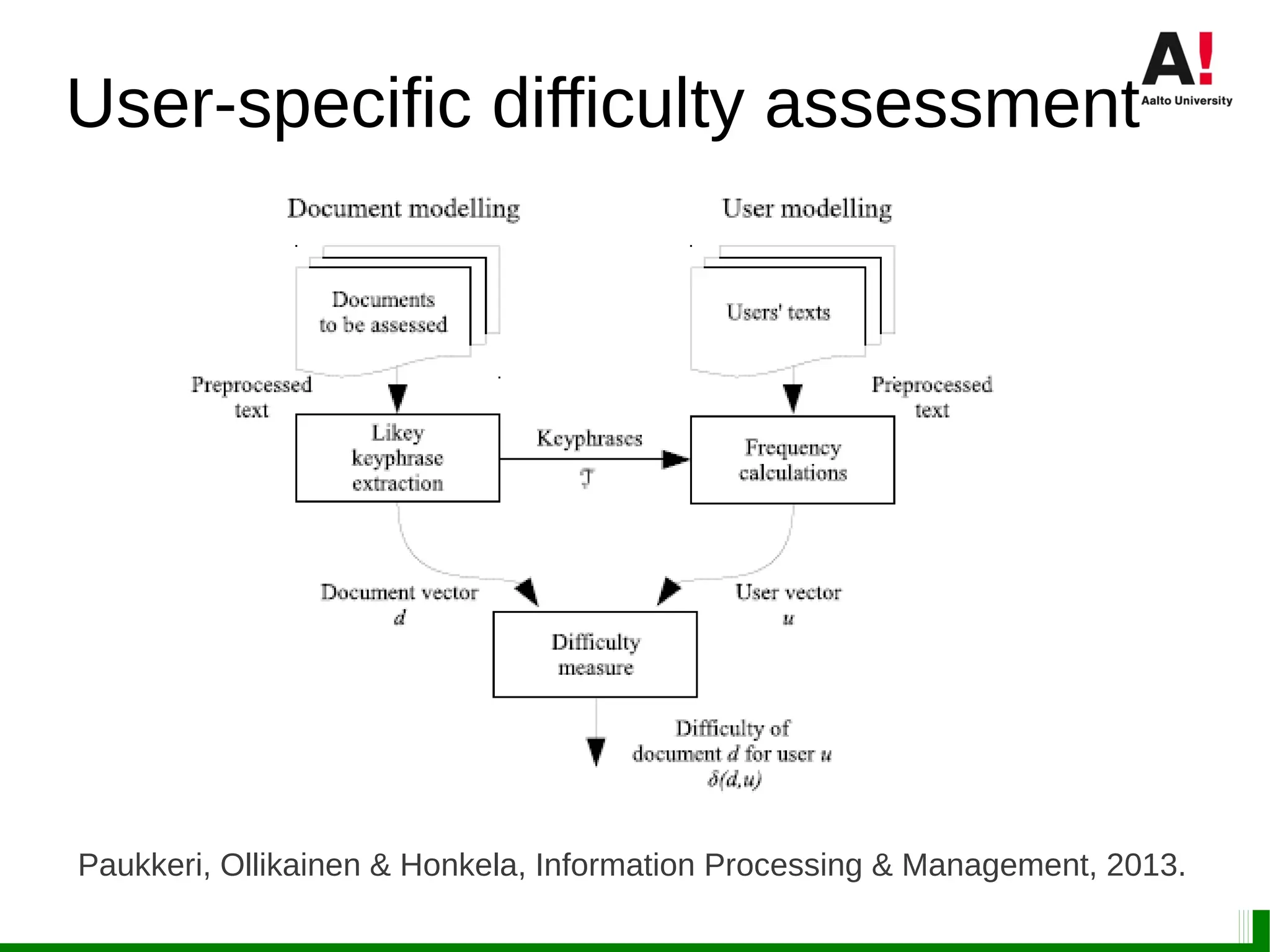
User-specific
difficulty
assessment
Basic architecture of the method
User-specific difficulty assessment
Paukkeri, Ollikainen & Honkela, Information Processing & Management, 2013.
GICA:
Grounded
Intersubjective
Concept
Analysis
Case: State of the Union Addresses
● Text mining is used in populating
a Subject-Object-Context tensor
● This took place by calculating the frequencies
on how often a subject uses an object word in
the context of a context word
● Context window of 30 words
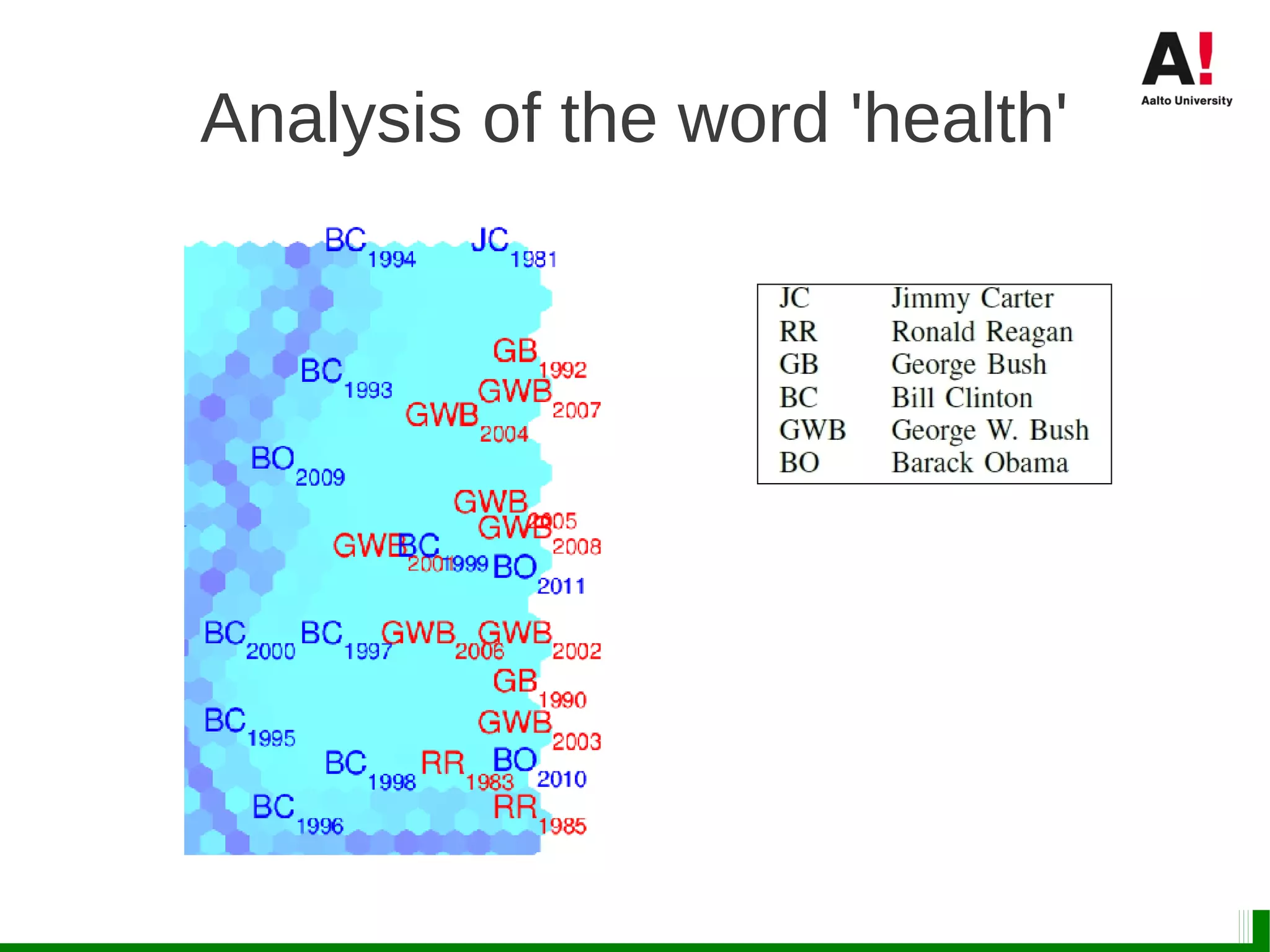
Analysis of the word 'health'
Movement and
Subjectivity
goo.gl / UZnvH
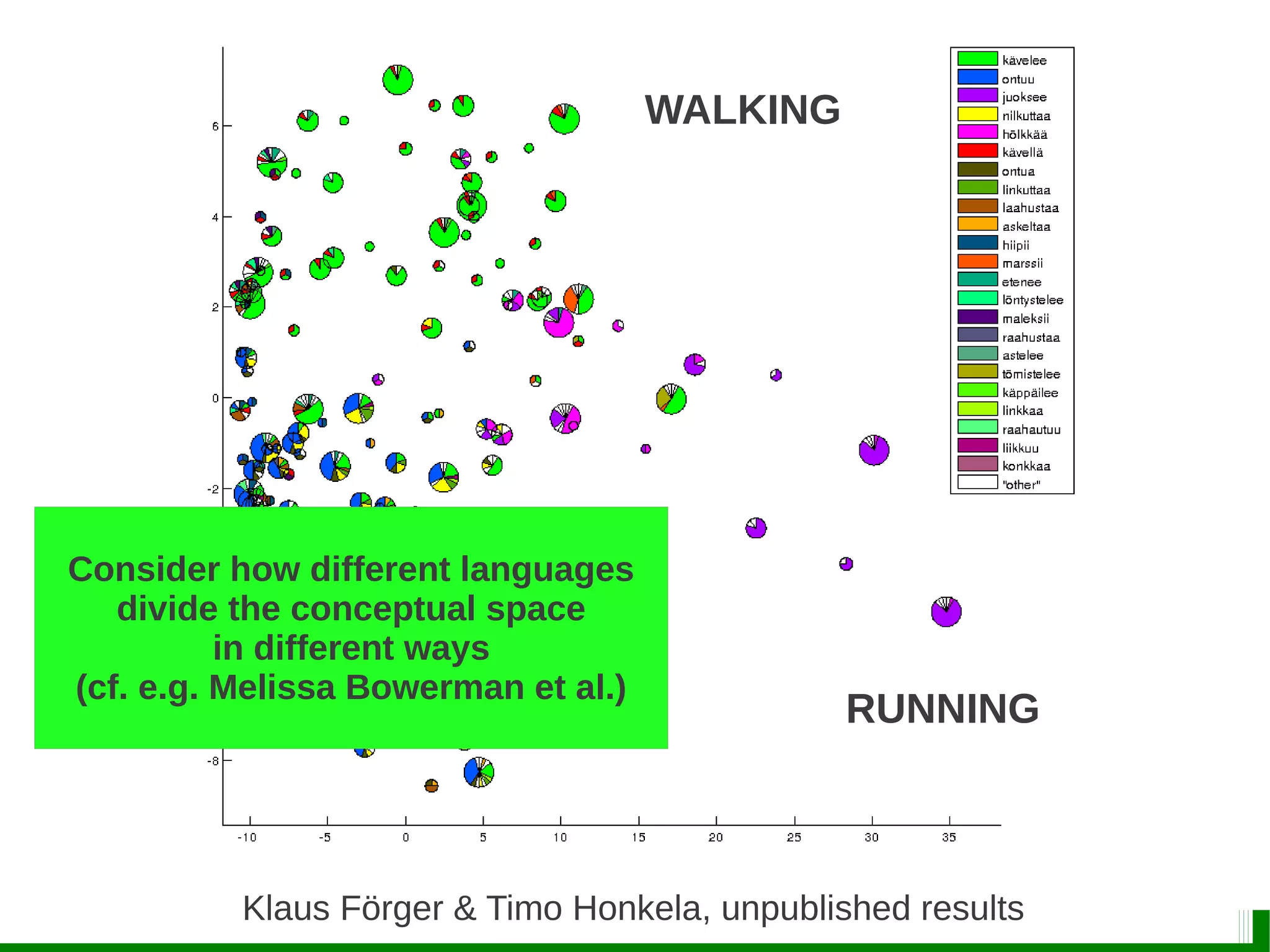
Klaus Förger & Timo Honkela, unpublished results
WALKING
RUNNINGRUNNING
Consider how different languages
divide the conceptual space
in different ways
(cf. e.g. Melissa Bowerman et al.)
Machines more like humans – why?
● Developing better and better tools
to share and benefit from human knowledge and
understanding
● Alleviating the need for people and organizations
to act like machines
● Increasing understanding of individuals and
communities through modeling and simulating
complex systems
● Dealing with the inherent complexity of
the research topics in humanities
information should be fully
accessible for all, regardless of
format, language or location
Thank you!
Merci!
Kiitos!
¡Gracias!
Tack!
Danke schön!
ありがとう
Onneksi olkoon ja 
lämmin kiitos kaikesta 
Kalervo!
Onneksi olkoon ja 
lämmin kiitos kaikesta 
Kalervo!

Timo Honkela: Relevance and meaning: Interplay between objective and subjective

  • 1.
    Relevance and meaning:Interplay between objective and subjective Timo Honkela Aalto University (former Helsinki University of Technology) Department of Information and Computer Science Cognitive Systems research group Professori Kalervo Järvelinin 60-vuotisjuhlaseminaari 30.8.2013
  • 2.
    information should befully accessible for all, regardless of format, language or location ASIS&T annual meeting award winners: A career in information retrieval research
  • 3.
    SIGIR Best PaperAward 2000 Kalervo Järvelin & Jaana Kekäläinen: IR evaluation methods for retrieving highly relevant documents. Tony Kent Strix Award
  • 9.
    Each individual userhas a different cognitive composition and behavioral disposition. Users vary according to all sorts of factors including how much they know about particular topics, how motivated they are to search, how much they know about searching, how much they know about the particular work or search task they need to complete, [...] Kelly (2009):
  • 10.
    People are treated ina black box way
  • 11.
  • 12.
    Learning to knowKalervo Through WEBSOM research Teuvo Kohonen: Self-Organizing Map 1981 Timo Honkela: What about maps of documents? 1991 Honkela, Kaski, Lagus, Kohonen 1996 WEBSOM Saarikoski, J., Laurikkala, J., Järvelin, K., & Juhola, M. (2009). A study of the use of self-organising maps in information retrieval. Journal of Documentation, 65(2), 304-322.
  • 13.
    Exploring meaning inman and machine Information retrieval Content analysis Artificial and computational intelligence Natural language processing Cognitive science Linguistics Cognitive linguistics Philosophy Social sciences
  • 14.
    Information processing in humansand machines Digital content Storage and retrieval tools Relevance judgment Information interpretation Contextualization Learning
  • 15.
    Information processing in humansand machines Digital content Storage and retrieval tools Relevance judgment Information interpretation Contextualization Learning
  • 16.
    Information processing in humansand machines Machine learning Pattern recognition Cognitive systems with perception-action loops > Semiotically competent autonomous systems Relevance judgment Information interpretation Contextualization Learning
  • 17.
  • 18.
    Example of MultimediaContent Analysis Acknowledgement: Jorma Laaksonen and Mikko Kurimo with their research teams at Aalto University
  • 19.
    Example of MultimediaContent Analysis Acknowledgement: Jorma Laaksonen and Mikko Kurimo with their research teams at Aalto University Speech-to-text Video content (context) classification Speaker recognition Optical character recognition
  • 20.
  • 21.
    Why brains? ● Whatare the central differences between plants and animals? “The original need for a nervous system was to coordinate movement, so an organism could go find food, instead of waiting for the food to come to it.” ● An extreme example: A sea squirt transforms from an “animal” to a “plant”. It absorbs its own cerebral ganglion that it used to swim about and find its attachment place. http://goodheartextremescience.wordpress.com/2010/01/27/meet-the-creature-that-eats-its-own-brain/ http://www.fi.edu/learn/brain/
  • 22.
    Point of viewfrom cognitive linguistics ● The meaning of linguistic symbols in the mind of the language users derives from the users' sensory perceptions, their actions with the world and with each other. ● For example: the meaning of the word 'walk' involves ● what walking looks like ● what it feels like to walk and after having walked ● how the world looks when walking (e.g. objects approach at a certain speed, etc.). ● ...
  • 23.
    Abstract vs concretegrounding Ronald Langacker
  • 24.
    Multimodally Grounded LanguageTechnology A project funded by Academy of Finland 2011-2014 A collaboration between departments of * Information and Computer Science, and * Media Technology
  • 25.
    Labeling movements Honkela &Förger (2013), in print
  • 26.
  • 27.
    Meaning is contextual redwine red skin red shirt Gärdenfors: Conceptual Spaces Hardin: Color for Philosophers
  • 28.
  • 29.
    Meaning is contextual ●“Small”, “big” ● “White house” ● “Get” ● “Every” - “Every Swede is tall/blond” ● etc. etc. Another comment: Strict compositionality cannot be assumed Fuzziness
  • 30.
    Learning meaning fromcontext ● Self-Organizing Semantic Maps ● Latent Semantic Analysis ● Latent Dirichlet Allocation ● WordICA ● etc. etc.
  • 31.
  • 32.
    Meaning is subjective ●Good ● Fair ● Useful ● Scientific ● Democratic ● Sustainable ● etc. A proper theory of meaning has to take this into account
  • 33.
  • 34.
  • 35.
    User-specific difficulty assessment Paukkeri,Ollikainen & Honkela, Information Processing & Management, 2013.
  • 36.
  • 37.
    Case: State ofthe Union Addresses ● Text mining is used in populating a Subject-Object-Context tensor ● This took place by calculating the frequencies on how often a subject uses an object word in the context of a context word ● Context window of 30 words
  • 38.
    Analysis of theword 'health'
  • 39.
  • 40.
  • 41.
    Klaus Förger &Timo Honkela, unpublished results WALKING RUNNINGRUNNING Consider how different languages divide the conceptual space in different ways (cf. e.g. Melissa Bowerman et al.)
  • 42.
    Machines more likehumans – why? ● Developing better and better tools to share and benefit from human knowledge and understanding ● Alleviating the need for people and organizations to act like machines ● Increasing understanding of individuals and communities through modeling and simulating complex systems ● Dealing with the inherent complexity of the research topics in humanities
  • 43.
    information should befully accessible for all, regardless of format, language or location
  • 44.