2 Lesson 1
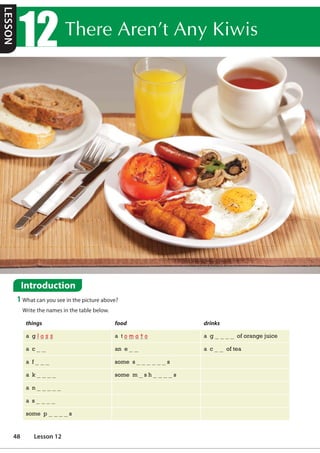
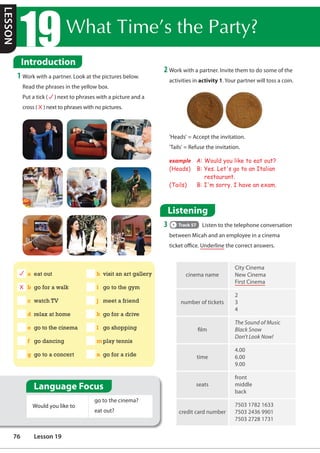
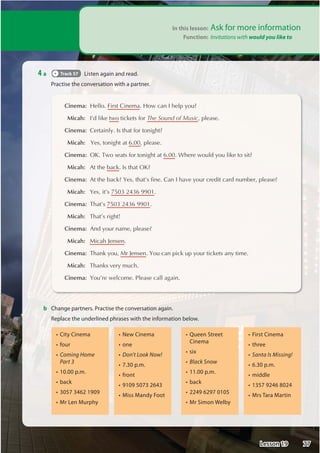
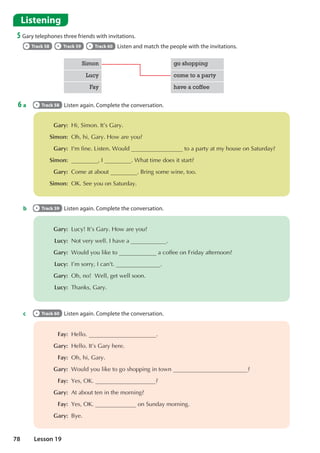
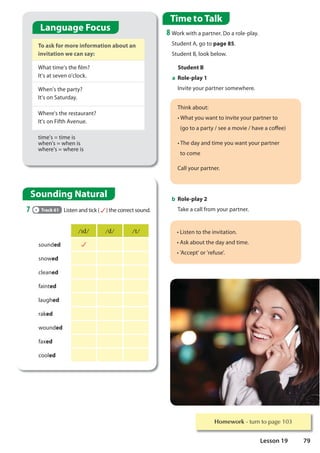
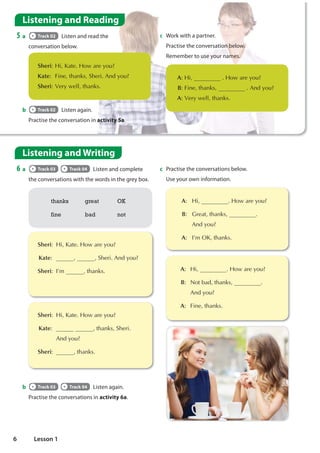
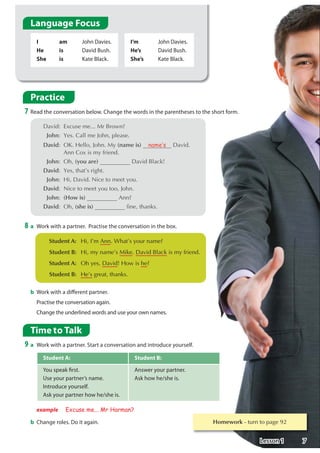
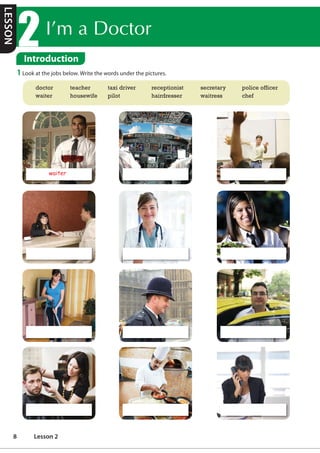
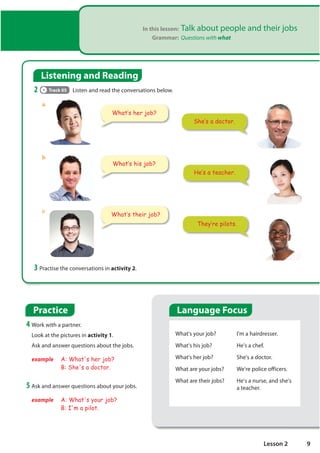
LessonTitle Pages In this lesson:
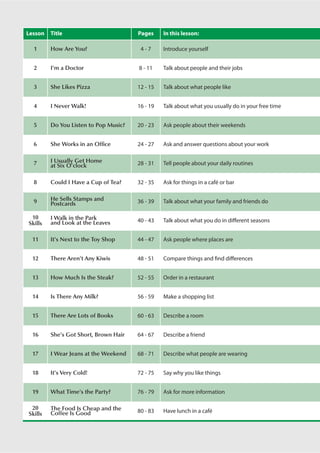
1 How Are You? 4 - 7 Introduce yourself
2 I'm a Doctor 8 - 11 Talk about people and their jobs
3 She Likes Pizza 12 - 15 Talk about what people like
4 I Never Walk! 16 - 19 Talk about what you usually do in your free time
5 Do You Listen to Pop Music? 20 - 23 Ask people about their weekends
6 She Works in an Office 24 - 27 Ask and answer questions about your work
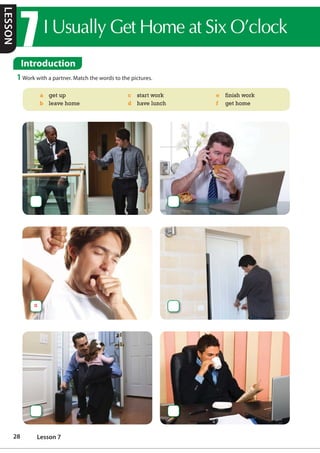
7 I Usually Get Home
at Six O'clock 28 - 31 Tell people about your daily routines
8 Could I Have a Cup of Tea? 32 - 35 Ask for things in a café or bar
9 He Sells Stamps and
Postcards 36 - 39 Talk about what your family and friends do
10
Skills
I Walk in the Park
and Look at the Leaves 40 - 43 Talk about what you do in different seasons
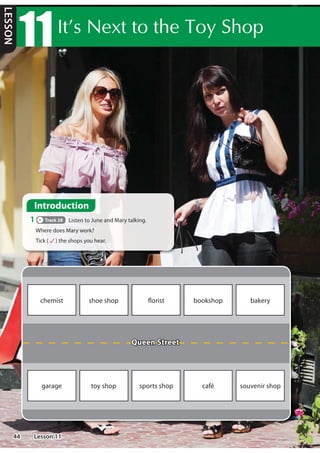
11 It's Next to the Toy Shop 44 - 47 Ask people where places are
12 There Aren't Any Kiwis 48 - 51 Compare things and find differences
13 How Much Is the Steak? 52 - 55 Order in a restaurant
14 Is There Any Milk? 56 - 59 Make a shopping list
15 There Are Lots of Books 60 - 63 Describe a room
16 She's Got Short, Brown Hair 64 - 67 Describe a friend
17 I Wear Jeans at the Weekend 68 - 71 Describe what people are wearing
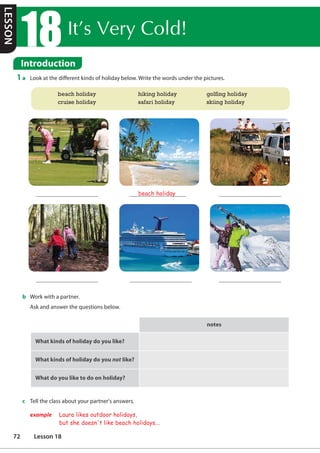
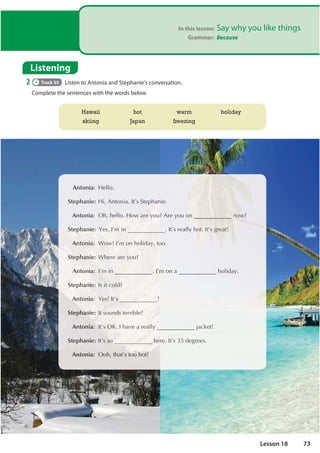
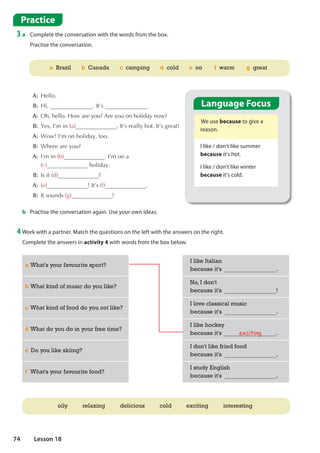
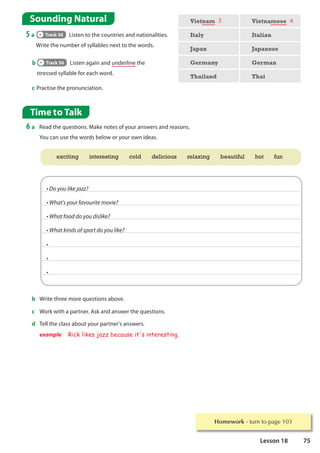
18 It's Very Cold! 72 - 75 Say why you like things
19 What Time's the Party? 76 - 79 Ask for more information
20
Skills
The Food Is Cheap and the
Coffee Is Good 80 - 83 Have lunch in a café
3.
Lesson 1 3
LanguageCD Tracks
Grammar Articles: a/an Possessives: my/your/his/her
Present simple form of be
01 - 04
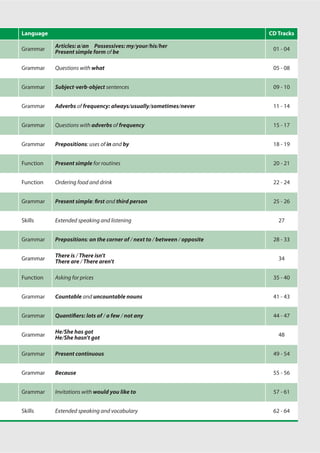
Grammar Questions with what 05 - 08
Grammar Subject-verb-object sentences 09 - 10
Grammar Adverbs of frequency: always/usually/sometimes/never 11 - 14
Grammar Questions with adverbs of frequency 15 - 17
Grammar Prepositions: uses of in and by 18 - 19
Function Present simple for routines 20 - 21
Function Ordering food and drink 22 - 24
Grammar Present simple: first and third person 25 - 26
Skills Extended speaking and listening 27
Grammar Prepositions: on the corner of / next to / between / opposite 28 - 33
Grammar
There is / There isn't
There are / There aren't 34
Function Asking for prices 35 - 40
Grammar Countable and uncountable nouns 41 - 43
Grammar Quantifiers: lots of / a few / not any 44 - 47
Grammar He/She has got
He/She hasn't got 48
Grammar Present continuous 49 - 54
Grammar Because 55 - 56
Grammar Invitations with would you like to 57 - 61
Skills Extended speaking and vocabulary 62 - 64
4.
Language Focus
a +consonant
a book
a chair
an + vowel
an umbrella
an oven
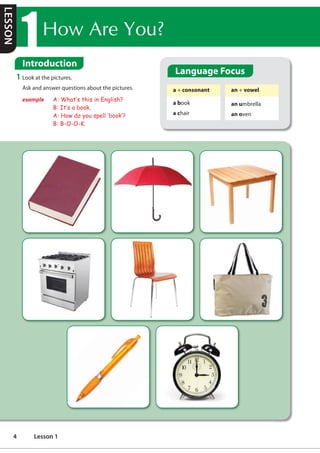
1 Look at the pictures.
Ask and answer questions about the pictures.
example A: What·s this in English?
B: It·s a book.
A: How do you spell ‘book·?
B: B-O-O-K.
+RZ$UHRX
Introduction
LESSON
4 Lesson 1
Introduce ourselves
Article a/an
Possessive adjectives
listening and speaking
Book
Umbrella Table
Oven/griller Chair Bag
Pen
Clock
What do you have?/ Do you have a/an...
I have a/an ....
phụ âm nguyên âm
u, e, o, a, i
Ex an hour: giờ
a Euro: /j/
an orange
a an
a
an/a
a a
a a
hello, my name is ....
i am ... years old
i live in
i am from
5.
Sounding Natural
3 Track01 Read and listen to the
sentences below.
a Open your book.
b How do you say this word?
c What’s this in English?
d Work with a partner.
e Look at the example.
f Can you say that again, please?
g Listen.
h How do you spell‘pencil’?
4 Match the sentences in activity 3 with the
pictures below.
It·s his book.
a
Language Focus
my, your, his, her
It’s
my
your
his
her
pen.
Practice
2 Work with a partner. Put three things from your bag on
the table. Talk about the things.
example It·s my pen.
It·s your rubber.
Make notes.
In this lesson: Introduce yourself
Grammar: Articles: a/an
Possessives: my/your/his/her
Present simple form of be
5
Lesson 1
possessive adjectives
của toi
của bạn
của anh ấy
của cô ấy
It's my pen
It's your pen
It's his pen
It's her book
It's my umbrella
In this lesson:Talk about people and their jobs
Grammar: Questions with what
Listening and Reading
2 Track 05 Listen and read the conversations below.
3 Practise the conversations in activity 2.
What's your job?
What's his job?
What's her job?
What are your jobs?
What are their jobs?
I'm a hairdresser.
He's a chef.
She's a doctor.
We're police officers.
He's a nurse, and she's
a teacher.
Practice
4 Work with a partner.
Look at the pictures in activity 1.
Ask and answer questions about the jobs.
example A: What's her job?
B: She's a doctor.
They·re pilots.
He·s a teacher.
She·s a doctor.
What·s her job?
What·s their job?
5 Ask and answer questions about your jobs.
example A: What's your job?
B: I'm a pilot.
What·s his job?
a
b
c
Language Focus
9
Lesson 2
What is your job?
=
What do you do for a living?
10.
Speaking
8 a Track08 Listen and read the conversation.
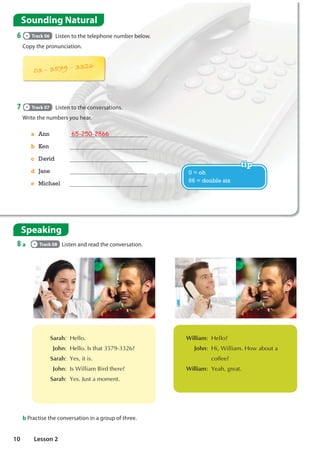
a Ann 65-250-2866
b Ken
c David
d Jane
e Michael
Sounding Natural
6 Track 06 Listen to the telephone number below.
Copy the pronunciation.
7 Track 07 Listen to the conversations.
Write the numbers you hear.
b Practise the conversation in a group of three.
0 = oh
66 = double six
Sarah +HOOR
John +HOOR,VWKDW
Sarah HVLWLV
John ,V:LOOLDP%LUGWKHUH
Sarah HV-XVWDPRPHQW
William +HOOR
John +L:LOOLDP+RZDERXWD
FRIIHH
William HDKJUHDW
10 Lesson 2
36742211
774661
29853393
91767766
0336742211
6774661
0229853393
0391767766
What's your (telephone) numbers?
It's ....
0908770899
do you want to go to the
supermarket?
11.
Homework WXUQWRSDJH
Time toTalk
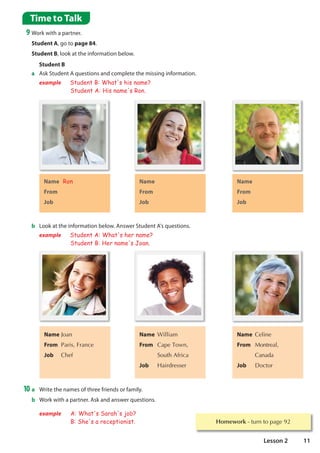
9 Work with a partner.
Student A, go to page 84.
Student B, look at the information below.
Name Ron
From
Job
b Look at the information below. Answer Student A's questions.
example Student A: What's her name?
Student B: Her name's Joan.
Name -RDQ
From 3DULV)UDQFH
Job KHI
Name :LOOLDP
From DSH7RZQ
6RXWK$IULFD
Job +DLUGUHVVHU
Name HOLQH
From 0RQWUHDO
DQDGD
Job 'RFWRU
10 a Write the names of three friends or family.
b Work with a partner. Ask and answer questions.
example A: What's Sarah's job?
B: She's a receptionist.
Name
From
Job
Name
From
Job
a Ask Student A questions and complete the missing information.
example Student B: What's his name?
Student A: His name's Ron.
Student B
11
Lesson 2
USA
Doctor
RUBY
Canada
teacher
JACK
Australia
Chef
What is your name?
Where are you from?
What is your job?
12.
6KH/LNHV3L]]D
Introduction
1 Read whatthe woman and man say.
2 Work with a partner. Write the names of the food and drink under the pictures.
cereal
cereal beer bread carrots bananas eggs
orange juice rice spaghetti tea tomatoes wine
,OLNHSL]]D
,GRQ WOLNHPLON
Introduction
LESSON
12 Lesson 3
ngũ cốc bánh mì
traditional: truyền thống
pork: thịt heo
beef: thịt bò
fish: cá
guava: ổi
cheese: phô mai
13.
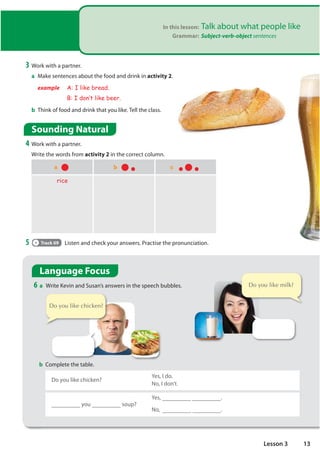
In this lesson:Talk about what people like
Grammar: Subject-verb-object sentences
Sounding Natural
4 Work with a partner.
Write the words from activity 2 in the correct column.
3 Work with a partner.
a Make sentences about the food and drink in activity 2.
example A: I like bread.
B: I don·t like beer.
b Think of food and drink that you like. Tell the class.
a b c
rice
5 Track 09 Listen and check your answers. Practise the pronunciation.
Language Focus
6 a Write Kevin and Susan’s answers in the speech bubbles.
b Complete the table.
Do you like chicken?
Yes, I do.
No, I don’t.
you soup?
Yes, .
No, .
'RRXOLNHFKLFNHQ
'RRXOLNHPLON
13
Lesson 3
she/he/it likes
she/he/it does not like = doesn't like
we/they/you like
we/they/you don't like
tea /ti:/
wine
eggs
bread /bred/
carrots
cereal
spaghetti
bananas
tomatoes
d, orange juice
syllable: âm tiết
u,e,o,a,i
1 nguyên âm = 1 âm tiết
no, i don't chicken
yes, i like milk
Do like
i do
i don't
does she/he/it like chicken?
14.
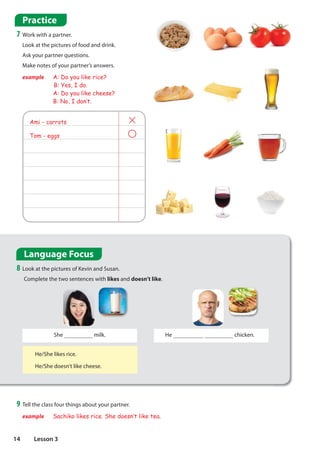
Practice
7 Work witha partner.
Look at the pictures of food and drink.
Ask your partner questions.
Make notes of your partner’s answers.
example A: Do you like rice?
B: Yes, I do.
A: Do you like cheese?
B: No, I don·t.
Language Focus
8 Look at the pictures of Kevin and Susan.
Complete the two sentences with likes and doesn’t like.
He/She likes rice.
He/She doesn’t like cheese.
Ami - carrots
Tom - eggs
9 Tell the class four things about your partner.
example Sachiko likes rice. She doesn·t like tea.
He chicken.
She milk.
14 Lesson 3
15.
Time to Talk
12aThink of one person in your family.
Write three things he/she likes and three things
he/she doesn’t like in the box on the right.
b Work with a partner.
Ask your partner yes/no questions about his/her family.
example A: Does your father like potatoes?
B: Yes, he does.
c Tell the class about your partner’s answers.
example Dave·s father likes potatoes and carrots.
He doesn·t like beer.
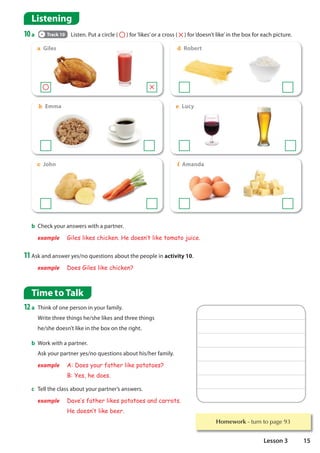
Listening
10a Track 10 Listen. Put a circle ( ) for‘likes’or a cross ( ) for‘doesn’t like’in the box for each picture.
b Check your answers with a partner.
example Giles likes chicken. He doesn·t like tomato juice.
11Ask and answer yes/no questions about the people in activity 10.
example Does Giles like chicken?
f Amanda
e Lucy
d Robert
a Giles
b Emma
c John
Homework WXUQWRSDJH
15
Lesson 3
what does A like? what do you like?
X
O
potato
O O
O
X
X X
O O
she does like/ i do like = i like/ she likes
16.
,1HYHU:DON
Introduction
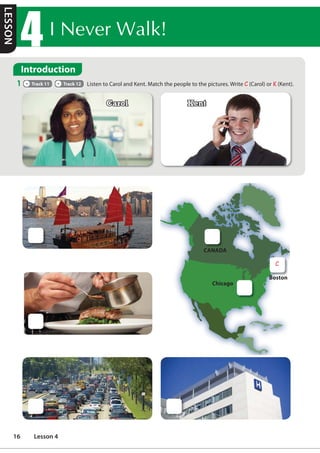
1 Track 11Track 12 Listen to Carol and Kent. Match the people to the pictures. Write C (Carol) or K (Kent).
Carol Kent
Chicago
Boston
B
B
B
B
B
B
B
C
CANADA
LESSON
16 Lesson 4
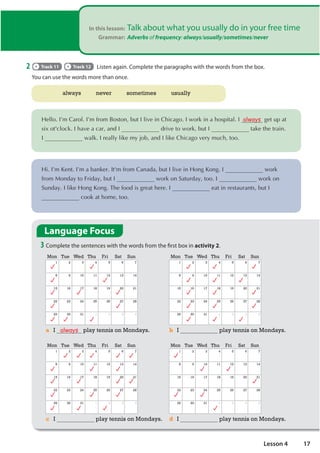
I'm from Boston but I live in Chicago. I work in a hospital and I always get up at 6 o'clock. I have a
car and I usually drive to work. But I sometimes take a train and I never walk. I really like my job
and I like Chicago very much too.
I'm a banker. I'm from Canada but i live in Hongkong. I always work from Monday to Friday but I
sometimes work on Saturday too. I never work on Sunday. I like Hongkong. The food is great here. I
usually eat in restaurant but I sometimes cook at home too.
K
K
K
C
C C
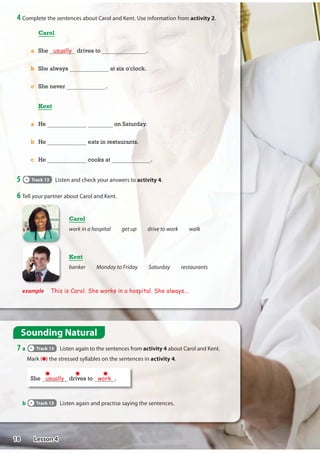
4 Complete thesentences about Carol and Kent. Use information from activity 2.
Sounding Natural
7 a Track 13 Listen again to the sentences from activity 4 about Carol and Kent.
Mark ( ) the stressed syllables on the sentences in activity 4.
6 Tell your partner about Carol and Kent.
Carol
a She usually drives to .
b She always at six o'clock.
c She never .
Kent
a He on Saturday.
b He eats in restaurants.
c He cooks at .
example This is Carol. She works in a hospital. She always...
Carol
work in a hospital get up drive to work walk
b Track 13 Listen again and practise saying the sentences.
5 Track 13 Listen and check your answers to activity 4.
She usually drives to work .
Kent
banker Monday to Friday Saturday restaurants
18 Lesson 4
work
gets up
walks
sometimes works
usually
sometimes home
always usually never
always sometimes usually eats in
19.
Homework WXUQWRSDJH
Time toTalk
9 a Look at Carol's weekend in activity 8. Make some notes below about your weekend.
Listening
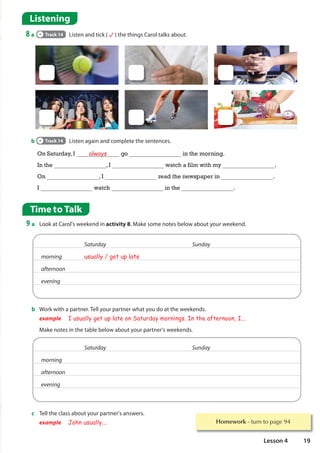
8 a Track 14 Listen and tick ( ) the things Carol talks about.
b Track 14 Listen again and complete the sentences.
b Work with a partner. Tell your partner what you do at the weekends.
example I usually get up late on Saturday mornings. In the afternoon, I...
Make notes in the table below about your partner's weekends.
c Tell the class about your partner's answers.
example John usually...
On Saturday, I always go in the morning.
In the , I watch a film with my .
On , I read the newspaper in .
I watch in the .
Saturday Sunday
morning usually / get up late
afternoon
evening
Saturday Sunday
morning
afternoon
evening
19
Lesson 4
20.
'RRX/LVWHQWR3RS0XVLF
Introduction
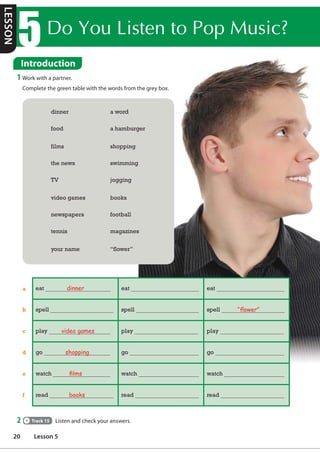
1 Work witha partner.
Complete the green table with the words from the grey box.
2 Track 15 Listen and check your answers.
dinner a word
food a hamburger
films shopping
the news swimming
TV jogging
video games books
newspapers football
tennis magazines
your name “flower”
eat dinner eat eat
spell spell spell “Áower”
play video games play play
go shopping go go
watch Àlms watch watch
read books read read
a
b
c
d
e
f
LESSON
20 Lesson 5
21.
In this lesson:Ask people about their weekends
Grammar: Questions with adverbs of frequency
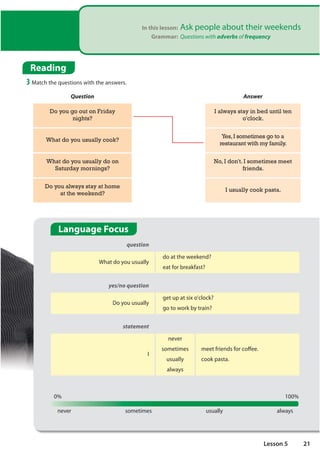
Question Answer
Do you go out on Friday
nights?
I always stay in bed until ten
o'clock.
What do you usually cook?
Yes,I sometimes go to a
restaurant with my family.
What do you usually do on
Saturday mornings?
No, I don't. I sometimes meet
friends.
Do you always stay at home
at the weekend?
I usually cook pasta.
question
What do you usually
do at the weekend?
eat for breakfast?
yes/no question
Do you usually
get up at six o'clock?
go to work by train?
statement
I
never
sometimes
usually
always
meet friends for coffee.
cook pasta.
never sometimes usually always
0% 100%
Language Focus
Reading
3 Match the questions with the answers.
21
Lesson 5
22.
7 a Changepartners. Ask and answer the questions in activity 4.
Write the information in the table below.
Practice
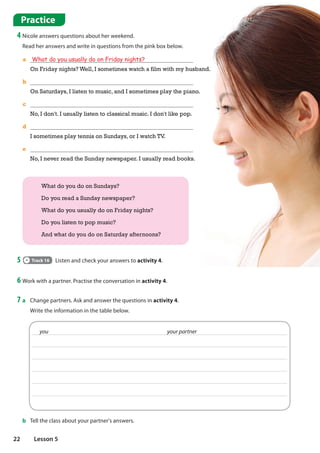
4 Nicole answers questions about her weekend.
Read her answers and write in questions from the pink box below.
What do you do on Sundays?
Do you read a Sunday newspaper?
What do you usually do on Friday nights?
Do you listen to pop music?
And what do you do on Saturday afternoons?
6 Work with a partner. Practise the conversation in activity 4.
b Tell the class about your partner's answers.
you your partner
5 Track 16 Listen and check your answers to activity 4.
a What do you usually do on Friday nights?
On Friday nights? Well, I sometimes watch a film with my husband.
b
On Saturdays, I listen to music, and I sometimes play the piano.
c
No, I don't. I usually listen to classical music. I don't like pop.
d
I sometimes play tennis on Sundays, or I watch TV.
e
No, I never read the Sunday newspaper. I usually read books.
22 Lesson 5
23.
Homework WXUQWRSDJH
Sounding Natural
8a Track 17 Listen and repeat the words below.
the weekend?
do at the weekend?
you usually do at the weekend?
What do you usually do at the weekend?
b Practise saying the words below.
for breakfast?
usually eat for breakfast?
do you usually eat for breakfast?
What do you usually eat for breakfast?
you like?
music do you like?
kind of music do you like?
What kind of music do you like?
Time to Talk
9 a Work with a partner.
Read the questions below.
Ask your partner questions and make notes.
What do you usually do at the weekend?
What do you usually eat for breakfast?
What do you usually do on Friday?
Do you usually sleep late on Sunday mornings?
What do you usually watch on TV?
What do you usually do after work / school?
Do you usually go to sleep late?
b Tell the class the about your partner's answers.
example Eri usually plays tennis
at the weekend.
23
Lesson 5
24.
6KH:RUNVLQDQ2IILFH
Introduction
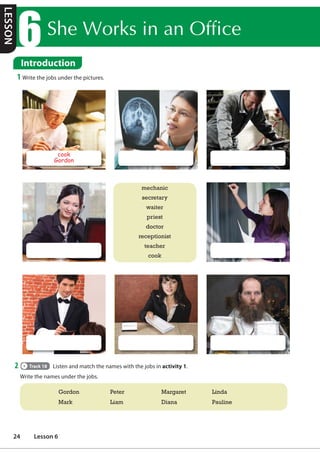
1 Write thejobs under the pictures.
mechanic
secretary
waiter
priest
doctor
receptionist
teacher
cook
cook
Gordon
2 Track 18 Listen and match the names with the jobs in activity 1.
Write the names under the jobs.
Gordon Peter Margaret Linda
Mark Liam Diana Pauline
LESSON
24 Lesson 6
25.
In this lesson:Ask and answer questions about your work
Grammar: Prepositions: uses of in and by
Vocabulary
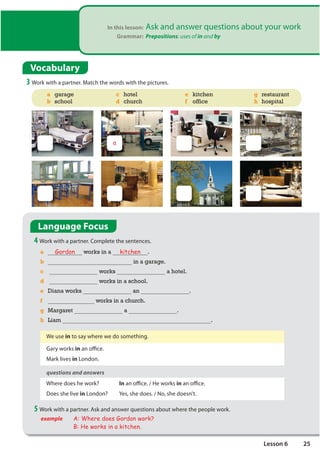
3 Work with a partner. Match the words with the pictures.
a garage
b school
c hotel
d church
e kitchen
f office
g restaurant
h hospital
Language Focus
4 Work with a partner. Complete the sentences.
5 Work with a partner. Ask and answer questions about where the people work.
example A: Where does Gordon work?
B: He works in a kitchen.
a Gordon works in a kitchen .
b in a garage.
c works a hotel.
d works in a school.
e Diana works an .
f works in a church.
g Margaret a .
h Liam .
We use in to say where we do something.
Gary works in an office.
Mark lives in London.
questions and answers
Where does he work? In an office. / He works in an office.
Does she live in London? Yes, she does. / No, she doesn't.
a
25
Lesson 6
26.
Vocabulary
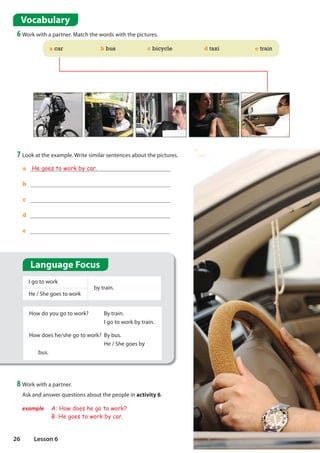
6 Work witha partner. Match the words with the pictures.
a He goes to work by car.
b
c
d
e
7 Look at the example. Write similar sentences about the pictures.
I go to work
by train.
He / She goes to work
How do you go to work? By train.
I go to work by train.
How does he/she go to work? By bus.
He / She goes by
bus.
8 Work with a partner.
Ask and answer questions about the people in activity 6.
example A: How does he go to work?
B: He goes to work by car.
a car b bus c bicycle d taxi e train
Language Focus
26 Lesson 6
27.
Homework WXUQWRSDJH
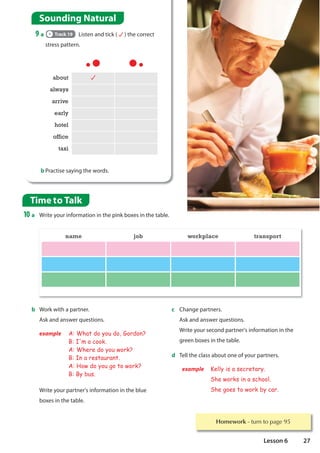
about
always
arrive
early
hotel
office
taxi
b Practisesaying the words.
Time to Talk
10 a Write your information in the pink boxes in the table.
b Work with a partner.
Ask and answer questions.
example A: What do you do, Gordon?
B: I'm a cook.
A: Where do you work?
B: In a restaurant.
A: How do you go to work?
B: By bus.
Write your partner's information in the blue
boxes in the table.
c Change partners.
Ask and answer questions.
Write your second partner's information in the
green boxes in the table.
d Tell the class about one of your partners.
example Kelly is a secretary.
She works in a school.
She goes to work by car.
name job workplace transport
Sounding Natural
9 a Track 19 Listen and tick ( ) the correct
stress pattern.
27
Lesson 6
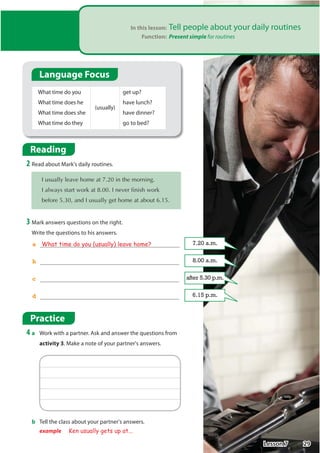
In this lesson:Tell people about your daily routines
Function: Present simple for routines
Reading
2 Read about Mark's daily routines.
,XVXDOOOHDYHKRPHDWLQWKHPRUQLQJ
,DOZDVVWDUWZRUNDW,QHYHUILQLVKZRUN
EHIRUHDQG,XVXDOOJHWKRPHDWDERXW
3 Mark answers questions on the right.
Write the questions to his answers.
What time do you
What time does he
What time does she
What time do they
(usually)
get up?
have lunch?
have dinner?
go to bed?
a What time do you (usually) leave home?
b
c
d
7.20 a.m.
8.00 a.m.
after 5.30 p.m.
6.15 p.m.
Practice
4 a Work with a partner. Ask and answer the questions from
activity 3. Make a note of your partner's answers.
b Tell the class about your partner's answers.
example Ken usually gets up at...
Language Focus
29
Lesson 7
30.
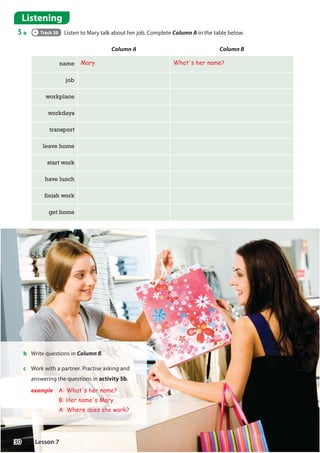
b Write questionsin Column B.
c Work with a partner. Practise asking and
answering the questions in activity 5b.
example A: What's her name?
B: Her name's Mary.
A: Where does she work?
Column A Column B
name Mary What's her name?
job
workplace
workdays
transport
leave home
start work
have lunch
finish work
get home
Listening
5 a Track 20 Listen to Mary talk about her job. Complete Column A in the table below.
30 Lesson 7
31.
1 2 3
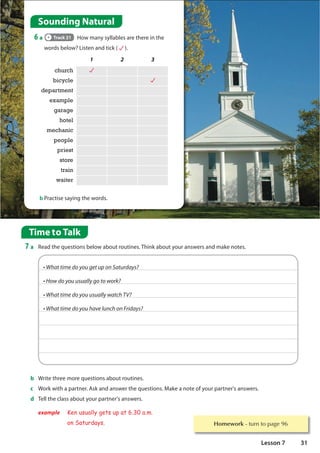
church
bicycle
department
example
garage
hotel
mechanic
people
priest
store
train
waiter
bPractise saying the words.
Sounding Natural
6 a Track 21 How many syllables are there in the
words below? Listen and tick ( ).
Homework WXUQWRSDJH
Time to Talk
7 a Read the questions below about routines. Think about your answers and make notes.
b Write three more questions about routines.
c Work with a partner. Ask and answer the questions. Make a note of your partner's answers.
d Tell the class about your partner's answers.
example Ken usually gets up at 6.30 a.m.
on Saturdays.
@$-88.2*)4=49,*89543!896)=7
@4;)4=4997911=,484;460
@$-88.2*)4=4997911=;8(-#
@$-88.2*)4=49-:*193(-436.)=7
31
Lesson 7
32.
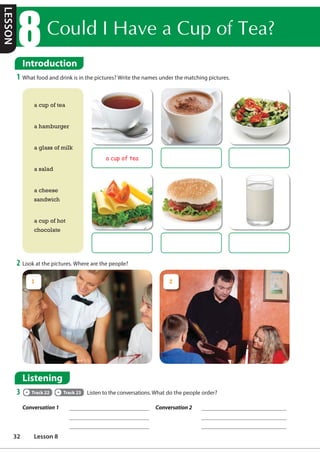
2 Look atthe pictures. Where are the people?
Introduction
1 What food and drink is in the pictures? Write the names under the matching pictures.
a cup of tea
a hamburger
a glass of milk
a salad
a cheese
sandwich
a cup of hot
chocolate
a cup of tea
Listening
3 Track 22 Track 23 Listen to the conversations. What do the people order?
Conversation 1 Conversation 2
1 2
Introduction
RXOG,+DYHDXSRI7HD
LESSON
32 Lesson 8
Sounding Natural
10 Track24 Listen and underline the prices you hear.
Vocabulary
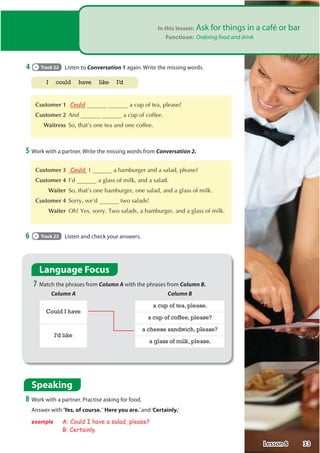
9 Write the names of the money under the pictures.
yen
won
euro
dollar
pound
won
a £15.99 £50.99
b $9.19 $9.90
c ¥350 ¥315
d £14.00 £40.00
e $10.30 $10.13
11Practise saying the prices with a partner.
34 Lesson 8
35.
Time to Talk
14aWork with a partner. Choose a situation below and do a role-play.
Student A, you are the customer. Think about what you want.
Student B, you are the worker. Help the customer.
Practice
12Match the conversations with the pictures.
13Work with a partner. Practise the conversations.
a
$
RXOG,KDYHDUHWXUQ
WLFNHWIRU/RQGRQ
SOHDVH
%7KDW’V£
$+HUHRXDUH
%+HUH’V£FKDQJH
$7KDQNV
b
$,’GOLNHWKUHHPDJD]LQHV
DQGDOLJKWHUSOHDVH
%7KDW’V£SOHDVH
$+HUHRXDUH
%7KDQNV+HUH’VRXU
FKDQJH
$7KDQNRX
c
$
,’GOLNHWZRFDSSXFFLQRV
DQGDODWWHSOHDVH
%7KDW’VSOHDVH
$+HUH’V
%
7KDQNRX7KDW’V
FKDQJH
$7KDQNV
in a café
tea £2
coffee £3
hot chocolate £3
sandwiches £4
cake £4
b Change roles and repeat.
c Act out your conversation for the class. Can they guess where you are?
example A: I·d like a coffee and a hot chocolate, please.
B: That·s £6.
in a restaurant
steak £20
cola £2.20
chips £5
salad £13
chicken £14.50
Homework WXUQWRSDJH
35
Lesson 8
In this lesson:Talk about what your family and friends do
Grammar: Present simple: first and third person
Practice
3 a Read about the people. Write where they work, in the spaces.
b Track 25 Listen and check your answers.
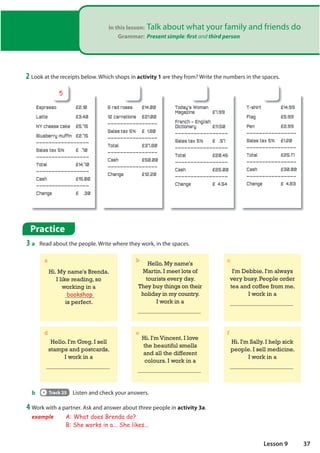
2 Look at the receipts below. Which shops in activity 1 are they from? Write the numbers in the spaces.
Hi. My name's Brenda.
I like reading, so
working in a
bookshop
is perfect.
I'm Debbie. I'm always
very busy. People order
tea and coffee from me.
I work in a
Hello. My name's
Martin. I meet lots of
tourists every day.
They buy things on their
holiday in my country.
I work in a
Hello. I'm Greg. I sell
stamps and postcards.
I work in a
Hi. I'm Sally. I help sick
people. I sell medicine.
I work in a
Hi. I'm Vincent. I love
the beautiful smells
and all the different
colours. I work in a
a b c
d e f
4 Work with a partner. Ask and answer about three people in activity 3a.
example A: What does Brenda do?
B: She works in a... She likes...
Espresso £2.10
Latte £3.40
NY cheese cake £5.75
Blueberry muffin £2.75
_________________
Sales tax 5% £ .70
_________________
Total £14.70
_________________
Cash £15.00
_________________
Change £ .30
6 red roses £14.00
12 carnations £21.00
________________
Sales tax 5% £ 1.80
________________
Total £37.80
________________
Cash £50.00
________________
Change £12.20
Today's Woman
Magazine £7.99
French – English
Dictionary £11.50
_________________
Sales tax 5% £ .97
_________________
Total £20.46
_________________
Cash £25.00
_________________
Change £ 4.54
T-shirt £14.99
Flag £5.99
Pen £2.99
________________
Sales tax 5% £1.20
________________
Total £25.17
________________
Cash £30.00
________________
Change £ 4.83
5
37
Lesson 9
38.
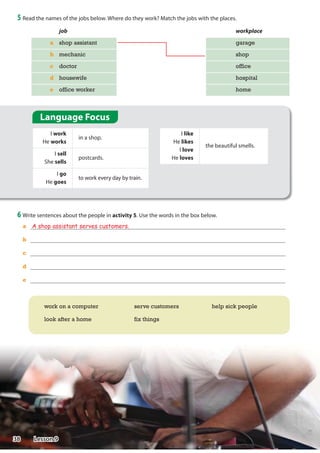
6 Write sentencesabout the people in activity 5. Use the words in the box below.
a A shop assistant serves customers.
b
c
d
e
work on a computer serve customers help sick people
look after a home fix things
I work
He works
in a shop.
I sell
She sells
postcards.
I go
He goes
to work every day by train.
I like
He likes
I love
He loves
the beautiful smells.
5 Read the names of the jobs below. Where do they work? Match the jobs with the places.
job workplace
a shop assistant garage
b mechanic shop
c doctor office
d housewife hospital
e office worker home
Language Focus
38 Lesson 9
39.
Homework WXUQWRSDJH
Time toTalk
9 a Think about two people you know (a friend, someone in your family). What do they do every day? Make notes.
Sounding Natural
7 Track 26 Listen to the sentences below.
How do we say the underlined words when we speak naturally?
8 Track 26 Listen again and practise the pronunciation.
a I work in a garage.
b He works in a restaurant.
c She works in a hospital.
d I work in an office.
c Tell the class about your partner's answers.
example Her friend works in a chemist. Her husband works in a post ofÀce.
brother - works in an ofÀce, answers the phone...
friend (Tom) - works in a shop...
b Work with a partner.
Ask and answer questions about the people in activity 9a.
Make notes about your partner's people.
39
Lesson 9
40.
40
LESSON
,:DONLQWKH3DUN
DQG/RRNDWWKH/HDYHV
Introduction
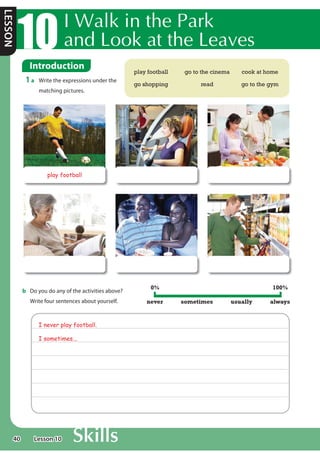
1 a Writethe expressions under the
matching pictures.
play football go to the cinema cook at home
go shopping read go to the gym
play football
b Do you do any of the activities above?
Write four sentences about yourself.
I never play football.
I sometimes...
never sometimes usually always
0% 100%
Lesson 10
41.
41
In this lesson:Talk about what you do in different seasons
Skills: Extended speaking and listening
Listening and Speaking
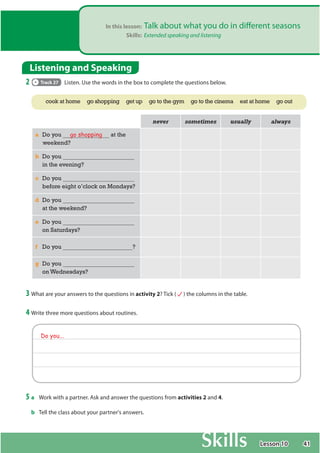
2 Track 27 Listen. Use the words in the box to complete the questions below.
QHYHU VRPHWLPHV XVXDOO DOZDV
a Do you go shopping at the
weekend?
b Do you
in the evening?
c Do you
before eight o’clock on Mondays?
d Do you
at the weekend?
e Do you
on Saturdays?
f Do you ?
g Do you
on Wednesdays?
3 What are your answers to the questions in activity 2? Tick ( ) the columns in the table.
4 Write three more questions about routines.
cook at home go shopping get up go to the gym go to the cinema eat at home go out
Do you...
5 a Work with a partner. Ask and answer the questions from activities 2 and 4.
b Tell the class about your partner's answers.
Lesson 10
42.
42
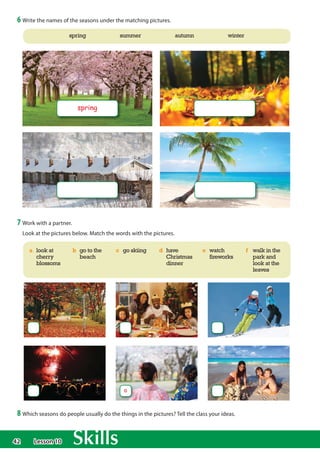
6 Write thenames of the seasons under the matching pictures.
spring
spring summer autumn winter
7 Work with a partner.
Look at the pictures below. Match the words with the pictures.
a look at
cherry
blossoms
b go to the
beach
c go skiing d have
Christmas
dinner
e watch
fireworks
f walk in the
park and
look at the
leaves
8 Which seasons do people usually do the things in the pictures? Tell the class your ideas.
a
Lesson 10
43.
43
Time to Talk
10a Work with a partner. Ask what your partner does in the different seasons.
Make notes about your partner's answers.
b Tell the class about your partner's answers.
example Dan plays golf in the summer.
9 What do you usually do in the different seasons?
Write sentences below.
QRWHV
What do you do in the spring?
What do you do in the summer?
What do you do in the autumn?
What do you do in the winter?
Homework WXUQWRSDJH
spring - Give chocolates to...
summer -
autumn -
winter -
Lesson 10
In this lesson:Ask people where places are
Grammar: Prepositions: on the corner of / next to / between / opposite
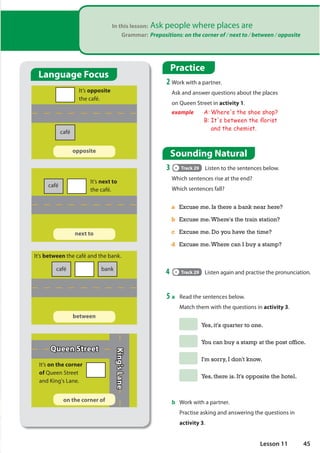
Practice
2 Work with a partner.
Ask and answer questions about the places
on Queen Street in activity 1.
example A: Where's the shoe shop?
B: It's between the Áorist
and the chemist.
Sounding Natural
3 Track 29 Listen to the sentences below.
Which sentences rise at the end?
Which sentences fall?
a Excuse me. Is there a bank near here?
b Excuse me.Where's the train station?
c Excuse me. Do you have the time?
d Excuse me.Where can I buy a stamp?
4 Track 29 Listen again and practise the pronunciation.
5 a Read the sentences below.
Match them with the questions in activity 3.
Yes, it's quarter to one.
You can buy a stamp at the post office.
I'm sorry, I don't know.
Yes, there is. It's opposite the hotel.
b Work with a partner.
Practise asking and answering the questions in
activity 3.
on the corner of
café
café
café bank
Queen Street
King's
Lane
It’s opposite
the café.
It’s next to
the café.
It’s between the café and the bank.
It’s on the corner
of Queen Street
and King's Lane.
between
next to
opposite
Language Focus
45
Lesson 11
46.
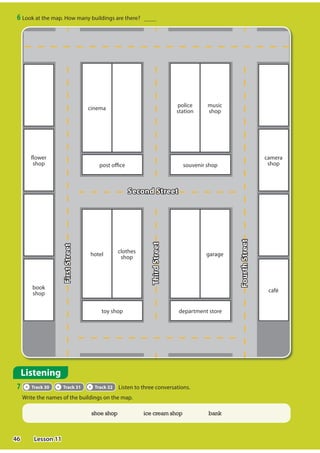
6 Look atthe map. How many buildings are there?
Listening
7 Track 30 Track 31 Track 32 Listen to three conversations.
Write the names of the buildings on the map.
Second Street
flower
shop
book
shop
post office
cinema
souvenir shop
police
station
music
shop
toy shop
hotel
clothes
shop
department store
garage
camera
shop
café
First
Street
Third
Street
Fourth
Street
shoe shop ice cream shop bank
46 Lesson 11
In this lesson:Compare things and find differences
Grammar: There is / There isn't
There are / There aren't
Practice
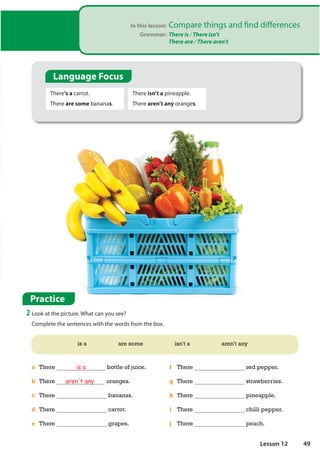
2 Look at the picture. What can you see?
Complete the sentences with the words from the box.
There's a carrot.
There are some bananas.
There isn't a pineapple.
There aren't any oranges.
is a are some isn't a aren't any
a There is a bottle of juice.
b There aren't any oranges.
c There bananas.
d There carrot.
e There grapes.
f There red pepper.
g There strawberries.
h There pineapple.
i There chilli pepper.
j There peach.
Language Focus
49
Lesson 12
50.
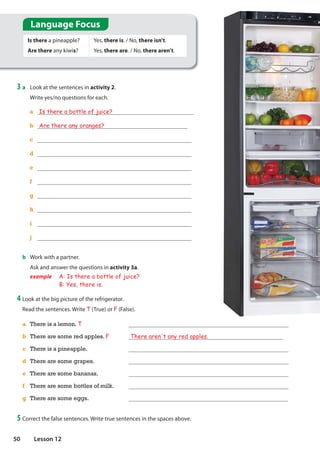
a There isa lemon. T
b There are some red apples. F There aren't any red apples.
c There is a pineapple.
d There are some grapes.
e There are some bananas.
f There are some bottles of milk.
g There are some eggs.
3 a Look at the sentences in activity 2.
Write yes/no questions for each.
Is there a pineapple?
Are there any kiwis?
Yes, there is. / No, there isn't.
Yes, there are. / No, there aren't.
a Is there a bottle of juice?
b Are there any oranges?
c
d
e
f
g
h
i
j
b Work with a partner.
Ask and answer the questions in activity 3a.
example A: Is there a bottle of juice?
B: Yes, there is.
4 Look at the big picture of the refrigerator.
Read the sentences. Write T (True) or F (False).
5 Correct the false sentences. Write true sentences in the spaces above.
Language Focus
50 Lesson 12
51.
Homework WXUQWRSDJH
Sounding Natural
6Track 34 Listen and underline the word with the different sound.
a go so no to
b cleared heard beard feared
c shoes goes nose toes
d great wait gate treat
e among wrong sung begun
f load road snowed board
7 Practise saying the words.
Time to Talk
8 Work with a partner.
Student A, go to page 85.
Student B, look at the picture on the right.
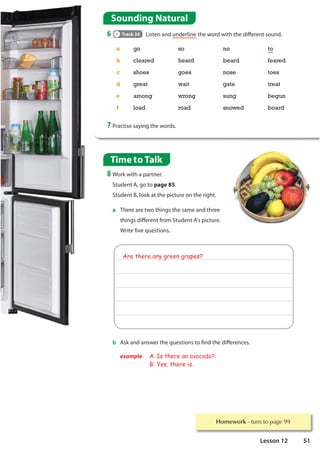
a There are two things the same and three
things different from Student A's picture.
Write five questions.
Are there any green grapes?
b Ask and answer the questions to find the differences.
example A: Is there an avocado?
B: Yes, there is.
51
Lesson 12
52.
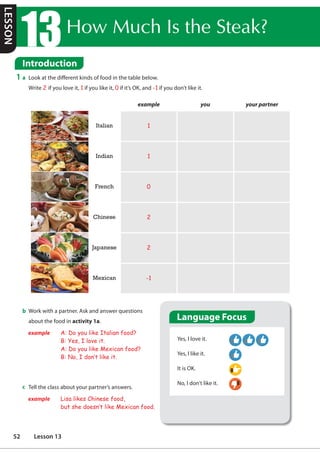
+RZ0XFK,VWKH6WHDN
Introduction
1 a Lookat the different kinds of food in the table below.
Write 2 if you love it, 1 if you like it, 0 if it’s OK, and -1 if you don’t like it.
b Work with a partner. Ask and answer questions
about the food in activity 1a.
example A: Do you like Italian food?
B: Yes, I love it.
A: Do you like Mexican food?
B: No, I don·t like it.
c Tell the class about your partner’s answers.
example Lisa likes Chinese food,
but she doesn·t like Mexican food.
Yes, I love it.
Yes, I like it.
It is OK.
No, I don’t like it.
Yes, I love it.
Yes, I like it.
It is OK.
No, I don’t like it.
Language Focus
example you your partner
Italian 1
Indian 1
French 0
Chinese 2
Japanese 2
Mexican -1
Introduction
LESSON
52 Lesson 13
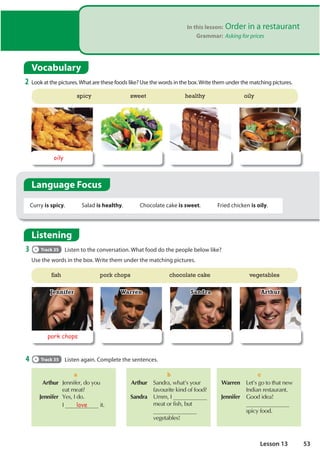
Starters
%UHDGDQG
ROLYHRLO
£
KLFNHQVDODG £
Main Courses
6WHDNZLWK
PXVKURRPV
£
)LVKDQG
SRWDWRSLH
£
3RUNFKRSVZLWK
DSSOHVDXFH
£
/DPEFDVVHUROH£
6SDJKHWWLZLWK
WRPDWRVDXFH
£
1RRGOHVZLWK
FKLFNHQJDUOLF
DQGJLQJHU
£
Side Dishes
5RDVWSRWDWRHV £
5RDVWSDUVQLSV £
*UHHQEHDQV
ZLWKJDUOLF
£
%DESHDVDQG
FDUURWV
£
Desserts
'DLOVHOHFWLRQ
IURPGHVVHUW
WUROOH
£
KRFRODWH
VSRQJH
£
,FHFUHDPDQG
IUHVKIUXLW
£
KHHVHFDNH £
Alcohol
5HGZLQH
*ODVV
%RWWOH
:KLWHZLQH
*ODVV
%RWWOH
%HHU
Soft Drinks
0LQHUDOZDWHU
)UXLWMXLFH
Time to Talk
11a Work with a partner.
Student A, you are the waiter.
Write the prices of drinks in the menu.
Don’t show it to your partner.
Student B, you are the customer.
Look at the menu.
Decide what you want.
b Role-play the situation.
c Change roles and do it again.
waiter/waitress customer
Can I take your order?
Anything to drink?
Any dessert?
Anything else?
I’d like...
How much is the... ?
That’s all, thanks.
Useful Language
Homework WXUQWRSDJH
55
Lesson 13
56.
,V7KHUH$Q0LON
Introduction
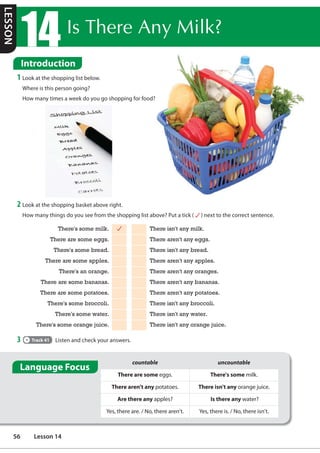
1 Look atthe shopping list below.
Where is this person going?
How many times a week do you go shopping for food?
2 Look at the shopping basket above right.
How many things do you see from the shopping list above? Put a tick ( ) next to the correct sentence.
There's some milk. There isn't any milk.
There are some eggs. There aren't any eggs.
There's some bread. There isn't any bread.
There are some apples. There aren't any apples.
There's an orange. There aren't any oranges.
There are some bananas. There aren't any bananas.
There are some potatoes. There aren't any potatoes.
There's some broccoli. There isn't any broccoli.
There's some water. There isn't any water.
There's some orange juice. There isn't any orange juice.
3 Track 41 Listen and check your answers.
countable uncountable
There are some eggs. There's some milk.
There aren't any potatoes. There isn't any orange juice.
Are there any apples? Is there any water?
Yes, there are. / No, there aren't. Yes, there is. / No, there isn't.
Language Focus
LESSON
56 Lesson 14
57.
In this lesson:Make a shopping list
Grammar: Countable and uncountable nouns
Vocabulary
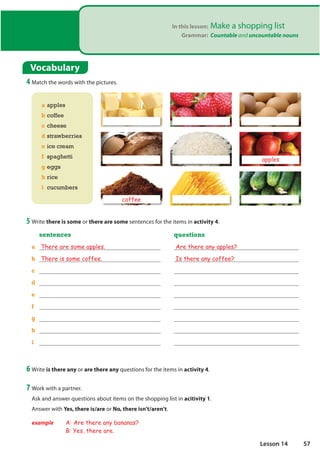
4 Match the words with the pictures.
5 Write there is some or there are some sentences for the items in activity 4.
a apples
b coffee
c cheese
d strawberries
e ice cream
f spaghetti
g eggs
h rice
i cucumbers
sentences
a There are some apples.
b There is some coffee.
c
d
e
f
g
h
i
questions
Are there any apples?
Is there any coffee?
6 Write is there any or are there any questions for the items in activity 4.
7 Work with a partner.
Ask and answer questions about items on the shopping list in acitivity 1.
Answer with Yes, there is/are or No, there isn't/aren't.
example A: Are there any bananas?
B: Yes, there are.
coffee
apples
57
Lesson 14
Homework WXUQWRSDJH
Sounding Natural
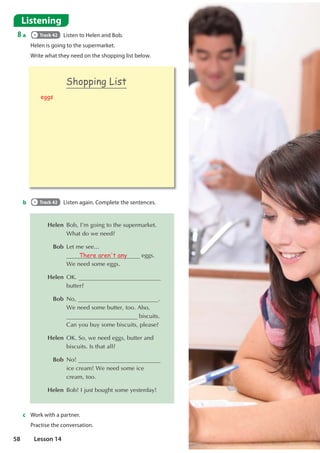
9Track 43 Listen to the sentences below.
How do we say the underlined words when we speak naturally?
Time to Talk
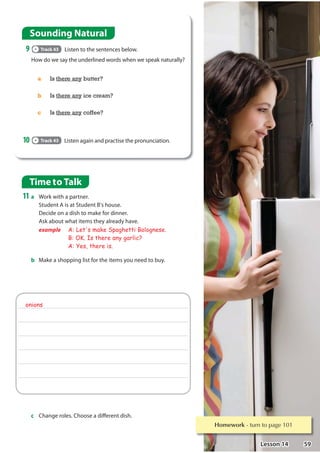
11 a Work with a partner.
Student A is at Student B's house.
Decide on a dish to make for dinner.
Ask about what items they already have.
example A: Let's make Spaghetti Bolognese.
B: OK. Is there any garlic?
A: Yes, there is.
b Make a shopping list for the items you need to buy.
a Is there any butter?
b Is there any ice cream?
c Is there any coffee?
10 Track 43 Listen again and practise the pronunciation.
c Change roles. Choose a different dish.
onions
59
Lesson 14
In this lesson:Describe a room
Grammar: lots of / a few / not any
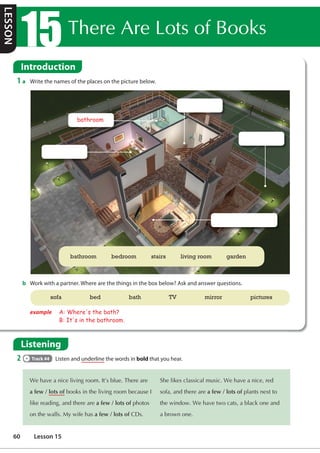
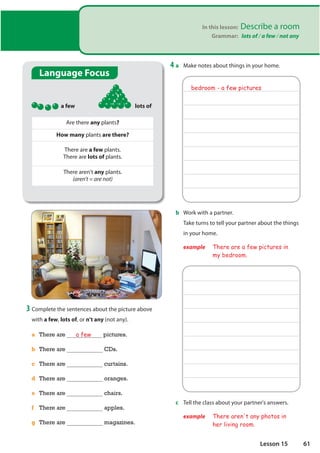
3 Complete the sentences about the picture above
with a few, lots of, or n't any (not any).
Are there any plants?
How many plants are there?
There are a few plants.
There are lots of plants.
There aren't any plants.
(aren't = are not)
a There are a few pictures.
b There are CDs.
c There are curtains.
d There are oranges.
e There are chairs.
f There are apples.
g There are magazines.
a few lots of
4 a Make notes about things in your home.
bedroom - a few pictures
b Work with a partner.
Take turns to tell your partner about the things
in your home.
example There are a few pictures in
my bedroom.
c Tell the class about your partner's answers.
example There aren't any photos in
her living room.
Language Focus
61
Lesson 15
62.
Listening
5 a Track45 Listen to the sentences. Connect the words in the columns.
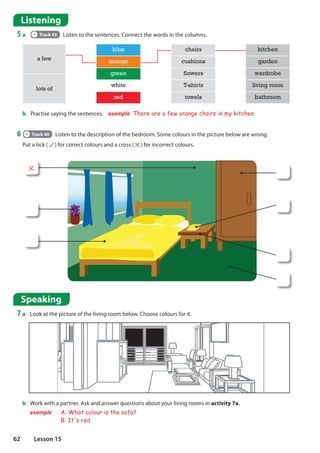
6 Track 46 Listen to the description of the bedroom. Some colours in the picture below are wrong.
Put a tick ( ) for correct colours and a cross ( ) for incorrect colours.
a few
blue chairs kitchen
orange cushions garden
green flowers wardrobe
lots of
white T-shirts living room
red towels bathroom
Speaking
7 a Look at the picture of the living room below. Choose colours for it.
b Work with a partner. Ask and answer questions about your living rooms in activity 7a.
example A: What colour is the sofa?
B: It's red.
b Practise saying the sentences. example There are a few orange chairs in my kitchen.
62 Lesson 15
63.
1 2 3
45 6
Homework WXUQWRSDJH
Time to Talk
10 a Work with a partner.
Look at the pictures below and read the description. Guess which picture it is.
a magazine
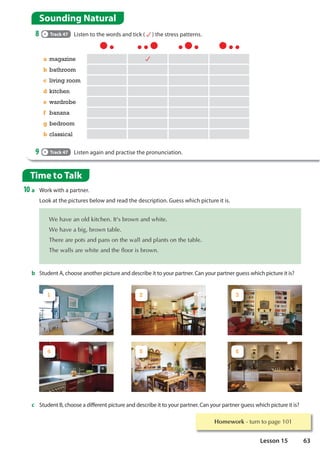
b bathroom
c living room
d kitchen
e wardrobe
f banana
g bedroom
h classical
9 Track 47 Listen again and practise the pronunciation.
b Student A, choose another picture and describe it to your partner. Can your partner guess which picture it is?
:HKDYHDQROGNLWFKHQ,W VEURZQDQGZKLWH
:HKDYHDELJEURZQWDEOH
7KHUHDUHSRWVDQGSDQVRQWKHZDOODQGSODQWVRQWKHWDEOH
7KHZDOOVDUHZKLWHDQGWKHIORRULVEURZQ
c Student B, choose a different picture and describe it to your partner. Can your partner guess which picture it is?
Sounding Natural
8 Track 47 Listen to the words and tick ( ) the stress patterns.
63
Lesson 15
A B
a Fiona/ overweight?
b Joanne / attractive?
c Jerome / good-looking?
d Dan / old?
e Fiona / short?
f Who / overweight?
g Who / slim?
h Who / young?
i Who / good-looking?
a Gordon / tall?
b Jerome / short?
c Gordon / old?
d Dan / tall?
e Joanne / young?
f Who / old?
g Who / young?
h Who / tall?
i Who / short?
In this lesson: Describe a friend
Grammar: He/She has got
He/She hasn’t got
Reading
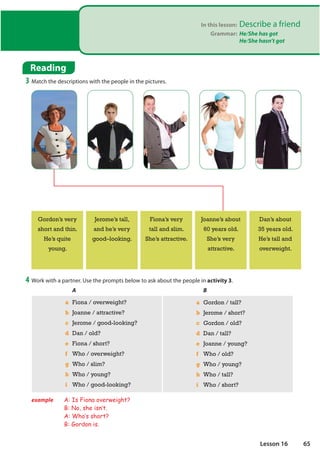
3 Match the descriptions with the people in the pictures.
4 Work with a partner. Use the prompts below to ask about the people in activity 3.
Gordon’s very
short and thin.
He’s quite
young.
Dan’s about
35 years old.
He’s tall and
overweight.
Jerome’s tall,
and he’s very
good–looking.
Fiona’s very
tall and slim.
She’s attractive.
example A: Is Fiona overweight?
B: No, she isn·t.
A: Who·s short?
B: Gordon is.
Joanne’s about
60 years old.
She’s very
attractive.
Reading
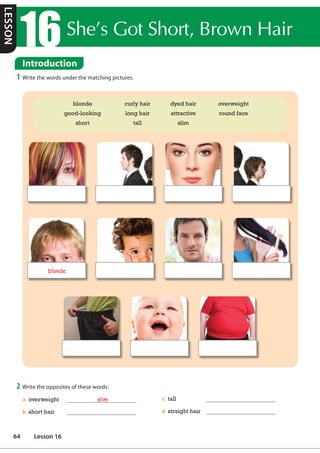
65
Lesson 16
66.
Practice
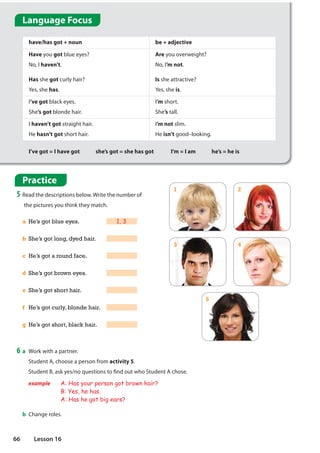
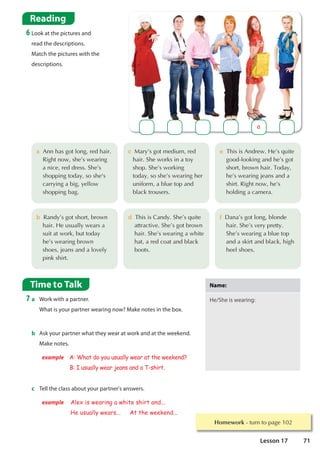
5 Read thedescriptions below.Write the number of
the pictures you think they match.
a He’s got blue eyes. 1, 3
b She’s got long, dyed hair.
c He’s got a round face.
d She’s got brown eyes.
e She’s got short hair.
f He’s got curly, blonde hair.
g He’s got short, black hair.
have/has got + noun be + adjective
Have you got blue eyes?
No, I haven’t.
Has she got curly hair?
Yes, she has.
Are you overweight?
No, I’m not.
Is she attractive?
Yes, she is.
I’ve got black eyes.
She’s got blonde hair.
I’m short.
She’s tall.
I haven’t got straight hair.
He hasn’t got short hair.
I’m not slim.
He isn’t good–looking.
I’ve got = I have got she’s got = she has got I’m = I am he’s = he is
1
3
5
2
4
6 a Work with a partner.
Student A, choose a person from activity 5.
Student B, ask yes/no questions to find out who Student A chose.
example A: Has your person got brown hair?
B: Yes, he has.
A: Has he got big ears?
b Change roles.
Language Focus
66 Lesson 16
67.
Sounding Natural
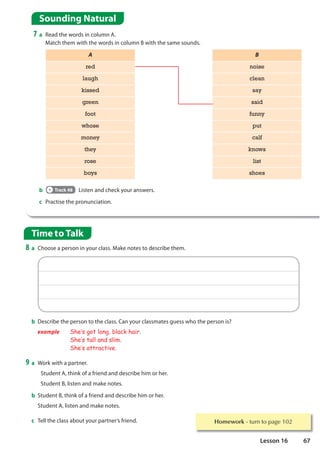
7 aRead the words in column A.
Match them with the words in column B with the same sounds.
Time to Talk
8 a Choose a person in your class. Make notes to describe them.
b Track 48 Listen and check your answers.
c Practise the pronunciation.
A B
red noise
laugh clean
kissed say
green said
foot funny
whose put
money calf
they knows
rose list
boys shoes
b Describe the person to the class. Can your classmates guess who the person is?
example She·s got long, black hair.
She·s tall and slim.
She·s attractive.
9 a Work with a partner.
Student A, think of a friend and describe him or her.
Student B, listen and make notes.
b Student B, think of a friend and describe him or her.
Student A, listen and make notes.
c Tell the class about your partner’s friend. Homework WXUQWRSDJH
67
Lesson 16
68.
,:HDU-HDQVDWWKH:HHNHQG
Introduction
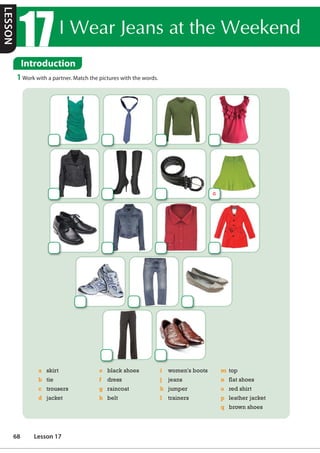
1 Work witha partner. Match the pictures with the words.
a skirt
b tie
c trousers
d jacket
e black shoes
f dress
g raincoat
h belt
i women's boots
j jeans
k jumper
l trainers
m top
n flat shoes
o red shirt
p leather jacket
q brown shoes
a
LESSON
68 Lesson 17
69.
1RZ
In this lesson:Describe what people are wearing
Grammar: Present continuous
Listening
3 The people from activity 2 are going to work. What are they wearing now?
Track 49 Listen and match the descriptions with the pictures.
4 Track 50 Listen. Write the missing words.
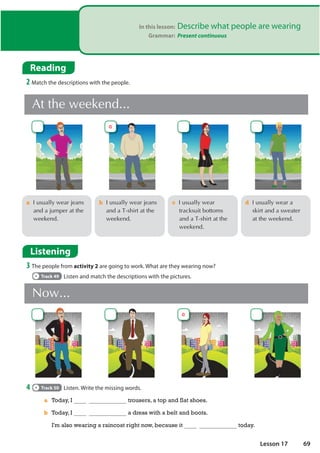
c,XVXDOOZHDU
WUDFNVXLWERWWRPV
DQGD7VKLUWDWWKH
ZHHNHQG
a,XVXDOOZHDUMHDQV
DQGDMXPSHUDWWKH
ZHHNHQG
d,XVXDOOZHDUD
VNLUWDQGDVZHDWHU
DWWKHZHHNHQG
b,XVXDOOZHDUMHDQV
DQGD7VKLUWDWWKH
ZHHNHQG
$WWKHZHHNHQG
a Today, I trousers, a top and flat shoes.
b Today, I a dress with a belt and boots.
I'm also wearing a raincoat right now, because it today.
Reading
2 Match the descriptions with the people.
a
a
69
Lesson 17
70.
be + verb+ -ing
What are you wearing?
Today, I'm wearing trousers.
Is she wearing a dress?
Yes, she is.
No, she isn't.
It's raining today.
Language Focus
Talking about now:
b Track 53 Listen and practise saying the two sentences.
Sounding Natural
5 a Listen and copy the pronunciation.
Track 51
wear
wear a jumper
I usually wear a jumper.
I usually wear a jumper at home.
I usually wear a jumper at home at the weekend.
Track 52
wear
wear a shirt
I usually wear a shirt.
I usually wear a shirt at work.
I usually wear a shirt at work on Mondays.
I usually wear a jumper at home at the weekend.
I always wear a shirt at work.
c Track 54 Listen and practise saying the sentences together.
I usually wear a jumper at home at the weekend,
but I always wear a shirt at work.
70 Lesson 17
Homework WXUQWRSDJH
Time toTalk
6 a Read the questions. Make notes of your answers and reasons.
You can use the words below or your own ideas.
Sounding Natural
5 a Track 56 Listen to the countries and nationalities.
Write the number of syllables next to the words.
c Practise the pronunciation.
Vietnam 3 Vietnamese 4
Italy Italian
Japan Japanese
Germany German
Thailand Thai
b Track 56 Listen again and underline the
stressed syllable for each word.
b Write three more questions above.
c Work with a partner. Ask and answer the questions.
d Tell the class about your partner's answers.
example Rick likes jazz because it's interesting.
@4=491.0*/
@$-8?7=496+:496.8*24:.*
@$-8+44))4=49).71.0*
@$-80.3)74+75468)4=491.0*
@
@
@
exciting interesting cold delicious relaxing beautiful hot fun
75
Lesson 18
Student B
a Role-play1
Invite your partner somewhere.
Homework WXUQWRSDJH
To ask for more information about an
invitation we can say:
What time's the film?
It's at seven o'clock.
When's the party?
It's on Saturday.
Where's the restaurant?
It's on Fifth Avenue.
time's = time is
when's = when is
where's = where is
Sounding Natural
7 Track 61 Listen and tick ( ) the correct sound.
,G G W
sounded
snowed
cleaned
fainted
laughed
raked
wounded
faxed
cooled
Think about:
S/5HMCIK5BHHC=BJ=H9MCIFD5FHB9FHC
(go to a party / see a movie / have a coffee)
S,985M5B8H=A9MCIK5BHMCIFD5FHB9F
to come
Call your partner.
S$=GH9BHCH9=BJ=H5H=CB
SG?56CIHH985M5B8H=A9
SP779DHPCFPF9:IG9P
Time to Talk
8 Work with a partner. Do a role-play.
Student A, go to page 85.
Student B, look below.
b Role-play 2
Take a call from your partner.
Language Focus
79
Lesson 19
80.
80
LESSON
7KH)RRG,VKHDS
DQGWKHRIIHH,V*RRG
Introduction
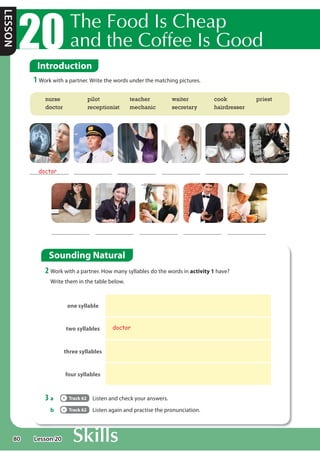
1 Work witha partner. Write the words under the matching pictures.
Sounding Natural
2 Work with a partner. How many syllables do the words in activity 1 have?
Write them in the table below.
3 a Track 62 Listen and check your answers.
b Track 62 Listen again and practise the pronunciation.
one syllable
two syllables doctor
three syllables
four syllables
doctor
nurse
doctor
pilot
receptionist
teacher
mechanic
waiter
secretary
cook
hairdresser
priest
Lesson 20
82
b Do youlike these things? Tell the class.
example I like tomato soup, but I don't like potato salad.
Vocabulary
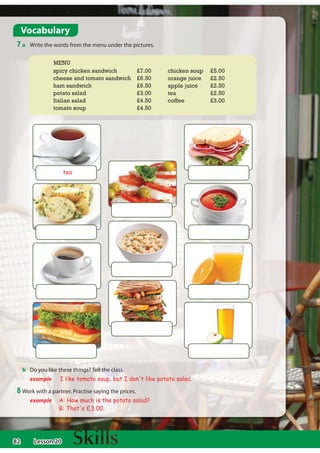
7 a Write the words from the menu under the pictures.
8 Work with a partner. Practise saying the prices.
example A: How much is the potato salad?
B: That's £3.00.
spicy chicken sandwich £7.00
cheese and tomato sandwich £6.50
ham sandwich £6.50
potato salad £3.00
Italian salad £4.50
tomato soup £4.50
chicken soup £5.00
orange juice £2.50
apple juice £2.50
tea £2.50
coffee £3.00
tea
MENU
Lesson 20
83.
83
Homework WXUQWRSDJH
Time toTalk
11 Work with a partner.
a Practise ordering food and drink in a café.
One student is the customer. One student is the assistant.
Customer:
Look at the menu in activity 7. Decide what you want.
Assistant:
Listen to the customer. Ask for the money.
b Change roles and do it again.
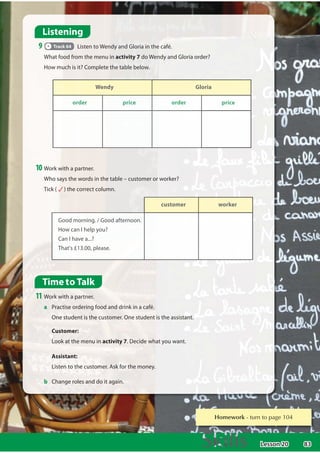
Wendy Gloria
order price order price
Listening
9 Track 64 Listen to Wendy and Gloria in the café.
What food from the menu in activity 7 do Wendy and Gloria order?
How much is it? Complete the table below.
10 Work with a partner.
Who says the words in the table – customer or worker?
Tick ( ) the correct column.
customer worker
Go
Good
o m
mo
orning. /
/ Good afternoon
on.
.
Ho
How
w c
can
n I help y
you
ou?
?
Ca
Can
n I ha
have
v a...?
Th
T at
at's
's £
£13
1 .00, please.
Lesson 20


![6KH/LNHV3L]]D
Introduction
1 Read what the woman and man say.
2 Work with a partner. Write the names of the food and drink under the pictures.
cereal
cereal beer bread carrots bananas eggs
orange juice rice spaghetti tea tomatoes wine
,OLNHSL]]D
,GRQ WOLNHPLON
Introduction
LESSON
12 Lesson 3
ngũ cốc bánh mì
traditional: truyền thống
pork: thịt heo
beef: thịt bò
fish: cá
guava: ổi
cheese: phô mai](https://image.slidesharecdn.com/timetotalkfoundationpre-a1sb-250521142051-2b7e08dd/85/Time-To-Talk-Elementary-A1-SB-slide-share-12-320.jpg)
![Time to Talk
14a Work with a partner. Choose a situation below and do a role-play.
Student A, you are the customer. Think about what you want.
Student B, you are the worker. Help the customer.
Practice
12Match the conversations with the pictures.
13Work with a partner. Practise the conversations.
a
$
RXOG,KDYHDUHWXUQ
WLFNHWIRU/RQGRQ
SOHDVH
%7KDW’V£
$+HUHRXDUH
%+HUH’V£FKDQJH
$7KDQNV
b
$,’GOLNHWKUHHPDJD]LQHV
DQGDOLJKWHUSOHDVH
%7KDW’V£SOHDVH
$+HUHRXDUH
%7KDQNV+HUH’VRXU
FKDQJH
$7KDQNRX
c
$
,’GOLNHWZRFDSSXFFLQRV
DQGDODWWHSOHDVH
%7KDW’VSOHDVH
$+HUH’V
%
7KDQNRX7KDW’V
FKDQJH
$7KDQNV
in a café
tea £2
coffee £3
hot chocolate £3
sandwiches £4
cake £4
b Change roles and repeat.
c Act out your conversation for the class. Can they guess where you are?
example A: I·d like a coffee and a hot chocolate, please.
B: That·s £6.
in a restaurant
steak £20
cola £2.20
chips £5
salad £13
chicken £14.50
Homework WXUQWRSDJH
35
Lesson 8](https://image.slidesharecdn.com/timetotalkfoundationpre-a1sb-250521142051-2b7e08dd/85/Time-To-Talk-Elementary-A1-SB-slide-share-35-320.jpg)