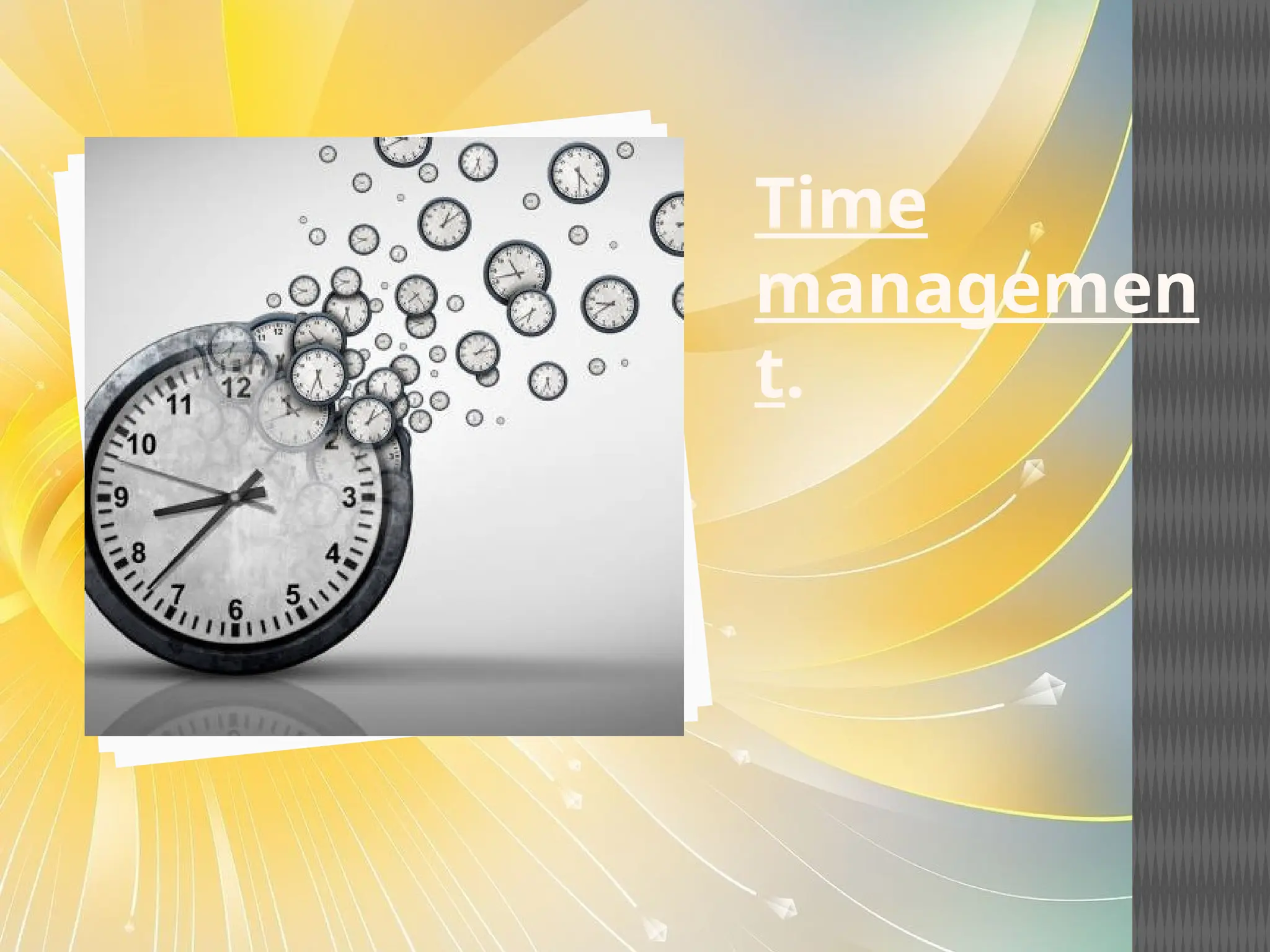
Time
managemen
t.
TIME MANAGEMENT
Time Management (समय का सदुपयोग्) Time plays an important role
in human life.
PRESENTED BY
SHIVENDRA PRATAP SINGH
Amitestripathi
Sumit KumarMishra
TIME IS MONEY
• You can make money ; you can’t make time.
• An inch of gold cannot buy an inch of time.
WHY TIME MANAGEMENT ?
• To utilise the available time in optimum manner to
achieve one’s personal and professional goals.
TIME FOR EVERYTHING
• Take time to think, it is the source of power.
• Take Time to work, it is the price of
success.
• Take time to play, it is the source of youth.
• Take time read, it is the source of wisdom.
• Take time to love, it is the privilage of gods.
• To take to time, it is the success of life.
BENEFITS OF TIME MANAGEMENT
Time management offers numerous benefits that can
greatly improved productivity, well being, and
success in both personal and professional life.
KEYS OF TIME MANAGEMENT
• Reduced Stress.
• Goal Achievement.
• Increased Free Time.
• Personal Growth.
• Better Relationships.
REDUCED STRESS
Proper planning and allocation of time prevent
last-minute rushes and the anxiety associated
with missed deadlines, leading to a more relaxed
and focused mindset.
GOAL ACHIEVEMENT
• Time management enable the setting of clear,
achievable goals and ensures consistent progress
towards accomplishing them.
INCREASED FREE TIME
• By eliminating wasted time and improving
efficiency, time management can create more
free time for hobbies, relaxation, or other
meaningful activities.
PERSONAL GROWTH
• Creates room for skill development and
pursuing new interests.
• frees of time to explore creativity and
innovation.
BETTER RELATIONSHIPS
• By managing your time well, you can
allocate quality time to family, friends and
colleagues.
• Reduces tension caused by missed
commitments or overwork.
STRATEGIES OF TIME
MANAGEMENT
• Set Smart Goals.
• Create a Daily Schedule.
• Apply the 80/20 rule .
• Build Routines and habits.
• Take regular break.
SET SMART GOALS.
• Define short term and long term goals using
the SMART criteria.
• Break larger goals into smaller manageable
tasks.
CREATE A DAILY SCHEDULE.
• Use planners calendar or apps to plan your
day or week.
• Block out specific times for tasks including
breaks and leisure.
APPLY THE 80/20 RULE
• Focus on the 20% of the tasks that generates
80% of the result.
BUILD ROUTINES AND HABIT
• Focus on small, manageable changes instead
of overhauling your entire schedule.
• Break larger goals into smaller daily actions.
TAKE REGULAR BREAK
• Schedule short breaks to recharge for better
mental fatigue.
• Avoid burnout by including leisure and self –
care in your routine.
CONCLUSION
Time management is the cornerstone of
productivity, success, and personal well-
being by prioritizing tasks, setting clear
goals, and creating structured routines, you
can maximize efficiency and achieve both
short-term and long-term objectives. Key
strategies like avoiding multitasking,
delegating, and taking breaks help maintain
focus and prevent burnout.
.THANK YOU.

time management skills.pptx raj new topic

  • 1.
  • 2.
    TIME MANAGEMENT Time Management(समय का सदुपयोग्) Time plays an important role in human life. PRESENTED BY SHIVENDRA PRATAP SINGH Amitestripathi Sumit KumarMishra
  • 3.
    TIME IS MONEY •You can make money ; you can’t make time. • An inch of gold cannot buy an inch of time.
  • 4.
    WHY TIME MANAGEMENT? • To utilise the available time in optimum manner to achieve one’s personal and professional goals.
  • 5.
    TIME FOR EVERYTHING •Take time to think, it is the source of power. • Take Time to work, it is the price of success. • Take time to play, it is the source of youth. • Take time read, it is the source of wisdom. • Take time to love, it is the privilage of gods. • To take to time, it is the success of life.
  • 6.
    BENEFITS OF TIMEMANAGEMENT Time management offers numerous benefits that can greatly improved productivity, well being, and success in both personal and professional life.
  • 7.
    KEYS OF TIMEMANAGEMENT • Reduced Stress. • Goal Achievement. • Increased Free Time. • Personal Growth. • Better Relationships.
  • 8.
    REDUCED STRESS Proper planningand allocation of time prevent last-minute rushes and the anxiety associated with missed deadlines, leading to a more relaxed and focused mindset.
  • 9.
    GOAL ACHIEVEMENT • Timemanagement enable the setting of clear, achievable goals and ensures consistent progress towards accomplishing them.
  • 10.
    INCREASED FREE TIME •By eliminating wasted time and improving efficiency, time management can create more free time for hobbies, relaxation, or other meaningful activities.
  • 11.
    PERSONAL GROWTH • Createsroom for skill development and pursuing new interests. • frees of time to explore creativity and innovation.
  • 12.
    BETTER RELATIONSHIPS • Bymanaging your time well, you can allocate quality time to family, friends and colleagues. • Reduces tension caused by missed commitments or overwork.
  • 13.
    STRATEGIES OF TIME MANAGEMENT •Set Smart Goals. • Create a Daily Schedule. • Apply the 80/20 rule . • Build Routines and habits. • Take regular break.
  • 14.
    SET SMART GOALS. •Define short term and long term goals using the SMART criteria. • Break larger goals into smaller manageable tasks.
  • 15.
    CREATE A DAILYSCHEDULE. • Use planners calendar or apps to plan your day or week. • Block out specific times for tasks including breaks and leisure.
  • 16.
    APPLY THE 80/20RULE • Focus on the 20% of the tasks that generates 80% of the result.
  • 17.
    BUILD ROUTINES ANDHABIT • Focus on small, manageable changes instead of overhauling your entire schedule. • Break larger goals into smaller daily actions.
  • 18.
    TAKE REGULAR BREAK •Schedule short breaks to recharge for better mental fatigue. • Avoid burnout by including leisure and self – care in your routine.
  • 19.
    CONCLUSION Time management isthe cornerstone of productivity, success, and personal well- being by prioritizing tasks, setting clear goals, and creating structured routines, you can maximize efficiency and achieve both short-term and long-term objectives. Key strategies like avoiding multitasking, delegating, and taking breaks help maintain focus and prevent burnout.
  • 20.