Time domain spectral
element-based wave finite
element method for
periodic Timoshenko Beam
M.E. IN CIVIL ENGINEERING
ROHAN DAS
ROLL NO: 002210402001
SESSION-2022-24
Periodic Structure
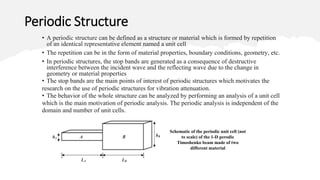
• A periodic structure can be defined as a structure or material which is formed by repetition
of an identical representative element named a unit cell
• The repetition can be in the form of material properties, boundary conditions, geometry, etc.
• In periodic structures, the stop bands are generated as a consequence of destructive
interference between the incident wave and the reflecting wave due to the change in
geometry or material properties
• The stop bands are the main points of interest of periodic structures which motivates the
research on the use of periodic structures for vibration attenuation.
• The behavior of the whole structure can be analyzed by performing an analysis of a unit cell
which is the main motivation of periodic analysis. The periodic analysis is independent of the
domain and number of unit cells.
Schematic of the periodic unit cell (not
to scale) of the 1-D perodic
Timoshenko beam made of two
different material
Method of Analysis
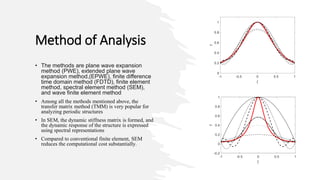
• The methods are plane wave expansion
method (PWE), extended plane wave
expansion method,(EPWE), finite difference
time domain method (FDTD), finite element
method, spectral element method (SEM),
and wave finite element method
• Among all the methods mentioned above, the
transfer matrix method (TMM) is very popular for
analyzing periodic structures
• In SEM, the dynamic stiffness matrix is formed, and
the dynamic response of the structure is expressed
using spectral representations
• Compared to conventional finite element, SEM
reduces the computational cost substantially.
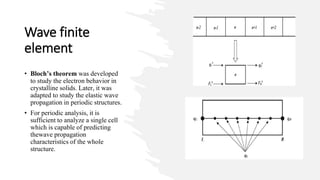
Wave finite
element
• Bloch’s theorem was developed
to study the electron behavior in
crystalline solids. Later, it was
adapted to study the elastic wave
propagation in periodic structures.
• For periodic analysis, it is
sufficient to analyze a single cell
which is capable of predicting
thewave propagation
characteristics of the whole
structure.
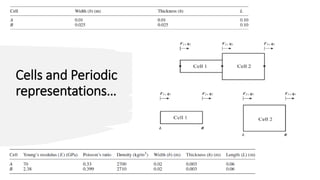
Cells and Periodic
representations…
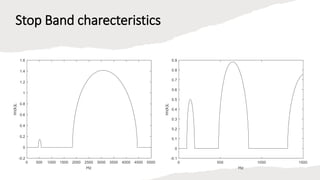
Stop Band charecteristics
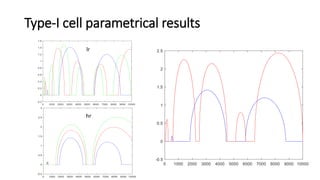
Type-I cell parametrical results
hr
lr
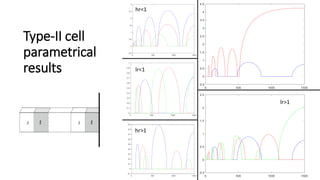
Type-II cell
parametrical
results lr<1
hr<1
hr>1
lr>1
THANK YOU !

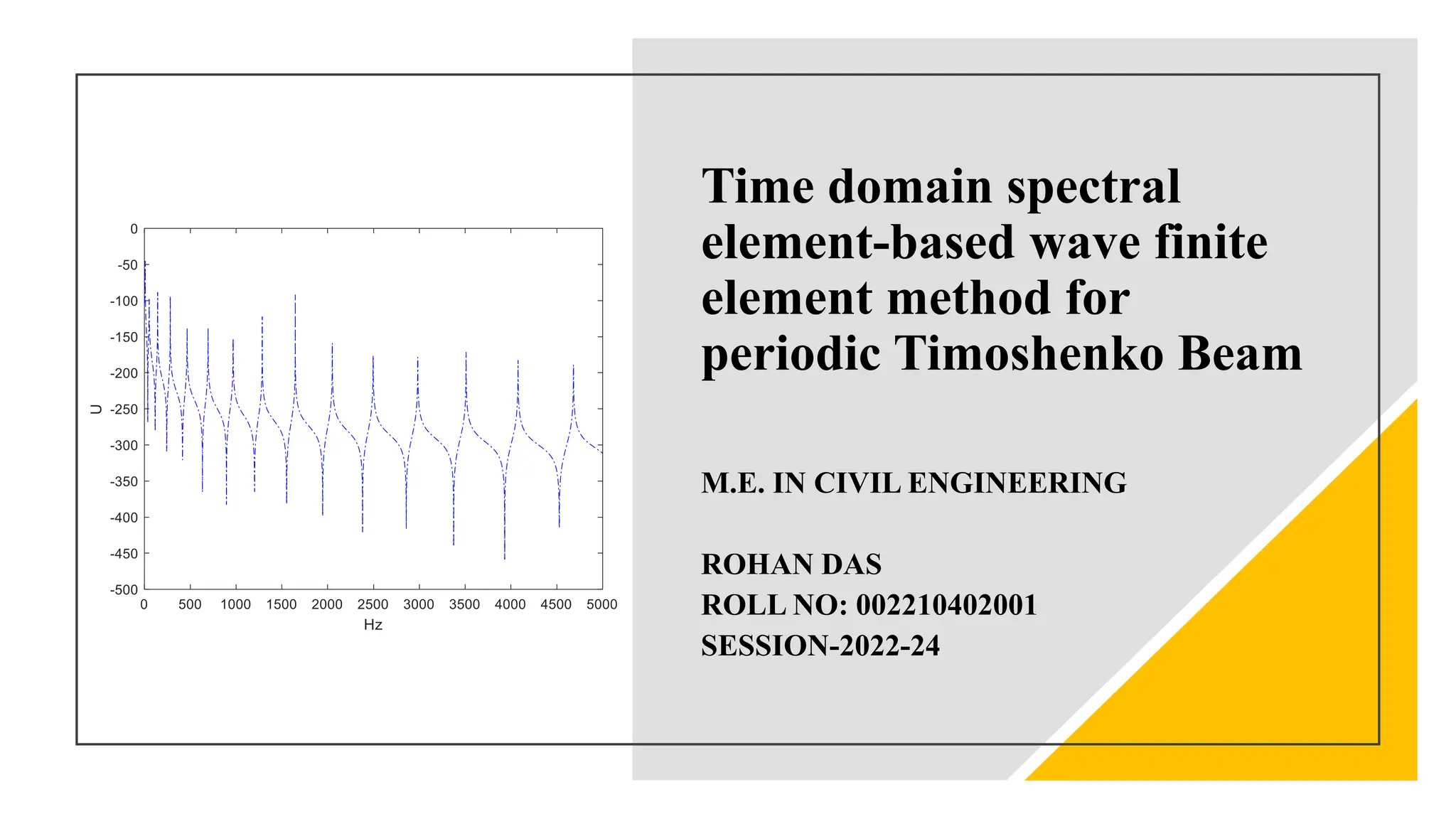
Time domain spectral element-based wave finite element method for periodic Timoshenko beam

  • 1.
    Time domain spectral element-basedwave finite element method for periodic Timoshenko Beam M.E. IN CIVIL ENGINEERING ROHAN DAS ROLL NO: 002210402001 SESSION-2022-24
  • 2.
    Periodic Structure • Aperiodic structure can be defined as a structure or material which is formed by repetition of an identical representative element named a unit cell • The repetition can be in the form of material properties, boundary conditions, geometry, etc. • In periodic structures, the stop bands are generated as a consequence of destructive interference between the incident wave and the reflecting wave due to the change in geometry or material properties • The stop bands are the main points of interest of periodic structures which motivates the research on the use of periodic structures for vibration attenuation. • The behavior of the whole structure can be analyzed by performing an analysis of a unit cell which is the main motivation of periodic analysis. The periodic analysis is independent of the domain and number of unit cells. Schematic of the periodic unit cell (not to scale) of the 1-D perodic Timoshenko beam made of two different material
  • 3.
    Method of Analysis •The methods are plane wave expansion method (PWE), extended plane wave expansion method,(EPWE), finite difference time domain method (FDTD), finite element method, spectral element method (SEM), and wave finite element method • Among all the methods mentioned above, the transfer matrix method (TMM) is very popular for analyzing periodic structures • In SEM, the dynamic stiffness matrix is formed, and the dynamic response of the structure is expressed using spectral representations • Compared to conventional finite element, SEM reduces the computational cost substantially.
  • 4.
    Wave finite element • Bloch’stheorem was developed to study the electron behavior in crystalline solids. Later, it was adapted to study the elastic wave propagation in periodic structures. • For periodic analysis, it is sufficient to analyze a single cell which is capable of predicting thewave propagation characteristics of the whole structure.
  • 5.
  • 6.
  • 7.
  • 8.
  • 9.