ii
Tic Toc
Edited by: A.J. Huffman
and April Salzano
iii
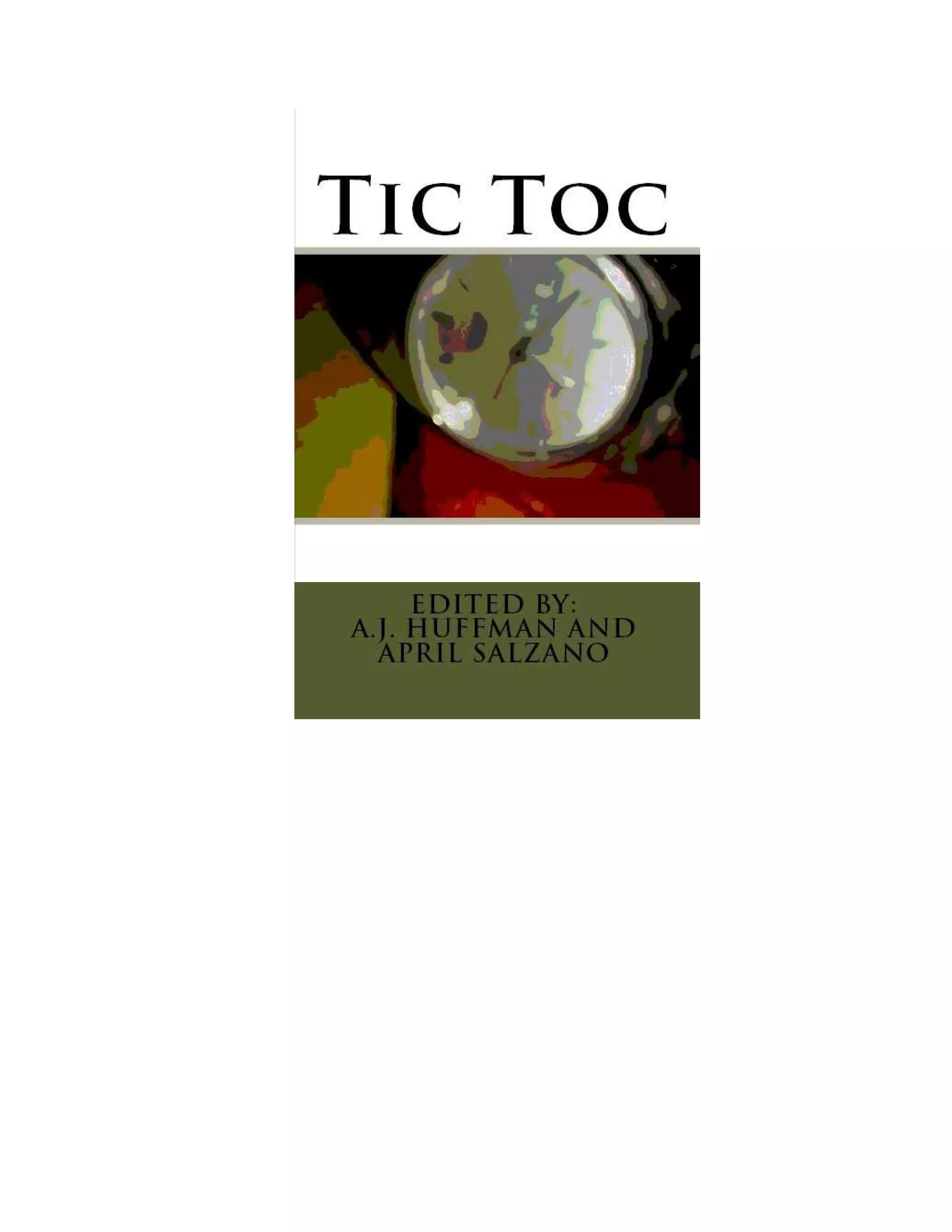
Cover Art: “Tic Toc” photograph by A.J. Huffman
Copyright © 2014 A.J. Huffman
All rights reserved. Except for brief quotations in critical
articles or reviews, no part of this book may be reproduced in
any manner without prior written permission from the publisher:
Kind of a Hurricane Press
www.kindofahurricanepress.com
kindofahurricanepress@yahoo.com
CONTENTS
A.J. Huffman Five Hundred Twenty Five
Thousand Six Hundred Minutes
2
From the Authors
Carol Alexander Atrribution: Blue Lady (1957?)
Amanda Anastasi Half-Past
Untitled
Sylvia Ashby Space-Time
Barbara Bald At Season’s End
There Comes a Time
It’s About Memory
Adjustable
Mary Jo Balistreri Riffing on an Old Tune
Flying Out of Phoenix
Donna Barkman Child’s Play
Summer 2012
Forbidden Fruit
David J. Bauman Second Hand
Years Later
Recurrents
Linda Bearss The God in My Ear
vi
Colin Bell Over Time
James Bell A Time to Remember
A.C. Billedeaux Vintage Vinyl
Rose Mary Boehm Between Here and Midnight
Doug Bolling Late Summer
Evening Passage
Time Past
Brennan Burnside World Trade Center Study Room
Lesley Burt Eternal Lines
Brenda Butka The Prisoners Vanishes
Jeffrey Bruckwicki Chaucer
Miki Byrne o Time for History
These Were the Times
Andrew Campbell-Kearsey The Alliterative Assasin
J.R. Carson Mutually Forgotten
Daniel Clausen Again
Esteban Colon Till
13 33
Sepia Colored Past
Randall Compton Ambitions
vii
Envelope
Diana L. Conces Quitting Time
Apocalypse
J.L. Cooper High oon with Pink Carnation
Melodie Corrigall Scattered to the Wind
Linda M. Crate Movement of Time
Larry Crist Forever Stamps
Group Photo
Oliver Cutshaw Honey in October
Susan Dale In the Beginning
Untitled
The Color of Time
Tim Dardis Driving to Physical Therapy After
Reading Delmore Schwarty
Tatjana Debelijacki The Time of Birth
Julie A. Dickson Cuckoo Clock
Bruce Louis Dodson Solitude
The Time of My Life
Old Men
Jane Dominick Precursor
Jacqueline Doyle Memories of the Future

viii
Chiyuma Elliot Why I Called So Late
eil Ellman The Clock
Zach Fechter Under a Glass Desert
Sue Mayfield Geiger oir Couture
Sarah Ghoshal Garage Sale
For Chris
The Sharp Edges of Trees
Jessica Gleason Third-Life Crisis
Misshapen Adulthood
Allison Grayhurst Time Like . . .
Karen Greenbaum-Maya Silence and Slow Time
Ghazal Before Memory
Ray Greenblatt Measuring Time
Harmony Hodges The Bullpen
Lynn Hoffman Pliation, n.
The 23rd
Century
Trish Hopkinson Empty Sockets
Trash Bag Burial
Sue eufarth Howard Droughtful October
Susan M. Huebner Archived
ovember’s Last Call
ix
Wendy Elizabeth Ingersoll Christmas Future
S.E. Ingraham Tick-Tock
Diane Jackman BBC Radio Interview
Miguel Jacq ine Year Microwave Sky
20000
Marker Horizon
Michael Lee Johnson Quiet Hours Passing
Mindful, Mindless October Date
When You Get Old
She
John Lambremont, Sr. Time After Time
David Lymanstall The Time Thief
Arlene Mandell Start . . . Stop! Print . . . Send!
Fleeting Beauty
Wild Strawberries
Jacqueline Markowski Of Pigs & Pizza
And Another One Down
Residual
Joe Massingham Just a Mother
Janet McCann Pathetique
Joan Mc erney Keepsake
x
Tonight
Jim Meirose In Marty Time
Karla Linn Merrifield Sixth Dimension
Jane Miller Making What We Can
Concrete Bloom
Mark J. Mitchell Timepiece
Jude eale Mexico
Emily Pittman ewberry This Too Will Pass
Signs
BZ iditch At Cape Cod
Rees ielsen The Trick
One of the Guys
ayaz daryl nielsen A Memory
Loretta Oleck Slow Time
Rooms & Ruins
Amy S. Pacini Yesterday’s Clock
Timeless Companion
Carl Palmer Mexico Time
Time
Chris Palmer Chemistry 101
Jeffrey Park Time Keeper
xi
Mangal Patel Time’s Up
David S. Pointer Time: Back in Stock
Stephen V. Ramey Predestination and a Potato
kerry rawlinson African oon
Wind Memory Kenya
Svidrigailov, You Have ot Wound
the Clock
Jendi Reiter Mis umeros
Polish Joke
henry 7. reneau, jr. Sins of the Father: 2442 AD
The Terminal Blues
Selective Recall
Kristin Roahrig Ghosts of a Photograph
Sy Roth The Wallflower
Salty Rivers
Silences
Tentative
Len Saculla All Your Sweet Sales Talk
Richard Schnap Severed Flights
Andrew Scott Time is Ticking
Rex Sexton Clockers
xii
Chris Shorne Stop, Watch
Smita Sriwastav My Weekly Meanderings…
Vignettes on Amnesic Memories…
Bekah Steimel Untitled
Kevin Strong Musical Lives
Anne Swannell Keeping Time
Marianne Szlyk Listening to No Other, Thinking of
Takoma Park
Rose of Sharon
He was a Friend of Hers
Talaia Thomas After the Before
Sarah Thursday Westwood Boulevard (Why I Can’t
Go Back)
Tim Tobin My Old Grandfather
Tamara K. Walker Stumble to Infinity
Go
Mercedes Webb-Pullman Terra Sancta
Lucid ights
Joanna M. Weston I Open the Door
The Present Past
Abigail Wyatt Little Red
Tock
xiii
Dana Yost Variations on Isolation
From the Editors
A.J. Huffman On the Surface
Chronomentrophile
Because Seconds
Misappropriated Chambers
The Road to Timeless Road
Looking through the Hands of Time
Watch Unplugged
April Salzano Just a Click Ago
Leftovers
My Grandparents’ Basement
George, Tell Me About the Rabbits
From Age This Periphery
Closed Doors
The Relocating of Things
Author Bios
About the Editors
i
2
Five Hundred Twenty Five Thousand Six Hundred Minutes
That is one way to measure a year according to my favorite Broadway
song, Seasons of Love (from Rent). It goes on to give verses of
alternative ways to measure that same length of time.
For this anthology, we asked our authors to give voice to their own
verses, stanzas and paragraphs detailing how they measure time, or
even how time measures them. Never disappointing, they took us
down a rabbit hole of infinite possibilities. “In daylights, in sunsets, in
midnights, in cups of coffee . . . “ the song continues. Our authors
touched those tangibles, along with dozens of others. Some delved
deeper still, measuring time by ghosts and memories and disappearing
increments of mathematical division.
“How about love?” the song asks. Some of our authors answered with
a resounding yes, then countered: What about despair? What about
death? They opened their hearts and their wounds, allowing us as
readers to bathe in the aftermath of both.
This was one of the broadest themes we have ever posed, and yet even
with the diversity of the responses, as a whole this was the most
intimate collection we have ever put together. The ephemeral has come
to hold hands with the tangible as they both chase the paranormal right
into our heads and hearts. And we were glad to have taken the journey
with them all.
3
From The Authors
4
Attribution: Blue Lady (1957?)
Their paintings are the sum of all we know
of the seven ages of man--some slides were lost,
inevitably, and then, we stayed no length of time
to mark bone growth on doorframes,
but like the seeds of the wild plum straggled,
blown off course, to fall where we would.
From the wreck off the coast, this washed ashore
scumbled on a white field, head cropped off
as if by the whimsy of a fey small child
coloring gamely from the bottom of the page
(amazed that there is no place left to go).
Its subject gazes out with aqueous eyes,
a perpetual prisoner of the wormy frame.
For years, I thought my father painted her
when really, I should have known.
This canvas has the strangest pull,
as if prestidigitation charmed the oils:
thin lady, logy prophetess, her long blues
trailing on yet another six decades,
sipped a draught of wormwood and gall
in beauty like netsuke worn from daily ecstasies,
unmade beds and passing children's squalls,
the lashings from sea-brewed storms,
streams of water seeping underneath the sills.
Father in his post-stroke days grasped crayons,
drawing mermaids on the paper mats while
Mother's lady lingered in a darkened room.
She's made the ocean-blue of nereides
undulating in the eddies of neap tides.
5
When they had gone, I dreamed we met
in waters off the eastern shoals.
-- Carol Alexander
6
Half Past
We are hypocrites about the past,
clinging to dead things, resurrecting
some memories like avid hoarders
while others are locked in penitentiaries.
We snap stills with our camera phones:
selected poses, stretched truth marketed
to future reminiscences – in them we laugh
and dance, our faces turned to their best angle.
When we flick through them in twenty years
we’ll have convinced ourselves
that it was our happiest time,
that we will never be that way again
and our grim acceptance of the lesser
present is justified - we believe
our own propaganda about ourselves;
so busy remaking and remodelling
the past, rereading and reinterpreting
its texts, we never completely live
in the here and now,
making our past a half past
and our present half lived.
-- Amanda Anastasi
7
This poem contains clock hands
that stop and start, a struck
match over a black wick
two falcons clawing at the bars
though the cage door is open
the pluck of a tense wire
a mountain lion on a leash
a moment of white:
a fresh inhale
a cry caught at the back of a throat
the fiddling of a lock
the dropping of calculations
a searchlight turning in on itself
a Siberian husky on a beach
a finding of words where before
there was a deafening hush
a nod to the improbable
-- Amanda Anastasi
8
Space-Time
Of the constellation’s span
that you dwell in my mind
I dreamt you once:
You walked a corridor
and whispered my name,
softly whispered my name.
Dangling now by a silky thread
spun from a far-away star
I wonder what time wanting is.
Whispers are young to succumb
I learn and dreams: seeds drawn from
to be withdrawn from the sun.
There is only the constellation
that waits or nibbles an inch
from the century.
Oh, but this thousand-year
has tired me – may I rest
in your chair a while, Cassiopeia
-- Sylvia Ashby
9
At Season’s End
His gray hair catches waning light,
as he reaches for her younger hand,
beckons his partner to him.
In her blaze-blue blouse bought for this occasion,
she smiles, responding like a teen on a first date.
Inconspicuous as white-tailed deer,
this couple dances in the shadow of a mini-van
parked to the side of a courtyard stage.
Across the parking lot, a second senior pair
sits in lawn chairs, their coolers beside them.
With the finality of gates slammed behind an inmate,
his ‘no’ to her plea to dance shatters the humid air.
On this night war wages in Afghanistan,
wildfires gobble up western forests
and an impeding hurricane threatens the east-coast.
On this night one couple chooses to dance
to summer’s last concert;
another remains staunchly seated.
-- Barbara Bald
10
There Comes a Time
I’ve decided to talk to the dead,
to chat with ghosts who encircle me
like elders at a pow-wow.
I hold deep conversations with them,
share one-liners or a few laughs.
I’m sorry you can’t sit with me
on this mossy rock, I say
to the man who once claimed by heart.
Your swimming hole is still here,
I tell the phantom dog.
Forgive me, mother, for not
taking your arm when you visited.
It does not matter that I cannot see them
or that they no longer really exist.
It only matters that, like the imaginary friend
who snuggled with me in soft flannel sheets,
they listen to my musings,
know my history
and offer a hand when
I’m tired of traveling alone.
-- Barbara Bald
11
It’s About Memory
It starts out in your youth like Santa’s bag of toys –
images and feelings stuffed into his sack one at a time,
ready to be pulled out in an instant,
pleasure on demand.
It may be about spaniels racing round a pond,
a canoe tipped by the current, laughter in its hull,
sounds of playing horseshoes on the lawn,
even an argument, remembered fondly,
over where to stack dishes to dry.
Cabin no longer there, mirth burned in its rafters
and dogs long gone, memories come unbidden,
see-saw back and forth – one minute a warm blanket,
another a hair shirt you’d do anything to remove.
Over time the bag’s sides bulge, joy and grief
seep through its seams and the drawstring tightens
like a noose around the neck.
A burden now, too heavy on the back,
even Santa loses his swagger.
-- Barbara Bald
12
Adjustable
Time, like an expandable watchband, stretches—
no deadlines, nothing to do except
watch a lazy river drift quietly to wherever.
It offers space to appreciate
hummingbirds dive-bombing one another
at sugary feeders; flexes to welcome butterflies
tasting new-found freedoms—but
snapping back in place, time contracts,
sets boundaries, halts appreciation.
As a fast-ticking timepiece, it can set a frantic pace,
imprison the senses, dull them
to flowing rivers and chittering hummers.
Time can steal hours, days, years, even lifetimes,
stashing them into booty bags, until,
in wisdom—or luck—the wearer decides
to remove the band.
-- Barbara Bald
13
Riffing on an Old Tune
Three adults and a newly minted teenager
linger over lager and lemonade
taco salads and quesadillas
The moon hangs
round and full
and we’re sure summer’s flavor is blueberry
Relaxed tonight, his words
are open windows
Paris light
champagne bubbly
whirling dervish of sound
Brio and abandon bounce
on the polished table
exploratory fire
free jazz
Tonight he takes a break
meditative half notes gone
His forward drive swings,
spins a lyrical improv
a new unmetered riff
the old licks quoted
in double-time
-- Mary Jo Balistreri
14
Flying Out of Phoenix
Time is the coin of our life. The only one we have
— Carl Sandburg
Held aloft on wings of a huge aluminum bird,
we fly through time on highways unfamiliar.
Strangers to each other, we are mostly alone,
twenty-thousand feet above ground in a lake
of air and light, lily pads of white. We disappear.
Reappear over desert, mountains, and striated canyons.
I fly with bliss and dread, bundled and lost in blue fleece.
Page after page, The Lemon Tree describes clouds
shadowing both Israel and Palestine,
their clash over borders.
The vastness of no borders outside the plane’s window
penetrates the story line. It too presents conflict,
jars in a different way.
With the extreme of no boundaries, the thought of free fall
makes me tense and helpless.
I check my watch for focus, but the face has no numbers.
And it occurs to me as the minute hand circles and circles
that time is space, the numbers arbitrary as are borders.
Uncertainty is our bedrock,
a contrail of exhaust the only sign of our passing.
-- Mary Jo Balistreri
15
Child’s Play
No word exists in English for children who are grown.
Do you have kids? I used to, years ago, when they were young.
Now they’re middle-aged, salt-and-peppered, easing into bald,
with delicate lines, not yet wrinkles, etching their brows.
Memories pop, to think of them as youngsters, diving
from the high board, herding gerbils and hamsters, scaling
the alley fence to scoot to Daisy’s, the bodega down the block.
I’ve lived beyond the ages of my parents when they died.
They will always be my parents; will I always be their child?
A child in memory only, playing jacks and jump rope –
Double Dutch – puppet shows, backyard trapeze tricks – slowly
aging to grey hair and crow’s feet, becoming the one who cared
for them, like the children they’d become, as my own grown kids
will need to, when my ripened life dims into a second childhood –
minus Double Dutch.
-- Donna Barkman
16
Summer, 2012
Big dead ants surround
my bed, exterminator’s victims.
Under siege I pluck them from the carpet
morning noon and night for weeks.
Their fragile brittle exoskeletons –
protectors in life – now crumble
at my touch.
In a hospice bed in Texas,
my sister dwindles day by day.
Morphine and oxygen sustain
what little’s left of her. Deprived
of flesh and muscle, her bones
surface to make a human
exoskeleton, delicate and crisp,
that contains her slowing breath
and pulse.
Gutted by loss and disappointment,
June, July and August heed
their sweaty expiration dates that
spanned a friend’s death,
another’s permanent
departure, a sister gone.
September’s not exempt, not yet.
A slight invisible carapace
would be welcomed:
an exoskeleton for me to don.
-- Donna Barkman
17
Forbidden Fruit
I was tempted by the apples
round and smooth
as they hung from branches,
low.
An injunction Do ot Touch
made them irresistible
luscious in their
juiciness
just as my baby nakedness
round and smooth
was luscious, irresistible
to him, my older, older-brother
Now grown, now old, I still see
his prying hands in those of others’:
last week’s plumber, the UPS man
my younger son
Strong and square
my own hands resemble his
as I gaze on fallen apples
ransacked memory in my palm
and plan these words
-- Donna Barkman
18
Second Hand
Sorry, my emotions were cheap back then.
The youngest of six, I wore hand-me-downs
and thrift store clothes like I was anyone.
Simple, that's how we lived, how we did
everything. "They’re good alright," the clerk
had told her, but unlike the latest
(more expensive) name brands, these emotions
had no dimmer switch. They were either on or off.
And I've always been sentimental about Mom—
the things she gave me, so I never had the heart
to trade them in for something new, updated or
fashionable. Once, recovering from an all-night tantrum
I picked up a surge suppressor at the hardware store,
but even after all these years of filters and shades
I leave Bloomingdale's and Macy's
empty handed, the newer models still on the shelf.
I keep the old things turned off, in the corner and imagine
balance—just enough love, just enough care,
a touch of romance in low light, a soft kiss
and an honest smile at the thought of you
walking fast on fourth street
in your blue pea coat, and me able to keep
that vision with easy eyes, a simple sigh
and the possibility of sleep.
-- David J. Bauman
19
Years Later
I watch now—a primal instinct.
In the yard my sons are swinging,
laughing, while at the window
I wash dishes—mindless clinks
of silver and glass. Eyes scan,
ears tune in for a cry that
isn't laughter. When we go out
I hold their hands in parking lots
and stores. I cannot help the child
I was. Someone should have been
there for him. A brother stood shaking
at the bottom of the stairs, hoping
what was done to him was not being done
to me. Sometimes hope has no feathers.
Adults were in the house, laughing,
drinking. It was cute, they said the way
we became pals. You asked me
to show you where the bathroom was.
I feared every visit after. When
for other reasons you were finally locked
in jail, they asked me cautious questions,
not careful ones, clutching faith, so
I let them believe. It doesn't hurt,
not anymore. Now I watch, I hold
hands, stay close, call often. Perhaps
in doing so I also stretch my arms
past decades to the boy, trembling
beneath blankets in the dark,
hearing a voice, a shoe on the stair,
a fluttering on the window sill.
20
Now, at last, he may be safe
as my children are embraced.
-- David J. Bauman
21
Recurrents
There we are by the shore again—well, me
by the shore, you out there, bobbing in the waves
once more, eyes bugged out, lips ice-blue,
arms flailing. Desperate to keep your head
above the white caps, you've somehow managed
to grasp a fallen branch. "Are you okay?"
The classic stupid question, but what am I to say?
"I'm sorry," you sputter-shout
as you spit a school of minnows from your teeth.
"I'm always drowning when we're here together."
Yet just last week we enjoyed a day here, dangling
foaming feet, skipping little stones, but now
is not the time to argue. I throw the rope,
always looped to my belt in anticipation
of times like this, but you miss it every toss.
All the while your enormous eyes convey a bevy
of emotions; fear of the current, rage at the waves
and sympathy for my own failings. My rope is too short.
In a frenzy now I fumble through my pockets, and toss
their contents to you—a marble, a feather, a rubber
chicken, hoping you'll know how to use them. "Don't worry
about me," you gurgle. And I am touched; I know
how you hate it when your moods affect me. Too late
I dive and plunge into the icy flow, as you lose
your slippery grip and begin to drift
around the bend, waving kind assurances
as your head sinks beneath the surface. You're always
22
thoughtful like that. Resigned, I crawl back
up the bank, and find my favorite rock. I check my watch—
it could be hours yet, before you're washed ashore.
-- David J. Bauman
23
The God in My Ear
I.
the God in my ear is male
knows the only truth
the one right way
and where the traps are
birthed in the mire
my foot slides
sticking fast
just like a woman
just like his woman
who made the mud anyway?
II.
the Spirit rides
a gentle whisper
notes sing to me
quills prick
drawing epiphanies
blood minerals
to my finger tips
visions taking form
my right hand brushes
white living fibers
composing new psalms
the God in my ear
croons “Such colors and melodies
are birthed in the mire
what a tapestry you weave
from brokenness—
I was right to let you fall.”
24
III.
divine and human
enigmas paradoxes
theology debate
seen in a mirror
dimly lit
my Aunt Louise
knew His voice
smiled at my
logical assertions
and revelations
put her hand on her heart
drew out her faith
and shared a piece with me
IV.
it is so hard for a rich man
for a man who counts himself wise
to grow and hold faith
for a wounded woman
who has learned how to stand
to trust in someone stronger
than herself to lean on
V.
the Giver of all life
offers His claim
on this broken vessel
logic fades, slipping
over the dampness of
the potter’s hands
mending the fragments
left from generations of fear
reason and arrogance
25
He rents my understanding
draws out my faith
invites my allegiance
and I ask “Why me?”
VI.
hours days years drift
transient moments
of need and questioning
the master mender
of broken pots
marks my soul
with proverbs
and psalms,
letters of love,
promises of a future
He calls me “beloved
precious, unique”
VII.
Time is a shadow
my fugitive soul
an aberration too weak
to hold to trust
“Time is Mine” whispers
the God in my ear
-- Linda Bearss
26
Over Time
Overtired from overtime,
under-paid and over-worked,
we over-act.
Protests overdone,
Thespian tempers overheat,
our emotions overflow
and yet again, you throw me overboard.
Maybe our love is overpriced,
a game of lust overspent,
passion overdosed.
My comeuppance is overdue,
but it’s a mutual oversight
thinking I am over you.
I too often overlook
your power to overwhelm
me. We continually overreach,
over-estimating sentimental leftovers,
eroticising over-indulgence.
Expectations often overcooked,
our careers make us over-ambitious.
We’re hopeless at the overview.
Over and over again we try to say it’s over,
but pain can be overcome,
lives can be overhauled.
Love’s the overall winner -
over time.
-- Colin Bell
27
A Time to Remember
as clouds draw forward in the distance
and cover clear sky
I remember that incident where
a bird flew low before the car bonnet
and you insisted I stop to look
to see if it was injured or dead
for you are concerned with such detail -
but I could see nothing on the road
so we agreed it must have flown by
and continued into town for our promised lunch
on return to the car
I happened to walk round the front
and saw a live robin stuck by its legs
there in the radiator grill from where
it looked at us with that fixed friendly expression
as if to say - what are you going to do about this -
while we discussed how to set it free
hit with the guilt of a fine lunch
we wrapped it in a soft scarf fearing to crush it
when we tried to set it free -
this cost it one leg
we could only watch as it flew away -
I tried to imagine its future life
how it would live in a strange place with one leg
the clouds have completely covered the clear sky
I see a chimney begin to smoke
among some rooftops
watch again how the world turns
and shows how quickly time passes
-- James Bell
28
Vintage Vinyl
This is the conversation they never had.
He is sitting on one side of a large, brick wall. It’s cold against his
back, but he rests his head against the brick anyway. His eyes are
closed. He can almost feel her.
She is on the other side of the wall. She’s sitting cross-legged, facing it.
When she hears him breathing, she looks up. Her hair falls away from
her face and in a rush, the emotions paint her expression. She fancies
herself stone, immune to everything and impenetrable, but he knows
better. In moments like this, he knows exactly how her face looks.
He wants to reach through the stone, touch her cheek. He wants to hold
her hands because he knows that she is shaking.
She is scared. She is always scared. And he is so far away.
How it really happens is like this. She stays there, for a few minutes.
He begs her to say something. She doesn’t. She reaches up and presses
her palm against the stone. Then, lips sealed shut, imagining her heart
to be stone, she climbs unsteadily to her feet and walks away. The next
time he sees her, she is dead.
That’s how it really goes.
After, he rewrites it.
He is still sitting on the ground by the brick wall. His knees are drawn
up to his chin. He is looking at the sky and, almost too softly to be
heard, he is speaking. He is singing. It’s a song they both know, from
when they were children. She stays, on her side of the wall, and listens
to it. Her gloved hands are pressed to the brick. It hurts, especially
where the skin has died at the tips of her fingers, but she pushes as hard
as she can. She wants to leave a mark.
She says, “We should have never met.”
29
He stops singing, but doesn’t move. He says, “I’m glad we did.”
Her dead fingers are just the beginning. There are other parts of
her that are dying too. There are parts of her that have been dead
since before he knew her. She is just pieces--always has been.
Pieces that are alive. Pieces that fight. Pieces that are stone. And
pieces that were buried a long time ago.
“You’re going to ask me why,” he says.
She doesn’t, because she doesn’t want to sound needy.
But he tells her, because she doesn’t say anything else. “You
changed me too.”
"Not enough." Not the way that he had changed her. She’d been
so different when they’d first met. She’d been only one piece
then. Just the dead one. The buried one. Something terrible had
happened to her--like terrible things always happen to people and
turn them into something they never were before--and she had
become nothing.
Stone, she’d said.
But he had made her more.
“How did I change you?” she asks.
He closes his eyes and breathes her in. It’s almost as if she’s
right next to him. He says, “You made me.”
She was two-sided. She had side A, before. She had side B, after.
She had the incident that defined her.
But she was the incident that defined him. She was the before
and the after. She had turned him from ordinary into
extraordinary. She had made him brave.
On the other side of the wall, she hesitates. He can hear the smile in her
voice. “You’d have been you anyway, without me.”
30
“I wouldn’t have,” he says. Then, “And I wouldn’t have wanted to be.”
She understands, because of her two sides. The first side, from before,
understands that he doesn’t want to be what he is without her. The
second side, the one that is forever, understands that she was the one
that made him strong enough to do just that.
Side B says, “I’m glad you came.”
Side A says, “I have to go. It’s time.”
He listens to both sides of her--the stone and the fire--and he
understand that this is all they get. This last conversation.
“It’s time,” he agrees.
The next time he sees her, she’s dead.
He wishes he’d said goodbye.
-- A.C. Billedeaux
31
Between Here and Midnight
Walking along the Pacific coast
night comes upon us abruptly.
We sit and watch the last hot ore
dipping into Prussian blue.
Flames are dying behind
a black wall of insubstantiality.
Giant footprints fill with red lava.
Overflowing.
Alluvial.
These angels have large beaks,
the wings of black swans.
Comfortable on the foam of roaring
waves, they set fire to the sea.
I close my eyes, go inward, back to a time
when I was shaped. When I promised
the old gods that I’d heed my own advice.
Promised I’d remember the dead
and watch the robin.
The smelter of all that is
tried me and spat me out.
I am not about to become
indignant.
-- Rose Mary Boehm
32
Late Summer
Light ebbs, an old man in a
frail coat.
The grasses here now brittle
in their fierce ownership
of dying.
The echoes of myself crowd
in. What is the present
but a minute particle.
Three crows plunder the remains
of seed and berry.
I step into a sudden wind
as though
invisible.
Is it that world is an
invention of words
and memory.
It is colder now. The mirrors
will no longer serve
the will to
escape.
I reach out to touch
the shadows before they drift
behind the mountain.
-- Doug Bolling
33
Evening Passage
The games of checkers by the hour.
Small rodents sleep and dream
of the feast of plenty.
If you watch you will see the shadow
of time slowly cross the floor and
vanish behind the far wall.
Sounds of traffic from the interstate
bulge and shrink and return
hour after hour as here in the
narrow room each moment becomes
a slow drip in the rain bucket
by the window next the
chrysanthemums.
The old men are through.
Clack clack of pieces dropping
into the cigar box below.
They have no words.
Night waits like a lengthy yawn.
Rain rises again from the west
beating against the small house.
In the pantry the stacked plates
bump against each other in
rhythm with the rain.
A form of chatter that dulls
the imagination,
speeds the path into sleep.
-- Doug Bolling
34
Time Past
A remembering as of children.
How the years withdrew in a
long suddenness
and returned becoming
a present.
Voices motionless. Footsteps
ghostly, small traces in their
warp of time.
And the children here by
the sea.
A dozen of them or a
hundred.
They play. they play.
Their moments as unburdened
by thought as those of sea gulls
lofting into sunlight
from the sand dunes.
The tide comes and it
takes away.
Toy boats and tatters
of dream sail outward
to the unknown.
Things continue.
They become the places
where time was.
-- Doug Bolling
35
Eternal Lines
The percussive growl from a light aircraft,
high overhead, backs the melodies
of blackbirds and finches;
jasmine is flowering on the trellis,
so that late afternoon’s bright warmth
spreads its scent across the garden;
sky is unbroken blue; and the breeze
is satin on skin; we sip wine,
apple-crisp; smile; touch hands.
Before I can think beyond perfect
that moment is words in past tense.
-- Lesley Burt
36
The Prisoner Vanishes
doing time consists of no time at all.
in this snake-eyed cube of time
time rises like smoke, marking
nothing except
my heartbeat, which
should be secret, my breath
shuffling in and out, of no interest
to anyone. in my no-time doing time
dreams pile up of metronomes, of
a day unfolding its morning news again
and again, its regular ticket punched.
I have been here longer than these walls,
and slower, have become old graffiti
written on the shades
of my predecessors. I am living in the pure air
at the top of a mountain of grief,
this white box
no longer my container, with its
airtight lid. I am no longer present
to be contained, simply not here,
no more. lockdown is no triumph,
this is not a victory of the human spirit,
just another story of gone.
six feet wide six
feet under six feet up just
walking crazy on stocking feet.
talk about doing time when
time is doing me.
-- Brenda Butka
37
Chaucer
I covered my ears trying to smother the sound
The anger rattled my canals at four years old
At twenty four I sat on the sticky surface of a bar room
laughing, smiling, acting like I had unclogged my ears
Married now I hear myself from the outside
Blurting words that tear and will scar
I took a class on Chaucer in college
Tthe words I remembered
and used
and my lexicon grew
and I could spread anger with acrobatics
I learned things thirty years ago that stand true today
The decay that time brings to relationships
The guilty thinks that all talk is about them
all of the minutes in the day
and I hear the voices
bouncing, tearing through my scarred canals
-- Jeffrey Bruckwicki
38
o Time for History
I remember the Great Humane Cull.
When millions of the old and sick
gave themselves to forever-peace.
We revere their sacrifice,
keep them in virtual niches for our homage.
It wasn’t enough. Now a new structure exists.
Wrought from chaos by the Global Senate,
as resources died and the great tracts withered.
We became used to it. After the riots
and the underground prison building program,
we achieved order.
Learned control, how to be selfless.
Each family was allocated its stasis tube
and consciousness habitat.
We live in a cycle of here and gone.
Lives crammed into two years of life-three years of sleep.
This module holds traces of our shared occupancy.
A small child’s holo-bup-a bent credit chip.
I absorb our intended life plan.
Twenty four months of precious eye function.
My retinas re-acclimate to the bruised yellow sky.
I allow a luxurious touch of welcome-back oxygen
into the room. Outside, the air is a silent jam of vehicles.
I identify myself to the Domestic Replicator,
begin the procedure that will bring my family
back to full brain activity.
In my hand, the antique iPhone that is my only treasure,
hold glimpses of how Earth used to be.
I return it to its display hub. I have no time today,
for history.
-- Miki Byrne
39
These Were the Times
That was the time of parties. A neighbor slept on my sofa;
Disheveled, too drunk to notice his broken rib.
Another day I stood up for myself. Refused to be a victim.
Broke away and made a better life.
One beautiful time my love and I sat on a hills peak
and he stroked the storm’s rain from my arm.
On a shining day I climbed down to Prussia Cove.
Seals rolled out of the sea, as the sun arced over the horizon.
Then came the time we sat by the river at Stratford Upon Avon,
fed the swans whilst actors posed behind us.
At one point, I steered my boat through a lock.
A small frog chirped on my shoulder all the way through.
Another time my old dog died. I shed hot tears. Then
swallowed her soul to keep her forever with me.
One fine day a pupil of mine won a prize for his work.
He had always been viewed as ‘unruly.’
Then was the time we made a fire on the beach,
drank hot toddies till our eyes blurred as the waves whispered in.
A dark day was when I discovered the knife of infidelity
stuck fast in my back. I bled for a very long time.
Later came a time when I was too ill to move
and knew that a cure was just fantasy.
Another bleak time I experienced loss and began
the expanding collection of holes that funerals leave in my heart.
40
Now is the time that memories cushion age.
I lean back on them. Wonder what the future may bring.
-- Miki Byrne
41
The Alliterative Assassin
The tabloids labelled him, ‘The Solomon Grundy Killer’. He
inflicted a sliding scale of harm in a range of locations. He
maimed Michael from Malmesbury on Monday. On Tuesday he
tortured Tony from Truro. Poor Wendy from Wensleydale was
assaulted by a welder’s torch on Wednesday. Thirsk residents
were already on stand-by on Thursday but it didn’t stop Thelma
from being throttled. Floral wreaths were left outside Frank’s
chippy in Frome on Friday. Forensic staff never released to the
public which body parts they found in the deep-fat frier.
Many people claimed they were the sole perpetrators and gave
reasons for their actions. Scotland Yard received an email at six
minutes past six every evening giving details of the latest
atrocity. After a few days, the accuracy of the information and
specific named location proved the emails to be genuine.
Sometimes the emails arrived before the crime had even been
reported. Under emergency legislation, facebook pages that
glorified ‘Solomon’s’ handiwork, were taken down. Editorials
searched for a meaning behind the apparently random acts and
locations.
Newsreaders reported with grim faces how an elephant-keeper
had been crushed to death by his favourite pachyderm. No
connection was made initially as the tragic accident occurred at
Whipsnade on the Saturday. When information emerged that the
recently deceased keeper was called Satnam and the full name of
the establishment was Whipsnade Safari Park. It came as no
surprise that the elephant had literally sat on his victim. The
daily email to Scotland Yard confirmed what was feared that this
was the sixth in a worsening list of crimes.
The more sensationalist of bloggers attributed godlike powers to
Solomon. ‘He can even control animals!’ The Sunday paper
headlines were united for once. ‘It’s a race against time before he
strikes again’. Inhabitants of Sunderland with the misfortune to
be called Sunny were under self-imposed house arrest.
42
Speculation mounted over the manner of Solomon’s next outrage. Sun-
tanning salons were an obvious choice.
At 6.06 the police received a briefer email than usual.
‘Like God, I too need a day of rest. Normal business resumes
tomorrow.’
-- Andrew Campbell-Kearsey
43
Mutually Forgotten
Spectre of city’s past move on
with no more than the chill of
night breezes on wet skin.
No scent of rain drenched dog
or sun drenched blonde
or any aroma betwixt and between can fill
the nose with sensory memories like
afternoon steam on asphalt
three days before the end
of summer in this
southern town.
Whimsy and nostalgia mix heavy in the sunset,
block out the shadows of history with
golden-orange solar flares
and forethought of new
memories in the making.
These are the days that never end but
hold youth’s reins and
guide the equinous flow of aging’s river
despite the power of time’s current.
These heady days, sapped of turgor,
listing toward comfort in soil,
are when time and self are
mutually
forgotten.
-- J.R. Carson
44
Again
After years of fighting, pointless bickering, we materialize someplace
with no walls, no boundaries, it takes in the air effortlessly and
produces us as two people in our twenties. I sit in the cafeteria of the
university and think--all I have to do is ignore her and this whole thing
goes away. Our two trajectories will never touch. Long ago we had
stopped communicating in any meaningful way--now we’ll just
eternalize the arrangement by never communicating in the first place.
Somehow though, I begin to think of life without her. I’m not the man
of the future, of pointless fights. I want to live it all again, even as I see
the train wreck coming. We’ll do it even worse this time. We'll be more
joyous in our youth and bitter in our twilight--logic and good sense be
damned. We’ll be in love, we’ll be exasperated. We’ll rush where we
should slow down, and slow down and wait when opportunity knocks.
And in the little garden on the terrace of your favorite Italian restaurant,
we’ll make magic feel like an everyday experience again and again. All
these places and times stop, turn, twist, and there I am again with you,
where I should be: miserable, happy, but never lonely.
-- Daniel Clausen
45
Till
when I was young
I was taught to punch through someone,
so
I wasn’t happy with just making contact,
so
impacts would be felt.
as an adult, I saw perfection,
a shaman spirit mending souls in minutes,
stared
slack jawed,
till I collected enough of me
to declare
I’d become better than him.
looking forward, I think in trajectories,
finished arcs,
hear
the word “till” enter my brain
and begin to plan
for whatever comes after immortality.
-- Esteban Colon
46
13 33
Like a tourist, I entered
empty husk house, floor mattress, the
kinetic energy of every knife thrown, forehead through drywall
thoughts of the half grown, fending for themselves
pumped fists, unstoppable
youth shaping their lives
half starved teens, cutting white powder, counting
dollars earned with backs pressed to floors, the insides of cars
Like a tourist, I entered
listened to loud voices
arguments of thick skin pushing everyone away
too defiant to listen to anything
and as they set the night ablaze, I
raged without limit, roaring to the sky
waited, with open arms, to care for their burns
-- Esteban Colon
47
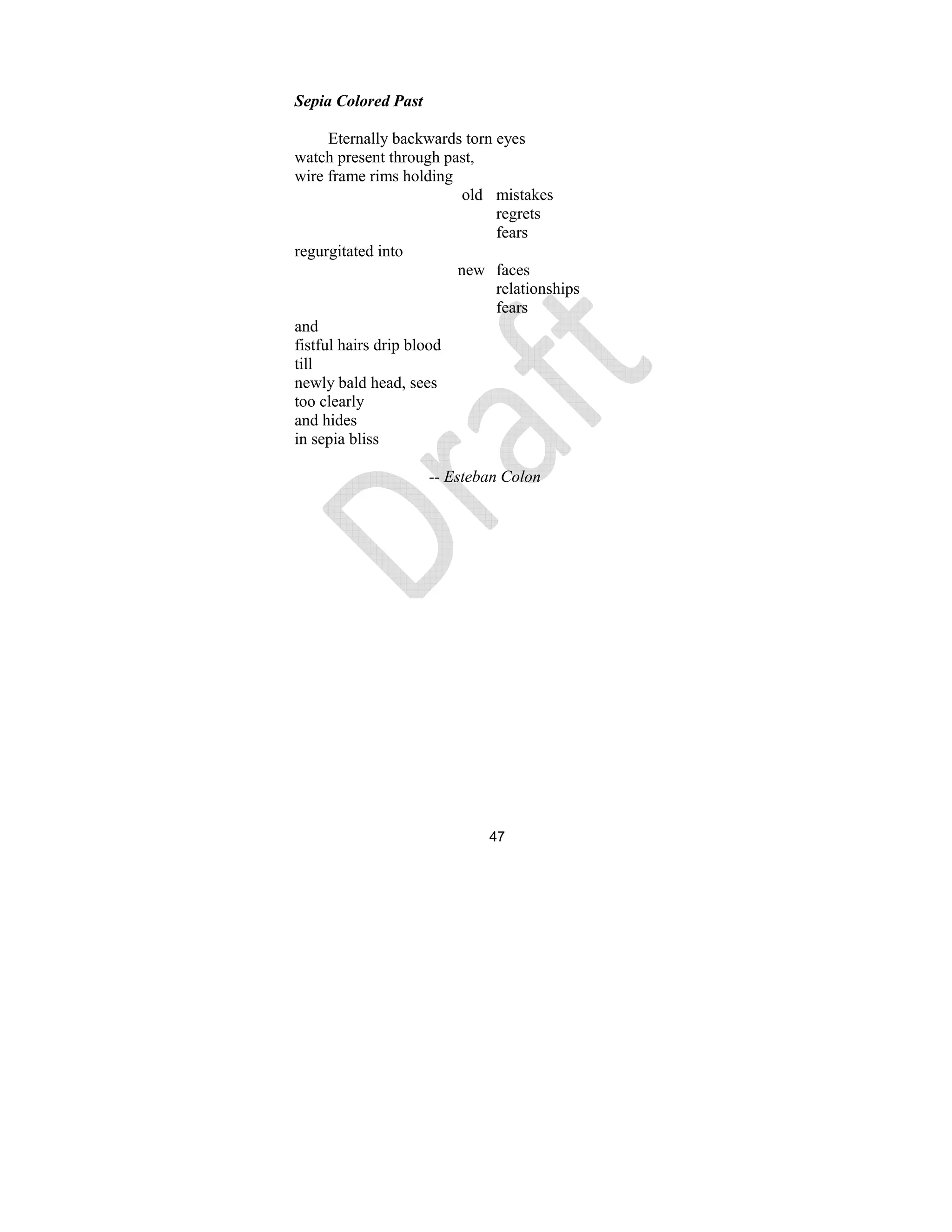
Sepia Colored Past
Eternally backwards torn eyes
watch present through past,
wire frame rims holding
old mistakes
regrets
fears
regurgitated into
new faces
relationships
fears
and
fistful hairs drip blood
till
newly bald head, sees
too clearly
and hides
in sepia bliss
-- Esteban Colon
48
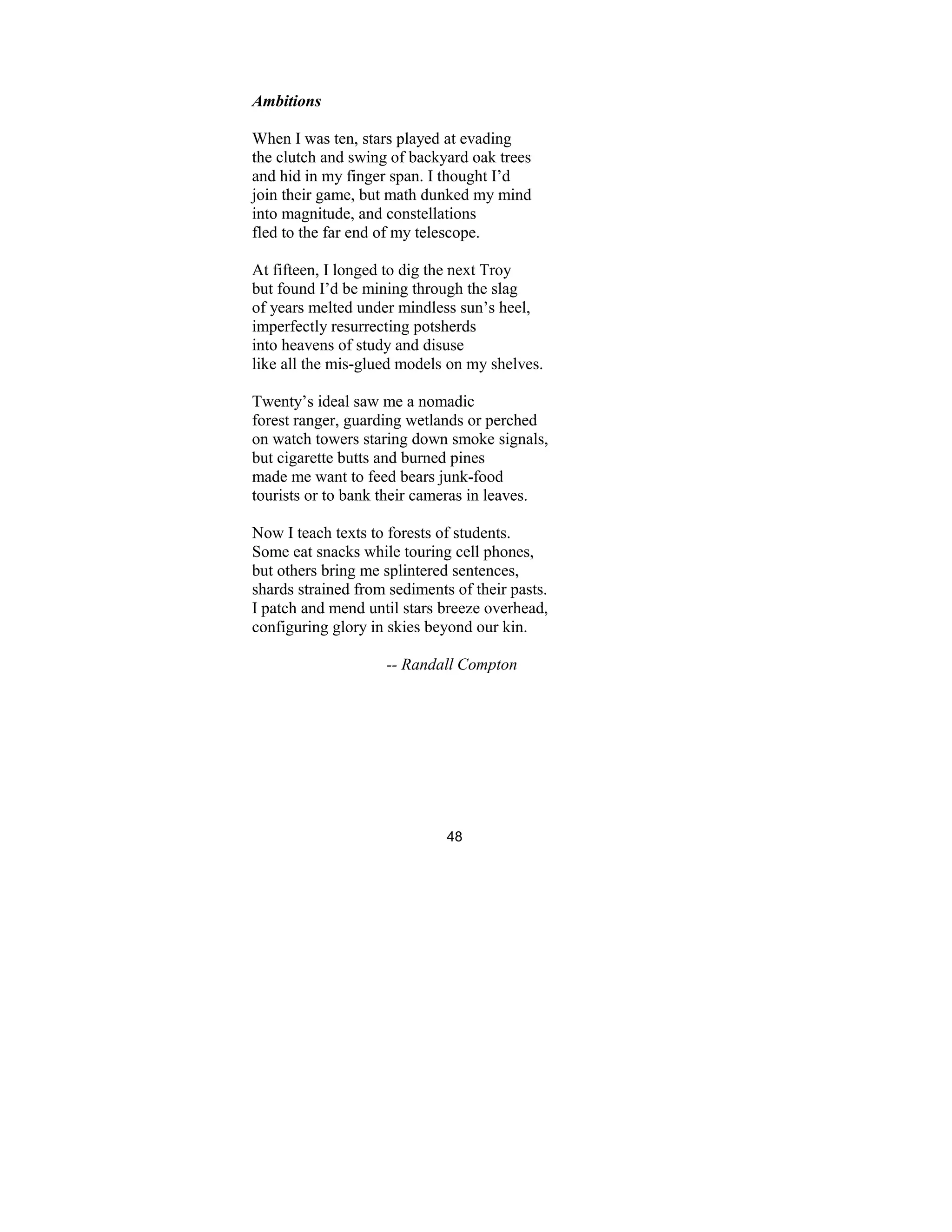
Ambitions
When I was ten, stars played at evading
the clutch and swing of backyard oak trees
and hid in my finger span. I thought I’d
join their game, but math dunked my mind
into magnitude, and constellations
fled to the far end of my telescope.
At fifteen, I longed to dig the next Troy
but found I’d be mining through the slag
of years melted under mindless sun’s heel,
imperfectly resurrecting potsherds
into heavens of study and disuse
like all the mis-glued models on my shelves.
Twenty’s ideal saw me a nomadic
forest ranger, guarding wetlands or perched
on watch towers staring down smoke signals,
but cigarette butts and burned pines
made me want to feed bears junk-food
tourists or to bank their cameras in leaves.
Now I teach texts to forests of students.
Some eat snacks while touring cell phones,
but others bring me splintered sentences,
shards strained from sediments of their pasts.
I patch and mend until stars breeze overhead,
configuring glory in skies beyond our kin.
-- Randall Compton
49
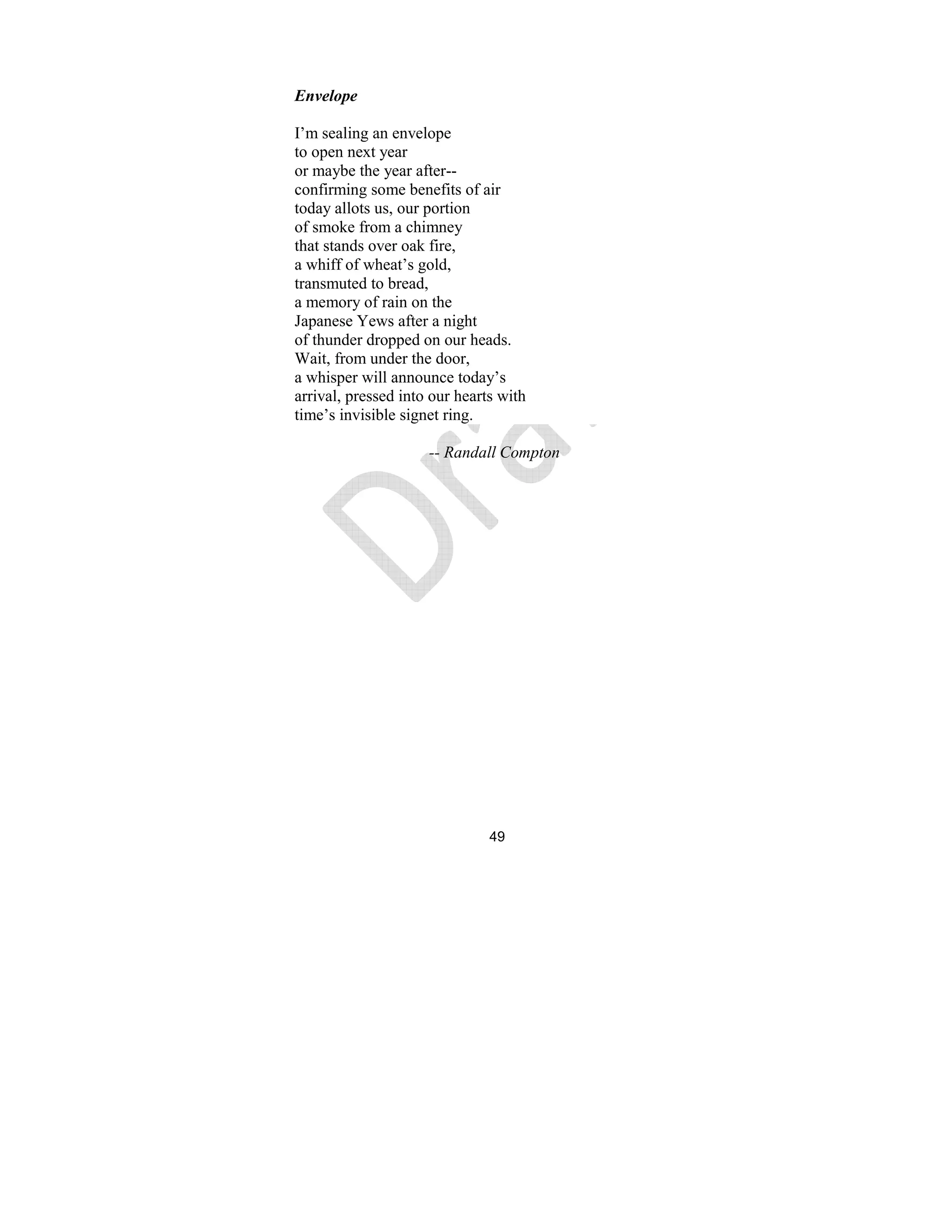
Envelope
I’m sealing an envelope
to open next year
or maybe the year after--
confirming some benefits of air
today allots us, our portion
of smoke from a chimney
that stands over oak fire,
a whiff of wheat’s gold,
transmuted to bread,
a memory of rain on the
Japanese Yews after a night
of thunder dropped on our heads.
Wait, from under the door,
a whisper will announce today’s
arrival, pressed into our hearts with
time’s invisible signet ring.
-- Randall Compton
50
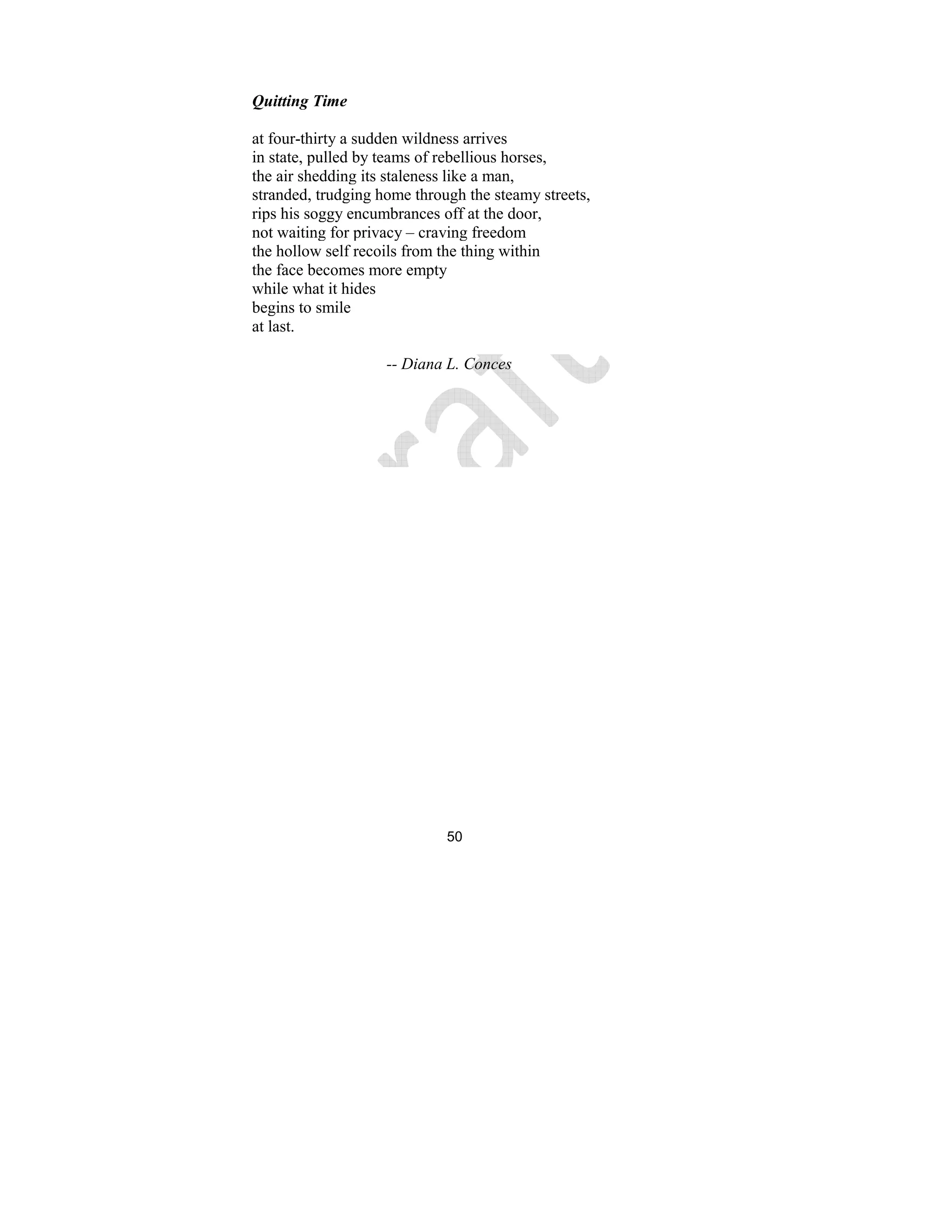
Quitting Time
at four-thirty a sudden wildness arrives
in state, pulled by teams of rebellious horses,
the air shedding its staleness like a man,
stranded, trudging home through the steamy streets,
rips his soggy encumbrances off at the door,
not waiting for privacy – craving freedom
the hollow self recoils from the thing within
the face becomes more empty
while what it hides
begins to smile
at last.
-- Diana L. Conces
51
Apocalypse
There’s an apocalypse coming,
forty, fifty years on
and the lights are flashing,
bars coming down
I sit cross-legged on the tracks
eyes closed breath still
waiting. still. waiting.
still. waiting. still.
The train will ride over me
one day I know
My rivers will boil, my eyes weep
Blood of my heart
Long cold wars will erupt
My earth quake
Pestilential doubts, memories
false prophets or true
It will come, it will come
the rhythm, the sound
the train on the tracks
the end – the end
yours is
mine is
all.
-- Diana L. Conces
52
High oon with Pink Carnations
A conundrum, long-brewing, is that nobody hated you at the
dentist’s office when you were a child. It didn’t help that your mother
tried to comfort you by saying that getting a filling was small potatoes.
Let’s say nobody was truly cruel, that even decent parents have
unlikely ways of abiding and resisting your full becoming. Now you’re
thirty-five and need to see a dentist, but you think of the first time you
were alone in the office, eight years old, daring to grow your hair long,
beginning to notice your body. Your big problem would come after the
appointment was over, when you were offered a pink carnation you
didn’t feel you earned; the kind everyone gets at the dentist - along with
a toothbrush and sugar-free candy. Just seeing the flowers across the
waiting room reminds you of decisions you need to make: whether to
take the new job in the exciting city or stay and see what happens here.
It was weird at age eight, when the x-ray machine was pointed at
your face. The technician was resplendent. She easily saw your secret
way of holding back tears. You put away your hiding tricks because she
casually mentioned she cries as easily as stepping in and out of summer
rain. She hummed in a way that made you want to hear her sing. You
were safe in her hazel eyes as she put the lead apron on your chest,
saying this was your protection. This actually helped - the certain
weight of it - and was strangely missed when lifted.
But she left. The dentist came in to numb you, declaring you
wouldn’t feel the rest. But you did.
Your mouth was full of cotton, ears murderously trapped by
pleasant music. There was an unearthly smell of false mint. Everyone
was nice. Your bravery was highly expected. You weren’t brave in the
slightest, but your feet managed to dance to the sound of the
grandfather clock speaking from the hall. The clock hypnotized you.
The dentist carelessly left a glaring light in your eyes when she left the
room. You pushed it aside and closed your eyes. Half of you lower lip
was numb, and a single drop of spit fell to the clean blue cloth around
your neck. You thought of being embarrassed, but instead you started
remembering:
53
“I miss my real grandpa, our boat rides in mountain lakes. I
remember looking over the side of the boat. Grandpa said that
whatever I saw there was a snapshot I can look at anytime I
want. I saw pillars of light streaking through pure blue water. A
single drop of water fell from the wooden oar, making tiny
waves out into the lake. My hair touched the water and grandpa
smiled because he knew I found something I didn’t have to tell
about. Now I want the lead shield back. I want the x-ray person
back. I want her hazel eyes on me, and I miss grandpa so bad I
can’t stop crying in my heart. Why can’t I speak?”
No answer came, because you didn’t ask a person other
than you. Visitations are like that. When it was all over, the
receptionist reminded you to take a flower. It was high noon with
pink carnations. Memory of this next part is lost in prophesy.
Maybe you froze, feeling you didn’t deserve anything because
you cried a little. Maybe you took yours with an angry fist, or
threw it out the car window, or balanced the stem elegantly
between two fingers with a mixture of defiance and curiosity,
keeping it just the right distance while your piercing eyes
bargained with places still becoming. Maybe your exquisite eight
year old arm lifted it to a simple claimed breath. Yes, sweet
child, flowers from dentists are complicated, this one not your
favorite color, unexpected in keen fresh spice. This flower knows
nothing of what it gives from the round burgundy vase in the
room where everyone waits.
Wombs are like that. You wonder why you dream of hazel
eyes. I’m sorry you lost your grandpa when you were so young.
He’s in you, not in the clock. He’s in you all your life, radiant,
present and unfinished. He’s saying you are the best girl ever, at
the dentist. He’s saying, “take two” of the long-stemmed
carnations. And you do, offering your famous half-numb smile
all the way to the airport.
-- J.L. Cooper
54
Scattered to the Wind
Still as stone
she lies beside her husband
soon to be her ex.
Fifty years earlier, at 28,
she had expected that in death
she would mirror the Egyptian statues
at the museum
one of two constant companions
side-by-side
equal and loving
to eternity.
Instead, when death calls,
she will be single,
leaving behind
a coddled cat.
Her body neither
pampered nor perfumed
but burned to ashes.
Her bones not calcified
but scattered to the wind.
-- Melodie Corrigall
55
Movement of Time
i wish i could be like time
keep moving,
never look back never
examine anything but the now
fly freely as an autumn leaf
without having to pay
any heed
master of my own design
never unraveling emotions or having
to carry the satin of this flesh
or the sting of these bones
to float ethereal
like a ghost
through the universe dancing in
sunlit pools without getting
wet,
knowing both the tongue of roses and men;
i wonder if time ever tires
because i know he never sleeps,
wish i could be the master
insomniac
never burdened by anything but the flowing
movement of stepping forward.
-- Linda M. Crate
56
Forever Stamps
Forever like that which we used to feel
when i was yours and you were mine
back when our love was new and true
with hearts and minds intertwined
and we would kiss endlessly, forever
Forever like these doldrums that wallow in the mist
stretching like a Slinky from end to end
Forever since last i cut my toenails, my hair, took a bath or changed
my underwear
Forever till lunch as hunger’s minutes land like Chinese water torture
and people talk, god-how-they-talk, with forever pauses
and points they never quite make
Forever like these rivalries twixt the aged and ageless
between callous hard-wrought experience and those who fly theoretical
prepared to pepper the world with answers to questions they
are scared to ask, who have always lived in one place, basking
in their all-purpose lineage, inbred, ill-read, with steadfast
certainty and insights set in quicksand and cement
These things you’ve had forever: a red comb, your Parker Brother’s
pen, that little green pipe you can’t find—but don’t worry
it will turn up, like everything eventually does, like these
dogged temptations, hounding you, scratching at the door, breaking
through glass, forever crying, screaming, thumping their chest
with angry gorilla abandon
if not forever—for a very long time
The post office person tells me it took them a long time
to figure out their forever angle—that they could
forever save money stamping forever on their stamps
and skip all those annoying annual price hikes
and now, like herpes or HIV, radioactivity, or past episodes
of Friends and Seinfeld, stamps may endure as long as Stone Henge
or the Sphinx, or minutes from the last meeting that sputter
like a dying comedian, or my grand father’s driving
or my aunt’s ploddingly delivered grace as everything turns cold
and hardens
57
Expanding like a black hole, light years in the distance, barreling through
sucking back eternity through a straw, sucking up our present into the past
back to whenever it was, as it was written. . .
before parchment or Parker Brother’s, before Nefertiti
or the New York Yankees, back when a nickel spent like a dollar
and daguerreotypes cut with their stolen images, spurting
like geysers, towering with mushroom ambition, reaching like the Phoenix
flailing her wings, hitching a ride atop the four winds with dandelion determination
bowing down before an exploding sky, forever and again, as long as it takes, on-
ward into extra innings, overtime, sudden death, in a game no one can win, with-
out end until that letter finally arrives and i hear from you, hear you, see you
in my head, when again i will recall what i have forgotten
regarding this thing destined to transcend us
as the last scribe screams from the rafters, repeating everything
that’s been said and is eaten by fire, by the all expanding
sun, vanishing at a million degrees centigrade
disappearing amidst the swirling debris
settling, and bearing down
forever
and so on. . .
and on
Forever like this poem, this poetry reading
You shifting in your chair, wanting to check your messages
waiting for your waiter, your check, your ship, your train to come in
your red-letter arrival, gandy-dancing while doing cartwheels
waiting for the wind to rise, your stocks to stabilize, for the weekend to save you
the sermon to end, for death to relieve you and still save the game
as you battle the clock, search for your keys, your phone, your purse
en route to something you’ve already missed
Forever since it began when you wished it would end, back when we were in
love swearing we would always feel the same exact way, forever since
before
we ended only to begin again in someone else’s arms, re-born
whenever it was, since last i heard from you
or it rained or the sun last appeared
58
stalking us like a killer, killing whatever we left
failing to murder it ourselves
-- Larry Crist
59
Group Photo
Ten of us in my best friend’s back yard
Kent’s X wife’s old place
She’s not in the picture—she likely took it
There are several children, including my daughter, Nicky
3 or 4, wearing a pale blue dress, her hair
in a matching beret; sharp contrast to the others, her age
with Cheetos rings and chocolate circles round their mouths
Near the foreground, with his face half hidden by a
squatting hippie girl, who i don’t remember, is my pal Ted
in his signature straw cowboy hat, overalls, ciggie in hand
Beside him, with a baby on her lap, that i know was not
hers, is Jane—our drama teacher
Bill has a strapped on guitar, red
Kent is leaning in, with one meaty arm, holding a beam
like Atlas, ciggie in mouth, a cup of something, alcoholic
I’m on the ground, without shirt, mustache with Sinatra style fedora
with my arm draped around Nicky
We are captured in an otherwise forgettable moment
forgetting even as the camera is clicked
This moment i find 30 years later in a pile of pics
while attending Kent’s memorial service
the last time i would see Ted, who would die a year later
My daughter has 3 kids of her own
Our drama teacher has long since retired and relocated
Bill, surprised us all by making lots of money
and no one, in that he never did learn to play guitar
I’m uncertain as to whatever happened to that hat
except i’ve replaced it
with another just like it
the newness of which
60
i blame
for making my face look old
-- Larry Crist
61
Honey in October
The husk of the dead bee
dances with the wind,
left and right it rolls
down the walk,
following a certain shard of light,
the confetti of Summer
haunts the day
until some sudden gust
sets it aflight
into my neighbor’s yard.
The lawn is still full of dead summer,
my rake must gather the red and gold leaves scattered everywhere,
I wipe the sweat from my face,
it is a day for collecting and recollecting.
The season of basket and broom,
the shadows are growing longer,
the angles stark, we prepare for the unwelcome dark,
Winter is crouching in every corner.
But a scattering of roses still crimsons on the trellis,
blooming in the crisp and clear,
the air is suddenly filled
with common sense, seasons have their reasons,
It is good to put Summer’s easy ways into the closet,
and converse with the bare branches
of life just for a while.
-- Oliver Cutshaw
62
In the Beginning
In the beginning before there was day
There was a shadowed moon
Barring herself
Behind the dreams
Through which we all pass
One over the other
Carrying our little deaths with us
Ghosts never awoken
Traveling the nights
Paralyzed to eternity
Nights where winds breathe
A long black low
Until archangels with swords
Slice time to a faint light
That calls to riptide oceans
And they bubble with new life
Pulse and throb
To part to a spit of land
Rising in between
-- Susan Dale
63
Hard days; the hard clay of living
And the gnawing teeth of time
Grinding steadily at our days
Heavy nets of time across our shoulders
Thrown into the river of time
To catch currents of time
On their journey through time
Into time eternal
-- Susan Dale
64
The Color of Time
Our dreams with tendrils,
coiling around
to climb the tree of life
And swim with a bruised moon
and a cup of stars poured into the sky
Fragile the spring petals
falling from flowers
blooming under the light that left us
stumbling blindly through our days
Spring traipsing off with minute winds
To summer with fat fingers and firm feet
and full crowns of treetops
Syllables of light galloping across the skies
in three quarter time
to the glory of fecundity
suffocating the meadows
A bonfire sun and barefoot dances
Gliding down river and hours
Our sampans too wide
Our dreams too deep
for the narrow canals we sailed
The noose of our fears
strangling us
The monopoly others had on luck
A lady they courted with lusty songs
and syrupy endearments
Lady luck on the balconies
we sat beneath
wearing masks to shield our faces
from desires that shackled us
65
from the fingers of time
squeezing, tightening
A solemn command brought autumn
with gold veins and cream clouds
To winter waiting in the sacristy
We stepped up to an altar of chalky skies
and the silence of frozen years,
And frozen tears of snow
Waves of winds, stone cold silence
Filaments of white lights
Leather straps binding us to our pasts
Powerful jaws of our determinations
clamping down
Skeletons of the dead
searching for old lovers with hollow cheeks
carrying dreams they’d outgrown
Caught we were in whispery webs
We beat with moth wings
trying to find the light,
beating ourselves to shreds
Our dreams burnt scarlet by sunsets of delirious colors
The velocities of our time
Captured in cloud waves
and measured by the star spun seconds
Of time into tomorrow
-- Susan Dale
66
Driving To Physical Therapy After Reading Delmore Schwartz
If time is the fire in which we burn
then each day is a slow match of salt-
peter, cord, and ember. What
measures an eternity of ash?
My clock is atomic,
more precise than Swiss,
accurate enough to incinerate cities; geo-
synchronous satellites
tell me exactly when I am.
“Better one hour early than one minute late,”
said Batman to Boy Wonder. I prefer punctual.
-- Tim Dardis
67
The Time of Birth
I will conquer the fear of flying
I will jump with the parachute of kiss
While walking I’ll dance to the drum rhythm
Dream in the clothes of the penguin
Thumb through the book
Goodbye my sixteen years
with premises in the mind
that I will carry them
in my fifties
real and modest
and at least once a day
I will laugh out loud
Really enjoy
In intimately woven world
When the moon passes its seventh round
And Jupiter falls on Mars
Our world will be the leader
And love will be the path for the stars
That would be the time when
Aquarius is born
To my grandchildren, grand-grandchildren
I will tell stories about times
When people were people.
-- Tatjana Debelijacki
68
Cuckoo Clock
Awake again, I looked up at the ceiling.
What had I heard?
My mother’s cuckoo clock,
Chirping out every hour, the
Relentless wooden carved bird, tiny
Yet noisily announcing passing time.
A single chirp on the half hour,
Enough to bring me back to consciousness.
When twelve cuckoos had come and gone
And the chirps became fewer,
I found myself drifting back to sleep;
But on many sleepless nights
I crept from my bed, silently down the stairs
To strangle that cuckoo – don’t worry
I only stopped the clock and when those
Mornings came, I looked sheepishly
At my toast while my mother remarked
That the cuckoo clock had stopped once again.
-- Julie A. Dickson
69
Solitude
After counting the hours
Of being alone
He found himself
Bankrupt
Making desperate payments
His heart could not cover.
-- Bruce Louis Dodson
70
The Time of My Life
Hot summer afternoon
It’s ninety-seven in the shade
And more inside my gear
White paper dust mask
Padded rubber on my ears
To stop some of the noise
A pair of safety glasses
Dark blue coveralls on top my clothing
Heavy leather gloves
Thick socks and steel toed boots.
Holding this powerful electric drill
Eight pounds of heavy metal
Spinning wire-brush wheel
A blur of blue and gray
Against the rust that has accumulated
On eight tons of angle iron
My job.
Eight hours inside a cloud of dark red dust
Fire storm of sparks
Steel bristles flying off
Go through my fabric armor
Into sweating skin
Dust makes it hard to breath
My glasses fogged by body heat
I watch the slow shop clock
Selling the time of my life
Eight-fifty an hour.
-- Bruce Louis Dodson
71
Old Men
Old Men
Know youth
Far better than the young
Regret the loss of strength
And daring fearless
Knowing what might possibly befall
Beyond recall.
Loss of naivety
And craving for excitement
Wartime gun smoke, blood, and tears
Replaced
With sense of needless loss
In places far from home
Much eulogized in words more glorious than this.
-- Bruce Louis Dodson
72
Precursor
Early light haloes blooming sage.
Wind ruffles water, gentian blue,
and golden grasses undulate.
Low silhouettes reveal two loons,
mid-lake migrants to this scene
in spring and fall, their size mammoth
next to goldeneyes. The sky fills
with lenticular clouds, pale grey.
Today I resonate with fall.
Its poignant beauty presages.
The lake, frozen and still,
waterfowl gone. Grey sky spits snow.
Earth’s losses like our loves wrung real
and sharpened by impending end.
-- Jane Dominick
73
Memories of the Future
Are hard to explain, and may come across as some science
fiction conceit, a plot revolving around a man who can recall the
future in the same vivid detail that we remember the past. You
know what I mean. It was probably on TV, a pilot and a short-
lived series. The man rescues victims of disasters about to occur,
evacuates buildings about to collapse, saves the baby before the
apartment is engulfed in flames. And then one day he is horrified
by an indelible memory of his own death and realizes there's
nothing he can do to change the future. That's the premonition
we've all had late at night, not sure if we're sleeping or dreaming
or looking back at the past from some unimaginable afterlife. But
no, it's the future, already encoded in our genes and written in the
constellations. Too late to change.
-- Jacqueline Doyle
74
Why I Called So Late
Once, it was stone fruit
halved on a low table.
It had been the backgammon board,
neglected, gathering dust.
It might have been a stack of coins,
could have been creosote from the railroad ties
you cut to make raised beds in the garden,
or maybe just a curry we weren’t used to—
that sluiced us into green streams (we’d lost
the enzymes to break down animal flesh).
Someone said time held us, green and dying.
Though we sang like the sea.
Someone else: it’s better to ask forgiveness
than permission. Love, forgive me—
it would have been
a wilderness of water.
I called because time’s a dish
in which fine gold chains get tangled.
-- Chiyuma Elliot
75
The Clock
after the painting by Philip Guston
Time’s machine
making endless circles
spring-driven
and ratcheted wheels
endless circles
seconds at a time

in endless circles
around a compass point
circling
days and nights
seasons come and go
endless circling
like perpetual motion’s
mechanical life
endlessly
aimlessly
around a clock
going nowhere
and again.
-- eil Ellman
76
Under a Glass Desert
There's a little green bottle on the wall today
It is born slow
A feeling
Rising from the blue undertow
Like a sensual slow swirling
Like a fading image of your mother
Into a grey film
A sharp wind through the wood
An old woman playing piano
A party on the desert
Wind slowly blows across
They clutch their hats and disappear
Behind the dunes as their laughs and cackles
Echo into the sky
Rising from the slowly releasing clutch
Of a trembling hand in the sea
And collapsing into a puff of rising sand
A thin man peering over the fence
Shaking in the autumn storm
A cobblestone path through the wood
With haze slithering around its ankles
A dark dying hunched city
The sand blows and rises to the sky
And the sky is angry and orange
And smells of spices
77
And he glances as he walks past
Into the universal sun
-- Zach Fechter
78
oir Couture
“Where were you on the night of the crime?”
With a gloved hand, I calmly insert a cigarette into my jeweled holder,
shutting my Deitsch handbag with a snap. The detective offers me a
light and I lean forward toward the Zippo’s flame and notice the 5-
barrel hinge on a chrome-plated nickel/silver case.
I cross my legs and inhale. Exhale. My Alice Caviness bracelet dangles
from my wrist, making a soft clink. My hair is coiffed with two front
victory rolls—the rest hanging down my back in a pageboy.
“I was at the opera,” I tell the detective.
“And what were you wearing?” he asks.
“A bias-cut beaded tulle evening dress with matching
Ferragamo beaded satin evening sandals,” I reply.
“Wedge or stilettos?”
“Wedge.”
“What time did you leave?”
“Around midnight.”
“And how did you get home?”
“I took a taxi.”
“Checker or Yellow?”
“Checker”
“What was the cab driver wearing?”
79
“Button down shirt, pressed pants, tie, Eisenhower jacket and a
hard bill cap.”
“And who can verify the time you got back to your apartment?”
“The doorman.”
“And what was he wearing?”
“A slate gray overcoat, 100% wool, with button-down tab
detailing a dual front flap with welt pockets. Oh, and elongated
peaked lapels.”
“So, when you entered your apartment, what happened next?”
“I changed into my apricot dressing gown embellished with
trapunto stitching and studded with metal brads.”
“Then what?”
“I read for a while and went to bed around 2 a.m.”
“What were you reading?”
“Vogue.”
“The magazine?”
“Yes.”
“Who was on the cover?”
“An auburn-haired model in mauve silk tap shorts.”
“I’ll need to question the witnesses who saw you at the opera,
track down the cabbie and interview your doorman.”
“Of course. Can I go now?”
80
“Yes, but don’t leave town as the investigation is still ongoing.”
I nod and reach for my coat. It’s a full-length Nevius Voorhees mink,
with burgundy satin lining.
“Let me help you with that,” he says.
I walk out the door and take the stairs instead of the elevator.
As I make my descent, I let the mink slide off my shoulders; toss my
blond wig on the steps
and ditch the purse, bracelet and gloves. I exit through the “employees
only” door and disappear into the night in my Oleg Cassini navy wool
two-piece suit with matching Henri Flatow patent leather peep-toe
pumps.
-- Sue Mayfield Geiger
81
Garage Sale
Pony: Caramel tail and blue saddle, saddled with the dreams of
three grown children. Wooden. It’s yours for $7.50. A teenager
sits forlornly on a thin, green couch on the thin, green lawn,
picking her nails.
Blender: Specks and chips and lopsided and dull blades and
chocolate, just a bit, near the tip. I don’t see a cover. I think of
smoothies and rice.
Box of Books: Stephen King and Jackie Collins and Dean
Koontz and Dan Brown. Never the old, yellowed copy of
Rimbaud I dream of. Once, I found Siddhartha. Here, there is no
Buddha – only old construction manuals, terrible mysteries and
dog-eared paperbacks from 1983.
Christmas Sweater: Dirty beard of cotton balls on woven string
on knit that scratches and calls you from the other room in a
shrill and unforgiving voice. Smells like attic. A woman in a
yellow, Winnie the Pooh sweatshirt tries to sell it to me for $20.
Lawnmower: Manual. Claws like death. Metal. Clank. Like
movies no one watches anymore, relegated to film snob circles
with pumpkin and wine. I’m afraid of the way it leans.
Pipe: Corncob. Never used, or cleaned by a sparkling fairy.
Looks like snowmen and Grandpa. Smells like nothing. I deem
it a magic corncob pipe and buy it for $1, anxiously waiting for
winter.
-- Sarah Ghoshal
82
For Chris
We were in Kenny’s apartment, with a snake and Neal Pert and a black light with the
lights out and his Uncle Richard, whose belly was as big as the whole wide world.
Or we were in dorm we didn’t live in, watching the Columbine footage just because we
were still awake from the night before.
Or we were peeling me off the blacktop on my mom’s street after I had been thrown
from the hood of the car.
Or we were in the basement, small quarters, fast punk rock, teenage dreams of cult
followings and permanent backstage passes.
Or we were at that restaurant where I worked, or that other restaurant where I worked,
or that other one, or the one where Chris worked, or Chi Chi’s, where our friend Jonny
would give us free fried ice cream.
Or we were in a car, windows closed, smoke fogging the view, reggae and bottled soda
on a deserted suburban court in the middle of the night.
We remember birthdays despite time difference.
We go months without seeing each other.
We slip in and out of each other’s lives like thieves.
-- Sarah Ghoshal
83
The Sharp Edges of Trees
Like family gatherings and smoky trees and leftover cheese at
the bottom of the oven, like hungry, like roasting, bad but raw,
plain, nothing else at all but what you see here, there, at the
bottom after an hour of telling yourself …
… well, you know what you say when clarity is staring you in
the face and you’re trying to hide behind beach towels and
ownership of the corner.
“It’s all or nothing, you dirty monger of dreams.”
The children roll down the hill under skies on their way to
nightfall, glowing with the incandescent fire of flies that hover
above their bare feet. In their screams, we find harried memories
and wild desire, even when wishes float to the ground, underfoot,
near the sharp edge of the trees.
-- Sarah Ghoshal
84
Third-Life Crisis
As it moves – fluid – and
impending
my insides rot
more each
day.
Sagging closer
to the ground – though hydrated – new
lines and darker circles
take up residence
on my once
exotic frame.
More make-up than
woman – I smile – teeth
yellowed with impending
middle- age.
And, no matter the
product or surgical
consult
these signs
can never be
erased and
I’ll never be
my younger
thinner
self in low-rise
ripped
jeans.
Hand in a bag of
chemical-filled
cookies, I eat
to fill a void
that expands as the days
85
surreptitiously multiply
and march
towards the toll
of a death-knell that even
the shoddiest of hearing—
aids
will pick up.
-- Jessica Gleason
86
Misshapen Adulthood
They remind you when it’s time
to disband your
stuffed-animal militia.
To take your imaginary tea and
replace it with an addictive
and acidic
coffee addiction.
And though you’re childhood
was confident
sure
with clarity that now
seems
heart-breaking.
They tell you that conformity
is what pays the bills
fills your life
with meaning
and purpose,
something that you didn’t
know
was missing
until reality gave
you bruises in places
you’d never even felt before.
And the militia,
sitting in a water-damaged basement--
box,
is sad
silently waiting
with a Care-Bear stare that will
shoot life back
into your lemming
career.
87
Wishing you’d walk the plank
back into
an existence
that would sustain you
in ways that the 9-5 paycheck
never could.
-- Jessica Gleason
88
Time Like . . .
There is time like there is
a carpet or somebody
knocking on the door. The battle
rages in a chaotic frenzy. People
cave into fears as if that means
‘maturity’. There is no time like there is
no permanence other than God. Stimulation and bleeding gums.
Sit down, run your hand over your face. I will
run my fingers along your jaw line, your
brow line, and trace a constellation. Be my
instrument, expose the terror I cautiously keep. Call me
a hypocrite and then forgive me, avenge me for my mortality.
In heaven, the Earth is a vegetable left too long in
the fridge. In the mornings, I am lonely but want only
to be alone. Your breath howls, sometimes I can hear it
when you think you are sleeping. Those times I would rip
across any void just to clean your blood. Time is
laughing at us, because we’ve touched the flesh of freedom
and everything after that wears on our skin, groaning, growing
as instant madness.
-- Allison Grayhurst
89
Silence and Slow Time
From the stairwell, steps dwindle, then flee.
You rub your eyes, blink at the buzzing lamps.
It seems you are in Paradise. Fall to your knees.
Low-ceilinged room with booths and desks; you glance
at empty tables, empty straight-backed chairs.
You rub your eyes, blink at the buzzing lamps.
The Glory of Sharks. The History of Hair.
The Book of Knots and Their Untying.
At empty tables, empty straight-backed chairs.
Time is art books, oversized, left lying
on armchairs dressed in herringbone, moss-green:
The Book of Knots and Their Untying.
The cooler, set for Kelvin 3 degrees,
holds water, coffee, tea and Coke in bottles.
Armchairs dressed in herringbone, moss-green,
stand in the library basement, mottled,
impersonal. The clerk says, Wait your turn
for water, coffee, Coke, iced tea in bottles.
Your drowsy dullness deepens with the drone.
In the stairwells, steps dwindle, then flee.
Impersonal, the clock says, Wait your turn.
It seems you are in Paradise. Fall to your knees.
-- Karen Greenbaum-Maya
90
Ghazal before Memory
A song we’d danced to jarred my memory.
Our first clumsy kiss is starred in memory.
Heloïse, banished to a nunnery, did not repent.
She lived but to write of Abelard, the memory.
Hemingway lived here, where Verlaine died.
In Paris I used the camera’s card for memory.
Our linguist friend in France, abruptly dead.
We ate pistou then drank Ricard in memory.
I learned: while learning, all roads climb uphill.
Hands, knees are healed and scarred in memory.
I paced iambic, chanting o longer mourn for me . . .
Forty years on, and still I hold the Bard in memory.
When his time comes, she will howl and clutch.
How could Karen grieve less hard in memory?
-- Karen Greenbaum-Maya
91
Measuring Time
As long as our feet stay
on the ground or we are
atop an animal
whose hooves touch solidly down
we can be accurate;
but autos, trains and
especially planes warp time
as Einstein’s space was bent;
our vehicle moves making
weeds stand at attention,
an arm of fog clasps
a steeple then slips away,
our time sliding into a void.
-- Ray Greenblatt
92
The Bullpen
A child, age three
got on that bull
a coarse box of sweat and musk.
Sharp frayed hair
rose from the steam
pricked and crimped
the soft pale skin.
The bull scraped the gate
with its horns made of iron
and said,
“I’ll kill you
before this is over.”
The whistle blew
with a flash
life was on.
The crowd seemed excited
the child wondered why.
The beast chortled and kicked
with a back breaking menace
and snarled,
“Remember what I said
back in the pen?”
The child held on
to hide of worn leather,
it was thin
shredding, breaking.
But the child locked eyes
with a face in the crowd.
One sincere child, age eight,
his future.
93
Among fist pumping giants
the booze sloshed
the popcorn popped.
But the boy in the crowd
wore tall red galoshes.
He held up his fingers
eight tiny digits
and put one away
second by second.
The boy on the bull
in the ear of the beast
whispered, “Bring it on bull.”
Three.
Two.
One.
It’s over.
-- Harmony Hodges
94
Pliation, n.
there is a word for the folds, wrinkles
and bending in time that give the things
their very thingness (though not their ‘it’).
they are called pliations, the crests
and ripples and sharp-edged, pick your teeth with ‘em
bendings in the it that was once straight
and flat as air-whipped eggs in a
medium-hot pan.
they are called pliations so that
you and i can pliate from time to time
and thus admit, in a sheepfold kind of way
to having our plans pliated
by forces entirely bending to our will.
we call on pliation for
the way we end up
as night enfolds
speaking with our parents’ voice.
in a crowd, we pliate him and her to tuck
into a pocket, to keep them small
and flat, inpliated out of sight.
ho, down at the Church of Pliatology,
we bend our knees and necks
at the sight of the Spring Azure
that skips a bit of sky across the grass
then stops, pliates and disappears.
and the latest wrinkle boys and girls
lies in how we come to fear the fold-
such pliaphobes, all pliafugal
hoping vainly for magic tucks
95
to make us strai
ght and smooth.
-- Lynn Hoffman
96
The 23rd Century
The 23rd Century just ordered her second martini,
not too dry, lemon peel, sprig of rosemary.
She’s older than you think, been around
since the beginning but
she’s not above a certain crude directitude.
to the waiter, who’s just a boy decade
in the early 21st, she says “Do you have any idea
how your wisdoms look from here?
What vice your virtue left us?”
She takes a sip in proof, then a swallow
before she pays his tab and leaves,
a ghost, a guest, aghast.
-- Lynn Hoffman
97
Empty Sockets
I lost an eyelash today. It happens
all the time—loss
of moon shapes—curved slivers of nail clippings
and of lashes laden with parasitic mites and black mascara.
My skin, it sloughs off in microbes onto mattresses
and bath towels hung to dry above lost strands of hair
that wad and crawl away down into the drain.
The wastebasket that opens wide to cradle
snot-filled tissues and cotton swabs topped with brownish yellow.
It’s always happening—loss occurs from every orifice—
the unwanted, the wasted.
The monthly shedding of eggs, discarded yolks
that float in menstruation, and drop to their deaths.
The baby teeth that climb their way out, struggling
to cut through pink, supple gums,
to later be wiggled loose by bigger bully teeth.
The wisdoms that were yanked bloody from their constricted caves
to make way for molars and impending crookedness.
All this for not—all the chewing and grinding will turn them
to wooden nubs to rot and fall out, until my gums grow
over to cover the empty sockets.
I long for the missing—my shaved whiskers,
my hair trimmings, misplaced eyelashes, saline tears,
drools of spit, picked scabs, and filed fingernail dust.
My used-up cells drift dormant onto shelves and knick-knacks,
waiting to be wiped away.
-- Trish Hopkinson
98
Trash Bag Burial
When I was young, I collected odd things to remind me of moments—snapshots
of friends, napkins with signatures and doodles, pieces of ribbon, Roland
Orzabal’s comb, dried flowers hung upside down by a pushpin, newspaper
clippings, mini bottles, candy wrappers, concert ticket stubs, restaurant
receipts—mementos that littered the shelves and wall above my Curtis Mathes
rent-to-own stereo. I spent many hours mooning the past, the moments that
seemed pivotal to existence, the items that made me. Just a blip on the timeline
later, what made me became dust collectors, muddied up the little space I had,
complicated what I’d become. I didn’t think much of it, as I shook the folded
trash bag, rushing it with air to create an opening for their burial. I pulled them
roughly, tore from beneath pins, raked from shelves, and turned my head as the
dust flew and the bag dropped heavy. I paused as I held the comb. It still smelled
foolish, like ‘80’s hair mousse.
-- Trish Hopkinson
99
Droughtful October
The wind buffets dry leaves - a near death rattle, like a rain
stick - yet they cling to their branches, make shadow
sidewalk lace. One Canada Goose, left behind, forages among bone
bleached blades of grass, then swims with today's foster family
of ducks. A swatch of rainbow hovers across the dancing white
arches of the pond fountain; the sun flexes its muscle in a last
summer fling. Bee abandoned, parched marigolds along the walking
path are withered - hump backed; palsied leaves tremble with
the slightest breeze. I sense a held breath among the bone dry
needy trees and grassy slopes, a patience - conserving
every drop of sustenance, holding out for rain.
-- Sue eufarth Howard
100
Archived
At ten years old
she sits in her attic bedroom where
the eaves lean in like sheltering arms.
Her thoughts float out above the rooftops
of the darkened houses below.
She’s wide awake
immortality heavy on her mind.
She reaches for her notebook
her favorite ballpoint pen.
It’s time to write a letter to the future.
When it’s done
she folds the paper
into a thousand squares
pokes it through a tiny hole
in the knotty pine paneling.
Her handprint on the cave wall
she falls into prairie dreams
of wind drift wildflowers.
-- Susan M. Huebner
101
ovember’s Last Call
the full moon’s clogged with clouds tonight
warm breezes blow: it’s Saturday
the park is lounging midnight-naked
childfree and feeling frisky
across the street on wooden porches
the jack-o-lanterns grin
happy empty-headed fools
they watch the goblins float and dance
drunk beneath the streetlamps
August has dropped in for a gig
the song is Catch Me If You Can
and making an encore appearance
everything is chasing Summer
-- Susan M. Huebner
102
Christmas Future
As I play Noel on my aging piano
I see my reflection in its fallboard, distorted
like an older me – I’m glad to see how we’ll be,
still playing beyond our prime,
me not deaf nor swollen-knuckled,
sitting down from time to time
to share the Nocturnes, perhaps Bach
or that Beethoven sonata,
leaping arpeggios –
no way to tell from this patina if skill
increases with the years or fails—
or if the players are content, have they spent
every counterpoint they have within –
or even whether what I envision
is indeed a future us or just
wraiths, wavy and wavering finis, no
earthly concerto,
but a trick of light slanting off a piano.
-- Wendy Elizabeth Ingersoll
103
Tick-Tock
We sit silent in her kitchen
Everything is white – the walls, the floor;
all the appliances, the sink, the door even,
any metal trim, all white
I wonder if she prefers white or if it’s just how it came
The clock on the wall – white of course –
ticks off seconds as loud as a drum beat
She seems unaware of time passing
But I am sure is not; it’s long past the hour
her daughter should have returned
I picture her as she fled past me,
coatless, into the frosty night
The fullness of her prepubescent tummy
under her woolly lumberjack shirt
Admonishment enough; her mother’s
scream echoing in her ears
No doubt, as they were in mine as I came up
the same walk she ran down
My shadow on the wall grows longer with every tick,
disappears as we turn the overhead on.
-- S.E. Ingraham
104
BBC Radio Interview
So Mr. Jones, you want to be an egg-timer?
Has the demon of utility
pursued you through life, compelling
you to be useful in death?
No. I just want to be an egg-timer,
to let my ashes drip out the seconds,
pass the carefree time eternally
from one glass world to another.
Mr. Jones, why can’t you
be buried decently
like everyone else?
That would be a waste of time.
-- Diane Jackman
105
ine Year Microwave Sky
You thought you could dive through time
as you did the seventh waves
of Cape Conran as a child
You thought the gaping black
was hollow,
except for the odd miracle
languid and creaking, bejeweled
in moons and singing.
But it’s a dusty contradicting force,
full of debris and decisions
colliding like chance love.
You didn’t realize your ballooning mind
dined on curiosity
at the periodic table,
impossibly expanding in
the belly of a finite law, stuffing
hot stars into your skull
[ as much as your pockets
could hold ]
You didn’t notice your flesh
was blushing,
even as you lay your cooling gaze
on me
106
I didn’t notice
because my newlywed’s red dress
had me burning up
on her entry
-- Miguel Jacq
107
20000
twenty kilometers
out
from the town
it melts
into the thundering
herd
of tomorrow.
there are no monks
chanting here.
there is no safehouse.
there is only that
slow hum
of worry,
coming down
from the sky
like darkness,
punctuated and
inchoate,
sometimes inspired.
we are all twenty
kilometers
from something
just near enough
to sense in our heels
the tug,
108
the stampede threatening
to drag us back,
but just far enough
to resonate, drifting
on slow orbit,
meditative on
whatever keeps us
fixed
upon the centre.
-- Miguel Jacq
109
Marker Horizon
Sometime between mid to end of February
the night cools down, makes audible of
circadian rhythm stabilizing
and the concrete letting out
a breath.
Somewhere a map carves out something
for itself,
divides the land and lovers.
A headache occurs, heart breaking.
Spray meeting shore, a thought erodes
or is chosen to forget.
History perseveres,
commits the moment to memory
in soil
still warm and beating.
-- Miguel Jacq
110
Quiet Hours Passing
You rest
in this empty hospital room.
Your repetitious words, spoken to yourself,
stumble over one another.
Everything is in holes and pieces.
The strange ear ringing sounds of silence
broken by occasional voices in the hall-
the shadows pushing the lights
around like street bullies-
the sparse furniture all changed,
each strange piece placed differently than
you would have it at home.
But you’re not at home, you’re
in this empty hospital room, resting.
Everything is in holes and pieces.
-- Michael Lee Johnson
111
Mindful, Mindless, October Date
Mindful of my lover
running late, as common
as tying my shoestrings;
I'm battered as an armadillo shell;
I put my rubber band around my emotional
body, hold tight, armor my manliness,
walk like a stud
in darkness.
I am sealed with dismay.
Though everything in October, has a bright side,
a shade of orange, a hint of witches and goblins.
In the leaves between my naked feet
and toes, I pace my walk feverishly,
trying to avoid adjectives
and soured screams,
in the parking lot.
I count them
color charts, fragments, bites, anything of matter:
hickory leaves golden, sassafras greens and yellows,
maples of scarlet, shades of pink, even purple.
The landscape is turning turf brown.
Barefooted I break into tears, the year-fragmented.
I am male discolored in this relationship,
tested and declared void of my testosterone
no sexual rectification or recharging
of my batteries.
I lie limp, native within myself, my circumstance
mindful of my lover running late.
She finally arrives; I quickly transition myself.
-- Michael Lee Johnson
112
When You Get Old
When you get old
you leave everything behind−
present tense past tense,
hangers on refusing to turn loose,
high school letter sweaters, varsity
woolen jackets, yearbooks 1965,
covers that quickly open, slam shut−
high school romances only faces
where they were then−
ice cubes frozen in time.
No more teary eyes,
striking flames,
moist match heads
igniting bedroom sheets
and teenage bedside rumors.
You leave wife, or wives
behind toss out your youthful affairs.
All single events were just encounters,
cardiac dry ice, ladies with crimson clover eyes.
No more strings tightened, broken bows,
heart dreams slit vows, melancholy violin romances.
You continue leaving reading glasses, key chain, ATM card,
senior discount cards, footnotes are your history,
artificial sweeteners, doctor appointments daily,
keep touching those piano notes, phone numbers in sequence
in tattered address books, names attached to memories
hidden behind.
Everything rhymes with plural thoughts and foggy memories.
113
Youth was a bullyboy club-
the older I get the less I am battered−
trust me I got witnesses in between−
saviors of wings, fantasies,
tense has no grammatical corrector,
it always dances around the rim of red wine.
Life now fills with silver teaspoons
of empty senior moments−
blank shells of present, past tense,
and yank me back recalls.
Do you remember those 1st 25 years?
Shrinking brain space remembers
dances of sporadic nighttime boogies,
sports, senior prom, Thomas's Drive-In,
Spin-It-Record Shop, Dick Biondi,
WLS Chicago top 100.
Remember the next 25 years?
high school reunions grow dimmer−
priest of the voodoo dolls punch in numbers
of once living and now dead−
undresses all.
Rise forward from your medieval pews.
Wherever you now live,
do you remember these things−
prayer, ghosts deep in the
pockets of our former youth.
Old age waits patiently in the face
of a full moon—a new generation.
When you get old
you leave everything behind.
-- Michael Lee Johnson
114
She
Somewhere
she has lost
her shadow-
now,
she stands
still…
with nowhere
to go.
-- Michael Lee Johnson
115
Time After Time
Brubeck made time Rubikal,
the permutations never-ending,
transitions seamless,
a custom cruise bike
rolling down a hill
to a coast around a new lake,
but parked in a familiar place
always.
Bird contracted time,
squeezed more from less
than any before or since,
and time contracted him,
the beautiful blue odonata
beating his lace wings to pieces
on the burning light bulb.
Monk turned time on its ear
and made it space,
the fox in the barnyard
that called out the tunes,
and all the animals
danced the wiggly.
Billie made time slow down
and take a longer look,
languorous reticent flirtation,
an allure of expression,
making time instantly
immortal;
and Louie,
dear Louie, sweet Louie,
116
with one strong arm made
time stand still.
-- John Lambremont, Sr.
117
The Time Thief
In the wee hours of a late winter night,
Time is stolen by a silent thief,
Swiftly running off with an hour of sleep.
The heist takes place at two in the morning,
Not one, not three, but exactly two o’clock,
The moment when two becomes three like magic each spring.
Who can explain to me how an hour can be lost?
Perhaps Hawkins, Einstein, or Hubble
Could tell me where two- thirty or two forty- five can be
found.
The earth must laugh as we declare an hour gone,
A spinning orb with no compulsion to follow the rules
Of a species obsessed with time.
Oblivious to this crime is the bird outside my kitchen
window,
His song erupts with the dawn of each new day
Regardless of what shows on the face of my watch.
For now, I set my clock, and perhaps the alarm for two,
So that I may witness the heist of these precious minutes
And find the secret of time altered once again.
Tomorrow I will awaken to follow the cycle of the new day,
Feeling the effects of an hour lost at that magic moment,
Yearning to be the bird that follows no clock.
-- David Lymanstall
118
Start . . . Stop! Print . . . Send!
Fingers poised on the keys of our sturdy Royal typewriters, we
await Mrs. Tutnauer’s command: "START!"
All around me, clacking, erratic rhythms. "Damn it!" from the
sweating girl on my left. I tune out everything except the
staccato of my fingers pounding the black keys.
"STOP!" she orders. My hands drop into my lap. We trade
papers, compute speed, deduct errors. My score: eighty-seven
words per minute, two errors.
With this skill and Pitman stenography, I enter the workforce at
sixteen, assisting law professors at NYU on my IBM Selectric,
trusted to type papers on complex legal arguments.
Fifty years later, now a retired English professor, my fingers fly
over the Logitech keyboard, the occasional typo magically
underlined in red.
Then I press PRINT . . . SEND . . . and take the dogs for a walk.
-- Arlene Mandell
119
Fleeting Beauty
Awake for an hour, I glance
from the humming screen
with its drafts, spam, trash
to distant diagonal streaks –
yellow, coral, pink –
splayed above jagged edges
of the Mayacama Mountains.
Barefoot, coffee mug in hand
I pad onto the deck, watch the sky
fade to ordinary.
-- Arlene Mandell
120
Wild Strawberries
The deck feels warm
under my bare feet.
I hold a sky blue bowl
of thumbnail-size berries,
dip one in sugar.
A tart sweet taste floods
my senses. I am thirty-one,
thirteen, sixty once again.
Under a filtered canopy
of sunlight and shade
I savor memory’s fruit.
-- Arlene Mandell
121
Of Pigs & Pizza
I am twenty-nine and, quite literally, a single-mother: sole-supporter
and making 100% of the decisions. My son’s father is nonexistent.
9/11 hasn’t happened yet. My heart has been stepped on, picked up,
coddled, dropped, kicked, drop-kicked by my most recent boyfriend.
Our relationship was an opossum, least appealing of the rodent
family. It played dead. The final ending has occurred, I currently
believe. I know he is seeing someone. I heard them having sex. It is
the first time I’ve been butt-dialed, during coitus or otherwise.
I’m out having drinks at my favorite bar with my favorite frenemy. I
think I just coined that phrase- I am totally drunk. We sit on stools,
chatting with a pretty bartender. Behind us comes a twenty-one-ish
guy. I can’t hear what he is saying to us but from my friends’
reaction, it is sexist and stupid. Pig is hitting on all three of us
simultaneously, believing his odds are better. We are giving him the
cold shoulder. Pretty Bartender is telling him to move it along.
Conversation resumes as he interlopes on down the line. We are
talking about moving on from heartache. Pretty Bartender is telling
me that remaining friends isn’t something that happens in real life,
especially when the breakup takes so long. As she is telling me that
it only happens in romantic comedies, I hear Frienemy gasp. She is
staring behind me. I look back to see Ex with his arm around his new
girlfriend. I think I just pee’d a little. My tongue is a cottonball. I
can’t breathe and know, already, that my voice will not hold if he
comes over to talk to me. He is heading over to talk to me. I see Pig
next to me and tap him. I am shouting the first thing I think into his
ear. I wish I’d heard myself say it because I already don’t remember.
He is taking the bait, turning his back on the girl to my left. She
looks relieved. He shout-whispers something back and leans in. I see
Bartender roll her eyes. Frenemy looks confused. Ex is closing the
distance between us. He is saying hello to me and to Frenemy. He is
calling to his girlfriend to introduce us but she is taking a seat down
the bar, glaring at me while yawning at him. He is telling me that she
is bored and her name is Candy. I don’t yet know that she is a
stripper. I won’t be surprised when I learn this fact. I am repeating it
122
to myself, doubting I’ll remember her name tomorrow morning. Ex is
looking at me as though I’ve just said her name aloud. I am wondering
if maybe I did. She is tall, covered in acne and has ridiculous bangs.
She is refusing to wave. Ex is just standing there. I keep drinking, my
tongue, still a cotton ball, is stuck to the roof of my mouth. He is
waiting for me to introduce Pig, who is now leaning over and onto me.
I realize Ex thinks we’re dating. I don’t know Pig’s name. I say
nothing. Frenemy breaks the silence with a witty remark about his
vintage Pizza Delivery Guy tee-shirt. She is asking him if he gets a
collared shirt for his fifteen year anniversary. He is asking why she
gotta be like that as he is putting his hand out for Pig to shake. Pig is
shaking it. They are exchanging friendly words. Probably names. I am
leaning in to hear Pig’s name. I am a few seconds too late. Bangs
appears next to Ex, yelling that she’s ready to go. She is wearing Daisy
Dukes with pleats (I will later wonder if they were custom made- pleats
with short shorts?) Miscellaneous scars are crosshatching her legs. I am
trying to say hello. She is refusing to make eye contact.
They’re gone and Frenemy is asking me what the fuck. I am telling her
I don’t know, that everything happened so fast. Pig is fucking off,
probably per my request—it is blurry even as it
is occurring. Frenemy looks at me with judgment and disgust. I feel
ashamed, realizing I used Pig to cast shadow on my insecurity.
Frenemy is ditching me (I must pay for my sins.) I somehow make it

home.
I am waking up on the hardwood floor. My dog is licking my face. My
first thought: shame. Before I am fully conscious. I already know the
look on Frienemy’s face will haunt me for twenty years, when Ex is a
distant memory, long after I’ve gotten married, had a second child,
moved away and left not only my twenties but nearly my thirties
behind me.
-- Jacqueline Markowski
123
And Another One Down
Last time I ran away, I plucked adolescent
pines from sappy roots, fighting
earth and reason with the sticky
ether of yesterday. By that point seasoned,
past lives and active loss were off-ramp forks
on old mountain highways. Consequences
shrink in the mirror as images of hope
dance silently on the horizon, where I am
forever sixteen, cigarette dangling
from chapped lips as I swing axes
at choppy, obsessive phrases. The last time,
a meager half decade ago: Another One
Bites the Dust. The reflective bumps
on the highway created the simple beat
my OCD required. I can’t remember
which burst of randomness repeated
nine months later as I made our way
South. Maybe white noise as I
focused on forgiveness, occasionally
chanting Stupid Girl to the sparkling ether
on the horizon.
-- Jacqueline Markowski
124
Residual
Behind me, time collapses, forgotten
chapters atrophy. A hint of knowledge resides
within each drop of experience: you will forget
this moment. It is already gone.
Motivations escape upon ignition,
spark spent, metaphor remains
along with more questions than answers.
-- Jacqueline Markowski
125
Just a Moment
He stood woodenly in the hall
staring silently forward. He had
a striking face if expressionless,
though I sensed him watching me
from the corner of his eye.
The rich chestnut of his waistcoat
invited, almost pleaded for, my touch
and I longed to pass the time with him,
feel the smoothness of his body.
Reluctantly, though, I forebore.
“After all,” I thought,
“He is a grandfather and it might not
do his ticker any good.”
-- Joe Massingham
126
Pathetique
he leans into the memory,
piano music from a distance source,
leaning too far into the other
vibrations of forgetting
into the minor key of diminution
a black bird alone on an old-fashioned
telephone pole with blue glass
wind blowing through the abandoned barn
ghosts in blue dresses
the smell of the farm in the past:
horse-dung and hay going sour
his chest aches
but not in the heart, somewhere behind the heart
as the notes die away
and his hands close over an empty space
-- Janet McCann
127
Keepsake
There are too many
clocks and not enough
time. I will take
and save this minute
for myself.
This minute
of mercury
this swift night
as sleepless stars
glide through
the sky in
aerial ballet.
-- Joan Mc erney
128
Tonight
Chimes tap against our
windowpane. This evening
becomes starry sapphire
as sea gulls rise in
flight over rooftops.
Winds wrapping around
trees tossing leaves.
The court yard is full of
aromas from dinnertime.
Shadows growing longer
each minute. Lights go
on and I wait for you.
-- Joan Mc erney
129
In Marty Time
The late afternoon sun shone dimly through the barroom
windows.
Oh—hey listen, she said idly, holding her beer. What are
your plans for today?
I’ll be going home. Marty is taking over from me at five.
Marty? I don’t think I’ve ever met Marty.
Oh! He’s quite a guy. Single too. You’d like him. You
ought to stay long enough to meet Marty. You ought to stay until
five. It’s four already. He drives a Mercedes convertible—a
flashy sporty red one.
That sounds cute—
It is—Marty’s got a plane too.
God—a Mercedes, a plane—how’s he do it on this salary?
Oh this is just a side job for Marty. He’s got several
businesses—he rakes in the dough. He just works as a bartender
to decompress.
Is he married?
Nope. Single. You should meet him. I’ve seen him with
women—he pours on the charm—he really knows how to treat a
woman—money is no object. I could see him going for you.
Hang around until five. I’ll introduce you. It’s four thirty
now. Hey--maybe Marty will cook a dinner for you. He’s done
that for other ladies he’s met here. He’s had them over, had some
wine, a good dinner—
And what else? she said, with one eyebrow raised.
130
Oh nothing else. Marty is a perfect gentleman. He would never
impose himself on a lady.
Sounds like you’re pretty impressed with him yourself.
I am. He’s someone a man can look up to. A good example. You
should see how they’ll flock in here after he takes over—everybody
will try and be near Marty—he’s got that—that charisma. And as a
bartender, he’s superb—he knows every drink there is. Nobody’s
stumped him yet. Wait until you meet him you’ll see—try and stump
him.
I don’t usually go for exotic drinks—
Oh, but here’s something else—he’ll talk to you a little bit, size
up your personality, then make you a special drink mixed just for you.
He does that for all the ladies. Those are usually on the house. But
look—it’s eight to five—he will be here any time now. Oh—and you
know what else?
No. What?
He’s a great dancer. He’s won several dancing
competitions. You ought to get to know him and get him to take you
out dancing—why, I’ve heard that out at the Willows, when he goes
there dancing, the people just gather around in a big circle and watch
him and his partner dance, that’s how good he is. He’s like a Fred
Astaire—hey look—it’s four to five. He will be here any time now. Be
ready though. Sometimes he comes in a little bit early. Likes to freshen
up in the men’s room before he starts his shift—he always looks fresh
pressed and sharp, hair perfect—and you ought to see his posture—it’s
better than a Marine’s. He carries himself like a king.
Wow—you really think a lot of him don’t you—
I can’t help it but go on and on about Marty—hey—it’s two
minutes to five. That door might open any second—
131
What kind of cologne does he wear? That’s about the only
thing you haven’t told me—
It’s a minute to five. Watch the door.
My God. You—
It’s thirty seconds to five. Look—Marty’s always on time,
on the dot.
Really—
It’s fifteen seconds to five.
I—
It’s eight seconds to five—
She drank from her beer.
It’s four seconds—
Two—
One—
It’s half a second to five.
It’s a quarter of a second to five—
An eighth—
A sixteenth—
She sat open-mouthed.
A thirty secondth.
132
A sixty fourth—
A one hundred twenty eighth—
A two hundred fifty sixth—
And they sat frozen waiting forever in the dim lit late afternoon
bar for Marty, because the time turned out to be always half of a half of
a half of a half of the time until five. They waited and they waited and
five o’clock never came—and the closer it got to five o’clock the less
time there was to speak, to think, to act, about Marty. The less time
there was for their hearts to pump and their blood to flow. So they
ceased to exist in normal time. They froze. They shrank to nothing—
trapped in Marty time.
-- Jim Meirose
133
Sixth Dimension
with a line from Michael G. Smith
Time is a magnetic,
has critical poetic mass,
repelling any like pole.
Time swerves to attractions,
opposite attachments.
Feel the pull to dream addiction.
Time wins its human blood,
shedding iron filings when the forces
of fate, of place, lose their hold—
-- Karla Linn Merrifield
134
Making What We Can
He is making stew.
I know because I hear the knocking
of his knife on the steps of the recipe.
He is precise and measured,
counting time on the carrots.
I can hear in the steel’s recoil
their vibrant resistance.
This is our together life,
making what we can,
him finding a use for his hands,
spicing a pork to cook slow,
and me, shredding the silence
with the clack of words to savor
or recycle later. Nothing
is wasted that can serve.
-- Jane Miller
135
Concrete Bloom
I came of age in a time of no heroes. Only bullets and ghosts. The
bullets took aim, not sides. Every time we ventured into our box of a
backyard, it was to cement stillness. There was no shadow of a tree
for cover, only the walls, pitted like a firing range.
We waited, the three of us huddled under the overhang of mother’s
whispers. When her fear ran out of words, we listened in the hollow
silence for some sign: that the crosshairs had gone - to eat, to take a
leak, to have a smoke. But the wind did not breathe a word. It was a
fool’s chance we took to feel the winter sun, to mark minutes with
our frosted breath, to pretend away the sniper’s aim.
That winter, death became our neighbor. A girl from my old school
ran out her front door. As if the bullet was her secret lover. She fell
for him like a doll on the street. Froze in her rags. From the
shattered trees, crows took to her. They were shot too. We were
happy when it snowed.
Her family had to wait days to break her out. Their shovels clanged
hard in the night like blunt church bells.
“They were lucky,” Mother said. “The snow kept the wild dogs
away.”
Crazy with hunger, they would have torn that girl to the bone. I
almost envied them. They could roam the city, free to search for
food. We chewed wallpaper like gum, for something to chew. If
bullets were food, Mother said we might not starve.
They stored the dead girl in their shed, waiting for the ground to
thaw. She wandered the night between our walls.
“Touch me with your words,” she said. “I have time to kill.”
We talked. I could share things with her my mother did not want to
hear. She was like a diary, who absorbed my words, who
136
disappeared, who came back for more. When I had nothing left to say,
she made me promise that I would live. When they buried her, the
walls wept with spring rain.
That was years ago. Outside her house, they painted a splash of rose,
the petals of her blood underfoot in the concrete scar where she died.
They called it a hero’s flower, a forget-me-not for all seasons. As if
they could paint death pretty, stomp out guilt where it blooms.
-- Jane Miller
137
Timepiece
Spotting a clock in the mirror
she feels her skin start its slow itch.
No sounds—modern clocks will not tick—
but seconds still fall. Her eyes hear
time, that’s her curse. Running her hand
along her arm, she shivers, breathes
out without thought. Today she needs
a way out. She will drop like sand
through the narrow waist an hourglass
offers—no more numbers for her.
She checks her hair for her escape.
A door below that broken plate
will open. The mocking mirror
knows her voice. She knows she can pass.
-- Mark J. Mitchell
138
Mexico
Stalks of calla lilies
fold like bells
While the many birded clock
unleashes the cuckoo
shy in her response
to the measured leak of day
In the tabled nook
crimson candles
hollowed by the flight of winter sun
beam red and tangerine
In the explosive blare of noon
I shine a single-minded fire
reminding me
of how I hunger to eat
the whole pallet
using only my empty hands
and the insidious stroke
of my quiet blue eyes.
-- Jude eale
139
This Too Will Pass
In time all this will pass.
Sure. But I’m not living
in time. I’m in travel
or in turmoil, or interpretation
of the solipsistic sort.
I have my mind and my moments,
and the two constantly collide
in an error of comedies making jokes
about my eternal reveries.
I could pass this on to another life,
but then I’d have to relive it
and know I’d been there before.
-- Emily Pittman ewberry
140
Signs
In the interval between
an open door and a closed heart lies
a secret rustling like
dried leaves in the wind.
I ask for patience.
Tomorrow comes
before today.
I ask
for truth.
The paper boy
stops writing
advice columns.
I ask for remembrance.
My pen cuts
the hero before
writing the ending.
And there are signs
and signs of signs
and the wind runs
naked in the grass
speaks of nothing
and the new world
grows lightly over the old.
-- Emily Pittman ewberry
141
At Cape Cod
Along the gazebo shade
on this ocean side
by Bay windows
eclipsed by night swells
phantom memories float
as a wave of ideas
press me
here at the Cape
with dark sun glasses
consumed by rays
with my baseball hat
on backwards
keeping watch
on my homemade kayak
near the sand dunes
breathing in a south wind
tossing about
like the gulls on the deck
of the home harbor
by beachcombers
with sea dog voices
resembling the pirates
of Penzance
playing cards on the beach
as a poet waits
to navigate
by his child’s laughter
on islands of observation.
-- B.Z. iditch
142
The Trick
be wary of the group mind
the thrown stone
is the death of individual conscience
remember
evil
runs with the pack
chew your anger thoughtfully
before you swallow
laugh,
piss your pants
let it all go
ultimately,
there is no clemency
just a date circled on the calendar
and some variation
of the hangman’s noose
find the legitimate excuse
to celebrate this brief interlude
between today and tomorrow
show up Monday morning
for work
bullshit with the best of them
but don’t bullshit yourself
it’s not as easy as it sounds
remember
time is the only reality you have
and time is but a trick
space has played on itself
-- Rees ielsen
143
One of the Guys
Hung by the slender thread
of random design
the electron orbits
it’s sun
the stars flash
their message
ciphers of a million years past
we are stuck
here,
in the middle,
where God stumbles
through a labyrinth of his own creation
inventing elaborate odyssey
in order to experience
himself
to become palpable
to be one of the guys
-- Rees ielsen
144
A Memory
as she crosses the street . . .
under heavy wool blanket
small mountain cabin teasing
with her breasts ‘just try to say
no to these – and to this’ as
she lowers her lips and chill
midwinter drafts couldn’t touch
the fire of our long embrace
Her stride is still long
vibrant and confident
I call her name, she stops
we could hug and talk
and then . . .
cars honking
We could walk
each
our own way . . .
and yet . . .
Our stride is long
vibrant and confident
as we move toward us
as we safely cross
As traffic begins
moving again.
-- ayaz daryl nielsen
145
Slow Time
Serenade of shadow
Over the river’s twine
Slide between a memory
And the lapping shine of dream
I hear a distant chanting
Tucked safely in the pocket light of dusk
Sudden flock of black sparrows twirl
Like ballerinas across a rip of mist
It’s a slow coming
An even slower reveal
Under the stretched veil of afternoon
Rests the languid drape of evening
Where I am wrapped in a velvet touch
Remembering your splay of stars
Spreading warm round my waist
My ache- a corset pulled taut
Constricting my breath
A frayed ribbon fastened tight
Shaping together the heart of memory
Against the head of night
I sink back into your prairie reverie
Into time’s trance
Wondering when the hands
Will stop circling the face
So we can finally begin
Our day
-- Loretta Oleck
146
Rooms & Ruins
Aphrodite paid a visit
when she knew the hour
would be ripe
Eros hidden behind
her gaze powerful enough
to seize the secrets
in our room
cease the echoes
from our ruins
as we fell into her allure
even when she laughed
a mighty mocking laugh
to remind us we are mortal
to keep alive Adonis
she sent us folding
into creased sheets
perfumed with her milk
under a shell of light
the only goddess
bright enough
bold enough
to pin us down
hold us ransom
so still we wait
for the moon to pay
the sun to lick
a thousand dawns
sliding into the palm
of Aphrodite's greed
knowing that eternity
is not ours to keep
and only immortals
accept the grace of time
-- Loretta Oleck
147
Yesterday’s Clock
Our paths have not crossed
In nine years time
There was never a chance
For us to properly
Say goodbye.
You disappeared unobtrusively
Like melted snow in March
Leaving behind a puddle of bewilderment
To those who made your acquaintance.
I miss your happy-go-lucky nature
Like a four leaf clover
Your carefree stance
Like a soaring albatross
Your artistic flair
Following in
The fanciful footsteps
Of Renoir and Degas
Your comical lines
That emulate Jerry Seinfeld
Your literary passion for words
Mellifluous like Lord Byron.
Yet beneath the bright surface
Lies a dark cobwebbed cave
Revealing a silhouette of sadness
As you reclusively hide
In the lonely trenches of turmoil
Unable to face
Reality’s misfortunes and maladies.
Your pain punctures my heart
Like a gunshot flesh wound
Oh how I want to erase
Your terminal suffering
Like a classroom chalk board
Starting over from scratch
With a spanking clean slate
Romantic regrets still remain
148
Of not clasping your hand
On that late May evening
While strolling Parisian cobblestone streets
You lured me with your debonair charm
Playfully flirting with your mocha eyes
And dazzling diamond smile.
Our hands brushed lightly together
Like a cluster of fluttering butterflies
Then spontaneously separated
Like repelling magnets
Confusingly conflicted
Over how
This immediate affinity
Between us
Might have progressed.
Wondering whether
The by product
Of this brief encounter
Would end in happiness or heartache.
But tomorrow’s pendulum
Keeps swinging faster
Inching time forward
Into a continuous cycle
Of unforeseen change
And wavering winds.
Yet it wishfully leaves me
With the fairytale fantasy
Of romantically reconnecting
With you again someday.
Envisioning our coupling
Being as beautiful
As an ivory swan
Gracefully gliding
Through the lilting lake
Exotic like the flamboyant feathers
Of a coral flamingo
Mystical as a tropical rainstorm
In the Amazon jungle
149
And flowing deeper
Than the Grand Canyon basin.
Though we are separated
By the opaque outskirts
Of time and space
Your crystalline countenance
Still shimmers
In the looking glass
Of my yearning soul
Magically magnifying
The music box memories
We shared not so long ago
Delightedly daydreaming
Of rhythmically reversing
The pendulum’s tempo
Of yesterday’s clock.
-- Amy S. Pacini
150
Timeless Companions
We walked that country lane
A thousand times when we were girls
Sharing secrets of the boy we both admired
Giggling about Old Man Duncan
The eighty-year old farmer
Who toothlessly talked
With food stuck in his grisly gray beard
Or the challenging history test
We would run home
To devour a plate full
Of freshly baked chocolate chip cookies
And two tall glasses of cow’s milk
Before Mother would scold us
For eating too many treats before dinner
Molly went home before long
To feast with her family
And do her daily dose of homework
Like myself
But after everyone was asleep
We would sneak out of our bedroom windows
And head down to the wilderness lake
Listening to chirping crickets
And hooting owls
As the moon uncovers its glowing veneer
We would sit with our feet
Dangling in the placid water
Skipping stones
And singing silly tunes about love
When laughter turned into silence
We knew that slumber was waiting for us
So we walked once again down the country lane
Exchanging a smiling glance at one another
Looking forward to another day
151
Sharing secrets and laughter
Between timeless companions.
-- Amy S. Pacini
152
Mexico Time
What time did she say our taxi arrives?
We are booked at La Perla Restaurant to watch the famous cliff divers
at 8pm.
She said we'll be picked up at 6PM.
Waiting since 5:45 outside our hotel, we smell delicious aromas from
the nearby seafood restaurant rated 5 stars in our Acapulco guide.
I’m starving, it's almost 7, let's eat.
The next morning at the tourista bureau,
Did you change your plans, Senor Palmer?
o, we waited until almost 7.
Please understand in Mexico it is 6 o’clock until it is 7 o’clock.
We attend the 8 o’clock show that night, starting promptly at 8:59.
-- Carl Palmer
153
Time
in that little bit of time
from the time it took
for my eyes to adjust
to the dark to the time
to recognize you two
rows down your head
on his shoulder was
all the time it took
for time to stand still
-- Carl Palmer
154
Chemistry 101
On April 26th
, 1994 when Mariam Sanders spilled her
backpack all over the quad, Paul Rendon rushed over, and as they say –
the rest is history.
For twenty years Paul and Mariam told the story, trading jabs
until the truth was so intimately entwined there was no beginning or
end –there was only their story.
But after Mariam passed that was the memory he kept
returning to; from dusk until dawn Paul stared at the ceiling trying to
recapture his approach, the hem in her skirt, the awkward smile across
his face…but he couldn’t remember whether she called it awkward or
he did. And the devil was certainly in the details: 3:30, Iowa City,
Pentacrest, twenty to thirty feet from the Old Capital, Spring... She had
on the blue dress that showed her legs a little more than he was used to
and set off her strawberry – auburn hair; but he left that part out; as he
was sure there were things she left out.
Without her, every retelling became distorted, lost in flux and
the more he lived without Mariam the more he needed something to
barter with the sleepless nights, panic attacks….
He didn’t run too fast, but the momentum made him feel like
he was hurdling a vast expanse; he was young, still growing – clothes
slightly askew of his shoulders and when he called to her, his voice
cracked; “sweetly” as she recalled. But he couldn’t say sweetly, that
was her word. There was always a hiccup. Each time he went through,
there was a stumble – a jigsaw piece that fit into another time, another
moment – but they never struck the same chord: the Intro to Economics
where first saw her, when she showed up for quarter beers at The
Sports Column, or their first date when her roommates locked them out
on the porch. Those were beginnings, not the inception.
He understood science and compounds, but the chemistry that
made humans speak and think was exotic; she pumped him loose from
his infatuation with cosmic intellect and brought the story from head to
155
is heart. “It’s what I get marrying a words lady,” he said when
they finished.
But since she died he became muddled. Nothing fit; he
couldn’t zone in on that afternoon; the look when he came from
behind and tapped her on the shoulder. Every time Paul waited
for her to turn around, his mind became a reel of snapshots: they
graduated, married, miscarried, gave birth, raised a child and lost
each other in muted middle age.
He wanted the old fashioned yarn because it reminded
him of all their beginnings – Hailey’s birth, their first house,
Spring Break in Colorado… That moment spawned a million
more but the deeper he burrowed into the logistics; how he coyly
trailed after her and asked for her number – how she blushed and
he nearly walked away: “I can’t believe he walked away.” The
more difficult it became to forget the unabashed look on her
face, the one usually followed by a slap on his arm when she
shamed him for almost walking away. “I didn’t want to seem
weird,” he’d tell the crowd. Everyone laughed. And as he
laughed with them, he paused for a drink and saw himself on one
knee in Millennium Park, rushing through downtown to get to
the hospital….
For all those million moments the only clarity he
mustered was the night she left the house; he barely heard the
door shut – his essay on Neutrino Acids was due the following
day. When she didn’t return a few hours later Paul got worried,
after midnight he was frantic and when the deputy came to the
door he slumped against the jamb and listened.
How he got to sleep or when was a mystery, but the
following morning Iowa was in his mind; innocent and
unattainable. Without her voice their story was adrift, just an
ancillary piece of a life somehow pulled loose from the atomic
weight in the two universes infinitely collapsed into one.
He wouldn’t catch the embarrassed panic across her
face, he never would; in his story he could only see an
156
undefinable radiance that left him slightly speechless, feel the moment
his heart paused when she spoke and the slight elation walking away
wondering, not if, but when he would see her again.
-- Chris Palmer
157
Time Keeper
Observe the Clockwork Man
unwinding
at the end of the day,
gears, springs, trembling cogwheels
on the verge, always, of
flying apart
to ricochet around inside
his copper head.
Tick tick tick clang
go his tortured distorted thoughts
tick tick scrape
his polished eyes moving
side to side
slower now, slower
as time runs down on another
tedious clockwork day.
The same procedure as yesterday
and a million yesterdays,
so dependable
in his irregularity
you could set your timepiece
by him
and watch its hands sweep
into infinity.
-- Jeffrey Park
158
Time’s Up
Time and time again the long hand overtook the short one, an
eternal movement, round and round, pounding to the rhythmic beat of
his heart. Father Time or Tim as his colleagues called him, wondered
what would happen if his heart stopped or if for once he took a day off.
After all, he hadn’t rested since kicking off time, that fatal flick of his
toe that had set off the Big Bang.
“I think I’ll stay in bed all day today,” he announced to his wife
who was already dressed and shining brightly in her golden attire.
“As you please dear,” she sighed, remembering the other times
Time had thrown a strop. Once, when Time had sneezed the whole
world had frozen over resulting in the extermination of the dinosaurs
amongst other species. Then there was the occasion when Time had
slipped and days had merged into one another, a whole decade wiped
from living memory. She worried what might happen this time.
* * *
Meanwhile, far away, two inpatients at the local hospice crept
along the corridors towards the kitchen in search of a late night snack.
After all what was the point of being on a calorie controlled diet of
healthy eating if you were soon to pass away?
“Hurry up, time is running out, whispered Bert, then, “Hush” as
Sid stubbed his foot.
“I wish I could buy more time,” Sid moaned. “I swear the days are
getting shorter, I can almost feel Death breathing down my neck.”
“Never mind Death, it’ll be Matron who’ll kill us if we get
caught.”
“Time’s up”, Death muttered, silently following the two closely
behind, his scythe poised determinedly over Sid. He felt hurt and
saddened by the manner in which he was always feared and never ever
159
welcome. It was his unpleasant job to carry away the souls at the
appointed time. Although gravity and magnetic forces would
ensure the universe continued with its cycle of perpetual motion,
Death needed Time to tell him when the preordained event of
spiriting away the souls was to take place. Glancing at his time
piece, which lay face upwards across his rotund belly, Death
gasped with horror.
“No! Time’s standing still, and I’ve so many expiries to
deal with still.”
Ahead of him Sid and Bert moved stealthily into the kitchen
and gorged on the contents of the fridge. The sound of their
crunching and munching drowned out the angry whoosh as
Death in a flying rage stormed off to give Father Time a piece of
his mind.
* * *
“Wake up you cantankerous old fool,” Death burst in on
Father Time’s sweet slumber. Pulling off the cosy, still warm
blanket, he demanded Father Time get back to work.
Father Time, none too pleased at this intrusion flung his
staff at Death who batted it off to the left with his scythe. Father
Time rushing forward in a rage stumbled on the hem of his
nightgown and fell heavily against the sharp edge of Death’s
deadly weapon. Lying unseeing in a pool of crimson Time
passed away.
With a curdling scream frozen in his throat, Death stared
wild eyed as it dawned on him that he was now redundant and no
longer able to carry out his job. The Devil and Saint Peter too
would have a reduced workload unless he worked randomly
creating chaos in his wake. Shivers waved down his spine as he
mused on how Devil, a stickler for discipline, and Saint Peter,
the ultimate bureaucrat, would react to this change? Worse still
what would Godfrina, God to all her subjects, do when she found
160
out what he had done to her husband Father Time? Maybe she could
reset Time?
* * *
Far away, two elderly gentlemen, Bert and Sid finished their
midnight feast and slipping past the snoozing Matron, returned to their
beds.
“Funny, that little snack seemed to stretch infinitely!” Sid mused
to Bert as he snuggled deeply under his duvet.
-- Mangal Patel
161
Time: Back in Stock
Time is a gentle feather, a
charcoal plumage of smoke,
a blackberry garden, unfrosted,
simultaneously as terrible and
terrific as the pull of geological
mind crime atop grey matter,
inside each human calendar,
inside each Victorian pocket
watch inside each grandmother
clock on her packaged voyage
to the repair shop or estate sale
rigged with nanosecond tic toc
amidst unlaced and disposable
moments between grave-speak
and the eternal burnt descent of
electronic cigarette to be saved
-- David S. Pointer
162
Predestination and a Potato
Mark held a barbeque fork, two tines, wooden handle, that
dangly thing at the end like a pierced chicken's waddle.
"Everything's foreseeable," he said. "What has been fated
cannot be avoided. Even this potato, this fork, this chunk of dark bread-
-" he lifted the heel of rye to his mouth and bit down. "This thought
too."
"You may be right," I said. I stood from the lawn chair. I felt
the speckled impression of the webbing dissolving from the backs of
my thighs. Was that predetermined? "But what's the point of living if
everything is predestined."
"Exactly," he said, nodding in that annoyingly knowing way
that made me always take the other side of a debate.
"What do you mean, 'exactly'?"
Mark snorted. "What I mean, Rachelle, is 'exactly'. There is no
point to living life beyond living life. We do what we are meant to do."
I shook my head, then tossed back my long hair. It can't be
that simple. With a yank, I pulled my halter top down. This was
something I would never do. Adrenaline pumped through my veins, hot
and cold and hot again. The air slid cool across my breasts.
Mark stared. I saw the calculus in his eyes. What does this
mean? Does she want me? We'd been friends for years, but I knew he
had always wanted to screw me.
I laughed and pulled the halter up. "Not in your wildest
dreams, Mark. That, my friend, is never going to happen."
His gaze angled away. The fork wilted from his fist.
"Your potato is burning," I said.
163
"Oh." He spun around and stabbed, but the potato broke
apart. Pieces tumbled between the grate, peel smoldering into
flame.
Smiling, I watched black smoke curl, trying to make
shapes of it in my head.
-- Stephen V. Ramey
164
African oon
bird... frog
thunder... dog
rain...
sultry sounds slip a sweet lasso
around the soul
bringing proportion to
the slavery of pain
senses suffused...
the scorched brain
reduced
can only retain
images-
these remain:
in the vibrant visage of sky
a whitehot sun
somnolently slips in
and out of focus
like a glass eye...
the cat bats locusts in a blur
of ginger fur
the sun stakes me out, sears me
to leaden ashes
I cannot stir
a dragonfly flashes by
its lingam tail
pulsating in a languid
slow-motion beat
pyrite eyes forever wide...
165
hibiscus buds in the heat haze
turn to the sun
like sinners to god, or girls
to boys in cologne
they won't last the day
bumblebees drone god’s tonal hum
bombarding blooms
with their blessings, limbs thickly
crusted with gold
heavily fecund...
flies scold each other on my chest
fuss over sweat
between my thighs and bicker
over treacly drops;
ants never rest
mobilized to stop anarchy
they trek on in
rigorous rows, clearing all
fleshly debris devolving
exoskeletal conformity...
resolving to slide my pink palms
down into the
wet, cool, aquablue pool that
engulfs open pores
with silver mercury balm.
I perceive my foreshortened arms
liferaft a drowned
millipede; their up-tilted
reflections fragment
then become calm...
166
on sun-scorched cement the dogs wilt
their pink tongues pant
foul breath, lapping listlessly
beside my numbed nose;
my feet disturb the silt
the embrace of fluid poses to love you
drifting you deep
but as it closes over
deceit is shown
it must dissolve you...
the seeds of life gloriously sown
all burst open-
growth comes wild and soon. You are
not ever alone
in a full African noon.
-- kerry rawlinson
167
Wind Memory Kenya
This wind is ferocious
cutting cruel through clothes and coat
keen and killing like
pangas in long grass…
oldbone memory
flashes up from the past-
wind wildly rushes in
tree frogs hush
weaver birds quiver
in their braided gourds,
swinging
cicadas don’t sing
strangely whistling wind
slashes viciously through
frailly-laced fingers leaking fear
bloodlust and betrayal
cohere:
rusted blades and spears
disembowel the shocked body
in a shrieking gale
louder than livestock machete’d
louder than infants gutted
louder than cut gullets
gurgling...
Reprisal swift and indiscriminate
rounds up the innocent along with
the blamed, while the curdled milk
of colonial pride
168
drowns every shivering twitch
to stillness
then it all subsides...
till the next time.
-- kerry rawlinson
169
Svidrigailov, You Have ot Wound the Clock . . .
- o.
I have not.
What would there be, after all
but the demented or damned-
a cold smell, a
dank pall.
What all but spiders.
Predators strung out on god's great web
snaring souls that cross the bounds
with death's soft sounds.
Only the crack of the bee against the pane
only the flutter of a wing as it hits
the web chain
only the soft fall of a distant thought in the brain
-Oh come into my parlour
and we shall discuss such things
as delight all disciples of lepidoptery.
We shall sip our samovar tea while
admonishing sinners quite solemnly.
Only the patter of the rain
to blind the fliers of the night
as they stumble on their journey to false light
only the shocked, drawn-in breath
as they blunder into that mesh of death.
I said to him the other day:
-What of life and the penitent prayers of the
petty man
who seeks only to obey? Do they
not know, these creatures of yours
that your trap, neatly hung
will trip them up
their business not begun
170
their hair not even grey?
Our old men shall see visions
and our young men dream such dreams
while the spider's bristly leg
weaves a net with no seams
Don't look up!
You would see a ceiling
of hair and webs and eyes
Don't look behind!
You would see a wall
of fallen wings and sighs
-And what then does it matter?
I shall not wind the clock.
I have crossed the bounds.
There is only the spiders' delicate patter
and death's soft sounds.
-- kerry rawlinson
171
Mis umeros
Inspired by the bilingual picture book Mis umeros by
Rebecca Emberley
Una lagaritija, one
salamander—son
spun in the vernal womb, you turn
on my lap to gum this page,
dos hojas, two
leaves like your double tree
of names, mothers, she
(me) who waited and she who grew
you, the reason we learn
to try these words on our tongues
like the wet fruit you mash in your fist,
tres fresas, three
strawberries, why is death the color of kisses,
quartos corazones, four
hearts that never banged
against baby ribs like the good ringing
of your spoon on wood,
cinco zanahorias, five
carrots sunrise splattered, scattered
brothers in a fairy tale,
your other father’s sons
baptized in Colombian rain—
him salamander again, gone to ground
to work without a name,
paperless, surviving in the cracks, as
seis serpientes, six
snakes of my lean years whispered praise
for quiet rooms, bare cellars, battle-rest
that you laugh at each dawn, silver
rattle crash that shakes
siete estrellas, seven
stars from the sky over two nations,
four ancestors, unnumbered questions
172
you will bellow, my April ram,
when these words become yours.
-- Jendi Reiter
173
Polish Joke
This circus has been in our family
forty years, no,
round it up to a hundred—
from the days of us bundled and stowed
out of the old country faster than horses,
lucky as a round number,
one skinny papa with two zero eyes.
You wouldn’t have believed to look at us
that we were carrying a circus.
Back then, it was just fleas.
But what gets you across the ocean
except a conjurer who pulls
scarves of red battles, blue hills and yellow butter
out of his memory hat
for weeks in the seasick dark?
Who charms fat rabbits
out of an empty cupboard
except a dame hard enough
to tango with pythons
and disappear a sword down her throat?
Later, when we had enough eggs to juggle,
we added some new members
you might recognize:
The girl who jumps from high places,
the versatile girl
who is not really sawed in half,
who is not really rising asleep from her bed
snagged on invisible wires.
The bickering family with flapping shoes
and greasepaint smiles red as borscht,
honking up in their tiny car
through the middle of somebody else’s ballet,
laughter sticking to them like flypaper.
174
The young fellow with eyes black as magnets
who combs out golden manes,
leads tawny bodies through caged tricks,
but makes the anxious ladies we their handkerchiefs
by sticking his head for a moment
in the whipped animal’s jaws.
Our greatest addition was the strongman:
Even forty years,
no, call it a hundred
since he’s been gone,
his sausage-armed sons
and their sons after them
are still pounding that mallet
against the target at their feet,
sweating to make the same bell ring
loud enough to shatter
the old man’s perfect score.
-- Jendi Reiter
175
Sins of the Father: 2442 A.D.
1. bread & circuses
chameleon-like,
incognito holograms
written by machines
2. sex toy: 2442 A.D.
Barbie doll incre-
ments of robot concubines
who never say: No!
3. final solution
eye spy Big Brother
lone sentry drone targeting
homeless jaywalker
4. we shall overcome . . . someday
mile-high Wall Street floor
reboot 9/11 as
revenge of the proles
5. good old days
nostalgic recall:
puddles of oil casting rain-
bows across lone parking lots
-- henry 7. reneau, jr.
176
The Terminal Blues
a journey begun eager to reach a final destination: the nest
left bare & dangling,
emptied & without as tear-stained goodbyes—
as dust,
the light burned out &
drifted
beyond the gravity of its luminance,
departure as anxious flow, no, more like a faucet’s slow drip,
bleeding from an extremity & needing
the grip of a wrench
to stem the forever mortal losses.
the expanse of time, as keen of scouring wind slamming
the door into what’s possible,
something enormous
that flicks a tobacco-stained tongue. from in the beginning
the end is near,
weighted down with toppled palms & broken glass,
with whip rain torrent of tears &
shattered windshields scattered diamonds in the road,
with feral breath capriciously blown into an empty bottle—
with the burden of Atlas, which we carry
on our backs.
destiny-like destination, sliding down while holding on-
to a crumbling horizon: a moment of sun
between squalls of rain that smell of violets, tombstones &
ash,
that which happens, instead
of the other way around,
as the tide rises & compels us all
toward the frigid, blue lip of some possibly dreadful new
world.
-- henry 7. reneau, jr.
177
Selective Recall
“We don't see things as they are; we see them as we are”
-- Anaïs in
i remember my daughter’s first smile
beneath a maternity ward micky d heating lamp
recall as hauntingly familiar as battery acid
thrown into a public pool filled with black children
i remember wearing levi 501s
raybans
black panther/huelga/power to the people! buttons
to my high school graduation
& the echo of a gunshot as the messiah fell to hate
i remember first love’s
tentative carousing puppy love
an emotion so deep i almost perished
like the soldier flogged, lynched & castrated
on the soil he fought to save
hand to heart pledging red whiter blue(s)
i remember signs leading disciplined anger
i am a man!
rocks & bottles flying
&
scalding words like rock salt in open wounds
&
ill-mannered fire hose pushing & shoving
men women & children
&
snarling gestapo hounds keyed on hate
i remember . . .
chewy the pimp at the main motel on union ave.
to live life, you take the bitter with the sweet
178
i remember . . .
that ear-ringin’ beam-me-up boo-yah sizzle
as the gorilla shifted
for better purchase on my back
i remember . . .
things were better yesterday that weren’t
-- henry 7. reneau, jr.
179
Ghost of a Photograph
Gray birds fly above the shore line
Matching the rocks that jut from the waters at this unknown hour
One woman gazes out beyond the waters, lost
She stands out on the jagged rocks dressed loosely in black
In an instant the waves too have gone gray
Only the girl remains in a gown of black, gazing out to an image seen many years before
An image as if I’m looking at an old photograph
Another instant and she’s gone
She fades and the world has returned to it's own colors of blues and fawns
All a ghost of a photograph
Disappearing into the colors of my own time
-- Kristin Roahrig
180
The Wallflower
A beauteous garland of flowers, they declare,
Surrounds the garden
Dresses it in colorful saris.
All speak of their pulchritude,
ignoring the others.
But Lacy-leafed ferns,
chided children of the forest floor,
wait in the soil, bide their time,
an artist’s monochromatic palette.
Their exiled faces crammed
into overcrowded trains of resplendent flora,
searching for their own earth pockets to plow.
Obdurate roots sprout legs in the moist soil,
their flags unfurl in whipping spring winds
a verdigris sea pushing their popinjay neighbors aside
trumpeting their independence.
Like Alfalfa’s cowlick,
mint green leaves emerge erect fans
delicately curlicued arms,
supplicants genuflecting to the heavens
embracing their freedom.
They elbow the others into corners,
their terran-flagged territory anointed.
Nomenclature doesn’t truly matter.
Just a Sargasso Sea of whispering leaves
dominate the landscape.
Slow motion time-cameras watch them blanket the others,
colors canopied beneath their green swatches.
181
others listen for the new garden sounds,
delicate breezes borne carry music in their swaying arms.
-- Sy Roth
182
Salty Rivers
He warned her not to look.
Fire would rain down
And they would all be consumed.
He trudged ahead of the storm.
Head bowed by the reality of what lay behind.
She beside him
struggled with the sound of destruction.
Eyes darted this way and that
His admonition mere cookie-jar echo.
Her curiosity pecked about her yard
like hens in a chicken-feeding frenzy.
She hesitated,
A frozen stare at words that danced in her head
hillocks of impossibilities--
destruction could not be that bad.
The crackle of humans
chipped at the warnings
her heart thumped,
curiosity of a brain aghast.
Lot’s wife swept over--
stared at the confounding reality.
Frozen by it,
salty tears mingled with the immolation.
She shed a river lachrymosely.
Lot had no time for it.
He left her behind
183
a pillar in the field
monument to humanity.
-- Sy Roth
184
Silences
silences learned at the bosom,
milk of sedation slurped silently.
let sleep not awaken ardor
in the oppressed.
quiet *kind,
else they will hear you.
hearing strips the mask of invisibility.
Speak and they will know you.
shhh, Mengela will hear you,
the kapos with their trucheons
will burn your shoulders,
beneath a torrent of blows.
silence of the schools,
the libraries,
board rooms where silence of the meek
celebrates mum lips.
mute family in the background,
pari passu, weighing the reality,
immorality in speech
juxtaposed against white silence.
kind, make silence the rule.
-- Sy Roth
*kind—German for child.
185
Tentative
Took the corners,
With trembling hands
like bumpkins at a wheel-car arcade
curves popping up suddenly
extreme els turning into twisting esses.
In the long ago, the roads
once straight lines
to be dared at full speed
followed by scraped shins
and laughing knee flaps.
A jerky fit-and-start machine now,
leaking roller coaster
bearing a steam-hissing asp in his dotage.
Sere hands hover above brake handles
life anchors, squeeze-ready.
Rides a Keystone Kop pursuit of youth
Dipped into a frozen landscape.
Roads once breezy barrens of soft grasses.
Flying hair caught in soothing currents
gives rise to a stuttering mind on a nowhere voyage
slip-sliding confidence, rueful steps,
unsure assertions where callow invincibility
once reigned.
Now superannuated obsolescence
jounces along on a well worn bicycle seat,
dragging memories like a broken chain in its wake.
Ancient oceans sing their ancient songs,
While crest-to-crest it ends in a dousing curl.
Wind chimes tinkle a remembrance tune
of thighs rubbed raw with tension,
186
of lilting interrogatives,
and inevitable brevity.
-- Sy Roth
187
All Your Sweet Sales Talk
Professor Baker wasn’t ready; he never would be. But he
stepped onto the virtual stage anyway.
“Earthlings, alien friends, non-corporeal guests, I am
pleased to demonstrate to you the very latest in temporal
technology: The Acme Time Sidestepping Cabinet. This device
will enable any travelling sales being to return themselves to the
key moment of balance when the deal was most definitely on.
Essentially, you hop back a few minutes, having learnt where
you went wrong, and go back and put it right. Who wouldn’t
want one of these?”
Oops, he’d launched into a rhetorical question. Always a
bad idea as human and extraterrestrial audiences had an
annoying tendency to answer that which should not and need not
be answered. Maybe he should himself step back a few seconds
and amend that little piece of history. Too late –
“Professor,” a six-tentacled Gargling asked, “thank you for
all your sweet sales talk but what if we can’t actually fit into
your magic cabinet?”
“Mr Baker,” demanded a Vega Five colonist, “is your
machine made from wood from sustainable forests?”
“Hey, Prof,” Sammy Spacecake, Earth Cadet, called out,
“does this mean they’ll be no space in the room – or, ha-ha, no
room in the space – for the traditional Corby trouser press?”
Imbeciles, all of them. Trivial queries when what he was
presenting was the greatest advance yet seen this century.
He fielded these and other questions with his regular smile,
collated a few finger, paw, tentacle and light emitter prints for
potential future follow-up sales meetings; then he bade farewell
to the orbiting conference centre.
188
When had this money-grabbing lifestyle become his burden? All
he’d ever really wanted to do was sit in an airy lab and develop
theories. Other people should be doing the hard selling. The turning
point must have happened at that Tempo Star Cartel conference two
Earth years ago. So if he stepped into the cabinet he could maybe –
The flashing of a five-pointed yellow clock glowed next to the
ceiling. On the far wall the slogan – “Tempo Star – Your Time, Your
Place” glowed in vivid red accompanied by a pleasant smell of
strawberries.
The ambassador from Rigel One sneered with all five sets of
nostrils. “That’s the trouble with you academics,” he buzzed, “you
never come up with anything that has practical applications.”
Professor Baker smiled. He remembered dealing with that guy.
The cabinet definitely worked then.
Hang on – what cabinet?
-- Len Saculla
189
Severed Flights
He had recurring dreams
Where he traveled through time
To have second chances
For things he lost in life
The Midwestern college
He left in junior year
Its cum laude diploma
Now within his grasp
The rock and roll band
That had kicked him out
Inviting him to return
For a fresh start at stardom
But when he awoke
Trapped in the future
He’d watch students pass by
Singing songs like airborne birds
-- Richard Schnap
190
Time Is Ticking (A Villanelle)
The hour is upon us to start thinking
before we whisk it all away
For us all, time is ticking
we need to begin answering
before our being does decay
The hour is upon us to start thinking
if we could feel past the bickering
get back before we went astray
For us all, time is ticking
the peace and respect is there for the learning
by having us all clearing the crumbled way
The hour is upon us to start thinking
it is our future we are butchering
by ripping apart the ground’s sky
For us all, time is ticking
so consumed by the blood letting
even the red is turning dark grey
The hour is upon us to start thinking
For us all, time is ticking
-- Andrew Scott
191
Clockers
We rotate shifts every week
here, from first to third in a
continuous progression, so no
one is ever quite sure what’s
going on with their bodily
functions. Morning, midnight,
the moon at noon? Your head
gets in a mess. Makes life even
more of a dream than it would
ordinarily be as a cog in a
machine, repeating the same
function over and over again,
with no concept of time to
keep things in equilibrium.
It’s supposed to be good for
production. Bodies in motion
with no brain to distract them.
Morale too, because everyone
gets to grab their share of that
OT pay for time working those
shifts when the rest of the world
is at play or in bed or having a
beer and watching a ballgame.
Got to hand it to the executives.
Way to go, geniuses! I’ll give
them a thumbs up next time I’m
working the nine to five and get
to see them. Hope I remember
to make the correct gesture.
Things get mixed up, more now
than ever.
-- Rex Sexton
192
Stop, Watch
Might as well pack
that watch in your pants, then
you can fuck me until the alarm goes off,
and I’ll hit snooze—once, then stop
because
you
miss every bus
that leaves
too soon,
while I stand at the bus stop too
long, pretending
to ignore the people around me.
We both see dolphins eventually.
I like linear hands on symmetrical faces, you know that
sometimes beauty fades when we hold it
too close.
So this time, I watch
lazy-like as you
plan the trip. Order time
and batteries and window seats. You,
who passes exits; punches
yellow lights. You,
who is often called on and always answers: “Yes
but
first I have to do just this one . . . “
We arrive at the airport shuttle with time to spare. I get out of the car
and check, for the first time, that I have my ID. I retrace the lines in
my mind back to the last time I held it in my hand.
193
I check, and double check
pockets, the trunk of the car, my backpack. We drive home I go
to my room, check the raincoat, other pants pockets, the floor.
Dig through dirty laundry. I walk the route between my room
and everywhere I went, then walk back to the front door, palms
open
and empty.
I have seldom been so careless.
You have rarely been so anxious.
I’m almost smitten
with the change of pace, until
you decide to answer your cell, in
the middle of scanning the floor and entry table, standing half in
and
half out of
the house while I am in the middle of
speaking: “. . . go, you should just go get on the plane
without me.”
You are in the moment.
I am in the minute.
I get back in the car to drive you
to the airport, and there it is, right there
where I had been sitting, all that time,
with you sitting next to me,
you:
my exploring tongue,
194
me:
the roof of your mouth.
That is: we embrace
our failings and kiss
like we have all the time
we’ll ever need and we’ll die when we stop.
-- Chris Shorne
195
My Weekly Meanderings . . .
The relentless shriek
of an impatient alarm
sounds to dozing consciousness
like a poignant wail from
beyond the horizons of oblivion,
the sun grumbles at my laziness
in heated syllables
that filter through flimsy drapes
and the madness of forced monotony
beckons while last crumbs
of savored Sunday
escape in a groaned expletive...
its Monday again.
Familiar faces, distorted grins,
the stench of stale garbage fills nostrils
dreaming of night jasmines,
as I sieve genuine illness
sifting through
faked ailments and complaints
baked by idle thoughts
maimed in a confined crowd
of bruised temperaments,
just another Tuesday
of existing through unlived days.
On Wednesday,
tea brews with my impatience,
darkening like thoughts
eager to escape from a corked soda bottle,
perfection falters before the racing hands
of frowning wall clock,
pressure cooker whistles its urgency
as guilt at stolen minutes
beneath the duvet flush cheeks with guilt,
words of prayer trip over themselves
in haste after a brief bath,
comb and socks find place inside
196
the ever bulging purse while
yet again the mobile phone is lost
within sheets left tangled on
a bed still unmade-
and silent annoyance is louder
than the screech of tires
on the blistered asphalt trail.
After burping last night
on chicken legs
Thursday is about abstinence,
and the mind daydreams with
the weekend just round the corner,
mellowing the moods
of long suffering grey cells
yellow is the color today
and perfume is sprinkled
in generous sprays
with soaps left dry on their shelves-
whatever happened to cleanliness
being next to piety?
Friday dawns hungry with the sun
seemingly a golden bun
steaming in the oven,
fasting on fruits with the promise
of answered desires
I find my usually anorexic appetite
return with vengeance
as aroma of food tortures my nostrils
long past dinner time,
amid the usual craziness
of syringes, bandages and remedies.
Saturday is a reiteration
of Tuesday's paranoia and claustrophobia,
but caramelized in sweet anticipation
of languid moments
before late night sitcoms and delicious bites
prior to a long night without
the dread of the alarm's wail.
197
But Sunday dawns with
my spouse paradoxically eager
to start the day early,
demanding tea and breakfast while
the drone of whirling washing machine
erases my drowsiness,
setting fire to all hopes
of a late Sunday brunch past noontime,
yet moments of friendly banter
are stolen to rejuvenate spirits
dropping with loneliness
further down the week's marathon.
Moments of November Reverie...
Whiplash winds flog
trees denuded by pilferer autumn,
as sugar-flakes fall
from mixed feeling grays, to pepper
landscapes and sweeten
the bitterness of November chill,
with wispy, caramel kisses.
Simmering in warmth
of kitchen strewn in blended aromas,
a lonely cup of cocoa
tries to mellow, to sugarcoat
lingering piquancy of departed fall,
before filling emptiness
of hollow, porcelain throats
to trickle down drooling tongues
as pacifying gulps
of winter's complacence.
Golden glow of flickering amber flames
ablaze in hearth coated in
soot of past years and memories,
casting sepia shadows on Bokhara rugs,
as armchairs cuddle duvet quilted moments
festooned with trysts in reverie.
Moments sepia and maimed by amnesia
crowd on stilted footsteps
198
on chilled minutes yet untouched
by miasma of preoccupations,
like hesitant words or hiccups,
as disjointed snippets
from the alleys of wilted yesteryears
are reincarnated to
etch smiles or paint tear trickles
to the whimsy of fickle emotions.
-- Smita Sriwastav
199
Vignettes on Amnesic Memories . . .
(i)
drinking sweet sips
after munched gooseberries
were swallowed by a tongue
addicted to raw and tangy desires,
while dew-kissed feet of childhood
pranced on velvety greens,
and childish fingers
gathered green sour sighs
peppered on grassy indifferences,
beneath benevolent boughs.
(ii)
arbitrarily scattered
wildflowers with fireflies aglow
seemingly in their pink, nectarine wombs,
were like fractured fragments
of a dialogue lost in ambiguities,
fringing drains and puddles
to effortlessly smear
tempest-tainted days in laughter~
they were picked in idle whimsy
to momentarily scent
innards of porcelain vases
too sophisticated to bask in
faint redolence of the commonplace
spawns of rustic weeds.
(iii)
memories were treasured
within scrap books in weird collages
composed of wrappers
snapshots, newspaper cut-outs
200
and old greeting cards,
glued in togetherness to enhance
the fading realms of reverie~
a quirk of adolescence
which now lies on dusty shelves
to be rifled by fingers of nostalgia.
(iv)
drinking hot coffee
on somnolent nights of winter
frostbitten at the edges,
when taunting, unread volumes
lay glaring on the study table
and pleading for caffeine-induced insomnia
tired eyes tried to learn lessons soon forgotten
in mandarin sunshine of days
which dawned with sinister threat
of examination looming.
(v)
eyes caressed visions
which mannequins preened in
within lighted shop windows,
like a stardust strewn fairytale~
elusive yet alluring,
mute sighs of desires too lofty
to be touched by earthbound realms
peppered blandness of naivete,
and a silence pregnant
with anticipations from the morrow
yet to emerge from
its chrysalis of oblivion,
and every lavish indulgence of today
201
is a reflection of
those wasted, sterile sighs.
-- Smita Sriwastav
202
No one’s life is ever cut short
we are not coupons
clipped and redeemed
before our expiration date
we are breathing obituaries
ready to go to press
at any moment
we simply are
and then are not
-- Bekah Steimel
203
Musical Lives
Childhood seems to last forever
My days are filled with fun and games
(London Bridge is Falling Down)
I guess it's about time for my youth
I'm growing and learning
This is fun
Can I stay a while?
(Satisfaction)
What do you mean 'responsibilities'?
Oh, I get it...
I'm an adult now
Wow! Big deal.
All work and no play
(Let's Go Crazy)
How can you be moving out of the house already?
Your mother gave birth to you just the other day -
Or was that twenty years ago?
How many children do we have, dear?
Two-and-a-half?
Good, that's normal
(Stand By Me)
Why am I in a personal care home?
I'm not that old
The golden years? HA!
There are so many things left to see and do
I don't want to die yet!
(No One Is To Blame)
204
Allow me tranquility
And let me make my peace with God
(Stairway To Heaven)
-- Kevin Strong
205
Keeping Time
With open palms, relaxed wrists, to loosen congestion
I beat your upper back like a drum―something
―according to your doctor―that must be done
if we want to keep you with us.
This week, it’s my turn. I drum. I drum.
How small you’ve become, how thin!
Your heart beat a rhythm like this one once
when I lay curled, feet upper-most, under your ribs
as your breath nourished me.
“Okay, time to cough,” you mutter, and summon
demon mucus from your lungs, spit
fastidiously into a tissue you will later burn.
We begin again. I drum. I drum.
After this session, we’ll make tea, peel potatoes,
cut up onions for supper, go on―
as if your lungs were perfectly clear,
as though they were filled with nothing but pure air,
as though this were not a quest but an answer,
as if we were not
keeping time for that clicking rack of bones
who calls himself a dancer.
-- Anne Swannell
206
Listening to o Other, Thinking of Takoma Park
Lila remembers
slipping into the storefronts,
the places her parents called
junk stores.
Then the world was a collage
of tinted-blue tinfoil
and broken mirrors (deliciously
bad luck for seven years),
cherry blossoms
against a maroon sky,
the sea-green walls of a
luncheonette (we forget
the cigarettes and grease),
a frayed voice
smothered in sopranos.
But it was not her past.
None of it was.
Then Lila’s daughter,
the pink-haired girl
in maroon vegan leather,
a soprano
in the school choir,
slips into the kitchen,
this collage
of magazines, TV shows,
someone else’s taste,
not her mother’s.
Wishing for an electronic cigarette,
Maddie looks out to the snow
that falls on the cherry blossoms
the shards of mirrors
from Restoration Hardware
207
and scraps of greasy tinfoil
alike.
-- Marianne Szlyk
208
Rose of Sharon
One summer, just after she took out the lilac bushes to appease my
aunt, my grandmother planted a Rose of Sharon tree in the front yard.
My brother and I called it the Stick of Sharon because it was just a
stick—no leaves, no branches, no flowers. The Nashua River flowing
through downtown was more colorful, turning red, yellow, or green,
depending on the dyes used at the mill that day.
The next summer Gram sold the house and moved out to the country
with us.
Every so often I Google her old address. Only two houses remain on
Avon Place, a dead-end street less than a mile from downtown and the
once-colorful river that will someday be clean enough to swim in. My
grandmother’s house is green now—and the Rose of Sharon, almost the
size of the other trees, flourishes. And the lilac bushes have grown
back.
-- Marianne Szlyk
209
He Was a Friend of Hers
In November,
first her father died,
then the President,
and her clock kept ticking.
Two years married,
my mother still wasn’t pregnant.
Pulling down the hem of her boxy dress,
she wished it was 1952,
the year she had begun teaching,
the year she and her parents had seen
soon-to-be Senator Kennedy
(not Teddy or Bobby
but Jack)
at a Howard Johnson’s on the Pike.
She did not see the grimace in his grin,
the automatic nature of his wave.
Besides everyone was a little stiff in those days.
Every girl wore a hat, wore gloves,
buttoned the top button of her dress.
She herself wore a girdle
beneath crinoline petticoats, then
a navy blue polka dot dress and matching coat.
A patent leather belt nipped in her waist.
Always she remembered Jack’s vigor,
the way he livened up the dull buzz and clatter
of a restaurant on a rainy night,
making it seem
like the center of the world.
210
She remembered
even when she no longer
believed.
-- Marianne Szlyk
211
After the Before
There was a before. Wasn’t there?
When new baby blues wobbled for focus
At my breast we gazed into each other.
Wasn’t it in the before that he smiled
And we beamed back at him, at each other,
At the amazing art our togetherness bore?
Before he arrived we spoke of every possibility,
A Harvard lawyer, Australian goat farmer and
When we spun the wheel, landing on the
Most amazingly perfect infant, we wept in gratitude.
His first steps? They were before, right?
We were his Pole Stars and he was ours.
When did the after start? Before the before was done?
Reversing falls bewildered, stumbling chaos of
Broken flow, hostaged waters left to work it out.
And when the falls reversed is that when
The before ended? Time’s not always so neatly split.
I touched the word as the before receded,
Ran my fingers along the edges, but couldn’t
Speak it, until the cicada-stolen silence demanded
Recognition. Who stole our son? Who stole our baby?
And who the hell is Autism anyway?
After the after became the norm, new after-punctuated
Befores began, life measured in past tense befores.
He hasn’t bitten anyone or himself in three weeks
And words once learned have been relearned now,
Some of them anyway, but not like before.
-- Talaia Thomas
212
Westwood Boulevard (Why I can't Go Back)
I.
because I'd have too many questions
like does her husband know
have you ever met her children
do your parents know about her
does she hate your new car
or your new 60 inch TV
does she love the extra 20 pounds
I left behind
II.
because I know exactly
how small your ass really is
how you taste in the shower
how your eyes are lost
first thing in the morning
how you loved those thin pillows
from World War II
how you bought a fat one
just for me
how I know you really meant it
at the time
III.
because I'm still counting days
they are all anniversaries
of first times, of last times
of times we drove for no reason
my calendar dates lay over
like a transparency
so it's all how-long-since
how many-days-until-it's-been
and every case on People's Court
213
mentions November and Hurricane Sandy
then we're standing there on the Boulevard
you said we need to talk
find some place for dinner
we missed our movie
I could unmake plans with you all weekend
it was cold enough to wear a sweater
I can almost count the hours
IV.
because I forgot to hate you
though you really wished I would
V.
because I told everyone
with eyes or ears near these words
I spoke you out loud
I own my story—this is mine
I will love it long after your scent
is rubbed off my page
-- Sarah Thursday
214
My Old Grandfather
“Tic,” I said.
“Toc,” replied Old Grandfather.
Mama told me I was a boy who lived in an egg shell that few sounds
could penetrate. Except for Old Grandfather. He and I chatted
everyday. Tic Toc. I giggled when his bongs rattled my shell. His St.
Michael’s chimes called me to dinner and sang me to sleep.
Old Grandfather stood in a corner in the entrance hall for three
generations according to my family. They moved him from time to
time to lay new carpet and my old friend grew silent for a few moments
but he always said hello again. Tic Toc.
My chair nestled along side of my Old Grandfather. A long ago a lime
green wing back chair replaced my child hood rocker. My family made
sure the chair matched the décor of the living room.
Not long ago they celebrated my eighty-first birthday. I ate my cake
and ice cream in my lime green chair and told Old Grandfather about
the new sweater and slippers I got. Tic Toc.
Not long ago my niece said she wanted to modernize the house. That
Old Grandfather had to move out. That he would fetch a fine price at
auction.
“No, no, no!” I screamed inside my muffled shell. Apparently the
sound did not reach my niece. I jumped into my chair and begged Old
Grandfather not to leave me. Tic Toc.
Time passed and I began to think I heard wrong but one day the beep-
beep-beep of a truck cracked the stillness of my shell and frightened me
to the depths. Today was the day Old Grandfather moved from my
house. I hugged him, of course, and told him I would never forget him.
I hoped he would say goodbye but the men stopped his pendulum,
silenced his chimes, packed him in a huge box and took my only friend
away.
215
Quiet as a chick in its shell, I waited in my green chair for a
friend to talk to and prayed that Old Grandfather might come
home. Instead, the beep-beep-beeping truck unloaded a monster
made of chrome, brass and other stuff.
Today the Chrome Monster occupies Old Grandfather’s place in
the hallway. An uncomfortable straight back chair now sits
across from the newest member of my household. At first I
feared the garish looking monstrosity. I hoped Old Grandfather
would come home to talk to me, comfort me, tuck me in. Tic
Toc.
But no, I was alone, with the Chrome Monster who did me no
harm.
So I tried talking to him.
“Tic,” I said.
The Chrome Monster remained silent.
A salty tear ran down my egg shell.
-- Tim Tobin
216
Stumble to Infinity
concrete
a sidewalk
the curb the slant of the coarse-grained gray-white
pavement
foot-awareness
quick, deep inhalation
transparency, vaseline translucence & infinite vertigo
free-fall
vector commitment & uncertainty
chaotic complexity of an immersive
reality
moderate struggle to determine
how much control
a logical epiphany
yet still
wonder
how much time will it take to reach
that comforting loop
-- Tamara K. Walker
217
Go
We spring out of side doors
--and jail cells
made of mental mirrors. . .
Accel/excel. Push the pedal on video; forward. Commit.
Commit to an
imperative destination that approaches regardless of your
irreal intention.
Imaginary numbers. Conceptual dimensional rotations that
happen along
axis unseen. Sprint integral—race to the asymptote.
Unhooked liberation from,
to, for the solid self.
Green. Green seen, green i wear. Turn. Lime green, acid
green, kelly green,
vibrant grape green. Kelp. Nori and the nasally electric
wasabi paste. The green
of the signal and the green of naiveté.
Florescent, neon green children walking. Playing
indeterminate games at maximum
bliss. Zip. Emotive Lorentz effect. Fade in and out.
Stretch. Arrive. The stack
of bleached paper is gone, replaced by leaves. But an entire
novella is written.
-- Tamara K. Walker
218
Terra Sancta
you think love is a foreign country
a dusky tract, ambiguous
and vaguely treacherous
like a stretch of high country plain
in midwinter twilight
it could be Yorkshire or China
national park or nuclear
contaminant site, night-glowing
not marked on charts, but someone
left clues: a heart carved through
tree trunk bark in a school-yard
notched growth marks on a broken
doorjamb in a war zone
maybe a land of carnival masks,
silken, perfumed, where everyone speaks
ancient Greek, and always keeps
strictly to rhyme and meter
a place of benevolent weather - rain falls
only at night, it’s permanently spring
and black jaguars sport with blue
blood-sucking butterflies
instead of making war we’ll make
decent cold martinis, watch unlimited
black and white movies
from Gloria Swanson’s
swan bed, remote controls and a vast
phone-out menu
in a sanctuary impervious to time
I’ll be the Laotian masseuse
who makes you think of almonds
who cracks your back
219
in her stilettos, and laughs
a temple-bell tinkle
and you, finally, will apply
for permanent residence
-- Mercedes Webb-Pullman
220
Lucid ights
I see my shadow
skim the surface as I swoop
and dip, exhilarated; it grows
and shrinks as hills come and go
I glide over toy houses
in toy towns, tiny
roads rivers trees, enchanted
world of playground
until the shadow grows
sucks me down
thump bump
back on ground
to wake, chained
captive of time
haunted by dreams
of when I could fly
-- Mercedes Webb-Pullman
221
I Open the Door
to find her sitting
on a hard-back chair
head bent over a book
floral print dress rucked
above knobby knees
in sloppy socks
strap shoes
she looks up
we gaze
eye to eye
I step back
close the door
leave her
feet swinging
in my childhood
-- Joanna M. Weston
222
The Present Past
I lean on winds
that stream the sky
through clouds laden
with stale memories
old longings cling
like autumn leaves
snag in my hair
and spin my body
in scenarios
I thought forgotten
yet they flash
as lightning
across fading night
until I rise
in present tense
-- Joanna M. Weston
223
Little Red
When I was little,
more than anything,
I wanted just to be seen:
I wanted to wear
cherry red mackintosh,
cinched tight at the waist by a belt,
my hair in neat plaits,
white lace ankle socks,
patent leather shoes.
Half blind and bewildered
but not knowing it quite,
I wanted them to see me coming.
I wanted to wave my arms and shout,
have them see me burn like a star.
But I was a good girl
in my knee socks with garters
drab in my grey gabardine:
I didn’t spit, I didn’t swear,
or fight or bite, or steal.
I crossed my arms;
I sat up straight;
I learned to spend
my evenings in the library.
Years have passed
but nothing much changes:
I strive, I bristle, I burn.
Now, on some good days,
when I am feeling strong,
I wear my red scarf and my red earrings;
those black patent shoes,
though I owned some once,
were a step too scary and too far;
and now, when my mother
224
is locked up next door
so that, at last, I know
she cannot see to scold me,
I see myself flying,
in that bright red coat,
the way things never were.
-- Abigail Wyatt
225
Tock
Time tonight is a blank face
where the fingers are
ripped away
but still and always
its tock ticks,
pointless,
relentless,
absurd.
There is no mechanism now
to measure these silences
or the spaces
that fall between them,
no neat graduations
to show how life
lapses by minutes
and degrees.
When a chime
strikes the ear
its long note
whirs and winds
at random,
divides silence
to make then
and now
but leaves
no mark
or sign.
-- Abigail Wyatt
226
Variations on Isolation
“Pour over me. Pour over me. Let your rain flood this thirsty soul.”
-- Stuart Townsend
“I see the words on a rocking horse of time. I see birds in the rain.”
-- Pearl Jam
I. Night
In bed, but unasleep,
watching the red display
of the clock like a bug
1:16 becomes 1:17.
I gather two pillows,
head to the living room floor,
and sleep face down,
gilded by the reflected gleam
of lush frost on the trees outside:
clean and lavishly white
like jewelry of the rich,
a woman, perhaps, wearing
it on bare throat,
long wrist,
to a party
where she’s
meeting
a man.
II. Speck
Billions of stars,
billions of galaxies.
We look up, a speck, an erasable
bit of pencil scratch.
227
Some say this makes us tiny,
insignificant, and they pout their way
to oblivion.
I say: why not celebrate
communion with something large
and alive, where even a speck
can see another speck’s twinkle
across the black, noiseless sea,
and in the morning have toast and tea
and dance in the sunlight
to a waltz on the radio.
III. Asteroid
In a big city, alone among hundreds of thousands:
I am an asteroid amid the planets and moons and comets:
space dirt and gouged-away flanks of metal,
brutishly shaped, a drunk-wandering spin
through the place.
Yet, there is solace in this kind of solitude:
a peace without judgment, a meal without interjections.
I see a movie I want to see— otorious at the Uptown,
and eat rainbow trout, fried and lemon-seasoned.
The next day, I’m early for the ballgame,
so I linger on the outdoor concourse through
a cooling October afternoon. I blurt
the name of a Hall-of-Famer walking past me
in high-priced-and-shiny black suit—
say his name with such shameless, familiar ease
it embarrasses him: does he know me
from somewhere?
I’m matter-of-fact, Jack, kicking back, and I rap a hard set of knuckles
on the painted-blue iron pipe of a railing: Like that.
What is this thing that possesses us,
the desire to be alone and savor it?
228
To not be lonely, but free,
and to find the solitude of anonymity
in the city to be as comforting
as a bird-watching stroll
in the woods in autumn?
I know the apogee of the loneliness orbit,
of course: to be so alone you cry for a warm hand
on your shoulder, that you linger in a café raking
in waitress gossip as if it were casino change.
Long days, days of bruised soul and sob-chafed
throat, and I have lived them.
But I crave the perigee now:
the asteroid broken from its pack,
pin-wheeling, jagged chunk
— mere speck, yes, of the cosmic whole:
single pair of feet, not quite the bumpers and axles of I-35 —
but on a free ride,
no tether,
no other,
no deadline.
After the ballgame,
pizza from a shop
where it’s home-made,
and a lazy rest on a bench
at Lake Calhoun, watching the stars,
looking to see
what burns.
IV. Brick
Soldiers under a stone bridge in Algeria,
1943, bone breaking, blood streaming:
mortars have caught them against the stone,
shrapnel smacks like sluggers’ flailing fists,
blades taped to the knuckles.
229
An alley behind a small-town ballroom,
1979, bone breaking, blood streaming:
a seventeen-year-old boy, drunk, desperate,
punches his fists into the brick exterior
of the ballroom, wails the name of a girl
who has rejected him. Stumbles, spits,
sags into the pea-rock gravel of the alley.
It’s all gone quiet: the rock band inside
is on break between sets. He screams
the girl’s name again. A braying
that punctures the brick, ricochets
off black-cased speakers, beer pitchers
emptied and spun sideways on steel tables.
The girl hears, and runs to the restroom,
locking the drab-green door of the stall,
but her name chases after her, a bleating
now, puddles of failure, the boy—hands gone white bone
and graveled-up flesh—slapping away the offers
of friends trying to lift him, blood like spittle
on their faces. Algeria, 1943: the dead begin to swell,
float off in the dirty river. There is no chaplain to pray,
and the living clutch holes in the earth, all of life untended,
names wailed, then lost, fists into brick,
the dead and the lost, a mire the stars cannot clear.
V. Beggar
Old women doing gossip
over their clothes lines are disgusted
when they see me: a beggar licking
at dust, so starved and ragged.
They spit, and so do I,
although mine is dry, a cough of air
230
that hasn’t the strength to land,
is hauled away by the growled breath
of a basset tethered to the clothes line post.
I can’t tell you anything,
can’t tell myself, either,
can’t ask it, so disgusted of the turns
in my life I live among the wretches.
The old women know, and in their foreign language
they wrap my name in profanities.
I reach for the light bulb, wanting to screw
it out of place, but the socket bobs away
from reach, and my hand lands in the hound’s
sloppy mouth, and the women spit.
School children sing on a hill, at recess among junipers
and chocolate bars. I’ll never see them,
but maybe someone will bury me
in that lullaby.
***
Harpoon, sword
and a deep breath of dust.
I am a desperate wanderer.
Rocking horse in the burn barrel,
it cannot gallop home.
-- Dana Yost
231
From The Editors
232
On the Surface
Twelve positions hold
face. An odd birth
defect, three hands, revolving
at different tempos:
Tick. Tock. Titter.
Their daily dance unfolds.
Arching forward, in mirrored
motion of cosmic rotation.
A micro-chronology, less
than a blink on the expansive map
unfolding as life.
-- A.J. Huffman
233
Chronomentrophile
I breathe only in space between
tick and tock, grip wheel precisely
at 10 and 2. Statured posture,
perfected mimicry of antique grand-
father. Voice tuned to tone of twittering
coo coo. I clothe myself in enumeration,
fabric, flawless façade to frame my hands. My life,
infused by every possible variable derived
from classic form of beloved time-
tellers, all of whom have chimed
in to remind me this is not the century of
analog. Adaptation is always key, making
morning’s motivator scream in neon, a delightful
digital diatribe of ditties for the latest dawn.
-- A.J. Huffman
234
Because Seconds
echo like lifetimes under midnight’s hateful eye,
I tie the clock’s hands, bind them to dawn’s
preferential hours, hoping the vision will radiate
through my limbs, convincing them darkness is light,
hoping I can slip a little slumber in through the cracks
in my own flawed logistics.
-- A.J. Huffman
235
Misappropriated Chambers
of time fall, broken and wasted
in backroomed corners of the mind.
They conspire inside darkness, copulating.
Ritualistic half-bred bastards, they fester,
pick their own scabs until they ooze
yellow lament. Stumbling into blink-back
moments of light, they whore
themselves as would-be memories
for just a taste of repentance, regret.
-- A.J. Huffman
236
The Road to Timeless Road
is a banded face with two broken hands,
a cuckoo without batteries
to power hourly chords. It is a dream.
Destination: middle of nowhere,
an island surrounded by nothing
but clouds and sun, no modern conveniences
needed. It is a lobotomy, a loss of ability
to stress, obsess or even care
about tangible tables. To-do lists become
self-portraits of precedent, blacked-out beacons
of yesterday’s waste.
-- A.J. Huffman
237
Looking through the Hands of Time
after Orsay Clock, photograph by Tom Artin
Tangible. The seconds tick inches from my fingers.
I am mechanism, perpetuating the present. Behind
the glass, everything reads sedentary, as if waiting
for eruptive hourly chime to trigger something
monumental. One . . . Two . . . Three. Anticipation
fades into anticlimactic reality. Nothing changes
except the position of the sun, the color of sky.
-- A.J. Huffman
238
Watch Unplugged
Tickless face. Immobilized
hands. Lack of momentum
breeds suspension. Life hangs
in the space of what would be
a second, listens to the silence
that holds no hope of moving
forward to any form of future.
-- A.J. Huffman
239
Just a Click Ago
you were swimming in black and white on my 2D
sonogram, a fish in peaceful waters, cold jelly
sliding in circles over my stretched skin
so I could watch your heart beat in fluid slowness.
You expected nothing. Then you were smiling
in the tiny window of my 5 mega pixel
digital camera, propped up on the precipice
of pillows, head bobbing, giggling at small sounds
and silly faces. When I looked again, you were dancing
in the viewfinder of my VHS camcorder, a legitimately
grown ego, center of every attention. Your webcam-
grandparents admired your singing and reading
from three states away on their clunky desktop.
Now I hardly see you emerge from your wifi
bedroom. When I do, you talk of lag time and downloads,
snapchats and hashtags as if these are the things
I want to have replace me. You say baller and hipster
and break my heart with your insistence
that I would not understand why your friends have
decided that cutting their arms with pencils
and pocket knives will make them feel something,
as if this is a new idea. I brave your scorn to step
in front of your flatscreen, trip over the wires
connecting you to your Xbox missions, completed
in hi-def and real time with boys from school
under the pretense of putting away your laundry
so I can look into the face you have started shaving,
just to see if I can recognize my long lost infant son.
-- April Salzano
240
Leftovers
My son can’t imagine why I hate
it when he says he despises beef stew.
I do not bother reheating
the past. The story of abuse I know
has no bearing on his aversion.
I am not my mother. My father
is tucked safely in the ground,
and I will not wear a dripping dress
of beef-juice, thick with potatoes and carrots.
My son doesn’t get the connection
between his father’s pacing, our divorce,
and why I forbid him to throw around
the term OCD for every need for order
he might display, or when I turn around
to make sure the coffee pot is unplugged,
again. A woman wearing a scar on her
arm in the shape of plug prongs tells
me there is always an alternative
to going back, to doing it all over.
-- April Salzano
241
My Grandparents’ Basement
The things that have lodged themselves
hard in my memory come back,
cattle prods to a brain that threatens
to forget, to shove into repression
that which promises pain. A pinball
machine with a short. Rubber soles required
for grounding. Plungers for gear shifts between
metal folding chairs. Gas, brake. Pedal
cars and piss in floor drains. Cold cellars
with non-perishables lined like soldiers of the Great
Depression. Chest freezer full of McDonald’s
ten-cent cheeseburgers. Muffled arguments
blowing through air returns until too loud
to ignore. Center stage. We were Solid Gold
dancers and 80’s pop stars, prostitutes and nuns
till our narratives got all mixed, tangled
with our parents’ screams upstairs.
-- April Salzano
242
George, Tell Me About the Rabbits
A hole in the sky in the shape of a pie
reminds me that my life will reach the half
century mark before I start a career,
if I am lucky and my autistic son is
able to function almost independently—tie
his shoes, remember to pull his pants up
before he leaves the bathroom, eat
with utensils, or is at least semi-self-reliant
so that I am able to work at something
else. The last eight years was cooked,
plated, and eaten before I could keep
track of all the ideas I had lost, forgotten,
set aside in the growing pile of things
to think about later, a mountain eventually
eclipsed by the speed and urgency
of everything that accompanies autism.
-- April Salzano
243
From Age This Periphery
I find myself in the margins, lurking
between paragraphs written on youth
and aging, in a middle I would not have
been able to foresee.
No one notices when I mess up
the color of my roots in an attempt
to avoid grey, which in any other context
is my favorite color. There they are,
hot red, glowing against brown gone black.
I am still alive in here, I want to exclaim
through exhalation of poisonous smoke
of cigarette. I choke on ammonia as I develop
and process. I am revised, written over,
corrected into a story everyone has already read.
-- April Salzano
244
Closed Doors
Wait, there’s been a slaughter here!
Otep screams through my writing class
as I attempt to creatively explain the importance
of cultural icons. Her voice hits the invisible wall
my own often does when I discuss MLA format
or symbolism. Students stare. Who are The Doors?
Yoga pants and pink headband in the front row asks.
My surprise is a killer on the road,
my brain, squirming like a toad. I am wondering
how to answer, how to define a generation,
a movement, when boy with long hair and acne
intervenes. Headband shrugs and asks why
they were called The Doors. She says it like it smells funny.
Things were different in the last century, Ugg boots
and mini skirt chimes in. YouTube it.
We don’t get very far when American Eagle
hoodie says, Did he just say the engine runs on gooey tar?
I cut ot to Touch the Earth short,
before we even head east to meet the sun.
I try to ignore the obvious pained expressions
of those who will never break on through
to the other side.
-- April Salzano
245
The Relocating of Things
And then it was a lifetime ago I loved you.
So many seasons have passed, holidays
with separate celebrations for our kids, divided
time, missed weekends and redrafting the plan
that had a snowball’s chance in hell of surviving
in the first place. When I look down from where
I am standing. I see you not walking away,
but finally, having already done so, disappearing
into another life with different colored walls,
my coffee table dead center of your new living
room, my reading chair in the corner by your bed,
your grandmother’s linens in my cedar chest. I tried
to give them back, but no one in your family
wanted to take cursed doilies and pillowcases, edges
scalloped by hand and pressed into neat folds.
They are turning yellow, but I cannot
throw them away. Every year I will relocate them,
chest to dresser to closet until eventually
I will forget them entirely.
-- April Salzano
246
Author Bios
247
Carol Alexander has had her poems appear in journals such
as Bluestem, Canary, The Commonline, Chiron Review, Ilya's
Honey, Mobius, Poetica, Pyrokinection, Red River Review,
The San Pedro River Review, and Sugar Mule. Her work has
also appeared in the anthologies Broken Circles, Joy
Interrupted, The Storm is Coming, Proud to Be: Writing by
American Warriors (Poetry Finalist), and Surrounded: Living
with Islands. She won the poetry prize for the upcoming
anthology Through a Distant Lens (Write Wing Publishing,
2014) and has twice been nominated for the Pushcart Prize.
Alexander's first chapbook, Bridal Veil Falls, is published by
Flutter Press (2013).
Amanda Anastasi is a poet from Melbourne, Australia, and is
a two-time winner of the Williamstown Literary
Festival’s Ada Cambridge Poetry Prize. Amanda’s first
poetry collection 2012 and other poems was named in Ali
Alizadeh’s Top Ten Poetic Works of 2012 in Overland
Literary Journal. She is also the co-writer of Loop City, a
spoken word/music show about Melbourne, which was
commissioned by MSO violinist Sarah Curro for
the Volume concert series.
Sylvia Ashby has a background is in theatre, acting and
writing; she's published 15 plays for family audiences.
Seeing her short memoir in Anderbo.com last spring,
prompted her to send out poetry: Now she has a few dozen
pieces appearing or forthcoming in various lit mags (Abyss &
Apex, Mezzo Cammin, From the Depths, Glass, Vine
Leaves,etc.)
Barbara Bald
Mary Jo Balistreri has two books of poetry, Joy in the
Morning and gathering the harvest published by Bellowing
Ark Press, a chapbook Best Brothers published by Tiger's
Eye Press. She has three Pushcart nominations and two Best
of the Net. Mary Jo publishes widely and speaks frequently at
various functions including the South East Wisconsin Book
248
Festival, and venues in Delaware and Florida. She is a
founding member of Grace River Poets, an outreach for
women's shelters, churches and schools. Please visit her
website at maryjobalistreripoet.com
Donna Barkman was born in Oshkock, WI, and is currently
a resident of Ossining, NY. She was born into a family of
actors and has continued that tradition, while adding the
writing of poetry and short plays to her repertoire. Her
poetry has been published in Chautauqua, The Westchester
Review, Common Ground, Adrienne Rich, A Tribute
Anthology and many others, and has been performed by her at
the Hudson Valley Center for Contemporary Art in Peekskill
and in galleries in New York City and environs. She had
enjoyed two artist residencies, at Jentel and Brush Creek,
both in Wyoming.
David J. Bauman has been printed in various student and
faculty journals. His awards include the Savage Poetry Prize
from Bloomsburg University and the Academy of American
Poets. He has recent poems published or forthcoming in
T(OUR), The Blue Hour Magazine, Word Fountain and
Watershed, a Journal of the Susquehanna. He writes
regularly about the joys of fatherhood, nature and poetry in
his blog The Dad Poet, http://dadpoet.wordpress.com
Linda Bearss has published poetry as well as articles on
Theodore Roethke and Paul Laurence Dunbar. Her poetry
and literary analysis have appeared in several anthologies,
including: The Midwest Miscellany XXXV, Midwest
Miscellany XXXIV, Midwest Miscellany XXVI, Temenos:
Special Roethke Edition, Of Sun and Sand, and Poised in
Flight. Ms. Bearss teaches literature and composition for high
school and college students. She has earned master degrees
in English language and literature from Central Michigan
University and the University of Michigan-Flint. Ms. Bearss
is a long term fellow of the National Writing Project and
member of the Academy of American Poets.
249
Colin Bell was born in a Franciscan convent in Surrey,
England but grew up in Sussex - almost everything he's done,
he did for the first time in Brighton. His first novel, Stephen
Dearsley's Summer Of Love was published in October
2013 (Ward Wood Publishing). It is set in Brighton in 1967.
His poetry has been published in the UK (including
Cinnamon Press and Soaring Penguin) and the USA
(Musepie Press, The Blotter, Every Day Poets). He has also
published short stories (Ether Books) and children’s books
(Novello). He was a producer-director and then Executive
Producer of music and arts programmes for Granada
Television in Manchester and executive producer, EuroArts-
Primetime. He’s made programmes for ITV, Channel Four
and the BBC as well as for American, Japanese and German
broadcasters. He now lives in Lewes, Sussex where he also
writes a daily blog - www.wolfiewolfgang.com. He is
currently finishing a new novel - also set in Brighton.
James Bell has published two poetry collections the just
vanished place (2008) and fishing for beginners (2010), both
from tall-lighthouse in London. Born in Scotland he now
lives in France where he contributes articles and photographs
to an English language journal and continues to publish
poems nationally and internationally with recent print
appearances in: The Journal, Elbow Room, Shearsman,
Tears In The Fence, Under The Radar and Upstairs at Du
Roc. His latest eBook is By Shinkansen to the Deep South
(Poetry Super Highway 2013).
A.C. Billedeaux
Rose Mary Boehm was born a German UK national, but lives
and works in Lima, Peru. Author of two novels and a poetry
collection (TANGENTS), her poems have appeared or are
forthcoming in a good two dozen US poetry reviews. To help
give other artists (especially poets) additional space, she
started the art blog HOUSEBOAT in
2011: http://houseboathouse.blogspot.com/.
250
Doug Bolling has had his poetry appear in Water-Stone
Review, Tribeca Poetry Review, Storm Cellar, English
Journal, Illuminations, The Inflectionist Review and Basalt
among many others, recently online in The Missing Slate
with Poet of the Month and interview. He has received five
Pushcart nominations and lives in the greater Chicago area.
Lesley Burt lives in Christchurch, Dorset, UK. She retired
from social work education in 2009. Her poetry has been
published online, including the Poetry Kit website, and in
magazines and anthologies, including: Tears in the
Fence, Poetry ottingham, The Interpreter’s House,
Roundyhouse, Sarasvati, The Genesis of Falcon the Robin
Hood Book, (2012), and three KOAH anthologies. Awards in
competitions include Bedford 2011, Christchurch Writers
2009 & 2010, Alan Sillitoe 2012, Virginia Warbey 2012 and
Thynks 2013. She wrote a chapter in: Teaching Creative
Writing (2012, editor Elaine Walker). She also runs a small
poetry group aiming to promote enjoyment of poetry in her
local community.
Brenda Butka
Jeffrey Bruckwicki is a tailor in Atlanta, Georgia. He
attended Darrin Doyle's school of literary excellence a few
years back at Central Michigan University. It was here that
Jeffrey learned that he would do better as a tailor.
Miki Byrne
Andrew Campbell-Kearsey is a former headteacher/principal
who now writes short stories. His first anthology was printed
last year by Spinetinglers, called ‘Centurionman.’ Two of his
stories have been filmed and screened at Cannes and at the
Hollyshorts Film Festival, Los Angeles.
J.R. Carson has multiple prose pieces in publications such
as Anathematic, Skive Magazine, and Defenestration, plus
poetry on Mindl[ess] Muse and in the Storm Cycle anthology.
251
An award-winning playwright, his poetry placed at the 2006
Sandhills Writers Conference and garnered him an invitation
to Bread Loaf in 2007. In most of his work, he tries to tell at
least three different stories from at least five different points
of view, or whatever the cosmos may give him.
Daniel Clausen has had his fiction published in Slipstream
Magazine, Zygote in my Coffee, Leading Edge Magazine,
and Spindrift, among other places. You can learn more
about his newest novel, The Ghosts of Nagasaki,
at: ghostsofnagasaki.com
Esteban Colon is a writer and experiential educator from
Chicago Heights now living in Kenosha. His work can be
found in varied journals, anthologies and chapbooks, along
with his full length collection of poems Things I Learned the
Hard Way (Plain View Press). He's an hugger, and proud
that he's recently heard his work described as "Raw, as in
nerve."
Randall Compton lives in Longview, Texas where he teaches
writing and literature at LeTourneau University. His work
has recently appeared inPenwood Review, and Concho River
Review.
Diana L. Conces lives in Austin, Texas. Her poetry has been
published in Best of Austin Poetry 2012-2013. She has won
several local contests, and her poetry has been featured on
local buses.
J.L. Cooper is a psychologist in Sacramento , California ,
writing about the tensions between the literal world and the
imagined. His poetry and short stories convey a mix of highly
personal imagery with unexpected influence from inner and
outer worlds. He is winner of the 2013 Short Short Fiction
award in New Millennium, to be published in 2014, and was
recently notified of Second Place for Personal Essay
in Literal Latte, forthcoming. His work has appeared
inOberon, Subliminal Interiors, Flutter Poetry Journal, The
252
Sun (Reader's Write) and Barrier Islands Review. The
current submission is an original piece, High Noon with Pink
Carnations, at 748 words, including title.
Melodie Corrigall
Linda M. Crate is a Pennsylvanian native born in Pittsburgh yet
raised in the rural town of Conneautville. She has a Bachelors in
English Literature from Edinboro University. Her poetry, short
stories, articles, and reviews have been published in various
journals both online and in print. Her chapbook A Mermaid
Crashing Into Dawn was published in June of 2013, and her
chapbook Less Than A Man was published by The Camel Saloon
in January 2014. Her novel Amethyst Epiphany is forthcoming
from Assent Publishing.
Larry Crist has lived in Seattle for the past 20 years and is
originally from California, specifically Humboldt County. He
has lived in Chicago, Houston, London, and Philadelphia
where he attended Temple U receiving an MFA in theatre.
He’s been widely published. Some of his favorites are Pearl,
Rattle, Slipstream, Evening Street Review, Dos Passos
Review, Alimentum, Floating Bridge Press and Clover.
Oliver Cutshaw has published poetry, short stories, articles,
and non-fiction works. He is currently writing a memoir of
his father’s career as a jockey in the heyday of the horse
racing industry. Originally from the East Coast, his works
frequently appeared in the literary journals and pop culture
weeklies of the Boston area. He now resides in Southern
California working as a librarian.
Susan Dale has had her poems and fiction appear in Eastown
Fiction, Ken *Again, Penman Review, Inner Art Journal,
Feathered Flounder, and Hurricane Press. In 2007, she won the
grand prize for poetry from Oneswan.
253
Tim Dardis lives in Boulder Colorado. He is a graduate of
Cornell College in Mt. Vernon, Iowa, and Colorado
University at Boulder. Recently, his poems have appeared in
Midnight Screaming, Toad Suck Review, and Exquisite
Corpse.
Tatjana Debeljacki writes poetry, short stories, stories and
haiku. She is a Member of Association of Writers of Serbia -
UKS since 2004. She is Haiku Society of Serbia- Deputy
editor of Diogen. She also is the editor of the magazine Poeta.
She has four books of poetry published. Hammer & Anvil
Books.
Julie A. Dickson is a New Hampshire poet who writes a
variety of poems on the subject of nature, environmental
issues, abuse, teen concerns and humor. She has been writing
poetry since age 12, and her poetry has been published in
various magazines and journals. Julie is a member of the
Poetry Society of NH and she participates regularly in many
workshops. Dickson has long encouraged young writers and
volunteered for many years in schools with the Project Write
program.
Bruce Louis Dodson has recently relocated from Seattle,
Washington, to Borlänge, Sweden, where he continues to
practice photography and write fiction and poetry. Some of
his most recent work has appeared in: Breadline Press West
Coast Poetry Anthology, Foreign & Far Away – Writers
Abroad Anthology, Sleeping Cat Books – Trip of a Lifetime
Anthology, Sounds of Solace – Meditative Verse Anthology,
The Crucible, Blue Collar Review, The Path, Barely South
Review, 3rd Wednesday, and Northern Liberties Review.
Jane Dominick studied creative writing at the University of
Wyoming and has taught writing and literature in colleges
and in high schools. Her writing has been published in Owen
Wister Review and Open Window Review.
254
Jacqueline Doyle lives in the San Francisco Bay Area with
her husband and son. Her flash prose has appeared in Vestal
Review, Sweet, Monkeybicycle, The Rumpus, Café Irreal, and
elsewhere. Recently nominated for a Pushcart Prize, she also
has a “Notable Essay” listed in Best American Essays 2013.
Please visit: www.facebook.com/authorjacquelinedoyle.
Chiyuma Elliott is an Assistant Professor of English and
African-American Studies at the University of Mississippi. A
former Stegner Fellow in Poetry at Stanford, and an alumni
fellow of Cave Canem, her poems have appeared in
the African American Review, Callaloo, The Collagist,
the Langston Hughes Review, MARGIE, the otre Dame
Review, theP Review, and Torch. She has received
fellowships from the American Philosophical Society, the
James Irvine Foundation, and the Andrew W. Mellon
Foundation. She lives in Oxford, Mississippi with her
husband and two noisy dogs.
eil Ellman is a poet from New Jersey, has been nominated
for the Pushcart Prize, Best of the et and Rhysling Award.
More than 950 of his poems, many of which are ekphrastic
and based on works of modern art, appear in print and online
journals, anthologies and chapbooks throughout the world.
Zach Fechter lives and writes in Wilton, Connecticut. He has
been published in Poetry Quarterly Magazine and Kind of a
Hurrican Press. He is a graduate of Roanoke College in
Salem, Virginia.
Sue Mayfield Geiger is a freelance writer living on the Texas
Gulf Coast.
Sarah Ghoshal has had her work featured in publications
such as Press 1, Brooklyn Paramount, The Fat City
Review, Adanna Literary Journal and OVS Magazine, among
others. She earned her M.F.A. from Long Island University.
She has a memoir available on Amazon and most recently
had three poems accepted for publication in the Burningword
255
Literary Journal and one poem in Broad! Magazine.. These
poems come from her most recent book of prose
poetry, Peaceful Monster, which is currently under review for
publication.
Jessica Gleason writes because Bukowski no longer can. She
likes to break the norms, do some writing, drink some
whiskey, and then repeat. Gleason has one published
novel, "Madison Murphy, Wisconsin Weirdo" and an
upcoming chapbook, "Sunset on this Town" which will be
made available by Popcorn Press in 2014. Her work can also
be found in Postcard Shorts, The Idiom, The Writer's Eye,
Fickle Muses, Misfits Miscellany, Citizens for Decent
Literature and Verse Wisconsin. If you want to read more of
her work, Google her. You can find poems, prose and samples
of her novel all over the Internet, but you have to work for it.
She also, occasionally, likes to sleep in a Star Trek uniform
and has mastered The Song of Time on her Ocarina.
Allison Grayhurst has had over 275 poems published or
accepted and soon to be published in more than 160 journals,
magazines, and anthologies throughout the United States,
Canada, India, Australia, and in the United Kingdom. Her
book Somewhere Falling was published by Beach Holme
Publishers, a Porcepic Book, in Vancouver in 1995. Since
then she has published ten other books of poetry and four
collections with Edge Unlimited Publishing. Prior to the
publication of Somewhere Falling she had a poetry book
published, Common Dream, and four chapbooks published by
The Plowman. Her poetry chapbook The River is Blind was
recently published by Ottawa publisher above/ground
press December 2012. She lives in Toronto with her
husband, two children, two cats, and a dog. She also sculpts,
working with clay.
Karen Greenbaum-Maya is a retired clinical psychologist,
German major, Pushcart nominee and occasional
photographer, no longer lives for Art, but still thinks about it
256
a lot. “Real Poem” received Honorable Mention in the 2013
Muriel Craft Bailey Memorial Competition, and “The poem
is a space casual” received Honorable Mention in Found
Poetry’s 2013 inaugural Dog-Ear Poetry contest.
Kattywompus Press publishes her two chapbooks, Burrowing
Song and Eggs Satori (in press). Links to work online
at: www.cloudslikemountains.blogspot.com/.
Ray Greenblatt
Harmony Hodges is a mixed media artist living in Portland
Oregon. She writes poetry and fiction. Her writing has
appeared in With Painted Words.
Lynn Hoffman
Trish Hopkinson loves words and digs poetry slams. Her
mother tells everyone that she was born with a pen in her
hand. She has been published in the Chagrin River
Review and UVU’s Touchstones, the latter in which she won
second place for poetry twice. She recently placed fourth in
the Poetry on Canvas competition and received an honorable
mention from the League of Utah Writers for her poetry
anthology, Emissions. She is a project manager by profession
and resides in Utah with her handsome husband and two
outstanding children.
Sue eufarth Howard
Susan M. Huebner is recently retired full time faculty at
Milwaukee Area Technical College where she taught writing.
She reads and writes with a critique community through
AllWriters' Workshop and Workplace in nearby Waukesha,
WI. Memberships include Wisconsin Regional Writers
Association, Wisconsin Fellowship of Poets, and the Master
Gardeners of Southeast Wisconsin. Her first novel, Charmed
by a Trinket, is searching the planet for an agent or editor
wishing to publish it. She is currently working on a second.
She has been published in The Cancer Poetry Project 2, Free
257
Verse; Wisconsin Poets' Calendar; WFOP Museletter;
Aroostook Review; and Quality Women's Fiction. Her non-
fiction essay "Attitude Adjustment" won second place in a
national contest sponsored by Townsend Press and was
printed in the Chrysalis Reader, Let's Make a Deal.
Wendy Elizabeth Ingersoll and her book Grace Only
Follows won the 2010 National Federation of Press Women
Contest and was a finalist for Drake University’s 2012
Emerging Writer Prize. Her poems have appeared in
Naugatuck River Review, Passager, Caesura, Controlled
Burn, and received a Pushcart Prize nomination. She’s a
retired piano teacher.
S.E. Ingraham is a retired mental health consumer and
award-winning poet (1st, 2013 Tom Howard Poetry contest)
pens poetry from the 53rd parallel, and has work in both on-
line and print journals. She continues to work on chapbooks,
non-fiction pieces, and the ubiquitous WIP novel. When not
writing, she is uber-grand-parenting, world-travelling with
the love of her life, and compulsively straightening public
works of art (hence the miniature carpenter's level always at
the ready). More of her writing may be found here:
http://whenthepenbleeds.blogspot.ca/ and here: http://thepoet-
tree-house.blog.ca/
Diane Jackman has had her poetry appear in The Rialto,
Outposts, Words-Myth, Fib Review, UEA140 story. Chuffed
Buff Books and Story (Happenstance Press). Winner of
Liverpool Poetry Festival 2006 and Mystery short story
competition 2013. Other works include the libretto for
"Pinocchio" for the Kings' Singers/LSO, seven children's
books and many stories. She has just completed “Old Land” a
series of narratives exploring the lightly-buried past of the
countryside. She lives in deepest agricultural Norfolk,
England.
Miguel Jacq is a French-Australian poet. He lives in
Melbourne, Australia where he runs (some say ruins) an I.T
258
business. His work has been published by The Blue Hour
Press, Dagda Publishing, Deep Water Literary Journal, Kind
Of A Hurricane Press, The Poetry Jar, Vox Poetica and
Visible Ink. In 2013, he was shortlisted for the Australian
Science Poetry Prize, and published two poetry collections
'Black Coat City' and 'Magnetics'. He is co-editor of the
online literary journal, 'The Blue Hour Magazine'.
Michael Lee Johnson lived ten years in Canada during the
Vietnam era: now known as the Itasca, IL poet. Today he is
a poet, freelance writer, photographer who experiments
with poetography (blending poetry with photography), and
small business owner in Itasca, Illinois, who has been
published in more than 750 small press magazines in 26
countries, he edits 7 poetry sites. Michael is the author of
The Lost American: From Exile to Freedom (136 pages
book), several chapbooks of poetry, including From Which
Place the Morning Rises and Challenge of ight and Day,
and Chicago Poems. He also has over 69 poetry videos on
YouTube. Links:
http://poetryman.mysite.com/. http://www.lulu.com/spotlig
ht/promomanusa
https://www.youtube.com/user/poetrymanusa/videos
http://bookstore.iuniverse.com/Products/SKU-
000058168/The-Lost-American.aspx
http://www.amazon.com/The-Lost-American-Exile-
Freedom/dp/0595460917
John Lambremont, Sr. is a prize-winning poet from Baton
Rouge, Louisiana, where he serves as editor of Big River
Poetry Review, see bigriverpoetry.com. John has a B.A. in
Creative Writing and a J.D. from Louisiana State University,
and his work has been published internationally in many
reviews and anthologies, including The Minetta Review, The
Chaffin Journal, The Mayo Review, Picayune, The Louisiana
Review, Words & Images, Indian River Review, and Suisun
Valley Review, and he has been nominated for The Pushcart
Prize. John’s second full-length poetry collection, “Dispelling
259
The Indigo Dream” (Local Gems Poetry Press, 2013), will be
available on-line in the winter of 2014, and his latest
chapbook, “What It Means To Be A Man,” has been selected
for publication by Finishing Line Press. John’s blog of his
previously published poems can be found at
http://jlambremontpoet.blogspot.com.
David Lymanstall has been an educator for over twenty
years, teaching in a variety of settings including a Montessori
Middle School and currently as faculty in the college
classroom. In his spare time he enjoys writing poetry and
creating two-dimensional art using graphite, color pencil,
watercolor and woodcut printing. He has conducted
workshops in scientific and botanical illustration as well as
illustrated journaling. Any of his remaining time is spent
learning new fiddle tunes to play in local Irish music
sessions.
Arlene Mandell is a retired English professor who lives in
Santa Rosa, CA, has published more than 600 poems, essays
and short stories. Her echapbook, Scenes from My Life on
Hemlock Street: A Brooklyn Memoir, is available free at
http://www.echapbook.com/memoir/mandell.
Jacqueline Markowski has had her poetry appear in
numerous publications including Cochlea/The eovictorian,
Permafrost Literary Journal, The Camel Saloon,
Pyrokinection and Jellyfish Whispers and has been
anthologized in “Backlit Barbell”, “Storm Cycle” and “Point
Mass” (Kind of a Hurricane Press). Her short stories have
appeared in PoundofFlash.com. She is a Pushcart prize
nominee and was awarded first place in poetry at The
Sandhills Writers Conference. She is currently working on a
compilation of short stories and a collection of poetry.
Joe Massingham
Janet McCann has had her poetry published in Journals
including Kansas Quarterly, Parnassus, imrod, Sou’Wester,
260
ew York Quarterly, Tendril, Poetry Australia, etc. A 1989
NEA Creative Writing Fellowship winner, she has taught at
Texas A & M University since 1969. Her most recent book of
poems: The Crone at the Casino, Lamar University Press,
2013.
Joan Mc erney has had her poetry included in numerous literary
magazines such as Seven Circle Press, Dinner with the Muse,
Blueline, Spectrum, three Bright Spring Press Anthologies and
several Kind of A Hurricane Publications. She has been
nominated three times for Best of the Net. Poet and Geek
recognized her work as their best poem of 2013. Four of her
books have been published by fine small literary presses and she
has three e-book titles.
Jim Meirose
Karla Linn Merrifield is an eight-time Pushcart Prize nominee,
and has had 400+ poems appear in dozens of publications. Among
her ten published books are her latest,Lithic Scatter and Other
Poems (Mercury Heartlink) and Attaining Canopy: Amazon
Poems (FootHills Publishing). Visit her blog at
http://karlalinn.blogspot.com.
Jane Miller is a poetry and fiction writer from Wilmington,
DE. Her work has appeared or is forthcoming
in Wanderings, Connected: What Remains As We All
Change, Halfway Down The Stairs, In Gilded Cage, Storm
Cycle, Krampus Anthology (working title). She received a
2014 Individual Artist Award as emerging poet from the
Delaware Division of the Arts.
Mark J. Mitchell studied writing at UC Santa Cruz under
Raymond Carver, George Hitchcock and Barbara Hull. His
work has appeared in various periodicals over the last thirty
five years, as well as the anthologies. It has also bee
nominated for both Pushcart Prizes and The Best of the
Net. Good Poems, American Places, Hunger Enough, Retail
Woes and Line Drives. Two full length collections are in the
261
works: Lent 1999 is coming soon from Leaf Garden Press
and This Twilight World will be published by Popcorn Press.
His chapbook, Three Visitors has recently been published by
Negative Capability Press. Artifacts and Relics, another
chapbook, is forthcoming from Folded Word and his
novel, Knight Prisoner, was recently published by
Vagabondage Press. He lives in San Francisco with his wife,
the documentarian and filmmaker Joan Juster.
Jude eale was shortlisted for the Gregory O’Donoghue
International Poetry Prize (Ireland), The International Poetic
Republic Poetry Prize (U.K),The Mary Chalmers Smith
Poetry Prize (UK), The Wenlock International Poetry
Prize(UK), the RCLA short story and poem competition and
she was nominated for the Canadian ReLit Award and the Pat
Lowther Award for her book ‘Only the Fallen Can See’.
Emily Pittman ewberry is a performance poet living in
Portland, Oregon. She was born in the Midwest during WW
II and grew up on the east coast during the rebellion against
consumer culture. She is fascinated by the way we dance
with vulnerability as our lives intersect, and by how the rich
diversity of life and the many paths we take somehow seem
to lead us all home. OneSpirit Press published her two books
of poetry, Butterfly A Rose and Nature Speaking, Naturally.
Her website is www.wizense.com.
B.Z. iditch is a poet, playwright, fiction writer and teacher.
His work is widely published in journals and magazines
throughout the world, including: Columbia: A Magazine of
Poetry and Art; The Literary Review; Denver Quarterly;
Hawaii Review; Le Guepard (France); Kadmos (France);
Prism International; Jejune (Czech Republic); Leopold
Bloom (Budapest); Antioch Review; and Prairie Schooner,
among others. He lives in Brookline, Massachusetts.
Rees ielsen farmed grapes and stone fruit for 35 years in
California's San Joaquin Valley 2 miles south west of Selma.
262
After the passing of his wife, Riina, he moved to Iowa and
now resides within a mile of his grandchildren Marshall and
Adelaide Taylor. He has written prose, poetry and painted all
of his life. He has been published in many magazines here
and in the UK. Examples of his art work can be viewed
at thehowlingquail.com.
ayaz daryl nielsen, husband, father, veteran, x-roughneck (as on
oil rigs) and hospice nurse, editor of bear creek haiku (24+
years/116+ issues), his poetry’s homes include Lilliput
Review, Yellow Mama, Verse Wisconsin, Shamrock, Kind of a
Hurricane and Shemom, he has earned some cherished awards and
participated in worthy anthologies - poetry ensembles
include Concentric Penumbra’s of the Heart and Tumbleweeds
Still Tumbling, and, in 2013, released an anthology The Poet’s
of Bear Creek - beloved wife/poet Judith Partin-Nielsen,
assistant Frosty, and! bearcreekhaiku.blogspot.com (translates
as joie de vivre)
Loretta Oleck has been published or is forthcoming in High
Coupe, Black Lawrence Press, Word Riot, The Westchester
Review, Feminist Studies, The Mom Egg, among numerous
others. More recently her work has been read at The Hudson
Valley Center for Contemporary Art. She holds a Masters
degree in Creative Writing from New York University.
Amy S. Pacini is a freelance writer from Land O Lakes,
Florida. She is the Poetry Editor for Long Story Short, an
Ezine for Writers. She has held memberships in Pasco Poets,
Poets Live, Brandon Poets & Artists Guild, the International
Women's Writing Guild, and The Write Time. Her work has
been published in Torrid Literature Journal, The Gift of a
Rose, Kind Of A Hurricane Press: Mistletoe Madness
Anthology, Making Waves Poetry Anthology, All Things
Girl, Magnapoets, Hope Whispers, Hanging Moss Journal,
Sand Literary Journal, and many other publications. She is
the First Prize Recipient of the 2013 2nd
Annual Romancing
The Craft of Poetry & Fiction Contest sponsored by the TL
263
Publishing Group. Pacini writes poetry, short stories,
personal essays, and motivational quotes. She is the owner
and operator of A.S.P. INK and its
site www.amyspacini.com.
Carl Palmer is retired Army, retired FAA, now just plain
retired, lives in University Place, WA. He has six chapbooks,
been published in Trellis, Mobius, The Dallas Review, Mayo,
Wilderness House, New Plains, Copperfield, Welter, Cadeus,
Stony Thursday Book and the contest winning poem riding a
bus somewhere in Seattle. MOTTO: Long Weekends
Forever. www.authorsden.com/carlpalmer
Chris Palmer is a high school teacher looking to break into
the publishing world. He keeps busy with training for
marathons and hiking. His short story The Moonshiner was
recently published by Liquid Imagination of the Mind.
Jeffrey Park has had his poetry appear most recently in
Danse Macabre, The Rainbow Journal, In Parentheses, and
the science fiction anthology Just One More Step from
Horrified Press. A native of Baltimore, Jeffrey currently lives
in Munich, Germany, where he works at a private secondary
school. Links to all of his published work can be found at
www.scribbles-and-dribbles.com.
Mangal Patel is a semi-retired Director of Information
Technology (IT) and a School Governor, Mangal lives in
London, is married and has twins. Relatively new to writing
she’s encouraged by some early successes.
David S. Pointer has new work included in “Haiku of the
Dead” anthology. His most recent poetry book is entitled
“Oncoming Crime Facts” sold at www.lulu.com.
Stephen V. Ramey lives and writes in beautiful New Castle,
Pennsylvania, a rust belt city on the verge of renaissance. His
work has appeared in various places including Cease, Cows,
Gone Lawn, and Zest Literary Magazine. He edits the annual
264
Triangulation anthologies from Parsec Ink as well as the
speculative twitterzine, trapeze. Find him at
http://www.stephenvramey.com
kerry rawlinson embarked over 3 decades ago to Canada
from Zambia with husband & children, leaving behind
innocence, wildness and any artistic/ literary aspiration to
grow both a family & drafting career. Never-saying-die, upon
recently moving to Canada's stunning Okanagan valley, she
began prodding the old, patient progeny of her ambition into
full-on life. She is published or upcoming in Lantern
Journal; Prospective: A Journal; 3Elements Review; Unshod
Quills;ditch poetry; War, Literature & the Arts; winner
of Postcards, Poems & Prose “drawkcaB” Contest; winner
in Ascent Aspirations Poetry Contest; Finalist inMississippi
Valley Poetry Contest. Photo-artwork also in Qwerty;
Centrifugal Eye.
Jendi Reiter is the author of the poetry collections A Talent
for Sadness (Turning Point Books, 2003), Swallow
(Amsterdam Press, 2009), and Barbie at 50 (Cervena Barva
Press, 2010). Awards include a 2010 Massachusetts Cultural
Council Artists' Grant for Poetry, the 2013 Little Red Tree
International Poetry Prize, the 2012 Betsy Colquitt Award for
Poetry from Descant magazine, the 2011 James Knudsen
Editor's Prize in Fiction from Bayou Magazine, the 2011
OSA Enizagam Award for Fiction, the 2010 Anderbo Poetry
Prize, and second prize in the 2010 Iowa Review Awards for
Fiction. She is the editor of WinningWriters.com, an online
resource site for creative writers.
henry 7. reneau, jr. writes words in fire to wake the world
ablaze & illuminated by courage that empathizes with all the
awful moments: a freight train bearing down with
warning that blazes from the heart, like a chambered bullet
exploding inadvertently.
265
Kristin Roahrig has had her poetry and short stories appear
in various publications. She is also the author of several plays
and lives in Indiana.
Sy Roth
Len Saculla has had stories or poetry published in The BFS
Journal, Unspoken Water, Wordland (online) and has a
couple of flashes due soon in Tube Flash at The Casket
(www.thecasket.co.uk). His background is a mix of Irish and
Italian, but he has lived in London, England for several years
now.
Richard Schnap is a poet, songwriter and collagist living in
Pittsburgh, Pennsylvania. His poems have most recently
appeared locally, nationally and overseas in a variety of print
and online publications.
Andrew Scott is a Canadian Native from Fredericton, New
Brunswick. He is a reviewer for literature and music on
Swaggakings.com and hosts ReVerse, an international on-
line classic poetry radio program. Andrew's eclectic poetry
style has been featured in numerous publications worldwide.
Swagga King Book and Music Reviews
http://swaggakings.com/articles/entertainment/swagga-book-
club/sk-book-reviews.html
http://swaggakings.com/blog/categories/listings/music.html
ReVerse Radio Show www.blogtalkradio.com/re-verse
His chapbook, Snake With A Flower, is available now on
Amazon.com. http://www.amazon.com/Snake-With-Flower-
Collection-Poems/dp/1468160621
Rex Sexton
Chris Shorne has had her work appear in, or is forthcoming
from, “Sinister Wisdom,” “Make/Shift Magazine,” and “Iris
Brown Lit Mag.” She is an MFA candidate at Antioch
University Los Angeles.
266
Smita Sriwastav is an M.B.B.S. doctor with a passion for
poetry and literature. She has always expressed her innermost
thoughts and sentiments through the medium of poetry. A
feeling of inner tranquility and bliss captures her soul
whenever she pens her verse. Nature has been the most
inspiring force in molding the shape of her writings. She has
published two books and has published poems in journals like
the Rusty Nail ( Rule of Survival)and Contemporary Literary
Review India ( spring lingers),four and twenty, Paradise
Review, Literary Juice, Blast Furnace and many more and
one of her poems “Unsaid Goodbyes” was published in an
anthology called ‘Inspired by Tagore’ published by Sampad
and British Council. She has also had a few poems published
in the anthology ' A Golden Time for Poetry. She has written
poetry all her life and aims to do so forever. Her poetry can
also be read online on her blog Rain-Chimes- My Poetry
Blog: http://drsmitasriwas280.wordpress.com/.
Bekah Steimel is an internationally published poet living in
St. Louis. Her pastimes include flirting, drinking whiskey and
making people uncomfortable. Find her in Deep Water
Literary, Five, Gutter Eloquence, The RPD Society, TRIVIA:
Voices of Feminism, and more. Visit www.bekahsteimel.com.
Kevin Strong is from Winnipeg, Canada. He writes music,
scripts, stories and poetry when he is not doing accounting or
doting on his wife and 2 children.
Anne Swannell is a writer, painter and mosaicist who lives in
Victoria, Canada. She has published three books of poetry:
Drawing Circles on the Water, Mall (Rowan Books, 1991)
and Shifting (Ekstasis Editions, 2008) plus a children¹s
picture book, The Lost Kitten of Toledo. She is currently
working on a manuscript of ekphrastic poems.
Marianne Szlyk always wanted to live in the city. She is an
associate professor at Montgomery College, Rockville, and a
member of the D.C. Poetry Project. Her poems have
appeared in Of Sun and Sand, [Insert Coin Here], What's
267
Your Sign?, and Something's Brewing. Other poems have
appeared in Jellyfish Whispers, Aberration Labyrinth, Linden
Avenue Poetry Review, The Foliate Oak Literary Journal,
and Walking Is Still Honest.
Talaia Thomas lives, works, and writes in Vermont's
Northeast Kingdom. Her writing has been published in 4
Legs and a Tail, Catkin On!, and The Transcript.
Sarah Thursday is a music obsessed, Long Beach poetry
advocate, editor of CadenceCollective.net, and teacher of 4th
and 5th graders.She is honored to have forthcoming or been
published in The Long Beach Union, The Atticus
Review, East Jasmine Review, Ishaan Literary
Review, apalm and ovocain, Mind[less]
Muse, Pyrokinection, Something’s Brewing Anthology,
and Mayo Review. Her full length collection, All the Tiny
Anchors, is in the works. Follow her at SarahThursday.com.
Tim Tobin holds a degree in mathematics from LaSalle
University and is retired from L-3 Communications. The Old
Grandfather marks his fourth appearance in Kind of a
Hurricane Press publications. His work also appears in Grey
Wolfe Press, In Parentheses, River Poets Journal, Static
Movement, Cruentus Libri Press, The Speculative Edge,
Rainstorm Press, Twisted Dreams, The Rusty Nail,
Whortleberry Press and various websites and ezines. Follow
him on Twitter @TimTobin.
Tamara K. Walker is a writer of various forms, a habitual
reconceptualizer of things, a snuggly existentialist, and
fancies herself an amateur semiotician of sorts. She resides
in Colorado with her primary partner and blogs irregularly
about writing and literature at
http://tamarakwalker.wordpress.com (she may also be found
online at http://about.me/tamara.kwalker). Her writing has
previously appeared or is forthcoming in Apocrypha and
Abstractions, Gay Flash Fiction, nin: a journal of erotic
poetics, LY X: a Journal for Linking Poets, and Scifaikuest.
268
Mercedes Webb-Pullman has had her poems and stories
appear in many online journals and anthologies, eBooks and
in print. She lives on the Kapiti Coast, New Zealand. Visit
her website at www.benchpress.co.nz
Joanna M. Weston is married, has two cats, multiple spiders,
a herd of deer, and two derelict hen-houses. Her middle-
reader, ‘Those Blue Shoes', published by Clarity House
Press; and poetry, ‘A Summer Father’, published by
Frontenac House of Calgary. Her eBooks found at her
blog: http://www.1960willowtree.wordpress.com/
Abigail Wyatt lives in Redruth in Cornwall where she
devotes as much time as possible to writing poetry and short
fiction. A Pushcart nominee in 2013, her work has appeared
in more than seventy outlets. She is the co-editor of two
anthologies of the work of new Cornish voices as well as co-
editor of the online poetry journal 'Poetry24'.
Dana Yost of Forest City, Iowa, is the author of four books
and a two-time Pushcart Prize nominee. He was an award-
winning daily newspaper for 29 years at papers in the Upper
Midwest. His poems have appeared in such journals and
magazines and anthologies as Verse Wisconsin, Bare Root
Review, Jellyfish Whispers, Pyrokinection, Vagabond City,
Big River Poetry Review, Still Point Arts Quarterly, Split
Rock Review, JMWW and Kind of A Hurricane's In Gilded
Frame, Poised in Flight and Point Mass.
269
About The Editors
A.J. Huffman has published seven solo chapbooks and one joint
chapbook through various small presses. Her eighth solo
chapbook, Drippings from a Painted Mind, won the 2013 Two
Wolves Chapbook Contest. She is a Pushcart Prize nominee,
and her poetry, fiction, haiku, and photography have appeared in
hundreds of national and international journals, including
Labletter, The James Dickey Review, Bone Orchard,
EgoPHobia, Kritya, and Offerta Speciale, in which her work
appeared in both English and Italian translation. She is also the
founding editor of Kind of a Hurricane Press.
www.kindofahurricanepress.com
April Salzano teaches college writing in Pennsylvania where she
lives with her husband and two sons. Most recently, she was
nominated for two Pushcart prizes and finished her first
collection of poetry. She is working on a memoir on raising a
child with autism. Her work has appeared in journals such
as Convergence, Ascent Aspirations, The Camel Saloon,
Centrifugal Eye, Deadsnakes, Visceral Uterus, Salome, Poetry
Quarterly, Writing Tomorrow and Rattle. The author also serves
as co-editor at Kind of a Hurricane Press.

Tic toc - ebook file

  • 2.
    ii Tic Toc Edited by:A.J. Huffman and April Salzano
  • 3.
    iii Cover Art: “TicToc” photograph by A.J. Huffman Copyright © 2014 A.J. Huffman All rights reserved. Except for brief quotations in critical articles or reviews, no part of this book may be reproduced in any manner without prior written permission from the publisher: Kind of a Hurricane Press www.kindofahurricanepress.com kindofahurricanepress@yahoo.com
  • 5.
    CONTENTS A.J. Huffman FiveHundred Twenty Five Thousand Six Hundred Minutes 2 From the Authors Carol Alexander Atrribution: Blue Lady (1957?) Amanda Anastasi Half-Past Untitled Sylvia Ashby Space-Time Barbara Bald At Season’s End There Comes a Time It’s About Memory Adjustable Mary Jo Balistreri Riffing on an Old Tune Flying Out of Phoenix Donna Barkman Child’s Play Summer 2012 Forbidden Fruit David J. Bauman Second Hand Years Later Recurrents Linda Bearss The God in My Ear
  • 6.
    vi Colin Bell OverTime James Bell A Time to Remember A.C. Billedeaux Vintage Vinyl Rose Mary Boehm Between Here and Midnight Doug Bolling Late Summer Evening Passage Time Past Brennan Burnside World Trade Center Study Room Lesley Burt Eternal Lines Brenda Butka The Prisoners Vanishes Jeffrey Bruckwicki Chaucer Miki Byrne o Time for History These Were the Times Andrew Campbell-Kearsey The Alliterative Assasin J.R. Carson Mutually Forgotten Daniel Clausen Again Esteban Colon Till 13 33 Sepia Colored Past Randall Compton Ambitions
  • 7.
    vii Envelope Diana L. ConcesQuitting Time Apocalypse J.L. Cooper High oon with Pink Carnation Melodie Corrigall Scattered to the Wind Linda M. Crate Movement of Time Larry Crist Forever Stamps Group Photo Oliver Cutshaw Honey in October Susan Dale In the Beginning Untitled The Color of Time Tim Dardis Driving to Physical Therapy After Reading Delmore Schwarty Tatjana Debelijacki The Time of Birth Julie A. Dickson Cuckoo Clock Bruce Louis Dodson Solitude The Time of My Life Old Men Jane Dominick Precursor Jacqueline Doyle Memories of the Future
  • 8.
    viii Chiyuma Elliot WhyI Called So Late eil Ellman The Clock Zach Fechter Under a Glass Desert Sue Mayfield Geiger oir Couture Sarah Ghoshal Garage Sale For Chris The Sharp Edges of Trees Jessica Gleason Third-Life Crisis Misshapen Adulthood Allison Grayhurst Time Like . . . Karen Greenbaum-Maya Silence and Slow Time Ghazal Before Memory Ray Greenblatt Measuring Time Harmony Hodges The Bullpen Lynn Hoffman Pliation, n. The 23rd Century Trish Hopkinson Empty Sockets Trash Bag Burial Sue eufarth Howard Droughtful October Susan M. Huebner Archived ovember’s Last Call
  • 9.
    ix Wendy Elizabeth IngersollChristmas Future S.E. Ingraham Tick-Tock Diane Jackman BBC Radio Interview Miguel Jacq ine Year Microwave Sky 20000 Marker Horizon Michael Lee Johnson Quiet Hours Passing Mindful, Mindless October Date When You Get Old She John Lambremont, Sr. Time After Time David Lymanstall The Time Thief Arlene Mandell Start . . . Stop! Print . . . Send! Fleeting Beauty Wild Strawberries Jacqueline Markowski Of Pigs & Pizza And Another One Down Residual Joe Massingham Just a Mother Janet McCann Pathetique Joan Mc erney Keepsake
  • 10.
    x Tonight Jim Meirose InMarty Time Karla Linn Merrifield Sixth Dimension Jane Miller Making What We Can Concrete Bloom Mark J. Mitchell Timepiece Jude eale Mexico Emily Pittman ewberry This Too Will Pass Signs BZ iditch At Cape Cod Rees ielsen The Trick One of the Guys ayaz daryl nielsen A Memory Loretta Oleck Slow Time Rooms & Ruins Amy S. Pacini Yesterday’s Clock Timeless Companion Carl Palmer Mexico Time Time Chris Palmer Chemistry 101 Jeffrey Park Time Keeper
  • 11.
    xi Mangal Patel Time’sUp David S. Pointer Time: Back in Stock Stephen V. Ramey Predestination and a Potato kerry rawlinson African oon Wind Memory Kenya Svidrigailov, You Have ot Wound the Clock Jendi Reiter Mis umeros Polish Joke henry 7. reneau, jr. Sins of the Father: 2442 AD The Terminal Blues Selective Recall Kristin Roahrig Ghosts of a Photograph Sy Roth The Wallflower Salty Rivers Silences Tentative Len Saculla All Your Sweet Sales Talk Richard Schnap Severed Flights Andrew Scott Time is Ticking Rex Sexton Clockers
  • 12.
    xii Chris Shorne Stop,Watch Smita Sriwastav My Weekly Meanderings… Vignettes on Amnesic Memories… Bekah Steimel Untitled Kevin Strong Musical Lives Anne Swannell Keeping Time Marianne Szlyk Listening to No Other, Thinking of Takoma Park Rose of Sharon He was a Friend of Hers Talaia Thomas After the Before Sarah Thursday Westwood Boulevard (Why I Can’t Go Back) Tim Tobin My Old Grandfather Tamara K. Walker Stumble to Infinity Go Mercedes Webb-Pullman Terra Sancta Lucid ights Joanna M. Weston I Open the Door The Present Past Abigail Wyatt Little Red Tock
  • 13.
    xiii Dana Yost Variationson Isolation From the Editors A.J. Huffman On the Surface Chronomentrophile Because Seconds Misappropriated Chambers The Road to Timeless Road Looking through the Hands of Time Watch Unplugged April Salzano Just a Click Ago Leftovers My Grandparents’ Basement George, Tell Me About the Rabbits From Age This Periphery Closed Doors The Relocating of Things Author Bios About the Editors
  • 15.
  • 16.
    2 Five Hundred TwentyFive Thousand Six Hundred Minutes That is one way to measure a year according to my favorite Broadway song, Seasons of Love (from Rent). It goes on to give verses of alternative ways to measure that same length of time. For this anthology, we asked our authors to give voice to their own verses, stanzas and paragraphs detailing how they measure time, or even how time measures them. Never disappointing, they took us down a rabbit hole of infinite possibilities. “In daylights, in sunsets, in midnights, in cups of coffee . . . “ the song continues. Our authors touched those tangibles, along with dozens of others. Some delved deeper still, measuring time by ghosts and memories and disappearing increments of mathematical division. “How about love?” the song asks. Some of our authors answered with a resounding yes, then countered: What about despair? What about death? They opened their hearts and their wounds, allowing us as readers to bathe in the aftermath of both. This was one of the broadest themes we have ever posed, and yet even with the diversity of the responses, as a whole this was the most intimate collection we have ever put together. The ephemeral has come to hold hands with the tangible as they both chase the paranormal right into our heads and hearts. And we were glad to have taken the journey with them all.
  • 17.
  • 18.
    4 Attribution: Blue Lady(1957?) Their paintings are the sum of all we know of the seven ages of man--some slides were lost, inevitably, and then, we stayed no length of time to mark bone growth on doorframes, but like the seeds of the wild plum straggled, blown off course, to fall where we would. From the wreck off the coast, this washed ashore scumbled on a white field, head cropped off as if by the whimsy of a fey small child coloring gamely from the bottom of the page (amazed that there is no place left to go). Its subject gazes out with aqueous eyes, a perpetual prisoner of the wormy frame. For years, I thought my father painted her when really, I should have known. This canvas has the strangest pull, as if prestidigitation charmed the oils: thin lady, logy prophetess, her long blues trailing on yet another six decades, sipped a draught of wormwood and gall in beauty like netsuke worn from daily ecstasies, unmade beds and passing children's squalls, the lashings from sea-brewed storms, streams of water seeping underneath the sills. Father in his post-stroke days grasped crayons, drawing mermaids on the paper mats while Mother's lady lingered in a darkened room. She's made the ocean-blue of nereides undulating in the eddies of neap tides.
  • 19.
    5 When they hadgone, I dreamed we met in waters off the eastern shoals. -- Carol Alexander
  • 20.
    6 Half Past We arehypocrites about the past, clinging to dead things, resurrecting some memories like avid hoarders while others are locked in penitentiaries. We snap stills with our camera phones: selected poses, stretched truth marketed to future reminiscences – in them we laugh and dance, our faces turned to their best angle. When we flick through them in twenty years we’ll have convinced ourselves that it was our happiest time, that we will never be that way again and our grim acceptance of the lesser present is justified - we believe our own propaganda about ourselves; so busy remaking and remodelling the past, rereading and reinterpreting its texts, we never completely live in the here and now, making our past a half past and our present half lived. -- Amanda Anastasi
  • 21.
    7 This poem containsclock hands that stop and start, a struck match over a black wick two falcons clawing at the bars though the cage door is open the pluck of a tense wire a mountain lion on a leash a moment of white: a fresh inhale a cry caught at the back of a throat the fiddling of a lock the dropping of calculations a searchlight turning in on itself a Siberian husky on a beach a finding of words where before there was a deafening hush a nod to the improbable -- Amanda Anastasi
  • 22.
    8 Space-Time Of the constellation’sspan that you dwell in my mind I dreamt you once: You walked a corridor and whispered my name, softly whispered my name. Dangling now by a silky thread spun from a far-away star I wonder what time wanting is. Whispers are young to succumb I learn and dreams: seeds drawn from to be withdrawn from the sun. There is only the constellation that waits or nibbles an inch from the century. Oh, but this thousand-year has tired me – may I rest in your chair a while, Cassiopeia -- Sylvia Ashby
  • 23.
    9 At Season’s End Hisgray hair catches waning light, as he reaches for her younger hand, beckons his partner to him. In her blaze-blue blouse bought for this occasion, she smiles, responding like a teen on a first date. Inconspicuous as white-tailed deer, this couple dances in the shadow of a mini-van parked to the side of a courtyard stage. Across the parking lot, a second senior pair sits in lawn chairs, their coolers beside them. With the finality of gates slammed behind an inmate, his ‘no’ to her plea to dance shatters the humid air. On this night war wages in Afghanistan, wildfires gobble up western forests and an impeding hurricane threatens the east-coast. On this night one couple chooses to dance to summer’s last concert; another remains staunchly seated. -- Barbara Bald
  • 24.
    10 There Comes aTime I’ve decided to talk to the dead, to chat with ghosts who encircle me like elders at a pow-wow. I hold deep conversations with them, share one-liners or a few laughs. I’m sorry you can’t sit with me on this mossy rock, I say to the man who once claimed by heart. Your swimming hole is still here, I tell the phantom dog. Forgive me, mother, for not taking your arm when you visited. It does not matter that I cannot see them or that they no longer really exist. It only matters that, like the imaginary friend who snuggled with me in soft flannel sheets, they listen to my musings, know my history and offer a hand when I’m tired of traveling alone. -- Barbara Bald
  • 25.
    11 It’s About Memory Itstarts out in your youth like Santa’s bag of toys – images and feelings stuffed into his sack one at a time, ready to be pulled out in an instant, pleasure on demand. It may be about spaniels racing round a pond, a canoe tipped by the current, laughter in its hull, sounds of playing horseshoes on the lawn, even an argument, remembered fondly, over where to stack dishes to dry. Cabin no longer there, mirth burned in its rafters and dogs long gone, memories come unbidden, see-saw back and forth – one minute a warm blanket, another a hair shirt you’d do anything to remove. Over time the bag’s sides bulge, joy and grief seep through its seams and the drawstring tightens like a noose around the neck. A burden now, too heavy on the back, even Santa loses his swagger. -- Barbara Bald
  • 26.
    12 Adjustable Time, like anexpandable watchband, stretches— no deadlines, nothing to do except watch a lazy river drift quietly to wherever. It offers space to appreciate hummingbirds dive-bombing one another at sugary feeders; flexes to welcome butterflies tasting new-found freedoms—but snapping back in place, time contracts, sets boundaries, halts appreciation. As a fast-ticking timepiece, it can set a frantic pace, imprison the senses, dull them to flowing rivers and chittering hummers. Time can steal hours, days, years, even lifetimes, stashing them into booty bags, until, in wisdom—or luck—the wearer decides to remove the band. -- Barbara Bald
  • 27.
    13 Riffing on anOld Tune Three adults and a newly minted teenager linger over lager and lemonade taco salads and quesadillas The moon hangs round and full and we’re sure summer’s flavor is blueberry Relaxed tonight, his words are open windows Paris light champagne bubbly whirling dervish of sound Brio and abandon bounce on the polished table exploratory fire free jazz Tonight he takes a break meditative half notes gone His forward drive swings, spins a lyrical improv a new unmetered riff the old licks quoted in double-time -- Mary Jo Balistreri
  • 28.
    14 Flying Out ofPhoenix Time is the coin of our life. The only one we have — Carl Sandburg Held aloft on wings of a huge aluminum bird, we fly through time on highways unfamiliar. Strangers to each other, we are mostly alone, twenty-thousand feet above ground in a lake of air and light, lily pads of white. We disappear. Reappear over desert, mountains, and striated canyons. I fly with bliss and dread, bundled and lost in blue fleece. Page after page, The Lemon Tree describes clouds shadowing both Israel and Palestine, their clash over borders. The vastness of no borders outside the plane’s window penetrates the story line. It too presents conflict, jars in a different way. With the extreme of no boundaries, the thought of free fall makes me tense and helpless. I check my watch for focus, but the face has no numbers. And it occurs to me as the minute hand circles and circles that time is space, the numbers arbitrary as are borders. Uncertainty is our bedrock, a contrail of exhaust the only sign of our passing. -- Mary Jo Balistreri
  • 29.
    15 Child’s Play No wordexists in English for children who are grown. Do you have kids? I used to, years ago, when they were young. Now they’re middle-aged, salt-and-peppered, easing into bald, with delicate lines, not yet wrinkles, etching their brows. Memories pop, to think of them as youngsters, diving from the high board, herding gerbils and hamsters, scaling the alley fence to scoot to Daisy’s, the bodega down the block. I’ve lived beyond the ages of my parents when they died. They will always be my parents; will I always be their child? A child in memory only, playing jacks and jump rope – Double Dutch – puppet shows, backyard trapeze tricks – slowly aging to grey hair and crow’s feet, becoming the one who cared for them, like the children they’d become, as my own grown kids will need to, when my ripened life dims into a second childhood – minus Double Dutch. -- Donna Barkman
  • 30.
    16 Summer, 2012 Big deadants surround my bed, exterminator’s victims. Under siege I pluck them from the carpet morning noon and night for weeks. Their fragile brittle exoskeletons – protectors in life – now crumble at my touch. In a hospice bed in Texas, my sister dwindles day by day. Morphine and oxygen sustain what little’s left of her. Deprived of flesh and muscle, her bones surface to make a human exoskeleton, delicate and crisp, that contains her slowing breath and pulse. Gutted by loss and disappointment, June, July and August heed their sweaty expiration dates that spanned a friend’s death, another’s permanent departure, a sister gone. September’s not exempt, not yet. A slight invisible carapace would be welcomed: an exoskeleton for me to don. -- Donna Barkman
  • 31.
    17 Forbidden Fruit I wastempted by the apples round and smooth as they hung from branches, low. An injunction Do ot Touch made them irresistible luscious in their juiciness just as my baby nakedness round and smooth was luscious, irresistible to him, my older, older-brother Now grown, now old, I still see his prying hands in those of others’: last week’s plumber, the UPS man my younger son Strong and square my own hands resemble his as I gaze on fallen apples ransacked memory in my palm and plan these words -- Donna Barkman
  • 32.
    18 Second Hand Sorry, myemotions were cheap back then. The youngest of six, I wore hand-me-downs and thrift store clothes like I was anyone. Simple, that's how we lived, how we did everything. "They’re good alright," the clerk had told her, but unlike the latest (more expensive) name brands, these emotions had no dimmer switch. They were either on or off. And I've always been sentimental about Mom— the things she gave me, so I never had the heart to trade them in for something new, updated or fashionable. Once, recovering from an all-night tantrum I picked up a surge suppressor at the hardware store, but even after all these years of filters and shades I leave Bloomingdale's and Macy's empty handed, the newer models still on the shelf. I keep the old things turned off, in the corner and imagine balance—just enough love, just enough care, a touch of romance in low light, a soft kiss and an honest smile at the thought of you walking fast on fourth street in your blue pea coat, and me able to keep that vision with easy eyes, a simple sigh and the possibility of sleep. -- David J. Bauman
  • 33.
    19 Years Later I watchnow—a primal instinct. In the yard my sons are swinging, laughing, while at the window I wash dishes—mindless clinks of silver and glass. Eyes scan, ears tune in for a cry that isn't laughter. When we go out I hold their hands in parking lots and stores. I cannot help the child I was. Someone should have been there for him. A brother stood shaking at the bottom of the stairs, hoping what was done to him was not being done to me. Sometimes hope has no feathers. Adults were in the house, laughing, drinking. It was cute, they said the way we became pals. You asked me to show you where the bathroom was. I feared every visit after. When for other reasons you were finally locked in jail, they asked me cautious questions, not careful ones, clutching faith, so I let them believe. It doesn't hurt, not anymore. Now I watch, I hold hands, stay close, call often. Perhaps in doing so I also stretch my arms past decades to the boy, trembling beneath blankets in the dark, hearing a voice, a shoe on the stair, a fluttering on the window sill.
  • 34.
    20 Now, at last,he may be safe as my children are embraced. -- David J. Bauman
  • 35.
    21 Recurrents There we areby the shore again—well, me by the shore, you out there, bobbing in the waves once more, eyes bugged out, lips ice-blue, arms flailing. Desperate to keep your head above the white caps, you've somehow managed to grasp a fallen branch. "Are you okay?" The classic stupid question, but what am I to say? "I'm sorry," you sputter-shout as you spit a school of minnows from your teeth. "I'm always drowning when we're here together." Yet just last week we enjoyed a day here, dangling foaming feet, skipping little stones, but now is not the time to argue. I throw the rope, always looped to my belt in anticipation of times like this, but you miss it every toss. All the while your enormous eyes convey a bevy of emotions; fear of the current, rage at the waves and sympathy for my own failings. My rope is too short. In a frenzy now I fumble through my pockets, and toss their contents to you—a marble, a feather, a rubber chicken, hoping you'll know how to use them. "Don't worry about me," you gurgle. And I am touched; I know how you hate it when your moods affect me. Too late I dive and plunge into the icy flow, as you lose your slippery grip and begin to drift around the bend, waving kind assurances as your head sinks beneath the surface. You're always
  • 36.
    22 thoughtful like that.Resigned, I crawl back up the bank, and find my favorite rock. I check my watch— it could be hours yet, before you're washed ashore. -- David J. Bauman
  • 37.
    23 The God inMy Ear I. the God in my ear is male knows the only truth the one right way and where the traps are birthed in the mire my foot slides sticking fast just like a woman just like his woman who made the mud anyway? II. the Spirit rides a gentle whisper notes sing to me quills prick drawing epiphanies blood minerals to my finger tips visions taking form my right hand brushes white living fibers composing new psalms the God in my ear croons “Such colors and melodies are birthed in the mire what a tapestry you weave from brokenness— I was right to let you fall.”
  • 38.
    24 III. divine and human enigmasparadoxes theology debate seen in a mirror dimly lit my Aunt Louise knew His voice smiled at my logical assertions and revelations put her hand on her heart drew out her faith and shared a piece with me IV. it is so hard for a rich man for a man who counts himself wise to grow and hold faith for a wounded woman who has learned how to stand to trust in someone stronger than herself to lean on V. the Giver of all life offers His claim on this broken vessel logic fades, slipping over the dampness of the potter’s hands mending the fragments left from generations of fear reason and arrogance
  • 39.
    25 He rents myunderstanding draws out my faith invites my allegiance and I ask “Why me?” VI. hours days years drift transient moments of need and questioning the master mender of broken pots marks my soul with proverbs and psalms, letters of love, promises of a future He calls me “beloved precious, unique” VII. Time is a shadow my fugitive soul an aberration too weak to hold to trust “Time is Mine” whispers the God in my ear -- Linda Bearss
  • 40.
    26 Over Time Overtired fromovertime, under-paid and over-worked, we over-act. Protests overdone, Thespian tempers overheat, our emotions overflow and yet again, you throw me overboard. Maybe our love is overpriced, a game of lust overspent, passion overdosed. My comeuppance is overdue, but it’s a mutual oversight thinking I am over you. I too often overlook your power to overwhelm me. We continually overreach, over-estimating sentimental leftovers, eroticising over-indulgence. Expectations often overcooked, our careers make us over-ambitious. We’re hopeless at the overview. Over and over again we try to say it’s over, but pain can be overcome, lives can be overhauled. Love’s the overall winner - over time. -- Colin Bell
  • 41.
    27 A Time toRemember as clouds draw forward in the distance and cover clear sky I remember that incident where a bird flew low before the car bonnet and you insisted I stop to look to see if it was injured or dead for you are concerned with such detail - but I could see nothing on the road so we agreed it must have flown by and continued into town for our promised lunch on return to the car I happened to walk round the front and saw a live robin stuck by its legs there in the radiator grill from where it looked at us with that fixed friendly expression as if to say - what are you going to do about this - while we discussed how to set it free hit with the guilt of a fine lunch we wrapped it in a soft scarf fearing to crush it when we tried to set it free - this cost it one leg we could only watch as it flew away - I tried to imagine its future life how it would live in a strange place with one leg the clouds have completely covered the clear sky I see a chimney begin to smoke among some rooftops watch again how the world turns and shows how quickly time passes -- James Bell
  • 42.
    28 Vintage Vinyl This isthe conversation they never had. He is sitting on one side of a large, brick wall. It’s cold against his back, but he rests his head against the brick anyway. His eyes are closed. He can almost feel her. She is on the other side of the wall. She’s sitting cross-legged, facing it. When she hears him breathing, she looks up. Her hair falls away from her face and in a rush, the emotions paint her expression. She fancies herself stone, immune to everything and impenetrable, but he knows better. In moments like this, he knows exactly how her face looks. He wants to reach through the stone, touch her cheek. He wants to hold her hands because he knows that she is shaking. She is scared. She is always scared. And he is so far away. How it really happens is like this. She stays there, for a few minutes. He begs her to say something. She doesn’t. She reaches up and presses her palm against the stone. Then, lips sealed shut, imagining her heart to be stone, she climbs unsteadily to her feet and walks away. The next time he sees her, she is dead. That’s how it really goes. After, he rewrites it. He is still sitting on the ground by the brick wall. His knees are drawn up to his chin. He is looking at the sky and, almost too softly to be heard, he is speaking. He is singing. It’s a song they both know, from when they were children. She stays, on her side of the wall, and listens to it. Her gloved hands are pressed to the brick. It hurts, especially where the skin has died at the tips of her fingers, but she pushes as hard as she can. She wants to leave a mark. She says, “We should have never met.”
  • 43.
    29 He stops singing,but doesn’t move. He says, “I’m glad we did.” Her dead fingers are just the beginning. There are other parts of her that are dying too. There are parts of her that have been dead since before he knew her. She is just pieces--always has been. Pieces that are alive. Pieces that fight. Pieces that are stone. And pieces that were buried a long time ago. “You’re going to ask me why,” he says. She doesn’t, because she doesn’t want to sound needy. But he tells her, because she doesn’t say anything else. “You changed me too.” "Not enough." Not the way that he had changed her. She’d been so different when they’d first met. She’d been only one piece then. Just the dead one. The buried one. Something terrible had happened to her--like terrible things always happen to people and turn them into something they never were before--and she had become nothing. Stone, she’d said. But he had made her more. “How did I change you?” she asks. He closes his eyes and breathes her in. It’s almost as if she’s right next to him. He says, “You made me.” She was two-sided. She had side A, before. She had side B, after. She had the incident that defined her. But she was the incident that defined him. She was the before and the after. She had turned him from ordinary into extraordinary. She had made him brave. On the other side of the wall, she hesitates. He can hear the smile in her voice. “You’d have been you anyway, without me.”
  • 44.
    30 “I wouldn’t have,”he says. Then, “And I wouldn’t have wanted to be.” She understands, because of her two sides. The first side, from before, understands that he doesn’t want to be what he is without her. The second side, the one that is forever, understands that she was the one that made him strong enough to do just that. Side B says, “I’m glad you came.” Side A says, “I have to go. It’s time.” He listens to both sides of her--the stone and the fire--and he understand that this is all they get. This last conversation. “It’s time,” he agrees. The next time he sees her, she’s dead. He wishes he’d said goodbye. -- A.C. Billedeaux
  • 45.
    31 Between Here andMidnight Walking along the Pacific coast night comes upon us abruptly. We sit and watch the last hot ore dipping into Prussian blue. Flames are dying behind a black wall of insubstantiality. Giant footprints fill with red lava. Overflowing. Alluvial. These angels have large beaks, the wings of black swans. Comfortable on the foam of roaring waves, they set fire to the sea. I close my eyes, go inward, back to a time when I was shaped. When I promised the old gods that I’d heed my own advice. Promised I’d remember the dead and watch the robin. The smelter of all that is tried me and spat me out. I am not about to become indignant. -- Rose Mary Boehm
  • 46.
    32 Late Summer Light ebbs,an old man in a frail coat. The grasses here now brittle in their fierce ownership of dying. The echoes of myself crowd in. What is the present but a minute particle. Three crows plunder the remains of seed and berry. I step into a sudden wind as though invisible. Is it that world is an invention of words and memory. It is colder now. The mirrors will no longer serve the will to escape. I reach out to touch the shadows before they drift behind the mountain. -- Doug Bolling
  • 47.
    33 Evening Passage The gamesof checkers by the hour. Small rodents sleep and dream of the feast of plenty. If you watch you will see the shadow of time slowly cross the floor and vanish behind the far wall. Sounds of traffic from the interstate bulge and shrink and return hour after hour as here in the narrow room each moment becomes a slow drip in the rain bucket by the window next the chrysanthemums. The old men are through. Clack clack of pieces dropping into the cigar box below. They have no words. Night waits like a lengthy yawn. Rain rises again from the west beating against the small house. In the pantry the stacked plates bump against each other in rhythm with the rain. A form of chatter that dulls the imagination, speeds the path into sleep. -- Doug Bolling
  • 48.
    34 Time Past A rememberingas of children. How the years withdrew in a long suddenness and returned becoming a present. Voices motionless. Footsteps ghostly, small traces in their warp of time. And the children here by the sea. A dozen of them or a hundred. They play. they play. Their moments as unburdened by thought as those of sea gulls lofting into sunlight from the sand dunes. The tide comes and it takes away. Toy boats and tatters of dream sail outward to the unknown. Things continue. They become the places where time was. -- Doug Bolling
  • 49.
    35 Eternal Lines The percussivegrowl from a light aircraft, high overhead, backs the melodies of blackbirds and finches; jasmine is flowering on the trellis, so that late afternoon’s bright warmth spreads its scent across the garden; sky is unbroken blue; and the breeze is satin on skin; we sip wine, apple-crisp; smile; touch hands. Before I can think beyond perfect that moment is words in past tense. -- Lesley Burt
  • 50.
    36 The Prisoner Vanishes doingtime consists of no time at all. in this snake-eyed cube of time time rises like smoke, marking nothing except my heartbeat, which should be secret, my breath shuffling in and out, of no interest to anyone. in my no-time doing time dreams pile up of metronomes, of a day unfolding its morning news again and again, its regular ticket punched. I have been here longer than these walls, and slower, have become old graffiti written on the shades of my predecessors. I am living in the pure air at the top of a mountain of grief, this white box no longer my container, with its airtight lid. I am no longer present to be contained, simply not here, no more. lockdown is no triumph, this is not a victory of the human spirit, just another story of gone. six feet wide six feet under six feet up just walking crazy on stocking feet. talk about doing time when time is doing me. -- Brenda Butka
  • 51.
    37 Chaucer I covered myears trying to smother the sound The anger rattled my canals at four years old At twenty four I sat on the sticky surface of a bar room laughing, smiling, acting like I had unclogged my ears Married now I hear myself from the outside Blurting words that tear and will scar I took a class on Chaucer in college Tthe words I remembered and used and my lexicon grew and I could spread anger with acrobatics I learned things thirty years ago that stand true today The decay that time brings to relationships The guilty thinks that all talk is about them all of the minutes in the day and I hear the voices bouncing, tearing through my scarred canals -- Jeffrey Bruckwicki
  • 52.
    38 o Time forHistory I remember the Great Humane Cull. When millions of the old and sick gave themselves to forever-peace. We revere their sacrifice, keep them in virtual niches for our homage. It wasn’t enough. Now a new structure exists. Wrought from chaos by the Global Senate, as resources died and the great tracts withered. We became used to it. After the riots and the underground prison building program, we achieved order. Learned control, how to be selfless. Each family was allocated its stasis tube and consciousness habitat. We live in a cycle of here and gone. Lives crammed into two years of life-three years of sleep. This module holds traces of our shared occupancy. A small child’s holo-bup-a bent credit chip. I absorb our intended life plan. Twenty four months of precious eye function. My retinas re-acclimate to the bruised yellow sky. I allow a luxurious touch of welcome-back oxygen into the room. Outside, the air is a silent jam of vehicles. I identify myself to the Domestic Replicator, begin the procedure that will bring my family back to full brain activity. In my hand, the antique iPhone that is my only treasure, hold glimpses of how Earth used to be. I return it to its display hub. I have no time today, for history. -- Miki Byrne
  • 53.
    39 These Were theTimes That was the time of parties. A neighbor slept on my sofa; Disheveled, too drunk to notice his broken rib. Another day I stood up for myself. Refused to be a victim. Broke away and made a better life. One beautiful time my love and I sat on a hills peak and he stroked the storm’s rain from my arm. On a shining day I climbed down to Prussia Cove. Seals rolled out of the sea, as the sun arced over the horizon. Then came the time we sat by the river at Stratford Upon Avon, fed the swans whilst actors posed behind us. At one point, I steered my boat through a lock. A small frog chirped on my shoulder all the way through. Another time my old dog died. I shed hot tears. Then swallowed her soul to keep her forever with me. One fine day a pupil of mine won a prize for his work. He had always been viewed as ‘unruly.’ Then was the time we made a fire on the beach, drank hot toddies till our eyes blurred as the waves whispered in. A dark day was when I discovered the knife of infidelity stuck fast in my back. I bled for a very long time. Later came a time when I was too ill to move and knew that a cure was just fantasy. Another bleak time I experienced loss and began the expanding collection of holes that funerals leave in my heart.
  • 54.
    40 Now is thetime that memories cushion age. I lean back on them. Wonder what the future may bring. -- Miki Byrne
  • 55.
    41 The Alliterative Assassin Thetabloids labelled him, ‘The Solomon Grundy Killer’. He inflicted a sliding scale of harm in a range of locations. He maimed Michael from Malmesbury on Monday. On Tuesday he tortured Tony from Truro. Poor Wendy from Wensleydale was assaulted by a welder’s torch on Wednesday. Thirsk residents were already on stand-by on Thursday but it didn’t stop Thelma from being throttled. Floral wreaths were left outside Frank’s chippy in Frome on Friday. Forensic staff never released to the public which body parts they found in the deep-fat frier. Many people claimed they were the sole perpetrators and gave reasons for their actions. Scotland Yard received an email at six minutes past six every evening giving details of the latest atrocity. After a few days, the accuracy of the information and specific named location proved the emails to be genuine. Sometimes the emails arrived before the crime had even been reported. Under emergency legislation, facebook pages that glorified ‘Solomon’s’ handiwork, were taken down. Editorials searched for a meaning behind the apparently random acts and locations. Newsreaders reported with grim faces how an elephant-keeper had been crushed to death by his favourite pachyderm. No connection was made initially as the tragic accident occurred at Whipsnade on the Saturday. When information emerged that the recently deceased keeper was called Satnam and the full name of the establishment was Whipsnade Safari Park. It came as no surprise that the elephant had literally sat on his victim. The daily email to Scotland Yard confirmed what was feared that this was the sixth in a worsening list of crimes. The more sensationalist of bloggers attributed godlike powers to Solomon. ‘He can even control animals!’ The Sunday paper headlines were united for once. ‘It’s a race against time before he strikes again’. Inhabitants of Sunderland with the misfortune to be called Sunny were under self-imposed house arrest.
  • 56.
    42 Speculation mounted overthe manner of Solomon’s next outrage. Sun- tanning salons were an obvious choice. At 6.06 the police received a briefer email than usual. ‘Like God, I too need a day of rest. Normal business resumes tomorrow.’ -- Andrew Campbell-Kearsey
  • 57.
    43 Mutually Forgotten Spectre ofcity’s past move on with no more than the chill of night breezes on wet skin. No scent of rain drenched dog or sun drenched blonde or any aroma betwixt and between can fill the nose with sensory memories like afternoon steam on asphalt three days before the end of summer in this southern town. Whimsy and nostalgia mix heavy in the sunset, block out the shadows of history with golden-orange solar flares and forethought of new memories in the making. These are the days that never end but hold youth’s reins and guide the equinous flow of aging’s river despite the power of time’s current. These heady days, sapped of turgor, listing toward comfort in soil, are when time and self are mutually forgotten. -- J.R. Carson
  • 58.
    44 Again After years offighting, pointless bickering, we materialize someplace with no walls, no boundaries, it takes in the air effortlessly and produces us as two people in our twenties. I sit in the cafeteria of the university and think--all I have to do is ignore her and this whole thing goes away. Our two trajectories will never touch. Long ago we had stopped communicating in any meaningful way--now we’ll just eternalize the arrangement by never communicating in the first place. Somehow though, I begin to think of life without her. I’m not the man of the future, of pointless fights. I want to live it all again, even as I see the train wreck coming. We’ll do it even worse this time. We'll be more joyous in our youth and bitter in our twilight--logic and good sense be damned. We’ll be in love, we’ll be exasperated. We’ll rush where we should slow down, and slow down and wait when opportunity knocks. And in the little garden on the terrace of your favorite Italian restaurant, we’ll make magic feel like an everyday experience again and again. All these places and times stop, turn, twist, and there I am again with you, where I should be: miserable, happy, but never lonely. -- Daniel Clausen
  • 59.
    45 Till when I wasyoung I was taught to punch through someone, so I wasn’t happy with just making contact, so impacts would be felt. as an adult, I saw perfection, a shaman spirit mending souls in minutes, stared slack jawed, till I collected enough of me to declare I’d become better than him. looking forward, I think in trajectories, finished arcs, hear the word “till” enter my brain and begin to plan for whatever comes after immortality. -- Esteban Colon
  • 60.
    46 13 33 Like atourist, I entered empty husk house, floor mattress, the kinetic energy of every knife thrown, forehead through drywall thoughts of the half grown, fending for themselves pumped fists, unstoppable youth shaping their lives half starved teens, cutting white powder, counting dollars earned with backs pressed to floors, the insides of cars Like a tourist, I entered listened to loud voices arguments of thick skin pushing everyone away too defiant to listen to anything and as they set the night ablaze, I raged without limit, roaring to the sky waited, with open arms, to care for their burns -- Esteban Colon
  • 61.
    47 Sepia Colored Past Eternallybackwards torn eyes watch present through past, wire frame rims holding old mistakes regrets fears regurgitated into new faces relationships fears and fistful hairs drip blood till newly bald head, sees too clearly and hides in sepia bliss -- Esteban Colon
  • 62.
    48 Ambitions When I wasten, stars played at evading the clutch and swing of backyard oak trees and hid in my finger span. I thought I’d join their game, but math dunked my mind into magnitude, and constellations fled to the far end of my telescope. At fifteen, I longed to dig the next Troy but found I’d be mining through the slag of years melted under mindless sun’s heel, imperfectly resurrecting potsherds into heavens of study and disuse like all the mis-glued models on my shelves. Twenty’s ideal saw me a nomadic forest ranger, guarding wetlands or perched on watch towers staring down smoke signals, but cigarette butts and burned pines made me want to feed bears junk-food tourists or to bank their cameras in leaves. Now I teach texts to forests of students. Some eat snacks while touring cell phones, but others bring me splintered sentences, shards strained from sediments of their pasts. I patch and mend until stars breeze overhead, configuring glory in skies beyond our kin. -- Randall Compton
  • 63.
    49 Envelope I’m sealing anenvelope to open next year or maybe the year after-- confirming some benefits of air today allots us, our portion of smoke from a chimney that stands over oak fire, a whiff of wheat’s gold, transmuted to bread, a memory of rain on the Japanese Yews after a night of thunder dropped on our heads. Wait, from under the door, a whisper will announce today’s arrival, pressed into our hearts with time’s invisible signet ring. -- Randall Compton
  • 64.
    50 Quitting Time at four-thirtya sudden wildness arrives in state, pulled by teams of rebellious horses, the air shedding its staleness like a man, stranded, trudging home through the steamy streets, rips his soggy encumbrances off at the door, not waiting for privacy – craving freedom the hollow self recoils from the thing within the face becomes more empty while what it hides begins to smile at last. -- Diana L. Conces
  • 65.
    51 Apocalypse There’s an apocalypsecoming, forty, fifty years on and the lights are flashing, bars coming down I sit cross-legged on the tracks eyes closed breath still waiting. still. waiting. still. waiting. still. The train will ride over me one day I know My rivers will boil, my eyes weep Blood of my heart Long cold wars will erupt My earth quake Pestilential doubts, memories false prophets or true It will come, it will come the rhythm, the sound the train on the tracks the end – the end yours is mine is all. -- Diana L. Conces
  • 66.
    52 High oon withPink Carnations A conundrum, long-brewing, is that nobody hated you at the dentist’s office when you were a child. It didn’t help that your mother tried to comfort you by saying that getting a filling was small potatoes. Let’s say nobody was truly cruel, that even decent parents have unlikely ways of abiding and resisting your full becoming. Now you’re thirty-five and need to see a dentist, but you think of the first time you were alone in the office, eight years old, daring to grow your hair long, beginning to notice your body. Your big problem would come after the appointment was over, when you were offered a pink carnation you didn’t feel you earned; the kind everyone gets at the dentist - along with a toothbrush and sugar-free candy. Just seeing the flowers across the waiting room reminds you of decisions you need to make: whether to take the new job in the exciting city or stay and see what happens here. It was weird at age eight, when the x-ray machine was pointed at your face. The technician was resplendent. She easily saw your secret way of holding back tears. You put away your hiding tricks because she casually mentioned she cries as easily as stepping in and out of summer rain. She hummed in a way that made you want to hear her sing. You were safe in her hazel eyes as she put the lead apron on your chest, saying this was your protection. This actually helped - the certain weight of it - and was strangely missed when lifted. But she left. The dentist came in to numb you, declaring you wouldn’t feel the rest. But you did. Your mouth was full of cotton, ears murderously trapped by pleasant music. There was an unearthly smell of false mint. Everyone was nice. Your bravery was highly expected. You weren’t brave in the slightest, but your feet managed to dance to the sound of the grandfather clock speaking from the hall. The clock hypnotized you. The dentist carelessly left a glaring light in your eyes when she left the room. You pushed it aside and closed your eyes. Half of you lower lip was numb, and a single drop of spit fell to the clean blue cloth around your neck. You thought of being embarrassed, but instead you started remembering:
  • 67.
    53 “I miss myreal grandpa, our boat rides in mountain lakes. I remember looking over the side of the boat. Grandpa said that whatever I saw there was a snapshot I can look at anytime I want. I saw pillars of light streaking through pure blue water. A single drop of water fell from the wooden oar, making tiny waves out into the lake. My hair touched the water and grandpa smiled because he knew I found something I didn’t have to tell about. Now I want the lead shield back. I want the x-ray person back. I want her hazel eyes on me, and I miss grandpa so bad I can’t stop crying in my heart. Why can’t I speak?” No answer came, because you didn’t ask a person other than you. Visitations are like that. When it was all over, the receptionist reminded you to take a flower. It was high noon with pink carnations. Memory of this next part is lost in prophesy. Maybe you froze, feeling you didn’t deserve anything because you cried a little. Maybe you took yours with an angry fist, or threw it out the car window, or balanced the stem elegantly between two fingers with a mixture of defiance and curiosity, keeping it just the right distance while your piercing eyes bargained with places still becoming. Maybe your exquisite eight year old arm lifted it to a simple claimed breath. Yes, sweet child, flowers from dentists are complicated, this one not your favorite color, unexpected in keen fresh spice. This flower knows nothing of what it gives from the round burgundy vase in the room where everyone waits. Wombs are like that. You wonder why you dream of hazel eyes. I’m sorry you lost your grandpa when you were so young. He’s in you, not in the clock. He’s in you all your life, radiant, present and unfinished. He’s saying you are the best girl ever, at the dentist. He’s saying, “take two” of the long-stemmed carnations. And you do, offering your famous half-numb smile all the way to the airport. -- J.L. Cooper
  • 68.
    54 Scattered to theWind Still as stone she lies beside her husband soon to be her ex. Fifty years earlier, at 28, she had expected that in death she would mirror the Egyptian statues at the museum one of two constant companions side-by-side equal and loving to eternity. Instead, when death calls, she will be single, leaving behind a coddled cat. Her body neither pampered nor perfumed but burned to ashes. Her bones not calcified but scattered to the wind. -- Melodie Corrigall
  • 69.
    55 Movement of Time iwish i could be like time keep moving, never look back never examine anything but the now fly freely as an autumn leaf without having to pay any heed master of my own design never unraveling emotions or having to carry the satin of this flesh or the sting of these bones to float ethereal like a ghost through the universe dancing in sunlit pools without getting wet, knowing both the tongue of roses and men; i wonder if time ever tires because i know he never sleeps, wish i could be the master insomniac never burdened by anything but the flowing movement of stepping forward. -- Linda M. Crate
  • 70.
    56 Forever Stamps Forever likethat which we used to feel when i was yours and you were mine back when our love was new and true with hearts and minds intertwined and we would kiss endlessly, forever Forever like these doldrums that wallow in the mist stretching like a Slinky from end to end Forever since last i cut my toenails, my hair, took a bath or changed my underwear Forever till lunch as hunger’s minutes land like Chinese water torture and people talk, god-how-they-talk, with forever pauses and points they never quite make Forever like these rivalries twixt the aged and ageless between callous hard-wrought experience and those who fly theoretical prepared to pepper the world with answers to questions they are scared to ask, who have always lived in one place, basking in their all-purpose lineage, inbred, ill-read, with steadfast certainty and insights set in quicksand and cement These things you’ve had forever: a red comb, your Parker Brother’s pen, that little green pipe you can’t find—but don’t worry it will turn up, like everything eventually does, like these dogged temptations, hounding you, scratching at the door, breaking through glass, forever crying, screaming, thumping their chest with angry gorilla abandon if not forever—for a very long time The post office person tells me it took them a long time to figure out their forever angle—that they could forever save money stamping forever on their stamps and skip all those annoying annual price hikes and now, like herpes or HIV, radioactivity, or past episodes of Friends and Seinfeld, stamps may endure as long as Stone Henge or the Sphinx, or minutes from the last meeting that sputter like a dying comedian, or my grand father’s driving or my aunt’s ploddingly delivered grace as everything turns cold and hardens
  • 71.
    57 Expanding like ablack hole, light years in the distance, barreling through sucking back eternity through a straw, sucking up our present into the past back to whenever it was, as it was written. . . before parchment or Parker Brother’s, before Nefertiti or the New York Yankees, back when a nickel spent like a dollar and daguerreotypes cut with their stolen images, spurting like geysers, towering with mushroom ambition, reaching like the Phoenix flailing her wings, hitching a ride atop the four winds with dandelion determination bowing down before an exploding sky, forever and again, as long as it takes, on- ward into extra innings, overtime, sudden death, in a game no one can win, with- out end until that letter finally arrives and i hear from you, hear you, see you in my head, when again i will recall what i have forgotten regarding this thing destined to transcend us as the last scribe screams from the rafters, repeating everything that’s been said and is eaten by fire, by the all expanding sun, vanishing at a million degrees centigrade disappearing amidst the swirling debris settling, and bearing down forever and so on. . . and on Forever like this poem, this poetry reading You shifting in your chair, wanting to check your messages waiting for your waiter, your check, your ship, your train to come in your red-letter arrival, gandy-dancing while doing cartwheels waiting for the wind to rise, your stocks to stabilize, for the weekend to save you the sermon to end, for death to relieve you and still save the game as you battle the clock, search for your keys, your phone, your purse en route to something you’ve already missed Forever since it began when you wished it would end, back when we were in love swearing we would always feel the same exact way, forever since before we ended only to begin again in someone else’s arms, re-born whenever it was, since last i heard from you or it rained or the sun last appeared
  • 72.
    58 stalking us likea killer, killing whatever we left failing to murder it ourselves -- Larry Crist
  • 73.
    59 Group Photo Ten ofus in my best friend’s back yard Kent’s X wife’s old place She’s not in the picture—she likely took it There are several children, including my daughter, Nicky 3 or 4, wearing a pale blue dress, her hair in a matching beret; sharp contrast to the others, her age with Cheetos rings and chocolate circles round their mouths Near the foreground, with his face half hidden by a squatting hippie girl, who i don’t remember, is my pal Ted in his signature straw cowboy hat, overalls, ciggie in hand Beside him, with a baby on her lap, that i know was not hers, is Jane—our drama teacher Bill has a strapped on guitar, red Kent is leaning in, with one meaty arm, holding a beam like Atlas, ciggie in mouth, a cup of something, alcoholic I’m on the ground, without shirt, mustache with Sinatra style fedora with my arm draped around Nicky We are captured in an otherwise forgettable moment forgetting even as the camera is clicked This moment i find 30 years later in a pile of pics while attending Kent’s memorial service the last time i would see Ted, who would die a year later My daughter has 3 kids of her own Our drama teacher has long since retired and relocated Bill, surprised us all by making lots of money and no one, in that he never did learn to play guitar I’m uncertain as to whatever happened to that hat except i’ve replaced it with another just like it the newness of which
  • 74.
    60 i blame for makingmy face look old -- Larry Crist
  • 75.
    61 Honey in October Thehusk of the dead bee dances with the wind, left and right it rolls down the walk, following a certain shard of light, the confetti of Summer haunts the day until some sudden gust sets it aflight into my neighbor’s yard. The lawn is still full of dead summer, my rake must gather the red and gold leaves scattered everywhere, I wipe the sweat from my face, it is a day for collecting and recollecting. The season of basket and broom, the shadows are growing longer, the angles stark, we prepare for the unwelcome dark, Winter is crouching in every corner. But a scattering of roses still crimsons on the trellis, blooming in the crisp and clear, the air is suddenly filled with common sense, seasons have their reasons, It is good to put Summer’s easy ways into the closet, and converse with the bare branches of life just for a while. -- Oliver Cutshaw
  • 76.
    62 In the Beginning Inthe beginning before there was day There was a shadowed moon Barring herself Behind the dreams Through which we all pass One over the other Carrying our little deaths with us Ghosts never awoken Traveling the nights Paralyzed to eternity Nights where winds breathe A long black low Until archangels with swords Slice time to a faint light That calls to riptide oceans And they bubble with new life Pulse and throb To part to a spit of land Rising in between -- Susan Dale
  • 77.
    63 Hard days; thehard clay of living And the gnawing teeth of time Grinding steadily at our days Heavy nets of time across our shoulders Thrown into the river of time To catch currents of time On their journey through time Into time eternal -- Susan Dale
  • 78.
    64 The Color ofTime Our dreams with tendrils, coiling around to climb the tree of life And swim with a bruised moon and a cup of stars poured into the sky Fragile the spring petals falling from flowers blooming under the light that left us stumbling blindly through our days Spring traipsing off with minute winds To summer with fat fingers and firm feet and full crowns of treetops Syllables of light galloping across the skies in three quarter time to the glory of fecundity suffocating the meadows A bonfire sun and barefoot dances Gliding down river and hours Our sampans too wide Our dreams too deep for the narrow canals we sailed The noose of our fears strangling us The monopoly others had on luck A lady they courted with lusty songs and syrupy endearments Lady luck on the balconies we sat beneath wearing masks to shield our faces from desires that shackled us
  • 79.
    65 from the fingersof time squeezing, tightening A solemn command brought autumn with gold veins and cream clouds To winter waiting in the sacristy We stepped up to an altar of chalky skies and the silence of frozen years, And frozen tears of snow Waves of winds, stone cold silence Filaments of white lights Leather straps binding us to our pasts Powerful jaws of our determinations clamping down Skeletons of the dead searching for old lovers with hollow cheeks carrying dreams they’d outgrown Caught we were in whispery webs We beat with moth wings trying to find the light, beating ourselves to shreds Our dreams burnt scarlet by sunsets of delirious colors The velocities of our time Captured in cloud waves and measured by the star spun seconds Of time into tomorrow -- Susan Dale
  • 80.
    66 Driving To PhysicalTherapy After Reading Delmore Schwartz If time is the fire in which we burn then each day is a slow match of salt- peter, cord, and ember. What measures an eternity of ash? My clock is atomic, more precise than Swiss, accurate enough to incinerate cities; geo- synchronous satellites tell me exactly when I am. “Better one hour early than one minute late,” said Batman to Boy Wonder. I prefer punctual. -- Tim Dardis
  • 81.
    67 The Time ofBirth I will conquer the fear of flying I will jump with the parachute of kiss While walking I’ll dance to the drum rhythm Dream in the clothes of the penguin Thumb through the book Goodbye my sixteen years with premises in the mind that I will carry them in my fifties real and modest and at least once a day I will laugh out loud Really enjoy In intimately woven world When the moon passes its seventh round And Jupiter falls on Mars Our world will be the leader And love will be the path for the stars That would be the time when Aquarius is born To my grandchildren, grand-grandchildren I will tell stories about times When people were people. -- Tatjana Debelijacki
  • 82.
    68 Cuckoo Clock Awake again,I looked up at the ceiling. What had I heard? My mother’s cuckoo clock, Chirping out every hour, the Relentless wooden carved bird, tiny Yet noisily announcing passing time. A single chirp on the half hour, Enough to bring me back to consciousness. When twelve cuckoos had come and gone And the chirps became fewer, I found myself drifting back to sleep; But on many sleepless nights I crept from my bed, silently down the stairs To strangle that cuckoo – don’t worry I only stopped the clock and when those Mornings came, I looked sheepishly At my toast while my mother remarked That the cuckoo clock had stopped once again. -- Julie A. Dickson
  • 83.
    69 Solitude After counting thehours Of being alone He found himself Bankrupt Making desperate payments His heart could not cover. -- Bruce Louis Dodson
  • 84.
    70 The Time ofMy Life Hot summer afternoon It’s ninety-seven in the shade And more inside my gear White paper dust mask Padded rubber on my ears To stop some of the noise A pair of safety glasses Dark blue coveralls on top my clothing Heavy leather gloves Thick socks and steel toed boots. Holding this powerful electric drill Eight pounds of heavy metal Spinning wire-brush wheel A blur of blue and gray Against the rust that has accumulated On eight tons of angle iron My job. Eight hours inside a cloud of dark red dust Fire storm of sparks Steel bristles flying off Go through my fabric armor Into sweating skin Dust makes it hard to breath My glasses fogged by body heat I watch the slow shop clock Selling the time of my life Eight-fifty an hour. -- Bruce Louis Dodson
  • 85.
    71 Old Men Old Men Knowyouth Far better than the young Regret the loss of strength And daring fearless Knowing what might possibly befall Beyond recall. Loss of naivety And craving for excitement Wartime gun smoke, blood, and tears Replaced With sense of needless loss In places far from home Much eulogized in words more glorious than this. -- Bruce Louis Dodson
  • 86.
    72 Precursor Early light haloesblooming sage. Wind ruffles water, gentian blue, and golden grasses undulate. Low silhouettes reveal two loons, mid-lake migrants to this scene in spring and fall, their size mammoth next to goldeneyes. The sky fills with lenticular clouds, pale grey. Today I resonate with fall. Its poignant beauty presages. The lake, frozen and still, waterfowl gone. Grey sky spits snow. Earth’s losses like our loves wrung real and sharpened by impending end. -- Jane Dominick
  • 87.
    73 Memories of theFuture Are hard to explain, and may come across as some science fiction conceit, a plot revolving around a man who can recall the future in the same vivid detail that we remember the past. You know what I mean. It was probably on TV, a pilot and a short- lived series. The man rescues victims of disasters about to occur, evacuates buildings about to collapse, saves the baby before the apartment is engulfed in flames. And then one day he is horrified by an indelible memory of his own death and realizes there's nothing he can do to change the future. That's the premonition we've all had late at night, not sure if we're sleeping or dreaming or looking back at the past from some unimaginable afterlife. But no, it's the future, already encoded in our genes and written in the constellations. Too late to change. -- Jacqueline Doyle
  • 88.
    74 Why I CalledSo Late Once, it was stone fruit halved on a low table. It had been the backgammon board, neglected, gathering dust. It might have been a stack of coins, could have been creosote from the railroad ties you cut to make raised beds in the garden, or maybe just a curry we weren’t used to— that sluiced us into green streams (we’d lost the enzymes to break down animal flesh). Someone said time held us, green and dying. Though we sang like the sea. Someone else: it’s better to ask forgiveness than permission. Love, forgive me— it would have been a wilderness of water. I called because time’s a dish in which fine gold chains get tangled. -- Chiyuma Elliot
  • 89.
    75 The Clock after thepainting by Philip Guston Time’s machine making endless circles spring-driven and ratcheted wheels endless circles seconds at a time in endless circles around a compass point circling days and nights seasons come and go endless circling like perpetual motion’s mechanical life endlessly aimlessly around a clock going nowhere and again. -- eil Ellman
  • 90.
    76 Under a GlassDesert There's a little green bottle on the wall today It is born slow A feeling Rising from the blue undertow Like a sensual slow swirling Like a fading image of your mother Into a grey film A sharp wind through the wood An old woman playing piano A party on the desert Wind slowly blows across They clutch their hats and disappear Behind the dunes as their laughs and cackles Echo into the sky Rising from the slowly releasing clutch Of a trembling hand in the sea And collapsing into a puff of rising sand A thin man peering over the fence Shaking in the autumn storm A cobblestone path through the wood With haze slithering around its ankles A dark dying hunched city The sand blows and rises to the sky And the sky is angry and orange And smells of spices
  • 91.
    77 And he glancesas he walks past Into the universal sun -- Zach Fechter
  • 92.
    78 oir Couture “Where wereyou on the night of the crime?” With a gloved hand, I calmly insert a cigarette into my jeweled holder, shutting my Deitsch handbag with a snap. The detective offers me a light and I lean forward toward the Zippo’s flame and notice the 5- barrel hinge on a chrome-plated nickel/silver case. I cross my legs and inhale. Exhale. My Alice Caviness bracelet dangles from my wrist, making a soft clink. My hair is coiffed with two front victory rolls—the rest hanging down my back in a pageboy. “I was at the opera,” I tell the detective. “And what were you wearing?” he asks. “A bias-cut beaded tulle evening dress with matching Ferragamo beaded satin evening sandals,” I reply. “Wedge or stilettos?” “Wedge.” “What time did you leave?” “Around midnight.” “And how did you get home?” “I took a taxi.” “Checker or Yellow?” “Checker” “What was the cab driver wearing?”
  • 93.
    79 “Button down shirt,pressed pants, tie, Eisenhower jacket and a hard bill cap.” “And who can verify the time you got back to your apartment?” “The doorman.” “And what was he wearing?” “A slate gray overcoat, 100% wool, with button-down tab detailing a dual front flap with welt pockets. Oh, and elongated peaked lapels.” “So, when you entered your apartment, what happened next?” “I changed into my apricot dressing gown embellished with trapunto stitching and studded with metal brads.” “Then what?” “I read for a while and went to bed around 2 a.m.” “What were you reading?” “Vogue.” “The magazine?” “Yes.” “Who was on the cover?” “An auburn-haired model in mauve silk tap shorts.” “I’ll need to question the witnesses who saw you at the opera, track down the cabbie and interview your doorman.” “Of course. Can I go now?”
  • 94.
    80 “Yes, but don’tleave town as the investigation is still ongoing.” I nod and reach for my coat. It’s a full-length Nevius Voorhees mink, with burgundy satin lining. “Let me help you with that,” he says. I walk out the door and take the stairs instead of the elevator. As I make my descent, I let the mink slide off my shoulders; toss my blond wig on the steps and ditch the purse, bracelet and gloves. I exit through the “employees only” door and disappear into the night in my Oleg Cassini navy wool two-piece suit with matching Henri Flatow patent leather peep-toe pumps. -- Sue Mayfield Geiger
  • 95.
    81 Garage Sale Pony: Carameltail and blue saddle, saddled with the dreams of three grown children. Wooden. It’s yours for $7.50. A teenager sits forlornly on a thin, green couch on the thin, green lawn, picking her nails. Blender: Specks and chips and lopsided and dull blades and chocolate, just a bit, near the tip. I don’t see a cover. I think of smoothies and rice. Box of Books: Stephen King and Jackie Collins and Dean Koontz and Dan Brown. Never the old, yellowed copy of Rimbaud I dream of. Once, I found Siddhartha. Here, there is no Buddha – only old construction manuals, terrible mysteries and dog-eared paperbacks from 1983. Christmas Sweater: Dirty beard of cotton balls on woven string on knit that scratches and calls you from the other room in a shrill and unforgiving voice. Smells like attic. A woman in a yellow, Winnie the Pooh sweatshirt tries to sell it to me for $20. Lawnmower: Manual. Claws like death. Metal. Clank. Like movies no one watches anymore, relegated to film snob circles with pumpkin and wine. I’m afraid of the way it leans. Pipe: Corncob. Never used, or cleaned by a sparkling fairy. Looks like snowmen and Grandpa. Smells like nothing. I deem it a magic corncob pipe and buy it for $1, anxiously waiting for winter. -- Sarah Ghoshal
  • 96.
    82 For Chris We werein Kenny’s apartment, with a snake and Neal Pert and a black light with the lights out and his Uncle Richard, whose belly was as big as the whole wide world. Or we were in dorm we didn’t live in, watching the Columbine footage just because we were still awake from the night before. Or we were peeling me off the blacktop on my mom’s street after I had been thrown from the hood of the car. Or we were in the basement, small quarters, fast punk rock, teenage dreams of cult followings and permanent backstage passes. Or we were at that restaurant where I worked, or that other restaurant where I worked, or that other one, or the one where Chris worked, or Chi Chi’s, where our friend Jonny would give us free fried ice cream. Or we were in a car, windows closed, smoke fogging the view, reggae and bottled soda on a deserted suburban court in the middle of the night. We remember birthdays despite time difference. We go months without seeing each other. We slip in and out of each other’s lives like thieves. -- Sarah Ghoshal
  • 97.
    83 The Sharp Edgesof Trees Like family gatherings and smoky trees and leftover cheese at the bottom of the oven, like hungry, like roasting, bad but raw, plain, nothing else at all but what you see here, there, at the bottom after an hour of telling yourself … … well, you know what you say when clarity is staring you in the face and you’re trying to hide behind beach towels and ownership of the corner. “It’s all or nothing, you dirty monger of dreams.” The children roll down the hill under skies on their way to nightfall, glowing with the incandescent fire of flies that hover above their bare feet. In their screams, we find harried memories and wild desire, even when wishes float to the ground, underfoot, near the sharp edge of the trees. -- Sarah Ghoshal
  • 98.
    84 Third-Life Crisis As itmoves – fluid – and impending my insides rot more each day. Sagging closer to the ground – though hydrated – new lines and darker circles take up residence on my once exotic frame. More make-up than woman – I smile – teeth yellowed with impending middle- age. And, no matter the product or surgical consult these signs can never be erased and I’ll never be my younger thinner self in low-rise ripped jeans. Hand in a bag of chemical-filled cookies, I eat to fill a void that expands as the days
  • 99.
    85 surreptitiously multiply and march towardsthe toll of a death-knell that even the shoddiest of hearing— aids will pick up. -- Jessica Gleason
  • 100.
    86 Misshapen Adulthood They remindyou when it’s time to disband your stuffed-animal militia. To take your imaginary tea and replace it with an addictive and acidic coffee addiction. And though you’re childhood was confident sure with clarity that now seems heart-breaking. They tell you that conformity is what pays the bills fills your life with meaning and purpose, something that you didn’t know was missing until reality gave you bruises in places you’d never even felt before. And the militia, sitting in a water-damaged basement-- box, is sad silently waiting with a Care-Bear stare that will shoot life back into your lemming career.
  • 101.
    87 Wishing you’d walkthe plank back into an existence that would sustain you in ways that the 9-5 paycheck never could. -- Jessica Gleason
  • 102.
    88 Time Like .. . There is time like there is a carpet or somebody knocking on the door. The battle rages in a chaotic frenzy. People cave into fears as if that means ‘maturity’. There is no time like there is no permanence other than God. Stimulation and bleeding gums. Sit down, run your hand over your face. I will run my fingers along your jaw line, your brow line, and trace a constellation. Be my instrument, expose the terror I cautiously keep. Call me a hypocrite and then forgive me, avenge me for my mortality. In heaven, the Earth is a vegetable left too long in the fridge. In the mornings, I am lonely but want only to be alone. Your breath howls, sometimes I can hear it when you think you are sleeping. Those times I would rip across any void just to clean your blood. Time is laughing at us, because we’ve touched the flesh of freedom and everything after that wears on our skin, groaning, growing as instant madness. -- Allison Grayhurst
  • 103.
    89 Silence and SlowTime From the stairwell, steps dwindle, then flee. You rub your eyes, blink at the buzzing lamps. It seems you are in Paradise. Fall to your knees. Low-ceilinged room with booths and desks; you glance at empty tables, empty straight-backed chairs. You rub your eyes, blink at the buzzing lamps. The Glory of Sharks. The History of Hair. The Book of Knots and Their Untying. At empty tables, empty straight-backed chairs. Time is art books, oversized, left lying on armchairs dressed in herringbone, moss-green: The Book of Knots and Their Untying. The cooler, set for Kelvin 3 degrees, holds water, coffee, tea and Coke in bottles. Armchairs dressed in herringbone, moss-green, stand in the library basement, mottled, impersonal. The clerk says, Wait your turn for water, coffee, Coke, iced tea in bottles. Your drowsy dullness deepens with the drone. In the stairwells, steps dwindle, then flee. Impersonal, the clock says, Wait your turn. It seems you are in Paradise. Fall to your knees. -- Karen Greenbaum-Maya
  • 104.
    90 Ghazal before Memory Asong we’d danced to jarred my memory. Our first clumsy kiss is starred in memory. Heloïse, banished to a nunnery, did not repent. She lived but to write of Abelard, the memory. Hemingway lived here, where Verlaine died. In Paris I used the camera’s card for memory. Our linguist friend in France, abruptly dead. We ate pistou then drank Ricard in memory. I learned: while learning, all roads climb uphill. Hands, knees are healed and scarred in memory. I paced iambic, chanting o longer mourn for me . . . Forty years on, and still I hold the Bard in memory. When his time comes, she will howl and clutch. How could Karen grieve less hard in memory? -- Karen Greenbaum-Maya
  • 105.
    91 Measuring Time As longas our feet stay on the ground or we are atop an animal whose hooves touch solidly down we can be accurate; but autos, trains and especially planes warp time as Einstein’s space was bent; our vehicle moves making weeds stand at attention, an arm of fog clasps a steeple then slips away, our time sliding into a void. -- Ray Greenblatt
  • 106.
    92 The Bullpen A child,age three got on that bull a coarse box of sweat and musk. Sharp frayed hair rose from the steam pricked and crimped the soft pale skin. The bull scraped the gate with its horns made of iron and said, “I’ll kill you before this is over.” The whistle blew with a flash life was on. The crowd seemed excited the child wondered why. The beast chortled and kicked with a back breaking menace and snarled, “Remember what I said back in the pen?” The child held on to hide of worn leather, it was thin shredding, breaking. But the child locked eyes with a face in the crowd. One sincere child, age eight, his future.
  • 107.
    93 Among fist pumpinggiants the booze sloshed the popcorn popped. But the boy in the crowd wore tall red galoshes. He held up his fingers eight tiny digits and put one away second by second. The boy on the bull in the ear of the beast whispered, “Bring it on bull.” Three. Two. One. It’s over. -- Harmony Hodges
  • 108.
    94 Pliation, n. there isa word for the folds, wrinkles and bending in time that give the things their very thingness (though not their ‘it’). they are called pliations, the crests and ripples and sharp-edged, pick your teeth with ‘em bendings in the it that was once straight and flat as air-whipped eggs in a medium-hot pan. they are called pliations so that you and i can pliate from time to time and thus admit, in a sheepfold kind of way to having our plans pliated by forces entirely bending to our will. we call on pliation for the way we end up as night enfolds speaking with our parents’ voice. in a crowd, we pliate him and her to tuck into a pocket, to keep them small and flat, inpliated out of sight. ho, down at the Church of Pliatology, we bend our knees and necks at the sight of the Spring Azure that skips a bit of sky across the grass then stops, pliates and disappears. and the latest wrinkle boys and girls lies in how we come to fear the fold- such pliaphobes, all pliafugal hoping vainly for magic tucks
  • 109.
    95 to make usstrai ght and smooth. -- Lynn Hoffman
  • 110.
    96 The 23rd Century The23rd Century just ordered her second martini, not too dry, lemon peel, sprig of rosemary. She’s older than you think, been around since the beginning but she’s not above a certain crude directitude. to the waiter, who’s just a boy decade in the early 21st, she says “Do you have any idea how your wisdoms look from here? What vice your virtue left us?” She takes a sip in proof, then a swallow before she pays his tab and leaves, a ghost, a guest, aghast. -- Lynn Hoffman
  • 111.
    97 Empty Sockets I lostan eyelash today. It happens all the time—loss of moon shapes—curved slivers of nail clippings and of lashes laden with parasitic mites and black mascara. My skin, it sloughs off in microbes onto mattresses and bath towels hung to dry above lost strands of hair that wad and crawl away down into the drain. The wastebasket that opens wide to cradle snot-filled tissues and cotton swabs topped with brownish yellow. It’s always happening—loss occurs from every orifice— the unwanted, the wasted. The monthly shedding of eggs, discarded yolks that float in menstruation, and drop to their deaths. The baby teeth that climb their way out, struggling to cut through pink, supple gums, to later be wiggled loose by bigger bully teeth. The wisdoms that were yanked bloody from their constricted caves to make way for molars and impending crookedness. All this for not—all the chewing and grinding will turn them to wooden nubs to rot and fall out, until my gums grow over to cover the empty sockets. I long for the missing—my shaved whiskers, my hair trimmings, misplaced eyelashes, saline tears, drools of spit, picked scabs, and filed fingernail dust. My used-up cells drift dormant onto shelves and knick-knacks, waiting to be wiped away. -- Trish Hopkinson
  • 112.
    98 Trash Bag Burial WhenI was young, I collected odd things to remind me of moments—snapshots of friends, napkins with signatures and doodles, pieces of ribbon, Roland Orzabal’s comb, dried flowers hung upside down by a pushpin, newspaper clippings, mini bottles, candy wrappers, concert ticket stubs, restaurant receipts—mementos that littered the shelves and wall above my Curtis Mathes rent-to-own stereo. I spent many hours mooning the past, the moments that seemed pivotal to existence, the items that made me. Just a blip on the timeline later, what made me became dust collectors, muddied up the little space I had, complicated what I’d become. I didn’t think much of it, as I shook the folded trash bag, rushing it with air to create an opening for their burial. I pulled them roughly, tore from beneath pins, raked from shelves, and turned my head as the dust flew and the bag dropped heavy. I paused as I held the comb. It still smelled foolish, like ‘80’s hair mousse. -- Trish Hopkinson
  • 113.
    99 Droughtful October The windbuffets dry leaves - a near death rattle, like a rain stick - yet they cling to their branches, make shadow sidewalk lace. One Canada Goose, left behind, forages among bone bleached blades of grass, then swims with today's foster family of ducks. A swatch of rainbow hovers across the dancing white arches of the pond fountain; the sun flexes its muscle in a last summer fling. Bee abandoned, parched marigolds along the walking path are withered - hump backed; palsied leaves tremble with the slightest breeze. I sense a held breath among the bone dry needy trees and grassy slopes, a patience - conserving every drop of sustenance, holding out for rain. -- Sue eufarth Howard
  • 114.
    100 Archived At ten yearsold she sits in her attic bedroom where the eaves lean in like sheltering arms. Her thoughts float out above the rooftops of the darkened houses below. She’s wide awake immortality heavy on her mind. She reaches for her notebook her favorite ballpoint pen. It’s time to write a letter to the future. When it’s done she folds the paper into a thousand squares pokes it through a tiny hole in the knotty pine paneling. Her handprint on the cave wall she falls into prairie dreams of wind drift wildflowers. -- Susan M. Huebner
  • 115.
    101 ovember’s Last Call thefull moon’s clogged with clouds tonight warm breezes blow: it’s Saturday the park is lounging midnight-naked childfree and feeling frisky across the street on wooden porches the jack-o-lanterns grin happy empty-headed fools they watch the goblins float and dance drunk beneath the streetlamps August has dropped in for a gig the song is Catch Me If You Can and making an encore appearance everything is chasing Summer -- Susan M. Huebner
  • 116.
    102 Christmas Future As Iplay Noel on my aging piano I see my reflection in its fallboard, distorted like an older me – I’m glad to see how we’ll be, still playing beyond our prime, me not deaf nor swollen-knuckled, sitting down from time to time to share the Nocturnes, perhaps Bach or that Beethoven sonata, leaping arpeggios – no way to tell from this patina if skill increases with the years or fails— or if the players are content, have they spent every counterpoint they have within – or even whether what I envision is indeed a future us or just wraiths, wavy and wavering finis, no earthly concerto, but a trick of light slanting off a piano. -- Wendy Elizabeth Ingersoll
  • 117.
    103 Tick-Tock We sit silentin her kitchen Everything is white – the walls, the floor; all the appliances, the sink, the door even, any metal trim, all white I wonder if she prefers white or if it’s just how it came The clock on the wall – white of course – ticks off seconds as loud as a drum beat She seems unaware of time passing But I am sure is not; it’s long past the hour her daughter should have returned I picture her as she fled past me, coatless, into the frosty night The fullness of her prepubescent tummy under her woolly lumberjack shirt Admonishment enough; her mother’s scream echoing in her ears No doubt, as they were in mine as I came up the same walk she ran down My shadow on the wall grows longer with every tick, disappears as we turn the overhead on. -- S.E. Ingraham
  • 118.
    104 BBC Radio Interview SoMr. Jones, you want to be an egg-timer? Has the demon of utility pursued you through life, compelling you to be useful in death? No. I just want to be an egg-timer, to let my ashes drip out the seconds, pass the carefree time eternally from one glass world to another. Mr. Jones, why can’t you be buried decently like everyone else? That would be a waste of time. -- Diane Jackman
  • 119.
    105 ine Year MicrowaveSky You thought you could dive through time as you did the seventh waves of Cape Conran as a child You thought the gaping black was hollow, except for the odd miracle languid and creaking, bejeweled in moons and singing. But it’s a dusty contradicting force, full of debris and decisions colliding like chance love. You didn’t realize your ballooning mind dined on curiosity at the periodic table, impossibly expanding in the belly of a finite law, stuffing hot stars into your skull [ as much as your pockets could hold ] You didn’t notice your flesh was blushing, even as you lay your cooling gaze on me
  • 120.
    106 I didn’t notice becausemy newlywed’s red dress had me burning up on her entry -- Miguel Jacq
  • 121.
    107 20000 twenty kilometers out from thetown it melts into the thundering herd of tomorrow. there are no monks chanting here. there is no safehouse. there is only that slow hum of worry, coming down from the sky like darkness, punctuated and inchoate, sometimes inspired. we are all twenty kilometers from something just near enough to sense in our heels the tug,
  • 122.
    108 the stampede threatening todrag us back, but just far enough to resonate, drifting on slow orbit, meditative on whatever keeps us fixed upon the centre. -- Miguel Jacq
  • 123.
    109 Marker Horizon Sometime betweenmid to end of February the night cools down, makes audible of circadian rhythm stabilizing and the concrete letting out a breath. Somewhere a map carves out something for itself, divides the land and lovers. A headache occurs, heart breaking. Spray meeting shore, a thought erodes or is chosen to forget. History perseveres, commits the moment to memory in soil still warm and beating. -- Miguel Jacq
  • 124.
    110 Quiet Hours Passing Yourest in this empty hospital room. Your repetitious words, spoken to yourself, stumble over one another. Everything is in holes and pieces. The strange ear ringing sounds of silence broken by occasional voices in the hall- the shadows pushing the lights around like street bullies- the sparse furniture all changed, each strange piece placed differently than you would have it at home. But you’re not at home, you’re in this empty hospital room, resting. Everything is in holes and pieces. -- Michael Lee Johnson
  • 125.
    111 Mindful, Mindless, OctoberDate Mindful of my lover running late, as common as tying my shoestrings; I'm battered as an armadillo shell; I put my rubber band around my emotional body, hold tight, armor my manliness, walk like a stud in darkness. I am sealed with dismay. Though everything in October, has a bright side, a shade of orange, a hint of witches and goblins. In the leaves between my naked feet and toes, I pace my walk feverishly, trying to avoid adjectives and soured screams, in the parking lot. I count them color charts, fragments, bites, anything of matter: hickory leaves golden, sassafras greens and yellows, maples of scarlet, shades of pink, even purple. The landscape is turning turf brown. Barefooted I break into tears, the year-fragmented. I am male discolored in this relationship, tested and declared void of my testosterone no sexual rectification or recharging of my batteries. I lie limp, native within myself, my circumstance mindful of my lover running late. She finally arrives; I quickly transition myself. -- Michael Lee Johnson
  • 126.
    112 When You GetOld When you get old you leave everything behind− present tense past tense, hangers on refusing to turn loose, high school letter sweaters, varsity woolen jackets, yearbooks 1965, covers that quickly open, slam shut− high school romances only faces where they were then− ice cubes frozen in time. No more teary eyes, striking flames, moist match heads igniting bedroom sheets and teenage bedside rumors. You leave wife, or wives behind toss out your youthful affairs. All single events were just encounters, cardiac dry ice, ladies with crimson clover eyes. No more strings tightened, broken bows, heart dreams slit vows, melancholy violin romances. You continue leaving reading glasses, key chain, ATM card, senior discount cards, footnotes are your history, artificial sweeteners, doctor appointments daily, keep touching those piano notes, phone numbers in sequence in tattered address books, names attached to memories hidden behind. Everything rhymes with plural thoughts and foggy memories.
  • 127.
    113 Youth was abullyboy club- the older I get the less I am battered− trust me I got witnesses in between− saviors of wings, fantasies, tense has no grammatical corrector, it always dances around the rim of red wine. Life now fills with silver teaspoons of empty senior moments− blank shells of present, past tense, and yank me back recalls. Do you remember those 1st 25 years? Shrinking brain space remembers dances of sporadic nighttime boogies, sports, senior prom, Thomas's Drive-In, Spin-It-Record Shop, Dick Biondi, WLS Chicago top 100. Remember the next 25 years? high school reunions grow dimmer− priest of the voodoo dolls punch in numbers of once living and now dead− undresses all. Rise forward from your medieval pews. Wherever you now live, do you remember these things− prayer, ghosts deep in the pockets of our former youth. Old age waits patiently in the face of a full moon—a new generation. When you get old you leave everything behind. -- Michael Lee Johnson
  • 128.
    114 She Somewhere she has lost hershadow- now, she stands still… with nowhere to go. -- Michael Lee Johnson
  • 129.
    115 Time After Time Brubeckmade time Rubikal, the permutations never-ending, transitions seamless, a custom cruise bike rolling down a hill to a coast around a new lake, but parked in a familiar place always. Bird contracted time, squeezed more from less than any before or since, and time contracted him, the beautiful blue odonata beating his lace wings to pieces on the burning light bulb. Monk turned time on its ear and made it space, the fox in the barnyard that called out the tunes, and all the animals danced the wiggly. Billie made time slow down and take a longer look, languorous reticent flirtation, an allure of expression, making time instantly immortal; and Louie, dear Louie, sweet Louie,
  • 130.
    116 with one strongarm made time stand still. -- John Lambremont, Sr.
  • 131.
    117 The Time Thief Inthe wee hours of a late winter night, Time is stolen by a silent thief, Swiftly running off with an hour of sleep. The heist takes place at two in the morning, Not one, not three, but exactly two o’clock, The moment when two becomes three like magic each spring. Who can explain to me how an hour can be lost? Perhaps Hawkins, Einstein, or Hubble Could tell me where two- thirty or two forty- five can be found. The earth must laugh as we declare an hour gone, A spinning orb with no compulsion to follow the rules Of a species obsessed with time. Oblivious to this crime is the bird outside my kitchen window, His song erupts with the dawn of each new day Regardless of what shows on the face of my watch. For now, I set my clock, and perhaps the alarm for two, So that I may witness the heist of these precious minutes And find the secret of time altered once again. Tomorrow I will awaken to follow the cycle of the new day, Feeling the effects of an hour lost at that magic moment, Yearning to be the bird that follows no clock. -- David Lymanstall
  • 132.
    118 Start . .. Stop! Print . . . Send! Fingers poised on the keys of our sturdy Royal typewriters, we await Mrs. Tutnauer’s command: "START!" All around me, clacking, erratic rhythms. "Damn it!" from the sweating girl on my left. I tune out everything except the staccato of my fingers pounding the black keys. "STOP!" she orders. My hands drop into my lap. We trade papers, compute speed, deduct errors. My score: eighty-seven words per minute, two errors. With this skill and Pitman stenography, I enter the workforce at sixteen, assisting law professors at NYU on my IBM Selectric, trusted to type papers on complex legal arguments. Fifty years later, now a retired English professor, my fingers fly over the Logitech keyboard, the occasional typo magically underlined in red. Then I press PRINT . . . SEND . . . and take the dogs for a walk. -- Arlene Mandell
  • 133.
    119 Fleeting Beauty Awake foran hour, I glance from the humming screen with its drafts, spam, trash to distant diagonal streaks – yellow, coral, pink – splayed above jagged edges of the Mayacama Mountains. Barefoot, coffee mug in hand I pad onto the deck, watch the sky fade to ordinary. -- Arlene Mandell
  • 134.
    120 Wild Strawberries The deckfeels warm under my bare feet. I hold a sky blue bowl of thumbnail-size berries, dip one in sugar. A tart sweet taste floods my senses. I am thirty-one, thirteen, sixty once again. Under a filtered canopy of sunlight and shade I savor memory’s fruit. -- Arlene Mandell
  • 135.
    121 Of Pigs &Pizza I am twenty-nine and, quite literally, a single-mother: sole-supporter and making 100% of the decisions. My son’s father is nonexistent. 9/11 hasn’t happened yet. My heart has been stepped on, picked up, coddled, dropped, kicked, drop-kicked by my most recent boyfriend. Our relationship was an opossum, least appealing of the rodent family. It played dead. The final ending has occurred, I currently believe. I know he is seeing someone. I heard them having sex. It is the first time I’ve been butt-dialed, during coitus or otherwise. I’m out having drinks at my favorite bar with my favorite frenemy. I think I just coined that phrase- I am totally drunk. We sit on stools, chatting with a pretty bartender. Behind us comes a twenty-one-ish guy. I can’t hear what he is saying to us but from my friends’ reaction, it is sexist and stupid. Pig is hitting on all three of us simultaneously, believing his odds are better. We are giving him the cold shoulder. Pretty Bartender is telling him to move it along. Conversation resumes as he interlopes on down the line. We are talking about moving on from heartache. Pretty Bartender is telling me that remaining friends isn’t something that happens in real life, especially when the breakup takes so long. As she is telling me that it only happens in romantic comedies, I hear Frienemy gasp. She is staring behind me. I look back to see Ex with his arm around his new girlfriend. I think I just pee’d a little. My tongue is a cottonball. I can’t breathe and know, already, that my voice will not hold if he comes over to talk to me. He is heading over to talk to me. I see Pig next to me and tap him. I am shouting the first thing I think into his ear. I wish I’d heard myself say it because I already don’t remember. He is taking the bait, turning his back on the girl to my left. She looks relieved. He shout-whispers something back and leans in. I see Bartender roll her eyes. Frenemy looks confused. Ex is closing the distance between us. He is saying hello to me and to Frenemy. He is calling to his girlfriend to introduce us but she is taking a seat down the bar, glaring at me while yawning at him. He is telling me that she is bored and her name is Candy. I don’t yet know that she is a stripper. I won’t be surprised when I learn this fact. I am repeating it
  • 136.
    122 to myself, doubtingI’ll remember her name tomorrow morning. Ex is looking at me as though I’ve just said her name aloud. I am wondering if maybe I did. She is tall, covered in acne and has ridiculous bangs. She is refusing to wave. Ex is just standing there. I keep drinking, my tongue, still a cotton ball, is stuck to the roof of my mouth. He is waiting for me to introduce Pig, who is now leaning over and onto me. I realize Ex thinks we’re dating. I don’t know Pig’s name. I say nothing. Frenemy breaks the silence with a witty remark about his vintage Pizza Delivery Guy tee-shirt. She is asking him if he gets a collared shirt for his fifteen year anniversary. He is asking why she gotta be like that as he is putting his hand out for Pig to shake. Pig is shaking it. They are exchanging friendly words. Probably names. I am leaning in to hear Pig’s name. I am a few seconds too late. Bangs appears next to Ex, yelling that she’s ready to go. She is wearing Daisy Dukes with pleats (I will later wonder if they were custom made- pleats with short shorts?) Miscellaneous scars are crosshatching her legs. I am trying to say hello. She is refusing to make eye contact. They’re gone and Frenemy is asking me what the fuck. I am telling her I don’t know, that everything happened so fast. Pig is fucking off, probably per my request—it is blurry even as it is occurring. Frenemy looks at me with judgment and disgust. I feel ashamed, realizing I used Pig to cast shadow on my insecurity. Frenemy is ditching me (I must pay for my sins.) I somehow make it home. I am waking up on the hardwood floor. My dog is licking my face. My first thought: shame. Before I am fully conscious. I already know the look on Frienemy’s face will haunt me for twenty years, when Ex is a distant memory, long after I’ve gotten married, had a second child, moved away and left not only my twenties but nearly my thirties behind me. -- Jacqueline Markowski
  • 137.
    123 And Another OneDown Last time I ran away, I plucked adolescent pines from sappy roots, fighting earth and reason with the sticky ether of yesterday. By that point seasoned, past lives and active loss were off-ramp forks on old mountain highways. Consequences shrink in the mirror as images of hope dance silently on the horizon, where I am forever sixteen, cigarette dangling from chapped lips as I swing axes at choppy, obsessive phrases. The last time, a meager half decade ago: Another One Bites the Dust. The reflective bumps on the highway created the simple beat my OCD required. I can’t remember which burst of randomness repeated nine months later as I made our way South. Maybe white noise as I focused on forgiveness, occasionally chanting Stupid Girl to the sparkling ether on the horizon. -- Jacqueline Markowski
  • 138.
    124 Residual Behind me, timecollapses, forgotten chapters atrophy. A hint of knowledge resides within each drop of experience: you will forget this moment. It is already gone. Motivations escape upon ignition, spark spent, metaphor remains along with more questions than answers. -- Jacqueline Markowski
  • 139.
    125 Just a Moment Hestood woodenly in the hall staring silently forward. He had a striking face if expressionless, though I sensed him watching me from the corner of his eye. The rich chestnut of his waistcoat invited, almost pleaded for, my touch and I longed to pass the time with him, feel the smoothness of his body. Reluctantly, though, I forebore. “After all,” I thought, “He is a grandfather and it might not do his ticker any good.” -- Joe Massingham
  • 140.
    126 Pathetique he leans intothe memory, piano music from a distance source, leaning too far into the other vibrations of forgetting into the minor key of diminution a black bird alone on an old-fashioned telephone pole with blue glass wind blowing through the abandoned barn ghosts in blue dresses the smell of the farm in the past: horse-dung and hay going sour his chest aches but not in the heart, somewhere behind the heart as the notes die away and his hands close over an empty space -- Janet McCann
  • 141.
    127 Keepsake There are toomany clocks and not enough time. I will take and save this minute for myself. This minute of mercury this swift night as sleepless stars glide through the sky in aerial ballet. -- Joan Mc erney
  • 142.
    128 Tonight Chimes tap againstour windowpane. This evening becomes starry sapphire as sea gulls rise in flight over rooftops. Winds wrapping around trees tossing leaves. The court yard is full of aromas from dinnertime. Shadows growing longer each minute. Lights go on and I wait for you. -- Joan Mc erney
  • 143.
    129 In Marty Time Thelate afternoon sun shone dimly through the barroom windows. Oh—hey listen, she said idly, holding her beer. What are your plans for today? I’ll be going home. Marty is taking over from me at five. Marty? I don’t think I’ve ever met Marty. Oh! He’s quite a guy. Single too. You’d like him. You ought to stay long enough to meet Marty. You ought to stay until five. It’s four already. He drives a Mercedes convertible—a flashy sporty red one. That sounds cute— It is—Marty’s got a plane too. God—a Mercedes, a plane—how’s he do it on this salary? Oh this is just a side job for Marty. He’s got several businesses—he rakes in the dough. He just works as a bartender to decompress. Is he married? Nope. Single. You should meet him. I’ve seen him with women—he pours on the charm—he really knows how to treat a woman—money is no object. I could see him going for you. Hang around until five. I’ll introduce you. It’s four thirty now. Hey--maybe Marty will cook a dinner for you. He’s done that for other ladies he’s met here. He’s had them over, had some wine, a good dinner— And what else? she said, with one eyebrow raised.
  • 144.
    130 Oh nothing else.Marty is a perfect gentleman. He would never impose himself on a lady. Sounds like you’re pretty impressed with him yourself. I am. He’s someone a man can look up to. A good example. You should see how they’ll flock in here after he takes over—everybody will try and be near Marty—he’s got that—that charisma. And as a bartender, he’s superb—he knows every drink there is. Nobody’s stumped him yet. Wait until you meet him you’ll see—try and stump him. I don’t usually go for exotic drinks— Oh, but here’s something else—he’ll talk to you a little bit, size up your personality, then make you a special drink mixed just for you. He does that for all the ladies. Those are usually on the house. But look—it’s eight to five—he will be here any time now. Oh—and you know what else? No. What? He’s a great dancer. He’s won several dancing competitions. You ought to get to know him and get him to take you out dancing—why, I’ve heard that out at the Willows, when he goes there dancing, the people just gather around in a big circle and watch him and his partner dance, that’s how good he is. He’s like a Fred Astaire—hey look—it’s four to five. He will be here any time now. Be ready though. Sometimes he comes in a little bit early. Likes to freshen up in the men’s room before he starts his shift—he always looks fresh pressed and sharp, hair perfect—and you ought to see his posture—it’s better than a Marine’s. He carries himself like a king. Wow—you really think a lot of him don’t you— I can’t help it but go on and on about Marty—hey—it’s two minutes to five. That door might open any second—
  • 145.
    131 What kind ofcologne does he wear? That’s about the only thing you haven’t told me— It’s a minute to five. Watch the door. My God. You— It’s thirty seconds to five. Look—Marty’s always on time, on the dot. Really— It’s fifteen seconds to five. I— It’s eight seconds to five— She drank from her beer. It’s four seconds— Two— One— It’s half a second to five. It’s a quarter of a second to five— An eighth— A sixteenth— She sat open-mouthed. A thirty secondth.
  • 146.
    132 A sixty fourth— Aone hundred twenty eighth— A two hundred fifty sixth— And they sat frozen waiting forever in the dim lit late afternoon bar for Marty, because the time turned out to be always half of a half of a half of a half of the time until five. They waited and they waited and five o’clock never came—and the closer it got to five o’clock the less time there was to speak, to think, to act, about Marty. The less time there was for their hearts to pump and their blood to flow. So they ceased to exist in normal time. They froze. They shrank to nothing— trapped in Marty time. -- Jim Meirose
  • 147.
    133 Sixth Dimension with aline from Michael G. Smith Time is a magnetic, has critical poetic mass, repelling any like pole. Time swerves to attractions, opposite attachments. Feel the pull to dream addiction. Time wins its human blood, shedding iron filings when the forces of fate, of place, lose their hold— -- Karla Linn Merrifield
  • 148.
    134 Making What WeCan He is making stew. I know because I hear the knocking of his knife on the steps of the recipe. He is precise and measured, counting time on the carrots. I can hear in the steel’s recoil their vibrant resistance. This is our together life, making what we can, him finding a use for his hands, spicing a pork to cook slow, and me, shredding the silence with the clack of words to savor or recycle later. Nothing is wasted that can serve. -- Jane Miller
  • 149.
    135 Concrete Bloom I cameof age in a time of no heroes. Only bullets and ghosts. The bullets took aim, not sides. Every time we ventured into our box of a backyard, it was to cement stillness. There was no shadow of a tree for cover, only the walls, pitted like a firing range. We waited, the three of us huddled under the overhang of mother’s whispers. When her fear ran out of words, we listened in the hollow silence for some sign: that the crosshairs had gone - to eat, to take a leak, to have a smoke. But the wind did not breathe a word. It was a fool’s chance we took to feel the winter sun, to mark minutes with our frosted breath, to pretend away the sniper’s aim. That winter, death became our neighbor. A girl from my old school ran out her front door. As if the bullet was her secret lover. She fell for him like a doll on the street. Froze in her rags. From the shattered trees, crows took to her. They were shot too. We were happy when it snowed. Her family had to wait days to break her out. Their shovels clanged hard in the night like blunt church bells. “They were lucky,” Mother said. “The snow kept the wild dogs away.” Crazy with hunger, they would have torn that girl to the bone. I almost envied them. They could roam the city, free to search for food. We chewed wallpaper like gum, for something to chew. If bullets were food, Mother said we might not starve. They stored the dead girl in their shed, waiting for the ground to thaw. She wandered the night between our walls. “Touch me with your words,” she said. “I have time to kill.” We talked. I could share things with her my mother did not want to hear. She was like a diary, who absorbed my words, who
  • 150.
    136 disappeared, who cameback for more. When I had nothing left to say, she made me promise that I would live. When they buried her, the walls wept with spring rain. That was years ago. Outside her house, they painted a splash of rose, the petals of her blood underfoot in the concrete scar where she died. They called it a hero’s flower, a forget-me-not for all seasons. As if they could paint death pretty, stomp out guilt where it blooms. -- Jane Miller
  • 151.
    137 Timepiece Spotting a clockin the mirror she feels her skin start its slow itch. No sounds—modern clocks will not tick— but seconds still fall. Her eyes hear time, that’s her curse. Running her hand along her arm, she shivers, breathes out without thought. Today she needs a way out. She will drop like sand through the narrow waist an hourglass offers—no more numbers for her. She checks her hair for her escape. A door below that broken plate will open. The mocking mirror knows her voice. She knows she can pass. -- Mark J. Mitchell
  • 152.
    138 Mexico Stalks of callalilies fold like bells While the many birded clock unleashes the cuckoo shy in her response to the measured leak of day In the tabled nook crimson candles hollowed by the flight of winter sun beam red and tangerine In the explosive blare of noon I shine a single-minded fire reminding me of how I hunger to eat the whole pallet using only my empty hands and the insidious stroke of my quiet blue eyes. -- Jude eale
  • 153.
    139 This Too WillPass In time all this will pass. Sure. But I’m not living in time. I’m in travel or in turmoil, or interpretation of the solipsistic sort. I have my mind and my moments, and the two constantly collide in an error of comedies making jokes about my eternal reveries. I could pass this on to another life, but then I’d have to relive it and know I’d been there before. -- Emily Pittman ewberry
  • 154.
    140 Signs In the intervalbetween an open door and a closed heart lies a secret rustling like dried leaves in the wind. I ask for patience. Tomorrow comes before today. I ask for truth. The paper boy stops writing advice columns. I ask for remembrance. My pen cuts the hero before writing the ending. And there are signs and signs of signs and the wind runs naked in the grass speaks of nothing and the new world grows lightly over the old. -- Emily Pittman ewberry
  • 155.
    141 At Cape Cod Alongthe gazebo shade on this ocean side by Bay windows eclipsed by night swells phantom memories float as a wave of ideas press me here at the Cape with dark sun glasses consumed by rays with my baseball hat on backwards keeping watch on my homemade kayak near the sand dunes breathing in a south wind tossing about like the gulls on the deck of the home harbor by beachcombers with sea dog voices resembling the pirates of Penzance playing cards on the beach as a poet waits to navigate by his child’s laughter on islands of observation. -- B.Z. iditch
  • 156.
    142 The Trick be waryof the group mind the thrown stone is the death of individual conscience remember evil runs with the pack chew your anger thoughtfully before you swallow laugh, piss your pants let it all go ultimately, there is no clemency just a date circled on the calendar and some variation of the hangman’s noose find the legitimate excuse to celebrate this brief interlude between today and tomorrow show up Monday morning for work bullshit with the best of them but don’t bullshit yourself it’s not as easy as it sounds remember time is the only reality you have and time is but a trick space has played on itself -- Rees ielsen
  • 157.
    143 One of theGuys Hung by the slender thread of random design the electron orbits it’s sun the stars flash their message ciphers of a million years past we are stuck here, in the middle, where God stumbles through a labyrinth of his own creation inventing elaborate odyssey in order to experience himself to become palpable to be one of the guys -- Rees ielsen
  • 158.
    144 A Memory as shecrosses the street . . . under heavy wool blanket small mountain cabin teasing with her breasts ‘just try to say no to these – and to this’ as she lowers her lips and chill midwinter drafts couldn’t touch the fire of our long embrace Her stride is still long vibrant and confident I call her name, she stops we could hug and talk and then . . . cars honking We could walk each our own way . . . and yet . . . Our stride is long vibrant and confident as we move toward us as we safely cross As traffic begins moving again. -- ayaz daryl nielsen
  • 159.
    145 Slow Time Serenade ofshadow Over the river’s twine Slide between a memory And the lapping shine of dream I hear a distant chanting Tucked safely in the pocket light of dusk Sudden flock of black sparrows twirl Like ballerinas across a rip of mist It’s a slow coming An even slower reveal Under the stretched veil of afternoon Rests the languid drape of evening Where I am wrapped in a velvet touch Remembering your splay of stars Spreading warm round my waist My ache- a corset pulled taut Constricting my breath A frayed ribbon fastened tight Shaping together the heart of memory Against the head of night I sink back into your prairie reverie Into time’s trance Wondering when the hands Will stop circling the face So we can finally begin Our day -- Loretta Oleck
  • 160.
    146 Rooms & Ruins Aphroditepaid a visit when she knew the hour would be ripe Eros hidden behind her gaze powerful enough to seize the secrets in our room cease the echoes from our ruins as we fell into her allure even when she laughed a mighty mocking laugh to remind us we are mortal to keep alive Adonis she sent us folding into creased sheets perfumed with her milk under a shell of light the only goddess bright enough bold enough to pin us down hold us ransom so still we wait for the moon to pay the sun to lick a thousand dawns sliding into the palm of Aphrodite's greed knowing that eternity is not ours to keep and only immortals accept the grace of time -- Loretta Oleck
  • 161.
    147 Yesterday’s Clock Our pathshave not crossed In nine years time There was never a chance For us to properly Say goodbye. You disappeared unobtrusively Like melted snow in March Leaving behind a puddle of bewilderment To those who made your acquaintance. I miss your happy-go-lucky nature Like a four leaf clover Your carefree stance Like a soaring albatross Your artistic flair Following in The fanciful footsteps Of Renoir and Degas Your comical lines That emulate Jerry Seinfeld Your literary passion for words Mellifluous like Lord Byron. Yet beneath the bright surface Lies a dark cobwebbed cave Revealing a silhouette of sadness As you reclusively hide In the lonely trenches of turmoil Unable to face Reality’s misfortunes and maladies. Your pain punctures my heart Like a gunshot flesh wound Oh how I want to erase Your terminal suffering Like a classroom chalk board Starting over from scratch With a spanking clean slate Romantic regrets still remain
  • 162.
    148 Of not claspingyour hand On that late May evening While strolling Parisian cobblestone streets You lured me with your debonair charm Playfully flirting with your mocha eyes And dazzling diamond smile. Our hands brushed lightly together Like a cluster of fluttering butterflies Then spontaneously separated Like repelling magnets Confusingly conflicted Over how This immediate affinity Between us Might have progressed. Wondering whether The by product Of this brief encounter Would end in happiness or heartache. But tomorrow’s pendulum Keeps swinging faster Inching time forward Into a continuous cycle Of unforeseen change And wavering winds. Yet it wishfully leaves me With the fairytale fantasy Of romantically reconnecting With you again someday. Envisioning our coupling Being as beautiful As an ivory swan Gracefully gliding Through the lilting lake Exotic like the flamboyant feathers Of a coral flamingo Mystical as a tropical rainstorm In the Amazon jungle
  • 163.
    149 And flowing deeper Thanthe Grand Canyon basin. Though we are separated By the opaque outskirts Of time and space Your crystalline countenance Still shimmers In the looking glass Of my yearning soul Magically magnifying The music box memories We shared not so long ago Delightedly daydreaming Of rhythmically reversing The pendulum’s tempo Of yesterday’s clock. -- Amy S. Pacini
  • 164.
    150 Timeless Companions We walkedthat country lane A thousand times when we were girls Sharing secrets of the boy we both admired Giggling about Old Man Duncan The eighty-year old farmer Who toothlessly talked With food stuck in his grisly gray beard Or the challenging history test We would run home To devour a plate full Of freshly baked chocolate chip cookies And two tall glasses of cow’s milk Before Mother would scold us For eating too many treats before dinner Molly went home before long To feast with her family And do her daily dose of homework Like myself But after everyone was asleep We would sneak out of our bedroom windows And head down to the wilderness lake Listening to chirping crickets And hooting owls As the moon uncovers its glowing veneer We would sit with our feet Dangling in the placid water Skipping stones And singing silly tunes about love When laughter turned into silence We knew that slumber was waiting for us So we walked once again down the country lane Exchanging a smiling glance at one another Looking forward to another day
  • 165.
    151 Sharing secrets andlaughter Between timeless companions. -- Amy S. Pacini
  • 166.
    152 Mexico Time What timedid she say our taxi arrives? We are booked at La Perla Restaurant to watch the famous cliff divers at 8pm. She said we'll be picked up at 6PM. Waiting since 5:45 outside our hotel, we smell delicious aromas from the nearby seafood restaurant rated 5 stars in our Acapulco guide. I’m starving, it's almost 7, let's eat. The next morning at the tourista bureau, Did you change your plans, Senor Palmer? o, we waited until almost 7. Please understand in Mexico it is 6 o’clock until it is 7 o’clock. We attend the 8 o’clock show that night, starting promptly at 8:59. -- Carl Palmer
  • 167.
    153 Time in that littlebit of time from the time it took for my eyes to adjust to the dark to the time to recognize you two rows down your head on his shoulder was all the time it took for time to stand still -- Carl Palmer
  • 168.
    154 Chemistry 101 On April26th , 1994 when Mariam Sanders spilled her backpack all over the quad, Paul Rendon rushed over, and as they say – the rest is history. For twenty years Paul and Mariam told the story, trading jabs until the truth was so intimately entwined there was no beginning or end –there was only their story. But after Mariam passed that was the memory he kept returning to; from dusk until dawn Paul stared at the ceiling trying to recapture his approach, the hem in her skirt, the awkward smile across his face…but he couldn’t remember whether she called it awkward or he did. And the devil was certainly in the details: 3:30, Iowa City, Pentacrest, twenty to thirty feet from the Old Capital, Spring... She had on the blue dress that showed her legs a little more than he was used to and set off her strawberry – auburn hair; but he left that part out; as he was sure there were things she left out. Without her, every retelling became distorted, lost in flux and the more he lived without Mariam the more he needed something to barter with the sleepless nights, panic attacks…. He didn’t run too fast, but the momentum made him feel like he was hurdling a vast expanse; he was young, still growing – clothes slightly askew of his shoulders and when he called to her, his voice cracked; “sweetly” as she recalled. But he couldn’t say sweetly, that was her word. There was always a hiccup. Each time he went through, there was a stumble – a jigsaw piece that fit into another time, another moment – but they never struck the same chord: the Intro to Economics where first saw her, when she showed up for quarter beers at The Sports Column, or their first date when her roommates locked them out on the porch. Those were beginnings, not the inception. He understood science and compounds, but the chemistry that made humans speak and think was exotic; she pumped him loose from his infatuation with cosmic intellect and brought the story from head to
  • 169.
    155 is heart. “It’swhat I get marrying a words lady,” he said when they finished. But since she died he became muddled. Nothing fit; he couldn’t zone in on that afternoon; the look when he came from behind and tapped her on the shoulder. Every time Paul waited for her to turn around, his mind became a reel of snapshots: they graduated, married, miscarried, gave birth, raised a child and lost each other in muted middle age. He wanted the old fashioned yarn because it reminded him of all their beginnings – Hailey’s birth, their first house, Spring Break in Colorado… That moment spawned a million more but the deeper he burrowed into the logistics; how he coyly trailed after her and asked for her number – how she blushed and he nearly walked away: “I can’t believe he walked away.” The more difficult it became to forget the unabashed look on her face, the one usually followed by a slap on his arm when she shamed him for almost walking away. “I didn’t want to seem weird,” he’d tell the crowd. Everyone laughed. And as he laughed with them, he paused for a drink and saw himself on one knee in Millennium Park, rushing through downtown to get to the hospital…. For all those million moments the only clarity he mustered was the night she left the house; he barely heard the door shut – his essay on Neutrino Acids was due the following day. When she didn’t return a few hours later Paul got worried, after midnight he was frantic and when the deputy came to the door he slumped against the jamb and listened. How he got to sleep or when was a mystery, but the following morning Iowa was in his mind; innocent and unattainable. Without her voice their story was adrift, just an ancillary piece of a life somehow pulled loose from the atomic weight in the two universes infinitely collapsed into one. He wouldn’t catch the embarrassed panic across her face, he never would; in his story he could only see an
  • 170.
    156 undefinable radiance thatleft him slightly speechless, feel the moment his heart paused when she spoke and the slight elation walking away wondering, not if, but when he would see her again. -- Chris Palmer
  • 171.
    157 Time Keeper Observe theClockwork Man unwinding at the end of the day, gears, springs, trembling cogwheels on the verge, always, of flying apart to ricochet around inside his copper head. Tick tick tick clang go his tortured distorted thoughts tick tick scrape his polished eyes moving side to side slower now, slower as time runs down on another tedious clockwork day. The same procedure as yesterday and a million yesterdays, so dependable in his irregularity you could set your timepiece by him and watch its hands sweep into infinity. -- Jeffrey Park
  • 172.
    158 Time’s Up Time andtime again the long hand overtook the short one, an eternal movement, round and round, pounding to the rhythmic beat of his heart. Father Time or Tim as his colleagues called him, wondered what would happen if his heart stopped or if for once he took a day off. After all, he hadn’t rested since kicking off time, that fatal flick of his toe that had set off the Big Bang. “I think I’ll stay in bed all day today,” he announced to his wife who was already dressed and shining brightly in her golden attire. “As you please dear,” she sighed, remembering the other times Time had thrown a strop. Once, when Time had sneezed the whole world had frozen over resulting in the extermination of the dinosaurs amongst other species. Then there was the occasion when Time had slipped and days had merged into one another, a whole decade wiped from living memory. She worried what might happen this time. * * * Meanwhile, far away, two inpatients at the local hospice crept along the corridors towards the kitchen in search of a late night snack. After all what was the point of being on a calorie controlled diet of healthy eating if you were soon to pass away? “Hurry up, time is running out, whispered Bert, then, “Hush” as Sid stubbed his foot. “I wish I could buy more time,” Sid moaned. “I swear the days are getting shorter, I can almost feel Death breathing down my neck.” “Never mind Death, it’ll be Matron who’ll kill us if we get caught.” “Time’s up”, Death muttered, silently following the two closely behind, his scythe poised determinedly over Sid. He felt hurt and saddened by the manner in which he was always feared and never ever
  • 173.
    159 welcome. It washis unpleasant job to carry away the souls at the appointed time. Although gravity and magnetic forces would ensure the universe continued with its cycle of perpetual motion, Death needed Time to tell him when the preordained event of spiriting away the souls was to take place. Glancing at his time piece, which lay face upwards across his rotund belly, Death gasped with horror. “No! Time’s standing still, and I’ve so many expiries to deal with still.” Ahead of him Sid and Bert moved stealthily into the kitchen and gorged on the contents of the fridge. The sound of their crunching and munching drowned out the angry whoosh as Death in a flying rage stormed off to give Father Time a piece of his mind. * * * “Wake up you cantankerous old fool,” Death burst in on Father Time’s sweet slumber. Pulling off the cosy, still warm blanket, he demanded Father Time get back to work. Father Time, none too pleased at this intrusion flung his staff at Death who batted it off to the left with his scythe. Father Time rushing forward in a rage stumbled on the hem of his nightgown and fell heavily against the sharp edge of Death’s deadly weapon. Lying unseeing in a pool of crimson Time passed away. With a curdling scream frozen in his throat, Death stared wild eyed as it dawned on him that he was now redundant and no longer able to carry out his job. The Devil and Saint Peter too would have a reduced workload unless he worked randomly creating chaos in his wake. Shivers waved down his spine as he mused on how Devil, a stickler for discipline, and Saint Peter, the ultimate bureaucrat, would react to this change? Worse still what would Godfrina, God to all her subjects, do when she found
  • 174.
    160 out what hehad done to her husband Father Time? Maybe she could reset Time? * * * Far away, two elderly gentlemen, Bert and Sid finished their midnight feast and slipping past the snoozing Matron, returned to their beds. “Funny, that little snack seemed to stretch infinitely!” Sid mused to Bert as he snuggled deeply under his duvet. -- Mangal Patel
  • 175.
    161 Time: Back inStock Time is a gentle feather, a charcoal plumage of smoke, a blackberry garden, unfrosted, simultaneously as terrible and terrific as the pull of geological mind crime atop grey matter, inside each human calendar, inside each Victorian pocket watch inside each grandmother clock on her packaged voyage to the repair shop or estate sale rigged with nanosecond tic toc amidst unlaced and disposable moments between grave-speak and the eternal burnt descent of electronic cigarette to be saved -- David S. Pointer
  • 176.
    162 Predestination and aPotato Mark held a barbeque fork, two tines, wooden handle, that dangly thing at the end like a pierced chicken's waddle. "Everything's foreseeable," he said. "What has been fated cannot be avoided. Even this potato, this fork, this chunk of dark bread- -" he lifted the heel of rye to his mouth and bit down. "This thought too." "You may be right," I said. I stood from the lawn chair. I felt the speckled impression of the webbing dissolving from the backs of my thighs. Was that predetermined? "But what's the point of living if everything is predestined." "Exactly," he said, nodding in that annoyingly knowing way that made me always take the other side of a debate. "What do you mean, 'exactly'?" Mark snorted. "What I mean, Rachelle, is 'exactly'. There is no point to living life beyond living life. We do what we are meant to do." I shook my head, then tossed back my long hair. It can't be that simple. With a yank, I pulled my halter top down. This was something I would never do. Adrenaline pumped through my veins, hot and cold and hot again. The air slid cool across my breasts. Mark stared. I saw the calculus in his eyes. What does this mean? Does she want me? We'd been friends for years, but I knew he had always wanted to screw me. I laughed and pulled the halter up. "Not in your wildest dreams, Mark. That, my friend, is never going to happen." His gaze angled away. The fork wilted from his fist. "Your potato is burning," I said.
  • 177.
    163 "Oh." He spunaround and stabbed, but the potato broke apart. Pieces tumbled between the grate, peel smoldering into flame. Smiling, I watched black smoke curl, trying to make shapes of it in my head. -- Stephen V. Ramey
  • 178.
    164 African oon bird... frog thunder...dog rain... sultry sounds slip a sweet lasso around the soul bringing proportion to the slavery of pain senses suffused... the scorched brain reduced can only retain images- these remain: in the vibrant visage of sky a whitehot sun somnolently slips in and out of focus like a glass eye... the cat bats locusts in a blur of ginger fur the sun stakes me out, sears me to leaden ashes I cannot stir a dragonfly flashes by its lingam tail pulsating in a languid slow-motion beat pyrite eyes forever wide...
  • 179.
    165 hibiscus buds inthe heat haze turn to the sun like sinners to god, or girls to boys in cologne they won't last the day bumblebees drone god’s tonal hum bombarding blooms with their blessings, limbs thickly crusted with gold heavily fecund... flies scold each other on my chest fuss over sweat between my thighs and bicker over treacly drops; ants never rest mobilized to stop anarchy they trek on in rigorous rows, clearing all fleshly debris devolving exoskeletal conformity... resolving to slide my pink palms down into the wet, cool, aquablue pool that engulfs open pores with silver mercury balm. I perceive my foreshortened arms liferaft a drowned millipede; their up-tilted reflections fragment then become calm...
  • 180.
    166 on sun-scorched cementthe dogs wilt their pink tongues pant foul breath, lapping listlessly beside my numbed nose; my feet disturb the silt the embrace of fluid poses to love you drifting you deep but as it closes over deceit is shown it must dissolve you... the seeds of life gloriously sown all burst open- growth comes wild and soon. You are not ever alone in a full African noon. -- kerry rawlinson
  • 181.
    167 Wind Memory Kenya Thiswind is ferocious cutting cruel through clothes and coat keen and killing like pangas in long grass… oldbone memory flashes up from the past- wind wildly rushes in tree frogs hush weaver birds quiver in their braided gourds, swinging cicadas don’t sing strangely whistling wind slashes viciously through frailly-laced fingers leaking fear bloodlust and betrayal cohere: rusted blades and spears disembowel the shocked body in a shrieking gale louder than livestock machete’d louder than infants gutted louder than cut gullets gurgling... Reprisal swift and indiscriminate rounds up the innocent along with the blamed, while the curdled milk of colonial pride
  • 182.
    168 drowns every shiveringtwitch to stillness then it all subsides... till the next time. -- kerry rawlinson
  • 183.
    169 Svidrigailov, You Haveot Wound the Clock . . . - o. I have not. What would there be, after all but the demented or damned- a cold smell, a dank pall. What all but spiders. Predators strung out on god's great web snaring souls that cross the bounds with death's soft sounds. Only the crack of the bee against the pane only the flutter of a wing as it hits the web chain only the soft fall of a distant thought in the brain -Oh come into my parlour and we shall discuss such things as delight all disciples of lepidoptery. We shall sip our samovar tea while admonishing sinners quite solemnly. Only the patter of the rain to blind the fliers of the night as they stumble on their journey to false light only the shocked, drawn-in breath as they blunder into that mesh of death. I said to him the other day: -What of life and the penitent prayers of the petty man who seeks only to obey? Do they not know, these creatures of yours that your trap, neatly hung will trip them up their business not begun
  • 184.
    170 their hair noteven grey? Our old men shall see visions and our young men dream such dreams while the spider's bristly leg weaves a net with no seams Don't look up! You would see a ceiling of hair and webs and eyes Don't look behind! You would see a wall of fallen wings and sighs -And what then does it matter? I shall not wind the clock. I have crossed the bounds. There is only the spiders' delicate patter and death's soft sounds. -- kerry rawlinson
  • 185.
    171 Mis umeros Inspired bythe bilingual picture book Mis umeros by Rebecca Emberley Una lagaritija, one salamander—son spun in the vernal womb, you turn on my lap to gum this page, dos hojas, two leaves like your double tree of names, mothers, she (me) who waited and she who grew you, the reason we learn to try these words on our tongues like the wet fruit you mash in your fist, tres fresas, three strawberries, why is death the color of kisses, quartos corazones, four hearts that never banged against baby ribs like the good ringing of your spoon on wood, cinco zanahorias, five carrots sunrise splattered, scattered brothers in a fairy tale, your other father’s sons baptized in Colombian rain— him salamander again, gone to ground to work without a name, paperless, surviving in the cracks, as seis serpientes, six snakes of my lean years whispered praise for quiet rooms, bare cellars, battle-rest that you laugh at each dawn, silver rattle crash that shakes siete estrellas, seven stars from the sky over two nations, four ancestors, unnumbered questions
  • 186.
    172 you will bellow,my April ram, when these words become yours. -- Jendi Reiter
  • 187.
    173 Polish Joke This circushas been in our family forty years, no, round it up to a hundred— from the days of us bundled and stowed out of the old country faster than horses, lucky as a round number, one skinny papa with two zero eyes. You wouldn’t have believed to look at us that we were carrying a circus. Back then, it was just fleas. But what gets you across the ocean except a conjurer who pulls scarves of red battles, blue hills and yellow butter out of his memory hat for weeks in the seasick dark? Who charms fat rabbits out of an empty cupboard except a dame hard enough to tango with pythons and disappear a sword down her throat? Later, when we had enough eggs to juggle, we added some new members you might recognize: The girl who jumps from high places, the versatile girl who is not really sawed in half, who is not really rising asleep from her bed snagged on invisible wires. The bickering family with flapping shoes and greasepaint smiles red as borscht, honking up in their tiny car through the middle of somebody else’s ballet, laughter sticking to them like flypaper.
  • 188.
    174 The young fellowwith eyes black as magnets who combs out golden manes, leads tawny bodies through caged tricks, but makes the anxious ladies we their handkerchiefs by sticking his head for a moment in the whipped animal’s jaws. Our greatest addition was the strongman: Even forty years, no, call it a hundred since he’s been gone, his sausage-armed sons and their sons after them are still pounding that mallet against the target at their feet, sweating to make the same bell ring loud enough to shatter the old man’s perfect score. -- Jendi Reiter
  • 189.
    175 Sins of theFather: 2442 A.D. 1. bread & circuses chameleon-like, incognito holograms written by machines 2. sex toy: 2442 A.D. Barbie doll incre- ments of robot concubines who never say: No! 3. final solution eye spy Big Brother lone sentry drone targeting homeless jaywalker 4. we shall overcome . . . someday mile-high Wall Street floor reboot 9/11 as revenge of the proles 5. good old days nostalgic recall: puddles of oil casting rain- bows across lone parking lots -- henry 7. reneau, jr.
  • 190.
    176 The Terminal Blues ajourney begun eager to reach a final destination: the nest left bare & dangling, emptied & without as tear-stained goodbyes— as dust, the light burned out & drifted beyond the gravity of its luminance, departure as anxious flow, no, more like a faucet’s slow drip, bleeding from an extremity & needing the grip of a wrench to stem the forever mortal losses. the expanse of time, as keen of scouring wind slamming the door into what’s possible, something enormous that flicks a tobacco-stained tongue. from in the beginning the end is near, weighted down with toppled palms & broken glass, with whip rain torrent of tears & shattered windshields scattered diamonds in the road, with feral breath capriciously blown into an empty bottle— with the burden of Atlas, which we carry on our backs. destiny-like destination, sliding down while holding on- to a crumbling horizon: a moment of sun between squalls of rain that smell of violets, tombstones & ash, that which happens, instead of the other way around, as the tide rises & compels us all toward the frigid, blue lip of some possibly dreadful new world. -- henry 7. reneau, jr.
  • 191.
    177 Selective Recall “We don'tsee things as they are; we see them as we are” -- Anaïs in i remember my daughter’s first smile beneath a maternity ward micky d heating lamp recall as hauntingly familiar as battery acid thrown into a public pool filled with black children i remember wearing levi 501s raybans black panther/huelga/power to the people! buttons to my high school graduation & the echo of a gunshot as the messiah fell to hate i remember first love’s tentative carousing puppy love an emotion so deep i almost perished like the soldier flogged, lynched & castrated on the soil he fought to save hand to heart pledging red whiter blue(s) i remember signs leading disciplined anger i am a man! rocks & bottles flying & scalding words like rock salt in open wounds & ill-mannered fire hose pushing & shoving men women & children & snarling gestapo hounds keyed on hate i remember . . . chewy the pimp at the main motel on union ave. to live life, you take the bitter with the sweet
  • 192.
    178 i remember .. . that ear-ringin’ beam-me-up boo-yah sizzle as the gorilla shifted for better purchase on my back i remember . . . things were better yesterday that weren’t -- henry 7. reneau, jr.
  • 193.
    179 Ghost of aPhotograph Gray birds fly above the shore line Matching the rocks that jut from the waters at this unknown hour One woman gazes out beyond the waters, lost She stands out on the jagged rocks dressed loosely in black In an instant the waves too have gone gray Only the girl remains in a gown of black, gazing out to an image seen many years before An image as if I’m looking at an old photograph Another instant and she’s gone She fades and the world has returned to it's own colors of blues and fawns All a ghost of a photograph Disappearing into the colors of my own time -- Kristin Roahrig
  • 194.
    180 The Wallflower A beauteousgarland of flowers, they declare, Surrounds the garden Dresses it in colorful saris. All speak of their pulchritude, ignoring the others. But Lacy-leafed ferns, chided children of the forest floor, wait in the soil, bide their time, an artist’s monochromatic palette. Their exiled faces crammed into overcrowded trains of resplendent flora, searching for their own earth pockets to plow. Obdurate roots sprout legs in the moist soil, their flags unfurl in whipping spring winds a verdigris sea pushing their popinjay neighbors aside trumpeting their independence. Like Alfalfa’s cowlick, mint green leaves emerge erect fans delicately curlicued arms, supplicants genuflecting to the heavens embracing their freedom. They elbow the others into corners, their terran-flagged territory anointed. Nomenclature doesn’t truly matter. Just a Sargasso Sea of whispering leaves dominate the landscape. Slow motion time-cameras watch them blanket the others, colors canopied beneath their green swatches.
  • 195.
    181 others listen forthe new garden sounds, delicate breezes borne carry music in their swaying arms. -- Sy Roth
  • 196.
    182 Salty Rivers He warnedher not to look. Fire would rain down And they would all be consumed. He trudged ahead of the storm. Head bowed by the reality of what lay behind. She beside him struggled with the sound of destruction. Eyes darted this way and that His admonition mere cookie-jar echo. Her curiosity pecked about her yard like hens in a chicken-feeding frenzy. She hesitated, A frozen stare at words that danced in her head hillocks of impossibilities-- destruction could not be that bad. The crackle of humans chipped at the warnings her heart thumped, curiosity of a brain aghast. Lot’s wife swept over-- stared at the confounding reality. Frozen by it, salty tears mingled with the immolation. She shed a river lachrymosely. Lot had no time for it. He left her behind
  • 197.
    183 a pillar inthe field monument to humanity. -- Sy Roth
  • 198.
    184 Silences silences learned atthe bosom, milk of sedation slurped silently. let sleep not awaken ardor in the oppressed. quiet *kind, else they will hear you. hearing strips the mask of invisibility. Speak and they will know you. shhh, Mengela will hear you, the kapos with their trucheons will burn your shoulders, beneath a torrent of blows. silence of the schools, the libraries, board rooms where silence of the meek celebrates mum lips. mute family in the background, pari passu, weighing the reality, immorality in speech juxtaposed against white silence. kind, make silence the rule. -- Sy Roth *kind—German for child.
  • 199.
    185 Tentative Took the corners, Withtrembling hands like bumpkins at a wheel-car arcade curves popping up suddenly extreme els turning into twisting esses. In the long ago, the roads once straight lines to be dared at full speed followed by scraped shins and laughing knee flaps. A jerky fit-and-start machine now, leaking roller coaster bearing a steam-hissing asp in his dotage. Sere hands hover above brake handles life anchors, squeeze-ready. Rides a Keystone Kop pursuit of youth Dipped into a frozen landscape. Roads once breezy barrens of soft grasses. Flying hair caught in soothing currents gives rise to a stuttering mind on a nowhere voyage slip-sliding confidence, rueful steps, unsure assertions where callow invincibility once reigned. Now superannuated obsolescence jounces along on a well worn bicycle seat, dragging memories like a broken chain in its wake. Ancient oceans sing their ancient songs, While crest-to-crest it ends in a dousing curl. Wind chimes tinkle a remembrance tune of thighs rubbed raw with tension,
  • 200.
    186 of lilting interrogatives, andinevitable brevity. -- Sy Roth
  • 201.
    187 All Your SweetSales Talk Professor Baker wasn’t ready; he never would be. But he stepped onto the virtual stage anyway. “Earthlings, alien friends, non-corporeal guests, I am pleased to demonstrate to you the very latest in temporal technology: The Acme Time Sidestepping Cabinet. This device will enable any travelling sales being to return themselves to the key moment of balance when the deal was most definitely on. Essentially, you hop back a few minutes, having learnt where you went wrong, and go back and put it right. Who wouldn’t want one of these?” Oops, he’d launched into a rhetorical question. Always a bad idea as human and extraterrestrial audiences had an annoying tendency to answer that which should not and need not be answered. Maybe he should himself step back a few seconds and amend that little piece of history. Too late – “Professor,” a six-tentacled Gargling asked, “thank you for all your sweet sales talk but what if we can’t actually fit into your magic cabinet?” “Mr Baker,” demanded a Vega Five colonist, “is your machine made from wood from sustainable forests?” “Hey, Prof,” Sammy Spacecake, Earth Cadet, called out, “does this mean they’ll be no space in the room – or, ha-ha, no room in the space – for the traditional Corby trouser press?” Imbeciles, all of them. Trivial queries when what he was presenting was the greatest advance yet seen this century. He fielded these and other questions with his regular smile, collated a few finger, paw, tentacle and light emitter prints for potential future follow-up sales meetings; then he bade farewell to the orbiting conference centre.
  • 202.
    188 When had thismoney-grabbing lifestyle become his burden? All he’d ever really wanted to do was sit in an airy lab and develop theories. Other people should be doing the hard selling. The turning point must have happened at that Tempo Star Cartel conference two Earth years ago. So if he stepped into the cabinet he could maybe – The flashing of a five-pointed yellow clock glowed next to the ceiling. On the far wall the slogan – “Tempo Star – Your Time, Your Place” glowed in vivid red accompanied by a pleasant smell of strawberries. The ambassador from Rigel One sneered with all five sets of nostrils. “That’s the trouble with you academics,” he buzzed, “you never come up with anything that has practical applications.” Professor Baker smiled. He remembered dealing with that guy. The cabinet definitely worked then. Hang on – what cabinet? -- Len Saculla
  • 203.
    189 Severed Flights He hadrecurring dreams Where he traveled through time To have second chances For things he lost in life The Midwestern college He left in junior year Its cum laude diploma Now within his grasp The rock and roll band That had kicked him out Inviting him to return For a fresh start at stardom But when he awoke Trapped in the future He’d watch students pass by Singing songs like airborne birds -- Richard Schnap
  • 204.
    190 Time Is Ticking(A Villanelle) The hour is upon us to start thinking before we whisk it all away For us all, time is ticking we need to begin answering before our being does decay The hour is upon us to start thinking if we could feel past the bickering get back before we went astray For us all, time is ticking the peace and respect is there for the learning by having us all clearing the crumbled way The hour is upon us to start thinking it is our future we are butchering by ripping apart the ground’s sky For us all, time is ticking so consumed by the blood letting even the red is turning dark grey The hour is upon us to start thinking For us all, time is ticking -- Andrew Scott
  • 205.
    191 Clockers We rotate shiftsevery week here, from first to third in a continuous progression, so no one is ever quite sure what’s going on with their bodily functions. Morning, midnight, the moon at noon? Your head gets in a mess. Makes life even more of a dream than it would ordinarily be as a cog in a machine, repeating the same function over and over again, with no concept of time to keep things in equilibrium. It’s supposed to be good for production. Bodies in motion with no brain to distract them. Morale too, because everyone gets to grab their share of that OT pay for time working those shifts when the rest of the world is at play or in bed or having a beer and watching a ballgame. Got to hand it to the executives. Way to go, geniuses! I’ll give them a thumbs up next time I’m working the nine to five and get to see them. Hope I remember to make the correct gesture. Things get mixed up, more now than ever. -- Rex Sexton
  • 206.
    192 Stop, Watch Might aswell pack that watch in your pants, then you can fuck me until the alarm goes off, and I’ll hit snooze—once, then stop because you miss every bus that leaves too soon, while I stand at the bus stop too long, pretending to ignore the people around me. We both see dolphins eventually. I like linear hands on symmetrical faces, you know that sometimes beauty fades when we hold it too close. So this time, I watch lazy-like as you plan the trip. Order time and batteries and window seats. You, who passes exits; punches yellow lights. You, who is often called on and always answers: “Yes but first I have to do just this one . . . “ We arrive at the airport shuttle with time to spare. I get out of the car and check, for the first time, that I have my ID. I retrace the lines in my mind back to the last time I held it in my hand.
  • 207.
    193 I check, anddouble check pockets, the trunk of the car, my backpack. We drive home I go to my room, check the raincoat, other pants pockets, the floor. Dig through dirty laundry. I walk the route between my room and everywhere I went, then walk back to the front door, palms open and empty. I have seldom been so careless. You have rarely been so anxious. I’m almost smitten with the change of pace, until you decide to answer your cell, in the middle of scanning the floor and entry table, standing half in and half out of the house while I am in the middle of speaking: “. . . go, you should just go get on the plane without me.” You are in the moment. I am in the minute. I get back in the car to drive you to the airport, and there it is, right there where I had been sitting, all that time, with you sitting next to me, you: my exploring tongue,
  • 208.
    194 me: the roof ofyour mouth. That is: we embrace our failings and kiss like we have all the time we’ll ever need and we’ll die when we stop. -- Chris Shorne
  • 209.
    195 My Weekly Meanderings. . . The relentless shriek of an impatient alarm sounds to dozing consciousness like a poignant wail from beyond the horizons of oblivion, the sun grumbles at my laziness in heated syllables that filter through flimsy drapes and the madness of forced monotony beckons while last crumbs of savored Sunday escape in a groaned expletive... its Monday again. Familiar faces, distorted grins, the stench of stale garbage fills nostrils dreaming of night jasmines, as I sieve genuine illness sifting through faked ailments and complaints baked by idle thoughts maimed in a confined crowd of bruised temperaments, just another Tuesday of existing through unlived days. On Wednesday, tea brews with my impatience, darkening like thoughts eager to escape from a corked soda bottle, perfection falters before the racing hands of frowning wall clock, pressure cooker whistles its urgency as guilt at stolen minutes beneath the duvet flush cheeks with guilt, words of prayer trip over themselves in haste after a brief bath, comb and socks find place inside
  • 210.
    196 the ever bulgingpurse while yet again the mobile phone is lost within sheets left tangled on a bed still unmade- and silent annoyance is louder than the screech of tires on the blistered asphalt trail. After burping last night on chicken legs Thursday is about abstinence, and the mind daydreams with the weekend just round the corner, mellowing the moods of long suffering grey cells yellow is the color today and perfume is sprinkled in generous sprays with soaps left dry on their shelves- whatever happened to cleanliness being next to piety? Friday dawns hungry with the sun seemingly a golden bun steaming in the oven, fasting on fruits with the promise of answered desires I find my usually anorexic appetite return with vengeance as aroma of food tortures my nostrils long past dinner time, amid the usual craziness of syringes, bandages and remedies. Saturday is a reiteration of Tuesday's paranoia and claustrophobia, but caramelized in sweet anticipation of languid moments before late night sitcoms and delicious bites prior to a long night without the dread of the alarm's wail.
  • 211.
    197 But Sunday dawnswith my spouse paradoxically eager to start the day early, demanding tea and breakfast while the drone of whirling washing machine erases my drowsiness, setting fire to all hopes of a late Sunday brunch past noontime, yet moments of friendly banter are stolen to rejuvenate spirits dropping with loneliness further down the week's marathon. Moments of November Reverie... Whiplash winds flog trees denuded by pilferer autumn, as sugar-flakes fall from mixed feeling grays, to pepper landscapes and sweeten the bitterness of November chill, with wispy, caramel kisses. Simmering in warmth of kitchen strewn in blended aromas, a lonely cup of cocoa tries to mellow, to sugarcoat lingering piquancy of departed fall, before filling emptiness of hollow, porcelain throats to trickle down drooling tongues as pacifying gulps of winter's complacence. Golden glow of flickering amber flames ablaze in hearth coated in soot of past years and memories, casting sepia shadows on Bokhara rugs, as armchairs cuddle duvet quilted moments festooned with trysts in reverie. Moments sepia and maimed by amnesia crowd on stilted footsteps
  • 212.
    198 on chilled minutesyet untouched by miasma of preoccupations, like hesitant words or hiccups, as disjointed snippets from the alleys of wilted yesteryears are reincarnated to etch smiles or paint tear trickles to the whimsy of fickle emotions. -- Smita Sriwastav
  • 213.
    199 Vignettes on AmnesicMemories . . . (i) drinking sweet sips after munched gooseberries were swallowed by a tongue addicted to raw and tangy desires, while dew-kissed feet of childhood pranced on velvety greens, and childish fingers gathered green sour sighs peppered on grassy indifferences, beneath benevolent boughs. (ii) arbitrarily scattered wildflowers with fireflies aglow seemingly in their pink, nectarine wombs, were like fractured fragments of a dialogue lost in ambiguities, fringing drains and puddles to effortlessly smear tempest-tainted days in laughter~ they were picked in idle whimsy to momentarily scent innards of porcelain vases too sophisticated to bask in faint redolence of the commonplace spawns of rustic weeds. (iii) memories were treasured within scrap books in weird collages composed of wrappers snapshots, newspaper cut-outs
  • 214.
    200 and old greetingcards, glued in togetherness to enhance the fading realms of reverie~ a quirk of adolescence which now lies on dusty shelves to be rifled by fingers of nostalgia. (iv) drinking hot coffee on somnolent nights of winter frostbitten at the edges, when taunting, unread volumes lay glaring on the study table and pleading for caffeine-induced insomnia tired eyes tried to learn lessons soon forgotten in mandarin sunshine of days which dawned with sinister threat of examination looming. (v) eyes caressed visions which mannequins preened in within lighted shop windows, like a stardust strewn fairytale~ elusive yet alluring, mute sighs of desires too lofty to be touched by earthbound realms peppered blandness of naivete, and a silence pregnant with anticipations from the morrow yet to emerge from its chrysalis of oblivion, and every lavish indulgence of today
  • 215.
    201 is a reflectionof those wasted, sterile sighs. -- Smita Sriwastav
  • 216.
    202 No one’s lifeis ever cut short we are not coupons clipped and redeemed before our expiration date we are breathing obituaries ready to go to press at any moment we simply are and then are not -- Bekah Steimel
  • 217.
    203 Musical Lives Childhood seemsto last forever My days are filled with fun and games (London Bridge is Falling Down) I guess it's about time for my youth I'm growing and learning This is fun Can I stay a while? (Satisfaction) What do you mean 'responsibilities'? Oh, I get it... I'm an adult now Wow! Big deal. All work and no play (Let's Go Crazy) How can you be moving out of the house already? Your mother gave birth to you just the other day - Or was that twenty years ago? How many children do we have, dear? Two-and-a-half? Good, that's normal (Stand By Me) Why am I in a personal care home? I'm not that old The golden years? HA! There are so many things left to see and do I don't want to die yet! (No One Is To Blame)
  • 218.
    204 Allow me tranquility Andlet me make my peace with God (Stairway To Heaven) -- Kevin Strong
  • 219.
    205 Keeping Time With openpalms, relaxed wrists, to loosen congestion I beat your upper back like a drum―something ―according to your doctor―that must be done if we want to keep you with us. This week, it’s my turn. I drum. I drum. How small you’ve become, how thin! Your heart beat a rhythm like this one once when I lay curled, feet upper-most, under your ribs as your breath nourished me. “Okay, time to cough,” you mutter, and summon demon mucus from your lungs, spit fastidiously into a tissue you will later burn. We begin again. I drum. I drum. After this session, we’ll make tea, peel potatoes, cut up onions for supper, go on― as if your lungs were perfectly clear, as though they were filled with nothing but pure air, as though this were not a quest but an answer, as if we were not keeping time for that clicking rack of bones who calls himself a dancer. -- Anne Swannell
  • 220.
    206 Listening to oOther, Thinking of Takoma Park Lila remembers slipping into the storefronts, the places her parents called junk stores. Then the world was a collage of tinted-blue tinfoil and broken mirrors (deliciously bad luck for seven years), cherry blossoms against a maroon sky, the sea-green walls of a luncheonette (we forget the cigarettes and grease), a frayed voice smothered in sopranos. But it was not her past. None of it was. Then Lila’s daughter, the pink-haired girl in maroon vegan leather, a soprano in the school choir, slips into the kitchen, this collage of magazines, TV shows, someone else’s taste, not her mother’s. Wishing for an electronic cigarette, Maddie looks out to the snow that falls on the cherry blossoms the shards of mirrors from Restoration Hardware
  • 221.
    207 and scraps ofgreasy tinfoil alike. -- Marianne Szlyk
  • 222.
    208 Rose of Sharon Onesummer, just after she took out the lilac bushes to appease my aunt, my grandmother planted a Rose of Sharon tree in the front yard. My brother and I called it the Stick of Sharon because it was just a stick—no leaves, no branches, no flowers. The Nashua River flowing through downtown was more colorful, turning red, yellow, or green, depending on the dyes used at the mill that day. The next summer Gram sold the house and moved out to the country with us. Every so often I Google her old address. Only two houses remain on Avon Place, a dead-end street less than a mile from downtown and the once-colorful river that will someday be clean enough to swim in. My grandmother’s house is green now—and the Rose of Sharon, almost the size of the other trees, flourishes. And the lilac bushes have grown back. -- Marianne Szlyk
  • 223.
    209 He Was aFriend of Hers In November, first her father died, then the President, and her clock kept ticking. Two years married, my mother still wasn’t pregnant. Pulling down the hem of her boxy dress, she wished it was 1952, the year she had begun teaching, the year she and her parents had seen soon-to-be Senator Kennedy (not Teddy or Bobby but Jack) at a Howard Johnson’s on the Pike. She did not see the grimace in his grin, the automatic nature of his wave. Besides everyone was a little stiff in those days. Every girl wore a hat, wore gloves, buttoned the top button of her dress. She herself wore a girdle beneath crinoline petticoats, then a navy blue polka dot dress and matching coat. A patent leather belt nipped in her waist. Always she remembered Jack’s vigor, the way he livened up the dull buzz and clatter of a restaurant on a rainy night, making it seem like the center of the world.
  • 224.
    210 She remembered even whenshe no longer believed. -- Marianne Szlyk
  • 225.
    211 After the Before Therewas a before. Wasn’t there? When new baby blues wobbled for focus At my breast we gazed into each other. Wasn’t it in the before that he smiled And we beamed back at him, at each other, At the amazing art our togetherness bore? Before he arrived we spoke of every possibility, A Harvard lawyer, Australian goat farmer and When we spun the wheel, landing on the Most amazingly perfect infant, we wept in gratitude. His first steps? They were before, right? We were his Pole Stars and he was ours. When did the after start? Before the before was done? Reversing falls bewildered, stumbling chaos of Broken flow, hostaged waters left to work it out. And when the falls reversed is that when The before ended? Time’s not always so neatly split. I touched the word as the before receded, Ran my fingers along the edges, but couldn’t Speak it, until the cicada-stolen silence demanded Recognition. Who stole our son? Who stole our baby? And who the hell is Autism anyway? After the after became the norm, new after-punctuated Befores began, life measured in past tense befores. He hasn’t bitten anyone or himself in three weeks And words once learned have been relearned now, Some of them anyway, but not like before. -- Talaia Thomas
  • 226.
    212 Westwood Boulevard (WhyI can't Go Back) I. because I'd have too many questions like does her husband know have you ever met her children do your parents know about her does she hate your new car or your new 60 inch TV does she love the extra 20 pounds I left behind II. because I know exactly how small your ass really is how you taste in the shower how your eyes are lost first thing in the morning how you loved those thin pillows from World War II how you bought a fat one just for me how I know you really meant it at the time III. because I'm still counting days they are all anniversaries of first times, of last times of times we drove for no reason my calendar dates lay over like a transparency so it's all how-long-since how many-days-until-it's-been and every case on People's Court
  • 227.
    213 mentions November andHurricane Sandy then we're standing there on the Boulevard you said we need to talk find some place for dinner we missed our movie I could unmake plans with you all weekend it was cold enough to wear a sweater I can almost count the hours IV. because I forgot to hate you though you really wished I would V. because I told everyone with eyes or ears near these words I spoke you out loud I own my story—this is mine I will love it long after your scent is rubbed off my page -- Sarah Thursday
  • 228.
    214 My Old Grandfather “Tic,”I said. “Toc,” replied Old Grandfather. Mama told me I was a boy who lived in an egg shell that few sounds could penetrate. Except for Old Grandfather. He and I chatted everyday. Tic Toc. I giggled when his bongs rattled my shell. His St. Michael’s chimes called me to dinner and sang me to sleep. Old Grandfather stood in a corner in the entrance hall for three generations according to my family. They moved him from time to time to lay new carpet and my old friend grew silent for a few moments but he always said hello again. Tic Toc. My chair nestled along side of my Old Grandfather. A long ago a lime green wing back chair replaced my child hood rocker. My family made sure the chair matched the décor of the living room. Not long ago they celebrated my eighty-first birthday. I ate my cake and ice cream in my lime green chair and told Old Grandfather about the new sweater and slippers I got. Tic Toc. Not long ago my niece said she wanted to modernize the house. That Old Grandfather had to move out. That he would fetch a fine price at auction. “No, no, no!” I screamed inside my muffled shell. Apparently the sound did not reach my niece. I jumped into my chair and begged Old Grandfather not to leave me. Tic Toc. Time passed and I began to think I heard wrong but one day the beep- beep-beep of a truck cracked the stillness of my shell and frightened me to the depths. Today was the day Old Grandfather moved from my house. I hugged him, of course, and told him I would never forget him. I hoped he would say goodbye but the men stopped his pendulum, silenced his chimes, packed him in a huge box and took my only friend away.
  • 229.
    215 Quiet as achick in its shell, I waited in my green chair for a friend to talk to and prayed that Old Grandfather might come home. Instead, the beep-beep-beeping truck unloaded a monster made of chrome, brass and other stuff. Today the Chrome Monster occupies Old Grandfather’s place in the hallway. An uncomfortable straight back chair now sits across from the newest member of my household. At first I feared the garish looking monstrosity. I hoped Old Grandfather would come home to talk to me, comfort me, tuck me in. Tic Toc. But no, I was alone, with the Chrome Monster who did me no harm. So I tried talking to him. “Tic,” I said. The Chrome Monster remained silent. A salty tear ran down my egg shell. -- Tim Tobin
  • 230.
    216 Stumble to Infinity concrete asidewalk the curb the slant of the coarse-grained gray-white pavement foot-awareness quick, deep inhalation transparency, vaseline translucence & infinite vertigo free-fall vector commitment & uncertainty chaotic complexity of an immersive reality moderate struggle to determine how much control a logical epiphany yet still wonder how much time will it take to reach that comforting loop -- Tamara K. Walker
  • 231.
    217 Go We spring outof side doors --and jail cells made of mental mirrors. . . Accel/excel. Push the pedal on video; forward. Commit. Commit to an imperative destination that approaches regardless of your irreal intention. Imaginary numbers. Conceptual dimensional rotations that happen along axis unseen. Sprint integral—race to the asymptote. Unhooked liberation from, to, for the solid self. Green. Green seen, green i wear. Turn. Lime green, acid green, kelly green, vibrant grape green. Kelp. Nori and the nasally electric wasabi paste. The green of the signal and the green of naiveté. Florescent, neon green children walking. Playing indeterminate games at maximum bliss. Zip. Emotive Lorentz effect. Fade in and out. Stretch. Arrive. The stack of bleached paper is gone, replaced by leaves. But an entire novella is written. -- Tamara K. Walker
  • 232.
    218 Terra Sancta you thinklove is a foreign country a dusky tract, ambiguous and vaguely treacherous like a stretch of high country plain in midwinter twilight it could be Yorkshire or China national park or nuclear contaminant site, night-glowing not marked on charts, but someone left clues: a heart carved through tree trunk bark in a school-yard notched growth marks on a broken doorjamb in a war zone maybe a land of carnival masks, silken, perfumed, where everyone speaks ancient Greek, and always keeps strictly to rhyme and meter a place of benevolent weather - rain falls only at night, it’s permanently spring and black jaguars sport with blue blood-sucking butterflies instead of making war we’ll make decent cold martinis, watch unlimited black and white movies from Gloria Swanson’s swan bed, remote controls and a vast phone-out menu in a sanctuary impervious to time I’ll be the Laotian masseuse who makes you think of almonds who cracks your back
  • 233.
    219 in her stilettos,and laughs a temple-bell tinkle and you, finally, will apply for permanent residence -- Mercedes Webb-Pullman
  • 234.
    220 Lucid ights I seemy shadow skim the surface as I swoop and dip, exhilarated; it grows and shrinks as hills come and go I glide over toy houses in toy towns, tiny roads rivers trees, enchanted world of playground until the shadow grows sucks me down thump bump back on ground to wake, chained captive of time haunted by dreams of when I could fly -- Mercedes Webb-Pullman
  • 235.
    221 I Open theDoor to find her sitting on a hard-back chair head bent over a book floral print dress rucked above knobby knees in sloppy socks strap shoes she looks up we gaze eye to eye I step back close the door leave her feet swinging in my childhood -- Joanna M. Weston
  • 236.
    222 The Present Past Ilean on winds that stream the sky through clouds laden with stale memories old longings cling like autumn leaves snag in my hair and spin my body in scenarios I thought forgotten yet they flash as lightning across fading night until I rise in present tense -- Joanna M. Weston
  • 237.
    223 Little Red When Iwas little, more than anything, I wanted just to be seen: I wanted to wear cherry red mackintosh, cinched tight at the waist by a belt, my hair in neat plaits, white lace ankle socks, patent leather shoes. Half blind and bewildered but not knowing it quite, I wanted them to see me coming. I wanted to wave my arms and shout, have them see me burn like a star. But I was a good girl in my knee socks with garters drab in my grey gabardine: I didn’t spit, I didn’t swear, or fight or bite, or steal. I crossed my arms; I sat up straight; I learned to spend my evenings in the library. Years have passed but nothing much changes: I strive, I bristle, I burn. Now, on some good days, when I am feeling strong, I wear my red scarf and my red earrings; those black patent shoes, though I owned some once, were a step too scary and too far; and now, when my mother
  • 238.
    224 is locked upnext door so that, at last, I know she cannot see to scold me, I see myself flying, in that bright red coat, the way things never were. -- Abigail Wyatt
  • 239.
    225 Tock Time tonight isa blank face where the fingers are ripped away but still and always its tock ticks, pointless, relentless, absurd. There is no mechanism now to measure these silences or the spaces that fall between them, no neat graduations to show how life lapses by minutes and degrees. When a chime strikes the ear its long note whirs and winds at random, divides silence to make then and now but leaves no mark or sign. -- Abigail Wyatt
  • 240.
    226 Variations on Isolation “Pourover me. Pour over me. Let your rain flood this thirsty soul.” -- Stuart Townsend “I see the words on a rocking horse of time. I see birds in the rain.” -- Pearl Jam I. Night In bed, but unasleep, watching the red display of the clock like a bug 1:16 becomes 1:17. I gather two pillows, head to the living room floor, and sleep face down, gilded by the reflected gleam of lush frost on the trees outside: clean and lavishly white like jewelry of the rich, a woman, perhaps, wearing it on bare throat, long wrist, to a party where she’s meeting a man. II. Speck Billions of stars, billions of galaxies. We look up, a speck, an erasable bit of pencil scratch.
  • 241.
    227 Some say thismakes us tiny, insignificant, and they pout their way to oblivion. I say: why not celebrate communion with something large and alive, where even a speck can see another speck’s twinkle across the black, noiseless sea, and in the morning have toast and tea and dance in the sunlight to a waltz on the radio. III. Asteroid In a big city, alone among hundreds of thousands: I am an asteroid amid the planets and moons and comets: space dirt and gouged-away flanks of metal, brutishly shaped, a drunk-wandering spin through the place. Yet, there is solace in this kind of solitude: a peace without judgment, a meal without interjections. I see a movie I want to see— otorious at the Uptown, and eat rainbow trout, fried and lemon-seasoned. The next day, I’m early for the ballgame, so I linger on the outdoor concourse through a cooling October afternoon. I blurt the name of a Hall-of-Famer walking past me in high-priced-and-shiny black suit— say his name with such shameless, familiar ease it embarrasses him: does he know me from somewhere? I’m matter-of-fact, Jack, kicking back, and I rap a hard set of knuckles on the painted-blue iron pipe of a railing: Like that. What is this thing that possesses us, the desire to be alone and savor it?
  • 242.
    228 To not belonely, but free, and to find the solitude of anonymity in the city to be as comforting as a bird-watching stroll in the woods in autumn? I know the apogee of the loneliness orbit, of course: to be so alone you cry for a warm hand on your shoulder, that you linger in a café raking in waitress gossip as if it were casino change. Long days, days of bruised soul and sob-chafed throat, and I have lived them. But I crave the perigee now: the asteroid broken from its pack, pin-wheeling, jagged chunk — mere speck, yes, of the cosmic whole: single pair of feet, not quite the bumpers and axles of I-35 — but on a free ride, no tether, no other, no deadline. After the ballgame, pizza from a shop where it’s home-made, and a lazy rest on a bench at Lake Calhoun, watching the stars, looking to see what burns. IV. Brick Soldiers under a stone bridge in Algeria, 1943, bone breaking, blood streaming: mortars have caught them against the stone, shrapnel smacks like sluggers’ flailing fists, blades taped to the knuckles.
  • 243.
    229 An alley behinda small-town ballroom, 1979, bone breaking, blood streaming: a seventeen-year-old boy, drunk, desperate, punches his fists into the brick exterior of the ballroom, wails the name of a girl who has rejected him. Stumbles, spits, sags into the pea-rock gravel of the alley. It’s all gone quiet: the rock band inside is on break between sets. He screams the girl’s name again. A braying that punctures the brick, ricochets off black-cased speakers, beer pitchers emptied and spun sideways on steel tables. The girl hears, and runs to the restroom, locking the drab-green door of the stall, but her name chases after her, a bleating now, puddles of failure, the boy—hands gone white bone and graveled-up flesh—slapping away the offers of friends trying to lift him, blood like spittle on their faces. Algeria, 1943: the dead begin to swell, float off in the dirty river. There is no chaplain to pray, and the living clutch holes in the earth, all of life untended, names wailed, then lost, fists into brick, the dead and the lost, a mire the stars cannot clear. V. Beggar Old women doing gossip over their clothes lines are disgusted when they see me: a beggar licking at dust, so starved and ragged. They spit, and so do I, although mine is dry, a cough of air
  • 244.
    230 that hasn’t thestrength to land, is hauled away by the growled breath of a basset tethered to the clothes line post. I can’t tell you anything, can’t tell myself, either, can’t ask it, so disgusted of the turns in my life I live among the wretches. The old women know, and in their foreign language they wrap my name in profanities. I reach for the light bulb, wanting to screw it out of place, but the socket bobs away from reach, and my hand lands in the hound’s sloppy mouth, and the women spit. School children sing on a hill, at recess among junipers and chocolate bars. I’ll never see them, but maybe someone will bury me in that lullaby. *** Harpoon, sword and a deep breath of dust. I am a desperate wanderer. Rocking horse in the burn barrel, it cannot gallop home. -- Dana Yost
  • 245.
  • 246.
    232 On the Surface Twelvepositions hold face. An odd birth defect, three hands, revolving at different tempos: Tick. Tock. Titter. Their daily dance unfolds. Arching forward, in mirrored motion of cosmic rotation. A micro-chronology, less than a blink on the expansive map unfolding as life. -- A.J. Huffman
  • 247.
    233 Chronomentrophile I breathe onlyin space between tick and tock, grip wheel precisely at 10 and 2. Statured posture, perfected mimicry of antique grand- father. Voice tuned to tone of twittering coo coo. I clothe myself in enumeration, fabric, flawless façade to frame my hands. My life, infused by every possible variable derived from classic form of beloved time- tellers, all of whom have chimed in to remind me this is not the century of analog. Adaptation is always key, making morning’s motivator scream in neon, a delightful digital diatribe of ditties for the latest dawn. -- A.J. Huffman
  • 248.
    234 Because Seconds echo likelifetimes under midnight’s hateful eye, I tie the clock’s hands, bind them to dawn’s preferential hours, hoping the vision will radiate through my limbs, convincing them darkness is light, hoping I can slip a little slumber in through the cracks in my own flawed logistics. -- A.J. Huffman
  • 249.
    235 Misappropriated Chambers of timefall, broken and wasted in backroomed corners of the mind. They conspire inside darkness, copulating. Ritualistic half-bred bastards, they fester, pick their own scabs until they ooze yellow lament. Stumbling into blink-back moments of light, they whore themselves as would-be memories for just a taste of repentance, regret. -- A.J. Huffman
  • 250.
    236 The Road toTimeless Road is a banded face with two broken hands, a cuckoo without batteries to power hourly chords. It is a dream. Destination: middle of nowhere, an island surrounded by nothing but clouds and sun, no modern conveniences needed. It is a lobotomy, a loss of ability to stress, obsess or even care about tangible tables. To-do lists become self-portraits of precedent, blacked-out beacons of yesterday’s waste. -- A.J. Huffman
  • 251.
    237 Looking through theHands of Time after Orsay Clock, photograph by Tom Artin Tangible. The seconds tick inches from my fingers. I am mechanism, perpetuating the present. Behind the glass, everything reads sedentary, as if waiting for eruptive hourly chime to trigger something monumental. One . . . Two . . . Three. Anticipation fades into anticlimactic reality. Nothing changes except the position of the sun, the color of sky. -- A.J. Huffman
  • 252.
    238 Watch Unplugged Tickless face.Immobilized hands. Lack of momentum breeds suspension. Life hangs in the space of what would be a second, listens to the silence that holds no hope of moving forward to any form of future. -- A.J. Huffman
  • 253.
    239 Just a ClickAgo you were swimming in black and white on my 2D sonogram, a fish in peaceful waters, cold jelly sliding in circles over my stretched skin so I could watch your heart beat in fluid slowness. You expected nothing. Then you were smiling in the tiny window of my 5 mega pixel digital camera, propped up on the precipice of pillows, head bobbing, giggling at small sounds and silly faces. When I looked again, you were dancing in the viewfinder of my VHS camcorder, a legitimately grown ego, center of every attention. Your webcam- grandparents admired your singing and reading from three states away on their clunky desktop. Now I hardly see you emerge from your wifi bedroom. When I do, you talk of lag time and downloads, snapchats and hashtags as if these are the things I want to have replace me. You say baller and hipster and break my heart with your insistence that I would not understand why your friends have decided that cutting their arms with pencils and pocket knives will make them feel something, as if this is a new idea. I brave your scorn to step in front of your flatscreen, trip over the wires connecting you to your Xbox missions, completed in hi-def and real time with boys from school under the pretense of putting away your laundry so I can look into the face you have started shaving, just to see if I can recognize my long lost infant son. -- April Salzano
  • 254.
    240 Leftovers My son can’timagine why I hate it when he says he despises beef stew. I do not bother reheating the past. The story of abuse I know has no bearing on his aversion. I am not my mother. My father is tucked safely in the ground, and I will not wear a dripping dress of beef-juice, thick with potatoes and carrots. My son doesn’t get the connection between his father’s pacing, our divorce, and why I forbid him to throw around the term OCD for every need for order he might display, or when I turn around to make sure the coffee pot is unplugged, again. A woman wearing a scar on her arm in the shape of plug prongs tells me there is always an alternative to going back, to doing it all over. -- April Salzano
  • 255.
    241 My Grandparents’ Basement Thethings that have lodged themselves hard in my memory come back, cattle prods to a brain that threatens to forget, to shove into repression that which promises pain. A pinball machine with a short. Rubber soles required for grounding. Plungers for gear shifts between metal folding chairs. Gas, brake. Pedal cars and piss in floor drains. Cold cellars with non-perishables lined like soldiers of the Great Depression. Chest freezer full of McDonald’s ten-cent cheeseburgers. Muffled arguments blowing through air returns until too loud to ignore. Center stage. We were Solid Gold dancers and 80’s pop stars, prostitutes and nuns till our narratives got all mixed, tangled with our parents’ screams upstairs. -- April Salzano
  • 256.
    242 George, Tell MeAbout the Rabbits A hole in the sky in the shape of a pie reminds me that my life will reach the half century mark before I start a career, if I am lucky and my autistic son is able to function almost independently—tie his shoes, remember to pull his pants up before he leaves the bathroom, eat with utensils, or is at least semi-self-reliant so that I am able to work at something else. The last eight years was cooked, plated, and eaten before I could keep track of all the ideas I had lost, forgotten, set aside in the growing pile of things to think about later, a mountain eventually eclipsed by the speed and urgency of everything that accompanies autism. -- April Salzano
  • 257.
    243 From Age ThisPeriphery I find myself in the margins, lurking between paragraphs written on youth and aging, in a middle I would not have been able to foresee. No one notices when I mess up the color of my roots in an attempt to avoid grey, which in any other context is my favorite color. There they are, hot red, glowing against brown gone black. I am still alive in here, I want to exclaim through exhalation of poisonous smoke of cigarette. I choke on ammonia as I develop and process. I am revised, written over, corrected into a story everyone has already read. -- April Salzano
  • 258.
    244 Closed Doors Wait, there’sbeen a slaughter here! Otep screams through my writing class as I attempt to creatively explain the importance of cultural icons. Her voice hits the invisible wall my own often does when I discuss MLA format or symbolism. Students stare. Who are The Doors? Yoga pants and pink headband in the front row asks. My surprise is a killer on the road, my brain, squirming like a toad. I am wondering how to answer, how to define a generation, a movement, when boy with long hair and acne intervenes. Headband shrugs and asks why they were called The Doors. She says it like it smells funny. Things were different in the last century, Ugg boots and mini skirt chimes in. YouTube it. We don’t get very far when American Eagle hoodie says, Did he just say the engine runs on gooey tar? I cut ot to Touch the Earth short, before we even head east to meet the sun. I try to ignore the obvious pained expressions of those who will never break on through to the other side. -- April Salzano
  • 259.
    245 The Relocating ofThings And then it was a lifetime ago I loved you. So many seasons have passed, holidays with separate celebrations for our kids, divided time, missed weekends and redrafting the plan that had a snowball’s chance in hell of surviving in the first place. When I look down from where I am standing. I see you not walking away, but finally, having already done so, disappearing into another life with different colored walls, my coffee table dead center of your new living room, my reading chair in the corner by your bed, your grandmother’s linens in my cedar chest. I tried to give them back, but no one in your family wanted to take cursed doilies and pillowcases, edges scalloped by hand and pressed into neat folds. They are turning yellow, but I cannot throw them away. Every year I will relocate them, chest to dresser to closet until eventually I will forget them entirely. -- April Salzano
  • 260.
  • 261.
    247 Carol Alexander hashad her poems appear in journals such as Bluestem, Canary, The Commonline, Chiron Review, Ilya's Honey, Mobius, Poetica, Pyrokinection, Red River Review, The San Pedro River Review, and Sugar Mule. Her work has also appeared in the anthologies Broken Circles, Joy Interrupted, The Storm is Coming, Proud to Be: Writing by American Warriors (Poetry Finalist), and Surrounded: Living with Islands. She won the poetry prize for the upcoming anthology Through a Distant Lens (Write Wing Publishing, 2014) and has twice been nominated for the Pushcart Prize. Alexander's first chapbook, Bridal Veil Falls, is published by Flutter Press (2013). Amanda Anastasi is a poet from Melbourne, Australia, and is a two-time winner of the Williamstown Literary Festival’s Ada Cambridge Poetry Prize. Amanda’s first poetry collection 2012 and other poems was named in Ali Alizadeh’s Top Ten Poetic Works of 2012 in Overland Literary Journal. She is also the co-writer of Loop City, a spoken word/music show about Melbourne, which was commissioned by MSO violinist Sarah Curro for the Volume concert series. Sylvia Ashby has a background is in theatre, acting and writing; she's published 15 plays for family audiences. Seeing her short memoir in Anderbo.com last spring, prompted her to send out poetry: Now she has a few dozen pieces appearing or forthcoming in various lit mags (Abyss & Apex, Mezzo Cammin, From the Depths, Glass, Vine Leaves,etc.) Barbara Bald Mary Jo Balistreri has two books of poetry, Joy in the Morning and gathering the harvest published by Bellowing Ark Press, a chapbook Best Brothers published by Tiger's Eye Press. She has three Pushcart nominations and two Best of the Net. Mary Jo publishes widely and speaks frequently at various functions including the South East Wisconsin Book
  • 262.
    248 Festival, and venuesin Delaware and Florida. She is a founding member of Grace River Poets, an outreach for women's shelters, churches and schools. Please visit her website at maryjobalistreripoet.com Donna Barkman was born in Oshkock, WI, and is currently a resident of Ossining, NY. She was born into a family of actors and has continued that tradition, while adding the writing of poetry and short plays to her repertoire. Her poetry has been published in Chautauqua, The Westchester Review, Common Ground, Adrienne Rich, A Tribute Anthology and many others, and has been performed by her at the Hudson Valley Center for Contemporary Art in Peekskill and in galleries in New York City and environs. She had enjoyed two artist residencies, at Jentel and Brush Creek, both in Wyoming. David J. Bauman has been printed in various student and faculty journals. His awards include the Savage Poetry Prize from Bloomsburg University and the Academy of American Poets. He has recent poems published or forthcoming in T(OUR), The Blue Hour Magazine, Word Fountain and Watershed, a Journal of the Susquehanna. He writes regularly about the joys of fatherhood, nature and poetry in his blog The Dad Poet, http://dadpoet.wordpress.com Linda Bearss has published poetry as well as articles on Theodore Roethke and Paul Laurence Dunbar. Her poetry and literary analysis have appeared in several anthologies, including: The Midwest Miscellany XXXV, Midwest Miscellany XXXIV, Midwest Miscellany XXVI, Temenos: Special Roethke Edition, Of Sun and Sand, and Poised in Flight. Ms. Bearss teaches literature and composition for high school and college students. She has earned master degrees in English language and literature from Central Michigan University and the University of Michigan-Flint. Ms. Bearss is a long term fellow of the National Writing Project and member of the Academy of American Poets.
  • 263.
    249 Colin Bell wasborn in a Franciscan convent in Surrey, England but grew up in Sussex - almost everything he's done, he did for the first time in Brighton. His first novel, Stephen Dearsley's Summer Of Love was published in October 2013 (Ward Wood Publishing). It is set in Brighton in 1967. His poetry has been published in the UK (including Cinnamon Press and Soaring Penguin) and the USA (Musepie Press, The Blotter, Every Day Poets). He has also published short stories (Ether Books) and children’s books (Novello). He was a producer-director and then Executive Producer of music and arts programmes for Granada Television in Manchester and executive producer, EuroArts- Primetime. He’s made programmes for ITV, Channel Four and the BBC as well as for American, Japanese and German broadcasters. He now lives in Lewes, Sussex where he also writes a daily blog - www.wolfiewolfgang.com. He is currently finishing a new novel - also set in Brighton. James Bell has published two poetry collections the just vanished place (2008) and fishing for beginners (2010), both from tall-lighthouse in London. Born in Scotland he now lives in France where he contributes articles and photographs to an English language journal and continues to publish poems nationally and internationally with recent print appearances in: The Journal, Elbow Room, Shearsman, Tears In The Fence, Under The Radar and Upstairs at Du Roc. His latest eBook is By Shinkansen to the Deep South (Poetry Super Highway 2013). A.C. Billedeaux Rose Mary Boehm was born a German UK national, but lives and works in Lima, Peru. Author of two novels and a poetry collection (TANGENTS), her poems have appeared or are forthcoming in a good two dozen US poetry reviews. To help give other artists (especially poets) additional space, she started the art blog HOUSEBOAT in 2011: http://houseboathouse.blogspot.com/.
  • 264.
    250 Doug Bolling hashad his poetry appear in Water-Stone Review, Tribeca Poetry Review, Storm Cellar, English Journal, Illuminations, The Inflectionist Review and Basalt among many others, recently online in The Missing Slate with Poet of the Month and interview. He has received five Pushcart nominations and lives in the greater Chicago area. Lesley Burt lives in Christchurch, Dorset, UK. She retired from social work education in 2009. Her poetry has been published online, including the Poetry Kit website, and in magazines and anthologies, including: Tears in the Fence, Poetry ottingham, The Interpreter’s House, Roundyhouse, Sarasvati, The Genesis of Falcon the Robin Hood Book, (2012), and three KOAH anthologies. Awards in competitions include Bedford 2011, Christchurch Writers 2009 & 2010, Alan Sillitoe 2012, Virginia Warbey 2012 and Thynks 2013. She wrote a chapter in: Teaching Creative Writing (2012, editor Elaine Walker). She also runs a small poetry group aiming to promote enjoyment of poetry in her local community. Brenda Butka Jeffrey Bruckwicki is a tailor in Atlanta, Georgia. He attended Darrin Doyle's school of literary excellence a few years back at Central Michigan University. It was here that Jeffrey learned that he would do better as a tailor. Miki Byrne Andrew Campbell-Kearsey is a former headteacher/principal who now writes short stories. His first anthology was printed last year by Spinetinglers, called ‘Centurionman.’ Two of his stories have been filmed and screened at Cannes and at the Hollyshorts Film Festival, Los Angeles. J.R. Carson has multiple prose pieces in publications such as Anathematic, Skive Magazine, and Defenestration, plus poetry on Mindl[ess] Muse and in the Storm Cycle anthology.
  • 265.
    251 An award-winning playwright,his poetry placed at the 2006 Sandhills Writers Conference and garnered him an invitation to Bread Loaf in 2007. In most of his work, he tries to tell at least three different stories from at least five different points of view, or whatever the cosmos may give him. Daniel Clausen has had his fiction published in Slipstream Magazine, Zygote in my Coffee, Leading Edge Magazine, and Spindrift, among other places. You can learn more about his newest novel, The Ghosts of Nagasaki, at: ghostsofnagasaki.com Esteban Colon is a writer and experiential educator from Chicago Heights now living in Kenosha. His work can be found in varied journals, anthologies and chapbooks, along with his full length collection of poems Things I Learned the Hard Way (Plain View Press). He's an hugger, and proud that he's recently heard his work described as "Raw, as in nerve." Randall Compton lives in Longview, Texas where he teaches writing and literature at LeTourneau University. His work has recently appeared inPenwood Review, and Concho River Review. Diana L. Conces lives in Austin, Texas. Her poetry has been published in Best of Austin Poetry 2012-2013. She has won several local contests, and her poetry has been featured on local buses. J.L. Cooper is a psychologist in Sacramento , California , writing about the tensions between the literal world and the imagined. His poetry and short stories convey a mix of highly personal imagery with unexpected influence from inner and outer worlds. He is winner of the 2013 Short Short Fiction award in New Millennium, to be published in 2014, and was recently notified of Second Place for Personal Essay in Literal Latte, forthcoming. His work has appeared inOberon, Subliminal Interiors, Flutter Poetry Journal, The
  • 266.
    252 Sun (Reader's Write)and Barrier Islands Review. The current submission is an original piece, High Noon with Pink Carnations, at 748 words, including title. Melodie Corrigall Linda M. Crate is a Pennsylvanian native born in Pittsburgh yet raised in the rural town of Conneautville. She has a Bachelors in English Literature from Edinboro University. Her poetry, short stories, articles, and reviews have been published in various journals both online and in print. Her chapbook A Mermaid Crashing Into Dawn was published in June of 2013, and her chapbook Less Than A Man was published by The Camel Saloon in January 2014. Her novel Amethyst Epiphany is forthcoming from Assent Publishing. Larry Crist has lived in Seattle for the past 20 years and is originally from California, specifically Humboldt County. He has lived in Chicago, Houston, London, and Philadelphia where he attended Temple U receiving an MFA in theatre. He’s been widely published. Some of his favorites are Pearl, Rattle, Slipstream, Evening Street Review, Dos Passos Review, Alimentum, Floating Bridge Press and Clover. Oliver Cutshaw has published poetry, short stories, articles, and non-fiction works. He is currently writing a memoir of his father’s career as a jockey in the heyday of the horse racing industry. Originally from the East Coast, his works frequently appeared in the literary journals and pop culture weeklies of the Boston area. He now resides in Southern California working as a librarian. Susan Dale has had her poems and fiction appear in Eastown Fiction, Ken *Again, Penman Review, Inner Art Journal, Feathered Flounder, and Hurricane Press. In 2007, she won the grand prize for poetry from Oneswan.
  • 267.
    253 Tim Dardis livesin Boulder Colorado. He is a graduate of Cornell College in Mt. Vernon, Iowa, and Colorado University at Boulder. Recently, his poems have appeared in Midnight Screaming, Toad Suck Review, and Exquisite Corpse. Tatjana Debeljacki writes poetry, short stories, stories and haiku. She is a Member of Association of Writers of Serbia - UKS since 2004. She is Haiku Society of Serbia- Deputy editor of Diogen. She also is the editor of the magazine Poeta. She has four books of poetry published. Hammer & Anvil Books. Julie A. Dickson is a New Hampshire poet who writes a variety of poems on the subject of nature, environmental issues, abuse, teen concerns and humor. She has been writing poetry since age 12, and her poetry has been published in various magazines and journals. Julie is a member of the Poetry Society of NH and she participates regularly in many workshops. Dickson has long encouraged young writers and volunteered for many years in schools with the Project Write program. Bruce Louis Dodson has recently relocated from Seattle, Washington, to Borlänge, Sweden, where he continues to practice photography and write fiction and poetry. Some of his most recent work has appeared in: Breadline Press West Coast Poetry Anthology, Foreign & Far Away – Writers Abroad Anthology, Sleeping Cat Books – Trip of a Lifetime Anthology, Sounds of Solace – Meditative Verse Anthology, The Crucible, Blue Collar Review, The Path, Barely South Review, 3rd Wednesday, and Northern Liberties Review. Jane Dominick studied creative writing at the University of Wyoming and has taught writing and literature in colleges and in high schools. Her writing has been published in Owen Wister Review and Open Window Review.
  • 268.
    254 Jacqueline Doyle livesin the San Francisco Bay Area with her husband and son. Her flash prose has appeared in Vestal Review, Sweet, Monkeybicycle, The Rumpus, Café Irreal, and elsewhere. Recently nominated for a Pushcart Prize, she also has a “Notable Essay” listed in Best American Essays 2013. Please visit: www.facebook.com/authorjacquelinedoyle. Chiyuma Elliott is an Assistant Professor of English and African-American Studies at the University of Mississippi. A former Stegner Fellow in Poetry at Stanford, and an alumni fellow of Cave Canem, her poems have appeared in the African American Review, Callaloo, The Collagist, the Langston Hughes Review, MARGIE, the otre Dame Review, theP Review, and Torch. She has received fellowships from the American Philosophical Society, the James Irvine Foundation, and the Andrew W. Mellon Foundation. She lives in Oxford, Mississippi with her husband and two noisy dogs. eil Ellman is a poet from New Jersey, has been nominated for the Pushcart Prize, Best of the et and Rhysling Award. More than 950 of his poems, many of which are ekphrastic and based on works of modern art, appear in print and online journals, anthologies and chapbooks throughout the world. Zach Fechter lives and writes in Wilton, Connecticut. He has been published in Poetry Quarterly Magazine and Kind of a Hurrican Press. He is a graduate of Roanoke College in Salem, Virginia. Sue Mayfield Geiger is a freelance writer living on the Texas Gulf Coast. Sarah Ghoshal has had her work featured in publications such as Press 1, Brooklyn Paramount, The Fat City Review, Adanna Literary Journal and OVS Magazine, among others. She earned her M.F.A. from Long Island University. She has a memoir available on Amazon and most recently had three poems accepted for publication in the Burningword
  • 269.
    255 Literary Journal andone poem in Broad! Magazine.. These poems come from her most recent book of prose poetry, Peaceful Monster, which is currently under review for publication. Jessica Gleason writes because Bukowski no longer can. She likes to break the norms, do some writing, drink some whiskey, and then repeat. Gleason has one published novel, "Madison Murphy, Wisconsin Weirdo" and an upcoming chapbook, "Sunset on this Town" which will be made available by Popcorn Press in 2014. Her work can also be found in Postcard Shorts, The Idiom, The Writer's Eye, Fickle Muses, Misfits Miscellany, Citizens for Decent Literature and Verse Wisconsin. If you want to read more of her work, Google her. You can find poems, prose and samples of her novel all over the Internet, but you have to work for it. She also, occasionally, likes to sleep in a Star Trek uniform and has mastered The Song of Time on her Ocarina. Allison Grayhurst has had over 275 poems published or accepted and soon to be published in more than 160 journals, magazines, and anthologies throughout the United States, Canada, India, Australia, and in the United Kingdom. Her book Somewhere Falling was published by Beach Holme Publishers, a Porcepic Book, in Vancouver in 1995. Since then she has published ten other books of poetry and four collections with Edge Unlimited Publishing. Prior to the publication of Somewhere Falling she had a poetry book published, Common Dream, and four chapbooks published by The Plowman. Her poetry chapbook The River is Blind was recently published by Ottawa publisher above/ground press December 2012. She lives in Toronto with her husband, two children, two cats, and a dog. She also sculpts, working with clay. Karen Greenbaum-Maya is a retired clinical psychologist, German major, Pushcart nominee and occasional photographer, no longer lives for Art, but still thinks about it
  • 270.
    256 a lot. “RealPoem” received Honorable Mention in the 2013 Muriel Craft Bailey Memorial Competition, and “The poem is a space casual” received Honorable Mention in Found Poetry’s 2013 inaugural Dog-Ear Poetry contest. Kattywompus Press publishes her two chapbooks, Burrowing Song and Eggs Satori (in press). Links to work online at: www.cloudslikemountains.blogspot.com/. Ray Greenblatt Harmony Hodges is a mixed media artist living in Portland Oregon. She writes poetry and fiction. Her writing has appeared in With Painted Words. Lynn Hoffman Trish Hopkinson loves words and digs poetry slams. Her mother tells everyone that she was born with a pen in her hand. She has been published in the Chagrin River Review and UVU’s Touchstones, the latter in which she won second place for poetry twice. She recently placed fourth in the Poetry on Canvas competition and received an honorable mention from the League of Utah Writers for her poetry anthology, Emissions. She is a project manager by profession and resides in Utah with her handsome husband and two outstanding children. Sue eufarth Howard Susan M. Huebner is recently retired full time faculty at Milwaukee Area Technical College where she taught writing. She reads and writes with a critique community through AllWriters' Workshop and Workplace in nearby Waukesha, WI. Memberships include Wisconsin Regional Writers Association, Wisconsin Fellowship of Poets, and the Master Gardeners of Southeast Wisconsin. Her first novel, Charmed by a Trinket, is searching the planet for an agent or editor wishing to publish it. She is currently working on a second. She has been published in The Cancer Poetry Project 2, Free
  • 271.
    257 Verse; Wisconsin Poets'Calendar; WFOP Museletter; Aroostook Review; and Quality Women's Fiction. Her non- fiction essay "Attitude Adjustment" won second place in a national contest sponsored by Townsend Press and was printed in the Chrysalis Reader, Let's Make a Deal. Wendy Elizabeth Ingersoll and her book Grace Only Follows won the 2010 National Federation of Press Women Contest and was a finalist for Drake University’s 2012 Emerging Writer Prize. Her poems have appeared in Naugatuck River Review, Passager, Caesura, Controlled Burn, and received a Pushcart Prize nomination. She’s a retired piano teacher. S.E. Ingraham is a retired mental health consumer and award-winning poet (1st, 2013 Tom Howard Poetry contest) pens poetry from the 53rd parallel, and has work in both on- line and print journals. She continues to work on chapbooks, non-fiction pieces, and the ubiquitous WIP novel. When not writing, she is uber-grand-parenting, world-travelling with the love of her life, and compulsively straightening public works of art (hence the miniature carpenter's level always at the ready). More of her writing may be found here: http://whenthepenbleeds.blogspot.ca/ and here: http://thepoet- tree-house.blog.ca/ Diane Jackman has had her poetry appear in The Rialto, Outposts, Words-Myth, Fib Review, UEA140 story. Chuffed Buff Books and Story (Happenstance Press). Winner of Liverpool Poetry Festival 2006 and Mystery short story competition 2013. Other works include the libretto for "Pinocchio" for the Kings' Singers/LSO, seven children's books and many stories. She has just completed “Old Land” a series of narratives exploring the lightly-buried past of the countryside. She lives in deepest agricultural Norfolk, England. Miguel Jacq is a French-Australian poet. He lives in Melbourne, Australia where he runs (some say ruins) an I.T
  • 272.
    258 business. His workhas been published by The Blue Hour Press, Dagda Publishing, Deep Water Literary Journal, Kind Of A Hurricane Press, The Poetry Jar, Vox Poetica and Visible Ink. In 2013, he was shortlisted for the Australian Science Poetry Prize, and published two poetry collections 'Black Coat City' and 'Magnetics'. He is co-editor of the online literary journal, 'The Blue Hour Magazine'. Michael Lee Johnson lived ten years in Canada during the Vietnam era: now known as the Itasca, IL poet. Today he is a poet, freelance writer, photographer who experiments with poetography (blending poetry with photography), and small business owner in Itasca, Illinois, who has been published in more than 750 small press magazines in 26 countries, he edits 7 poetry sites. Michael is the author of The Lost American: From Exile to Freedom (136 pages book), several chapbooks of poetry, including From Which Place the Morning Rises and Challenge of ight and Day, and Chicago Poems. He also has over 69 poetry videos on YouTube. Links: http://poetryman.mysite.com/. http://www.lulu.com/spotlig ht/promomanusa https://www.youtube.com/user/poetrymanusa/videos http://bookstore.iuniverse.com/Products/SKU- 000058168/The-Lost-American.aspx http://www.amazon.com/The-Lost-American-Exile- Freedom/dp/0595460917 John Lambremont, Sr. is a prize-winning poet from Baton Rouge, Louisiana, where he serves as editor of Big River Poetry Review, see bigriverpoetry.com. John has a B.A. in Creative Writing and a J.D. from Louisiana State University, and his work has been published internationally in many reviews and anthologies, including The Minetta Review, The Chaffin Journal, The Mayo Review, Picayune, The Louisiana Review, Words & Images, Indian River Review, and Suisun Valley Review, and he has been nominated for The Pushcart Prize. John’s second full-length poetry collection, “Dispelling
  • 273.
    259 The Indigo Dream”(Local Gems Poetry Press, 2013), will be available on-line in the winter of 2014, and his latest chapbook, “What It Means To Be A Man,” has been selected for publication by Finishing Line Press. John’s blog of his previously published poems can be found at http://jlambremontpoet.blogspot.com. David Lymanstall has been an educator for over twenty years, teaching in a variety of settings including a Montessori Middle School and currently as faculty in the college classroom. In his spare time he enjoys writing poetry and creating two-dimensional art using graphite, color pencil, watercolor and woodcut printing. He has conducted workshops in scientific and botanical illustration as well as illustrated journaling. Any of his remaining time is spent learning new fiddle tunes to play in local Irish music sessions. Arlene Mandell is a retired English professor who lives in Santa Rosa, CA, has published more than 600 poems, essays and short stories. Her echapbook, Scenes from My Life on Hemlock Street: A Brooklyn Memoir, is available free at http://www.echapbook.com/memoir/mandell. Jacqueline Markowski has had her poetry appear in numerous publications including Cochlea/The eovictorian, Permafrost Literary Journal, The Camel Saloon, Pyrokinection and Jellyfish Whispers and has been anthologized in “Backlit Barbell”, “Storm Cycle” and “Point Mass” (Kind of a Hurricane Press). Her short stories have appeared in PoundofFlash.com. She is a Pushcart prize nominee and was awarded first place in poetry at The Sandhills Writers Conference. She is currently working on a compilation of short stories and a collection of poetry. Joe Massingham Janet McCann has had her poetry published in Journals including Kansas Quarterly, Parnassus, imrod, Sou’Wester,
  • 274.
    260 ew York Quarterly,Tendril, Poetry Australia, etc. A 1989 NEA Creative Writing Fellowship winner, she has taught at Texas A & M University since 1969. Her most recent book of poems: The Crone at the Casino, Lamar University Press, 2013. Joan Mc erney has had her poetry included in numerous literary magazines such as Seven Circle Press, Dinner with the Muse, Blueline, Spectrum, three Bright Spring Press Anthologies and several Kind of A Hurricane Publications. She has been nominated three times for Best of the Net. Poet and Geek recognized her work as their best poem of 2013. Four of her books have been published by fine small literary presses and she has three e-book titles. Jim Meirose Karla Linn Merrifield is an eight-time Pushcart Prize nominee, and has had 400+ poems appear in dozens of publications. Among her ten published books are her latest,Lithic Scatter and Other Poems (Mercury Heartlink) and Attaining Canopy: Amazon Poems (FootHills Publishing). Visit her blog at http://karlalinn.blogspot.com. Jane Miller is a poetry and fiction writer from Wilmington, DE. Her work has appeared or is forthcoming in Wanderings, Connected: What Remains As We All Change, Halfway Down The Stairs, In Gilded Cage, Storm Cycle, Krampus Anthology (working title). She received a 2014 Individual Artist Award as emerging poet from the Delaware Division of the Arts. Mark J. Mitchell studied writing at UC Santa Cruz under Raymond Carver, George Hitchcock and Barbara Hull. His work has appeared in various periodicals over the last thirty five years, as well as the anthologies. It has also bee nominated for both Pushcart Prizes and The Best of the Net. Good Poems, American Places, Hunger Enough, Retail Woes and Line Drives. Two full length collections are in the
  • 275.
    261 works: Lent 1999is coming soon from Leaf Garden Press and This Twilight World will be published by Popcorn Press. His chapbook, Three Visitors has recently been published by Negative Capability Press. Artifacts and Relics, another chapbook, is forthcoming from Folded Word and his novel, Knight Prisoner, was recently published by Vagabondage Press. He lives in San Francisco with his wife, the documentarian and filmmaker Joan Juster. Jude eale was shortlisted for the Gregory O’Donoghue International Poetry Prize (Ireland), The International Poetic Republic Poetry Prize (U.K),The Mary Chalmers Smith Poetry Prize (UK), The Wenlock International Poetry Prize(UK), the RCLA short story and poem competition and she was nominated for the Canadian ReLit Award and the Pat Lowther Award for her book ‘Only the Fallen Can See’. Emily Pittman ewberry is a performance poet living in Portland, Oregon. She was born in the Midwest during WW II and grew up on the east coast during the rebellion against consumer culture. She is fascinated by the way we dance with vulnerability as our lives intersect, and by how the rich diversity of life and the many paths we take somehow seem to lead us all home. OneSpirit Press published her two books of poetry, Butterfly A Rose and Nature Speaking, Naturally. Her website is www.wizense.com. B.Z. iditch is a poet, playwright, fiction writer and teacher. His work is widely published in journals and magazines throughout the world, including: Columbia: A Magazine of Poetry and Art; The Literary Review; Denver Quarterly; Hawaii Review; Le Guepard (France); Kadmos (France); Prism International; Jejune (Czech Republic); Leopold Bloom (Budapest); Antioch Review; and Prairie Schooner, among others. He lives in Brookline, Massachusetts. Rees ielsen farmed grapes and stone fruit for 35 years in California's San Joaquin Valley 2 miles south west of Selma.
  • 276.
    262 After the passingof his wife, Riina, he moved to Iowa and now resides within a mile of his grandchildren Marshall and Adelaide Taylor. He has written prose, poetry and painted all of his life. He has been published in many magazines here and in the UK. Examples of his art work can be viewed at thehowlingquail.com. ayaz daryl nielsen, husband, father, veteran, x-roughneck (as on oil rigs) and hospice nurse, editor of bear creek haiku (24+ years/116+ issues), his poetry’s homes include Lilliput Review, Yellow Mama, Verse Wisconsin, Shamrock, Kind of a Hurricane and Shemom, he has earned some cherished awards and participated in worthy anthologies - poetry ensembles include Concentric Penumbra’s of the Heart and Tumbleweeds Still Tumbling, and, in 2013, released an anthology The Poet’s of Bear Creek - beloved wife/poet Judith Partin-Nielsen, assistant Frosty, and! bearcreekhaiku.blogspot.com (translates as joie de vivre) Loretta Oleck has been published or is forthcoming in High Coupe, Black Lawrence Press, Word Riot, The Westchester Review, Feminist Studies, The Mom Egg, among numerous others. More recently her work has been read at The Hudson Valley Center for Contemporary Art. She holds a Masters degree in Creative Writing from New York University. Amy S. Pacini is a freelance writer from Land O Lakes, Florida. She is the Poetry Editor for Long Story Short, an Ezine for Writers. She has held memberships in Pasco Poets, Poets Live, Brandon Poets & Artists Guild, the International Women's Writing Guild, and The Write Time. Her work has been published in Torrid Literature Journal, The Gift of a Rose, Kind Of A Hurricane Press: Mistletoe Madness Anthology, Making Waves Poetry Anthology, All Things Girl, Magnapoets, Hope Whispers, Hanging Moss Journal, Sand Literary Journal, and many other publications. She is the First Prize Recipient of the 2013 2nd Annual Romancing The Craft of Poetry & Fiction Contest sponsored by the TL
  • 277.
    263 Publishing Group. Paciniwrites poetry, short stories, personal essays, and motivational quotes. She is the owner and operator of A.S.P. INK and its site www.amyspacini.com. Carl Palmer is retired Army, retired FAA, now just plain retired, lives in University Place, WA. He has six chapbooks, been published in Trellis, Mobius, The Dallas Review, Mayo, Wilderness House, New Plains, Copperfield, Welter, Cadeus, Stony Thursday Book and the contest winning poem riding a bus somewhere in Seattle. MOTTO: Long Weekends Forever. www.authorsden.com/carlpalmer Chris Palmer is a high school teacher looking to break into the publishing world. He keeps busy with training for marathons and hiking. His short story The Moonshiner was recently published by Liquid Imagination of the Mind. Jeffrey Park has had his poetry appear most recently in Danse Macabre, The Rainbow Journal, In Parentheses, and the science fiction anthology Just One More Step from Horrified Press. A native of Baltimore, Jeffrey currently lives in Munich, Germany, where he works at a private secondary school. Links to all of his published work can be found at www.scribbles-and-dribbles.com. Mangal Patel is a semi-retired Director of Information Technology (IT) and a School Governor, Mangal lives in London, is married and has twins. Relatively new to writing she’s encouraged by some early successes. David S. Pointer has new work included in “Haiku of the Dead” anthology. His most recent poetry book is entitled “Oncoming Crime Facts” sold at www.lulu.com. Stephen V. Ramey lives and writes in beautiful New Castle, Pennsylvania, a rust belt city on the verge of renaissance. His work has appeared in various places including Cease, Cows, Gone Lawn, and Zest Literary Magazine. He edits the annual
  • 278.
    264 Triangulation anthologies fromParsec Ink as well as the speculative twitterzine, trapeze. Find him at http://www.stephenvramey.com kerry rawlinson embarked over 3 decades ago to Canada from Zambia with husband & children, leaving behind innocence, wildness and any artistic/ literary aspiration to grow both a family & drafting career. Never-saying-die, upon recently moving to Canada's stunning Okanagan valley, she began prodding the old, patient progeny of her ambition into full-on life. She is published or upcoming in Lantern Journal; Prospective: A Journal; 3Elements Review; Unshod Quills;ditch poetry; War, Literature & the Arts; winner of Postcards, Poems & Prose “drawkcaB” Contest; winner in Ascent Aspirations Poetry Contest; Finalist inMississippi Valley Poetry Contest. Photo-artwork also in Qwerty; Centrifugal Eye. Jendi Reiter is the author of the poetry collections A Talent for Sadness (Turning Point Books, 2003), Swallow (Amsterdam Press, 2009), and Barbie at 50 (Cervena Barva Press, 2010). Awards include a 2010 Massachusetts Cultural Council Artists' Grant for Poetry, the 2013 Little Red Tree International Poetry Prize, the 2012 Betsy Colquitt Award for Poetry from Descant magazine, the 2011 James Knudsen Editor's Prize in Fiction from Bayou Magazine, the 2011 OSA Enizagam Award for Fiction, the 2010 Anderbo Poetry Prize, and second prize in the 2010 Iowa Review Awards for Fiction. She is the editor of WinningWriters.com, an online resource site for creative writers. henry 7. reneau, jr. writes words in fire to wake the world ablaze & illuminated by courage that empathizes with all the awful moments: a freight train bearing down with warning that blazes from the heart, like a chambered bullet exploding inadvertently.
  • 279.
    265 Kristin Roahrig hashad her poetry and short stories appear in various publications. She is also the author of several plays and lives in Indiana. Sy Roth Len Saculla has had stories or poetry published in The BFS Journal, Unspoken Water, Wordland (online) and has a couple of flashes due soon in Tube Flash at The Casket (www.thecasket.co.uk). His background is a mix of Irish and Italian, but he has lived in London, England for several years now. Richard Schnap is a poet, songwriter and collagist living in Pittsburgh, Pennsylvania. His poems have most recently appeared locally, nationally and overseas in a variety of print and online publications. Andrew Scott is a Canadian Native from Fredericton, New Brunswick. He is a reviewer for literature and music on Swaggakings.com and hosts ReVerse, an international on- line classic poetry radio program. Andrew's eclectic poetry style has been featured in numerous publications worldwide. Swagga King Book and Music Reviews http://swaggakings.com/articles/entertainment/swagga-book- club/sk-book-reviews.html http://swaggakings.com/blog/categories/listings/music.html ReVerse Radio Show www.blogtalkradio.com/re-verse His chapbook, Snake With A Flower, is available now on Amazon.com. http://www.amazon.com/Snake-With-Flower- Collection-Poems/dp/1468160621 Rex Sexton Chris Shorne has had her work appear in, or is forthcoming from, “Sinister Wisdom,” “Make/Shift Magazine,” and “Iris Brown Lit Mag.” She is an MFA candidate at Antioch University Los Angeles.
  • 280.
    266 Smita Sriwastav isan M.B.B.S. doctor with a passion for poetry and literature. She has always expressed her innermost thoughts and sentiments through the medium of poetry. A feeling of inner tranquility and bliss captures her soul whenever she pens her verse. Nature has been the most inspiring force in molding the shape of her writings. She has published two books and has published poems in journals like the Rusty Nail ( Rule of Survival)and Contemporary Literary Review India ( spring lingers),four and twenty, Paradise Review, Literary Juice, Blast Furnace and many more and one of her poems “Unsaid Goodbyes” was published in an anthology called ‘Inspired by Tagore’ published by Sampad and British Council. She has also had a few poems published in the anthology ' A Golden Time for Poetry. She has written poetry all her life and aims to do so forever. Her poetry can also be read online on her blog Rain-Chimes- My Poetry Blog: http://drsmitasriwas280.wordpress.com/. Bekah Steimel is an internationally published poet living in St. Louis. Her pastimes include flirting, drinking whiskey and making people uncomfortable. Find her in Deep Water Literary, Five, Gutter Eloquence, The RPD Society, TRIVIA: Voices of Feminism, and more. Visit www.bekahsteimel.com. Kevin Strong is from Winnipeg, Canada. He writes music, scripts, stories and poetry when he is not doing accounting or doting on his wife and 2 children. Anne Swannell is a writer, painter and mosaicist who lives in Victoria, Canada. She has published three books of poetry: Drawing Circles on the Water, Mall (Rowan Books, 1991) and Shifting (Ekstasis Editions, 2008) plus a children¹s picture book, The Lost Kitten of Toledo. She is currently working on a manuscript of ekphrastic poems. Marianne Szlyk always wanted to live in the city. She is an associate professor at Montgomery College, Rockville, and a member of the D.C. Poetry Project. Her poems have appeared in Of Sun and Sand, [Insert Coin Here], What's
  • 281.
    267 Your Sign?, andSomething's Brewing. Other poems have appeared in Jellyfish Whispers, Aberration Labyrinth, Linden Avenue Poetry Review, The Foliate Oak Literary Journal, and Walking Is Still Honest. Talaia Thomas lives, works, and writes in Vermont's Northeast Kingdom. Her writing has been published in 4 Legs and a Tail, Catkin On!, and The Transcript. Sarah Thursday is a music obsessed, Long Beach poetry advocate, editor of CadenceCollective.net, and teacher of 4th and 5th graders.She is honored to have forthcoming or been published in The Long Beach Union, The Atticus Review, East Jasmine Review, Ishaan Literary Review, apalm and ovocain, Mind[less] Muse, Pyrokinection, Something’s Brewing Anthology, and Mayo Review. Her full length collection, All the Tiny Anchors, is in the works. Follow her at SarahThursday.com. Tim Tobin holds a degree in mathematics from LaSalle University and is retired from L-3 Communications. The Old Grandfather marks his fourth appearance in Kind of a Hurricane Press publications. His work also appears in Grey Wolfe Press, In Parentheses, River Poets Journal, Static Movement, Cruentus Libri Press, The Speculative Edge, Rainstorm Press, Twisted Dreams, The Rusty Nail, Whortleberry Press and various websites and ezines. Follow him on Twitter @TimTobin. Tamara K. Walker is a writer of various forms, a habitual reconceptualizer of things, a snuggly existentialist, and fancies herself an amateur semiotician of sorts. She resides in Colorado with her primary partner and blogs irregularly about writing and literature at http://tamarakwalker.wordpress.com (she may also be found online at http://about.me/tamara.kwalker). Her writing has previously appeared or is forthcoming in Apocrypha and Abstractions, Gay Flash Fiction, nin: a journal of erotic poetics, LY X: a Journal for Linking Poets, and Scifaikuest.
  • 282.
    268 Mercedes Webb-Pullman hashad her poems and stories appear in many online journals and anthologies, eBooks and in print. She lives on the Kapiti Coast, New Zealand. Visit her website at www.benchpress.co.nz Joanna M. Weston is married, has two cats, multiple spiders, a herd of deer, and two derelict hen-houses. Her middle- reader, ‘Those Blue Shoes', published by Clarity House Press; and poetry, ‘A Summer Father’, published by Frontenac House of Calgary. Her eBooks found at her blog: http://www.1960willowtree.wordpress.com/ Abigail Wyatt lives in Redruth in Cornwall where she devotes as much time as possible to writing poetry and short fiction. A Pushcart nominee in 2013, her work has appeared in more than seventy outlets. She is the co-editor of two anthologies of the work of new Cornish voices as well as co- editor of the online poetry journal 'Poetry24'. Dana Yost of Forest City, Iowa, is the author of four books and a two-time Pushcart Prize nominee. He was an award- winning daily newspaper for 29 years at papers in the Upper Midwest. His poems have appeared in such journals and magazines and anthologies as Verse Wisconsin, Bare Root Review, Jellyfish Whispers, Pyrokinection, Vagabond City, Big River Poetry Review, Still Point Arts Quarterly, Split Rock Review, JMWW and Kind of A Hurricane's In Gilded Frame, Poised in Flight and Point Mass.
  • 283.
    269 About The Editors A.J.Huffman has published seven solo chapbooks and one joint chapbook through various small presses. Her eighth solo chapbook, Drippings from a Painted Mind, won the 2013 Two Wolves Chapbook Contest. She is a Pushcart Prize nominee, and her poetry, fiction, haiku, and photography have appeared in hundreds of national and international journals, including Labletter, The James Dickey Review, Bone Orchard, EgoPHobia, Kritya, and Offerta Speciale, in which her work appeared in both English and Italian translation. She is also the founding editor of Kind of a Hurricane Press. www.kindofahurricanepress.com April Salzano teaches college writing in Pennsylvania where she lives with her husband and two sons. Most recently, she was nominated for two Pushcart prizes and finished her first collection of poetry. She is working on a memoir on raising a child with autism. Her work has appeared in journals such as Convergence, Ascent Aspirations, The Camel Saloon, Centrifugal Eye, Deadsnakes, Visceral Uterus, Salome, Poetry Quarterly, Writing Tomorrow and Rattle. The author also serves as co-editor at Kind of a Hurricane Press.