Thyroid Physiology and
Thyroiditis
Thyroiditis
Heidi Chamberlain Shea, MD
Endocrine Associates of Dallas
Case Presentation
Case Presentation
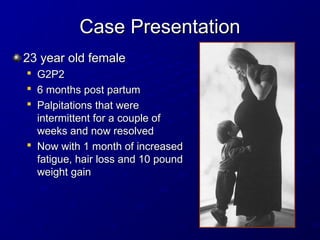
23 year old female
23 year old female

G2P2
G2P2

6 months post partum

Palpitations that were
intermittent for a couple of
weeks and now resolved

Now with 1 month of increased
fatigue, hair loss and 10 pound
weight gain
weight gain
Case Presentation
Case Presentation
What is her diagnosis?
Tests that should be done?
Pathophysiology of her disease process?
Thyroid Trivia
Thyroid Trivia
“
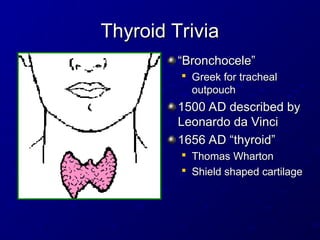
“Bronchocele”
Bronchocele”

Greek for tracheal
Greek for tracheal
outpouch
outpouch
1500 AD described by
Leonardo da Vinci
Leonardo da Vinci
1656 AD “thyroid”
1656 AD “thyroid”

Thomas Wharton
Thomas Wharton

Shield shaped cartilage
Thyroid Trivia
Thyroid Trivia
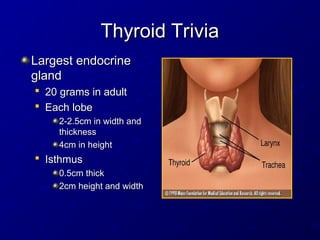
Largest endocrine
Largest endocrine
gland
gland

20 grams in adult
20 grams in adult

Each lobe
Each lobe
2-2.5cm in width and
thickness
thickness
4cm in height
4cm in height

Isthmus
Isthmus
0.5cm thick
0.5cm thick
2cm height and width
Thyroid
Thyroid
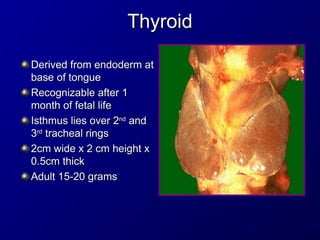
Derived from endoderm at
base of tongue
base of tongue
Recognizable after 1
month of fetal life
month of fetal life
Isthmus lies over 2
Isthmus lies over 2nd
nd
and
and
3
3rd
rd
tracheal rings
tracheal rings
2cm wide x 2 cm height x
0.5cm thick
0.5cm thick
Adult 15-20 grams
Adult 15-20 grams
Thyroid
Thyroid
Largest of the endocrine glands
Blood flow 5x the weight of the gland/minute
Hormones produced
Hormones produced

93% thyroxine (T4)
93% thyroxine (T4)

7% triiodothyronine (T3)
4x the potency of thyroxine
Responsible for the basal metabolic rate

Deficiency = 40-50% fall in metabolic rate

Excess = 60-100% increase in metabolic rate
Thyroid Histology
Thyroid Histology
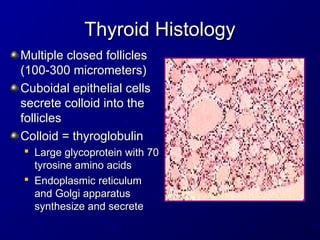
Multiple closed follicles
(100-300 micrometers)
Cuboidal epithelial cells
secrete colloid into the
follicles
follicles
Colloid = thyroglobulin

Large glycoprotein with 70
tyrosine amino acids

Endoplasmic reticulum
and Golgi apparatus
and Golgi apparatus
synthesize and secrete
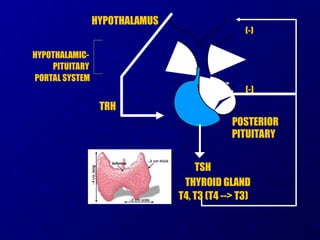
TRH
(+)
HYPOTHALAMUS
ANTERIOR
PITUITARY
HYPOTHALAMIC-
PITUITARY
PORTAL SYSTEM
T4, T3 (T4 --> T3)
THYROID GLAND
TSH
POSTERIOR
PITUITARY
(-)
(-)
TRH
TRH
Produced by Hypothalamus
Release is pulsatile, circadian
Downregulated by T
Downregulated by T4
4, T
, T3
3
Travels through portal venous system to
adenohypophysis
adenohypophysis
Stimulates TSH formation
TSH
TSH
Produced by Adenohypophysis Thyrotrophs
Upregulated by TRH
Upregulated by TRH
Downregulated by T
Downregulated by T4
4, T
, T3
3
Travels through portal venous system to
cavernous sinus, body.
Stimulates several processes

Iodine uptake
Iodine uptake

Colloid endocytosis
Colloid endocytosis

Growth of thyroid gland
Thyroid Physiology
Thyroid Physiology
Uptake of Iodine by thyroid
Coupling of Iodine to Thyroglobulin
Storage of MIT / DIT in follicular space
Re-absorption of MIT / DIT
Formation of T
Formation of T3
3, T
, T4
4 from MIT / DIT
from MIT / DIT
Release of T
Release of T3
3, T
, T4
4 into serum
into serum
Breakdown of T
Breakdown of T3
3, T
, T4
4 with release of Iodine
with release of Iodine
Thyroid and Iodine
Thyroid and Iodine
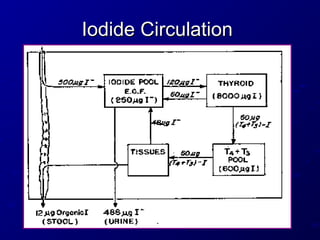
50 mg of iodides are needed per year

1 mg/week
1 mg/week

Iodized salt
Iodized salt
1 part Na iodide to 100,000 parts NaCl
Iodides are ingested and oxidized to iodine in
the thyroid
the thyroid

Nascent iodine(I
Nascent iodine(Io
o
) or I
) or I3
3
-
-

Peroxidase enzyme (hydrogen peroxide)
1/5 of ingested iodine utilized for hormone
synthesis
synthesis
Iodide Circulation
Iodide Circulation
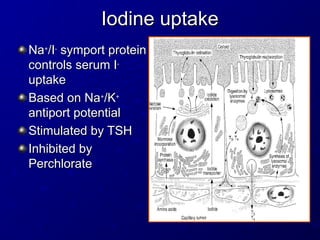
Iodine uptake
Iodine uptake
Na
Na+
+
/I
/I-
-
symport protein
symport protein
controls serum I
controls serum I-
-
uptake
uptake
Based on Na
Based on Na+
+
/K
/K+
+
antiport potential
antiport potential
Stimulated by TSH
Stimulated by TSH
Inhibited by
Inhibited by
Perchlorate
Perchlorate
Iodide Pump
Iodide Pump
Thyroid gland actively pumps iodide into
the cell via the basal membrane
(iodide trapping)
(iodide trapping)

Iodide 30x the concentration of blood

Able to concentrate to 250x the concentration
in blood
in blood
Rate of iodide trapping

TSH dependent
TSH dependent
Thyroid Hormone Synthesis
Tyrosine backbone
Tyrosine backbone
Iodine
Iodine

Iodinase
Iodinase enzyme (enzyme I) attaches iodine
enzyme (enzyme I) attaches iodine
to thyroglobulin
to thyroglobulin
Number of iodines determine activity of
thyroid hormone
thyroid hormone

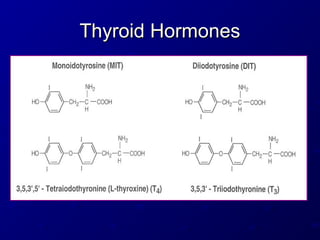
Thyroxine (4 iodines)

Triiodothyronine (3 iodines)
MIT / DIT Formation
MIT / DIT Formation
Thyroid Peroxidase (TPO)

Apical membrane protein

Catalyzes iodide oxidation to reactive iodine
Binds to Tyrosine residues of Thyroglobulin

Antagonized by thionamides

Coupling enzyme
Coupling enzyme
MIT with DIT= T3
MIT with DIT= T3
Two DIT’s= T4
Two DIT’s= T4
Pre-hormones secreted into follicular space
Transport of T3 and T4
When in circulation
When in circulation

93% thyroxine and 7% triiodothyronine

Conversion to active (T3) is by slow
deiodination process

99% of T4 and T3 bound to plasma proteins
Causes slow release of hormone to tissue
Thyroxine-binding globulin (TBG)
Tyroxine-binding prealbumin and albumin
Secretion of Thyroid Hormone
Stimulated by TSH
Stimulated by TSH
Endocytosis of colloid on apical membrane
Coupling of MIT & DIT residues

Catalyzed by TPO
Catalyzed by TPO
 MIT + DIT = T
MIT + DIT = T3
3
 DIT + DIT = T
DIT + DIT = T4
4
Hydrolysis of Thyroglobulin
Release of T
Release of T3
3, T
, T4
4
Release inhibited by Lithium
Thyroid Hormones
Thyroid Hormones
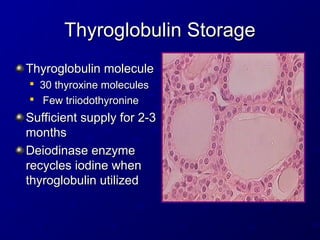
Thyroglobulin Storage
Thyroglobulin molecule

30 thyroxine molecules

Few triiodothyronine
Sufficient supply for 2-3
months
months
Deiodinase enzyme
Deiodinase enzyme
recycles iodine when
thyroglobulin utilized
Thyroid Hormone
Thyroid Hormone
Metabolic effect of thyroxine noticed 2-3
days after release
days after release
Steady state of thyroid hormone 10-12
days after ingestion
Half life of 15 days
Due to steady state, thyroid hormone is
typically adjusted every 4-6 weeks

Check T4 vs. TSH in the short term
assessment
assessment
Thyroid Hormone
Thyroid Hormone

Majority of circulating hormone is T
Majority of circulating hormone is T4
4
98.5% T
98.5% T4
4
1.5% T
1.5% T3
3

Total Hormone load is influenced by serum
binding proteins
binding proteins
Thyroid Binding Globulin 70%
Albumin 15%
Albumin 15%
Transthyretin 10%
Transthyretin 10%

Regulation is based on the free component of
thyroid hormone
thyroid hormone
Hormone Binding Factors
Increased TBG
Increased TBG

High estrogen states (pregnancy, OCP, HRT, Tamoxifen)

Liver disease (early)
Decreased TBG
Decreased TBG

Androgens or anabolic steroids

Liver disease (late)
Binding Site Competition

NSAID’s
NSAID’s

Furosemide IV
Furosemide IV

Anticonvulsants (Phenytoin, Carbamazepine)
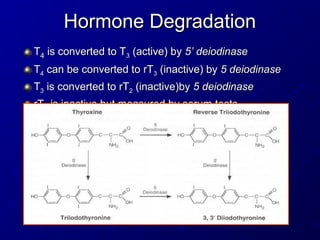
Hormone Degradation
Hormone Degradation
T
T4
4 is converted to T
is converted to T3
3 (active) by
(active) by 5’ deiodinase
5’ deiodinase
T
T4
4 can be converted to rT
can be converted to rT3
3 (inactive) by
(inactive) by 5 deiodinase
5 deiodinase
T
T3
3 is converted to rT
is converted to rT2
2 (inactive)by
(inactive)by 5 deiodinase
5 deiodinase
rT
rT3
3 is inactive but measured by serum tests
is inactive but measured by serum tests
Hypothyroidism
Hypothyroidism
Symptoms
Symptoms
Nervous system
Nervous system

Forgetfulness and
Forgetfulness and
mental slowing
mental slowing

Paresthesias
Paresthesias

Carpal tunnel
Carpal tunnel

Ataxia and decreased
hearing
hearing

Tendon jerk slowed
Tendon jerk slowed
with prolonged
with prolonged
relaxation phase
relaxation phase
Cardiovascular
Cardiovascular

Bradycardia
Bradycardia

Decreased cardiac
Decreased cardiac
output
output

Pericardial effusion

Reduced voltage on
Reduced voltage on
EKG and flat T waves

Dependent edema
Dependent edema
Hypothyroidism
Hypothyroidism
Symptoms
Symptoms
Gastrointestinal
Gastrointestinal

Constipation
Constipation

Achlorhydria with
Achlorhydria with
pernicious anemia
pernicious anemia

Ascitic fluid with high
protein
protein
Renal
Renal

Reduced excretion of
water load
water load
Hyponatremia
Hyponatremia

Decreased renal blood
flow and glomerular
flow and glomerular
filtration
filtration
Pulmonary
Pulmonary

Responses to hypoxia and
hypercapnia are decreased

Pleural effusions high
protein
protein
Musculoskeletal
Musculoskeletal

Arthralgia
Arthralgia

Joint effusions
Joint effusions

Muscle cramps
Muscle cramps

CK can be elevated
CK can be elevated
Anemia
Anemia

Normochromic normocytic

Megaloblastic
Megaloblastic
Pernicious anemia
Pernicious anemia
Hypothyroidism
Hypothyroidism
Symptoms
Symptoms
Skin and hair
Skin and hair

Loss of lateral eye brows

Dry, cool skin
Dry, cool skin

Facial features
Facial features
Coarse and puffy
Coarse and puffy

Orange skin
Orange skin
Carotene
Carotene
Reproductive system
Reproductive system

Menorrhagia from
Menorrhagia from
anovulatory cycles
anovulatory cycles

Hyperprolactinemia
Hyperprolactinemia
No inhibition of thyroid
hormone
hormone
Metabolism
Metabolism

Hypothermia
Hypothermia

Intolerance to cold
Intolerance to cold

Increased cholesterol
and triglyceride
and triglyceride
Decreased lipoprotein
receptors
receptors

Weight gain
Weight gain
Thyroid Hormone
Thyroid Hormone
Metabolic effect of thyroxine noticed 2-3
days after release
days after release
Steady state of thyroid hormone 10-12
days after ingestion
Half life of 15 days
Due to steady state, thyroid hormone is
typically adjusted every 4-6 weeks

Check T4 vs TSH in the short term
assessment
assessment
Hypothyroidism
Hypothyroidism
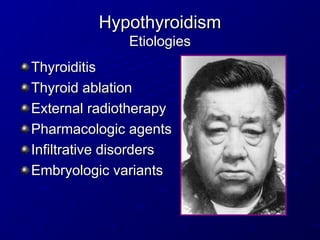
Etiologies
Etiologies
Thyroiditis
Thyroiditis
Thyroid ablation
Thyroid ablation
External radiotherapy
Pharmacologic agents
Infiltrative disorders
Embryologic variants
Thyroiditis
Thyroiditis
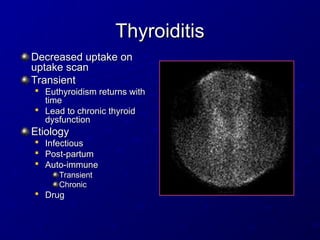
Decreased uptake on
Decreased uptake on
uptake scan
uptake scan
Transient
Transient

Euthyroidism returns with
time
time

Lead to chronic thyroid
dysfunction
dysfunction
Etiology
Etiology

Infectious
Infectious

Post-partum
Post-partum

Auto-immune
Auto-immune
Transient
Transient
Chronic
Chronic

Drug
Drug
Thyroiditis
Thyroiditis
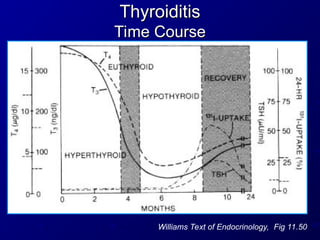
Thyrotoxic phase
Thyrotoxic phase

Short phase
Short phase

Increased T3 and T4
Increased T3 and T4

Symptoms of
Symptoms of
hyperthyroidism
hyperthyroidism

Thionamides not
Thionamides not
effective
effective
Thyroid synthesis low

Can use beta-blockers
Hypothyroid phase
Hypothyroid phase

Transient or permanent

Symptomatic patients
need replacement
need replacement

Can check for recovery
with stopping after 3-6
months
months
Thyroiditis
Thyroiditis
Time Course
Time Course
Williams Text of Endocrinology, Fig 11.50
Infectious Thyroiditis
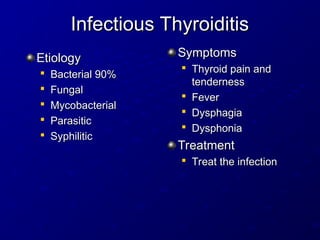
Etiology
Etiology

Bacterial 90%
Bacterial 90%

Fungal
Fungal

Mycobacterial
Mycobacterial

Parasitic
Parasitic

Syphilitic
Syphilitic
Symptoms
Symptoms

Thyroid pain and
Thyroid pain and
tenderness
tenderness

Fever
Fever

Dysphagia
Dysphagia

Dysphonia
Dysphonia
Treatment
Treatment

Treat the infection
Treat the infection
Autoimmune Thyroiditis
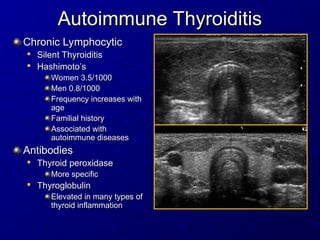
Chronic Lymphocytic
Chronic Lymphocytic

Silent Thyroiditis
Silent Thyroiditis

Hashimoto’s
Hashimoto’s
Women 3.5/1000
Women 3.5/1000
Men 0.8/1000
Men 0.8/1000
Frequency increases with
age
age
Familial history
Familial history
Associated with
Associated with
autoimmune diseases
autoimmune diseases
Antibodies
Antibodies

Thyroid peroxidase
Thyroid peroxidase
More specific
More specific

Thyroglobulin
Thyroglobulin
Elevated in many types of
thyroid inflammation
Thyroiditis
Thyroiditis
Postpartum thyroiditis

2-21% of pregnancies

Can occur up to one
Can occur up to one
year post partum
year post partum

Usually transient and
returns to euthyroid
state
state

Treat
Treat
Hypothyroidism
Hypothyroidism
Symptoms with
Symptoms with
‘hyperthyroidism’
‘hyperthyroidism’
Presence of TPO AB
Presence of TPO AB
increases risk of long
term hypothyroidism
term hypothyroidism
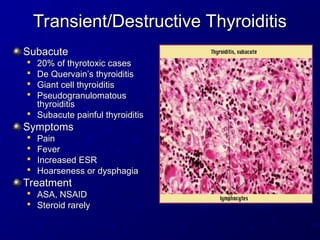
Transient/Destructive Thyroiditis
Subacute
Subacute

20% of thyrotoxic cases

De Quervain’s thyroiditis

Giant cell thyroiditis

Pseudogranulomatous
Pseudogranulomatous
thyroiditis
thyroiditis

Subacute painful thyroiditis
Symptoms
Symptoms

Pain
Pain

Fever
Fever

Increased ESR
Increased ESR

Hoarseness or dysphagia
Treatment
Treatment

ASA, NSAID
ASA, NSAID

Steroid rarely
Steroid rarely
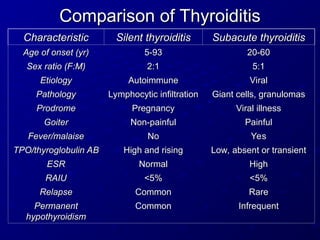
Comparison of Thyroiditis
Characteristic
Characteristic Silent thyroiditis
Silent thyroiditis Subacute thyroiditis
Subacute thyroiditis
Age of onset (yr)
Age of onset (yr) 5-93
5-93 20-60
20-60
Sex ratio (F:M)
Sex ratio (F:M) 2:1
2:1 5:1
5:1
Etiology
Etiology Autoimmune
Autoimmune Viral
Viral
Pathology
Pathology Lymphocytic infiltration
Lymphocytic infiltration Giant cells, granulomas
Giant cells, granulomas
Prodrome
Prodrome Pregnancy
Pregnancy Viral illness
Viral illness
Goiter
Goiter Non-painful
Non-painful Painful
Painful
Fever/malaise
Fever/malaise No
No Yes
Yes
TPO/thyroglobulin AB
TPO/thyroglobulin AB High and rising
High and rising Low, absent or transient
Low, absent or transient
ESR
ESR Normal
Normal High
High
RAIU
RAIU <5%
<5% <5%
<5%
Relapse
Relapse Common
Common Rare
Rare
Permanent
Permanent
hypothyroidism
hypothyroidism
Common
Common Infrequent
Infrequent
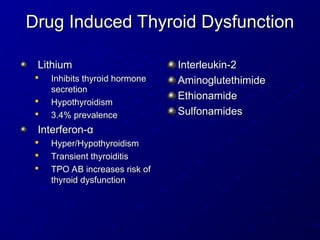
Drug Induced Thyroid Dysfunction
Lithium
Lithium

Inhibits thyroid hormone
secretion
secretion

Hypothyroidism
Hypothyroidism

3.4% prevalence
3.4% prevalence
Interferon-
Interferon-α
α

Hyper/Hypothyroidism

Transient thyroiditis

TPO AB increases risk of
thyroid dysfunction
thyroid dysfunction
Interleukin-2
Interleukin-2
Aminoglutethimide
Aminoglutethimide
Ethionamide
Ethionamide
Sulfonamides
Sulfonamides
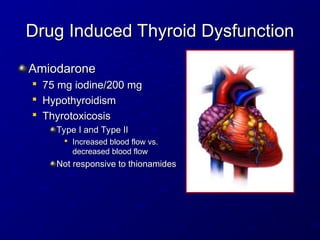
Drug Induced Thyroid Dysfunction
Amiodarone
Amiodarone

75 mg iodine/200 mg
75 mg iodine/200 mg

Hypothyroidism
Hypothyroidism

Thyrotoxicosis
Thyrotoxicosis
Type I and Type II
Type I and Type II

Increased blood flow vs.
decreased blood flow
Not responsive to thionamides
Hypothyroidism
Hypothyroidism
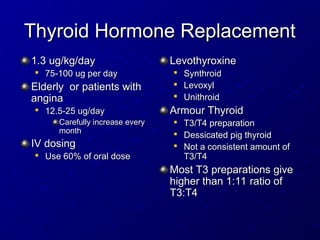
Infiltrative Disorders
Riedel’s thyroiditis

Invasive Fibrous Thyroiditis

Thyroid tissue replaced by
fibrous tissue
fibrous tissue

Rapidly enlarging neck
mass
mass

Compressive symptoms

Surgical removal
Surgical removal

Steroids and tamoxifen
Amyloidosis
Amyloidosis
Sarcoidosis
Sarcoidosis
Hemochromatosis
Hemochromatosis
Cystinosis
Cystinosis
Pneumocystis carinii
Lymphoma
Lymphoma
Thyroid Hormone Replacement
1.3 ug/kg/day
1.3 ug/kg/day

75-100 ug per day
75-100 ug per day
Elderly or patients with
angina
angina

12.5-25 ug/day
12.5-25 ug/day
Carefully increase every
month
month
IV dosing
IV dosing

Use 60% of oral dose
Levothyroxine
Levothyroxine

Synthroid
Synthroid

Levoxyl
Levoxyl

Unithroid
Unithroid
Armour Thyroid
Armour Thyroid

T3/T4 preparation
T3/T4 preparation

Dessicated pig thyroid

Not a consistent amount of
T3/T4
T3/T4
Most T3 preparations give
higher than 1:11 ratio of
T3:T4
T3:T4
Case Presentation
Case Presentation
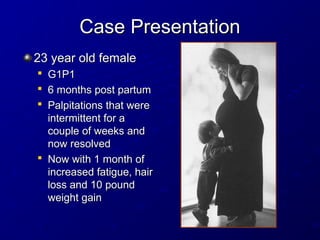
23 year old female
23 year old female

G1P1
G1P1

6 months post partum

Palpitations that were
intermittent for a
intermittent for a
couple of weeks and
couple of weeks and
now resolved
now resolved

Now with 1 month of
Now with 1 month of
increased fatigue, hair
loss and 10 pound
loss and 10 pound
weight gain
weight gain
Case Presentation
Case Presentation
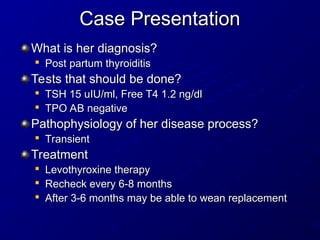
What is her diagnosis?

Post partum thyroiditis
Tests that should be done?

TSH 15 uIU/ml, Free T4 1.2 ng/dl

TPO AB negative
TPO AB negative
Pathophysiology of her disease process?

Transient
Transient
Treatment
Treatment

Levothyroxine therapy

Recheck every 6-8 months

After 3-6 months may be able to wean replacement
Post Partum Thyroiditis
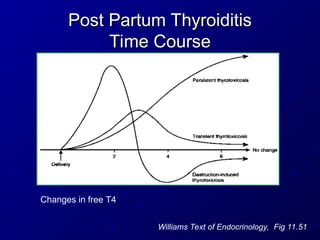
Time Course
Time Course
Williams Text of Endocrinology, Fig 11.51
Changes in free T4
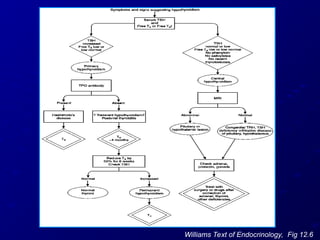
Williams Text of Endocrinology, Fig 12.6

Thyroiditis.ppt dg ffkjsnd.x.,jrei lvfdl

  • 1.
    Thyroid Physiology and ThyroidPhysiology and Thyroiditis Thyroiditis Heidi Chamberlain Shea, MD Heidi Chamberlain Shea, MD Endocrine Associates of Dallas Endocrine Associates of Dallas
  • 2.
    Case Presentation Case Presentation 23year old female 23 year old female  G2P2 G2P2  6 months post partum 6 months post partum  Palpitations that were Palpitations that were intermittent for a couple of intermittent for a couple of weeks and now resolved weeks and now resolved  Now with 1 month of increased Now with 1 month of increased fatigue, hair loss and 10 pound fatigue, hair loss and 10 pound weight gain weight gain
  • 3.
    Case Presentation Case Presentation Whatis her diagnosis? What is her diagnosis? Tests that should be done? Tests that should be done? Pathophysiology of her disease process? Pathophysiology of her disease process?
  • 4.
    Thyroid Trivia Thyroid Trivia “ “Bronchocele” Bronchocele”  Greekfor tracheal Greek for tracheal outpouch outpouch 1500 AD described by 1500 AD described by Leonardo da Vinci Leonardo da Vinci 1656 AD “thyroid” 1656 AD “thyroid”  Thomas Wharton Thomas Wharton  Shield shaped cartilage Shield shaped cartilage
  • 5.
    Thyroid Trivia Thyroid Trivia Largestendocrine Largest endocrine gland gland  20 grams in adult 20 grams in adult  Each lobe Each lobe 2-2.5cm in width and 2-2.5cm in width and thickness thickness 4cm in height 4cm in height  Isthmus Isthmus 0.5cm thick 0.5cm thick 2cm height and width 2cm height and width
  • 6.
    Thyroid Thyroid Derived from endodermat Derived from endoderm at base of tongue base of tongue Recognizable after 1 Recognizable after 1 month of fetal life month of fetal life Isthmus lies over 2 Isthmus lies over 2nd nd and and 3 3rd rd tracheal rings tracheal rings 2cm wide x 2 cm height x 2cm wide x 2 cm height x 0.5cm thick 0.5cm thick Adult 15-20 grams Adult 15-20 grams
  • 7.
    Thyroid Thyroid Largest of theendocrine glands Largest of the endocrine glands Blood flow 5x the weight of the gland/minute Blood flow 5x the weight of the gland/minute Hormones produced Hormones produced  93% thyroxine (T4) 93% thyroxine (T4)  7% triiodothyronine (T3) 7% triiodothyronine (T3) 4x the potency of thyroxine 4x the potency of thyroxine Responsible for the basal metabolic rate Responsible for the basal metabolic rate  Deficiency = 40-50% fall in metabolic rate Deficiency = 40-50% fall in metabolic rate  Excess = 60-100% increase in metabolic rate Excess = 60-100% increase in metabolic rate
  • 8.
    Thyroid Histology Thyroid Histology Multipleclosed follicles Multiple closed follicles (100-300 micrometers) (100-300 micrometers) Cuboidal epithelial cells Cuboidal epithelial cells secrete colloid into the secrete colloid into the follicles follicles Colloid = thyroglobulin Colloid = thyroglobulin  Large glycoprotein with 70 Large glycoprotein with 70 tyrosine amino acids tyrosine amino acids  Endoplasmic reticulum Endoplasmic reticulum and Golgi apparatus and Golgi apparatus synthesize and secrete synthesize and secrete
  • 9.
    TRH (+) HYPOTHALAMUS ANTERIOR PITUITARY HYPOTHALAMIC- PITUITARY PORTAL SYSTEM T4, T3(T4 --> T3) THYROID GLAND TSH POSTERIOR PITUITARY (-) (-)
  • 10.
    TRH TRH Produced by Hypothalamus Producedby Hypothalamus Release is pulsatile, circadian Release is pulsatile, circadian Downregulated by T Downregulated by T4 4, T , T3 3 Travels through portal venous system to Travels through portal venous system to adenohypophysis adenohypophysis Stimulates TSH formation Stimulates TSH formation
  • 11.
    TSH TSH Produced by AdenohypophysisThyrotrophs Produced by Adenohypophysis Thyrotrophs Upregulated by TRH Upregulated by TRH Downregulated by T Downregulated by T4 4, T , T3 3 Travels through portal venous system to Travels through portal venous system to cavernous sinus, body. cavernous sinus, body. Stimulates several processes Stimulates several processes  Iodine uptake Iodine uptake  Colloid endocytosis Colloid endocytosis  Growth of thyroid gland Growth of thyroid gland
  • 12.
    Thyroid Physiology Thyroid Physiology Uptakeof Iodine by thyroid Uptake of Iodine by thyroid Coupling of Iodine to Thyroglobulin Coupling of Iodine to Thyroglobulin Storage of MIT / DIT in follicular space Storage of MIT / DIT in follicular space Re-absorption of MIT / DIT Re-absorption of MIT / DIT Formation of T Formation of T3 3, T , T4 4 from MIT / DIT from MIT / DIT Release of T Release of T3 3, T , T4 4 into serum into serum Breakdown of T Breakdown of T3 3, T , T4 4 with release of Iodine with release of Iodine
  • 13.
    Thyroid and Iodine Thyroidand Iodine 50 mg of iodides are needed per year 50 mg of iodides are needed per year  1 mg/week 1 mg/week  Iodized salt Iodized salt 1 part Na iodide to 100,000 parts NaCl 1 part Na iodide to 100,000 parts NaCl Iodides are ingested and oxidized to iodine in Iodides are ingested and oxidized to iodine in the thyroid the thyroid  Nascent iodine(I Nascent iodine(Io o ) or I ) or I3 3 - -  Peroxidase enzyme (hydrogen peroxide) Peroxidase enzyme (hydrogen peroxide) 1/5 of ingested iodine utilized for hormone 1/5 of ingested iodine utilized for hormone synthesis synthesis
  • 14.
  • 15.
    Iodine uptake Iodine uptake Na Na+ + /I /I- - symportprotein symport protein controls serum I controls serum I- - uptake uptake Based on Na Based on Na+ + /K /K+ + antiport potential antiport potential Stimulated by TSH Stimulated by TSH Inhibited by Inhibited by Perchlorate Perchlorate
  • 16.
    Iodide Pump Iodide Pump Thyroidgland actively pumps iodide into Thyroid gland actively pumps iodide into the cell via the basal membrane the cell via the basal membrane (iodide trapping) (iodide trapping)  Iodide 30x the concentration of blood Iodide 30x the concentration of blood  Able to concentrate to 250x the concentration Able to concentrate to 250x the concentration in blood in blood Rate of iodide trapping Rate of iodide trapping  TSH dependent TSH dependent
  • 17.
    Thyroid Hormone Synthesis ThyroidHormone Synthesis Tyrosine backbone Tyrosine backbone Iodine Iodine  Iodinase Iodinase enzyme (enzyme I) attaches iodine enzyme (enzyme I) attaches iodine to thyroglobulin to thyroglobulin Number of iodines determine activity of Number of iodines determine activity of thyroid hormone thyroid hormone  Thyroxine (4 iodines) Thyroxine (4 iodines)  Triiodothyronine (3 iodines) Triiodothyronine (3 iodines)
  • 18.
    MIT / DITFormation MIT / DIT Formation Thyroid Peroxidase (TPO) Thyroid Peroxidase (TPO)  Apical membrane protein Apical membrane protein  Catalyzes iodide oxidation to reactive iodine Catalyzes iodide oxidation to reactive iodine Binds to Tyrosine residues of Thyroglobulin Binds to Tyrosine residues of Thyroglobulin  Antagonized by thionamides Antagonized by thionamides  Coupling enzyme Coupling enzyme MIT with DIT= T3 MIT with DIT= T3 Two DIT’s= T4 Two DIT’s= T4 Pre-hormones secreted into follicular space Pre-hormones secreted into follicular space
  • 19.
    Transport of T3and T4 Transport of T3 and T4 When in circulation When in circulation  93% thyroxine and 7% triiodothyronine 93% thyroxine and 7% triiodothyronine  Conversion to active (T3) is by slow Conversion to active (T3) is by slow deiodination process deiodination process  99% of T4 and T3 bound to plasma proteins 99% of T4 and T3 bound to plasma proteins Causes slow release of hormone to tissue Causes slow release of hormone to tissue Thyroxine-binding globulin (TBG) Thyroxine-binding globulin (TBG) Tyroxine-binding prealbumin and albumin Tyroxine-binding prealbumin and albumin
  • 20.
    Secretion of ThyroidHormone Secretion of Thyroid Hormone Stimulated by TSH Stimulated by TSH Endocytosis of colloid on apical membrane Endocytosis of colloid on apical membrane Coupling of MIT & DIT residues Coupling of MIT & DIT residues  Catalyzed by TPO Catalyzed by TPO  MIT + DIT = T MIT + DIT = T3 3  DIT + DIT = T DIT + DIT = T4 4 Hydrolysis of Thyroglobulin Hydrolysis of Thyroglobulin Release of T Release of T3 3, T , T4 4 Release inhibited by Lithium Release inhibited by Lithium
  • 21.
  • 22.
    Thyroglobulin Storage Thyroglobulin Storage Thyroglobulinmolecule Thyroglobulin molecule  30 thyroxine molecules 30 thyroxine molecules  Few triiodothyronine Few triiodothyronine Sufficient supply for 2-3 Sufficient supply for 2-3 months months Deiodinase enzyme Deiodinase enzyme recycles iodine when recycles iodine when thyroglobulin utilized thyroglobulin utilized
  • 23.
    Thyroid Hormone Thyroid Hormone Metaboliceffect of thyroxine noticed 2-3 Metabolic effect of thyroxine noticed 2-3 days after release days after release Steady state of thyroid hormone 10-12 Steady state of thyroid hormone 10-12 days after ingestion days after ingestion Half life of 15 days Half life of 15 days Due to steady state, thyroid hormone is Due to steady state, thyroid hormone is typically adjusted every 4-6 weeks typically adjusted every 4-6 weeks  Check T4 vs. TSH in the short term Check T4 vs. TSH in the short term assessment assessment
  • 24.
    Thyroid Hormone Thyroid Hormone  Majorityof circulating hormone is T Majority of circulating hormone is T4 4 98.5% T 98.5% T4 4 1.5% T 1.5% T3 3  Total Hormone load is influenced by serum Total Hormone load is influenced by serum binding proteins binding proteins Thyroid Binding Globulin 70% Thyroid Binding Globulin 70% Albumin 15% Albumin 15% Transthyretin 10% Transthyretin 10%  Regulation is based on the free component of Regulation is based on the free component of thyroid hormone thyroid hormone
  • 25.
    Hormone Binding Factors HormoneBinding Factors Increased TBG Increased TBG  High estrogen states (pregnancy, OCP, HRT, Tamoxifen) High estrogen states (pregnancy, OCP, HRT, Tamoxifen)  Liver disease (early) Liver disease (early) Decreased TBG Decreased TBG  Androgens or anabolic steroids Androgens or anabolic steroids  Liver disease (late) Liver disease (late) Binding Site Competition Binding Site Competition  NSAID’s NSAID’s  Furosemide IV Furosemide IV  Anticonvulsants (Phenytoin, Carbamazepine) Anticonvulsants (Phenytoin, Carbamazepine)
  • 26.
    Hormone Degradation Hormone Degradation T T4 4is converted to T is converted to T3 3 (active) by (active) by 5’ deiodinase 5’ deiodinase T T4 4 can be converted to rT can be converted to rT3 3 (inactive) by (inactive) by 5 deiodinase 5 deiodinase T T3 3 is converted to rT is converted to rT2 2 (inactive)by (inactive)by 5 deiodinase 5 deiodinase rT rT3 3 is inactive but measured by serum tests is inactive but measured by serum tests
  • 27.
    Hypothyroidism Hypothyroidism Symptoms Symptoms Nervous system Nervous system  Forgetfulnessand Forgetfulness and mental slowing mental slowing  Paresthesias Paresthesias  Carpal tunnel Carpal tunnel  Ataxia and decreased Ataxia and decreased hearing hearing  Tendon jerk slowed Tendon jerk slowed with prolonged with prolonged relaxation phase relaxation phase Cardiovascular Cardiovascular  Bradycardia Bradycardia  Decreased cardiac Decreased cardiac output output  Pericardial effusion Pericardial effusion  Reduced voltage on Reduced voltage on EKG and flat T waves EKG and flat T waves  Dependent edema Dependent edema
  • 28.
    Hypothyroidism Hypothyroidism Symptoms Symptoms Gastrointestinal Gastrointestinal  Constipation Constipation  Achlorhydria with Achlorhydria with perniciousanemia pernicious anemia  Ascitic fluid with high Ascitic fluid with high protein protein Renal Renal  Reduced excretion of Reduced excretion of water load water load Hyponatremia Hyponatremia  Decreased renal blood Decreased renal blood flow and glomerular flow and glomerular filtration filtration Pulmonary Pulmonary  Responses to hypoxia and Responses to hypoxia and hypercapnia are decreased hypercapnia are decreased  Pleural effusions high Pleural effusions high protein protein Musculoskeletal Musculoskeletal  Arthralgia Arthralgia  Joint effusions Joint effusions  Muscle cramps Muscle cramps  CK can be elevated CK can be elevated Anemia Anemia  Normochromic normocytic Normochromic normocytic  Megaloblastic Megaloblastic Pernicious anemia Pernicious anemia
  • 29.
    Hypothyroidism Hypothyroidism Symptoms Symptoms Skin and hair Skinand hair  Loss of lateral eye brows Loss of lateral eye brows  Dry, cool skin Dry, cool skin  Facial features Facial features Coarse and puffy Coarse and puffy  Orange skin Orange skin Carotene Carotene Reproductive system Reproductive system  Menorrhagia from Menorrhagia from anovulatory cycles anovulatory cycles  Hyperprolactinemia Hyperprolactinemia No inhibition of thyroid No inhibition of thyroid hormone hormone Metabolism Metabolism  Hypothermia Hypothermia  Intolerance to cold Intolerance to cold  Increased cholesterol Increased cholesterol and triglyceride and triglyceride Decreased lipoprotein Decreased lipoprotein receptors receptors  Weight gain Weight gain
  • 30.
    Thyroid Hormone Thyroid Hormone Metaboliceffect of thyroxine noticed 2-3 Metabolic effect of thyroxine noticed 2-3 days after release days after release Steady state of thyroid hormone 10-12 Steady state of thyroid hormone 10-12 days after ingestion days after ingestion Half life of 15 days Half life of 15 days Due to steady state, thyroid hormone is Due to steady state, thyroid hormone is typically adjusted every 4-6 weeks typically adjusted every 4-6 weeks  Check T4 vs TSH in the short term Check T4 vs TSH in the short term assessment assessment
  • 31.
    Hypothyroidism Hypothyroidism Etiologies Etiologies Thyroiditis Thyroiditis Thyroid ablation Thyroid ablation Externalradiotherapy External radiotherapy Pharmacologic agents Pharmacologic agents Infiltrative disorders Infiltrative disorders Embryologic variants Embryologic variants
  • 32.
    Thyroiditis Thyroiditis Decreased uptake on Decreaseduptake on uptake scan uptake scan Transient Transient  Euthyroidism returns with Euthyroidism returns with time time  Lead to chronic thyroid Lead to chronic thyroid dysfunction dysfunction Etiology Etiology  Infectious Infectious  Post-partum Post-partum  Auto-immune Auto-immune Transient Transient Chronic Chronic  Drug Drug
  • 33.
    Thyroiditis Thyroiditis Thyrotoxic phase Thyrotoxic phase  Shortphase Short phase  Increased T3 and T4 Increased T3 and T4  Symptoms of Symptoms of hyperthyroidism hyperthyroidism  Thionamides not Thionamides not effective effective Thyroid synthesis low Thyroid synthesis low  Can use beta-blockers Can use beta-blockers Hypothyroid phase Hypothyroid phase  Transient or permanent Transient or permanent  Symptomatic patients Symptomatic patients need replacement need replacement  Can check for recovery Can check for recovery with stopping after 3-6 with stopping after 3-6 months months
  • 34.
  • 35.
    Infectious Thyroiditis Infectious Thyroiditis Etiology Etiology  Bacterial90% Bacterial 90%  Fungal Fungal  Mycobacterial Mycobacterial  Parasitic Parasitic  Syphilitic Syphilitic Symptoms Symptoms  Thyroid pain and Thyroid pain and tenderness tenderness  Fever Fever  Dysphagia Dysphagia  Dysphonia Dysphonia Treatment Treatment  Treat the infection Treat the infection
  • 36.
    Autoimmune Thyroiditis Autoimmune Thyroiditis ChronicLymphocytic Chronic Lymphocytic  Silent Thyroiditis Silent Thyroiditis  Hashimoto’s Hashimoto’s Women 3.5/1000 Women 3.5/1000 Men 0.8/1000 Men 0.8/1000 Frequency increases with Frequency increases with age age Familial history Familial history Associated with Associated with autoimmune diseases autoimmune diseases Antibodies Antibodies  Thyroid peroxidase Thyroid peroxidase More specific More specific  Thyroglobulin Thyroglobulin Elevated in many types of Elevated in many types of thyroid inflammation thyroid inflammation
  • 37.
    Thyroiditis Thyroiditis Postpartum thyroiditis Postpartum thyroiditis  2-21%of pregnancies 2-21% of pregnancies  Can occur up to one Can occur up to one year post partum year post partum  Usually transient and Usually transient and returns to euthyroid returns to euthyroid state state  Treat Treat Hypothyroidism Hypothyroidism Symptoms with Symptoms with ‘hyperthyroidism’ ‘hyperthyroidism’ Presence of TPO AB Presence of TPO AB increases risk of long increases risk of long term hypothyroidism term hypothyroidism
  • 38.
    Transient/Destructive Thyroiditis Transient/Destructive Thyroiditis Subacute Subacute  20%of thyrotoxic cases 20% of thyrotoxic cases  De Quervain’s thyroiditis De Quervain’s thyroiditis  Giant cell thyroiditis Giant cell thyroiditis  Pseudogranulomatous Pseudogranulomatous thyroiditis thyroiditis  Subacute painful thyroiditis Subacute painful thyroiditis Symptoms Symptoms  Pain Pain  Fever Fever  Increased ESR Increased ESR  Hoarseness or dysphagia Hoarseness or dysphagia Treatment Treatment  ASA, NSAID ASA, NSAID  Steroid rarely Steroid rarely
  • 39.
    Comparison of Thyroiditis Comparisonof Thyroiditis Characteristic Characteristic Silent thyroiditis Silent thyroiditis Subacute thyroiditis Subacute thyroiditis Age of onset (yr) Age of onset (yr) 5-93 5-93 20-60 20-60 Sex ratio (F:M) Sex ratio (F:M) 2:1 2:1 5:1 5:1 Etiology Etiology Autoimmune Autoimmune Viral Viral Pathology Pathology Lymphocytic infiltration Lymphocytic infiltration Giant cells, granulomas Giant cells, granulomas Prodrome Prodrome Pregnancy Pregnancy Viral illness Viral illness Goiter Goiter Non-painful Non-painful Painful Painful Fever/malaise Fever/malaise No No Yes Yes TPO/thyroglobulin AB TPO/thyroglobulin AB High and rising High and rising Low, absent or transient Low, absent or transient ESR ESR Normal Normal High High RAIU RAIU <5% <5% <5% <5% Relapse Relapse Common Common Rare Rare Permanent Permanent hypothyroidism hypothyroidism Common Common Infrequent Infrequent
  • 40.
    Drug Induced ThyroidDysfunction Drug Induced Thyroid Dysfunction Lithium Lithium  Inhibits thyroid hormone Inhibits thyroid hormone secretion secretion  Hypothyroidism Hypothyroidism  3.4% prevalence 3.4% prevalence Interferon- Interferon-α α  Hyper/Hypothyroidism Hyper/Hypothyroidism  Transient thyroiditis Transient thyroiditis  TPO AB increases risk of TPO AB increases risk of thyroid dysfunction thyroid dysfunction Interleukin-2 Interleukin-2 Aminoglutethimide Aminoglutethimide Ethionamide Ethionamide Sulfonamides Sulfonamides
  • 41.
    Drug Induced ThyroidDysfunction Drug Induced Thyroid Dysfunction Amiodarone Amiodarone  75 mg iodine/200 mg 75 mg iodine/200 mg  Hypothyroidism Hypothyroidism  Thyrotoxicosis Thyrotoxicosis Type I and Type II Type I and Type II  Increased blood flow vs. Increased blood flow vs. decreased blood flow decreased blood flow Not responsive to thionamides Not responsive to thionamides
  • 42.
    Hypothyroidism Hypothyroidism Infiltrative Disorders Infiltrative Disorders Riedel’sthyroiditis Riedel’s thyroiditis  Invasive Fibrous Thyroiditis Invasive Fibrous Thyroiditis  Thyroid tissue replaced by Thyroid tissue replaced by fibrous tissue fibrous tissue  Rapidly enlarging neck Rapidly enlarging neck mass mass  Compressive symptoms Compressive symptoms  Surgical removal Surgical removal  Steroids and tamoxifen Steroids and tamoxifen Amyloidosis Amyloidosis Sarcoidosis Sarcoidosis Hemochromatosis Hemochromatosis Cystinosis Cystinosis Pneumocystis carinii Pneumocystis carinii Lymphoma Lymphoma
  • 43.
    Thyroid Hormone Replacement ThyroidHormone Replacement 1.3 ug/kg/day 1.3 ug/kg/day  75-100 ug per day 75-100 ug per day Elderly or patients with Elderly or patients with angina angina  12.5-25 ug/day 12.5-25 ug/day Carefully increase every Carefully increase every month month IV dosing IV dosing  Use 60% of oral dose Use 60% of oral dose Levothyroxine Levothyroxine  Synthroid Synthroid  Levoxyl Levoxyl  Unithroid Unithroid Armour Thyroid Armour Thyroid  T3/T4 preparation T3/T4 preparation  Dessicated pig thyroid Dessicated pig thyroid  Not a consistent amount of Not a consistent amount of T3/T4 T3/T4 Most T3 preparations give Most T3 preparations give higher than 1:11 ratio of higher than 1:11 ratio of T3:T4 T3:T4
  • 44.
    Case Presentation Case Presentation 23year old female 23 year old female  G1P1 G1P1  6 months post partum 6 months post partum  Palpitations that were Palpitations that were intermittent for a intermittent for a couple of weeks and couple of weeks and now resolved now resolved  Now with 1 month of Now with 1 month of increased fatigue, hair increased fatigue, hair loss and 10 pound loss and 10 pound weight gain weight gain
  • 45.
    Case Presentation Case Presentation Whatis her diagnosis? What is her diagnosis?  Post partum thyroiditis Post partum thyroiditis Tests that should be done? Tests that should be done?  TSH 15 uIU/ml, Free T4 1.2 ng/dl TSH 15 uIU/ml, Free T4 1.2 ng/dl  TPO AB negative TPO AB negative Pathophysiology of her disease process? Pathophysiology of her disease process?  Transient Transient Treatment Treatment  Levothyroxine therapy Levothyroxine therapy  Recheck every 6-8 months Recheck every 6-8 months  After 3-6 months may be able to wean replacement After 3-6 months may be able to wean replacement
  • 46.
    Post Partum Thyroiditis PostPartum Thyroiditis Time Course Time Course Williams Text of Endocrinology, Fig 11.51 Changes in free T4
  • 47.
    Williams Text ofEndocrinology, Fig 12.6

Editor's Notes

  • #8 Colloid contains thyroid hormones. Colloid is stored in the follicles and then reabsorbed back through the follicular epithelium and into the blood stream to be utilized.
  • #13 1Na Iodide to 100,000 parts of
  • #16 Refer you to pg 859 and Figure 76-2 shows iodine transport Thus, decreasing TSH (will decrease the iodide pump)
  • #17 Without oxidation of iodide, iodine is not placed onto thyroglobulin and hormone formation ceases Organification is a rapid process occurs minutes/seconds
  • #29 Glycosaminoglycans accumulate in skin