The Quest Philosophy for
Reading Comprehension

  STUDENT LEARNING WORKSHOP #1
           SPRING 2012
The Goals of Reading

Mortimer Adler and
                              Francis Bacon
Charles Van Doren

 “[t]here is still another    “Some Bookes are to be
                                Tasted, Others to be
  goal of reading, besides      Swallowed, and Some Few
  gaining information           to be Chewed and Digested:
  and understanding,            That is, some Bookes are to
                                be read onely in Parts;
  and that is                   Others to be read but not
  entertainment” (10).          Curiously; and some Few to
                                be read wholly, and with
                                Diligence and Attention”
                                (151, ll. 22-26).
Thesis: what to read, how to read, and why to
                      read

 What is reading comprehension?
   “the process whereby a mind, with nothing to operate on but the
    symbols of the readable matter, and with no help from outside,
    elevates itself by the power of its own operations. The mind passes
    from understanding less to understanding more” (8).
 Students are best equipped with the ability to carry
  out this process when they are taught how to read
  the right books, in the right ways, for the right
  reasons – in short, the art of reading well.
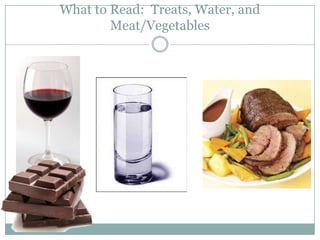
What to Read: Treats, Water, and
        Meat/Vegetables
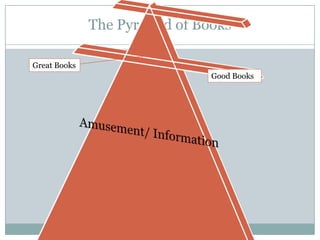
The Pyramid of Books

Great Books
                               Good Books
Books of Information or Entertainment

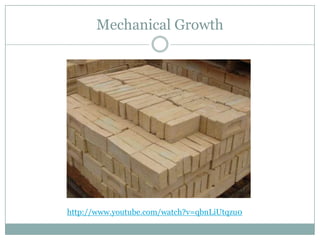
 99% of all books written in the history of the western
  world
 Worthy only of being “tasted” or read in part or
  “skimmed”
 Fosters Mechanical, not organic Growth
Mechanical Growth


http://www.youtube.com/watch?v=qbnLiUtqzu0
The Good Books

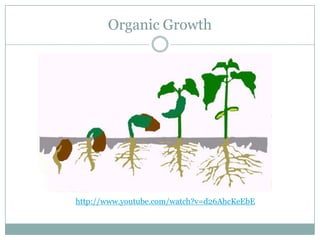
 A few thousand books of the millions of books
  written in the history of the western world
 Worth reading analytically once; that is, deserving to
  be swallowed, but not necessarily chewed/ digested
 Fosters organic, not mechanical growth
The Great Books

 Less than one hundred books of those written in the
    history of the western world
   Cannot be outgrown or exhausted
   Worthy of reading analytically many times over
   Analogous to Bacon’s description of those “Few
    [texts which ought] to be Chewed and Digested”
   Fosters organic growth
Organic Growth


http://www.youtube.com/watch?v=d26AhcKeEbE
How to Read: Tasting, Swallowing,
    Chewing, and Digesting
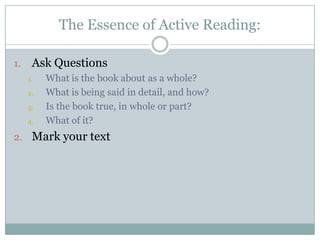
The Essence of Active Reading:

1.    Ask Questions
     1.   What is the book about as a whole?
     2.   What is being said in detail, and how?
     3.   Is the book true, in whole or part?
     4.   What of it?
2. Mark your text
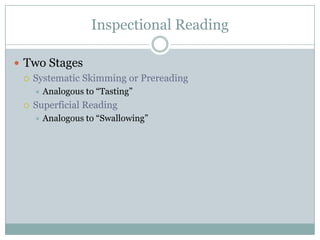
Inspectional Reading

 Two Stages
   Systematic Skimming or Prereading
         Analogous to “Tasting”
     Superficial Reading
         Analogous to “Swallowing”
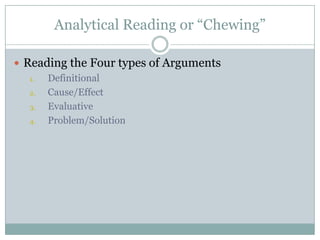
Analytical Reading or “Chewing”

 Reading the Four types of Arguments
   1. Definitional
   2. Cause/Effect
   3. Evaluative
   4. Problem/Solution
Syntopical Reading or “Digesting”

 Survey the Field
 Read Syntopically
Why to Read: the two Questions of a Great
                   Education

 What is the nature of reality?
 How should a life be lived?

Student learning workshop_#1

  • 1.
    The Quest Philosophyfor Reading Comprehension STUDENT LEARNING WORKSHOP #1 SPRING 2012
  • 2.
    The Goals ofReading Mortimer Adler and Francis Bacon Charles Van Doren  “[t]here is still another  “Some Bookes are to be Tasted, Others to be goal of reading, besides Swallowed, and Some Few gaining information to be Chewed and Digested: and understanding, That is, some Bookes are to be read onely in Parts; and that is Others to be read but not entertainment” (10). Curiously; and some Few to be read wholly, and with Diligence and Attention” (151, ll. 22-26).
  • 3.
    Thesis: what toread, how to read, and why to read  What is reading comprehension?  “the process whereby a mind, with nothing to operate on but the symbols of the readable matter, and with no help from outside, elevates itself by the power of its own operations. The mind passes from understanding less to understanding more” (8).  Students are best equipped with the ability to carry out this process when they are taught how to read the right books, in the right ways, for the right reasons – in short, the art of reading well.
  • 4.
    What to Read:Treats, Water, and Meat/Vegetables
  • 5.
    The Pyramid ofBooks Great Books Good Books
  • 6.
    Books of Informationor Entertainment  99% of all books written in the history of the western world  Worthy only of being “tasted” or read in part or “skimmed”  Fosters Mechanical, not organic Growth
  • 7.
  • 8.
    The Good Books A few thousand books of the millions of books written in the history of the western world  Worth reading analytically once; that is, deserving to be swallowed, but not necessarily chewed/ digested  Fosters organic, not mechanical growth
  • 9.
    The Great Books Less than one hundred books of those written in the history of the western world  Cannot be outgrown or exhausted  Worthy of reading analytically many times over  Analogous to Bacon’s description of those “Few [texts which ought] to be Chewed and Digested”  Fosters organic growth
  • 10.
  • 11.
    How to Read:Tasting, Swallowing, Chewing, and Digesting
  • 12.
    The Essence ofActive Reading: 1. Ask Questions 1. What is the book about as a whole? 2. What is being said in detail, and how? 3. Is the book true, in whole or part? 4. What of it? 2. Mark your text
  • 13.
    Inspectional Reading  TwoStages  Systematic Skimming or Prereading  Analogous to “Tasting”  Superficial Reading  Analogous to “Swallowing”
  • 14.
    Analytical Reading or“Chewing”  Reading the Four types of Arguments 1. Definitional 2. Cause/Effect 3. Evaluative 4. Problem/Solution
  • 15.
    Syntopical Reading or“Digesting”  Survey the Field  Read Syntopically
  • 16.
    Why to Read:the two Questions of a Great Education  What is the nature of reality?  How should a life be lived?