HISTORY OF BASKETBALL
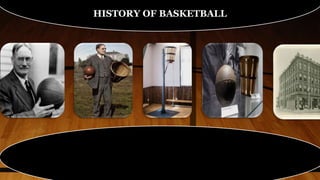
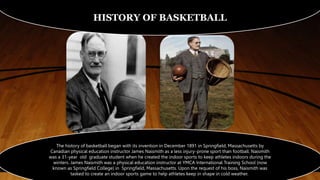
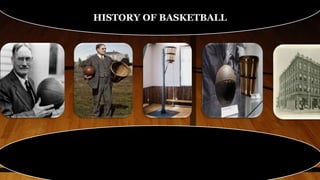
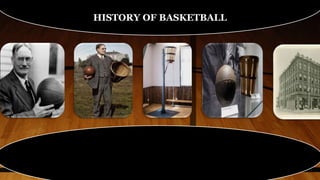
The history of basketball began with its invention in December 1891 in Springfield, Massachusetts by
Canadian physical education instructor James Naismith as a less injury-prone sport than football. Naismith
was a 31-year old graduate student when he created the indoor sports to keep athletes indoors during the
winters. James Naismith was a physical education instructor at YMCA International Training School (now
known as Springfield College) in Springfield, Massachusetts. Upon the request of his boss, Naismith was
tasked to create an indoor sports game to help athletes keep in shape in cold weather.
HISTORY OF BASKETBALL
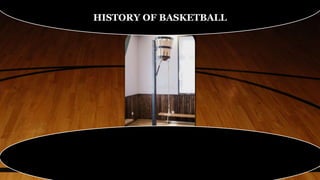
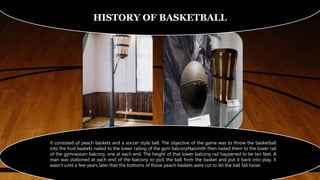
It consisted of peach baskets and a soccer style ball. The objective of the game was to throw the basketball
into the fruit baskets nailed to the lower railing of the gym balconyNaismith then nailed them to the lower rail
of the gymnasium balcony, one at each end. The height of that lower balcony rail happened to be ten feet. A
man was stationed at each end of the balcony to pick the ball from the basket and put it back into play. It
wasn’t until a few years later that the bottoms of those peach baskets were cut to let the ball fall loose.
HISTORY OF BASKETBALL
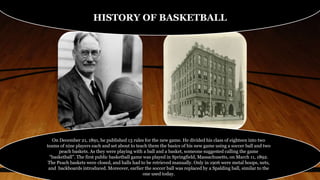
On December 21, 1891, he published 13 rules for the new game. He divided his class of eighteen into two
teams of nine players each and set about to teach them the basics of his new game using a soccer ball and two
peach baskets. As they were playing with a ball and a basket, someone suggested calling the game
“basketball”. The first public basketball game was played in Springfield, Massachusetts, on March 11, 1892.
The Peach baskets were closed, and balls had to be retrieved manually. Only in 1906 were metal hoops, nets,
and backboards introduced. Moreover, earlier the soccer ball was replaced by a Spalding ball, similar to the
one used today.
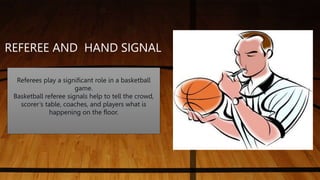
Referees play a significant role in a basketball
game.
Basketball referee signals help to tell the crowd,
scorer’s table, coaches, and players what is
happening on the floor.
REFEREE AND HAND SIGNAL
Violation Signals:
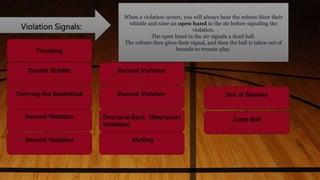
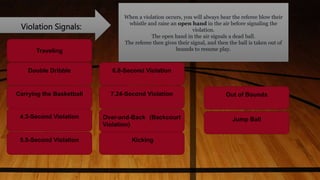
When a violation occurs, you will always hear
the referee blow their whistle and raise an
open hand in the air before signaling the
violation.
The open hand in the air signals a dead ball.
The referee then gives their signal, and then
the ball is taken out of bounds to resume play.
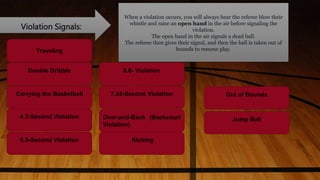
Violation Signals:
When a violation occurs, you will always hear the referee blow their
whistle and raise an open hand in the air before signaling the
violation.
The open hand in the air signals a dead ball.
The referee then gives their signal, and then the ball is taken out of
bounds to resume play.
Double Dribble
Carrying the Basketball
5.5Second Violation
Over-and-Back (Backcourt
Violation)
7.24-Second Violation
4.3-Second Violation
6.8-Second Violation
Out of Bounds
Kicking
Traveling
Jump Ball
Violation Signals:
Traveling
Violation Signals: Traveling
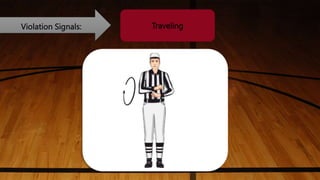
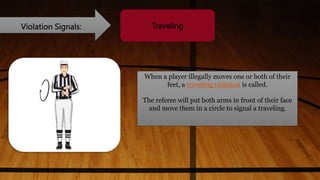
When a player illegally moves one or both of their
feet, a traveling violation is called.
The referee will put both arms in front of their face
and move them in a circle to signal a traveling.
Violation Signals:
Double Dribble
Violation Signals:
Double Dribble
Violation Signals:
Double Dribble
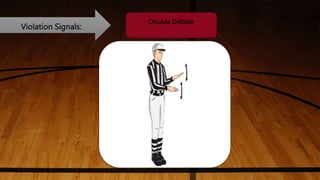
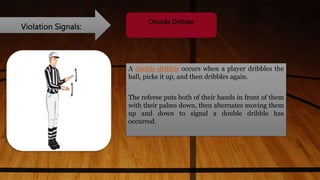
A double dribble occurs when a player dribbles the
ball, picks it up, and then dribbles again.
The referee puts both of their hands in front of them
with their palms down, then alternates moving them
up and down to signal a double dribble has
occurred.
Violation Signals:
When a violation occurs, you will always hear the referee blow their
whistle and raise an open hand in the air before signaling the
violation.
The open hand in the air signals a dead ball.
The referee then gives their signal, and then the ball is taken out of
bounds to resume play.
Double Dribble
Carrying the Basketball
Second Violation
Over-and-Back (Backcourt
Violation)
Second Violation
Second Violation
Second Violation
Out of Bounds
Kicking
Traveling
Jump Ball
Violation Signals:
Carrying the Basketball
Violation Signals:
Carrying the
Basketball
Violation Signals:
Carrying the
Basketball
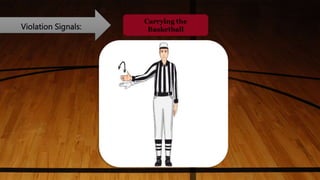
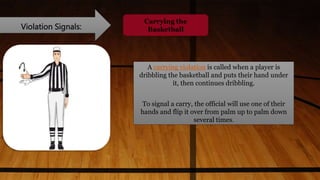
A carrying violation is called when a player is
dribbling the basketball and puts their hand under
it, then continues dribbling.
To signal a carry, the official will use one of their
hands and flip it over from palm up to palm down
several times.
Violation Signals:
When a violation occurs, you will always hear the referee blow their
whistle and raise an open hand in the air before signaling the
violation.
The open hand in the air signals a dead ball.
The referee then gives their signal, and then the ball is taken out of
bounds to resume play.
Double Dribble
Carrying the Basketball
5.5-Second Violation
Over-and-Back (Backcourt
Violation)
7.24-Second Violation
4.3-Second Violation
6.8Second Violation
Out of Bounds
Kicking
Traveling
Jump Ball
Violation Signals:
4.3-Second Violation
Violation Signals:
4.3-Second Violation
Violation Signals:
4.3-Second Violation
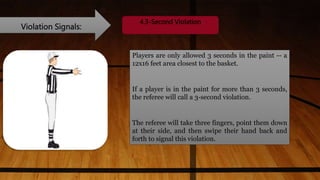
Players are only allowed 3 seconds in the paint -- a
12x16 feet area closest to the basket.
If a player is in the paint for more than 3 seconds,
the referee will call a 3-second violation.
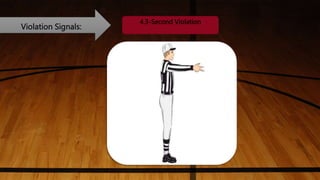
The referee will take three fingers, point them down
at their side, and then swipe their hand back and
forth to signal this violation.
Violation Signals:
When a violation occurs, you will always hear the referee blow their
whistle and raise an open hand in the air before signaling the
violation.
The open hand in the air signals a dead ball.
The referee then gives their signal, and then the ball is taken out of
bounds to resume play.
Double Dribble
Carrying the Basketball
5.5-Second Violation
Over-and-Back (Backcourt
Violation)
7.24-Second Violation
4.3Second Violation
6.8-Second Violation
Out of Bounds
Kicking
Traveling
Jump Ball
Violation Signals:
5.5-Second Violation
Violation Signals:
5.5-Second Violation
Violation Signals:
5.5-Second Violation
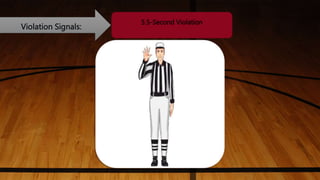
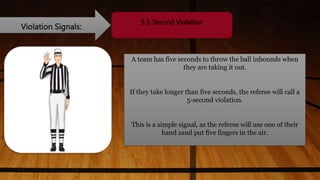
A team has five seconds to throw the ball inbounds when
they are taking it out.
If they take longer than five seconds, the referee will call a
5-second violation.
This is a simple signal, as the referee will use one of their
hand sand put five fingers in the air.
Violation Signals:
When a violation occurs, you will always hear the referee blow their
whistle and raise an open hand in the air before signaling the
violation.
The open hand in the air signals a dead ball.
The referee then gives their signal, and then the ball is taken out of
bounds to resume play.
Double Dribble
Carrying the Basketball
5.5-Second Violation
Over-and-Back (Backcourt
Violation)
7.24-Second Violation
4.3-Second Violation
6.8-Second Violation
Out of Bounds
Kicking
Traveling
Jump Ball
Violation Signals:
6.8-Second Violation
Violation Signals:
6.8-Second Violation
Violation Signals:
6.8-Second Violation
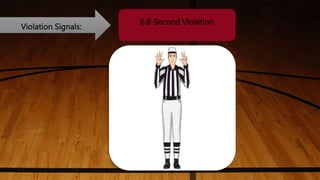
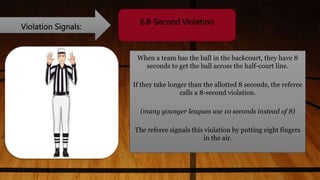
When a team has the ball in the backcourt, they have 8
seconds to get the ball across the half-court line.
If they take longer than the allotted 8 seconds, the referee
calls a 8-second violation.
(many younger leagues use 10 seconds instead of 8)
The referee signals this violation by putting eight fingers
in the air.
Violation Signals:
When a violation occurs, you will always hear the referee blow their
whistle and raise an open hand in the air before signaling the
violation.
The open hand in the air signals a dead ball.
The referee then gives their signal, and then the ball is taken out of
bounds to resume play.
Double Dribble
Carrying the Basketball
5.5-Second Violation
Over-and-Back (Backcourt
Violation)
7.24-Second Violation
4.3-Second Violation
6.8-Second Violation
Out of Bounds
Kicking
Traveling
Jump Ball
Violation Signals:
7.24-Second Violation
Violation Signals:
7.24-Second Violation
Violation Signals:
7.24-Second Violation
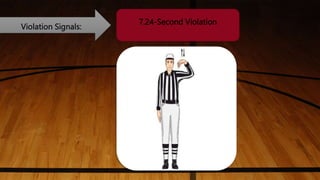
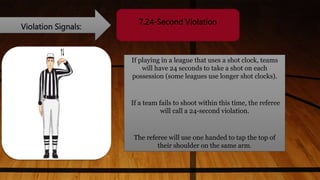
If playing in a league that uses a shot clock, teams
will have 24 seconds to take a shot on each
possession (some leagues use longer shot clocks).
If a team fails to shoot within this time, the referee
will call a 24-second violation.
The referee will use one handed to tap the top of
their shoulder on the same arm.
Violation Signals:
When a violation occurs, you will always hear the referee blow their
whistle and raise an open hand in the air before signaling the
violation.
The open hand in the air signals a dead ball.
The referee then gives their signal, and then the ball is taken out of
bounds to resume play.
Double Dribble
Carrying the Basketball
5.5-Second Violation
Over-and-Back (Backcourt
Violation)
7.24-Second Violation
4.3-Second Violation
6.8-Second Violation
Out of Bounds
Kicking
Traveling
Jump Ball
Violation Signals:
Over-and-Back (Backcourt Violation)
Violation Signals:
Over-and-Back (Backcourt
Violation)
Violation Signals:
Over-and-Back (Backcourt
Violation)
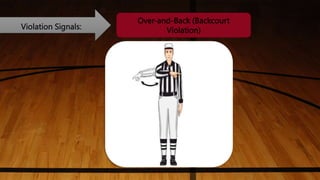
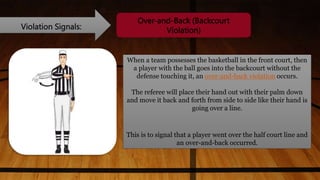
When a team possesses the basketball in the front court, then
a player with the ball goes into the backcourt without the
defense touching it, an over-and-back violation occurs.
The referee will place their hand out with their palm down
and move it back and forth from side to side like their hand is
going over a line.
This is to signal that a player went over the half court line and
an over-and-back occurred.
Violation Signals:
When a violation occurs, you will always hear the referee blow their
whistle and raise an open hand in the air before signaling the
violation.
The open hand in the air signals a dead ball.
The referee then gives their signal, and then the ball is taken out of
bounds to resume play.
Double Dribble
Carrying the Basketball
5.5-Second Violation
Over-and-Back (Backcourt
Violation)
7.24-Second Violation
4.3-Second Violation
6.8-Second Violation
Out of Bounds
Kicking
Traveling
Jump Ball
Violation Signals:
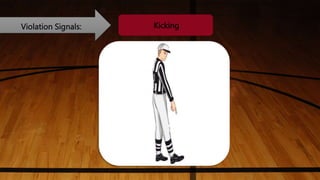
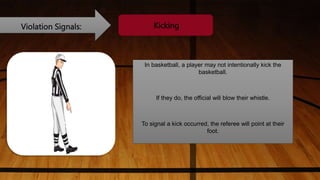
Kicking
Violation Signals: Kicking
In basketball, a player may not intentionally kick the
basketball.
If they do, the official will blow their whistle.
To signal a kick occurred, the referee will point at their
foot.
Violation Signals:
When a violation occurs, you will always hear the referee blow their
whistle and raise an open hand in the air before signaling the
violation.
The open hand in the air signals a dead ball.
The referee then gives their signal, and then the ball is taken out of
bounds to resume play.
Double Dribble
Carrying the Basketball
5.5-Second Violation
Over-and-Back (Backcourt
Violation)
7.24-Second Violation
4.3-Second Violation
6.8-Second Violation
Out of Bounds
Kicking
Traveling
Jump Ball
Violation Signals:
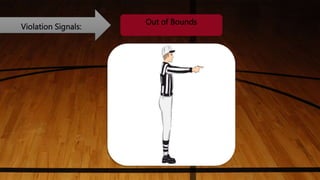
Out of Bounds
Violation Signals:
Out of Bounds
Violation Signals:
Out of Bounds
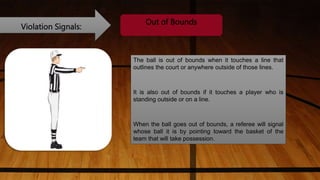
The ball is out of bounds when it touches a line that
outlines the court or anywhere outside of those lines.
It is also out of bounds if it touches a player who is
standing outside or on a line.
When the ball goes out of bounds, a referee will signal
whose ball it is by pointing toward the basket of the
team that will take possession.
Violation Signals:
When a violation occurs, you will always hear the referee blow their
whistle and raise an open hand in the air before signaling the
violation.
The open hand in the air signals a dead ball.
The referee then gives their signal, and then the ball is taken out of
bounds to resume play.
Double Dribble
Carrying the Basketball
5.5-Second Violation
Over-and-Back (Backcourt
Violation)
7.24-Second Violation
4.3-Second Violation
6.8- Violation
Out of Bounds
Kicking
Traveling
Jump Ball
Violation Signals:
Jump Ball
Violation Signals:
Jump Ball
Violation Signals:
Jump Ball
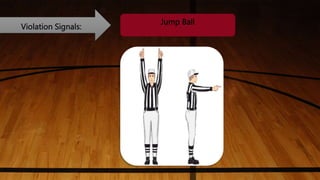
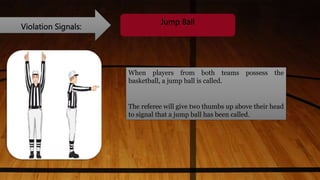
When players from both teams possess the
basketball, a jump ball is called.
The referee will give two thumbs up above their head
to signal that a jump ball has been called.
Fouling Signals:
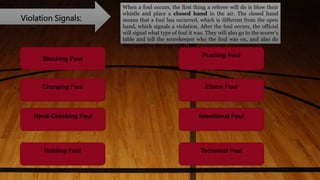
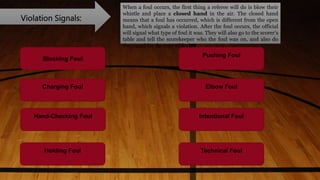
When a foul occurs, the first thing a referee will do
is blow their whistle and place a closed hand in
the air. The closed hand means that a foul has
occurred, which is different from the open hand,
which signals a violation. After the foul occurs, the
official will signal what type of foul it was. They will
also go to the scorer’s table and tell the scorekeeper
who the foul was on, and also do the signal for the
type of foul.
Charging Foul
Hand-Checking Foul
Technical Foul
Holding Foul
Intentional Foul
Elbow Foul
Pushing Foul
Blocking Foul
Violation Signals:
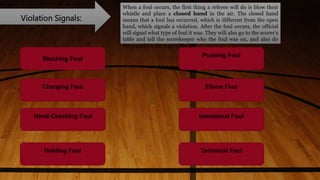
When a foul occurs, the first thing a referee will do is blow their
whistle and place a closed hand in the air. The closed hand
means that a foul has occurred, which is different from the open
hand, which signals a violation. After the foul occurs, the official
will signal what type of foul it was. They will also go to the scorer’s
table and tell the scorekeeper who the foul was on, and also do
the signal for the type of foul.
Violation Signals:
Blocking Foul
Violation Signals: Blocking Foul
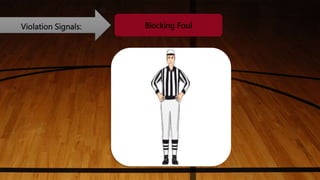
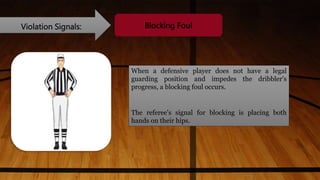
When a defensive player does not have a legal
guarding position and impedes the dribbler’s
progress, a blocking foul occurs.
The referee's signal for blocking is placing both
hands on their hips.
Charging Foul
Hand-Checking Foul
Technical Foul
Holding Foul
Intentional Foul
Elbow Foul
Pushing Foul
Blocking Foul
Violation Signals:
When a foul occurs, the first thing a referee will do is blow their
whistle and place a closed hand in the air. The closed hand
means that a foul has occurred, which is different from the open
hand, which signals a violation. After the foul occurs, the official
will signal what type of foul it was. They will also go to the scorer’s
table and tell the scorekeeper who the foul was on, and also do
the signal for the type of foul.
Violation Signals:
Charging Foul
Violation Signals:
Charging Foul
Violation Signals:
Charging Foul
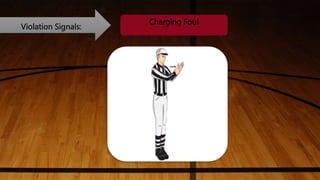
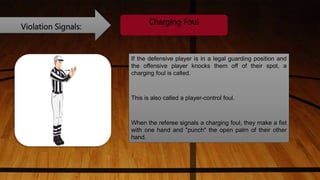
If the defensive player is in a legal guarding position and
the offensive player knocks them off of their spot, a
charging foul is called.
This is also called a player-control foul.
When the referee signals a charging foul, they make a fist
with one hand and "punch" the open palm of their other
hand.
Charging Foul
Hand-Checking Foul
Technical Foul
Holding Foul
Intentional Foul
Elbow Foul
Pushing Foul
Blocking Foul
Violation Signals:
When a foul occurs, the first thing a referee will do is blow their
whistle and place a closed hand in the air. The closed hand
means that a foul has occurred, which is different from the open
hand, which signals a violation. After the foul occurs, the official
will signal what type of foul it was. They will also go to the scorer’s
table and tell the scorekeeper who the foul was on, and also do
the signal for the type of foul.
Violation Signals:
Hand-Checking Foul
Violation Signals:
Hand-Checking Foul
Violation Signals:
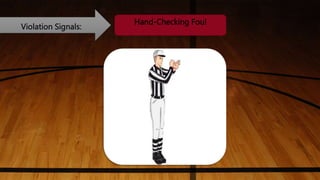
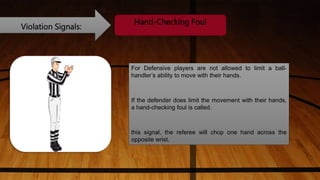
Hand-Checking Foul
For Defensive players are not allowed to limit a ball-
handler’s ability to move with their hands.
If the defender does limit the movement with their hands,
a hand-checking foul is called.
this signal, the referee will chop one hand across the
opposite wrist.
Charging Foul
Hand-Checking Foul
Technical Foul
Holding Foul
Intentional Foul
Elbow Foul
Pushing Foul
Blocking Foul
Violation Signals:
When a foul occurs, the first thing a referee will do is blow their
whistle and place a closed hand in the air. The closed hand
means that a foul has occurred, which is different from the open
hand, which signals a violation. After the foul occurs, the official
will signal what type of foul it was. They will also go to the scorer’s
table and tell the scorekeeper who the foul was on, and also do
the signal for the type of foul.
Violation Signals:
Holding Foul
Violation Signals:
Holding Foul
Violation Signals:
Holding Foul
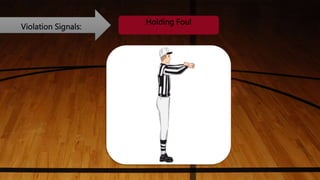
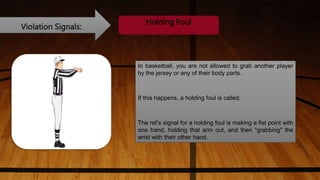
In basketball, you are not allowed to grab another player
by the jersey or any of their body parts.
If this happens, a holding foul is called.
The ref’s signal for a holding foul is making a fist point with
one hand, holding that arm out, and then "grabbing" the
wrist with their other hand.
Charging Foul
Hand-Checking Foul
Technical Foul
Holding Foul
Intentional Foul
Elbow Foul
Pushing Foul
Blocking Foul
Violation Signals:
When a foul occurs, the first thing a referee will do is blow their
whistle and place a closed hand in the air. The closed hand
means that a foul has occurred, which is different from the open
hand, which signals a violation. After the foul occurs, the official
will signal what type of foul it was. They will also go to the scorer’s
table and tell the scorekeeper who the foul was on, and also do
the signal for the type of foul.
Violation Signals:
Pushing Foul
Violation Signals:
Pushing Foul
Violation Signals:
Pushing Foul
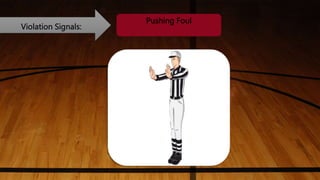
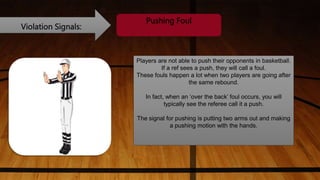
Players are not able to push their opponents in basketball.
If a ref sees a push, they will call a foul.
These fouls happen a lot when two players are going after
the same rebound.
In fact, when an ‘over the back’ foul occurs, you will
typically see the referee call it a push.
The signal for pushing is putting two arms out and making
a pushing motion with the hands.
Charging Foul
Hand-Checking Foul
Technical Foul
Holding Foul
Intentional Foul
Elbow Foul
Pushing Foul
Blocking Foul
Violation Signals:
When a foul occurs, the first thing a referee will do is blow their
whistle and place a closed hand in the air. The closed hand
means that a foul has occurred, which is different from the open
hand, which signals a violation. After the foul occurs, the official
will signal what type of foul it was. They will also go to the scorer’s
table and tell the scorekeeper who the foul was on, and also do
the signal for the type of foul.
Violation Signals:
Elbow Foul
Violation Signals:
Elbow Foul
Violation Signals:
Elbow Foul
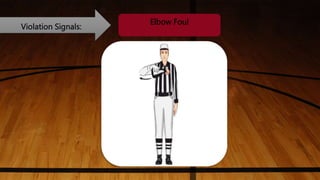
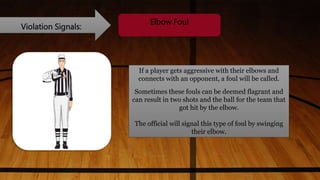
If a player gets aggressive with their elbows and
connects with an opponent, a foul will be called.
Sometimes these fouls can be deemed flagrant and
can result in two shots and the ball for the team that
got hit by the elbow.
The official will signal this type of foul by swinging
their elbow.
Charging Foul
Hand-Checking Foul
Technical Foul
Holding Foul
Intentional Foul
Elbow Foul
Pushing Foul
Blocking Foul
Violation Signals:
When a foul occurs, the first thing a referee will do is blow their
whistle and place a closed hand in the air. The closed hand
means that a foul has occurred, which is different from the open
hand, which signals a violation. After the foul occurs, the official
will signal what type of foul it was. They will also go to the scorer’s
table and tell the scorekeeper who the foul was on, and also do
the signal for the type of foul.
Violation Signals:
Intentional Foul
Violation Signals:
Intentional Foul
Violation Signals:
Intentional Foul
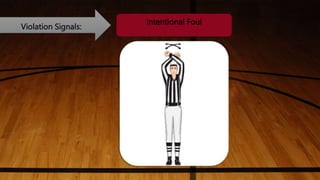
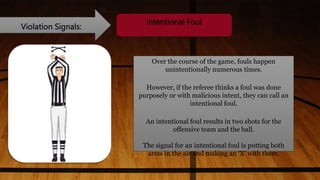
Over the course of the game, fouls happen
unintentionally numerous times.
However, if the referee thinks a foul was done
purposely or with malicious intent, they can call an
intentional foul.
An intentional foul results in two shots for the
offensive team and the ball.
The signal for an intentional foul is putting both
arms in the air and making an ‘X’ with them.
Charging Foul
Hand-Checking Foul
Technical Foul
Holding Foul
Intentional Foul
Elbow Foul
Pushing Foul
Blocking Foul
Violation Signals:
When a foul occurs, the first thing a referee will do is blow their
whistle and place a closed hand in the air. The closed hand
means that a foul has occurred, which is different from the open
hand, which signals a violation. After the foul occurs, the official
will signal what type of foul it was. They will also go to the scorer’s
table and tell the scorekeeper who the foul was on, and also do
the signal for the type of foul.
Violation Signals:
Technical Foul
Violation Signals:
Technical Foul
Violation Signals:
Technical Foul
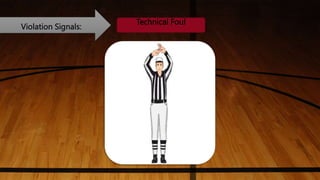
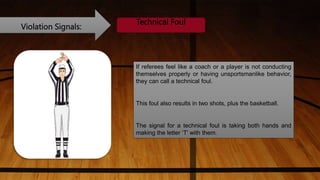
If referees feel like a coach or a player is not conducting
themselves properly or having unsportsmanlike behavior,
they can call a technical foul.
This foul also results in two shots, plus the basketball.
The signal for a technical foul is taking both hands and
making the letter ‘T’ with them.
Other Hand Signals to Know:
Sometimes referees will make signals that
don’t indicate a violation or a foul has
occurred.
These signals can be found below.
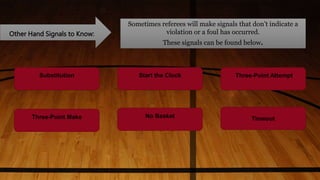
Other Hand Signals to Know:
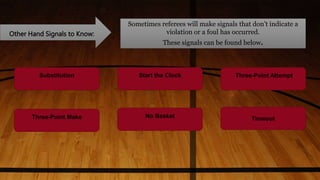
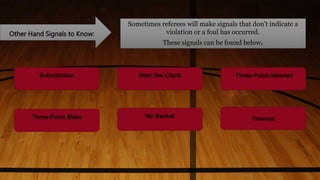
Sometimes referees will make signals that don’t indicate a
violation or a foul has occurred.
These signals can be found below.
Three-Point Attempt
Substitution Start the Clock
Three-Point Make No Basket Timeout
Other Hand Signals to Know:
Substitution
Other Hand Signals to Know:
Substitution
Other Hand Signals to Know:
Substitution
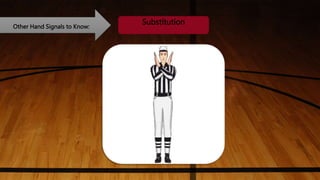
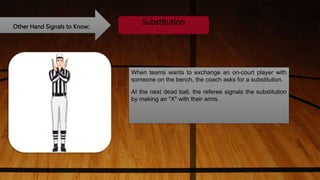
When teams wants to exchange an on-court player with
someone on the bench, the coach asks for a substitution.
At the next dead ball, the referee signals the substitution
by making an "X" with their arms.
Other Hand Signals to Know:
Sometimes referees will make signals that don’t indicate a
violation or a foul has occurred.
These signals can be found below.
Three-Point Attempt
Substitution Start the Clock
Three-Point Make No Basket Timeout
Other Hand Signals to Know:
Start the Clock
Other Hand Signals to Know:
Start the Clock
Other Hand Signals to Know:
Start the Clock
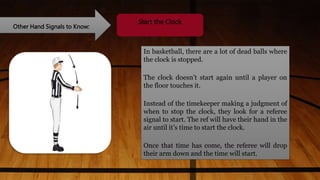
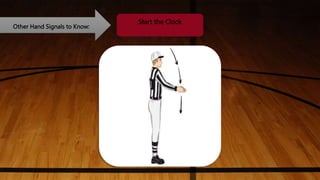
In basketball, there are a lot of dead balls where
the clock is stopped.
The clock doesn’t start again until a player on
the floor touches it.
Instead of the timekeeper making a judgment of
when to stop the clock, they look for a referee
signal to start. The ref will have their hand in the
air until it’s time to start the clock.
Once that time has come, the referee will drop
their arm down and the time will start.
Other Hand Signals to Know:
Sometimes referees will make signals that don’t indicate a
violation or a foul has occurred.
These signals can be found below.
Three-Point Attempt
Substitution Start the Clock
Three-Point Make No Basket Timeout
Other Hand Signals to Know:
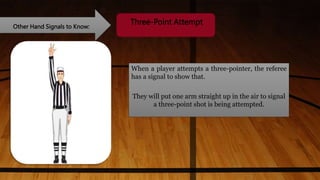
Three-Point Attempt
Other Hand Signals to Know:
Three-Point Attempt
Other Hand Signals to Know:
Three-Point Attempt
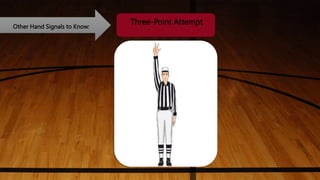
When a player attempts a three-pointer, the referee
has a signal to show that.
They will put one arm straight up in the air to signal
a three-point shot is being attempted.
Other Hand Signals to Know:
Sometimes referees will make signals that don’t indicate a
violation or a foul has occurred.
These signals can be found below.
Three-Point Attempt
Substitution Start the Clock
Three-Point Make No Basket Timeout
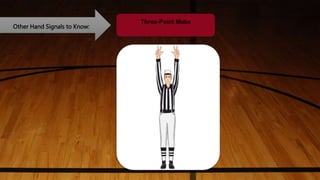
Other Hand Signals to Know:
Three-Point Make
Other Hand Signals to Know:
Three-Point Make
Other Hand Signals to Know:
Three-Point Make
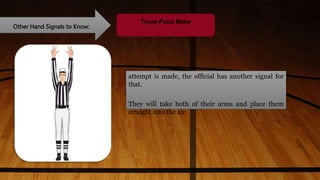
attempt is made, the official has another signal for
that.
They will take both of their arms and place them
straight into the air.
Other Hand Signals to Know:
Sometimes referees will make signals that don’t indicate a
violation or a foul has occurred.
These signals can be found below.
Three-Point Attempt
Substitution Start the Clock
Three-Point Make No Basket Timeout
Other Hand Signals to Know:
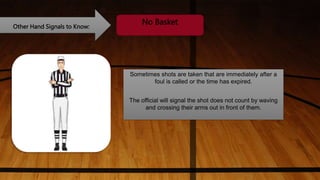
No Basket
Other Hand Signals to Know:
No Basket
Other Hand Signals to Know:
No Basket
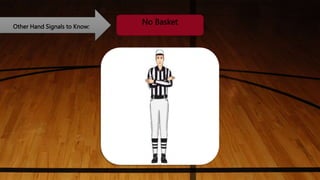
Sometimes shots are taken that are immediately after a
foul is called or the time has expired.
The official will signal the shot does not count by waving
and crossing their arms out in front of them.
Other Hand Signals to Know:
Sometimes referees will make signals that don’t indicate a
violation or a foul has occurred.
These signals can be found below.
Three-Point Attempt
Substitution Start the Clock
Three-Point Make No Basket Timeout
Other Hand Signals to Know:
Timeout
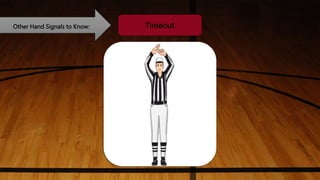
Other Hand Signals to Know: Timeout
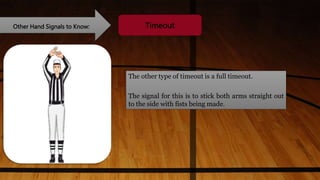
The other type of timeout is a full timeout.
The signal for this is to stick both arms straight out
to the side with fists being made.
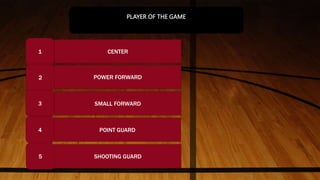
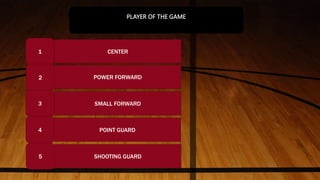
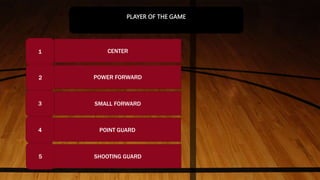
CENTER
PLAYER OF THE GAME
POWER FORWARD
SMALL FORWARD
POINT GUARD
SHOOTING GUARD
CENTER
PLAYER OF THE GAME
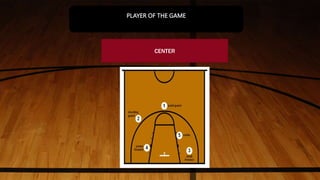
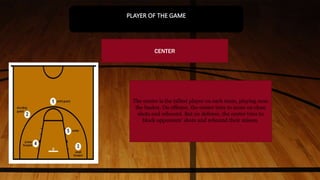
The center is the tallest player on each team, playing near
the basket. On offense, the center tries to score on close
shots and rebound. But on defense, the center tries to
block opponents' shots and rebound their misses.
CENTER
PLAYER OF THE GAME
CENTER
PLAYER OF THE GAME
1
2
3
5
4
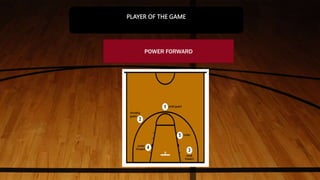
POWER FORWARD
SMALL FORWARD
POINT GUARD
SHOOTING GUARD
POWER FORWARD
PLAYER OF THE GAME
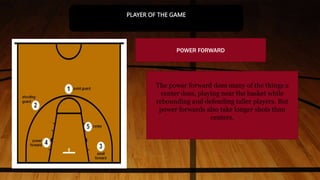
POWER FORWARD
The power forward does many of the things a
center does, playing near the basket while
rebounding and defending taller players. But
power forwards also take longer shots than
centers.
PLAYER OF THE GAME
CENTER
PLAYER OF THE GAME
1
2
3
5
4
POWER FORWARD
SMALL FORWARD
POINT GUARD
SHOOTING GUARD
SMALL FORWARD
PLAYER OF THE GAME
SMALL FORWARD
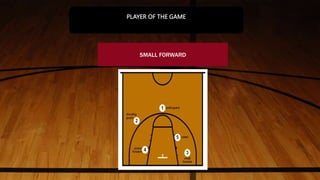
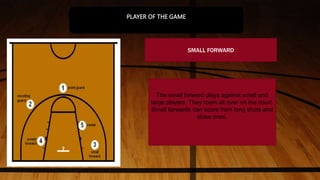
The small forward plays against small and
large players. They roam all over on the court.
Small forwards can score from long shots and
close ones.
PLAYER OF THE GAME
CENTER
PLAYER OF THE GAME
1
2
3
5
4
POWER FORWARD
SMALL FORWARD
POINT GUARD
SHOOTING GUARD
POINT GUARD
PLAYER OF THE GAME
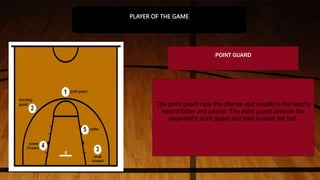
POINT GUARD
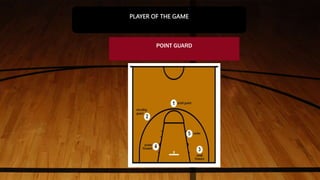
The point guard runs the offense and usually is the team's
best dribbler and passer. The point guard defends the
opponent's point guard and tries to steal the ball.
PLAYER OF THE GAME
CENTER
PLAYER OF THE GAME
1
2
3
5
4
POWER FORWARD
SMALL FORWARD
POINT GUARD
SHOOTING GUARD
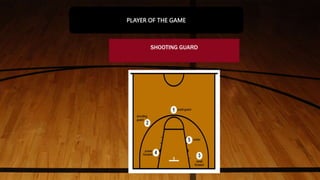
SHOOTING GUARD
PLAYER OF THE GAME
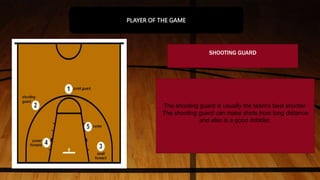
SHOOTING GUARD
The shooting guard is usually the team's best shooter.
The shooting guard can make shots from long distance
and also is a good dribbler.
PLAYER OF THE GAME
UNIFORM
UNIFORM
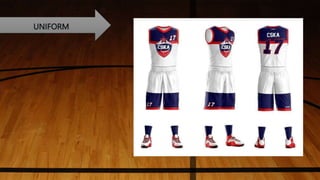
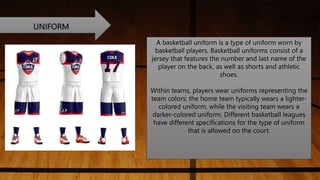
A basketball uniform is a type of uniform worn by
basketball players. Basketball uniforms consist of a
jersey that features the number and last name of the
player on the back, as well as shorts and athletic
shoes.
Within teams, players wear uniforms representing the
team colors; the home team typically wears a lighter-
colored uniform, while the visiting team wears a
darker-colored uniform. Different basketball leagues
have different specifications for the type of uniform
that is allowed on the court.
Basketball Equipment
Basketball can be played with very little equipment. That is why it
has become one of the most popular sports to play worldwide.
Basketball can be played outdoors on asphalt and dirt or indoors
on wooden floors.
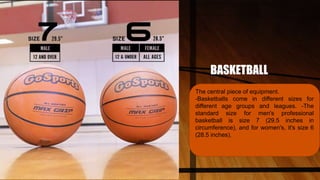
BASKETBALL
The central piece of equipment.
-Basketballs come in different sizes for
different age groups and leagues. -The
standard size for men's professional
basketball is size 7 (29.5 inches in
circumference), and for women's, it's size 6
(28.5 inches).
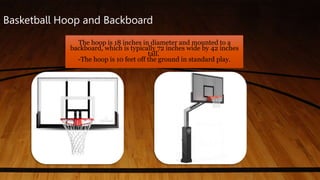
Basketball Hoop and Backboard
The hoop is 18 inches in diameter and mounted to a
backboard, which is typically 72 inches wide by 42 inches
tall.
-The hoop is 10 feet off the ground in standard play.
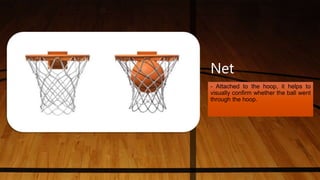
Net
- Attached to the hoop, it helps to
visually confirm whether the ball went
through the hoop.
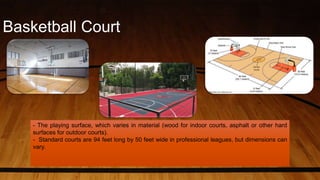
Basketball Court
- The playing surface, which varies in material (wood for indoor courts, asphalt or other hard
surfaces for outdoor courts).
- Standard courts are 94 feet long by 50 feet wide in professional leagues, but dimensions can
vary.
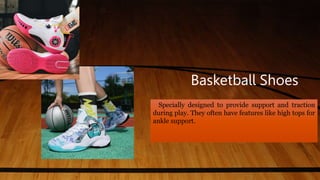
Basketball Shoes
Specially designed to provide support and traction
during play. They often have features like high tops for
ankle support.
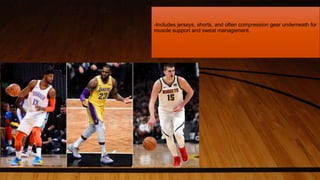
-Includes jerseys, shorts, and often compression gear underneath for
muscle support and sweat management.
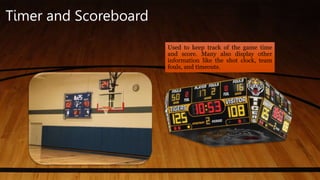
Timer and Scoreboard
Used to keep track of the game time
and score. Many also display other
information like the shot clock, team
fouls, and timeouts.
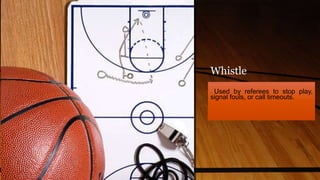
Whistle
- Used by referees to stop play,
signal fouls, or call timeouts.
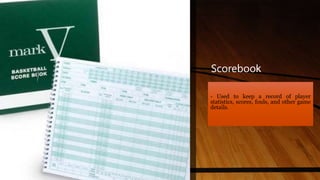
Scorebook
- Used to keep a record of player
statistics, scores, fouls, and other game
details.
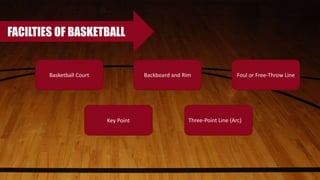
FACILTIES OF BASKETBALL
Basketball Court Foul or Free-Throw Line
Key Point Three-Point Line (Arc)
Backboard and Rim
FACILTIES OF BASKETBALL
Basketball Court
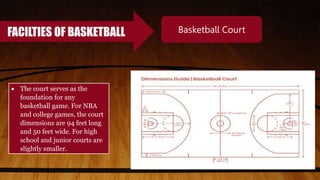
FACILTIES OF BASKETBALL Basketball Court
 The court serves as the
foundation for any
basketball game. For NBA
and college games, the court
dimensions are 94 feet long
and 50 feet wide. For high
school and junior courts are
slightly smaller.
FACILTIES OF BASKETBALL
Basketball Court Foul or Free-Throw Line
Key Point Three-Point Line (Arc)
Backboard and Rim
FACILTIES OF BASKETBALL
Backboard and Rim
FACILTIES OF BASKETBALL Backboard and Rim
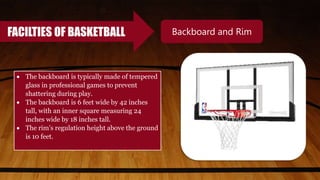
 The backboard is typically made of tempered
glass in professional games to prevent
shattering during play.
 The backboard is 6 feet wide by 42 inches
tall, with an inner square measuring 24
inches wide by 18 inches tall.
 The rim’s regulation height above the ground
is 10 feet.
FACILTIES OF BASKETBALL
Basketball Court Foul or Free-Throw Line
Key Point Three-Point Line (Arc)
Backboard and Rim
FACILTIES OF BASKETBALL
Foul or Free-Throw Line
FACILTIES OF BASKETBALL Foul or Free-Throw Line
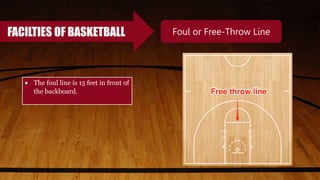
 The foul line is 15 feet in front of
the backboard.
FACILTIES OF BASKETBALL
Basketball Court Foul or Free-Throw Line
Key Point Three-Point Line (Arc)
Backboard and Rim
FACILTIES OF BASKETBALL
Key Point
FACILTIES OF BASKETBALL Key Point
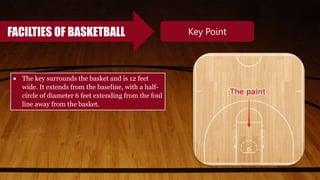
 The key surrounds the basket and is 12 feet
wide. It extends from the baseline, with a half-
circle of diameter 6 feet extending from the foul
line away from the basket.
FACILTIES OF BASKETBALL
Basketball Court Foul or Free-Throw Line
Key Point Three-Point Line (Arc)
Backboard and Rim
FACILTIES OF BASKETBALL
Three-Point Line (Arc)
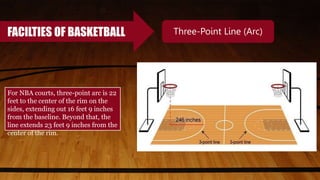
FACILTIES OF BASKETBALL Three-Point Line (Arc)
For NBA courts, three-point arc is 22
feet to the center of the rim on the
sides, extending out 16 feet 9 inches
from the baseline. Beyond that, the
line extends 23 feet 9 inches from the
center of the rim.
BASKETBALL RULES
Basketball rules can change slightly based on where the game is
played (international rules differ from USA professional rules) or
the level of play (professional rules differ from college rules, for
example). However, most of the rules covered here are applicable
to almost any basketball game performed, with the exception of
those that differ in how the game is played.
RULES FOR OFFENSE
1.) The player must bounce, or
dribble, the ball with one hand
while moving both feet. If, at
any time, both hands touch
the ball or the player stops
dribbling, the player must
only move one foot. The foot
that is stationary is called the
pivot foot.
2.) The basketball player can only
take one turn at dribbling. In other
words, once a player has stopped
dribbling they cannot start another
dribble. A player who starts dribbling
again is called for a double-dribbling
violation and looses the basketball to
the other team. A player can only
start another dribble after another
player from either team touches or
gains control of the basketball. This
is usually after a shot or pass.
3.)The ball must stay in
bounds. If the offensive team
looses the ball out of bounds
the other team gets control of
the basketball.
RULES FOR OFFENSE
4.) The players hand must be
on top of the ball while
dribbling. If they touch the
bottom of the basketball while
dribbling and continue to
dribble this is called carrying
the ball and the player will
lose the ball to the other team.
5.) Once the offensive team
crosses half court, they may
not go back into the
backcourt. This is called a
backcourt violation. If the
defensive team knocks the ball
into the backcourt, then the
offensive team can recover the
ball legally.
DEFENSIVE RULES
The defensive player's main rule is to avoid fouling. Getting an unfair
advantage through physical contact is referred to as a foul. In
principle, the defensive player is not allowed to contact the offensive
player in a way that results in the offensive player losing the ball or
missing a shot, though the referee may have to make some
interpretations.
The defensive player's main rule is to avoid fouling. Getting an unfair
advantage through physical contact is referred to as a foul. In
principle, the defensive player is not allowed to contact the offensive
player in a way that results in the offensive player losing the ball or
missing a shot, though the referee may have to make some
interpretations.
RULES FOR EVERYONE
1.) All players on the
court, including
offensive players, are
subject to the foul rule,
despite the fact that it
was previously
discussed as a
defensive rule.
2.) Basketball players
cannot kick the ball or
hit it with their fist.
3.) No player can touch
the basketball while it is
traveling downward
towards the basket or if it
is on the rim. This is
called goaltending.
(touching the ball on the
rim is legal in some
games).
“THANKYOU FOR
YOUR ATTENTION”
QUIZ TIME!
This help us to confirm whether
the ball went through the hoop
A. Basketball
B. Uniform
C. Net
D.Backboard
This were we used to record of players
statistics, scores, fouls, and other game
details.
This is used to help us track the
game time and score.
Who invented basketball?
A. James Charles
B. James Naesmith
C. James Yap
D. James Naismith
What are the two materials used to play
basketball with when it was first invented by
a P.E. instructor in Springfield,
Massachusetts?
Only in 1908 were metal hoops, nets, and
backboards were introduced.
This is a player of the basketball that
does many of the things a center
does, playing near the basket while
rebounding and defending taller
players.
Consist of a jersey that features the
number and last name of the player
on the back, as well as shorts and
athletic shoes.
This is a player of the basketball that can
make shots from long distance and also
is a good dribbler.
Enumerate at least 6 referee hand signals

Physicallllll educationnnnn presentationn

  • 1.
  • 2.
  • 3.
    HISTORY OF BASKETBALL Thehistory of basketball began with its invention in December 1891 in Springfield, Massachusetts by Canadian physical education instructor James Naismith as a less injury-prone sport than football. Naismith was a 31-year old graduate student when he created the indoor sports to keep athletes indoors during the winters. James Naismith was a physical education instructor at YMCA International Training School (now known as Springfield College) in Springfield, Massachusetts. Upon the request of his boss, Naismith was tasked to create an indoor sports game to help athletes keep in shape in cold weather.
  • 4.
  • 5.
  • 6.
    HISTORY OF BASKETBALL Itconsisted of peach baskets and a soccer style ball. The objective of the game was to throw the basketball into the fruit baskets nailed to the lower railing of the gym balconyNaismith then nailed them to the lower rail of the gymnasium balcony, one at each end. The height of that lower balcony rail happened to be ten feet. A man was stationed at each end of the balcony to pick the ball from the basket and put it back into play. It wasn’t until a few years later that the bottoms of those peach baskets were cut to let the ball fall loose.
  • 7.
  • 8.
    HISTORY OF BASKETBALL OnDecember 21, 1891, he published 13 rules for the new game. He divided his class of eighteen into two teams of nine players each and set about to teach them the basics of his new game using a soccer ball and two peach baskets. As they were playing with a ball and a basket, someone suggested calling the game “basketball”. The first public basketball game was played in Springfield, Massachusetts, on March 11, 1892. The Peach baskets were closed, and balls had to be retrieved manually. Only in 1906 were metal hoops, nets, and backboards introduced. Moreover, earlier the soccer ball was replaced by a Spalding ball, similar to the one used today.
  • 9.
    Referees play asignificant role in a basketball game. Basketball referee signals help to tell the crowd, scorer’s table, coaches, and players what is happening on the floor. REFEREE AND HAND SIGNAL
  • 10.
    Violation Signals: When aviolation occurs, you will always hear the referee blow their whistle and raise an open hand in the air before signaling the violation. The open hand in the air signals a dead ball. The referee then gives their signal, and then the ball is taken out of bounds to resume play.
  • 11.
    Violation Signals: When aviolation occurs, you will always hear the referee blow their whistle and raise an open hand in the air before signaling the violation. The open hand in the air signals a dead ball. The referee then gives their signal, and then the ball is taken out of bounds to resume play. Double Dribble Carrying the Basketball 5.5Second Violation Over-and-Back (Backcourt Violation) 7.24-Second Violation 4.3-Second Violation 6.8-Second Violation Out of Bounds Kicking Traveling Jump Ball
  • 12.
  • 13.
  • 14.
    Violation Signals: Traveling Whena player illegally moves one or both of their feet, a traveling violation is called. The referee will put both arms in front of their face and move them in a circle to signal a traveling.
  • 15.
  • 16.
  • 17.
    Violation Signals: Double Dribble Adouble dribble occurs when a player dribbles the ball, picks it up, and then dribbles again. The referee puts both of their hands in front of them with their palms down, then alternates moving them up and down to signal a double dribble has occurred.
  • 18.
    Violation Signals: When aviolation occurs, you will always hear the referee blow their whistle and raise an open hand in the air before signaling the violation. The open hand in the air signals a dead ball. The referee then gives their signal, and then the ball is taken out of bounds to resume play. Double Dribble Carrying the Basketball Second Violation Over-and-Back (Backcourt Violation) Second Violation Second Violation Second Violation Out of Bounds Kicking Traveling Jump Ball
  • 19.
  • 20.
  • 21.
    Violation Signals: Carrying the Basketball Acarrying violation is called when a player is dribbling the basketball and puts their hand under it, then continues dribbling. To signal a carry, the official will use one of their hands and flip it over from palm up to palm down several times.
  • 22.
    Violation Signals: When aviolation occurs, you will always hear the referee blow their whistle and raise an open hand in the air before signaling the violation. The open hand in the air signals a dead ball. The referee then gives their signal, and then the ball is taken out of bounds to resume play. Double Dribble Carrying the Basketball 5.5-Second Violation Over-and-Back (Backcourt Violation) 7.24-Second Violation 4.3-Second Violation 6.8Second Violation Out of Bounds Kicking Traveling Jump Ball
  • 23.
  • 24.
  • 25.
    Violation Signals: 4.3-Second Violation Playersare only allowed 3 seconds in the paint -- a 12x16 feet area closest to the basket. If a player is in the paint for more than 3 seconds, the referee will call a 3-second violation. The referee will take three fingers, point them down at their side, and then swipe their hand back and forth to signal this violation.
  • 26.
    Violation Signals: When aviolation occurs, you will always hear the referee blow their whistle and raise an open hand in the air before signaling the violation. The open hand in the air signals a dead ball. The referee then gives their signal, and then the ball is taken out of bounds to resume play. Double Dribble Carrying the Basketball 5.5-Second Violation Over-and-Back (Backcourt Violation) 7.24-Second Violation 4.3Second Violation 6.8-Second Violation Out of Bounds Kicking Traveling Jump Ball
  • 27.
  • 28.
  • 29.
    Violation Signals: 5.5-Second Violation Ateam has five seconds to throw the ball inbounds when they are taking it out. If they take longer than five seconds, the referee will call a 5-second violation. This is a simple signal, as the referee will use one of their hand sand put five fingers in the air.
  • 30.
    Violation Signals: When aviolation occurs, you will always hear the referee blow their whistle and raise an open hand in the air before signaling the violation. The open hand in the air signals a dead ball. The referee then gives their signal, and then the ball is taken out of bounds to resume play. Double Dribble Carrying the Basketball 5.5-Second Violation Over-and-Back (Backcourt Violation) 7.24-Second Violation 4.3-Second Violation 6.8-Second Violation Out of Bounds Kicking Traveling Jump Ball
  • 31.
  • 32.
  • 33.
    Violation Signals: 6.8-Second Violation Whena team has the ball in the backcourt, they have 8 seconds to get the ball across the half-court line. If they take longer than the allotted 8 seconds, the referee calls a 8-second violation. (many younger leagues use 10 seconds instead of 8) The referee signals this violation by putting eight fingers in the air.
  • 34.
    Violation Signals: When aviolation occurs, you will always hear the referee blow their whistle and raise an open hand in the air before signaling the violation. The open hand in the air signals a dead ball. The referee then gives their signal, and then the ball is taken out of bounds to resume play. Double Dribble Carrying the Basketball 5.5-Second Violation Over-and-Back (Backcourt Violation) 7.24-Second Violation 4.3-Second Violation 6.8-Second Violation Out of Bounds Kicking Traveling Jump Ball
  • 35.
  • 36.
  • 37.
    Violation Signals: 7.24-Second Violation Ifplaying in a league that uses a shot clock, teams will have 24 seconds to take a shot on each possession (some leagues use longer shot clocks). If a team fails to shoot within this time, the referee will call a 24-second violation. The referee will use one handed to tap the top of their shoulder on the same arm.
  • 38.
    Violation Signals: When aviolation occurs, you will always hear the referee blow their whistle and raise an open hand in the air before signaling the violation. The open hand in the air signals a dead ball. The referee then gives their signal, and then the ball is taken out of bounds to resume play. Double Dribble Carrying the Basketball 5.5-Second Violation Over-and-Back (Backcourt Violation) 7.24-Second Violation 4.3-Second Violation 6.8-Second Violation Out of Bounds Kicking Traveling Jump Ball
  • 39.
  • 40.
  • 41.
    Violation Signals: Over-and-Back (Backcourt Violation) Whena team possesses the basketball in the front court, then a player with the ball goes into the backcourt without the defense touching it, an over-and-back violation occurs. The referee will place their hand out with their palm down and move it back and forth from side to side like their hand is going over a line. This is to signal that a player went over the half court line and an over-and-back occurred.
  • 42.
    Violation Signals: When aviolation occurs, you will always hear the referee blow their whistle and raise an open hand in the air before signaling the violation. The open hand in the air signals a dead ball. The referee then gives their signal, and then the ball is taken out of bounds to resume play. Double Dribble Carrying the Basketball 5.5-Second Violation Over-and-Back (Backcourt Violation) 7.24-Second Violation 4.3-Second Violation 6.8-Second Violation Out of Bounds Kicking Traveling Jump Ball
  • 43.
  • 44.
  • 45.
    Violation Signals: Kicking Inbasketball, a player may not intentionally kick the basketball. If they do, the official will blow their whistle. To signal a kick occurred, the referee will point at their foot.
  • 46.
    Violation Signals: When aviolation occurs, you will always hear the referee blow their whistle and raise an open hand in the air before signaling the violation. The open hand in the air signals a dead ball. The referee then gives their signal, and then the ball is taken out of bounds to resume play. Double Dribble Carrying the Basketball 5.5-Second Violation Over-and-Back (Backcourt Violation) 7.24-Second Violation 4.3-Second Violation 6.8-Second Violation Out of Bounds Kicking Traveling Jump Ball
  • 47.
  • 48.
  • 49.
    Violation Signals: Out ofBounds The ball is out of bounds when it touches a line that outlines the court or anywhere outside of those lines. It is also out of bounds if it touches a player who is standing outside or on a line. When the ball goes out of bounds, a referee will signal whose ball it is by pointing toward the basket of the team that will take possession.
  • 50.
    Violation Signals: When aviolation occurs, you will always hear the referee blow their whistle and raise an open hand in the air before signaling the violation. The open hand in the air signals a dead ball. The referee then gives their signal, and then the ball is taken out of bounds to resume play. Double Dribble Carrying the Basketball 5.5-Second Violation Over-and-Back (Backcourt Violation) 7.24-Second Violation 4.3-Second Violation 6.8- Violation Out of Bounds Kicking Traveling Jump Ball
  • 51.
  • 52.
  • 53.
    Violation Signals: Jump Ball Whenplayers from both teams possess the basketball, a jump ball is called. The referee will give two thumbs up above their head to signal that a jump ball has been called.
  • 54.
    Fouling Signals: When afoul occurs, the first thing a referee will do is blow their whistle and place a closed hand in the air. The closed hand means that a foul has occurred, which is different from the open hand, which signals a violation. After the foul occurs, the official will signal what type of foul it was. They will also go to the scorer’s table and tell the scorekeeper who the foul was on, and also do the signal for the type of foul.
  • 55.
    Charging Foul Hand-Checking Foul TechnicalFoul Holding Foul Intentional Foul Elbow Foul Pushing Foul Blocking Foul Violation Signals: When a foul occurs, the first thing a referee will do is blow their whistle and place a closed hand in the air. The closed hand means that a foul has occurred, which is different from the open hand, which signals a violation. After the foul occurs, the official will signal what type of foul it was. They will also go to the scorer’s table and tell the scorekeeper who the foul was on, and also do the signal for the type of foul.
  • 56.
  • 57.
  • 58.
    Violation Signals: BlockingFoul When a defensive player does not have a legal guarding position and impedes the dribbler’s progress, a blocking foul occurs. The referee's signal for blocking is placing both hands on their hips.
  • 59.
    Charging Foul Hand-Checking Foul TechnicalFoul Holding Foul Intentional Foul Elbow Foul Pushing Foul Blocking Foul Violation Signals: When a foul occurs, the first thing a referee will do is blow their whistle and place a closed hand in the air. The closed hand means that a foul has occurred, which is different from the open hand, which signals a violation. After the foul occurs, the official will signal what type of foul it was. They will also go to the scorer’s table and tell the scorekeeper who the foul was on, and also do the signal for the type of foul.
  • 60.
  • 61.
  • 62.
    Violation Signals: Charging Foul Ifthe defensive player is in a legal guarding position and the offensive player knocks them off of their spot, a charging foul is called. This is also called a player-control foul. When the referee signals a charging foul, they make a fist with one hand and "punch" the open palm of their other hand.
  • 63.
    Charging Foul Hand-Checking Foul TechnicalFoul Holding Foul Intentional Foul Elbow Foul Pushing Foul Blocking Foul Violation Signals: When a foul occurs, the first thing a referee will do is blow their whistle and place a closed hand in the air. The closed hand means that a foul has occurred, which is different from the open hand, which signals a violation. After the foul occurs, the official will signal what type of foul it was. They will also go to the scorer’s table and tell the scorekeeper who the foul was on, and also do the signal for the type of foul.
  • 64.
  • 65.
  • 66.
    Violation Signals: Hand-Checking Foul ForDefensive players are not allowed to limit a ball- handler’s ability to move with their hands. If the defender does limit the movement with their hands, a hand-checking foul is called. this signal, the referee will chop one hand across the opposite wrist.
  • 67.
    Charging Foul Hand-Checking Foul TechnicalFoul Holding Foul Intentional Foul Elbow Foul Pushing Foul Blocking Foul Violation Signals: When a foul occurs, the first thing a referee will do is blow their whistle and place a closed hand in the air. The closed hand means that a foul has occurred, which is different from the open hand, which signals a violation. After the foul occurs, the official will signal what type of foul it was. They will also go to the scorer’s table and tell the scorekeeper who the foul was on, and also do the signal for the type of foul.
  • 68.
  • 69.
  • 70.
    Violation Signals: Holding Foul Inbasketball, you are not allowed to grab another player by the jersey or any of their body parts. If this happens, a holding foul is called. The ref’s signal for a holding foul is making a fist point with one hand, holding that arm out, and then "grabbing" the wrist with their other hand.
  • 71.
    Charging Foul Hand-Checking Foul TechnicalFoul Holding Foul Intentional Foul Elbow Foul Pushing Foul Blocking Foul Violation Signals: When a foul occurs, the first thing a referee will do is blow their whistle and place a closed hand in the air. The closed hand means that a foul has occurred, which is different from the open hand, which signals a violation. After the foul occurs, the official will signal what type of foul it was. They will also go to the scorer’s table and tell the scorekeeper who the foul was on, and also do the signal for the type of foul.
  • 72.
  • 73.
  • 74.
    Violation Signals: Pushing Foul Playersare not able to push their opponents in basketball. If a ref sees a push, they will call a foul. These fouls happen a lot when two players are going after the same rebound. In fact, when an ‘over the back’ foul occurs, you will typically see the referee call it a push. The signal for pushing is putting two arms out and making a pushing motion with the hands.
  • 75.
    Charging Foul Hand-Checking Foul TechnicalFoul Holding Foul Intentional Foul Elbow Foul Pushing Foul Blocking Foul Violation Signals: When a foul occurs, the first thing a referee will do is blow their whistle and place a closed hand in the air. The closed hand means that a foul has occurred, which is different from the open hand, which signals a violation. After the foul occurs, the official will signal what type of foul it was. They will also go to the scorer’s table and tell the scorekeeper who the foul was on, and also do the signal for the type of foul.
  • 76.
  • 77.
  • 78.
    Violation Signals: Elbow Foul Ifa player gets aggressive with their elbows and connects with an opponent, a foul will be called. Sometimes these fouls can be deemed flagrant and can result in two shots and the ball for the team that got hit by the elbow. The official will signal this type of foul by swinging their elbow.
  • 79.
    Charging Foul Hand-Checking Foul TechnicalFoul Holding Foul Intentional Foul Elbow Foul Pushing Foul Blocking Foul Violation Signals: When a foul occurs, the first thing a referee will do is blow their whistle and place a closed hand in the air. The closed hand means that a foul has occurred, which is different from the open hand, which signals a violation. After the foul occurs, the official will signal what type of foul it was. They will also go to the scorer’s table and tell the scorekeeper who the foul was on, and also do the signal for the type of foul.
  • 80.
  • 81.
  • 82.
    Violation Signals: Intentional Foul Overthe course of the game, fouls happen unintentionally numerous times. However, if the referee thinks a foul was done purposely or with malicious intent, they can call an intentional foul. An intentional foul results in two shots for the offensive team and the ball. The signal for an intentional foul is putting both arms in the air and making an ‘X’ with them.
  • 83.
    Charging Foul Hand-Checking Foul TechnicalFoul Holding Foul Intentional Foul Elbow Foul Pushing Foul Blocking Foul Violation Signals: When a foul occurs, the first thing a referee will do is blow their whistle and place a closed hand in the air. The closed hand means that a foul has occurred, which is different from the open hand, which signals a violation. After the foul occurs, the official will signal what type of foul it was. They will also go to the scorer’s table and tell the scorekeeper who the foul was on, and also do the signal for the type of foul.
  • 84.
  • 85.
  • 86.
    Violation Signals: Technical Foul Ifreferees feel like a coach or a player is not conducting themselves properly or having unsportsmanlike behavior, they can call a technical foul. This foul also results in two shots, plus the basketball. The signal for a technical foul is taking both hands and making the letter ‘T’ with them.
  • 87.
    Other Hand Signalsto Know: Sometimes referees will make signals that don’t indicate a violation or a foul has occurred. These signals can be found below.
  • 88.
    Other Hand Signalsto Know: Sometimes referees will make signals that don’t indicate a violation or a foul has occurred. These signals can be found below. Three-Point Attempt Substitution Start the Clock Three-Point Make No Basket Timeout
  • 89.
    Other Hand Signalsto Know: Substitution
  • 90.
    Other Hand Signalsto Know: Substitution
  • 91.
    Other Hand Signalsto Know: Substitution When teams wants to exchange an on-court player with someone on the bench, the coach asks for a substitution. At the next dead ball, the referee signals the substitution by making an "X" with their arms.
  • 92.
    Other Hand Signalsto Know: Sometimes referees will make signals that don’t indicate a violation or a foul has occurred. These signals can be found below. Three-Point Attempt Substitution Start the Clock Three-Point Make No Basket Timeout
  • 93.
    Other Hand Signalsto Know: Start the Clock
  • 94.
    Other Hand Signalsto Know: Start the Clock
  • 95.
    Other Hand Signalsto Know: Start the Clock In basketball, there are a lot of dead balls where the clock is stopped. The clock doesn’t start again until a player on the floor touches it. Instead of the timekeeper making a judgment of when to stop the clock, they look for a referee signal to start. The ref will have their hand in the air until it’s time to start the clock. Once that time has come, the referee will drop their arm down and the time will start.
  • 96.
    Other Hand Signalsto Know: Sometimes referees will make signals that don’t indicate a violation or a foul has occurred. These signals can be found below. Three-Point Attempt Substitution Start the Clock Three-Point Make No Basket Timeout
  • 97.
    Other Hand Signalsto Know: Three-Point Attempt
  • 98.
    Other Hand Signalsto Know: Three-Point Attempt
  • 99.
    Other Hand Signalsto Know: Three-Point Attempt When a player attempts a three-pointer, the referee has a signal to show that. They will put one arm straight up in the air to signal a three-point shot is being attempted.
  • 100.
    Other Hand Signalsto Know: Sometimes referees will make signals that don’t indicate a violation or a foul has occurred. These signals can be found below. Three-Point Attempt Substitution Start the Clock Three-Point Make No Basket Timeout
  • 101.
    Other Hand Signalsto Know: Three-Point Make
  • 102.
    Other Hand Signalsto Know: Three-Point Make
  • 103.
    Other Hand Signalsto Know: Three-Point Make attempt is made, the official has another signal for that. They will take both of their arms and place them straight into the air.
  • 104.
    Other Hand Signalsto Know: Sometimes referees will make signals that don’t indicate a violation or a foul has occurred. These signals can be found below. Three-Point Attempt Substitution Start the Clock Three-Point Make No Basket Timeout
  • 105.
    Other Hand Signalsto Know: No Basket
  • 106.
    Other Hand Signalsto Know: No Basket
  • 107.
    Other Hand Signalsto Know: No Basket Sometimes shots are taken that are immediately after a foul is called or the time has expired. The official will signal the shot does not count by waving and crossing their arms out in front of them.
  • 108.
    Other Hand Signalsto Know: Sometimes referees will make signals that don’t indicate a violation or a foul has occurred. These signals can be found below. Three-Point Attempt Substitution Start the Clock Three-Point Make No Basket Timeout
  • 109.
    Other Hand Signalsto Know: Timeout
  • 110.
    Other Hand Signalsto Know: Timeout
  • 111.
    Other Hand Signalsto Know: Timeout The other type of timeout is a full timeout. The signal for this is to stick both arms straight out to the side with fists being made.
  • 112.
    CENTER PLAYER OF THEGAME POWER FORWARD SMALL FORWARD POINT GUARD SHOOTING GUARD
  • 113.
  • 114.
    The center isthe tallest player on each team, playing near the basket. On offense, the center tries to score on close shots and rebound. But on defense, the center tries to block opponents' shots and rebound their misses. CENTER PLAYER OF THE GAME
  • 115.
    CENTER PLAYER OF THEGAME 1 2 3 5 4 POWER FORWARD SMALL FORWARD POINT GUARD SHOOTING GUARD
  • 116.
  • 117.
    POWER FORWARD The powerforward does many of the things a center does, playing near the basket while rebounding and defending taller players. But power forwards also take longer shots than centers. PLAYER OF THE GAME
  • 118.
    CENTER PLAYER OF THEGAME 1 2 3 5 4 POWER FORWARD SMALL FORWARD POINT GUARD SHOOTING GUARD
  • 119.
  • 120.
    SMALL FORWARD The smallforward plays against small and large players. They roam all over on the court. Small forwards can score from long shots and close ones. PLAYER OF THE GAME
  • 121.
    CENTER PLAYER OF THEGAME 1 2 3 5 4 POWER FORWARD SMALL FORWARD POINT GUARD SHOOTING GUARD
  • 122.
  • 123.
    POINT GUARD The pointguard runs the offense and usually is the team's best dribbler and passer. The point guard defends the opponent's point guard and tries to steal the ball. PLAYER OF THE GAME
  • 124.
    CENTER PLAYER OF THEGAME 1 2 3 5 4 POWER FORWARD SMALL FORWARD POINT GUARD SHOOTING GUARD
  • 125.
  • 126.
    SHOOTING GUARD The shootingguard is usually the team's best shooter. The shooting guard can make shots from long distance and also is a good dribbler. PLAYER OF THE GAME
  • 127.
  • 128.
    UNIFORM A basketball uniformis a type of uniform worn by basketball players. Basketball uniforms consist of a jersey that features the number and last name of the player on the back, as well as shorts and athletic shoes. Within teams, players wear uniforms representing the team colors; the home team typically wears a lighter- colored uniform, while the visiting team wears a darker-colored uniform. Different basketball leagues have different specifications for the type of uniform that is allowed on the court.
  • 129.
    Basketball Equipment Basketball canbe played with very little equipment. That is why it has become one of the most popular sports to play worldwide. Basketball can be played outdoors on asphalt and dirt or indoors on wooden floors.
  • 130.
    BASKETBALL The central pieceof equipment. -Basketballs come in different sizes for different age groups and leagues. -The standard size for men's professional basketball is size 7 (29.5 inches in circumference), and for women's, it's size 6 (28.5 inches).
  • 131.
    Basketball Hoop andBackboard The hoop is 18 inches in diameter and mounted to a backboard, which is typically 72 inches wide by 42 inches tall. -The hoop is 10 feet off the ground in standard play.
  • 132.
    Net - Attached tothe hoop, it helps to visually confirm whether the ball went through the hoop.
  • 133.
    Basketball Court - Theplaying surface, which varies in material (wood for indoor courts, asphalt or other hard surfaces for outdoor courts). - Standard courts are 94 feet long by 50 feet wide in professional leagues, but dimensions can vary.
  • 134.
    Basketball Shoes Specially designedto provide support and traction during play. They often have features like high tops for ankle support.
  • 135.
    -Includes jerseys, shorts,and often compression gear underneath for muscle support and sweat management.
  • 136.
    Timer and Scoreboard Usedto keep track of the game time and score. Many also display other information like the shot clock, team fouls, and timeouts.
  • 137.
    Whistle - Used byreferees to stop play, signal fouls, or call timeouts.
  • 138.
    Scorebook - Used tokeep a record of player statistics, scores, fouls, and other game details.
  • 139.
    FACILTIES OF BASKETBALL BasketballCourt Foul or Free-Throw Line Key Point Three-Point Line (Arc) Backboard and Rim
  • 140.
  • 141.
    FACILTIES OF BASKETBALLBasketball Court  The court serves as the foundation for any basketball game. For NBA and college games, the court dimensions are 94 feet long and 50 feet wide. For high school and junior courts are slightly smaller.
  • 142.
    FACILTIES OF BASKETBALL BasketballCourt Foul or Free-Throw Line Key Point Three-Point Line (Arc) Backboard and Rim
  • 143.
  • 144.
    FACILTIES OF BASKETBALLBackboard and Rim  The backboard is typically made of tempered glass in professional games to prevent shattering during play.  The backboard is 6 feet wide by 42 inches tall, with an inner square measuring 24 inches wide by 18 inches tall.  The rim’s regulation height above the ground is 10 feet.
  • 145.
    FACILTIES OF BASKETBALL BasketballCourt Foul or Free-Throw Line Key Point Three-Point Line (Arc) Backboard and Rim
  • 146.
    FACILTIES OF BASKETBALL Foulor Free-Throw Line
  • 147.
    FACILTIES OF BASKETBALLFoul or Free-Throw Line  The foul line is 15 feet in front of the backboard.
  • 148.
    FACILTIES OF BASKETBALL BasketballCourt Foul or Free-Throw Line Key Point Three-Point Line (Arc) Backboard and Rim
  • 149.
  • 150.
    FACILTIES OF BASKETBALLKey Point  The key surrounds the basket and is 12 feet wide. It extends from the baseline, with a half- circle of diameter 6 feet extending from the foul line away from the basket.
  • 151.
    FACILTIES OF BASKETBALL BasketballCourt Foul or Free-Throw Line Key Point Three-Point Line (Arc) Backboard and Rim
  • 152.
  • 153.
    FACILTIES OF BASKETBALLThree-Point Line (Arc) For NBA courts, three-point arc is 22 feet to the center of the rim on the sides, extending out 16 feet 9 inches from the baseline. Beyond that, the line extends 23 feet 9 inches from the center of the rim.
  • 154.
    BASKETBALL RULES Basketball rulescan change slightly based on where the game is played (international rules differ from USA professional rules) or the level of play (professional rules differ from college rules, for example). However, most of the rules covered here are applicable to almost any basketball game performed, with the exception of those that differ in how the game is played.
  • 155.
    RULES FOR OFFENSE 1.)The player must bounce, or dribble, the ball with one hand while moving both feet. If, at any time, both hands touch the ball or the player stops dribbling, the player must only move one foot. The foot that is stationary is called the pivot foot. 2.) The basketball player can only take one turn at dribbling. In other words, once a player has stopped dribbling they cannot start another dribble. A player who starts dribbling again is called for a double-dribbling violation and looses the basketball to the other team. A player can only start another dribble after another player from either team touches or gains control of the basketball. This is usually after a shot or pass. 3.)The ball must stay in bounds. If the offensive team looses the ball out of bounds the other team gets control of the basketball.
  • 156.
    RULES FOR OFFENSE 4.)The players hand must be on top of the ball while dribbling. If they touch the bottom of the basketball while dribbling and continue to dribble this is called carrying the ball and the player will lose the ball to the other team. 5.) Once the offensive team crosses half court, they may not go back into the backcourt. This is called a backcourt violation. If the defensive team knocks the ball into the backcourt, then the offensive team can recover the ball legally.
  • 157.
    DEFENSIVE RULES The defensiveplayer's main rule is to avoid fouling. Getting an unfair advantage through physical contact is referred to as a foul. In principle, the defensive player is not allowed to contact the offensive player in a way that results in the offensive player losing the ball or missing a shot, though the referee may have to make some interpretations. The defensive player's main rule is to avoid fouling. Getting an unfair advantage through physical contact is referred to as a foul. In principle, the defensive player is not allowed to contact the offensive player in a way that results in the offensive player losing the ball or missing a shot, though the referee may have to make some interpretations.
  • 158.
    RULES FOR EVERYONE 1.)All players on the court, including offensive players, are subject to the foul rule, despite the fact that it was previously discussed as a defensive rule. 2.) Basketball players cannot kick the ball or hit it with their fist. 3.) No player can touch the basketball while it is traveling downward towards the basket or if it is on the rim. This is called goaltending. (touching the ball on the rim is legal in some games).
  • 159.
  • 160.
  • 161.
    This help usto confirm whether the ball went through the hoop A. Basketball B. Uniform C. Net D.Backboard
  • 162.
    This were weused to record of players statistics, scores, fouls, and other game details.
  • 163.
    This is usedto help us track the game time and score.
  • 164.
    Who invented basketball? A.James Charles B. James Naesmith C. James Yap D. James Naismith
  • 165.
    What are thetwo materials used to play basketball with when it was first invented by a P.E. instructor in Springfield, Massachusetts?
  • 166.
    Only in 1908were metal hoops, nets, and backboards were introduced.
  • 167.
    This is aplayer of the basketball that does many of the things a center does, playing near the basket while rebounding and defending taller players.
  • 168.
    Consist of ajersey that features the number and last name of the player on the back, as well as shorts and athletic shoes.
  • 169.
    This is aplayer of the basketball that can make shots from long distance and also is a good dribbler.
  • 170.
    Enumerate at least6 referee hand signals