By Dalaksaline
12.7
What is thriller?
• Thriller is a broad genre of literature, film and television, having numerous
subgenres. Thrillers are characterized and defined by the moods they
elicit, giving viewers heightened feelings of suspense, excitement,
surprise, anticipation and anxiety.
• Thriller Film is a genre that revolves around anticipation and suspense.
The aim for Thrillers is to keep the audience alert and on the edge of their
seats. The protagonist in these films is set against a problem – an escape,
a mission, or a mystery. No matter what sub-genre a Thriller film falls into,
it will emphasize the danger that the protagonist faces. The tension with
the main problem is built on throughout the film and leads to a highly
stressful climax.
• My understanding of thriller genre is that creating suspense for the
audience through events in the film and key element such as lighting,
sound, camerawork and setting. These are all the aspects that creates the
thriller moment within a film creation. The suspense in the thriller films
gives the audience a edge of the sit feeling because of the excitement to
see what will be happening next in the film.
What are the Historical overview of
Thriller genre?
• The first thriller movie that was released is The lodger by Alfred Hitchcock a British film director.
The technique that was used at the time till now is codes and convections.
• Later on in the 1950s, Alfred Hitchcock added Technicolor to his thrillers, the thriller movies were
no longer in black and white.
• During the 1970s and 80s thriller films edged closer to horror genre, by adding violence. But
director made sure, audience where shown the difference between both genre.
• During the 21st century the thriller genre started moving closer with horror genre. The films
contained blood, death and gore. There were also combination of codes and convention of action
movies.
• The directors of thriller movies refused to use the same plot from old thriller films. Instead they
decided to modernise them by adding plots involving government conspiracy, terrorism and world
wide issues.
• Alfred Hitchcock played massive part in the development of thriller genre, his first thriller film The
lodger was the basis for all the thriller films.
• Over the time thriller genre had key changes for example, the stereotypical plots, although its still
being used, modern twist such as involves films that contained latest issues around the world.
Music and sound were used too ‘heighten the viewers mood’, to make them feel tensed and to
create suspense for example, build up of music when something is going happen.
• Lighting and colour was also available for director, this has let them create dark, shadowing lighting
to show a place or a character dark side.
Sub-genres of Thriller genre.
• Psychological Thriller
• Romance Thriller
• Crime Thriller
• Eco-Thriller
• Mystery Thriller
• Medical Thriller
• Spy Thriller
• Religious Thriller
• Supernatural Thriller
• Disaster Thriller
• Forensic Thriller
• Legal Thriller
• Action Thriller
• Conspiracy Thriller
• Political Thriller
• https://kathrineroid.wordp
ress.com/2011/09/12/list-
of-thriller-subgenres/
Romantic Thriller: This is a
sub genre of thriller. In a
thriller film we would
expect suspense that would
put audience at edge of the
sit. But when romance and
thriller merges it will create
a different sensation for the
audience. Romantic thriller
still contain thriller’s main
ideas such as creating
tension, suspense and
excitement, but a main
element is the growing
relationship between two
character.
Religious Thriller: This is also a sub
genre of Thriller. Religious thriller
uses the history and myths of
religion. In a Religious Thriller film it
usually involves discovering historical
secrets or religious artefact, this will
usually have a protagonist trying to
find something's that has not been
discovered for many years. It will also
show the obstacles the protagonist
will be facing while he discovers the
hidden myths.
What is the difference between
Thriller and Horror?
Horror is to built and create
a fear sensation to the
audience by containing gore
and bloody image in the film
itself. Horror creates more
vivid image of the horror
showing the ghost but in
thriller the fear is hidden
creating suspense to the
audience. This is shown by
creating story behind what
happened but will not be
revealed until the end.
Key Films.
Key Stars
• Amanda Tapping
• Adam Nevill
• William L. Petersen
• Letitia Vladescu
• Rene Russo
• Robert Englund
• Michael Douglas
• John Gardner
• Jeremy Robinson
• Jennifer Connelly
• Brittany Murphy
• Mark Wahlberg
• Kevin Bacon
• Sigourney Weaver
• Christian Bale
http://www.slideshare.net/JasonsA2Media/co
des-and-conventions-of-the-thriller-genre
Key Director
• Alfred Hitchcock - Psycho
• Roman Polanski - The Pianist
• Brian De Palma - Scarface
• Sidney Lumet – 12 Angry Men
• David Fincher - Fight Club
• Steven Soderbergh - Ocean Eleven
• John Huston - The Maltese Falcon
• Fritz Lang - M
• Robert Siodmak- The Killer
• Robert Hamer – Kind hearts and Cornets
• Otto Premincher – Anatomy of a Murder
• Michael powell – The Red Shoes
• Edward Dmytryk – The Caine Mutiny
• John Frankenheimer – Ronin
• Brad Anderson – The Machinist
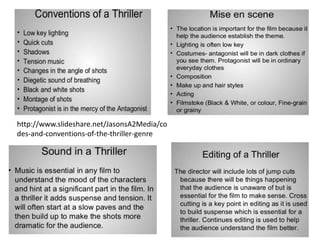
Typical conventions of thrillers.
• Setting:
• Abandoned places
• Isolated building
• City centres
• Cooperate building
• Everyday family home
• Themes:
• Crime
• Missions
• Mystery
• Supernatural
• Detective skills
• Psychological kidnap
Props:
Knifes
Blood
Drugs
Guns
Blindfolds/mask
Mysterious boxes/items
Everyday household
objects
Typical
Characters:
Murder
Psychopath
Serial killer
Traditional family
People with dark
background
Anti-hero
Orphan
Continuation…
• Costumes:
• Dark clothing
• Cooperate clothing
• Futuristic clothing
• Everyday clothing
• Narrative:
• Films that keep certain things hidden right to the end to hold suspense
• There can be the psychological experience so you can feel a wide range of
emotions varying from sad, happy, anxious all in one film.
• You can feel the thrill of the film so the action and the violence and the danger can
make you feel thrilling and excited because it doesn’t happen in your everyday life
• Then there is the extraordinary happening in the ordinary so place/ objects/people
all can become dangerous and thrilling filmed in a way to create fear and suspense
and excitement
Case study…
• The Sixth Sense
This is a film that fits the genre thriller. This film as aspects that shows this is suitable
for thriller genre for example the films over view is that, this little boy who is able to
see and talk to dead's. He doesn’t reveal to anyone until he talks to this guy. Some
aspects that shows its thriller is when the boy hears and sees the dead’s in his room
and where ever he goes. The audience get shocked when they get revealed that the
man who talks to the boy is also dead. This has created a turning point in the film,
and this is was kept a suspense till the end.

Thriller reserach

  • 1.
  • 2.
    What is thriller? •Thriller is a broad genre of literature, film and television, having numerous subgenres. Thrillers are characterized and defined by the moods they elicit, giving viewers heightened feelings of suspense, excitement, surprise, anticipation and anxiety. • Thriller Film is a genre that revolves around anticipation and suspense. The aim for Thrillers is to keep the audience alert and on the edge of their seats. The protagonist in these films is set against a problem – an escape, a mission, or a mystery. No matter what sub-genre a Thriller film falls into, it will emphasize the danger that the protagonist faces. The tension with the main problem is built on throughout the film and leads to a highly stressful climax. • My understanding of thriller genre is that creating suspense for the audience through events in the film and key element such as lighting, sound, camerawork and setting. These are all the aspects that creates the thriller moment within a film creation. The suspense in the thriller films gives the audience a edge of the sit feeling because of the excitement to see what will be happening next in the film.
  • 3.
    What are theHistorical overview of Thriller genre? • The first thriller movie that was released is The lodger by Alfred Hitchcock a British film director. The technique that was used at the time till now is codes and convections. • Later on in the 1950s, Alfred Hitchcock added Technicolor to his thrillers, the thriller movies were no longer in black and white. • During the 1970s and 80s thriller films edged closer to horror genre, by adding violence. But director made sure, audience where shown the difference between both genre. • During the 21st century the thriller genre started moving closer with horror genre. The films contained blood, death and gore. There were also combination of codes and convention of action movies. • The directors of thriller movies refused to use the same plot from old thriller films. Instead they decided to modernise them by adding plots involving government conspiracy, terrorism and world wide issues. • Alfred Hitchcock played massive part in the development of thriller genre, his first thriller film The lodger was the basis for all the thriller films. • Over the time thriller genre had key changes for example, the stereotypical plots, although its still being used, modern twist such as involves films that contained latest issues around the world. Music and sound were used too ‘heighten the viewers mood’, to make them feel tensed and to create suspense for example, build up of music when something is going happen. • Lighting and colour was also available for director, this has let them create dark, shadowing lighting to show a place or a character dark side.
  • 4.
    Sub-genres of Thrillergenre. • Psychological Thriller • Romance Thriller • Crime Thriller • Eco-Thriller • Mystery Thriller • Medical Thriller • Spy Thriller • Religious Thriller • Supernatural Thriller • Disaster Thriller • Forensic Thriller • Legal Thriller • Action Thriller • Conspiracy Thriller • Political Thriller • https://kathrineroid.wordp ress.com/2011/09/12/list- of-thriller-subgenres/ Romantic Thriller: This is a sub genre of thriller. In a thriller film we would expect suspense that would put audience at edge of the sit. But when romance and thriller merges it will create a different sensation for the audience. Romantic thriller still contain thriller’s main ideas such as creating tension, suspense and excitement, but a main element is the growing relationship between two character. Religious Thriller: This is also a sub genre of Thriller. Religious thriller uses the history and myths of religion. In a Religious Thriller film it usually involves discovering historical secrets or religious artefact, this will usually have a protagonist trying to find something's that has not been discovered for many years. It will also show the obstacles the protagonist will be facing while he discovers the hidden myths.
  • 5.
    What is thedifference between Thriller and Horror? Horror is to built and create a fear sensation to the audience by containing gore and bloody image in the film itself. Horror creates more vivid image of the horror showing the ghost but in thriller the fear is hidden creating suspense to the audience. This is shown by creating story behind what happened but will not be revealed until the end.
  • 6.
  • 7.
    Key Stars • AmandaTapping • Adam Nevill • William L. Petersen • Letitia Vladescu • Rene Russo • Robert Englund • Michael Douglas • John Gardner • Jeremy Robinson • Jennifer Connelly • Brittany Murphy • Mark Wahlberg • Kevin Bacon • Sigourney Weaver • Christian Bale
  • 8.
  • 9.
    Key Director • AlfredHitchcock - Psycho • Roman Polanski - The Pianist • Brian De Palma - Scarface • Sidney Lumet – 12 Angry Men • David Fincher - Fight Club • Steven Soderbergh - Ocean Eleven • John Huston - The Maltese Falcon • Fritz Lang - M • Robert Siodmak- The Killer • Robert Hamer – Kind hearts and Cornets • Otto Premincher – Anatomy of a Murder • Michael powell – The Red Shoes • Edward Dmytryk – The Caine Mutiny • John Frankenheimer – Ronin • Brad Anderson – The Machinist
  • 10.
    Typical conventions ofthrillers. • Setting: • Abandoned places • Isolated building • City centres • Cooperate building • Everyday family home • Themes: • Crime • Missions • Mystery • Supernatural • Detective skills • Psychological kidnap Props: Knifes Blood Drugs Guns Blindfolds/mask Mysterious boxes/items Everyday household objects Typical Characters: Murder Psychopath Serial killer Traditional family People with dark background Anti-hero Orphan
  • 11.
    Continuation… • Costumes: • Darkclothing • Cooperate clothing • Futuristic clothing • Everyday clothing • Narrative: • Films that keep certain things hidden right to the end to hold suspense • There can be the psychological experience so you can feel a wide range of emotions varying from sad, happy, anxious all in one film. • You can feel the thrill of the film so the action and the violence and the danger can make you feel thrilling and excited because it doesn’t happen in your everyday life • Then there is the extraordinary happening in the ordinary so place/ objects/people all can become dangerous and thrilling filmed in a way to create fear and suspense and excitement
  • 12.
    Case study… • TheSixth Sense This is a film that fits the genre thriller. This film as aspects that shows this is suitable for thriller genre for example the films over view is that, this little boy who is able to see and talk to dead's. He doesn’t reveal to anyone until he talks to this guy. Some aspects that shows its thriller is when the boy hears and sees the dead’s in his room and where ever he goes. The audience get shocked when they get revealed that the man who talks to the boy is also dead. This has created a turning point in the film, and this is was kept a suspense till the end.