Thriller Research
By Teddy Collins 12.7
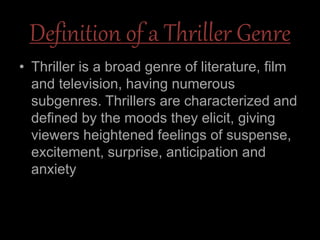
Definition of a Thriller Genre
• Thriller is a broad genre of literature, film
and television, having numerous
subgenres. Thrillers are characterized and
defined by the moods they elicit, giving
viewers heightened feelings of suspense,
excitement, surprise, anticipation and
anxiety
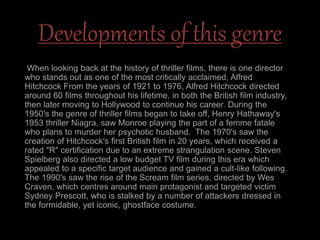
Developments of this genre
When looking back at the history of thriller films, there is one director
who stands out as one of the most critically acclaimed, Alfred
Hitchcock From the years of 1921 to 1976, Alfred Hitchcock directed
around 60 films throughout his lifetime, in both the British film industry,
then later moving to Hollywood to continue his career. During the
1950's the genre of thriller films began to take off, Henry Hathaway's
1953 thriller Niagra, saw Monroe playing the part of a femme fatale
who plans to murder her psychotic husband. The 1970's saw the
creation of Hitchcock's first British film in 20 years, which received a
rated "R" certification due to an extreme strangulation scene. Steven
Spielberg also directed a low budget TV film during this era which
appealed to a specific target audience and gained a cult-like following.
The 1990's saw the rise of the Scream film series, directed by Wes
Craven, which centres around main protagonist and targeted victim
Sydney Prescott, who is stalked by a number of attackers dressed in
the formidable, yet iconic, ghostface costume.
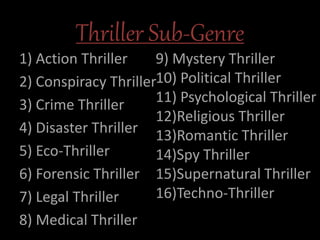
Thriller Sub-Genre
1) Action Thriller
2) Conspiracy Thriller
3) Crime Thriller
4) Disaster Thriller
5) Eco-Thriller
6) Forensic Thriller
7) Legal Thriller
8) Medical Thriller
9) Mystery Thriller
10) Political Thriller
11) Psychological Thriller
12)Religious Thriller
13)Romantic Thriller
14)Spy Thriller
15)Supernatural Thriller
16)Techno-Thriller
Difference between Thriller and
Horror
• 1) Thrillers are meant to thrill while horror
films are meant to horrify the viewers.
• 2) Thrillers are predominantly witty, usually
twisted, and contain better plots while horror
films are, more often than not, predictable.
• 3) Horror films are often less practical and less
realistic than thrillers.
• 4) Horror films usually have more
supernatural elements than thrillers
Key Thriller Films
• The Dark Knight (2008)
• Inception (2010)
• The Departed (2006)
• Heat (1995)
• Léon (1994)
• The Bourne Ultimatum
• The Bourne Ultimatum (2007)
• Black Swan (2010)
• Kill Bill: Vol. 1 (2003)
• Mulholland Drive (2001)
Key Thriller Stars
• Neve Campbell
• Rose McGowan
• Courteney Cox
• David Arquette
• Skeet Ulrich
• Matthew Lillard
• Liev Schreiber
• Lance Henriksen
• Parker Posey
• Anna Paquin
Key Thriller Directors
• Ben Affleck
• Paul Greengrass
• Quentin Tarantino
• Roman Polanski
• Michael Mann
• Orson Welles
• Billy Wilder
• David Lynch
• David Fincher
• Alfred Hitckcock
Thriller Conventions
• Pace, Intensity.
• Spooky, Sinister Music.
• Tension.
• Enigma, Questions posed to the audience
• Ambiguity
• Cliff-hanger

Thriller research

  • 1.
  • 2.
    Definition of aThriller Genre • Thriller is a broad genre of literature, film and television, having numerous subgenres. Thrillers are characterized and defined by the moods they elicit, giving viewers heightened feelings of suspense, excitement, surprise, anticipation and anxiety
  • 3.
    Developments of thisgenre When looking back at the history of thriller films, there is one director who stands out as one of the most critically acclaimed, Alfred Hitchcock From the years of 1921 to 1976, Alfred Hitchcock directed around 60 films throughout his lifetime, in both the British film industry, then later moving to Hollywood to continue his career. During the 1950's the genre of thriller films began to take off, Henry Hathaway's 1953 thriller Niagra, saw Monroe playing the part of a femme fatale who plans to murder her psychotic husband. The 1970's saw the creation of Hitchcock's first British film in 20 years, which received a rated "R" certification due to an extreme strangulation scene. Steven Spielberg also directed a low budget TV film during this era which appealed to a specific target audience and gained a cult-like following. The 1990's saw the rise of the Scream film series, directed by Wes Craven, which centres around main protagonist and targeted victim Sydney Prescott, who is stalked by a number of attackers dressed in the formidable, yet iconic, ghostface costume.
  • 4.
    Thriller Sub-Genre 1) ActionThriller 2) Conspiracy Thriller 3) Crime Thriller 4) Disaster Thriller 5) Eco-Thriller 6) Forensic Thriller 7) Legal Thriller 8) Medical Thriller 9) Mystery Thriller 10) Political Thriller 11) Psychological Thriller 12)Religious Thriller 13)Romantic Thriller 14)Spy Thriller 15)Supernatural Thriller 16)Techno-Thriller
  • 5.
    Difference between Thrillerand Horror • 1) Thrillers are meant to thrill while horror films are meant to horrify the viewers. • 2) Thrillers are predominantly witty, usually twisted, and contain better plots while horror films are, more often than not, predictable. • 3) Horror films are often less practical and less realistic than thrillers. • 4) Horror films usually have more supernatural elements than thrillers
  • 6.
    Key Thriller Films •The Dark Knight (2008) • Inception (2010) • The Departed (2006) • Heat (1995) • Léon (1994) • The Bourne Ultimatum • The Bourne Ultimatum (2007) • Black Swan (2010) • Kill Bill: Vol. 1 (2003) • Mulholland Drive (2001)
  • 7.
    Key Thriller Stars •Neve Campbell • Rose McGowan • Courteney Cox • David Arquette • Skeet Ulrich • Matthew Lillard • Liev Schreiber • Lance Henriksen • Parker Posey • Anna Paquin
  • 8.
    Key Thriller Directors •Ben Affleck • Paul Greengrass • Quentin Tarantino • Roman Polanski • Michael Mann • Orson Welles • Billy Wilder • David Lynch • David Fincher • Alfred Hitckcock
  • 9.
    Thriller Conventions • Pace,Intensity. • Spooky, Sinister Music. • Tension. • Enigma, Questions posed to the audience • Ambiguity • Cliff-hanger