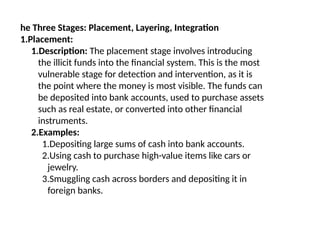
he Three Stages: Placement, Layering, Integration
1.Placement:
1.Description: The placement stage involves introducing
the illicit funds into the financial system. This is the most
vulnerable stage for detection and intervention, as it is
the point where the money is most visible. The funds can
be deposited into bank accounts, used to purchase assets
such as real estate, or converted into other financial
instruments.
2.Examples:
1.Depositing large sums of cash into bank accounts.
2.Using cash to purchase high-value items like cars or
jewelry.
3.Smuggling cash across borders and depositing it in
foreign banks.
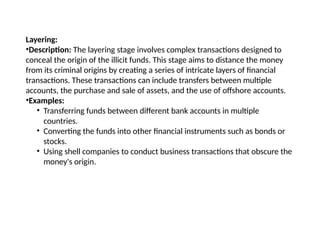
Layering:
•Description: The layering stage involves complex transactions designed to
conceal the origin of the illicit funds. This stage aims to distance the money
from its criminal origins by creating a series of intricate layers of financial
transactions. These transactions can include transfers between multiple
accounts, the purchase and sale of assets, and the use of offshore accounts.
•Examples:
• Transferring funds between different bank accounts in multiple
countries.
• Converting the funds into other financial instruments such as bonds or
stocks.
• Using shell companies to conduct business transactions that obscure the
money's origin.
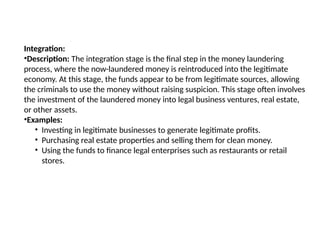
Integration:
•Description: The integration stage is the final step in the money laundering
process, where the now-laundered money is reintroduced into the legitimate
economy. At this stage, the funds appear to be from legitimate sources, allowing
the criminals to use the money without raising suspicion. This stage often involves
the investment of the laundered money into legal business ventures, real estate,
or other assets.
•Examples:
• Investing in legitimate businesses to generate legitimate profits.
• Purchasing real estate properties and selling them for clean money.
• Using the funds to finance legal enterprises such as restaurants or retail
stores.
Tools and Techniques for Strategic Risk Management
Scenario Planning: Exploring multiple potential futures to
understand how risks might unfold and preparing
contingency plans accordingly. SWOT Analysis: Identifying
strengths, weaknesses, opportunities, and threats to gain a
comprehensive understanding of risks in relation to
strategic goals. Risk Matrices: Mapping risks based on their
likelihood and impact to prioritize actions. Predictive
Analytics: Leveraging data to anticipate trends and
disruptions that could pose risks.

Three Stages Placement Layering-Integration.pptx

  • 1.
    he Three Stages:Placement, Layering, Integration 1.Placement: 1.Description: The placement stage involves introducing the illicit funds into the financial system. This is the most vulnerable stage for detection and intervention, as it is the point where the money is most visible. The funds can be deposited into bank accounts, used to purchase assets such as real estate, or converted into other financial instruments. 2.Examples: 1.Depositing large sums of cash into bank accounts. 2.Using cash to purchase high-value items like cars or jewelry. 3.Smuggling cash across borders and depositing it in foreign banks.
  • 2.
    Layering: •Description: The layeringstage involves complex transactions designed to conceal the origin of the illicit funds. This stage aims to distance the money from its criminal origins by creating a series of intricate layers of financial transactions. These transactions can include transfers between multiple accounts, the purchase and sale of assets, and the use of offshore accounts. •Examples: • Transferring funds between different bank accounts in multiple countries. • Converting the funds into other financial instruments such as bonds or stocks. • Using shell companies to conduct business transactions that obscure the money's origin.
  • 3.
    Integration: •Description: The integrationstage is the final step in the money laundering process, where the now-laundered money is reintroduced into the legitimate economy. At this stage, the funds appear to be from legitimate sources, allowing the criminals to use the money without raising suspicion. This stage often involves the investment of the laundered money into legal business ventures, real estate, or other assets. •Examples: • Investing in legitimate businesses to generate legitimate profits. • Purchasing real estate properties and selling them for clean money. • Using the funds to finance legal enterprises such as restaurants or retail stores.
  • 4.
    Tools and Techniquesfor Strategic Risk Management Scenario Planning: Exploring multiple potential futures to understand how risks might unfold and preparing contingency plans accordingly. SWOT Analysis: Identifying strengths, weaknesses, opportunities, and threats to gain a comprehensive understanding of risks in relation to strategic goals. Risk Matrices: Mapping risks based on their likelihood and impact to prioritize actions. Predictive Analytics: Leveraging data to anticipate trends and disruptions that could pose risks.

Editor's Notes

  • #1 Description: The placement stage involves introducing the illicit funds into the financial system. This is the most vulnerable stage for detection and intervention, as it is the point where the money is most visible. The funds can be deposited into bank accounts, used to purchase assets such as real estate, or converted into other financial instruments.
  • #2 Layering: Description: The layering stage involves complex transactions designed to conceal the origin of the illicit funds. This stage aims to distance the money from its criminal origins by creating a series of intricate layers of financial transactions. These transactions can include transfers between multiple accounts, the purchase and sale of assets, and the use of offshore accounts. Examples: Transferring funds between different bank accounts in multiple countries. Converting the funds into other financial instruments such as bonds or stocks. Using shell companies to conduct business transactions that obscure the money's origin.
  • #3 Integration: Description: The integration stage is the final step in the money laundering process, where the now-laundered money is reintroduced into the legitimate economy. At this stage, the funds appear to be from legitimate sources, allowing the criminals to use the money without raising suspicion. This stage often involves the investment of the laundered money into legal business ventures, real estate, or other assets. Examples: Investing in legitimate businesses to generate legitimate profits. Purchasing real estate properties and selling them for clean money. Using the funds to finance legal enterprises such as restaurants or retail stores.
  • #4 Tools and Techniques for Strategic Risk Management Scenario Planning: Exploring multiple potential futures to understand how risks might unfold and preparing contingency plans accordingly. SWOT Analysis: Identifying strengths, weaknesses, opportunities, and threats to gain a comprehensive understanding of risks in relation to strategic goals. Risk Matrices: Mapping risks based on their likelihood and impact to prioritize actions. Predictive Analytics: Leveraging data to anticipate trends and disruptions that could pose risks.