THORACIC ONCOLOGY
IMAGING
Presenter:Dr. Bosibori Ondari
Facilitator: Dr. Omamo
OBJECTIVES
• Overview of the relevant thoracic anatomy
• Imaging modalities and oncologic applications in Lung
and Esophageal Cancer.
TRACHEOBRONCHIAL TREE
• Trachea
– begins at lower border of
cricoid cartilage at C6 level
– T 5 level, T 4 on
inspiration and T 6 on
expiration)
– Extends to carina at sternal
angle at T5 level
Main bronchi
• Carina is the point of tracheal bifurcation
• Lies at T5(T4 in expiration, T6 at inspiration)
• Carinal angle
– 60°(20° right & 40° left)
– larger in children; increases by 10-15* in recumbency
– Marker of atrial enlargement if widened on PA CXR
• Right main bronchus is shorter wider and more vertical than
the left
• The left main bronchus is longer, more horizontal and
narrower
PA (1)trachea (2) right mainstem bronchus (3) left mainstem bronchus (4)aortic knob/arch(5)
azygos vein emptying into superior vena cava right interlobar pulmonary artery (6), (7), left
pulmonary artery(8)right upper lobe pulmonary artery (truncus anterior) (9) right inferior pulmonary
vein (10) right atrium (11)left ventricle
Lateral(1), pulmonary outflow tract (2), (3), ascending aorta aortic arch (4), brachiocephalic vessels
(5), trachea (6), right upper lobe bronchus (7), left upper lobe bronchus (8), right pulmonary
artery(9), left pulmonary artery(10), confluence of pulmonary veins
Review of Xray Anatomy
tttt
Acinus
The functional unit for gas exchange distal to the
terminal (lobular) bronchioles. The acini are formed by
the bronchioli respiratorii, the ductuli alveolares, the
alveoli, and the local pulmonary vessels
1
0
LUNG LOBES AND FISSURES
11
Bronchopulmonary segments
• This is the cone-shaped
smallest, functionally
independent region of a
lung.
– Supplied by a segmental
bronchus and a pulmonary
artery branch.
– Pulmonary vein trib. pass
on the margins of
segments.
• 10 on the right and eight
on the left
12
The Secondary Lobule
• It is the smallest lung unit that is
surrounded by connective tissue septa.
• It measures about 1-2 cm and is made
up of 5-15 pulmonary acini, that contain
the alveoli for gas exchange.
• Is key to HRCT terminology because
Interpretation of interstitial lung diseases is
based on the type of involvement of the
secondary lobule.
13
Secondary lobule ctd.
• Terminal bronchiole in the
center, paralleled by the
centrilobular artery.
• Septal periphery of the lobule-
Pulmonary veins and
lymphatics
• Usually only a few seen
14
SECONDARY LOBULE ctd...
• Centrilobular area…(in blue)
• site of the airways diseases
e.g respiratory bronchiolitis, emphysema
• Perilymphatic area…(in yellow)
• site of lymphatics dzs of the interlobular septa
e.g sarcoid, lymphangitic carcinomatosis,
pulmonary edema).
15
Pulmonary vessels
• Pulmonary arteries
– Arise from pulm trunk
– Rt and left
• Pulm veins
– 2per side(superior and inferior)
– Begin at hilum, empty into left atrium
• Bronchial aa/veins
– Nutritive function to lung
• Innervation
– vagus nn: constricts bronchioles
– sympathetic chain: dilates
Lymphatic drainage
• Two lymphatic systems:
– central network, along the bronchovascular bundle
(centrilobular area)
– peripheral network in interlobular septa and along
the pleural linings(perilymphtic area)
• These drain to the hila bronchopulmonary
nodes→ tracheobronchial nodes & paratracheal
nodes→bronchomediastinal trunks
17
MEDIASTINAL LYMPH NODE MAP
18
Regional Lymph Node Staging Classification
Lymph Node Station
#1
Low cervical
Supraclavicula
r Sternal
notch
• Below lower margin of
cricoid cartilage and
Regional Lymph Node Staging Classification
Lymph Node Station
#1
Low cervical
Supraclavicula
r Sternal
notch
• Below lung
apex & #1
• Above innominate
vein & aortic arch
• 2R extends to left
lateral border of
Regional Lymph Node Staging Classification
Lymph Node Station
#2
2R: right
upper
paratracheal
• Below lung
apex & #1
• Above innominate
vein & aortic arch
Regional Lymph Node Staging Classification
Lymph Node Station
#2
2L: left
upper
paratracheal
Regional Lymph Node Staging Classification
Lymph Node Station
#2
2R: right
upper
paratracheal
Regional Lymph Node Staging Classification
Lymph Node Station #3a
Pre-vascular
• Below apex
• Above carina
• Posterior to sternum
• Anterior to SVC
and left common
carotid artery
Regional Lymph Node Staging Classification
Lymph Node Station #3a
Pre-vascular
Regional Lymph Node Staging Classification
Lymph Node Station #3p
Retrotracheal
• Below apex
• Above carina
Regional Lymph Node Staging Classification
Lymph Node Station #3p
Retrotracheal
Regional Lymph Node Staging Classification
Lymph Node Station #4R
4R: right lower
paratracheal and
pretracheal
• Below innominate vein
• Above azygous vein
• Extends to left
lateral border of
trachea
Regional Lymph Node Staging Classification
Lymph Node Station #4R
4R: right lower
paratracheal and
pretracheal
Regional Lymph Node Staging Classification
Lymph Node Station #4L
4L: left
lower
paratracheal
• Medial to
ligamentum
arteriosum
• Below upper
margin of aortic
Regional Lymph Node Staging Classification
Lymph Node Station #4L
4L: left
lower
paratracheal
Regional Lymph Node Staging Classification
Lymph Node Station #4L
4L: left
lower
paratracheal
• Medial to
ligamentum
arteriosum
• Lateral to
ligamentum
arteriosum
• Below bottom of aortic
arch
• Above top of left MPA
Regional Lymph Node Staging Classification
Lymph Node Station
#5
Subaortic (aorto-
pulmonary window)
Regional Lymph Node Staging Classification
Lymph Node Station
#5
Subaortic (aorto-
pulmonary window)
• Lateral to
ligamentum
arteriosum
• Anterior and lateral
to ascending aorta
and arch
• Below top of aortic
arch
• Above bottom of arch
Regional Lymph Node Staging Classification
Lymph Node Station
#6
Para-aortic
Regional Lymph Node Staging Classification
Lymph Node Station
#6
Para-aortic
• Below carina
• Above left
lower lobe
bronchus and
lower border
of bronchus
intermedius
Regional Lymph Node Staging Classification
Lymph Node Station
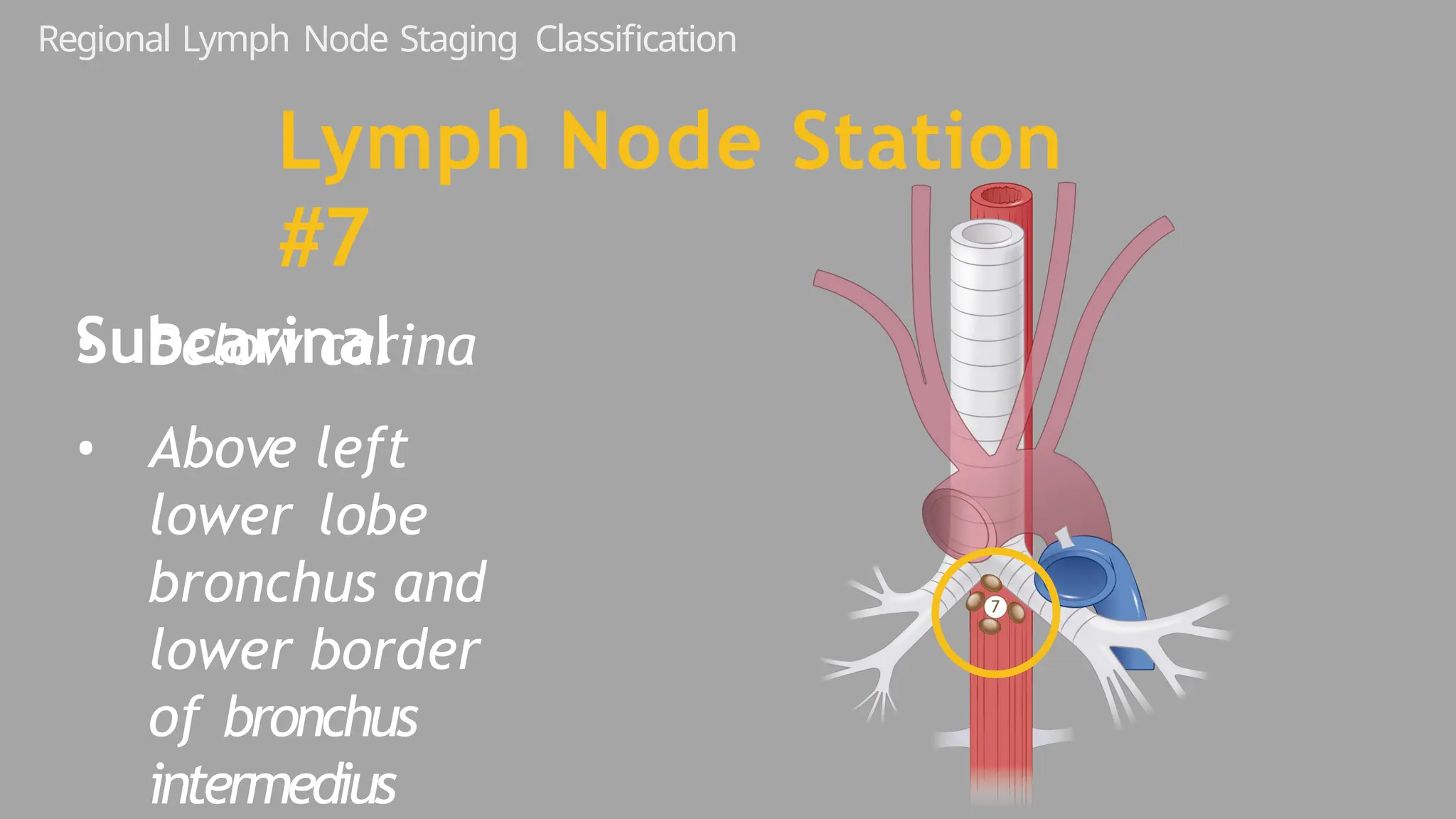
#7
Subcarinal
Regional Lymph Node Staging Classification
Lymph Node Station
#7
Subcarinal
• Below carina
• Adjacent to
esophagus
• Below #7
• Above diaphragm
Regional Lymph Node Staging Classification
Lymph Node Station
#8
Paraesophageal
• Below carina
• Adjacent to
esophagus
• Below #7
• Above diaphragm
Regional Lymph Node Staging Classification
Lymph Node Station
#8
Paraesophageal
Regional Lymph Node Staging Classification
• Below azygous
vein on right
• Below top of left
pulm artery on
left
• Above interlobar
region bilaterally
Lymph Node Station #10
Hilar
Regional Lymph Node Staging Classification
Lymph Node Station #10
Hilar
Regional Lymph Node Staging Classification
Lymph Node Station #11
Interlobar
• Between the
origins of the
lobar bronchi
Regional Lymph Node Staging Classification
Lymph Node Station #11
Interlobar
• Between the
origins of the
lobar bronchi
CT Atlas for Lymph N ode
Stations
From El-Sherief et al. Radiographics 2014;34:
CT Atlas for Lymph N ode
Stations
Regional Lymph Node Staging Classification
This image was published in The Journal of
Thoracic Oncology, 4(5), Rausch et al., “The
IASLC Lung Cancer Staging Project: A
Proposal for a N ew International Lymph N ode
Map in the Forthcoming Seventh Edition of the
TNM Classification for Lung Cancer,” 568-577,
© Elsevier, 2009.
http://www.sciencedirect.com/science/journal/15560
864.
N2/
3
N1
This image was published in The Journal of
Thoracic Oncology, 4(5), Rausch et al., “The
IASLC Lung Cancer Staging Project: A
Proposal for a N ew International Lymph N ode
Map in the Forthcoming Seventh Edition of the
TNM Classification for Lung Cancer,” 568-577,
© Elsevier, 2009.
http://www.sciencedirect.com/science/journal/15560
864.
IMAGING MODALITIES
1. Conventional radiographs
2. Computed Tomography
3. Positron Emission Tomography(PET)
4. Ultrasound- for pleural disease
5. Radionuclide Imaging (V/Q scans)
6. MRI
7. CT Pulmonary Angiography
8. Lymphography
9. Bronchography
SPECIAL DIAGNOSTIC PROCEDURES
• PERCUTANEOUS FINE NEEDLE ASPIRATION
• CT guided
• Excellent for peripheral nodules
• limitation is that it cannot rule out malignancy
• BRONCHOSCOPY
• Able to visualize tracheobronchial tree upto 2nd /3rd segment
• Cytologic brushing/biopsy forceps are used to acquire specimens
50
• ENDOSCOPIC ULTRASOUND
• Evaluation of mediastinal /hilar lymph nodes
• ENDOBRONCHIAL U/S GUIDED NEEDLE TRANSBRONCHIAAL
ASPIRATION
• Involves FNA sampling at levels 2,4,7,10
• 98% sensitivity 92% specificity
• THORACOCENTESIS
• Evaluation of pleural effusion
• Can be used simultaneously with thoracoscopy to evaluate the pleural space
further
51
• MEDIASTINOSCOPY
• Most accurate technique to assess lymph node stations 2,4,3,7
• Has been replaced with U/S
• Considered when less invasive techniques are non diagnostic
• Recommended to rule out N3 disease/identify N2 disease for induction chemotherapy
• THORACOSCOPY
• Video assisted
• Used for diagnosis, staging and resection
• Valuable in evaluating pleural disease
• Useful in evaluating mediastinal nodes inaccessible by standard mediastinoscopy/U/S
52
LUNG CANCER
• Lung cancer is a heterogenous (not one disease) , with multiple histologic subtypes
and molecular phenotypes
• Staging of Lung cancer offers both theraupetic and prognostic guidance, imaging aids
in determining anatomic extent of disease
• Proper initial evaluation and and staging of patients is important for appropriate
theraupetic decision making.
• CT is an imortant component in staging, FDG PET used to assess Nodal and
extrathoracic metastasis
WHO Classification of Lung Cancer
• Non-small cell lung cancer (NSCLC)- Most common 85%
➢ Adenocarcinoma (40%)– Ass with smoking, most common in non smokers.
Multiple histologic subtypes, including acinar, papillary, solid, micropapillary, or
lepidic. Peripheral, solitary pulmonary nodule with irregular or spiculated
margins, cavitation is rare
➢ Squamous cell (30%)- Highly smoking related, occur as central endobronchial
mass, affect proximal bronchi-causes obstruction cough, haemoptysis and
post obstructive pneumonia, most likely to cavitate
➢ Large cell (15%)- peripheral, poorly maginated
➢Carcinoid-
• Small Cell Carcinoma (15%)- decreasing incidence, always in smokers, Small
Central mass with mediastinal LNs, rapid growth and spread, paraneoplastic
syndromes
54
ROUTES OF SPREAD
Local extension
• Direct extension from tumor to surrounding tissues
• Most commonly involves
• Pleural extension- Most frequently results in pleural metastases in caudal and posterior parts of pleural spaces
• Chest wall
• Esophagus
Lymphatic spread
• Through lymphatic system to neighboring or distant lymph nodes
• Lymphangitic spread can be associated with hematogenous dissemination, Followed by invasion of adjacent interstitium and lymphatics
esp in adenocarcinomas (lymphangitic carcinomatosis)
• Subsequent tumor spread toward hilum or lung periphery
Distant metastases
• When tumor develops invasive behavior, it has access to rich pulmonary capillary networks
• Pulmonary veins are common route of metastasis, hematogenous spread is high with adenocarcinomas, occurs late in SCC
• Adrenals, liver, brain, bones
• Disemmination and tumor emboli are common and are a prognostic factor for overall survival
Staging Work-Up
•Complete H& P, CBC, Chemistry panel
•CXR-limited role now
•CT chest & upper abdomen with contrast
•PET CT to evaluate LNs and distant metastasis
•CT scan Brain/MRI- Stage III and IV
•Pulmonary function tests for Surgical Candidates
•Thoracocentesis with cytology in patients with Pleural Effusion
DIAGNOSTIC IMAGING MODALITIES
CHEST RADIOGRAPH
• Can be used to evaluate a patient presenting with chest symptoms with documented sensitivity of 77-80 %
CLINICAL UTILITY
• Systematic review of all chest anatomic compartments
• Lungs and airways
• Nodule, mass-Airway-related nodule/mass
• Atelectasis, consolidation
• Hilar
• Enlargement from lymphadenopathy or mass
• Mediastinum- Focal mass or diffuse mediastinal enlargement
• Pleura
• Malignant pleural effusion ± pleural nodules/masses/thickening
• Chest wall
• Nodule, mass, infiltrative lesion
58
• There is a large area of
airspace opacification in the
left mid-lower zone.
• There is silhouetting of the left
heart border on the frontal
projection, placing the
abnormality in the lingula
segments of the left upper
lobe.
• The oblique fissure appears
lobulated.
• The right lung and pleural
recesses appear clear.
CHEST COMPUTED TOMOGRAPHY
• Recommended for all patients
suspected of lung cancer
• CT CHEST with contrast
extending to include the liver
and the adrenal glands
• CT is able to establish: T stage,
presence of atelactesis,
invasion of adjacent
structures and proximal
extent of tumor
CT CHEST…
Contrast Enhanced CT is used to stage most patients
○ Tumour (T) staging
– Size and location
– Extent of disease
□ Relationship to airways and vessels
□ Invasion of adjacent structures
□ Tumour nodules
– PS: CT is Inferior to MR in detection of locoregional invasion of chest wall, mediastinum, and
diaphragm
• LYMPH NODE (N) STAGING
• Anatomic criteria used on CT
• Lymph node size not always reliable
• Inferior to PET/CT for detecting lymph node metastases
• METASTASIS (M) STAGING
• PET/CT-Superior to CT in detecting metastases
• RESTAGING
• CECT routinely used for assessment of treatment response, surveillance, and restaging – Inferior to PET/CT in many studies
NSCLC Staging
• Once the histologic diagnosis of NSCLC has been established, the extent of disease must be determined. The
stage of disease will dictate therapy.
• All patients must undergo a complete history and physical examination, chest x-ray, CT scan of the chest and
upper abdomen (to include the adrenal glands), a complete blood count, and blood chemistry tests that include
electrolyte and liver enzyme studies
• All patients with stage II to IV disease should have evaluation of the brain, with magnetic resonance imaging
(MRI) if possible.
• For stage I to III NSCLC, 18Ffluorodeoxyglucose (FDG)-PET should be performed to evaluate mediastinal nodes
and for distant metastases.
T1
• ≤ 3 cm in greatest
dimension
• Surrounded by lung
or visceral pleura
• Not in main bronchus
T1b: >1 – 2 cm
T1a: < 1 cm T1c: >2 – 3 cm
T1a (mi)
• New category
• Minimally invasive
adenocarcinoma
• Solitary
• Predominantly lepidic
pattern
• < 5 mm invasion in greatest
dimension
T2
• >3 – 5 cm in greatest
dimension
T2
• Involves main bronchus
regardless of distance to
carina, without carinal
involvement
T2
• Invades visceral pleura
T2
• Post-
obstructive
atelectasis/
pneumonia
extending to
hilum involving
part or entire
lung
T2a: >3 – 4 cm T2b: >4 – 5 cm
T3
• >5 – 7 cm in greatest dimension
T3
Chest wall
invasion,
including
superior
sulcus
T3
Chest wall
invasion,
including
superior sulcus
T3
• Invades:
– phrenic nerve
– parietal
pericardium
T3
• Separate tumor nodule(s) in
same lobe
T4
• >7 cm in greatest dimension
INVADES;
– Diaphragm
– Mediastinum
– Heart
– Great vessels
– Trachea / carina
– Recurrentlaryngeal nerve
– Esophagus
– Vertebral body
T4
• Invades:
– Diaphragm
– Mediastinum
– Heart
– Great vessels
– Trachea / carina
– Recurrent laryngeal nerve
– Esophagus
– Vertebral body
T4
• Invades:
– Diaphragm
– Mediastinum
– Heart
– Great vessels
– Trachea / carina
– Recurrentlaryngeal nerve
– Esophagus
– Vertebral body
T4
• Invades:
– Diaphragm
– Mediastinum
– Heart
– Great vessels
– Trachea / carina
– Recurrentlaryngeal nerve
– Esophagus
– Vertebral body
T4
• Invades:
– Diaphragm
– Mediastinum
– Heart
– Great vessels
– Trachea / carina
– Recurrentlaryngeal nerve
– Esophagus
– Vertebral body
T4
• Invades:
– Diaphragm
– Mediastinum
– Heart
– Great vessels
– Trachea / carina
– Recurrentlaryngeal nerve
– Esophagus
– Vertebral body
T4
• Invades:
– Diaphragm
– Mediastinum
– Heart
– Great vessels
– Trachea / carina
– Recurrentlaryngeal nerve
– Esophagus
– Vertebral body
T4
• Invades:
– Diaphragm
– Mediastinum
– Heart
– Great vessels
– Trachea / carina
– Recurrentlaryngeal nerve
– Esophagus
– Vertebral body
T4
• Separate tumor nodule in
different ipsilateral lobe
T4
• Separate tumor nodule in
different ipsilateral lobe
•Is a standard in staging, limited use due to cost
•Purpose:
1. stage primary tumor characteristics
2. distinguish atelectasis from tumor
3. identify nodal metastasis
4. identify distant metastasis
•Able to detect 0.5cm tumor
90
PET CT SCAN
PET CT SCAN ctd…
Staging
• More accurate than CT in delineating extent of tumor involvement
• Accuracy: CT: 68%; PET: 46%; PET/CT: 86%; visually corrected PET/CT: 72%
• PET and PET/CT improve detection of lymph node metastases
• Accuracy: 75-80%; sensitivity: 70-75%; specificity: 90-95%
• Superior to CT and PET alone
• Metastases
• Superior to CT and PET for pericardial metastases
• More sensitive and accurate than bone scan (91% and 94% vs. 75% and 85%, respectively)
• Low sensitivity for brain metastases due to increased FDG uptake of brain parenchyma
• Monitoring, surveillance, and restaging
• Not recommended for routine follow-up
• Often performed for concerning symptoms or suspicious findings on CT
91
PET-CT is recommended in : NCCN
(a) Diagnosis in patients with one or two pulmonary nodules
(b) Initial staging except if multiple distant metastases exist
(c) Restaging stage III or IV after 2–3 months after treatment or before surgery
(d) Restaging in patients with symptoms suggestive of recurrence
(e) Radiation therapy
92
SCLC
• Imaging is principal method of staging SCLC
• Chest CT with i.v. contrast, incl. adrenals
• Brain imaging, MR preferable to CT
• FDG-PET often obtained
• Abdomen CT and Tc-99m bone scan if PET not available
SCLC: Staging Criteria
- According to Veterans Administration Lung Cancer Group (VALG)
Limited Stage 1/3
Confined to one hemithorax and regional lymph nodes
Unlike NSCLC, mets to ipsilateral & contralateral supraclav, mediastinal LNs are considerred limited
disease
Extensive stage 2/3
Positive pleural effusion, contralateral lung nodules, contralateral supraclavicular LNs, distant
metastasis
Asymptomatic metastasis -70% at diagnosis
Small Cell Lung Cancer
90-95% of SCLC arise from lobar or main bronchi thus most commonly manifest as a large mass centrally
located within the parenchyma or a mediastinal mass involving at least one hilum (paratracheal node pointed)
Lung nodule with mediastinal adenopathy;
limited-stage disease
Small Cell Lung Cancer (SCLC)
Primary Tumor
• 90 - 95% are centrally located
(hilar/mediastinal), arising from main bronchi
• Often a hilar/mediastinal mass without a visible
lung nodule
• Usually large and bulky
• Often surrounds and narrows central bronchi
• May have post-obstructive atelectasis / pneumonia
Imaging of Small Cell Lung Cancer (SCLC)
Pre
Treatment
Imaging of Small Cell Lung Cancer (SCLC)
Pre
Treatment
Post
Treatment
Imaging of Small Cell Lung Cancer (SCLC)
Primary Tumor
• Frequently encases and invades adjacent
structures
• Trachea, esophagus, heart, SVC,
other vessels, chest wall
Small Cell Lung Cancer (SCLC)
Primary Tumor
• Rarely (<5%) small peripheral
nodule
• Without lymphadenopathy
Small Cell Lung Cancer (SCLC) Y
Small Cell Lung Cancer (SCLC)
Common Sites of
Spread
• Pleura
• Pericardium
• Contralateral lung
Small Cell Lung Cancer (SCLC)
Common Sites of
“Extensive Stage” Spread
• Bone (19-38% of cases)
• Liver (17-34% of cases)
• Adrenals (10-17%)
• Brain (up to 14%)
Small Cell Lung Cancer (SCLC)
FDG-PET
• PET ~ 95% accurate in detecting
extensive disease, affects choice of
therapy
• PET may change management in ¼ of
patients
• Upstaging more common than downstaging
• Commonly modifies determination of
Small Cell Lung Cancer (SCLC)
Brain Imaging
• Brain metastases in 10-15% of neurologically
asymptomatic patients
• Including 12% of patients otherwise thought to
have limited stage disease
• Head MR and CT more sensitive than PET
• MR more sensitive and specific compared to CT
Imaging of Small Cell Lung Cancer (SCLC)
CA OESOPHAGUS
SUBTYPES
• squamous cell carcinoma of oesophagus: 81-95% (worldwide)
• adenocarcinoma of oesophagus: 4-19% (worldwide)
➢ arising from mucosal/submucosal glands, heterotopic gastric mucosa, or columnar-lined epithelium
➢ >90% related to Barrett oesophagus
➢ tend to occur at the gastro-oesophageal junction
other types
• mucoepidermoid carcinoma
• adenoid cystic carcinoma (ACC)
• spindle-cell squamous carcinoma
• leiomyosarcoma
• rhabdomyosarcoma
• fibrosarcoma
• lymphoma
11
8
CHEST RADIOGRAPH
• Many indirect signs can be sought on a chest radiograph and these include:
• widened azygo-oesophageal recess with convexity toward right lung (in 30% of distal
and mid-oesophageal cancers)
• thickening of posterior tracheal stripe and right paratracheal stripe >4 mm (if tumour
located in the upper third of oesophagus)
• tracheal deviation or posterior tracheal indentation/mass
• retrocardiac or posterior mediastinal mass
• oesophageal air-fluid level
• lobulated mass extending into gastric bubble (Kirklin sign)
• repeated aspiration pneumonia (with tracheo-oesophageal fistula)
12
1
FLUOROSCOPY/ESOPHAGOGRAM
• Contrast/ barium swallow
• irregular stricture
• prestricture dilatation with 'hold up'
• shouldering of the stricture
• Although useful in evaluating
length and severity of malignant
strictures, which can be used in
treatment planning, it does not
provide useful staging information
12
2
ENDOSCOPIC ULTRASOUND
• The most accurate imaging modality for the T staging of oesophageal cancer. It defines
the layers of the oesophageal wall hence can differentiate T1, T2, and T3 tumours.
• The oesophagus consists of five layers:
1.first hyperechoic layer represents the interface between the balloon and the superficial
mucosa
2.second hypoechoic layer represents the lamina propria and muscularis mucosae
3.third hyperechoic layer represents the submucosa
4.fourth hypoechoic layer represents the muscularis propria
5.fifth layer represents the interface between the adventitia and surrounding tissues
12
3
ENDOSCOPIC ULTRASOUND
The most accurate imaging modality for the T
staging of oesophageal cancer. It defines the
layers of the oesophageal wall hence can
differentiate T1, T2, and T3 tumours.
The oesophagus consists of five layers:
1.first hyperechoic layer represents the interface
between the balloon and the superficial mucosa
2.second hypoechoic layer represents the lamina
propria and muscularis mucosae
3.third hyperechoic layer represents the
submucosa
4.fourth hypoechoic layer represents the
muscularis propria
5.fifth layer represents the interface between the
adventitia and surrounding tissues
12
4
Contrast Enhanced CT (CECT)
• Determination of T4 disease is most important role of CT in evaluating local disease: Tracheobronchial, aortic, or pericardial involvement
• Unable to adequately differentiate between T1, T2, and T3 disease
• Limited in determining depth of esophageal wall invasion
• Better performance for higher stage lesions (T3,T4)
Aortic invasion is suggested by
• □ ≥ 90° of aorta in contact with tumor
CT criteria for local invasion include
• □ Obliteration of triangular fat space between esophagus, aorta, and spine adjacent to primary tumor
Tracheobronchial invasion is suggested by
• Displacement of trachea or bronchus
• Indentation of tracheal or bronchial posterior wall by tumor
• Tracheobronchial fistula or tumor extension into airway lumen is definite sign of tracheobronchial invasion
Pericardial invasion is suspected if there is
• Pericardial thickening
• Pericardial effusionith limited diagnostic accuracy in lower stage lesions (T1, T2)
12
5
CECT
• CT has poor sensitivity for depiction superficial lesions
• Irregular, thick, enhancing esophageal wall, resulting in proximal esophageal dilatation
• Normal distended esophageal wall is usually < 3 mm thick
• Any wall thickness > 5 mm is considered abnormal
• Wall thickening is usually asymmetric, causing eccentric luminal narrowing
• Less accurate than EUS and biopsy
• Determining involvement of nodes depends on nodal size
• Intrathoracic and abdominal lymph nodes > 1 cm in diameter
• Supraclavicular lymph nodes with short axis > 5 mm
• Retrocrural lymph nodes with short axis > 6 mm
• Portocaval lymph node, which has big longitudinal axis
• Limitations
• Micrometastasis may be found in normal-sized nodes
• Some enlarged nodes may be reactive
• Cannot detect peritumoral /conglomerate lymph
• nodes that are inseparable from tumor
12
6
T: D epth of
Invasion
Inability of CT to determine degree of extension
within esophageal wall (T1-T3 disease)
Y
CT may allow for exclusion of T4
disease (invasion of adjacent
structures) via the presence of
T: D epth of
Invasion
T: D epth of Invasion
CT findings suggestive of T4 disease:
• Loss of intervening fat plane
• D isplacement of mediastinal structures
• > 90 degree contact of tumor with aorta
• Pericardial thickening or effusion
• Variable sensitivities and specificities reported
in the literature for these findings
CT Imaging of Esophageal Cancer
Aortic invasion and aorto-esophageal
T: D epth of
Invasion
Tracheal invasion with tracheoesophageal
N: Regional N odal Involvement
CT assessment for nodal metastases
• Sensitivity 42-50%
• Specificity 83-93%
Sensitivity limited as normal sized lymph
nodes (< 1cm short axis) may have
metastatic disease
CT Imaging of Esophageal Cancer
Enlarged gastro-hepatic lymph
N: Regional N odal
Involvement
M: D istant
Metastasis
Common sites of distant
metastases:
• Liver (35%)
• Lung (20%)
• Bone (9%)
er
Liver
CT Imaging of Esophageal Cancer Y
Metastatic disease to the
Limits of CT
• Not for primary diagnosis
• Suboptimal evaluation for the
degree of esophageal wall invasion
• Detection of regional lymph
node involvement limited
PET CT SCAN
• FDG PET-CT is useful for detecting oesophageal primary tumors yet it has little role in helping
determine the specific T classification because it provides limited information about the depth of
tumor invasion.
• PET-CT is also superior to CT for detecting lymph node metastases and can depict metastases in
normal-sized lymph nodes through the uptake of FDG.
• PET-CT has a primary role in the depiction of distant sites of metastatic disease.
• The most common sites of distant metastases detected at PET (but frequently missed at CT) are
the bones and liver.
• Higher sensitivity than CT in detection of primary esophageal cancer, as most esophageal
malignancies are FDG avid
• Helpful in detection of esophageal tumors in patients with metastases of unknown origin
• False-negatives in small T1 and T2, necrotic or mucinous tumors
• False-positives due to esophagitis secondary to GERD, infectious esophagitis or after endoscopy
intervention
13
8
r
Indications for PET/CT
• Strategy to detect distant metastases
• Improving specificity of lymph node staging
• Combining PET/CT and EUS-guided biopsy
as preoperative work-up for the highest nodal
yield
Y
PET/CT Performance
• Locoregional staging
– Sensitivity 51% Specificity 94%
• Distant staging
– Sensitivity 67% Specificity 84%
PET/CT of Esophageal Cancer
Primary Tumor
• PET/CT has overall sensitivity 80% for
primary esophageal cancer
• Sensitivity is close to 100% for T3 and T4
tumors
• BUT, sensitivity is only 43% for T1 tumors
• PET/CT cannot detect in-situ and T1a tumors
• PET/CT cannot determine T stage
PET/CT of Esophageal Cancer Y
PET/CT of Esophageal Cancer
PET/CT of Esophageal Cancer LOGY
Pitfalls
• Mild esophageal uptake (SUVmax < 4.0) may relate
to esophagitis or lower esophageal sphincter
• Hiatal hernias, benign stricture after dilatation, post-biopsy
and esophageal leiomyomas can have mild FDG uptake
(false- positives)
• Small intracapsular nodal metastases have a high
false- negative rate
• Intense uptake in the primary tumor may obscure
subtle abnormal adjacent nodes
• Synchronous primary neoplasms in 5.5-8% of patients
RESTAGING
• PET/CT – Most sensitive method of differentiating chemotherapy responders from no responders
• Responders demonstrates decrease in maximum standardized uptake value (SUVmax) of 45-60% between baseline
and post chemotherapy staging
• No responders might demonstrate persistent FDG uptake in tumor, which correlates with persistent viable macroscopic
malignancy and poor clinical outcome
• Added value in differentiating tumor recurrence from posttreatment changes
• Posttreatment changes may include fibrosis and inflammation, making CT appearance nonspecific
• Inflammation related to post endoscopy biopsy or stent placement or chemoradiation-induced esophagitis or ulceration
might mimic viable tumor
• Perform no sooner than 3-4 weeks after completion of chemoradiation
14
8
• Restaging important after neoadjuvant chemotherapy to determine if patient is surgical candidate by
detecting new metastatic disease, which can occur in 17% of cases and can preclude surgery
• May identify complications of therapy
➢ Esophagitis
➢ Tracheoesophageal fistula
14
9

Thoracic Oncology Imaging Dr. Bosibori.pptx

  • 1.
  • 2.
    OBJECTIVES • Overview ofthe relevant thoracic anatomy • Imaging modalities and oncologic applications in Lung and Esophageal Cancer.
  • 5.
    TRACHEOBRONCHIAL TREE • Trachea –begins at lower border of cricoid cartilage at C6 level – T 5 level, T 4 on inspiration and T 6 on expiration) – Extends to carina at sternal angle at T5 level
  • 6.
    Main bronchi • Carinais the point of tracheal bifurcation • Lies at T5(T4 in expiration, T6 at inspiration) • Carinal angle – 60°(20° right & 40° left) – larger in children; increases by 10-15* in recumbency – Marker of atrial enlargement if widened on PA CXR • Right main bronchus is shorter wider and more vertical than the left • The left main bronchus is longer, more horizontal and narrower
  • 9.
    PA (1)trachea (2)right mainstem bronchus (3) left mainstem bronchus (4)aortic knob/arch(5) azygos vein emptying into superior vena cava right interlobar pulmonary artery (6), (7), left pulmonary artery(8)right upper lobe pulmonary artery (truncus anterior) (9) right inferior pulmonary vein (10) right atrium (11)left ventricle Lateral(1), pulmonary outflow tract (2), (3), ascending aorta aortic arch (4), brachiocephalic vessels (5), trachea (6), right upper lobe bronchus (7), left upper lobe bronchus (8), right pulmonary artery(9), left pulmonary artery(10), confluence of pulmonary veins Review of Xray Anatomy
  • 10.
    tttt Acinus The functional unitfor gas exchange distal to the terminal (lobular) bronchioles. The acini are formed by the bronchioli respiratorii, the ductuli alveolares, the alveoli, and the local pulmonary vessels 1 0
  • 11.
    LUNG LOBES ANDFISSURES 11
  • 12.
    Bronchopulmonary segments • Thisis the cone-shaped smallest, functionally independent region of a lung. – Supplied by a segmental bronchus and a pulmonary artery branch. – Pulmonary vein trib. pass on the margins of segments. • 10 on the right and eight on the left 12
  • 13.
    The Secondary Lobule •It is the smallest lung unit that is surrounded by connective tissue septa. • It measures about 1-2 cm and is made up of 5-15 pulmonary acini, that contain the alveoli for gas exchange. • Is key to HRCT terminology because Interpretation of interstitial lung diseases is based on the type of involvement of the secondary lobule. 13
  • 14.
    Secondary lobule ctd. •Terminal bronchiole in the center, paralleled by the centrilobular artery. • Septal periphery of the lobule- Pulmonary veins and lymphatics • Usually only a few seen 14
  • 15.
    SECONDARY LOBULE ctd... •Centrilobular area…(in blue) • site of the airways diseases e.g respiratory bronchiolitis, emphysema • Perilymphatic area…(in yellow) • site of lymphatics dzs of the interlobular septa e.g sarcoid, lymphangitic carcinomatosis, pulmonary edema). 15
  • 16.
    Pulmonary vessels • Pulmonaryarteries – Arise from pulm trunk – Rt and left • Pulm veins – 2per side(superior and inferior) – Begin at hilum, empty into left atrium • Bronchial aa/veins – Nutritive function to lung • Innervation – vagus nn: constricts bronchioles – sympathetic chain: dilates
  • 17.
    Lymphatic drainage • Twolymphatic systems: – central network, along the bronchovascular bundle (centrilobular area) – peripheral network in interlobular septa and along the pleural linings(perilymphtic area) • These drain to the hila bronchopulmonary nodes→ tracheobronchial nodes & paratracheal nodes→bronchomediastinal trunks 17
  • 18.
  • 19.
    Regional Lymph NodeStaging Classification Lymph Node Station #1 Low cervical Supraclavicula r Sternal notch • Below lower margin of cricoid cartilage and
  • 20.
    Regional Lymph NodeStaging Classification Lymph Node Station #1 Low cervical Supraclavicula r Sternal notch
  • 21.
    • Below lung apex& #1 • Above innominate vein & aortic arch • 2R extends to left lateral border of Regional Lymph Node Staging Classification Lymph Node Station #2 2R: right upper paratracheal
  • 22.
    • Below lung apex& #1 • Above innominate vein & aortic arch Regional Lymph Node Staging Classification Lymph Node Station #2 2L: left upper paratracheal
  • 23.
    Regional Lymph NodeStaging Classification Lymph Node Station #2 2R: right upper paratracheal
  • 24.
    Regional Lymph NodeStaging Classification Lymph Node Station #3a Pre-vascular • Below apex • Above carina • Posterior to sternum • Anterior to SVC and left common carotid artery
  • 25.
    Regional Lymph NodeStaging Classification Lymph Node Station #3a Pre-vascular
  • 26.
    Regional Lymph NodeStaging Classification Lymph Node Station #3p Retrotracheal • Below apex • Above carina
  • 27.
    Regional Lymph NodeStaging Classification Lymph Node Station #3p Retrotracheal
  • 28.
    Regional Lymph NodeStaging Classification Lymph Node Station #4R 4R: right lower paratracheal and pretracheal • Below innominate vein • Above azygous vein • Extends to left lateral border of trachea
  • 29.
    Regional Lymph NodeStaging Classification Lymph Node Station #4R 4R: right lower paratracheal and pretracheal
  • 30.
    Regional Lymph NodeStaging Classification Lymph Node Station #4L 4L: left lower paratracheal • Medial to ligamentum arteriosum • Below upper margin of aortic
  • 31.
    Regional Lymph NodeStaging Classification Lymph Node Station #4L 4L: left lower paratracheal
  • 32.
    Regional Lymph NodeStaging Classification Lymph Node Station #4L 4L: left lower paratracheal • Medial to ligamentum arteriosum
  • 33.
    • Lateral to ligamentum arteriosum •Below bottom of aortic arch • Above top of left MPA Regional Lymph Node Staging Classification Lymph Node Station #5 Subaortic (aorto- pulmonary window)
  • 34.
    Regional Lymph NodeStaging Classification Lymph Node Station #5 Subaortic (aorto- pulmonary window) • Lateral to ligamentum arteriosum
  • 35.
    • Anterior andlateral to ascending aorta and arch • Below top of aortic arch • Above bottom of arch Regional Lymph Node Staging Classification Lymph Node Station #6 Para-aortic
  • 36.
    Regional Lymph NodeStaging Classification Lymph Node Station #6 Para-aortic
  • 37.
    • Below carina •Above left lower lobe bronchus and lower border of bronchus intermedius Regional Lymph Node Staging Classification Lymph Node Station #7 Subcarinal
  • 38.
    Regional Lymph NodeStaging Classification Lymph Node Station #7 Subcarinal
  • 39.
    • Below carina •Adjacent to esophagus • Below #7 • Above diaphragm Regional Lymph Node Staging Classification Lymph Node Station #8 Paraesophageal
  • 40.
    • Below carina •Adjacent to esophagus • Below #7 • Above diaphragm Regional Lymph Node Staging Classification Lymph Node Station #8 Paraesophageal
  • 41.
    Regional Lymph NodeStaging Classification • Below azygous vein on right • Below top of left pulm artery on left • Above interlobar region bilaterally Lymph Node Station #10 Hilar
  • 42.
    Regional Lymph NodeStaging Classification Lymph Node Station #10 Hilar
  • 43.
    Regional Lymph NodeStaging Classification Lymph Node Station #11 Interlobar • Between the origins of the lobar bronchi
  • 44.
    Regional Lymph NodeStaging Classification Lymph Node Station #11 Interlobar • Between the origins of the lobar bronchi
  • 45.
    CT Atlas forLymph N ode Stations
  • 46.
    From El-Sherief etal. Radiographics 2014;34: CT Atlas for Lymph N ode Stations
  • 47.
    Regional Lymph NodeStaging Classification This image was published in The Journal of Thoracic Oncology, 4(5), Rausch et al., “The IASLC Lung Cancer Staging Project: A Proposal for a N ew International Lymph N ode Map in the Forthcoming Seventh Edition of the TNM Classification for Lung Cancer,” 568-577, © Elsevier, 2009. http://www.sciencedirect.com/science/journal/15560 864.
  • 48.
    N2/ 3 N1 This image waspublished in The Journal of Thoracic Oncology, 4(5), Rausch et al., “The IASLC Lung Cancer Staging Project: A Proposal for a N ew International Lymph N ode Map in the Forthcoming Seventh Edition of the TNM Classification for Lung Cancer,” 568-577, © Elsevier, 2009. http://www.sciencedirect.com/science/journal/15560 864.
  • 49.
    IMAGING MODALITIES 1. Conventionalradiographs 2. Computed Tomography 3. Positron Emission Tomography(PET) 4. Ultrasound- for pleural disease 5. Radionuclide Imaging (V/Q scans) 6. MRI 7. CT Pulmonary Angiography 8. Lymphography 9. Bronchography
  • 50.
    SPECIAL DIAGNOSTIC PROCEDURES •PERCUTANEOUS FINE NEEDLE ASPIRATION • CT guided • Excellent for peripheral nodules • limitation is that it cannot rule out malignancy • BRONCHOSCOPY • Able to visualize tracheobronchial tree upto 2nd /3rd segment • Cytologic brushing/biopsy forceps are used to acquire specimens 50
  • 51.
    • ENDOSCOPIC ULTRASOUND •Evaluation of mediastinal /hilar lymph nodes • ENDOBRONCHIAL U/S GUIDED NEEDLE TRANSBRONCHIAAL ASPIRATION • Involves FNA sampling at levels 2,4,7,10 • 98% sensitivity 92% specificity • THORACOCENTESIS • Evaluation of pleural effusion • Can be used simultaneously with thoracoscopy to evaluate the pleural space further 51
  • 52.
    • MEDIASTINOSCOPY • Mostaccurate technique to assess lymph node stations 2,4,3,7 • Has been replaced with U/S • Considered when less invasive techniques are non diagnostic • Recommended to rule out N3 disease/identify N2 disease for induction chemotherapy • THORACOSCOPY • Video assisted • Used for diagnosis, staging and resection • Valuable in evaluating pleural disease • Useful in evaluating mediastinal nodes inaccessible by standard mediastinoscopy/U/S 52
  • 53.
    LUNG CANCER • Lungcancer is a heterogenous (not one disease) , with multiple histologic subtypes and molecular phenotypes • Staging of Lung cancer offers both theraupetic and prognostic guidance, imaging aids in determining anatomic extent of disease • Proper initial evaluation and and staging of patients is important for appropriate theraupetic decision making. • CT is an imortant component in staging, FDG PET used to assess Nodal and extrathoracic metastasis
  • 54.
    WHO Classification ofLung Cancer • Non-small cell lung cancer (NSCLC)- Most common 85% ➢ Adenocarcinoma (40%)– Ass with smoking, most common in non smokers. Multiple histologic subtypes, including acinar, papillary, solid, micropapillary, or lepidic. Peripheral, solitary pulmonary nodule with irregular or spiculated margins, cavitation is rare ➢ Squamous cell (30%)- Highly smoking related, occur as central endobronchial mass, affect proximal bronchi-causes obstruction cough, haemoptysis and post obstructive pneumonia, most likely to cavitate ➢ Large cell (15%)- peripheral, poorly maginated ➢Carcinoid- • Small Cell Carcinoma (15%)- decreasing incidence, always in smokers, Small Central mass with mediastinal LNs, rapid growth and spread, paraneoplastic syndromes 54
  • 56.
    ROUTES OF SPREAD Localextension • Direct extension from tumor to surrounding tissues • Most commonly involves • Pleural extension- Most frequently results in pleural metastases in caudal and posterior parts of pleural spaces • Chest wall • Esophagus Lymphatic spread • Through lymphatic system to neighboring or distant lymph nodes • Lymphangitic spread can be associated with hematogenous dissemination, Followed by invasion of adjacent interstitium and lymphatics esp in adenocarcinomas (lymphangitic carcinomatosis) • Subsequent tumor spread toward hilum or lung periphery Distant metastases • When tumor develops invasive behavior, it has access to rich pulmonary capillary networks • Pulmonary veins are common route of metastasis, hematogenous spread is high with adenocarcinomas, occurs late in SCC • Adrenals, liver, brain, bones • Disemmination and tumor emboli are common and are a prognostic factor for overall survival
  • 57.
    Staging Work-Up •Complete H&P, CBC, Chemistry panel •CXR-limited role now •CT chest & upper abdomen with contrast •PET CT to evaluate LNs and distant metastasis •CT scan Brain/MRI- Stage III and IV •Pulmonary function tests for Surgical Candidates •Thoracocentesis with cytology in patients with Pleural Effusion
  • 58.
    DIAGNOSTIC IMAGING MODALITIES CHESTRADIOGRAPH • Can be used to evaluate a patient presenting with chest symptoms with documented sensitivity of 77-80 % CLINICAL UTILITY • Systematic review of all chest anatomic compartments • Lungs and airways • Nodule, mass-Airway-related nodule/mass • Atelectasis, consolidation • Hilar • Enlargement from lymphadenopathy or mass • Mediastinum- Focal mass or diffuse mediastinal enlargement • Pleura • Malignant pleural effusion ± pleural nodules/masses/thickening • Chest wall • Nodule, mass, infiltrative lesion 58
  • 59.
    • There isa large area of airspace opacification in the left mid-lower zone. • There is silhouetting of the left heart border on the frontal projection, placing the abnormality in the lingula segments of the left upper lobe. • The oblique fissure appears lobulated. • The right lung and pleural recesses appear clear.
  • 60.
    CHEST COMPUTED TOMOGRAPHY •Recommended for all patients suspected of lung cancer • CT CHEST with contrast extending to include the liver and the adrenal glands • CT is able to establish: T stage, presence of atelactesis, invasion of adjacent structures and proximal extent of tumor
  • 61.
    CT CHEST… Contrast EnhancedCT is used to stage most patients ○ Tumour (T) staging – Size and location – Extent of disease □ Relationship to airways and vessels □ Invasion of adjacent structures □ Tumour nodules – PS: CT is Inferior to MR in detection of locoregional invasion of chest wall, mediastinum, and diaphragm
  • 62.
    • LYMPH NODE(N) STAGING • Anatomic criteria used on CT • Lymph node size not always reliable • Inferior to PET/CT for detecting lymph node metastases • METASTASIS (M) STAGING • PET/CT-Superior to CT in detecting metastases • RESTAGING • CECT routinely used for assessment of treatment response, surveillance, and restaging – Inferior to PET/CT in many studies
  • 63.
    NSCLC Staging • Oncethe histologic diagnosis of NSCLC has been established, the extent of disease must be determined. The stage of disease will dictate therapy. • All patients must undergo a complete history and physical examination, chest x-ray, CT scan of the chest and upper abdomen (to include the adrenal glands), a complete blood count, and blood chemistry tests that include electrolyte and liver enzyme studies • All patients with stage II to IV disease should have evaluation of the brain, with magnetic resonance imaging (MRI) if possible. • For stage I to III NSCLC, 18Ffluorodeoxyglucose (FDG)-PET should be performed to evaluate mediastinal nodes and for distant metastases.
  • 67.
    T1 • ≤ 3cm in greatest dimension • Surrounded by lung or visceral pleura • Not in main bronchus
  • 68.
    T1b: >1 –2 cm T1a: < 1 cm T1c: >2 – 3 cm
  • 69.
    T1a (mi) • Newcategory • Minimally invasive adenocarcinoma • Solitary • Predominantly lepidic pattern • < 5 mm invasion in greatest dimension
  • 70.
    T2 • >3 –5 cm in greatest dimension
  • 71.
    T2 • Involves mainbronchus regardless of distance to carina, without carinal involvement
  • 72.
  • 73.
  • 74.
    T2a: >3 –4 cm T2b: >4 – 5 cm
  • 75.
    T3 • >5 –7 cm in greatest dimension
  • 76.
  • 77.
  • 78.
    T3 • Invades: – phrenicnerve – parietal pericardium
  • 79.
    T3 • Separate tumornodule(s) in same lobe
  • 80.
    T4 • >7 cmin greatest dimension INVADES; – Diaphragm – Mediastinum – Heart – Great vessels – Trachea / carina – Recurrentlaryngeal nerve – Esophagus – Vertebral body
  • 81.
    T4 • Invades: – Diaphragm –Mediastinum – Heart – Great vessels – Trachea / carina – Recurrent laryngeal nerve – Esophagus – Vertebral body
  • 82.
    T4 • Invades: – Diaphragm –Mediastinum – Heart – Great vessels – Trachea / carina – Recurrentlaryngeal nerve – Esophagus – Vertebral body
  • 83.
    T4 • Invades: – Diaphragm –Mediastinum – Heart – Great vessels – Trachea / carina – Recurrentlaryngeal nerve – Esophagus – Vertebral body
  • 84.
    T4 • Invades: – Diaphragm –Mediastinum – Heart – Great vessels – Trachea / carina – Recurrentlaryngeal nerve – Esophagus – Vertebral body
  • 85.
    T4 • Invades: – Diaphragm –Mediastinum – Heart – Great vessels – Trachea / carina – Recurrentlaryngeal nerve – Esophagus – Vertebral body
  • 86.
    T4 • Invades: – Diaphragm –Mediastinum – Heart – Great vessels – Trachea / carina – Recurrentlaryngeal nerve – Esophagus – Vertebral body
  • 87.
    T4 • Invades: – Diaphragm –Mediastinum – Heart – Great vessels – Trachea / carina – Recurrentlaryngeal nerve – Esophagus – Vertebral body
  • 88.
    T4 • Separate tumornodule in different ipsilateral lobe
  • 89.
    T4 • Separate tumornodule in different ipsilateral lobe
  • 90.
    •Is a standardin staging, limited use due to cost •Purpose: 1. stage primary tumor characteristics 2. distinguish atelectasis from tumor 3. identify nodal metastasis 4. identify distant metastasis •Able to detect 0.5cm tumor 90 PET CT SCAN
  • 91.
    PET CT SCANctd… Staging • More accurate than CT in delineating extent of tumor involvement • Accuracy: CT: 68%; PET: 46%; PET/CT: 86%; visually corrected PET/CT: 72% • PET and PET/CT improve detection of lymph node metastases • Accuracy: 75-80%; sensitivity: 70-75%; specificity: 90-95% • Superior to CT and PET alone • Metastases • Superior to CT and PET for pericardial metastases • More sensitive and accurate than bone scan (91% and 94% vs. 75% and 85%, respectively) • Low sensitivity for brain metastases due to increased FDG uptake of brain parenchyma • Monitoring, surveillance, and restaging • Not recommended for routine follow-up • Often performed for concerning symptoms or suspicious findings on CT 91
  • 92.
    PET-CT is recommendedin : NCCN (a) Diagnosis in patients with one or two pulmonary nodules (b) Initial staging except if multiple distant metastases exist (c) Restaging stage III or IV after 2–3 months after treatment or before surgery (d) Restaging in patients with symptoms suggestive of recurrence (e) Radiation therapy 92
  • 93.
    SCLC • Imaging isprincipal method of staging SCLC • Chest CT with i.v. contrast, incl. adrenals • Brain imaging, MR preferable to CT • FDG-PET often obtained • Abdomen CT and Tc-99m bone scan if PET not available
  • 94.
    SCLC: Staging Criteria -According to Veterans Administration Lung Cancer Group (VALG) Limited Stage 1/3 Confined to one hemithorax and regional lymph nodes Unlike NSCLC, mets to ipsilateral & contralateral supraclav, mediastinal LNs are considerred limited disease Extensive stage 2/3 Positive pleural effusion, contralateral lung nodules, contralateral supraclavicular LNs, distant metastasis Asymptomatic metastasis -70% at diagnosis
  • 95.
    Small Cell LungCancer 90-95% of SCLC arise from lobar or main bronchi thus most commonly manifest as a large mass centrally located within the parenchyma or a mediastinal mass involving at least one hilum (paratracheal node pointed) Lung nodule with mediastinal adenopathy; limited-stage disease
  • 98.
    Small Cell LungCancer (SCLC) Primary Tumor • 90 - 95% are centrally located (hilar/mediastinal), arising from main bronchi • Often a hilar/mediastinal mass without a visible lung nodule • Usually large and bulky • Often surrounds and narrows central bronchi • May have post-obstructive atelectasis / pneumonia
  • 99.
    Imaging of SmallCell Lung Cancer (SCLC)
  • 100.
    Imaging of SmallCell Lung Cancer (SCLC) Pre Treatment
  • 101.
    Imaging of SmallCell Lung Cancer (SCLC) Pre Treatment Post Treatment
  • 102.
    Imaging of SmallCell Lung Cancer (SCLC) Primary Tumor • Frequently encases and invades adjacent structures • Trachea, esophagus, heart, SVC, other vessels, chest wall
  • 103.
    Small Cell LungCancer (SCLC)
  • 104.
    Small Cell LungCancer (SCLC) Primary Tumor • Rarely (<5%) small peripheral nodule • Without lymphadenopathy
  • 105.
    Small Cell LungCancer (SCLC) Y
  • 106.
    Small Cell LungCancer (SCLC)
  • 107.
    Small Cell LungCancer (SCLC) Common Sites of Spread • Pleura • Pericardium • Contralateral lung
  • 108.
    Small Cell LungCancer (SCLC)
  • 109.
    Small Cell LungCancer (SCLC)
  • 110.
    Small Cell LungCancer (SCLC)
  • 111.
    Small Cell LungCancer (SCLC) Common Sites of “Extensive Stage” Spread • Bone (19-38% of cases) • Liver (17-34% of cases) • Adrenals (10-17%) • Brain (up to 14%)
  • 112.
    Small Cell LungCancer (SCLC)
  • 113.
    Small Cell LungCancer (SCLC) FDG-PET • PET ~ 95% accurate in detecting extensive disease, affects choice of therapy • PET may change management in ¼ of patients • Upstaging more common than downstaging • Commonly modifies determination of
  • 114.
    Small Cell LungCancer (SCLC)
  • 115.
    Small Cell LungCancer (SCLC) Brain Imaging • Brain metastases in 10-15% of neurologically asymptomatic patients • Including 12% of patients otherwise thought to have limited stage disease • Head MR and CT more sensitive than PET • MR more sensitive and specific compared to CT
  • 116.
    Imaging of SmallCell Lung Cancer (SCLC)
  • 117.
  • 118.
    SUBTYPES • squamous cellcarcinoma of oesophagus: 81-95% (worldwide) • adenocarcinoma of oesophagus: 4-19% (worldwide) ➢ arising from mucosal/submucosal glands, heterotopic gastric mucosa, or columnar-lined epithelium ➢ >90% related to Barrett oesophagus ➢ tend to occur at the gastro-oesophageal junction other types • mucoepidermoid carcinoma • adenoid cystic carcinoma (ACC) • spindle-cell squamous carcinoma • leiomyosarcoma • rhabdomyosarcoma • fibrosarcoma • lymphoma 11 8
  • 121.
    CHEST RADIOGRAPH • Manyindirect signs can be sought on a chest radiograph and these include: • widened azygo-oesophageal recess with convexity toward right lung (in 30% of distal and mid-oesophageal cancers) • thickening of posterior tracheal stripe and right paratracheal stripe >4 mm (if tumour located in the upper third of oesophagus) • tracheal deviation or posterior tracheal indentation/mass • retrocardiac or posterior mediastinal mass • oesophageal air-fluid level • lobulated mass extending into gastric bubble (Kirklin sign) • repeated aspiration pneumonia (with tracheo-oesophageal fistula) 12 1
  • 122.
    FLUOROSCOPY/ESOPHAGOGRAM • Contrast/ bariumswallow • irregular stricture • prestricture dilatation with 'hold up' • shouldering of the stricture • Although useful in evaluating length and severity of malignant strictures, which can be used in treatment planning, it does not provide useful staging information 12 2
  • 123.
    ENDOSCOPIC ULTRASOUND • Themost accurate imaging modality for the T staging of oesophageal cancer. It defines the layers of the oesophageal wall hence can differentiate T1, T2, and T3 tumours. • The oesophagus consists of five layers: 1.first hyperechoic layer represents the interface between the balloon and the superficial mucosa 2.second hypoechoic layer represents the lamina propria and muscularis mucosae 3.third hyperechoic layer represents the submucosa 4.fourth hypoechoic layer represents the muscularis propria 5.fifth layer represents the interface between the adventitia and surrounding tissues 12 3
  • 124.
    ENDOSCOPIC ULTRASOUND The mostaccurate imaging modality for the T staging of oesophageal cancer. It defines the layers of the oesophageal wall hence can differentiate T1, T2, and T3 tumours. The oesophagus consists of five layers: 1.first hyperechoic layer represents the interface between the balloon and the superficial mucosa 2.second hypoechoic layer represents the lamina propria and muscularis mucosae 3.third hyperechoic layer represents the submucosa 4.fourth hypoechoic layer represents the muscularis propria 5.fifth layer represents the interface between the adventitia and surrounding tissues 12 4
  • 125.
    Contrast Enhanced CT(CECT) • Determination of T4 disease is most important role of CT in evaluating local disease: Tracheobronchial, aortic, or pericardial involvement • Unable to adequately differentiate between T1, T2, and T3 disease • Limited in determining depth of esophageal wall invasion • Better performance for higher stage lesions (T3,T4) Aortic invasion is suggested by • □ ≥ 90° of aorta in contact with tumor CT criteria for local invasion include • □ Obliteration of triangular fat space between esophagus, aorta, and spine adjacent to primary tumor Tracheobronchial invasion is suggested by • Displacement of trachea or bronchus • Indentation of tracheal or bronchial posterior wall by tumor • Tracheobronchial fistula or tumor extension into airway lumen is definite sign of tracheobronchial invasion Pericardial invasion is suspected if there is • Pericardial thickening • Pericardial effusionith limited diagnostic accuracy in lower stage lesions (T1, T2) 12 5
  • 126.
    CECT • CT haspoor sensitivity for depiction superficial lesions • Irregular, thick, enhancing esophageal wall, resulting in proximal esophageal dilatation • Normal distended esophageal wall is usually < 3 mm thick • Any wall thickness > 5 mm is considered abnormal • Wall thickening is usually asymmetric, causing eccentric luminal narrowing • Less accurate than EUS and biopsy • Determining involvement of nodes depends on nodal size • Intrathoracic and abdominal lymph nodes > 1 cm in diameter • Supraclavicular lymph nodes with short axis > 5 mm • Retrocrural lymph nodes with short axis > 6 mm • Portocaval lymph node, which has big longitudinal axis • Limitations • Micrometastasis may be found in normal-sized nodes • Some enlarged nodes may be reactive • Cannot detect peritumoral /conglomerate lymph • nodes that are inseparable from tumor 12 6
  • 127.
    T: D epthof Invasion Inability of CT to determine degree of extension within esophageal wall (T1-T3 disease)
  • 128.
    Y CT may allowfor exclusion of T4 disease (invasion of adjacent structures) via the presence of T: D epth of Invasion
  • 129.
    T: D epthof Invasion CT findings suggestive of T4 disease: • Loss of intervening fat plane • D isplacement of mediastinal structures • > 90 degree contact of tumor with aorta • Pericardial thickening or effusion • Variable sensitivities and specificities reported in the literature for these findings
  • 130.
    CT Imaging ofEsophageal Cancer Aortic invasion and aorto-esophageal
  • 131.
    T: D epthof Invasion Tracheal invasion with tracheoesophageal
  • 132.
    N: Regional Nodal Involvement CT assessment for nodal metastases • Sensitivity 42-50% • Specificity 83-93% Sensitivity limited as normal sized lymph nodes (< 1cm short axis) may have metastatic disease
  • 133.
    CT Imaging ofEsophageal Cancer Enlarged gastro-hepatic lymph N: Regional N odal Involvement
  • 134.
    M: D istant Metastasis Commonsites of distant metastases: • Liver (35%) • Lung (20%) • Bone (9%)
  • 135.
  • 136.
    CT Imaging ofEsophageal Cancer Y Metastatic disease to the
  • 137.
    Limits of CT •Not for primary diagnosis • Suboptimal evaluation for the degree of esophageal wall invasion • Detection of regional lymph node involvement limited
  • 138.
    PET CT SCAN •FDG PET-CT is useful for detecting oesophageal primary tumors yet it has little role in helping determine the specific T classification because it provides limited information about the depth of tumor invasion. • PET-CT is also superior to CT for detecting lymph node metastases and can depict metastases in normal-sized lymph nodes through the uptake of FDG. • PET-CT has a primary role in the depiction of distant sites of metastatic disease. • The most common sites of distant metastases detected at PET (but frequently missed at CT) are the bones and liver. • Higher sensitivity than CT in detection of primary esophageal cancer, as most esophageal malignancies are FDG avid • Helpful in detection of esophageal tumors in patients with metastases of unknown origin • False-negatives in small T1 and T2, necrotic or mucinous tumors • False-positives due to esophagitis secondary to GERD, infectious esophagitis or after endoscopy intervention 13 8
  • 139.
    r Indications for PET/CT •Strategy to detect distant metastases • Improving specificity of lymph node staging • Combining PET/CT and EUS-guided biopsy as preoperative work-up for the highest nodal yield
  • 140.
    Y PET/CT Performance • Locoregionalstaging – Sensitivity 51% Specificity 94% • Distant staging – Sensitivity 67% Specificity 84%
  • 141.
    PET/CT of EsophagealCancer Primary Tumor • PET/CT has overall sensitivity 80% for primary esophageal cancer • Sensitivity is close to 100% for T3 and T4 tumors • BUT, sensitivity is only 43% for T1 tumors • PET/CT cannot detect in-situ and T1a tumors • PET/CT cannot determine T stage
  • 142.
  • 143.
  • 144.
  • 145.
  • 146.
  • 147.
    Pitfalls • Mild esophagealuptake (SUVmax < 4.0) may relate to esophagitis or lower esophageal sphincter • Hiatal hernias, benign stricture after dilatation, post-biopsy and esophageal leiomyomas can have mild FDG uptake (false- positives) • Small intracapsular nodal metastases have a high false- negative rate • Intense uptake in the primary tumor may obscure subtle abnormal adjacent nodes • Synchronous primary neoplasms in 5.5-8% of patients
  • 148.
    RESTAGING • PET/CT –Most sensitive method of differentiating chemotherapy responders from no responders • Responders demonstrates decrease in maximum standardized uptake value (SUVmax) of 45-60% between baseline and post chemotherapy staging • No responders might demonstrate persistent FDG uptake in tumor, which correlates with persistent viable macroscopic malignancy and poor clinical outcome • Added value in differentiating tumor recurrence from posttreatment changes • Posttreatment changes may include fibrosis and inflammation, making CT appearance nonspecific • Inflammation related to post endoscopy biopsy or stent placement or chemoradiation-induced esophagitis or ulceration might mimic viable tumor • Perform no sooner than 3-4 weeks after completion of chemoradiation 14 8
  • 149.
    • Restaging importantafter neoadjuvant chemotherapy to determine if patient is surgical candidate by detecting new metastatic disease, which can occur in 17% of cases and can preclude surgery • May identify complications of therapy ➢ Esophagitis ➢ Tracheoesophageal fistula 14 9

Editor's Notes

  • #5 Cervical The anterior relations are as follows: • Anterior: isthmus of thyroid anterior to the second, third and fourth rings inferior thyroid veins strap muscles: sternohyoid and sternothyroid • Posterior: oesophagus and recurrent laryngeal nerves • Lateral: lobes of thyroid gland common carotid artery The thoracic relations are as follows: • Anterior: brachiocephalic and left common carotid arteries left brachiocephalic vein • Posterior: oesophagus and left recurrent laryngeal nerve • Left lateral: arch of the aorta left common carotid and left subclavian arteries • Right lateral: right brachiocephalic artery right vagus nerve arch of the azygos vein pleura (in direct contact unlike the other side)
  • #6 Right main bronchi relations anterior: superior vena cava right pulmonary artery; posterior: azygos vein; and • superior: arch of azygos vein The bronchus to the upper lobe arises almost immediately after the tracheal bifurcation, entering the hilum of the lung separately The relations of the left main bronchus are as follows: • anterior: pulmonary trunk; • posterior: oesophagus descending aorta; and superior: aortic arch; pulmonary artery
  • #7 segmental bronchi each named after its supplying lobe segments
  • #10  has a diameter of 7.5 to 8.5 mm and contains 3000 to 4000 alveoli. The whole lung consists of 15,000 to 20,000 acini.
  • #11 Major fissureT 4 /T 5 posteriorly to the diaphragm anteroinferiorly The left major fi ssure is more vertically orientated than the right. Minor fissure runs horizontally from the hilum to the anterior and lateral surfaces of the right lung at the level of the fourth costal car- tilage Its posterior limit is the right oblique fi ssure, which it meets at the level of the sixth rib in the midaxillary line It is anatomically complete in only one-third of subjects and is absent in 10%
  • #60  The CT shows a tumor mass , which is obstructing the right upper lobe bronchus and it is extending into the distal right mainstem bronchus. There is post-obstructive consolidation of the entire right upper lobe.
  • #68 T1 lesions. small cancers, no more than three centimeters in greatest dimension, surrounded by lung, or surrounded by visceral pleura. These cancers do not involve a main bronchus. T1 is broken down depending on size
  • #69 There's a new category called T1a(mi). These are the minimally invasive, early bronchogenic adenocarcinomas. They are solitary and they show a predominantly lepidic pattern under the microscope and there's no more than five millimeters of stromal invasion in greatest dimension. This is a histologic category, but we do see a correlate on our CT scans. Generally, these lesions show up as small subsolid nodules, like this one, that are mostly ground glass but they have a small central solid component. It is the solid component that corresponds to the area of invasions, so the solid component should be no more than five millimeters in diameter.
  • #72 The T2 category also includes invasion of the visceral pleura and that is suggested in this patient with a left upper lobe cancer that shows broad contact with the pleural surface.
  • #73  The T2 category also includes invasion of the visceral pleura and that is suggested in this patient with a left upper lobe cancer that shows broad contact with the pleural surface.
  • #74  T2 is also broken down by size. The T2a lesions are from 3-4 centimeters in diameter, and the T2b lesions from 4-5 centimeters in diameter.
  • #75  T3 category, these are larger cancers from 5-7 centimeters in greatest dimension. The T3 category includes chest wall invasion. On CT scanning, we look for frank rib destruction
  • #76 T3 also includes superior sulcus invasion as illustrated in this patient on an MR scan. We see a tumor here at the apex of the lung, it's growing out of the lung into the adjacent soft tissues here on a sagittal MR image and here on a coronal MR. MR is the modality of choice in diagnosing superior sulcus invasion and that would again constitute T3 disease. MR is also the modality of choice in looking for associated brachial plexus involvement by these types of tumors.
  • #79 T3 category- separate tumor nodules in the same lobe of the lung. There is severe underlying smoking-related emphysema and there are two nodules, both of these were cancers so this constitutes T3 disease, both on the same lobe of the lung.
  • #80 T4 category- these are the very large cancers more than seven centimeters in greatest dimension. The T4 category includes invasion of all of the structures listed
  • #81 The patient has a right lower lobe cancer- it's indenting the liver with diaphragmatic invasion.
  • #82 Also on the T4 category is mediastinal invasion. Sometimes the invasion is gross as in this pt
  • #83  A) the tumor is invading directly into the main pulmonary trunk B) there is tumor invasion of mediastinal fat in addition the tumor is invading into the superior vena cava