Statistical Treatment
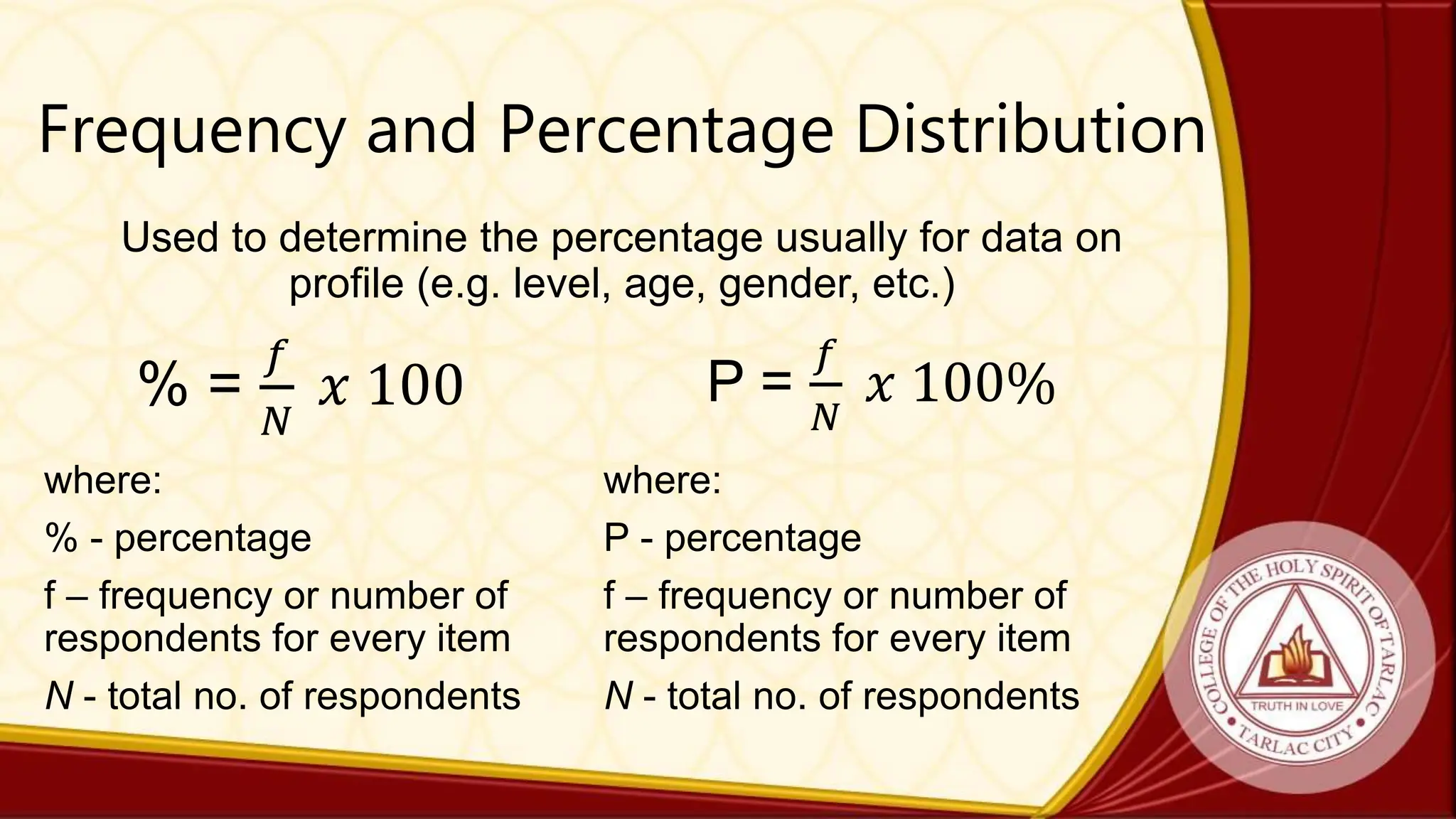
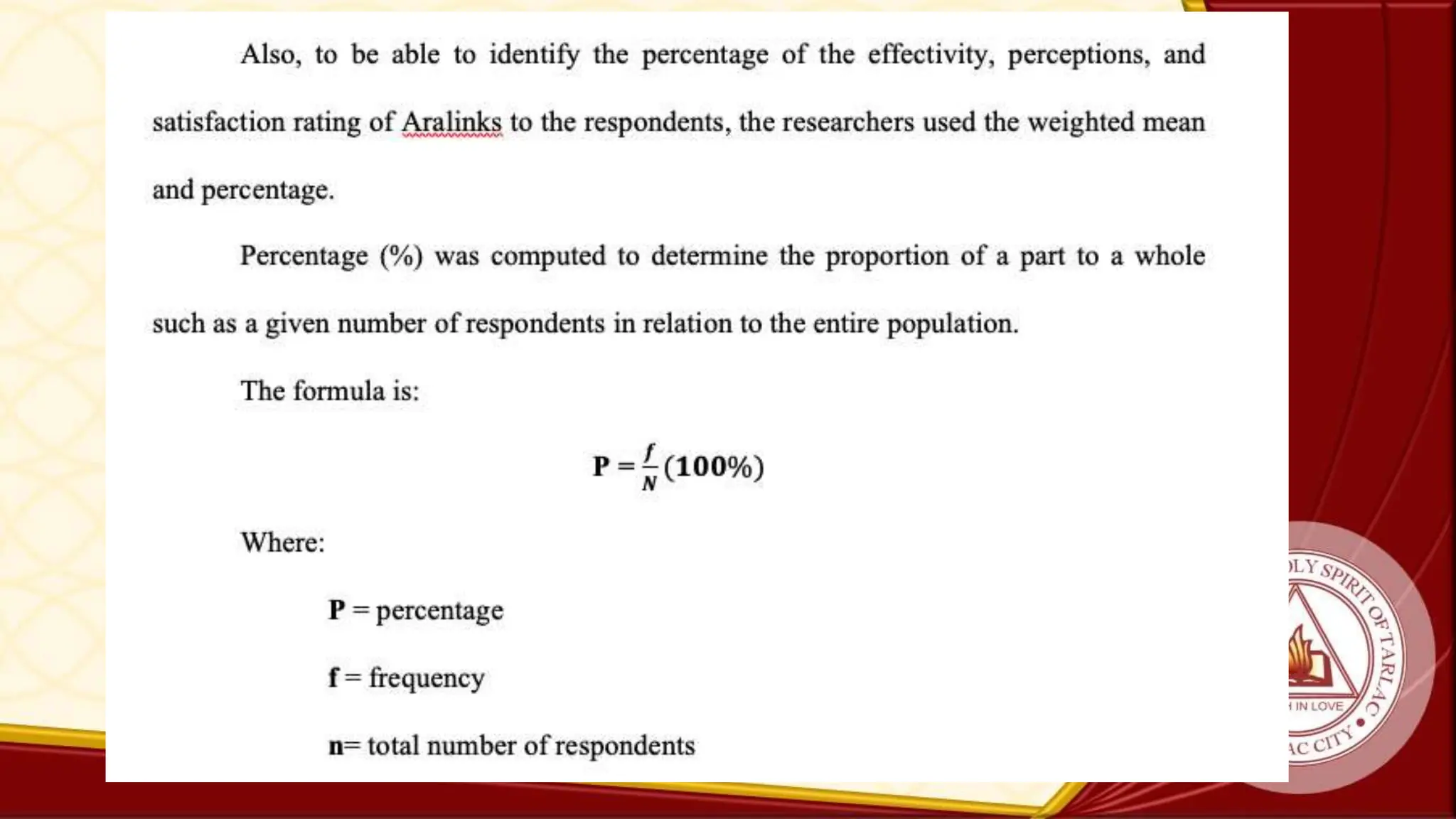
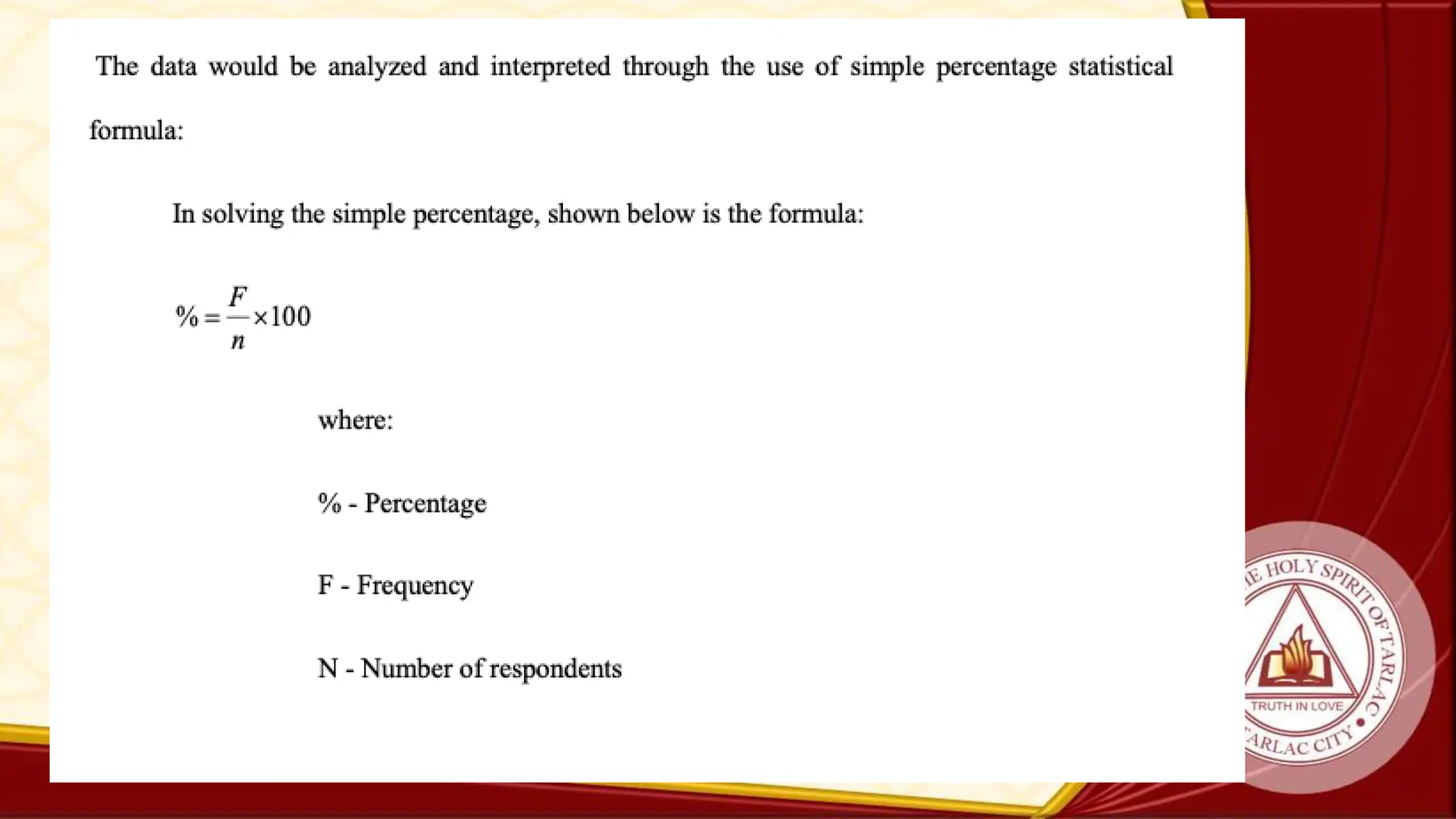
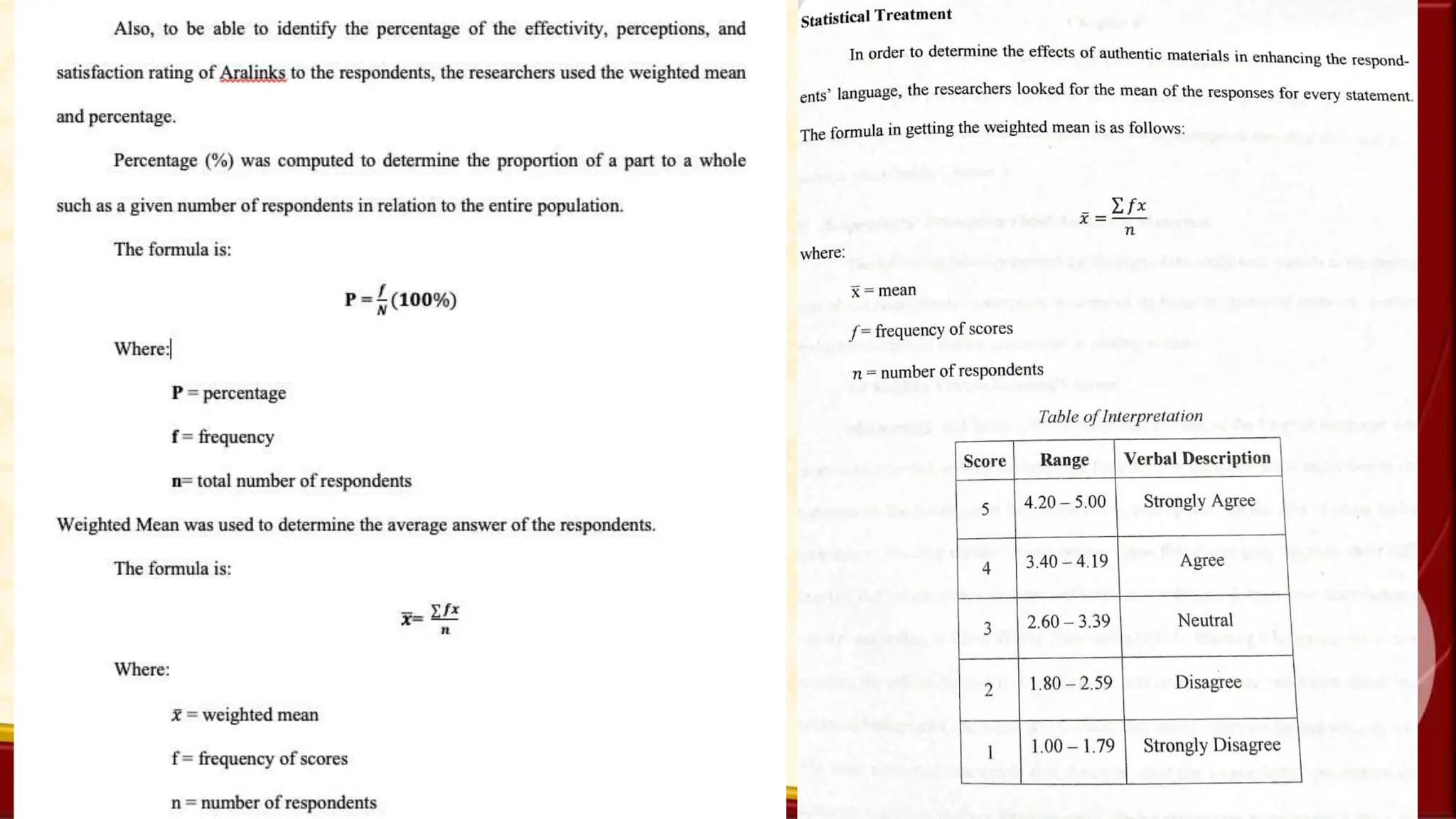
Frequency and Percentage Distribution
Used to determine the percentage usually for data on
profile (e.g. level, age, gender, etc.)
% =
𝑓
𝑁
𝑥 100
where:
% - percentage
f – frequency or number of
respondents for every item
N - total no. of respondents
P =
𝑓
𝑁
𝑥 100%
where:
P - percentage
f – frequency or number of
respondents for every item
N - total no. of respondents
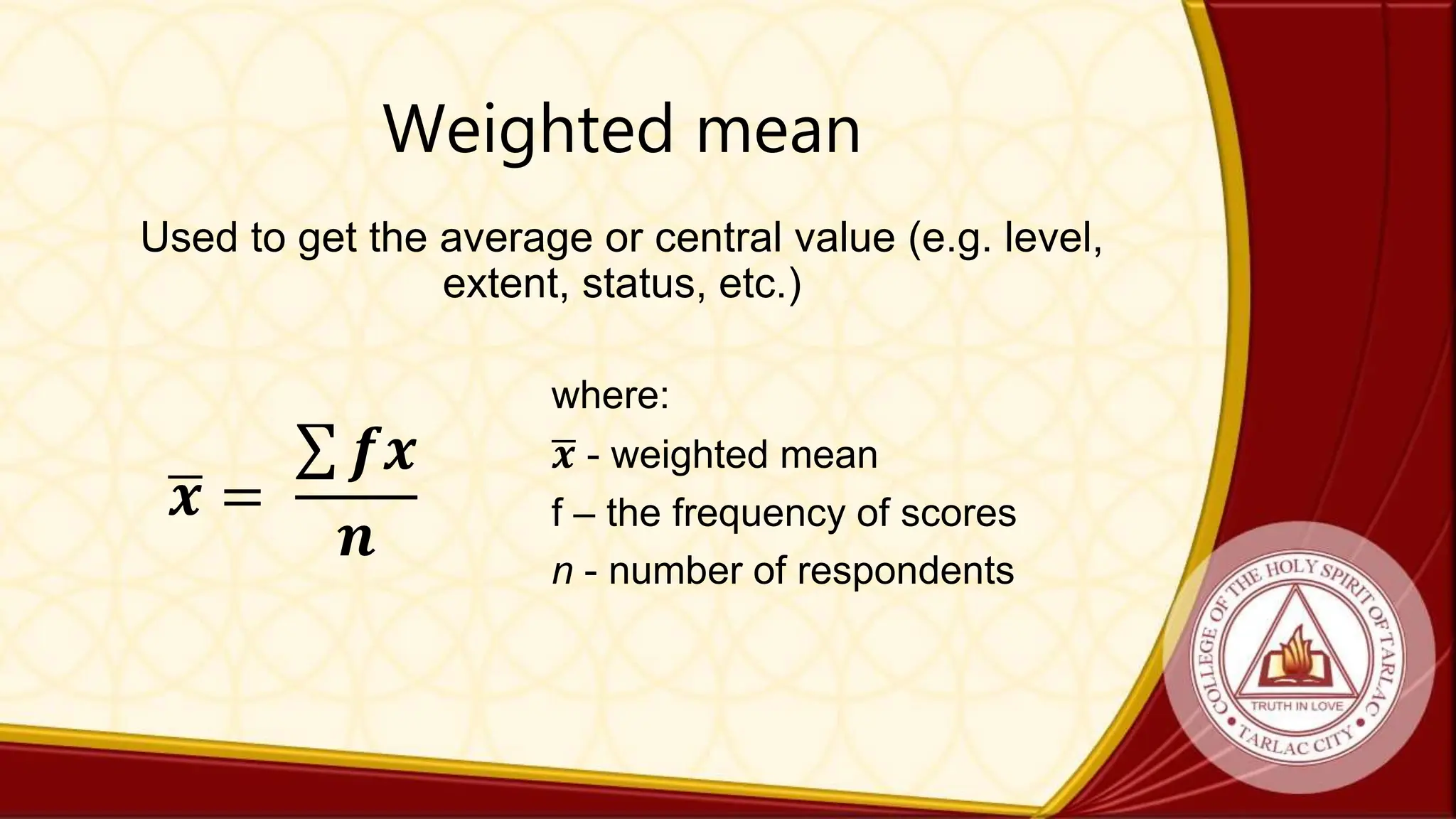
Weighted mean
Used to get the average or central value (e.g. level,
extent, status, etc.)
𝒙 =
𝒇𝒙
𝒏
where:
𝒙 - weighted mean
f – the frequency of scores
n - number of respondents
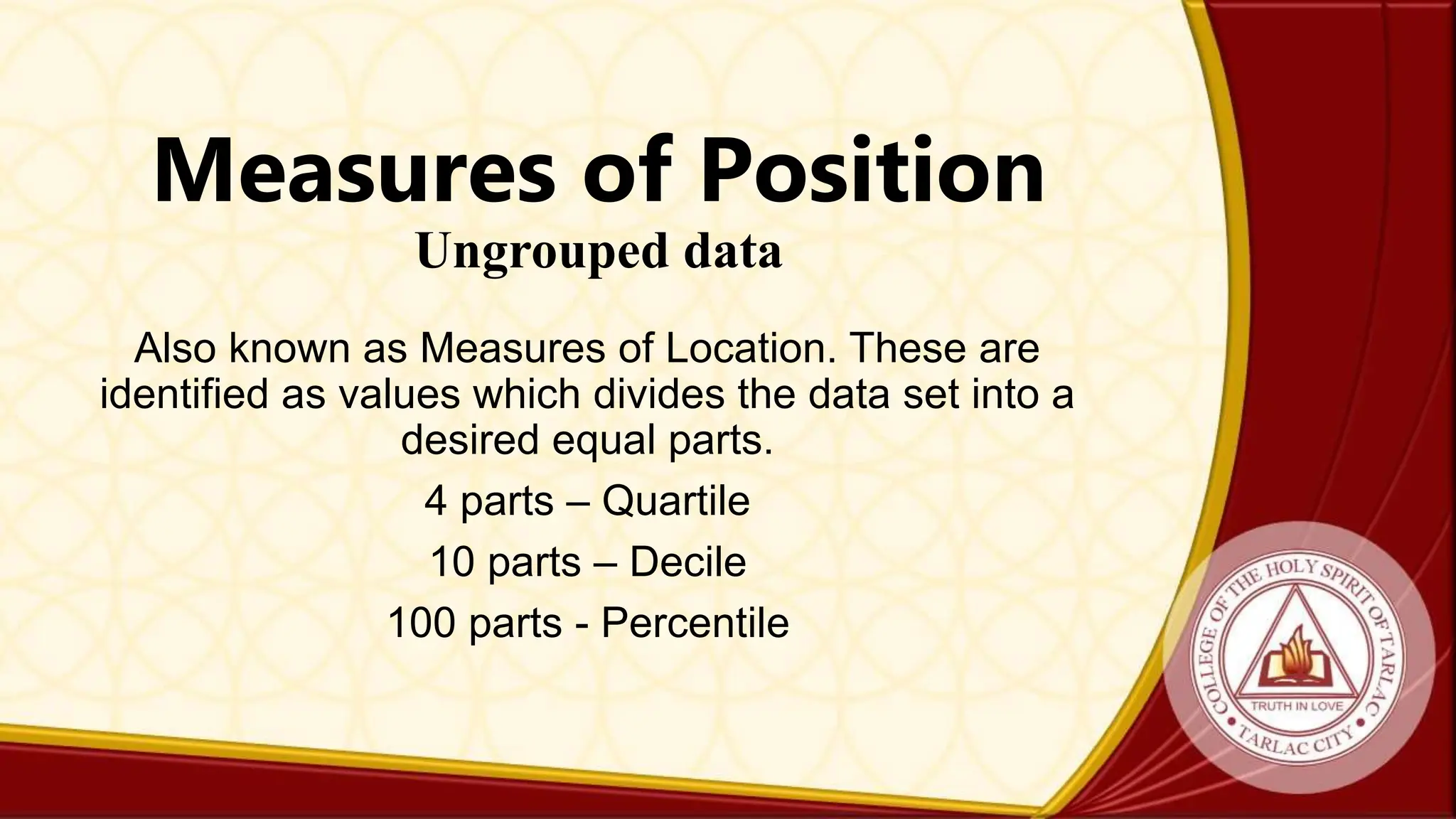
Measures of Position
Ungrouped data
Also known as Measures of Location. These are
identified as values which divides the data set into a
desired equal parts.
4 parts – Quartile
10 parts – Decile
100 parts - Percentile
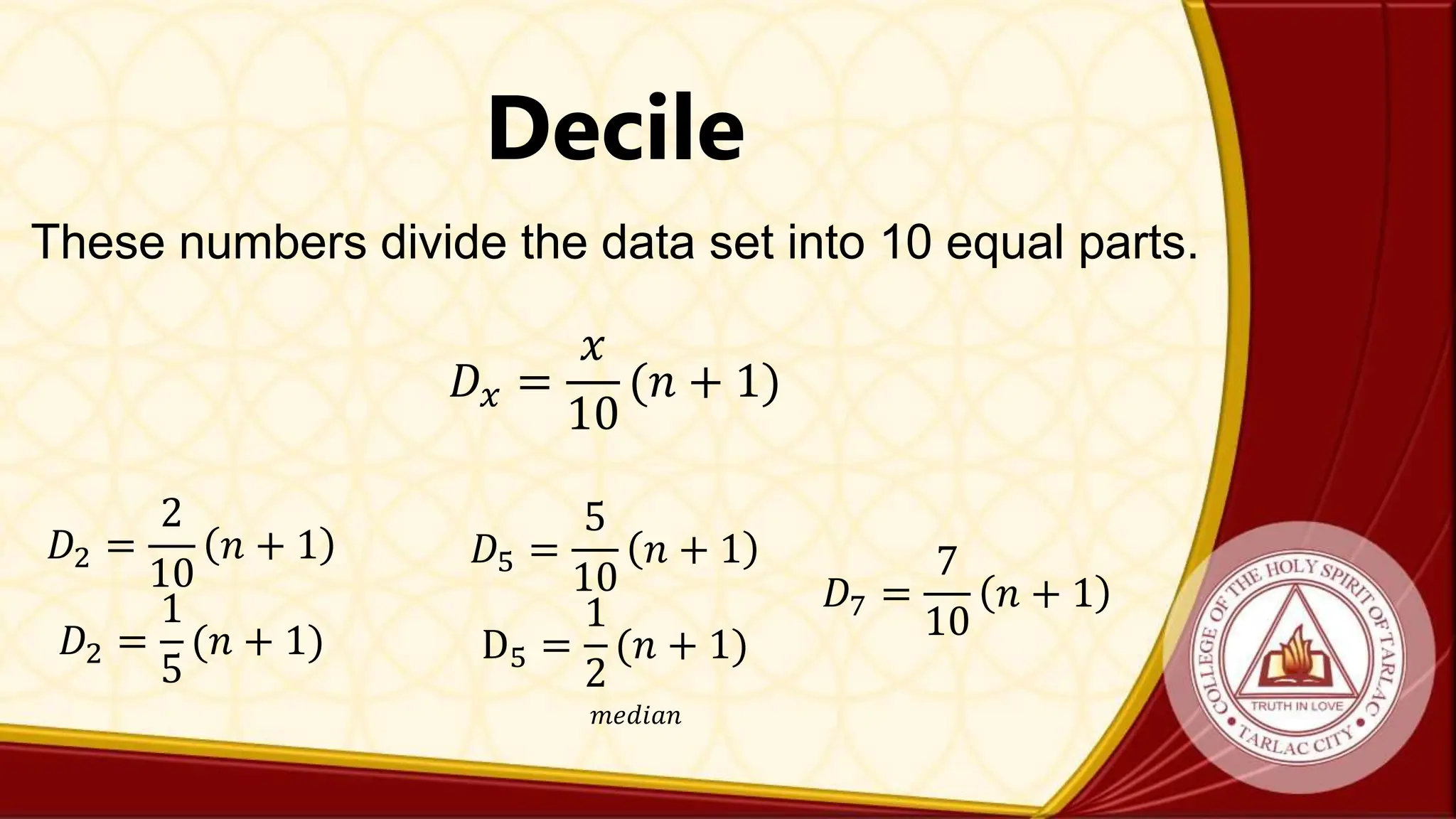
Decile
These numbers divide the data set into 10 equal parts.
𝐷𝑥 =
𝑥
10
(𝑛 + 1)
𝐷2 =
2
10
𝑛 + 1
𝐷2 =
1
5
(𝑛 + 1)
𝐷5 =
5
10
𝑛 + 1
D5 =
1
2
(𝑛 + 1)
𝑚𝑒𝑑𝑖𝑎𝑛
𝐷7 =
7
10
𝑛 + 1
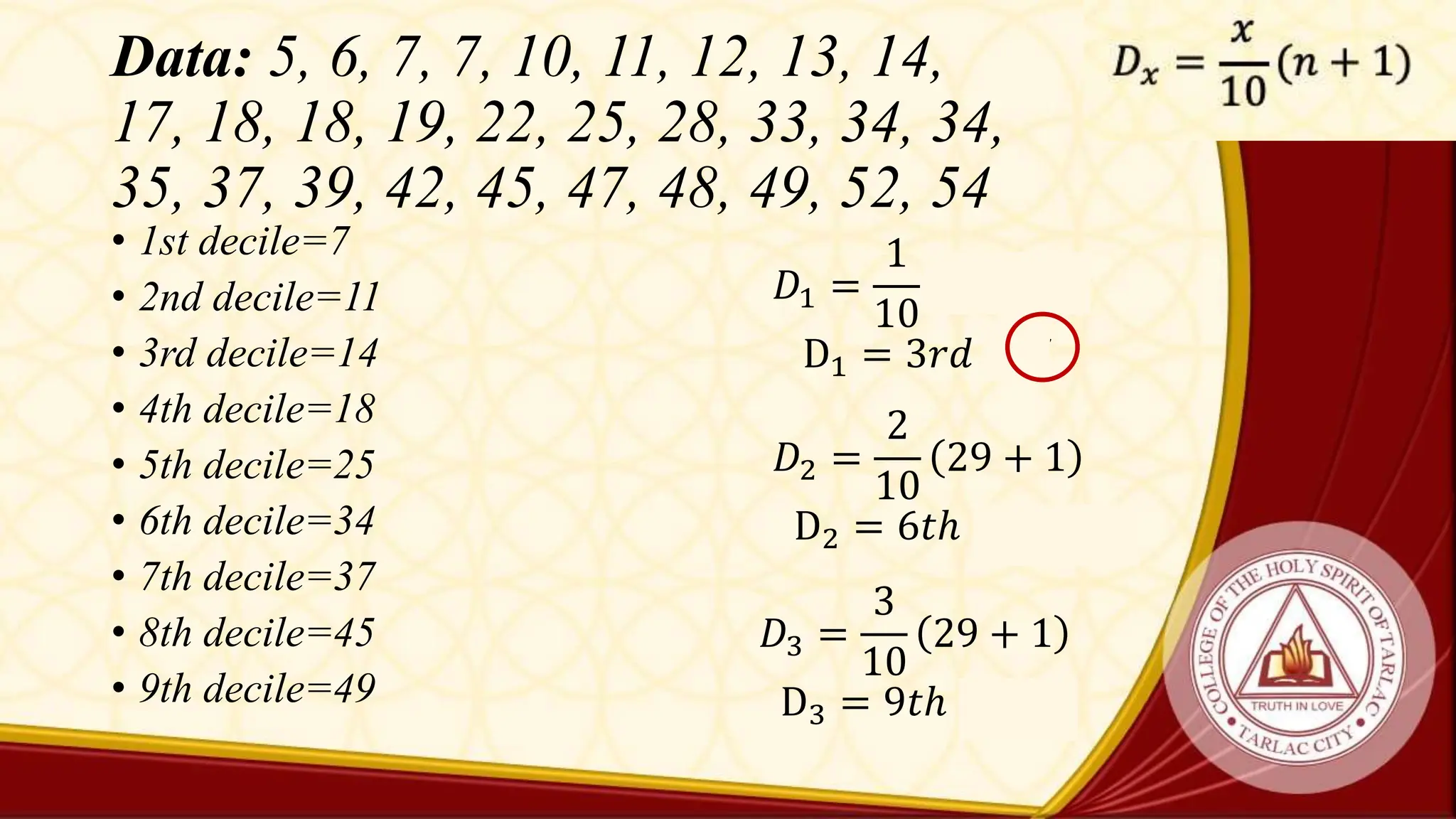
Data: 5, 6, 7, 7, 10, 11, 12, 13, 14,
17, 18, 18, 19, 22, 25, 28, 33, 34, 34,
35, 37, 39, 42, 45, 47, 48, 49, 52, 54
• 1st decile=7
• 2nd decile=11
• 3rd decile=14
• 4th decile=18
• 5th decile=25
• 6th decile=34
• 7th decile=37
• 8th decile=45
• 9th decile=49
𝐷1 =
1
10
29 + 1
D1 = 3𝑟𝑑 = 7
𝐷2 =
2
10
29 + 1
D2 = 6𝑡ℎ = 11
𝐷3 =
3
10
29 + 1
D3 = 9𝑡ℎ = 14
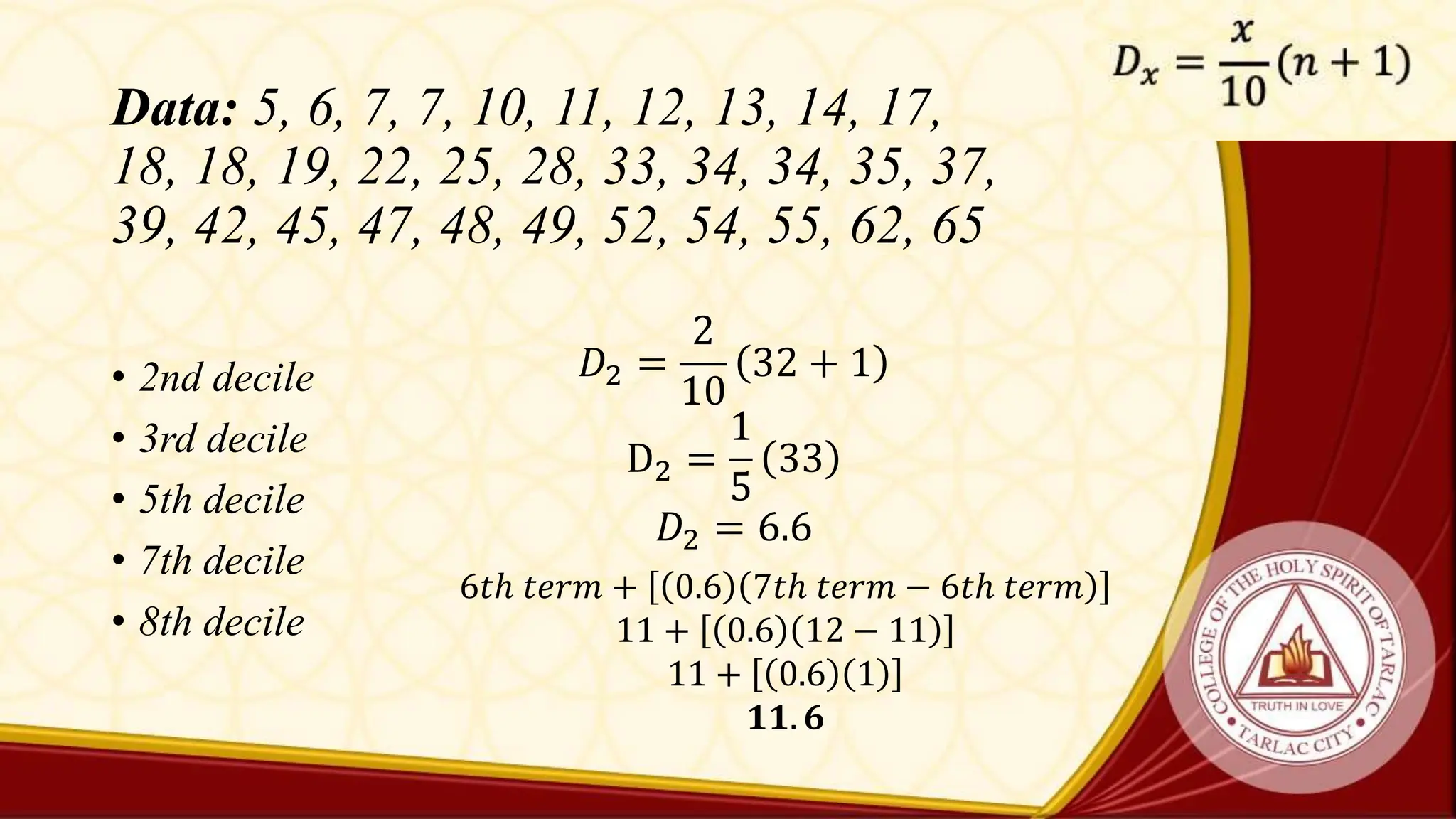
Data: 5, 6, 7, 7, 10, 11, 12, 13, 14, 17,
18, 18, 19, 22, 25, 28, 33, 34, 34, 35, 37,
39, 42, 45, 47, 48, 49, 52, 54, 55, 62, 65
• 2nd decile
• 3rd decile
• 5th decile
• 7th decile
• 8th decile
𝐷2 =
2
10
32 + 1
D2 =
1
5
33
𝐷2 = 6.6
6𝑡ℎ 𝑡𝑒𝑟𝑚 + 0.6 7𝑡ℎ 𝑡𝑒𝑟𝑚 − 6𝑡ℎ 𝑡𝑒𝑟𝑚
11 + 0.6 12 − 11
11 + 0.6 1
𝟏𝟏. 𝟔
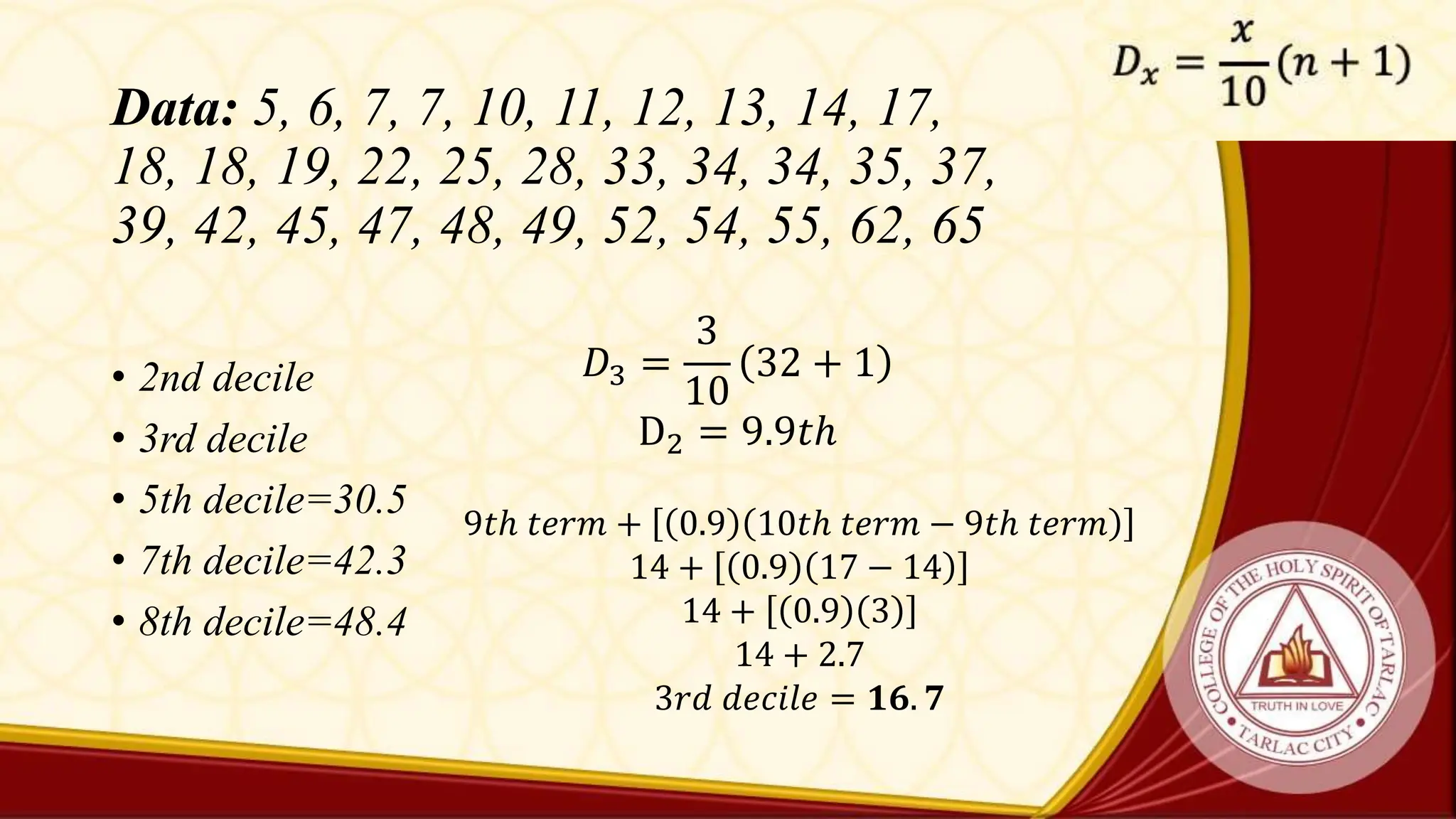
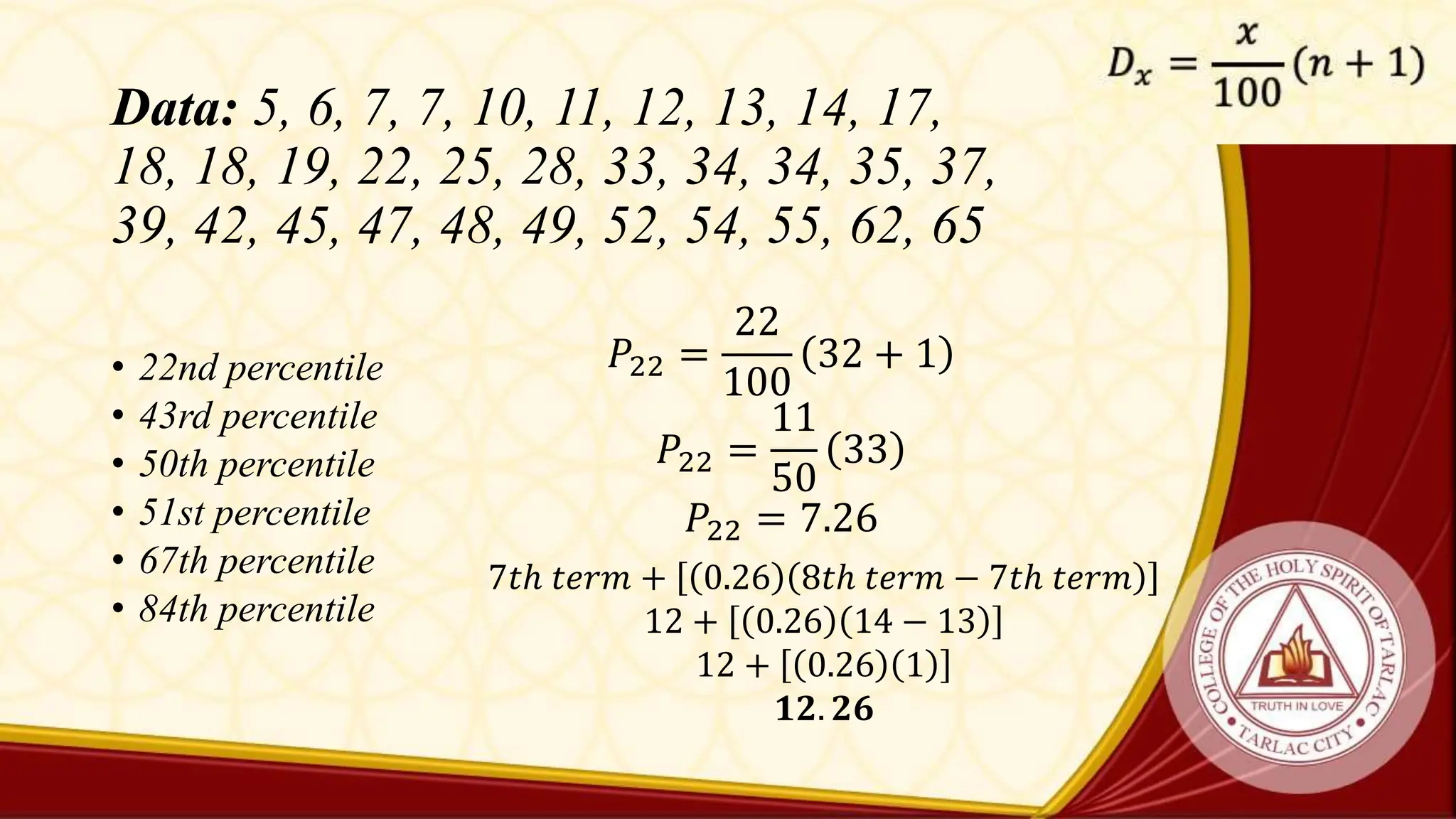
Data: 5, 6, 7, 7, 10, 11, 12, 13, 14, 17,
18, 18, 19, 22, 25, 28, 33, 34, 34, 35, 37,
39, 42, 45, 47, 48, 49, 52, 54, 55, 62, 65
• 2nd decile
• 3rd decile
• 5th decile=30.5
• 7th decile=42.3
• 8th decile=48.4
𝐷3 =
3
10
32 + 1
D2 = 9.9𝑡ℎ
9𝑡ℎ 𝑡𝑒𝑟𝑚 + 0.9 10𝑡ℎ 𝑡𝑒𝑟𝑚 − 9𝑡ℎ 𝑡𝑒𝑟𝑚
14 + 0.9 17 − 14
14 + 0.9 3
14 + 2.7
3𝑟𝑑 𝑑𝑒𝑐𝑖𝑙𝑒 = 𝟏𝟔. 𝟕
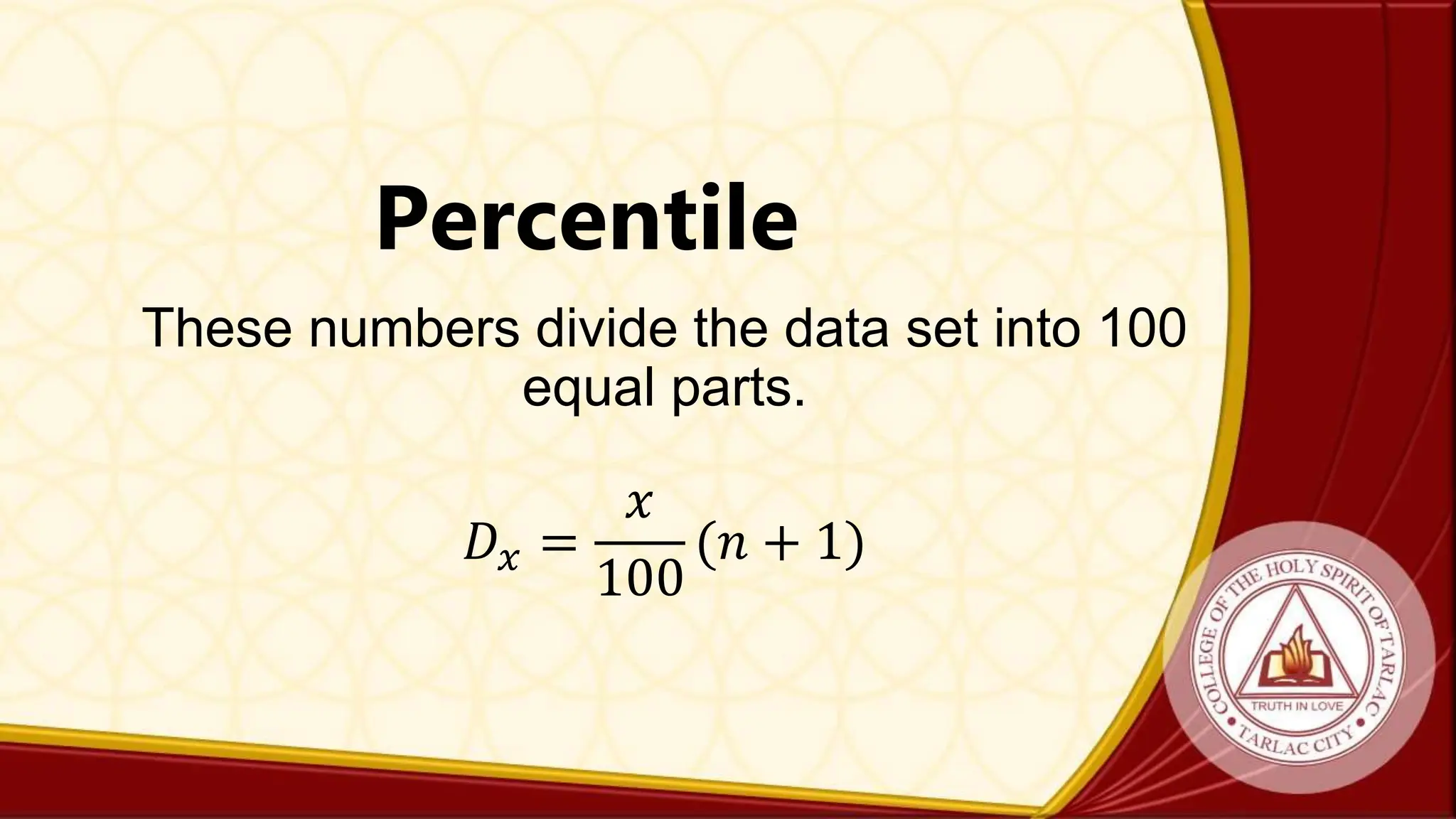
Percentile
These numbers divide the data set into 100
equal parts.
𝐷𝑥 =
𝑥
100
(𝑛 + 1)
Data: 5, 6, 7, 7, 10, 11, 12, 13, 14, 17,
18, 18, 19, 22, 25, 28, 33, 34, 34, 35, 37,
39, 42, 45, 47, 48, 49, 52, 54, 55, 62, 65
• 22nd percentile
• 43rd percentile
• 50th percentile
• 51st percentile
• 67th percentile
• 84th percentile
𝑃22 =
22
100
32 + 1
𝑃22 =
11
50
33
𝑃22 = 7.26
7𝑡ℎ 𝑡𝑒𝑟𝑚 + 0.26 8𝑡ℎ 𝑡𝑒𝑟𝑚 − 7𝑡ℎ 𝑡𝑒𝑟𝑚
12 + 0.26 14 − 13
12 + 0.26 1
𝟏𝟐. 𝟐𝟔
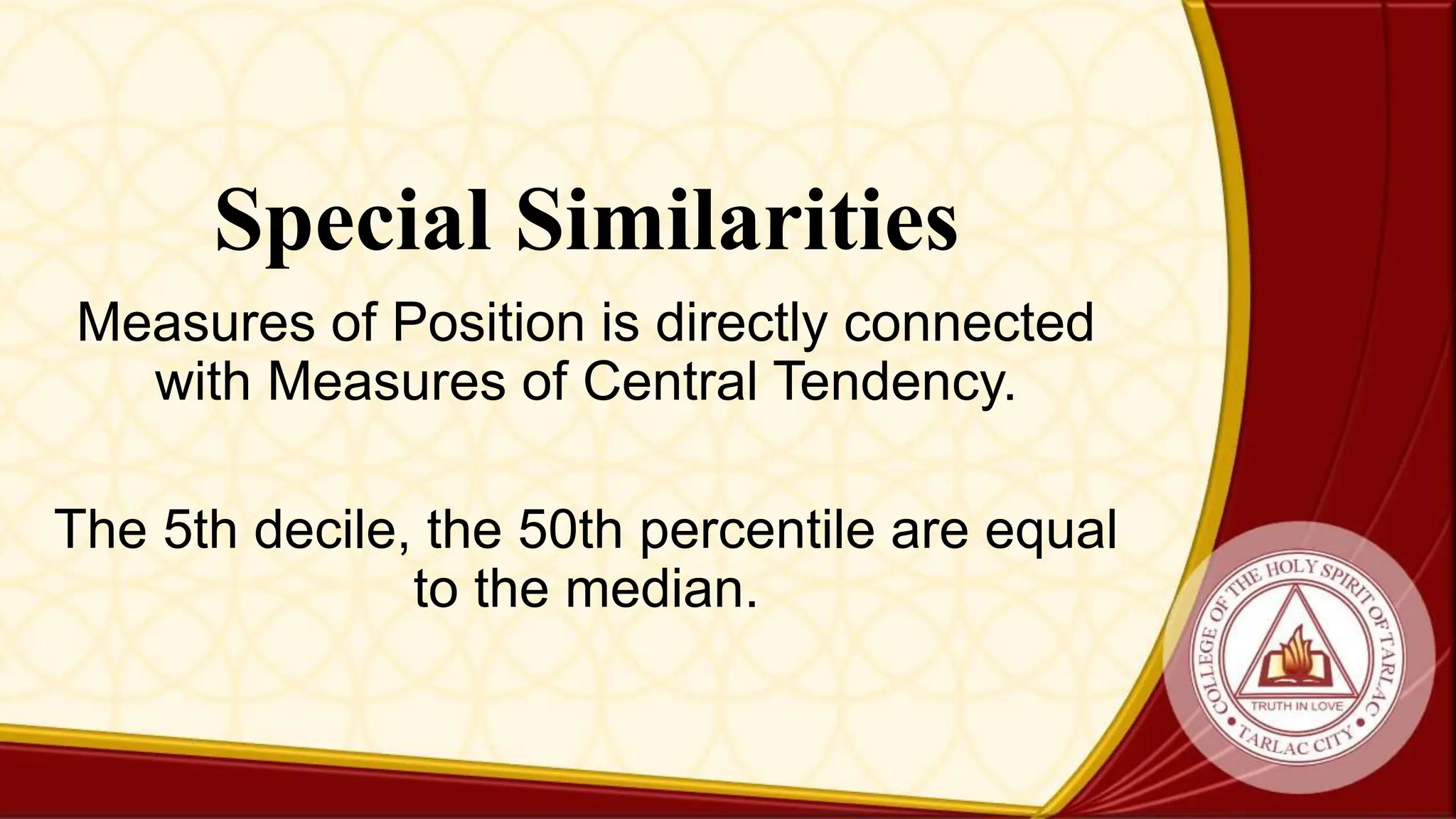
Special Similarities
Measures of Position is directly connected
with Measures of Central Tendency.
The 5th decile, the 50th percentile are equal
to the median.
Quartile
These numbers divide the data set into 4
equal parts.
UNGROUPED DATA
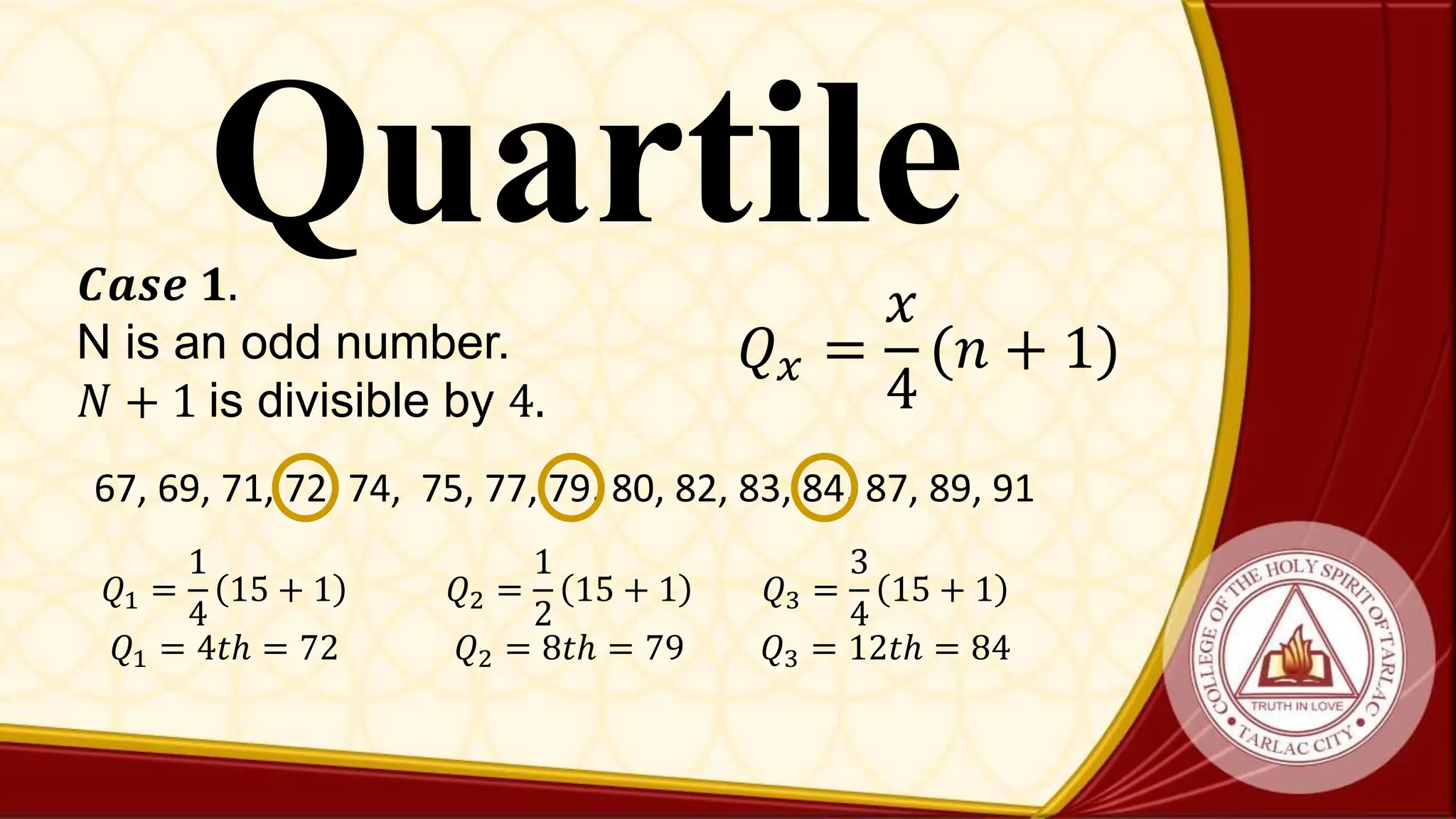
Quartile
𝑄𝑥 =
𝑥
4
(𝑛 + 1)
𝑪𝒂𝒔𝒆 𝟏.
N is an odd number.
𝑁 + 1 is divisible by 4.
67, 69, 71, 72, 74, 75, 77, 79, 80, 82, 83, 84, 87, 89, 91
𝑄1 =
1
4
15 + 1
𝑄1 = 4𝑡ℎ = 72
𝑄2 =
1
2
15 + 1
𝑄2 = 8𝑡ℎ = 79
𝑄3 =
3
4
15 + 1
𝑄3 = 12𝑡ℎ = 84
Quartile
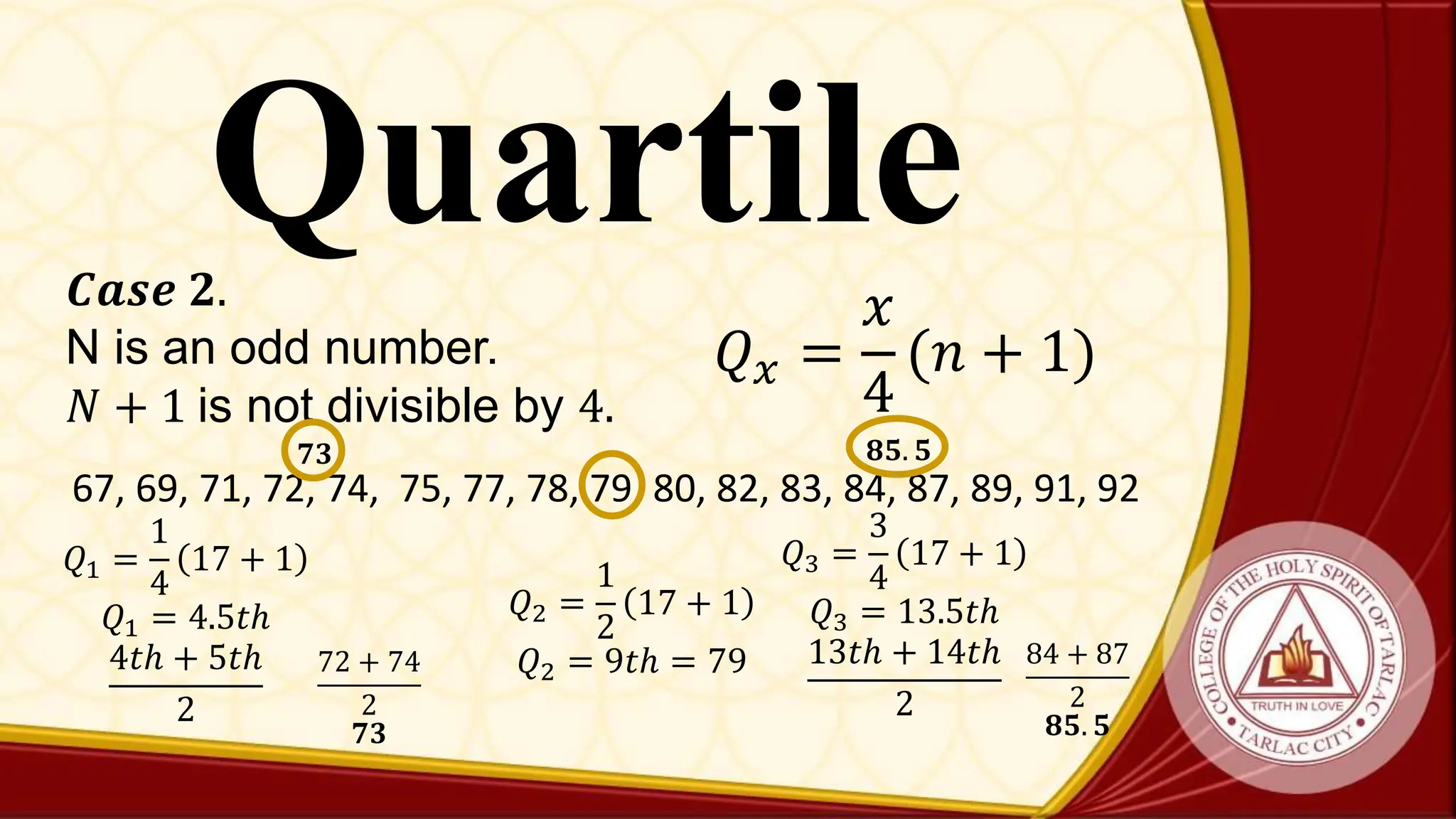
𝑄𝑥 =
𝑥
4
(𝑛 + 1)
𝑪𝒂𝒔𝒆 𝟐.
N is an odd number.
𝑁 + 1 is not divisible by 4.
67, 69, 71, 72, 74, 75, 77, 78, 79, 80, 82, 83, 84, 87, 89, 91, 92
𝑄1 =
1
4
17 + 1
𝑄1 = 4.5𝑡ℎ
4𝑡ℎ + 5𝑡ℎ
2
72 + 74
2
𝟕𝟑
𝟕𝟑
𝑄2 =
1
2
17 + 1
𝑄2 = 9𝑡ℎ = 79
𝑄3 =
3
4
17 + 1
𝑄3 = 13.5𝑡ℎ
13𝑡ℎ + 14𝑡ℎ
2
84 + 87
2
𝟖𝟓. 𝟓
𝟖𝟓. 𝟓
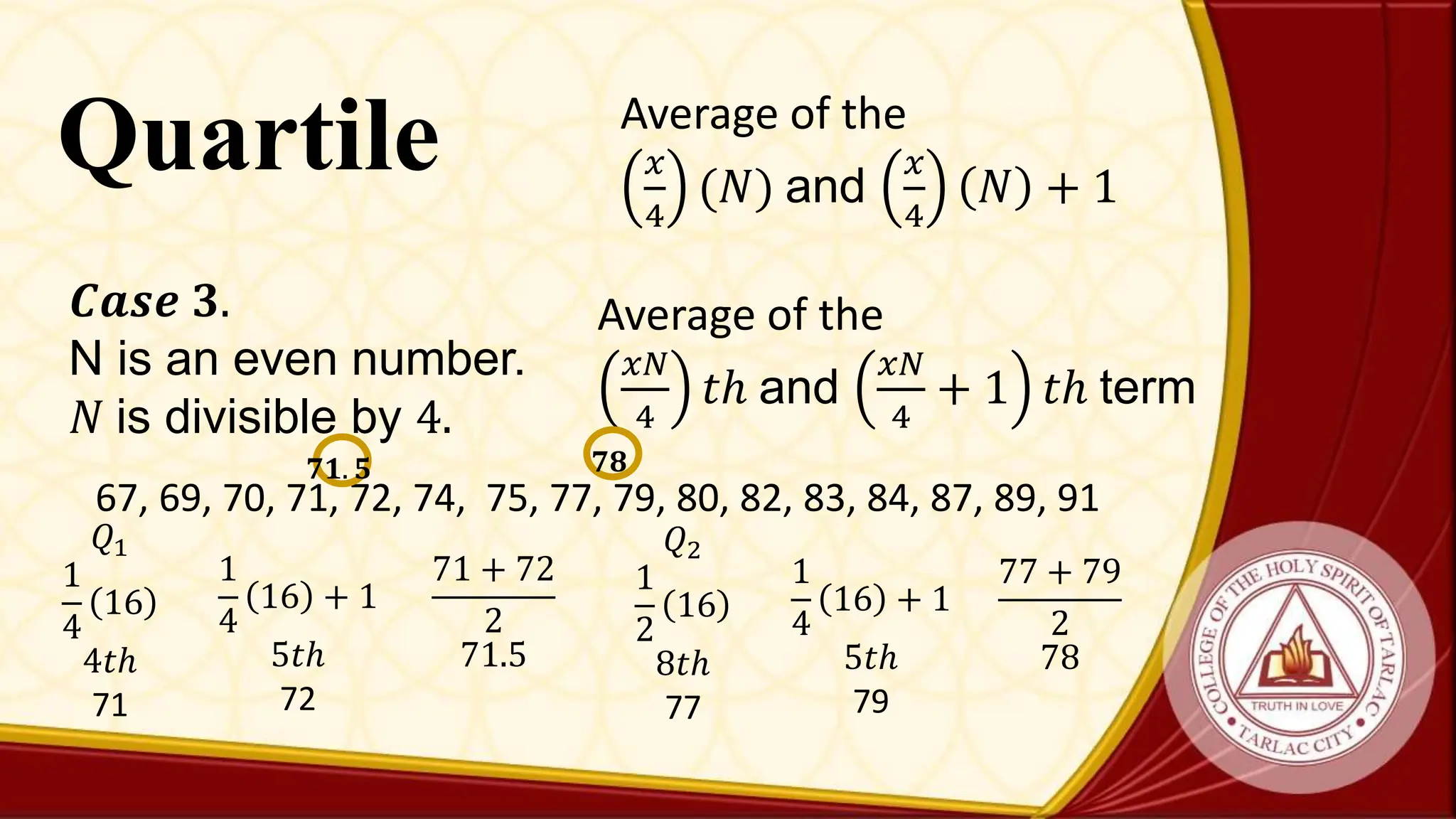
Quartile
Average of the
𝑥𝑁
4
𝑡ℎ and
𝑥𝑁
4
+ 1 𝑡ℎ term
𝑪𝒂𝒔𝒆 𝟑.
N is an even number.
𝑁 is divisible by 4.
67, 69, 70, 71, 72, 74, 75, 77, 79, 80, 82, 83, 84, 87, 89, 91
𝑄1
1
4
16
4𝑡ℎ
71
𝟕𝟏. 𝟓
1
4
16 + 1
5𝑡ℎ
72
71 + 72
2
71.5
𝑄2
1
2
16
8𝑡ℎ
77
1
4
16 + 1
5𝑡ℎ
79
77 + 79
2
78
𝟕𝟖
Average of the
𝑥
4
(𝑁) and
𝑥
4
𝑁 + 1
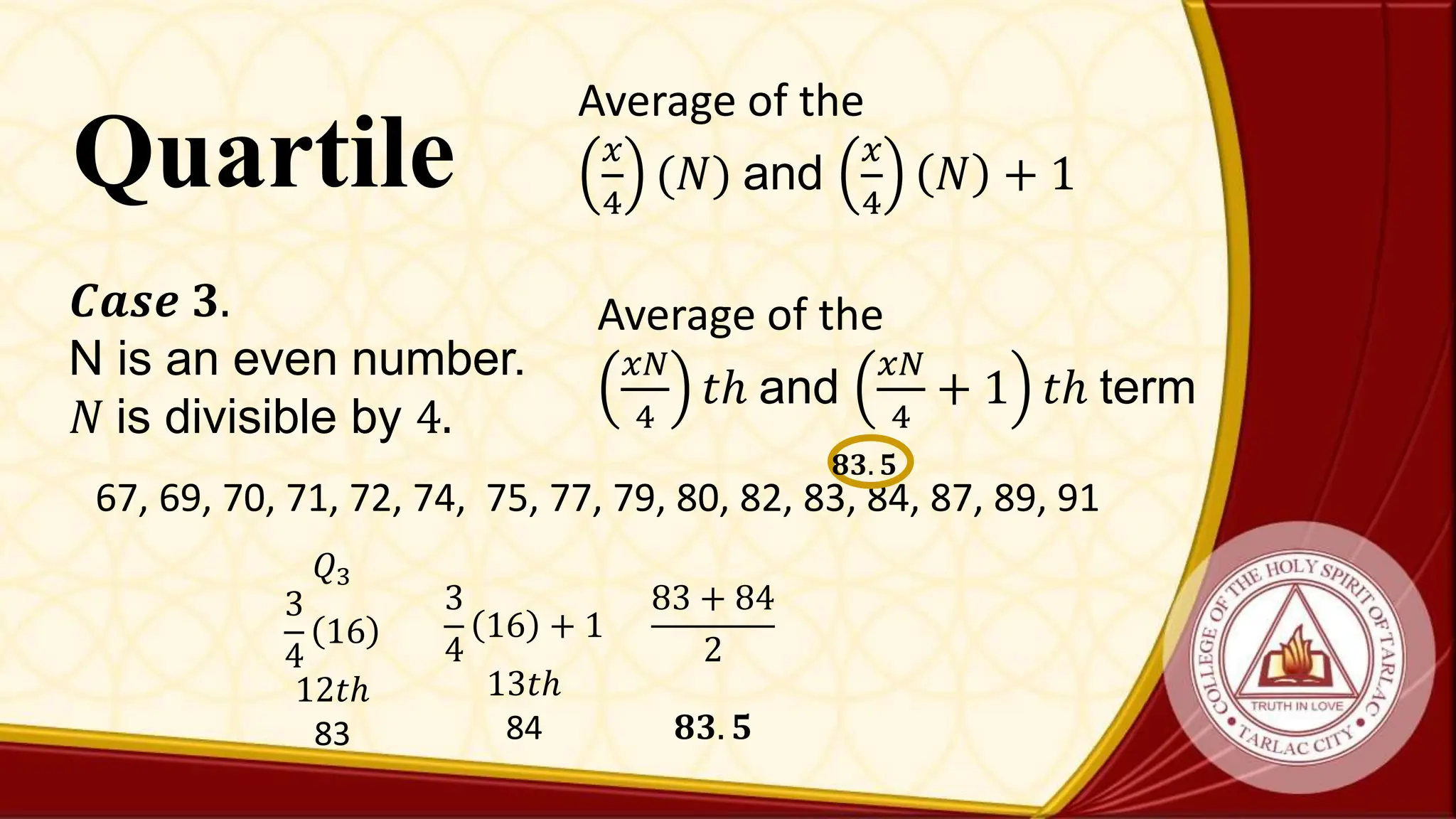
Quartile
Average of the
𝑥𝑁
4
𝑡ℎ and
𝑥𝑁
4
+ 1 𝑡ℎ term
𝑪𝒂𝒔𝒆 𝟑.
N is an even number.
𝑁 is divisible by 4.
67, 69, 70, 71, 72, 74, 75, 77, 79, 80, 82, 83, 84, 87, 89, 91
𝑄3
3
4
16
12𝑡ℎ
83
𝟖𝟑. 𝟓
3
4
16 + 1
13𝑡ℎ
84
83 + 84
2
𝟖𝟑. 𝟓
Average of the
𝑥
4
(𝑁) and
𝑥
4
𝑁 + 1
Quartile
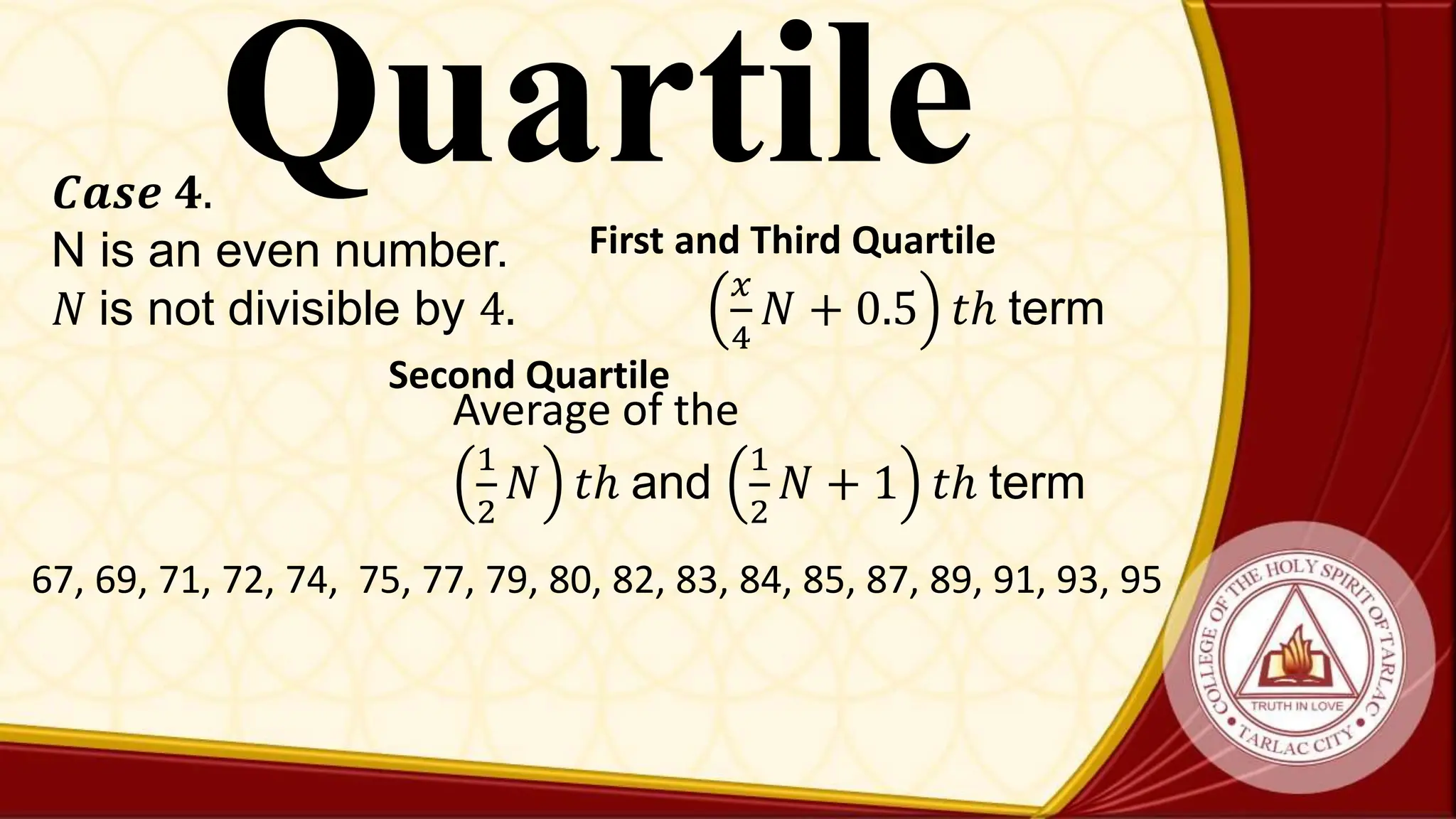
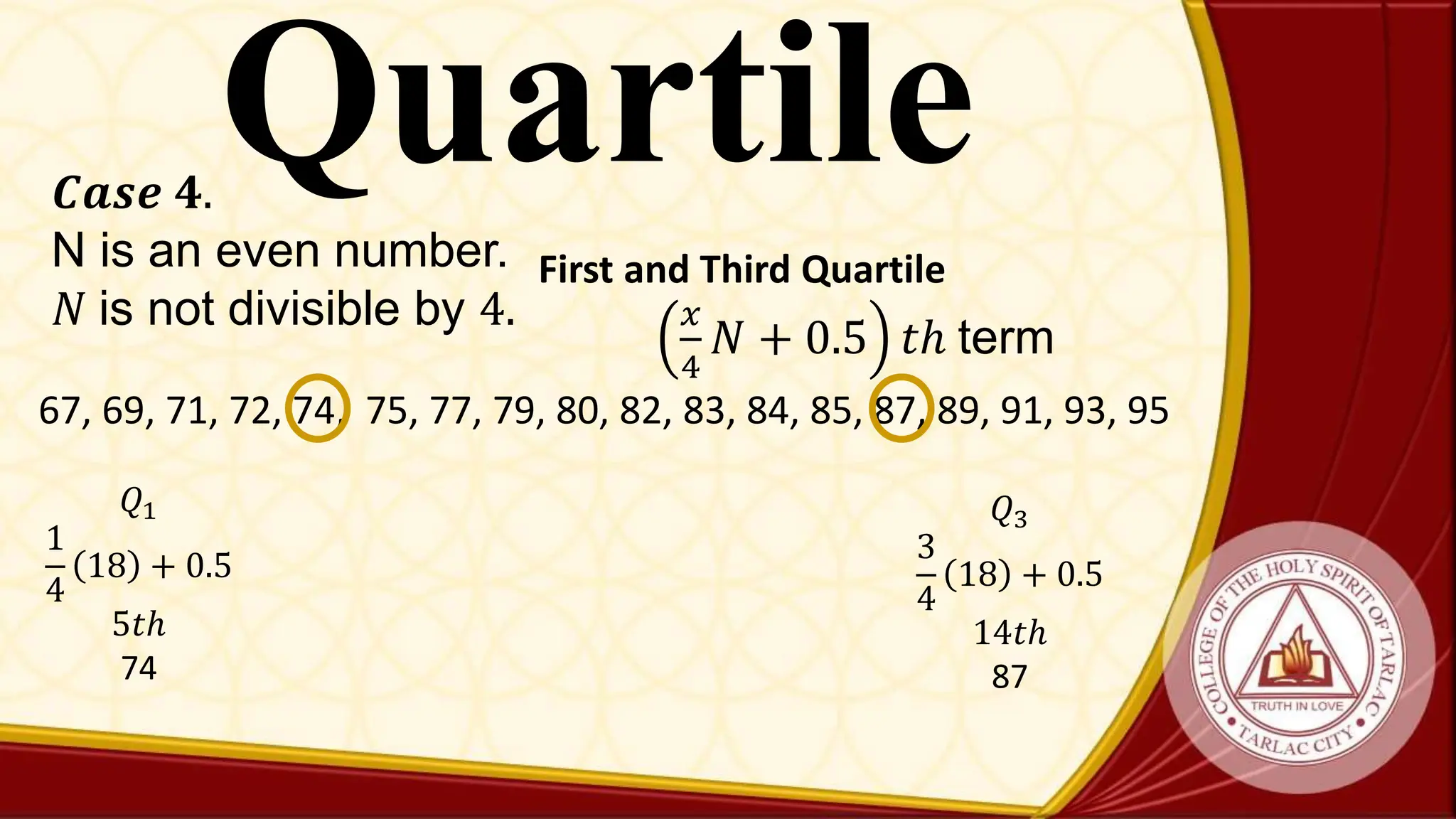
𝑪𝒂𝒔𝒆 𝟒.
N is an even number.
𝑁 is not divisible by 4.
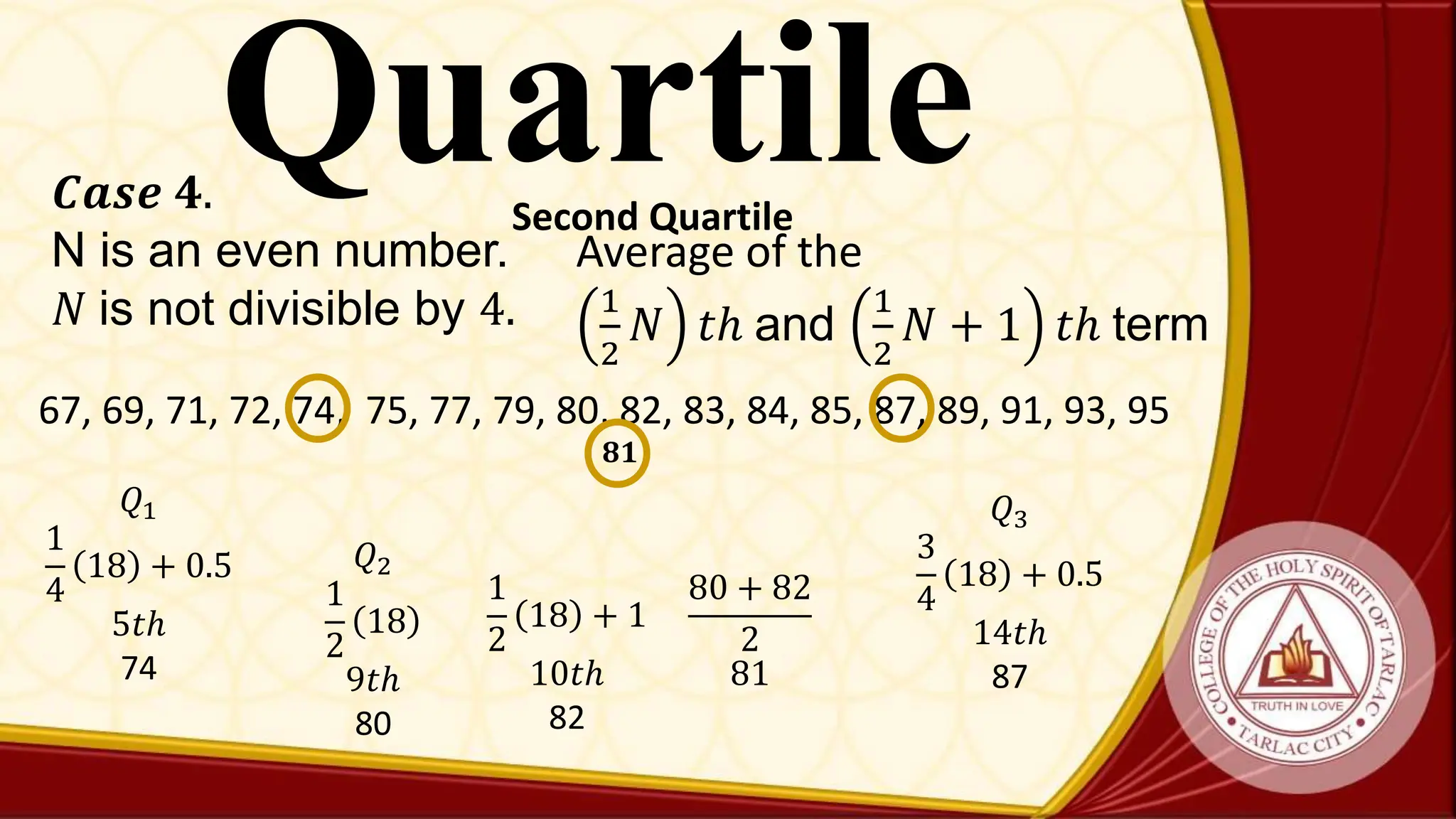
Average of the
1
2
𝑁 𝑡ℎ and
1
2
𝑁 + 1 𝑡ℎ term
Second Quartile
𝑥
4
𝑁 + 0.5 𝑡ℎ term
First and Third Quartile
67, 69, 71, 72, 74, 75, 77, 79, 80, 82, 83, 84, 85, 87, 89, 91, 93, 95
Quartile
𝑪𝒂𝒔𝒆 𝟒.
N is an even number.
𝑁 is not divisible by 4. 𝑥
4
𝑁 + 0.5 𝑡ℎ term
First and Third Quartile
67, 69, 71, 72, 74, 75, 77, 79, 80, 82, 83, 84, 85, 87, 89, 91, 93, 95
𝑄1
1
4
18 + 0.5
5𝑡ℎ
74
𝑄3
3
4
18 + 0.5
14𝑡ℎ
87
Quartile
𝑪𝒂𝒔𝒆 𝟒.
N is an even number.
𝑁 is not divisible by 4.
Average of the
1
2
𝑁 𝑡ℎ and
1
2
𝑁 + 1 𝑡ℎ term
Second Quartile
67, 69, 71, 72, 74, 75, 77, 79, 80, 82, 83, 84, 85, 87, 89, 91, 93, 95
𝑄1
1
4
18 + 0.5
5𝑡ℎ
74
𝑄3
3
4
18 + 0.5
14𝑡ℎ
87
𝑄2
1
2
18
9𝑡ℎ
80
𝟖𝟏
1
2
18 + 1
10𝑡ℎ
82
80 + 82
2
81
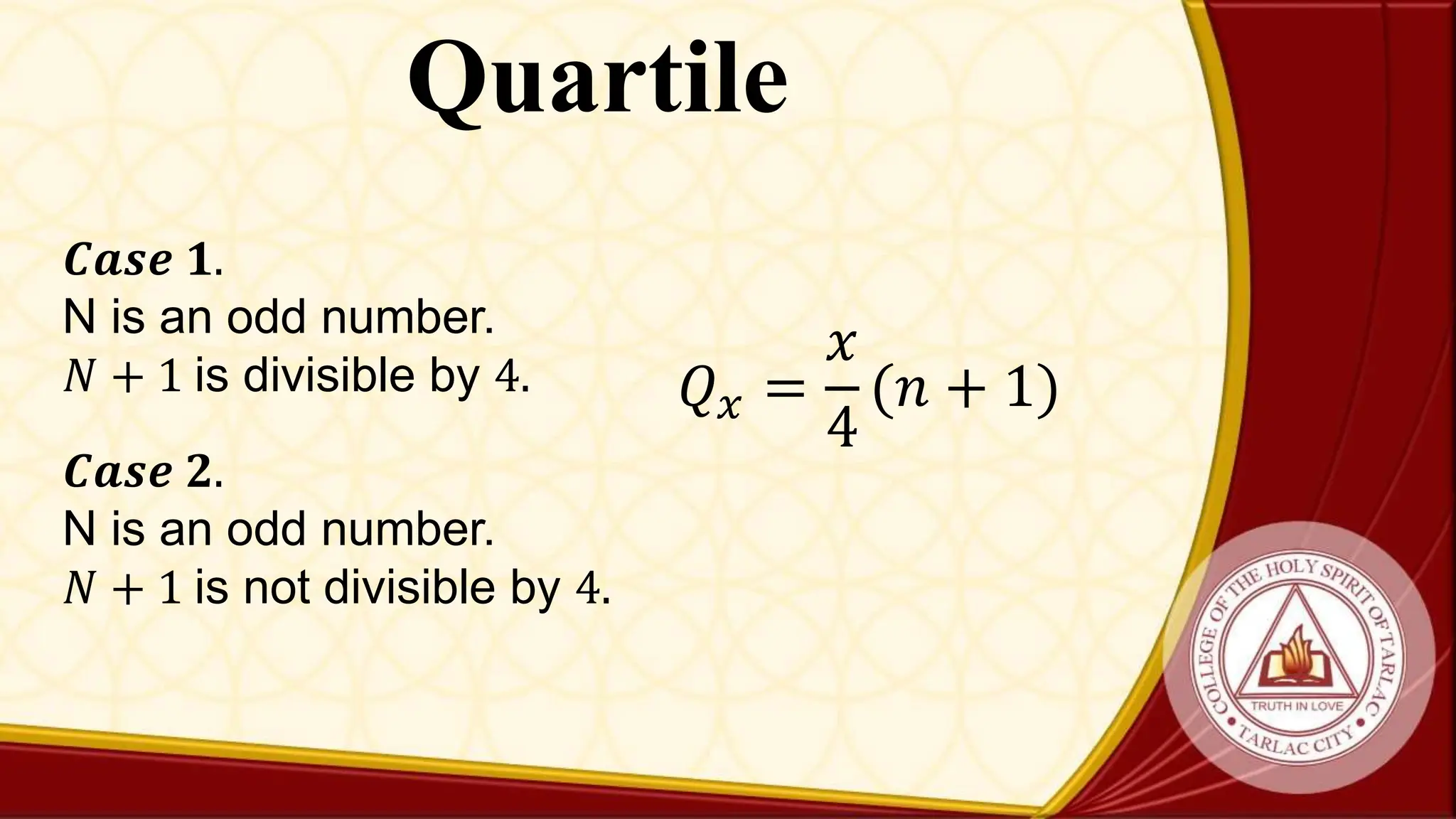
Quartile
𝑄𝑥 =
𝑥
4
(𝑛 + 1)
𝑪𝒂𝒔𝒆 𝟏.
N is an odd number.
𝑁 + 1 is divisible by 4.
𝑪𝒂𝒔𝒆 𝟐.
N is an odd number.
𝑁 + 1 is not divisible by 4.
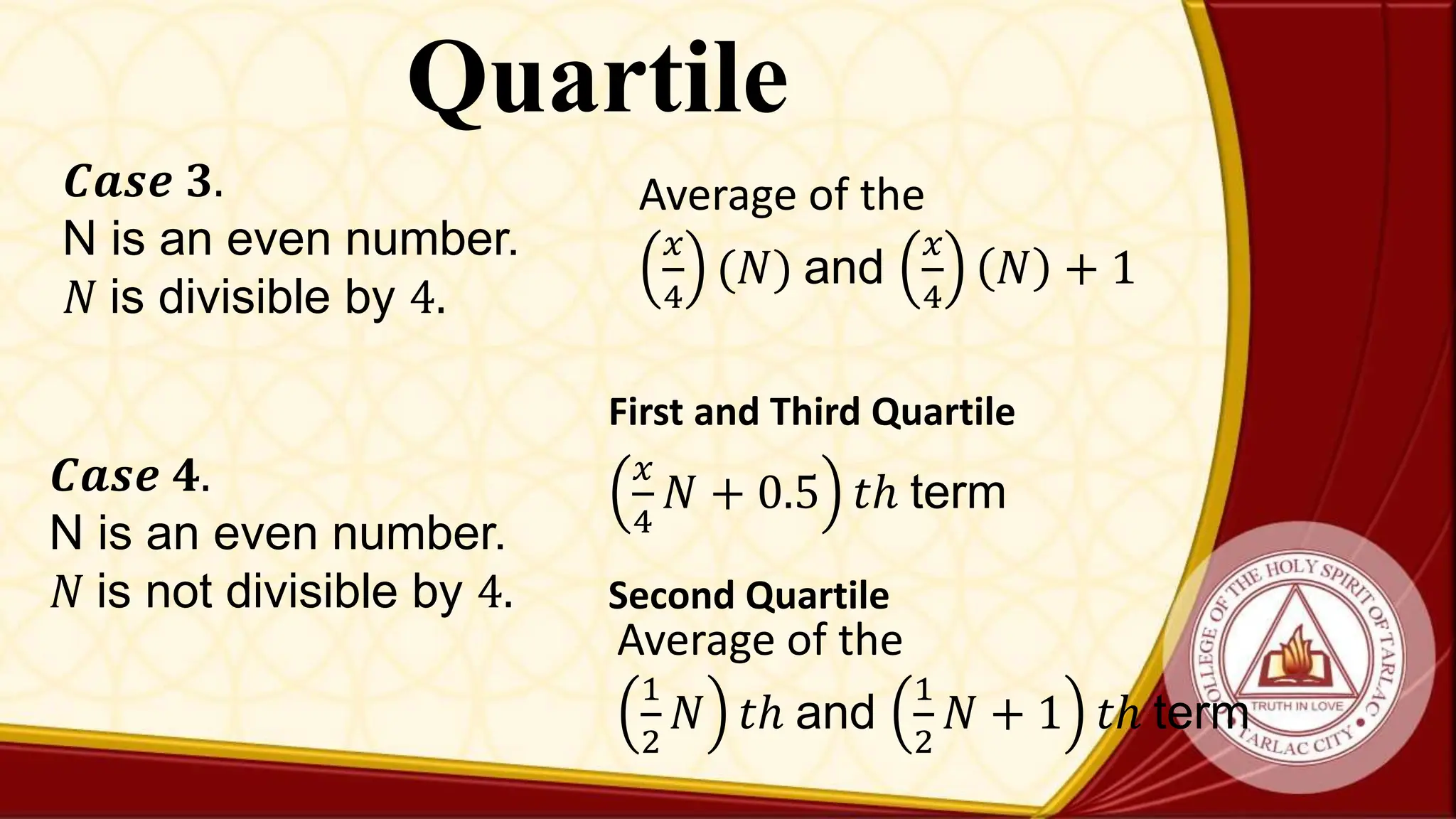
Quartile
𝑪𝒂𝒔𝒆 𝟑.
N is an even number.
𝑁 is divisible by 4.
Average of the
𝑥
4
(𝑁) and
𝑥
4
𝑁 + 1
𝑪𝒂𝒔𝒆 𝟒.
N is an even number.
𝑁 is not divisible by 4.
Average of the
1
2
𝑁 𝑡ℎ and
1
2
𝑁 + 1 𝑡ℎ term
Second Quartile
𝑥
4
𝑁 + 0.5 𝑡ℎ term
First and Third Quartile
This is a PPTX on Measures of Position for Math 10

This is a PPTX on Measures of Position for Math 10

  • 2.
  • 3.
    Frequency and PercentageDistribution Used to determine the percentage usually for data on profile (e.g. level, age, gender, etc.) % = 𝑓 𝑁 𝑥 100 where: % - percentage f – frequency or number of respondents for every item N - total no. of respondents P = 𝑓 𝑁 𝑥 100% where: P - percentage f – frequency or number of respondents for every item N - total no. of respondents
  • 7.
    Weighted mean Used toget the average or central value (e.g. level, extent, status, etc.) 𝒙 = 𝒇𝒙 𝒏 where: 𝒙 - weighted mean f – the frequency of scores n - number of respondents
  • 14.
    Measures of Position Ungroupeddata Also known as Measures of Location. These are identified as values which divides the data set into a desired equal parts. 4 parts – Quartile 10 parts – Decile 100 parts - Percentile
  • 15.
    Decile These numbers dividethe data set into 10 equal parts. 𝐷𝑥 = 𝑥 10 (𝑛 + 1) 𝐷2 = 2 10 𝑛 + 1 𝐷2 = 1 5 (𝑛 + 1) 𝐷5 = 5 10 𝑛 + 1 D5 = 1 2 (𝑛 + 1) 𝑚𝑒𝑑𝑖𝑎𝑛 𝐷7 = 7 10 𝑛 + 1
  • 16.
    Data: 5, 6,7, 7, 10, 11, 12, 13, 14, 17, 18, 18, 19, 22, 25, 28, 33, 34, 34, 35, 37, 39, 42, 45, 47, 48, 49, 52, 54 • 1st decile=7 • 2nd decile=11 • 3rd decile=14 • 4th decile=18 • 5th decile=25 • 6th decile=34 • 7th decile=37 • 8th decile=45 • 9th decile=49 𝐷1 = 1 10 29 + 1 D1 = 3𝑟𝑑 = 7 𝐷2 = 2 10 29 + 1 D2 = 6𝑡ℎ = 11 𝐷3 = 3 10 29 + 1 D3 = 9𝑡ℎ = 14
  • 17.
    Data: 5, 6,7, 7, 10, 11, 12, 13, 14, 17, 18, 18, 19, 22, 25, 28, 33, 34, 34, 35, 37, 39, 42, 45, 47, 48, 49, 52, 54, 55, 62, 65 • 2nd decile • 3rd decile • 5th decile • 7th decile • 8th decile 𝐷2 = 2 10 32 + 1 D2 = 1 5 33 𝐷2 = 6.6 6𝑡ℎ 𝑡𝑒𝑟𝑚 + 0.6 7𝑡ℎ 𝑡𝑒𝑟𝑚 − 6𝑡ℎ 𝑡𝑒𝑟𝑚 11 + 0.6 12 − 11 11 + 0.6 1 𝟏𝟏. 𝟔
  • 18.
    Data: 5, 6,7, 7, 10, 11, 12, 13, 14, 17, 18, 18, 19, 22, 25, 28, 33, 34, 34, 35, 37, 39, 42, 45, 47, 48, 49, 52, 54, 55, 62, 65 • 2nd decile • 3rd decile • 5th decile=30.5 • 7th decile=42.3 • 8th decile=48.4 𝐷3 = 3 10 32 + 1 D2 = 9.9𝑡ℎ 9𝑡ℎ 𝑡𝑒𝑟𝑚 + 0.9 10𝑡ℎ 𝑡𝑒𝑟𝑚 − 9𝑡ℎ 𝑡𝑒𝑟𝑚 14 + 0.9 17 − 14 14 + 0.9 3 14 + 2.7 3𝑟𝑑 𝑑𝑒𝑐𝑖𝑙𝑒 = 𝟏𝟔. 𝟕
  • 19.
    Percentile These numbers dividethe data set into 100 equal parts. 𝐷𝑥 = 𝑥 100 (𝑛 + 1)
  • 20.
    Data: 5, 6,7, 7, 10, 11, 12, 13, 14, 17, 18, 18, 19, 22, 25, 28, 33, 34, 34, 35, 37, 39, 42, 45, 47, 48, 49, 52, 54, 55, 62, 65 • 22nd percentile • 43rd percentile • 50th percentile • 51st percentile • 67th percentile • 84th percentile 𝑃22 = 22 100 32 + 1 𝑃22 = 11 50 33 𝑃22 = 7.26 7𝑡ℎ 𝑡𝑒𝑟𝑚 + 0.26 8𝑡ℎ 𝑡𝑒𝑟𝑚 − 7𝑡ℎ 𝑡𝑒𝑟𝑚 12 + 0.26 14 − 13 12 + 0.26 1 𝟏𝟐. 𝟐𝟔
  • 21.
    Special Similarities Measures ofPosition is directly connected with Measures of Central Tendency. The 5th decile, the 50th percentile are equal to the median.
  • 23.
    Quartile These numbers dividethe data set into 4 equal parts. UNGROUPED DATA
  • 24.
    Quartile 𝑄𝑥 = 𝑥 4 (𝑛 +1) 𝑪𝒂𝒔𝒆 𝟏. N is an odd number. 𝑁 + 1 is divisible by 4. 67, 69, 71, 72, 74, 75, 77, 79, 80, 82, 83, 84, 87, 89, 91 𝑄1 = 1 4 15 + 1 𝑄1 = 4𝑡ℎ = 72 𝑄2 = 1 2 15 + 1 𝑄2 = 8𝑡ℎ = 79 𝑄3 = 3 4 15 + 1 𝑄3 = 12𝑡ℎ = 84
  • 25.
    Quartile 𝑄𝑥 = 𝑥 4 (𝑛 +1) 𝑪𝒂𝒔𝒆 𝟐. N is an odd number. 𝑁 + 1 is not divisible by 4. 67, 69, 71, 72, 74, 75, 77, 78, 79, 80, 82, 83, 84, 87, 89, 91, 92 𝑄1 = 1 4 17 + 1 𝑄1 = 4.5𝑡ℎ 4𝑡ℎ + 5𝑡ℎ 2 72 + 74 2 𝟕𝟑 𝟕𝟑 𝑄2 = 1 2 17 + 1 𝑄2 = 9𝑡ℎ = 79 𝑄3 = 3 4 17 + 1 𝑄3 = 13.5𝑡ℎ 13𝑡ℎ + 14𝑡ℎ 2 84 + 87 2 𝟖𝟓. 𝟓 𝟖𝟓. 𝟓
  • 26.
    Quartile Average of the 𝑥𝑁 4 𝑡ℎand 𝑥𝑁 4 + 1 𝑡ℎ term 𝑪𝒂𝒔𝒆 𝟑. N is an even number. 𝑁 is divisible by 4. 67, 69, 70, 71, 72, 74, 75, 77, 79, 80, 82, 83, 84, 87, 89, 91 𝑄1 1 4 16 4𝑡ℎ 71 𝟕𝟏. 𝟓 1 4 16 + 1 5𝑡ℎ 72 71 + 72 2 71.5 𝑄2 1 2 16 8𝑡ℎ 77 1 4 16 + 1 5𝑡ℎ 79 77 + 79 2 78 𝟕𝟖 Average of the 𝑥 4 (𝑁) and 𝑥 4 𝑁 + 1
  • 27.
    Quartile Average of the 𝑥𝑁 4 𝑡ℎand 𝑥𝑁 4 + 1 𝑡ℎ term 𝑪𝒂𝒔𝒆 𝟑. N is an even number. 𝑁 is divisible by 4. 67, 69, 70, 71, 72, 74, 75, 77, 79, 80, 82, 83, 84, 87, 89, 91 𝑄3 3 4 16 12𝑡ℎ 83 𝟖𝟑. 𝟓 3 4 16 + 1 13𝑡ℎ 84 83 + 84 2 𝟖𝟑. 𝟓 Average of the 𝑥 4 (𝑁) and 𝑥 4 𝑁 + 1
  • 28.
    Quartile 𝑪𝒂𝒔𝒆 𝟒. N isan even number. 𝑁 is not divisible by 4. Average of the 1 2 𝑁 𝑡ℎ and 1 2 𝑁 + 1 𝑡ℎ term Second Quartile 𝑥 4 𝑁 + 0.5 𝑡ℎ term First and Third Quartile 67, 69, 71, 72, 74, 75, 77, 79, 80, 82, 83, 84, 85, 87, 89, 91, 93, 95
  • 29.
    Quartile 𝑪𝒂𝒔𝒆 𝟒. N isan even number. 𝑁 is not divisible by 4. 𝑥 4 𝑁 + 0.5 𝑡ℎ term First and Third Quartile 67, 69, 71, 72, 74, 75, 77, 79, 80, 82, 83, 84, 85, 87, 89, 91, 93, 95 𝑄1 1 4 18 + 0.5 5𝑡ℎ 74 𝑄3 3 4 18 + 0.5 14𝑡ℎ 87
  • 30.
    Quartile 𝑪𝒂𝒔𝒆 𝟒. N isan even number. 𝑁 is not divisible by 4. Average of the 1 2 𝑁 𝑡ℎ and 1 2 𝑁 + 1 𝑡ℎ term Second Quartile 67, 69, 71, 72, 74, 75, 77, 79, 80, 82, 83, 84, 85, 87, 89, 91, 93, 95 𝑄1 1 4 18 + 0.5 5𝑡ℎ 74 𝑄3 3 4 18 + 0.5 14𝑡ℎ 87 𝑄2 1 2 18 9𝑡ℎ 80 𝟖𝟏 1 2 18 + 1 10𝑡ℎ 82 80 + 82 2 81
  • 32.
    Quartile 𝑄𝑥 = 𝑥 4 (𝑛 +1) 𝑪𝒂𝒔𝒆 𝟏. N is an odd number. 𝑁 + 1 is divisible by 4. 𝑪𝒂𝒔𝒆 𝟐. N is an odd number. 𝑁 + 1 is not divisible by 4.
  • 33.
    Quartile 𝑪𝒂𝒔𝒆 𝟑. N isan even number. 𝑁 is divisible by 4. Average of the 𝑥 4 (𝑁) and 𝑥 4 𝑁 + 1 𝑪𝒂𝒔𝒆 𝟒. N is an even number. 𝑁 is not divisible by 4. Average of the 1 2 𝑁 𝑡ℎ and 1 2 𝑁 + 1 𝑡ℎ term Second Quartile 𝑥 4 𝑁 + 0.5 𝑡ℎ term First and Third Quartile