Thirst Receptors
Presented by
Najala P
Contents
Drinking behavior
• Water deprivation produces an on signal that is
detected by receptors in the nervous system.
• The neural reactions to this signal initiate
behavior gear to the reinstate then normal water
level.
• When the normal level is reached once again, and
of signal is converted to the brain to stop drinking
thus to understand water intake at physiological
level it is not enough to understand the signals
that turn it on and off the receptors that monitor
the signals
Responding to water
deprivation
Hypothalamus
and thirst
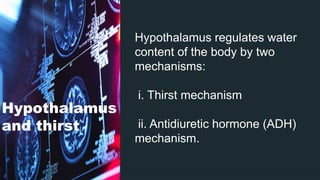
Hypothalamus regulates water
content of the body by two
mechanisms:
i. Thirst mechanism
ii. Antidiuretic hormone (ADH)
mechanism.
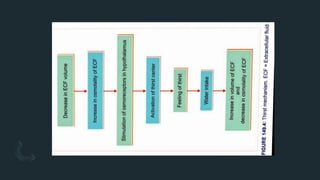
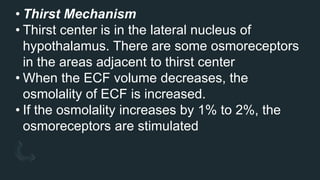
• Thirst Mechanism
• Thirst center is in the lateral nucleus of
hypothalamus. There are some osmoreceptors
in the areas adjacent to thirst center
• When the ECF volume decreases, the
osmolality of ECF is increased.
• If the osmolality increases by 1% to 2%, the
osmoreceptors are stimulated
• ADH Mechanism
• Simultaneously, when the volume of ECF
decreases with increased osmolality, the
supraoptic nucleus is stimulated and ADH is
released.
• ADH causes retention of water by facultative
reabsorption in the renal tubules.
It increases the ECF volume and brings the
osmolality back to the normal level.
•On the contrary, when ECF volume is increased,
the supraoptic nucleus is not stimulated and
ADH is not secreted.
• In the absence of ADH, more amount of water is
excreted through urine and the volume of ECF is
brought back to normal.
Detection
There are many different receptors for
sensing the crystal volume or an
increase to osmolite concentration.
Decreased volume
1. Renin Angiotensin system RAS
Hypovolemia leads to activation of the renin
angiotensin system (RAS) and a decrease in
atrial natriuretic peptide. These mechanisms,
along their other functions, contribute to elicit
thirst, by affecting the sub fornical organ.
For instance, angiotensin II, activated in RAS,
is a powerful dipsogen (ie it stimulates thirst)
which acts via the subfornical organ.
• Arterial baroreceptors sense a decreased
arterial pressure, and signals to the central
nervous system in the area postrema and
nucleus tractussolitarius.
Cardiopulmonary receptors sense a
decreased blood volume, and signal to
bareapostrema and nucleus
tractussolitarius[2] as well.
Increased osmolite
volume
• An increase in osmotic pressure, e.g. after eating a
salty meal activate osmo receptors.
• There are osmo receptors already in the central
nervous system, more specifically in the
hypothalamus, notably in two circumventricular
organs that lack an effective blood brain barrier, the
organum vasculosum of the
laminaterminalisorganumvasculosum of the lamina
terminalis (OVLT) and the subfornicalorgan (SFO).
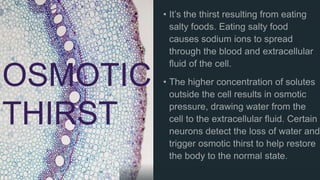
OSMOTIC
THIRST
Hypovolemic Thirst
Physiology of thirst
Factors that increase thirst
Decreases thirst
Thank you

Thirst receptors.pptx

  • 1.
  • 2.
  • 3.
    Drinking behavior • Waterdeprivation produces an on signal that is detected by receptors in the nervous system. • The neural reactions to this signal initiate behavior gear to the reinstate then normal water level. • When the normal level is reached once again, and of signal is converted to the brain to stop drinking thus to understand water intake at physiological level it is not enough to understand the signals that turn it on and off the receptors that monitor the signals
  • 4.
  • 6.
    Hypothalamus and thirst Hypothalamus regulateswater content of the body by two mechanisms: i. Thirst mechanism ii. Antidiuretic hormone (ADH) mechanism.
  • 8.
    • Thirst Mechanism •Thirst center is in the lateral nucleus of hypothalamus. There are some osmoreceptors in the areas adjacent to thirst center • When the ECF volume decreases, the osmolality of ECF is increased. • If the osmolality increases by 1% to 2%, the osmoreceptors are stimulated
  • 10.
    • ADH Mechanism •Simultaneously, when the volume of ECF decreases with increased osmolality, the supraoptic nucleus is stimulated and ADH is released. • ADH causes retention of water by facultative reabsorption in the renal tubules. It increases the ECF volume and brings the osmolality back to the normal level.
  • 11.
    •On the contrary,when ECF volume is increased, the supraoptic nucleus is not stimulated and ADH is not secreted. • In the absence of ADH, more amount of water is excreted through urine and the volume of ECF is brought back to normal.
  • 12.
    Detection There are manydifferent receptors for sensing the crystal volume or an increase to osmolite concentration. Decreased volume 1. Renin Angiotensin system RAS
  • 13.
    Hypovolemia leads toactivation of the renin angiotensin system (RAS) and a decrease in atrial natriuretic peptide. These mechanisms, along their other functions, contribute to elicit thirst, by affecting the sub fornical organ. For instance, angiotensin II, activated in RAS, is a powerful dipsogen (ie it stimulates thirst) which acts via the subfornical organ.
  • 14.
    • Arterial baroreceptorssense a decreased arterial pressure, and signals to the central nervous system in the area postrema and nucleus tractussolitarius. Cardiopulmonary receptors sense a decreased blood volume, and signal to bareapostrema and nucleus tractussolitarius[2] as well.
  • 15.
    Increased osmolite volume • Anincrease in osmotic pressure, e.g. after eating a salty meal activate osmo receptors. • There are osmo receptors already in the central nervous system, more specifically in the hypothalamus, notably in two circumventricular organs that lack an effective blood brain barrier, the organum vasculosum of the laminaterminalisorganumvasculosum of the lamina terminalis (OVLT) and the subfornicalorgan (SFO).
  • 17.
  • 18.
  • 19.
  • 20.
  • 21.
  • 22.