1
Sensing
Dr. Sudip Misra
Associate Professor
Department of Computer Science and Engineering
IIT KHARAGPUR
Email: smisra@sit.iitkgp.ernet.in
Website: http://cse.iitkgp.ac.in/~smisra/
Introduction to Internet of Things
Definition
 A sensor detects (senses) changes in the ambient conditions
or in the state of another device or a system, and forwards or
processes this information in a certain manner [1].
“A device which detects or measures a physical property and
records, indicates, or otherwise responds to it” [2].
‐ Oxford Dictionary
2
References:
1. http://www.businessdictionary.com/definition/sensor.html
2. https://en.oxforddictionaries.com/definition/sensor
Introduction to Internet of Things
Sensors
 They perform some input functions by sensing or feeling the
physical changes in characteristics of a system in response to a
stimuli.
 For example heat is converted to electrical signals in a
temperature sensor, or atmospheric pressure is converted to
electrical signals in a barometer.
3
Introduction to Internet of Things
Transducers
 Transducers convert or transduce energy of one kind into
another.
 For example, in a sound system, a microphone (input device)
converts sound waves into electrical signals for an amplifier to
amplify (a process), and a loudspeaker (output device)
converts these electrical signals back into sound waves.
4
Introduction to Internet of Things
Sensor vs. Transducer
 The word “Transducer” is the collective term used for both
Sensors which can be used to sense a wide range of different
energy forms such as movement, electrical signals, radiant
energy, thermal or magnetic energy etc., and Actuators which
can be used to switch voltages or currents [1].
5
References:
1. http://www.electronics‐tutorials.ws/io/io_1.html
Introduction to Internet of Things
Sensor Features
 It is only sensitive to the measured property (e.g., A
temperature sensor senses the ambient temperature of a
room.)
 It is insensitive to any other property likely to be encountered
in its application (e.g., A temperature sensor does not bother
about light or pressure while sensing the temperature.)
 It does not influence the measured property (e.g., measuring
the temperature does not reduce or increase the
temperature).
6
Introduction to Internet of Things
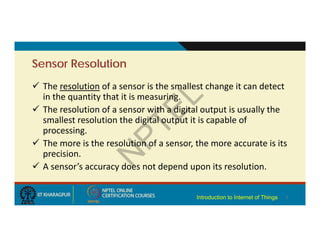
Sensor Resolution
 The resolution of a sensor is the smallest change it can detect
in the quantity that it is measuring.
 The resolution of a sensor with a digital output is usually the
smallest resolution the digital output it is capable of
processing.
 The more is the resolution of a sensor, the more accurate is its
precision.
 A sensor’s accuracy does not depend upon its resolution.
7
Introduction to Internet of Things
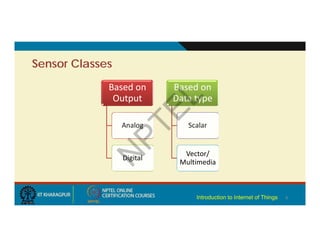
Sensor Classes
8
Based on
Output
Analog
Digital
Based on
Data type
Scalar
Vector/
Multimedia
Introduction to Internet of Things
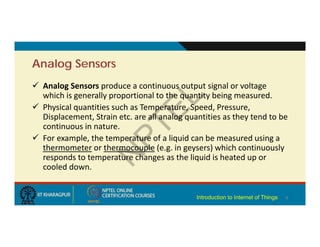
Analog Sensors
 Analog Sensors produce a continuous output signal or voltage
which is generally proportional to the quantity being measured.
 Physical quantities such as Temperature, Speed, Pressure,
Displacement, Strain etc. are all analog quantities as they tend to be
continuous in nature.
 For example, the temperature of a liquid can be measured using a
thermometer or thermocouple (e.g. in geysers) which continuously
responds to temperature changes as the liquid is heated up or
cooled down.
9
Introduction to Internet of Things
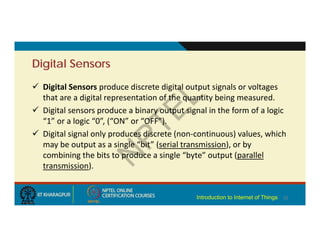
Digital Sensors
 Digital Sensors produce discrete digital output signals or voltages
that are a digital representation of the quantity being measured.
 Digital sensors produce a binary output signal in the form of a logic
“1” or a logic “0”, (“ON” or “OFF”).
 Digital signal only produces discrete (non‐continuous) values, which
may be output as a single “bit” (serial transmission), or by
combining the bits to produce a single “byte” output (parallel
transmission).
10
Introduction to Internet of Things
Scalar Sensors
 Scalar Sensors produce output signal or voltage which is generally
proportional to the magnitude of the quantity being measured.
 Physical quantities such as temperature, color, pressure, strain, etc.
are all scalar quantities as only their magnitude is sufficient to
convey an information.
 For example, the temperature of a room can be measured using a
thermometer or thermocouple, which responds to temperature
changes irrespective of the orientation of the sensor or its
direction.
11
Introduction to Internet of Things
Vector Sensors
 Vector Sensors produce output signal or voltage which is generally
proportional to the magnitude, direction, as well as the orientation
of the quantity being measured.
 Physical quantities such as sound, image, velocity, acceleration,
orientation, etc. are all vector quantities, as only their magnitude is
not sufficient to convey the complete information.
 For example, the acceleration of a body can be measured using an
accelerometer, which gives the components of acceleration of the
body with respect to the x,y,z coordinate axes.
12
Introduction to Internet of Things
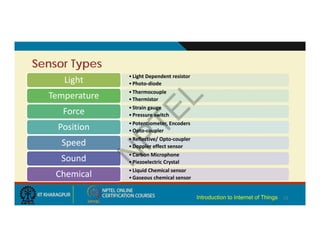
Sensor Types
•Light Dependent resistor
•Photo‐diode
Light
•Thermocouple
•Thermistor
Temperature
•Strain gauge
•Pressure switch
Force
•Potentiometer, Encoders
•Opto‐coupler
Position
•Reflective/ Opto‐coupler
•Doppler effect sensor
Speed
•Carbon Microphone
•Piezoelectric Crystal
Sound
•Liquid Chemical sensor
•Gaseous chemical sensor
Chemical
13
Introduction to Internet of Things
14
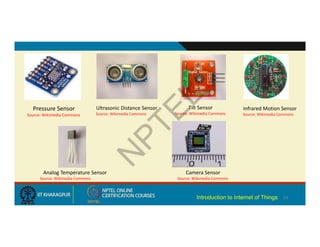
Pressure Sensor
Source: Wikimedia Commons
Ultrasonic Distance Sensor
Source: Wikimedia Commons
Tilt Sensor
Source: Wikimedia Commons
Infrared Motion Sensor
Source: Wikimedia Commons
Analog Temperature Sensor
Source: Wikimedia Commons
Camera Sensor
Source: Wikimedia Commons
Introduction to Internet of Things
Sensorial Deviations
 Since the range of the output signal is always limited, the
output signal will eventually reach a minimum or maximum,
when the measured property exceeds the limits. The full scale
range of a sensor defines the maximum and minimum values
of the measured property.
 The sensitivity of a sensor under real conditions may differ
from the value specified. This is called a sensitivity error.
 If the output signal differs from the correct value by a
constant, the sensor has an offset error or bias.
15
Reference: https://en.wikipedia.org/wiki/Sensor
They perform some input functions by sensing

They perform some input functions by sensing

  • 1.
    1 Sensing Dr. Sudip Misra AssociateProfessor Department of Computer Science and Engineering IIT KHARAGPUR Email: smisra@sit.iitkgp.ernet.in Website: http://cse.iitkgp.ac.in/~smisra/ Introduction to Internet of Things
  • 2.
    Definition  A sensordetects (senses) changes in the ambient conditions or in the state of another device or a system, and forwards or processes this information in a certain manner [1]. “A device which detects or measures a physical property and records, indicates, or otherwise responds to it” [2]. ‐ Oxford Dictionary 2 References: 1. http://www.businessdictionary.com/definition/sensor.html 2. https://en.oxforddictionaries.com/definition/sensor Introduction to Internet of Things
  • 3.
    Sensors  They performsome input functions by sensing or feeling the physical changes in characteristics of a system in response to a stimuli.  For example heat is converted to electrical signals in a temperature sensor, or atmospheric pressure is converted to electrical signals in a barometer. 3 Introduction to Internet of Things
  • 4.
    Transducers  Transducers convertor transduce energy of one kind into another.  For example, in a sound system, a microphone (input device) converts sound waves into electrical signals for an amplifier to amplify (a process), and a loudspeaker (output device) converts these electrical signals back into sound waves. 4 Introduction to Internet of Things
  • 5.
    Sensor vs. Transducer The word “Transducer” is the collective term used for both Sensors which can be used to sense a wide range of different energy forms such as movement, electrical signals, radiant energy, thermal or magnetic energy etc., and Actuators which can be used to switch voltages or currents [1]. 5 References: 1. http://www.electronics‐tutorials.ws/io/io_1.html Introduction to Internet of Things
  • 6.
    Sensor Features  Itis only sensitive to the measured property (e.g., A temperature sensor senses the ambient temperature of a room.)  It is insensitive to any other property likely to be encountered in its application (e.g., A temperature sensor does not bother about light or pressure while sensing the temperature.)  It does not influence the measured property (e.g., measuring the temperature does not reduce or increase the temperature). 6 Introduction to Internet of Things
  • 7.
    Sensor Resolution  Theresolution of a sensor is the smallest change it can detect in the quantity that it is measuring.  The resolution of a sensor with a digital output is usually the smallest resolution the digital output it is capable of processing.  The more is the resolution of a sensor, the more accurate is its precision.  A sensor’s accuracy does not depend upon its resolution. 7 Introduction to Internet of Things
  • 8.
    Sensor Classes 8 Based on Output Analog Digital Basedon Data type Scalar Vector/ Multimedia Introduction to Internet of Things
  • 9.
    Analog Sensors  AnalogSensors produce a continuous output signal or voltage which is generally proportional to the quantity being measured.  Physical quantities such as Temperature, Speed, Pressure, Displacement, Strain etc. are all analog quantities as they tend to be continuous in nature.  For example, the temperature of a liquid can be measured using a thermometer or thermocouple (e.g. in geysers) which continuously responds to temperature changes as the liquid is heated up or cooled down. 9 Introduction to Internet of Things
  • 10.
    Digital Sensors  DigitalSensors produce discrete digital output signals or voltages that are a digital representation of the quantity being measured.  Digital sensors produce a binary output signal in the form of a logic “1” or a logic “0”, (“ON” or “OFF”).  Digital signal only produces discrete (non‐continuous) values, which may be output as a single “bit” (serial transmission), or by combining the bits to produce a single “byte” output (parallel transmission). 10 Introduction to Internet of Things
  • 11.
    Scalar Sensors  ScalarSensors produce output signal or voltage which is generally proportional to the magnitude of the quantity being measured.  Physical quantities such as temperature, color, pressure, strain, etc. are all scalar quantities as only their magnitude is sufficient to convey an information.  For example, the temperature of a room can be measured using a thermometer or thermocouple, which responds to temperature changes irrespective of the orientation of the sensor or its direction. 11 Introduction to Internet of Things
  • 12.
    Vector Sensors  VectorSensors produce output signal or voltage which is generally proportional to the magnitude, direction, as well as the orientation of the quantity being measured.  Physical quantities such as sound, image, velocity, acceleration, orientation, etc. are all vector quantities, as only their magnitude is not sufficient to convey the complete information.  For example, the acceleration of a body can be measured using an accelerometer, which gives the components of acceleration of the body with respect to the x,y,z coordinate axes. 12 Introduction to Internet of Things
  • 13.
    Sensor Types •Light Dependentresistor •Photo‐diode Light •Thermocouple •Thermistor Temperature •Strain gauge •Pressure switch Force •Potentiometer, Encoders •Opto‐coupler Position •Reflective/ Opto‐coupler •Doppler effect sensor Speed •Carbon Microphone •Piezoelectric Crystal Sound •Liquid Chemical sensor •Gaseous chemical sensor Chemical 13 Introduction to Internet of Things
  • 14.
    14 Pressure Sensor Source: WikimediaCommons Ultrasonic Distance Sensor Source: Wikimedia Commons Tilt Sensor Source: Wikimedia Commons Infrared Motion Sensor Source: Wikimedia Commons Analog Temperature Sensor Source: Wikimedia Commons Camera Sensor Source: Wikimedia Commons Introduction to Internet of Things
  • 15.
    Sensorial Deviations  Sincethe range of the output signal is always limited, the output signal will eventually reach a minimum or maximum, when the measured property exceeds the limits. The full scale range of a sensor defines the maximum and minimum values of the measured property.  The sensitivity of a sensor under real conditions may differ from the value specified. This is called a sensitivity error.  If the output signal differs from the correct value by a constant, the sensor has an offset error or bias. 15 Reference: https://en.wikipedia.org/wiki/Sensor