M y research: Spatial Sound
Control w ith the iOS device
       S1170144 Ryo K anno
A bstract
   In m y thesis, I describe the system for controlling
“ Spatial sound ” w ith the iOS device. A sm artphone , like
iOS device, had a touch panel on it ’ s display, and can
quantify the position w here w e touch as a com bination
of x and y coordinates. Based on this quantified
positional inform ation, I aim to establish a new system
for controlling spatial sound and enable iOS devices to be
a new interface of virtual reality.
Spatial Sound
    Spatial sound is one of the im portant sound
expression in virtual reality, and has sam e m eaning of
“ stereophony ” or “ 3D surround ” . It includes the
sound of direction, range, yew , depth (near and far),
elevation, and so on. In virtual reality, w e can enjoy
m ore realistic sound by com binating these features
effectively.
Previous W ork
  Tw o years ago, a previous thesis, “ Spatial Sound
Control w ith the Yam aha Tenori - on ” w as published.
M y research succeeds and extends this, aim ing to
                              allow the sound m ore
                              sm oothly and freely
                              m ovem ent around a space.


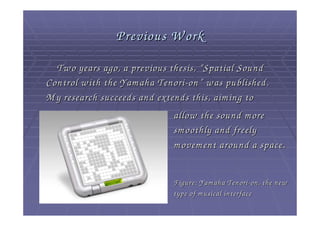
                             Figure: Yam aha Tenori - on, the new
                             type of m usical interface
Research A rchitecture
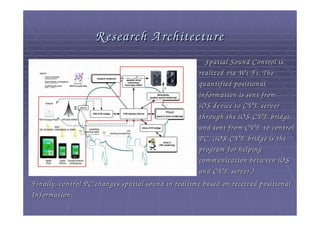
                                                        Spatial Sound Control is
                                                      realized via W i - Fi. The
                                                      quantified positional
                                                      inform ation is sent from
                                                      iOS device to CV E server
                                                      through the iOS - CV E bridge,
                                                      and sent from CV E to control
                                                      PC. ( iOS - CV E bridge is the
                                                      program for helping
                                                      com m unication betw een iOS
                                                      and CV E server.)
Finally, control PC changes spatial sound in realtim e based on received positional
Inform ation.
Flow of Research 1
  First, I create a application for getting positional
inform ation from touch panel. To achieve this, a
source code of draw ing application w ill be leveraged.
These application are w ritten by objective - C.
Flow of Research 2
   Then, a com m unication system betw een iOS device
and com puter is also needed. I leverage the
Collaborative V irtual E nvironm ent (CV E ) server to
connect these device to each other. This system has
alm ost been com pleted in previous research (as I said,
this program is called “ iOS - CV E bridge), so I use and
extend it.
Flow of Research
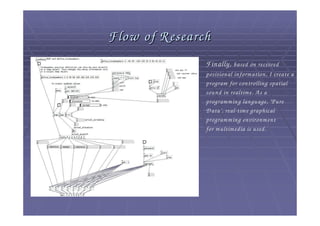
               Finally, based on received
               positional information, I create a
               program for controlling spatial
               sound in realtime. A s a
               programm ing language, "Pure
               D ata", real-time graphical
               programm ing environm ent
               for m ultimedia is used.

Thesis writing assignment; thesis presentation

  • 1.
    M y research:Spatial Sound Control w ith the iOS device S1170144 Ryo K anno
  • 2.
    A bstract In m y thesis, I describe the system for controlling “ Spatial sound ” w ith the iOS device. A sm artphone , like iOS device, had a touch panel on it ’ s display, and can quantify the position w here w e touch as a com bination of x and y coordinates. Based on this quantified positional inform ation, I aim to establish a new system for controlling spatial sound and enable iOS devices to be a new interface of virtual reality.
  • 3.
    Spatial Sound Spatial sound is one of the im portant sound expression in virtual reality, and has sam e m eaning of “ stereophony ” or “ 3D surround ” . It includes the sound of direction, range, yew , depth (near and far), elevation, and so on. In virtual reality, w e can enjoy m ore realistic sound by com binating these features effectively.
  • 4.
    Previous W ork Tw o years ago, a previous thesis, “ Spatial Sound Control w ith the Yam aha Tenori - on ” w as published. M y research succeeds and extends this, aim ing to allow the sound m ore sm oothly and freely m ovem ent around a space. Figure: Yam aha Tenori - on, the new type of m usical interface
  • 5.
    Research A rchitecture Spatial Sound Control is realized via W i - Fi. The quantified positional inform ation is sent from iOS device to CV E server through the iOS - CV E bridge, and sent from CV E to control PC. ( iOS - CV E bridge is the program for helping com m unication betw een iOS and CV E server.) Finally, control PC changes spatial sound in realtim e based on received positional Inform ation.
  • 6.
    Flow of Research1 First, I create a application for getting positional inform ation from touch panel. To achieve this, a source code of draw ing application w ill be leveraged. These application are w ritten by objective - C.
  • 7.
    Flow of Research2 Then, a com m unication system betw een iOS device and com puter is also needed. I leverage the Collaborative V irtual E nvironm ent (CV E ) server to connect these device to each other. This system has alm ost been com pleted in previous research (as I said, this program is called “ iOS - CV E bridge), so I use and extend it.
  • 8.
    Flow of Research Finally, based on received positional information, I create a program for controlling spatial sound in realtime. A s a programm ing language, "Pure D ata", real-time graphical programm ing environm ent for m ultimedia is used.