Data Augmentation Techniques
for Improved Plant Disease Diagnosis
Aadarsh Kumar Singh (22072005)
Under the guidance of
Dr. Pratik Chattopadhyay
Department of Computer Science and Engineering
Indian Institute Of Technology (BHU)
Varanasi
Contents
• Introduction
• Related Work
• Problem Definition
• Dataset Used
• Work Done – CycleGAN
• Work Done - LeafyGAN
• Comparison of CycleGAN and LeafyGAN
• Evaluation Metrices
• Conclusion
• Future Works
• References
Introduction
• Automated plant disease diagnosis is one of the most active research areas in agriculture.
• More data is necessary to achieve accurate diagnosis. However, the data available on the
internet is insufficient.
• To obtain more data, we can either manually collect new data or apply data augmentation
techniques on existing data to generate new data.
Traditional Data Augmentation Techniques:
• Traditional data augmentation techniques like rotating or flipping an image can enhance
the dataset.
• But they don't actually create new data.
Generating Completely New Data:
• To generate completely new data, we need to build a model that takes a healthy leaf
image and generates a diseased version of it and vice versa.
• GANs (Generative Adversarial Networks) are a type of model that can be used to
generate synthetic data.
Related Work
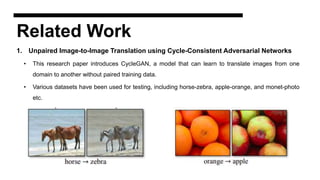
1. Unpaired Image-to-Image Translation using Cycle-Consistent Adversarial Networks
• This research paper introduces CycleGAN, a model that can learn to translate images from one
domain to another without paired training data.
• Various datasets have been used for testing, including horse-zebra, apple-orange, and monet-photo
etc.
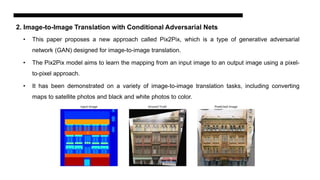
2. Image-to-Image Translation with Conditional Adversarial Nets
• This paper proposes a new approach called Pix2Pix, which is a type of generative adversarial
network (GAN) designed for image-to-image translation.
• The Pix2Pix model aims to learn the mapping from an input image to an output image using a pixel-
to-pixel approach.
• It has been demonstrated on a variety of image-to-image translation tasks, including converting
maps to satellite photos and black and white photos to color.
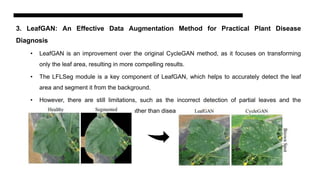
3. LeafGAN: An Effective Data Augmentation Method for Practical Plant Disease
Diagnosis
• LeafGAN is an improvement over the original CycleGAN method, as it focuses on transforming
only the leaf area, resulting in more compelling results.
• The LFLSeg module is a key component of LeafGAN, which helps to accurately detect the leaf
area and segment it from the background.
• However, there are still limitations, such as the incorrect detection of partial leaves and the
occasional transformation of color rather than disease symptom.
Problem Definition
The problem is how to improve the accuracy of Deep Learning models for plant disease
detection using leaf images, by augmenting the existing dataset. Augmentation techniques are
needed to create new training data from the existing data, while preserving the key features and
introducing useful variations. The goal is to develop effective and diverse augmentation
techniques that can improve the accuracy of Deep learning models without requiring additional
data collection.
Dataset Used
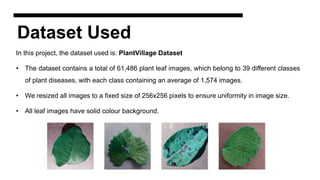
In this project, the dataset used is: PlantVillage Dataset
• The dataset contains a total of 61,486 plant leaf images, which belong to 39 different classes
of plant diseases, with each class containing an average of 1,574 images.
• We resized all images to a fixed size of 256x256 pixels to ensure uniformity in image size.
• All leaf images have solid colour background.
Work Done - CycleGAN
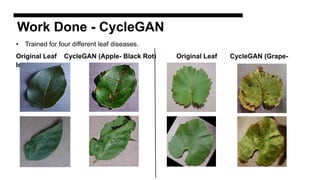
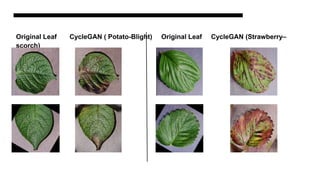
• Trained for four different leaf diseases.
Original Leaf CycleGAN (Apple- Black Rot) Original Leaf CycleGAN (Grape-
Isarioposis)
Original Leaf CycleGAN ( Potato-Blight) Original Leaf CycleGAN (Strawberry–
scorch)
Limitations of CycleGAN
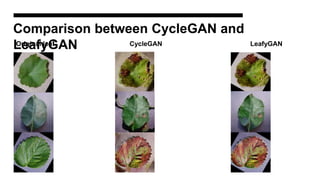
•CycleGAN changes the background along with the leaves, which can be problematic for
applications like crop disease diagnosis.
•Additionally, CycleGAN does not trace the leaf boundaries accurately, which can lead to
incomplete or incorrect transformations of the leaves themselves.
•These limitations can result in generated images that are not suitable for use in automated
crop disease diagnosis or other applications that require accurate and reliable image
translations.
Work Done - LeafyGAN
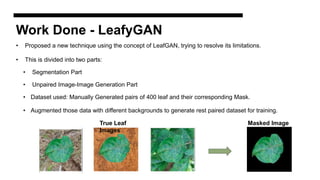
• Proposed a new technique using the concept of LeafGAN, trying to resolve its limitations.
• This is divided into two parts:
• Segmentation Part
• Unpaired Image-Image Generation Part
• Dataset used: Manually Generated pairs of 400 leaf and their corresponding Mask.
• Augmented those data with different backgrounds to generate rest paired dataset for training.
True Leaf
Images
Masked Image
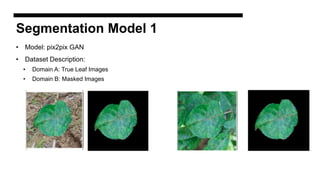
Segmentation Model 1
• Model: pix2pix GAN
• Dataset Description:
• Domain A: True Leaf Images
• Domain B: Masked Images
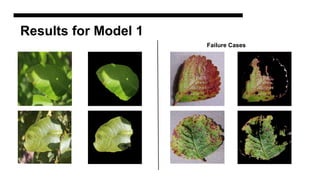
Results for Model 1
Failure Cases
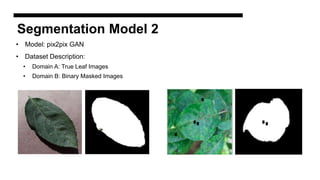
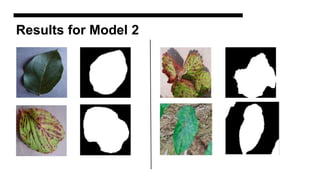
Segmentation Model 2
• Model: pix2pix GAN
• Dataset Description:
• Domain A: True Leaf Images
• Domain B: Binary Masked Images
Results for Model 2
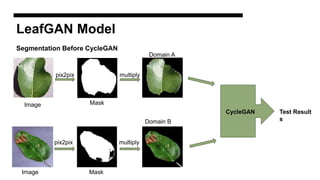
LeafGAN Model
Segmentation Before CycleGAN
pix2pix multiply
pix2pix multiply
Domain A
Domain B
CycleGAN Test Result
s
Image Mask
Mask​
Image​
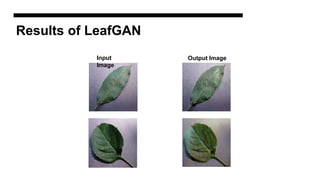
Results of LeafGAN
Input
Image
Output Image
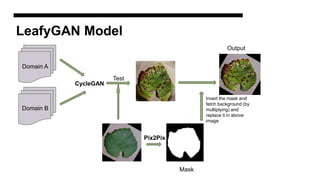
LeafyGAN Model
Domain A
Domain B​
CycleGAN
Pix2Pix
Test
Invert the mask and
fetch background (by
multiplying) and
replace it in above
image
Mask
Output
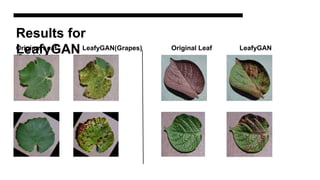
Results for
LeafyGAN
Original Leaf LeafyGAN(Grapes) Original Leaf LeafyGAN
(Potato)
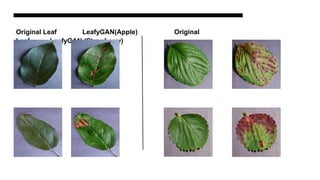
Original Leaf LeafyGAN(Apple) Original
Leaf LeafyGAN (Strawberry)
Comparison between CycleGAN and
LeafyGAN
Original leaf CycleGAN LeafyGAN
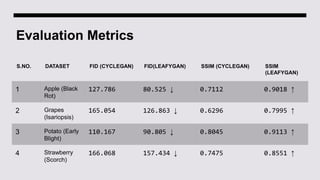
Evaluation Metrics
S.NO. DATASET FID (CYCLEGAN) FID(LEAFYGAN) SSIM (CYCLEGAN) SSIM
(LEAFYGAN)
1 Apple (Black
Rot)
127.786 80.525 ↓ 0.7112 0.9018 ↑
2 Grapes
(Isariopsis)
165.054 126.863 ↓ 0.6296 0.7995 ↑
3 Potato (Early
Blight)
110.167 90.805 ↓ 0.8045 0.9113 ↑
4 Strawberry
(Scorch)
166.068 157.434 ↓ 0.7475 0.8551 ↑
Conclusion
•Based on evaluation metrics, the LeafyGAN model generated higher quality images and more
similar images as compared to the CycleGAN model.
•This Model was consistent across all datasets tested.
•The Pix2Pix model was found to be highly effective for binary segmentation tasks and
performed exceptionally well in that domain.
•Overall, these findings suggest that the LeafyGAN model may be a promising alternative to
CycleGAN for image generation tasks, while the Pix2Pix model is a powerful tool for image
segmentation tasks.

Future Works
•One potential avenue for future work is to integrate the segmentation model and unpaired
image generation model into a single architecture. This could potentially improve the overall
performance and efficiency of the system.
•Currently, the proposed architecture is designed to work with a single leaf set and its
associated disease. In the future, we plan to extend this module to work with different plants
and diseases.
•To achieve this, we intend to include an additional component in the architecture that can
differentiate between different plants and their associated diseases. This could potentially
make the system more versatile and applicable to a wider range of plant diseases.
References
1. Zhu, J.Y., Park, T., Isola, P., & Efros, A. (2017). Unpaired Image-To-Image Translation
Using Cycle-Consistent Adversarial Networks. In Proceedings of the IEEE International
Conference on Computer Vision (ICCV).
2. Isola, P., Zhu, J.Y., Zhou, T., & Efros, A. (2017). Image-To-Image Translation With
Conditional Adversarial Networks. In Proceedings of the IEEE Conference on Computer
Vision and Pattern Recognition (CVPR).
3. Cap, Q., Uga, H., Kagiwada, S., & Iyatomi, H. (2022). LeafGAN: An Effective Data
Augmentation Method for Practical Plant Disease Diagnosis. IEEE Transactions on
Automation Science and Engineering, 19(2), 1258-1267.
Thank You

Thesis Presentation.pptx

  • 1.
    Data Augmentation Techniques forImproved Plant Disease Diagnosis Aadarsh Kumar Singh (22072005) Under the guidance of Dr. Pratik Chattopadhyay Department of Computer Science and Engineering Indian Institute Of Technology (BHU) Varanasi
  • 2.
    Contents • Introduction • RelatedWork • Problem Definition • Dataset Used • Work Done – CycleGAN • Work Done - LeafyGAN • Comparison of CycleGAN and LeafyGAN • Evaluation Metrices • Conclusion • Future Works • References
  • 3.
    Introduction • Automated plantdisease diagnosis is one of the most active research areas in agriculture. • More data is necessary to achieve accurate diagnosis. However, the data available on the internet is insufficient. • To obtain more data, we can either manually collect new data or apply data augmentation techniques on existing data to generate new data. Traditional Data Augmentation Techniques: • Traditional data augmentation techniques like rotating or flipping an image can enhance the dataset. • But they don't actually create new data.
  • 4.
    Generating Completely NewData: • To generate completely new data, we need to build a model that takes a healthy leaf image and generates a diseased version of it and vice versa. • GANs (Generative Adversarial Networks) are a type of model that can be used to generate synthetic data.
  • 5.
    Related Work 1. UnpairedImage-to-Image Translation using Cycle-Consistent Adversarial Networks • This research paper introduces CycleGAN, a model that can learn to translate images from one domain to another without paired training data. • Various datasets have been used for testing, including horse-zebra, apple-orange, and monet-photo etc.
  • 6.
    2. Image-to-Image Translationwith Conditional Adversarial Nets • This paper proposes a new approach called Pix2Pix, which is a type of generative adversarial network (GAN) designed for image-to-image translation. • The Pix2Pix model aims to learn the mapping from an input image to an output image using a pixel- to-pixel approach. • It has been demonstrated on a variety of image-to-image translation tasks, including converting maps to satellite photos and black and white photos to color.
  • 7.
    3. LeafGAN: AnEffective Data Augmentation Method for Practical Plant Disease Diagnosis • LeafGAN is an improvement over the original CycleGAN method, as it focuses on transforming only the leaf area, resulting in more compelling results. • The LFLSeg module is a key component of LeafGAN, which helps to accurately detect the leaf area and segment it from the background. • However, there are still limitations, such as the incorrect detection of partial leaves and the occasional transformation of color rather than disease symptom.
  • 8.
    Problem Definition The problemis how to improve the accuracy of Deep Learning models for plant disease detection using leaf images, by augmenting the existing dataset. Augmentation techniques are needed to create new training data from the existing data, while preserving the key features and introducing useful variations. The goal is to develop effective and diverse augmentation techniques that can improve the accuracy of Deep learning models without requiring additional data collection.
  • 9.
    Dataset Used In thisproject, the dataset used is: PlantVillage Dataset • The dataset contains a total of 61,486 plant leaf images, which belong to 39 different classes of plant diseases, with each class containing an average of 1,574 images. • We resized all images to a fixed size of 256x256 pixels to ensure uniformity in image size. • All leaf images have solid colour background.
  • 10.
    Work Done -CycleGAN • Trained for four different leaf diseases. Original Leaf CycleGAN (Apple- Black Rot) Original Leaf CycleGAN (Grape- Isarioposis)
  • 11.
    Original Leaf CycleGAN( Potato-Blight) Original Leaf CycleGAN (Strawberry– scorch)
  • 12.
    Limitations of CycleGAN •CycleGANchanges the background along with the leaves, which can be problematic for applications like crop disease diagnosis. •Additionally, CycleGAN does not trace the leaf boundaries accurately, which can lead to incomplete or incorrect transformations of the leaves themselves. •These limitations can result in generated images that are not suitable for use in automated crop disease diagnosis or other applications that require accurate and reliable image translations.
  • 13.
    Work Done -LeafyGAN • Proposed a new technique using the concept of LeafGAN, trying to resolve its limitations. • This is divided into two parts: • Segmentation Part • Unpaired Image-Image Generation Part • Dataset used: Manually Generated pairs of 400 leaf and their corresponding Mask. • Augmented those data with different backgrounds to generate rest paired dataset for training. True Leaf Images Masked Image
  • 14.
    Segmentation Model 1 •Model: pix2pix GAN • Dataset Description: • Domain A: True Leaf Images • Domain B: Masked Images
  • 15.
    Results for Model1 Failure Cases
  • 16.
    Segmentation Model 2 •Model: pix2pix GAN • Dataset Description: • Domain A: True Leaf Images • Domain B: Binary Masked Images
  • 17.
  • 18.
    LeafGAN Model Segmentation BeforeCycleGAN pix2pix multiply pix2pix multiply Domain A Domain B CycleGAN Test Result s Image Mask Mask​ Image​
  • 19.
  • 20.
    LeafyGAN Model Domain A DomainB​ CycleGAN Pix2Pix Test Invert the mask and fetch background (by multiplying) and replace it in above image Mask Output
  • 21.
    Results for LeafyGAN Original LeafLeafyGAN(Grapes) Original Leaf LeafyGAN (Potato)
  • 22.
    Original Leaf LeafyGAN(Apple)Original Leaf LeafyGAN (Strawberry)
  • 23.
    Comparison between CycleGANand LeafyGAN Original leaf CycleGAN LeafyGAN
  • 24.
    Evaluation Metrics S.NO. DATASETFID (CYCLEGAN) FID(LEAFYGAN) SSIM (CYCLEGAN) SSIM (LEAFYGAN) 1 Apple (Black Rot) 127.786 80.525 ↓ 0.7112 0.9018 ↑ 2 Grapes (Isariopsis) 165.054 126.863 ↓ 0.6296 0.7995 ↑ 3 Potato (Early Blight) 110.167 90.805 ↓ 0.8045 0.9113 ↑ 4 Strawberry (Scorch) 166.068 157.434 ↓ 0.7475 0.8551 ↑
  • 25.
    Conclusion •Based on evaluationmetrics, the LeafyGAN model generated higher quality images and more similar images as compared to the CycleGAN model. •This Model was consistent across all datasets tested. •The Pix2Pix model was found to be highly effective for binary segmentation tasks and performed exceptionally well in that domain. •Overall, these findings suggest that the LeafyGAN model may be a promising alternative to CycleGAN for image generation tasks, while the Pix2Pix model is a powerful tool for image segmentation tasks.
  • 26.
    Future Works •One potentialavenue for future work is to integrate the segmentation model and unpaired image generation model into a single architecture. This could potentially improve the overall performance and efficiency of the system. •Currently, the proposed architecture is designed to work with a single leaf set and its associated disease. In the future, we plan to extend this module to work with different plants and diseases. •To achieve this, we intend to include an additional component in the architecture that can differentiate between different plants and their associated diseases. This could potentially make the system more versatile and applicable to a wider range of plant diseases.
  • 27.
    References 1. Zhu, J.Y.,Park, T., Isola, P., & Efros, A. (2017). Unpaired Image-To-Image Translation Using Cycle-Consistent Adversarial Networks. In Proceedings of the IEEE International Conference on Computer Vision (ICCV). 2. Isola, P., Zhu, J.Y., Zhou, T., & Efros, A. (2017). Image-To-Image Translation With Conditional Adversarial Networks. In Proceedings of the IEEE Conference on Computer Vision and Pattern Recognition (CVPR). 3. Cap, Q., Uga, H., Kagiwada, S., & Iyatomi, H. (2022). LeafGAN: An Effective Data Augmentation Method for Practical Plant Disease Diagnosis. IEEE Transactions on Automation Science and Engineering, 19(2), 1258-1267.
  • 28.