EFFECT OF MUSIC ON INTRA OPERATIVE
SEDATIVE REQUIREMENT IN PATIENTS UNDER
SPINAL ANAESTHESIA
GUIDE : DR GEETHA C R
CO-GUIDE: DR BALAJI T
INTRODUCTION
 Various pharmacological methods like opiods, ketamine,
benzodiazepines, dexmedetomidine and Propofol are used
to decrease these effects but the disadvantages of these
drugs are possible central nervous system and cardio-
respiratory depression.
 Non pharmacological method like acupressure, hypnosis,
therapeutic suggestions and music therapy is employed to
decrease sedative requirement during intraoperative
period3.
 Various pharmacological methods like opiods, ketamine,
benzodiazepines, dexmedetomidine and Propofol are used to
decrease these effects but the disadvantages of these drugs
are possible central nervous system and cardio-respiratory
depression.
 Non pharmacological method like acupressure, hypnosis,
therapeutic suggestions and music therapy is employed to
decrease sedative requirement during intraoperative period3.
INTRODUCTION
INTRODUCTION
 Studies reported that relaxing music and music that patient
likes decreases sedative requirement during regional
anaesthesia4-6 . Listening to relaxing music has effects on
hypothalamic-pituitary-adrenal axis which leads to decrease
in cortisol levels.
 Music also initiates brainstem responses that, in turn, regulate haemodynamic
parameters (blood pressure, pulse, heart rate), temperature, muscle tension partly
via noradrenergic neurons that regulate cholinergic and dopaminergic
neurotransmission which are predicted to be the reason for peace, tranquillity and
decreased pain perception7.
INTRODUCTION
 1. The present study with primary objective to determine effect
of music and the effect of elimination of ambient noise on the
sedative requirement of the patients under spinal anaesthesia.
 2. Secondary objective is to assess patient satisfaction by using
patient satisfaction score.
Aims and Objectives
SAMPLE SIZE CALCULATION:
 Based on previous study conducted by Chakib M Ayoub et al, it
was found that music decreases intra operative sedative
requirement in patients undergoing surgical procedures. In the
present study sample size is calculated in order to detect minimum
difference of 36% for dosage of midazolam consumption during
spinal anesthesia, sample size of 29 in each group would be
required to detect the power of 80% and to achieve confidence
level of 95%.
STUDY SAMPLE
 Study subjects: 87 numbers of patients undergoing elective
infra umbilical surgeries under spinal anaesthesia, in
gynaecological, urological, orthopaedic, general surgical
procedures will be included in the study.
 Type of study: Randomized controlled study.
 The randomization process of allocating into three different groups done
using computer generated random numbers.
 Informed consent was taken.
 Before the assignment of group, Patients were informed that they may or may
not have an opportunity to wear headphones and even if they have
opportunity to wear headphones, they may or may not listen to the music.
METHODOLOGY:
 For all patients on arrival to operative room, standard monitor was connected
which includes, pulse-oximeter, electrocardiography, and non invasive arterial
blood pressure. Supplemental Oxygen was given by face mask at rate of 5
liters per minute.
 After securing Intravenous (IV) cannula (18 G/ 20 G) , IV fluids will be started
and baseline vitals were noted.
 Under aseptic precautions Spinal anesthesia was performed in sitting
position with injection bupivacaine 0.5% (H) 3cc (15mg of bupivacaine), then
patient is positioned supine, baseline parameters are noted, time ‘0’.
METHODOLOGY:
Contd..
 In addition Bispectral index monitor [BIS] was connected, Baseline value noted and
injection midazolam 0.04mg per kg i.v will be given.
 Further depending on group allotted
For,
• Group-C: Control group- No headphones, patients were exposed to operative room
ambient noise.
• Group M: Receive music through headphones, volume comfortable to the patient
[Instrumental relaxing music].
• Group H: Patients were given headphones with no music.
METHODOLOGY: Contd..
 Type of music- Instrumental music (same music for all the patients allotted in group M).
 All Haemodynamic parameters [Heart rate, systolic blood pressure, diastolic blood pressure and
mean arterial pressure] noted along with BIS score and Ramsey sedation score(RSS).
 Intra operatively baseline parameters, BIS index, Ramsey sedation score were noted as follows:
 1. Every 5 minutes for the First 20 minutes of the procedure.
 2. Every 10 minutes from 20 minutes to 1 hour of the procedure.
 3. Every 20 minutes after 1 hour of surgery till the end of procedure.
METHODOLOGY: Contd..
 Intra operative sedation requirement was be determined by Ramsey sedation score.
 Intra operatively if patients Ramsey sedation score is less than 3, Injection Midaolam i.v 0.01mg per kg
given [Maximum dosage-0.1mg per kg].
SCORE RESPONSE
1 ANXIOUS OR RESTLESS OR BOTH
2 COOPERATIVE,ORIENTED AND TRANQUIL
3 RESPONDING TO VERBAL COMMANDS
4 BRISK RESPONSE TO STIMULUS
5 SLUGGISH RESPONSE TO STIMULUS
6 NO RESPONSE TO STIMULUS
METHODOLOGY Contd..
 Intra operative complications were noted and treated accordingly.
 Intra operative Bradycardia ( <45) treated with intravenous atropine 0.6mg
and intra operative hypotension ( Systolic blood pressure < 90 ) treated with
intravenous injection ephedrine 6mg boluses.
METHODOLOGY Contd..
Patient satisfaction score.
 Intra operative patient satisfaction score was noted in the post-operative
care unit at 1 hour after surgery in recovery room.
Gradings..
1-Unsatisfactory
2-Poor
3-Satisfactory.
4-Good
5-Excellent.
METHODOLOGY Contd..
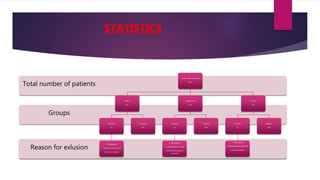
Reason for exlusion
Groups
Total number of patients
(101)
Music
(32)
Excluded
(3)
1- Bradycardia
1- Withdrawal from study
1.Technical problem
Analyzed
(29)
Headphones
(33)
Excluded
(4)
1- Bradycardia
2- Withdrawal from study
1-Converted to general
anesthesia
Analyzed
(29)
Control
(34)
Excluded
(5)
1- Bradycardia
3- Withdrawal from the study
2.Techinal problem
Analyzed
(29)
STATISTICS
thesis presentation.pptx

thesis presentation.pptx

  • 1.
    EFFECT OF MUSICON INTRA OPERATIVE SEDATIVE REQUIREMENT IN PATIENTS UNDER SPINAL ANAESTHESIA GUIDE : DR GEETHA C R CO-GUIDE: DR BALAJI T
  • 2.
    INTRODUCTION  Various pharmacologicalmethods like opiods, ketamine, benzodiazepines, dexmedetomidine and Propofol are used to decrease these effects but the disadvantages of these drugs are possible central nervous system and cardio- respiratory depression.  Non pharmacological method like acupressure, hypnosis, therapeutic suggestions and music therapy is employed to decrease sedative requirement during intraoperative period3.
  • 3.
     Various pharmacologicalmethods like opiods, ketamine, benzodiazepines, dexmedetomidine and Propofol are used to decrease these effects but the disadvantages of these drugs are possible central nervous system and cardio-respiratory depression.  Non pharmacological method like acupressure, hypnosis, therapeutic suggestions and music therapy is employed to decrease sedative requirement during intraoperative period3. INTRODUCTION
  • 4.
    INTRODUCTION  Studies reportedthat relaxing music and music that patient likes decreases sedative requirement during regional anaesthesia4-6 . Listening to relaxing music has effects on hypothalamic-pituitary-adrenal axis which leads to decrease in cortisol levels.
  • 5.
     Music alsoinitiates brainstem responses that, in turn, regulate haemodynamic parameters (blood pressure, pulse, heart rate), temperature, muscle tension partly via noradrenergic neurons that regulate cholinergic and dopaminergic neurotransmission which are predicted to be the reason for peace, tranquillity and decreased pain perception7. INTRODUCTION
  • 6.
     1. Thepresent study with primary objective to determine effect of music and the effect of elimination of ambient noise on the sedative requirement of the patients under spinal anaesthesia.  2. Secondary objective is to assess patient satisfaction by using patient satisfaction score. Aims and Objectives
  • 7.
    SAMPLE SIZE CALCULATION: Based on previous study conducted by Chakib M Ayoub et al, it was found that music decreases intra operative sedative requirement in patients undergoing surgical procedures. In the present study sample size is calculated in order to detect minimum difference of 36% for dosage of midazolam consumption during spinal anesthesia, sample size of 29 in each group would be required to detect the power of 80% and to achieve confidence level of 95%.
  • 8.
    STUDY SAMPLE  Studysubjects: 87 numbers of patients undergoing elective infra umbilical surgeries under spinal anaesthesia, in gynaecological, urological, orthopaedic, general surgical procedures will be included in the study.  Type of study: Randomized controlled study.
  • 9.
     The randomizationprocess of allocating into three different groups done using computer generated random numbers.  Informed consent was taken.  Before the assignment of group, Patients were informed that they may or may not have an opportunity to wear headphones and even if they have opportunity to wear headphones, they may or may not listen to the music. METHODOLOGY:
  • 10.
     For allpatients on arrival to operative room, standard monitor was connected which includes, pulse-oximeter, electrocardiography, and non invasive arterial blood pressure. Supplemental Oxygen was given by face mask at rate of 5 liters per minute.  After securing Intravenous (IV) cannula (18 G/ 20 G) , IV fluids will be started and baseline vitals were noted.  Under aseptic precautions Spinal anesthesia was performed in sitting position with injection bupivacaine 0.5% (H) 3cc (15mg of bupivacaine), then patient is positioned supine, baseline parameters are noted, time ‘0’. METHODOLOGY: Contd..
  • 11.
     In additionBispectral index monitor [BIS] was connected, Baseline value noted and injection midazolam 0.04mg per kg i.v will be given.  Further depending on group allotted For, • Group-C: Control group- No headphones, patients were exposed to operative room ambient noise. • Group M: Receive music through headphones, volume comfortable to the patient [Instrumental relaxing music]. • Group H: Patients were given headphones with no music. METHODOLOGY: Contd..
  • 12.
     Type ofmusic- Instrumental music (same music for all the patients allotted in group M).  All Haemodynamic parameters [Heart rate, systolic blood pressure, diastolic blood pressure and mean arterial pressure] noted along with BIS score and Ramsey sedation score(RSS).  Intra operatively baseline parameters, BIS index, Ramsey sedation score were noted as follows:  1. Every 5 minutes for the First 20 minutes of the procedure.  2. Every 10 minutes from 20 minutes to 1 hour of the procedure.  3. Every 20 minutes after 1 hour of surgery till the end of procedure. METHODOLOGY: Contd..
  • 13.
     Intra operativesedation requirement was be determined by Ramsey sedation score.  Intra operatively if patients Ramsey sedation score is less than 3, Injection Midaolam i.v 0.01mg per kg given [Maximum dosage-0.1mg per kg]. SCORE RESPONSE 1 ANXIOUS OR RESTLESS OR BOTH 2 COOPERATIVE,ORIENTED AND TRANQUIL 3 RESPONDING TO VERBAL COMMANDS 4 BRISK RESPONSE TO STIMULUS 5 SLUGGISH RESPONSE TO STIMULUS 6 NO RESPONSE TO STIMULUS METHODOLOGY Contd..
  • 14.
     Intra operativecomplications were noted and treated accordingly.  Intra operative Bradycardia ( <45) treated with intravenous atropine 0.6mg and intra operative hypotension ( Systolic blood pressure < 90 ) treated with intravenous injection ephedrine 6mg boluses. METHODOLOGY Contd..
  • 15.
    Patient satisfaction score. Intra operative patient satisfaction score was noted in the post-operative care unit at 1 hour after surgery in recovery room. Gradings.. 1-Unsatisfactory 2-Poor 3-Satisfactory. 4-Good 5-Excellent. METHODOLOGY Contd..
  • 16.
    Reason for exlusion Groups Totalnumber of patients Total number of patients (101) Music (32) Excluded (3) 1- Bradycardia 1- Withdrawal from study 1.Technical problem Analyzed (29) Headphones (33) Excluded (4) 1- Bradycardia 2- Withdrawal from study 1-Converted to general anesthesia Analyzed (29) Control (34) Excluded (5) 1- Bradycardia 3- Withdrawal from the study 2.Techinal problem Analyzed (29) STATISTICS