Thermal load calculation
Saba Arif
Objective
Cooling load calculations may be used to
accomplish one or more of the following
objectives:
a) Provide information for equipment selection,
system sizing and system design.
b) Provide data for evaluating the optimum
possibilities for load reduction.
c) Permit analysis of partial loads as required for
system design, operation and control.
TERMINOLOGIES
⚫Space – is either a volume or a site without a
partition or a partitioned room or group of
rooms.
⚫Room – is an enclosed or partitioned space that
is usually treated as single load.
⚫Zone – is a space or group of spaces within a
building with heating and/or cooling
requirements sufficiently similar so that comfort
conditions can be maintained throughout by a
single controlling device.
British thermal unit (Btu)
⚫ the approximate heat required to raise 1 lb.
of water 1 deg Fahrenheit, from 590 F to 600 F.
⚫Air conditioners are rated by the number of
British Thermal Units (Btu) of heat they can
remove per hour.
⚫ Another common rating term for air
conditioning size is the "ton," which is 12,000 Btu
per hour and Watts. ƒ
⚫ 1 ton is equivalent to 12,000 BTU/hr. and 12,000
ƒ
BTU/hr is equivalent to 3,516 Watts - or 3.516 kW
(kilo-Watts).
⚫Cooling Load Temperature Difference (CLTD) – an
equivalent temperature difference used for calculating
the instantaneous external cooling load across a wall or
roof.
⚫Sensible Heat Gain – is the energy added to the space by
conduction, convection and/or radiation.
⚫ Latent Heat Gain – is the energy added to the space
when moisture is added to the space by means of vapor
emitted by the
1. Occupants
2. generated by a process or through air infiltration
from outside or adjacent areas.
⚫ Radiant Heat Gain – the rate at which heat absorbed is
by the surfaces enclosing the space and the objects within
the space.
⚫Space Heat Gain – is the rate at which heat enters
into and/or is generated within the conditioned space
during a given time interval.
⚫Space Cooling Load – is the rate at which energy
must be removed from a space to maintain a
constant space air temperature.
⚫Space Heat Extraction Rate - the rate at which heat
is removed from the conditioned space and is equal
to the space cooling load if the room temperature
remains constant.
⚫Temperature, Dry Bulb – is the temperature of air
indicated by a regular thermometer.
Temperature, Wet Bulb
⚫ is the temperature measured by a thermometer
that has a bulb wrapped in wet cloth. The
evaporation of water from the thermometer has a
cooling effect, so the temperature indicated by the
wet bulb thermometer is less than the temperature
indicated by a dry-bulb (normal, unmodified)
thermometer.
⚫The rate of evaporation from the wet-bulb
thermometer depends on the humidity of the air.
⚫Evaporation is slower when the air is already full of
water vapor. For this reason, the difference in the
temperatures indicated by ordinary dry bulb and wet
bulb thermometers gives a measure of atmospheric
humidity.
Temperature, Dewpoint
is the temperature to which air must be cooled in
order to reach saturation or at which the
condensation of water vapor in a space begins
for a given state of humidity and pressure.
Relative humidity - describes how far the air is
from saturation.
It is a useful term for expressing the amount of
water vapor when discussing the amount and
rate of evaporation.
Thermal Transmittance or Heat
Transfer Coefficient (U-factor)
⚫ is the rate of heat flow through a unit area of
building envelope material or assembly, including its
boundary films, per unit of temperature difference
between the inside and outside air.
⚫The U-factor is expressed in W/m2.K
⚫Thermal Resistance (R) – is the reciprocal of a heat
transfer coefficient and is expressed in m2.K/W.
⚫ For example, a wall with a U-value of 0.25 would
have a resistance value of R = 1/U = 1/0.25=4.0.
⚫The value of R is also used to represent Thermal
Resistivity, the reciprocal of the thermal conductivity.
⚫It is obvious that you will need to remove the
amount of heat gain - if it is hot outside.
Similarly, you'll need to add in the heat loss from
your space - if outside temperature is cold. In
short, heat gain and loss, must be equally
balanced by heat removal, and addition, to get
the desired room comfort that we want.
⚫So;
The heat gain or heat loss through
a building depends on:
⚫ The temperature difference between outside temperature and
our desired temperature.
⚫ The type of construction and the amount of insulation is in
your ceiling and walls. Let's say, that you have two identical
buildings, one is build out of glass, and the other out of brick.
Of course the one built with glass would require much more
heat addition, or removal, compared to the other - given a same
day. This is because the glass has a high thermal conductivity
(U-value) as compared to the brick and also because it is
transparent, it allows direct transmission of solar heat.
⚫ How much shade is on your building’s windows, walls, and
roof? Two identical buildings with different orientation with
respect to the direction of sun rise and fall will also influence
the air conditioner sizing.
⚫How large is your room? The surface area of the
walls. The larger the surface area - the more heat can
loose, or gain through it.
⚫How much air leaks into indoor space from the
outside? Infiltration plays a part in determining our
air conditioner sizing. Door gaps, cracked windows,
chimneys - are the "doorways" for air to enter from
outside, into your living space.
⚫The occupants. It takes a lot to cool a town hall full of
people.
⚫Activities and other equipment within a building.
Cooking? Hot bath? Gymnasium?
⚫ Amount of lighting in the room. High efficiency
lighting fixtures generate less heat.
⚫How much heat the appliances generate.
Number of power equipments such as oven,
washing machine, computers, TV inside the
space; all contribute to heat.
⚫It is important to use the correct procedure for
estimating heat gain or heat loss.
⚫Two groups—
⚫the Air Conditioning Contractors of America
(ACCA)
⚫American Society of Heating, Refrigerating, and
Air Conditioning Engineers (ASHRAE)
publish calculation procedures for sizing central
air conditioners.
HEAT FLOW RATES
⚫Space heat gain ----How much heat (energy) is
entering the space?
⚫ Space cooling load --How much energy must be
removed from the space to keep temperature
and relative humidity constant?
⚫Space heat extraction---How much energy is the
HVAC removing from the space?
⚫ Cooling load (coil) --How much energy is
removed by the cooling coil serving various
spaces plus any loads external to the spaces such
as duct heat gain, duct leakage, fan heat and
outdoor makeup air?
Space Heat Gain
⚫This instantaneous rate of heat gain is the
rate at which heat enters into and/or is
generated within a space at a given instant.
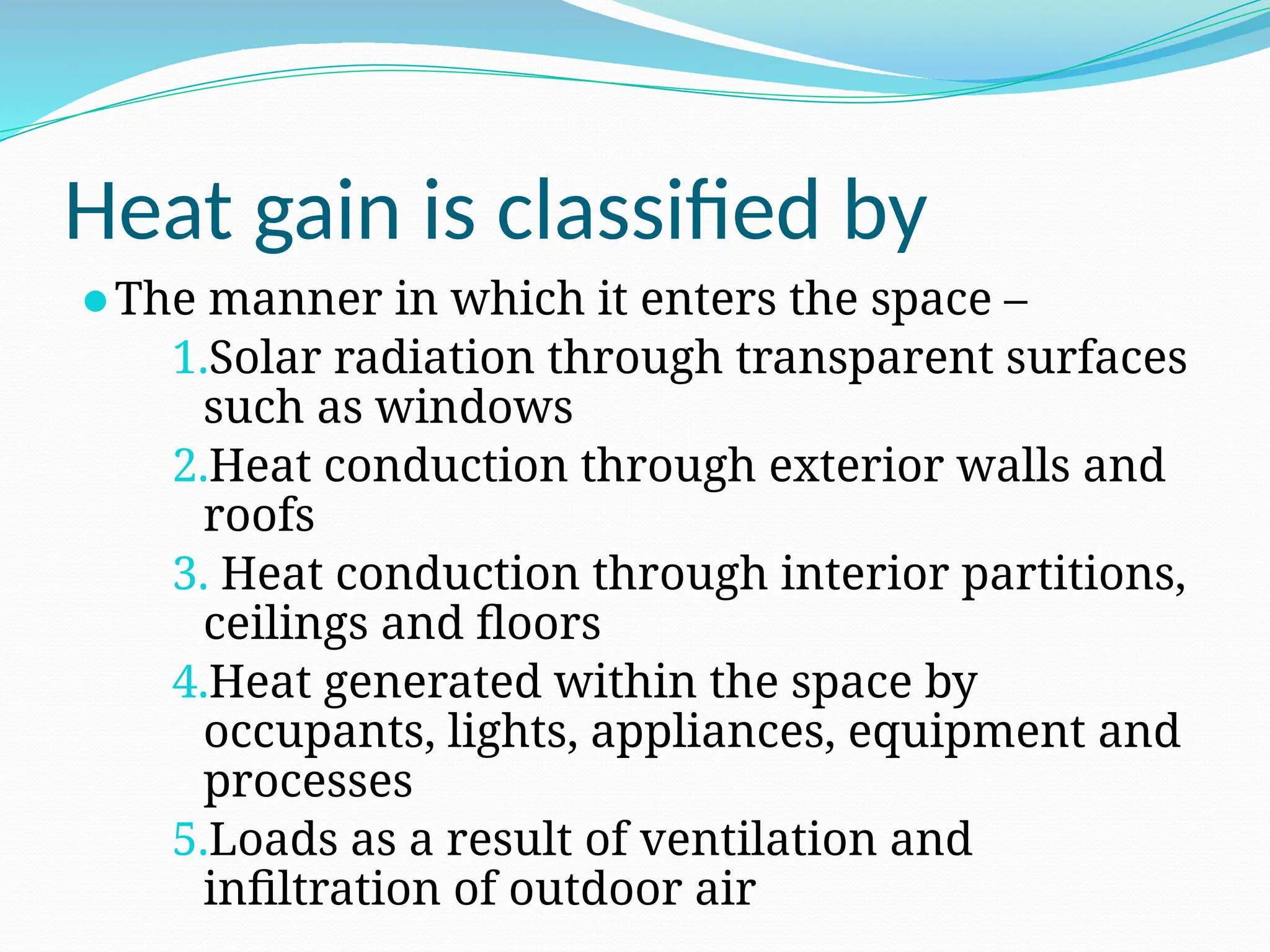
Heat gain is classified by
⚫The manner in which it enters the space –
1.Solar radiation through transparent surfaces
such as windows
2.Heat conduction through exterior walls and
roofs
3. Heat conduction through interior partitions,
ceilings and floors
4.Heat generated within the space by
occupants, lights, appliances, equipment and
processes
5.Loads as a result of ventilation and
infiltration of outdoor air
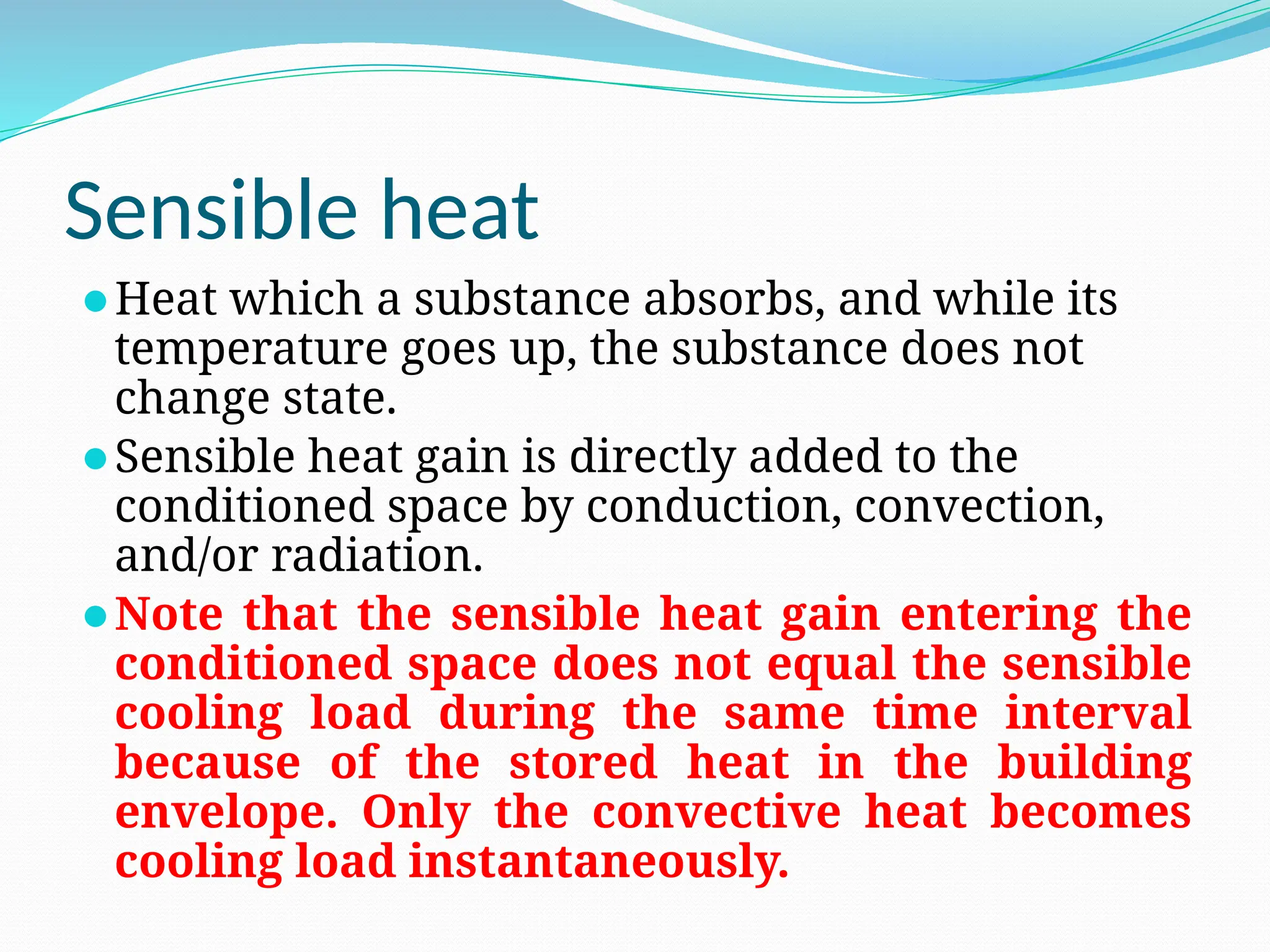
Sensible heat
⚫Heat which a substance absorbs, and while its
temperature goes up, the substance does not
change state.
⚫Sensible heat gain is directly added to the
conditioned space by conduction, convection,
and/or radiation.
⚫Note that the sensible heat gain entering the
conditioned space does not equal the sensible
cooling load during the same time interval
because of the stored heat in the building
envelope. Only the convective heat becomes
cooling load instantaneously.
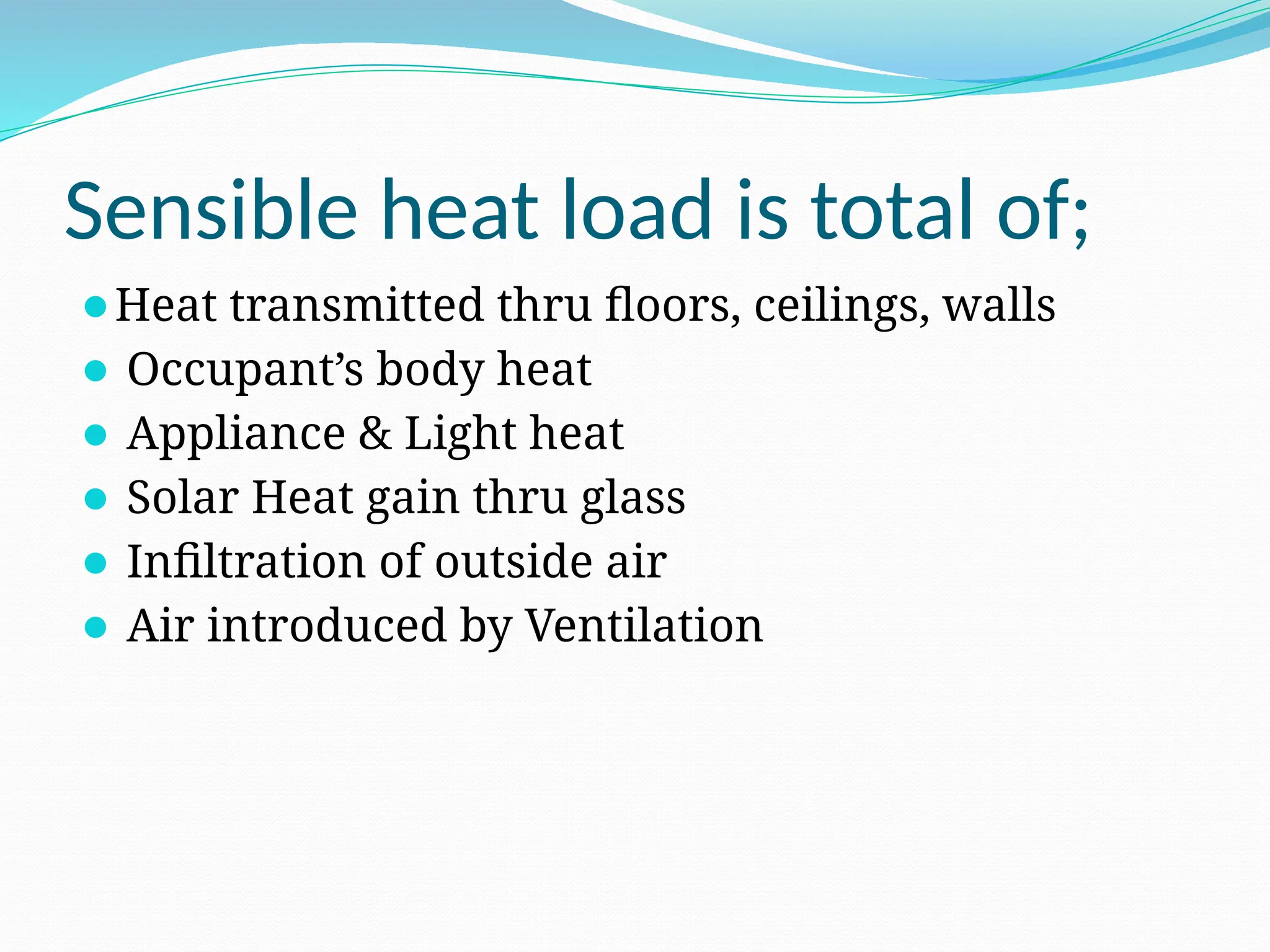
Sensible heat load is total of;
⚫Heat transmitted thru floors, ceilings, walls
⚫ Occupant’s body heat
⚫ Appliance & Light heat
⚫ Solar Heat gain thru glass
⚫ Infiltration of outside air
⚫ Air introduced by Ventilation
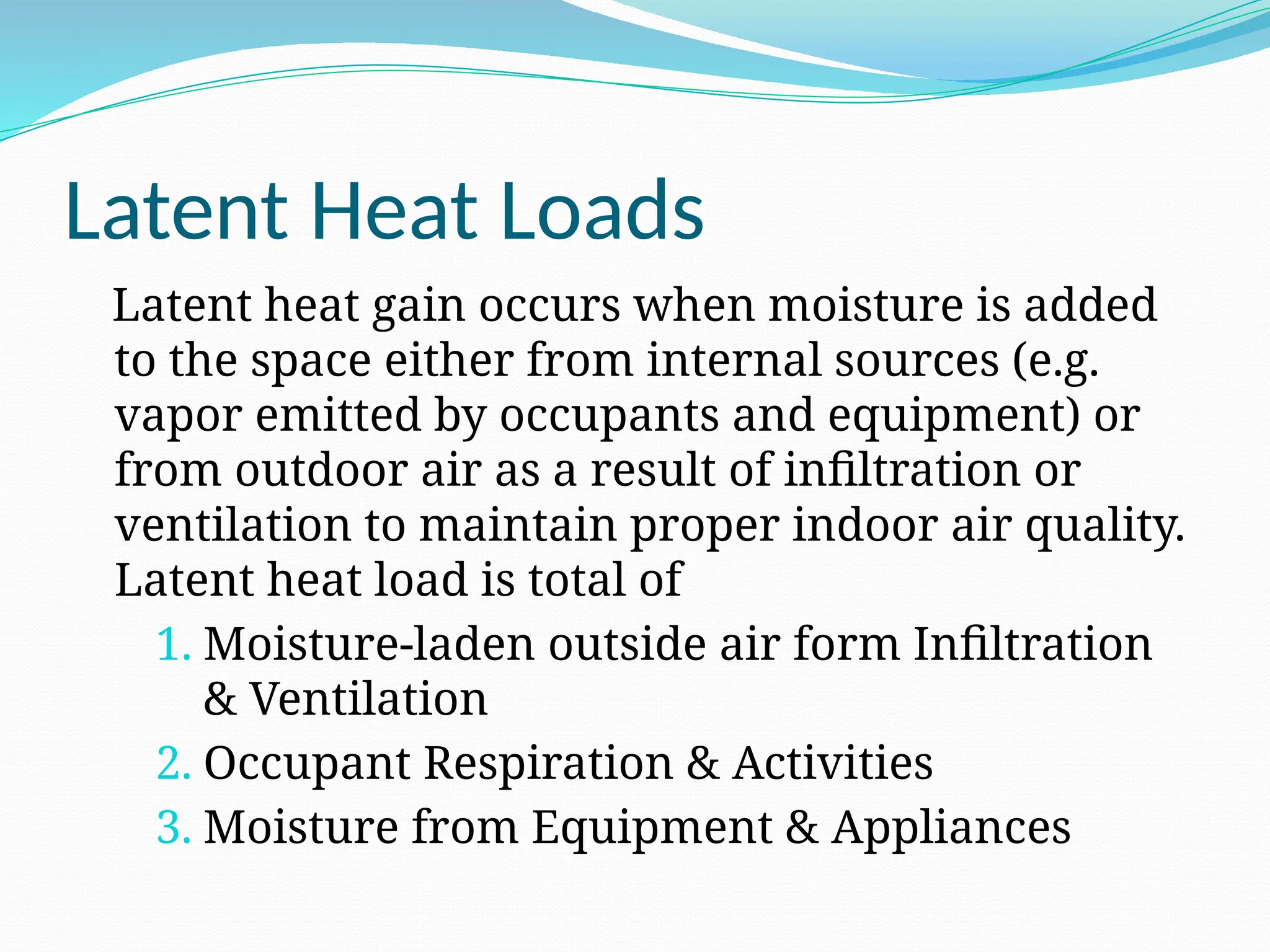
Latent Heat Loads
Latent heat gain occurs when moisture is added
to the space either from internal sources (e.g.
vapor emitted by occupants and equipment) or
from outdoor air as a result of infiltration or
ventilation to maintain proper indoor air quality.
Latent heat load is total of
1. Moisture-laden outside air form Infiltration
& Ventilation
2. Occupant Respiration & Activities
3. Moisture from Equipment & Appliances
Remember
⚫To maintain a constant humidity ratio, water
vapor must condense on cooling apparatus at a
rate equal to its rate of addition into the space.
This process is called dehumidification and is
very energy intensive,
⚫for instance, removing 1 kg of humidity requires
approximately 0.7 kWh of energy.

Thermal load calculation.pptxmmmmmmbbbhggbbhbhhhbv

  • 1.
  • 2.
    Objective Cooling load calculationsmay be used to accomplish one or more of the following objectives: a) Provide information for equipment selection, system sizing and system design. b) Provide data for evaluating the optimum possibilities for load reduction. c) Permit analysis of partial loads as required for system design, operation and control.
  • 3.
    TERMINOLOGIES ⚫Space – iseither a volume or a site without a partition or a partitioned room or group of rooms. ⚫Room – is an enclosed or partitioned space that is usually treated as single load. ⚫Zone – is a space or group of spaces within a building with heating and/or cooling requirements sufficiently similar so that comfort conditions can be maintained throughout by a single controlling device.
  • 4.
    British thermal unit(Btu) ⚫ the approximate heat required to raise 1 lb. of water 1 deg Fahrenheit, from 590 F to 600 F. ⚫Air conditioners are rated by the number of British Thermal Units (Btu) of heat they can remove per hour. ⚫ Another common rating term for air conditioning size is the "ton," which is 12,000 Btu per hour and Watts. ƒ ⚫ 1 ton is equivalent to 12,000 BTU/hr. and 12,000 ƒ BTU/hr is equivalent to 3,516 Watts - or 3.516 kW (kilo-Watts).
  • 5.
    ⚫Cooling Load TemperatureDifference (CLTD) – an equivalent temperature difference used for calculating the instantaneous external cooling load across a wall or roof. ⚫Sensible Heat Gain – is the energy added to the space by conduction, convection and/or radiation. ⚫ Latent Heat Gain – is the energy added to the space when moisture is added to the space by means of vapor emitted by the 1. Occupants 2. generated by a process or through air infiltration from outside or adjacent areas. ⚫ Radiant Heat Gain – the rate at which heat absorbed is by the surfaces enclosing the space and the objects within the space.
  • 6.
    ⚫Space Heat Gain– is the rate at which heat enters into and/or is generated within the conditioned space during a given time interval. ⚫Space Cooling Load – is the rate at which energy must be removed from a space to maintain a constant space air temperature. ⚫Space Heat Extraction Rate - the rate at which heat is removed from the conditioned space and is equal to the space cooling load if the room temperature remains constant. ⚫Temperature, Dry Bulb – is the temperature of air indicated by a regular thermometer.
  • 7.
    Temperature, Wet Bulb ⚫is the temperature measured by a thermometer that has a bulb wrapped in wet cloth. The evaporation of water from the thermometer has a cooling effect, so the temperature indicated by the wet bulb thermometer is less than the temperature indicated by a dry-bulb (normal, unmodified) thermometer. ⚫The rate of evaporation from the wet-bulb thermometer depends on the humidity of the air. ⚫Evaporation is slower when the air is already full of water vapor. For this reason, the difference in the temperatures indicated by ordinary dry bulb and wet bulb thermometers gives a measure of atmospheric humidity.
  • 8.
    Temperature, Dewpoint is thetemperature to which air must be cooled in order to reach saturation or at which the condensation of water vapor in a space begins for a given state of humidity and pressure. Relative humidity - describes how far the air is from saturation. It is a useful term for expressing the amount of water vapor when discussing the amount and rate of evaporation.
  • 9.
    Thermal Transmittance orHeat Transfer Coefficient (U-factor) ⚫ is the rate of heat flow through a unit area of building envelope material or assembly, including its boundary films, per unit of temperature difference between the inside and outside air. ⚫The U-factor is expressed in W/m2.K ⚫Thermal Resistance (R) – is the reciprocal of a heat transfer coefficient and is expressed in m2.K/W. ⚫ For example, a wall with a U-value of 0.25 would have a resistance value of R = 1/U = 1/0.25=4.0. ⚫The value of R is also used to represent Thermal Resistivity, the reciprocal of the thermal conductivity.
  • 10.
    ⚫It is obviousthat you will need to remove the amount of heat gain - if it is hot outside. Similarly, you'll need to add in the heat loss from your space - if outside temperature is cold. In short, heat gain and loss, must be equally balanced by heat removal, and addition, to get the desired room comfort that we want. ⚫So;
  • 11.
    The heat gainor heat loss through a building depends on: ⚫ The temperature difference between outside temperature and our desired temperature. ⚫ The type of construction and the amount of insulation is in your ceiling and walls. Let's say, that you have two identical buildings, one is build out of glass, and the other out of brick. Of course the one built with glass would require much more heat addition, or removal, compared to the other - given a same day. This is because the glass has a high thermal conductivity (U-value) as compared to the brick and also because it is transparent, it allows direct transmission of solar heat. ⚫ How much shade is on your building’s windows, walls, and roof? Two identical buildings with different orientation with respect to the direction of sun rise and fall will also influence the air conditioner sizing.
  • 12.
    ⚫How large isyour room? The surface area of the walls. The larger the surface area - the more heat can loose, or gain through it. ⚫How much air leaks into indoor space from the outside? Infiltration plays a part in determining our air conditioner sizing. Door gaps, cracked windows, chimneys - are the "doorways" for air to enter from outside, into your living space. ⚫The occupants. It takes a lot to cool a town hall full of people.
  • 13.
    ⚫Activities and otherequipment within a building. Cooking? Hot bath? Gymnasium? ⚫ Amount of lighting in the room. High efficiency lighting fixtures generate less heat. ⚫How much heat the appliances generate. Number of power equipments such as oven, washing machine, computers, TV inside the space; all contribute to heat.
  • 14.
    ⚫It is importantto use the correct procedure for estimating heat gain or heat loss. ⚫Two groups— ⚫the Air Conditioning Contractors of America (ACCA) ⚫American Society of Heating, Refrigerating, and Air Conditioning Engineers (ASHRAE) publish calculation procedures for sizing central air conditioners.
  • 15.
    HEAT FLOW RATES ⚫Spaceheat gain ----How much heat (energy) is entering the space? ⚫ Space cooling load --How much energy must be removed from the space to keep temperature and relative humidity constant? ⚫Space heat extraction---How much energy is the HVAC removing from the space? ⚫ Cooling load (coil) --How much energy is removed by the cooling coil serving various spaces plus any loads external to the spaces such as duct heat gain, duct leakage, fan heat and outdoor makeup air?
  • 16.
    Space Heat Gain ⚫Thisinstantaneous rate of heat gain is the rate at which heat enters into and/or is generated within a space at a given instant.
  • 17.
    Heat gain isclassified by ⚫The manner in which it enters the space – 1.Solar radiation through transparent surfaces such as windows 2.Heat conduction through exterior walls and roofs 3. Heat conduction through interior partitions, ceilings and floors 4.Heat generated within the space by occupants, lights, appliances, equipment and processes 5.Loads as a result of ventilation and infiltration of outdoor air
  • 18.
    Sensible heat ⚫Heat whicha substance absorbs, and while its temperature goes up, the substance does not change state. ⚫Sensible heat gain is directly added to the conditioned space by conduction, convection, and/or radiation. ⚫Note that the sensible heat gain entering the conditioned space does not equal the sensible cooling load during the same time interval because of the stored heat in the building envelope. Only the convective heat becomes cooling load instantaneously.
  • 19.
    Sensible heat loadis total of; ⚫Heat transmitted thru floors, ceilings, walls ⚫ Occupant’s body heat ⚫ Appliance & Light heat ⚫ Solar Heat gain thru glass ⚫ Infiltration of outside air ⚫ Air introduced by Ventilation
  • 20.
    Latent Heat Loads Latentheat gain occurs when moisture is added to the space either from internal sources (e.g. vapor emitted by occupants and equipment) or from outdoor air as a result of infiltration or ventilation to maintain proper indoor air quality. Latent heat load is total of 1. Moisture-laden outside air form Infiltration & Ventilation 2. Occupant Respiration & Activities 3. Moisture from Equipment & Appliances
  • 21.
    Remember ⚫To maintain aconstant humidity ratio, water vapor must condense on cooling apparatus at a rate equal to its rate of addition into the space. This process is called dehumidification and is very energy intensive, ⚫for instance, removing 1 kg of humidity requires approximately 0.7 kWh of energy.