Bimrisha Bimal 2024-AJ-30
Biborsondutta 2024-AJ-29
Bastob Borah 2024-AJ-27
B
Submitted to the Department of extension education,AAU,Jorhat_785013
2.
STRUCTURE
• Theories ofintelligence
1]Hebb’s theory of intelligence
2]Gardner’s theory of multiple intelligence
3]Triarchic theory of intelligence
4]Cognitive contextual theory of intelligence
3.
HEBB’S THEORY OFINTELLIGENCE
• Hebbs theory was given by Donald.O.Hebb,a Canadian
psychologist proposed an influential theory.
• He divided intelligence into two types
A]Intelligence A
B]Intelligence B
Bastob borah
4.
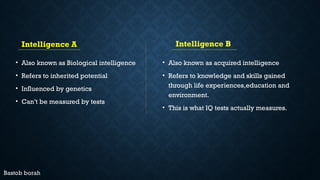
Intelligence A
• Alsoknown as Biological intelligence
• Refers to inherited potential
• Influenced by genetics
• Can’t be measured by tests
Intelligence B
• Also known as acquired intelligence
• Refers to knowledge and skills gained
through life experiences,education and
environment.
• This is what IQ tests actually measures.
5.
GARDNER’S THEORY OFMULTIPLE
INTELLIGENCE
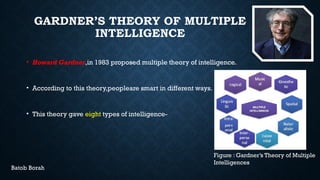
• Howard Gardner,in 1983 proposed multiple theory of intelligence.
• According to this theory,peopleare smart in different ways.
• This theory gave eight types of intelligence-
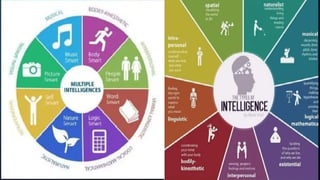
Figure : Gardner’s Theory of Multiple
Intelligences
Batob Borah
7.
1]Linguistic intelligence-Good atwriting,speaking,reading and listening.
• They enjoy learning new words,telling stories and expressing ideas clearly.
• Examples-Writers,poets,teachers,journalist,public speaers and lawyers.
2]Logical-mathematical intelligence-Good at numbers,logic and problem solving.
• They enjoy math,reasoning,puzzles and finding patterns.
• Examples-Scientists,mathematicians,engineers,computer programmers,accountants.
3]Spatial intelligence
• Good at visualizing things.
• People with this intelligence can easily imagine objects,shapes and how things fit together.
• Examples-Artists,architechts,engineers,designers,pilots.
8.
4] Bodily-kinesthetic intelligence
•Good at using body and hands.
• People with this intelligence are good in sports,dancing,acting and building things.
• Example-sportsperson,dancers.
5]Interpersonal intelligence
• Ability to understsnd and interact with others.
• Skilled in communication,empathy and conflict resolution.
• Example-Teachers,Salesperson,therapy.
6]Intrapersonal intelligence
• Deep understanding of self understanding,motivation,goals.
• Reactive and self aware.
• Example-Philosopher,psychologists,spiritual leaders.
Batob borah
9.
7]Musical intelligence
• Skillin performance, composition, and appreciation of musical patterns.
• Recognizes pitch, rhythm, tone, and sound easily.
• Found in musicians, composers, and sound engineers.
8]Naturalistic intelligence
• Recognizes and categorizes flora, fauna, and natural phenomena.
• Sensitive to nature and environmental patterns.
• Present in botanists, farmers, and environmentalists.
Bastob borah
10.
COGNITIVE CONTEXTUAL THEORYOF
INTELLIGENCE
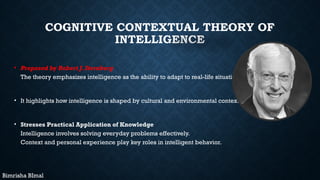
• Proposed by Robert J. Sternberg
The theory emphasizes intelligence as the ability to adapt to real-life situations.
• It highlights how intelligence is shaped by cultural and environmental context.
• Stresses Practical Application of Knowledge
Intelligence involves solving everyday problems effectively.
Context and personal experience play key roles in intelligent behavior.
Bimrisha BImal
11.
• Intelligence asContext-Dependent
What is considered intelligent behavior varies across cultures.
The theory recognizes that intelligence cannot be measured in isolation.
• Adaptation to the Environment
A key part of intelligence is adapting to one’s surroundings.
This includes learning from experience and responding effectively to change.
• Incorporates Practical Intelligence
Practical intelligence is central to the theory’s approach.
It focuses on how people use skills to navigate daily life and solve real problems.
Bimrisha Bimal
TRIARCHIC THEORY OFINTELLIGENCE
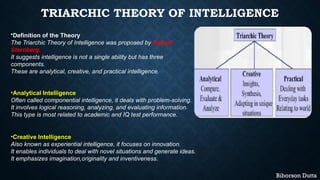
•Definition of the Theory
The Triarchic Theory of Intelligence was proposed by Robert
Sternberg.
It suggests intelligence is not a single ability but has three
components.
These are analytical, creative, and practical intelligence.
•Analytical Intelligence
Often called componential intelligence, it deals with problem-solving.
It involves logical reasoning, analyzing, and evaluating information.
This type is most related to academic and IQ test performance.
•Creative Intelligence
Also known as experiential intelligence, it focuses on innovation.
It enables individuals to deal with novel situations and generate ideas.
It emphasizes imagination,originality and inventiveness.
Biborson Dutta
14.
Practical intelligence
• Oftencalled street smarts,it’s about applying knowledge to real world situations.
• It helps adapt to,shape and select environment effectively.
Stenberg emphasizes that intelligence is not about how well you do in school but also
about creativity and everyday problem solving.
Also,practical intelligence is shaped by cultural context.What’s considered intelligent
behaviour
Varies across the culture.
Biborson Dutta
15.
RELATION BETWEEN COGNITIVECONTEXTUAL
AND TRIARCHIAL THEORY OF INTELLIGENCE
Bimrisha Bimal & Biborson Dutta
16.
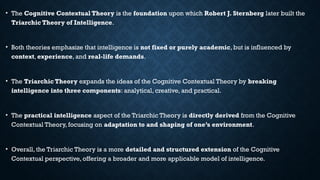
• The CognitiveContextual Theory is the foundation upon which Robert J. Sternberg later built the
Triarchic Theory of Intelligence.
• Both theories emphasize that intelligence is not fixed or purely academic, but is influenced by
context, experience, and real-life demands.
• The Triarchic Theory expands the ideas of the Cognitive Contextual Theory by breaking
intelligence into three components: analytical, creative, and practical.
• The practical intelligence aspect of the Triarchic Theory is directly derived from the Cognitive
Contextual Theory, focusing on adaptation to and shaping of one’s environment.
• Overall, the Triarchic Theory is a more detailed and structured extension of the Cognitive
Contextual perspective, offering a broader and more applicable model of intelligence.
17.
LET’S SUM UP
Expandingon this conclusion, it becomes evident that no single
theory can fully capture the range and depth of human
intelligence.While traditional models like Spearman’s
emphasize logical reasoning and problem-solving, more
contemporary theories such as Gardner’s and Sternberg’s
consider creative, practical, and emotional dimensions of
intelligence.These broader views challenge conventional IQ-
based assessments and call for more holistic approaches to
understanding cognitive potential. Furthermore, the integration
of cultural, social, and emotional factors into modern theories
reflects a growing recognition of how environment and
experience shape intelligence. Ultimately, the evolving study of
intelligence encourages continuous exploration, flexibility in
evaluation, and a deeper appreciation for individual strengths
and capabilities.
Bimrisha Bimal

![STRUCTURE
• Theories of intelligence
1]Hebb’s theory of intelligence
2]Gardner’s theory of multiple intelligence
3]Triarchic theory of intelligence
4]Cognitive contextual theory of intelligence](https://image.slidesharecdn.com/theoriesofintelligencefinal-260103151433-ebbe8022/85/THEORIES_OF_INTELLIGENCE-final-pptx-2024-2-320.jpg)
![HEBB’S THEORY OF INTELLIGENCE
• Hebbs theory was given by Donald.O.Hebb,a Canadian
psychologist proposed an influential theory.
• He divided intelligence into two types
A]Intelligence A
B]Intelligence B
Bastob borah](https://image.slidesharecdn.com/theoriesofintelligencefinal-260103151433-ebbe8022/85/THEORIES_OF_INTELLIGENCE-final-pptx-2024-3-320.jpg)
![1]Linguistic intelligence-Good at writing,speaking,reading and listening.
• They enjoy learning new words,telling stories and expressing ideas clearly.
• Examples-Writers,poets,teachers,journalist,public speaers and lawyers.
2]Logical-mathematical intelligence-Good at numbers,logic and problem solving.
• They enjoy math,reasoning,puzzles and finding patterns.
• Examples-Scientists,mathematicians,engineers,computer programmers,accountants.
3]Spatial intelligence
• Good at visualizing things.
• People with this intelligence can easily imagine objects,shapes and how things fit together.
• Examples-Artists,architechts,engineers,designers,pilots.](https://image.slidesharecdn.com/theoriesofintelligencefinal-260103151433-ebbe8022/85/THEORIES_OF_INTELLIGENCE-final-pptx-2024-7-320.jpg)
![4] Bodily-kinesthetic intelligence
• Good at using body and hands.
• People with this intelligence are good in sports,dancing,acting and building things.
• Example-sportsperson,dancers.
5]Interpersonal intelligence
• Ability to understsnd and interact with others.
• Skilled in communication,empathy and conflict resolution.
• Example-Teachers,Salesperson,therapy.
6]Intrapersonal intelligence
• Deep understanding of self understanding,motivation,goals.
• Reactive and self aware.
• Example-Philosopher,psychologists,spiritual leaders.
Batob borah](https://image.slidesharecdn.com/theoriesofintelligencefinal-260103151433-ebbe8022/85/THEORIES_OF_INTELLIGENCE-final-pptx-2024-8-320.jpg)
![7]Musical intelligence
• Skill in performance, composition, and appreciation of musical patterns.
• Recognizes pitch, rhythm, tone, and sound easily.
• Found in musicians, composers, and sound engineers.
8]Naturalistic intelligence
• Recognizes and categorizes flora, fauna, and natural phenomena.
• Sensitive to nature and environmental patterns.
• Present in botanists, farmers, and environmentalists.
Bastob borah](https://image.slidesharecdn.com/theoriesofintelligencefinal-260103151433-ebbe8022/85/THEORIES_OF_INTELLIGENCE-final-pptx-2024-9-320.jpg)