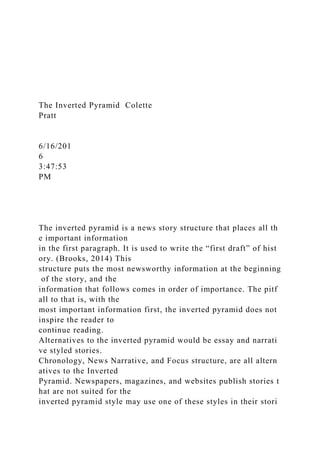
The Inverted Pyramid Colette
Pratt
6/16/201
6
3:47:53
PM
The inverted pyramid is a news story structure that places all th
e important information
in the first paragraph. It is used to write the “first draft” of hist
ory. (Brooks, 2014) This
structure puts the most newsworthy information at the beginning
of the story, and the
information that follows comes in order of importance. The pitf
all to that is, with the
most important information first, the inverted pyramid does not
inspire the reader to
continue reading.
Alternatives to the inverted pyramid would be essay and narrati
ve styled stories.
Chronology, News Narrative, and Focus structure, are all altern
atives to the Inverted
Pyramid. Newspapers, magazines, and websites publish stories t
hat are not suited for the
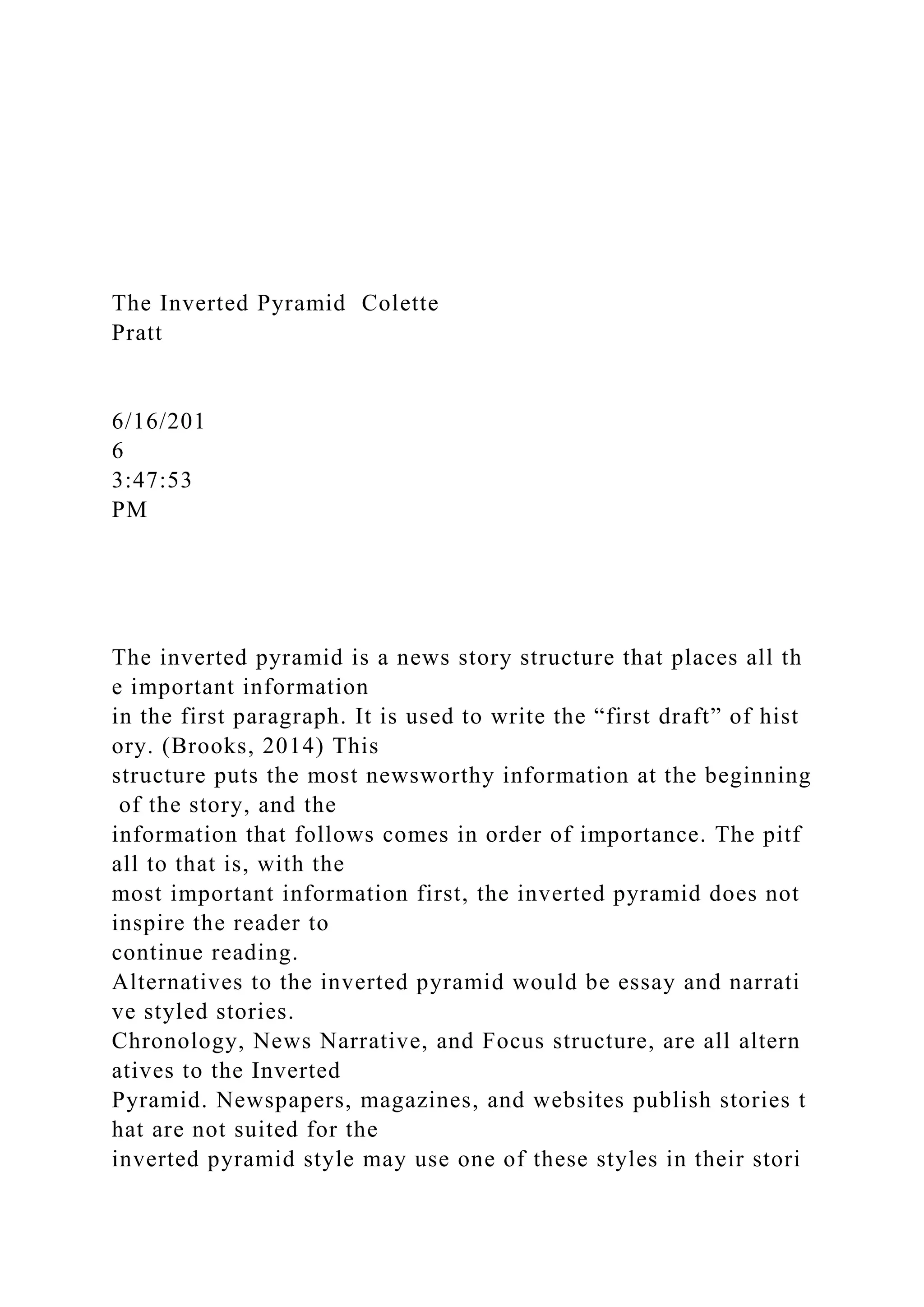
inverted pyramid style may use one of these styles in their stori
es. Writers focus on the
people involved, (the victims of the Orlando shooting, for exam
ple) to give a first-hand
account of what happened (Brooks, 2014)
The interviews, and reports of the Shooting in Orlando would be
a good example of
Chronology and News Narrative structured stories. Many of the
eye witness reports were
at the forefront of the news coverage, which has been played ou
t on television, social
media, and in newspapers. It is a certainty that the next issues o
f Newsweek, Rolling
Stone, and/or Time magazine will have coverage of the incident,
most likely it will be
the lead story, complete with cover picture. In a chronology styl
ed story, some portion of
the incident is the lead, however all of the important informatio
n is not at the beginning.
It is weaved throughout the story, with a mixture of personal int
erest, and factual
information to allow the reader to become engrossed in the activ
ities that transpired.
Reference:
Brooks, B., Kennedy, G., Moen, D. R., & Ranly, D. (2014).
News reporting and writing
(11th ed.). Boston, MA: Bedford/St. Martin’s. Chapters 9 & 11
Obama in Orlando Emily
Binkerd
6/16/201
6
9:17:56
PM
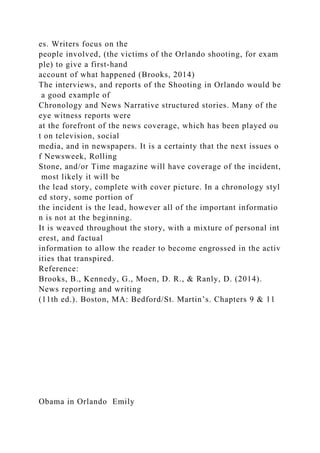
The news event that I have chosen is the pieces of writing writte
n about Obama visiting
Orlando to address the mass shooting that took place in Orlando
early this past Sunday
All three news outlets, The New York Times, Associated Press,
and CNN covered
Obama's visit. All three sites gave a precise story of the central
ideal, which was Obama
visiting Orlando, and consoling the families and loved ones who
had lost someone due
to the shootings. These are professional news sites, so the spelli
ng grammar, and
punctuation were near, if not completely perfect, but one place t
hey began to differ is
the supporting material. I personally thought the CNN article w
as the most readable.
Before reading them, I just assumed that the New York Times w
ould have been my
answer to that question, but I guess you know what they say wh
en you assume things.
The CNN article included great quotes from Obama's speech, an
d minor details that
made the article seem not only factual, but warm; a very person
al piece. CNN
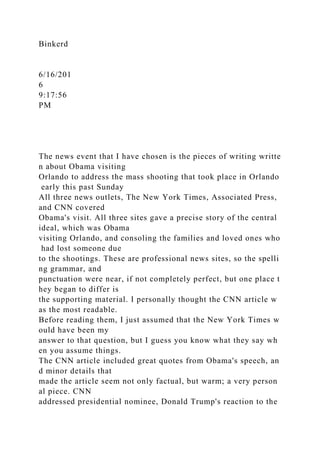
addressed presidential nominee, Donald Trump's reaction to the
shooting, and to his
response in regards to Obama's speech, just hours after it took p
lace. (Why, WHY are
so many Americans supporting this man...) I'm glad all three art
icles mentioned
McCain's opinions on all of this as well; I found both his views
and Trumps views nice
minor details that helped complete the story.
Resources:
Liptak, K. (2016).
Obama: Orlando victims' families pleaded with me to stop the
violence. Retrieved from
http://www.cnn.com/2016/06/16/politics/obama-visit-orlando-sh
ooting/index.html
Lederman, J. (2016)
Obama embraces Orlando families, appeals for gun controls.
Retrieved from
http://bigstory.ap.org/article/9c066538dfa64f7c807660b897f0b3
ec/obama-seek-healing-
orlando-even-politicians-spar
Hirschfeld Davis, J.
'Long and Genuine' Hugs: Shooting Victims' Relatives Recall
Obama's Empathy. Retrieved from
http://www.nytimes.com/2016/06/17/us/politics/obama-orlando-
shooting.html
Inverted Pryamid D1 Shelby
Moore
6/16/201
6
4:03:02
PM
The Inverted Pyramid is a format used by many journalists to en
sure critical news coverage. This
type of format is commonly used for delivering news stories, ra
dio stories, and even television.
"Public relations professionals use it in news releases to get atte
ntion from news editors" (Brooks,
Kennedy, Moen, & Ranly, 2014). One of the strengths of using t
his format is that breaking news
coverage will obtain the most valuable information first. "Follo
wing this structure, the “base” of the
pyramid—the most fundamental facts—
appear at the top of the story, in the lead paragraph.
Non-essential information appears in the following paragraphs,
or “nut” graphs, in order of
importance" (Purdue University, 2016). However, this method d
oes have its critics and for good
reason. A weakness to this format is that once the reader has all
the important information, they
usually do not read much further. "Although it delivers the most
important news first, it does not
encourage people to read the whole story" (Purdue University, 2
016). This can cause a lack of
knowledge on an important topic or event. Other critics have fo
und this format to be out-dated and
confusing for their audience.
Overall, the inverted pyramid has its benefits and is still used b
y many today despite critics. "That's
why the same inverted pyramid that is used in newspapers is the
most common story structure
found on such news websites such as CNN.com, msnbc.com, CB
Snews.com, and ABCnews.com"
(Brooks, Kennedy, Moen, and Ranly, 2014).
An alternative to the inverted pyramid would be focus structure.
"This approach allows the writer to
make large institutions, complex issues, and seven digit number
s meaningful" (Brooks, Kennedy,
Moen, and Ranly, 2014).
References
Brooks, B., Kennedy, G., Moen, D. R., & Ranly, D. (2014). Ne
ws reporting and writing (11th ed.).
Boston, MA: Bedford/St. Martin’s.
Purdue University. (2016). The Inverted Pyramid Structure. Retr
ieved June 16, 2016, from
https://owl.english.purdue.edu/owl/resource/735/04/
Effective Writing Colette
Pratt
6/16/201
6
6:16:45
PM
Good writing is accurate when it is built on concrete details. W
hen you use language to
communicate those details precisely, you inform and entertain y
our readers (Brooks,
2014)
I chose a story from The New York Times, Associated Press and
USA TODAY,
regarding Donald Trump and his views concerning gun bans for
those on the no fly list.
Each of the stories relayed an earlier tweet where Mr. Trump sta
ted, “I will be meeting
with the NRA, who has endorsed me, about not allowing people
on the terrorist watch
list, or the no fly list to buy guns.”
In the article in the New York Times, the NRA responded to thi
s information by saying
that they would be happy to meet with Mr. Trump, however thei
r stand on the issue is
concrete. “Withholding guns from people on the terrorist watch
list, the vast majority of
whom have not been charged with a crime, would give the gover
nment too much power
to deny people of their Second Amendment right. (Parker & Her
szenhorn, 2016)
While the Associated Press ran the same story, the information t
hey relayed was
different. “The NRA’s position on this issue has not changed. T
he NRA believes that
terrorists should not be allowed to purchase or possess firearms,
period,” said Chris Cox,
the executive director of the group’s Institute for Legislative Ac
tion, in the statement.
“Anyone on a terror watch list who tries to buy a gun should be
thoroughly investigated
by the FBI and the sale delayed while the investigation is ongoi
ng.”(Lemire & Colvin,
2016)
USA TODAY reported the same information as the Associated P
ress, with the additional
comment that, “Trump’s support for a ban would put him on the
same side of the issue
as presumptive Democratic nominee Hillary Clinton and Preside
nt Obama” (Collins,
2016)
Of the three I felt the most readable story was that of the Associ
ated Press. It was
detailed, and full of comments from both Mr. Trump, and the N
RA, with sidebars
concerning Clinton and President Obama’s views, without veeri
ng too far from the topic
of the article, Mr. Trump’s desire to sit down with the NRA Whi
le no one knows exactly
what Mr. Trump will propose, it should prove to be an interestin
g meeting.
Reference:
Brooks, B., Kennedy, G., Moen, D. R., & Ranly, D. (2014).
News reporting and writing
(11th ed.). Boston, MA: Bedford/St. Martin’s. Chapter 10
Collins, E. (2016, June 15).
Trump says he’ll meet with NRA to discuss gun ban for those
on no-fly list. USA TODAY. Retrieved June 16.
Lemire, J., & Colvin, J. (2016, June 15). Trump to Discuss Terr
orism Watch List, No
Fly Ban with NRA.
Trump to Discuss Terrorism Watch List, No Fly Ban with NRA.
Associated Press. Retrieved June 16, 2016.
Parker, A., & Herszenhorn, D. M. (2016, June 15).
Trump Veers from Party Line on Gun
Control. New York Times. Retrieved June 16, 2016.

The Inverted Pyramid  Colette Pratt 6162016 .docx

  • 1.
    The Inverted PyramidColette Pratt 6/16/201 6 3:47:53 PM The inverted pyramid is a news story structure that places all th e important information in the first paragraph. It is used to write the “first draft” of hist ory. (Brooks, 2014) This structure puts the most newsworthy information at the beginning of the story, and the information that follows comes in order of importance. The pitf all to that is, with the most important information first, the inverted pyramid does not inspire the reader to continue reading. Alternatives to the inverted pyramid would be essay and narrati ve styled stories. Chronology, News Narrative, and Focus structure, are all altern atives to the Inverted Pyramid. Newspapers, magazines, and websites publish stories t hat are not suited for the inverted pyramid style may use one of these styles in their stori
  • 2.
    es. Writers focuson the people involved, (the victims of the Orlando shooting, for exam ple) to give a first-hand account of what happened (Brooks, 2014) The interviews, and reports of the Shooting in Orlando would be a good example of Chronology and News Narrative structured stories. Many of the eye witness reports were at the forefront of the news coverage, which has been played ou t on television, social media, and in newspapers. It is a certainty that the next issues o f Newsweek, Rolling Stone, and/or Time magazine will have coverage of the incident, most likely it will be the lead story, complete with cover picture. In a chronology styl ed story, some portion of the incident is the lead, however all of the important informatio n is not at the beginning. It is weaved throughout the story, with a mixture of personal int erest, and factual information to allow the reader to become engrossed in the activ ities that transpired. Reference: Brooks, B., Kennedy, G., Moen, D. R., & Ranly, D. (2014). News reporting and writing (11th ed.). Boston, MA: Bedford/St. Martin’s. Chapters 9 & 11 Obama in Orlando Emily
  • 3.
    Binkerd 6/16/201 6 9:17:56 PM The news eventthat I have chosen is the pieces of writing writte n about Obama visiting Orlando to address the mass shooting that took place in Orlando early this past Sunday All three news outlets, The New York Times, Associated Press, and CNN covered Obama's visit. All three sites gave a precise story of the central ideal, which was Obama visiting Orlando, and consoling the families and loved ones who had lost someone due to the shootings. These are professional news sites, so the spelli ng grammar, and punctuation were near, if not completely perfect, but one place t hey began to differ is the supporting material. I personally thought the CNN article w as the most readable. Before reading them, I just assumed that the New York Times w ould have been my answer to that question, but I guess you know what they say wh en you assume things. The CNN article included great quotes from Obama's speech, an d minor details that made the article seem not only factual, but warm; a very person al piece. CNN addressed presidential nominee, Donald Trump's reaction to the
  • 4.
    shooting, and tohis response in regards to Obama's speech, just hours after it took p lace. (Why, WHY are so many Americans supporting this man...) I'm glad all three art icles mentioned McCain's opinions on all of this as well; I found both his views and Trumps views nice minor details that helped complete the story. Resources: Liptak, K. (2016). Obama: Orlando victims' families pleaded with me to stop the violence. Retrieved from http://www.cnn.com/2016/06/16/politics/obama-visit-orlando-sh ooting/index.html Lederman, J. (2016) Obama embraces Orlando families, appeals for gun controls. Retrieved from http://bigstory.ap.org/article/9c066538dfa64f7c807660b897f0b3 ec/obama-seek-healing- orlando-even-politicians-spar Hirschfeld Davis, J. 'Long and Genuine' Hugs: Shooting Victims' Relatives Recall Obama's Empathy. Retrieved from http://www.nytimes.com/2016/06/17/us/politics/obama-orlando- shooting.html
  • 5.
    Inverted Pryamid D1Shelby Moore 6/16/201 6 4:03:02 PM The Inverted Pyramid is a format used by many journalists to en sure critical news coverage. This type of format is commonly used for delivering news stories, ra dio stories, and even television. "Public relations professionals use it in news releases to get atte ntion from news editors" (Brooks, Kennedy, Moen, & Ranly, 2014). One of the strengths of using t his format is that breaking news coverage will obtain the most valuable information first. "Follo wing this structure, the “base” of the pyramid—the most fundamental facts— appear at the top of the story, in the lead paragraph. Non-essential information appears in the following paragraphs, or “nut” graphs, in order of importance" (Purdue University, 2016). However, this method d oes have its critics and for good reason. A weakness to this format is that once the reader has all the important information, they usually do not read much further. "Although it delivers the most important news first, it does not
  • 6.
    encourage people toread the whole story" (Purdue University, 2 016). This can cause a lack of knowledge on an important topic or event. Other critics have fo und this format to be out-dated and confusing for their audience. Overall, the inverted pyramid has its benefits and is still used b y many today despite critics. "That's why the same inverted pyramid that is used in newspapers is the most common story structure found on such news websites such as CNN.com, msnbc.com, CB Snews.com, and ABCnews.com" (Brooks, Kennedy, Moen, and Ranly, 2014). An alternative to the inverted pyramid would be focus structure. "This approach allows the writer to make large institutions, complex issues, and seven digit number s meaningful" (Brooks, Kennedy, Moen, and Ranly, 2014). References Brooks, B., Kennedy, G., Moen, D. R., & Ranly, D. (2014). Ne ws reporting and writing (11th ed.). Boston, MA: Bedford/St. Martin’s. Purdue University. (2016). The Inverted Pyramid Structure. Retr ieved June 16, 2016, from https://owl.english.purdue.edu/owl/resource/735/04/
  • 7.
    Effective Writing Colette Pratt 6/16/201 6 6:16:45 PM Goodwriting is accurate when it is built on concrete details. W hen you use language to communicate those details precisely, you inform and entertain y our readers (Brooks, 2014) I chose a story from The New York Times, Associated Press and USA TODAY, regarding Donald Trump and his views concerning gun bans for those on the no fly list. Each of the stories relayed an earlier tweet where Mr. Trump sta ted, “I will be meeting with the NRA, who has endorsed me, about not allowing people on the terrorist watch list, or the no fly list to buy guns.” In the article in the New York Times, the NRA responded to thi s information by saying that they would be happy to meet with Mr. Trump, however thei r stand on the issue is concrete. “Withholding guns from people on the terrorist watch list, the vast majority of whom have not been charged with a crime, would give the gover nment too much power
  • 8.
    to deny peopleof their Second Amendment right. (Parker & Her szenhorn, 2016) While the Associated Press ran the same story, the information t hey relayed was different. “The NRA’s position on this issue has not changed. T he NRA believes that terrorists should not be allowed to purchase or possess firearms, period,” said Chris Cox, the executive director of the group’s Institute for Legislative Ac tion, in the statement. “Anyone on a terror watch list who tries to buy a gun should be thoroughly investigated by the FBI and the sale delayed while the investigation is ongoi ng.”(Lemire & Colvin, 2016) USA TODAY reported the same information as the Associated P ress, with the additional comment that, “Trump’s support for a ban would put him on the same side of the issue as presumptive Democratic nominee Hillary Clinton and Preside nt Obama” (Collins, 2016) Of the three I felt the most readable story was that of the Associ ated Press. It was detailed, and full of comments from both Mr. Trump, and the N RA, with sidebars concerning Clinton and President Obama’s views, without veeri ng too far from the topic of the article, Mr. Trump’s desire to sit down with the NRA Whi le no one knows exactly what Mr. Trump will propose, it should prove to be an interestin g meeting. Reference:
  • 9.
    Brooks, B., Kennedy,G., Moen, D. R., & Ranly, D. (2014). News reporting and writing (11th ed.). Boston, MA: Bedford/St. Martin’s. Chapter 10 Collins, E. (2016, June 15). Trump says he’ll meet with NRA to discuss gun ban for those on no-fly list. USA TODAY. Retrieved June 16. Lemire, J., & Colvin, J. (2016, June 15). Trump to Discuss Terr orism Watch List, No Fly Ban with NRA. Trump to Discuss Terrorism Watch List, No Fly Ban with NRA. Associated Press. Retrieved June 16, 2016. Parker, A., & Herszenhorn, D. M. (2016, June 15). Trump Veers from Party Line on Gun Control. New York Times. Retrieved June 16, 2016.