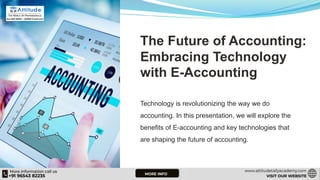
The Future of Accounting:
Embracing Technology
with E-Accounting
Technology is revolutionizing the way we do
accounting. In this presentation, we will explore the
benefits of E-accounting and key technologies that
are shaping the future of accounting.
Definition of E-Accounting
E-Accounting refers to the use of modern technology to
manage financial data. It streamlines and automates
accounting processes, from bookkeeping to financial
reporting.
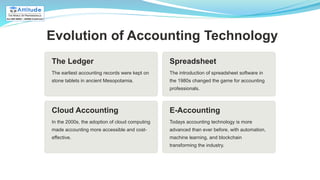
Evolution of Accounting Technology
The Ledger
The earliest accounting records were kept on
stone tablets in ancient Mesopotamia.
Spreadsheet
The introduction of spreadsheet software in
the 1980s changed the game for accounting
professionals.
Cloud Accounting
In the 2000s, the adoption of cloud computing
made accounting more accessible and cost-
effective.
E-Accounting
Todays accounting technology is more
advanced than ever before, with automation,
machine learning, and blockchain
transforming the industry.
Benefits of E-Accounting
1 Efficiency and Time Savings
E-accounting automates many manual
processes, reducing the time it takes to perform
tasks like data entry, payroll, and compliance.
2
Accuracy and Error Reduction
By eliminating manual data entry and the risk
of human error, E-accounting ensures that
financial information is accurate and reliable. 3 Accessibility and Collaboratio
The cloud-based nature of E-accounting makes
financial data accessible from anywhere with
internet access. Collaboration between different
departments and stakeholders is also easier and
more efficient.
4
Data Security
E-accounting provides secure and reliable
storage of financial data, reducing the risk
of data breaches and other security threats.
Key Technologies in E-Accounting
Cloud Computing
Provides the backbone for
E-accounting, allowing
businesses to store and
access data from anywhere.
AI and Machine
Learning
AI and ML models
help automate
accounting functions
such as data
categorization and
report generation,
making accounting
easier and more
efficient.
Blockchain
Technology
Blockchain
technology
provides a
distributed ledger
of transactions,
allowing for
secure and
transparent
financial records.
Robotic
Process
Automation
Robots can
perform
repetitive and
time-consuming
tasks, such as
data entry,
allowing
professionals to
focus on higher-
level tasks.
FAQ's
What is E-accounting? E-accounting refers to the use of modern
technology to manage financial data. It automates
accounting processes and streamlines financial
management.
What are the benefits of E-accounting?
E-accounting provides many benefits, such as
increased efficiency and accuracy, improved
accessibility and collaboration, and better data security.
What are some key technologies
in E-accounting?
Cloud computing, artificial intelligence and machine
learning, blockchain technology, and robotic process
automation are key technologies in e-accounting.
How can businesses get started
with E-accounting?
Businesses can start by researching different E-
accounting solutions that meet their needs and budgets.
They can also consult with technology vendors and
accounting professionals to customize and implement E-
accounting systems.
The-Future-of-Accounting-Embracing-Technology-with-E-Accounting .

The-Future-of-Accounting-Embracing-Technology-with-E-Accounting .

  • 1.
    The Future ofAccounting: Embracing Technology with E-Accounting Technology is revolutionizing the way we do accounting. In this presentation, we will explore the benefits of E-accounting and key technologies that are shaping the future of accounting.
  • 2.
    Definition of E-Accounting E-Accountingrefers to the use of modern technology to manage financial data. It streamlines and automates accounting processes, from bookkeeping to financial reporting.
  • 3.
    Evolution of AccountingTechnology The Ledger The earliest accounting records were kept on stone tablets in ancient Mesopotamia. Spreadsheet The introduction of spreadsheet software in the 1980s changed the game for accounting professionals. Cloud Accounting In the 2000s, the adoption of cloud computing made accounting more accessible and cost- effective. E-Accounting Todays accounting technology is more advanced than ever before, with automation, machine learning, and blockchain transforming the industry.
  • 4.
    Benefits of E-Accounting 1Efficiency and Time Savings E-accounting automates many manual processes, reducing the time it takes to perform tasks like data entry, payroll, and compliance. 2 Accuracy and Error Reduction By eliminating manual data entry and the risk of human error, E-accounting ensures that financial information is accurate and reliable. 3 Accessibility and Collaboratio The cloud-based nature of E-accounting makes financial data accessible from anywhere with internet access. Collaboration between different departments and stakeholders is also easier and more efficient. 4 Data Security E-accounting provides secure and reliable storage of financial data, reducing the risk of data breaches and other security threats.
  • 5.
    Key Technologies inE-Accounting Cloud Computing Provides the backbone for E-accounting, allowing businesses to store and access data from anywhere. AI and Machine Learning AI and ML models help automate accounting functions such as data categorization and report generation, making accounting easier and more efficient. Blockchain Technology Blockchain technology provides a distributed ledger of transactions, allowing for secure and transparent financial records. Robotic Process Automation Robots can perform repetitive and time-consuming tasks, such as data entry, allowing professionals to focus on higher- level tasks.
  • 6.
    FAQ's What is E-accounting?E-accounting refers to the use of modern technology to manage financial data. It automates accounting processes and streamlines financial management. What are the benefits of E-accounting? E-accounting provides many benefits, such as increased efficiency and accuracy, improved accessibility and collaboration, and better data security. What are some key technologies in E-accounting? Cloud computing, artificial intelligence and machine learning, blockchain technology, and robotic process automation are key technologies in e-accounting. How can businesses get started with E-accounting? Businesses can start by researching different E- accounting solutions that meet their needs and budgets. They can also consult with technology vendors and accounting professionals to customize and implement E- accounting systems.