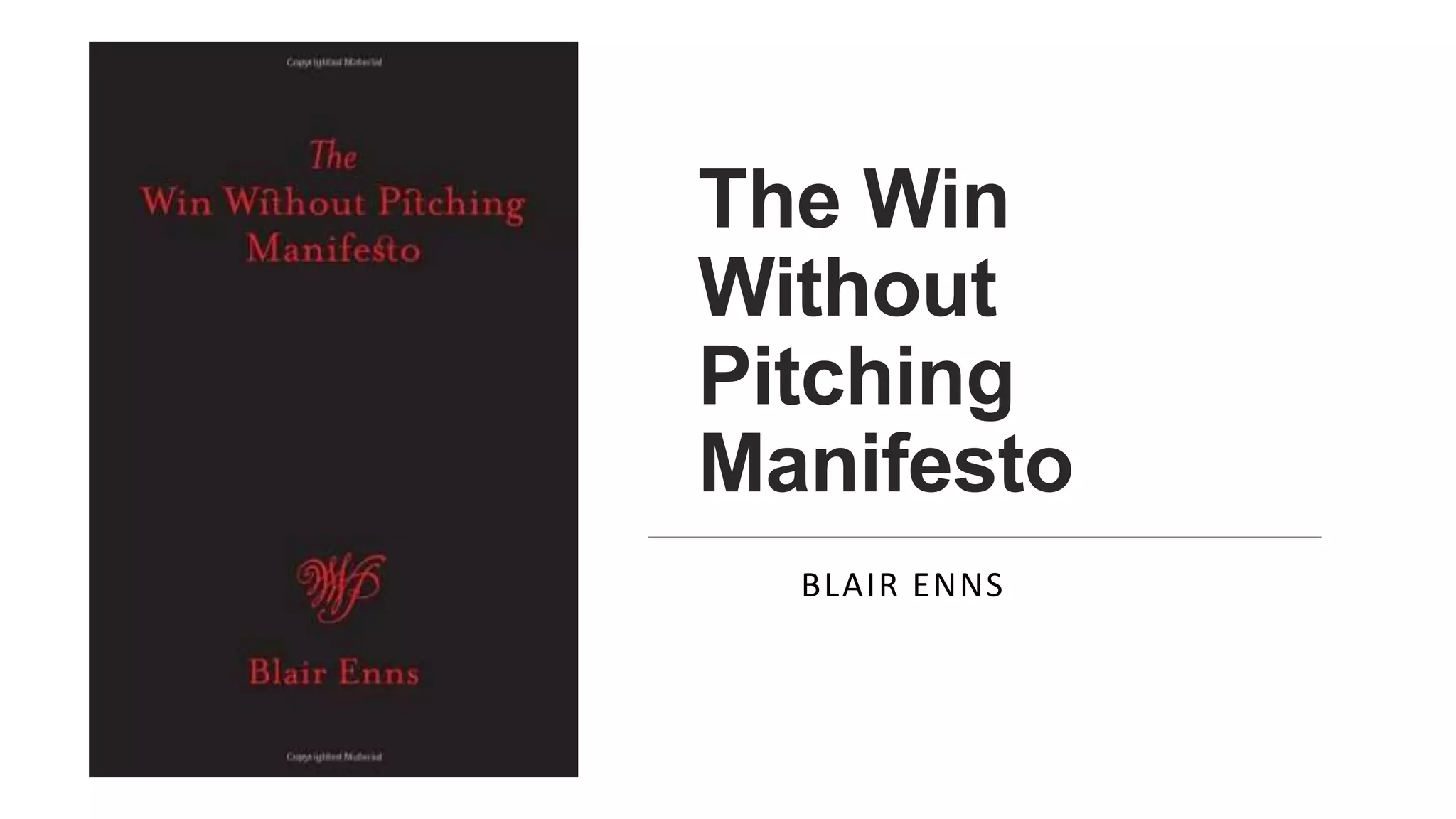
The Win
Without
Pitching
Manifesto
BLAIR ENNS
Every day, we pitch ourselves and our ideas – Conventional Business
strategy.
*Pitch: The attempt to sell or win approval for one’s idea by giving them away
for free.
The goal of this book is to free the creative firm from the ‘pitch’.
In a knowledge-based economy, why would we provide our ideas or solutions
for free when it’s the very service we are selling?
Tells us how to take back control of our work, increase our value to the
market, and make yourself irreplaceable to our customers.
- BLAIR ENNS
Blair Enns
The Win Without Pitching Manifesto!
 It is very common practice for companies to Pitch
for FREE.
 The problem with the Pitch is it declares 'MAY
THE BEST WIN' while forgetting that the best
won't be in such a situation to begin with.
Main Idea: To win you must act like a specialized
expert, charge based on the value of your
solutions “Positioning”, and say “No” early and
often.
The core content of this book is structured around
The 12 proclamations that make up the Win
Without Pitching philosophy.
Chapter 1 – We Will Specialize
What separates us from the competition is not our personality,
branding, pricing, or a unique proprietary process, — it’s our
expertise.
When the client has few alternatives to our expertise then we
can dictate pricing, we can set the terms of the engagement
and we can take control.
Specialization allows us to charge more. It causes others to
give our work the trust and respect it deserves.
Through Expertise and Positioning, we shift the power
balance away from the client and toward us.
Chapter 1 – Continue
3 Steps of Positioning: Fundamental Business Strategy
1.Choose a focus. “What business are we in?”
2. Articulate that focus via a consistent claim of expertise.
3. Work to add the missing skills, capabilities and processes
necessary to support our new claim.
Benefits: It brings forward a sales advantage and a price
premium, both of which allow us to guarantee clients
satisfaction as well as the opportunity to reinvest in ourselves
thereby further strengthening our expertise.
Control: We need to take control from Start.
Chapter 1 – Continue
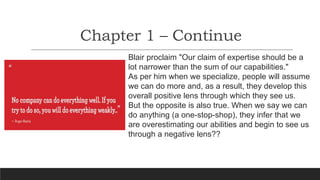
Blair proclaim "Our claim of expertise should be a
lot narrower than the sum of our capabilities."
As per him when we specialize, people will assume
we can do more and, as a result, they develop this
overall positive lens through which they see us.
But the opposite is also true. When we say we can
do anything (a one-stop-shop), they infer that we
are overestimating our abilities and begin to see us
through a negative lens??
Chapter 2 – We Will Replace
Presentations With Conversations
"Presentation, like pitch, is a word that we will leave behind as
we seek conversation and collaboration in their place.“
"Practitioners do not present. Stars do not audition.“
We should choose to let our work speak for itself.
Prefer conversations instead of presentations.
We forget about having meaningful conversations instead of
beautiful presentations.
Chapter 2 – Continue
It is never your job to convince the client to hire through the
presentation. Our mission is to position ourselves as the
“expert practitioner” in the mind of the prospective client.
"We welcome the client’s input on the strategy and in
exchange we ask him to grant us the freedom to explore
various ways of executing it."
It is important that we determine fit — to see if there is a fit
between the client’s need and the expertise we possess.
Application in my role
1. Stop Pitching, Focus on Our Expertise and Services and alternatives for
continuous improvements.
2. Look for Companies who Value our expertise and give control, looking
for a fit between the client’s need and our expertise.
3. Will try to Converse rather than Pitching: I will prefer to ask for Meetings
and conversations rather than giving presentations.
4. Good relations with existing clients, sharing our ideas for future
collaborations.
5. Stop preparing detailed RFP; Sell with confidence; Position as Valuable
experts; Price on Value, not hours.
Chapter 3 –We will diagnose
before we prescribe
Common Mistake: The companies assumes that they know what the
client Wants, even before he has asked.
Instead of jumping straight to answer, let’s take the baby steps to
understand more clearly.
“Being misunderstood by people whose opinions you value is
absolutely the most painful” - Gloria Steinem, American Activist.
On the other side, we also have clients coming in with a solution
already. A good response: "You may be correct, but let's find out“.
Then put them through our process to determine their problem to see
if we’re able to help them.
Always remember — Be an expert, not an order taker.
Chapter 3 –We will diagnose
before we prescribe
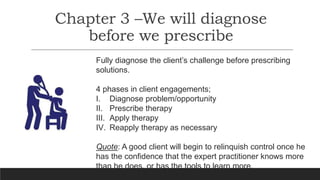
Fully diagnose the client’s challenge before prescribing
solutions.
4 phases in client engagements;
I. Diagnose problem/opportunity
II. Prescribe therapy
III. Apply therapy
IV. Reapply therapy as necessary
Quote: A good client will begin to relinquish control once he
has the confidence that the expert practitioner knows more
than he does, or has the tools to learn more.
Chapter 4 –We Will Rethink What
it Means to Sell
Selling is an important part of business. No two ways about it.
If you’re working with clients over the long term, then high-
pressure and buyer’s regret isn’t the way to go. Here we’ll
want to be a respectful facilitator- someone who determines
whether or not a next step is required.
I think what we need to do first is rethink what selling is. It is
not about bragging or convincing the client to hire you (a
common assumption) but rather determining a fit between the
client’s needs and your skills (your supply).
Chapter 4 –We Will Rethink What
it Means to Sell
The steps are the following:
1. Help the unaware- are they aware of their problem or
opportunity that require our services?
2. Inspire the interested- help them with the intent to solve
their problem, NOT inspire them to hire us. You can do this by
showing past case studies of what is possible.
3. Reassuring the intent- Build relationships and elevate
their trust, help them overcome self-doubt and fear of making
a mistake.
Chapter 4 –We Will Rethink What
it Means to Sell
4 priorities when “selling” – Getting new Business:
1.Win without pitching (sometimes this is not possible)
2.Derail the pitch (when you show up late, get the client to put
his process aside and take a different approach with you)
3.Gain the inside track (If #1 and #2 fail, get the client to treat
you special)
4.Walk away (if #1, #2, and #3 fail, you walk away)
Chapter 5 –We Will Do With Words
What We Used to Do With Paper
We need to remember that written proposals do not solely
win projects — it’s also your relationship with the
client. A proposal isn’t a necessary step in the buying
process.
The closing of the deal do not happen on paper, it
happens during the conversation. The written proposal is
just a public verification of both parties’ agreement which
could probably cover the scope, budget, and details of the
engagement.
The paper is only produced once the agreement has been
reached.
Chapter 6 – We Will Be Selective
Instead of chasing every lead and closing every possible deal we should focus more
on choosing clients with perfect fit. We do not lose clients by saying no, but we gain
the opportunity to be closer to the right ones.
Whisper, don’t shout.
What’s your natural reaction when you talk to someone shouting? You try to close
your ears or move farther away right? But when you whisper to someone, people
naturally lean in and listen to what you are saying.
Shouting looks like blindly marketing to every person you find with the intent of
increasing your reach. While this might work for huge organizations, for freelancers
& smaller agencies — it is very costly & exhausting.

The Win Without Pitching Manifesto_resume.pptx

  • 1.
  • 2.
    Every day, wepitch ourselves and our ideas – Conventional Business strategy. *Pitch: The attempt to sell or win approval for one’s idea by giving them away for free. The goal of this book is to free the creative firm from the ‘pitch’. In a knowledge-based economy, why would we provide our ideas or solutions for free when it’s the very service we are selling? Tells us how to take back control of our work, increase our value to the market, and make yourself irreplaceable to our customers. - BLAIR ENNS
  • 3.
    Blair Enns The WinWithout Pitching Manifesto!  It is very common practice for companies to Pitch for FREE.  The problem with the Pitch is it declares 'MAY THE BEST WIN' while forgetting that the best won't be in such a situation to begin with. Main Idea: To win you must act like a specialized expert, charge based on the value of your solutions “Positioning”, and say “No” early and often. The core content of this book is structured around The 12 proclamations that make up the Win Without Pitching philosophy.
  • 4.
    Chapter 1 –We Will Specialize What separates us from the competition is not our personality, branding, pricing, or a unique proprietary process, — it’s our expertise. When the client has few alternatives to our expertise then we can dictate pricing, we can set the terms of the engagement and we can take control. Specialization allows us to charge more. It causes others to give our work the trust and respect it deserves. Through Expertise and Positioning, we shift the power balance away from the client and toward us.
  • 5.
    Chapter 1 –Continue 3 Steps of Positioning: Fundamental Business Strategy 1.Choose a focus. “What business are we in?” 2. Articulate that focus via a consistent claim of expertise. 3. Work to add the missing skills, capabilities and processes necessary to support our new claim. Benefits: It brings forward a sales advantage and a price premium, both of which allow us to guarantee clients satisfaction as well as the opportunity to reinvest in ourselves thereby further strengthening our expertise. Control: We need to take control from Start.
  • 6.
    Chapter 1 –Continue Blair proclaim "Our claim of expertise should be a lot narrower than the sum of our capabilities." As per him when we specialize, people will assume we can do more and, as a result, they develop this overall positive lens through which they see us. But the opposite is also true. When we say we can do anything (a one-stop-shop), they infer that we are overestimating our abilities and begin to see us through a negative lens??
  • 7.
    Chapter 2 –We Will Replace Presentations With Conversations "Presentation, like pitch, is a word that we will leave behind as we seek conversation and collaboration in their place.“ "Practitioners do not present. Stars do not audition.“ We should choose to let our work speak for itself. Prefer conversations instead of presentations. We forget about having meaningful conversations instead of beautiful presentations.
  • 8.
    Chapter 2 –Continue It is never your job to convince the client to hire through the presentation. Our mission is to position ourselves as the “expert practitioner” in the mind of the prospective client. "We welcome the client’s input on the strategy and in exchange we ask him to grant us the freedom to explore various ways of executing it." It is important that we determine fit — to see if there is a fit between the client’s need and the expertise we possess.
  • 9.
    Application in myrole 1. Stop Pitching, Focus on Our Expertise and Services and alternatives for continuous improvements. 2. Look for Companies who Value our expertise and give control, looking for a fit between the client’s need and our expertise. 3. Will try to Converse rather than Pitching: I will prefer to ask for Meetings and conversations rather than giving presentations. 4. Good relations with existing clients, sharing our ideas for future collaborations. 5. Stop preparing detailed RFP; Sell with confidence; Position as Valuable experts; Price on Value, not hours.
  • 10.
    Chapter 3 –Wewill diagnose before we prescribe Common Mistake: The companies assumes that they know what the client Wants, even before he has asked. Instead of jumping straight to answer, let’s take the baby steps to understand more clearly. “Being misunderstood by people whose opinions you value is absolutely the most painful” - Gloria Steinem, American Activist. On the other side, we also have clients coming in with a solution already. A good response: "You may be correct, but let's find out“. Then put them through our process to determine their problem to see if we’re able to help them. Always remember — Be an expert, not an order taker.
  • 11.
    Chapter 3 –Wewill diagnose before we prescribe Fully diagnose the client’s challenge before prescribing solutions. 4 phases in client engagements; I. Diagnose problem/opportunity II. Prescribe therapy III. Apply therapy IV. Reapply therapy as necessary Quote: A good client will begin to relinquish control once he has the confidence that the expert practitioner knows more than he does, or has the tools to learn more.
  • 12.
    Chapter 4 –WeWill Rethink What it Means to Sell Selling is an important part of business. No two ways about it. If you’re working with clients over the long term, then high- pressure and buyer’s regret isn’t the way to go. Here we’ll want to be a respectful facilitator- someone who determines whether or not a next step is required. I think what we need to do first is rethink what selling is. It is not about bragging or convincing the client to hire you (a common assumption) but rather determining a fit between the client’s needs and your skills (your supply).
  • 13.
    Chapter 4 –WeWill Rethink What it Means to Sell The steps are the following: 1. Help the unaware- are they aware of their problem or opportunity that require our services? 2. Inspire the interested- help them with the intent to solve their problem, NOT inspire them to hire us. You can do this by showing past case studies of what is possible. 3. Reassuring the intent- Build relationships and elevate their trust, help them overcome self-doubt and fear of making a mistake.
  • 14.
    Chapter 4 –WeWill Rethink What it Means to Sell 4 priorities when “selling” – Getting new Business: 1.Win without pitching (sometimes this is not possible) 2.Derail the pitch (when you show up late, get the client to put his process aside and take a different approach with you) 3.Gain the inside track (If #1 and #2 fail, get the client to treat you special) 4.Walk away (if #1, #2, and #3 fail, you walk away)
  • 15.
    Chapter 5 –WeWill Do With Words What We Used to Do With Paper We need to remember that written proposals do not solely win projects — it’s also your relationship with the client. A proposal isn’t a necessary step in the buying process. The closing of the deal do not happen on paper, it happens during the conversation. The written proposal is just a public verification of both parties’ agreement which could probably cover the scope, budget, and details of the engagement. The paper is only produced once the agreement has been reached.
  • 16.
    Chapter 6 –We Will Be Selective Instead of chasing every lead and closing every possible deal we should focus more on choosing clients with perfect fit. We do not lose clients by saying no, but we gain the opportunity to be closer to the right ones. Whisper, don’t shout. What’s your natural reaction when you talk to someone shouting? You try to close your ears or move farther away right? But when you whisper to someone, people naturally lean in and listen to what you are saying. Shouting looks like blindly marketing to every person you find with the intent of increasing your reach. While this might work for huge organizations, for freelancers & smaller agencies — it is very costly & exhausting.

Editor's Notes

  • #2 One of the more popular business books. Started out as a blog post and became his claim to fame in the consulting space. Since than Book Sales have only been increasing. Win Without Pitching program, a sales training program for creative entrepreneurs and their teams around the world. Blair Quote: “There's nothing in it that would be outdated at any point”
  • #11 Why do we give solutions even without understanding the problems we are actually solving? Why do we prescribe solutions to a symptom we haven’t diagnosed yet? Why do we always assume?
  • #16 Any asks of written proposals are tactics of a client resistant to the decision making process and waste a lot of our time. We’re not in the proposal writing business, so let us not allow a document to do what we should physically — and that is to propose.