The Wetlands Handbook Tom Barker Edward Maltby
download
https://ebookbell.com/product/the-wetlands-handbook-tom-barker-
edward-maltby-4314018
Explore and download more ebooks at ebookbell.com
Here are some recommended products that we believe you will be
interested in. You can click the link to download.
The Oxford Handbook Of Wetland Archaeology Francesco Menottiaidan
Osullivan Aidan Osullivan
https://ebookbell.com/product/the-oxford-handbook-of-wetland-
archaeology-francesco-menottiaidan-osullivan-aidan-osullivan-59410942
Handbook On White Matter Structure Function And Changes Neuroanatomy
Research At The Leading Edge 1st Edition Timothy B Westland
https://ebookbell.com/product/handbook-on-white-matter-structure-
function-and-changes-neuroanatomy-research-at-the-leading-edge-1st-
edition-timothy-b-westland-2019668
The Body In The Wetlands Judi Lynn
https://ebookbell.com/product/the-body-in-the-wetlands-judi-
lynn-34155296
The Fall And Rise Of The Wetlands Of Californias Great Central Valley
Philip Garone
https://ebookbell.com/product/the-fall-and-rise-of-the-wetlands-of-
californias-great-central-valley-philip-garone-51818054
Baby Animals Of The Wetlands Carmen Bredeson
https://ebookbell.com/product/baby-animals-of-the-wetlands-carmen-
bredeson-48959980
Fall And Rise Of The Wetlands Of Californias Great Central Valley
Garone Philip
https://ebookbell.com/product/fall-and-rise-of-the-wetlands-of-
californias-great-central-valley-garone-philip-9054252
The Becher Wetlands A Ramsar Site Evolution Of Wetland Habitats And
Vegetation Associations 1st Edition Christine Semeniuk Auth
https://ebookbell.com/product/the-becher-wetlands-a-ramsar-site-
evolution-of-wetland-habitats-and-vegetation-associations-1st-edition-
christine-semeniuk-auth-4387768
Cities And Wetlands The Return Of The Repressed In Nature And Culture
Rod Giblett
https://ebookbell.com/product/cities-and-wetlands-the-return-of-the-
repressed-in-nature-and-culture-rod-giblett-50219530
The Hellpig Hunt A Hunting Adventure In The Wild Wetlands At The Mouth
Of The Mississippi River By Middle Aged Lunatics Who Refuse To Grow Up
Humberto Fontova
https://ebookbell.com/product/the-hellpig-hunt-a-hunting-adventure-in-
the-wild-wetlands-at-the-mouth-of-the-mississippi-river-by-middle-
aged-lunatics-who-refuse-to-grow-up-humberto-fontova-46413112
THE WETLANDS HANDBOOK
Maltby-C000.indd i
Maltby-C000.indd i 6/23/2009 10:12:14 AM
6/23/2009 10:12:14 AM
The Wetlands Handbook Edited by Edward Maltby and Tom Barker
© 2009 Blackwell Publishing Ltd. ISBN: 978-0-632-05255-4
The Wetlands Handbook
EDITORS
Edward Maltby BSc PhD
Professor of Wetland and Water Science
Institute for Sustainable Water,
Integrated Management and Ecosystem Research
University of Liverpool
Liverpool, L69 3GP, UK
Tom Barker BSc PhD
Research Ecologist
Institute for Sustainable Water,
Integrated Management and Ecosystem Research
University of Liverpool
Liverpool, L69 3GP, UK
Maltby-C000.indd iii
Maltby-C000.indd iii 6/23/2009 10:12:16 AM
6/23/2009 10:12:16 AM
This edition first published 2009, © 2009 by Blackwell Publishing Ltd
Blackwell Publishing was acquired by John Wiley & Sons in February 2007. Blackwell’s publishing program has
been merged with Wiley’s global Scientific, Technical and Medical business to form Wiley-Blackwell.
Registered office: John Wiley & Sons Ltd, The Atrium, Southern Gate, Chichester, West Sussex, PO19 8SQ, UK
Editorial offices: 9600 Garsington Road, Oxford, OX4 2DQ, UK
The Atrium, Southern Gate, Chichester, West Sussex, PO19 8SQ, UK
111 River Street, Hoboken, NJ 07030-5774, USA
For details of our global editorial offices, for customer services and for information about how to apply for
permission to reuse the copyright material in this book please see our website at www.wiley.com/wiley-blackwell
The right of the author to be identified as the author of this work has been asserted in accordance with the
Copyright, Designs and Patents Act 1988.
All rights reserved. No part of this publication may be reproduced, stored in a retrieval system, or transmitted, in
any form or by any means, electronic, mechanical, photocopying, recording or otherwise, except as permitted by
the UK Copyright, Designs and Patents Act 1988, without the prior permission of the publisher.
Wiley also publishes its books in a variety of electronic formats. Some content that appears in print may not be
available in electronic books.
Designations used by companies to distinguish their products are often claimed as trademarks. All brand names
and product names used in this book are trade names, service marks, trademarks or registered trademarks of
their respective owners. The publisher is not associated with any product or vendor mentioned in this book. This
publication is designed to provide accurate and authoritative information in regard to the subject matter covered.
It is sold on the understanding that the publisher is not engaged in rendering professional services. If professional
advice or other expert assistance is required, the services of a competent professional should be sought.
Library of Congress Cataloguing-in-Publication Data
The wetlands handbook / edited by Edward Maltby, Tom Barker.
p. cm.
Includes bibliographical references.
ISBN 978-0-632-05255-4 (hardback : alk. paper) 1. Wetlands. 2. Wetland management. I. Maltby, Edward.
II. Barker, Tom.
QH87.3.W479 2009
577.68–dc22
2008029043
A catalogue record for this book is available from the British Library.
Set in 9/11.5 pt Trump Mediaeval by Newgen Imaging Systems (P) Ltd, Chennai, India
Printed and bound in Singapore
1 2009
Maltby-C000.indd iv
Maltby-C000.indd iv 6/23/2009 10:12:16 AM
6/23/2009 10:12:16 AM
Contents
Preface, ix
Contributors, xi
SECTION I WETLANDS IN THE GLOBAL ENVIRONMENT, 1
The Changing Wetland Paradigm,
1 3
Edward Maltby
Global Distribution, Diversity and Human Alterations of Wetland Resources, 4
2 3
Dennis F. Whigham
Biodiversity in Wetlands, 6
3 5
Brij Gopal
Peat as an Archive of Atmospheric, Climatic and Environmental Conditions, 9
4 6
R. Kelman Wieder, Merritt R. Turetsky and Melanie A. Vile
SECTION II WETLANDS IN THE NATURAL ENVIRONMENT:
HOW DO WETLANDS WORK?, 113
Introduction – The Dynamics of Wetlands, 11
5 5
Tom Barker and Edward Maltby
Hydrological Dynamics I: Surface Waters, Flood and Sediment Dynamics, 12
6 0
Chris Baker, Julian R. Thompson and Matthew Simpson
Hydrological Dynamics II: Groundwater and Hydrological Connectivity, 16
7 9
Dave J. Gilvear and Chris Bradley
Hydrological Dynamics III: Hydro-ecology, 19
8 4
Ab P. Grootjans and Rudy Van Diggelen
Biogeochemical Dynamics I: Nitrogen Cycling in Wetlands, 21
9 3
John R. White and K.R. Reddy
Biogeochemical Dynamics II: Cycling and Storage of Phosphorus in Wetlands, 22
10 8
Curtis J. Richardson and Panchabi Vaithiyanathan
Biogeochemical Dynamics III: The Critical Role of Carbon in Wetlands, 24
11 9
Nancy B. Dise
Wetland Biogeochemical Cycles and their Interactions, 26
12 6
Jos T.A. Verhoeven
Maltby-C000.indd Sec1:v
Maltby-C000.indd Sec1:v 6/23/2009 10:12:16 AM
6/23/2009 10:12:16 AM
vi Contents
Ecological Dynamics I: Vegetation as Bioindicator and Dynamic Community, 28
13 2
Bernard Clément and Michael C.F. Proctor
Ecological Dynamics II: The Influences of Vertebrate Herbivory on Ecological Dynamics in
14
Wetland Ecosystems, 304
Isabel J.J. Van Den Wyngaert and Roland Bobbink
Ecological Dynamics III: Decomposition in Wetlands, 32
15 6
Scott D. Bridgham and Gary A. Lamberti
SECTION III WETLANDS IN THE HUMAN ENVIRONMENT: HOW CAN WE UTILISE THE
WORK OF WETLANDS?, 347
Introduction – Using Wetland Functioning, 34
16 9
Tom Barker and Edward Maltby
Wetlands and Water Resources, 35
17 7
Matthew P. McCartney and Michael C. Acreman
Wetland and Floodplain Soils: Their Characteristics, Management and Future, 38
18 2
Hadrian F. Cook, Samuel A.F. Bonnett and Leendert J. Pons
The Role of Buffer Zones for Agricultural Runoff, 41
19 7
Martin S.A. Blackwell, David V. Hogan, Gilles Pinay and Edward Maltby
Wetlands for Contaminant and Wastewater Treatment, 44
20 0
Robert H. Kadlec
SECTION IV WETLAND ASSESSMENT: HOW CAN WE MEASURE THAT WETLANDS
ARE WORKING?, 465
Introduction – Methodologies for Wetland Assessment, 46
21 7
Joseph S. Larson
The United States HGM (Hydrogeomorphic) Approach, 48
22 6
Mark M. Brinson
Development of a European Methodology for the Functional Assessment of Wetlands, 51
23 3
Edward Maltby, Tom Barker and Conor Linstead
Wetlands Assessment in Practice: Development and Application in the
24
United States Regulatory Context, 545
R. Daniel Smith
Wetland Evaluation in Developing Countries, 56
25 9
Henri Roggeri
Methodologies for Economic Evaluation of Wetlands and Wetland Functioning, 60
26 1
R. Kerry Turner, Roy Brouwer and S. Georgiou
Maltby-C000.indd Sec1:vi
Maltby-C000.indd Sec1:vi 6/23/2009 10:12:16 AM
6/23/2009 10:12:16 AM
Contents vii
SECTION V WETLAND DYSFUNCTIONING: WHAT HAPPENS WHEN WETLANDS DO
NOT WORK?, 627
Introduction – How Do Wetlands Fail?, 62
27 9
Katherine C. Ewel
Hydrological Impacts in and around Wetlands, 64
28 3
Michael C. Acreman and Matthew P. McCartney
Biotic Pressures and Their Effects on Wetland Functioning, 66
29 7
C. Max Finlayson
Human Impacts: Farming, Fire, Forestry and Fuel, 68
30 9
Hans Joosten
SECTION VI WETLAND RESTORATION: MAKING WETLANDS WORK AGAIN, 719
Introduction – Re-establishment of Wetland Functioning, 72
31 1
Edward Maltby
Restoration of Wetland Environments: Lessons and Successes, 72
32 9
Arnold G. van der Valk
Replumbing Wetlands – Managing Water for the Restoration of
33
Bogs and Fens, 755
Russ P. Money, Bryan D. Wheeler, Andy J. Baird and A. Louise Heathwaite
Restoring Wetlands for Wildlife Habitat, 78
34 0
Dieter Ramseier, Frank Klötzli, Ursula Bollens and Jörg Pfadenhauer
Wetland Conditions and Requirements for Maintaining Economically Valuable Species:
35
Waterfowl, Furbearers, Fish and Plants, 802
Lisette C.M. Ross and Henry R. Murkin
SECTION VII SUSTAINABLE UTILISATION OF WETLANDS: BALANCING ECOSYSTEM
FUNCTIONING AND HUMAN NEEDS, 819
Introduction – Sustainable Wetlands in a Global Context, 82
36 1
Tom Barker
Melaleuca
37 Wetlands and Sustainable Development in the Mekong Delta,
Vietnam, 829
R.J. Safford, Edward Maltby, Duong Van Ni and Nick P. Branch
Multiple Use of Wetlands in Eastern Africa, 85
38 0
Reint Jacob Bakema, Geoffrey W. Howard and Adrian P. Wood
Deterioration and Rehabilitation of the Lower Danube Wetlands System, 87
39 6
Angheluta Vadineanu
Maltby-C000.indd Sec1:vii
Maltby-C000.indd Sec1:vii 6/23/2009 10:12:16 AM
6/23/2009 10:12:16 AM
viii Contents
The Pantanal of Mato Grosso: Linking Ecological Research, Actual Use and Management for
40
Sustainable Development, 908
Wolfgang J. Junk, Carolina J. Da Silva, Karl Matthias Wantzen, Catia Nunes da Cunha and
Flavia Nogueira
Wetlands for conservation and recreation use in the Norfolk and Suffolk Broads, 94
41 4
Tom Barker, Steve Crooks and Johan Schutten
Everglades and Agriculture in South Florida, 96
42 1
Robert H. Kadlec
Conclusions: Wetlands for the Future, 98
43 3
Edward Maltby and Tom Barker
Glossary, 1003
Index, 1007
Colour plates appear in between pages 530–531
Maltby-C000.indd Sec1:viii
Maltby-C000.indd Sec1:viii 6/23/2009 10:12:17 AM
6/23/2009 10:12:17 AM
Preface
Wetlands are diverse ecosystems that link
people, wildlife and environment in special and
often interdependent ways through the essential
life-support functions of water. Yet, once armed
with the technology, human endeavour has
focussed primarily on the large-scale dehydra-
tion of these landscapes, apart from exceptional
and localised circumstances such as the creation
of mediaeval fish ponds, more recent aquacul-
ture developments, decoy habitats for hunting or
aquatic gardens. Although considerably depleted
in area compared with their historical extent, a
new perspective of wetlands is now emerging and
it is this change in attitude that underpins the
philosophy, rationale and motivation behind the
present text.
The term, ‘wet land’ has been long used pejo-
ratively, inferring land conditions that are less
than ideal for the majority of practical purposes.
‘Wetland’ is a relatively new entry in dictionaries,
even in the United States, where its more techni-
cal usage originated, probably in the 1950s in such
publications as an inventory of wetland wildlife
habitats by Shaw and Fredine in 1956. The term
generally has been applied with an ecological,
rather than any wider functional, connotation.
Webster’s interpretation, for example, setting
aside the plethora of recent technical definitions,
states, ‘swamps and marshes, especially as an area
preserved for wildlife’ (Merriam-Webster 2006).
This restricted but common view of wetlands has
supported a dichotomy between those areas that
may, or even should, be altered for more directly
‘productive’ uses, and those that should or could
reasonably become part of a network of protected
sites. The basis of the latter designation is embed-
ded in the more traditional thinking of nature
conservation, emphasising species and communi-
ties (especially those that are rare, threatened or
endangered) or exceptional examples of a particu-
lar ecosystem type. This rationale has supported
some cutting edge scientific research on the fun-
damental ecology of individual species, commu-
nities and wetland types, together with improved
understanding of the management requirements
for maintenance of particular ecological charac-
teristics, such as application of burning, grazing,
water management, and the harvesting or control
of wildlife populations.
Conservation viewpoints, however, can over-
look the much wider role of wetlands as parts of
complex human and socio-economic landscapes,
in which it is essential to consider ecology and
economics together in a more coherent approach
to decision-making, rather than as separate and in
conflict. A generally held conservation-ecological
perspective may view wetlands primarily as natu-
ral communities, with the management objective
of maintaining the species, patterns and processes
within individual wetlands. A more recent per-
spective is functional, viewing wetlands as ‘living
machines that provide services to humans’ (Keddy
2000). This case has been argued for some time by
Maltby (Maltby 1986, 1988; Maltby et al. 1994)
because it puts wetland protection and manage-
ment into the context of societal values such as
water quality, flood risk reduction and fisheries
support. Politicians as well as the general public
can more easily evaluate these benefits against
competing economic returns compared to the
traditional nature conservation criteria. A strict
interpretation of this view may infer that as long
as particular functions are performed, the precise
character of the ecosystem is of little significance
compared with its utilitarian values. The two
views, however, are not contradictory. Particular
species and communities may have specific and
even unique functional roles. They are, never-
theless, examples of different perspectives of
wetlands. Such apparently divergent scientific
positions on the significance of these ecosystems
to society and our environment can contribute to
Maltby-C000.indd Sec3:ix
Maltby-C000.indd Sec3:ix 6/23/2009 10:12:17 AM
6/23/2009 10:12:17 AM
x Preface
confusion and misunderstanding, especially in
the implementation of appropriate policies. The
paradigm presented in The Wetlands Handbook
attempts to break down the artificial divisions
between the natural science of wetlands and
the societal criteria for their management. Such
greater coherence is essential in deciding on their
future; a future capable of harnessing their full,
but often hidden and ignored, values.
The editors thank Rosemary Maltby for tire-
less editorial assistance in the early stages of the
project in managing contributors and reviewers.
Vicky Cook manipulated manuscripts across dif-
ferent computer networks.
Jos Verhoeven, Dennis Whigham and Mark
Brinson, together with many unnamed reviewers
gave their time freely to scrutinise manuscripts
and provide advice.
Delia Sandford’s patience and encouragement
made it possible to complete the task of mobilis-
ing so many experts.
Leendert Pons passed away before being able to
see the final outcome of his labours. His enthu-
siasm for, and knowledge of, soils will be sadly
missed.
REFERENCES
Keddy P.A. 2000. Wetland Ecology. Principles
and Conservation. Cambridge University Press,
Cambridge, UK.
Maltby E. 1986. Waterlogged Wealth. Earthscan,
London.
Maltby E. 1988. Wetland resources and future pros-
pects – an international perspective. In: Zelazny J.
and Feierabend J.S. (editors), Increasing Our Wetland
Resources. National Wildlife Federation, Washington,
DC, pp. 3–14.
Maltby E., Hogan D.V., Immirzi C.P., Tellam J.H. and
van der Peijl M.J. 1994. Building a new approach to
the investigation and assessment of wetland eco-
system functioning. In: Mitsch W.J. (editor), Global
Wetlands: Old World and New. Elsevier, Amsterdam,
pp. 637–658.
Merriam-Webster 2006. Merriam Webster’s Dictionary
and Thesaurus. Merriam Webster Inc., Springfield
MA. ISBN: 0877798516.
Shaw S.P. and Fredine C.G. 1956. Wetlands of the
United States. Their Extent and Their Value to
Waterfowl and Other Wildlife. US Fish and Wildlife
Service, Circular 39, 67 pp.
Maltby-C000.indd Sec3:x
Maltby-C000.indd Sec3:x 6/23/2009 10:12:17 AM
6/23/2009 10:12:17 AM
Contributors
Michael C. Acreman Hydro-ecology and
Wetlands, Centre for Ecology and Hydrology,
Wallingford, Oxfordshire, UK
Andy J. Baird Room 3.68, School of Geography,
University of Leeds, Woodhouse Lane, Leeds LS2
9JT, UK
Reint Jacob Bakema Freelance Rural Devel-
opment Consultant, PO Box 5767, Kampala,
Uganda
Chris Baker Wetlands and Water Resources
Management, Wetlands International Headquar-
ters, Horapark 9, 6717 LZ Ede, The Netherlands
Tom Barker Institute for Sustainable Water,
Integrated Management and Ecosystem
Research, Nicholson Building, University of
Liverpool, Liverpool L69 3GP, UK
Martin S.A. Blackwell Biogeochemistry of Soils
and Water Group, North Wyke Research, Oke-
hampton, Devon, EX20 2SB, UK
Roland Bobbink B-Ware Research Centre,
Radboud University, PO Box 9010, 6500 GL,
Nijmegen, The Netherlands
Ursula Bollens Landschaftsarchitekturbüro, asp
Landschaftsarchitekten AG, Tobeleggweg 19,
8049 Zürich, Switzerland
Samuel A.F. Bonnett Institute for Sustainable
Water, Integrated Management and Ecosystem
Research, Nicholson Building, University of
Liverpool, Liverpool L69 3GP, UK
Chris Bradley School of Geography, Earth and
Environmental Sciences, University of Birming-
ham, Birmingham, UK
Nick P. Branch School of Human and
Environmental Sciences, University of Reading,
Whiteknights, PO Box 227, Reading, RG6 6AB,
UK
Scott D. Bridgham Center for Ecology and
Evolutionary Biology and Environmental Stud-
ies Program, 5289 University of Oregon, Eugene
97403, OR, USA
Mark M. Brinson Biology Department, East
Carolina University, Greenville, NC 27858,
USA
Roy Brouwer Department of Environmental
Economics, Institute for Environmental Studies,
VU University Amsterdam, The Netherlands
Bernard Clément Unité Mixte de Recherches
‘Ecobio’ 6553, Centre National de la Recherche
Scientifique, Université de Rennes 1, Campus de
Beaulieu, 35042 Rennes Cedex, France
Hadrian F. Cook School of Geography, Geol-
ogy and the Environment, Kingston University,
River House, 53-57 High Street, Kingston upon
Thames, Surrey KT1 1LQ, UK
Steve Crooks Phil Williams and Associates
Ltd, 550 Kearny Street, 9th Floor, San Francisco,
CA 94108-2404, USA
Carolina J. Da Silva Mato Grosso State Univer-
sity, Cáceres Brazil
Nancy B. Dise Department of Environmental &
Geographical Sciences, Manchester Metropolitan
University, John Dalton Building, Chester Street,
Manchester M1 5GD, UK
Maltby-C000.indd Sec4:xi
Maltby-C000.indd Sec4:xi 6/23/2009 10:12:17 AM
6/23/2009 10:12:17 AM
xii Contributors
Katherine C. Ewel USDA Forest Service, 60
Nowelo St., Hilo, H1 96720 USA;
Present address: School of Forest Resources and
Conservation, PO Box 110410, University of
Florida, Gainesville, FL 32611 USA
C. Max Finlayson Institute for Land, Water and
Society, Charles Sturt University, PO Box 789,
Albury, NSW 2640, Australia
S. Georgiou Centre for Social and Economic
Research on the Global Environment, University
of East Anglia, Norwich, and University College
London, London, UK
Dave J. Gilvear School of Biological & Environ-
mental Sciences, University of Stirling, Stirling
FK9 4LA, UK
Brij Gopal School of Environmental Sciences,
Jawaharlal Nehru University, New Delhi 110067,
India
Ab P. Grootjans IVEM, Center for Energy and
Environmental Studies, University of Gronin-
gen, Nijenborgh 4, 9747 AG Groningen, The
Netherlands
Louise Heathwaite Centre for Sustainable
Water Management, Lancaster Environment
Centre, University of Lancaster, Lancaster LA1
4YQ, UK
David V. Hogan Environmental Consultant,
291 Pinhoe Road, Exeter, Devon, EX4 8AD, UK
Geoffrey W. Howard IUCN East Africa Regional
Office, PO Box 68200, Nairobi, Kenya
Hans Joosten Institute of Botany and Landscape
Ecology, University of Greifswald, Grimmer
Strasse 88, D 17487 Greifswald, Germany
Wolfgang J. Junk Working Group Tropical
Ecology, Max-Planck-Institute for Limnology,
24306 Plön, p.b. 165, Germany
Robert H. Kadlec University of Michigan,
and Wetland Management Services, Chelsea,
MI, USA
Frank Klötzli ETH, Institute of Integrative
Biology, Universitätstrasse 16, 8092 Zürich,
Switzerland
Gary A. Lamberti Department of Biological Sci-
ences, University of Notre Dame, Notre Dame
46556, IN, USA
Joseph S. Larson Environmental Institute, Uni-
versity of Massachusetts, Amherst, MA, USA
Conor Linstead Institute for Sustainable
Water, Integrated Management and Ecosystem
Research, Nicholson Building, University of
Liverpool, Liverpool L69 3GP, UK
Edward Maltby Institute for Sustainable
Water, Integrated Management and Ecosystem
Research, Nicholson Building, University of
Liverpool, Liverpool L69 3GP, UK
Matthew P. McCartney International Water
Management Institute, Addis Ababa, Ethiopia
Russ P. Money South East Region Water
Resources Specialist, Natural England,
Government Buildings, Coley Park, Reading
RG1 6DT, UK
Henry R. Murkin Institute for Wetland and
Waterfowl Research, Ducks Unlimited Canada,
PO Box 1160, Stonewall, Manitoba R0C 2Z0,
Canada
Flavia Nogueira Federal University of Mato
Grosso, 78070-030 Cuiabá, Av. Fernando Correa
s/n, Brazil
Catia Nunes da Cunha Federal University of
Mato Grosso, 78070-030 Cuiabá, Av. Fernando
Correa s/n, Brazil
Maltby-C000.indd Sec4:xii
Maltby-C000.indd Sec4:xii 6/23/2009 10:12:17 AM
6/23/2009 10:12:17 AM
Contributors xiii
Jörg Pfadenhauer Vegetation Ecology, Technis-
che Universitaet Muenchen, Am Hochanger 6,
Building 219, 85350 Freising-Weihenstephan,
Germany
Gilles Pinay School of Geography, Earth and
Environmental Sciences, University of Birming-
ham, Edgbaston, Birmingham B15 2TT, UK.
Leendert J. Pons (deceased) Agricultural
University, Wageningen, The Netherlands
Michael C.F. Proctor School of Biosciences,
University of Exeter, Geoffrey Pope Building,
Stocker Road, Exeter EX4 4QD, UK
Dieter Ramseier ETH, Institute of Integrative
Biology, Universitätstrasse 16, 8092 Zürich,
Switzerland
K.R. Reddy Wetland Biogeochemistry
Laboratory, Soil and Water Science Depart-
ment, University of Florida, Gainesville,
FL 32611, USA
Curtis J. Richardson Duke University Wetland
Center, Nicholas School of the Environment,
Levine Science Center, Durham, NC 27708,
USA
Henri Roggeri IUCN National Committee of
The Netherlands, Plantage Middenlaan 2-K,
1018 DD Amsterdam, The Netherlands
Lisette C.M. Ross Institute for Wetland and
Waterfowl Research, Ducks Unlimited Canada,
PO Box 1160, Stonewall, Manitoba R0C 2Z0,
Canada
R.J. Safford BirdLife International, Wellbrook
Court, Girton Road, Cambridge CB3 0NA, UK
Johan Schutten Ecology, Environmental Sci-
ence Directorate, Scottish Environment Protec-
tion Agency, Carseview, Castle Business Park,
Stirling FK9 4SW, UK
Matthew Simpson WWT Consulting,
Wildfowl & Wetlands Trust, Slimbridge,
Gloucestershire GL2 7BT, UK
R. Daniel Smith Research Ecologist, Engineer-
ing Research and Development Center, Wet-
lands and Coastal Ecology Branch, 3909 Halls
Ferry Road, Vicksburg, MS 39180, USA
Julian R. Thompson Wetland Research Unit,
Department of Geography, UCL, Pearson Build-
ing, Gower Street, London WC1E 6BT, UK
Merritt R. Turetsky Department of Integrative
Biology, University of Guelph, Guelph, Ontario
N1G 2W1, Canada
R. Kerry Turner Centre for Social and Economic
Research on the Global Environment, University
of East Anglia, Norwich, UK
Angheluta Vadineanu Department of Sys-
tems Ecology and Sustainability, University of
Bucharest, Splaiul Independentei 91-95, 050095,
Bucharest, Romania
Panchabi Vaithiyanathan Divers Alert Net-
work, 6, West Colony Place, Durhan, NC 27705,
USA
Isabel J.J. van den Wyngaert Alterra,
PO Box 47, 6700 AA Wageningen, The
Netherlands
Arnold G. van der Valk Department of Ecology,
Evolution, and Organismal Biology, Iowa State
University of Science and Technology, Ames, IA
50011-1020, USA
Rudy Van Diggelen Ecosystem Management
Research Group, Department of Biology, Uni-
versity of Antwerp, Universiteitsplein 1, B-2610
Wilrijk, Belgium
Duong Van Ni Hoa An Research Station, Can
Tho University, Can Tho, Vietnam
Maltby-C000.indd Sec4:xiii
Maltby-C000.indd Sec4:xiii 6/23/2009 10:12:17 AM
6/23/2009 10:12:17 AM
xiv Contributors
Jos T.A. Verhoeven Landscape Ecology,
Institute of Environmental Biology, Utrecht
University, PO Box 80084, 3508 TB Utrecht, The
Netherlands
Melanie A. Vile College of Liberal Arts and
Sciences, Department of Biology, Villanova
University, 800 Lancaster Avenue, Villanova,
PA 19085, USA
Karl Matthias Wantzen Aquatic-Terrestrial
Interaction Group, Institute of Limnology,
University of Konstanz, Postfach M659, 78457
Konstanz, Germany
Bryan D. Wheeler Department of Animal and
Plant Sciences, University of Sheffield, Sheffield,
UK
Dennis F. Whigham Smithsonian Environmen-
tal Research Center, Box 28, Edgewater, MD
21037, USA
John R. White Department of Oceanography
and Coastal Sciences, Wetland and Aquatic
Biogeochemistry Laboratory, Energy Coast &
Env Building #3239, Louisiana State University,
Baton Rouge, LA 70803, USA
R. Kelman Wieder Department of Biology, 105
St. Augustine Center, Villanova University, 800
Lancaster Avenue, Villanova, PA 19085, USA
Adrian P. Wood Wetland Action, 1070NB
Amsterdam, The Netherlands
Maltby-C000.indd Sec4:xiv
Maltby-C000.indd Sec4:xiv 6/23/2009 10:12:17 AM
6/23/2009 10:12:17 AM
Plate 1.7 The progressive contraction over time of Lake Chad owing to diversion of river water for irrigation
and other uses (UNEP 2002). (Reproduced with permission from UNEP.)
Maltby-Plates.indd 1
Maltby-Plates.indd 1 5/26/2009 9:58:30 AM
5/26/2009 9:58:30 AM
The Wetlands Handbook Edited by Edward Maltby and Tom Barker
© 2009 Blackwell Publishing Ltd. ISBN: 978-0-632-05255-4
−3000
−2000
−1000
0
1000
2000
3000
4000
5000
Volume
(10
6
m
3
)
Volume
(10
6
m
3
)
Volume
(10
6
m
3
)
−1000
−500
0
500
1000
1500
2000
Jan Feb Mar Apr May Jun Jul Aug Sep Oct Nov Dec
−2000
−1000
0
1000
2000
3000
4000
Jan
64
Jan
65
Jan
66
Jan
67
Jan
68
Jan
69
Jan
70
Jan
71
Jan
72
Jan
73
Jan
74
Jan
75
Jan
76
Jan
77
Jan
78
Jan
79
Jan
80
Jan
81
Jan
82
Jan
83
Jan
84
Jan
85
Jan
86
Jan
87
River inflow Rainfall River outflow
Evapotranspiration Groundwater recharge Change in storage
(a) (b)
(c)
Plate 6.7 The water balance of the Hadejia-Nguru Wetlands, northern Nigeria (January 1964–November 1997).
(a) Mean annual inflows (+ve) and outflows (−ve), (b) Mean monthly inflows, outflows and change in surface water
storage, (c) Monthly inflows, outflows and change in storage.
Plate 6.11 (a) Level–area relationship for a subcatchment of the Sussex Wildlife Trust’s Reserve on the Pevensey
Levels, (b) Level–volume relationship for the same area, (c–f) Extent and depth (m) of inundation in the same area
associated with different ditch water levels. (Source: Gasca-Tucker, in preparation.)
Maltby-Plates.indd 2
Maltby-Plates.indd 2 5/26/2009 9:58:34 AM
5/26/2009 9:58:34 AM
Maltby-Plates.indd 3
Maltby-Plates.indd 3 5/26/2009 9:58:35 AM
5/26/2009 9:58:35 AM
4 m
F
r
e
s
h
200 m
Brackish
Brackish
Brackish
Salt
Salt
200 m
1 m
3 m
CaCO3 >0.25%
CaCO3 <0.25%
<20 3H(TU)
20–40 3H(TU)
>40 3H(TU)
Clay
Sea
Salt
(a)
(b)
(c)
Plate 8.2 Regional hydrological system of the Wadden Sea Island of Schiermonnikoog (a) and local hydrological
system of freshwater dune slack (Kapenglop) influenced by through-flow of calcareous groundwater (changed after
Grootjans et al. 1996a). (b) shows the depth of the decalcification front (CaCO3 <0.25%), and (c) illustrates the
interpolated concentrations of tritium (3H) in the shallow groundwater underneath the slack. (After Grootjans et al.
1996a.)
Maltby-Plates.indd 4
Maltby-Plates.indd 4 5/26/2009 9:58:40 AM
5/26/2009 9:58:40 AM
3 m
50 m
Sand
Bog peat
Fen peat
Lake gyttja
Open water
Sample points
(a)
(b)
(c)
Plate 8.3 Change in small mire systems in the Drawa National Park in Western-Poland. Reconstruction of past
conditions (a) was based on descriptions of peat remains in the peat profile. Lake levels were lowered by construc-
tion of linking streams, and original mires were later used as fen meadows (b) (later abandoned). These hydrologi-
cal changes caused compaction of the peat and triggered pronounced groundwater discharge along the margins of
the mire (c). This locally gave rise to springs that further eroded the peat deposits. (After Wolejko et al. 2000.)
Maltby-Plates.indd 5
Maltby-Plates.indd 5 5/26/2009 9:58:40 AM
5/26/2009 9:58:40 AM
750–1500
<750
1500–2250
>2250
Large sedges
Alder wood
Small sedges/moss
Common reed
EC25 (µS cm−1
)
EC-profile site
Betula shrub
Water sample site
500 m
1m
1 m
Sand
Peat
Loam
(a)
(b)
(c)
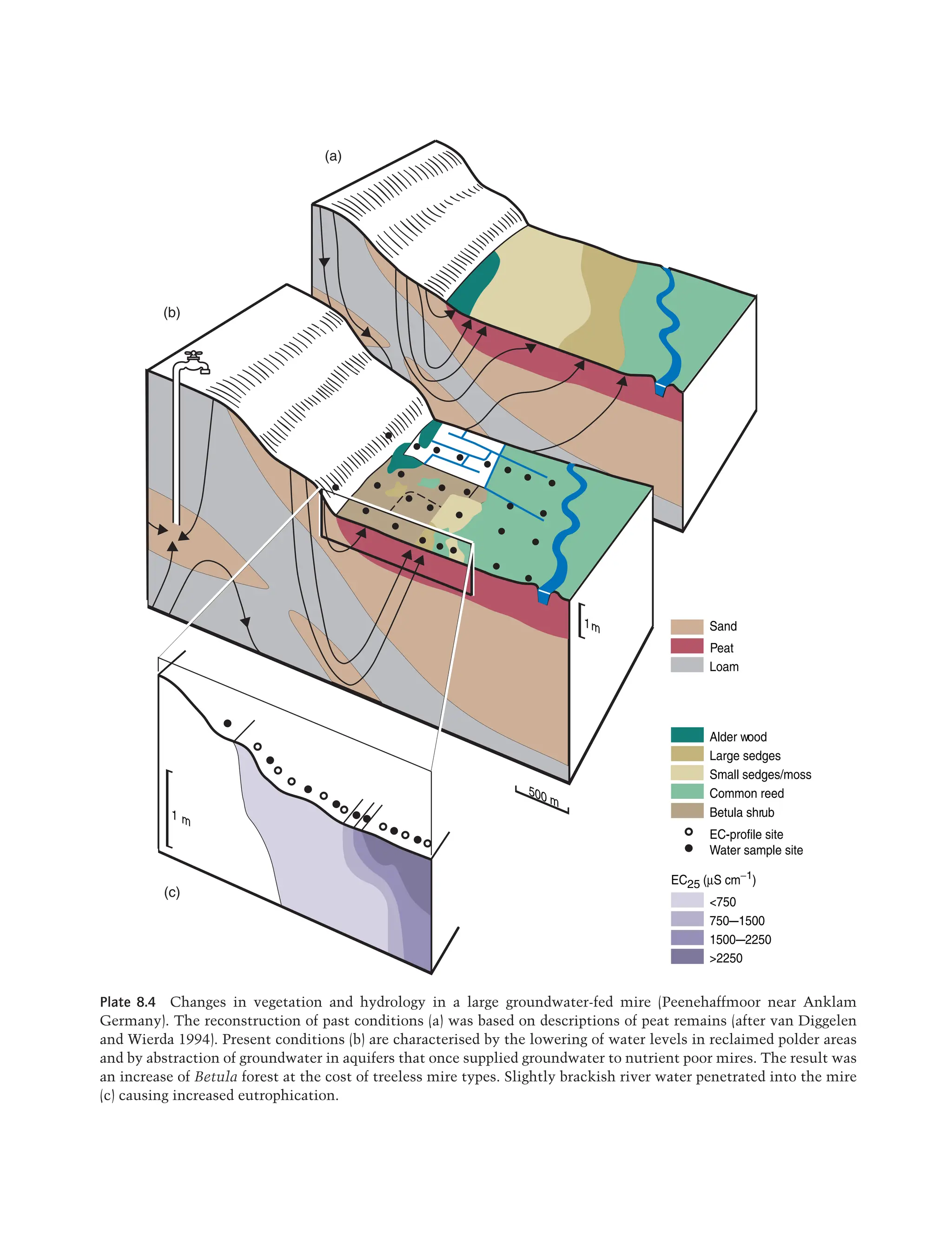
Plate 8.4 Changes in vegetation and hydrology in a large groundwater-fed mire (Peenehaffmoor near Anklam
Germany). The reconstruction of past conditions (a) was based on descriptions of peat remains (after van Diggelen
and Wierda 1994). Present conditions (b) are characterised by the lowering of water levels in reclaimed polder areas
and by abstraction of groundwater in aquifers that once supplied groundwater to nutrient poor mires. The result was
an increase of Betula forest at the cost of treeless mire types. Slightly brackish river water penetrated into the mire
(c) causing increased eutrophication.
Maltby-Plates.indd 6
Maltby-Plates.indd 6 5/26/2009 9:58:41 AM
5/26/2009 9:58:41 AM
30 m
200 m
1 m
40–80
<40
80–160
>80
Ca2+
(mg L−1
)
<150
<150
<150
>1000
Cl
-
(mg L−1
)
Small sedge-moss
Bog
Large sedges and reed
Fen meadow
Peat
Sand
Clay
Open water
(c)
(b)
(a)
Plate 8.5 Changes in vegetation and hydrology in the Hunze area near Groningen, The Netherlands). The
reconstruction of past conditions (a) was based on descriptions of peat remains (after van Diggelen et al. 1991).
Present conditions are characterised by low water levels in polder areas and by extraction of groundwater in deep
aquifers causing considerable changes in groundwater composition in the whole area (b) after van Diggelen et al.
1994. Severe drainage in the polder area created a local hydrological system in a lake-side wetland (c) which sus-
tained remnants of basiphilous fen-meadow vegetation, but was impeded by increased abstraction of groundwater.
(After van Diggelen et al. 2001.)
Maltby-Plates.indd 7
Maltby-Plates.indd 7 5/26/2009 9:58:41 AM
5/26/2009 9:58:41 AM
Plate 13.4 Lythrum salicaria, a common wetland
plant, which grows in meso-eutrophic mires in Europe
but is an invasive species in most North American
wetlands, particularly in relation to its very high seed
production.
Plate 13.5 Eutrophic open-water plants combining
rooted aquatics (Nymphaea) and floating aquatics
(Hydrocharis) in front of reed beds (Phragmites and
Schoenoplectus) in Grande-Brière, one of the largest
swamps in the west of France.
Plate 13.6 The red Sphagnum magellanicum, one of
the most abundant Sphagnum species in the world,
which is the origin of the name of ‘Tierra del Fuego’ in
South Argentina. Indicator species of succession from
the minerotrophic stage to the ombrotrophic stage in
peatlands.
Maltby-Plates.indd 8
Maltby-Plates.indd 8 5/26/2009 9:58:42 AM
5/26/2009 9:58:42 AM
(a) (b)
(c) (d)
Plate 15.2 Stages of leaf decomposition in aquatic ecosystems. Maple (Acer rubrum) leaf after (a) 1 week,
(b) 2 weeks, (c) 4 weeks and (d) 6 weeks of decomposition in a Michigan, USA, stream. Note holes in leaf caused by
detritivore feeding at 2 and 4 weeks, and residual veins and ribs after 6 weeks. (Photos courtesy of A. Bobeldyk.)
Maltby-Plates.indd 9
Maltby-Plates.indd 9 5/26/2009 9:59:02 AM
5/26/2009 9:59:02 AM
Plate 16.1 Part of a reed bed sewage system at the Centre for Alternative Technology, Machynlleth, UK, showing
that constructed wetlands can be attractive places with significant wildlife value. (Photo by T. Barker.)
E20
Park
Treatment
Plant
Folkestaleden
Eskilstuna
River
Plate 20.4 Layout of the Ekeby treatment
wetlands at Eskilstuna, Sweden. Water passes
through five cells in parallel to intermedi-
ate collection, and then through three cells
in parallel to the river. Gentle curves, deep
zones and islands accentuate the aesthetic
appearance of the system, and enhance its
efficiency.
Maltby-Plates.indd 10
Maltby-Plates.indd 10 5/26/2009 9:59:08 AM
5/26/2009 9:59:08 AM
Underlying strata
Water-filled
gravel bed
Detritus
Rock-filled
inlet deep zone
Live
Standing
dead
Impervious liner Liner bedding
Rock-filled
outlet deep zone
Dry gravel
Underlying strata
Hydric soils
Detritus
Live
Standing
dead
Impervious liner Liner bedding
Outlet deep zone
FWS
SSF
Inlet deep zone
Roots and rhizomes
Roots and rhizomes
Plate 20.5 Structural components of FWS and SSF constructed treatment wetlands. The FWS system is filled with
a layer of hydric soil and overlain by shallow water. The SSF system is filled with gravel in the central portion and
rock in the inlet and outlet zones. Both have outlet depth control.
Maltby-Plates.indd 11
Maltby-Plates.indd 11 5/26/2009 9:59:27 AM
5/26/2009 9:59:27 AM
CW
Crow Canyon RR – indicator scores
-06
CW-05
CW-04
CW-03
CW-02b
CW-02a
CW-01
0 5 10 15 20 25 30 35 40 45 50 55 60 65 70 75
AHC-RR AHC-DB VFPA FPI PSF RCB-
RCB-DB CABUF SR SWIED LULC-N LULC
Plate 24.7 Scores for individual indicators in the Crow Canyon drainage basin (indicator codes are provided in
the text).
2003
1989
Plate 25.1 Satellite images of the Aral Sea in the summer of 1989 and 2003. (Source: NASA’s Earth Observatory.)
Maltby-Plates.indd 12
Maltby-Plates.indd 12 5/26/2009 9:59:27 AM
5/26/2009 9:59:27 AM
Plate
32.2
Final
stages
(June
1992)
of
the
construction
of
a
sedge
meadow
swale
at
the
Des
Plaines
Wetland
Demonstration
Project
north
of
Chicago,
Illinois,
USA.
(Photograph
by
Joy
Marburger.)
Plate
34.2
Topsoil
removal
for
fen
meadow
restoration
around
lake
Nussbaumen,
Switzerland,
right
before
seeding
a
specifi
cally
developed
seed
mixture
in
April
2006.
Plate
34.1
Iris
sibirica,
a
species
that
can
be
fairly
easily
be
established
in
restored
fen
meadows
in
central
Europe.
Plate
32.3
Two-year-old
(May
1994),
created
sedge
meadow
swale
at
the
Des
Plaines
Wet
land
Demonstration
Project
north
of
Chicago,
Illinois,
USA.
(Photograph
by
Joy
Marburger.)
Maltby-Plates.indd 13
Maltby-Plates.indd 13 5/26/2009 9:59:42 AM
5/26/2009 9:59:42 AM
Plate 34.3 With 600–800gm−2 straw, the establishment of the small-seeded Salix was considerably reduced, whereas
the sown species with bigger seeds could still establish well (Suter et al. 2006).
0
1
2
3
4
5
6
7
8
11 12 13 14 15 16 17 18 19 20
pH
1 week
3 weeks
5 weeks
6 weeks
7 weeks
9 weeks
Rice field
Sampling locations
Melaleuca land Irri. canal
Plate 37.3 Seasonal variation in acidity of surface water in relation to present land uses on acid sulphate soils.
Maltby-Plates.indd 14
Maltby-Plates.indd 14 5/26/2009 9:59:56 AM
5/26/2009 9:59:56 AM
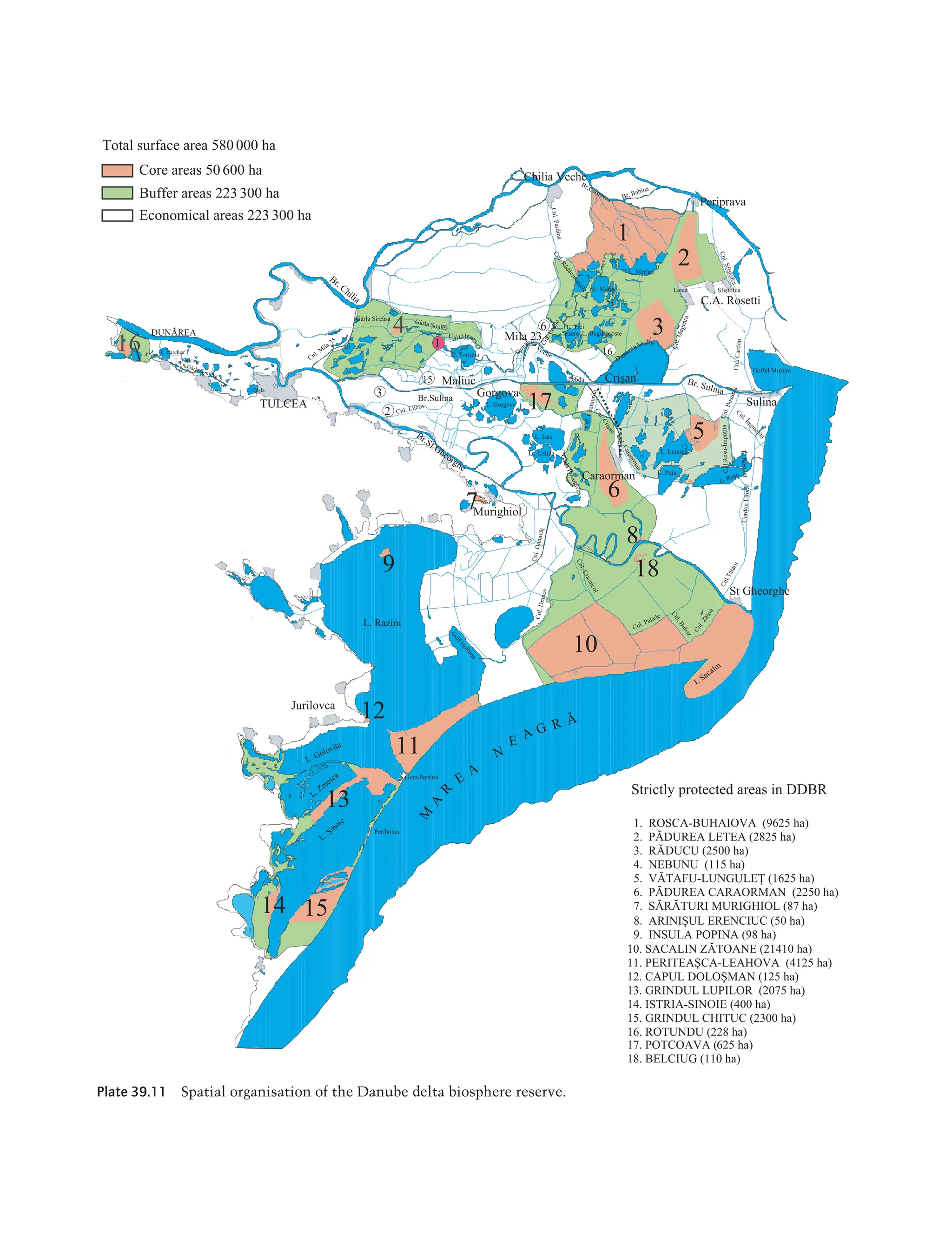
Plate 39.11 Spatial organisation of the Danube delta biosphere reserve.
Maltby-Plates.indd 15
Maltby-Plates.indd 15 5/26/2009 10:00:00 AM
5/26/2009 10:00:00 AM
Current Flow The Plan Flow
Plate 42.5 Current flows and planned future flows in the Comprehensive Everglades Restoration Program. (Source:
CERP website: http://www.evergladesplan.org/.)
Legend
Cattail
Cattail dominant mix
Cattail sparse mix
Other
1991 1995
Kilometers
0 3 6 9 2003
Plate 42.4 Approximate extent of cattail invasion of WCA2A from 1991–2003. (Source: Rutchey et al. 2008, with
permission.)
Maltby-Plates.indd 16
Maltby-Plates.indd 16 5/26/2009 10:00:02 AM
5/26/2009 10:00:02 AM
Section I
Wetlands in the Global Environment
Maltby-C001.indd 1
Maltby-C001.indd 1 6/2/2009 8:57:18 AM
6/2/2009 8:57:18 AM
The Wetlands Handbook Edited by Edward Maltby and Tom Barker
© 2009 Blackwell Publishing Ltd. ISBN: 978-0-632-05255-4
1 The Changing Wetland Paradigm
EDWARD MALTBY
Institute for Sustainable Water, Integrated Management and Ecosystem Research,
University of Liverpool, Liverpool, UK
INTRODUCTION
Never has there been such strong political or
institutional rhetoric, more effective governmen-
tal and non-governmental organisations, or the
present level of scientific information to promote
more sound environmental management of the
world’s natural resources. Yet loss and degrada-
tion of wetlands continues without well-informed
public or political support and often in the face of
significant opposition from one or other sector of
civil society. This introductory chapter examines
some of the fundamental historical, but changing,
relationships between humans and wetlands. It is
intended to serve as a context within which sci-
ence can establish a more compelling case and evi-
dence base for appropriate stewardship of wetland
ecosystems, and as a clearer recognition emerges
of the factors that impede progress towards a more
rational use of their natural capital (Costanza
et al. 1997; Balmford et al. 2002). Further, it pres-
ents the specifications for the scope of wetland
science in a rapidly changing social, economic
and natural world.
Human perception of, and relationships with,
wetlands have evolved alongside the transforma-
tions that have taken place in the organisation
of society, technological developments and sci-
entific knowledge. Additionally, wetlands have
distinctive relationships with particular interest
groups and with human communities in different
parts of the world. Most notable are the contrasts
in perspective between developed and developing
countries, particularly in identifying the point
of balance between conservation and use of wet-
lands. For some parts of society, wetlands have
particular iconic status associated with history,
literature, myth, religious or cultural significance.
For others it is an ethical or moral commitment
to their biodiversity that underpins the case for
their conservation. Yet others view wetlands as
just another natural resource, to be used sustain-
ably or unsustainably, or simply drained for non-
wetland use if this can achieve greater financial
or economic returns (see Chapter 2). The range
of consideration, then, is from the philosophical
and ethical to the utilitarian viewpoint. It is only
by awareness of the intimate, intricate and varied
links among wetlands, human culture, biological
diversity and wider environmental characteristics,
that it is possible to appreciate fully the complex-
ity of possible future as well as current manage-
ment objectives. Our ability to attain specific
wetland management goals, however, is depen-
dent not only on the adequacy and coordination of
the relevant experience, scientific and technical
knowledge but on the availability of institutional
and other enabling mechanisms to maintain and
manage these ecosystems in the face of sometimes
fiercely competing resource demands.
WETLANDS IN PERSPECTIVE
An intimate part of the evolutionary
driving force
Landscapes and ecosystems that we now label
wetlands have played seminal parts in Earth
Maltby-C001.indd 3
Maltby-C001.indd 3 6/2/2009 8:57:19 AM
6/2/2009 8:57:19 AM
The Wetlands Handbook Edited by Edward Maltby and Tom Barker
© 2009 Blackwell Publishing Ltd. ISBN: 978-0-632-05255-4
4 EDWARD MALTBY
and human history. Life itself could only have
originated in the presence of free water, but
whether it was fresh or salt, shallow or deep, is
not possible to answer. The origin of the earliest
microfossils, thought to have been between 3.46
and 3.85 billion years ago, is in dispute (Schopf
1993; Sankaran 2002), but liquid water was nec-
essary to prevent desiccation and death. Beyond
such possible beginnings, wetlands were the
site of evolution of many highly specialised spe-
cies (Chapter 3), and it is likely that key steps in
human evolution took place among hominins in
the wetland margins of rivers, lakes and the sea.
The so-called ‘aquatic ape’ theory suggests that
the fatty acids in fish caught by these early com-
munities were important in enabling the brain
capacity to develop, culminating in the evolution
of modern humans (Morgan 1982).
Many species of plant and animal have
survived within wetland boundaries where
counterparts outside have perished. The reasons
for survival of specialised species and communi-
ties are varied but include: the plentiful, though
frequently periodic, supply of water; specific
and varied adaptations to waterlogged condi-
tions; the moderating microclimate in extreme
environments (especially significant in desert
regions); the large extent of many wetland areas;
environmental conditions hostile to poten-
tially competing predatory or invasive species;
and often, difficulty of access for humans. The
role of wetland boundaries as an evolutionary
driving force has yet to be fully explored, but
certainly deserves greater attention (Naiman
et al. 1988).
Four characteristics of wetlands contribute
especially to the biodiversity associated with
these ecosystems:
change over time through ecological succes-
•
sion (Figures 1.1 and 1.3);
zonation both within and at the boundary of
•
the ecosystem (Figure 1.2);
change over time through seasonal or more
•
frequent hydrological or ‘pulsing’ cycles or indi-
vidual events;
adjacent ecosystems with generally contrasting
•
features.
Wetlands often are transient features in land-
scape development, and can be regarded in many
cases as the authors of their own destruction.
The inherent processes of natural change, such
as sedimentation, peat growth and soil develop-
ment lead to hydrologic changes that may be less
favourable for existing plants and animals than
for competitors. So too, a plant assemblage may
alter conditions in ways that make the habitat less
favourable for survival of its own component spe-
cies, and more favourable for the development of
a different community. Wetland ecosystems can
pass through many such ‘seral’ stages, emphasis-
ing their dynamic yet temporary character.
Many shallow lakes and ponds in the post-
glacial landscapes of the northern hemisphere
quickly filled in, to become marshes where inor-
ganic sediment dominated, or fens where the
detritus was peaty. In some places, such as the
Somerset levels or Malham Tarn (Figure 1.3) in
B
i
r
c
h
H
a
z
e
l
P
i
n
e
E
i
m
G
r
a
s
s
P
l
a
n
t
a
i
n
0
5000
10 000
Fig. 1.1 Enumeration of pollen grains in sediments can
assist reconstructions of past vegetation types, human
interventions and climates. Here, for example, hazel
replaced birch some 9000 years BP but was itself replaced
briefly by pine at 7000 BP. Populations of elm made an
abrupt decline some 5000 years BP, to be replaced in part
by grasses and plantain. (Source: O’Connell 1987.)
Maltby-C001.indd 4
Maltby-C001.indd 4 6/2/2009 8:57:19 AM
6/2/2009 8:57:19 AM
The Changing Wetland Paradigm 5
Green
frog
Mink
frog
Upland
grasses Lowland
grasses Sedge
Cattail
Hardstem
Ambystoma
salamanders
American toad
Newts
Wood frog
Spring peeper
Gray tree frog
Plethodon
salamanders
Bull frog
Leopard frog– - -
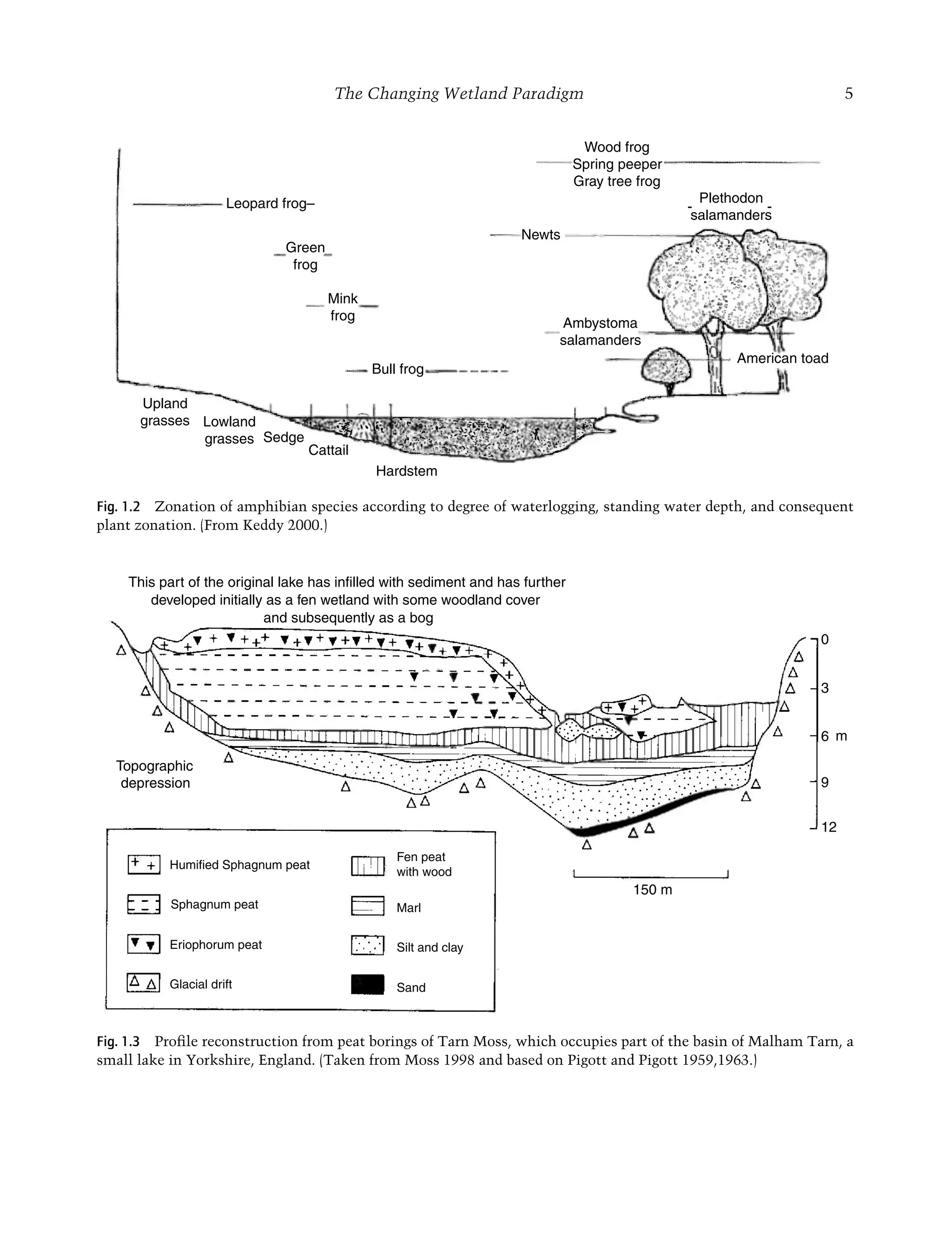
Fig. 1.2 Zonation of amphibian species according to degree of waterlogging, standing water depth, and consequent
plant zonation. (From Keddy 2000.)
Topographic
depression
Humified Sphagnum peat
Eriophorum peat
Glacial drift
Marl
Fen peat
with wood
150 m
12
9
6
3
m
0
Sand
Silt and clay
Sphagnum peat
This part of the original lake has infilled with sediment and has further
developed initially as a fen wetland with some woodland cover
and subsequently as a bog
Fig. 1.3 Profile reconstruction from peat borings of Tarn Moss, which occupies part of the basin of Malham Tarn, a
small lake in Yorkshire, England. (Taken from Moss 1998 and based on Pigott and Pigott 1959,1963.)
Maltby-C001.indd 5
Maltby-C001.indd 5 6/2/2009 8:57:19 AM
6/2/2009 8:57:19 AM
6 EDWARD MALTBY
the UK, fens were transformed into bogs as the
peat surface layer grew, becoming increasingly
separated from the influence of nutrient-rich
groundwater. As a result, the upper peat became
acidified and increasingly reliant on precipita-
tion alone for nutrients. Eventually, such bogs
may outgrow their ability to maintain a perma-
nently high water table, and trees can become
established, the roots of which can accelerate the
rate of desiccation. The formerly aquatic ecosys-
tem may thus become transformed into dense
woodland.
Often, through the process of succession, a
pattern of zonation occurs in the boundary zone
of a wetland. This is particularly the case around
lake margins, floodplain depressions and rivers.
This zonation tends to indicate in space what
is likely to happen over time in the wetland
itself. Thus, the sequence: open water–floating
swamp–marsh with emergent vegetation–wet
grassland–shrub–woodland, may be discovered
by taking a vertical core through the marginal
woodland surface (Figure 1.3). A wetland may
vary in structure and composition depending on
its stage of development. This is the result of
natural change in which a lake, marsh, bog and
woodland may occupy the same space over just a
few centuries or, at most, millennia.
Typically, wetlands also have considerable
internal diversity. Mire ecosystems demonstrate
this well, for example the hummock-hollow com-
plexes of blanket bogs and the varied microrelief
features of other mires. This produces distinc-
tive microhydrological gradients and associated
zonation of plant species which, in turn, provide
separate niches for different invertebrates and
birds that feed on them (Figure 1.4). Extensive
wetland areas are usually made up of complex
arrays of different ecosystems, reflecting varia-
tions in hydroperiod, substrate, water quality and
human intervention. For example, the Florida
Everglades (‘river of grass’) actually comprise
open water meandering channels (‘sloughs’),
various marsh communities, floating or anchored
Round-leaved sundew
Drosera rotundifolia
Hummock
High ridge
Low ridge
1
2
3
4
5
6
Pool
T3
T2
T1
50 cm
A1
A2
A3
A4
A
Rothwell/SA
Wallace
Hollow
Great sundew
Drosera anglica
Oblong-leaved sundew
Drosera intermedia Intermediate bladderwort
Utricularia intermedia
1 Sphagnum imbricatum
2 Sphagnum rubellum
3 Sphagnum magellanicum
4 Sphagnum papillosum
5 Sphagnum pulchrum
6 Sphagnum cuspidatum
Fig. 1.4 Niche zonation of wetland species in an oligotrophic hummocky wetland. (From Ratcliffe and
Oswald 1988.)
Maltby-C001.indd 6
Maltby-C001.indd 6 6/2/2009 8:57:21 AM
6/2/2009 8:57:21 AM
The Changing Wetland Paradigm 7
tree islands and permanent tree-dominated
hummocks where the bedrock is more elevated.
The inherent variations in depth, distribution
and duration of surface flooding add to this
diversity of habitat and enhances species
diversity (e.g. Ogden 2005).
Human cultural significance
Wetlands throughout the world have undergone
different patterns of change over time. While the
nature and timing of successional change can
be interpreted by the analysis of environmental
indicators such as pollen, macrofossils, diatom
frustules, chemical, physical and magnetic prop-
erties of the sediment and organic matter at
different levels in the subsurface stratigraphy
(Figures 1.1 and 1.3), there is often a close rela-
tionship with contemporary environmental
features, which are preserved within the timeline
of the stratigraphic sequence. These data, obtained
by sediment cores and excavations, can illustrate
events in society and periods of human develop-
ment, manipulation of the cultural landscape
and environmental change (see Chapter 4). The
famous prehistoric trackway across the Somerset
levels, known as the ‘Sweet Track’ (Coles and
Coles 1989), is preserved in a peat deposit that is
subject to successional development, dominated
now by birch woodland.
There are also well documented cases in
Scandinavia of deliberate burials in bogs, for
example Tollund Man and Elling Woman, both
found in a bog near Silkeborg, Denmark, and
Grauballe Man, also found in Denmark. The
burials, all discovered in the 1950s, are thought
to have had some ritual or ceremonial sacrificial
significance (Glob 1965). Perhaps the best-known
example in the UK is that of Lindow Man, found
in Lindow Moss, Cheshire in 1984. This was the
body of a man in his thirties, who had been the
victim of a ritual killing before being buried in the
peat in about 550 BC (Turner and Scaife 1995).
Wetlands can tell us as much about ambient
environmental change as they can about changes
in the wetland ecosystem itself (Figure 1.3). An
interpretation of the history of an area of extensive
floodplain rivers, associated peat deposits, and
contemporary human communities in what is
now the Norfolk Broads, UK, from 7000 years ago
to present, can be found in Moss (2001).
Seasonal hydrological patterns, such as flooding
from snowmelt or seasonal rains alternating with
drawdown or drought, means that some of the
world’s largest wetlands may alternate between
aquatic-dominated and terrestrial-dominated
ecosystems over the same space. This is true for
many of the large wetlands of Africa, such as the
Okovango Delta, and extensive floodplains such
as those of the Kafue Flats, Inner Niger Delta, the
Hadejia-Nguru and the Tana (Chapter 38). It is
also the case in the Pantanal (Chapter 40) where
evolutionary adaptation among species is linked
clearly to the flood cycle or ‘pulse’.
The multifunctional benefits that arise from
the often rapid and dramatic alternation of wet
and dry conditions are significant for wildlife, but
also provide the basis for the sustainable econo-
mies of many human populations; however, with
increasing frequency the ‘natural’ hydrology is
threatened by dams and irrigation projects. In
an analysis of seven case studies covering more
than a third of all floodplains in Africa, Drijver
and Marchand (1985) concluded that, ‘notwith-
standingthepossibleimpactofwatermanagement
projects, the negligence of ecological side-effects
generally means a deterioration of environmental
quality at the expense of the existing economic
situation for the local people and of the natural
conservation values. This often decreases the
intended advantages of a project, and can even
outweigh them’. More recent economic analyses
have demonstrated the gross economic failures
of many irrigation schemes (e.g. Barbier et al.
1993, 1997).
Wetlands can experience acute impacts from
individual extreme events such as storms, floods
and droughts because of their marginal loca-
tions and particular vulnerability to hydrological
change, but where these impacts are part of the
natural hydrological dynamic, recovery is rapid.
The benefits to adjacent ecological or human sys-
tems of protection from damage can be dramatic.
The particular role of mangroves and floodplain
Maltby-C001.indd 7
Maltby-C001.indd 7 6/2/2009 8:57:22 AM
6/2/2009 8:57:22 AM
8 EDWARD MALTBY
forests in reducing storm surges and flood hazard
became only too evident in the case of the Boxing
Day 2004 tsunami in the Indian Ocean. The pro-
tection conferred by mangroves was generally
greatest at some distance from the area of maxi-
mum impact. A study by Danielsen et al. (2005)
found that a 100m-wide stand of mangrove trees
at a density of 30 trees per 100m2 had the capac-
ity to reduce flow pressure by >90%. The dam-
age inflicted on the coastal zone was exacerbated
by previous human activities. In Tamil Nadu,
India, for example, villages situated behind man-
grove stands suffered no damage in the midst of
destruction in adjacent areas, and on the coast
where mangroves had been cleared, villages were
completely destroyed (Danielsen et al. 2005).
Dahdouh-Guebas et al. (2005) reported that 50%
of the world’s mangrove forests were destroyed
during the second half of the twentieth century.
The main reasons given were complete clear-
ance of mangroves, insufficient regrowth follow-
ing a prior clearing, and excess growth of ‘weed’
species, which partly or fully replaced the adult
mangroves (Dahdouh-Guebas et al. 2005).
A CULTURAL DRIVING FORCE
Some key stages in Earth history and turning
points in human culture
Wetlands have featured prominently in Earth
history and human development. Just two exam-
ples serve to illustrate. The first is represented by
the tropical peat-swamps of 250 million years ago
that were responsible for formation of the exten-
sive coal deposits of the Carboniferous period.
Sieffermann (1988) has described the modern
day analogues of their formation from Central
Kalimantan. Movement of continents over geo-
logical time, and associated climatic change,
shifted the highly compressed and transformed
geological product of the ancient tropical peat-
lands into the higher latitudes of Europe and
North America, where they would power the
Industrial Revolution of the early nineteenth cen-
tury. These fossil fuels, together with the patterns
of world trade, have had immense impacts on
economic and cultural development. They are
also the major agents of human-induced climate
change.
There is considerable debate over the possible
roles of both intact and drained contemporary
wetlands in contributing to climatic change by
the emissions of radiatively-active gases such as
methane, nitrous oxide and carbon dioxide or by
moderating it through sequestration and storage
of new carbon in organic matter and peat. It is
perhaps ironic that it should be the reconversion
to CO2 of carbon previously captured by ancient
wetlands that has contributed to accelerated
atmospheric warming.
Such a relationship is a strong reminder of the
importance of biogeochemical coupling between
wetlands and the larger global system, and the
importance of time, and rate of change, as consid-
erations in environmental management. Whereas
carbon and other elements may be sequestered
from the atmosphere in the course of natural wet-
land development and geological transformation
over many thousands and, in some cases, millions
of years, human exploitation may cause this store
to be depleted at a rate several orders of magni-
tude faster. Arguably, the fundamental challenge
to achieving optimum patterns of wetland use is
to avoid unbalancing natural process rates, and
this is illustrated dramatically whenever peat-
lands are subjected to drainage, that is when the
rate of oxidation of accumulated organic matter
greatly exceeds the rate of addition of new mate-
rial to the peat mass (Immirzi and Maltby 1992).
The second example is the role of wetlands as
a force that has encouraged collective natural
resource management and societal development
(Bayliss-Smith and Golson 1992). For millennia,
prehistoric communities thrived and benefited
from the natural goods and services of wetlands –
including food, water, materials for building,
shelter and clothing – which cost nothing more
than human energy to utilise. Wetlands, rivers
and lakes played extremely important roles in the
evolution of prehistoric communities, and were
the sites of the earliest stages in the development
of tool-producing hominins. The socio-economic
Maltby-C001.indd 8
Maltby-C001.indd 8 6/2/2009 8:57:22 AM
6/2/2009 8:57:22 AM
The Changing Wetland Paradigm 9
development of prehistoric communities in
north-eastern Europe has been interpreted by
Dolukhanov (1992) in terms of increasingly suc-
cessful adaptation to the riverine–lacustrine
environment by means of intensified foraging
strategies. Excavations of the many post-glacial
lake margin and riverine settlements in northern
Europe and Russia provide excellent examples
of the intimate and highly dependent relation-
ships that existed between humans and wetlands
in Mesolithic and Neolithic Europe (Coles and
Coles 1989).
Even while this prehistoric dependency per-
petuated in Europe, the development of simple
water control structures and associated irriga-
tion techniques, made possible by topography
and the predictable annual flood cycle, was
transforming the economy of the floodplain
peoples of the Middle East. Many consider that
in the great alluvial valleys and associated del-
taic systems of the Nile, Tigris and Euphrates,
the regularly inundated fertile floodplain was an
essential element in the development of early
The lower Mesopotamia Plain was home to
some of the earliest known civilisations. They
were founded on the sustainable use of the
region’s water resources, which enabled the
establishment of sophisticated and highly
organised irrigation systems. It is thought that
land occupation occurred from between 9000–
8000 BC, with the southern region, including
the wetlands, colonised at around 5000–4500 BC
by Ubaidians. These people were the first to
practice irrigated agriculture on a large scale,
to occupy suitable parts of the marshes and to
introduce trade for support of early industry.
The Ubaidians dominated the marsh people,
and mixed with the original hunters and fisher-
men in a pre-Sumerian culture. The subsequent
kingdom of Sumer was concentrated in the wet-
lands, which were much more extensive than in
the modern era. The relative security afforded
by the marshes enabled a prosperous civilisation
to develop in the midst of a hostile desert envi-
ronment. Cities with suburbs, temples, defen-
sive walls and dykes, gardens and orchards
were supported by the agricultural production
of irrigated farmlands, the rich produce of the
marshes, and an advanced system of commerce.
Evidence from cities such as Ur confirms that
the basic units of life in the present day marshes,
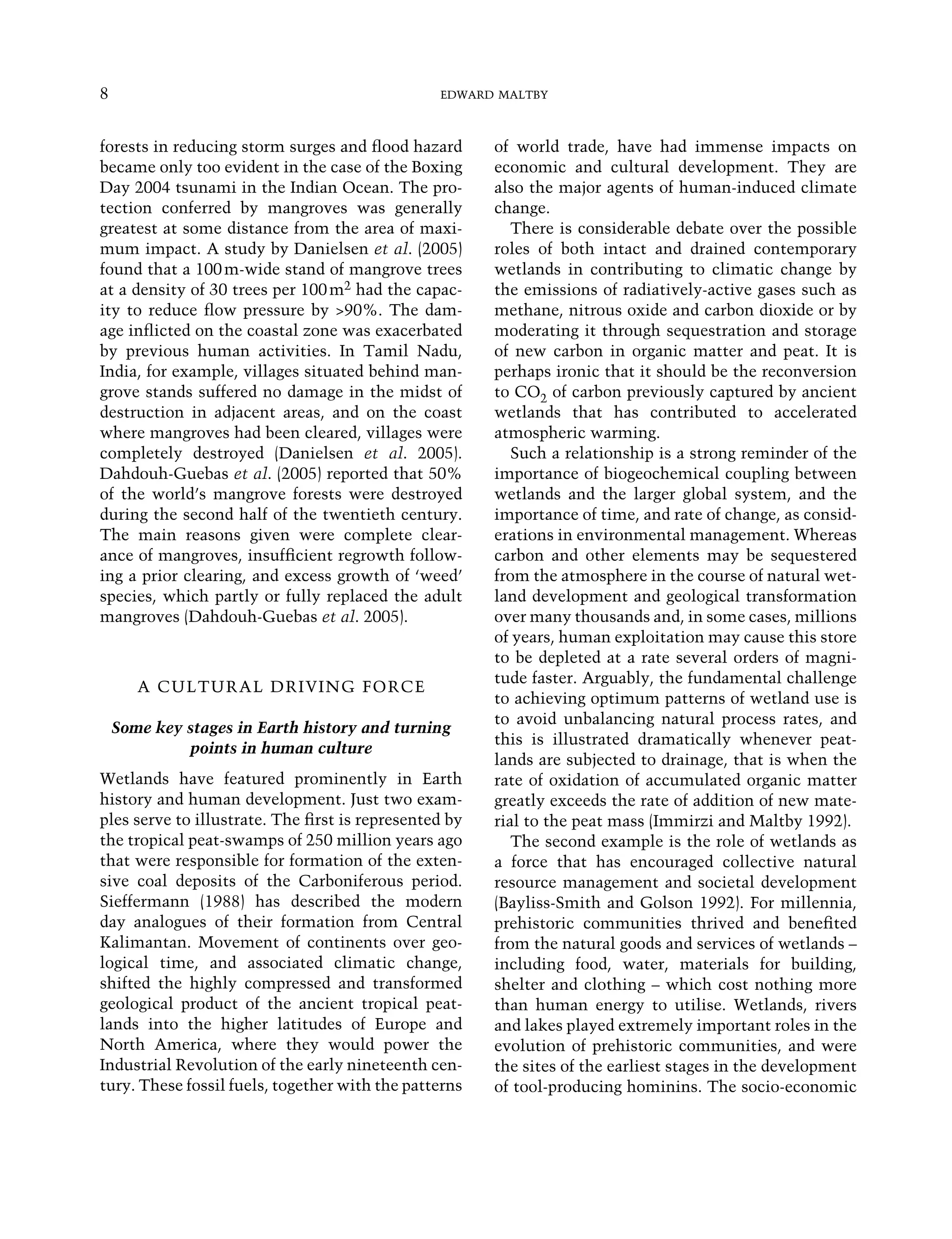
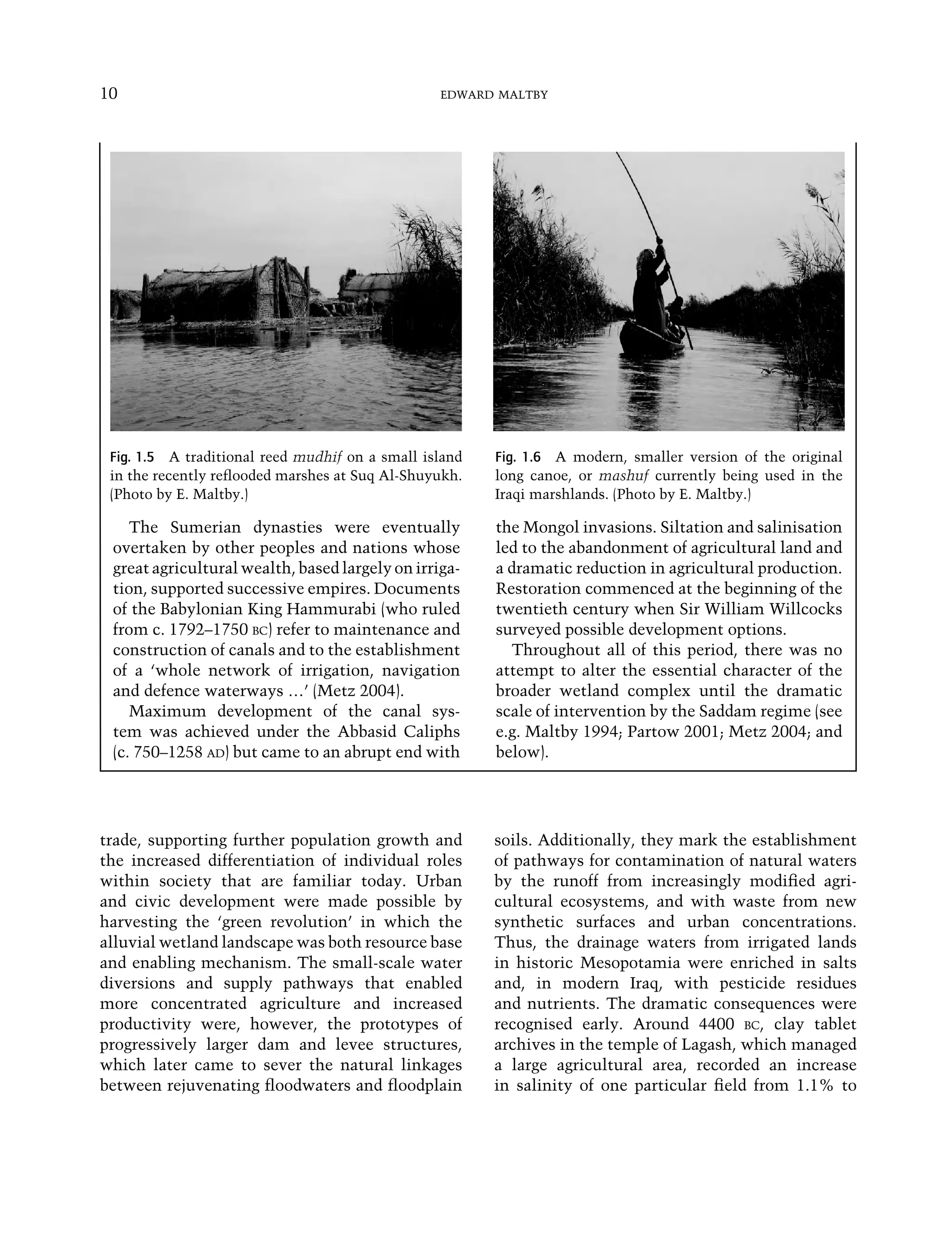
for example the reed-house: mudhif (Figure 1.5),
or the long canoe: mashuf (Figure 1.6), can
be traced back to the Sumerians. This dem-
onstrates continuity in the mode of land use,
and a cultural connection for more than 5000
years. Some of the earliest examples of writ-
ten language come from Sumer; the origins of
the biblical account of the Creation, and the
flood of Noah may be from Sumerian literature
(such as the epic of Gilgamesh), thus bequesting
an immense culture and philosophy to future
generations.
civilisations. Whilst these may not have been the
only ‘cradles’ where early human communities
moved from prehistoric, more or less nomadic,
lifestyles to new forms of cultural organisation,
they provide an excellent illustration of how
people could adapt to, harness, and modify the
natural functioning of floodplain wetlands to
create agricultural wealth and relative security
of food supplies.
The terms ‘hydraulic civilisation’ and ‘hydrau-
lic society’ have been used to describe the
distinctive systems that emerged as human com-
munities met the wetland challenge through the
organised use of the broad floodplain environ-
ment and the regular flood cycle (Steward 1949;
Wittlfogel 1957; Mitchell 1973).
The successful maintenance of modified hydro-
logical regimes required considerable cooperation
and organisation, especially as populations grew
and became increasingly concentrated. Rules
and laws became necessary to ensure efficient
management of the agricultural systems (see
Box 1.1). Food surpluses and demand stimulated
Box 1.1 The legacy of the Mesopotamian wetlands – cultural and technological
Maltby-C001.indd 9
Maltby-C001.indd 9 6/2/2009 8:57:22 AM
6/2/2009 8:57:22 AM
10 EDWARD MALTBY
soils. Additionally, they mark the establishment
of pathways for contamination of natural waters
by the runoff from increasingly modified agri-
cultural ecosystems, and with waste from new
synthetic surfaces and urban concentrations.
Thus, the drainage waters from irrigated lands
in historic Mesopotamia were enriched in salts
and, in modern Iraq, with pesticide residues
and nutrients. The dramatic consequences were
recognised early. Around 4400 BC, clay tablet
archives in the temple of Lagash, which managed
a large agricultural area, recorded an increase
in salinity of one particular field from 1.1% to
The Sumerian dynasties were eventually
overtaken by other peoples and nations whose
great agricultural wealth, based largely on irriga-
tion, supported successive empires. Documents
of the Babylonian King Hammurabi (who ruled
from c. 1792–1750 BC) refer to maintenance and
construction of canals and to the establishment
of a ‘whole network of irrigation, navigation
and defence waterways …’ (Metz 2004).
Maximum development of the canal sys-
tem was achieved under the Abbasid Caliphs
(c. 750–1258 AD) but came to an abrupt end with
the Mongol invasions. Siltation and salinisation
led to the abandonment of agricultural land and
a dramatic reduction in agricultural production.
Restoration commenced at the beginning of the
twentieth century when Sir William Willcocks
surveyed possible development options.
Throughout all of this period, there was no
attempt to alter the essential character of the
broader wetland complex until the dramatic
scale of intervention by the Saddam regime (see
e.g. Maltby 1994; Partow 2001; Metz 2004; and
below).
Fig. 1.5 A traditional reed mudhif on a small island
in the recently reflooded marshes at Suq Al-Shuyukh.
(Photo by E. Maltby.)
Fig. 1.6 A modern, smaller version of the original
long canoe, or mashuf currently being used in the
Iraqi marshlands. (Photo by E. Maltby.)
trade, supporting further population growth and
the increased differentiation of individual roles
within society that are familiar today. Urban
and civic development were made possible by
harvesting the ‘green revolution’ in which the
alluvial wetland landscape was both resource base
and enabling mechanism. The small-scale water
diversions and supply pathways that enabled
more concentrated agriculture and increased
productivity were, however, the prototypes of
progressively larger dam and levee structures,
which later came to sever the natural linkages
between rejuvenating floodwaters and floodplain
Maltby-C001.indd 10
Maltby-C001.indd 10 6/2/2009 8:57:22 AM
6/2/2009 8:57:22 AM
The Changing Wetland Paradigm 11
35% just 1 year later (Woolley 1965). The diffuse
pollution from agriculture, and the need to deal
with highly concentrated wastes from towns and
cities, are today among the greatest sources of
impact on freshwater ecosystems.
Traditionally, wetland management, whether
it be hydraulic structures for floodplain protec-
tion or water diversion, water control techniques
for growing taro in New Guinea or rice in the
Philippines, or grazing and drainage control in
the English fens, has demanded communal effort.
Bayliss-Smith and Golson (1992) cite the fenland
village of Cottenham, in the UK, as an example of
the strength and range of the community’s organ-
isation since medieval times. Access to various
resources was controlled by detailed regulation,
often leading to disputes arising from ‘the army
of complicated rights and interlocking interests’
(Darby 1983). Such ‘peasant power’ over the
wetland was considered by entrepreneurs to be
‘a conservative force that obstructed improve-
ment’. Bayliss-Smith and Golson (1992) cite this
as evidence of a paradox of wetland management:
‘Successful drainage by cooperative management,
if sustained, can also provide an opportunity for
the expropriation of wealth and the emergence of
inequality, and this tendency may be resisted’.
Historic attitudes
Sinceprehistorictimes,theutilisationofwetlands
throughout the developed world can be likened to
the ‘passing frontier of nature replaced by a per-
manently and sufficiently expanding frontier of
technology’ (Sauer 1938). Generations of school-
children have learned, unqualified until recently,
about the laudable achievements of the drainage
of the English Fens to create rich farmland (Darby
1983), and of the remarkable engineering to
establish agricultural polders in the Netherlands
where once there had been sea (Idema et al. 1998).
The parallel perceptions of wetlands such as bogs
and swamps as disease-ridden, dangerous to life,
inhospitable, and of little value unless altered,
has been promoted extensively in the literature
(historic, factual and fictional) and more recently
through the twentieth century cinematic media
(see Mitsch and Gosselink 2000). A questionnaire
in primary schools showed that antipathy to
wetlands is learned between the ages of 6 and 10
(Anderson and Moss 1993). For centuries ‘the
drainage of wetlands has been seen as a progres-
sive, public-spirited endeavour, the very antith-
esis of vandalism’ (Baldock 1984). Such attitudes
echo Carl Sauer’s 1938 analysis, ‘the recklessness
of an optimism that has become habitual, but
which is residual from the brave days when north
European free-booters overran the world and put
it under tribute. We have not yet learned the dif-
ference between yield and loot. We do not like to
be economic realists’.
Throughout history, the benefits that we pre-
sume were appreciated by early human cultures
and traditional users of wetlands were either
ignored or dismissed as less significant by more
powerful sectoral interest groups. Technology
enabled the rapid and progressive alteration of
wetlands, for example about two thirds of the
Netherlands, once part of the complex delta of
the Rhine, Meuse, Ems and Scheldt rivers, would
be regularly inundated were it not for dams, dykes
and engineering works built since the eighth
century. Opening new land for agriculture has
been the most common argument, at least in the
developed world, for reclamation of waterlogged
places, although for some areas, such as the Hula
Valley in Israel, the eradication of malaria was
also a compelling part of the rationale (Maltby
1986).
Despite the increasingly wide recognition of
their importance, the degradation and loss of
wetlands continues worldwide, and includes well
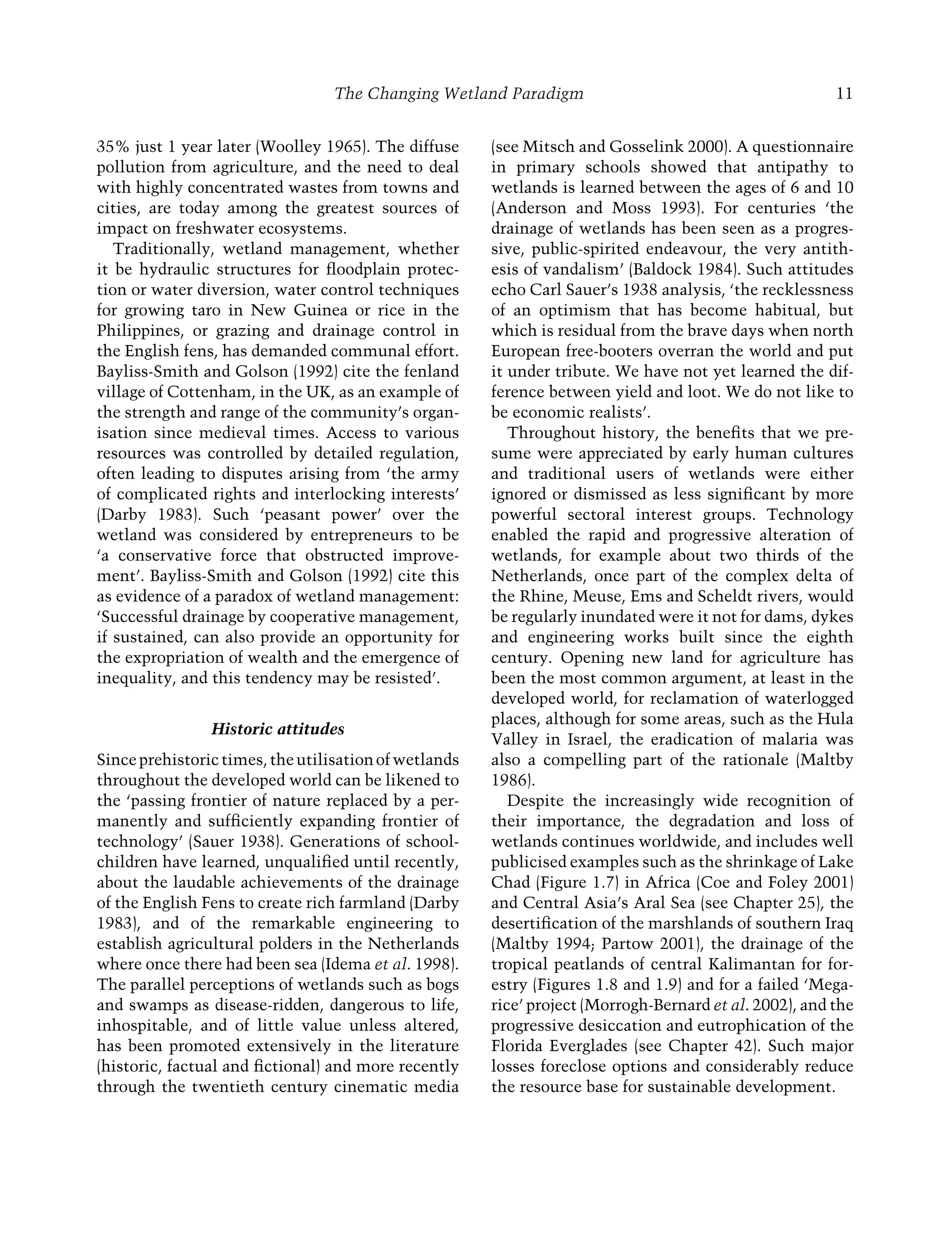
publicised examples such as the shrinkage of Lake
Chad (Figure 1.7) in Africa (Coe and Foley 2001)
and Central Asia’s Aral Sea (see Chapter 25), the
desertification of the marshlands of southern Iraq
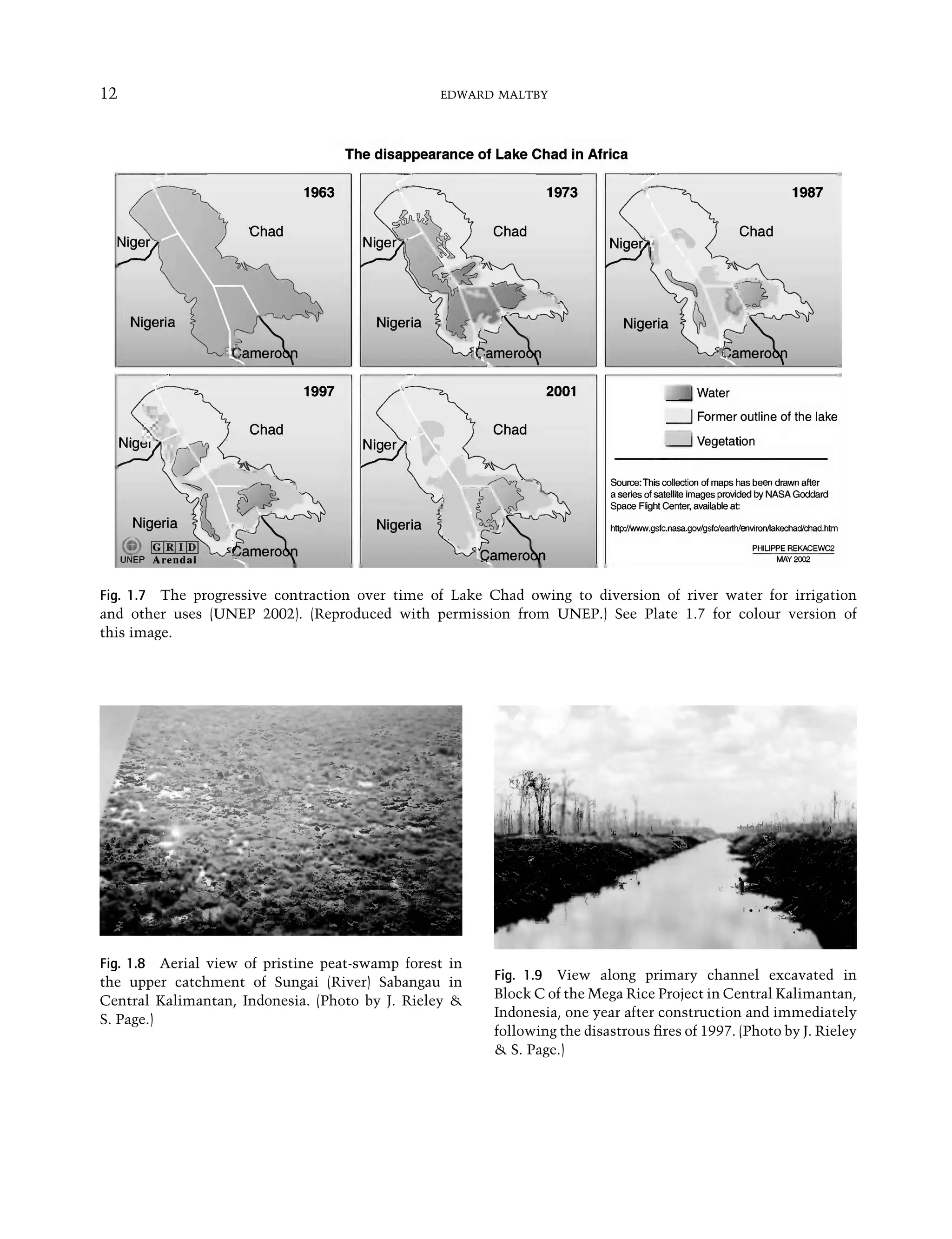
(Maltby 1994; Partow 2001), the drainage of the
tropical peatlands of central Kalimantan for for-
estry (Figures 1.8 and 1.9) and for a failed ‘Mega-
rice’ project (Morrogh-Bernard et al. 2002), and the
progressive desiccation and eutrophication of the
Florida Everglades (see Chapter 42). Such major
losses foreclose options and considerably reduce
the resource base for sustainable development.
Maltby-C001.indd 11
Maltby-C001.indd 11 6/2/2009 8:57:24 AM
6/2/2009 8:57:24 AM
12 EDWARD MALTBY
Fig. 1.7 The progressive contraction over time of Lake Chad owing to diversion of river water for irrigation
and other uses (UNEP 2002). (Reproduced with permission from UNEP.) See Plate 1.7 for colour version of
this image.
Fig. 1.8 Aerial view of pristine peat-swamp forest in
the upper catchment of Sungai (River) Sabangau in
Central Kalimantan, Indonesia. (Photo by J. Rieley &
S. Page.)
Fig. 1.9 View along primary channel excavated in
Block C of the Mega Rice Project in Central Kalimantan,
Indonesia, one year after construction and immediately
following the disastrous fires of 1997. (Photo by J. Rieley
& S. Page.)
Maltby-C001.indd 12
Maltby-C001.indd 12 6/2/2009 8:57:24 AM
6/2/2009 8:57:24 AM
The Changing Wetland Paradigm 13
NEW TRENDS AND PERSPECTIVES
The last 30 years or so has witnessed some
remarkable changes in attitudes to wetlands that
have placed them increasingly on the scientific
as well as political agenda. The main features of
these are associated with the following:
an increasing scientific focus on wetlands
•
within the environment and conservation
movement;
raised awareness of the socio-economic signifi-
•
cance of wetland functioning and the delivery of
ecosystem services;
wider recognition of the far-reaching conse-
•
quences of wetland degradation and loss, espe-
cially in relation to climate change;
opportunities for wetlands, particularly in
•
the developing world, to deliver improvements
in the welfare and livelihoods of local people
through integrated development and poverty
alleviation initiatives;
progressive recognition of the potential or
•
actual role of wetlands within various policy
frameworks, including specific legislative instru-
ments to deliver the wider objectives of sustain-
able development (e.g. Clean Water Acts of the
United States (Chapter 24), and the new European
Water Framework Directive).
It should be remembered also that wetlands
may have potential and actual disadvantages
such as providing habitat for disease vectors
e.g. malaria, schistosomiasis, onchocerciasis
and liver fluke (Carpenter and LaCasse 1955;
Githeko et al. 2000; Gallup and Sachs 2001),
and as sources of radiatively-active gases such
as nitrous oxide and methane. There are some
concerns that climate change and wetland res-
toration may increase such disadvantages.
Generally, however, it is the modification of
natural wetlands, especially through the expan-
sion of irrigation channels and reservoirs, that
increases the abundance of disease vectors
(Maltby 1986), whilst the drainage of organic
wetland soils is likely to generate a greater
load of greenhouse gases (and certainly more
quickly) than maintenance of wetlands as intact
hydrological systems.
The Ramsar Convention as standard-bearer:
an evolving instrument
The importance of wetland conservation in
order to safeguard the essential habitat require-
ments of migratory birds was the primary driv-
ing force leading to the establishment of the
Ramsar Convention on Wetlands of International
Importance Especially as Waterfowl Habitat
(Ramsar 1971; Table 1.1), the only international
agreement to cover a specific single group of eco-
system types. Established in 1971, it recognised
the vital importance of protecting not just single
wetlands but networks of wetlands, linked chain-
like over long distances, to safeguard breeding,
over-wintering, resting and feeding sites for
migratory birds. However, such a cause celebre
was also perceived by many as an indulgence on
the part of richer nations that poorer countries
could ill-afford in the face of the more pressing
problems of poverty, food shortages, lack of eco-
nomic development and burdens of foreign debt.
Initially, therefore, many developing countries
were reluctant to sign up to the Convention.
This position changed dramatically after the
Conference of Parties in 1987 at Regina, Canada
(Ramsar 1987), owing in large measure to two
developments (Table 1.2). These were:
progressive modifications to the criteria for
•
designation of wetlands of international impor-
tance, which recognised much more their wider
functional significance; and
elaboration of the ‘wise use’ concept to empha-
•
sise the benefits of wetlands in contributing to
sustainable development (Box 1.2).
Table 1.1 The Ramsar Convention in 2007.
Established 1971, Ramsar, Iran
Present No. of Contracting Parties (2007) 157
No. of wetland sites listed (by 2007) 1708
Total wetland area (ha) listed (2007) 153000000
Mission Statement: ‘The Convention’s mission is the conservation
and wise use of all wetlands through local, regional and national
actions and international cooperation, as a contribution towards
achieving sustainable development throughout the world’ (Ramsar
COP8, 2002).
Maltby-C001.indd 13
Maltby-C001.indd 13 6/2/2009 8:57:27 AM
6/2/2009 8:57:27 AM
14 EDWARD MALTBY
The modifications to the Ramsar criteria were
influenced by a growing scientific literature,
which has revealed the functional importance
of wetlands, for example in flood control, main-
tenance of water quality and fisheries support.
It was held that most people can relate more
readily to the functions that support human val-
ues rather than those characteristics associated
with traditional nature conservation, especially
the maintenance of populations of migratory
Table 1.2 Summary of wetland criteria in Conference of Parties (COP) 1 and 4, pre and post the Regina conference
in 1987.
CoP 1 Cagliari, 1980 CoP 4, Montreux, 1989
1. Quantitative criteria for identifying wetlands of importance
to waterfowl. A wetland should be considered internationally
important:
• if it regularly supports either 10000 ducks, geese, swans
or coots; or 20000 waders;
• if it regularly supports 1% of the individuals in a
population of one species or subspecies of waterfowl;
• if it regularly supports 1% of the breeding pairs in a
population of one species or subspecies of waterfowl.
1. Specific criteria based on waterfowl. A wetland should be
considered internationally important:
• if it regularly supports 20 000 waterfowl; or
• if it regularly supports substantial numbers of individuals
from particular groups of waterfowl, indicative of wetland
values, productivity or diversity; or
• where data on populations are available, it regularly
supports 1% of the individuals in a population of one
species or subspecies of waterfowl.
2. General criteria for identifying wetlands of importance
to plants or animals. A wetland should be considered
internationally important:
• if it supports an appreciable number of a rare, vulnerable,
or endangered species or subspecies of plant or animal;
• if it is of special value for maintaining the genetic and
ecological diversity of a region because of the quality and
peculiarities of its flora and fauna;
• if it is of special value as the habitat of plants or animals
at a critical stage of their biological cycles;
• if it is of special value for its endemic plant or animal
species or communities.
2. General criteria based on plants or animals. A wetland should
be considered internationally important:
• if it supports an appreciable assemblage of rare, vulnerable,
or endangered species or subspecies of plant or animal, or
an appreciable number of individuals of any one or more of
these species; or
• if it is of special value for maintaining the genetic and
ecological diversity of a region because of the quality and
peculiarities of its flora and fauna; or
• if it is of special value as the habitat of plants or animals at
a critical stage of their biological cycle; or
• if it is of special value for one or more endemic plant or
animal species or communities.
3. Criteria for assessing the value of representative or unique
wetlands. A wetland should be considered internationally
important if it is a particularly good example of a specific
type of wetland characteristic of its region.
3. Criteria for representative or unique wetlands. A wetland
should be considered internationally important:
• if it is a particularly good representative example of a
natural or near-natural wetland, characteristic of the
appropriate biogeographical region; or
• if it is a particularly good representative example of a
natural or near-natural wetland, common to more than one
biogeographical region; or
• if it is a particularly good representative example of a
wetland, which plays a substantial hydrological, biological
or ecological role in the natural functioning of a major river
basin or coastal system, especially when it is located in a
transborder position; or
• if it is an example of a specific type of wetland, rare or
unusual in the appropriate biogeographical region.
This is a synopsis of a more comprehensive review by Stroud (in preparation).
Maltby-C001.indd 14
Maltby-C001.indd 14 6/2/2009 8:57:27 AM
6/2/2009 8:57:27 AM
The Changing Wetland Paradigm 15
Since the Regina Convention, many developing
countries, and those with economies in transi-
tion, have become Contracting Parties, includ-
ing Botswana (6860000ha), Brazil (643000ha),
Cameroon (600000ha), Chad (9880000ha), China
(2940000ha), Cuba (1190000ha), the Democratic
Republic of Congo (866000ha), Guinea
(5590000ha), Mauritania (1230000ha), Mongolia
(1440000ha), Sudan (6780000ha), the United
Republic of Tanzania (4870000ha), Zambia
(593000ha) and, recently, Iraq (138000ha).
The change in emphasis has been supported
by recognition of the scale and degree of adverse
impacts resulting from wetland alterations.
Public concern had been voiced about many
cases of actual or potential wetland degradation
(Maltby 1986). There is growing evidence of far-
reaching adverse environmental, ecological and
socio-economic consequences of inappropriate
wetland management and modifications. Some
The wise use of wetlands refers to their environ-
mentally sound management. The original 1987
definition was worked out by the IUCN (World
Conservation Union) Wetlands Programme
Scientific Advisory Committee, and reads:
‘The wise use of wetlands is their sustainable
utilisation for the benefit of mankind in a way
compatible with the maintenance of the natural
properties of the ecosystem’. ‘Sustainable utili-
sation’ was determined as ‘human use of a wet-
land so that it may yield the greatest continuous
benefit to present generations while maintain-
ing its potential to meet the needs and aspira-
tions of future generations’ (Hollis et al. 1988).
A wide gap was recognised between defin-
ing ‘wise use’ and applying its principles to
specific wetlands or countries (Maltby 1991):
‘Identification of acceptable patterns and integ-
rity of use is not simple, and depends on a wide
range of factors, including wetland type, regional
context, existing use by human communities
and their future needs. In general, wise use will
require an identification of wetland functions
and values; integration of compatible use where
possible; separation of incompatible uses; zoning
and environmental planning; catchment man-
agement, and appropriate employment, social,
and economic strategies to relieve the ecosys-
tem of damaging pressures’ (Maltby 1991).
Ramsar updated the ‘wise use’ definition at
the 2005 Conference of Parties (COP 9, Kampala,
Uganda, 8–15 November 2005) to read, ‘Wise use
ofwetlandsisthemaintenanceoftheirecological
character, achieved through the implementation
of ecosystem approaches, within the context of
sustainable development’. This takes into
account the Convention’s mission statement
(http://www.ramsar.org/res/key_res_ix_01_
annexa_e.htm), the Millennium Ecosystem
Assessment (MA) terminology (MA 2005), the
Convention on Biological Diversity (http://
www.biodiv.org), concepts of the ecosystem
approach, and sustainable use (see Maltby 1999,
2006), and the Brundtland Commission’s defi-
nition of sustainable development adopted in
1987 (Brundtland Commission 1987).
waterfowl. Whilst the emphasis on wetland
conservation from the 1960s can be attributed
primarily to the bird lobby, since the mid-1980s
there has been a switch in emphasis to the
wider functional benefits of these ecosystems.
Notwithstanding this change, however, it has
still been the bird conservation movement that
has often remained at the forefront of promoting
this wider perspective, for example in the United
Kingdom, the Royal Society for the Protection
of Birds (RSPB) and the Wildfowl and Wetlands
Trust (WWT). More broadly-based conserva-
tion organisations such as the Worldwide Fund
for Nature (WWF), World Conservation Union
(IUCN) and Conservation International (CI) have
also led major initiatives.
The Convention’s acknowledgement of the
wider and, particularly, direct human signifi-
cance of wetlands has done much to attract a
growing number of developing nations to join.
Box 1.2 Commitment to ‘wise use’ is a key obligation on the part of signatories
to the Ramsar Convention
Maltby-C001.indd 15
Maltby-C001.indd 15 6/2/2009 8:57:27 AM
6/2/2009 8:57:27 AM
16 EDWARD MALTBY
effects, such as the decline in water quality
resulting from the drainage of Lake Karla in
Greece, have resulted in civil disorder and riot-
ing in the streets of Volos (Zalidis and Gerakis
1999; Zalidis et al. 2004). Other effects, such as
increased flooding hazard, have led to fundamen-
tal rethinking of the policies that have previously
enabled floodplain developments and, in some
instances, to enormously costly schemes for
re-establishment of the connections between
rivers and former floodplain wetlands, as in the
case of parts of the Rivers Rhine and Scheldt in
Europe. Additionally, extremely expensive efforts
have been made to reduce the damaging effects of
diffuse pollution (see Chapter 42).
Tackling these problems relies partly on some
measure of ecological state, and a definition of
its integrity or departure from that state. In an
attempt to establish a base line against which
to measure subsequent ecosystem damage, the
6th Conference of the Parties of the Ramsar
Convention (Ramsar 1971) defined ‘ecological
character’ as ‘the structure and inter-relationships
between the biological, chemical and physical
components of the wetland…[derived from]…
the interactions of individual processes, func-
tions, attributes and values of the ecosystem(s)’
(Resolution VI.1). If ecological character is estab-
lished on a particular date, any adverse changes
to the area can be identified, while improvements
through restoration can be noted.
SOME CHALLENGES TO BETTER
WETLAND MANAGEMENT
Wetland losses and gains
Worldwide, wetlands have been degraded
either by their direct alteration or through the
consequences of changes to their necessary envi-
ronmental, and especially hydrological, inputs
(Tables 1.3 and 1.4).
The underlying causes of such wetland deg-
radation and loss include poverty and the drive
for immediate improvement in living standards,
population pressure, alternative sectoral demands
for water resources, centralised planning and per-
verse financial or economic policies. Chapter 27
reviews the threats and impacts faced by wetlands,
typically from changed hydrology, pollution and
invasions by exotic species. Specific pressures from
hydrology (Chapter 28), from biological impacts
(Chapter 29), and from exploitation by centralised
societies (Chapter 30) reveal the extreme stresses
commonly facing wetlands when their wider
functional values are not recognised. Without a
holistic approach at governmental level directed
towards wetland management, there is little
chance of arresting the progressive decline in
wetland resources worldwide.
Dugan and Jones (1992) showed that 84% of
Ramsar sites had suffered, or were threatened by,
ecological change and, despite regulation, environ-
mental degradation of wetlands continues today.
The most commonly cited reasons for wetland
damage are water diversion schemes and changed
flow regimes upstream (Georges and Cottingham
2002; Kingsford and Auld 2005; Ramsar 2005), but
water-borne pollutants, invading species (Georges
and Cottingham 2002), hunting and livestock
damage (Beilfuss et al. 2002), and reclamation of
wetland areas, pollution and agricultural develop-
ment (Žalakevičius 2002) also remain important
causes of continued wetland loss.
The most systematic record of change in wet-
land area exists for North America (Table 1.5).
Wetland losses in the United States between
European colonisation and the late-twentieth
century were substantial. By the 1970s, just
40 million hectares (ha) of wetlands remained
out of the 87 million ha that were present in the
conterminous 48 states when the US was created,
including 3.6 million ha lost between 1950 and
1970, 87% of which was from agricultural devel-
opment (Tiner 1984). Drainage for agriculture
throughout both the United States and Europe
persisted despite food overproduction, price
support mechanisms and various other forms
of perverse incentive. Notwithstanding this,
as policies have changed to place less emphasis
on production and more on environmental
protection, so the rate of loss of wetlands has
moderated and, to some extent, even reversed.
Maltby-C001.indd 16
Maltby-C001.indd 16 6/2/2009 8:57:27 AM
6/2/2009 8:57:27 AM
The Changing Wetland Paradigm 17
For example, in the United States, agricultural
conversion accounted for only 26% of wetland
losses between 1986 and 1997 (Dahl 2000).
Between 1998 and 2004, agricultural conserva-
tion programmes in the United States were actu-
ally responsible for most of the gross freshwater
wetland restoration, with gains coming from
lands in the ‘agriculture’ (28600ha) as well as
‘other’ (e.g. native prairie, upland forest, conser-
vation and barren area) land use categories. This
latter grouping accounted for 141500ha (Dahl
2006). The situation has improved further in the
most recent census (Table 1.6).
The recent net gain of wetlands in the contermi-
nous United States has been accounted for by both
regulatory and non-regulatory programmes aimed
Table 1.3 Types and causes of wetland alteration.
Type of change Discrete events Gradual long-term processes
Physical
Changes in topography or elevation Filling or excavation: mining, dredge
and fill
Natural deposition or erosion: floods
Waterborne sediment increase: denuding
watersheds (clearing)
Waterborne sediment decrease: reservoirs, flood
control levees
Changes in local or regional hydrology Reduction in available water: draining
agricultural land; diverting water
Increases in water: flooding from
reservoir filling
Reduction in available water: increasing upstream
withdrawal; groundwater overdraft
Increased water volume or depth: watershed
clearing; coastal submergence
Chemical
Changes in nutrient concentrations Increased loading: point-source
discharge
Decreased loading
Increased loading
Agricultural runoff: wetland wastewater disposal.
Decreased loading: upland reforestation
Change in toxic substances or
contaminants
Increased loading: pesticide application;
oil, or toxic spill
Increased loading: chronic low level disposal;
pesticide runoff; industry waste water
discharge; deposition from air
Changes in salt concentrations Increased concentrations; reduced freshwater
inflow; canal construction.
Decreased concentrations: reduced irrigation
return flow
Changes in pH Increased acidity: acid precipitation; acid mine
drainage; natural bog succession
Decreased acidity: increased irrigation return flow.
Change in temperature Discharge of heated effluents Climate change
Biological
Changes in biomass Biomass decrease: fire, clearing,
lumbering
Biomass decrease: grazing, many adverse physical
and chemical changes
Biomass increase: planting Biomass increase: re-growth, eutrophication
Changes in community composition Selective harvesting Natural succession
Introduction of exotic species Selective harvesting
Habitat loss
Change in hydrology, noise
Changes in landscape pattern through
clearing, selective forest harvest,
modified hydrology
All kinds of cumulative impacts
Source: Modified from Gosselink and Maltby (1990).
Maltby-C001.indd 17
Maltby-C001.indd 17 6/2/2009 8:57:27 AM
6/2/2009 8:57:27 AM
18 EDWARD MALTBY
specifically at the creation, enhancement and
restoration of wetlands (Figure 1.10). Much of this
has taken place on both active and inactive agri-
cultural land (Dahl 2006). It is now estimated that,
in 2004, there were 43.6 million ha of wetland in
the conterminous United States, of which 95%
were freshwater and 5% estuarine or marine.
Consequences of wetland ecosystem loss
Most inventory work to date has focused on the
recording and analysis of changes in the physical
extent of wetlands. However, this does not reflect
the important qualitative changes in wetland
ecosystems that may result from both natural
and human-induced impacts. The consequences
Table 1.4 Examples of historic wetland loss from around the world. (After Moser et al. 1996 and others as cited.)
United States 1780s–1980s (Dahl 1990)
Conterminous US (10 states > 70% wetlands) 53%
Iowa (Tiner 1984) 99%
California 91%
Ohio 90%
Florida 46%
Alaska 1%
Canada (Since settlement – see National Wetlands Working Group 1988)
Atlantic tidal and salt marshes 65%
Lower Great Lakes – St. Lawrence River shoreline marshes and swamps 70%
Prairie potholes and sloughs (e.g. Minnesota, S.W. Manitoba 1928–1982 up to 71%
pacific coast estuarine wetlands 80%
Neotropics (Scott and Carbonell 1985)
Mapped wetlands in Canca River valley, Colombia 1950s–1980s 88%
of 620 wetlands in the Directory of Neotropical Wetlands recorded major threats 81%
Europe (See especially Jones and Hughes 1993)
Original wetland area in Netherlands, Germany, Spain, Greece, France and Italy >50%
Loss of peatlands in 11 European countries (Immirzi and Maltby 1992) >50%
Wetlands in Italy lost since Roman times 93.6%
Loss of wetland grasslands (RSPB 1993) 40%
At least of shallow lakes, bogs and wet meadows in Denmark 1780s–1980s (Moller 1992) 66%
Africa
Wetlands in Tunisia (84% in Medjerda catchment) (Hollis 1992) 15%
In parts of Tugela Basin; 58% in Mfolozi catchment, Natal. 90%
Table 1.5 Half a century of wetland losses, catalogued by the US Fish and Wildlife Service.
1956 First report on wetland status and classification indicates substantial loss of
wetland habitat for migratory waterfowl.
Shaw and Fredine 1956
1983 First statistical wetlands status and trends report estimates rate of wetland loss
mid 1950s to mid 1970s at 185400 ha a−1
Frayer et al. 1983
1991 Second report. Update for period mid 1970s to mid 1980s estimates rate of loss
declined to 117400 ha a−1
Dahl and Johnston 1991
2000 Third Report covering 1986–1997 estimates rate of loss reduced further to
23700 ha a−1
Dahl 2000
2006 Fourth Report covering1998–2004 estimates gain overall in wetlands of
12900 ha a−1 but still an overall loss of freshwater emergent marshes of
57720 ha for the period.
Dahl 2006
Maltby-C001.indd 18
Maltby-C001.indd 18 6/2/2009 8:57:28 AM
6/2/2009 8:57:28 AM
The Changing Wetland Paradigm 19
of wetland alteration are raising fundamental
questions of irretrievable losses in human cul-
ture, other species, materials, information or eco-
nomic benefit arising from ecosystem services
(Costanza et al. 1997; Balmford et al. 2002).
An example of the quantitative significance of
wetland ecosystems is the potential value to the
pharmaceutical industry and human wellbeing
derived from indigenous knowledge of species
of the peat-swamp forests of south-east Asia
(Table 1.7). By analogy, the monetary value of any
one species may range from millions to billions of
dollars (Blum 1993).
It would be misleading, however, to assume
that dramatic losses of wetlands have passed
without comment, even during the ‘heyday’ of
agricultural development and new engineering
techniques. In the English fenland ‘the profit-
seeking “adventurers” saw their drainage efforts
resented and resisted by the ordinary Fenmen,
whose common rights to grazing and fen produce
were about to be expropriated’ (Bayliss-Smith
and Golson 1992). The objections of wildfowlers,
traditionally harvesting many thousands of ducks
and geese for the London market, were particu-
larly venomous (Darby 1983). Nonetheless, the
sectoral economic interests of arable agriculture
overwhelmed other considerations in the fens,
just as they have done in many other parts of the
world. Such overriding forces have continued
to promote wetland degradation and loss with-
out any properly informed debate of the issues.
Some of the overriding factors are summarised in
Table 1.8.
The impetus for restoration
Efforts to rehabilitate the River Rhine have been
progressing for 25 years, following declines in
water quality and habitat due to flow regulation
Table 1.6 Changes in freshwater wetland area (thousands of ha) by type in the conterminous United States from
the 1950s to 2004.
Period 1950s 1970s 1980s 1998 2004
Forested 24700 22300 21000 20500 21100
Shrub 4450 6270 6970 7390 7140
Emergent vegetated 13400 11500 10700 10600 10600
Area of ponds 939 1780 1970 2230 2520
Source: Dahl and Johnson 1991; Dahl 2000, 2006.
–50
0
50
100
150
Deepwater
Urban
Rural development
Silviculture
Agriculture
Other
Land use
Hectares
(millions)
Area of US (conterminous) wetlands lost or gained 1998–2004
Fig. 1.10 Area of wetlands lost or gained in the 48 conterminous states of the United States 1998–2004.
Losses of wetlands are greater in industrialised areas, while mitigations are more frequent in rural districts. (Source:
Dahl 2006.)
Maltby-C001.indd 19
Maltby-C001.indd 19 6/2/2009 8:57:28 AM
6/2/2009 8:57:28 AM
20 EDWARD MALTBY
and embankment. River–floodplain transition
zones, including marshes some distance from the
active channel, were most affected (Buijse et al.
2002). Improvements were designed to increase
species diversity in ecologically important
reaches and to mitigate the toxic contamination
of sediments, so that water could be suitable for a
potable supply (Van Dijk et al. 1995). There have
been marked improvements in water quality and,
to a lesser extent, the sediments, which have led
to increases in biodiversity. The rehabilitation
of lost and degraded ecosystems, including the
creation of new secondary channels, contributes
to increased habitat diversity and heterogene-
ity (Nienhuis et al. 2002). The International
Commission for the Protection of the Rhine,
which oversees the project in conjunction with
non-governmental organisations (NGOs), had
projected that costs would amount to €5.5 billion
up to 2005 (Buijse et al. 2002). Such restora-
tion schemes are directed by assessment of the
ecological state of the river–floodplain system,
Table 1.7 Medicinal plants from the peat-swamp forests. (After Chai et al. 1989.)
Family Species Plant form Medicinal value
Annonaceae Fississtigma rigidum Woody climber Drink for treating fever
Annonaceae Mitrella kentii (Bl.) Miq. Woody climber For treating gonorrhoea (poultice from ash of stem)
Apocynaceae Alstonia spathulata Bl. Tree For shingles (leaves made into poultice)
Araceae Scindapsus perakensis Hook. F. Herb For easing pain caused by stings (leaf paste used)
Davalliaceae Nephrolepis hirsutula (Forst.) Presl. Fern To stimulate lactation (drink made from boiled young
shoots)
Guttiferae Cratoxylum arborescens (Vahl) Bl. Tree For treatment of chicken pox (apply latex on rashes or skin
disease)
Leeaceae Leea sp. Shrub For scorpion and centipede bites, wasp and bee stings (apply
paste made from young twigs and leaves to wound)
Leguminosae Sindora leiocarpa Backer ex K. Hyne Tree Tonic (boil tap root and drink fruits boiled and mixed with
other spices as a drink)
Moraceae Ficus crassiramea Miq. Strangling fig For snake bite (apply paste on wounds – leaves, bark, roots)
Myrtaceae Eugenia cerina Hend. Small tree Tonic (leaves)
Myrtaceae Eugenia paradoxa Merr. Small tree For treating diarrhoea (leaves infused)
Myrtaceae Eugenia zeylanica (L.) Wight Small tree Tonic
Piperaceae Piper arborescens Roxb. Climber For treating rheumatism (plant boiled and drunk)
Simaroubaceae Quassia spp Medium-sized trees To cure impotence and hypertension (boil tap root and drink)
Table 1.8 Examples of overriding factors promoting wetland loss. (After Dugan 1990 and Maltby 1991.)
Science and information Ignorance of values of wetland functions. Products are ‘free’; costs of replacing them unseen. Need
effort to measure non-market values and relate these to decision makers.
Imbalance of costs and
benefits
Benefits accrue to developer; costs, in terms of harm to water, fisheries, or wildlife, to the wider
community. The converse is also true: a farmer who restores a wetland may not see the benefits
enjoyed by those downstream. Holistic planning with sympathetic intervention mechanisms
are needed.
Policy conflicts Incentives from one governmental body often clash with those of another for example proposals for
agricultural development might be in direct opposition with environmental policy.
Institutional and management
deficiencies
Insufficient attention given to wetland conservation issues, and a lack of funding, integration,
management and experience among government agencies.
Maltby-C001.indd 20
Maltby-C001.indd 20 6/2/2009 8:57:28 AM
6/2/2009 8:57:28 AM
The Changing Wetland Paradigm 21
including classification of the existing and poten-
tial hydrogeomorphological conditions, the posi-
tion (height and width) of the floodplain relative
to the river, and selected indicators of biodiversity
(e.g. fish, aquatic macrophytes and invertebrates).
Cooperation and a rigorous interdisciplinary
approach have been identified as important fac-
tors influencing the success of the project (Buijse
et al. 2002).
The successful restoration of wetlands relies
on a good understanding of their hydrology,
and establishment of the conditions suitable
for ecological succession and maturity of the
system. These issues are complex, and need
careful management if they are to be successful
(see Chapters 32 and 33), but targets for con-
servation or ongoing harvesting of species for
commercial reasons are important incentives
for wetland restoration, and management must
meet the particular requirements for provision
of these services. Chapters 34 and 35 discuss the
considerations and measures needed to ensure
that targets are met.
Increasingly, wetlands have featured in pro-
grammes and activities to raise standards of liv-
ing and underpin the delivery of integrated and
sustainable development (e.g. Pirot et al. 2000).
The re-establishment of Melaleuca wetlands in
the Mekong Delta, Vietnam (see Chapter 37) is
just one example of many worldwide that demon-
strate the capacity of often highly productive nat-
ural wetland systems to deliver multifunctional
benefits of economic value (see also Chapters 25
and 38).
STRUCTURE OF A NEW PARADIGM
Contemporary issues in wetlands: an
underlying rationale to improve understanding
and management
There are key underlying reasons for the recent
rise of interest in the nature and future status of
wetlands. Collectively they comprise the essen-
tial elements of a new paradigm for wetland sci-
ence, based on a more holistic, interdisciplinary
approach than has been applied previously (see
Figure 1.11). The cross-cutting perspective of
the new paradigm places wetlands centrally in
the implementation of the ecosystem approach
(CBD 2005) that is, the integrated management
of water, land and living resources to deliver sus-
tainable development in an equitable way. As we
move out from the focus on wetlands themselves,
the new model highlights the linkages to be made
between society and the natural environment on
the one hand, and environmental management on
the other, in order to achieve sustainable use of
wetlands that is valuable for society as a whole.
These linkages are made by way of the roles wet-
lands have in the water cycle, ecosystem func-
tioning, spatial relationships and policies, and
feed into management of water resources, use and
conservation of wetland resources, connectivity
and vulnerability in the landscape, social signif-
icance and the economic values of wetlands in
providing ecosystem services. Application of this
holistic approach can be made only by interdis-
ciplinary collaboration between and within the
natural and social sciences.
Fig. 1.11 Wetlands can be at the centre of a new, mature
understanding of the priority concerns of society, link-
ing natural and social sciences (expanded in main text).
Maltby-C001.indd 21
Maltby-C001.indd 21 6/2/2009 8:57:28 AM
6/2/2009 8:57:28 AM
22 EDWARD MALTBY
Wetlands and the water cycle
‘Hydrology is probably the single most important
determinant of the establishment and mainte-
nance of specific types of wetlands and wetland
processes’ (Mitsch and Gosselink 2000). Complex
interrelationships with the hydrological cycle
(Bullock and Acreman 2003) and essential depen-
dency on water supply place wetlands centrally in
some of the most contentious and urgent issues
governing the appropriate management of water.
Therefore, whilst wetland hydrology is a natu-
ral science, its relationship to the water cycle
is highly relevant to societal concerns such as
issues of water supply, resource allocation, water
quality and flood risk.
Wetlands have been cited variously as retain-
ing water or increasing evaporation rates, reduc-
ing flood peaks, desynchronising the flood flow
of tributaries, recharging or discharging ground-
waters, and ameliorating low flows. Nonetheless,
whilst wetlands are significant in altering the
water cycle, the precise ways in which this can
occur differ according to wetland type, position
in the landscape, catchment characteristics and
human interventions. The extensive database
assembled by Bullock and Acreman (2003) indi-
cates, for example, that whilst floodplain wet-
lands reduce or delay floods, some headwater
wetlands can actually increase flood peaks. It is
concluded that most wetlands evaporate more
water than other land surfaces, and many reduce
annual average river flows and decrease flow
during dry periods.
Nearly 40 years ago, the US Army Corps of
Engineers (USACE), in its work along the Charles
River, near Boston, Massachusetts, recognised
the potential societal benefits of using natural
wetlands for flood control. Contemporary propos-
als to alleviate flooding included the building of
reservoirs, walls and dykes. An alternative was to
simply protect the 3440 ha of wetlands as natural
water storage areas (see Chapter 21). In 1972, a
USACE study estimated that flood damage would
increase by at least $3 million per year if 40% of
the Charles River wetlands were destroyed, rising
to $17 million annually if all the wetlands were
lost (Horwitz 1978; Sather and Smith 1984). The
retained wetland was valued at $1203000 per
year, which was the difference between annual
flood economic losses based on present land
use and conditions, and projected flood losses
by 1990. In 1983, USACE completed the acqui-
sition and setting up of a protection regime for
the basin wetlands of the Charles River (Weiskel
et al. 2005).
Whilst Acreman et al. (2003) report that
floodplain wetlands on the River Cherwell, UK,
reduced flood peaks downstream by more than
50%, there is now considerable evidence that this
is a function that cannot necessarily be extrapo-
lated to wetlands generally, and emphasises the
need for objective ways of assessing, both individ-
ually and collectively, the probable functioning
of wetland ecosystems (see chapters in Section 4).
In particular, the multifunctional properties of
most wetlands means that lack of performance in
a single function should not necessarily limit the
overall significance and value of the area.
Water resources
Wetlands are inevitably influenced by the grow-
ing competition for freshwater and the increasing
human conflicts associated with its use (Gleick
et al. 1994; Ward 2002). The amount of freshwa-
ter abstracted from natural systems for purposes
other than the support of ecosystem functioning
has probably increased some twenty times in
the second half of the twentieth century (Gleick
1993; Abramovitz 1996; Postel et al. 1996) and
the trend is largely unabated. Fundamental issues
concerning the balance of water to support the
direct needs of humans as opposed to natural
ecosystems have been analysed in Falkenmark
and Rockström (2004). The need to find an opti-
mum balance between water utilised directly for
human purposes (‘blue’ water) and that which
delivers benefit through ecosystems (‘green’ and
‘indirect blue’ water) is embedded in a widened
water resource context built on an integrated eco-
hydrological framework. This new perspective is
based on rainfall, rather than runoff, as the basic
freshwater resource. It recognises that both water
Maltby-C001.indd 22
Maltby-C001.indd 22 6/2/2009 8:57:29 AM
6/2/2009 8:57:29 AM
Another Random Document on
Scribd Without Any Related Topics
was so strongly impressed parentally by the old Scotch songs and
ballads that his mother sung during her pregnancy, that his whole
nature longed to express itself in like measure and substance. He
always believed that his poetic spirit was kindled by this tendency on
the part of his mother during the period preceding his birth.
The mother of Napoleon Bonaparte during several months of her
pregnancy, accompanied her husband during his military campaigns
in Corsica, and during the entire term she lived in an atmosphere of
battles, military strategy, and troops. When the boy was very young
he manifested an unusual interest in war and conquest, and his
whole mind had the military bent, although his brothers were in no
wise remarkable in this direction. The artist, Flaxman, stated that his
mother had related to him how for several months prior to his birth
she had spent many hours each day studying drawings and
engravings, and endeavoring to visualize by memory the beautiful
figures of the human body drawn by the masters. The result was
that from early childhood Flaxman manifested an intense delight in
drawing; and in after life his drawings were regarded as
masterpieces. He, and his mother, always attributed his talent to the
parental impressions above mentioned.
"Buffalo Bill" was believed to owe his characteristics to the mental
states of his mother, the family living in Missouri during the days of
frontier fights and disturbances, the mother being called upon
several times to exercise resourceful courage and fortitude. A well-
known worker along the lines of liberal Christianity is said to have
attributed his tendencies in that direction to the prayers of his
mother, during her pregnancy, that the child might be true to the
teachings of the Christ, and should be a laborer in the cause of
human brotherhood. This man, relating the fact, said: "I may have
been converted before I was born." A well-known writer along the
lines of moral philosophy is believed by friends to owe his talent to
the earnest thoughts and hopes of his mother during pregnancy—
she is said to have pictured the child as a son destined to become a
great moral philosopher, her mind being so firmly fixed on this fact
that she felt it was already an assured fact.
The Greeks were wont to surround the pregnant women with
beautiful statuary, and it is recorded that in many cases the children
afterward born closely resembled these works of art and beauty. It is
claimed that many Italian women closely resemble the face shown in
Raphael's "Madonna," copies of this celebrated picture being quite
common in Italian households. Frances Willard, the temperance
worker, is said to have very closely resembled a young woman of
whom her mother was very fond. Many family resemblances are
believed to have arisen in this way, rather than by heredity. Zerah
Colburn, the mathematical prodigy whose feats astounded the
scientific world in the early part of the last century, is said to have
derived his wonderful faculty from maternal impressions of this kind;
his mother is said to have occupied much of her time during her
pregnancy in studying arithmetic and working problems, the study
being quite new to her and proving very interesting.
Cases similar to those above quoted might be duplicated almost
indefinitely. The story is practically the same in each and every case.
The principle involved is always that the pregnant mother took a
decided interest in certain subjects, studies, and work, and that the
child when born manifested at an early age similar tastes and
inclinations. But far more important to the average prospective
parent is the fact that many authorities positively claim that any
pregnant mother may consciously and deliberately influence
and shape the character, physical, mental, and moral of her
unborn child.
Newton well says, on this subject: "In the cases usually given to the
public bearing on this topic, the moulding power appears to have
been exercised merely by accident or chance; that is, without any
intelligent purpose on the part of mothers to produce the results.
Can there be any doubt that similar means, if purposely and wisely
adopted, and applied with the greater care and precision which
enlightened intention secure, would produce under the same law
even more perfect results. Is it not altogether probable that an
intentional direction of the vital or mental forces to any particular
portion of the brain will cause a development and activity in the
corresponding portion of the brain of the offspring? There seems to
be no reasonable ground on which these propositions can be denied.
The brain is made up of a congeries of organs which are the organs
of distinct faculties of the mind or soul. It follows, then, that if the
mother during gestation maintains a special activity of any one brain
organ, or group of organs, in her brain, she thereby causes more
development of the corresponding organ or group in the brain of the
fetus. She thus determines a tendency in the child to special activity
of the faculties, of which such organs are the instruments. It is plain,
furthermore, that if any one organ or faculty may thus be cultivated
before birth, and its activity enhanced for life, so may any other—
and so may all. It would seem, then, clearly within the bounds of
possibility that a mother, by pursuing a systematic and
comprehensive method, may give a well-rounded and harmoniously
developed organism to her child—notwithstanding her own defects,
which, under the unguided operation of hereditary law, are likely to
be repeated in her offspring. Or it is within her power to impart a
leading tendency in any specific direction that she may deem
desirable, for a life of the highest usefulness. In this way
ancestral defects and undesirable hereditary traits, of
whatever nature or however strong, may be overcome, or in
a good degree counterbalanced by giving greater activity to
counteracting tendencies; and, in this way, too, it would appear
the coveted gifts of genius may be conferred. In other words, it
would seem to be within the mother's power, by the voluntary and
intelligent direction of her own forces, in orderly and systematic
methods, both to mold the physical form to lines of beauty, and
shape the mental, moral, and spiritual features of her child to an
extent to which no limit can be assigned."
I think that in the pages of this particular part of the book the
prospective parent may find hints and general directions toward a
clearly defined ideal, which is carefully studied, and as carefully put
into practice will produce results far beyond the dreams of the
average man and woman. The hope is a magnificent one, and the
best testimony is in favor of the possibility of its actual realization.
LESSON VIII
EUGENICS AND CHARACTER
The rapidly growing interest in Eugenics, and the scientific
consideration of the world-wide decline in the birth-rate have drawn
attention to the study of the eugenic factors which determine the
production of high ability in offspring. Many distinguished
investigators have conducted long and exhaustive investigations for
the purpose of ascertaining and summarizing all possible biological
data concerning the parentage and birth of the most notable
persons born in European countries, and to a lesser extent in
America.
The investigations are now acquiring a fresh importance, because,
while it is becoming recognized that we are gaining a control over
the conditions of birth, the production of children has itself gained
an importance. The world is no longer to be bombarded by an
exuberant stream of babies, good, bad, and indifferent in quality,
with mankind to look on calmly at the struggle for existence among
them. Whether we like it or not, the quantity is steadily diminishing,
and the question of quality is beginning to assume a supreme
significance. The question then is being anxiously asked: "What are
the conditions which assure the finest quality in our children?"
A German scientist, Dr. Vaerting, of Berlin, published just before the
War a treatise on the subject of the most favorable age in parents
for the production of offspring of ability. He treated the question in
an entirely new spirit, not merely as a matter of academic
discussion, but rather as a practical matter of vital importance to the
welfare of modern society. He starts by asserting that "our century
has been called the century of the child," and that for the child all
manner of rights are now being claimed. But, he wisely adds, there
is seldom considered the prime right of all the child's rights, i. e., the
right of the child to the best ability and capacity for efficiency that
his parents are able to transmit to him. The good doctor adds that
this right is the root of all children's rights; and that when the
mysteries of procreation have been so far revealed as to enable this
right to be won, we shall, at the same time renew the spiritual
aspect of the nations.
The writer referred to decided that the most easily ascertainable and
measurable factor in the production of ability, and efficiency in
offspring, and a factor of the greatest significance, is the age of the
parents at the child's birth. He investigated a number of cases of
men of ability and efficiency, along these lines, and made a careful
summary of his results. Some of his results are somewhat startling,
and may possibly require the corroboration of other investigators
before they can be accepted as authoritative; but they are worthy of
being carefully considered at the present time, pending such further
investigation.
Vaerting found that the fathers who were themselves not notably
intellectual have a decidedly more prolonged power of procreating
distinguished children than is possessed by distinguished fathers.
The former may become the fathers of eminent children from the
period of sexual maturity up to the age of forty-three or beyond.
When, however, the father is himself of high intellectual distinction,
the records show that he was nearly always under thirty, and usually
under twenty-five years of age at the time of the birth of his
distinguished son, although the proportion of youthful fathers in the
general population is relatively small. The eleven youngest fathers
on Vaerting's list, from twenty-one to twenty-five years of age, were
with one exception themselves more or less distinguished; while the
fifteen oldest, from thirty-nine to sixty years of age, were all without
exception undistinguished.
Among the sons on the latter list are to be found much greater
names (such as Goethe, Bach, Kant, Bismarck, Wagner, etc.) than
are to be found among the sons of young and more distinguished
fathers, for here is only one name (Frederick the Great) of the same
caliber. The elderly fathers belonged to the large cities, and were
mostly married to wives very much younger than themselves.
Vaerting notes that the most eminent men have frequently been the
sons of fathers who were not engaged in intellectual avocations at
all, but earned their living as humble craftsmen. He draws the
conclusion from these data that strenuous intellectual energy is
much more unfavorable than hard physical labor to the production of
marked ability in the offspring. Intellectual workers, therefore, he
argues, must have their children when young, and we must so
modify our social ideals and economic conditions as to render this
possible.
Vaerting, however, holds that the mother need not be equally young;
he finds some superiority, indeed, provided the father is young, in
somewhat elderly mothers, and there were no mothers under
twenty-three on the list. The rarity of genius among the offspring of
distinguished parents he attributes to the unfortunate tendency to
marry too late; and he finds that the distinguished men who marry
late rarely have any children at all. Speaking generally, and apart
from the production of genius, he holds that women have children
too early, before their psychic development is completed, while men
have children too late, when they have already "in the years of their
highest psychic generative fitness planted their most precious seed
in the mud of the street."
The eldest child was found to have by far the best chance of turning
out distinguished, and in this fact Vaerting finds further proof of his
argument. The third son has the next best chance, and then the
second, the comparatively bad position of the second being
attributed to the too brief interval which often follows the birth of
the first child. He also notes that of all the professions the clergy
come beyond comparison first as the parents of distinguished sons
(who are, however, rarely of the highest degree of eminence),
lawyers following, while officers in the army and physicians scarcely
figure at all. Vaerting is inclined to see in this order, especially in the
predominance of the clergy, the favorable influence of an
unexhausted reserve of energy and a habit of chastity on intellectual
procreativeness.
It should be remembered, however, that Vaerting's cases on his list
were all those of Germans, and, therefore, the influence of the
characteristic social customs and conditions of the German people
must be taken into account in the consideration.
Havelock Ellis in his well known work "Study of British Genius" dealt
on a still larger scale, and with a somewhat more precise method,
with many of the same questions as illustrated by British cases. After
the publication of Vaerting's work, Ellis re-examined his cases, and
rearranged his data. His results, like those of the German authority,
showed a special tendency for genius to appear in the eldest child,
though there was no indication of notably early marriage in the
parents. He also found a similar predominance of the clergy among
the fathers, and a similar deficiency of army officers and physicians.
Ellis found that the most frequent age of the father was thirty-two
years, but that the average age of the father at the distinguished
child's birth was 36.6 years; and that when the fathers were
themselves distinguished their age was not, as Vaerting found in
Germany, notably low at the birth of their distinguished sons, but
higher than the general average, being 37.5 years. He found fifteen
distinguished sons of distinguished British fathers, but instead of
being nearly always under thirty and usually under twenty-five, as
Vaerting found it in Germany, the British distinguished father has
only five times been under thirty, and among these only twice under
twenty-five. Moreover, precisely the most distinguished of the sons
(Francis Bacon and William Pitt) had the oldest fathers, and the least
distinguished sons the youngest fathers.
Ellis says of his general conclusions resulting from this investigation:
"I made some attempts to ascertain whether different kinds of
genius tend to be produced by fathers who were at different periods
of life. I refrained from publishing the results as I doubted whether
the numbers dealt with were sufficiently large to carry any weight. It
may, however, be worth while to record them, as possibly they are
significant. I made four classes of men of genius: (1) Men of
Religion, (2) Poets, (3) Practical Men, (4) Scientific Men and
Sceptics. (It must not, of course, be supposed that in this last group
all the scientific men were sceptics, or all the sceptics scientific.) The
average age of the fathers at the distinguished son's birth was, in
the first group, 35 years; in the second and third group, 37 years;
and in the last group, 40 years. (It may be noted, however, that the
youngest father of all the history of British genius, aged sixteen,
produced Napier, who introduced logarithms.)
"It is difficult not to believe that as regards, at all events, the two
most discrepant groups, the first and last, we come upon a
significant indication. It is not unreasonable to suppose that in the
production of men of religion in whose activity emotion is so potent
a factor, the youthful age of the father should prove favorable; while
for the production of genius of a more coldly intellectual and analytic
type more elderly fathers are demanded. If that should prove to be
so, it would become a source of happiness to religious parents to
have their children early, while irreligious parents should be advised
to delay parentage.
"It is scarcely necessary to remark that the age of the mothers is
probably quite as influential as that of the fathers. Concerning the
mothers, however, we always have less precise information. My
records, so far as they go, agree with Vaerting's for German genius,
in indicating that an elderly mother is more likely to produce a child
of genius than a very youthful mother. There were only fifteen
mothers recorded under twenty-five years of age, while thirteen
were over thirty-nine years; the most important age for mothers was
twenty-seven.
"On all these points we certainly need controlling evidence from
other countries. Thus, before we insist with Vaerting that an elderly
mother is a factor in the production of genius, we may recall that
even in Germany the mothers of Goethe and Nietzsche were both
eighteen at their distinguished son's birth. A rule which permits of
such tremendous exceptions scarcely seems to bear the strain of
emphasis."
The student, however, must always remember that while the study
of genius and exceptionable talent is highly interesting, and even, as
is quite probable, not without significance for the general laws of
heredity, still we must beware of too hastily drawing conclusions
from it to bear on the practical questions of eugenics. Genius is rare
—and, in a certain sense, abnormal. Laws meant for application to
the general population must be based on a study of the general
population. Vaerting, himself, realized how inadequate it was to
confine our study to cases of genius.
Another investigator, Marro, an Italian scientist, in his well-known
book on puberty which was published several years ago, brought
forth some interesting data showing the result of the age of the
parents on the moral and intellectual characters of school-children in
Northern Italy. He found that children with fathers below twenty-six
at their birth showed the maximum of bad conduct and the
minimum of good; they also yielded the greatest proportion of
children of irregular, troublesome, or lazy character, but not of really
perverse children—the latter being equally distributed among fathers
of all ages. The largest number of cheerful children belonged to the
young fathers, while the children tended to become more
melancholy with ascending age of the fathers. Young fathers
produced the largest number of intelligent, as well as of troublesome
children; but when the very exceptional intelligent children were
considered separately, they were found to be more usually the
offspring of elderly fathers.
As regarded the mothers, Marro found that the children of young
mothers (under twenty-one) are superior, both as regards conduct
and intelligence, though the more exceptionally intelligent children
tended to belong to more mature mothers. When the parents were
both in the same age-groups, the immature and the elderly groups
tended to produce more children who were unsatisfactory, both as
regards conduct and intelligence—the intermediate group yielding
the most satisfactory results of this kind.
Havelock Ellis makes the following plea for further investigations
along these lines, in the interest of the well-being of the race: "But
we have need of inquiries made on a more wholesale and systematic
scale. They are no longer of a merely speculative character. We no
longer regard children as the 'gifts of God' flung into our helpless
hands; we are beginning to realize that the responsibility is ours to
see that they come into the world under the best conditions, and at
the moments when their parents are best fitted to produce them.
Vaerting proposes that it should be the business of all school
authorities to register the ages of the pupils' parents. This is scarcely
a provision to which even the most susceptible parent could
reasonably object, though there is no cause to make the declaration
compulsory where a 'conscientious' objection existed, and in any
case the declaration would not be public.
"It would be an advantage—although this might be more difficult to
obtain—to have the date of the children's marriage, and of the birth
of previous children, as well as some record of the father's standing
in his occupation. But even the ages of the parents alone would
teach us much when correlated with the school position of the pupil
in intelligence and conduct. It is quite true that there are
unavoidable fallacies. We are not, as in the case of genius, dealing
with people whose life-work is complete and open to the whole
world's examination.
"The good and clever child is not necessarily the forerunner of the
first-class man or woman; and many capable and successful men
have been careless in attendance at lectures, and rebellious to
discipline. Moreover, the prejudice and limitations of the teachers
have to be recognized. Yet when we are dealing with millions most
of these fallacies would be smoothed out. We should be, once for all,
in a position to determine authoritatively the exact bearing of one of
the simplest and most vital factors of the betterment of the race. We
should be in possession of a new clue to guide us in the creation of
the man in the coming world. Why not begin today?"
Considerable attention on the part of the American thinking public
has been directed toward the investigations and researches of
Casper L. Redfield. Mr. Redfield combats the orthodox scientific
position that the acquired qualities are not transmitted to offspring;
and he most positively states that such characteristics are
transmitted to offspring, and are really the causes which have
tended toward the evolution and progress of the race. But he insists
upon this vital point, namely, that the parent must already have
acquired improved quality before he can transmit improvement to
the offspring—and that before he can have acquired this improved
quality, he must have lived sufficiently long to have experienced the
causes which have developed improvement in himself. Consequently,
he holds that delayed parentage produces great men.
Mr. Redfield several years ago offered a prize of two hundred dollars
to anyone who could show that a single one of the great men of
history was the product of a succession of young parents, or was
produced by a line of ancestry represented by more than three
generations to a century. But no one ever claimed the prize money.
According to Mr. Redfield's doctrine, race improvement is and will be
accomplished as the result of effort, physical and mental, upon the
part of prospective parents, particularly if the period of effort is
sustained over a considerable number of years previous to
reproduction.
The following quotations from Mr. Redfield's writing will give a
general idea of his lines of thought and his theories. He says:
"At some time in the past there was a common ancestor for man
and the ape. At that time the mental ability of the man was the
same as that of the ape, because at that time man and the ape were
the same person. From that common ancestor there have been
derived two main lines of descent, one leading to man and the other
to the ape of today. In the line leading to man, mental ability has
increased little by little so that today the mental ability of the man is
far above that of the ape. While it may not be literally true for each
and every generation between that common ancestor and man of
the present time, still we will commit no error if we divide the total
increase in mental ability by the number of intervening generations
and say that each generation in turn was a little superior to that
which produced it. Now it happens that mental ability is something
which is inherited—is transmitted from parent to offspring. Take that
fact with the fact that there has been a regular (or irregular)
increase in mental ability in the generations leading to man, and it
will be seen that each generation in succession transmitted to its
offspring more than it inherited from its parents. But a parent
cannot transmit something which he did not have. Where and
how did those generations get that ability which they transmitted but
did not inherit?"
Mr. Redfield in his writings shows that what is true of the human
race is true of high-bred domesticated animals, namely, the cow of
high milk producing breeds; the fast running and trotting horses;
and the highly developed hunting dogs. To each case he applies his
question: "Where and how did those generations of animals get that
power which they transmitted but did not inherit?" In his
investigations he claims to have discovered the secret, namely, that
the ancestors, throughout several generations, had each acquired
the power which it transmitted, which added to the inherited power
raised the general power of the stock. This arose from careful
breeding, and directly from the fact that the average age of the
parent was much higher in the highly-bred stock than in the "scrub"
or ordinary run of stock. In other words, delayed parentage
produced better offspring.
Mr. Redfield proceeds to argue from these facts as follows: "At one
time man and ape reproduced at the same average age, whereas
now they reproduce at widely different ages. Going back to the time
when man and ape separated, our ancestors survived by physical
and mental activity in securing food and escaping from enemies. As
time went on man reproduced at later and later average age until
now he reproduces at about thirty years from birth of parent to birth
of offspring. When time between generations stretched out in the
man line more than it did in the ape line, the man acquired more
mental development before he reproduced than did the ape,
and he did this because he was mentally active more years before
reproducing. The successive generations leading to modern man
transmitted to offspring more than they inherited from their parents,
and the generations which did this are the same generations which
acquired, before reproducing, the identical thing which they
transmitted in excess of inheriting.
"Coming now to those rare men of whom we have only a few in a
century, how were they produced? It should be noted that each one
had two parents, four grandparents, and eight great-grandparents.
Also that they are certainly improvements over their great-
grandparents. If they were not such improvements, then there
would be many 'rare' cases in a century. In looking into the
pedigrees of these great men it is found that they were sons of
parents of nearly all ages, but were predominantly sons of elderly
parents. While we sometimes find comparatively young parents in
the pedigree of a great man, we never find a succession of young
parents. Neither do we find an intellectually great man produced by
a pedigree extending over three generations. The great man is
produced only when the average for three generations is on the
elderly side of what is normal. The average age of one thousand
fathers, grandfathers, and great-grandfathers in the pedigrees of
eminent men was found to be over forty years. Great men rise from
ordinary stock only when several generations in succession acquire
mental efforts in excess amounts before reproducing."
It is the opinion of the present writer that the theories of Mr.
Redfield are in the main true, and that in the future much valuable
information will be obtained along the same lines, which will tend to
corroborate his general conclusions. One's attention needs but to be
plainly directed to the matter, and then he will see that it is absurd
to think of a creature transmitting to his offspring qualities which
neither he or his mate had inherited or acquired. If there were no
transmission of acquired qualities there would be no improvement—
and in fact, we know that the bulk of inherited qualities were at
some time in the history of the race "acquired." And, reasoning
along the same line, we may see that the young parents who have
not had as yet an opportunity to acquire mental power cannot
expect to transmit it to their offspring—all that they can do is to
transmit the inherited stock qualities plus the small acquired power
which they have gained in their limited experience. And, finally, it is
seen that offspring produced at a riper age of parenthood, continued
over several generations, tend toward unusual ability and powers.
Consequently, the people or nation with a higher average age of
parenthood may logically expect to attain greater mental powers
than the peoples lacking that quality. And what is true of a people or
nation is of course true of a particular family.
The subject touched upon in this part of our book is one of the
greatest interest to careful students of Eugenics; and is one which
calls for careful and unprejudiced consideration from all persons
having the interest of the race at heart.
LESSON IX
THE DETERMINATION OF SEX
The term "The Determination of Sex" is employed in two general
senses in scientific circles.
The first usage is that of the biologist, and it includes within its
scope merely the discovery and understanding of the causes which
determine whether the embryo shall develop into a male or into a
female. In the discussion of the subject from this standpoint there is
but little, if any, attention given to the question of whether the sex
of the unborn child may be determined by methods under the
control of man. The biologist simply studies the causes which seem
to lead to the production of an individual of one or the other sex,
without regard to whether these causes, when discovered, may or
may not be amendable to human control.
An authority, speaking of this standpoint concerning the question
referred to, says: "We may discover the causes of storms or
earthquakes, and when our knowledge of them is sufficiently
advanced we may be able to predict them as successfully as
astronomers predict eclipses, but there is little hope that we shall
ever be able to control them. So it may be with sex; a complete
understanding of the causes which determine it may not necessarily
give us the power of producing one or the other sex at will, or even
of predicting the sex in any given case. Whether we shall ever be
able to influence the causes of sex-determination cannot as yet be
foretold; at present, biologists are engaged in the less practical, but
immensely interesting, problem, of discovering what those causes
are."
The second usage of the term, includes and embraces the idea of
the voluntary determination or control of the sex of the future child,
by means of certain methods or certain systems of treatment, etc.
Of recent years, science has been devoting considerable attention to
the question of whether or not man may not be able to produce any
particular sex at will, by means of certain systems or methods of
procedure. Many theories have been evolved, and many plans and
methods have been advocated, often with the expenditure of much
energy and enthusiasm on the part of the promulgators and their
adherents.
In this lesson there will be briefly presented to you the general
consensus of modern thought on the subject, with a general outline
of the favorite methods and systems advocated by the several
schools of thought concerned in the investigation.
Professor Doncaster, the well-known authority on the subject, says:
"But little progress has been made in the direction of predicting the
sex of any child, and, if possible, even less in artificially influencing
the determination of its sex. When the general principles arrived at
are borne in mind, it must be confessed that the prospects of our
ever attaining this power of control or even of prediction are not
very hopeful, but the possibility of it cannot be yet regarded as
entirely excluded. The general conclusions arrived at are that sex is
determined by a physiological condition of the embryonic cells, that
this condition is induced, at least in the absence of disturbing
causes, by the presence of a particular sex-chromosome. [A
"chromosome" is a portion of the chromatin, or substance
characteristic of the nucleus of the cell, this nucleus seemingly
controlling the life-processes of the cell.] But there is evidence,
which for the present at least cannot be neglected, that certain
extraneous conditions acting on the egg or early embryo may
perhaps be able to counteract the effect of sex chromosome.
"Quite generally, then, there are two conceivable methods by which
the sex might be artificially influenced in any particular case; firstly,
if means could be found of ensuring that any particular fertilized
ovum received the required chromosomes; and, secondly, by the
discovery of methods which always effect the ovum or embryo in
such a way as to produce the desired sex. Many suggestions for
applying both methods have been made, some of which have
attained considerable notoriety, but hitherto none of them has stood
the test of practical experience. In the case of the higher animals,
especially of the mammals, in which the embryo develops in the
maternal uterus until long after the sex is irrevocably decided, it is
obviously difficult to apply methods which might influence the sex
after fertilization, even if it were certainly known that such methods
were ever really effective.
"Apart from the few experiments like those of Hertwig on rearing
tadpoles at different temperatures, there have been a very few cases
in which there is even a suggestion that the sex of the fertilized egg
can be modified by environment, and the belief that this is possible
has been entirely abandoned by many of the leading investigators of
the subject. It is probable, therefore, that if it will ever be possible to
predict or determine artificially the sex of a particular child, the
means will have to be sought in some method of influencing the
output of germ-cells in such a way that one kind is produced rather
than the other. It is in this way that Heape and others interpret the
results of their investigations; they find that certain conditions affect
the sex-ratio of cells, and they explain the result by assuming that
under some circumstances male-determining ova are
produced in excess, and under other circumstances, female-
determining."
Professor Rumley Dawson holds to the opinion that the male-
determining and female-determining ova are discharged alternately
from the ovaries. In woman one ovum is usually discharged each
month, and it is maintained that on one month the ovum is male-
determining, and in the next, female-determining. It is obvious that
exceptions must occur, for boy and girl twins are quite common, but
if the cases which support the hypothesis are taken by themselves,
and the exceptions explained away, it is possible to make out a
strong case in favor of this theory. Some authorities hold that the
right ovary produces male-determining ova, and the left ovary
female-determining, and that the two ovaries discharge an ovum
alternately, but an impartial examination of the evidence for this
belief shows that it rests on very slender foundations. Experiments
on the lower animals have shown that after the complete removal of
one ovary the female may produce young of both sexes. Women,
also, have produced children of a particular sex after the
corresponding ovary has been removed, and it is hardly possible to
believe that the removal in all these cases was incomplete. On the
whole it must be concluded that the theory is insufficiently
supported by the evidence.
Another widely promulgated and vigorously supported theory is that
which holds that the sex of the future child may be determined by
specific nutrition of the mother before conception, and in some
cases after conception. Schenk's theory, advanced about 1900,
attracted much attention at the time. He based his method on the
observation that a number of women whose children were all girls all
excreted sugar in their urine, such as happens in the case of persons
affected with diabetes. From this he suspected that the physiological
condition which leads to the excretion of sugar was inimical to the
development of male-determining ova, and that males could be
produced by its prevention. He therefore recommended that those
who desire a male child should undergo treatment similar to that
prescribed for diabetes for two or three months before conception,
and held that a boy would be produced by these methods. Although
this method has had considerable vogue, it cannot be held to have
been established on a scientific basis.
Doncaster says "The general conclusion with regard to man must
therefore be that if sex is determined solely by the spermatozoon
there is no hope either of influencing or predicting it in special cases.
On the other hand, there is considerable evidence that the ovum has
some share in the effect, and if this is so, before any practical results
are reached it will be necessary to discover which of two conceivable
causes of sex-determination is the true one. It is possible that there
are two kinds of ova, as well as two kinds of spermatozoa, and that
there is a selective fertilization of such a kind that one kind of
spermatozoon only fertilizes one kind of ovum, the second kind of
spermatozoon the second kind of ovum. If this should prove to be
the case, it is possible that means might be found of influencing or
predicting that kind of ovum which is discharged under any set of
conditions. Secondly, it is possible that the ova are potentially all
alike, but that their physiological condition may under some
circumstances be so altered that the sex is determined
independently of the spermatozoon. * * * It is hardly possible to
avoid the conclusion that the sex of the offspring may be influenced,
at least under certain circumstances, by the mother. The search for
means of influencing the sex of the offspring through the mother is
not of necessity doomed to failure. No results of a really positive
kind have been obtained hitherto, and some of the facts point so
clearly to sex-determination by the male germ-cell alone in man and
other animals that many investigators have concluded that the quest
is hopeless; but until an adequate explanation has been given of
certain phenomena discovered in the investigation of the subject, it
seems more reasonable to maintain an open mind, and to regard the
control of sex in man as an achievement not entirely impossible of
realization."
Another writer on the subject has said: "Every individual among the
higher animals, whether male or female, begins as an impregnated
ovum in the mother's body. Any such ovum contains elements of
constitution from both of its parents. In the earliest existence of this
impregnated ovum, there is a season of sexual indifference, or
indecision, in which the embryo is both male and female, having the
characteristic rudiments of each sex, only indifferently manifested. In
this stage, the embryo is susceptible of being influenced by external
conditions to develop more strongly in the one or the other direction
and thus become distinctly and permanently male or female. It is
evident that this is the season in the development of the individual
in which influencing conditions and causes must operate in deciding
its sex, although it is possible in some of the lower animals to alter
the tendency of sex in the embryo from one sex to the other, even
after it has been quite definitely determined. It is well established, in
fact, that differences do not come from a difference in the ova
themselves; that is, there is not one kind of ova from the female
which becomes female, while other ova become male, for it is
possible to alter the tendency toward the one sex or the other after
the ovum has been fertilized and the embryo has begun its career of
development. This possible change in sex tendency in the embryo
also proves that sex is not decided by a difference in the
spermatozoa; that is some of the sperm cells from the father are not
male, while others are female, in their constitution.
"It is incorrect to suppose, as has been held by some theorists, that
one testicle give rise to male spermatozoa and the other to female
spermatozoa, for both male and female offspring have been
produced from the same male parent after one testicle or the other
has been removed. The same is true in cases in which either ovary
has been removed from the mother; that is, male and female
offspring are produced from mothers in whom either ovary has been
removed. In like manner, the sex of offspring is shown not to be
materially affected by the comparative vigor of the parents; thus, a
stronger father than mother does not necessarily produce one sex to
the exclusion of the other. These negative decisions are important
because they simplify the solution of the problem of sex-
determination, by excluding, more or less fully, various causes which
have been supposed to operate quite forcibly in deciding the sex of
offspring. Some of the more positive agencies that enter into the
determination of sex are found (1) in the influence of nutrition upon
the embryo during its indifferent stage of sexual development, and
(2) in the constitution and general condition of the mother before
and during the early stages of pregnancy. These two factors appear
to enter more fully than any others in the decision of the sex in
offspring, and deserve the greatest consideration. The influence of
food in supplying the embryo with nourishment for its development
is, perhaps, the most potent of these determining causes."
Investigators along the line of theory indicated in the above last
quotation, i. e., the theory of sex determination by means of
nourishment of the mother and embryo, have presented a volume of
reports which demand respectful consideration. The general report
may be said to be the discovery that abundant nourishment
during the period of sexual neutrality tends to produce
females; while lack of abundant nutrition during such period
tends to produce males.
These experiments, of course, have been chiefly performed upon the
lower animals. The frog has been a favorite subject of such
experiments—the tadpole stage being the one selected, because in
that stage there exists a lack of sex, the stage being one of sex
neutrality. Professor Yung's celebrated experiments will illustrate this
class of experiments. Here were chosen 300 tadpoles, which when
left to themselves manifested a ratio of 57 prospective females to 43
prospective males. These were divided into three classes of 100
tadpoles each. Each class was then fed upon one of several kinds of
nutritious diet in order to ascertain the change in sex-tendency due
to such food. The first set, with an original ratio of femaleness of 54
to 46, were fed abundantly on beef, and the ratio of femaleness was
changed to 78 to 22. The second class, with a ratio of femaleness of
61 to 39, were fed on fish (specially nourishing to frogs), and the
ratio changed to 81 to 19. The third class, with a ratio of 56 to 44,
were fed upon a still more nutritious diet (i. e., that of frogs' flesh),
and the ratio was raised to 92 to 8. In short, the experiments
showed that the increase of nourishment in diet changed every two
out of three male-tendency tadpoles into females. The experiment
was held to prove that a rich diet, affording nourishment, during the
period of sexual neutrality in the embryo, tended to develop
femaleness.
The advocates of this theory also point to the instance of the bees.
With the bees, the larva of ordinary worker-bees are fed ordinary
food, and do not develop sex; while the larva which is intended to
produce the queen-bee is fed specially nutritious "royal food," and
consequently develops larger size and full female sex powers. If the
queen is killed, or dies, the hive of bees proceeds to produce a new
queen by means of feeding a selected larva with the "royal food"
and thus developing full femaleness in it. It is said by some
authorities that in cases in which some other of the larva accidently
receive, through mistake, crumbs of the "royal food," they, too, grow
to an extraordinary size, and develop fertility. This fact is held by the
advocates of the nutrition theory to go toward establishing the fact
that abundant nourishment of the embryo, during the neutral stage,
tends to produce femaleness in it. They also claim that caterpillars
which are very poorly nourished before entering into the chrysalis
stage usually develop into male butterflies, while those highly
nourished in the said stage tend to become females. Experiments on
sheep have shown that when the ewes are particularly well
nourished the offspring will show a large proportion of females.
A writer, favoring the theory in question, says: "In general, it is
reasonable to infer that the higher sexual organization which
constitutes the female is to be attained in the greatest number of
cases by embryos which have superior vital conditions during the
formative period. Among human beings, some facts of general
observation become significant in the light of the foregoing
inferences. After epidemics, after wars, after seasons of privation
and distress, the tendency is toward a majority of male births. On
the other hand, abundant crops, low prices, peace, contentment and
prosperity tend to increase the number of females born. Mothers in
prosperous families usually have more girls; mothers in families of
distress have more boys. Large, well-fed, fully developed, healthy
women, who are of contented and passive disposition, generally
become mothers of families abounding in girls; while mothers who
are small or spare of flesh, who are poorly fed, restless, unhappy,
overworked, exhausted by frequent childbearing, or who are
reduced by other causes which waste their vital energies, usually
give birth to a greater number of boys. As a general proposition, the
facts and inferences tend to establish the truth of the doctrine with
women, that, the more favorable the vital conditions of the mother
during the period in which the sex of her offspring is being
determined, the greater the ratio of females she will bear; the less
favorable her vital conditions at such times, the greater will be her
tendency to bear males. That many apparent exceptions occur does
not disprove the general tendency here maintained. Moreover, it is
impossible to know in all cases what were the conditions of the
mother's organism at the time in which her child was in its delicate
balance between predominant femaleness and maleness; else many
cases which seemingly disprove the proposition would be found to
be forcible illustrations of its truth. Still further, it is probable that
other causes besides those here mentioned act with greater or less
effect in determining the sex of offspring."
Based upon this general theory of the relation of nutrition to sex-
determination, many methods and systems have been devised by as
many authorities, and have been followed and promulgated by as
many schools. Without going into the almost endless detail which
would be necessitated by a synopsis of these various methods and
systems, it may be said that they all consist of plans having for their
object the decrease of nutrition of the woman in cases in which male
children are desired, and the increase of nutrition in cases in which
female children are sought for. This increase or decrease in nutrition
is enforced for a reasonable period before the time selected for the
conception of the child, and also for a reasonable period after the
time of conception. The decrease in nutrition does not consist of
"starvation," but rather of a "training diet" similar to that followed by
athletics, and from which dietary all rich foods, sweets, etc., are
absent. In fact, the average dietary advocated by the "Eat and Grow
Thin" writers would seem to be almost identical with that of the
"male offspring" theorists.
Many persons who have followed the methods and systems based
on the nutrition theory above mentioned claim to have been more or
less successful in the production of the particular sex desired, but
many exceptions to the rule are noted, and some writers on the
subject are disposed to regard the reported successes as mere
coincidences, and claim that the failures are seldom reported while
the successes are widely heralded. The present writer presents the
claims of this school to the attention of his readers, but without
personally positively endorsing the idea. He is of the opinion that the
data obtainable is not as yet sufficient to justify the strong claims
made for the theory in some quarters; but, at the same time, he
does not hesitate to say that there are many points of interest
brought out in the presentation of the theory, and that many
thoughtful persons seem to accept the same as reasonably well
established and logical.
Another theory which has been heard of frequently of late years is
that in which it is held that the ova are expelled in alternating sex,
each month. Thus, if a male ovum is expelled in January, the
February ovum will be a female one, according to this theory. Under
this theory if the date of conception of a child be ascertained, and
the sex of the child noted at its birth, it is a simple matter to count
forward from the menstrual period following which the child was
conceived, and thus determine whether the ovum of any succeeding
period is male or female. It should be noted, however, that the
periods are regulated by the lunar months, and not the calendar
months. The fact that twins of different sexes are sometimes born
would seem to disturb this theory—but not more than any other
theory of sex-determination voluntarily produced, for that matter.
The several schools explain this apparent discrepancy by the familiar
saying that "exceptions prove the rule."
Another theory of sex-determination is that which holds that when
conception occurs within a few days after the last day of
menstruation, the child will be a girl; and that when conception
occurs at a later period, the child will be a boy. Methods and systems
based upon this theory are also reported as being reasonably
successful in producing satisfactory results. But, inasmuch as there
appears to be a great difference in individual women in this respect
(even according to the claims of this school of sex-determination), it
would seem that it would be difficult to proceed with certainty in the
matter in most cases. One of the writers advocating this method,
says: "Conception within five days after the end of the menstrual
period is almost certain to produce a girl child; within five days to
ten days, it may be either a boy or a girl; from ten to fifteen days, it
is almost sure to be a boy; from eighteen to twenty-five days is the
period of probable sterility, in which conception is extremely unlikely
to occur."
In conclusion, it may be said that Nature undoubtedly has certain
rules of sex-determination which govern in these cases; and that it is
possible if not indeed probable that these rules may some day be
discovered by man, and turned to account; but that it is very
doubtful whether the secret has as yet been solved by the
investigators. The writer may be pardoned for suggesting that, in his
opinion, if the discovery is ever made it will likely be found to be
very simple—so simple that we have probably overlooked it because
it was in too plain sight to attract our attention. Nature's methods
are usually very simple, when once discovered. She hides her
processes from man by making them simple, it would seem.
LESSON X
WHAT BIRTH CONTROL IS, AND IS NOT
The student of the progress of human affairs, or even the average
person whose knowledge of the doings of mankind is derived from a
hasty and casual reading of the daily newspapers and the popular
magazines, cannot plead ignorance of the growing interest in the
general subject which is embraced within the content of the term
"Birth Control."
But while the general meaning of the term is at least vaguely
grasped by the average member of the human crowd—the individual
to whom we refer as "the man on the street"—we find a startling
condition of mental confusion and often positive misconception
concerning the essence and spirit of the general idea expressed by
the term in question.
While the fact is a reflection upon the average intelligence of the
general public, it must be admitted that to the average person, or
"the man on the street," Birth Control means simply the teaching
and practice of certain methods whereby men and women may
indulge their sexual appetites, in or out of marriage, without
incurring the liability or risk of conception and child-bearing. The
average person does not stop to consider that such teachings and
practices do not constitute "Birth Control" at all, but are, rather,
merely the theory and practice of Birth Prevention, desirable only to
those who seek sexual indulgences without being called upon to
shoulder the responsibilities attached by Nature to the physical
sexual union of men and women.
The term "control" does not mean "prohibition," or "prevention";
but, on the contrary, means "governing, regulating, or managing
influence." Birth Control, in the true meaning of the term, does not
mean the prevention or prohibition of the birth of children, but
rather the encouragement of the birth of children under the best
possible conditions and the discouragement of the birth of children
under improper or unfavorable conditions.
Birth Control, in the true meaning of the term, does not mean
theories and practices which would tend to reduce the population of
the civilized countries of the world, but rather theories and practice
which would inevitably result in the production of an adequate ratio
of increase in the population of such countries, not only by reason of
a normal birth-rate, but also by reason of a diminishing death-rate
among infants—by the production of healthier children, accompanied
by the raising of the standard of the average child born in such
countries.
Birth Control, in the true meaning of the term, therefore, is seen to
consist not of the prohibition or prevention of human offspring,
but rather of the governing, regulating, and managing of the
production of human offspring, under the inspiration of the highest
ideals and under the direction of the highest reason, for the purpose
of the advancement and welfare of the race and that of the
individuals composing the race. Instead of being an anti-social and
anti-moral propaganda, Birth Control when rightly understood is
perceived to be in accordance with the highest social aims and
aspirations, and in accordance with the highest and purest morality
of the race.
Much of the opposition toward the general movement of Birth
Control which has been manifested by many well-meaning, though
misinformed, persons, has arisen by reason of the erroneous
conception and understanding of the term itself, and of misleading
information concerning the true nature of the best teachings on the
subject. This prejudice has been heightened by certain zealous but
ill-balanced advocates of the general movement who have
overemphasized the incidental feature of the limitation of offspring
under certain conditions, and who have appealed to the attention
and interest merely of those who wished to escape the
responsibilities of parenthood. This has caused much sorrow and
distress to the many persons who have the highest ideals and results
in view, and who deplore this unbalanced propaganda under the
name, and apparently under the cloak of the general movement.
Such persons have felt inclined to cry aloud "Good Lord, deliver us
from our so-called friends!"
One of the most distressing features of the popular prejudice against
Birth Control, arising from a total misconception of the subject, has
been the widely spread and popularly accepted notion that Birth
Control is practically analogous to abortion—or, at the best, but a
more refined and less repulsive and less dangerous form of abortion.
In view of the fact that one of the important results sought to be
obtained by a scientific knowledge of Birth Control actually is the
prevention and avoidance of the crime of abortion which has
wrought such terrible havoc among the women of civilized countries,
it is most distressing and discouraging to the conscientious and high-
minded advocates of Birth Control to have it said and believed that
their teachings encourage and justify abortion.
A reference to any standard dictionary or textbook will reveal the
fact that "Abortion" means: "the premature expulsion of the human
embryo or foetus; miscarriage voluntarily induced or produced," etc.
It is seen at a glance that the essence and meaning of abortion
consists in the destruction of the human embryo which has resulted
from conception. The embryo human child must already exist in its
elemental form, before it can be destroyed by abortion. Therefore, if
no such embryo form exists, it cannot be destroyed, and therefore
there can be no abortion in such a case. And, it may positively be
stated, no true advocate of Birth Control can possibly justify, much
less advocate, the destruction of the human embryo or foetus, which
act constitutes abortion. The difference between true Birth Control
teachings and methods, and that of the advocates of abortion, is as
great as the difference between the two poles. Instead of the two
being identical or similar, they are diametrically opposed one to the
other—they are logical "opposites," each the antithesis of the other.
Even in those forms or phases of the Birth Control propaganda in
which the use of "contraceptives," or "preventatives" is considered
justified in certain cases—and these forms and phases are far from
being the most important, as all students of the subject know—even
in these exceptional forms and phases of the general subject the
idea of abortion is combatted, and never justified or encouraged. A
"contraceptive" agency merely tends to prevent or obviate
undesirable conception; it never acts to destroy the result of
previous and accomplished conception. A "contraceptive" merely
prevents the union of the male and female elements of reproduction,
and consequently the process from which evolves the foetus or
embryo. A leading medical authority has said regarding this
distinction: "In inducing abortion, one destroys something already
formed—a foetus or an embryo, a fertilized ovum, a potential human
being. In prevention, however, one merely prevents chemically or
mechanically the spermatozoa from coming in contact with the
ovum. There is no greater sin or crime in this than there is in simple
abstinence, in refraining from sexual intercourse."
What then must we say when we consider the higher and more
advanced forms and phases of Birth Control, those phases and forms
which may be said to be mental or emotional "contraceptives,"
rather than physical? Surely these cannot be considered as identical
with or similar to abortion. And when we consider those phases and
forms of Birth Control which are concerned with Pre-Natal Culture—
the culture of the child before its birth—can one, even though he be
intensely prejudiced against Birth Control, assert that there is to be
found here anything which in any way whatsoever can be considered
as relating to the theory or practice of abortion? And what must we
say of the still higher phases in which the teachings are concerned
with the mental and physical preparation of the parents prior to the
conception of the child, to the end that the child may have the best
possible physiological and psychological basis for its future well-
being? Is not this the very antithesis and opposite of all that
concerns abortion or abortive methods?
The trouble about all great movements designed for the benefit of
the human race is that at the beginning there is attracted to the
movement, by reason of its novelty and "newness," certain elements
which seize upon certain incidental features of the general idea,
make them their own while excluding or ignoring the more important
things, and then exploit these incidental features in a sensational
way, thereby attracting public attention and gaining much
undesirable notoriety, and as a consequence bringing discredit and
disfavor, prejudice and misunderstanding, to the general movement.
Birth Control has passed through this apparently inevitable
experience, and has suffered greatly thereby. But the Light is being
thrown on the Dark Places, and the more intelligent portion of the
public is beginning to realize that there is another side to the shield
of Birth Control. And, as a consequence, much of the original
prejudice is disappearing, and a new understanding of the subject is
arising in the minds of many of the best individuals of the race. It is
the purpose of this book to help to dispel the ignorance and
misconception concerning this great subject of Birth Control, and to
aid in presenting the higher and nobler aspects of the general
movement to the attention of those who are concerned with the
advance and progress of the race as a whole, and of the individual
members thereof.
The student of the subject of Birth Control will fall into grievous error
if he begins his consideration of the subject under the impression
that the questions concerned therein are new to the world of living
things. If the process of Birth Control were something which had
suddenly sprung into existence in the consciousness of man, without
having an antecedent activity in the history of the race, and of living
creatures in general, we might well hesitate to go further in the
matter without the most serious and prolonged consideration of the
entire principle by the careful thought of the wisest of the race. But
while such consideration is advisable, as in the case of any and all
important problems presenting themselves for solution and
judgment, it is found that those so considering the subject have a
sound and firm foundation upon which to base their thought and to
test their conclusions.
As many thoughtful students of the subject have pointed out to us,
the question of Birth Control has been with the race practically since
the beginning of human history; and it has its correspondences in
the instinctive actions of the lower forms of life. The chief difference
is that we are now seeking to deal with these problems consciously,
voluntarily, and deliberately, whereas in the past the race has dealt
with them more or less unconsciously, by methods of trial and error,
through perpetual experiment which has often proved costly but
which has all the more clearly brought out the real course of natural
processes.
We cannot hope to solve problems so ancient and so deeply rooted
as these by merely the rational methods of yesterday and today. To
be of value our rational methods must be the revelation in deliberate
consciousness of unconscious methods which go far back into the
remote past. Our deliberate methods will not be sound except in so
far as they are a continuation of those methods which, in the slow
evolution of life, have been found sound and progressive on the
plane of instinct. This is particularly true in the case of those among
us who desire their own line of conduct in the matter to be so
closely in accord with natural law, or the law of creation, that to
question it would be impious.
It may be accepted without an extended argument or presentation
of evidence that at the outset the prime object of Nature seems to
have been that of Reproduction. There is evident, without doubt, an
effort on the part of Nature to secure economy of method in the
attainment of ever greater perfection in the process of reproduction,
but we cannot deny that the primary motive seems to be that of
reproduction pure and simple. The tendency toward reproduction is
indeed so fundamental in Nature that it is impressed with the
greatest emphasis upon every living thing. And, as careful thinkers
have told us "the course of evolution seems to have been more of an
effort to slow down reproduction than to furnish it with new
facilities."
Reproduction appears in the history of life even before sex manifests
itself. The lower forms of animal and plant life oftener produce
themselves without the aid of sex, and some authorities have argued
that the presence of sex differentiation serves rather to check active
propagation rather than to increase it. If quantity, without regard to
quality or variation, be the object of Nature, then that purpose
would have been better served by withholding sex-differentiation
than by evolving it. As Professor Coulter, a leading American
botanist, has well said: "The impression one gains of sexuality is that
it represents reproduction under peculiar difficulties."
To those who find it difficult to assimilate this somewhat startling
idea, we now present a brief statement of the infinitely greater
facility toward reproduction manifested by living creatures lacking in
sex-differentiation as compared with those possessing it. It is seen
that bacteria among primitive plants, and protozoa among primitive
animals, are patterns of very rapid and prolific reproduction, though
sex begins to appear in a rudimentary form in very lowly forms of
life. A single infusorian becomes in a week the ancestor of millions,
that is to say, of far more individuals than could proceed under the
most favorable conditions from a pair of elephants in five centuries;
and Huxley has calculated that the progeny of a single
parthenogenetic aphis, under favorable circumstances, would in a
few months outweigh the whole population of China. It must be
noted, however, that this proviso "under favorable circumstances"
reveals the weak point of Nature's early method of reproduction by
enormously rapid multiplication. Creatures so easily produced are
easily destroyed; and Nature, apparently in consequence, wastes no
time in imparting to them the qualities needed for a high form of life
and living.
And, even after sex differentiation had attained a considerable
degree of development, Nature seemed slow to abandon her original
plan of rapid multiplication of individuals. Among insects so far
advanced as the white ants, the queen lays eggs at the enormous
rate of 80,000 a day during her period of active life. Higher in the
scale, we find the female herring laying 70,000 eggs at one period of
delivery. But in both of these cases we find the manifestation of that
apparently invariable rule of Nature, viz., that a high birth-rate is
accompanied by a heavy death-rate, whether that high death-
rate be caused by natural enemies, wars, or disease.
At a certain stage of the evolutionary process, Nature seems to have
awakened to a realization of the fact that it was better, from every
point of view, to produce a few superior beings rather than a vast
number of inferior ones. Here, at last, Nature discloses a heretofore
hidden aim, namely, the production of quality rather than quantity;
and once she has started on this new path, she has pursued it with
even greater eagerness than that of reproduction pure and simple.
And here we pause to note a principle laid down by the students of
Evolution, viz., that advancing evolution is accompanied by
declining fertility.
This new stage of Nature's processes is marked by a constant and
invariable manifestation of diminished number of offspring,
accompanied by an increased amount of time and care in the
creation and breeding of each of the young creatures. Accompanying
this, we find that the reproductive life of the creature is shortened,
and confined to more or less special periods; these periods
beginning much later, and ending much earlier, and even during their
continuance tending to operate in cycles of activity. Here, we see,
Nature, grown wiser by experience, herself began to
exercise her power in the direction of Birth Control—the use
of preventive checks on reproduction.
A writer has said along these lines: "As reproduction slackened,
evolution was greatly accelerated. A highly important and essential
aspect of this greater individuation is a higher survival value. The
more complex and better equipped creature can meet and subdue
difficulties and dangers to which the more lowly organized creature
that came before—produced wholesale in a way which Nature seems
Welcome to our website – the perfect destination for book lovers and
knowledge seekers. We believe that every book holds a new world,
offering opportunities for learning, discovery, and personal growth.
That’s why we are dedicated to bringing you a diverse collection of
books, ranging from classic literature and specialized publications to
self-development guides and children's books.
More than just a book-buying platform, we strive to be a bridge
connecting you with timeless cultural and intellectual values. With an
elegant, user-friendly interface and a smart search system, you can
quickly find the books that best suit your interests. Additionally,
our special promotions and home delivery services help you save time
and fully enjoy the joy of reading.
Join us on a journey of knowledge exploration, passion nurturing, and
personal growth every day!
ebookbell.com

The Wetlands Handbook Tom Barker Edward Maltby

  • 1.
    The Wetlands HandbookTom Barker Edward Maltby download https://ebookbell.com/product/the-wetlands-handbook-tom-barker- edward-maltby-4314018 Explore and download more ebooks at ebookbell.com
  • 2.
    Here are somerecommended products that we believe you will be interested in. You can click the link to download. The Oxford Handbook Of Wetland Archaeology Francesco Menottiaidan Osullivan Aidan Osullivan https://ebookbell.com/product/the-oxford-handbook-of-wetland- archaeology-francesco-menottiaidan-osullivan-aidan-osullivan-59410942 Handbook On White Matter Structure Function And Changes Neuroanatomy Research At The Leading Edge 1st Edition Timothy B Westland https://ebookbell.com/product/handbook-on-white-matter-structure- function-and-changes-neuroanatomy-research-at-the-leading-edge-1st- edition-timothy-b-westland-2019668 The Body In The Wetlands Judi Lynn https://ebookbell.com/product/the-body-in-the-wetlands-judi- lynn-34155296 The Fall And Rise Of The Wetlands Of Californias Great Central Valley Philip Garone https://ebookbell.com/product/the-fall-and-rise-of-the-wetlands-of- californias-great-central-valley-philip-garone-51818054
  • 3.
    Baby Animals OfThe Wetlands Carmen Bredeson https://ebookbell.com/product/baby-animals-of-the-wetlands-carmen- bredeson-48959980 Fall And Rise Of The Wetlands Of Californias Great Central Valley Garone Philip https://ebookbell.com/product/fall-and-rise-of-the-wetlands-of- californias-great-central-valley-garone-philip-9054252 The Becher Wetlands A Ramsar Site Evolution Of Wetland Habitats And Vegetation Associations 1st Edition Christine Semeniuk Auth https://ebookbell.com/product/the-becher-wetlands-a-ramsar-site- evolution-of-wetland-habitats-and-vegetation-associations-1st-edition- christine-semeniuk-auth-4387768 Cities And Wetlands The Return Of The Repressed In Nature And Culture Rod Giblett https://ebookbell.com/product/cities-and-wetlands-the-return-of-the- repressed-in-nature-and-culture-rod-giblett-50219530 The Hellpig Hunt A Hunting Adventure In The Wild Wetlands At The Mouth Of The Mississippi River By Middle Aged Lunatics Who Refuse To Grow Up Humberto Fontova https://ebookbell.com/product/the-hellpig-hunt-a-hunting-adventure-in- the-wild-wetlands-at-the-mouth-of-the-mississippi-river-by-middle- aged-lunatics-who-refuse-to-grow-up-humberto-fontova-46413112
  • 5.
    THE WETLANDS HANDBOOK Maltby-C000.inddi Maltby-C000.indd i 6/23/2009 10:12:14 AM 6/23/2009 10:12:14 AM The Wetlands Handbook Edited by Edward Maltby and Tom Barker © 2009 Blackwell Publishing Ltd. ISBN: 978-0-632-05255-4
  • 6.
    The Wetlands Handbook EDITORS EdwardMaltby BSc PhD Professor of Wetland and Water Science Institute for Sustainable Water, Integrated Management and Ecosystem Research University of Liverpool Liverpool, L69 3GP, UK Tom Barker BSc PhD Research Ecologist Institute for Sustainable Water, Integrated Management and Ecosystem Research University of Liverpool Liverpool, L69 3GP, UK Maltby-C000.indd iii Maltby-C000.indd iii 6/23/2009 10:12:16 AM 6/23/2009 10:12:16 AM
  • 7.
    This edition firstpublished 2009, © 2009 by Blackwell Publishing Ltd Blackwell Publishing was acquired by John Wiley & Sons in February 2007. Blackwell’s publishing program has been merged with Wiley’s global Scientific, Technical and Medical business to form Wiley-Blackwell. Registered office: John Wiley & Sons Ltd, The Atrium, Southern Gate, Chichester, West Sussex, PO19 8SQ, UK Editorial offices: 9600 Garsington Road, Oxford, OX4 2DQ, UK The Atrium, Southern Gate, Chichester, West Sussex, PO19 8SQ, UK 111 River Street, Hoboken, NJ 07030-5774, USA For details of our global editorial offices, for customer services and for information about how to apply for permission to reuse the copyright material in this book please see our website at www.wiley.com/wiley-blackwell The right of the author to be identified as the author of this work has been asserted in accordance with the Copyright, Designs and Patents Act 1988. All rights reserved. No part of this publication may be reproduced, stored in a retrieval system, or transmitted, in any form or by any means, electronic, mechanical, photocopying, recording or otherwise, except as permitted by the UK Copyright, Designs and Patents Act 1988, without the prior permission of the publisher. Wiley also publishes its books in a variety of electronic formats. Some content that appears in print may not be available in electronic books. Designations used by companies to distinguish their products are often claimed as trademarks. All brand names and product names used in this book are trade names, service marks, trademarks or registered trademarks of their respective owners. The publisher is not associated with any product or vendor mentioned in this book. This publication is designed to provide accurate and authoritative information in regard to the subject matter covered. It is sold on the understanding that the publisher is not engaged in rendering professional services. If professional advice or other expert assistance is required, the services of a competent professional should be sought. Library of Congress Cataloguing-in-Publication Data The wetlands handbook / edited by Edward Maltby, Tom Barker. p. cm. Includes bibliographical references. ISBN 978-0-632-05255-4 (hardback : alk. paper) 1. Wetlands. 2. Wetland management. I. Maltby, Edward. II. Barker, Tom. QH87.3.W479 2009 577.68–dc22 2008029043 A catalogue record for this book is available from the British Library. Set in 9/11.5 pt Trump Mediaeval by Newgen Imaging Systems (P) Ltd, Chennai, India Printed and bound in Singapore 1 2009 Maltby-C000.indd iv Maltby-C000.indd iv 6/23/2009 10:12:16 AM 6/23/2009 10:12:16 AM
  • 8.
    Contents Preface, ix Contributors, xi SECTIONI WETLANDS IN THE GLOBAL ENVIRONMENT, 1 The Changing Wetland Paradigm, 1 3 Edward Maltby Global Distribution, Diversity and Human Alterations of Wetland Resources, 4 2 3 Dennis F. Whigham Biodiversity in Wetlands, 6 3 5 Brij Gopal Peat as an Archive of Atmospheric, Climatic and Environmental Conditions, 9 4 6 R. Kelman Wieder, Merritt R. Turetsky and Melanie A. Vile SECTION II WETLANDS IN THE NATURAL ENVIRONMENT: HOW DO WETLANDS WORK?, 113 Introduction – The Dynamics of Wetlands, 11 5 5 Tom Barker and Edward Maltby Hydrological Dynamics I: Surface Waters, Flood and Sediment Dynamics, 12 6 0 Chris Baker, Julian R. Thompson and Matthew Simpson Hydrological Dynamics II: Groundwater and Hydrological Connectivity, 16 7 9 Dave J. Gilvear and Chris Bradley Hydrological Dynamics III: Hydro-ecology, 19 8 4 Ab P. Grootjans and Rudy Van Diggelen Biogeochemical Dynamics I: Nitrogen Cycling in Wetlands, 21 9 3 John R. White and K.R. Reddy Biogeochemical Dynamics II: Cycling and Storage of Phosphorus in Wetlands, 22 10 8 Curtis J. Richardson and Panchabi Vaithiyanathan Biogeochemical Dynamics III: The Critical Role of Carbon in Wetlands, 24 11 9 Nancy B. Dise Wetland Biogeochemical Cycles and their Interactions, 26 12 6 Jos T.A. Verhoeven Maltby-C000.indd Sec1:v Maltby-C000.indd Sec1:v 6/23/2009 10:12:16 AM 6/23/2009 10:12:16 AM
  • 9.
    vi Contents Ecological DynamicsI: Vegetation as Bioindicator and Dynamic Community, 28 13 2 Bernard Clément and Michael C.F. Proctor Ecological Dynamics II: The Influences of Vertebrate Herbivory on Ecological Dynamics in 14 Wetland Ecosystems, 304 Isabel J.J. Van Den Wyngaert and Roland Bobbink Ecological Dynamics III: Decomposition in Wetlands, 32 15 6 Scott D. Bridgham and Gary A. Lamberti SECTION III WETLANDS IN THE HUMAN ENVIRONMENT: HOW CAN WE UTILISE THE WORK OF WETLANDS?, 347 Introduction – Using Wetland Functioning, 34 16 9 Tom Barker and Edward Maltby Wetlands and Water Resources, 35 17 7 Matthew P. McCartney and Michael C. Acreman Wetland and Floodplain Soils: Their Characteristics, Management and Future, 38 18 2 Hadrian F. Cook, Samuel A.F. Bonnett and Leendert J. Pons The Role of Buffer Zones for Agricultural Runoff, 41 19 7 Martin S.A. Blackwell, David V. Hogan, Gilles Pinay and Edward Maltby Wetlands for Contaminant and Wastewater Treatment, 44 20 0 Robert H. Kadlec SECTION IV WETLAND ASSESSMENT: HOW CAN WE MEASURE THAT WETLANDS ARE WORKING?, 465 Introduction – Methodologies for Wetland Assessment, 46 21 7 Joseph S. Larson The United States HGM (Hydrogeomorphic) Approach, 48 22 6 Mark M. Brinson Development of a European Methodology for the Functional Assessment of Wetlands, 51 23 3 Edward Maltby, Tom Barker and Conor Linstead Wetlands Assessment in Practice: Development and Application in the 24 United States Regulatory Context, 545 R. Daniel Smith Wetland Evaluation in Developing Countries, 56 25 9 Henri Roggeri Methodologies for Economic Evaluation of Wetlands and Wetland Functioning, 60 26 1 R. Kerry Turner, Roy Brouwer and S. Georgiou Maltby-C000.indd Sec1:vi Maltby-C000.indd Sec1:vi 6/23/2009 10:12:16 AM 6/23/2009 10:12:16 AM
  • 10.
    Contents vii SECTION VWETLAND DYSFUNCTIONING: WHAT HAPPENS WHEN WETLANDS DO NOT WORK?, 627 Introduction – How Do Wetlands Fail?, 62 27 9 Katherine C. Ewel Hydrological Impacts in and around Wetlands, 64 28 3 Michael C. Acreman and Matthew P. McCartney Biotic Pressures and Their Effects on Wetland Functioning, 66 29 7 C. Max Finlayson Human Impacts: Farming, Fire, Forestry and Fuel, 68 30 9 Hans Joosten SECTION VI WETLAND RESTORATION: MAKING WETLANDS WORK AGAIN, 719 Introduction – Re-establishment of Wetland Functioning, 72 31 1 Edward Maltby Restoration of Wetland Environments: Lessons and Successes, 72 32 9 Arnold G. van der Valk Replumbing Wetlands – Managing Water for the Restoration of 33 Bogs and Fens, 755 Russ P. Money, Bryan D. Wheeler, Andy J. Baird and A. Louise Heathwaite Restoring Wetlands for Wildlife Habitat, 78 34 0 Dieter Ramseier, Frank Klötzli, Ursula Bollens and Jörg Pfadenhauer Wetland Conditions and Requirements for Maintaining Economically Valuable Species: 35 Waterfowl, Furbearers, Fish and Plants, 802 Lisette C.M. Ross and Henry R. Murkin SECTION VII SUSTAINABLE UTILISATION OF WETLANDS: BALANCING ECOSYSTEM FUNCTIONING AND HUMAN NEEDS, 819 Introduction – Sustainable Wetlands in a Global Context, 82 36 1 Tom Barker Melaleuca 37 Wetlands and Sustainable Development in the Mekong Delta, Vietnam, 829 R.J. Safford, Edward Maltby, Duong Van Ni and Nick P. Branch Multiple Use of Wetlands in Eastern Africa, 85 38 0 Reint Jacob Bakema, Geoffrey W. Howard and Adrian P. Wood Deterioration and Rehabilitation of the Lower Danube Wetlands System, 87 39 6 Angheluta Vadineanu Maltby-C000.indd Sec1:vii Maltby-C000.indd Sec1:vii 6/23/2009 10:12:16 AM 6/23/2009 10:12:16 AM
  • 11.
    viii Contents The Pantanalof Mato Grosso: Linking Ecological Research, Actual Use and Management for 40 Sustainable Development, 908 Wolfgang J. Junk, Carolina J. Da Silva, Karl Matthias Wantzen, Catia Nunes da Cunha and Flavia Nogueira Wetlands for conservation and recreation use in the Norfolk and Suffolk Broads, 94 41 4 Tom Barker, Steve Crooks and Johan Schutten Everglades and Agriculture in South Florida, 96 42 1 Robert H. Kadlec Conclusions: Wetlands for the Future, 98 43 3 Edward Maltby and Tom Barker Glossary, 1003 Index, 1007 Colour plates appear in between pages 530–531 Maltby-C000.indd Sec1:viii Maltby-C000.indd Sec1:viii 6/23/2009 10:12:17 AM 6/23/2009 10:12:17 AM
  • 12.
    Preface Wetlands are diverseecosystems that link people, wildlife and environment in special and often interdependent ways through the essential life-support functions of water. Yet, once armed with the technology, human endeavour has focussed primarily on the large-scale dehydra- tion of these landscapes, apart from exceptional and localised circumstances such as the creation of mediaeval fish ponds, more recent aquacul- ture developments, decoy habitats for hunting or aquatic gardens. Although considerably depleted in area compared with their historical extent, a new perspective of wetlands is now emerging and it is this change in attitude that underpins the philosophy, rationale and motivation behind the present text. The term, ‘wet land’ has been long used pejo- ratively, inferring land conditions that are less than ideal for the majority of practical purposes. ‘Wetland’ is a relatively new entry in dictionaries, even in the United States, where its more techni- cal usage originated, probably in the 1950s in such publications as an inventory of wetland wildlife habitats by Shaw and Fredine in 1956. The term generally has been applied with an ecological, rather than any wider functional, connotation. Webster’s interpretation, for example, setting aside the plethora of recent technical definitions, states, ‘swamps and marshes, especially as an area preserved for wildlife’ (Merriam-Webster 2006). This restricted but common view of wetlands has supported a dichotomy between those areas that may, or even should, be altered for more directly ‘productive’ uses, and those that should or could reasonably become part of a network of protected sites. The basis of the latter designation is embed- ded in the more traditional thinking of nature conservation, emphasising species and communi- ties (especially those that are rare, threatened or endangered) or exceptional examples of a particu- lar ecosystem type. This rationale has supported some cutting edge scientific research on the fun- damental ecology of individual species, commu- nities and wetland types, together with improved understanding of the management requirements for maintenance of particular ecological charac- teristics, such as application of burning, grazing, water management, and the harvesting or control of wildlife populations. Conservation viewpoints, however, can over- look the much wider role of wetlands as parts of complex human and socio-economic landscapes, in which it is essential to consider ecology and economics together in a more coherent approach to decision-making, rather than as separate and in conflict. A generally held conservation-ecological perspective may view wetlands primarily as natu- ral communities, with the management objective of maintaining the species, patterns and processes within individual wetlands. A more recent per- spective is functional, viewing wetlands as ‘living machines that provide services to humans’ (Keddy 2000). This case has been argued for some time by Maltby (Maltby 1986, 1988; Maltby et al. 1994) because it puts wetland protection and manage- ment into the context of societal values such as water quality, flood risk reduction and fisheries support. Politicians as well as the general public can more easily evaluate these benefits against competing economic returns compared to the traditional nature conservation criteria. A strict interpretation of this view may infer that as long as particular functions are performed, the precise character of the ecosystem is of little significance compared with its utilitarian values. The two views, however, are not contradictory. Particular species and communities may have specific and even unique functional roles. They are, never- theless, examples of different perspectives of wetlands. Such apparently divergent scientific positions on the significance of these ecosystems to society and our environment can contribute to Maltby-C000.indd Sec3:ix Maltby-C000.indd Sec3:ix 6/23/2009 10:12:17 AM 6/23/2009 10:12:17 AM
  • 13.
    x Preface confusion andmisunderstanding, especially in the implementation of appropriate policies. The paradigm presented in The Wetlands Handbook attempts to break down the artificial divisions between the natural science of wetlands and the societal criteria for their management. Such greater coherence is essential in deciding on their future; a future capable of harnessing their full, but often hidden and ignored, values. The editors thank Rosemary Maltby for tire- less editorial assistance in the early stages of the project in managing contributors and reviewers. Vicky Cook manipulated manuscripts across dif- ferent computer networks. Jos Verhoeven, Dennis Whigham and Mark Brinson, together with many unnamed reviewers gave their time freely to scrutinise manuscripts and provide advice. Delia Sandford’s patience and encouragement made it possible to complete the task of mobilis- ing so many experts. Leendert Pons passed away before being able to see the final outcome of his labours. His enthu- siasm for, and knowledge of, soils will be sadly missed. REFERENCES Keddy P.A. 2000. Wetland Ecology. Principles and Conservation. Cambridge University Press, Cambridge, UK. Maltby E. 1986. Waterlogged Wealth. Earthscan, London. Maltby E. 1988. Wetland resources and future pros- pects – an international perspective. In: Zelazny J. and Feierabend J.S. (editors), Increasing Our Wetland Resources. National Wildlife Federation, Washington, DC, pp. 3–14. Maltby E., Hogan D.V., Immirzi C.P., Tellam J.H. and van der Peijl M.J. 1994. Building a new approach to the investigation and assessment of wetland eco- system functioning. In: Mitsch W.J. (editor), Global Wetlands: Old World and New. Elsevier, Amsterdam, pp. 637–658. Merriam-Webster 2006. Merriam Webster’s Dictionary and Thesaurus. Merriam Webster Inc., Springfield MA. ISBN: 0877798516. Shaw S.P. and Fredine C.G. 1956. Wetlands of the United States. Their Extent and Their Value to Waterfowl and Other Wildlife. US Fish and Wildlife Service, Circular 39, 67 pp. Maltby-C000.indd Sec3:x Maltby-C000.indd Sec3:x 6/23/2009 10:12:17 AM 6/23/2009 10:12:17 AM
  • 14.
    Contributors Michael C. AcremanHydro-ecology and Wetlands, Centre for Ecology and Hydrology, Wallingford, Oxfordshire, UK Andy J. Baird Room 3.68, School of Geography, University of Leeds, Woodhouse Lane, Leeds LS2 9JT, UK Reint Jacob Bakema Freelance Rural Devel- opment Consultant, PO Box 5767, Kampala, Uganda Chris Baker Wetlands and Water Resources Management, Wetlands International Headquar- ters, Horapark 9, 6717 LZ Ede, The Netherlands Tom Barker Institute for Sustainable Water, Integrated Management and Ecosystem Research, Nicholson Building, University of Liverpool, Liverpool L69 3GP, UK Martin S.A. Blackwell Biogeochemistry of Soils and Water Group, North Wyke Research, Oke- hampton, Devon, EX20 2SB, UK Roland Bobbink B-Ware Research Centre, Radboud University, PO Box 9010, 6500 GL, Nijmegen, The Netherlands Ursula Bollens Landschaftsarchitekturbüro, asp Landschaftsarchitekten AG, Tobeleggweg 19, 8049 Zürich, Switzerland Samuel A.F. Bonnett Institute for Sustainable Water, Integrated Management and Ecosystem Research, Nicholson Building, University of Liverpool, Liverpool L69 3GP, UK Chris Bradley School of Geography, Earth and Environmental Sciences, University of Birming- ham, Birmingham, UK Nick P. Branch School of Human and Environmental Sciences, University of Reading, Whiteknights, PO Box 227, Reading, RG6 6AB, UK Scott D. Bridgham Center for Ecology and Evolutionary Biology and Environmental Stud- ies Program, 5289 University of Oregon, Eugene 97403, OR, USA Mark M. Brinson Biology Department, East Carolina University, Greenville, NC 27858, USA Roy Brouwer Department of Environmental Economics, Institute for Environmental Studies, VU University Amsterdam, The Netherlands Bernard Clément Unité Mixte de Recherches ‘Ecobio’ 6553, Centre National de la Recherche Scientifique, Université de Rennes 1, Campus de Beaulieu, 35042 Rennes Cedex, France Hadrian F. Cook School of Geography, Geol- ogy and the Environment, Kingston University, River House, 53-57 High Street, Kingston upon Thames, Surrey KT1 1LQ, UK Steve Crooks Phil Williams and Associates Ltd, 550 Kearny Street, 9th Floor, San Francisco, CA 94108-2404, USA Carolina J. Da Silva Mato Grosso State Univer- sity, Cáceres Brazil Nancy B. Dise Department of Environmental & Geographical Sciences, Manchester Metropolitan University, John Dalton Building, Chester Street, Manchester M1 5GD, UK Maltby-C000.indd Sec4:xi Maltby-C000.indd Sec4:xi 6/23/2009 10:12:17 AM 6/23/2009 10:12:17 AM
  • 15.
    xii Contributors Katherine C.Ewel USDA Forest Service, 60 Nowelo St., Hilo, H1 96720 USA; Present address: School of Forest Resources and Conservation, PO Box 110410, University of Florida, Gainesville, FL 32611 USA C. Max Finlayson Institute for Land, Water and Society, Charles Sturt University, PO Box 789, Albury, NSW 2640, Australia S. Georgiou Centre for Social and Economic Research on the Global Environment, University of East Anglia, Norwich, and University College London, London, UK Dave J. Gilvear School of Biological & Environ- mental Sciences, University of Stirling, Stirling FK9 4LA, UK Brij Gopal School of Environmental Sciences, Jawaharlal Nehru University, New Delhi 110067, India Ab P. Grootjans IVEM, Center for Energy and Environmental Studies, University of Gronin- gen, Nijenborgh 4, 9747 AG Groningen, The Netherlands Louise Heathwaite Centre for Sustainable Water Management, Lancaster Environment Centre, University of Lancaster, Lancaster LA1 4YQ, UK David V. Hogan Environmental Consultant, 291 Pinhoe Road, Exeter, Devon, EX4 8AD, UK Geoffrey W. Howard IUCN East Africa Regional Office, PO Box 68200, Nairobi, Kenya Hans Joosten Institute of Botany and Landscape Ecology, University of Greifswald, Grimmer Strasse 88, D 17487 Greifswald, Germany Wolfgang J. Junk Working Group Tropical Ecology, Max-Planck-Institute for Limnology, 24306 Plön, p.b. 165, Germany Robert H. Kadlec University of Michigan, and Wetland Management Services, Chelsea, MI, USA Frank Klötzli ETH, Institute of Integrative Biology, Universitätstrasse 16, 8092 Zürich, Switzerland Gary A. Lamberti Department of Biological Sci- ences, University of Notre Dame, Notre Dame 46556, IN, USA Joseph S. Larson Environmental Institute, Uni- versity of Massachusetts, Amherst, MA, USA Conor Linstead Institute for Sustainable Water, Integrated Management and Ecosystem Research, Nicholson Building, University of Liverpool, Liverpool L69 3GP, UK Edward Maltby Institute for Sustainable Water, Integrated Management and Ecosystem Research, Nicholson Building, University of Liverpool, Liverpool L69 3GP, UK Matthew P. McCartney International Water Management Institute, Addis Ababa, Ethiopia Russ P. Money South East Region Water Resources Specialist, Natural England, Government Buildings, Coley Park, Reading RG1 6DT, UK Henry R. Murkin Institute for Wetland and Waterfowl Research, Ducks Unlimited Canada, PO Box 1160, Stonewall, Manitoba R0C 2Z0, Canada Flavia Nogueira Federal University of Mato Grosso, 78070-030 Cuiabá, Av. Fernando Correa s/n, Brazil Catia Nunes da Cunha Federal University of Mato Grosso, 78070-030 Cuiabá, Av. Fernando Correa s/n, Brazil Maltby-C000.indd Sec4:xii Maltby-C000.indd Sec4:xii 6/23/2009 10:12:17 AM 6/23/2009 10:12:17 AM
  • 16.
    Contributors xiii Jörg PfadenhauerVegetation Ecology, Technis- che Universitaet Muenchen, Am Hochanger 6, Building 219, 85350 Freising-Weihenstephan, Germany Gilles Pinay School of Geography, Earth and Environmental Sciences, University of Birming- ham, Edgbaston, Birmingham B15 2TT, UK. Leendert J. Pons (deceased) Agricultural University, Wageningen, The Netherlands Michael C.F. Proctor School of Biosciences, University of Exeter, Geoffrey Pope Building, Stocker Road, Exeter EX4 4QD, UK Dieter Ramseier ETH, Institute of Integrative Biology, Universitätstrasse 16, 8092 Zürich, Switzerland K.R. Reddy Wetland Biogeochemistry Laboratory, Soil and Water Science Depart- ment, University of Florida, Gainesville, FL 32611, USA Curtis J. Richardson Duke University Wetland Center, Nicholas School of the Environment, Levine Science Center, Durham, NC 27708, USA Henri Roggeri IUCN National Committee of The Netherlands, Plantage Middenlaan 2-K, 1018 DD Amsterdam, The Netherlands Lisette C.M. Ross Institute for Wetland and Waterfowl Research, Ducks Unlimited Canada, PO Box 1160, Stonewall, Manitoba R0C 2Z0, Canada R.J. Safford BirdLife International, Wellbrook Court, Girton Road, Cambridge CB3 0NA, UK Johan Schutten Ecology, Environmental Sci- ence Directorate, Scottish Environment Protec- tion Agency, Carseview, Castle Business Park, Stirling FK9 4SW, UK Matthew Simpson WWT Consulting, Wildfowl & Wetlands Trust, Slimbridge, Gloucestershire GL2 7BT, UK R. Daniel Smith Research Ecologist, Engineer- ing Research and Development Center, Wet- lands and Coastal Ecology Branch, 3909 Halls Ferry Road, Vicksburg, MS 39180, USA Julian R. Thompson Wetland Research Unit, Department of Geography, UCL, Pearson Build- ing, Gower Street, London WC1E 6BT, UK Merritt R. Turetsky Department of Integrative Biology, University of Guelph, Guelph, Ontario N1G 2W1, Canada R. Kerry Turner Centre for Social and Economic Research on the Global Environment, University of East Anglia, Norwich, UK Angheluta Vadineanu Department of Sys- tems Ecology and Sustainability, University of Bucharest, Splaiul Independentei 91-95, 050095, Bucharest, Romania Panchabi Vaithiyanathan Divers Alert Net- work, 6, West Colony Place, Durhan, NC 27705, USA Isabel J.J. van den Wyngaert Alterra, PO Box 47, 6700 AA Wageningen, The Netherlands Arnold G. van der Valk Department of Ecology, Evolution, and Organismal Biology, Iowa State University of Science and Technology, Ames, IA 50011-1020, USA Rudy Van Diggelen Ecosystem Management Research Group, Department of Biology, Uni- versity of Antwerp, Universiteitsplein 1, B-2610 Wilrijk, Belgium Duong Van Ni Hoa An Research Station, Can Tho University, Can Tho, Vietnam Maltby-C000.indd Sec4:xiii Maltby-C000.indd Sec4:xiii 6/23/2009 10:12:17 AM 6/23/2009 10:12:17 AM
  • 17.
    xiv Contributors Jos T.A.Verhoeven Landscape Ecology, Institute of Environmental Biology, Utrecht University, PO Box 80084, 3508 TB Utrecht, The Netherlands Melanie A. Vile College of Liberal Arts and Sciences, Department of Biology, Villanova University, 800 Lancaster Avenue, Villanova, PA 19085, USA Karl Matthias Wantzen Aquatic-Terrestrial Interaction Group, Institute of Limnology, University of Konstanz, Postfach M659, 78457 Konstanz, Germany Bryan D. Wheeler Department of Animal and Plant Sciences, University of Sheffield, Sheffield, UK Dennis F. Whigham Smithsonian Environmen- tal Research Center, Box 28, Edgewater, MD 21037, USA John R. White Department of Oceanography and Coastal Sciences, Wetland and Aquatic Biogeochemistry Laboratory, Energy Coast & Env Building #3239, Louisiana State University, Baton Rouge, LA 70803, USA R. Kelman Wieder Department of Biology, 105 St. Augustine Center, Villanova University, 800 Lancaster Avenue, Villanova, PA 19085, USA Adrian P. Wood Wetland Action, 1070NB Amsterdam, The Netherlands Maltby-C000.indd Sec4:xiv Maltby-C000.indd Sec4:xiv 6/23/2009 10:12:17 AM 6/23/2009 10:12:17 AM
  • 18.
    Plate 1.7 Theprogressive contraction over time of Lake Chad owing to diversion of river water for irrigation and other uses (UNEP 2002). (Reproduced with permission from UNEP.) Maltby-Plates.indd 1 Maltby-Plates.indd 1 5/26/2009 9:58:30 AM 5/26/2009 9:58:30 AM The Wetlands Handbook Edited by Edward Maltby and Tom Barker © 2009 Blackwell Publishing Ltd. ISBN: 978-0-632-05255-4
  • 19.
    −3000 −2000 −1000 0 1000 2000 3000 4000 5000 Volume (10 6 m 3 ) Volume (10 6 m 3 ) Volume (10 6 m 3 ) −1000 −500 0 500 1000 1500 2000 Jan Feb MarApr May Jun Jul Aug Sep Oct Nov Dec −2000 −1000 0 1000 2000 3000 4000 Jan 64 Jan 65 Jan 66 Jan 67 Jan 68 Jan 69 Jan 70 Jan 71 Jan 72 Jan 73 Jan 74 Jan 75 Jan 76 Jan 77 Jan 78 Jan 79 Jan 80 Jan 81 Jan 82 Jan 83 Jan 84 Jan 85 Jan 86 Jan 87 River inflow Rainfall River outflow Evapotranspiration Groundwater recharge Change in storage (a) (b) (c) Plate 6.7 The water balance of the Hadejia-Nguru Wetlands, northern Nigeria (January 1964–November 1997). (a) Mean annual inflows (+ve) and outflows (−ve), (b) Mean monthly inflows, outflows and change in surface water storage, (c) Monthly inflows, outflows and change in storage. Plate 6.11 (a) Level–area relationship for a subcatchment of the Sussex Wildlife Trust’s Reserve on the Pevensey Levels, (b) Level–volume relationship for the same area, (c–f) Extent and depth (m) of inundation in the same area associated with different ditch water levels. (Source: Gasca-Tucker, in preparation.) Maltby-Plates.indd 2 Maltby-Plates.indd 2 5/26/2009 9:58:34 AM 5/26/2009 9:58:34 AM
  • 20.
    Maltby-Plates.indd 3 Maltby-Plates.indd 35/26/2009 9:58:35 AM 5/26/2009 9:58:35 AM
  • 21.
    4 m F r e s h 200 m Brackish Brackish Brackish Salt Salt 200m 1 m 3 m CaCO3 >0.25% CaCO3 <0.25% <20 3H(TU) 20–40 3H(TU) >40 3H(TU) Clay Sea Salt (a) (b) (c) Plate 8.2 Regional hydrological system of the Wadden Sea Island of Schiermonnikoog (a) and local hydrological system of freshwater dune slack (Kapenglop) influenced by through-flow of calcareous groundwater (changed after Grootjans et al. 1996a). (b) shows the depth of the decalcification front (CaCO3 <0.25%), and (c) illustrates the interpolated concentrations of tritium (3H) in the shallow groundwater underneath the slack. (After Grootjans et al. 1996a.) Maltby-Plates.indd 4 Maltby-Plates.indd 4 5/26/2009 9:58:40 AM 5/26/2009 9:58:40 AM
  • 22.
    3 m 50 m Sand Bogpeat Fen peat Lake gyttja Open water Sample points (a) (b) (c) Plate 8.3 Change in small mire systems in the Drawa National Park in Western-Poland. Reconstruction of past conditions (a) was based on descriptions of peat remains in the peat profile. Lake levels were lowered by construc- tion of linking streams, and original mires were later used as fen meadows (b) (later abandoned). These hydrologi- cal changes caused compaction of the peat and triggered pronounced groundwater discharge along the margins of the mire (c). This locally gave rise to springs that further eroded the peat deposits. (After Wolejko et al. 2000.) Maltby-Plates.indd 5 Maltby-Plates.indd 5 5/26/2009 9:58:40 AM 5/26/2009 9:58:40 AM
  • 23.
    750–1500 <750 1500–2250 >2250 Large sedges Alder wood Smallsedges/moss Common reed EC25 (µS cm−1 ) EC-profile site Betula shrub Water sample site 500 m 1m 1 m Sand Peat Loam (a) (b) (c) Plate 8.4 Changes in vegetation and hydrology in a large groundwater-fed mire (Peenehaffmoor near Anklam Germany). The reconstruction of past conditions (a) was based on descriptions of peat remains (after van Diggelen and Wierda 1994). Present conditions (b) are characterised by the lowering of water levels in reclaimed polder areas and by abstraction of groundwater in aquifers that once supplied groundwater to nutrient poor mires. The result was an increase of Betula forest at the cost of treeless mire types. Slightly brackish river water penetrated into the mire (c) causing increased eutrophication. Maltby-Plates.indd 6 Maltby-Plates.indd 6 5/26/2009 9:58:41 AM 5/26/2009 9:58:41 AM
  • 24.
    30 m 200 m 1m 40–80 <40 80–160 >80 Ca2+ (mg L−1 ) <150 <150 <150 >1000 Cl - (mg L−1 ) Small sedge-moss Bog Large sedges and reed Fen meadow Peat Sand Clay Open water (c) (b) (a) Plate 8.5 Changes in vegetation and hydrology in the Hunze area near Groningen, The Netherlands). The reconstruction of past conditions (a) was based on descriptions of peat remains (after van Diggelen et al. 1991). Present conditions are characterised by low water levels in polder areas and by extraction of groundwater in deep aquifers causing considerable changes in groundwater composition in the whole area (b) after van Diggelen et al. 1994. Severe drainage in the polder area created a local hydrological system in a lake-side wetland (c) which sus- tained remnants of basiphilous fen-meadow vegetation, but was impeded by increased abstraction of groundwater. (After van Diggelen et al. 2001.) Maltby-Plates.indd 7 Maltby-Plates.indd 7 5/26/2009 9:58:41 AM 5/26/2009 9:58:41 AM
  • 25.
    Plate 13.4 Lythrumsalicaria, a common wetland plant, which grows in meso-eutrophic mires in Europe but is an invasive species in most North American wetlands, particularly in relation to its very high seed production. Plate 13.5 Eutrophic open-water plants combining rooted aquatics (Nymphaea) and floating aquatics (Hydrocharis) in front of reed beds (Phragmites and Schoenoplectus) in Grande-Brière, one of the largest swamps in the west of France. Plate 13.6 The red Sphagnum magellanicum, one of the most abundant Sphagnum species in the world, which is the origin of the name of ‘Tierra del Fuego’ in South Argentina. Indicator species of succession from the minerotrophic stage to the ombrotrophic stage in peatlands. Maltby-Plates.indd 8 Maltby-Plates.indd 8 5/26/2009 9:58:42 AM 5/26/2009 9:58:42 AM
  • 26.
    (a) (b) (c) (d) Plate15.2 Stages of leaf decomposition in aquatic ecosystems. Maple (Acer rubrum) leaf after (a) 1 week, (b) 2 weeks, (c) 4 weeks and (d) 6 weeks of decomposition in a Michigan, USA, stream. Note holes in leaf caused by detritivore feeding at 2 and 4 weeks, and residual veins and ribs after 6 weeks. (Photos courtesy of A. Bobeldyk.) Maltby-Plates.indd 9 Maltby-Plates.indd 9 5/26/2009 9:59:02 AM 5/26/2009 9:59:02 AM
  • 27.
    Plate 16.1 Partof a reed bed sewage system at the Centre for Alternative Technology, Machynlleth, UK, showing that constructed wetlands can be attractive places with significant wildlife value. (Photo by T. Barker.) E20 Park Treatment Plant Folkestaleden Eskilstuna River Plate 20.4 Layout of the Ekeby treatment wetlands at Eskilstuna, Sweden. Water passes through five cells in parallel to intermedi- ate collection, and then through three cells in parallel to the river. Gentle curves, deep zones and islands accentuate the aesthetic appearance of the system, and enhance its efficiency. Maltby-Plates.indd 10 Maltby-Plates.indd 10 5/26/2009 9:59:08 AM 5/26/2009 9:59:08 AM
  • 28.
    Underlying strata Water-filled gravel bed Detritus Rock-filled inletdeep zone Live Standing dead Impervious liner Liner bedding Rock-filled outlet deep zone Dry gravel Underlying strata Hydric soils Detritus Live Standing dead Impervious liner Liner bedding Outlet deep zone FWS SSF Inlet deep zone Roots and rhizomes Roots and rhizomes Plate 20.5 Structural components of FWS and SSF constructed treatment wetlands. The FWS system is filled with a layer of hydric soil and overlain by shallow water. The SSF system is filled with gravel in the central portion and rock in the inlet and outlet zones. Both have outlet depth control. Maltby-Plates.indd 11 Maltby-Plates.indd 11 5/26/2009 9:59:27 AM 5/26/2009 9:59:27 AM
  • 29.
    CW Crow Canyon RR– indicator scores -06 CW-05 CW-04 CW-03 CW-02b CW-02a CW-01 0 5 10 15 20 25 30 35 40 45 50 55 60 65 70 75 AHC-RR AHC-DB VFPA FPI PSF RCB- RCB-DB CABUF SR SWIED LULC-N LULC Plate 24.7 Scores for individual indicators in the Crow Canyon drainage basin (indicator codes are provided in the text). 2003 1989 Plate 25.1 Satellite images of the Aral Sea in the summer of 1989 and 2003. (Source: NASA’s Earth Observatory.) Maltby-Plates.indd 12 Maltby-Plates.indd 12 5/26/2009 9:59:27 AM 5/26/2009 9:59:27 AM
  • 30.
  • 31.
    Plate 34.3 With600–800gm−2 straw, the establishment of the small-seeded Salix was considerably reduced, whereas the sown species with bigger seeds could still establish well (Suter et al. 2006). 0 1 2 3 4 5 6 7 8 11 12 13 14 15 16 17 18 19 20 pH 1 week 3 weeks 5 weeks 6 weeks 7 weeks 9 weeks Rice field Sampling locations Melaleuca land Irri. canal Plate 37.3 Seasonal variation in acidity of surface water in relation to present land uses on acid sulphate soils. Maltby-Plates.indd 14 Maltby-Plates.indd 14 5/26/2009 9:59:56 AM 5/26/2009 9:59:56 AM
  • 32.
    Plate 39.11 Spatialorganisation of the Danube delta biosphere reserve. Maltby-Plates.indd 15 Maltby-Plates.indd 15 5/26/2009 10:00:00 AM 5/26/2009 10:00:00 AM
  • 33.
    Current Flow ThePlan Flow Plate 42.5 Current flows and planned future flows in the Comprehensive Everglades Restoration Program. (Source: CERP website: http://www.evergladesplan.org/.) Legend Cattail Cattail dominant mix Cattail sparse mix Other 1991 1995 Kilometers 0 3 6 9 2003 Plate 42.4 Approximate extent of cattail invasion of WCA2A from 1991–2003. (Source: Rutchey et al. 2008, with permission.) Maltby-Plates.indd 16 Maltby-Plates.indd 16 5/26/2009 10:00:02 AM 5/26/2009 10:00:02 AM
  • 34.
    Section I Wetlands inthe Global Environment Maltby-C001.indd 1 Maltby-C001.indd 1 6/2/2009 8:57:18 AM 6/2/2009 8:57:18 AM The Wetlands Handbook Edited by Edward Maltby and Tom Barker © 2009 Blackwell Publishing Ltd. ISBN: 978-0-632-05255-4
  • 35.
    1 The ChangingWetland Paradigm EDWARD MALTBY Institute for Sustainable Water, Integrated Management and Ecosystem Research, University of Liverpool, Liverpool, UK INTRODUCTION Never has there been such strong political or institutional rhetoric, more effective governmen- tal and non-governmental organisations, or the present level of scientific information to promote more sound environmental management of the world’s natural resources. Yet loss and degrada- tion of wetlands continues without well-informed public or political support and often in the face of significant opposition from one or other sector of civil society. This introductory chapter examines some of the fundamental historical, but changing, relationships between humans and wetlands. It is intended to serve as a context within which sci- ence can establish a more compelling case and evi- dence base for appropriate stewardship of wetland ecosystems, and as a clearer recognition emerges of the factors that impede progress towards a more rational use of their natural capital (Costanza et al. 1997; Balmford et al. 2002). Further, it pres- ents the specifications for the scope of wetland science in a rapidly changing social, economic and natural world. Human perception of, and relationships with, wetlands have evolved alongside the transforma- tions that have taken place in the organisation of society, technological developments and sci- entific knowledge. Additionally, wetlands have distinctive relationships with particular interest groups and with human communities in different parts of the world. Most notable are the contrasts in perspective between developed and developing countries, particularly in identifying the point of balance between conservation and use of wet- lands. For some parts of society, wetlands have particular iconic status associated with history, literature, myth, religious or cultural significance. For others it is an ethical or moral commitment to their biodiversity that underpins the case for their conservation. Yet others view wetlands as just another natural resource, to be used sustain- ably or unsustainably, or simply drained for non- wetland use if this can achieve greater financial or economic returns (see Chapter 2). The range of consideration, then, is from the philosophical and ethical to the utilitarian viewpoint. It is only by awareness of the intimate, intricate and varied links among wetlands, human culture, biological diversity and wider environmental characteristics, that it is possible to appreciate fully the complex- ity of possible future as well as current manage- ment objectives. Our ability to attain specific wetland management goals, however, is depen- dent not only on the adequacy and coordination of the relevant experience, scientific and technical knowledge but on the availability of institutional and other enabling mechanisms to maintain and manage these ecosystems in the face of sometimes fiercely competing resource demands. WETLANDS IN PERSPECTIVE An intimate part of the evolutionary driving force Landscapes and ecosystems that we now label wetlands have played seminal parts in Earth Maltby-C001.indd 3 Maltby-C001.indd 3 6/2/2009 8:57:19 AM 6/2/2009 8:57:19 AM The Wetlands Handbook Edited by Edward Maltby and Tom Barker © 2009 Blackwell Publishing Ltd. ISBN: 978-0-632-05255-4
  • 36.
    4 EDWARD MALTBY andhuman history. Life itself could only have originated in the presence of free water, but whether it was fresh or salt, shallow or deep, is not possible to answer. The origin of the earliest microfossils, thought to have been between 3.46 and 3.85 billion years ago, is in dispute (Schopf 1993; Sankaran 2002), but liquid water was nec- essary to prevent desiccation and death. Beyond such possible beginnings, wetlands were the site of evolution of many highly specialised spe- cies (Chapter 3), and it is likely that key steps in human evolution took place among hominins in the wetland margins of rivers, lakes and the sea. The so-called ‘aquatic ape’ theory suggests that the fatty acids in fish caught by these early com- munities were important in enabling the brain capacity to develop, culminating in the evolution of modern humans (Morgan 1982). Many species of plant and animal have survived within wetland boundaries where counterparts outside have perished. The reasons for survival of specialised species and communi- ties are varied but include: the plentiful, though frequently periodic, supply of water; specific and varied adaptations to waterlogged condi- tions; the moderating microclimate in extreme environments (especially significant in desert regions); the large extent of many wetland areas; environmental conditions hostile to poten- tially competing predatory or invasive species; and often, difficulty of access for humans. The role of wetland boundaries as an evolutionary driving force has yet to be fully explored, but certainly deserves greater attention (Naiman et al. 1988). Four characteristics of wetlands contribute especially to the biodiversity associated with these ecosystems: change over time through ecological succes- • sion (Figures 1.1 and 1.3); zonation both within and at the boundary of • the ecosystem (Figure 1.2); change over time through seasonal or more • frequent hydrological or ‘pulsing’ cycles or indi- vidual events; adjacent ecosystems with generally contrasting • features. Wetlands often are transient features in land- scape development, and can be regarded in many cases as the authors of their own destruction. The inherent processes of natural change, such as sedimentation, peat growth and soil develop- ment lead to hydrologic changes that may be less favourable for existing plants and animals than for competitors. So too, a plant assemblage may alter conditions in ways that make the habitat less favourable for survival of its own component spe- cies, and more favourable for the development of a different community. Wetland ecosystems can pass through many such ‘seral’ stages, emphasis- ing their dynamic yet temporary character. Many shallow lakes and ponds in the post- glacial landscapes of the northern hemisphere quickly filled in, to become marshes where inor- ganic sediment dominated, or fens where the detritus was peaty. In some places, such as the Somerset levels or Malham Tarn (Figure 1.3) in B i r c h H a z e l P i n e E i m G r a s s P l a n t a i n 0 5000 10 000 Fig. 1.1 Enumeration of pollen grains in sediments can assist reconstructions of past vegetation types, human interventions and climates. Here, for example, hazel replaced birch some 9000 years BP but was itself replaced briefly by pine at 7000 BP. Populations of elm made an abrupt decline some 5000 years BP, to be replaced in part by grasses and plantain. (Source: O’Connell 1987.) Maltby-C001.indd 4 Maltby-C001.indd 4 6/2/2009 8:57:19 AM 6/2/2009 8:57:19 AM
  • 37.
    The Changing WetlandParadigm 5 Green frog Mink frog Upland grasses Lowland grasses Sedge Cattail Hardstem Ambystoma salamanders American toad Newts Wood frog Spring peeper Gray tree frog Plethodon salamanders Bull frog Leopard frog– - - Fig. 1.2 Zonation of amphibian species according to degree of waterlogging, standing water depth, and consequent plant zonation. (From Keddy 2000.) Topographic depression Humified Sphagnum peat Eriophorum peat Glacial drift Marl Fen peat with wood 150 m 12 9 6 3 m 0 Sand Silt and clay Sphagnum peat This part of the original lake has infilled with sediment and has further developed initially as a fen wetland with some woodland cover and subsequently as a bog Fig. 1.3 Profile reconstruction from peat borings of Tarn Moss, which occupies part of the basin of Malham Tarn, a small lake in Yorkshire, England. (Taken from Moss 1998 and based on Pigott and Pigott 1959,1963.) Maltby-C001.indd 5 Maltby-C001.indd 5 6/2/2009 8:57:19 AM 6/2/2009 8:57:19 AM
  • 38.
    6 EDWARD MALTBY theUK, fens were transformed into bogs as the peat surface layer grew, becoming increasingly separated from the influence of nutrient-rich groundwater. As a result, the upper peat became acidified and increasingly reliant on precipita- tion alone for nutrients. Eventually, such bogs may outgrow their ability to maintain a perma- nently high water table, and trees can become established, the roots of which can accelerate the rate of desiccation. The formerly aquatic ecosys- tem may thus become transformed into dense woodland. Often, through the process of succession, a pattern of zonation occurs in the boundary zone of a wetland. This is particularly the case around lake margins, floodplain depressions and rivers. This zonation tends to indicate in space what is likely to happen over time in the wetland itself. Thus, the sequence: open water–floating swamp–marsh with emergent vegetation–wet grassland–shrub–woodland, may be discovered by taking a vertical core through the marginal woodland surface (Figure 1.3). A wetland may vary in structure and composition depending on its stage of development. This is the result of natural change in which a lake, marsh, bog and woodland may occupy the same space over just a few centuries or, at most, millennia. Typically, wetlands also have considerable internal diversity. Mire ecosystems demonstrate this well, for example the hummock-hollow com- plexes of blanket bogs and the varied microrelief features of other mires. This produces distinc- tive microhydrological gradients and associated zonation of plant species which, in turn, provide separate niches for different invertebrates and birds that feed on them (Figure 1.4). Extensive wetland areas are usually made up of complex arrays of different ecosystems, reflecting varia- tions in hydroperiod, substrate, water quality and human intervention. For example, the Florida Everglades (‘river of grass’) actually comprise open water meandering channels (‘sloughs’), various marsh communities, floating or anchored Round-leaved sundew Drosera rotundifolia Hummock High ridge Low ridge 1 2 3 4 5 6 Pool T3 T2 T1 50 cm A1 A2 A3 A4 A Rothwell/SA Wallace Hollow Great sundew Drosera anglica Oblong-leaved sundew Drosera intermedia Intermediate bladderwort Utricularia intermedia 1 Sphagnum imbricatum 2 Sphagnum rubellum 3 Sphagnum magellanicum 4 Sphagnum papillosum 5 Sphagnum pulchrum 6 Sphagnum cuspidatum Fig. 1.4 Niche zonation of wetland species in an oligotrophic hummocky wetland. (From Ratcliffe and Oswald 1988.) Maltby-C001.indd 6 Maltby-C001.indd 6 6/2/2009 8:57:21 AM 6/2/2009 8:57:21 AM
  • 39.
    The Changing WetlandParadigm 7 tree islands and permanent tree-dominated hummocks where the bedrock is more elevated. The inherent variations in depth, distribution and duration of surface flooding add to this diversity of habitat and enhances species diversity (e.g. Ogden 2005). Human cultural significance Wetlands throughout the world have undergone different patterns of change over time. While the nature and timing of successional change can be interpreted by the analysis of environmental indicators such as pollen, macrofossils, diatom frustules, chemical, physical and magnetic prop- erties of the sediment and organic matter at different levels in the subsurface stratigraphy (Figures 1.1 and 1.3), there is often a close rela- tionship with contemporary environmental features, which are preserved within the timeline of the stratigraphic sequence. These data, obtained by sediment cores and excavations, can illustrate events in society and periods of human develop- ment, manipulation of the cultural landscape and environmental change (see Chapter 4). The famous prehistoric trackway across the Somerset levels, known as the ‘Sweet Track’ (Coles and Coles 1989), is preserved in a peat deposit that is subject to successional development, dominated now by birch woodland. There are also well documented cases in Scandinavia of deliberate burials in bogs, for example Tollund Man and Elling Woman, both found in a bog near Silkeborg, Denmark, and Grauballe Man, also found in Denmark. The burials, all discovered in the 1950s, are thought to have had some ritual or ceremonial sacrificial significance (Glob 1965). Perhaps the best-known example in the UK is that of Lindow Man, found in Lindow Moss, Cheshire in 1984. This was the body of a man in his thirties, who had been the victim of a ritual killing before being buried in the peat in about 550 BC (Turner and Scaife 1995). Wetlands can tell us as much about ambient environmental change as they can about changes in the wetland ecosystem itself (Figure 1.3). An interpretation of the history of an area of extensive floodplain rivers, associated peat deposits, and contemporary human communities in what is now the Norfolk Broads, UK, from 7000 years ago to present, can be found in Moss (2001). Seasonal hydrological patterns, such as flooding from snowmelt or seasonal rains alternating with drawdown or drought, means that some of the world’s largest wetlands may alternate between aquatic-dominated and terrestrial-dominated ecosystems over the same space. This is true for many of the large wetlands of Africa, such as the Okovango Delta, and extensive floodplains such as those of the Kafue Flats, Inner Niger Delta, the Hadejia-Nguru and the Tana (Chapter 38). It is also the case in the Pantanal (Chapter 40) where evolutionary adaptation among species is linked clearly to the flood cycle or ‘pulse’. The multifunctional benefits that arise from the often rapid and dramatic alternation of wet and dry conditions are significant for wildlife, but also provide the basis for the sustainable econo- mies of many human populations; however, with increasing frequency the ‘natural’ hydrology is threatened by dams and irrigation projects. In an analysis of seven case studies covering more than a third of all floodplains in Africa, Drijver and Marchand (1985) concluded that, ‘notwith- standingthepossibleimpactofwatermanagement projects, the negligence of ecological side-effects generally means a deterioration of environmental quality at the expense of the existing economic situation for the local people and of the natural conservation values. This often decreases the intended advantages of a project, and can even outweigh them’. More recent economic analyses have demonstrated the gross economic failures of many irrigation schemes (e.g. Barbier et al. 1993, 1997). Wetlands can experience acute impacts from individual extreme events such as storms, floods and droughts because of their marginal loca- tions and particular vulnerability to hydrological change, but where these impacts are part of the natural hydrological dynamic, recovery is rapid. The benefits to adjacent ecological or human sys- tems of protection from damage can be dramatic. The particular role of mangroves and floodplain Maltby-C001.indd 7 Maltby-C001.indd 7 6/2/2009 8:57:22 AM 6/2/2009 8:57:22 AM
  • 40.
    8 EDWARD MALTBY forestsin reducing storm surges and flood hazard became only too evident in the case of the Boxing Day 2004 tsunami in the Indian Ocean. The pro- tection conferred by mangroves was generally greatest at some distance from the area of maxi- mum impact. A study by Danielsen et al. (2005) found that a 100m-wide stand of mangrove trees at a density of 30 trees per 100m2 had the capac- ity to reduce flow pressure by >90%. The dam- age inflicted on the coastal zone was exacerbated by previous human activities. In Tamil Nadu, India, for example, villages situated behind man- grove stands suffered no damage in the midst of destruction in adjacent areas, and on the coast where mangroves had been cleared, villages were completely destroyed (Danielsen et al. 2005). Dahdouh-Guebas et al. (2005) reported that 50% of the world’s mangrove forests were destroyed during the second half of the twentieth century. The main reasons given were complete clear- ance of mangroves, insufficient regrowth follow- ing a prior clearing, and excess growth of ‘weed’ species, which partly or fully replaced the adult mangroves (Dahdouh-Guebas et al. 2005). A CULTURAL DRIVING FORCE Some key stages in Earth history and turning points in human culture Wetlands have featured prominently in Earth history and human development. Just two exam- ples serve to illustrate. The first is represented by the tropical peat-swamps of 250 million years ago that were responsible for formation of the exten- sive coal deposits of the Carboniferous period. Sieffermann (1988) has described the modern day analogues of their formation from Central Kalimantan. Movement of continents over geo- logical time, and associated climatic change, shifted the highly compressed and transformed geological product of the ancient tropical peat- lands into the higher latitudes of Europe and North America, where they would power the Industrial Revolution of the early nineteenth cen- tury. These fossil fuels, together with the patterns of world trade, have had immense impacts on economic and cultural development. They are also the major agents of human-induced climate change. There is considerable debate over the possible roles of both intact and drained contemporary wetlands in contributing to climatic change by the emissions of radiatively-active gases such as methane, nitrous oxide and carbon dioxide or by moderating it through sequestration and storage of new carbon in organic matter and peat. It is perhaps ironic that it should be the reconversion to CO2 of carbon previously captured by ancient wetlands that has contributed to accelerated atmospheric warming. Such a relationship is a strong reminder of the importance of biogeochemical coupling between wetlands and the larger global system, and the importance of time, and rate of change, as consid- erations in environmental management. Whereas carbon and other elements may be sequestered from the atmosphere in the course of natural wet- land development and geological transformation over many thousands and, in some cases, millions of years, human exploitation may cause this store to be depleted at a rate several orders of magni- tude faster. Arguably, the fundamental challenge to achieving optimum patterns of wetland use is to avoid unbalancing natural process rates, and this is illustrated dramatically whenever peat- lands are subjected to drainage, that is when the rate of oxidation of accumulated organic matter greatly exceeds the rate of addition of new mate- rial to the peat mass (Immirzi and Maltby 1992). The second example is the role of wetlands as a force that has encouraged collective natural resource management and societal development (Bayliss-Smith and Golson 1992). For millennia, prehistoric communities thrived and benefited from the natural goods and services of wetlands – including food, water, materials for building, shelter and clothing – which cost nothing more than human energy to utilise. Wetlands, rivers and lakes played extremely important roles in the evolution of prehistoric communities, and were the sites of the earliest stages in the development of tool-producing hominins. The socio-economic Maltby-C001.indd 8 Maltby-C001.indd 8 6/2/2009 8:57:22 AM 6/2/2009 8:57:22 AM
  • 41.
    The Changing WetlandParadigm 9 development of prehistoric communities in north-eastern Europe has been interpreted by Dolukhanov (1992) in terms of increasingly suc- cessful adaptation to the riverine–lacustrine environment by means of intensified foraging strategies. Excavations of the many post-glacial lake margin and riverine settlements in northern Europe and Russia provide excellent examples of the intimate and highly dependent relation- ships that existed between humans and wetlands in Mesolithic and Neolithic Europe (Coles and Coles 1989). Even while this prehistoric dependency per- petuated in Europe, the development of simple water control structures and associated irriga- tion techniques, made possible by topography and the predictable annual flood cycle, was transforming the economy of the floodplain peoples of the Middle East. Many consider that in the great alluvial valleys and associated del- taic systems of the Nile, Tigris and Euphrates, the regularly inundated fertile floodplain was an essential element in the development of early The lower Mesopotamia Plain was home to some of the earliest known civilisations. They were founded on the sustainable use of the region’s water resources, which enabled the establishment of sophisticated and highly organised irrigation systems. It is thought that land occupation occurred from between 9000– 8000 BC, with the southern region, including the wetlands, colonised at around 5000–4500 BC by Ubaidians. These people were the first to practice irrigated agriculture on a large scale, to occupy suitable parts of the marshes and to introduce trade for support of early industry. The Ubaidians dominated the marsh people, and mixed with the original hunters and fisher- men in a pre-Sumerian culture. The subsequent kingdom of Sumer was concentrated in the wet- lands, which were much more extensive than in the modern era. The relative security afforded by the marshes enabled a prosperous civilisation to develop in the midst of a hostile desert envi- ronment. Cities with suburbs, temples, defen- sive walls and dykes, gardens and orchards were supported by the agricultural production of irrigated farmlands, the rich produce of the marshes, and an advanced system of commerce. Evidence from cities such as Ur confirms that the basic units of life in the present day marshes, for example the reed-house: mudhif (Figure 1.5), or the long canoe: mashuf (Figure 1.6), can be traced back to the Sumerians. This dem- onstrates continuity in the mode of land use, and a cultural connection for more than 5000 years. Some of the earliest examples of writ- ten language come from Sumer; the origins of the biblical account of the Creation, and the flood of Noah may be from Sumerian literature (such as the epic of Gilgamesh), thus bequesting an immense culture and philosophy to future generations. civilisations. Whilst these may not have been the only ‘cradles’ where early human communities moved from prehistoric, more or less nomadic, lifestyles to new forms of cultural organisation, they provide an excellent illustration of how people could adapt to, harness, and modify the natural functioning of floodplain wetlands to create agricultural wealth and relative security of food supplies. The terms ‘hydraulic civilisation’ and ‘hydrau- lic society’ have been used to describe the distinctive systems that emerged as human com- munities met the wetland challenge through the organised use of the broad floodplain environ- ment and the regular flood cycle (Steward 1949; Wittlfogel 1957; Mitchell 1973). The successful maintenance of modified hydro- logical regimes required considerable cooperation and organisation, especially as populations grew and became increasingly concentrated. Rules and laws became necessary to ensure efficient management of the agricultural systems (see Box 1.1). Food surpluses and demand stimulated Box 1.1 The legacy of the Mesopotamian wetlands – cultural and technological Maltby-C001.indd 9 Maltby-C001.indd 9 6/2/2009 8:57:22 AM 6/2/2009 8:57:22 AM
  • 42.
    10 EDWARD MALTBY soils.Additionally, they mark the establishment of pathways for contamination of natural waters by the runoff from increasingly modified agri- cultural ecosystems, and with waste from new synthetic surfaces and urban concentrations. Thus, the drainage waters from irrigated lands in historic Mesopotamia were enriched in salts and, in modern Iraq, with pesticide residues and nutrients. The dramatic consequences were recognised early. Around 4400 BC, clay tablet archives in the temple of Lagash, which managed a large agricultural area, recorded an increase in salinity of one particular field from 1.1% to The Sumerian dynasties were eventually overtaken by other peoples and nations whose great agricultural wealth, based largely on irriga- tion, supported successive empires. Documents of the Babylonian King Hammurabi (who ruled from c. 1792–1750 BC) refer to maintenance and construction of canals and to the establishment of a ‘whole network of irrigation, navigation and defence waterways …’ (Metz 2004). Maximum development of the canal sys- tem was achieved under the Abbasid Caliphs (c. 750–1258 AD) but came to an abrupt end with the Mongol invasions. Siltation and salinisation led to the abandonment of agricultural land and a dramatic reduction in agricultural production. Restoration commenced at the beginning of the twentieth century when Sir William Willcocks surveyed possible development options. Throughout all of this period, there was no attempt to alter the essential character of the broader wetland complex until the dramatic scale of intervention by the Saddam regime (see e.g. Maltby 1994; Partow 2001; Metz 2004; and below). Fig. 1.5 A traditional reed mudhif on a small island in the recently reflooded marshes at Suq Al-Shuyukh. (Photo by E. Maltby.) Fig. 1.6 A modern, smaller version of the original long canoe, or mashuf currently being used in the Iraqi marshlands. (Photo by E. Maltby.) trade, supporting further population growth and the increased differentiation of individual roles within society that are familiar today. Urban and civic development were made possible by harvesting the ‘green revolution’ in which the alluvial wetland landscape was both resource base and enabling mechanism. The small-scale water diversions and supply pathways that enabled more concentrated agriculture and increased productivity were, however, the prototypes of progressively larger dam and levee structures, which later came to sever the natural linkages between rejuvenating floodwaters and floodplain Maltby-C001.indd 10 Maltby-C001.indd 10 6/2/2009 8:57:22 AM 6/2/2009 8:57:22 AM
  • 43.
    The Changing WetlandParadigm 11 35% just 1 year later (Woolley 1965). The diffuse pollution from agriculture, and the need to deal with highly concentrated wastes from towns and cities, are today among the greatest sources of impact on freshwater ecosystems. Traditionally, wetland management, whether it be hydraulic structures for floodplain protec- tion or water diversion, water control techniques for growing taro in New Guinea or rice in the Philippines, or grazing and drainage control in the English fens, has demanded communal effort. Bayliss-Smith and Golson (1992) cite the fenland village of Cottenham, in the UK, as an example of the strength and range of the community’s organ- isation since medieval times. Access to various resources was controlled by detailed regulation, often leading to disputes arising from ‘the army of complicated rights and interlocking interests’ (Darby 1983). Such ‘peasant power’ over the wetland was considered by entrepreneurs to be ‘a conservative force that obstructed improve- ment’. Bayliss-Smith and Golson (1992) cite this as evidence of a paradox of wetland management: ‘Successful drainage by cooperative management, if sustained, can also provide an opportunity for the expropriation of wealth and the emergence of inequality, and this tendency may be resisted’. Historic attitudes Sinceprehistorictimes,theutilisationofwetlands throughout the developed world can be likened to the ‘passing frontier of nature replaced by a per- manently and sufficiently expanding frontier of technology’ (Sauer 1938). Generations of school- children have learned, unqualified until recently, about the laudable achievements of the drainage of the English Fens to create rich farmland (Darby 1983), and of the remarkable engineering to establish agricultural polders in the Netherlands where once there had been sea (Idema et al. 1998). The parallel perceptions of wetlands such as bogs and swamps as disease-ridden, dangerous to life, inhospitable, and of little value unless altered, has been promoted extensively in the literature (historic, factual and fictional) and more recently through the twentieth century cinematic media (see Mitsch and Gosselink 2000). A questionnaire in primary schools showed that antipathy to wetlands is learned between the ages of 6 and 10 (Anderson and Moss 1993). For centuries ‘the drainage of wetlands has been seen as a progres- sive, public-spirited endeavour, the very antith- esis of vandalism’ (Baldock 1984). Such attitudes echo Carl Sauer’s 1938 analysis, ‘the recklessness of an optimism that has become habitual, but which is residual from the brave days when north European free-booters overran the world and put it under tribute. We have not yet learned the dif- ference between yield and loot. We do not like to be economic realists’. Throughout history, the benefits that we pre- sume were appreciated by early human cultures and traditional users of wetlands were either ignored or dismissed as less significant by more powerful sectoral interest groups. Technology enabled the rapid and progressive alteration of wetlands, for example about two thirds of the Netherlands, once part of the complex delta of the Rhine, Meuse, Ems and Scheldt rivers, would be regularly inundated were it not for dams, dykes and engineering works built since the eighth century. Opening new land for agriculture has been the most common argument, at least in the developed world, for reclamation of waterlogged places, although for some areas, such as the Hula Valley in Israel, the eradication of malaria was also a compelling part of the rationale (Maltby 1986). Despite the increasingly wide recognition of their importance, the degradation and loss of wetlands continues worldwide, and includes well publicised examples such as the shrinkage of Lake Chad (Figure 1.7) in Africa (Coe and Foley 2001) and Central Asia’s Aral Sea (see Chapter 25), the desertification of the marshlands of southern Iraq (Maltby 1994; Partow 2001), the drainage of the tropical peatlands of central Kalimantan for for- estry (Figures 1.8 and 1.9) and for a failed ‘Mega- rice’ project (Morrogh-Bernard et al. 2002), and the progressive desiccation and eutrophication of the Florida Everglades (see Chapter 42). Such major losses foreclose options and considerably reduce the resource base for sustainable development. Maltby-C001.indd 11 Maltby-C001.indd 11 6/2/2009 8:57:24 AM 6/2/2009 8:57:24 AM
  • 44.
    12 EDWARD MALTBY Fig.1.7 The progressive contraction over time of Lake Chad owing to diversion of river water for irrigation and other uses (UNEP 2002). (Reproduced with permission from UNEP.) See Plate 1.7 for colour version of this image. Fig. 1.8 Aerial view of pristine peat-swamp forest in the upper catchment of Sungai (River) Sabangau in Central Kalimantan, Indonesia. (Photo by J. Rieley & S. Page.) Fig. 1.9 View along primary channel excavated in Block C of the Mega Rice Project in Central Kalimantan, Indonesia, one year after construction and immediately following the disastrous fires of 1997. (Photo by J. Rieley & S. Page.) Maltby-C001.indd 12 Maltby-C001.indd 12 6/2/2009 8:57:24 AM 6/2/2009 8:57:24 AM
  • 45.
    The Changing WetlandParadigm 13 NEW TRENDS AND PERSPECTIVES The last 30 years or so has witnessed some remarkable changes in attitudes to wetlands that have placed them increasingly on the scientific as well as political agenda. The main features of these are associated with the following: an increasing scientific focus on wetlands • within the environment and conservation movement; raised awareness of the socio-economic signifi- • cance of wetland functioning and the delivery of ecosystem services; wider recognition of the far-reaching conse- • quences of wetland degradation and loss, espe- cially in relation to climate change; opportunities for wetlands, particularly in • the developing world, to deliver improvements in the welfare and livelihoods of local people through integrated development and poverty alleviation initiatives; progressive recognition of the potential or • actual role of wetlands within various policy frameworks, including specific legislative instru- ments to deliver the wider objectives of sustain- able development (e.g. Clean Water Acts of the United States (Chapter 24), and the new European Water Framework Directive). It should be remembered also that wetlands may have potential and actual disadvantages such as providing habitat for disease vectors e.g. malaria, schistosomiasis, onchocerciasis and liver fluke (Carpenter and LaCasse 1955; Githeko et al. 2000; Gallup and Sachs 2001), and as sources of radiatively-active gases such as nitrous oxide and methane. There are some concerns that climate change and wetland res- toration may increase such disadvantages. Generally, however, it is the modification of natural wetlands, especially through the expan- sion of irrigation channels and reservoirs, that increases the abundance of disease vectors (Maltby 1986), whilst the drainage of organic wetland soils is likely to generate a greater load of greenhouse gases (and certainly more quickly) than maintenance of wetlands as intact hydrological systems. The Ramsar Convention as standard-bearer: an evolving instrument The importance of wetland conservation in order to safeguard the essential habitat require- ments of migratory birds was the primary driv- ing force leading to the establishment of the Ramsar Convention on Wetlands of International Importance Especially as Waterfowl Habitat (Ramsar 1971; Table 1.1), the only international agreement to cover a specific single group of eco- system types. Established in 1971, it recognised the vital importance of protecting not just single wetlands but networks of wetlands, linked chain- like over long distances, to safeguard breeding, over-wintering, resting and feeding sites for migratory birds. However, such a cause celebre was also perceived by many as an indulgence on the part of richer nations that poorer countries could ill-afford in the face of the more pressing problems of poverty, food shortages, lack of eco- nomic development and burdens of foreign debt. Initially, therefore, many developing countries were reluctant to sign up to the Convention. This position changed dramatically after the Conference of Parties in 1987 at Regina, Canada (Ramsar 1987), owing in large measure to two developments (Table 1.2). These were: progressive modifications to the criteria for • designation of wetlands of international impor- tance, which recognised much more their wider functional significance; and elaboration of the ‘wise use’ concept to empha- • sise the benefits of wetlands in contributing to sustainable development (Box 1.2). Table 1.1 The Ramsar Convention in 2007. Established 1971, Ramsar, Iran Present No. of Contracting Parties (2007) 157 No. of wetland sites listed (by 2007) 1708 Total wetland area (ha) listed (2007) 153000000 Mission Statement: ‘The Convention’s mission is the conservation and wise use of all wetlands through local, regional and national actions and international cooperation, as a contribution towards achieving sustainable development throughout the world’ (Ramsar COP8, 2002). Maltby-C001.indd 13 Maltby-C001.indd 13 6/2/2009 8:57:27 AM 6/2/2009 8:57:27 AM
  • 46.
    14 EDWARD MALTBY Themodifications to the Ramsar criteria were influenced by a growing scientific literature, which has revealed the functional importance of wetlands, for example in flood control, main- tenance of water quality and fisheries support. It was held that most people can relate more readily to the functions that support human val- ues rather than those characteristics associated with traditional nature conservation, especially the maintenance of populations of migratory Table 1.2 Summary of wetland criteria in Conference of Parties (COP) 1 and 4, pre and post the Regina conference in 1987. CoP 1 Cagliari, 1980 CoP 4, Montreux, 1989 1. Quantitative criteria for identifying wetlands of importance to waterfowl. A wetland should be considered internationally important: • if it regularly supports either 10000 ducks, geese, swans or coots; or 20000 waders; • if it regularly supports 1% of the individuals in a population of one species or subspecies of waterfowl; • if it regularly supports 1% of the breeding pairs in a population of one species or subspecies of waterfowl. 1. Specific criteria based on waterfowl. A wetland should be considered internationally important: • if it regularly supports 20 000 waterfowl; or • if it regularly supports substantial numbers of individuals from particular groups of waterfowl, indicative of wetland values, productivity or diversity; or • where data on populations are available, it regularly supports 1% of the individuals in a population of one species or subspecies of waterfowl. 2. General criteria for identifying wetlands of importance to plants or animals. A wetland should be considered internationally important: • if it supports an appreciable number of a rare, vulnerable, or endangered species or subspecies of plant or animal; • if it is of special value for maintaining the genetic and ecological diversity of a region because of the quality and peculiarities of its flora and fauna; • if it is of special value as the habitat of plants or animals at a critical stage of their biological cycles; • if it is of special value for its endemic plant or animal species or communities. 2. General criteria based on plants or animals. A wetland should be considered internationally important: • if it supports an appreciable assemblage of rare, vulnerable, or endangered species or subspecies of plant or animal, or an appreciable number of individuals of any one or more of these species; or • if it is of special value for maintaining the genetic and ecological diversity of a region because of the quality and peculiarities of its flora and fauna; or • if it is of special value as the habitat of plants or animals at a critical stage of their biological cycle; or • if it is of special value for one or more endemic plant or animal species or communities. 3. Criteria for assessing the value of representative or unique wetlands. A wetland should be considered internationally important if it is a particularly good example of a specific type of wetland characteristic of its region. 3. Criteria for representative or unique wetlands. A wetland should be considered internationally important: • if it is a particularly good representative example of a natural or near-natural wetland, characteristic of the appropriate biogeographical region; or • if it is a particularly good representative example of a natural or near-natural wetland, common to more than one biogeographical region; or • if it is a particularly good representative example of a wetland, which plays a substantial hydrological, biological or ecological role in the natural functioning of a major river basin or coastal system, especially when it is located in a transborder position; or • if it is an example of a specific type of wetland, rare or unusual in the appropriate biogeographical region. This is a synopsis of a more comprehensive review by Stroud (in preparation). Maltby-C001.indd 14 Maltby-C001.indd 14 6/2/2009 8:57:27 AM 6/2/2009 8:57:27 AM
  • 47.
    The Changing WetlandParadigm 15 Since the Regina Convention, many developing countries, and those with economies in transi- tion, have become Contracting Parties, includ- ing Botswana (6860000ha), Brazil (643000ha), Cameroon (600000ha), Chad (9880000ha), China (2940000ha), Cuba (1190000ha), the Democratic Republic of Congo (866000ha), Guinea (5590000ha), Mauritania (1230000ha), Mongolia (1440000ha), Sudan (6780000ha), the United Republic of Tanzania (4870000ha), Zambia (593000ha) and, recently, Iraq (138000ha). The change in emphasis has been supported by recognition of the scale and degree of adverse impacts resulting from wetland alterations. Public concern had been voiced about many cases of actual or potential wetland degradation (Maltby 1986). There is growing evidence of far- reaching adverse environmental, ecological and socio-economic consequences of inappropriate wetland management and modifications. Some The wise use of wetlands refers to their environ- mentally sound management. The original 1987 definition was worked out by the IUCN (World Conservation Union) Wetlands Programme Scientific Advisory Committee, and reads: ‘The wise use of wetlands is their sustainable utilisation for the benefit of mankind in a way compatible with the maintenance of the natural properties of the ecosystem’. ‘Sustainable utili- sation’ was determined as ‘human use of a wet- land so that it may yield the greatest continuous benefit to present generations while maintain- ing its potential to meet the needs and aspira- tions of future generations’ (Hollis et al. 1988). A wide gap was recognised between defin- ing ‘wise use’ and applying its principles to specific wetlands or countries (Maltby 1991): ‘Identification of acceptable patterns and integ- rity of use is not simple, and depends on a wide range of factors, including wetland type, regional context, existing use by human communities and their future needs. In general, wise use will require an identification of wetland functions and values; integration of compatible use where possible; separation of incompatible uses; zoning and environmental planning; catchment man- agement, and appropriate employment, social, and economic strategies to relieve the ecosys- tem of damaging pressures’ (Maltby 1991). Ramsar updated the ‘wise use’ definition at the 2005 Conference of Parties (COP 9, Kampala, Uganda, 8–15 November 2005) to read, ‘Wise use ofwetlandsisthemaintenanceoftheirecological character, achieved through the implementation of ecosystem approaches, within the context of sustainable development’. This takes into account the Convention’s mission statement (http://www.ramsar.org/res/key_res_ix_01_ annexa_e.htm), the Millennium Ecosystem Assessment (MA) terminology (MA 2005), the Convention on Biological Diversity (http:// www.biodiv.org), concepts of the ecosystem approach, and sustainable use (see Maltby 1999, 2006), and the Brundtland Commission’s defi- nition of sustainable development adopted in 1987 (Brundtland Commission 1987). waterfowl. Whilst the emphasis on wetland conservation from the 1960s can be attributed primarily to the bird lobby, since the mid-1980s there has been a switch in emphasis to the wider functional benefits of these ecosystems. Notwithstanding this change, however, it has still been the bird conservation movement that has often remained at the forefront of promoting this wider perspective, for example in the United Kingdom, the Royal Society for the Protection of Birds (RSPB) and the Wildfowl and Wetlands Trust (WWT). More broadly-based conserva- tion organisations such as the Worldwide Fund for Nature (WWF), World Conservation Union (IUCN) and Conservation International (CI) have also led major initiatives. The Convention’s acknowledgement of the wider and, particularly, direct human signifi- cance of wetlands has done much to attract a growing number of developing nations to join. Box 1.2 Commitment to ‘wise use’ is a key obligation on the part of signatories to the Ramsar Convention Maltby-C001.indd 15 Maltby-C001.indd 15 6/2/2009 8:57:27 AM 6/2/2009 8:57:27 AM
  • 48.
    16 EDWARD MALTBY effects,such as the decline in water quality resulting from the drainage of Lake Karla in Greece, have resulted in civil disorder and riot- ing in the streets of Volos (Zalidis and Gerakis 1999; Zalidis et al. 2004). Other effects, such as increased flooding hazard, have led to fundamen- tal rethinking of the policies that have previously enabled floodplain developments and, in some instances, to enormously costly schemes for re-establishment of the connections between rivers and former floodplain wetlands, as in the case of parts of the Rivers Rhine and Scheldt in Europe. Additionally, extremely expensive efforts have been made to reduce the damaging effects of diffuse pollution (see Chapter 42). Tackling these problems relies partly on some measure of ecological state, and a definition of its integrity or departure from that state. In an attempt to establish a base line against which to measure subsequent ecosystem damage, the 6th Conference of the Parties of the Ramsar Convention (Ramsar 1971) defined ‘ecological character’ as ‘the structure and inter-relationships between the biological, chemical and physical components of the wetland…[derived from]… the interactions of individual processes, func- tions, attributes and values of the ecosystem(s)’ (Resolution VI.1). If ecological character is estab- lished on a particular date, any adverse changes to the area can be identified, while improvements through restoration can be noted. SOME CHALLENGES TO BETTER WETLAND MANAGEMENT Wetland losses and gains Worldwide, wetlands have been degraded either by their direct alteration or through the consequences of changes to their necessary envi- ronmental, and especially hydrological, inputs (Tables 1.3 and 1.4). The underlying causes of such wetland deg- radation and loss include poverty and the drive for immediate improvement in living standards, population pressure, alternative sectoral demands for water resources, centralised planning and per- verse financial or economic policies. Chapter 27 reviews the threats and impacts faced by wetlands, typically from changed hydrology, pollution and invasions by exotic species. Specific pressures from hydrology (Chapter 28), from biological impacts (Chapter 29), and from exploitation by centralised societies (Chapter 30) reveal the extreme stresses commonly facing wetlands when their wider functional values are not recognised. Without a holistic approach at governmental level directed towards wetland management, there is little chance of arresting the progressive decline in wetland resources worldwide. Dugan and Jones (1992) showed that 84% of Ramsar sites had suffered, or were threatened by, ecological change and, despite regulation, environ- mental degradation of wetlands continues today. The most commonly cited reasons for wetland damage are water diversion schemes and changed flow regimes upstream (Georges and Cottingham 2002; Kingsford and Auld 2005; Ramsar 2005), but water-borne pollutants, invading species (Georges and Cottingham 2002), hunting and livestock damage (Beilfuss et al. 2002), and reclamation of wetland areas, pollution and agricultural develop- ment (Žalakevičius 2002) also remain important causes of continued wetland loss. The most systematic record of change in wet- land area exists for North America (Table 1.5). Wetland losses in the United States between European colonisation and the late-twentieth century were substantial. By the 1970s, just 40 million hectares (ha) of wetlands remained out of the 87 million ha that were present in the conterminous 48 states when the US was created, including 3.6 million ha lost between 1950 and 1970, 87% of which was from agricultural devel- opment (Tiner 1984). Drainage for agriculture throughout both the United States and Europe persisted despite food overproduction, price support mechanisms and various other forms of perverse incentive. Notwithstanding this, as policies have changed to place less emphasis on production and more on environmental protection, so the rate of loss of wetlands has moderated and, to some extent, even reversed. Maltby-C001.indd 16 Maltby-C001.indd 16 6/2/2009 8:57:27 AM 6/2/2009 8:57:27 AM
  • 49.
    The Changing WetlandParadigm 17 For example, in the United States, agricultural conversion accounted for only 26% of wetland losses between 1986 and 1997 (Dahl 2000). Between 1998 and 2004, agricultural conserva- tion programmes in the United States were actu- ally responsible for most of the gross freshwater wetland restoration, with gains coming from lands in the ‘agriculture’ (28600ha) as well as ‘other’ (e.g. native prairie, upland forest, conser- vation and barren area) land use categories. This latter grouping accounted for 141500ha (Dahl 2006). The situation has improved further in the most recent census (Table 1.6). The recent net gain of wetlands in the contermi- nous United States has been accounted for by both regulatory and non-regulatory programmes aimed Table 1.3 Types and causes of wetland alteration. Type of change Discrete events Gradual long-term processes Physical Changes in topography or elevation Filling or excavation: mining, dredge and fill Natural deposition or erosion: floods Waterborne sediment increase: denuding watersheds (clearing) Waterborne sediment decrease: reservoirs, flood control levees Changes in local or regional hydrology Reduction in available water: draining agricultural land; diverting water Increases in water: flooding from reservoir filling Reduction in available water: increasing upstream withdrawal; groundwater overdraft Increased water volume or depth: watershed clearing; coastal submergence Chemical Changes in nutrient concentrations Increased loading: point-source discharge Decreased loading Increased loading Agricultural runoff: wetland wastewater disposal. Decreased loading: upland reforestation Change in toxic substances or contaminants Increased loading: pesticide application; oil, or toxic spill Increased loading: chronic low level disposal; pesticide runoff; industry waste water discharge; deposition from air Changes in salt concentrations Increased concentrations; reduced freshwater inflow; canal construction. Decreased concentrations: reduced irrigation return flow Changes in pH Increased acidity: acid precipitation; acid mine drainage; natural bog succession Decreased acidity: increased irrigation return flow. Change in temperature Discharge of heated effluents Climate change Biological Changes in biomass Biomass decrease: fire, clearing, lumbering Biomass decrease: grazing, many adverse physical and chemical changes Biomass increase: planting Biomass increase: re-growth, eutrophication Changes in community composition Selective harvesting Natural succession Introduction of exotic species Selective harvesting Habitat loss Change in hydrology, noise Changes in landscape pattern through clearing, selective forest harvest, modified hydrology All kinds of cumulative impacts Source: Modified from Gosselink and Maltby (1990). Maltby-C001.indd 17 Maltby-C001.indd 17 6/2/2009 8:57:27 AM 6/2/2009 8:57:27 AM
  • 50.
    18 EDWARD MALTBY specificallyat the creation, enhancement and restoration of wetlands (Figure 1.10). Much of this has taken place on both active and inactive agri- cultural land (Dahl 2006). It is now estimated that, in 2004, there were 43.6 million ha of wetland in the conterminous United States, of which 95% were freshwater and 5% estuarine or marine. Consequences of wetland ecosystem loss Most inventory work to date has focused on the recording and analysis of changes in the physical extent of wetlands. However, this does not reflect the important qualitative changes in wetland ecosystems that may result from both natural and human-induced impacts. The consequences Table 1.4 Examples of historic wetland loss from around the world. (After Moser et al. 1996 and others as cited.) United States 1780s–1980s (Dahl 1990) Conterminous US (10 states > 70% wetlands) 53% Iowa (Tiner 1984) 99% California 91% Ohio 90% Florida 46% Alaska 1% Canada (Since settlement – see National Wetlands Working Group 1988) Atlantic tidal and salt marshes 65% Lower Great Lakes – St. Lawrence River shoreline marshes and swamps 70% Prairie potholes and sloughs (e.g. Minnesota, S.W. Manitoba 1928–1982 up to 71% pacific coast estuarine wetlands 80% Neotropics (Scott and Carbonell 1985) Mapped wetlands in Canca River valley, Colombia 1950s–1980s 88% of 620 wetlands in the Directory of Neotropical Wetlands recorded major threats 81% Europe (See especially Jones and Hughes 1993) Original wetland area in Netherlands, Germany, Spain, Greece, France and Italy >50% Loss of peatlands in 11 European countries (Immirzi and Maltby 1992) >50% Wetlands in Italy lost since Roman times 93.6% Loss of wetland grasslands (RSPB 1993) 40% At least of shallow lakes, bogs and wet meadows in Denmark 1780s–1980s (Moller 1992) 66% Africa Wetlands in Tunisia (84% in Medjerda catchment) (Hollis 1992) 15% In parts of Tugela Basin; 58% in Mfolozi catchment, Natal. 90% Table 1.5 Half a century of wetland losses, catalogued by the US Fish and Wildlife Service. 1956 First report on wetland status and classification indicates substantial loss of wetland habitat for migratory waterfowl. Shaw and Fredine 1956 1983 First statistical wetlands status and trends report estimates rate of wetland loss mid 1950s to mid 1970s at 185400 ha a−1 Frayer et al. 1983 1991 Second report. Update for period mid 1970s to mid 1980s estimates rate of loss declined to 117400 ha a−1 Dahl and Johnston 1991 2000 Third Report covering 1986–1997 estimates rate of loss reduced further to 23700 ha a−1 Dahl 2000 2006 Fourth Report covering1998–2004 estimates gain overall in wetlands of 12900 ha a−1 but still an overall loss of freshwater emergent marshes of 57720 ha for the period. Dahl 2006 Maltby-C001.indd 18 Maltby-C001.indd 18 6/2/2009 8:57:28 AM 6/2/2009 8:57:28 AM
  • 51.
    The Changing WetlandParadigm 19 of wetland alteration are raising fundamental questions of irretrievable losses in human cul- ture, other species, materials, information or eco- nomic benefit arising from ecosystem services (Costanza et al. 1997; Balmford et al. 2002). An example of the quantitative significance of wetland ecosystems is the potential value to the pharmaceutical industry and human wellbeing derived from indigenous knowledge of species of the peat-swamp forests of south-east Asia (Table 1.7). By analogy, the monetary value of any one species may range from millions to billions of dollars (Blum 1993). It would be misleading, however, to assume that dramatic losses of wetlands have passed without comment, even during the ‘heyday’ of agricultural development and new engineering techniques. In the English fenland ‘the profit- seeking “adventurers” saw their drainage efforts resented and resisted by the ordinary Fenmen, whose common rights to grazing and fen produce were about to be expropriated’ (Bayliss-Smith and Golson 1992). The objections of wildfowlers, traditionally harvesting many thousands of ducks and geese for the London market, were particu- larly venomous (Darby 1983). Nonetheless, the sectoral economic interests of arable agriculture overwhelmed other considerations in the fens, just as they have done in many other parts of the world. Such overriding forces have continued to promote wetland degradation and loss with- out any properly informed debate of the issues. Some of the overriding factors are summarised in Table 1.8. The impetus for restoration Efforts to rehabilitate the River Rhine have been progressing for 25 years, following declines in water quality and habitat due to flow regulation Table 1.6 Changes in freshwater wetland area (thousands of ha) by type in the conterminous United States from the 1950s to 2004. Period 1950s 1970s 1980s 1998 2004 Forested 24700 22300 21000 20500 21100 Shrub 4450 6270 6970 7390 7140 Emergent vegetated 13400 11500 10700 10600 10600 Area of ponds 939 1780 1970 2230 2520 Source: Dahl and Johnson 1991; Dahl 2000, 2006. –50 0 50 100 150 Deepwater Urban Rural development Silviculture Agriculture Other Land use Hectares (millions) Area of US (conterminous) wetlands lost or gained 1998–2004 Fig. 1.10 Area of wetlands lost or gained in the 48 conterminous states of the United States 1998–2004. Losses of wetlands are greater in industrialised areas, while mitigations are more frequent in rural districts. (Source: Dahl 2006.) Maltby-C001.indd 19 Maltby-C001.indd 19 6/2/2009 8:57:28 AM 6/2/2009 8:57:28 AM
  • 52.
    20 EDWARD MALTBY andembankment. River–floodplain transition zones, including marshes some distance from the active channel, were most affected (Buijse et al. 2002). Improvements were designed to increase species diversity in ecologically important reaches and to mitigate the toxic contamination of sediments, so that water could be suitable for a potable supply (Van Dijk et al. 1995). There have been marked improvements in water quality and, to a lesser extent, the sediments, which have led to increases in biodiversity. The rehabilitation of lost and degraded ecosystems, including the creation of new secondary channels, contributes to increased habitat diversity and heterogene- ity (Nienhuis et al. 2002). The International Commission for the Protection of the Rhine, which oversees the project in conjunction with non-governmental organisations (NGOs), had projected that costs would amount to €5.5 billion up to 2005 (Buijse et al. 2002). Such restora- tion schemes are directed by assessment of the ecological state of the river–floodplain system, Table 1.7 Medicinal plants from the peat-swamp forests. (After Chai et al. 1989.) Family Species Plant form Medicinal value Annonaceae Fississtigma rigidum Woody climber Drink for treating fever Annonaceae Mitrella kentii (Bl.) Miq. Woody climber For treating gonorrhoea (poultice from ash of stem) Apocynaceae Alstonia spathulata Bl. Tree For shingles (leaves made into poultice) Araceae Scindapsus perakensis Hook. F. Herb For easing pain caused by stings (leaf paste used) Davalliaceae Nephrolepis hirsutula (Forst.) Presl. Fern To stimulate lactation (drink made from boiled young shoots) Guttiferae Cratoxylum arborescens (Vahl) Bl. Tree For treatment of chicken pox (apply latex on rashes or skin disease) Leeaceae Leea sp. Shrub For scorpion and centipede bites, wasp and bee stings (apply paste made from young twigs and leaves to wound) Leguminosae Sindora leiocarpa Backer ex K. Hyne Tree Tonic (boil tap root and drink fruits boiled and mixed with other spices as a drink) Moraceae Ficus crassiramea Miq. Strangling fig For snake bite (apply paste on wounds – leaves, bark, roots) Myrtaceae Eugenia cerina Hend. Small tree Tonic (leaves) Myrtaceae Eugenia paradoxa Merr. Small tree For treating diarrhoea (leaves infused) Myrtaceae Eugenia zeylanica (L.) Wight Small tree Tonic Piperaceae Piper arborescens Roxb. Climber For treating rheumatism (plant boiled and drunk) Simaroubaceae Quassia spp Medium-sized trees To cure impotence and hypertension (boil tap root and drink) Table 1.8 Examples of overriding factors promoting wetland loss. (After Dugan 1990 and Maltby 1991.) Science and information Ignorance of values of wetland functions. Products are ‘free’; costs of replacing them unseen. Need effort to measure non-market values and relate these to decision makers. Imbalance of costs and benefits Benefits accrue to developer; costs, in terms of harm to water, fisheries, or wildlife, to the wider community. The converse is also true: a farmer who restores a wetland may not see the benefits enjoyed by those downstream. Holistic planning with sympathetic intervention mechanisms are needed. Policy conflicts Incentives from one governmental body often clash with those of another for example proposals for agricultural development might be in direct opposition with environmental policy. Institutional and management deficiencies Insufficient attention given to wetland conservation issues, and a lack of funding, integration, management and experience among government agencies. Maltby-C001.indd 20 Maltby-C001.indd 20 6/2/2009 8:57:28 AM 6/2/2009 8:57:28 AM
  • 53.
    The Changing WetlandParadigm 21 including classification of the existing and poten- tial hydrogeomorphological conditions, the posi- tion (height and width) of the floodplain relative to the river, and selected indicators of biodiversity (e.g. fish, aquatic macrophytes and invertebrates). Cooperation and a rigorous interdisciplinary approach have been identified as important fac- tors influencing the success of the project (Buijse et al. 2002). The successful restoration of wetlands relies on a good understanding of their hydrology, and establishment of the conditions suitable for ecological succession and maturity of the system. These issues are complex, and need careful management if they are to be successful (see Chapters 32 and 33), but targets for con- servation or ongoing harvesting of species for commercial reasons are important incentives for wetland restoration, and management must meet the particular requirements for provision of these services. Chapters 34 and 35 discuss the considerations and measures needed to ensure that targets are met. Increasingly, wetlands have featured in pro- grammes and activities to raise standards of liv- ing and underpin the delivery of integrated and sustainable development (e.g. Pirot et al. 2000). The re-establishment of Melaleuca wetlands in the Mekong Delta, Vietnam (see Chapter 37) is just one example of many worldwide that demon- strate the capacity of often highly productive nat- ural wetland systems to deliver multifunctional benefits of economic value (see also Chapters 25 and 38). STRUCTURE OF A NEW PARADIGM Contemporary issues in wetlands: an underlying rationale to improve understanding and management There are key underlying reasons for the recent rise of interest in the nature and future status of wetlands. Collectively they comprise the essen- tial elements of a new paradigm for wetland sci- ence, based on a more holistic, interdisciplinary approach than has been applied previously (see Figure 1.11). The cross-cutting perspective of the new paradigm places wetlands centrally in the implementation of the ecosystem approach (CBD 2005) that is, the integrated management of water, land and living resources to deliver sus- tainable development in an equitable way. As we move out from the focus on wetlands themselves, the new model highlights the linkages to be made between society and the natural environment on the one hand, and environmental management on the other, in order to achieve sustainable use of wetlands that is valuable for society as a whole. These linkages are made by way of the roles wet- lands have in the water cycle, ecosystem func- tioning, spatial relationships and policies, and feed into management of water resources, use and conservation of wetland resources, connectivity and vulnerability in the landscape, social signif- icance and the economic values of wetlands in providing ecosystem services. Application of this holistic approach can be made only by interdis- ciplinary collaboration between and within the natural and social sciences. Fig. 1.11 Wetlands can be at the centre of a new, mature understanding of the priority concerns of society, link- ing natural and social sciences (expanded in main text). Maltby-C001.indd 21 Maltby-C001.indd 21 6/2/2009 8:57:28 AM 6/2/2009 8:57:28 AM
  • 54.
    22 EDWARD MALTBY Wetlandsand the water cycle ‘Hydrology is probably the single most important determinant of the establishment and mainte- nance of specific types of wetlands and wetland processes’ (Mitsch and Gosselink 2000). Complex interrelationships with the hydrological cycle (Bullock and Acreman 2003) and essential depen- dency on water supply place wetlands centrally in some of the most contentious and urgent issues governing the appropriate management of water. Therefore, whilst wetland hydrology is a natu- ral science, its relationship to the water cycle is highly relevant to societal concerns such as issues of water supply, resource allocation, water quality and flood risk. Wetlands have been cited variously as retain- ing water or increasing evaporation rates, reduc- ing flood peaks, desynchronising the flood flow of tributaries, recharging or discharging ground- waters, and ameliorating low flows. Nonetheless, whilst wetlands are significant in altering the water cycle, the precise ways in which this can occur differ according to wetland type, position in the landscape, catchment characteristics and human interventions. The extensive database assembled by Bullock and Acreman (2003) indi- cates, for example, that whilst floodplain wet- lands reduce or delay floods, some headwater wetlands can actually increase flood peaks. It is concluded that most wetlands evaporate more water than other land surfaces, and many reduce annual average river flows and decrease flow during dry periods. Nearly 40 years ago, the US Army Corps of Engineers (USACE), in its work along the Charles River, near Boston, Massachusetts, recognised the potential societal benefits of using natural wetlands for flood control. Contemporary propos- als to alleviate flooding included the building of reservoirs, walls and dykes. An alternative was to simply protect the 3440 ha of wetlands as natural water storage areas (see Chapter 21). In 1972, a USACE study estimated that flood damage would increase by at least $3 million per year if 40% of the Charles River wetlands were destroyed, rising to $17 million annually if all the wetlands were lost (Horwitz 1978; Sather and Smith 1984). The retained wetland was valued at $1203000 per year, which was the difference between annual flood economic losses based on present land use and conditions, and projected flood losses by 1990. In 1983, USACE completed the acqui- sition and setting up of a protection regime for the basin wetlands of the Charles River (Weiskel et al. 2005). Whilst Acreman et al. (2003) report that floodplain wetlands on the River Cherwell, UK, reduced flood peaks downstream by more than 50%, there is now considerable evidence that this is a function that cannot necessarily be extrapo- lated to wetlands generally, and emphasises the need for objective ways of assessing, both individ- ually and collectively, the probable functioning of wetland ecosystems (see chapters in Section 4). In particular, the multifunctional properties of most wetlands means that lack of performance in a single function should not necessarily limit the overall significance and value of the area. Water resources Wetlands are inevitably influenced by the grow- ing competition for freshwater and the increasing human conflicts associated with its use (Gleick et al. 1994; Ward 2002). The amount of freshwa- ter abstracted from natural systems for purposes other than the support of ecosystem functioning has probably increased some twenty times in the second half of the twentieth century (Gleick 1993; Abramovitz 1996; Postel et al. 1996) and the trend is largely unabated. Fundamental issues concerning the balance of water to support the direct needs of humans as opposed to natural ecosystems have been analysed in Falkenmark and Rockström (2004). The need to find an opti- mum balance between water utilised directly for human purposes (‘blue’ water) and that which delivers benefit through ecosystems (‘green’ and ‘indirect blue’ water) is embedded in a widened water resource context built on an integrated eco- hydrological framework. This new perspective is based on rainfall, rather than runoff, as the basic freshwater resource. It recognises that both water Maltby-C001.indd 22 Maltby-C001.indd 22 6/2/2009 8:57:29 AM 6/2/2009 8:57:29 AM
  • 55.
    Another Random Documenton Scribd Without Any Related Topics
  • 56.
    was so stronglyimpressed parentally by the old Scotch songs and ballads that his mother sung during her pregnancy, that his whole nature longed to express itself in like measure and substance. He always believed that his poetic spirit was kindled by this tendency on the part of his mother during the period preceding his birth. The mother of Napoleon Bonaparte during several months of her pregnancy, accompanied her husband during his military campaigns in Corsica, and during the entire term she lived in an atmosphere of battles, military strategy, and troops. When the boy was very young he manifested an unusual interest in war and conquest, and his whole mind had the military bent, although his brothers were in no wise remarkable in this direction. The artist, Flaxman, stated that his mother had related to him how for several months prior to his birth she had spent many hours each day studying drawings and engravings, and endeavoring to visualize by memory the beautiful figures of the human body drawn by the masters. The result was that from early childhood Flaxman manifested an intense delight in drawing; and in after life his drawings were regarded as masterpieces. He, and his mother, always attributed his talent to the parental impressions above mentioned. "Buffalo Bill" was believed to owe his characteristics to the mental states of his mother, the family living in Missouri during the days of frontier fights and disturbances, the mother being called upon several times to exercise resourceful courage and fortitude. A well- known worker along the lines of liberal Christianity is said to have attributed his tendencies in that direction to the prayers of his mother, during her pregnancy, that the child might be true to the teachings of the Christ, and should be a laborer in the cause of human brotherhood. This man, relating the fact, said: "I may have been converted before I was born." A well-known writer along the lines of moral philosophy is believed by friends to owe his talent to the earnest thoughts and hopes of his mother during pregnancy— she is said to have pictured the child as a son destined to become a
  • 57.
    great moral philosopher,her mind being so firmly fixed on this fact that she felt it was already an assured fact. The Greeks were wont to surround the pregnant women with beautiful statuary, and it is recorded that in many cases the children afterward born closely resembled these works of art and beauty. It is claimed that many Italian women closely resemble the face shown in Raphael's "Madonna," copies of this celebrated picture being quite common in Italian households. Frances Willard, the temperance worker, is said to have very closely resembled a young woman of whom her mother was very fond. Many family resemblances are believed to have arisen in this way, rather than by heredity. Zerah Colburn, the mathematical prodigy whose feats astounded the scientific world in the early part of the last century, is said to have derived his wonderful faculty from maternal impressions of this kind; his mother is said to have occupied much of her time during her pregnancy in studying arithmetic and working problems, the study being quite new to her and proving very interesting. Cases similar to those above quoted might be duplicated almost indefinitely. The story is practically the same in each and every case. The principle involved is always that the pregnant mother took a decided interest in certain subjects, studies, and work, and that the child when born manifested at an early age similar tastes and inclinations. But far more important to the average prospective parent is the fact that many authorities positively claim that any pregnant mother may consciously and deliberately influence and shape the character, physical, mental, and moral of her unborn child. Newton well says, on this subject: "In the cases usually given to the public bearing on this topic, the moulding power appears to have been exercised merely by accident or chance; that is, without any intelligent purpose on the part of mothers to produce the results. Can there be any doubt that similar means, if purposely and wisely adopted, and applied with the greater care and precision which enlightened intention secure, would produce under the same law
  • 58.
    even more perfectresults. Is it not altogether probable that an intentional direction of the vital or mental forces to any particular portion of the brain will cause a development and activity in the corresponding portion of the brain of the offspring? There seems to be no reasonable ground on which these propositions can be denied. The brain is made up of a congeries of organs which are the organs of distinct faculties of the mind or soul. It follows, then, that if the mother during gestation maintains a special activity of any one brain organ, or group of organs, in her brain, she thereby causes more development of the corresponding organ or group in the brain of the fetus. She thus determines a tendency in the child to special activity of the faculties, of which such organs are the instruments. It is plain, furthermore, that if any one organ or faculty may thus be cultivated before birth, and its activity enhanced for life, so may any other— and so may all. It would seem, then, clearly within the bounds of possibility that a mother, by pursuing a systematic and comprehensive method, may give a well-rounded and harmoniously developed organism to her child—notwithstanding her own defects, which, under the unguided operation of hereditary law, are likely to be repeated in her offspring. Or it is within her power to impart a leading tendency in any specific direction that she may deem desirable, for a life of the highest usefulness. In this way ancestral defects and undesirable hereditary traits, of whatever nature or however strong, may be overcome, or in a good degree counterbalanced by giving greater activity to counteracting tendencies; and, in this way, too, it would appear the coveted gifts of genius may be conferred. In other words, it would seem to be within the mother's power, by the voluntary and intelligent direction of her own forces, in orderly and systematic methods, both to mold the physical form to lines of beauty, and shape the mental, moral, and spiritual features of her child to an extent to which no limit can be assigned." I think that in the pages of this particular part of the book the prospective parent may find hints and general directions toward a clearly defined ideal, which is carefully studied, and as carefully put
  • 59.
    into practice willproduce results far beyond the dreams of the average man and woman. The hope is a magnificent one, and the best testimony is in favor of the possibility of its actual realization.
  • 60.
    LESSON VIII EUGENICS ANDCHARACTER The rapidly growing interest in Eugenics, and the scientific consideration of the world-wide decline in the birth-rate have drawn attention to the study of the eugenic factors which determine the production of high ability in offspring. Many distinguished investigators have conducted long and exhaustive investigations for the purpose of ascertaining and summarizing all possible biological data concerning the parentage and birth of the most notable persons born in European countries, and to a lesser extent in America. The investigations are now acquiring a fresh importance, because, while it is becoming recognized that we are gaining a control over the conditions of birth, the production of children has itself gained an importance. The world is no longer to be bombarded by an exuberant stream of babies, good, bad, and indifferent in quality, with mankind to look on calmly at the struggle for existence among them. Whether we like it or not, the quantity is steadily diminishing, and the question of quality is beginning to assume a supreme significance. The question then is being anxiously asked: "What are the conditions which assure the finest quality in our children?" A German scientist, Dr. Vaerting, of Berlin, published just before the War a treatise on the subject of the most favorable age in parents for the production of offspring of ability. He treated the question in an entirely new spirit, not merely as a matter of academic discussion, but rather as a practical matter of vital importance to the welfare of modern society. He starts by asserting that "our century has been called the century of the child," and that for the child all manner of rights are now being claimed. But, he wisely adds, there is seldom considered the prime right of all the child's rights, i. e., the right of the child to the best ability and capacity for efficiency that
  • 61.
    his parents areable to transmit to him. The good doctor adds that this right is the root of all children's rights; and that when the mysteries of procreation have been so far revealed as to enable this right to be won, we shall, at the same time renew the spiritual aspect of the nations. The writer referred to decided that the most easily ascertainable and measurable factor in the production of ability, and efficiency in offspring, and a factor of the greatest significance, is the age of the parents at the child's birth. He investigated a number of cases of men of ability and efficiency, along these lines, and made a careful summary of his results. Some of his results are somewhat startling, and may possibly require the corroboration of other investigators before they can be accepted as authoritative; but they are worthy of being carefully considered at the present time, pending such further investigation. Vaerting found that the fathers who were themselves not notably intellectual have a decidedly more prolonged power of procreating distinguished children than is possessed by distinguished fathers. The former may become the fathers of eminent children from the period of sexual maturity up to the age of forty-three or beyond. When, however, the father is himself of high intellectual distinction, the records show that he was nearly always under thirty, and usually under twenty-five years of age at the time of the birth of his distinguished son, although the proportion of youthful fathers in the general population is relatively small. The eleven youngest fathers on Vaerting's list, from twenty-one to twenty-five years of age, were with one exception themselves more or less distinguished; while the fifteen oldest, from thirty-nine to sixty years of age, were all without exception undistinguished. Among the sons on the latter list are to be found much greater names (such as Goethe, Bach, Kant, Bismarck, Wagner, etc.) than are to be found among the sons of young and more distinguished fathers, for here is only one name (Frederick the Great) of the same caliber. The elderly fathers belonged to the large cities, and were
  • 62.
    mostly married towives very much younger than themselves. Vaerting notes that the most eminent men have frequently been the sons of fathers who were not engaged in intellectual avocations at all, but earned their living as humble craftsmen. He draws the conclusion from these data that strenuous intellectual energy is much more unfavorable than hard physical labor to the production of marked ability in the offspring. Intellectual workers, therefore, he argues, must have their children when young, and we must so modify our social ideals and economic conditions as to render this possible. Vaerting, however, holds that the mother need not be equally young; he finds some superiority, indeed, provided the father is young, in somewhat elderly mothers, and there were no mothers under twenty-three on the list. The rarity of genius among the offspring of distinguished parents he attributes to the unfortunate tendency to marry too late; and he finds that the distinguished men who marry late rarely have any children at all. Speaking generally, and apart from the production of genius, he holds that women have children too early, before their psychic development is completed, while men have children too late, when they have already "in the years of their highest psychic generative fitness planted their most precious seed in the mud of the street." The eldest child was found to have by far the best chance of turning out distinguished, and in this fact Vaerting finds further proof of his argument. The third son has the next best chance, and then the second, the comparatively bad position of the second being attributed to the too brief interval which often follows the birth of the first child. He also notes that of all the professions the clergy come beyond comparison first as the parents of distinguished sons (who are, however, rarely of the highest degree of eminence), lawyers following, while officers in the army and physicians scarcely figure at all. Vaerting is inclined to see in this order, especially in the predominance of the clergy, the favorable influence of an
  • 63.
    unexhausted reserve ofenergy and a habit of chastity on intellectual procreativeness. It should be remembered, however, that Vaerting's cases on his list were all those of Germans, and, therefore, the influence of the characteristic social customs and conditions of the German people must be taken into account in the consideration. Havelock Ellis in his well known work "Study of British Genius" dealt on a still larger scale, and with a somewhat more precise method, with many of the same questions as illustrated by British cases. After the publication of Vaerting's work, Ellis re-examined his cases, and rearranged his data. His results, like those of the German authority, showed a special tendency for genius to appear in the eldest child, though there was no indication of notably early marriage in the parents. He also found a similar predominance of the clergy among the fathers, and a similar deficiency of army officers and physicians. Ellis found that the most frequent age of the father was thirty-two years, but that the average age of the father at the distinguished child's birth was 36.6 years; and that when the fathers were themselves distinguished their age was not, as Vaerting found in Germany, notably low at the birth of their distinguished sons, but higher than the general average, being 37.5 years. He found fifteen distinguished sons of distinguished British fathers, but instead of being nearly always under thirty and usually under twenty-five, as Vaerting found it in Germany, the British distinguished father has only five times been under thirty, and among these only twice under twenty-five. Moreover, precisely the most distinguished of the sons (Francis Bacon and William Pitt) had the oldest fathers, and the least distinguished sons the youngest fathers. Ellis says of his general conclusions resulting from this investigation: "I made some attempts to ascertain whether different kinds of genius tend to be produced by fathers who were at different periods of life. I refrained from publishing the results as I doubted whether the numbers dealt with were sufficiently large to carry any weight. It
  • 64.
    may, however, beworth while to record them, as possibly they are significant. I made four classes of men of genius: (1) Men of Religion, (2) Poets, (3) Practical Men, (4) Scientific Men and Sceptics. (It must not, of course, be supposed that in this last group all the scientific men were sceptics, or all the sceptics scientific.) The average age of the fathers at the distinguished son's birth was, in the first group, 35 years; in the second and third group, 37 years; and in the last group, 40 years. (It may be noted, however, that the youngest father of all the history of British genius, aged sixteen, produced Napier, who introduced logarithms.) "It is difficult not to believe that as regards, at all events, the two most discrepant groups, the first and last, we come upon a significant indication. It is not unreasonable to suppose that in the production of men of religion in whose activity emotion is so potent a factor, the youthful age of the father should prove favorable; while for the production of genius of a more coldly intellectual and analytic type more elderly fathers are demanded. If that should prove to be so, it would become a source of happiness to religious parents to have their children early, while irreligious parents should be advised to delay parentage. "It is scarcely necessary to remark that the age of the mothers is probably quite as influential as that of the fathers. Concerning the mothers, however, we always have less precise information. My records, so far as they go, agree with Vaerting's for German genius, in indicating that an elderly mother is more likely to produce a child of genius than a very youthful mother. There were only fifteen mothers recorded under twenty-five years of age, while thirteen were over thirty-nine years; the most important age for mothers was twenty-seven. "On all these points we certainly need controlling evidence from other countries. Thus, before we insist with Vaerting that an elderly mother is a factor in the production of genius, we may recall that even in Germany the mothers of Goethe and Nietzsche were both eighteen at their distinguished son's birth. A rule which permits of
  • 65.
    such tremendous exceptionsscarcely seems to bear the strain of emphasis." The student, however, must always remember that while the study of genius and exceptionable talent is highly interesting, and even, as is quite probable, not without significance for the general laws of heredity, still we must beware of too hastily drawing conclusions from it to bear on the practical questions of eugenics. Genius is rare —and, in a certain sense, abnormal. Laws meant for application to the general population must be based on a study of the general population. Vaerting, himself, realized how inadequate it was to confine our study to cases of genius. Another investigator, Marro, an Italian scientist, in his well-known book on puberty which was published several years ago, brought forth some interesting data showing the result of the age of the parents on the moral and intellectual characters of school-children in Northern Italy. He found that children with fathers below twenty-six at their birth showed the maximum of bad conduct and the minimum of good; they also yielded the greatest proportion of children of irregular, troublesome, or lazy character, but not of really perverse children—the latter being equally distributed among fathers of all ages. The largest number of cheerful children belonged to the young fathers, while the children tended to become more melancholy with ascending age of the fathers. Young fathers produced the largest number of intelligent, as well as of troublesome children; but when the very exceptional intelligent children were considered separately, they were found to be more usually the offspring of elderly fathers. As regarded the mothers, Marro found that the children of young mothers (under twenty-one) are superior, both as regards conduct and intelligence, though the more exceptionally intelligent children tended to belong to more mature mothers. When the parents were both in the same age-groups, the immature and the elderly groups tended to produce more children who were unsatisfactory, both as
  • 66.
    regards conduct andintelligence—the intermediate group yielding the most satisfactory results of this kind. Havelock Ellis makes the following plea for further investigations along these lines, in the interest of the well-being of the race: "But we have need of inquiries made on a more wholesale and systematic scale. They are no longer of a merely speculative character. We no longer regard children as the 'gifts of God' flung into our helpless hands; we are beginning to realize that the responsibility is ours to see that they come into the world under the best conditions, and at the moments when their parents are best fitted to produce them. Vaerting proposes that it should be the business of all school authorities to register the ages of the pupils' parents. This is scarcely a provision to which even the most susceptible parent could reasonably object, though there is no cause to make the declaration compulsory where a 'conscientious' objection existed, and in any case the declaration would not be public. "It would be an advantage—although this might be more difficult to obtain—to have the date of the children's marriage, and of the birth of previous children, as well as some record of the father's standing in his occupation. But even the ages of the parents alone would teach us much when correlated with the school position of the pupil in intelligence and conduct. It is quite true that there are unavoidable fallacies. We are not, as in the case of genius, dealing with people whose life-work is complete and open to the whole world's examination. "The good and clever child is not necessarily the forerunner of the first-class man or woman; and many capable and successful men have been careless in attendance at lectures, and rebellious to discipline. Moreover, the prejudice and limitations of the teachers have to be recognized. Yet when we are dealing with millions most of these fallacies would be smoothed out. We should be, once for all, in a position to determine authoritatively the exact bearing of one of the simplest and most vital factors of the betterment of the race. We
  • 67.
    should be inpossession of a new clue to guide us in the creation of the man in the coming world. Why not begin today?" Considerable attention on the part of the American thinking public has been directed toward the investigations and researches of Casper L. Redfield. Mr. Redfield combats the orthodox scientific position that the acquired qualities are not transmitted to offspring; and he most positively states that such characteristics are transmitted to offspring, and are really the causes which have tended toward the evolution and progress of the race. But he insists upon this vital point, namely, that the parent must already have acquired improved quality before he can transmit improvement to the offspring—and that before he can have acquired this improved quality, he must have lived sufficiently long to have experienced the causes which have developed improvement in himself. Consequently, he holds that delayed parentage produces great men. Mr. Redfield several years ago offered a prize of two hundred dollars to anyone who could show that a single one of the great men of history was the product of a succession of young parents, or was produced by a line of ancestry represented by more than three generations to a century. But no one ever claimed the prize money. According to Mr. Redfield's doctrine, race improvement is and will be accomplished as the result of effort, physical and mental, upon the part of prospective parents, particularly if the period of effort is sustained over a considerable number of years previous to reproduction. The following quotations from Mr. Redfield's writing will give a general idea of his lines of thought and his theories. He says: "At some time in the past there was a common ancestor for man and the ape. At that time the mental ability of the man was the same as that of the ape, because at that time man and the ape were the same person. From that common ancestor there have been derived two main lines of descent, one leading to man and the other to the ape of today. In the line leading to man, mental ability has
  • 68.
    increased little bylittle so that today the mental ability of the man is far above that of the ape. While it may not be literally true for each and every generation between that common ancestor and man of the present time, still we will commit no error if we divide the total increase in mental ability by the number of intervening generations and say that each generation in turn was a little superior to that which produced it. Now it happens that mental ability is something which is inherited—is transmitted from parent to offspring. Take that fact with the fact that there has been a regular (or irregular) increase in mental ability in the generations leading to man, and it will be seen that each generation in succession transmitted to its offspring more than it inherited from its parents. But a parent cannot transmit something which he did not have. Where and how did those generations get that ability which they transmitted but did not inherit?" Mr. Redfield in his writings shows that what is true of the human race is true of high-bred domesticated animals, namely, the cow of high milk producing breeds; the fast running and trotting horses; and the highly developed hunting dogs. To each case he applies his question: "Where and how did those generations of animals get that power which they transmitted but did not inherit?" In his investigations he claims to have discovered the secret, namely, that the ancestors, throughout several generations, had each acquired the power which it transmitted, which added to the inherited power raised the general power of the stock. This arose from careful breeding, and directly from the fact that the average age of the parent was much higher in the highly-bred stock than in the "scrub" or ordinary run of stock. In other words, delayed parentage produced better offspring. Mr. Redfield proceeds to argue from these facts as follows: "At one time man and ape reproduced at the same average age, whereas now they reproduce at widely different ages. Going back to the time when man and ape separated, our ancestors survived by physical and mental activity in securing food and escaping from enemies. As
  • 69.
    time went onman reproduced at later and later average age until now he reproduces at about thirty years from birth of parent to birth of offspring. When time between generations stretched out in the man line more than it did in the ape line, the man acquired more mental development before he reproduced than did the ape, and he did this because he was mentally active more years before reproducing. The successive generations leading to modern man transmitted to offspring more than they inherited from their parents, and the generations which did this are the same generations which acquired, before reproducing, the identical thing which they transmitted in excess of inheriting. "Coming now to those rare men of whom we have only a few in a century, how were they produced? It should be noted that each one had two parents, four grandparents, and eight great-grandparents. Also that they are certainly improvements over their great- grandparents. If they were not such improvements, then there would be many 'rare' cases in a century. In looking into the pedigrees of these great men it is found that they were sons of parents of nearly all ages, but were predominantly sons of elderly parents. While we sometimes find comparatively young parents in the pedigree of a great man, we never find a succession of young parents. Neither do we find an intellectually great man produced by a pedigree extending over three generations. The great man is produced only when the average for three generations is on the elderly side of what is normal. The average age of one thousand fathers, grandfathers, and great-grandfathers in the pedigrees of eminent men was found to be over forty years. Great men rise from ordinary stock only when several generations in succession acquire mental efforts in excess amounts before reproducing." It is the opinion of the present writer that the theories of Mr. Redfield are in the main true, and that in the future much valuable information will be obtained along the same lines, which will tend to corroborate his general conclusions. One's attention needs but to be plainly directed to the matter, and then he will see that it is absurd
  • 70.
    to think ofa creature transmitting to his offspring qualities which neither he or his mate had inherited or acquired. If there were no transmission of acquired qualities there would be no improvement— and in fact, we know that the bulk of inherited qualities were at some time in the history of the race "acquired." And, reasoning along the same line, we may see that the young parents who have not had as yet an opportunity to acquire mental power cannot expect to transmit it to their offspring—all that they can do is to transmit the inherited stock qualities plus the small acquired power which they have gained in their limited experience. And, finally, it is seen that offspring produced at a riper age of parenthood, continued over several generations, tend toward unusual ability and powers. Consequently, the people or nation with a higher average age of parenthood may logically expect to attain greater mental powers than the peoples lacking that quality. And what is true of a people or nation is of course true of a particular family. The subject touched upon in this part of our book is one of the greatest interest to careful students of Eugenics; and is one which calls for careful and unprejudiced consideration from all persons having the interest of the race at heart.
  • 71.
    LESSON IX THE DETERMINATIONOF SEX The term "The Determination of Sex" is employed in two general senses in scientific circles. The first usage is that of the biologist, and it includes within its scope merely the discovery and understanding of the causes which determine whether the embryo shall develop into a male or into a female. In the discussion of the subject from this standpoint there is but little, if any, attention given to the question of whether the sex of the unborn child may be determined by methods under the control of man. The biologist simply studies the causes which seem to lead to the production of an individual of one or the other sex, without regard to whether these causes, when discovered, may or may not be amendable to human control. An authority, speaking of this standpoint concerning the question referred to, says: "We may discover the causes of storms or earthquakes, and when our knowledge of them is sufficiently advanced we may be able to predict them as successfully as astronomers predict eclipses, but there is little hope that we shall ever be able to control them. So it may be with sex; a complete understanding of the causes which determine it may not necessarily give us the power of producing one or the other sex at will, or even of predicting the sex in any given case. Whether we shall ever be able to influence the causes of sex-determination cannot as yet be foretold; at present, biologists are engaged in the less practical, but immensely interesting, problem, of discovering what those causes are." The second usage of the term, includes and embraces the idea of the voluntary determination or control of the sex of the future child, by means of certain methods or certain systems of treatment, etc.
  • 72.
    Of recent years,science has been devoting considerable attention to the question of whether or not man may not be able to produce any particular sex at will, by means of certain systems or methods of procedure. Many theories have been evolved, and many plans and methods have been advocated, often with the expenditure of much energy and enthusiasm on the part of the promulgators and their adherents. In this lesson there will be briefly presented to you the general consensus of modern thought on the subject, with a general outline of the favorite methods and systems advocated by the several schools of thought concerned in the investigation. Professor Doncaster, the well-known authority on the subject, says: "But little progress has been made in the direction of predicting the sex of any child, and, if possible, even less in artificially influencing the determination of its sex. When the general principles arrived at are borne in mind, it must be confessed that the prospects of our ever attaining this power of control or even of prediction are not very hopeful, but the possibility of it cannot be yet regarded as entirely excluded. The general conclusions arrived at are that sex is determined by a physiological condition of the embryonic cells, that this condition is induced, at least in the absence of disturbing causes, by the presence of a particular sex-chromosome. [A "chromosome" is a portion of the chromatin, or substance characteristic of the nucleus of the cell, this nucleus seemingly controlling the life-processes of the cell.] But there is evidence, which for the present at least cannot be neglected, that certain extraneous conditions acting on the egg or early embryo may perhaps be able to counteract the effect of sex chromosome. "Quite generally, then, there are two conceivable methods by which the sex might be artificially influenced in any particular case; firstly, if means could be found of ensuring that any particular fertilized ovum received the required chromosomes; and, secondly, by the discovery of methods which always effect the ovum or embryo in such a way as to produce the desired sex. Many suggestions for
  • 73.
    applying both methodshave been made, some of which have attained considerable notoriety, but hitherto none of them has stood the test of practical experience. In the case of the higher animals, especially of the mammals, in which the embryo develops in the maternal uterus until long after the sex is irrevocably decided, it is obviously difficult to apply methods which might influence the sex after fertilization, even if it were certainly known that such methods were ever really effective. "Apart from the few experiments like those of Hertwig on rearing tadpoles at different temperatures, there have been a very few cases in which there is even a suggestion that the sex of the fertilized egg can be modified by environment, and the belief that this is possible has been entirely abandoned by many of the leading investigators of the subject. It is probable, therefore, that if it will ever be possible to predict or determine artificially the sex of a particular child, the means will have to be sought in some method of influencing the output of germ-cells in such a way that one kind is produced rather than the other. It is in this way that Heape and others interpret the results of their investigations; they find that certain conditions affect the sex-ratio of cells, and they explain the result by assuming that under some circumstances male-determining ova are produced in excess, and under other circumstances, female- determining." Professor Rumley Dawson holds to the opinion that the male- determining and female-determining ova are discharged alternately from the ovaries. In woman one ovum is usually discharged each month, and it is maintained that on one month the ovum is male- determining, and in the next, female-determining. It is obvious that exceptions must occur, for boy and girl twins are quite common, but if the cases which support the hypothesis are taken by themselves, and the exceptions explained away, it is possible to make out a strong case in favor of this theory. Some authorities hold that the right ovary produces male-determining ova, and the left ovary female-determining, and that the two ovaries discharge an ovum
  • 74.
    alternately, but animpartial examination of the evidence for this belief shows that it rests on very slender foundations. Experiments on the lower animals have shown that after the complete removal of one ovary the female may produce young of both sexes. Women, also, have produced children of a particular sex after the corresponding ovary has been removed, and it is hardly possible to believe that the removal in all these cases was incomplete. On the whole it must be concluded that the theory is insufficiently supported by the evidence. Another widely promulgated and vigorously supported theory is that which holds that the sex of the future child may be determined by specific nutrition of the mother before conception, and in some cases after conception. Schenk's theory, advanced about 1900, attracted much attention at the time. He based his method on the observation that a number of women whose children were all girls all excreted sugar in their urine, such as happens in the case of persons affected with diabetes. From this he suspected that the physiological condition which leads to the excretion of sugar was inimical to the development of male-determining ova, and that males could be produced by its prevention. He therefore recommended that those who desire a male child should undergo treatment similar to that prescribed for diabetes for two or three months before conception, and held that a boy would be produced by these methods. Although this method has had considerable vogue, it cannot be held to have been established on a scientific basis. Doncaster says "The general conclusion with regard to man must therefore be that if sex is determined solely by the spermatozoon there is no hope either of influencing or predicting it in special cases. On the other hand, there is considerable evidence that the ovum has some share in the effect, and if this is so, before any practical results are reached it will be necessary to discover which of two conceivable causes of sex-determination is the true one. It is possible that there are two kinds of ova, as well as two kinds of spermatozoa, and that there is a selective fertilization of such a kind that one kind of
  • 75.
    spermatozoon only fertilizesone kind of ovum, the second kind of spermatozoon the second kind of ovum. If this should prove to be the case, it is possible that means might be found of influencing or predicting that kind of ovum which is discharged under any set of conditions. Secondly, it is possible that the ova are potentially all alike, but that their physiological condition may under some circumstances be so altered that the sex is determined independently of the spermatozoon. * * * It is hardly possible to avoid the conclusion that the sex of the offspring may be influenced, at least under certain circumstances, by the mother. The search for means of influencing the sex of the offspring through the mother is not of necessity doomed to failure. No results of a really positive kind have been obtained hitherto, and some of the facts point so clearly to sex-determination by the male germ-cell alone in man and other animals that many investigators have concluded that the quest is hopeless; but until an adequate explanation has been given of certain phenomena discovered in the investigation of the subject, it seems more reasonable to maintain an open mind, and to regard the control of sex in man as an achievement not entirely impossible of realization." Another writer on the subject has said: "Every individual among the higher animals, whether male or female, begins as an impregnated ovum in the mother's body. Any such ovum contains elements of constitution from both of its parents. In the earliest existence of this impregnated ovum, there is a season of sexual indifference, or indecision, in which the embryo is both male and female, having the characteristic rudiments of each sex, only indifferently manifested. In this stage, the embryo is susceptible of being influenced by external conditions to develop more strongly in the one or the other direction and thus become distinctly and permanently male or female. It is evident that this is the season in the development of the individual in which influencing conditions and causes must operate in deciding its sex, although it is possible in some of the lower animals to alter the tendency of sex in the embryo from one sex to the other, even after it has been quite definitely determined. It is well established, in
  • 76.
    fact, that differencesdo not come from a difference in the ova themselves; that is, there is not one kind of ova from the female which becomes female, while other ova become male, for it is possible to alter the tendency toward the one sex or the other after the ovum has been fertilized and the embryo has begun its career of development. This possible change in sex tendency in the embryo also proves that sex is not decided by a difference in the spermatozoa; that is some of the sperm cells from the father are not male, while others are female, in their constitution. "It is incorrect to suppose, as has been held by some theorists, that one testicle give rise to male spermatozoa and the other to female spermatozoa, for both male and female offspring have been produced from the same male parent after one testicle or the other has been removed. The same is true in cases in which either ovary has been removed from the mother; that is, male and female offspring are produced from mothers in whom either ovary has been removed. In like manner, the sex of offspring is shown not to be materially affected by the comparative vigor of the parents; thus, a stronger father than mother does not necessarily produce one sex to the exclusion of the other. These negative decisions are important because they simplify the solution of the problem of sex- determination, by excluding, more or less fully, various causes which have been supposed to operate quite forcibly in deciding the sex of offspring. Some of the more positive agencies that enter into the determination of sex are found (1) in the influence of nutrition upon the embryo during its indifferent stage of sexual development, and (2) in the constitution and general condition of the mother before and during the early stages of pregnancy. These two factors appear to enter more fully than any others in the decision of the sex in offspring, and deserve the greatest consideration. The influence of food in supplying the embryo with nourishment for its development is, perhaps, the most potent of these determining causes." Investigators along the line of theory indicated in the above last quotation, i. e., the theory of sex determination by means of
  • 77.
    nourishment of themother and embryo, have presented a volume of reports which demand respectful consideration. The general report may be said to be the discovery that abundant nourishment during the period of sexual neutrality tends to produce females; while lack of abundant nutrition during such period tends to produce males. These experiments, of course, have been chiefly performed upon the lower animals. The frog has been a favorite subject of such experiments—the tadpole stage being the one selected, because in that stage there exists a lack of sex, the stage being one of sex neutrality. Professor Yung's celebrated experiments will illustrate this class of experiments. Here were chosen 300 tadpoles, which when left to themselves manifested a ratio of 57 prospective females to 43 prospective males. These were divided into three classes of 100 tadpoles each. Each class was then fed upon one of several kinds of nutritious diet in order to ascertain the change in sex-tendency due to such food. The first set, with an original ratio of femaleness of 54 to 46, were fed abundantly on beef, and the ratio of femaleness was changed to 78 to 22. The second class, with a ratio of femaleness of 61 to 39, were fed on fish (specially nourishing to frogs), and the ratio changed to 81 to 19. The third class, with a ratio of 56 to 44, were fed upon a still more nutritious diet (i. e., that of frogs' flesh), and the ratio was raised to 92 to 8. In short, the experiments showed that the increase of nourishment in diet changed every two out of three male-tendency tadpoles into females. The experiment was held to prove that a rich diet, affording nourishment, during the period of sexual neutrality in the embryo, tended to develop femaleness. The advocates of this theory also point to the instance of the bees. With the bees, the larva of ordinary worker-bees are fed ordinary food, and do not develop sex; while the larva which is intended to produce the queen-bee is fed specially nutritious "royal food," and consequently develops larger size and full female sex powers. If the queen is killed, or dies, the hive of bees proceeds to produce a new
  • 78.
    queen by meansof feeding a selected larva with the "royal food" and thus developing full femaleness in it. It is said by some authorities that in cases in which some other of the larva accidently receive, through mistake, crumbs of the "royal food," they, too, grow to an extraordinary size, and develop fertility. This fact is held by the advocates of the nutrition theory to go toward establishing the fact that abundant nourishment of the embryo, during the neutral stage, tends to produce femaleness in it. They also claim that caterpillars which are very poorly nourished before entering into the chrysalis stage usually develop into male butterflies, while those highly nourished in the said stage tend to become females. Experiments on sheep have shown that when the ewes are particularly well nourished the offspring will show a large proportion of females. A writer, favoring the theory in question, says: "In general, it is reasonable to infer that the higher sexual organization which constitutes the female is to be attained in the greatest number of cases by embryos which have superior vital conditions during the formative period. Among human beings, some facts of general observation become significant in the light of the foregoing inferences. After epidemics, after wars, after seasons of privation and distress, the tendency is toward a majority of male births. On the other hand, abundant crops, low prices, peace, contentment and prosperity tend to increase the number of females born. Mothers in prosperous families usually have more girls; mothers in families of distress have more boys. Large, well-fed, fully developed, healthy women, who are of contented and passive disposition, generally become mothers of families abounding in girls; while mothers who are small or spare of flesh, who are poorly fed, restless, unhappy, overworked, exhausted by frequent childbearing, or who are reduced by other causes which waste their vital energies, usually give birth to a greater number of boys. As a general proposition, the facts and inferences tend to establish the truth of the doctrine with women, that, the more favorable the vital conditions of the mother during the period in which the sex of her offspring is being determined, the greater the ratio of females she will bear; the less
  • 79.
    favorable her vitalconditions at such times, the greater will be her tendency to bear males. That many apparent exceptions occur does not disprove the general tendency here maintained. Moreover, it is impossible to know in all cases what were the conditions of the mother's organism at the time in which her child was in its delicate balance between predominant femaleness and maleness; else many cases which seemingly disprove the proposition would be found to be forcible illustrations of its truth. Still further, it is probable that other causes besides those here mentioned act with greater or less effect in determining the sex of offspring." Based upon this general theory of the relation of nutrition to sex- determination, many methods and systems have been devised by as many authorities, and have been followed and promulgated by as many schools. Without going into the almost endless detail which would be necessitated by a synopsis of these various methods and systems, it may be said that they all consist of plans having for their object the decrease of nutrition of the woman in cases in which male children are desired, and the increase of nutrition in cases in which female children are sought for. This increase or decrease in nutrition is enforced for a reasonable period before the time selected for the conception of the child, and also for a reasonable period after the time of conception. The decrease in nutrition does not consist of "starvation," but rather of a "training diet" similar to that followed by athletics, and from which dietary all rich foods, sweets, etc., are absent. In fact, the average dietary advocated by the "Eat and Grow Thin" writers would seem to be almost identical with that of the "male offspring" theorists. Many persons who have followed the methods and systems based on the nutrition theory above mentioned claim to have been more or less successful in the production of the particular sex desired, but many exceptions to the rule are noted, and some writers on the subject are disposed to regard the reported successes as mere coincidences, and claim that the failures are seldom reported while the successes are widely heralded. The present writer presents the
  • 80.
    claims of thisschool to the attention of his readers, but without personally positively endorsing the idea. He is of the opinion that the data obtainable is not as yet sufficient to justify the strong claims made for the theory in some quarters; but, at the same time, he does not hesitate to say that there are many points of interest brought out in the presentation of the theory, and that many thoughtful persons seem to accept the same as reasonably well established and logical. Another theory which has been heard of frequently of late years is that in which it is held that the ova are expelled in alternating sex, each month. Thus, if a male ovum is expelled in January, the February ovum will be a female one, according to this theory. Under this theory if the date of conception of a child be ascertained, and the sex of the child noted at its birth, it is a simple matter to count forward from the menstrual period following which the child was conceived, and thus determine whether the ovum of any succeeding period is male or female. It should be noted, however, that the periods are regulated by the lunar months, and not the calendar months. The fact that twins of different sexes are sometimes born would seem to disturb this theory—but not more than any other theory of sex-determination voluntarily produced, for that matter. The several schools explain this apparent discrepancy by the familiar saying that "exceptions prove the rule." Another theory of sex-determination is that which holds that when conception occurs within a few days after the last day of menstruation, the child will be a girl; and that when conception occurs at a later period, the child will be a boy. Methods and systems based upon this theory are also reported as being reasonably successful in producing satisfactory results. But, inasmuch as there appears to be a great difference in individual women in this respect (even according to the claims of this school of sex-determination), it would seem that it would be difficult to proceed with certainty in the matter in most cases. One of the writers advocating this method, says: "Conception within five days after the end of the menstrual
  • 81.
    period is almostcertain to produce a girl child; within five days to ten days, it may be either a boy or a girl; from ten to fifteen days, it is almost sure to be a boy; from eighteen to twenty-five days is the period of probable sterility, in which conception is extremely unlikely to occur." In conclusion, it may be said that Nature undoubtedly has certain rules of sex-determination which govern in these cases; and that it is possible if not indeed probable that these rules may some day be discovered by man, and turned to account; but that it is very doubtful whether the secret has as yet been solved by the investigators. The writer may be pardoned for suggesting that, in his opinion, if the discovery is ever made it will likely be found to be very simple—so simple that we have probably overlooked it because it was in too plain sight to attract our attention. Nature's methods are usually very simple, when once discovered. She hides her processes from man by making them simple, it would seem.
  • 82.
    LESSON X WHAT BIRTHCONTROL IS, AND IS NOT The student of the progress of human affairs, or even the average person whose knowledge of the doings of mankind is derived from a hasty and casual reading of the daily newspapers and the popular magazines, cannot plead ignorance of the growing interest in the general subject which is embraced within the content of the term "Birth Control." But while the general meaning of the term is at least vaguely grasped by the average member of the human crowd—the individual to whom we refer as "the man on the street"—we find a startling condition of mental confusion and often positive misconception concerning the essence and spirit of the general idea expressed by the term in question. While the fact is a reflection upon the average intelligence of the general public, it must be admitted that to the average person, or "the man on the street," Birth Control means simply the teaching and practice of certain methods whereby men and women may indulge their sexual appetites, in or out of marriage, without incurring the liability or risk of conception and child-bearing. The average person does not stop to consider that such teachings and practices do not constitute "Birth Control" at all, but are, rather, merely the theory and practice of Birth Prevention, desirable only to those who seek sexual indulgences without being called upon to shoulder the responsibilities attached by Nature to the physical sexual union of men and women. The term "control" does not mean "prohibition," or "prevention"; but, on the contrary, means "governing, regulating, or managing influence." Birth Control, in the true meaning of the term, does not mean the prevention or prohibition of the birth of children, but
  • 83.
    rather the encouragementof the birth of children under the best possible conditions and the discouragement of the birth of children under improper or unfavorable conditions. Birth Control, in the true meaning of the term, does not mean theories and practices which would tend to reduce the population of the civilized countries of the world, but rather theories and practice which would inevitably result in the production of an adequate ratio of increase in the population of such countries, not only by reason of a normal birth-rate, but also by reason of a diminishing death-rate among infants—by the production of healthier children, accompanied by the raising of the standard of the average child born in such countries. Birth Control, in the true meaning of the term, therefore, is seen to consist not of the prohibition or prevention of human offspring, but rather of the governing, regulating, and managing of the production of human offspring, under the inspiration of the highest ideals and under the direction of the highest reason, for the purpose of the advancement and welfare of the race and that of the individuals composing the race. Instead of being an anti-social and anti-moral propaganda, Birth Control when rightly understood is perceived to be in accordance with the highest social aims and aspirations, and in accordance with the highest and purest morality of the race. Much of the opposition toward the general movement of Birth Control which has been manifested by many well-meaning, though misinformed, persons, has arisen by reason of the erroneous conception and understanding of the term itself, and of misleading information concerning the true nature of the best teachings on the subject. This prejudice has been heightened by certain zealous but ill-balanced advocates of the general movement who have overemphasized the incidental feature of the limitation of offspring under certain conditions, and who have appealed to the attention and interest merely of those who wished to escape the responsibilities of parenthood. This has caused much sorrow and
  • 84.
    distress to themany persons who have the highest ideals and results in view, and who deplore this unbalanced propaganda under the name, and apparently under the cloak of the general movement. Such persons have felt inclined to cry aloud "Good Lord, deliver us from our so-called friends!" One of the most distressing features of the popular prejudice against Birth Control, arising from a total misconception of the subject, has been the widely spread and popularly accepted notion that Birth Control is practically analogous to abortion—or, at the best, but a more refined and less repulsive and less dangerous form of abortion. In view of the fact that one of the important results sought to be obtained by a scientific knowledge of Birth Control actually is the prevention and avoidance of the crime of abortion which has wrought such terrible havoc among the women of civilized countries, it is most distressing and discouraging to the conscientious and high- minded advocates of Birth Control to have it said and believed that their teachings encourage and justify abortion. A reference to any standard dictionary or textbook will reveal the fact that "Abortion" means: "the premature expulsion of the human embryo or foetus; miscarriage voluntarily induced or produced," etc. It is seen at a glance that the essence and meaning of abortion consists in the destruction of the human embryo which has resulted from conception. The embryo human child must already exist in its elemental form, before it can be destroyed by abortion. Therefore, if no such embryo form exists, it cannot be destroyed, and therefore there can be no abortion in such a case. And, it may positively be stated, no true advocate of Birth Control can possibly justify, much less advocate, the destruction of the human embryo or foetus, which act constitutes abortion. The difference between true Birth Control teachings and methods, and that of the advocates of abortion, is as great as the difference between the two poles. Instead of the two being identical or similar, they are diametrically opposed one to the other—they are logical "opposites," each the antithesis of the other.
  • 85.
    Even in thoseforms or phases of the Birth Control propaganda in which the use of "contraceptives," or "preventatives" is considered justified in certain cases—and these forms and phases are far from being the most important, as all students of the subject know—even in these exceptional forms and phases of the general subject the idea of abortion is combatted, and never justified or encouraged. A "contraceptive" agency merely tends to prevent or obviate undesirable conception; it never acts to destroy the result of previous and accomplished conception. A "contraceptive" merely prevents the union of the male and female elements of reproduction, and consequently the process from which evolves the foetus or embryo. A leading medical authority has said regarding this distinction: "In inducing abortion, one destroys something already formed—a foetus or an embryo, a fertilized ovum, a potential human being. In prevention, however, one merely prevents chemically or mechanically the spermatozoa from coming in contact with the ovum. There is no greater sin or crime in this than there is in simple abstinence, in refraining from sexual intercourse." What then must we say when we consider the higher and more advanced forms and phases of Birth Control, those phases and forms which may be said to be mental or emotional "contraceptives," rather than physical? Surely these cannot be considered as identical with or similar to abortion. And when we consider those phases and forms of Birth Control which are concerned with Pre-Natal Culture— the culture of the child before its birth—can one, even though he be intensely prejudiced against Birth Control, assert that there is to be found here anything which in any way whatsoever can be considered as relating to the theory or practice of abortion? And what must we say of the still higher phases in which the teachings are concerned with the mental and physical preparation of the parents prior to the conception of the child, to the end that the child may have the best possible physiological and psychological basis for its future well- being? Is not this the very antithesis and opposite of all that concerns abortion or abortive methods?
  • 86.
    The trouble aboutall great movements designed for the benefit of the human race is that at the beginning there is attracted to the movement, by reason of its novelty and "newness," certain elements which seize upon certain incidental features of the general idea, make them their own while excluding or ignoring the more important things, and then exploit these incidental features in a sensational way, thereby attracting public attention and gaining much undesirable notoriety, and as a consequence bringing discredit and disfavor, prejudice and misunderstanding, to the general movement. Birth Control has passed through this apparently inevitable experience, and has suffered greatly thereby. But the Light is being thrown on the Dark Places, and the more intelligent portion of the public is beginning to realize that there is another side to the shield of Birth Control. And, as a consequence, much of the original prejudice is disappearing, and a new understanding of the subject is arising in the minds of many of the best individuals of the race. It is the purpose of this book to help to dispel the ignorance and misconception concerning this great subject of Birth Control, and to aid in presenting the higher and nobler aspects of the general movement to the attention of those who are concerned with the advance and progress of the race as a whole, and of the individual members thereof. The student of the subject of Birth Control will fall into grievous error if he begins his consideration of the subject under the impression that the questions concerned therein are new to the world of living things. If the process of Birth Control were something which had suddenly sprung into existence in the consciousness of man, without having an antecedent activity in the history of the race, and of living creatures in general, we might well hesitate to go further in the matter without the most serious and prolonged consideration of the entire principle by the careful thought of the wisest of the race. But while such consideration is advisable, as in the case of any and all important problems presenting themselves for solution and judgment, it is found that those so considering the subject have a
  • 87.
    sound and firmfoundation upon which to base their thought and to test their conclusions. As many thoughtful students of the subject have pointed out to us, the question of Birth Control has been with the race practically since the beginning of human history; and it has its correspondences in the instinctive actions of the lower forms of life. The chief difference is that we are now seeking to deal with these problems consciously, voluntarily, and deliberately, whereas in the past the race has dealt with them more or less unconsciously, by methods of trial and error, through perpetual experiment which has often proved costly but which has all the more clearly brought out the real course of natural processes. We cannot hope to solve problems so ancient and so deeply rooted as these by merely the rational methods of yesterday and today. To be of value our rational methods must be the revelation in deliberate consciousness of unconscious methods which go far back into the remote past. Our deliberate methods will not be sound except in so far as they are a continuation of those methods which, in the slow evolution of life, have been found sound and progressive on the plane of instinct. This is particularly true in the case of those among us who desire their own line of conduct in the matter to be so closely in accord with natural law, or the law of creation, that to question it would be impious. It may be accepted without an extended argument or presentation of evidence that at the outset the prime object of Nature seems to have been that of Reproduction. There is evident, without doubt, an effort on the part of Nature to secure economy of method in the attainment of ever greater perfection in the process of reproduction, but we cannot deny that the primary motive seems to be that of reproduction pure and simple. The tendency toward reproduction is indeed so fundamental in Nature that it is impressed with the greatest emphasis upon every living thing. And, as careful thinkers have told us "the course of evolution seems to have been more of an
  • 88.
    effort to slowdown reproduction than to furnish it with new facilities." Reproduction appears in the history of life even before sex manifests itself. The lower forms of animal and plant life oftener produce themselves without the aid of sex, and some authorities have argued that the presence of sex differentiation serves rather to check active propagation rather than to increase it. If quantity, without regard to quality or variation, be the object of Nature, then that purpose would have been better served by withholding sex-differentiation than by evolving it. As Professor Coulter, a leading American botanist, has well said: "The impression one gains of sexuality is that it represents reproduction under peculiar difficulties." To those who find it difficult to assimilate this somewhat startling idea, we now present a brief statement of the infinitely greater facility toward reproduction manifested by living creatures lacking in sex-differentiation as compared with those possessing it. It is seen that bacteria among primitive plants, and protozoa among primitive animals, are patterns of very rapid and prolific reproduction, though sex begins to appear in a rudimentary form in very lowly forms of life. A single infusorian becomes in a week the ancestor of millions, that is to say, of far more individuals than could proceed under the most favorable conditions from a pair of elephants in five centuries; and Huxley has calculated that the progeny of a single parthenogenetic aphis, under favorable circumstances, would in a few months outweigh the whole population of China. It must be noted, however, that this proviso "under favorable circumstances" reveals the weak point of Nature's early method of reproduction by enormously rapid multiplication. Creatures so easily produced are easily destroyed; and Nature, apparently in consequence, wastes no time in imparting to them the qualities needed for a high form of life and living. And, even after sex differentiation had attained a considerable degree of development, Nature seemed slow to abandon her original plan of rapid multiplication of individuals. Among insects so far
  • 89.
    advanced as thewhite ants, the queen lays eggs at the enormous rate of 80,000 a day during her period of active life. Higher in the scale, we find the female herring laying 70,000 eggs at one period of delivery. But in both of these cases we find the manifestation of that apparently invariable rule of Nature, viz., that a high birth-rate is accompanied by a heavy death-rate, whether that high death- rate be caused by natural enemies, wars, or disease. At a certain stage of the evolutionary process, Nature seems to have awakened to a realization of the fact that it was better, from every point of view, to produce a few superior beings rather than a vast number of inferior ones. Here, at last, Nature discloses a heretofore hidden aim, namely, the production of quality rather than quantity; and once she has started on this new path, she has pursued it with even greater eagerness than that of reproduction pure and simple. And here we pause to note a principle laid down by the students of Evolution, viz., that advancing evolution is accompanied by declining fertility. This new stage of Nature's processes is marked by a constant and invariable manifestation of diminished number of offspring, accompanied by an increased amount of time and care in the creation and breeding of each of the young creatures. Accompanying this, we find that the reproductive life of the creature is shortened, and confined to more or less special periods; these periods beginning much later, and ending much earlier, and even during their continuance tending to operate in cycles of activity. Here, we see, Nature, grown wiser by experience, herself began to exercise her power in the direction of Birth Control—the use of preventive checks on reproduction. A writer has said along these lines: "As reproduction slackened, evolution was greatly accelerated. A highly important and essential aspect of this greater individuation is a higher survival value. The more complex and better equipped creature can meet and subdue difficulties and dangers to which the more lowly organized creature that came before—produced wholesale in a way which Nature seems
  • 90.
    Welcome to ourwebsite – the perfect destination for book lovers and knowledge seekers. We believe that every book holds a new world, offering opportunities for learning, discovery, and personal growth. That’s why we are dedicated to bringing you a diverse collection of books, ranging from classic literature and specialized publications to self-development guides and children's books. More than just a book-buying platform, we strive to be a bridge connecting you with timeless cultural and intellectual values. With an elegant, user-friendly interface and a smart search system, you can quickly find the books that best suit your interests. Additionally, our special promotions and home delivery services help you save time and fully enjoy the joy of reading. Join us on a journey of knowledge exploration, passion nurturing, and personal growth every day! ebookbell.com