Different Forms of Violence against
Women
A. Violence in the Family:
 Traditional practices
 Son preference
 Domestic violence
 Sexual assault within marriage
B. Violence in the Community
 Rape
 Sexual Violence at Workplace
 Custodial violence against women
 Trafficking
Laws Protecting Women’s Rights
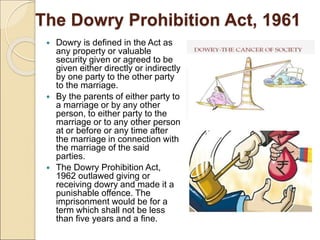
The Dowry Prohibition Act, 1961
 Dowry is defined in the Act as
any property or valuable
security given or agreed to be
given either directly or indirectly
by one party to the other party
to the marriage.
 By the parents of either party to
a marriage or by any other
person, to either party to the
marriage or to any other person
at or before or any time after
the marriage in connection with
the marriage of the said
parties.
 The Dowry Prohibition Act,
1962 outlawed giving or
receiving dowry and made it a
punishable offence. The
imprisonment would be for a
term which shall not be less
than five years and a fine.
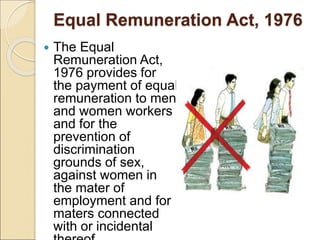
Equal Remuneration Act, 1976
 The Equal
Remuneration Act,
1976 provides for
the payment of equal
remuneration to men
and women workers
and for the
prevention of
discrimination
grounds of sex,
against women in
the mater of
employment and for
maters connected
with or incidental
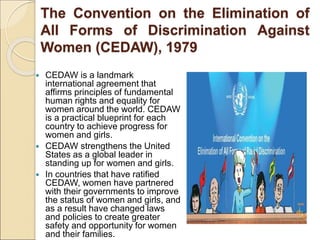
The Convention on the Elimination of
All Forms of Discrimination Against
Women (CEDAW), 1979
 CEDAW is a landmark
international agreement that
affirms principles of fundamental
human rights and equality for
women around the world. CEDAW
is a practical blueprint for each
country to achieve progress for
women and girls.
 CEDAW strengthens the United
States as a global leader in
standing up for women and girls.
 In countries that have ratified
CEDAW, women have partnered
with their governments to improve
the status of women and girls, and
as a result have changed laws
and policies to create greater
safety and opportunity for women
and their families.
The Indecent Representation of Women
(Prohibition) Act, 1986
 An Act to prohibit
indecent
representation of
women through
advertisements or
in
publications,writing
s, paintings, figures
or in any other
manner and for the
maters connected
therewith or
incidental thereto.
The National Commission for Women
Act, 1990
 The Central Government shall
constitute a body to be known as the
National Commission for Women
 to exercise the powers conferred on
and to perform the functions assigned
to it under this Act.
Functions of NCW:
 Investigate and examine all matiers
relating to the safeguards provided for
women under the
 Constitution and other laws .
 Look into complaints and take
suomoto notice of the matiers relating
to deprivation of
 women’s rights, non-implementation
of laws enacted to provide protection
to women, and
 also to achieve the objective of
equality and development .
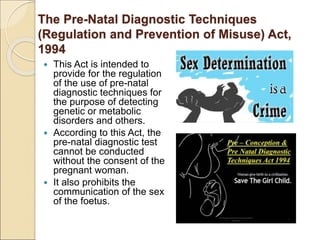
The Pre-Natal Diagnostic Techniques
(Regulation and Prevention of Misuse) Act,
1994
 This Act is intended to
provide for the regulation
of the use of pre-natal
diagnostic techniques for
the purpose of detecting
genetic or metabolic
disorders and others.
 According to this Act, the
pre-natal diagnostic test
cannot be conducted
without the consent of the
pregnant woman.
 It also prohibits the
communication of the sex
of the foetus.
Protection of Women from
Domestic Violence Act, 2005
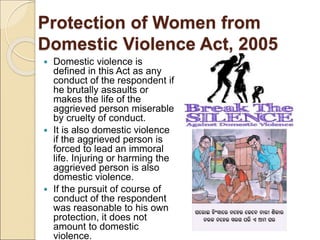
 Domestic violence is
defined in this Act as any
conduct of the respondent if
he brutally assaults or
makes the life of the
aggrieved person miserable
by cruelty of conduct.
 It is also domestic violence
if the aggrieved person is
forced to lead an immoral
life. Injuring or harming the
aggrieved person is also
domestic violence.
 If the pursuit of course of
conduct of the respondent
was reasonable to his own
protection, it does not
amount to domestic
violence.
The Prohibition of Child Marriages Act
(as amended up to 2006)
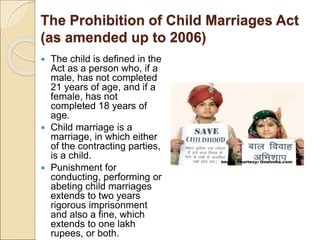
 The child is defined in the
Act as a person who, if a
male, has not completed
21 years of age, and if a
female, has not
completed 18 years of
age.
 Child marriage is a
marriage, in which either
of the contracting parties,
is a child.
 Punishment for
conducting, performing or
abeting child marriages
extends to two years
rigorous imprisonment
and also a fine, which
extends to one lakh
rupees, or both.
Sexual Harassment Prevention
Act, 2009
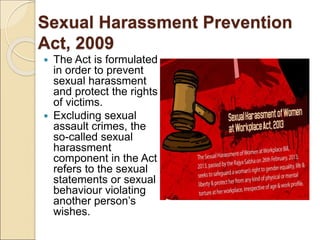
 The Act is formulated
in order to prevent
sexual harassment
and protect the rights
of victims.
 Excluding sexual
assault crimes, the
so-called sexual
harassment
component in the Act
refers to the sexual
statements or sexual
behaviour violating
another person’s
wishes.
Right to Maintenance
 This provision is to provide a
summary remedy to prevent
dependents from destitution
and to serve a social purpose.
 The following are entitled to the
Right to Maintenance:
1. Wife, if she is unable to
maintain herself
2. Legitimate or illegitimate minor
child, whether married or not,
who is unable to maintain
himself or herself
3. Father or mother who is
unable to maintain himself or
herself
Consequences of Violence Against
Women
 Physical
 Psychological
 Economical & Social
For the survivors, these are interconnected.
THANK YOU

the violence.pptx

  • 2.
    Different Forms ofViolence against Women A. Violence in the Family:  Traditional practices  Son preference  Domestic violence  Sexual assault within marriage B. Violence in the Community  Rape  Sexual Violence at Workplace  Custodial violence against women  Trafficking
  • 3.
  • 4.
    The Dowry ProhibitionAct, 1961  Dowry is defined in the Act as any property or valuable security given or agreed to be given either directly or indirectly by one party to the other party to the marriage.  By the parents of either party to a marriage or by any other person, to either party to the marriage or to any other person at or before or any time after the marriage in connection with the marriage of the said parties.  The Dowry Prohibition Act, 1962 outlawed giving or receiving dowry and made it a punishable offence. The imprisonment would be for a term which shall not be less than five years and a fine.
  • 5.
    Equal Remuneration Act,1976  The Equal Remuneration Act, 1976 provides for the payment of equal remuneration to men and women workers and for the prevention of discrimination grounds of sex, against women in the mater of employment and for maters connected with or incidental
  • 6.
    The Convention onthe Elimination of All Forms of Discrimination Against Women (CEDAW), 1979  CEDAW is a landmark international agreement that affirms principles of fundamental human rights and equality for women around the world. CEDAW is a practical blueprint for each country to achieve progress for women and girls.  CEDAW strengthens the United States as a global leader in standing up for women and girls.  In countries that have ratified CEDAW, women have partnered with their governments to improve the status of women and girls, and as a result have changed laws and policies to create greater safety and opportunity for women and their families.
  • 7.
    The Indecent Representationof Women (Prohibition) Act, 1986  An Act to prohibit indecent representation of women through advertisements or in publications,writing s, paintings, figures or in any other manner and for the maters connected therewith or incidental thereto.
  • 8.
    The National Commissionfor Women Act, 1990  The Central Government shall constitute a body to be known as the National Commission for Women  to exercise the powers conferred on and to perform the functions assigned to it under this Act. Functions of NCW:  Investigate and examine all matiers relating to the safeguards provided for women under the  Constitution and other laws .  Look into complaints and take suomoto notice of the matiers relating to deprivation of  women’s rights, non-implementation of laws enacted to provide protection to women, and  also to achieve the objective of equality and development .
  • 9.
    The Pre-Natal DiagnosticTechniques (Regulation and Prevention of Misuse) Act, 1994  This Act is intended to provide for the regulation of the use of pre-natal diagnostic techniques for the purpose of detecting genetic or metabolic disorders and others.  According to this Act, the pre-natal diagnostic test cannot be conducted without the consent of the pregnant woman.  It also prohibits the communication of the sex of the foetus.
  • 10.
    Protection of Womenfrom Domestic Violence Act, 2005  Domestic violence is defined in this Act as any conduct of the respondent if he brutally assaults or makes the life of the aggrieved person miserable by cruelty of conduct.  It is also domestic violence if the aggrieved person is forced to lead an immoral life. Injuring or harming the aggrieved person is also domestic violence.  If the pursuit of course of conduct of the respondent was reasonable to his own protection, it does not amount to domestic violence.
  • 11.
    The Prohibition ofChild Marriages Act (as amended up to 2006)  The child is defined in the Act as a person who, if a male, has not completed 21 years of age, and if a female, has not completed 18 years of age.  Child marriage is a marriage, in which either of the contracting parties, is a child.  Punishment for conducting, performing or abeting child marriages extends to two years rigorous imprisonment and also a fine, which extends to one lakh rupees, or both.
  • 12.
    Sexual Harassment Prevention Act,2009  The Act is formulated in order to prevent sexual harassment and protect the rights of victims.  Excluding sexual assault crimes, the so-called sexual harassment component in the Act refers to the sexual statements or sexual behaviour violating another person’s wishes.
  • 13.
    Right to Maintenance This provision is to provide a summary remedy to prevent dependents from destitution and to serve a social purpose.  The following are entitled to the Right to Maintenance: 1. Wife, if she is unable to maintain herself 2. Legitimate or illegitimate minor child, whether married or not, who is unable to maintain himself or herself 3. Father or mother who is unable to maintain himself or herself
  • 14.
    Consequences of ViolenceAgainst Women  Physical  Psychological  Economical & Social For the survivors, these are interconnected.
  • 16.