The UNIX Philosophy
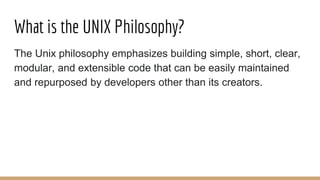
What is the UNIX Philosophy?
The Unix philosophy emphasizes building simple, short, clear,
modular, and extensible code that can be easily maintained
and repurposed by developers other than its creators.
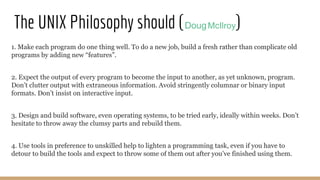
The UNIX Philosophy should (DougMcIlroy)
1. Make each program do one thing well. To do a new job, build a fresh rather than complicate old
programs by adding new “features”.
2. Expect the output of every program to become the input to another, as yet unknown, program.
Don’t clutter output with extraneous information. Avoid stringently columnar or binary input
formats. Don’t insist on interactive input.
3. Design and build software, even operating systems, to be tried early, ideally within weeks. Don’t
hesitate to throw away the clumsy parts and rebuild them.
4. Use tools in preference to unskilled help to lighten a programming task, even if you have to
detour to build the tools and expect to throw some of them out after you’ve finished using them.
Where did it originate?
The Unix philosophy, originated by Ken Thompson, is a set of
cultural norms and philosophical approaches to minimalist,
modular software development. It is based on the experience of
leading developers of the Unix operating system.
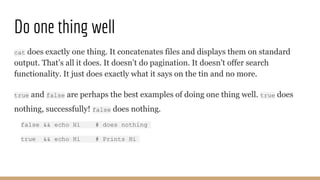
Do one thing well
cat does exactly one thing. It concatenates files and displays them on standard
output. That’s all it does. It doesn’t do pagination. It doesn’t offer search
functionality. It just does exactly what it says on the tin and no more.
true and false are perhaps the best examples of doing one thing well. true does
nothing, successfully! false does nothing.
false && echo Hi # does nothing
true && echo Hi # Prints Hi
Worse is Better
- Although this idea wasn’t a direct relative of the Unix philosophy, it’s
certainly similar.
- The idea references the fact that additional features or complexity doesn’t
necessarily make things better, and a “worse” project — one with fewer
features and less complexity — is actually better because it will tend to be
more reliable and usable.
- Most of us can recognize this idea in at least one of our projects. We start
work on a project but midway though the project we decide that it should
have another feature. The feature creep causes the project to be
unusable or unreliable, even given its initial simple design goal. An
emphasis on simplicity and interoperability helps fight feature creep.
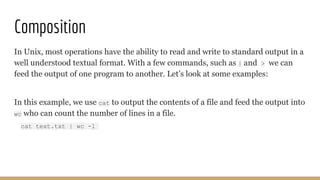
Composition
In Unix, most operations have the ability to read and write to standard output in a
well understood textual format. With a few commands, such as | and > we can
feed the output of one program to another. Let’s look at some examples:
In this example, we use cat to output the contents of a file and feed the output into
wc who can count the number of lines in a file.
cat text.txt | wc -l
Everything is a file
In UNIX everything is a file (or more precisely, everything is a stream of bytes). This
means that the same APIs/commands can be used for reading a CD-ROM drive,
writing a network socket or finding out CPU info.
For example, the entire /proc file system on Linux isn’t really files — it’s a dynamic view
of information that’s exposed as a bunch of file descriptors.
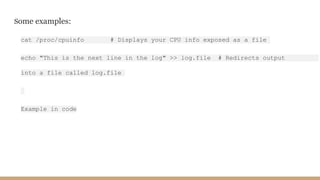
Some examples:
cat /proc/cpuinfo # Displays your CPU info exposed as a file
echo "This is the next line in the log" >> log.file # Redirects output
into a file called log.file
Example in code
A simple program
- Does one thing
- Does it well
- No versioning problems
- Can be used by any program written in any language
func upper(f *os.File) {
input := bufio.NewScanner(f)
for input.Scan() {
fmt.Println(strings.ToUpper(input.Text()))
}
}
func main() {
files := os.Args[1:]
if len(files) == 0 {
upper(os.Stdin)
} else {
for _, file := range files {
f, err := os.Open(file)
if err != nil {
fmt.Fprintf(os.Stderr, "%s: %vn", os.Args[0], err)
continue
}
upper(f)
f.Close()
}
}
}
Another example
- Does one thing
- Does it well
- No versioning problems
- Can be used by any program written in any language
func spilt(f *os.File) {
input := bufio.NewScanner(f)
for input.Scan() {
lines := strings.Split(input.Text(), " ")
for _, line := range lines {
fmt.Println(line)}
}
}
func main() {
files := os.Args[1:]
if len(files) == 0 {
split(os.Stdin)
} else {
for _, file := range files {
f, err := os.Open(file)
if err != nil {
fmt.Fprintf(os.Stderr, "%s: %vn", os.Args[0], err)
continue
}
split(f)
f.Close()
}
}
}
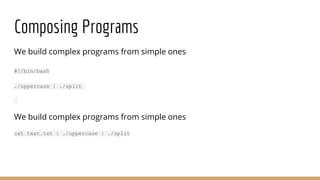
Composing Programs
We build complex programs from simple ones
#!/bin/bash
./uppercase | ./split
We build complex programs from simple ones
cat text.txt | ./uppercase | ./split
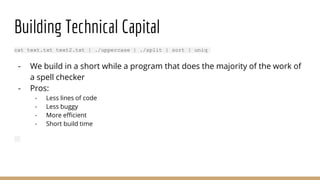
Building Technical Capital
cat text.txt text2.txt | ./uppercase | ./split | sort | uniq
- We build in a short while a program that does the majority of the work of
a spell checker
- Pros:
- Less lines of code
- Less buggy
- More efficient
- Short build time
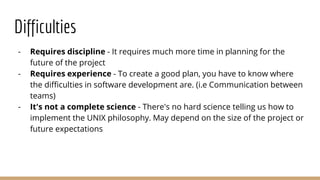
Difficulties
- Requires discipline - It requires much more time in planning for the
future of the project
- Requires experience - To create a good plan, you have to know where
the difficulties in software development are. (i.e Communication between
teams)
- It's not a complete science - There's no hard science telling us how to
implement the UNIX philosophy. May depend on the size of the project or
future expectations
How to learn
- Learn from experienced developers - Learn from their mistakes and
build on them
- Learn by doing - Learn from your own mistakes. Start small and build
your way up
- Reflect on your code - Look over your code and see where you could
redesign or refactor your code and make it better.
Hope you all gained some new knowledge
Links
- https://www.youtube.com/watch?v=aY7OzGPaP5I&t=176s&ab_channel=P
hilipBohun
- https://www.youtube.com/watch?v=dDwXnB6XeiA&ab_channel=StevieJay
- https://en.wikipedia.org/wiki/The_Art_of_Unix_Programming
- https://medium.com/ingeniouslysimple/philosophy-of-unix-development-
aa0104322491

The UNIX philosophy

  • 1.
  • 2.
    What is theUNIX Philosophy? The Unix philosophy emphasizes building simple, short, clear, modular, and extensible code that can be easily maintained and repurposed by developers other than its creators.
  • 3.
    The UNIX Philosophyshould (DougMcIlroy) 1. Make each program do one thing well. To do a new job, build a fresh rather than complicate old programs by adding new “features”. 2. Expect the output of every program to become the input to another, as yet unknown, program. Don’t clutter output with extraneous information. Avoid stringently columnar or binary input formats. Don’t insist on interactive input. 3. Design and build software, even operating systems, to be tried early, ideally within weeks. Don’t hesitate to throw away the clumsy parts and rebuild them. 4. Use tools in preference to unskilled help to lighten a programming task, even if you have to detour to build the tools and expect to throw some of them out after you’ve finished using them.
  • 4.
    Where did itoriginate? The Unix philosophy, originated by Ken Thompson, is a set of cultural norms and philosophical approaches to minimalist, modular software development. It is based on the experience of leading developers of the Unix operating system.
  • 5.
    Do one thingwell cat does exactly one thing. It concatenates files and displays them on standard output. That’s all it does. It doesn’t do pagination. It doesn’t offer search functionality. It just does exactly what it says on the tin and no more. true and false are perhaps the best examples of doing one thing well. true does nothing, successfully! false does nothing. false && echo Hi # does nothing true && echo Hi # Prints Hi
  • 6.
    Worse is Better -Although this idea wasn’t a direct relative of the Unix philosophy, it’s certainly similar. - The idea references the fact that additional features or complexity doesn’t necessarily make things better, and a “worse” project — one with fewer features and less complexity — is actually better because it will tend to be more reliable and usable. - Most of us can recognize this idea in at least one of our projects. We start work on a project but midway though the project we decide that it should have another feature. The feature creep causes the project to be unusable or unreliable, even given its initial simple design goal. An emphasis on simplicity and interoperability helps fight feature creep.
  • 7.
    Composition In Unix, mostoperations have the ability to read and write to standard output in a well understood textual format. With a few commands, such as | and > we can feed the output of one program to another. Let’s look at some examples: In this example, we use cat to output the contents of a file and feed the output into wc who can count the number of lines in a file. cat text.txt | wc -l
  • 8.
    Everything is afile In UNIX everything is a file (or more precisely, everything is a stream of bytes). This means that the same APIs/commands can be used for reading a CD-ROM drive, writing a network socket or finding out CPU info. For example, the entire /proc file system on Linux isn’t really files — it’s a dynamic view of information that’s exposed as a bunch of file descriptors.
  • 9.
    Some examples: cat /proc/cpuinfo# Displays your CPU info exposed as a file echo "This is the next line in the log" >> log.file # Redirects output into a file called log.file Example in code
  • 10.
    A simple program -Does one thing - Does it well - No versioning problems - Can be used by any program written in any language
  • 11.
    func upper(f *os.File){ input := bufio.NewScanner(f) for input.Scan() { fmt.Println(strings.ToUpper(input.Text())) } } func main() { files := os.Args[1:] if len(files) == 0 { upper(os.Stdin) } else { for _, file := range files { f, err := os.Open(file) if err != nil { fmt.Fprintf(os.Stderr, "%s: %vn", os.Args[0], err) continue } upper(f) f.Close() } } }
  • 12.
    Another example - Doesone thing - Does it well - No versioning problems - Can be used by any program written in any language
  • 13.
    func spilt(f *os.File){ input := bufio.NewScanner(f) for input.Scan() { lines := strings.Split(input.Text(), " ") for _, line := range lines { fmt.Println(line)} } } func main() { files := os.Args[1:] if len(files) == 0 { split(os.Stdin) } else { for _, file := range files { f, err := os.Open(file) if err != nil { fmt.Fprintf(os.Stderr, "%s: %vn", os.Args[0], err) continue } split(f) f.Close() } } }
  • 14.
    Composing Programs We buildcomplex programs from simple ones #!/bin/bash ./uppercase | ./split We build complex programs from simple ones cat text.txt | ./uppercase | ./split
  • 15.
    Building Technical Capital cattext.txt text2.txt | ./uppercase | ./split | sort | uniq - We build in a short while a program that does the majority of the work of a spell checker - Pros: - Less lines of code - Less buggy - More efficient - Short build time
  • 16.
    Difficulties - Requires discipline- It requires much more time in planning for the future of the project - Requires experience - To create a good plan, you have to know where the difficulties in software development are. (i.e Communication between teams) - It's not a complete science - There's no hard science telling us how to implement the UNIX philosophy. May depend on the size of the project or future expectations
  • 17.
    How to learn -Learn from experienced developers - Learn from their mistakes and build on them - Learn by doing - Learn from your own mistakes. Start small and build your way up - Reflect on your code - Look over your code and see where you could redesign or refactor your code and make it better.
  • 18.
    Hope you allgained some new knowledge
  • 19.
    Links - https://www.youtube.com/watch?v=aY7OzGPaP5I&t=176s&ab_channel=P hilipBohun - https://www.youtube.com/watch?v=dDwXnB6XeiA&ab_channel=StevieJay -https://en.wikipedia.org/wiki/The_Art_of_Unix_Programming - https://medium.com/ingeniouslysimple/philosophy-of-unix-development- aa0104322491