The primary difference between a fully automated enterprise and a traditional enterprise is their approaches to automation.
A fully automated enterprise thinks “automation first” and applies automation where it makes the most sense having the
greatest impact. It also understands the people requirements and nurtures and grows the talent needed to operate the
automations.
Find out more about each product below.
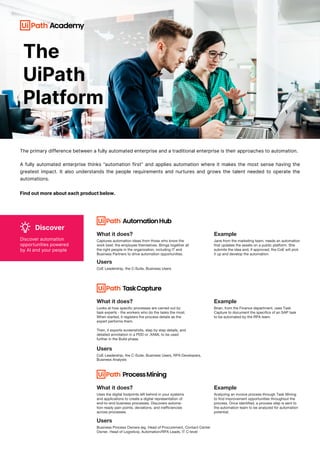
Discover
Discover automation
opportunities powered
by AI and your people
What it does?
Users
CoE Leadership, the C-Suite, Business Users
Captures automation ideas from those who know the
work best: the employee themselves. Brings together all
the right people in the organization, including IT and
Business Partners to drive automation opportunities.
Example
Jane from the marketing team, needs an automation
that updates the assets on a public platform. She
submits the idea and, if approved, the CoE will pick
it up and develop the automation.
Example
What it does?
Looks at how specific processes are carried out by
task experts - the workers who do the tasks the most.
When started, it registers the process details as the
expert performs them.
Then, it exports screenshots, step by step details, and
detailed annotation in a PDD or .XAML to be used
further in the Build phase.
Users
CoE Leadership, the C-Suite, Business Users, RPA Developers,
Business Analysts
Brian, from the Finance department, uses Task
Capture to document the specifics of an SAP task
to be automated by the RPA team.
What it does?
Users
Business Process Owners (eg. Head of Procurement, Contact Center
Owner, Head of Logistics), Automation/RPA Leads, IT C-level
Uses the digital footprints left behind in your systems
and applications to create a digital representation of
end-to-end business processes. Discovers automa-
tion-ready pain points, deviations, and inefficiencies
across processes.
Example
Analyzing an invoice process through Task Mining
to find improvement opportunities throughout the
process. Once identified, a process step is sent to
the automation team to be analyzed for automation
potential.
The
UiPath
Platform
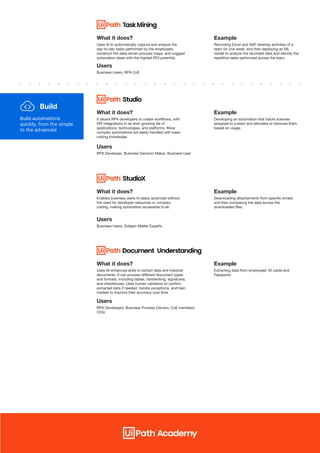
Build
Build automations
quickly, from the simple
to the advanced
What it does?
Users
Business Users, RPA CoE
Uses Al to automatically capture and analyze the
day-to-day tasks performed by the employees,
construct the data-driven process maps, and suggest
automation ideas with the highest ROI potential.
Example
Recording Excel and SAP desktop activities of a
team for one week, and then deploying an ML
model to analyze the recorded data and identify the
repetitive tasks performed across the team.
What it does? Example
Users
RPA Developer, Business Decision Maker, Business User
It allows RPA developers to create workflows, with
API integrations to an ever-growing list of
applications, technologies, and platforms. More
complex automations are easily handled with basic
coding knowledge.
Developing an automation that tracks licenses
assigned to a team and allocates or removes them
based on usage.
What it does?
Enables business users to easily automate without
the need for developer resources or complex
coding, making automation accessible to all.
Users
Business Users, Subject Matter Experts
Example
Downloading attachements from specific emails
and then comparing the data across the
downloaded files.
What it does? Example
Users
RPA Developers, Business Process Owners, CoE members,
CIOs
Uses AI-enhanced skills to extract data and interpret
documents. It can process different document types
and formats, including tables, handwriting, signatures,
and checkboxes. Uses human validation to confirm
extracted data if needed, handle exceptions, and train
models to improve their accuracy over time.
Extracting data from employees’ ID cards and
Passports.
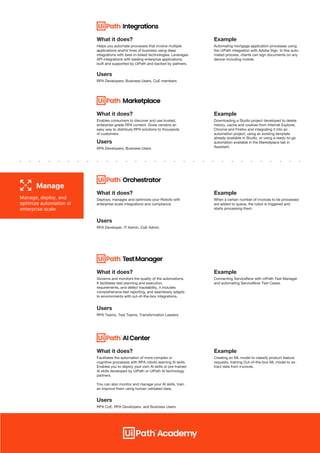
What it does?
Users
RPA Developers, Business Users, CoE members
Helps you automate processes that involve multiple
applications and/or lines of business using deep
integrations with best-in-breed technologies. Leverages
API integrations with leading enterprise applications,
built and supported by UiPath and backed by partners.
Example
Automating mortgage application processes using
the UiPath integration with Adobe Sign. In this auto-
mated process, clients can sign documents on any
device–including mobile.
What it does?
Enables consumers to discover and use trusted,
enterprise-grade RPA content. Gives vendors an
easy way to distribute RPA solutions to thousands
of customers.
Users
RPA Developers, Business Users
Example
Downloading a Studio project developed to delete
history, cache and cookies from Internet Explorer,
Chrome and Firefox and integrating it into an
automation project; using an existing template
already available in Studio, or using a ready-to-go
automation available in the Marketplace tab in
Assistant.
What it does? Example
Users
RPA Developer, IT Admin, CoE Admin
Deploys, manages and optimizes your Robots with
enterprise-scale integrations and compliance.
When a certain number of invoices to be processed
are added to queue, the robot is triggered and
starts processing them.
What it does?
Governs and monitors the quality of the automations.
It facilitates test planning and execution,
requirements, and defect traceability, it includes
comprehensive test reporting, and seamlessly adapts
to environments with out-of-the-box integrations.
Users
RPA Teams, Test Teams, Transformation Leaders
Example
Connecting ServiceNow with UiPath Test Manager
and automating ServiceNow Test Cases.
What it does?
Facilitates the automation of more complex or
cognitive processes with RPA robots learning Al skills.
Enables you to deploy your own Al skills or pre-trained
Al skills developed by UiPath or UiPath Al technology
partners.
You can also monitor and manage your AI skills, train
an improve them using human validated data.
Users
RPA CoE, RPA Developers, and Business Users
Example
Creating an ML model to classify product feature
requests, training Out-of-the-box ML model to ex-
tract data from invoices.
Manage
Manage, deploy, and
optimize automation at
enterprise scale
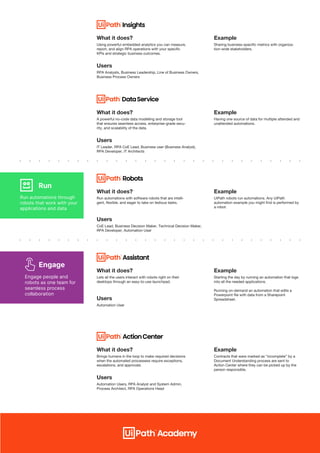
What it does? Example
Users
RPA Analysts, Business Leadership, Line of Business Owners,
Business Process Owners
Using powerful embedded analytics you can measure,
report, and align RPA operations with your specific
KPls and strategic business outcomes.
Sharing business-specific metrics with organiza-
tion-wide stakeholders.
What it does? Example
Users
IT Leader, RPA CoE Lead, Business user (Business Analyst),
RPA Developer, IT Architects
A powerful no-code data modelling and storage tool
that ensures seamless access, enterprise-grade secu-
rity, and scalability of the data.
Having one source of data for multiple attended and
unattended automations.
What it does? Example
Users
CoE Lead, Business Decision Maker, Technical Decision Maker,
RPA Developer, Automation User
Run automations with software robots that are intelli-
gent, flexible, and eager to take on tedious tasks.
UiPath robots run automations. Any UiPath
automation example you might find is performed by
a robot.
What it does?
Users
Automation User
Lets all the users interact with robots right on their
desktops through an easy-to-use launchpad.
Example
Starting the day by running an automation that logs
into all the needed applications.
Running on-demand an automation that edits a
Powerpoint file with data from a Sharepoint
Spreadsheet.
What it does? Example
Users
Automation Users, RPA Analyst and System Admin,
Process Architect, RPA Operations Head
Brings humans in the loop to make required decisions
when the automated processess require exceptions,
escalations, and approvals.
Contracts that were marked as “incomplete” by a
Document Understanding process are sent to
Action Center where they can be picked up by the
person responsible.
Run
Run automations through
robots that work with your
applications and data
Engage
Engage people and
robots as one team for
seamless process
collaboration
What it does? Example
Users
C-Level, IT Leader, RPA CoE Lead,
Automation User, Citizen Developer, RPA Developer,
IT Manager
Enables you to build, use, and share elegant business
apps that interact with your automations.
Consolidating data from dozen of applications used
daily into one interface.
You can govern how automations are built and what
users can do with them. Measurement of both
operational and business results helps you run an
effective program and maximize your return on
automation.
Measure &
Govern
Measure and govern
automation programs to
align with business
outcomes
Example
What it does?
Connects chatbots with UiPath processes for the
fulfillment of user requests without writing a single line
of code.
Users
C-Level, IT Leader, RPA CoE Lead,
Automation User, Citizen Developer, RPA Developer,
IT Manager
The UiPath Platform includes many capabilities
designed to allow you to measure and govern your
automation program at all stages of the lifecycle. For
example, there are rich role-based access controls
that work with your account directories.
A chatbot that helps employees create new service
requests in ServiceNow.

The UiPath Platform.pdf

  • 1.
    The primary differencebetween a fully automated enterprise and a traditional enterprise is their approaches to automation. A fully automated enterprise thinks “automation first” and applies automation where it makes the most sense having the greatest impact. It also understands the people requirements and nurtures and grows the talent needed to operate the automations. Find out more about each product below. Discover Discover automation opportunities powered by AI and your people What it does? Users CoE Leadership, the C-Suite, Business Users Captures automation ideas from those who know the work best: the employee themselves. Brings together all the right people in the organization, including IT and Business Partners to drive automation opportunities. Example Jane from the marketing team, needs an automation that updates the assets on a public platform. She submits the idea and, if approved, the CoE will pick it up and develop the automation. Example What it does? Looks at how specific processes are carried out by task experts - the workers who do the tasks the most. When started, it registers the process details as the expert performs them. Then, it exports screenshots, step by step details, and detailed annotation in a PDD or .XAML to be used further in the Build phase. Users CoE Leadership, the C-Suite, Business Users, RPA Developers, Business Analysts Brian, from the Finance department, uses Task Capture to document the specifics of an SAP task to be automated by the RPA team. What it does? Users Business Process Owners (eg. Head of Procurement, Contact Center Owner, Head of Logistics), Automation/RPA Leads, IT C-level Uses the digital footprints left behind in your systems and applications to create a digital representation of end-to-end business processes. Discovers automa- tion-ready pain points, deviations, and inefficiencies across processes. Example Analyzing an invoice process through Task Mining to find improvement opportunities throughout the process. Once identified, a process step is sent to the automation team to be analyzed for automation potential. The UiPath Platform
  • 2.
    Build Build automations quickly, fromthe simple to the advanced What it does? Users Business Users, RPA CoE Uses Al to automatically capture and analyze the day-to-day tasks performed by the employees, construct the data-driven process maps, and suggest automation ideas with the highest ROI potential. Example Recording Excel and SAP desktop activities of a team for one week, and then deploying an ML model to analyze the recorded data and identify the repetitive tasks performed across the team. What it does? Example Users RPA Developer, Business Decision Maker, Business User It allows RPA developers to create workflows, with API integrations to an ever-growing list of applications, technologies, and platforms. More complex automations are easily handled with basic coding knowledge. Developing an automation that tracks licenses assigned to a team and allocates or removes them based on usage. What it does? Enables business users to easily automate without the need for developer resources or complex coding, making automation accessible to all. Users Business Users, Subject Matter Experts Example Downloading attachements from specific emails and then comparing the data across the downloaded files. What it does? Example Users RPA Developers, Business Process Owners, CoE members, CIOs Uses AI-enhanced skills to extract data and interpret documents. It can process different document types and formats, including tables, handwriting, signatures, and checkboxes. Uses human validation to confirm extracted data if needed, handle exceptions, and train models to improve their accuracy over time. Extracting data from employees’ ID cards and Passports.
  • 3.
    What it does? Users RPADevelopers, Business Users, CoE members Helps you automate processes that involve multiple applications and/or lines of business using deep integrations with best-in-breed technologies. Leverages API integrations with leading enterprise applications, built and supported by UiPath and backed by partners. Example Automating mortgage application processes using the UiPath integration with Adobe Sign. In this auto- mated process, clients can sign documents on any device–including mobile. What it does? Enables consumers to discover and use trusted, enterprise-grade RPA content. Gives vendors an easy way to distribute RPA solutions to thousands of customers. Users RPA Developers, Business Users Example Downloading a Studio project developed to delete history, cache and cookies from Internet Explorer, Chrome and Firefox and integrating it into an automation project; using an existing template already available in Studio, or using a ready-to-go automation available in the Marketplace tab in Assistant. What it does? Example Users RPA Developer, IT Admin, CoE Admin Deploys, manages and optimizes your Robots with enterprise-scale integrations and compliance. When a certain number of invoices to be processed are added to queue, the robot is triggered and starts processing them. What it does? Governs and monitors the quality of the automations. It facilitates test planning and execution, requirements, and defect traceability, it includes comprehensive test reporting, and seamlessly adapts to environments with out-of-the-box integrations. Users RPA Teams, Test Teams, Transformation Leaders Example Connecting ServiceNow with UiPath Test Manager and automating ServiceNow Test Cases. What it does? Facilitates the automation of more complex or cognitive processes with RPA robots learning Al skills. Enables you to deploy your own Al skills or pre-trained Al skills developed by UiPath or UiPath Al technology partners. You can also monitor and manage your AI skills, train an improve them using human validated data. Users RPA CoE, RPA Developers, and Business Users Example Creating an ML model to classify product feature requests, training Out-of-the-box ML model to ex- tract data from invoices. Manage Manage, deploy, and optimize automation at enterprise scale
  • 4.
    What it does?Example Users RPA Analysts, Business Leadership, Line of Business Owners, Business Process Owners Using powerful embedded analytics you can measure, report, and align RPA operations with your specific KPls and strategic business outcomes. Sharing business-specific metrics with organiza- tion-wide stakeholders. What it does? Example Users IT Leader, RPA CoE Lead, Business user (Business Analyst), RPA Developer, IT Architects A powerful no-code data modelling and storage tool that ensures seamless access, enterprise-grade secu- rity, and scalability of the data. Having one source of data for multiple attended and unattended automations. What it does? Example Users CoE Lead, Business Decision Maker, Technical Decision Maker, RPA Developer, Automation User Run automations with software robots that are intelli- gent, flexible, and eager to take on tedious tasks. UiPath robots run automations. Any UiPath automation example you might find is performed by a robot. What it does? Users Automation User Lets all the users interact with robots right on their desktops through an easy-to-use launchpad. Example Starting the day by running an automation that logs into all the needed applications. Running on-demand an automation that edits a Powerpoint file with data from a Sharepoint Spreadsheet. What it does? Example Users Automation Users, RPA Analyst and System Admin, Process Architect, RPA Operations Head Brings humans in the loop to make required decisions when the automated processess require exceptions, escalations, and approvals. Contracts that were marked as “incomplete” by a Document Understanding process are sent to Action Center where they can be picked up by the person responsible. Run Run automations through robots that work with your applications and data Engage Engage people and robots as one team for seamless process collaboration
  • 5.
    What it does?Example Users C-Level, IT Leader, RPA CoE Lead, Automation User, Citizen Developer, RPA Developer, IT Manager Enables you to build, use, and share elegant business apps that interact with your automations. Consolidating data from dozen of applications used daily into one interface. You can govern how automations are built and what users can do with them. Measurement of both operational and business results helps you run an effective program and maximize your return on automation. Measure & Govern Measure and govern automation programs to align with business outcomes Example What it does? Connects chatbots with UiPath processes for the fulfillment of user requests without writing a single line of code. Users C-Level, IT Leader, RPA CoE Lead, Automation User, Citizen Developer, RPA Developer, IT Manager The UiPath Platform includes many capabilities designed to allow you to measure and govern your automation program at all stages of the lifecycle. For example, there are rich role-based access controls that work with your account directories. A chatbot that helps employees create new service requests in ServiceNow.