The two positions in a debate are the affirmative and the negative. The affirmative or "pro" side in
a debate argues in favor of something while the negative or "con" side argues against something.
For instance, the affirmative stance on gun control would argue why firearm regulations are
necessary for public safety while the negative stance on gun control would argue why controls
wouldn't work to ensure the safety of the public.
Presidential debates are held prior to every American Presidential election and have a long history in
the United States. They date back to 1858 when Abraham Lincoln debated Stephen A. Douglas in
seven different debates on slavery held in seven Illinois congressional districts. High school debates
usually involve debating teams rather than one-on-one debating formats. Sometimes, student
debaters are assigned a position rather than choosing their own position. Whether positions are
chosen or assigned, proper debate strategy is essential for winning debates.
Good debaters understand the importance of appealing not only to logic and reason but to the
emotions of the audience. Argumentative strategies are important and debaters must anticipate the
responses of the other debaters and the audience. An in-depth understanding of the topic and not
just the main points is absolutely essential for a good debate. A good debater needs to prove not
only why his or her position is the right one, but why the opponent’s position is the wrong one.
Most debate formats include a cross-examination section where participants can pose questions to
the other candidates. The strategic debating idea here is to try to expose weaknesses in your
opponent's argument. Rebuttal speeches are those at the end of a debate. They offer both a
summary of each debater's argument as well as conclusions drawn from the arguments of the other
debaters.
EBATE FORMATS
Different styles of debate offer their own distinct format and focus. The most widely used format at the
university level is Parliamentary Debate, although certain regions of the world have their own, slightly
different version of it. IDEA predominantly employs the Karl Popper Debate format with secondary school
students and the Parliamentary format with secondary and university students.
New debate formats are created all the time; some of them stay, some of them do not. If you feel the
following is not comprehensive or there are improvements you could make, please Contact Us.
Online Debate
Online debating formats are meant to allow debaters to engage in short debates using instant messaging
or video conferencing software. These debates will have one debater representing the "affirmative" and
another debater presenting the "negative". While online debates are not meant to replace face-to-face
communication, they are a way to bridge geographic distances and to allow for discussion between
people who might not otherwise have a chance to meet.
IDEA expects the opportunities for debating on the Internet to improve as technology improves and
believes this format will be dynamic and open to change. Starting in January 2012, IDEA will host video
and text debating competitions – visit DEBATE NOW to sign up and join in.
Team Debate
Karl Popper Debate
The Karl-Popper format focuses on relevant and often deeply divisive propositions, emphasizing the
development of critical thinking skills and tolerance for differing viewpoints. Debaters work together in
teams of three and must research both sides of each issue. Each team is given the opportunity to offer
arguments and direct questions to the opposing team. Judges then offer constructive feedback,
commenting on logical flaws, insufficient evidence or arguments that debaters may have overlooked.
This format was developed for use in secondary school programs and competitions. It is popular in
Central and Eastern Europe and in Russia. In Africa it is becoming increasingly popular in Uganda, Kenya,
Rwanda, Zimbabwe, Liberia and Nigeria. It is the format employed at the annual IDEA Youth Forum – a
two week debate event for secondary school students from all over the world.
The distinguishing features of the format are: cross-examination, when four of the six debaters ask their
opponents questions; and preparation time, when debaters can prepare before their speeches. This
format emphasizes team work and is a good format for beginner debaters, because each speaker in this
debate speaks once only and members of the team need to communicate with each other during the
designated preparation time.
Parliamentary Debate
Many formats of debate are described as 'parliamentary'. This is really a catch-all term which simply
means that they are loosely modeled on the practices of the British parliamentary system and other
parliaments around the world that adopted those practices. In practice it means that the motion for
debate is treated in much the same way as a legislative Bill placed before the UK House of Commons.
The motion always stands in the name of the Government (also called 'the Proposition') and it is the job
of the Opposition to demonstrate that the motion is either impractical or immoral.
The distinguishing factor of parliamentary formats, of which there are many, is the use of Points of
Information (PoI). These points allow debaters to interrupts a speaker to ask a question or offer
information which favors their side of the debate. Both Proposition and Opposition speakers can offer
PoIs, but only to the other side. It is not compulsory to accept a PoI, but in competitive debate speakers
are penalized if they fail to take any. Usually the first and last sections of a speech are 'protected time'
during which PoIs may not be offered.
In many parliamentary formats the terminology of the House of Commons has also been adopted with
the first proposition speaker being referred to as the Prime Minister and the first opposition speaker being
known as the Leader of the Opposition. The chair or presiding adjudicator is usually referred to as Mister
or Madam Speaker and all remarks are addressed to them not the other debaters.
British Parliamentary (BP)
This is the name of the format used for the World Universities Debating Championship and has, as a
result, become the default format for many university societies, especially in the English speaking world.
It is probably the most commonly used format in the World. In much the same way as many university
societies debate in their native language as well as English, so they tend to use a regional or local format
and also BP.
Debates comprise eight speakers: four speaking in favor of a motion and four against. Each side is made
up of two teams of two individuals. They debate a motion (the idea to be discussed) which is usually
framed with the wordingThis House Believes... or This House Would.... For example if the motion isThis
House Would Support Assisted Suicide, it is the role of the Proposition (or 'Government') speakers to
explain why assisted suicide is a good idea and the opposition should demonstrate that it is not. As a
form of parliamentary debate, in BP the government should propose a course of action and support it
with philosophical, practical and consequential arguments. The burden of proof is on the government, but
the opposition must also demonstrate the strength of their arguments.
Typically in BP, a motion is announced 15 minutes before the debate starts. Speeches are seven minutes
in length, with the first and last minute protected (Points of Information cannot be offered in 'protected'
time). The first proposition speaker is required to present a definition of the motion that places an idea in
a real-world setting. Once a motion has been defined, all speakers are required to address the definition,
not some other variant that might be easier for them.
Legislative Debate
Legislative Debate is based upon the notion of having representative student leaders consider some of
the problems that actually confront lawmakers. In doing so, Legislative Debate provides unparalleled
insight into the way legislation is drafted and establishes leadership and deliberation skills crucial to
effective participation in democratic processes. Legislative Debate also offers a vehicle for teaching
parliamentary procedure and helps students internalize the value of decision-making processes that draw
on consensus building and majority rule.
Lincoln-Douglas Debate
In Lincoln-Douglas Debate, the motion is a statement, phrased as a sentence that focuses on an issue of
philosophical or political concern and which will be analyzed from a moral perspective. Lincoln-Douglas
Debate places primacy on the ability of debaters to make original, coherent and philosophically
persuasive arguments on issues of ethics. Debaters should present a persuasive moral position that they
can defend from criticism and use to argue against an opposing case, without falling into self-
contradiction or denying the complexity of the issues at stake. Students should familiarize themselves
with the work of major ethical philosophers and should inform their cases with real-world examples and
analysis.
Middle School Debate
Fostering debate and speech activities on the middle school level is consistent with IDEA's commitment to
empower young people as participants of the democratic processes. Middle school students can benefit
uniquely from exposure to speech and debate. They are at an age, psychologically and socially, where
they can make considerable strides in acquiring research competence, media and argument literacy,
reading comprehension, evidence evaluation, and public speaking and civic skills. Finally, through
cultivating middle school speech and debate activities, not only are young people and teachers
empowered, but an appreciation of speech and debate is instilled in students who may well pursue it to
higher levels.
Mock Trial
Mock Trial is an exercise in argumentation and legal procedure and the only educational trial format
based on the International Criminal Court established by the Treaty of Rome. The IDEA Mock Trial hones
both legal reasoning and courtroom technique, while it familiarizes participants with a vital arena of
public debate. Teams representing the prosecution and defense take on the roles of all attorneys and
witnesses. A judge, or judging panel, oversees the round, provides educational criticism and makes a
decision based on each team's performance. Each case argued is an original scenario that the
participants must master. Facts are presented through a variety of legal documents and through the
testimony of witnesses. Although the underlying facts are the same, each round unfolds differently
according to the actions, decisions and interactions of the participants. Teams contest the facts of the
case through direct examination, cross-examination, re-direct and re-cross of both prosecution and
defense witnesses.
Cross-Examination (Policy) Debate
Like other forms of debate, Cross-Examination Debate focuses on the core elements of a controversial
issue. Cross-Examination Debate develops important skills, such as critical thinking, listening, argument
construction, research, note-taking and advocacy skills. Cross-Examination Debate is distinct from other
formats (with the exception of two team Parliamentary Debate) in is use of a two person team, along
with an emphasis on cross-examination between constructive speeches. While specific practices vary,
Cross Examination Debate typically rewards intensive use of evidence and is more focused on content
than delivery.
Public Forum Debate
Public Forum Debate offers students a unique opportunity to develop on-their-feet critical thinking skills
by situating them in contexts not unlike US political talk shows. Public Forum debaters must anticipate
numerous contingencies in planning their cases and must learn to adapt to rapidly changing
circumstances as discussions progress. Public Forum's open-ended cross-examination format encourages
the development of unique rhetorical strategies. Public Forum debates should be transparent to lay
audiences, while providing students with real-world public speaking skills, through the discussion of
contentious ideas.
Public Debate
IDEA believes that debate should not be limited to the setting of competitive debate tournaments in
which only students take part, but instead feels that debate should operate within a broader context of
public participation and should embrace different segments of a community. IDEA strongly encourages its
members to promote and support public access to debate through the organization of public debates and
by inviting the public to debate competitions.
Speech Events
Limited Preparation Events
(i) Impromptu Speaking
In Impromptu Speaking, students learn to prepare and deliver an original speech immediately and
without preparation. Impromptu Speaking topics range from the meaning of proverbs and abstract words
to the significance of events and quotations by famous speakers.
(ii) Extemporaneous Speaking
In Extemporaneous Speaking, students must prepare and deliver an original speech on a current event,
with a limited amount of preparation time. Extemporaneous topics are presented in the form of questions
and contestants are expected to take a position on the question as well as to justify their stance.
Platform Speaking Events
(i) Informative Speaking
In Informative Speaking, students prepare and deliver an original speech whose primary purpose is to
inform or educate the audience. The speech should describe, clarify, illustrate or define an object, idea,
concept or process.
(ii) Persuasive Speaking/Original Oratory
In Persuasive Speaking/Original Oratory, students prepare and deliver an original speech designed to
inspire, reinforce or change the beliefs, attitudes, values or actions of the audience.
Interpretative Events
(i) Prose Interpretation
In Prose Interpretation, students must select, analyze and share a cutting from literature (other than
verse or plays) through the art of reading aloud. Prose Interpretation expresses thought through
language recorded in sentences and paragraphs. Prose Interpretation includes fiction (short stories,
novels) and non-fiction (articles, essays, journals, biographies). An effective Prose Interpretation consists
of a selection or selections of materials with literary merit.
(ii) Poetry Interpretation
In Poetry Interpretation, students must find, analyze and share a cutting or rhyme through the art of
reading aloud. Poetry selections express ideas, experiences or emotions through the creative
arrangement of words according to their sound, rhythm and meaning. An effective Poetry Interpretation
consists of a selection or selections of material with literary merit.
(iii) Dramatic Interpretation
In Dramatic Interpretation, a student must select, analyze and share a cutting from a play through the
art of reading aloud. A Dramatic Interpretation consists of a selection or selections of literary merit that
may be drawn from more than one source.
(iv) Duo Dramatic Interpretation
In Duo Dramatic Interpretation, two students must find, analyze and share a cutting from a play through
the art of reading aloud. A Duo Dramatic Interpretation can be either humorous or serious. The cutting
should represent the portrayal of one or more characters presented by the two individuals.
(v) Programmed Oral Interpretation
In Programmed Oral Interpretation students must find, analyze and share a program of thematically
linked selections through the art of reading aloud. The selections should be of literary merit, and must be
chosen from at least two of the three recognized genres (prose/poetry/drama). 'Different genres' here
means that the material must appear in separate pieces of literature and that, for example, a poem
included in a short story that appears only in that short story does not constitute a poetry genre.
The First Steps to Debate in English
--Aiming at Cultivating Practical Ability--
(in Japanese)
Masatsugu Higuchi
English Teacher, Ikeda Senior High School Attached to Osaka Kyoiku University
(E-mail) higuchim@cc.osaka-kyoiku.ac.jp
(Home Page) http://www.ikeda.osaka-kyoiku.ac.jp/~higuchim/
1. Introduction
Debate class is fun. Doing debate in English is not so difficult. Having your own
opinion and expressing it in class is enjoyable. This is one of those abilities
which Japanese lack most. If Japanese are to play a leading part in the world,
we must cultivate the abilities which are needed in debate. You don't need to
take things too seriously. Let's begin step by step. This is a report about when I
let my students debate in English for the first time.
2. Why I Began Debate Lesson
Several years ago, Japan's Ministry of Education, Science and Culture
introduced three courses to choose from in English education: Oral
Communication (A) (situational conversation), Oral Communication(B) (aural
competence), Oral Communication (C) (discussion and debate).
We officially chose OC(B) and we had two lessons a week for each class of
first-year-students. One lesson was an aural-competence-oriented lesson
taught by a Japanese teacher. The other lesson was the one I taught with a
Canadian assistant-teacher.
At first we had the students make speeches, four students per class, but some
of them only read their manuscript or spoke to the wall of the room without
looking at other students.
I would like to improve these results. After the Great Hanshin Earthquake
people of Japan have realized the need to cope with the critical conditions
quickly. In the field of English education the same is the case. We must teach
the students how to make themselves understood properly when they speak
English.
To develop such skill I think debate is effective, thus I began debate class in
the following semester.
3. Actual Procedure in Debate Class
a. Choice of the Proposition (I called Topic in the class.)
In choosing the topic of the debate, it is recommendable to choose one which
is familiar to the students, and on which the students are divided evenly in
their opinions. And we need to take care that easier topics come first. In my
class, we chose these topics.
The first time : Dogs are better than cats.
The second time : Students of our school should wear school uniforms. (By the
way our students wear plain clothes.)
The third time : Students should have to go to high school in their
neighborhood.
b. Separating the class into Affirmative and Negative
I divided each class into six groups, seven or eight students in each group, and
made three pro groups and three con groups. Sometimes I asked the leader of
each group which side they wanted to choose, and I had the group which
wanted to take the pro side take the opposite side and vice versa. We must
have the students realize that in debate which side they take has nothing to
do with their personal opinions.
c. Brainstorming
After I decided which side the students are going to take, I had them think of
the strong points for their side and also those of their opponents. This was
done not only so they could gather the reasons behind an affirmative or
negative position, but also they could predict the speeches of the other side.
Note: In doing this, don't let the students worry about the strength of their
opinions. Let them think of as many points as possible. This is really
brainstorming.
When there were enough strong points for the members of their group, I had
the students put the points in order according to the degree of their strength,
and had them decide who would say which point and think about how they
would rebut the speeches of the other side. These activities I did in the first
period.
In the next period, we did the actual debate.
d. Actual Debate
Though there are many ways of doing debate, I chose the most traditional
one. The students spoke in the following order;
1) Constructive Speech of the pro side. (I called this "Build" in the class.)
2) Rebuttal Speech of the con side. (I called this "Attack" in the class.)
3) Constructive Speech of the con side.
4) Rebuttal Speech of the pro side.
This is one cycle. We repeated this cycle six or seven times until all the
members said their opinions. Please be sure to have the different persons say
the four speeches above. The students had to decide their speaking order.
In the first period, I gave them 30 seconds for the constructive speech and 15
seconds for the rebuttal . In the second period I gave 1 minute, 30 seconds
respectively and in the third period, 2 minutes, 1 minute. You may feel that 30
seconds is really long. You must prepare a lot when you are going to give a 2-
minute speech.
The fundamental form of speeches.
1) Introduction (Student's opinion.)
2) Body (Students must say why they think so. It is preferable they say it in
connection with their own experience.)
3) Conclusion (Student's opinion, again in connection with the proposition of
their side.)
I decided which two groups would start the debate first by doing some
quizzes. Our ALT asked some questions of the chief students of each group.
The groups who could answer the question correctly didn't have to do the
debate at that time. The last two groups had to do the debate on the spot.
The rest of the class should write the points of each speech on the record
sheet (chart 1) while listening to the speeches.
e. Evaluation of the Debate
When the debate is over, the rest of the class should decide which group was
more persuasive and write it on the record sheet. At the same time I asked the
students to raise their hand to show which side they thought won. The ALT
and I also evaluate the students' speeches on a scale of 5. Chart 2 is the record
sheet on which our ALT evaluated the students' speeches and wrote some
comments. We evaluated the students' speeches not so strictly because they
were doing debate for the first time.
4. Some Difficult Points
The point the con side should realize is they don't have to prove the opposite
of the proposition. All they have to do is prove the proposition is not correct.
For example, in the first debate, the con side could say, "Both dogs and cats
are animals. We can't say which is better." They didn't have to prove "Cats are
better than dogs." In this sense, the pro side is harder than the con side. They
must prove the proposition is correct.
5. Conclusion
In this way, we finished one cycle of the debate in 4 periods.
a. The announcement of the proposition, deciding the sides, brainstorming ---
1 period
b. The actual debate --- 3 periods
What I found in the debate lesson was we could always see things from both
sides. We could say something reasonable from both sides. When we took the
side regardless of our own opinion, we realized that all the more. Debate is an
intellectual game in which you must think of what you should say to persuade
others and how you could rebut the other's opinion. While I was doing the
model debate with the ALT, I felt I was experiencing the ways of thinking of
native speakers of English. I'd like to do debate lessons in my classes as often
as possible from now on.
6. References
* Matsumoto, S., (1996). Debate Makes Your Brain Better. Kodansha.
* Jinnbo, S., (1995). Hello, there! Oral Communication C. Tokyo Shoseki.
* Monbusho (The Ministry of Education, Science, and Culture) (1993).
The Guidelines for Study in Senior High School. Kyoiku Shuppan.
* Ishii, S., & Bowers, J.R. (1994).
Speak out. Oral Communication C. Kirihara Shoten.
Back to my Home Page
1. Introduce debates by producing the rubric that you will be using to grade them. For a sample
rubric, please see related sites at the bottom of this page.
2. A few weeks before the debate(s), give students the topic(s) to be covered.
3. Have students give you an ordered list showing in which debates they prefer to participate in
order of preference.
4. From these lists make a debate group consisting of two students for each side of your
debate: pro and con.
5. Before you hand the debate assignments out, explain that some students might be debating
positions opposite to their beliefs. This is an important skill for them to learn.
6. On the day of the debate, give students in the 'audience' a blank rubric. Explain that it is
their job to judge the debate objectively.
7. Begin the debate with the pro side speaking first. Allow them 5-7 minutes of uninterrupted
time to explain their position. Both members must participate equally.
8. Repeat step number seven for the con side.
9. Give both sides about three minutes to confer and prepare for their rebuttal.
10. Begin the rebuttals with the con side and give them three minutes to speak. Both members
must participate equally.
11. Repeat step number 10 for the pro side.
Tips:
1. Possibly give extra credit to the audience for well thought out questions.
2. Name ___________________________ Course ____ AHAP History HGHS
3. Criteria for Evaluating Debate Performance
4. Content
5. All of the information that you present should be accurate. You and your team should
6. demonstrate a comprehensive understanding of all aspects of the issue and should discuss all
of the
7. points that best support your case. You should not be expected to bring up points that do
damage to your
8. case - that is the job of the opposition.
9. Preparation
10. Each member of the team is responsible for giving a well-constructed opening statement of
a
11. minute to a minute and a half in length. During the course of the debate you should have
facts at your
12. fingertips and counter-arguments ready to go depending on the performance of the
opposition. You are
13. permitted to bring into the debate: note cards, outlines, books and any other helpful
resource. You should
14. also be prepared to make a closing statement of approximately one minute that emphasizes
your most
15. important points.
16. Argumentation
17. The arguments you make during the debate should be logical and demonstrate a clear
analysis of
18. the issue. Appropriate emphasis should be given to your strongest arguments, but you
shouldn’t harp on
19. only a single point for too long. Finally, you should demonstrate that you have heard and
understand your
20. opponents arguments by meeting them head on and giving your best counter-arguments.
21. Presentation
22. You should speak confidently and with conviction. In order to do this, you must make eye
contact
23. with the class and speak clearly.
24. Structure for the Debate
25. I. Opening Statements - Each team will be responsible for an opening statement which
should take
26. about two minutes per team member and no more to deliver (1-1½ typed pages, double-
spaced). The
27. opening statements will be collected by me two days before the debate and evaluated. The
purpose of
28. these statements is to lay out the outline of your case in a persuasive manner; you should
introduce each
29. of your strongest arguments. **A copy of each opening statement also must be given to the
other side
30. two school days before the day of the debate. (If primary source documents will be
used/quoted in your
31. presentation, a copy of each of those must be given to the opposing side as well two days
before!)**
32. Make sure that each team member covers some other aspect of the team’s debate position
[there should
33. NOT be a lot of repetitive points made by several team members—coordinate your
presentations!!]
34. II. Hot Seat Round - After each opening statement, each side will have the opportunity to
put the
35. person who just delivered the opening statement in the ―hot seat,‖ by asking a series of
questions. First
36. the con side will ask question after question to the person who delivered the pro side’s first
opening
37. statement for a period of up to two minutes. After the con side has delivered their first
opening statement, the roles will be reversed and so on until everyone in the debate has
delivered their opening
38. statement and then been cross examined. The side asking questions should not use this time
to make
39. statements or argue; the person responding should answer the questions as directly as
possible. The
40. purpose of the questions should be to perhaps expose a weakness in the opponent’s
argument, or force the
41. other side to commit to a position that you will attack later. After this round you should
know exactly
42. what your opponent is saying. In any case, if you are the questioner, this is not the time to
drag out an
43. argument or refute everything the opposition says - that will come in the next round.
44. III. Rebuttal Round - Each team will be responsible for a three minute rebuttal. This is the
time to:
45. first, defend against any attacks made on your team’s position and second, go on the
offensive yourself.
46. Don’t hold anything back during this round - take advantage of all the weaknesses you have
discovered in
47. your opponent’s argument during the previous rounds. DON’T just rehash the points you
made in your
48. opening statements!
49. IV. Prep Time - Before the turn of someone on your team to speak, your team may take a
―time out‖ to
50. consult and plan what to say. Each team will have a cumulative total of three minutes of this
prep time.
51. V. Closing Statements – Each team member on the PRO side will begin with a one minute
closing
52. statement [this should be based on what the CON side presented in their arguments and
rebuttal]. After
53. the PRO side has completed their closing statements, then the CON side will proceed.
54. VI. Questions from the class and the free for all round - At this point in the debate the class
will be
55. given the opportunity to ask questions of whichever side they choose. A maximum of ten
minutes will be
56. provided. Often times this part of the debate can be chaotic. I will be attempting to moderate
the
57. proceedings.
58. Grading Policy for AHAP Debates
59. Your grade will be based on the following items:
60. 1. The Debate itself - according to the ―criteria for evaluating debate performance.‖
61. 30% of the final grade.
62. 2. The Opening Statement - according to the criteria laid out above and to be collected the
day
63. of the debate. 15% of the final grade.
64. 3. Questions for the opposition - On the day of the debate I will collect three to five
questions
65. that you plan to ask the other side during the ―hot seat‖ round. These questions will be
66. evaluated based on how well designed they seem to gain useful information or penetrate to
the
67. weakness of the other side’s argument. 5% of the final grade.
68. 4. Four to five page paper - The paper should have three parts:
69. a) an explanation of the arguments on one side of the issue
70. b) an explanation of the arguments on the other side of the issue
71. c) your opinion - which can be different from the side you were forced to take during the
72. debate.
73. This paper should contain a bibliography of at least five sources and end notes should be
used as
74. citations used whenever appropriate. The paper is due exactly one cycle after the debate
takes place and
75. is worth 50% of the final grade for the debate.Cross-Examination Questions
76. Source: Breaking Down Barriers
77. 1. Ask Questions to Clarify Arguments
78. What was your second point?
79. How many people are you saying died during this period?
80. In your opinion who was most at fault for the war starting?
81. How are you saying these policies helped the economy?
82. 2. Ask Questions about the Quality of your Opponent’s Evidence
83. What was your source for that evidence? When was that book written?
84. Was that the historian’s opinion, or is s/he claiming this as fact?
85. 3. Ask Questions to get your Opponent to Admit their Case has Weaknesses
86. Are you aware of any plans at the time to fix this problem other than the plan that was
87. attempted?
88. Do you admit that on this occasion many people died?
89. Do you admit that this leader/country did anything to start the war?
90. 4. Ask Questions to Set Up Arguments
91. (For instance, if your opponent is arguing that Cromwell was bad for England because he
92. was intolerant of certain religious groups, you might proceed in the following manner).
93. So, are you arguing that religious intolerance is a bad thing? Does it then follow that if
94. one government is more tolerant than another, that it is a better government from the
95. perspective of religious tolerance?
96. (After getting your opponent to admit this, wait until the rebuttal round to point out that
97. Cromwell’s government was more tolerant than all of his opponents had been, or were
98. planning to be).
99. 5. Maintain Control of the Cross-Examination
100. Allowing your opponent to answer your questions doesn’t mean your opponent is
101. entitled to give a full speech each time s/he answers. Just give him/her the needed time to
102. answer. Likewise, don’t make arguments yourself during your time to ask questions - you
are
103. simply wasting the time you could be using to ask more questions, letting your opponent
off the
104. hot seat and inviting them to answer your arguments in kind and score points.Debate
Topics
105. 1. Resolved, that as President, Thomas Jefferson was faithful to his republican values.
106. 2. Resolved, Reconstruction was a ―splendid failure.‖
107. 3. Resolved, Progressivism failed because it brought about reforms that were superficial
at best, and
108. failed to seriously address issues of inequality in American society.
109. 4. Resolved, that the New Deal was an economic failure.
110. 5. Resolved, that Richard Nixon was America’s last liberal Republican President.
111. Course 1 PRO CON
112. 1 Brian N., Kamil S. Zaid Q., John W. Schw.
113. 2 Johanna A., John C., Matt T. Alex B., Carly B., Alvina Z.
114. 3 Brian D., Ali G. Michael G., Matt H.
115. 4 Ariel H., Kathryn A., Nick L. Lindsey K., Andrew P., Jake R.
116. 5 Eric S., Jon O. Schw. Hikari S., Jacob T.
117. Course 4 PRO CON
118. 1 Habbah C., Rachel M., Noah S. Hannah G., Alec S., Jake S.
119. 2 Adam B., Katie B., Adrianna H. Amanda C., Gae Min L., Nick W.
120. 3 Danielle B., Tim F., Meredith L. Jake G., Colby L., Emma Z.
121. 4 Corrine B., Nathaniel H., Ben H. Joe H., Madelyn P., David T.
122. 5 Jason B., Rafi S. Stefan H., Zach R.
123. Course 7 PRO CON
124. 1 Anna A., Austin B., Will Q. Michael M., Teddy N., Michelle N.
125. 2 Annalie A., Sneha B. Connor G., Steven H., Ben W.
126. 3 Josh B., Michael B., Dan T. Olivia F., Andrew S., Ross T.
127. 4 Karl E., Meredith S., Max S. Cristiana A., Zach S., Russell S.
128. 5 Kelsey M., Ved P. Lindsay M., John S.
General guidelines
Topic must be researched. There will be two teams for each topic and each will defend an opposing view.
Key elements: audibility, presence, rapport with other contenders and audience, a coherently presented
argument and demonstration of the ability to think on one’s feet.
Use of cue cards is encouraged but you should not rely too heavily on your notes. Reading and
memorising of speeches are not allowed.
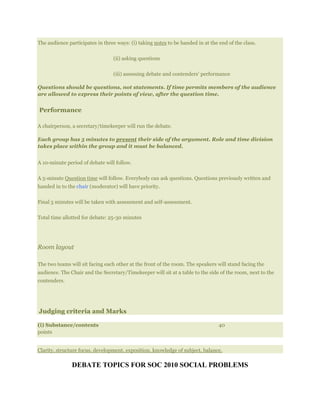
The audience participates in three ways: (i) taking notes to be handed in at the end of the class.
(ii) asking questions
(iii) assessing debate and contenders’ performance
Questions should be questions, not statements. If time permits members of the audience
are allowed to express their points of view, after the question time.
Performance
A chairperson, a secretary/timekeeper will run the debate.
Each group has 5 minutes to present their side of the argument. Role and time division
takes place within the group and it must be balanced.
A 10-minute period of debate will follow.
A 5-minute Question time will follow. Everybody can ask questions. Questions previously written and
handed in to the chair (moderator) will have priority.
Final 5 minutes will be taken with assessment and self-assessment.
Total time allotted for debate: 25-30 minutes
Room layout
The two teams will sit facing each other at the front of the room. The speakers will stand facing the
audience. The Chair and the Secretary/Timekeeper will sit at a table to the side of the room, next to the
contenders.
Judging criteria and Marks
(i) Substance/contents 40
points
Clarity, structure focus, development, exposition, knowledge of subject, balance.
DEBATE TOPICS FOR SOC 2010 SOCIAL PROBLEMS
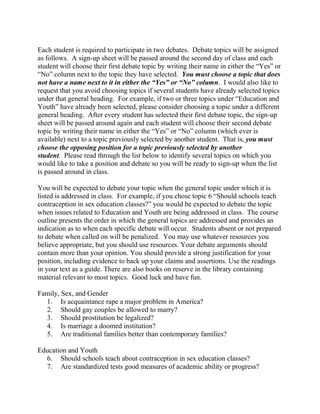
Each student is required to participate in two debates. Debate topics will be assigned
as follows. A sign-up sheet will be passed around the second day of class and each
student will choose their first debate topic by writing their name in either the ―Yes‖ or
―No‖ column next to the topic they have selected. You must choose a topic that does
not have a name next to it in either the “Yes” or “No” column. I would also like to
request that you avoid choosing topics if several students have already selected topics
under that general heading. For example, if two or three topics under ―Education and
Youth‖ have already been selected, please consider choosing a topic under a different
general heading. After every student has selected their first debate topic, the sign-up
sheet will be passed around again and each student will choose their second debate
topic by writing their name in either the ―Yes‖ or ―No‖ column (which ever is
available) next to a topic previously selected by another student. That is, you must
choose the opposing position for a topic previously selected by another
student. Please read through the list below to identify several topics on which you
would like to take a position and debate so you will be ready to sign-up when the list
is passed around in class.
You will be expected to debate your topic when the general topic under which it is
listed is addressed in class. For example, if you chose topic 6 ―Should schools teach
contraception in sex education classes?‖ you would be expected to debate the topic
when issues related to Education and Youth are being addressed in class. The course
outline presents the order in which the general topics are addressed and provides an
indication as to when each specific debate will occur. Students absent or not prepared
to debate when called on will be penalized. You may use whatever resources you
believe appropriate, but you should use resources. Your debate arguments should
contain more than your opinion. You should provide a strong justification for your
position, including evidence to back up your claims and assertions. Use the readings
in your text as a guide. There are also books on reserve in the library containing
material relevant to most topics. Good luck and have fun.
Family, Sex, and Gender
1. Is acquaintance rape a major problem in America?
2. Should gay couples be allowed to marry?
3. Should prostitution be legalized?
4. Is marriage a doomed institution?
5. Are traditional families better than contemporary families?
Education and Youth
6. Should schools teach about contraception in sex education classes?
7. Are standardized tests good measures of academic ability or progress?
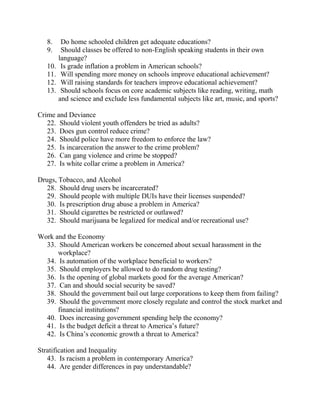
8. Do home schooled children get adequate educations?
9. Should classes be offered to non-English speaking students in their own
language?
10. Is grade inflation a problem in American schools?
11. Will spending more money on schools improve educational achievement?
12. Will raising standards for teachers improve educational achievement?
13. Should schools focus on core academic subjects like reading, writing, math
and science and exclude less fundamental subjects like art, music, and sports?
Crime and Deviance
22. Should violent youth offenders be tried as adults?
23. Does gun control reduce crime?
24. Should police have more freedom to enforce the law?
25. Is incarceration the answer to the crime problem?
26. Can gang violence and crime be stopped?
27. Is white collar crime a problem in America?
Drugs, Tobacco, and Alcohol
28. Should drug users be incarcerated?
29. Should people with multiple DUIs have their licenses suspended?
30. Is prescription drug abuse a problem in America?
31. Should cigarettes be restricted or outlawed?
32. Should marijuana be legalized for medical and/or recreational use?
Work and the Economy
33. Should American workers be concerned about sexual harassment in the
workplace?
34. Is automation of the workplace beneficial to workers?
35. Should employers be allowed to do random drug testing?
36. Is the opening of global markets good for the average American?
37. Can and should social security be saved?
38. Should the government bail out large corporations to keep them from failing?
39. Should the government more closely regulate and control the stock market and
financial institutions?
40. Does increasing government spending help the economy?
41. Is the budget deficit a threat to America’s future?
42. Is China’s economic growth a threat to America?
Stratification and Inequality
43. Is racism a problem in contemporary America?
44. Are gender differences in pay understandable?
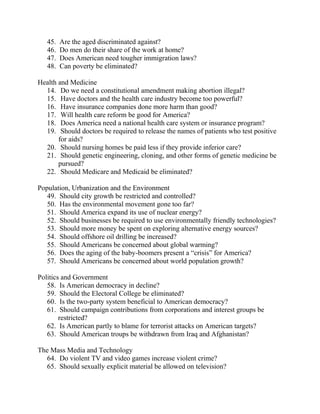
45. Are the aged discriminated against?
46. Do men do their share of the work at home?
47. Does American need tougher immigration laws?
48. Can poverty be eliminated?
Health and Medicine
14. Do we need a constitutional amendment making abortion illegal?
15. Have doctors and the health care industry become too powerful?
16. Have insurance companies done more harm than good?
17. Will health care reform be good for America?
18. Does America need a national health care system or insurance program?
19. Should doctors be required to release the names of patients who test positive
for aids?
20. Should nursing homes be paid less if they provide inferior care?
21. Should genetic engineering, cloning, and other forms of genetic medicine be
pursued?
22. Should Medicare and Medicaid be eliminated?
Population, Urbanization and the Environment
49. Should city growth be restricted and controlled?
50. Has the environmental movement gone too far?
51. Should America expand its use of nuclear energy?
52. Should businesses be required to use environmentally friendly technologies?
53. Should more money be spent on exploring alternative energy sources?
54. Should offshore oil drilling be increased?
55. Should Americans be concerned about global warming?
56. Does the aging of the baby-boomers present a ―crisis‖ for America?
57. Should Americans be concerned about world population growth?
Politics and Government
58. Is American democracy in decline?
59. Should the Electoral College be eliminated?
60. Is the two-party system beneficial to American democracy?
61. Should campaign contributions from corporations and interest groups be
restricted?
62. Is American partly to blame for terrorist attacks on American targets?
63. Should American troups be withdrawn from Iraq and Afghanistan?
The Mass Media and Technology
64. Do violent TV and video games increase violent crime?
65. Should sexually explicit material be allowed on television?
66. Do corporations and other powerful groups control what is on TV?
67. Should the internet be restricted and regulated?
68. Is technology making us more alienated, less sociable, and less human?
69. Should texting while driving be illegal?
70. Is Facebook changing our notions of privacy?
71. Does the media have a liberal bias?
Religion, Beliefs and Values
23. Has the separation of church and state gone too far?
24. Does religion create intolerance?
25. Should hate groups be allowed free speech?
26. Will restoring traditional religions improve morality and values?
27. Is America in moral decline?
The speech should hold the audience’s attention and be clearly structured
A wide range of structure and vocabulary should be used, the language well developed with minimal
errors.
(ii) Style and technique 30 points
Delivery and posture.
Verbal technique: effective use of rhetorical devices (e.g. metaphor, analogy, questions); non-verbal
technique (eye contact, gesture, volume ant tone of voice, pitch and rate).
(iii) Questions 20 points
Ability to deal with questions concisely and effectively.
(iv) General effectiveness 10 points
Ability to communicate thought and emotion and to achieve the overall objectives of the speech.
Remember: the debates are the speaking component of the summative test.

The two positions in a

  • 1.
    The two positionsin a debate are the affirmative and the negative. The affirmative or "pro" side in a debate argues in favor of something while the negative or "con" side argues against something. For instance, the affirmative stance on gun control would argue why firearm regulations are necessary for public safety while the negative stance on gun control would argue why controls wouldn't work to ensure the safety of the public. Presidential debates are held prior to every American Presidential election and have a long history in the United States. They date back to 1858 when Abraham Lincoln debated Stephen A. Douglas in seven different debates on slavery held in seven Illinois congressional districts. High school debates usually involve debating teams rather than one-on-one debating formats. Sometimes, student debaters are assigned a position rather than choosing their own position. Whether positions are chosen or assigned, proper debate strategy is essential for winning debates. Good debaters understand the importance of appealing not only to logic and reason but to the emotions of the audience. Argumentative strategies are important and debaters must anticipate the responses of the other debaters and the audience. An in-depth understanding of the topic and not just the main points is absolutely essential for a good debate. A good debater needs to prove not only why his or her position is the right one, but why the opponent’s position is the wrong one. Most debate formats include a cross-examination section where participants can pose questions to the other candidates. The strategic debating idea here is to try to expose weaknesses in your opponent's argument. Rebuttal speeches are those at the end of a debate. They offer both a summary of each debater's argument as well as conclusions drawn from the arguments of the other debaters. EBATE FORMATS Different styles of debate offer their own distinct format and focus. The most widely used format at the university level is Parliamentary Debate, although certain regions of the world have their own, slightly different version of it. IDEA predominantly employs the Karl Popper Debate format with secondary school students and the Parliamentary format with secondary and university students. New debate formats are created all the time; some of them stay, some of them do not. If you feel the following is not comprehensive or there are improvements you could make, please Contact Us. Online Debate Online debating formats are meant to allow debaters to engage in short debates using instant messaging or video conferencing software. These debates will have one debater representing the "affirmative" and another debater presenting the "negative". While online debates are not meant to replace face-to-face communication, they are a way to bridge geographic distances and to allow for discussion between people who might not otherwise have a chance to meet. IDEA expects the opportunities for debating on the Internet to improve as technology improves and believes this format will be dynamic and open to change. Starting in January 2012, IDEA will host video and text debating competitions – visit DEBATE NOW to sign up and join in. Team Debate Karl Popper Debate
  • 2.
    The Karl-Popper formatfocuses on relevant and often deeply divisive propositions, emphasizing the development of critical thinking skills and tolerance for differing viewpoints. Debaters work together in teams of three and must research both sides of each issue. Each team is given the opportunity to offer arguments and direct questions to the opposing team. Judges then offer constructive feedback, commenting on logical flaws, insufficient evidence or arguments that debaters may have overlooked. This format was developed for use in secondary school programs and competitions. It is popular in Central and Eastern Europe and in Russia. In Africa it is becoming increasingly popular in Uganda, Kenya, Rwanda, Zimbabwe, Liberia and Nigeria. It is the format employed at the annual IDEA Youth Forum – a two week debate event for secondary school students from all over the world. The distinguishing features of the format are: cross-examination, when four of the six debaters ask their opponents questions; and preparation time, when debaters can prepare before their speeches. This format emphasizes team work and is a good format for beginner debaters, because each speaker in this debate speaks once only and members of the team need to communicate with each other during the designated preparation time. Parliamentary Debate Many formats of debate are described as 'parliamentary'. This is really a catch-all term which simply means that they are loosely modeled on the practices of the British parliamentary system and other parliaments around the world that adopted those practices. In practice it means that the motion for debate is treated in much the same way as a legislative Bill placed before the UK House of Commons. The motion always stands in the name of the Government (also called 'the Proposition') and it is the job of the Opposition to demonstrate that the motion is either impractical or immoral. The distinguishing factor of parliamentary formats, of which there are many, is the use of Points of Information (PoI). These points allow debaters to interrupts a speaker to ask a question or offer information which favors their side of the debate. Both Proposition and Opposition speakers can offer PoIs, but only to the other side. It is not compulsory to accept a PoI, but in competitive debate speakers are penalized if they fail to take any. Usually the first and last sections of a speech are 'protected time' during which PoIs may not be offered. In many parliamentary formats the terminology of the House of Commons has also been adopted with the first proposition speaker being referred to as the Prime Minister and the first opposition speaker being known as the Leader of the Opposition. The chair or presiding adjudicator is usually referred to as Mister or Madam Speaker and all remarks are addressed to them not the other debaters. British Parliamentary (BP) This is the name of the format used for the World Universities Debating Championship and has, as a result, become the default format for many university societies, especially in the English speaking world. It is probably the most commonly used format in the World. In much the same way as many university societies debate in their native language as well as English, so they tend to use a regional or local format and also BP.
  • 3.
    Debates comprise eightspeakers: four speaking in favor of a motion and four against. Each side is made up of two teams of two individuals. They debate a motion (the idea to be discussed) which is usually framed with the wordingThis House Believes... or This House Would.... For example if the motion isThis House Would Support Assisted Suicide, it is the role of the Proposition (or 'Government') speakers to explain why assisted suicide is a good idea and the opposition should demonstrate that it is not. As a form of parliamentary debate, in BP the government should propose a course of action and support it with philosophical, practical and consequential arguments. The burden of proof is on the government, but the opposition must also demonstrate the strength of their arguments. Typically in BP, a motion is announced 15 minutes before the debate starts. Speeches are seven minutes in length, with the first and last minute protected (Points of Information cannot be offered in 'protected' time). The first proposition speaker is required to present a definition of the motion that places an idea in a real-world setting. Once a motion has been defined, all speakers are required to address the definition, not some other variant that might be easier for them. Legislative Debate Legislative Debate is based upon the notion of having representative student leaders consider some of the problems that actually confront lawmakers. In doing so, Legislative Debate provides unparalleled insight into the way legislation is drafted and establishes leadership and deliberation skills crucial to effective participation in democratic processes. Legislative Debate also offers a vehicle for teaching parliamentary procedure and helps students internalize the value of decision-making processes that draw on consensus building and majority rule. Lincoln-Douglas Debate In Lincoln-Douglas Debate, the motion is a statement, phrased as a sentence that focuses on an issue of philosophical or political concern and which will be analyzed from a moral perspective. Lincoln-Douglas Debate places primacy on the ability of debaters to make original, coherent and philosophically persuasive arguments on issues of ethics. Debaters should present a persuasive moral position that they can defend from criticism and use to argue against an opposing case, without falling into self- contradiction or denying the complexity of the issues at stake. Students should familiarize themselves with the work of major ethical philosophers and should inform their cases with real-world examples and analysis. Middle School Debate Fostering debate and speech activities on the middle school level is consistent with IDEA's commitment to empower young people as participants of the democratic processes. Middle school students can benefit uniquely from exposure to speech and debate. They are at an age, psychologically and socially, where they can make considerable strides in acquiring research competence, media and argument literacy, reading comprehension, evidence evaluation, and public speaking and civic skills. Finally, through cultivating middle school speech and debate activities, not only are young people and teachers empowered, but an appreciation of speech and debate is instilled in students who may well pursue it to higher levels. Mock Trial Mock Trial is an exercise in argumentation and legal procedure and the only educational trial format
  • 4.
    based on theInternational Criminal Court established by the Treaty of Rome. The IDEA Mock Trial hones both legal reasoning and courtroom technique, while it familiarizes participants with a vital arena of public debate. Teams representing the prosecution and defense take on the roles of all attorneys and witnesses. A judge, or judging panel, oversees the round, provides educational criticism and makes a decision based on each team's performance. Each case argued is an original scenario that the participants must master. Facts are presented through a variety of legal documents and through the testimony of witnesses. Although the underlying facts are the same, each round unfolds differently according to the actions, decisions and interactions of the participants. Teams contest the facts of the case through direct examination, cross-examination, re-direct and re-cross of both prosecution and defense witnesses. Cross-Examination (Policy) Debate Like other forms of debate, Cross-Examination Debate focuses on the core elements of a controversial issue. Cross-Examination Debate develops important skills, such as critical thinking, listening, argument construction, research, note-taking and advocacy skills. Cross-Examination Debate is distinct from other formats (with the exception of two team Parliamentary Debate) in is use of a two person team, along with an emphasis on cross-examination between constructive speeches. While specific practices vary, Cross Examination Debate typically rewards intensive use of evidence and is more focused on content than delivery. Public Forum Debate Public Forum Debate offers students a unique opportunity to develop on-their-feet critical thinking skills by situating them in contexts not unlike US political talk shows. Public Forum debaters must anticipate numerous contingencies in planning their cases and must learn to adapt to rapidly changing circumstances as discussions progress. Public Forum's open-ended cross-examination format encourages the development of unique rhetorical strategies. Public Forum debates should be transparent to lay audiences, while providing students with real-world public speaking skills, through the discussion of contentious ideas. Public Debate IDEA believes that debate should not be limited to the setting of competitive debate tournaments in which only students take part, but instead feels that debate should operate within a broader context of public participation and should embrace different segments of a community. IDEA strongly encourages its members to promote and support public access to debate through the organization of public debates and by inviting the public to debate competitions. Speech Events Limited Preparation Events (i) Impromptu Speaking In Impromptu Speaking, students learn to prepare and deliver an original speech immediately and without preparation. Impromptu Speaking topics range from the meaning of proverbs and abstract words to the significance of events and quotations by famous speakers. (ii) Extemporaneous Speaking In Extemporaneous Speaking, students must prepare and deliver an original speech on a current event,
  • 5.
    with a limitedamount of preparation time. Extemporaneous topics are presented in the form of questions and contestants are expected to take a position on the question as well as to justify their stance. Platform Speaking Events (i) Informative Speaking In Informative Speaking, students prepare and deliver an original speech whose primary purpose is to inform or educate the audience. The speech should describe, clarify, illustrate or define an object, idea, concept or process. (ii) Persuasive Speaking/Original Oratory In Persuasive Speaking/Original Oratory, students prepare and deliver an original speech designed to inspire, reinforce or change the beliefs, attitudes, values or actions of the audience. Interpretative Events (i) Prose Interpretation In Prose Interpretation, students must select, analyze and share a cutting from literature (other than verse or plays) through the art of reading aloud. Prose Interpretation expresses thought through language recorded in sentences and paragraphs. Prose Interpretation includes fiction (short stories, novels) and non-fiction (articles, essays, journals, biographies). An effective Prose Interpretation consists of a selection or selections of materials with literary merit. (ii) Poetry Interpretation In Poetry Interpretation, students must find, analyze and share a cutting or rhyme through the art of reading aloud. Poetry selections express ideas, experiences or emotions through the creative arrangement of words according to their sound, rhythm and meaning. An effective Poetry Interpretation consists of a selection or selections of material with literary merit. (iii) Dramatic Interpretation In Dramatic Interpretation, a student must select, analyze and share a cutting from a play through the art of reading aloud. A Dramatic Interpretation consists of a selection or selections of literary merit that may be drawn from more than one source. (iv) Duo Dramatic Interpretation In Duo Dramatic Interpretation, two students must find, analyze and share a cutting from a play through the art of reading aloud. A Duo Dramatic Interpretation can be either humorous or serious. The cutting should represent the portrayal of one or more characters presented by the two individuals. (v) Programmed Oral Interpretation In Programmed Oral Interpretation students must find, analyze and share a program of thematically linked selections through the art of reading aloud. The selections should be of literary merit, and must be chosen from at least two of the three recognized genres (prose/poetry/drama). 'Different genres' here means that the material must appear in separate pieces of literature and that, for example, a poem included in a short story that appears only in that short story does not constitute a poetry genre.
  • 6.
    The First Stepsto Debate in English --Aiming at Cultivating Practical Ability-- (in Japanese) Masatsugu Higuchi English Teacher, Ikeda Senior High School Attached to Osaka Kyoiku University (E-mail) higuchim@cc.osaka-kyoiku.ac.jp (Home Page) http://www.ikeda.osaka-kyoiku.ac.jp/~higuchim/ 1. Introduction Debate class is fun. Doing debate in English is not so difficult. Having your own opinion and expressing it in class is enjoyable. This is one of those abilities which Japanese lack most. If Japanese are to play a leading part in the world, we must cultivate the abilities which are needed in debate. You don't need to take things too seriously. Let's begin step by step. This is a report about when I let my students debate in English for the first time. 2. Why I Began Debate Lesson Several years ago, Japan's Ministry of Education, Science and Culture introduced three courses to choose from in English education: Oral Communication (A) (situational conversation), Oral Communication(B) (aural competence), Oral Communication (C) (discussion and debate). We officially chose OC(B) and we had two lessons a week for each class of first-year-students. One lesson was an aural-competence-oriented lesson
  • 7.
    taught by aJapanese teacher. The other lesson was the one I taught with a Canadian assistant-teacher. At first we had the students make speeches, four students per class, but some of them only read their manuscript or spoke to the wall of the room without looking at other students. I would like to improve these results. After the Great Hanshin Earthquake people of Japan have realized the need to cope with the critical conditions quickly. In the field of English education the same is the case. We must teach the students how to make themselves understood properly when they speak English. To develop such skill I think debate is effective, thus I began debate class in the following semester. 3. Actual Procedure in Debate Class a. Choice of the Proposition (I called Topic in the class.) In choosing the topic of the debate, it is recommendable to choose one which is familiar to the students, and on which the students are divided evenly in their opinions. And we need to take care that easier topics come first. In my class, we chose these topics. The first time : Dogs are better than cats. The second time : Students of our school should wear school uniforms. (By the way our students wear plain clothes.) The third time : Students should have to go to high school in their neighborhood. b. Separating the class into Affirmative and Negative I divided each class into six groups, seven or eight students in each group, and made three pro groups and three con groups. Sometimes I asked the leader of each group which side they wanted to choose, and I had the group which wanted to take the pro side take the opposite side and vice versa. We must have the students realize that in debate which side they take has nothing to do with their personal opinions.
  • 8.
    c. Brainstorming After Idecided which side the students are going to take, I had them think of the strong points for their side and also those of their opponents. This was done not only so they could gather the reasons behind an affirmative or negative position, but also they could predict the speeches of the other side. Note: In doing this, don't let the students worry about the strength of their opinions. Let them think of as many points as possible. This is really brainstorming. When there were enough strong points for the members of their group, I had the students put the points in order according to the degree of their strength, and had them decide who would say which point and think about how they would rebut the speeches of the other side. These activities I did in the first period. In the next period, we did the actual debate. d. Actual Debate Though there are many ways of doing debate, I chose the most traditional one. The students spoke in the following order; 1) Constructive Speech of the pro side. (I called this "Build" in the class.) 2) Rebuttal Speech of the con side. (I called this "Attack" in the class.) 3) Constructive Speech of the con side. 4) Rebuttal Speech of the pro side. This is one cycle. We repeated this cycle six or seven times until all the members said their opinions. Please be sure to have the different persons say the four speeches above. The students had to decide their speaking order. In the first period, I gave them 30 seconds for the constructive speech and 15 seconds for the rebuttal . In the second period I gave 1 minute, 30 seconds respectively and in the third period, 2 minutes, 1 minute. You may feel that 30 seconds is really long. You must prepare a lot when you are going to give a 2- minute speech. The fundamental form of speeches.
  • 9.
    1) Introduction (Student'sopinion.) 2) Body (Students must say why they think so. It is preferable they say it in connection with their own experience.) 3) Conclusion (Student's opinion, again in connection with the proposition of their side.) I decided which two groups would start the debate first by doing some quizzes. Our ALT asked some questions of the chief students of each group. The groups who could answer the question correctly didn't have to do the debate at that time. The last two groups had to do the debate on the spot. The rest of the class should write the points of each speech on the record sheet (chart 1) while listening to the speeches. e. Evaluation of the Debate When the debate is over, the rest of the class should decide which group was more persuasive and write it on the record sheet. At the same time I asked the students to raise their hand to show which side they thought won. The ALT and I also evaluate the students' speeches on a scale of 5. Chart 2 is the record sheet on which our ALT evaluated the students' speeches and wrote some comments. We evaluated the students' speeches not so strictly because they were doing debate for the first time. 4. Some Difficult Points The point the con side should realize is they don't have to prove the opposite of the proposition. All they have to do is prove the proposition is not correct. For example, in the first debate, the con side could say, "Both dogs and cats are animals. We can't say which is better." They didn't have to prove "Cats are better than dogs." In this sense, the pro side is harder than the con side. They must prove the proposition is correct. 5. Conclusion In this way, we finished one cycle of the debate in 4 periods. a. The announcement of the proposition, deciding the sides, brainstorming ---
  • 10.
    1 period b. Theactual debate --- 3 periods What I found in the debate lesson was we could always see things from both sides. We could say something reasonable from both sides. When we took the side regardless of our own opinion, we realized that all the more. Debate is an intellectual game in which you must think of what you should say to persuade others and how you could rebut the other's opinion. While I was doing the model debate with the ALT, I felt I was experiencing the ways of thinking of native speakers of English. I'd like to do debate lessons in my classes as often as possible from now on. 6. References * Matsumoto, S., (1996). Debate Makes Your Brain Better. Kodansha. * Jinnbo, S., (1995). Hello, there! Oral Communication C. Tokyo Shoseki. * Monbusho (The Ministry of Education, Science, and Culture) (1993). The Guidelines for Study in Senior High School. Kyoiku Shuppan. * Ishii, S., & Bowers, J.R. (1994). Speak out. Oral Communication C. Kirihara Shoten. Back to my Home Page 1. Introduce debates by producing the rubric that you will be using to grade them. For a sample rubric, please see related sites at the bottom of this page. 2. A few weeks before the debate(s), give students the topic(s) to be covered. 3. Have students give you an ordered list showing in which debates they prefer to participate in order of preference. 4. From these lists make a debate group consisting of two students for each side of your debate: pro and con. 5. Before you hand the debate assignments out, explain that some students might be debating positions opposite to their beliefs. This is an important skill for them to learn.
  • 11.
    6. On theday of the debate, give students in the 'audience' a blank rubric. Explain that it is their job to judge the debate objectively. 7. Begin the debate with the pro side speaking first. Allow them 5-7 minutes of uninterrupted time to explain their position. Both members must participate equally. 8. Repeat step number seven for the con side. 9. Give both sides about three minutes to confer and prepare for their rebuttal. 10. Begin the rebuttals with the con side and give them three minutes to speak. Both members must participate equally. 11. Repeat step number 10 for the pro side. Tips: 1. Possibly give extra credit to the audience for well thought out questions. 2. Name ___________________________ Course ____ AHAP History HGHS 3. Criteria for Evaluating Debate Performance 4. Content 5. All of the information that you present should be accurate. You and your team should 6. demonstrate a comprehensive understanding of all aspects of the issue and should discuss all of the 7. points that best support your case. You should not be expected to bring up points that do damage to your 8. case - that is the job of the opposition. 9. Preparation 10. Each member of the team is responsible for giving a well-constructed opening statement of a
  • 12.
    11. minute toa minute and a half in length. During the course of the debate you should have facts at your 12. fingertips and counter-arguments ready to go depending on the performance of the opposition. You are 13. permitted to bring into the debate: note cards, outlines, books and any other helpful resource. You should 14. also be prepared to make a closing statement of approximately one minute that emphasizes your most 15. important points. 16. Argumentation 17. The arguments you make during the debate should be logical and demonstrate a clear analysis of 18. the issue. Appropriate emphasis should be given to your strongest arguments, but you shouldn’t harp on 19. only a single point for too long. Finally, you should demonstrate that you have heard and understand your 20. opponents arguments by meeting them head on and giving your best counter-arguments. 21. Presentation 22. You should speak confidently and with conviction. In order to do this, you must make eye contact 23. with the class and speak clearly. 24. Structure for the Debate 25. I. Opening Statements - Each team will be responsible for an opening statement which should take 26. about two minutes per team member and no more to deliver (1-1½ typed pages, double- spaced). The
  • 13.
    27. opening statementswill be collected by me two days before the debate and evaluated. The purpose of 28. these statements is to lay out the outline of your case in a persuasive manner; you should introduce each 29. of your strongest arguments. **A copy of each opening statement also must be given to the other side 30. two school days before the day of the debate. (If primary source documents will be used/quoted in your 31. presentation, a copy of each of those must be given to the opposing side as well two days before!)** 32. Make sure that each team member covers some other aspect of the team’s debate position [there should 33. NOT be a lot of repetitive points made by several team members—coordinate your presentations!!] 34. II. Hot Seat Round - After each opening statement, each side will have the opportunity to put the 35. person who just delivered the opening statement in the ―hot seat,‖ by asking a series of questions. First 36. the con side will ask question after question to the person who delivered the pro side’s first opening 37. statement for a period of up to two minutes. After the con side has delivered their first opening statement, the roles will be reversed and so on until everyone in the debate has delivered their opening 38. statement and then been cross examined. The side asking questions should not use this time to make 39. statements or argue; the person responding should answer the questions as directly as possible. The 40. purpose of the questions should be to perhaps expose a weakness in the opponent’s argument, or force the
  • 14.
    41. other sideto commit to a position that you will attack later. After this round you should know exactly 42. what your opponent is saying. In any case, if you are the questioner, this is not the time to drag out an 43. argument or refute everything the opposition says - that will come in the next round. 44. III. Rebuttal Round - Each team will be responsible for a three minute rebuttal. This is the time to: 45. first, defend against any attacks made on your team’s position and second, go on the offensive yourself. 46. Don’t hold anything back during this round - take advantage of all the weaknesses you have discovered in 47. your opponent’s argument during the previous rounds. DON’T just rehash the points you made in your 48. opening statements! 49. IV. Prep Time - Before the turn of someone on your team to speak, your team may take a ―time out‖ to 50. consult and plan what to say. Each team will have a cumulative total of three minutes of this prep time. 51. V. Closing Statements – Each team member on the PRO side will begin with a one minute closing 52. statement [this should be based on what the CON side presented in their arguments and rebuttal]. After 53. the PRO side has completed their closing statements, then the CON side will proceed. 54. VI. Questions from the class and the free for all round - At this point in the debate the class will be 55. given the opportunity to ask questions of whichever side they choose. A maximum of ten minutes will be
  • 15.
    56. provided. Oftentimes this part of the debate can be chaotic. I will be attempting to moderate the 57. proceedings. 58. Grading Policy for AHAP Debates 59. Your grade will be based on the following items: 60. 1. The Debate itself - according to the ―criteria for evaluating debate performance.‖ 61. 30% of the final grade. 62. 2. The Opening Statement - according to the criteria laid out above and to be collected the day 63. of the debate. 15% of the final grade. 64. 3. Questions for the opposition - On the day of the debate I will collect three to five questions 65. that you plan to ask the other side during the ―hot seat‖ round. These questions will be 66. evaluated based on how well designed they seem to gain useful information or penetrate to the 67. weakness of the other side’s argument. 5% of the final grade. 68. 4. Four to five page paper - The paper should have three parts: 69. a) an explanation of the arguments on one side of the issue 70. b) an explanation of the arguments on the other side of the issue 71. c) your opinion - which can be different from the side you were forced to take during the 72. debate. 73. This paper should contain a bibliography of at least five sources and end notes should be used as
  • 16.
    74. citations usedwhenever appropriate. The paper is due exactly one cycle after the debate takes place and 75. is worth 50% of the final grade for the debate.Cross-Examination Questions 76. Source: Breaking Down Barriers 77. 1. Ask Questions to Clarify Arguments 78. What was your second point? 79. How many people are you saying died during this period? 80. In your opinion who was most at fault for the war starting? 81. How are you saying these policies helped the economy? 82. 2. Ask Questions about the Quality of your Opponent’s Evidence 83. What was your source for that evidence? When was that book written? 84. Was that the historian’s opinion, or is s/he claiming this as fact? 85. 3. Ask Questions to get your Opponent to Admit their Case has Weaknesses 86. Are you aware of any plans at the time to fix this problem other than the plan that was 87. attempted? 88. Do you admit that on this occasion many people died? 89. Do you admit that this leader/country did anything to start the war? 90. 4. Ask Questions to Set Up Arguments 91. (For instance, if your opponent is arguing that Cromwell was bad for England because he 92. was intolerant of certain religious groups, you might proceed in the following manner). 93. So, are you arguing that religious intolerance is a bad thing? Does it then follow that if
  • 17.
    94. one governmentis more tolerant than another, that it is a better government from the 95. perspective of religious tolerance? 96. (After getting your opponent to admit this, wait until the rebuttal round to point out that 97. Cromwell’s government was more tolerant than all of his opponents had been, or were 98. planning to be). 99. 5. Maintain Control of the Cross-Examination 100. Allowing your opponent to answer your questions doesn’t mean your opponent is 101. entitled to give a full speech each time s/he answers. Just give him/her the needed time to 102. answer. Likewise, don’t make arguments yourself during your time to ask questions - you are 103. simply wasting the time you could be using to ask more questions, letting your opponent off the 104. hot seat and inviting them to answer your arguments in kind and score points.Debate Topics 105. 1. Resolved, that as President, Thomas Jefferson was faithful to his republican values. 106. 2. Resolved, Reconstruction was a ―splendid failure.‖ 107. 3. Resolved, Progressivism failed because it brought about reforms that were superficial at best, and 108. failed to seriously address issues of inequality in American society. 109. 4. Resolved, that the New Deal was an economic failure. 110. 5. Resolved, that Richard Nixon was America’s last liberal Republican President. 111. Course 1 PRO CON 112. 1 Brian N., Kamil S. Zaid Q., John W. Schw.
  • 18.
    113. 2 JohannaA., John C., Matt T. Alex B., Carly B., Alvina Z. 114. 3 Brian D., Ali G. Michael G., Matt H. 115. 4 Ariel H., Kathryn A., Nick L. Lindsey K., Andrew P., Jake R. 116. 5 Eric S., Jon O. Schw. Hikari S., Jacob T. 117. Course 4 PRO CON 118. 1 Habbah C., Rachel M., Noah S. Hannah G., Alec S., Jake S. 119. 2 Adam B., Katie B., Adrianna H. Amanda C., Gae Min L., Nick W. 120. 3 Danielle B., Tim F., Meredith L. Jake G., Colby L., Emma Z. 121. 4 Corrine B., Nathaniel H., Ben H. Joe H., Madelyn P., David T. 122. 5 Jason B., Rafi S. Stefan H., Zach R. 123. Course 7 PRO CON 124. 1 Anna A., Austin B., Will Q. Michael M., Teddy N., Michelle N. 125. 2 Annalie A., Sneha B. Connor G., Steven H., Ben W. 126. 3 Josh B., Michael B., Dan T. Olivia F., Andrew S., Ross T. 127. 4 Karl E., Meredith S., Max S. Cristiana A., Zach S., Russell S. 128. 5 Kelsey M., Ved P. Lindsay M., John S. General guidelines Topic must be researched. There will be two teams for each topic and each will defend an opposing view. Key elements: audibility, presence, rapport with other contenders and audience, a coherently presented argument and demonstration of the ability to think on one’s feet. Use of cue cards is encouraged but you should not rely too heavily on your notes. Reading and memorising of speeches are not allowed.
  • 19.
    The audience participatesin three ways: (i) taking notes to be handed in at the end of the class. (ii) asking questions (iii) assessing debate and contenders’ performance Questions should be questions, not statements. If time permits members of the audience are allowed to express their points of view, after the question time. Performance A chairperson, a secretary/timekeeper will run the debate. Each group has 5 minutes to present their side of the argument. Role and time division takes place within the group and it must be balanced. A 10-minute period of debate will follow. A 5-minute Question time will follow. Everybody can ask questions. Questions previously written and handed in to the chair (moderator) will have priority. Final 5 minutes will be taken with assessment and self-assessment. Total time allotted for debate: 25-30 minutes Room layout The two teams will sit facing each other at the front of the room. The speakers will stand facing the audience. The Chair and the Secretary/Timekeeper will sit at a table to the side of the room, next to the contenders. Judging criteria and Marks (i) Substance/contents 40 points Clarity, structure focus, development, exposition, knowledge of subject, balance. DEBATE TOPICS FOR SOC 2010 SOCIAL PROBLEMS
  • 20.
    Each student isrequired to participate in two debates. Debate topics will be assigned as follows. A sign-up sheet will be passed around the second day of class and each student will choose their first debate topic by writing their name in either the ―Yes‖ or ―No‖ column next to the topic they have selected. You must choose a topic that does not have a name next to it in either the “Yes” or “No” column. I would also like to request that you avoid choosing topics if several students have already selected topics under that general heading. For example, if two or three topics under ―Education and Youth‖ have already been selected, please consider choosing a topic under a different general heading. After every student has selected their first debate topic, the sign-up sheet will be passed around again and each student will choose their second debate topic by writing their name in either the ―Yes‖ or ―No‖ column (which ever is available) next to a topic previously selected by another student. That is, you must choose the opposing position for a topic previously selected by another student. Please read through the list below to identify several topics on which you would like to take a position and debate so you will be ready to sign-up when the list is passed around in class. You will be expected to debate your topic when the general topic under which it is listed is addressed in class. For example, if you chose topic 6 ―Should schools teach contraception in sex education classes?‖ you would be expected to debate the topic when issues related to Education and Youth are being addressed in class. The course outline presents the order in which the general topics are addressed and provides an indication as to when each specific debate will occur. Students absent or not prepared to debate when called on will be penalized. You may use whatever resources you believe appropriate, but you should use resources. Your debate arguments should contain more than your opinion. You should provide a strong justification for your position, including evidence to back up your claims and assertions. Use the readings in your text as a guide. There are also books on reserve in the library containing material relevant to most topics. Good luck and have fun. Family, Sex, and Gender 1. Is acquaintance rape a major problem in America? 2. Should gay couples be allowed to marry? 3. Should prostitution be legalized? 4. Is marriage a doomed institution? 5. Are traditional families better than contemporary families? Education and Youth 6. Should schools teach about contraception in sex education classes? 7. Are standardized tests good measures of academic ability or progress?
  • 21.
    8. Do homeschooled children get adequate educations? 9. Should classes be offered to non-English speaking students in their own language? 10. Is grade inflation a problem in American schools? 11. Will spending more money on schools improve educational achievement? 12. Will raising standards for teachers improve educational achievement? 13. Should schools focus on core academic subjects like reading, writing, math and science and exclude less fundamental subjects like art, music, and sports? Crime and Deviance 22. Should violent youth offenders be tried as adults? 23. Does gun control reduce crime? 24. Should police have more freedom to enforce the law? 25. Is incarceration the answer to the crime problem? 26. Can gang violence and crime be stopped? 27. Is white collar crime a problem in America? Drugs, Tobacco, and Alcohol 28. Should drug users be incarcerated? 29. Should people with multiple DUIs have their licenses suspended? 30. Is prescription drug abuse a problem in America? 31. Should cigarettes be restricted or outlawed? 32. Should marijuana be legalized for medical and/or recreational use? Work and the Economy 33. Should American workers be concerned about sexual harassment in the workplace? 34. Is automation of the workplace beneficial to workers? 35. Should employers be allowed to do random drug testing? 36. Is the opening of global markets good for the average American? 37. Can and should social security be saved? 38. Should the government bail out large corporations to keep them from failing? 39. Should the government more closely regulate and control the stock market and financial institutions? 40. Does increasing government spending help the economy? 41. Is the budget deficit a threat to America’s future? 42. Is China’s economic growth a threat to America? Stratification and Inequality 43. Is racism a problem in contemporary America? 44. Are gender differences in pay understandable?
  • 22.
    45. Are theaged discriminated against? 46. Do men do their share of the work at home? 47. Does American need tougher immigration laws? 48. Can poverty be eliminated? Health and Medicine 14. Do we need a constitutional amendment making abortion illegal? 15. Have doctors and the health care industry become too powerful? 16. Have insurance companies done more harm than good? 17. Will health care reform be good for America? 18. Does America need a national health care system or insurance program? 19. Should doctors be required to release the names of patients who test positive for aids? 20. Should nursing homes be paid less if they provide inferior care? 21. Should genetic engineering, cloning, and other forms of genetic medicine be pursued? 22. Should Medicare and Medicaid be eliminated? Population, Urbanization and the Environment 49. Should city growth be restricted and controlled? 50. Has the environmental movement gone too far? 51. Should America expand its use of nuclear energy? 52. Should businesses be required to use environmentally friendly technologies? 53. Should more money be spent on exploring alternative energy sources? 54. Should offshore oil drilling be increased? 55. Should Americans be concerned about global warming? 56. Does the aging of the baby-boomers present a ―crisis‖ for America? 57. Should Americans be concerned about world population growth? Politics and Government 58. Is American democracy in decline? 59. Should the Electoral College be eliminated? 60. Is the two-party system beneficial to American democracy? 61. Should campaign contributions from corporations and interest groups be restricted? 62. Is American partly to blame for terrorist attacks on American targets? 63. Should American troups be withdrawn from Iraq and Afghanistan? The Mass Media and Technology 64. Do violent TV and video games increase violent crime? 65. Should sexually explicit material be allowed on television?
  • 23.
    66. Do corporationsand other powerful groups control what is on TV? 67. Should the internet be restricted and regulated? 68. Is technology making us more alienated, less sociable, and less human? 69. Should texting while driving be illegal? 70. Is Facebook changing our notions of privacy? 71. Does the media have a liberal bias? Religion, Beliefs and Values 23. Has the separation of church and state gone too far? 24. Does religion create intolerance? 25. Should hate groups be allowed free speech? 26. Will restoring traditional religions improve morality and values? 27. Is America in moral decline? The speech should hold the audience’s attention and be clearly structured A wide range of structure and vocabulary should be used, the language well developed with minimal errors. (ii) Style and technique 30 points Delivery and posture. Verbal technique: effective use of rhetorical devices (e.g. metaphor, analogy, questions); non-verbal technique (eye contact, gesture, volume ant tone of voice, pitch and rate). (iii) Questions 20 points Ability to deal with questions concisely and effectively. (iv) General effectiveness 10 points Ability to communicate thought and emotion and to achieve the overall objectives of the speech.
  • 24.
    Remember: the debatesare the speaking component of the summative test.