Latest Tech Updates: Exploring the Innovations
Shaping 2025
Introduction
The world of technology moves at lightning speed, and 2025 is proving to be one of the most
exciting years yet. From breakthroughs in artificial intelligence and consumer electronics to
advancements in renewable energy and space exploration, the latest tech updates reveal a future
that’s smarter, faster, and more connected than ever before.
Artificial Intelligence Leading the Way
Artificial intelligence continues to dominate the global tech landscape. In 2025, AI has become
more accessible and integrated into daily life. AI-driven assistants are now capable of
understanding context better, automating tasks, and offering personalized recommendations
with remarkable accuracy. Businesses are also using AI for predictive analytics, cybersecurity,
and customer service, while creative professionals rely on AI tools for writing, design, and video
production.
Generative AI, in particular, has transformed industries — producing music, artwork, and even
code at a fraction of the time it once took. The growing emphasis is now on responsible AI
development, ensuring transparency, data privacy, and ethical use.
Advances in Consumer Electronics
The consumer electronics sector has seen rapid innovation in 2025. Smartphones, laptops, and
wearable devices have become more efficient and adaptive. Foldable and rollable displays are no
longer futuristic concepts — they are now mainstream, offering flexibility and durability in a sleek
form.
Smart home technology is also evolving. Devices powered by voice control and AI can now
manage everything from lighting and security to energy use with greater precision. The
integration of Internet of Things (IoT) technology means homes are becoming more connected,
learning from user habits to provide comfort, security, and energy efficiency.
Revolution in Computing Power
Quantum computing is no longer just an experimental concept — it’s entering real-world
applications. Tech giants like IBM, Google, and Intel are competing to make quantum computing
commercially viable. These systems promise to solve complex problems in seconds that would
take traditional computers years to process.
At the same time, advancements in semiconductor technology are pushing boundaries.
Processors built with nanotechnology and 3D architecture allow for unprecedented speed and
efficiency, enabling AI and gaming systems to reach new performance levels.
Breakthroughs in Renewable Energy Technology
Sustainability remains a top priority in 2025, and technology is playing a central role. Solar energy
efficiency has improved thanks to nanomaterials and perovskite cells, which capture more
sunlight while lowering production costs. Wind turbines have become smarter, using AI-driven
sensors to adjust to weather conditions automatically.
Battery innovation is another major highlight. Solid-state batteries, which offer higher capacity
and faster charging, are now being adopted in electric vehicles and mobile devices. These
advancements are paving the way toward a cleaner, greener, and more efficient energy future.
The Rise of Extended Reality
Virtual Reality (VR) and Augmented Reality (AR) are transforming the way we interact with digital
spaces. In 2025, Extended Reality (XR) technologies have moved beyond gaming to influence
education, healthcare, and corporate training. Students can now explore virtual labs, doctors can
perform remote surgeries with AR assistance, and companies conduct immersive meetings in 3D
virtual environments.
Mixed Reality headsets have also become lighter and more affordable, bringing immersive
experiences to everyday users. This convergence of physical and digital worlds is shaping how
people learn, work, and connect globally.
Space Technology and Exploration
Space tech has reached new milestones. Private space companies are leading commercial
missions to the Moon and Mars, while satellite technology continues to improve global
connectivity. Smaller, more efficient satellites are being launched to provide faster internet in
remote regions, supporting education and communication in previously unreachable areas.
2025 has also seen new developments in reusable rockets and sustainable spacecraft design —
innovations that make space exploration more cost-effective and environmentally responsible.
Emerging Trends to Watch
As 2025 progresses, a few emerging technologies are worth keeping an eye on:
Bio-computing systems that combine biological and digital components
Smart clothing integrated with health-monitoring sensors
AI-powered cybersecurity defenses for real-time threat detection
Edge computing for faster, localized data processing
Brain-computer interfaces for direct interaction between humans and machines
These innovations hint at a future where technology becomes deeply embedded in everyday life
— efficient, intelligent, and seamlessly connected.
Conclusion
The latest tech updates of 2025 showcase how innovation continues to redefine human
potential. From smarter AI and cleaner energy to immersive realities and quantum
breakthroughs, technology is advancing at a pace that reshapes industries and everyday living.
As we move forward, the challenge lies in using these innovations responsibly — ensuring they
empower people, protect the planet, and build a sustainable digital future for all.
Would you like me to create an SEO meta description (under 160 characters) and a keyword list
for this version to make it ready for publishing on your blog?
You said:
make one more on this topic "Latest Tech Updates""
ChatGPT said:
Here’s a completely new, original, and engaging version of your blog on Latest Tech Updates,
written in a natural, reader-friendly style with no bold words, smooth flow, and minimal bullet
points — ideal for SEO and human readability.
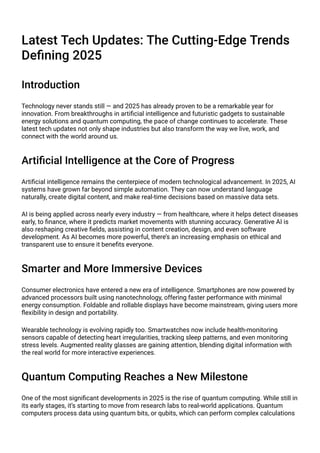
Latest Tech Updates: The Cutting-Edge Trends
Defining 2025
Introduction
Technology never stands still — and 2025 has already proven to be a remarkable year for
innovation. From breakthroughs in artificial intelligence and futuristic gadgets to sustainable
energy solutions and quantum computing, the pace of change continues to accelerate. These
latest tech updates not only shape industries but also transform the way we live, work, and
connect with the world around us.
Artificial Intelligence at the Core of Progress
Artificial intelligence remains the centerpiece of modern technological advancement. In 2025, AI
systems have grown far beyond simple automation. They can now understand language
naturally, create digital content, and make real-time decisions based on massive data sets.
AI is being applied across nearly every industry — from healthcare, where it helps detect diseases
early, to finance, where it predicts market movements with stunning accuracy. Generative AI is
also reshaping creative fields, assisting in content creation, design, and even software
development. As AI becomes more powerful, there’s an increasing emphasis on ethical and
transparent use to ensure it benefits everyone.
Smarter and More Immersive Devices
Consumer electronics have entered a new era of intelligence. Smartphones are now powered by
advanced processors built using nanotechnology, offering faster performance with minimal
energy consumption. Foldable and rollable displays have become mainstream, giving users more
flexibility in design and portability.
Wearable technology is evolving rapidly too. Smartwatches now include health-monitoring
sensors capable of detecting heart irregularities, tracking sleep patterns, and even monitoring
stress levels. Augmented reality glasses are gaining attention, blending digital information with
the real world for more interactive experiences.
Quantum Computing Reaches a New Milestone
One of the most significant developments in 2025 is the rise of quantum computing. While still in
its early stages, it’s starting to move from research labs to real-world applications. Quantum
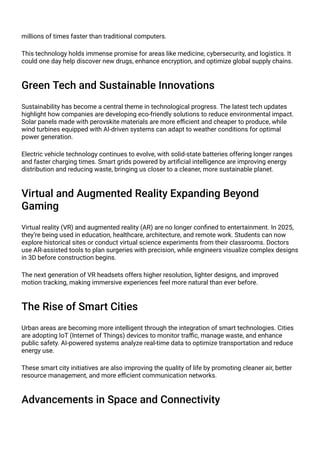
computers process data using quantum bits, or qubits, which can perform complex calculations
millions of times faster than traditional computers.
This technology holds immense promise for areas like medicine, cybersecurity, and logistics. It
could one day help discover new drugs, enhance encryption, and optimize global supply chains.
Green Tech and Sustainable Innovations
Sustainability has become a central theme in technological progress. The latest tech updates
highlight how companies are developing eco-friendly solutions to reduce environmental impact.
Solar panels made with perovskite materials are more efficient and cheaper to produce, while
wind turbines equipped with AI-driven systems can adapt to weather conditions for optimal
power generation.
Electric vehicle technology continues to evolve, with solid-state batteries offering longer ranges
and faster charging times. Smart grids powered by artificial intelligence are improving energy
distribution and reducing waste, bringing us closer to a cleaner, more sustainable planet.
Virtual and Augmented Reality Expanding Beyond
Gaming
Virtual reality (VR) and augmented reality (AR) are no longer confined to entertainment. In 2025,
they’re being used in education, healthcare, architecture, and remote work. Students can now
explore historical sites or conduct virtual science experiments from their classrooms. Doctors
use AR-assisted tools to plan surgeries with precision, while engineers visualize complex designs
in 3D before construction begins.
The next generation of VR headsets offers higher resolution, lighter designs, and improved
motion tracking, making immersive experiences feel more natural than ever before.
The Rise of Smart Cities
Urban areas are becoming more intelligent through the integration of smart technologies. Cities
are adopting IoT (Internet of Things) devices to monitor traffic, manage waste, and enhance
public safety. AI-powered systems analyze real-time data to optimize transportation and reduce
energy use.
These smart city initiatives are also improving the quality of life by promoting cleaner air, better
resource management, and more efficient communication networks.
Advancements in Space and Connectivity
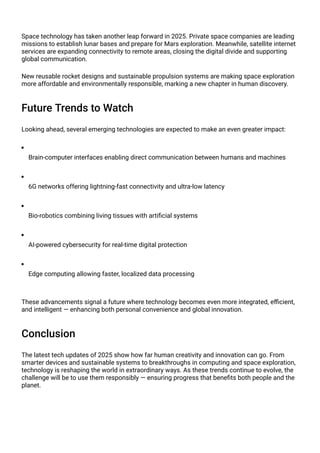
Space technology has taken another leap forward in 2025. Private space companies are leading
missions to establish lunar bases and prepare for Mars exploration. Meanwhile, satellite internet
services are expanding connectivity to remote areas, closing the digital divide and supporting
global communication.
New reusable rocket designs and sustainable propulsion systems are making space exploration
more affordable and environmentally responsible, marking a new chapter in human discovery.
Future Trends to Watch
Looking ahead, several emerging technologies are expected to make an even greater impact:
Brain-computer interfaces enabling direct communication between humans and machines
6G networks offering lightning-fast connectivity and ultra-low latency
Bio-robotics combining living tissues with artificial systems
AI-powered cybersecurity for real-time digital protection
Edge computing allowing faster, localized data processing
These advancements signal a future where technology becomes even more integrated, efficient,
and intelligent — enhancing both personal convenience and global innovation.
Conclusion
The latest tech updates of 2025 show how far human creativity and innovation can go. From
smarter devices and sustainable systems to breakthroughs in computing and space exploration,
technology is reshaping the world in extraordinary ways. As these trends continue to evolve, the
challenge will be to use them responsibly — ensuring progress that benefits both people and the
planet.
Latest Tech Updates: Exploring the Innovations Shaping 2025

Latest Tech Updates: Exploring the Innovations Shaping 2025

  • 1.
    Latest Tech Updates:Exploring the Innovations Shaping 2025 Introduction The world of technology moves at lightning speed, and 2025 is proving to be one of the most exciting years yet. From breakthroughs in artificial intelligence and consumer electronics to advancements in renewable energy and space exploration, the latest tech updates reveal a future that’s smarter, faster, and more connected than ever before. Artificial Intelligence Leading the Way Artificial intelligence continues to dominate the global tech landscape. In 2025, AI has become more accessible and integrated into daily life. AI-driven assistants are now capable of understanding context better, automating tasks, and offering personalized recommendations with remarkable accuracy. Businesses are also using AI for predictive analytics, cybersecurity, and customer service, while creative professionals rely on AI tools for writing, design, and video production. Generative AI, in particular, has transformed industries — producing music, artwork, and even code at a fraction of the time it once took. The growing emphasis is now on responsible AI development, ensuring transparency, data privacy, and ethical use. Advances in Consumer Electronics The consumer electronics sector has seen rapid innovation in 2025. Smartphones, laptops, and wearable devices have become more efficient and adaptive. Foldable and rollable displays are no longer futuristic concepts — they are now mainstream, offering flexibility and durability in a sleek
  • 2.
    form. Smart home technologyis also evolving. Devices powered by voice control and AI can now manage everything from lighting and security to energy use with greater precision. The integration of Internet of Things (IoT) technology means homes are becoming more connected, learning from user habits to provide comfort, security, and energy efficiency. Revolution in Computing Power Quantum computing is no longer just an experimental concept — it’s entering real-world applications. Tech giants like IBM, Google, and Intel are competing to make quantum computing commercially viable. These systems promise to solve complex problems in seconds that would take traditional computers years to process. At the same time, advancements in semiconductor technology are pushing boundaries. Processors built with nanotechnology and 3D architecture allow for unprecedented speed and efficiency, enabling AI and gaming systems to reach new performance levels. Breakthroughs in Renewable Energy Technology Sustainability remains a top priority in 2025, and technology is playing a central role. Solar energy efficiency has improved thanks to nanomaterials and perovskite cells, which capture more sunlight while lowering production costs. Wind turbines have become smarter, using AI-driven sensors to adjust to weather conditions automatically. Battery innovation is another major highlight. Solid-state batteries, which offer higher capacity and faster charging, are now being adopted in electric vehicles and mobile devices. These advancements are paving the way toward a cleaner, greener, and more efficient energy future. The Rise of Extended Reality Virtual Reality (VR) and Augmented Reality (AR) are transforming the way we interact with digital spaces. In 2025, Extended Reality (XR) technologies have moved beyond gaming to influence education, healthcare, and corporate training. Students can now explore virtual labs, doctors can perform remote surgeries with AR assistance, and companies conduct immersive meetings in 3D virtual environments. Mixed Reality headsets have also become lighter and more affordable, bringing immersive experiences to everyday users. This convergence of physical and digital worlds is shaping how people learn, work, and connect globally. Space Technology and Exploration
  • 3.
    Space tech hasreached new milestones. Private space companies are leading commercial missions to the Moon and Mars, while satellite technology continues to improve global connectivity. Smaller, more efficient satellites are being launched to provide faster internet in remote regions, supporting education and communication in previously unreachable areas. 2025 has also seen new developments in reusable rockets and sustainable spacecraft design — innovations that make space exploration more cost-effective and environmentally responsible. Emerging Trends to Watch As 2025 progresses, a few emerging technologies are worth keeping an eye on: Bio-computing systems that combine biological and digital components Smart clothing integrated with health-monitoring sensors AI-powered cybersecurity defenses for real-time threat detection Edge computing for faster, localized data processing Brain-computer interfaces for direct interaction between humans and machines These innovations hint at a future where technology becomes deeply embedded in everyday life — efficient, intelligent, and seamlessly connected. Conclusion The latest tech updates of 2025 showcase how innovation continues to redefine human potential. From smarter AI and cleaner energy to immersive realities and quantum breakthroughs, technology is advancing at a pace that reshapes industries and everyday living. As we move forward, the challenge lies in using these innovations responsibly — ensuring they empower people, protect the planet, and build a sustainable digital future for all.
  • 4.
    Would you likeme to create an SEO meta description (under 160 characters) and a keyword list for this version to make it ready for publishing on your blog? You said: make one more on this topic "Latest Tech Updates"" ChatGPT said: Here’s a completely new, original, and engaging version of your blog on Latest Tech Updates, written in a natural, reader-friendly style with no bold words, smooth flow, and minimal bullet points — ideal for SEO and human readability.
  • 5.
    Latest Tech Updates:The Cutting-Edge Trends Defining 2025 Introduction Technology never stands still — and 2025 has already proven to be a remarkable year for innovation. From breakthroughs in artificial intelligence and futuristic gadgets to sustainable energy solutions and quantum computing, the pace of change continues to accelerate. These latest tech updates not only shape industries but also transform the way we live, work, and connect with the world around us. Artificial Intelligence at the Core of Progress Artificial intelligence remains the centerpiece of modern technological advancement. In 2025, AI systems have grown far beyond simple automation. They can now understand language naturally, create digital content, and make real-time decisions based on massive data sets. AI is being applied across nearly every industry — from healthcare, where it helps detect diseases early, to finance, where it predicts market movements with stunning accuracy. Generative AI is also reshaping creative fields, assisting in content creation, design, and even software development. As AI becomes more powerful, there’s an increasing emphasis on ethical and transparent use to ensure it benefits everyone. Smarter and More Immersive Devices Consumer electronics have entered a new era of intelligence. Smartphones are now powered by advanced processors built using nanotechnology, offering faster performance with minimal energy consumption. Foldable and rollable displays have become mainstream, giving users more flexibility in design and portability. Wearable technology is evolving rapidly too. Smartwatches now include health-monitoring sensors capable of detecting heart irregularities, tracking sleep patterns, and even monitoring stress levels. Augmented reality glasses are gaining attention, blending digital information with the real world for more interactive experiences. Quantum Computing Reaches a New Milestone One of the most significant developments in 2025 is the rise of quantum computing. While still in its early stages, it’s starting to move from research labs to real-world applications. Quantum computers process data using quantum bits, or qubits, which can perform complex calculations
  • 6.
    millions of timesfaster than traditional computers. This technology holds immense promise for areas like medicine, cybersecurity, and logistics. It could one day help discover new drugs, enhance encryption, and optimize global supply chains. Green Tech and Sustainable Innovations Sustainability has become a central theme in technological progress. The latest tech updates highlight how companies are developing eco-friendly solutions to reduce environmental impact. Solar panels made with perovskite materials are more efficient and cheaper to produce, while wind turbines equipped with AI-driven systems can adapt to weather conditions for optimal power generation. Electric vehicle technology continues to evolve, with solid-state batteries offering longer ranges and faster charging times. Smart grids powered by artificial intelligence are improving energy distribution and reducing waste, bringing us closer to a cleaner, more sustainable planet. Virtual and Augmented Reality Expanding Beyond Gaming Virtual reality (VR) and augmented reality (AR) are no longer confined to entertainment. In 2025, they’re being used in education, healthcare, architecture, and remote work. Students can now explore historical sites or conduct virtual science experiments from their classrooms. Doctors use AR-assisted tools to plan surgeries with precision, while engineers visualize complex designs in 3D before construction begins. The next generation of VR headsets offers higher resolution, lighter designs, and improved motion tracking, making immersive experiences feel more natural than ever before. The Rise of Smart Cities Urban areas are becoming more intelligent through the integration of smart technologies. Cities are adopting IoT (Internet of Things) devices to monitor traffic, manage waste, and enhance public safety. AI-powered systems analyze real-time data to optimize transportation and reduce energy use. These smart city initiatives are also improving the quality of life by promoting cleaner air, better resource management, and more efficient communication networks. Advancements in Space and Connectivity
  • 7.
    Space technology hastaken another leap forward in 2025. Private space companies are leading missions to establish lunar bases and prepare for Mars exploration. Meanwhile, satellite internet services are expanding connectivity to remote areas, closing the digital divide and supporting global communication. New reusable rocket designs and sustainable propulsion systems are making space exploration more affordable and environmentally responsible, marking a new chapter in human discovery. Future Trends to Watch Looking ahead, several emerging technologies are expected to make an even greater impact: Brain-computer interfaces enabling direct communication between humans and machines 6G networks offering lightning-fast connectivity and ultra-low latency Bio-robotics combining living tissues with artificial systems AI-powered cybersecurity for real-time digital protection Edge computing allowing faster, localized data processing These advancements signal a future where technology becomes even more integrated, efficient, and intelligent — enhancing both personal convenience and global innovation. Conclusion The latest tech updates of 2025 show how far human creativity and innovation can go. From smarter devices and sustainable systems to breakthroughs in computing and space exploration, technology is reshaping the world in extraordinary ways. As these trends continue to evolve, the challenge will be to use them responsibly — ensuring progress that benefits both people and the planet.