Tiny
Garden
ToolkitEXERCISES FOR THE ENVIRONMENT
By Nourish The Planet
About The
Toolkit
Welcome, Educator!
With your leadership and the active
involvement of your 5-8 year olds, this toolkit
will spread tactical awareness of food deserts,
environmental impact and personal health
throughout our inner city communities.
Use the exercises below to involve your kids to
do great things!
Tiny Garden Toolkit
How to Use This Toolkit
This toolkit is comprised of carefully curated
exercises that your students will enjoy putting into
practice.
Exercises can be done in any order you decide.  We
encourage you to collaborate with your class and
create a plan together.
Tiny Garden Toolkit
"We do not inherit the earth
from our ancestors, we
borrow it from our
children."
N A T I V E A M E R I C A N P R O V E R B
Tiny Garden Toolkit
Let's
Explore
the
Exercises
Tiny Garden Toolkit
Tiny Garden Toolkit
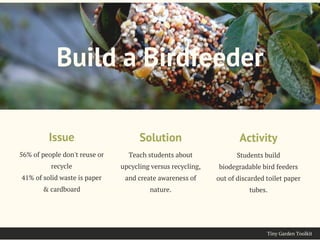
56% of people don't reuse or
recycle
41% of solid waste is paper
& cardboard
Issue
Build a Birdfeeder
Teach students about
upcycling versus recycling,
and create awareness of
nature.
Solution
Students build
biodegradable bird feeders
out of discarded toilet paper
tubes.
Activity
Tiny Garden Toolkit
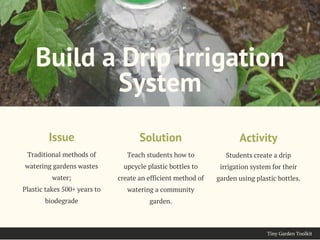
Traditional methods of
watering gardens wastes
water;
Plastic takes 500+ years to
biodegrade
Issue
Build a Drip Irrigation
System
Teach students how to
upcycle plastic bottles to
create an efficient method of
watering a community
garden.
Solution
Students create a drip
irrigation system for their
garden using plastic bottles.
Activity
Tiny Garden Toolkit
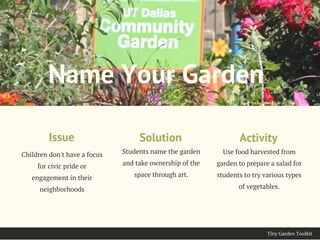
Children don't have a focus
for civic pride or
engagement in their
neighborhoods
Issue
Name Your Garden
Students name the garden
and take ownership of the
space through art.
Solution
Use food harvested from
garden to prepare a salad for
students to try various types
of vegetables.
Activity
Tiny Garden Toolkit
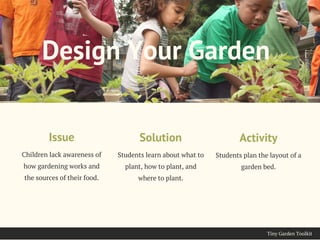
Children lack awareness of
how gardening works and
the sources of their food.
Issue
Design Your Garden
Students learn about what to
plant, how to plant, and
where to plant.
Solution
Students plan the layout of a
garden bed.
Activity
Tiny Garden Toolkit
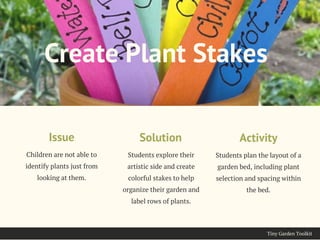
Children are not able to
identify plants just from
looking at them.
Issue
Create Plant Stakes
Students explore their
artistic side and create
colorful stakes to help
organize their garden and
label rows of plants.
Solution
Students plan the layout of a
garden bed, including plant
selection and spacing within
the bed.
Activity
Tiny Garden Toolkit
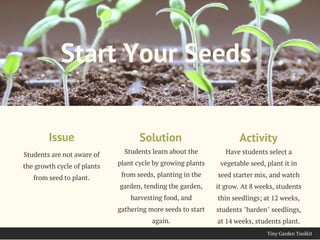
Students are not aware of
the growth cycle of plants
from seed to plant.
Issue
Start Your Seeds
Students learn about the
plant cycle by growing plants
from seeds, planting in the
garden, tending the garden,
harvesting food, and
gathering more seeds to start
again.
Solution
Have students select a
vegetable seed, plant it in
seed starter mix, and watch
it grow. At 8 weeks, students
thin seedlings; at 12 weeks,
students "harden" seedlings,
at 14 weeks, students plant.
Activity
Tiny Garden Toolkit
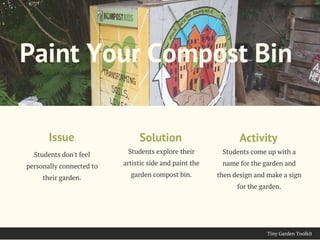
Students don't feel
personally connected to
their garden.
Issue
Paint Your Compost Bin
Students explore their
artistic side and paint the
garden compost bin.
Solution
Students come up with a
name for the garden and
then design and make a sign
for the garden.
Activity
Tiny Garden Toolkit
Students are not aware of
the nutrients needed in soil
to grow food, nor of how to
create nutrient rich soil from
food waste.
Issue
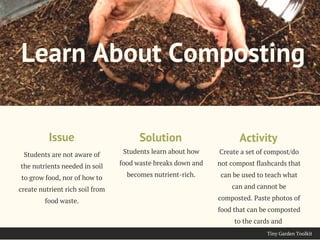
Learn About Composting
Students learn about how
food waste breaks down and
becomes nutrient-rich.
Solution
Create a set of compost/do
not compost flashcards that
can be used to teach what
can and cannot be
composted. Paste photos of
food that can be composted
to the cards and
Activity
Tiny Garden Toolkit
Children are not accustomed
to fresh food grown locally.
Issue
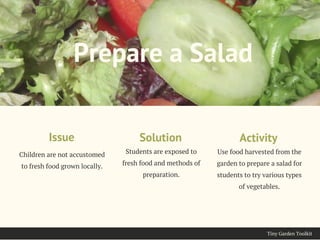
Prepare a Salad
Students are exposed to
fresh food and methods of
preparation.
Solution
Use food harvested from the
garden to prepare a salad for
students to try various types
of vegetables.
Activity
Toolkit Resources
Use this page to learn more about each of the
exercises in this toolkit.  In depth videos and
explanation resources will help your students
understand the benefits of these approaches.
Tiny Garden Toolkit
Resources
1.  Build a Bird Feeder
2.  Design a Drip Irrigation System
3.  Name Your Garden & Make a Sign
4.  Design Your Garden
5.  Create Plant Stakes
6.  Starting Your Seeds
7.  Paint Your Compost Bin
8.  Learn About Composting
9.  Prepare Your Salad
Tiny Garden Toolkit
Summary
We hope you've enjoyed your
journey with us as we work to
eliminate food deserts in inner
cities.
Please, send us your feedback and
think of your own exercises to
enhance this project.  Together we
can impact the environment directly
in our local communities.
Tiny Garden Toolkit

The Tiny Garden Toolkit

  • 1.
    Tiny Garden ToolkitEXERCISES FOR THEENVIRONMENT By Nourish The Planet
  • 2.
    About The Toolkit Welcome, Educator! Withyour leadership and the active involvement of your 5-8 year olds, this toolkit will spread tactical awareness of food deserts, environmental impact and personal health throughout our inner city communities. Use the exercises below to involve your kids to do great things! Tiny Garden Toolkit
  • 3.
    How to UseThis Toolkit This toolkit is comprised of carefully curated exercises that your students will enjoy putting into practice. Exercises can be done in any order you decide.  We encourage you to collaborate with your class and create a plan together. Tiny Garden Toolkit
  • 4.
    "We do notinherit the earth from our ancestors, we borrow it from our children." N A T I V E A M E R I C A N P R O V E R B Tiny Garden Toolkit
  • 5.
  • 6.
    Tiny Garden Toolkit 56%of people don't reuse or recycle 41% of solid waste is paper & cardboard Issue Build a Birdfeeder Teach students about upcycling versus recycling, and create awareness of nature. Solution Students build biodegradable bird feeders out of discarded toilet paper tubes. Activity
  • 7.
    Tiny Garden Toolkit Traditionalmethods of watering gardens wastes water; Plastic takes 500+ years to biodegrade Issue Build a Drip Irrigation System Teach students how to upcycle plastic bottles to create an efficient method of watering a community garden. Solution Students create a drip irrigation system for their garden using plastic bottles. Activity
  • 8.
    Tiny Garden Toolkit Childrendon't have a focus for civic pride or engagement in their neighborhoods Issue Name Your Garden Students name the garden and take ownership of the space through art. Solution Use food harvested from garden to prepare a salad for students to try various types of vegetables. Activity
  • 9.
    Tiny Garden Toolkit Childrenlack awareness of how gardening works and the sources of their food. Issue Design Your Garden Students learn about what to plant, how to plant, and where to plant. Solution Students plan the layout of a garden bed. Activity
  • 10.
    Tiny Garden Toolkit Childrenare not able to identify plants just from looking at them. Issue Create Plant Stakes Students explore their artistic side and create colorful stakes to help organize their garden and label rows of plants. Solution Students plan the layout of a garden bed, including plant selection and spacing within the bed. Activity
  • 11.
    Tiny Garden Toolkit Studentsare not aware of the growth cycle of plants from seed to plant. Issue Start Your Seeds Students learn about the plant cycle by growing plants from seeds, planting in the garden, tending the garden, harvesting food, and gathering more seeds to start again. Solution Have students select a vegetable seed, plant it in seed starter mix, and watch it grow. At 8 weeks, students thin seedlings; at 12 weeks, students "harden" seedlings, at 14 weeks, students plant. Activity
  • 12.
    Tiny Garden Toolkit Studentsdon't feel personally connected to their garden. Issue Paint Your Compost Bin Students explore their artistic side and paint the garden compost bin. Solution Students come up with a name for the garden and then design and make a sign for the garden. Activity
  • 13.
    Tiny Garden Toolkit Studentsare not aware of the nutrients needed in soil to grow food, nor of how to create nutrient rich soil from food waste. Issue Learn About Composting Students learn about how food waste breaks down and becomes nutrient-rich. Solution Create a set of compost/do not compost flashcards that can be used to teach what can and cannot be composted. Paste photos of food that can be composted to the cards and Activity
  • 14.
    Tiny Garden Toolkit Childrenare not accustomed to fresh food grown locally. Issue Prepare a Salad Students are exposed to fresh food and methods of preparation. Solution Use food harvested from the garden to prepare a salad for students to try various types of vegetables. Activity
  • 15.
    Toolkit Resources Use thispage to learn more about each of the exercises in this toolkit.  In depth videos and explanation resources will help your students understand the benefits of these approaches. Tiny Garden Toolkit
  • 16.
    Resources 1.  Build aBird Feeder 2.  Design a Drip Irrigation System 3.  Name Your Garden & Make a Sign 4.  Design Your Garden 5.  Create Plant Stakes 6.  Starting Your Seeds 7.  Paint Your Compost Bin 8.  Learn About Composting 9.  Prepare Your Salad Tiny Garden Toolkit
  • 17.
    Summary We hope you'veenjoyed your journey with us as we work to eliminate food deserts in inner cities. Please, send us your feedback and think of your own exercises to enhance this project.  Together we can impact the environment directly in our local communities. Tiny Garden Toolkit