- Srijan M
The Three
Revolutions
The
Enlightenment
01
The French
Revolution
02
The Industrial
Revolution
03
It is beyond the power of any man to make a
revolution. Neither can it be brought about on any
appointed date. It is brought about by special
environments; social and economic. The function of an
organised party is to utilise any such opportunity
offered by these circumstances.
Sociology is sometimes called the
child of the age of revolution. This
is because three revolutions paved
the way for the emergence of
sociology.
1) The Enlightenment
2) The French Revolution
3) The Industrial Revolution.
INTRODUCTION
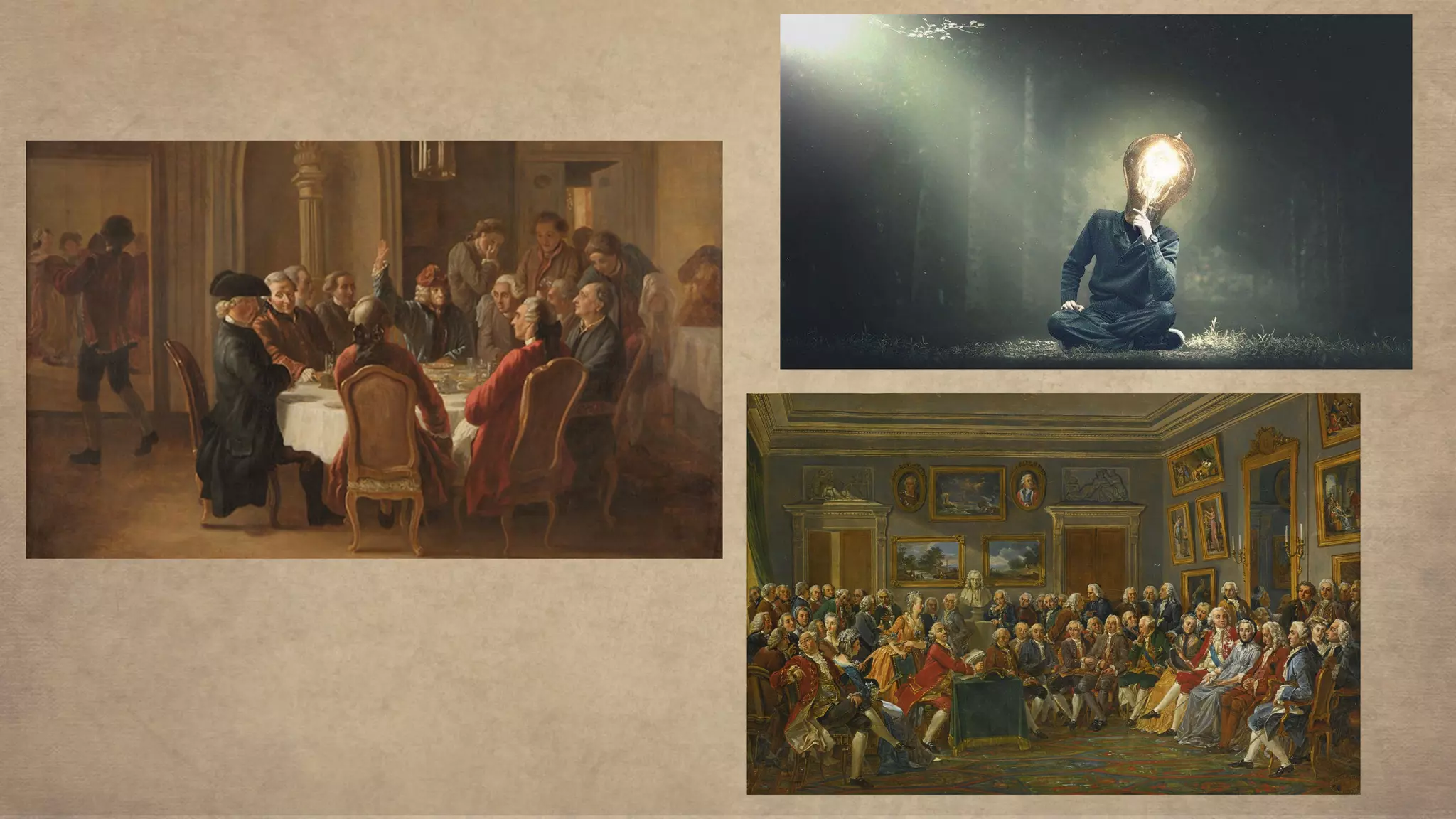
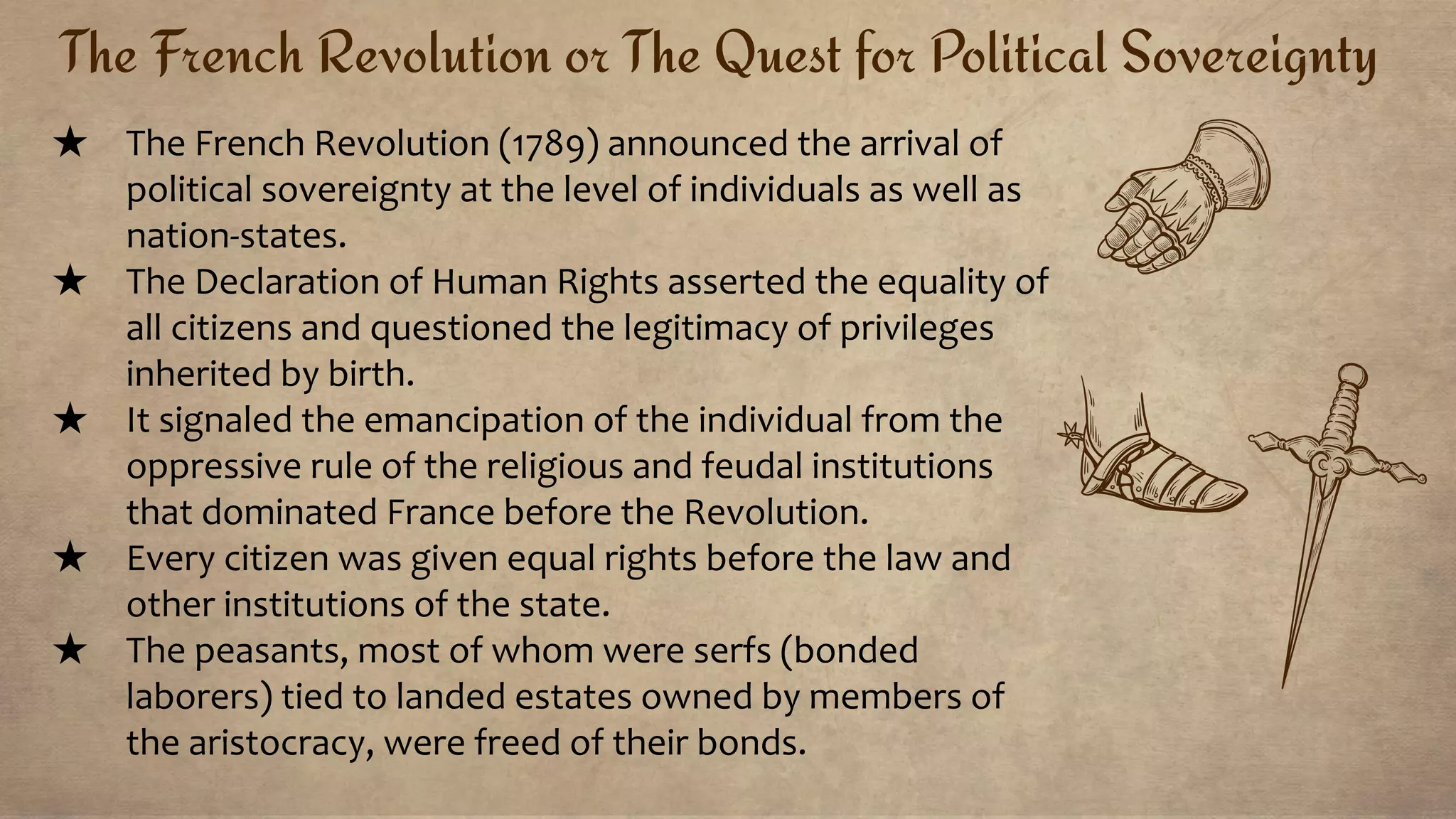
The Enlightenment or The Age of Reason
★ It is a period in the 17th and 18th centuries, in Western Europe when philosophers saw the
emergence of radically new ways of thinking about the world and rejected the supremacy
of religious doctrines, established reason as the means to truth, and the human being as
the sole bearer of reason.
★ The new ideologies established the human being at the center of the universe and rational
and lucid thoughts as the central feature of the human being.
★ The ability to think rationally and critically transformed the unique human being into both -
the producer and the user of all knowledge, making him/her 'The Knowing Subject'.
★ On the other hand, only people who could think and reason were considered fully human.
★ Being the handiwork of humans, civilization was amenable to rational analysis and thus,
comprehensible to other humans.
★ For reason to become the defining feature of the human world, it was necessary to
displace nature, religion, and the divine acts of gods from the central position they had in
earlier ways of understanding the world.
★ This means that the Enlightenment was made possible by, and in turn helped to materialize
the attitudes of mind that we refer to today as secular, scientific, and humanistic.
The French Revolution or The Quest for Political Sovereignty
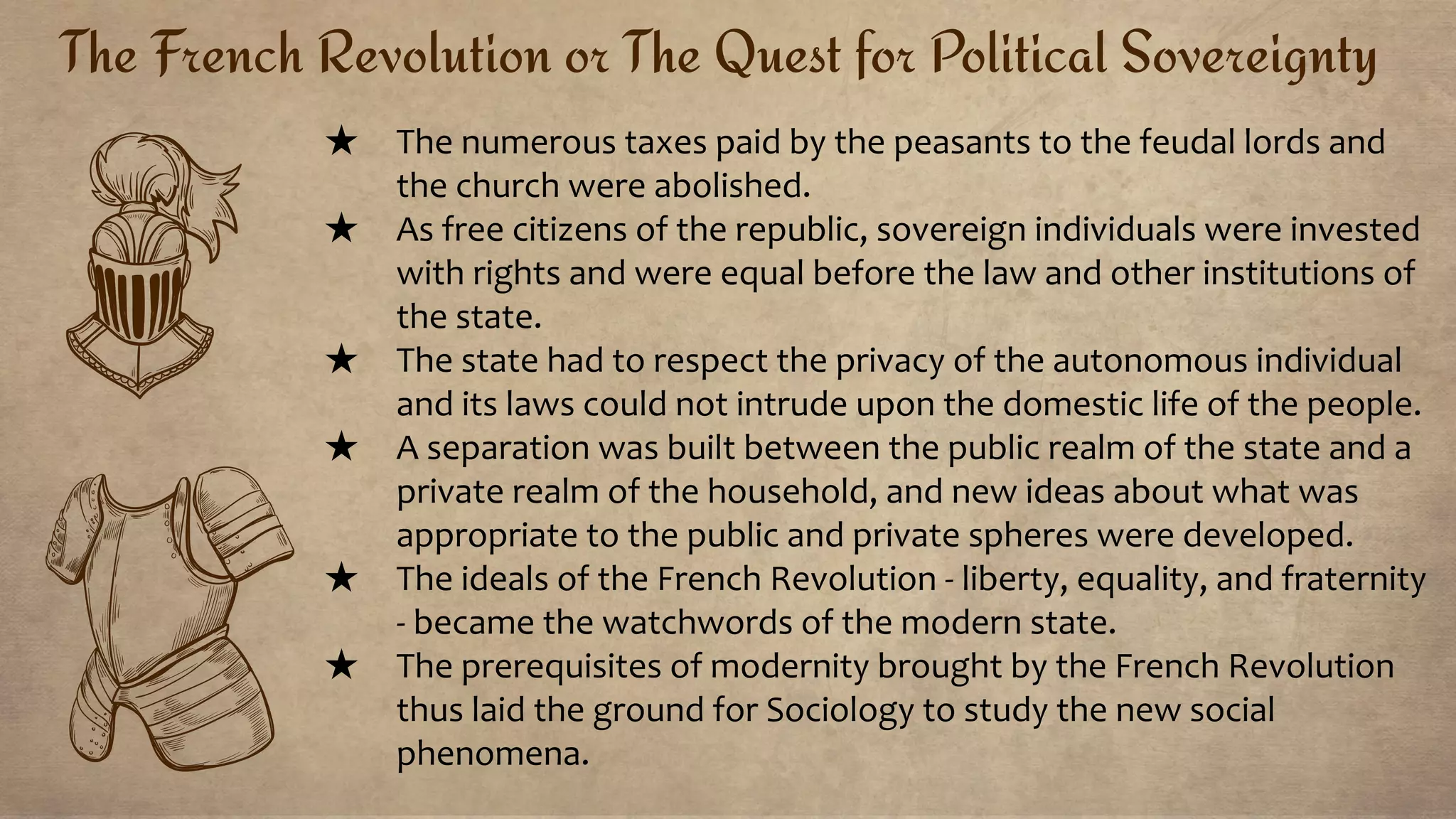
★ The French Revolution (1789) announced the arrival of
political sovereignty at the level of individuals as well as
nation-states.
★ The Declaration of Human Rights asserted the equality of
all citizens and questioned the legitimacy of privileges
inherited by birth.
★ It signaled the emancipation of the individual from the
oppressive rule of the religious and feudal institutions
that dominated France before the Revolution.
★ Every citizen was given equal rights before the law and
other institutions of the state.
★ The peasants, most of whom were serfs (bonded
laborers) tied to landed estates owned by members of
the aristocracy, were freed of their bonds.
The French Revolution or The Quest for Political Sovereignty
★ The numerous taxes paid by the peasants to the feudal lords and
the church were abolished.
★ As free citizens of the republic, sovereign individuals were invested
with rights and were equal before the law and other institutions of
the state.
★ The state had to respect the privacy of the autonomous individual
and its laws could not intrude upon the domestic life of the people.
★ A separation was built between the public realm of the state and a
private realm of the household, and new ideas about what was
appropriate to the public and private spheres were developed.
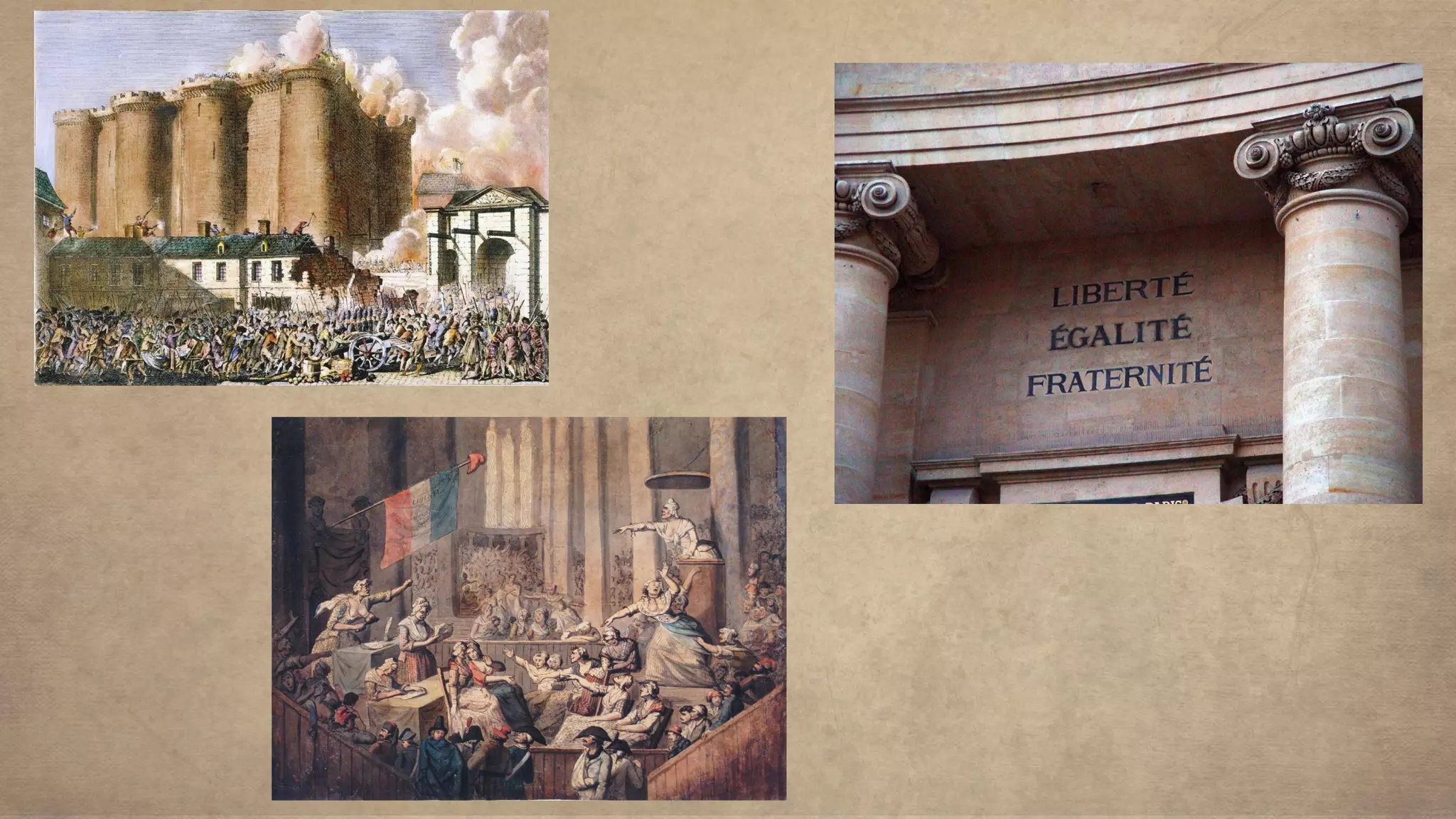
★ The ideals of the French Revolution - liberty, equality, and fraternity
- became the watchwords of the modern state.
★ The prerequisites of modernity brought by the French Revolution
thus laid the ground for Sociology to study the new social
phenomena.
The Industrial Revolution or The System
of Mass Manufacture
★ The foundations of contemporary industry were laid by the Industrial
Revolution which began in Britain in the late 18th and early 19th
centuries.
★ It had two major aspects:
★ (i) The first was the systematic application of science and technology to
industrial production, particularly of the invention of new machines and
the harnessing of new sources of power.
★ (ii) Secondly, it also evolved new ways of organizing labor and markets
on a scale larger than anything in the past.
★ The industrial revolution also evolved new ways of organizing labor and
markets.
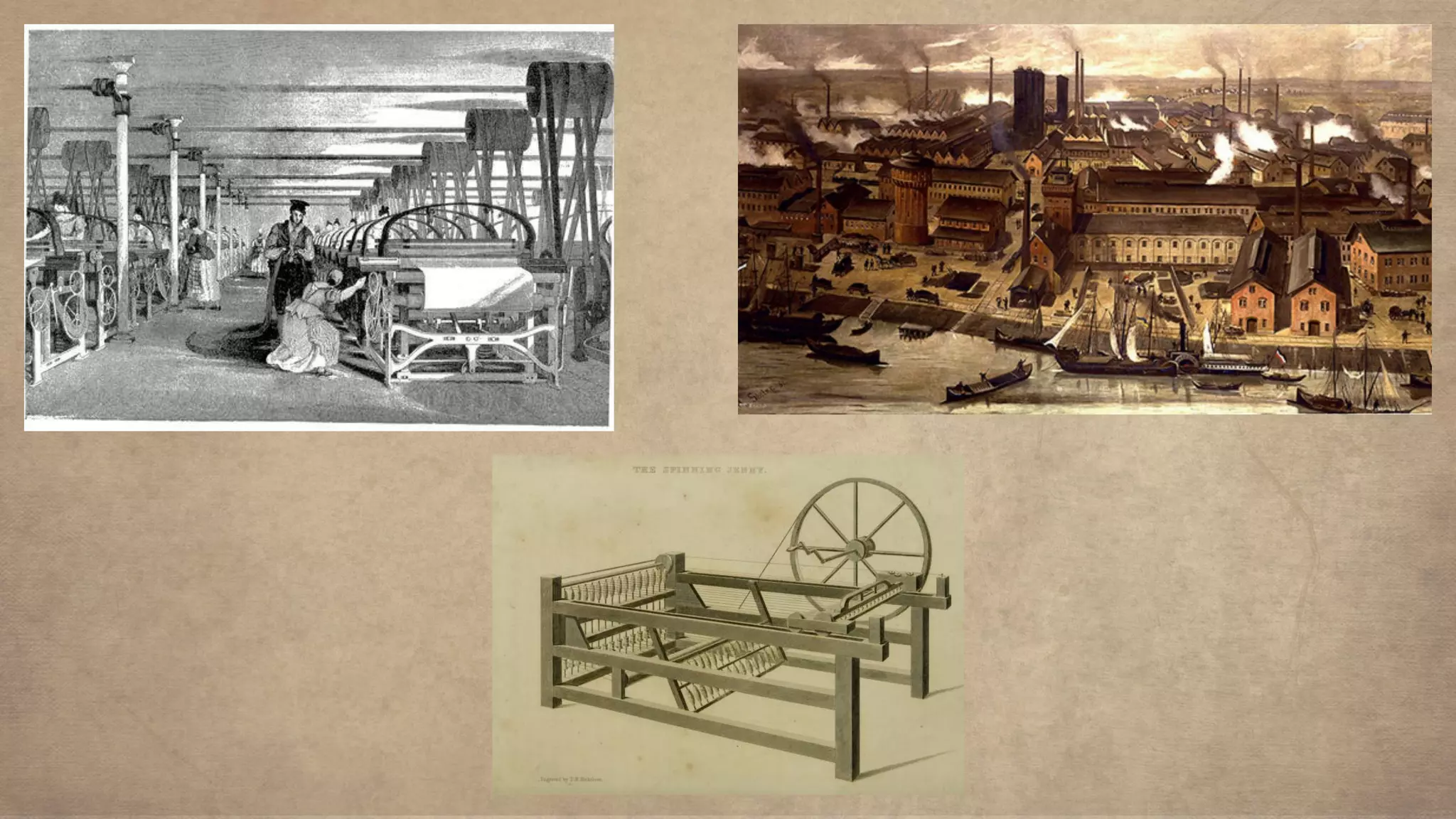
★ New machines like the 'Spinning Jenny' and new methods of obtaining
power (steam and hydraulic engines) facilitated the production process
and gave rise to the factory system and mass manufacture of goods.
The Industrial Revolution or The
System of Mass Manufacture
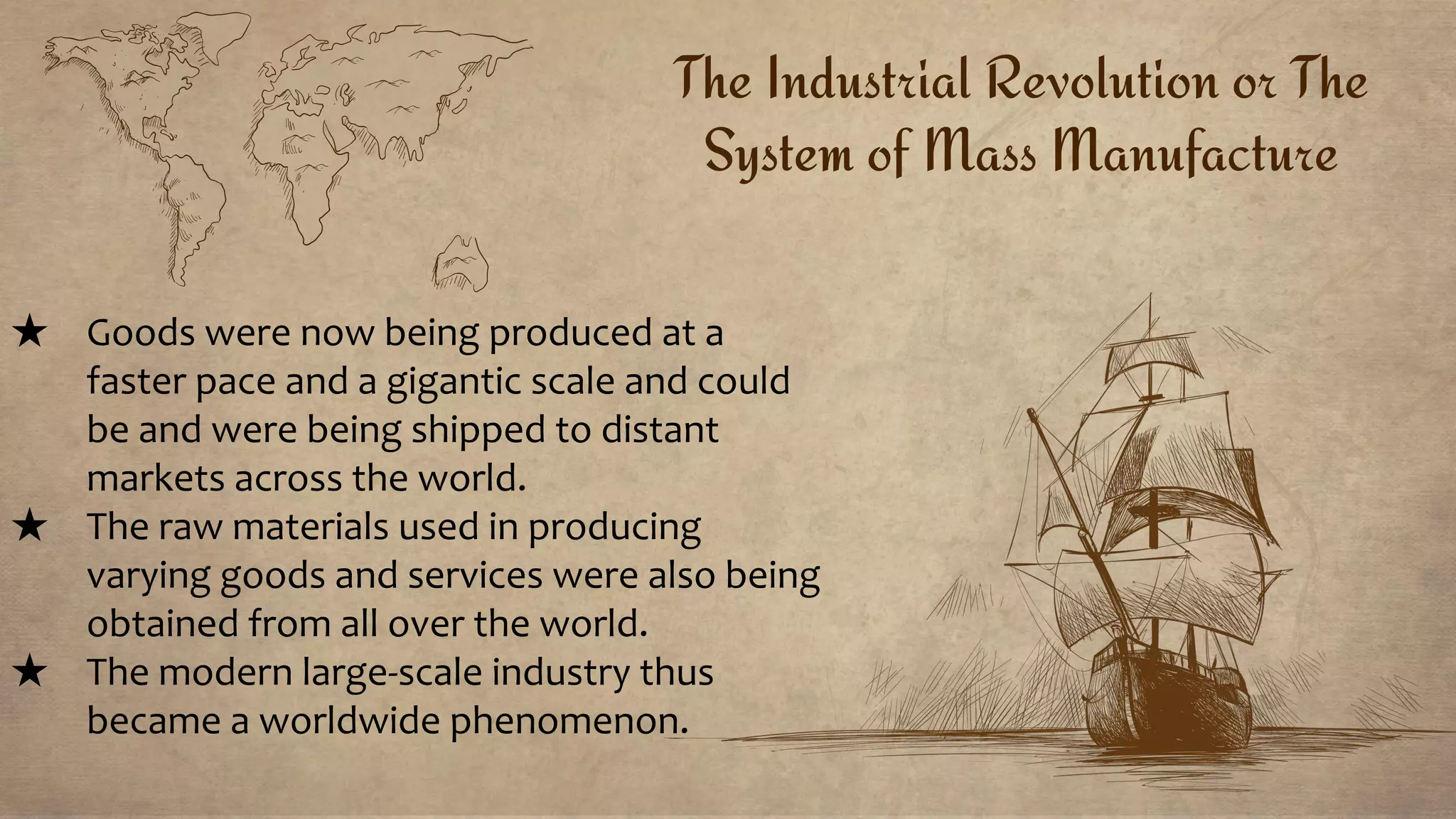
★ Goods were now being produced at a
faster pace and a gigantic scale and could
be and were being shipped to distant
markets across the world.
★ The raw materials used in producing
varying goods and services were also being
obtained from all over the world.
★ The modern large-scale industry thus
became a worldwide phenomenon.
The Industrial Revolution or The System
of Mass Manufacture
★ Changes in the production system also resulted in major changes in people's social life due
to large-scale industries bringing major changes in social life in terms of the settlement,
hazardous circumstances of working, unequal distributions of population, etc.
★ The factories were set up in urban areas and were manned by workers who were uprooted
from the rural areas and came to the cities in search of work.
★ The low wages at the factory meant that men, women, and even children had to work long
hours in perilous circumstances to eke out a living.
★ Modern industry enabled the urban to dominate over the rural.
★ Cities and towns became the dominant forms of human settlement. The rich and powerful
lived in the cities but the working class and poor lived in slums were formed at the outskirts
of the towns, amidst poverty and squalor.
★ Modern forms of governance, with the state assuming control of general 'development', in
fields like health, sanitation, crime control created the demand for new kinds of knowledge.
The Industrial Revolution or The System
of Mass Manufacture
★ The social sciences and particularly Sociology emerged partly as a
response to this need of the hour and was dubbed - 'science of the new
industrial society.
★ The industrial revolution laid down numerous conditions that were
responsible for the rise of sociology as a discipline.
★ Sociological thought was concerned with the scientific analysis of
developments in industrial society, the foundations of which were laid
down by the industrial revolution.
★ It studied trends in social behavior and people's feelings towards such
massive change and this became the basis for reflection on society.
★ Sociological theories thus became the result of self-reflection
CREDITS: This presentation template was created
by Slidesgo, including icons by Flaticon, and
infographics & images by Freepik

The Three Revolutions - Presentation.pdf

  • 1.
    - Srijan M TheThree Revolutions
  • 2.
  • 3.
    It is beyondthe power of any man to make a revolution. Neither can it be brought about on any appointed date. It is brought about by special environments; social and economic. The function of an organised party is to utilise any such opportunity offered by these circumstances.
  • 4.
    Sociology is sometimescalled the child of the age of revolution. This is because three revolutions paved the way for the emergence of sociology. 1) The Enlightenment 2) The French Revolution 3) The Industrial Revolution. INTRODUCTION
  • 5.
    The Enlightenment orThe Age of Reason ★ It is a period in the 17th and 18th centuries, in Western Europe when philosophers saw the emergence of radically new ways of thinking about the world and rejected the supremacy of religious doctrines, established reason as the means to truth, and the human being as the sole bearer of reason. ★ The new ideologies established the human being at the center of the universe and rational and lucid thoughts as the central feature of the human being. ★ The ability to think rationally and critically transformed the unique human being into both - the producer and the user of all knowledge, making him/her 'The Knowing Subject'. ★ On the other hand, only people who could think and reason were considered fully human. ★ Being the handiwork of humans, civilization was amenable to rational analysis and thus, comprehensible to other humans. ★ For reason to become the defining feature of the human world, it was necessary to displace nature, religion, and the divine acts of gods from the central position they had in earlier ways of understanding the world. ★ This means that the Enlightenment was made possible by, and in turn helped to materialize the attitudes of mind that we refer to today as secular, scientific, and humanistic.
  • 7.
    The French Revolutionor The Quest for Political Sovereignty ★ The French Revolution (1789) announced the arrival of political sovereignty at the level of individuals as well as nation-states. ★ The Declaration of Human Rights asserted the equality of all citizens and questioned the legitimacy of privileges inherited by birth. ★ It signaled the emancipation of the individual from the oppressive rule of the religious and feudal institutions that dominated France before the Revolution. ★ Every citizen was given equal rights before the law and other institutions of the state. ★ The peasants, most of whom were serfs (bonded laborers) tied to landed estates owned by members of the aristocracy, were freed of their bonds.
  • 8.
    The French Revolutionor The Quest for Political Sovereignty ★ The numerous taxes paid by the peasants to the feudal lords and the church were abolished. ★ As free citizens of the republic, sovereign individuals were invested with rights and were equal before the law and other institutions of the state. ★ The state had to respect the privacy of the autonomous individual and its laws could not intrude upon the domestic life of the people. ★ A separation was built between the public realm of the state and a private realm of the household, and new ideas about what was appropriate to the public and private spheres were developed. ★ The ideals of the French Revolution - liberty, equality, and fraternity - became the watchwords of the modern state. ★ The prerequisites of modernity brought by the French Revolution thus laid the ground for Sociology to study the new social phenomena.
  • 10.
    The Industrial Revolutionor The System of Mass Manufacture ★ The foundations of contemporary industry were laid by the Industrial Revolution which began in Britain in the late 18th and early 19th centuries. ★ It had two major aspects: ★ (i) The first was the systematic application of science and technology to industrial production, particularly of the invention of new machines and the harnessing of new sources of power. ★ (ii) Secondly, it also evolved new ways of organizing labor and markets on a scale larger than anything in the past. ★ The industrial revolution also evolved new ways of organizing labor and markets. ★ New machines like the 'Spinning Jenny' and new methods of obtaining power (steam and hydraulic engines) facilitated the production process and gave rise to the factory system and mass manufacture of goods.
  • 11.
    The Industrial Revolutionor The System of Mass Manufacture ★ Goods were now being produced at a faster pace and a gigantic scale and could be and were being shipped to distant markets across the world. ★ The raw materials used in producing varying goods and services were also being obtained from all over the world. ★ The modern large-scale industry thus became a worldwide phenomenon.
  • 12.
    The Industrial Revolutionor The System of Mass Manufacture ★ Changes in the production system also resulted in major changes in people's social life due to large-scale industries bringing major changes in social life in terms of the settlement, hazardous circumstances of working, unequal distributions of population, etc. ★ The factories were set up in urban areas and were manned by workers who were uprooted from the rural areas and came to the cities in search of work. ★ The low wages at the factory meant that men, women, and even children had to work long hours in perilous circumstances to eke out a living. ★ Modern industry enabled the urban to dominate over the rural. ★ Cities and towns became the dominant forms of human settlement. The rich and powerful lived in the cities but the working class and poor lived in slums were formed at the outskirts of the towns, amidst poverty and squalor. ★ Modern forms of governance, with the state assuming control of general 'development', in fields like health, sanitation, crime control created the demand for new kinds of knowledge.
  • 13.
    The Industrial Revolutionor The System of Mass Manufacture ★ The social sciences and particularly Sociology emerged partly as a response to this need of the hour and was dubbed - 'science of the new industrial society. ★ The industrial revolution laid down numerous conditions that were responsible for the rise of sociology as a discipline. ★ Sociological thought was concerned with the scientific analysis of developments in industrial society, the foundations of which were laid down by the industrial revolution. ★ It studied trends in social behavior and people's feelings towards such massive change and this became the basis for reflection on society. ★ Sociological theories thus became the result of self-reflection
  • 15.
    CREDITS: This presentationtemplate was created by Slidesgo, including icons by Flaticon, and infographics & images by Freepik