Page 1 
The Third Way 
Maintaining Independence 
Through Interdependence 
National Rural Health Association 
Critical Access Hospital Conference 
October 2, 2014 – Kansas City, MO
Page 2 
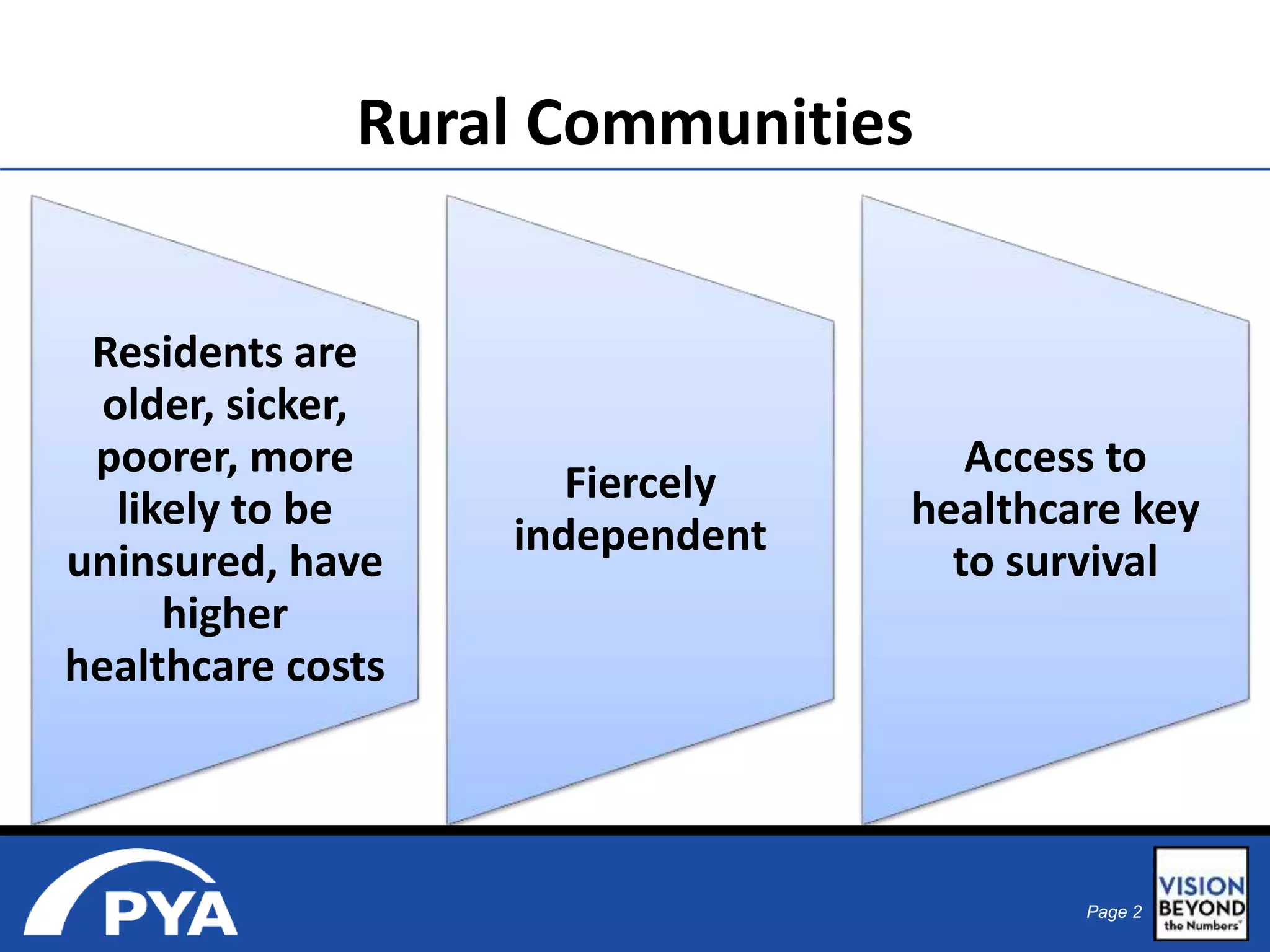
Rural Communities 
Residents are 
older, sicker, 
poorer, more 
likely to be 
uninsured, have 
higher 
healthcare costs 
Fiercely 
independent 
Access to 
healthcare key 
to survival
Page 3 
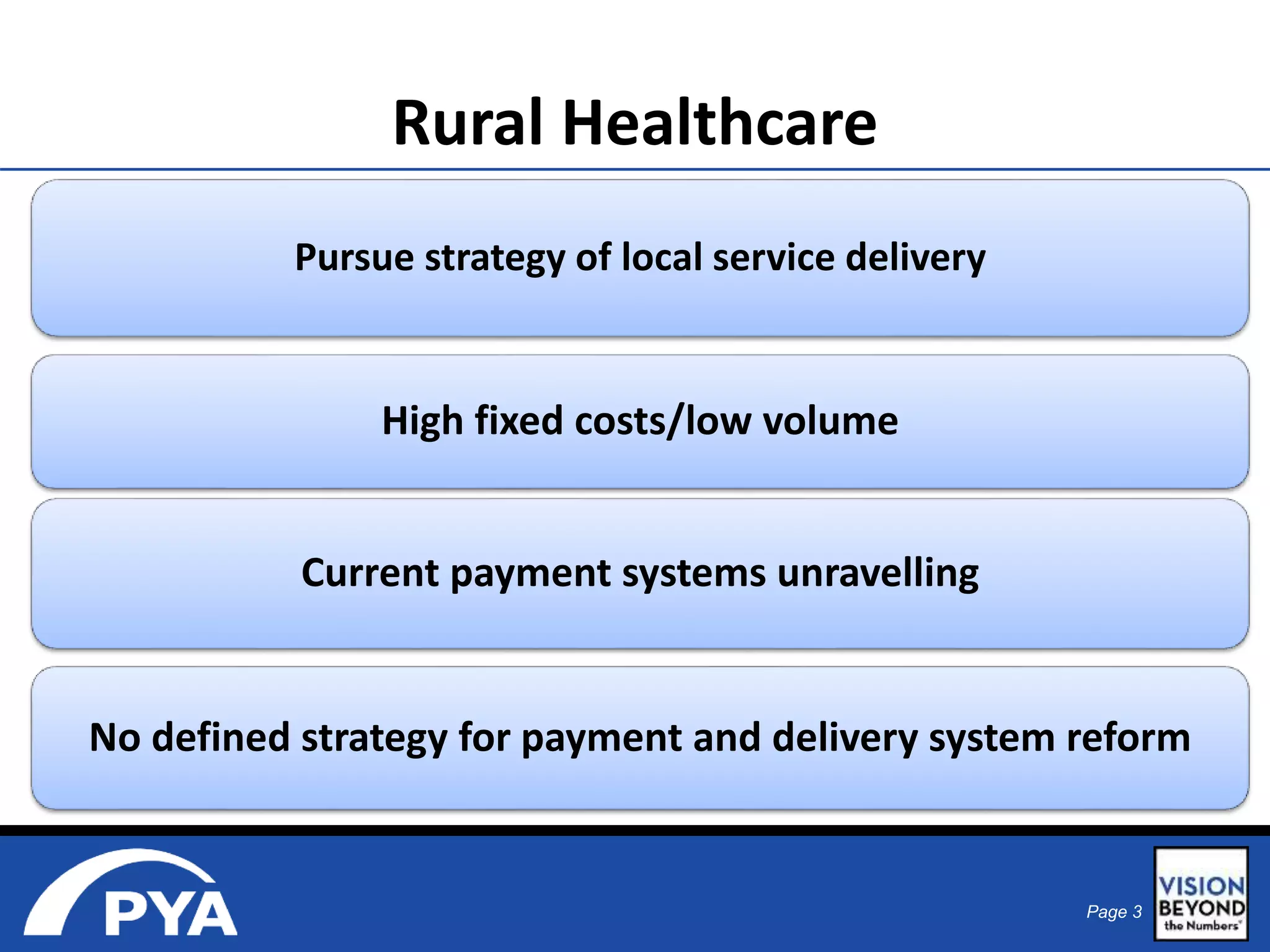
Rural Healthcare 
Pursue strategy of local service delivery 
High fixed costs/low volume 
Current payment systems unravelling 
No defined strategy for payment and delivery system reform
Page 4 
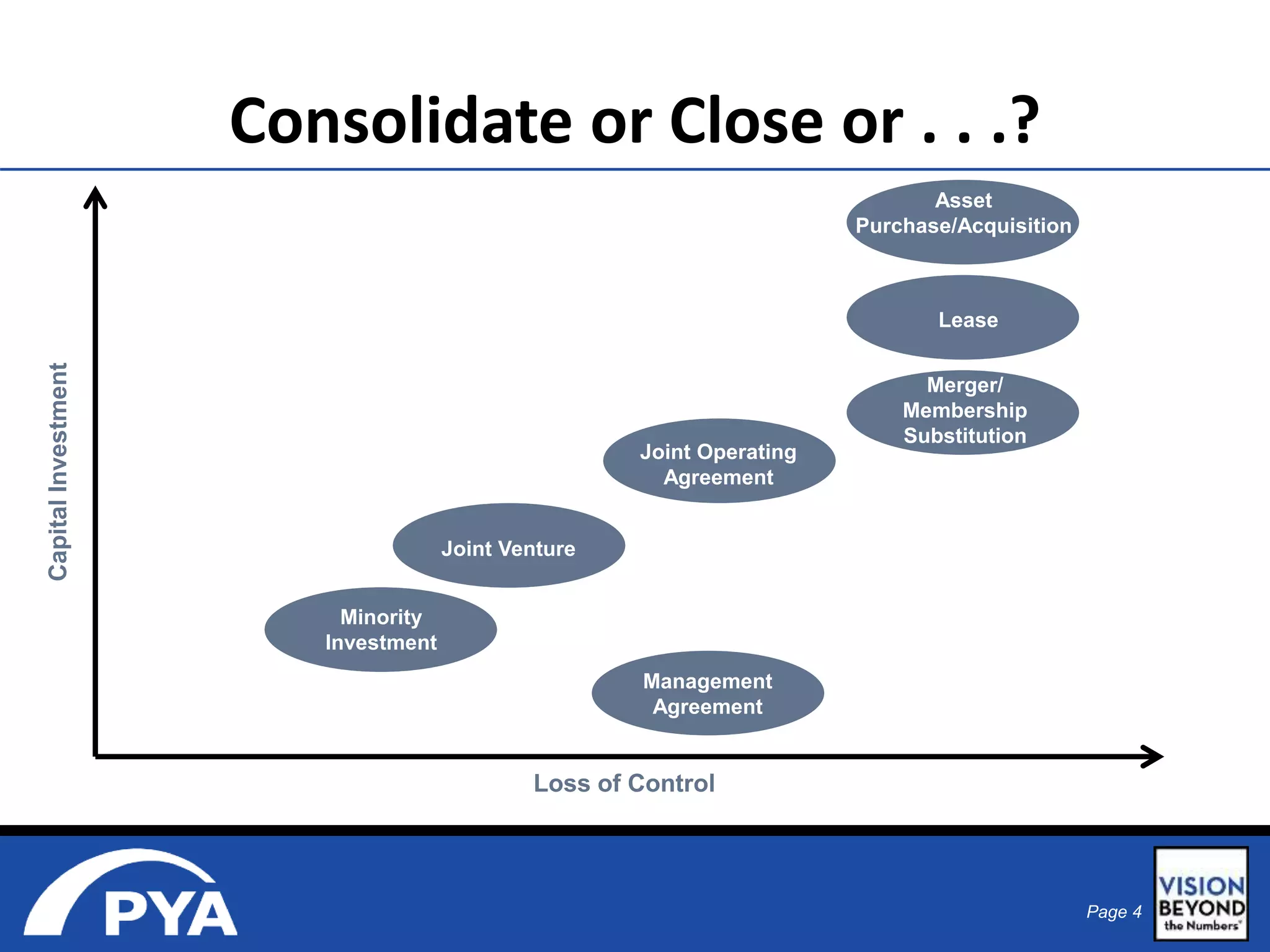
Consolidate or Close or . . .? 
Capital Investment 
Joint Operating 
Agreement 
Loss of Control 
Minority 
Investment 
Joint Venture 
Management 
Agreement 
Asset 
Purchase/Acquisition 
Lease 
Merger/ 
Membership 
Substitution
Page 5 
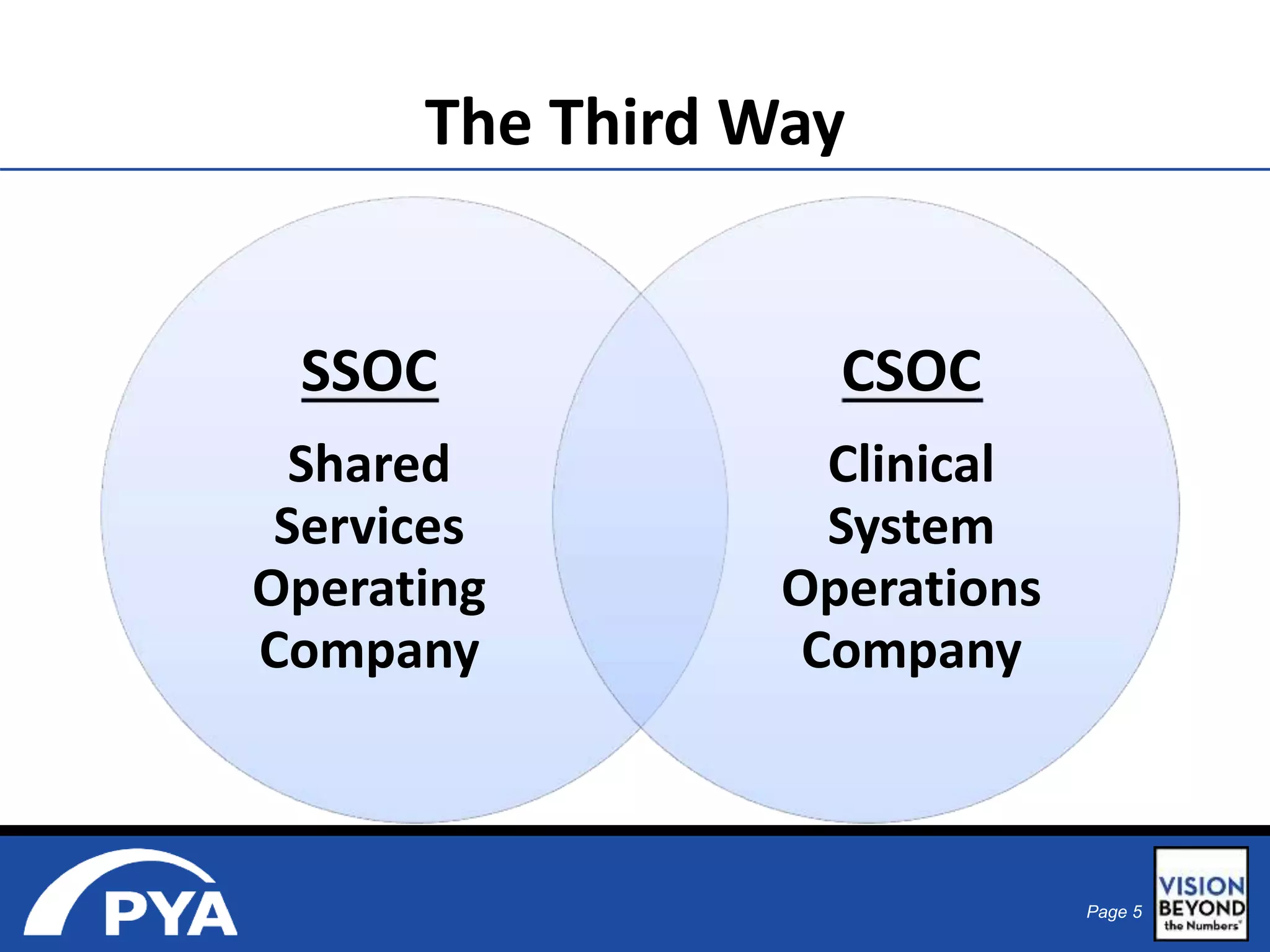
The Third Way 
SSOC 
Shared 
Services 
Operating 
Company 
CSOC 
Clinical 
System 
Operations 
Company
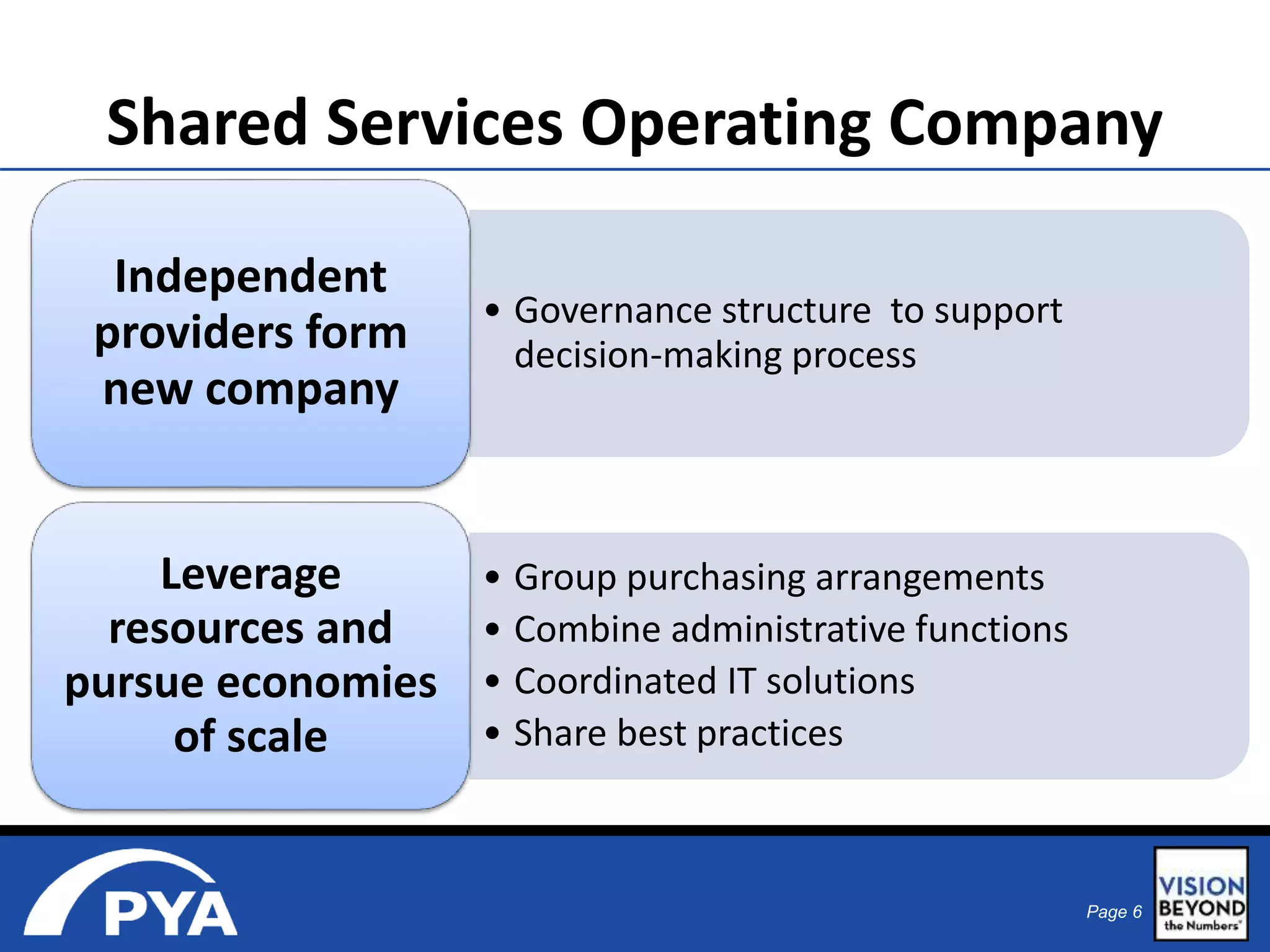
Shared Services Operating Company 
Page 6 
• Governance structure to support 
decision-making process 
Independent 
providers form 
new company 
• Group purchasing arrangements 
• Combine administrative functions 
• Coordinated IT solutions 
• Share best practices 
Leverage 
resources and 
pursue economies 
of scale
Page 7 
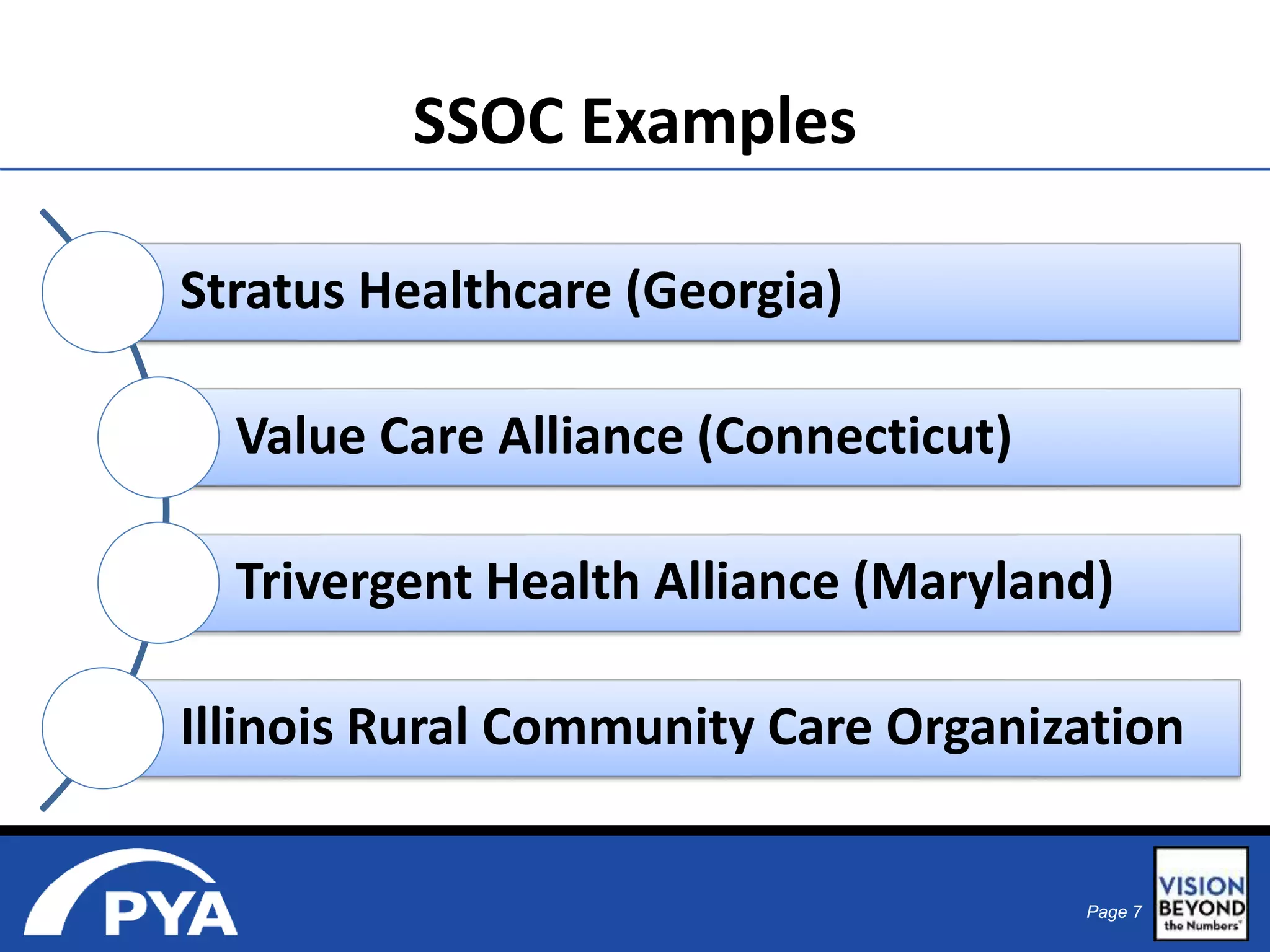
SSOC Examples 
Stratus Healthcare (Georgia) 
Value Care Alliance (Connecticut) 
Trivergent Health Alliance (Maryland) 
Illinois Rural Community Care Organization
Page 8 
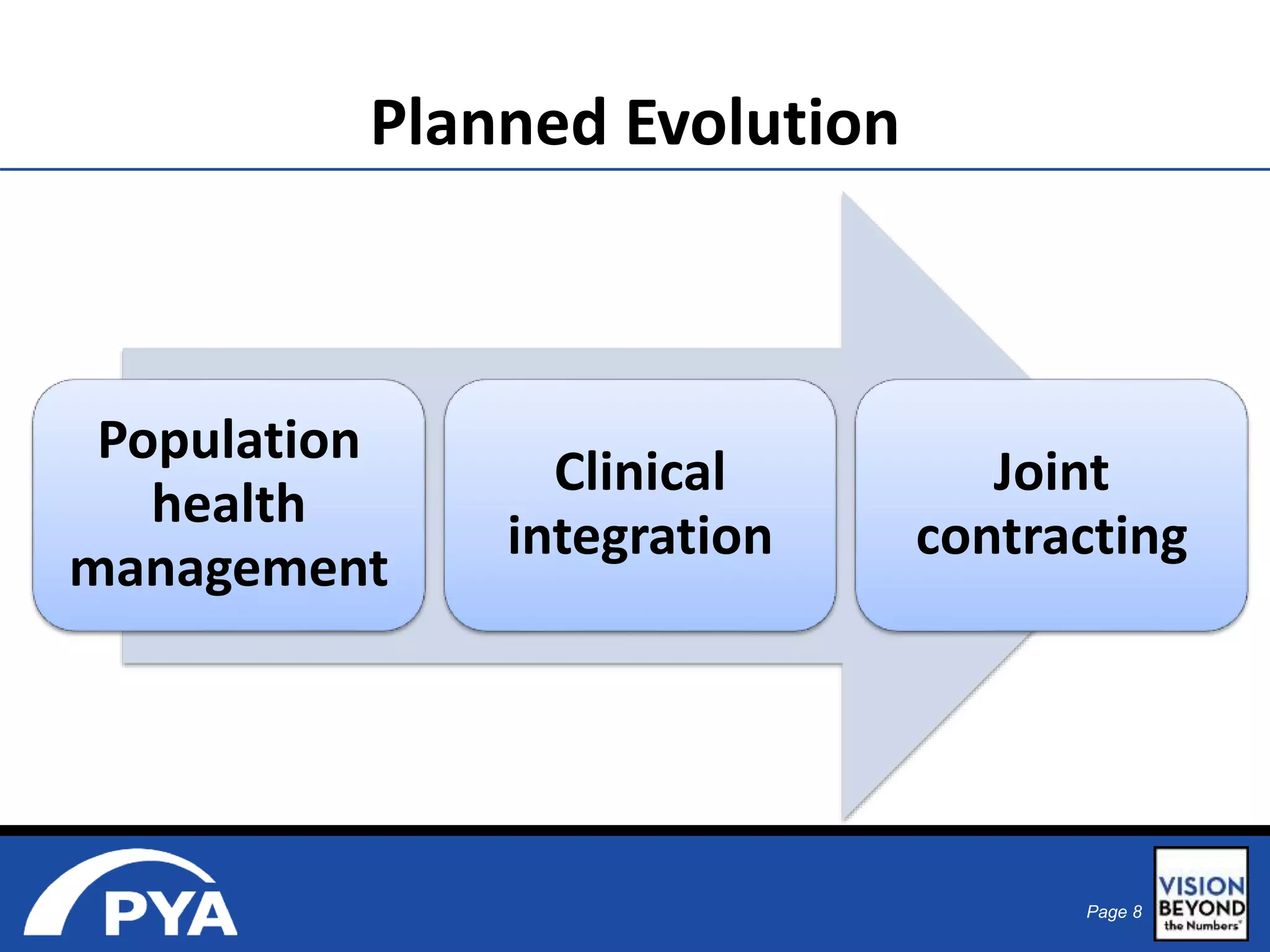
Population 
health 
management 
Clinical 
integration 
Joint 
contracting 
Planned Evolution
Page 9 
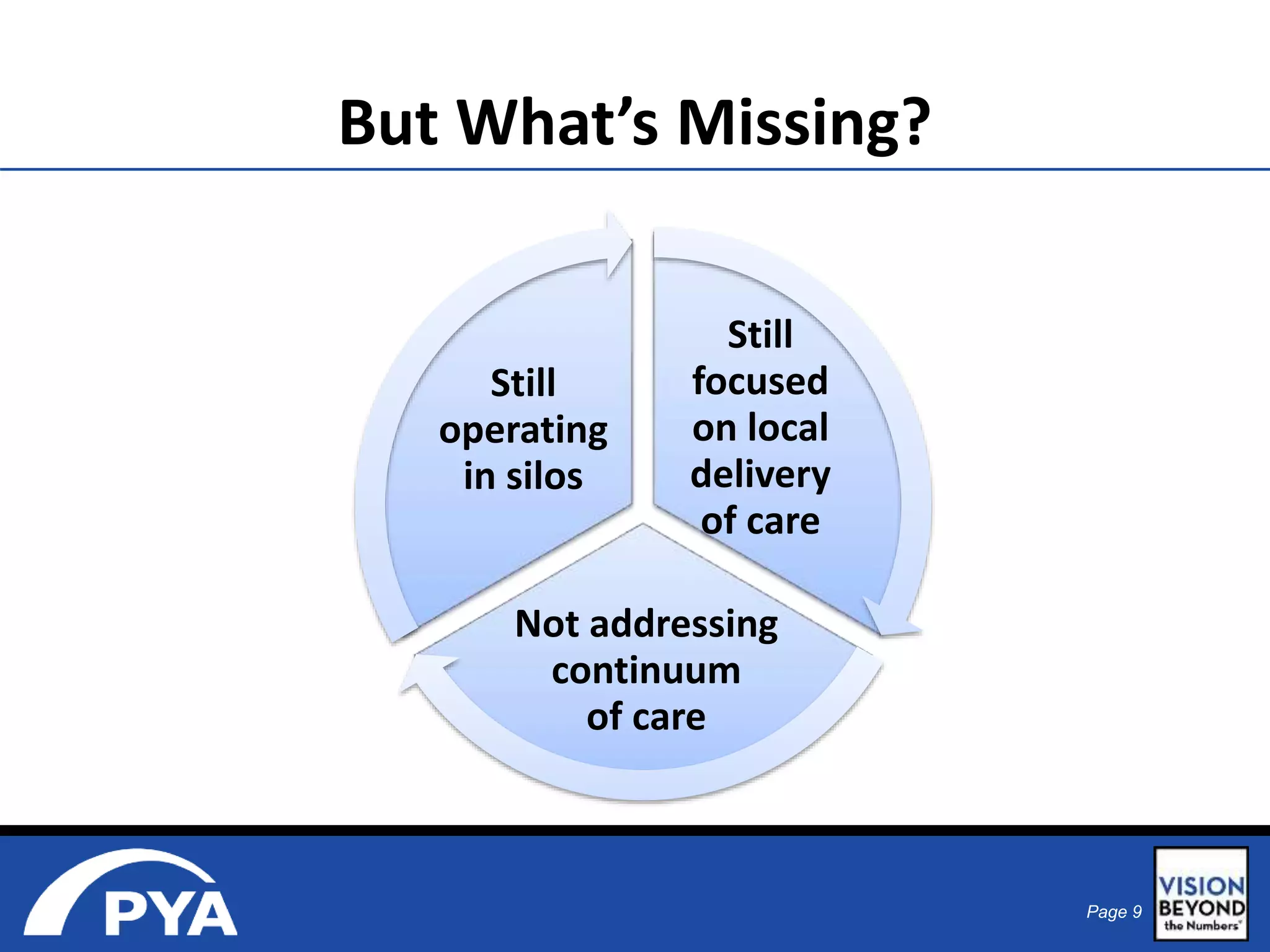
But What’s Missing? 
Still 
focused 
on local 
delivery 
of care 
Not addressing 
continuum 
of care 
Still 
operating 
in silos
Page 10 
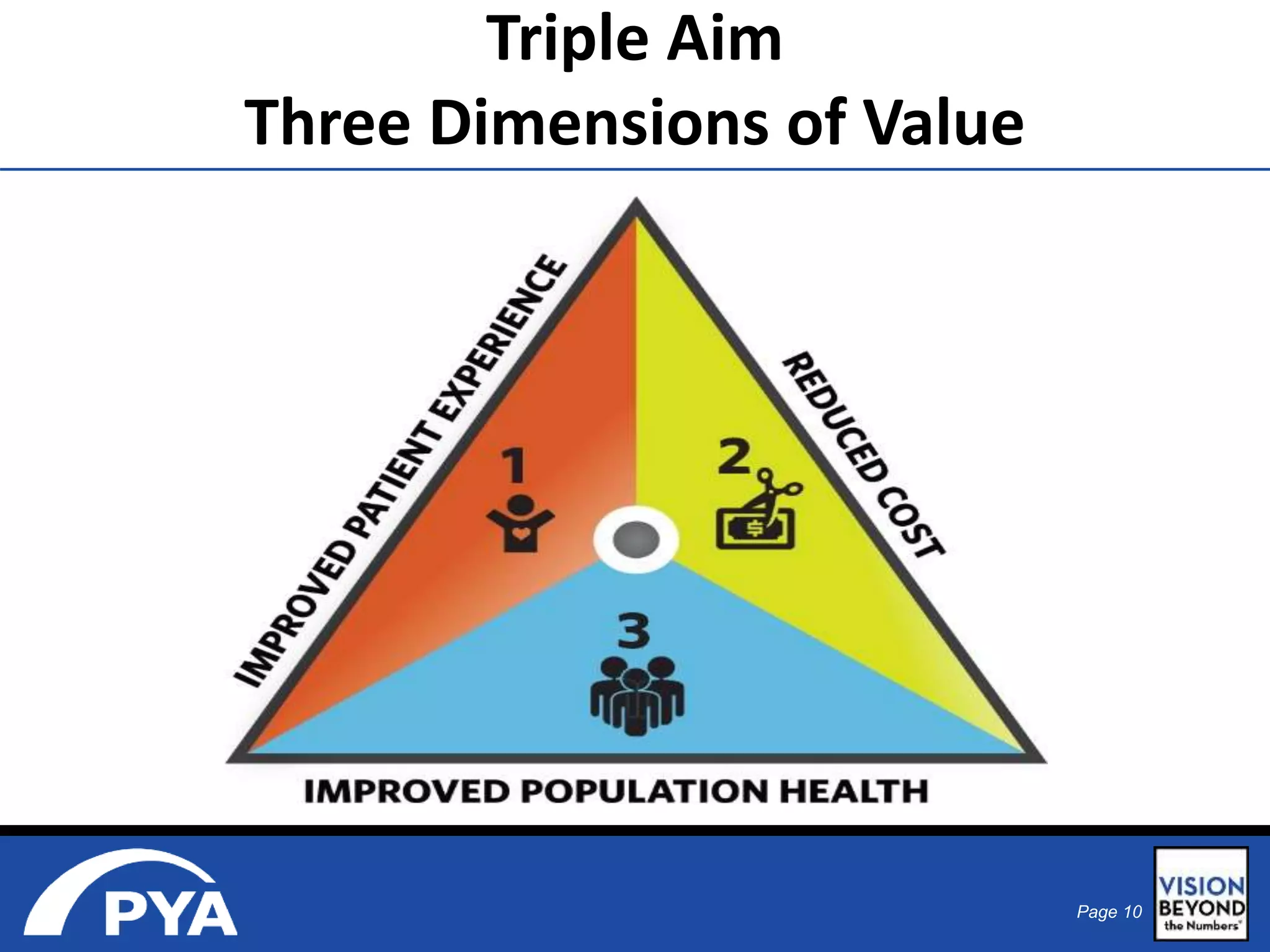
Triple Aim 
Three Dimensions of Value
Page 11 
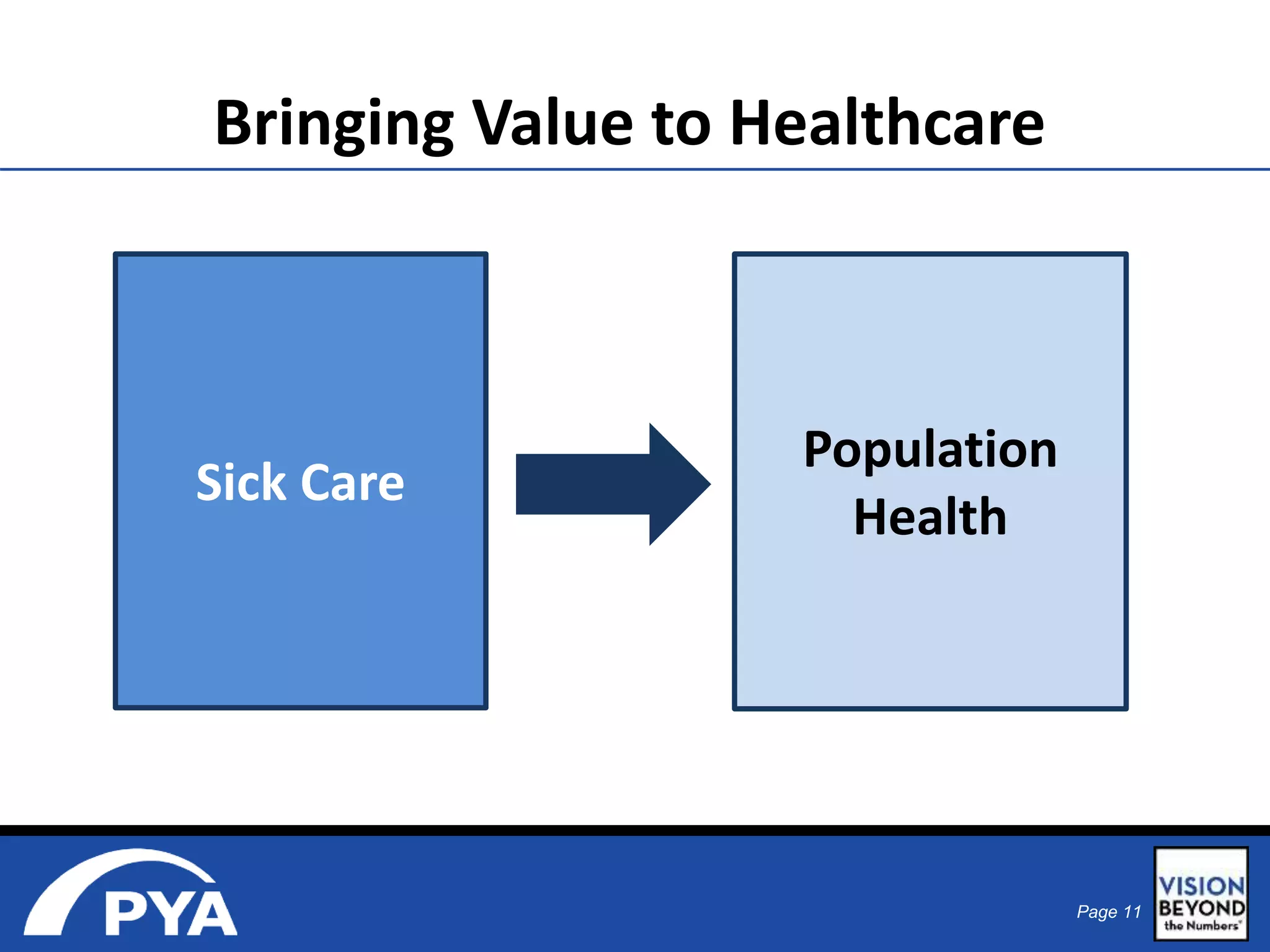
Bringing Value to Healthcare 
Sick Care 
Population 
Health
Sick Care Population Health 
Page 12 
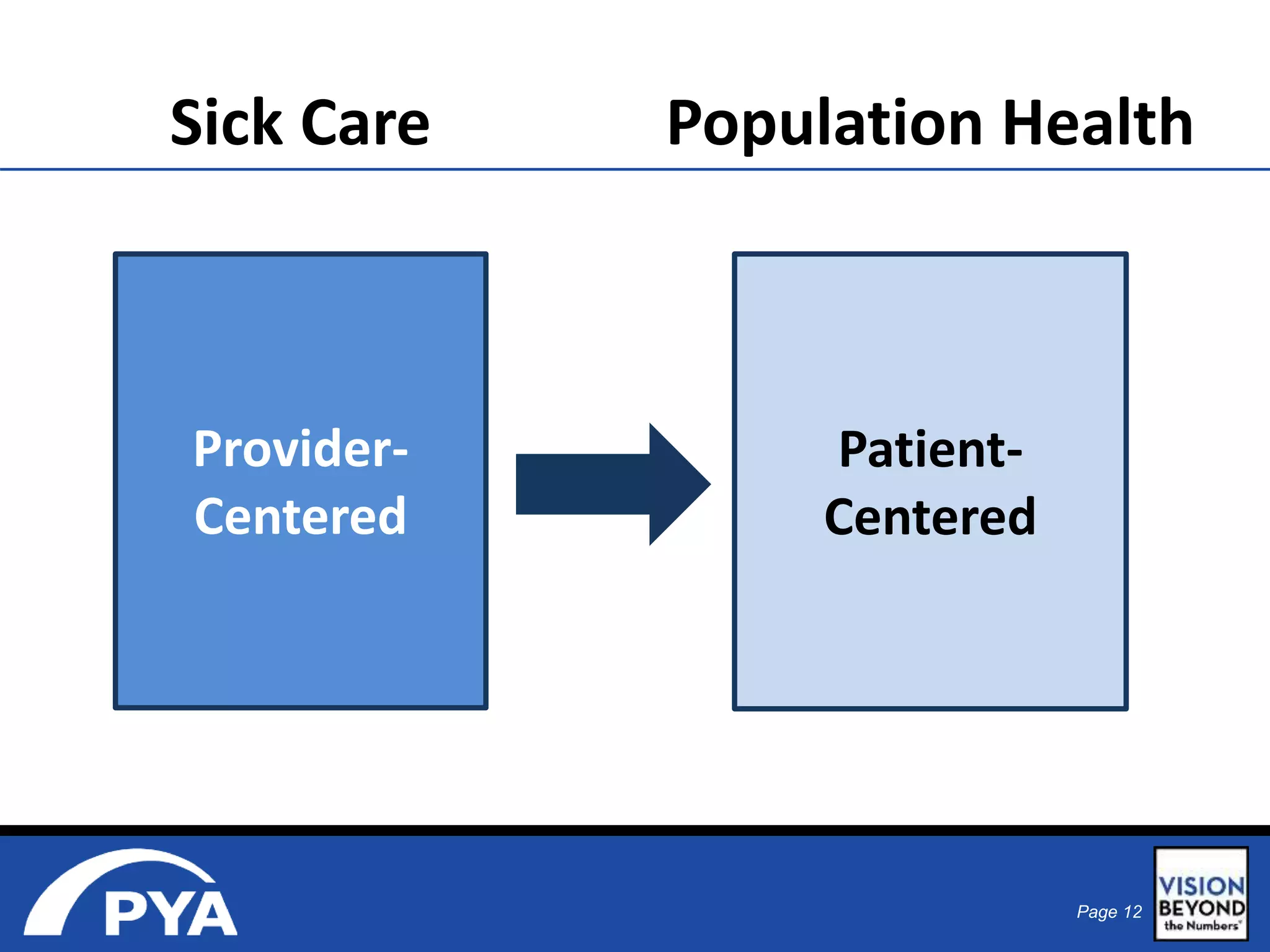
Provider- 
Centered 
Patient- 
Centered
Sick Care Population Health 
Page 13 
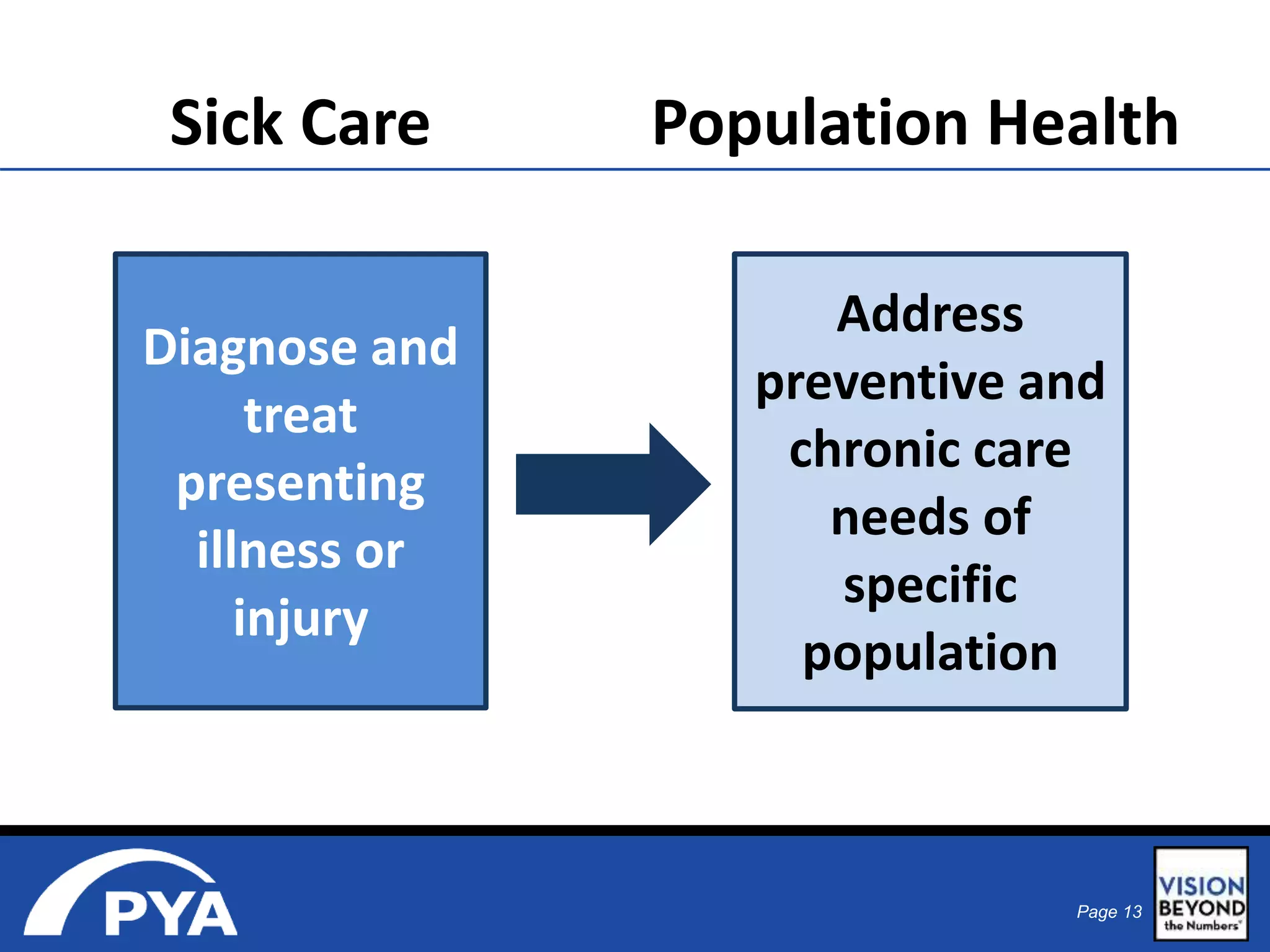
Diagnose and 
treat 
presenting 
illness or 
injury 
Address 
preventive and 
chronic care 
needs of 
specific 
population
Sick Care Population Health 
Page 14 
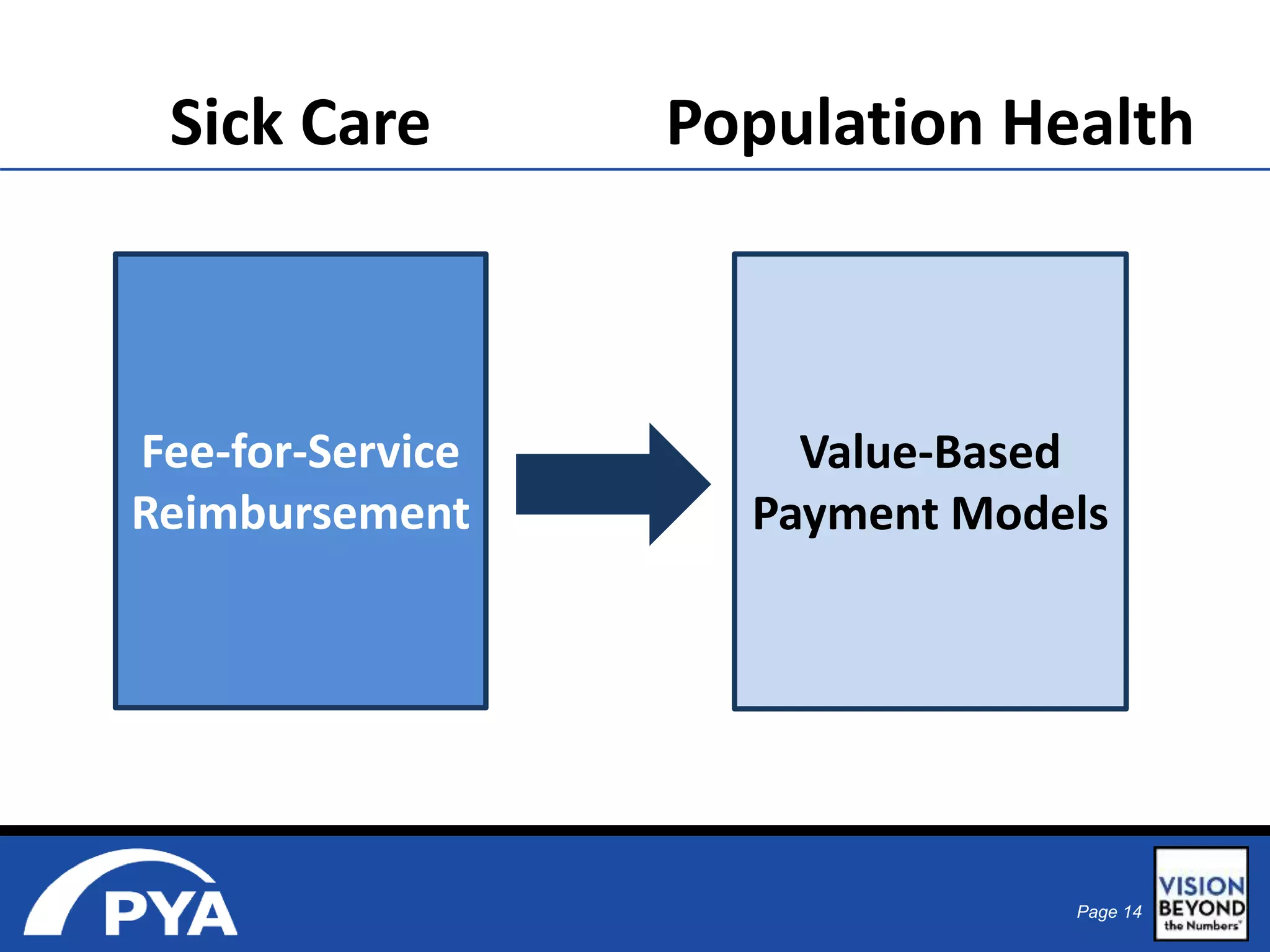
Fee-for-Service 
Reimbursement 
Value-Based 
Payment Models
Sick Care Population Health 
Page 15 
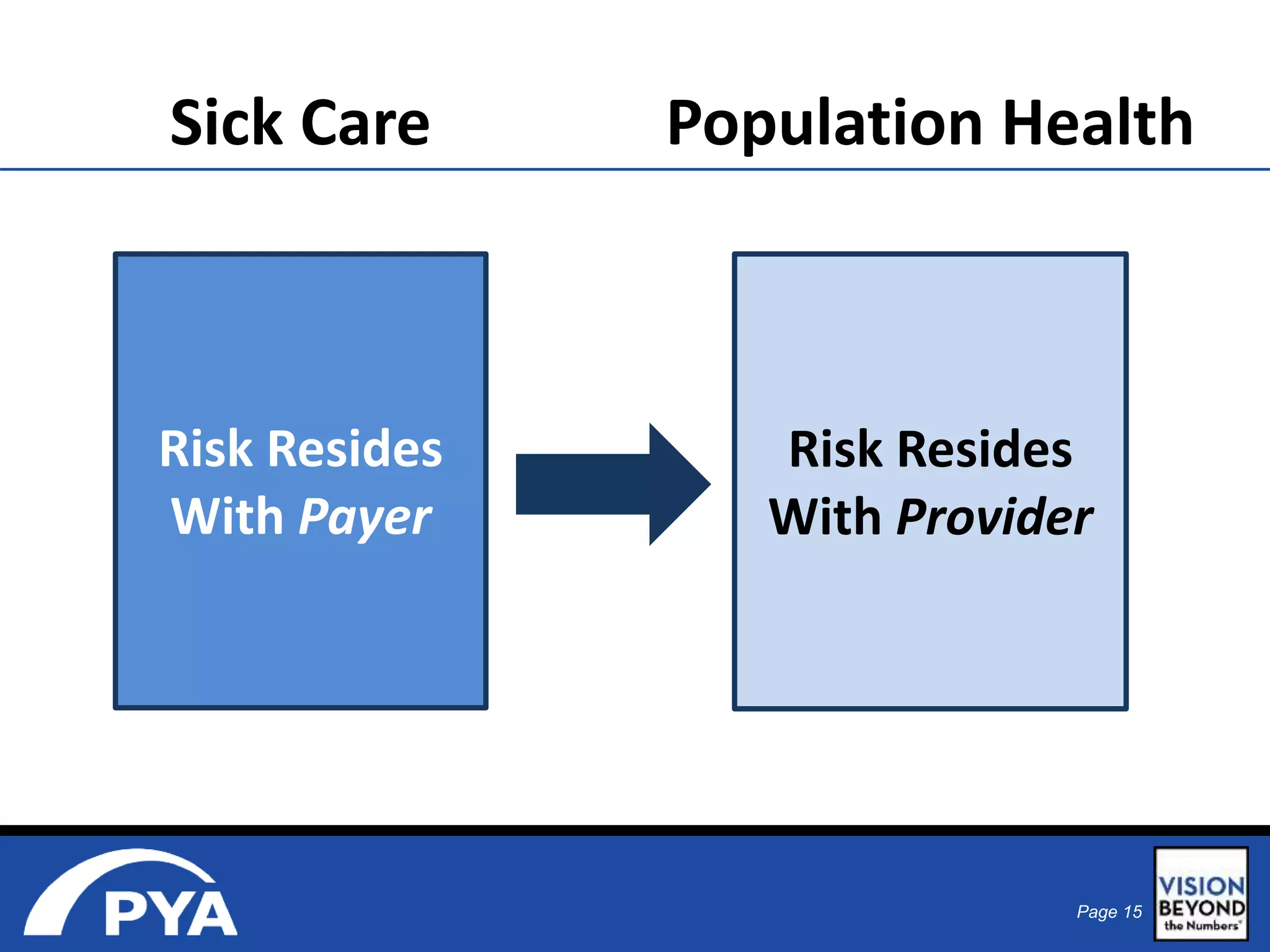
Risk Resides 
With Payer 
Risk Resides 
With Provider
Sick Care Population Health 
Page 16 
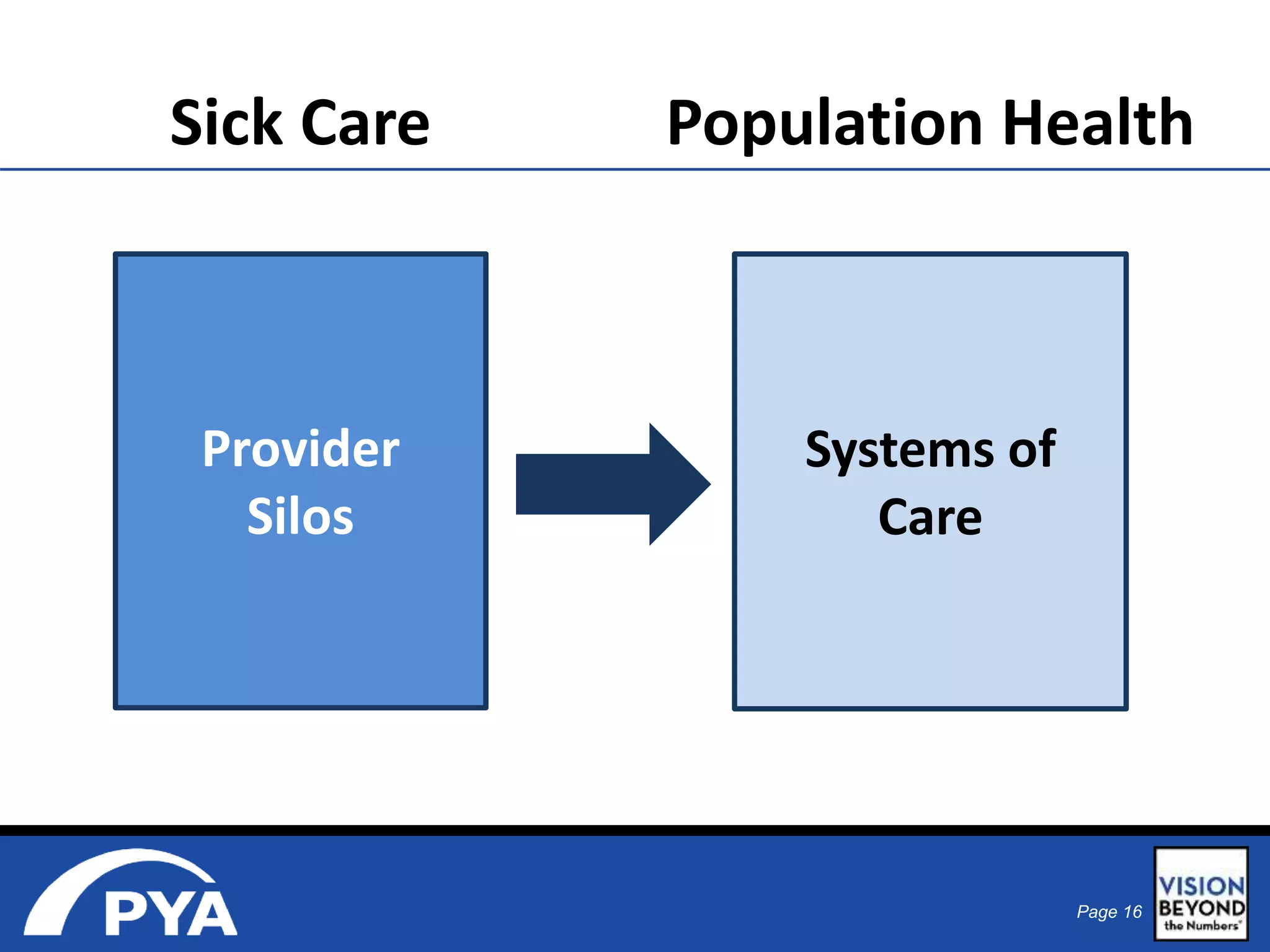
Provider 
Silos 
Systems of 
Care
Page 17 
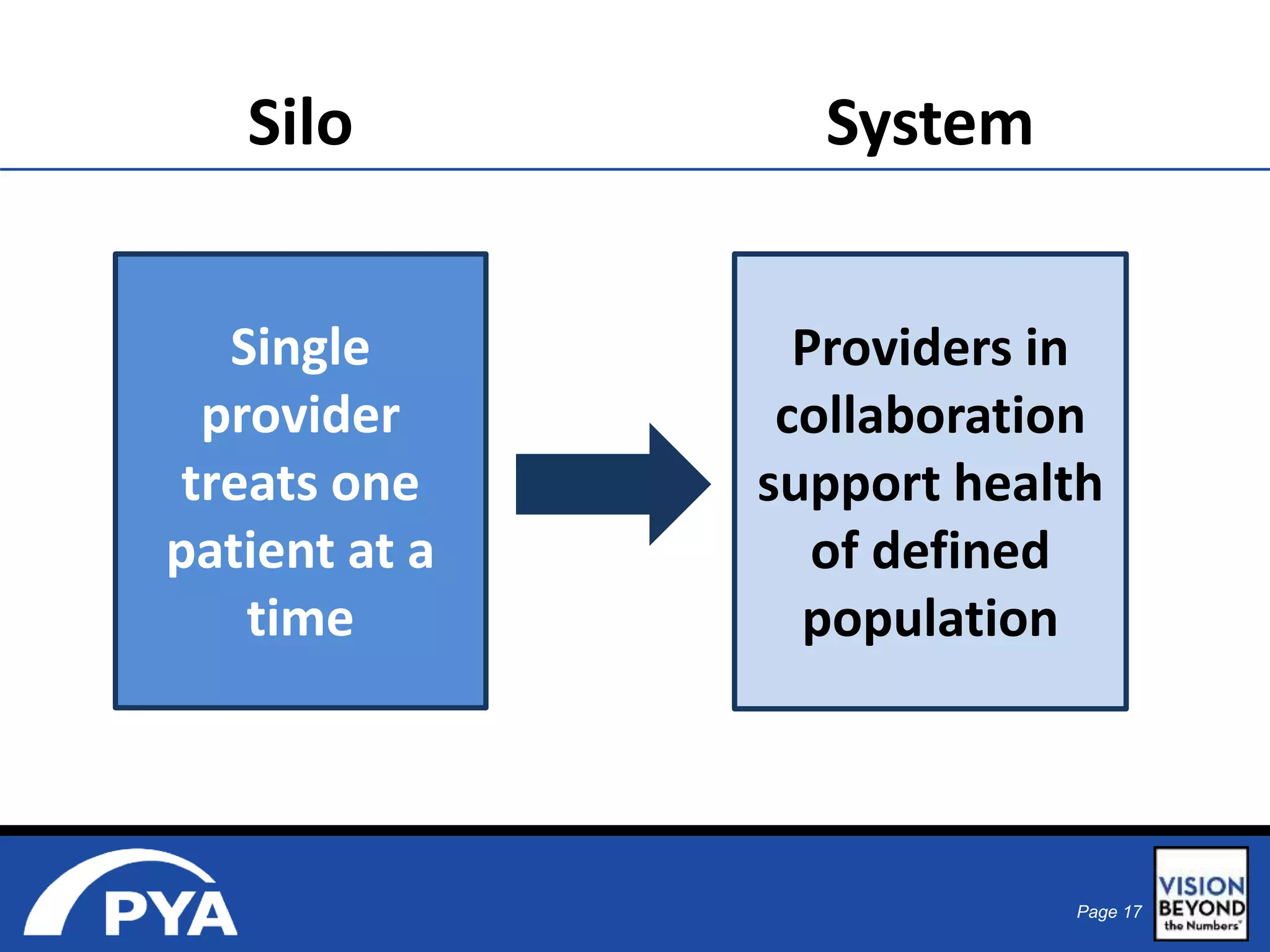
Silo System 
Single 
provider 
treats one 
patient at a 
time 
Providers in 
collaboration 
support health 
of defined 
population
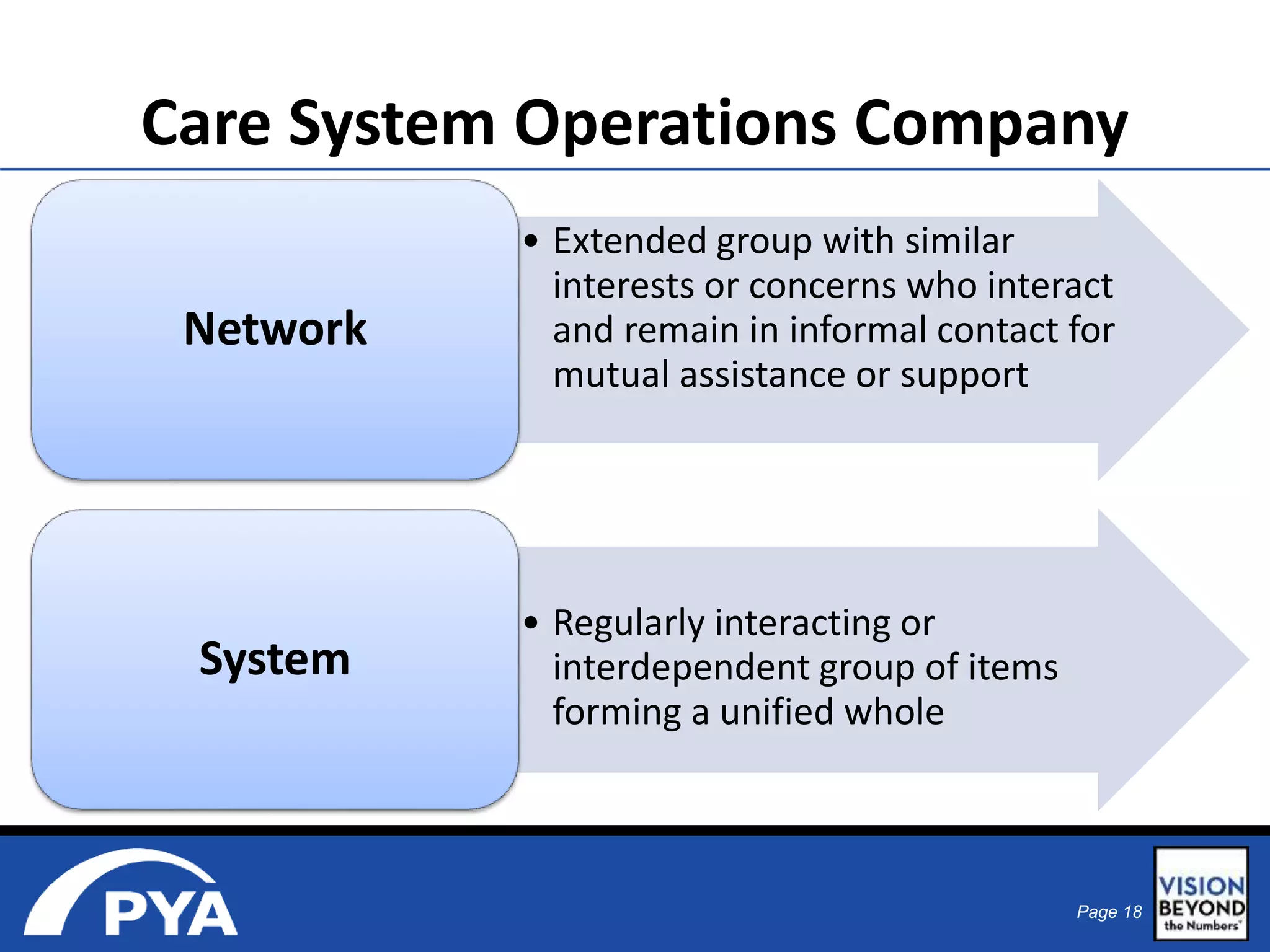
Care System Operations Company 
• Extended group with similar 
interests or concerns who interact 
and remain in informal contact for 
mutual assistance or support 
Page 18 
Network 
• Regularly interacting or 
interdependent group of items 
forming a unified whole 
System
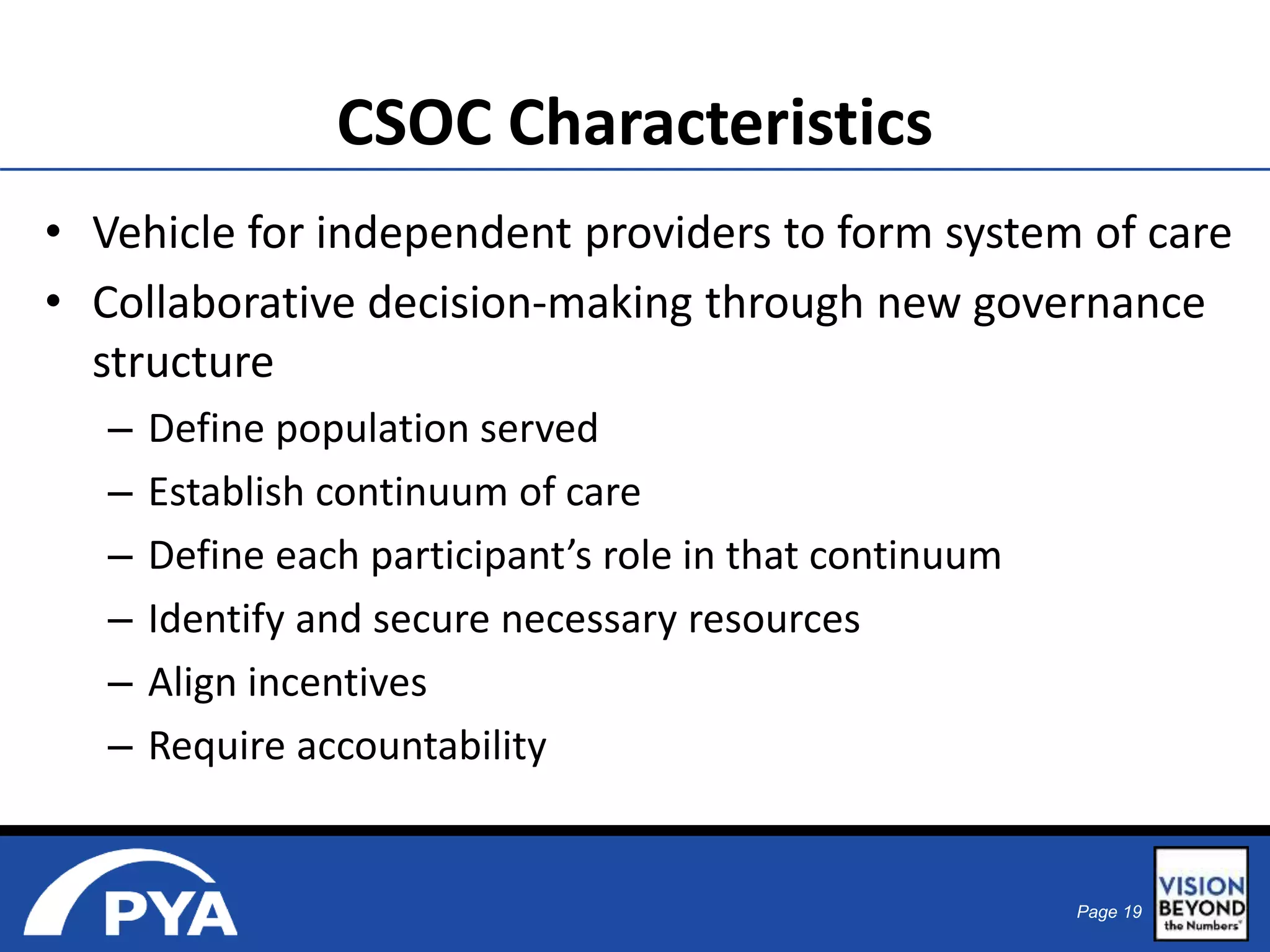
CSOC Characteristics 
• Vehicle for independent providers to form system of care 
• Collaborative decision-making through new governance 
structure 
Page 19 
– Define population served 
– Establish continuum of care 
– Define each participant’s role in that continuum 
– Identify and secure necessary resources 
– Align incentives 
– Require accountability
Page 20 
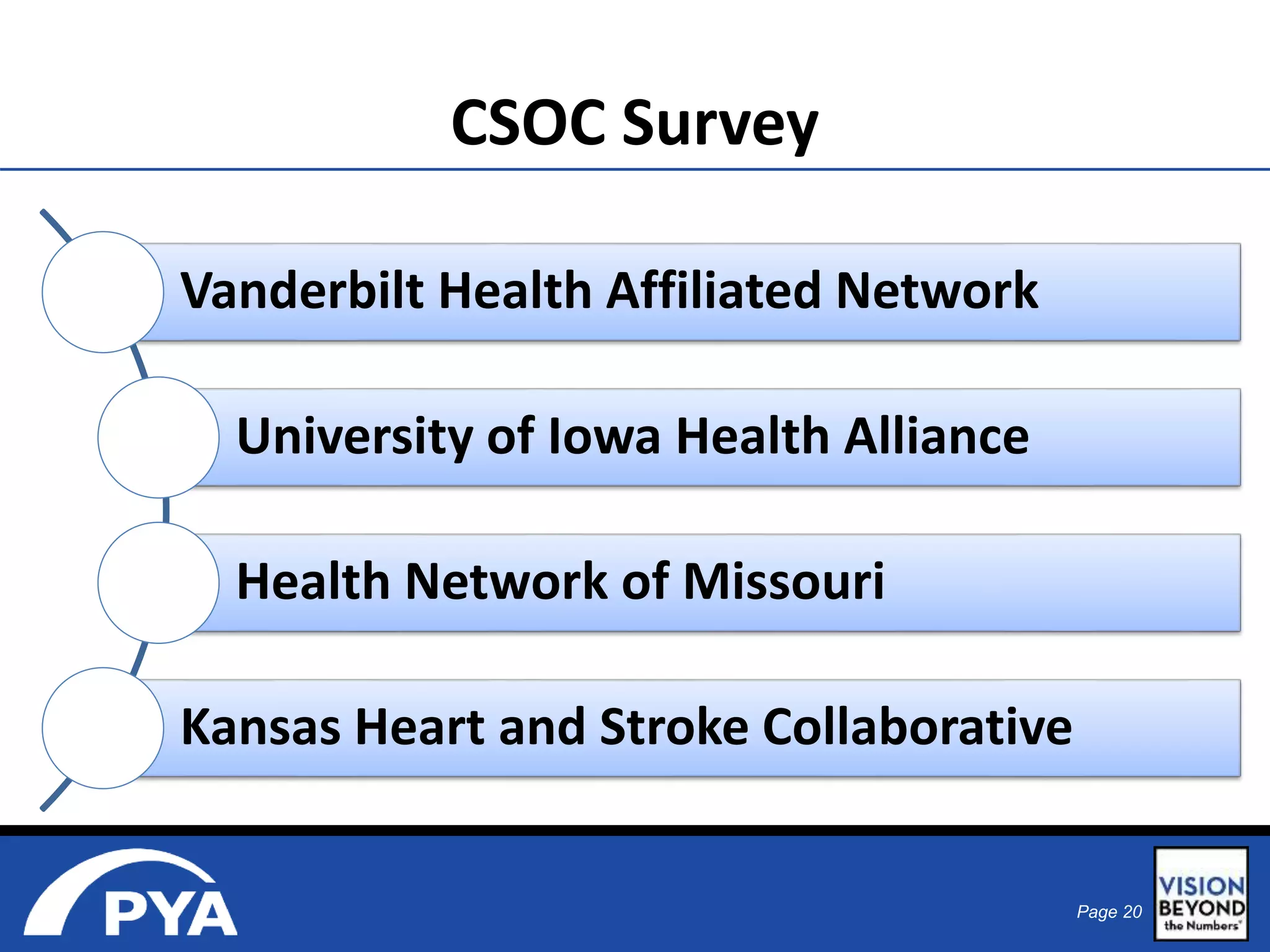
CSOC Survey 
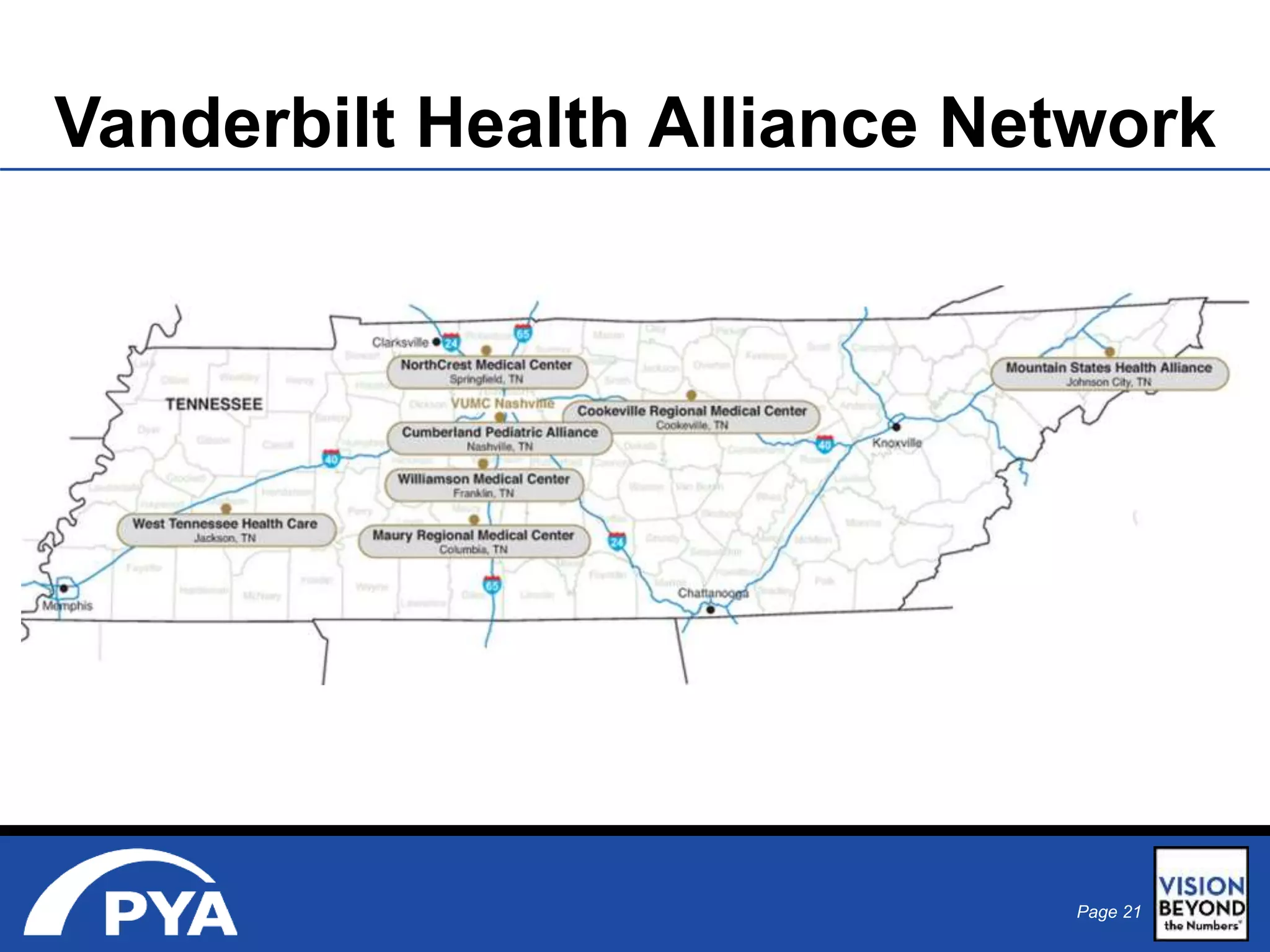
Vanderbilt Health Affiliated Network 
University of Iowa Health Alliance 
Health Network of Missouri 
Kansas Heart and Stroke Collaborative
Vanderbilt Health Alliance Network 
Page 21
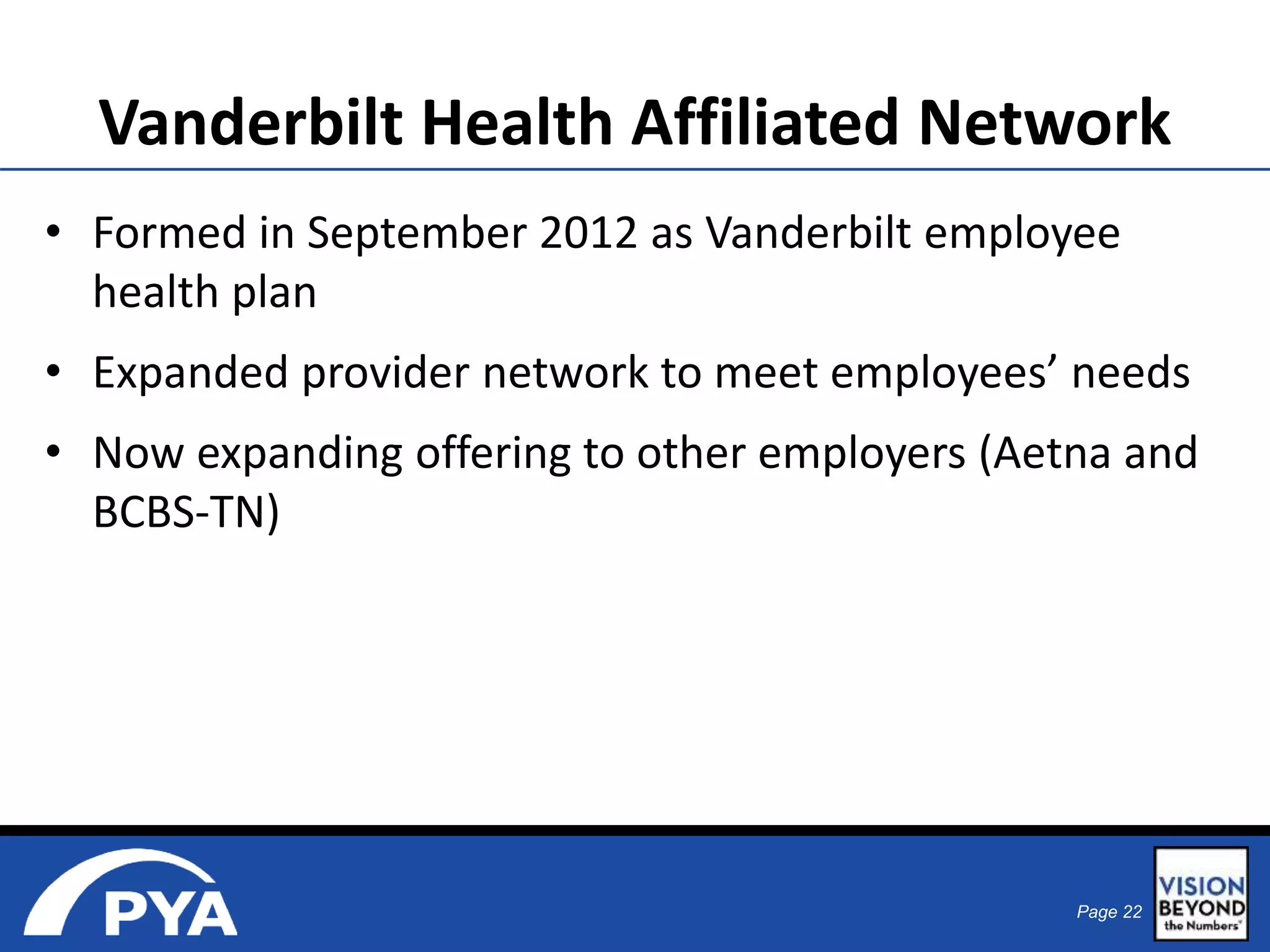
Vanderbilt Health Affiliated Network 
• Formed in September 2012 as Vanderbilt employee 
health plan 
• Expanded provider network to meet employees’ needs 
• Now expanding offering to other employers (Aetna and 
BCBS-TN) 
Page 22
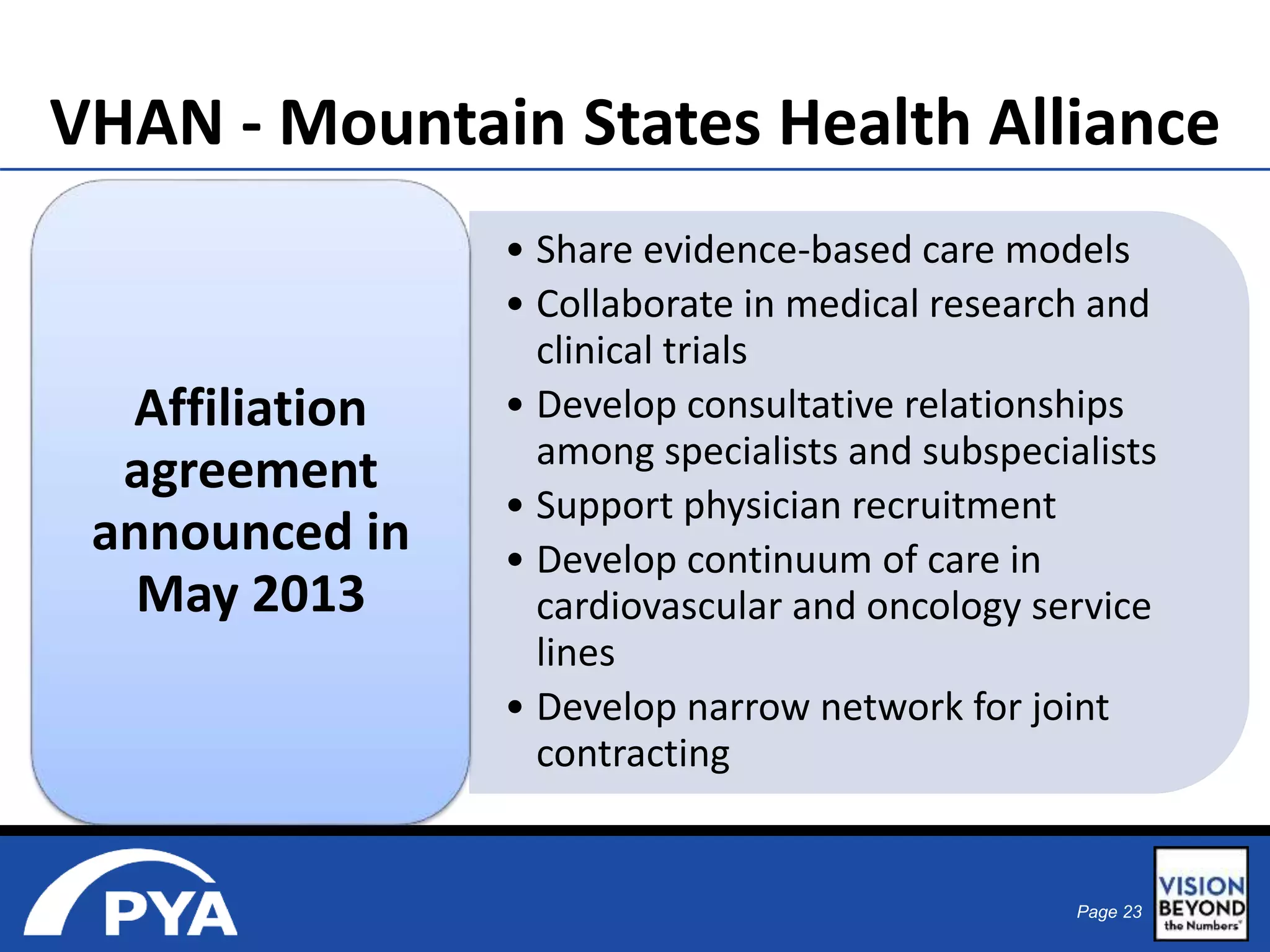
VHAN - Mountain States Health Alliance 
• Share evidence-based care models 
• Collaborate in medical research and 
clinical trials 
• Develop consultative relationships 
among specialists and subspecialists 
• Support physician recruitment 
• Develop continuum of care in 
cardiovascular and oncology service 
lines 
• Develop narrow network for joint 
contracting 
Page 23 
Affiliation 
agreement 
announced in 
May 2013
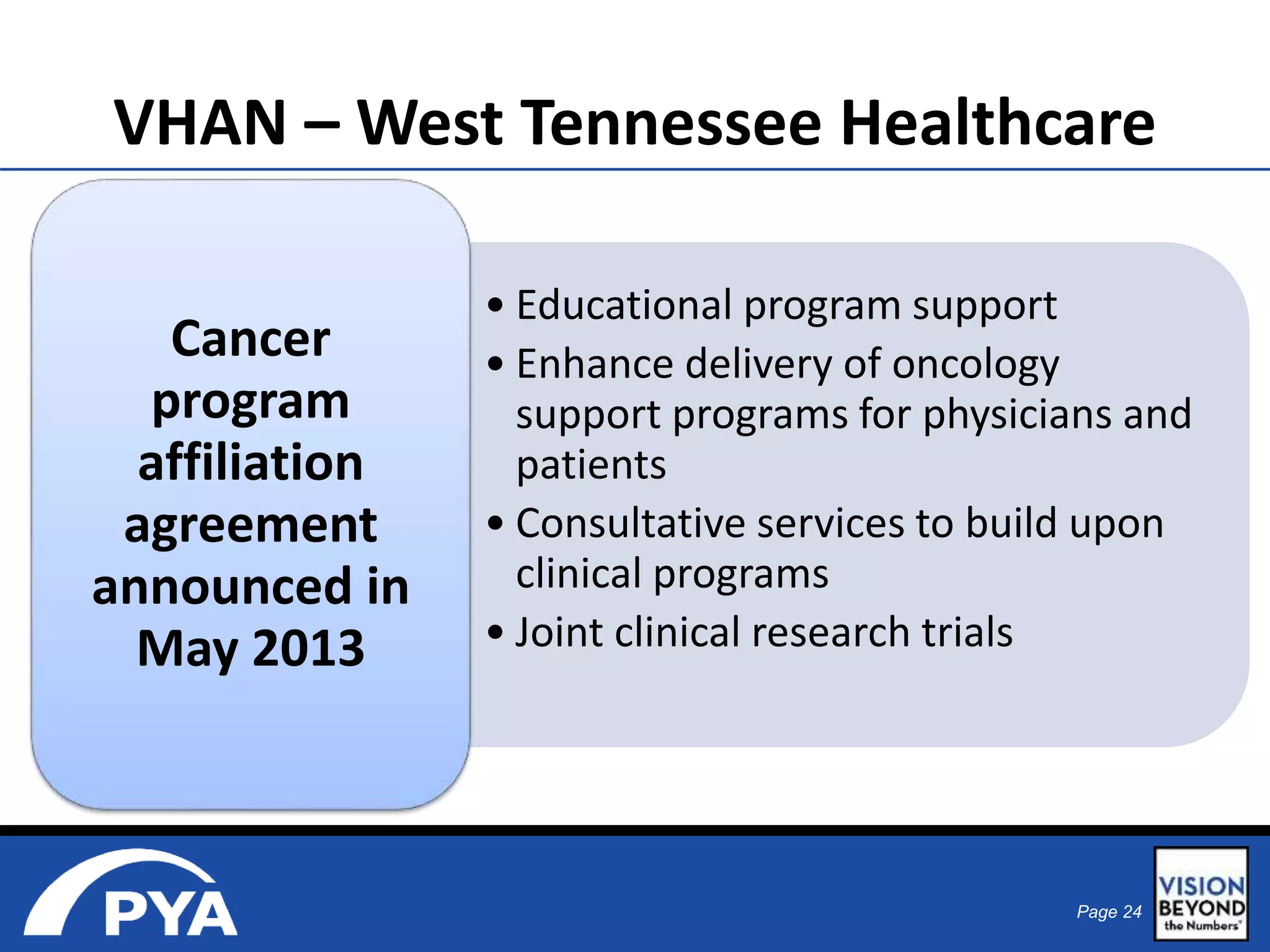
VHAN –West Tennessee Healthcare 
• Educational program support 
• Enhance delivery of oncology 
support programs for physicians and 
patients 
• Consultative services to build upon 
clinical programs 
• Joint clinical research trials 
Page 24 
Cancer 
program 
affiliation 
agreement 
announced in 
May 2013
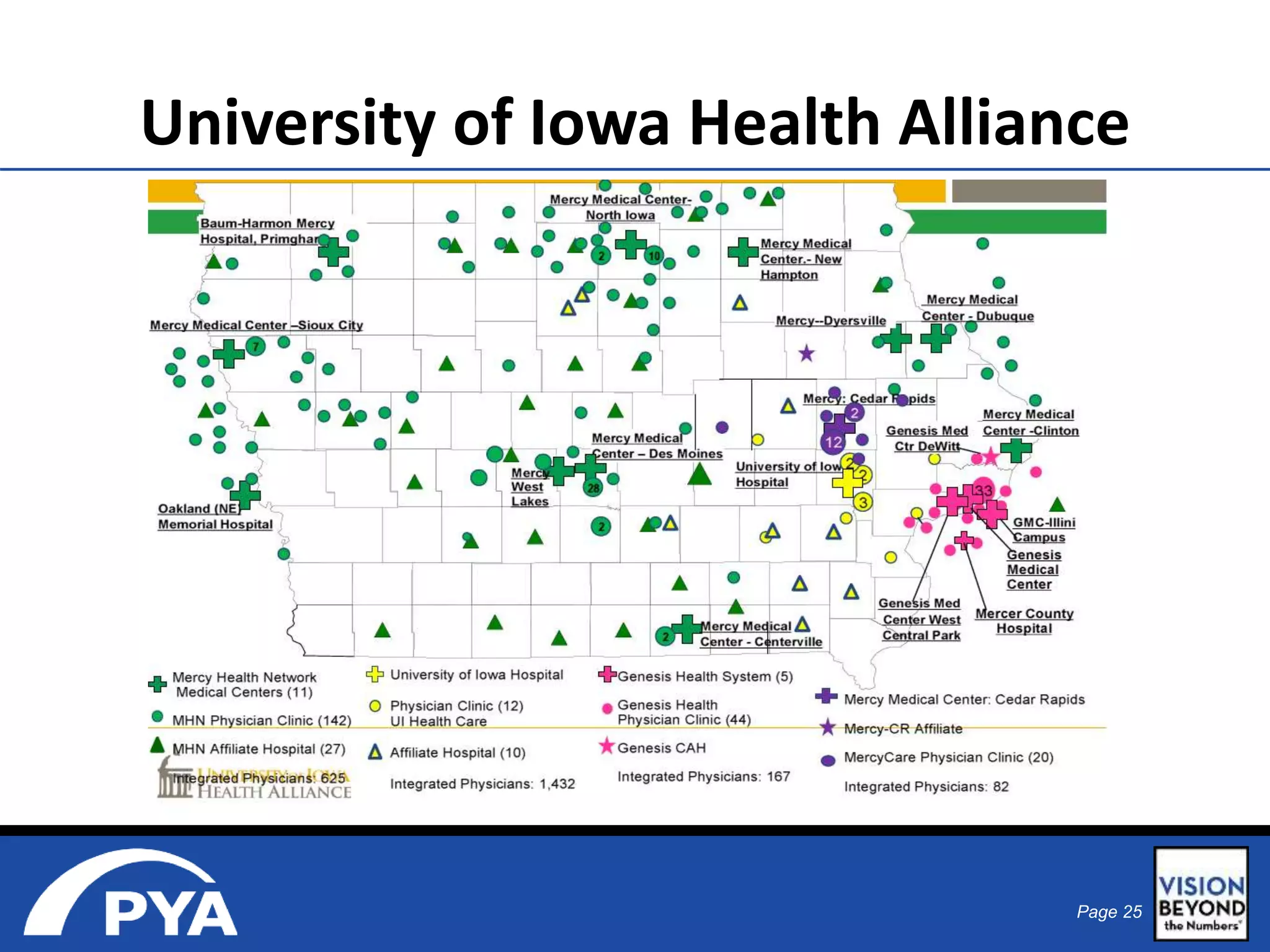
University of Iowa Health Alliance 
Page 25
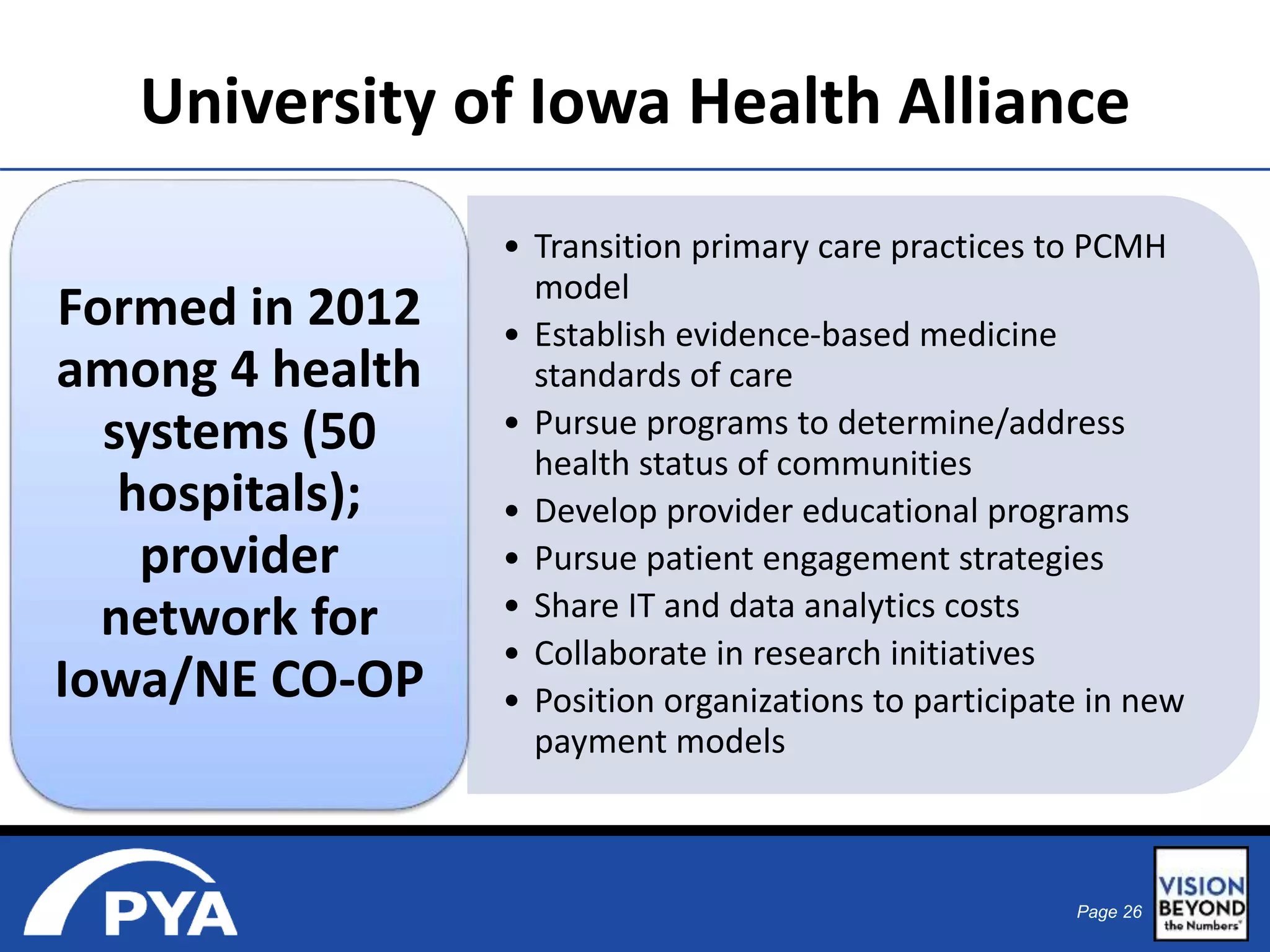
University of Iowa Health Alliance 
• Transition primary care practices to PCMH 
model 
• Establish evidence-based medicine 
standards of care 
• Pursue programs to determine/address 
health status of communities 
• Develop provider educational programs 
• Pursue patient engagement strategies 
• Share IT and data analytics costs 
• Collaborate in research initiatives 
• Position organizations to participate in new 
payment models 
Page 26 
Formed in 2012 
among 4 health 
systems (50 
hospitals); 
provider 
network for 
Iowa/NE CO-OP
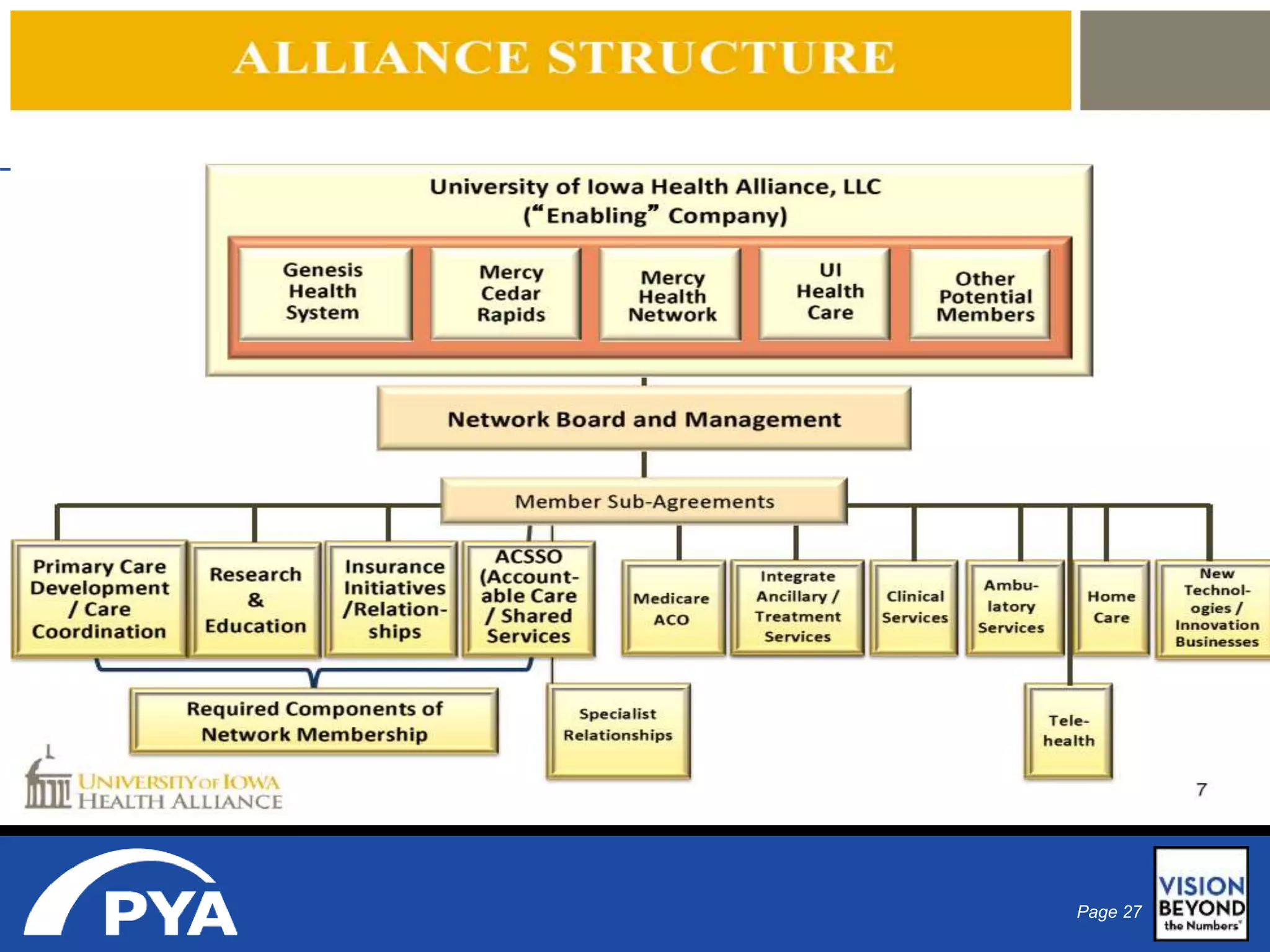
Page 27
Page 28 
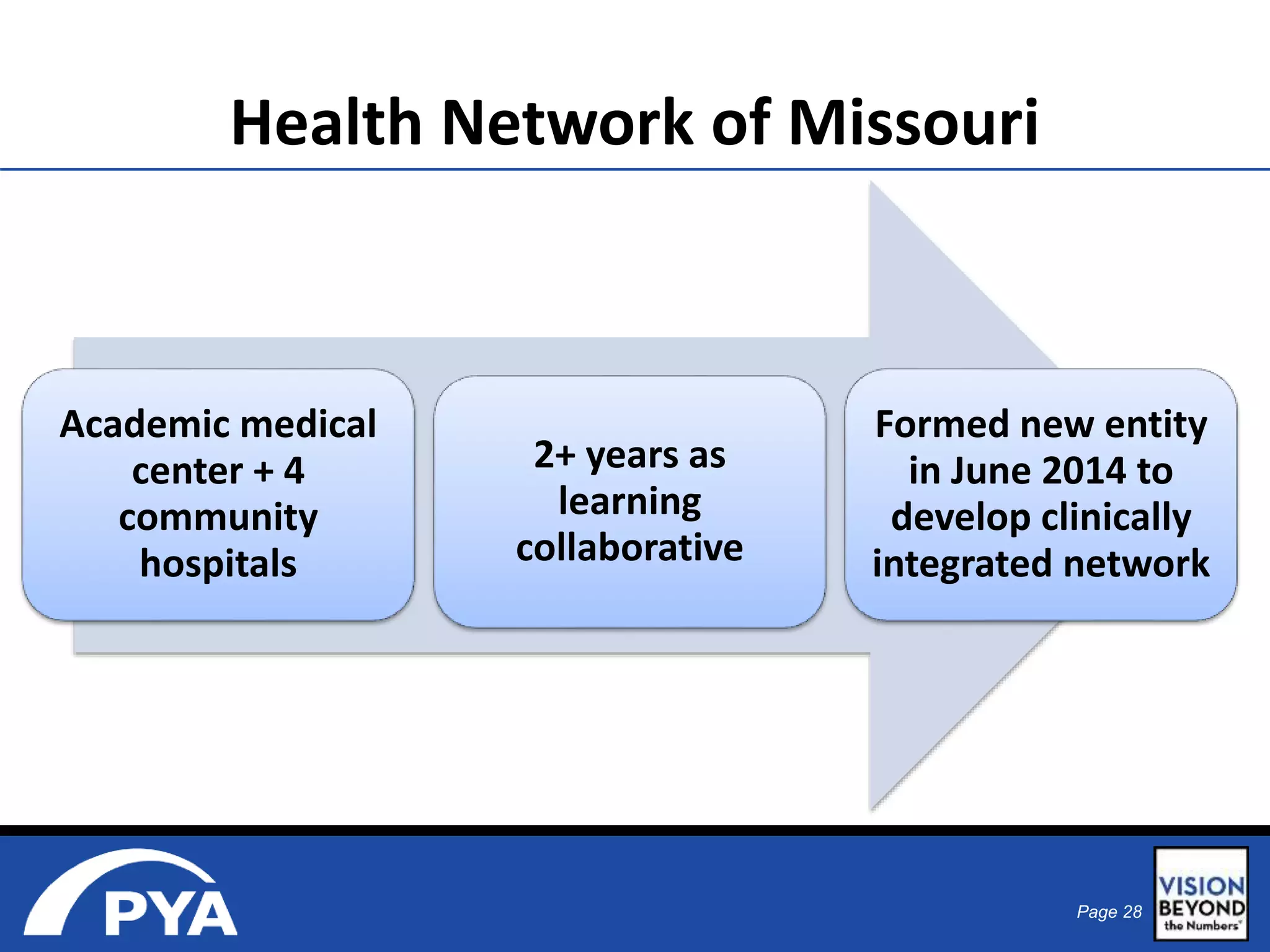
Health Network of Missouri 
Academic medical 
center + 4 
community 
hospitals 
2+ years as 
learning 
collaborative 
Formed new entity 
in June 2014 to 
develop clinically 
integrated network
Page 29
Page 30 
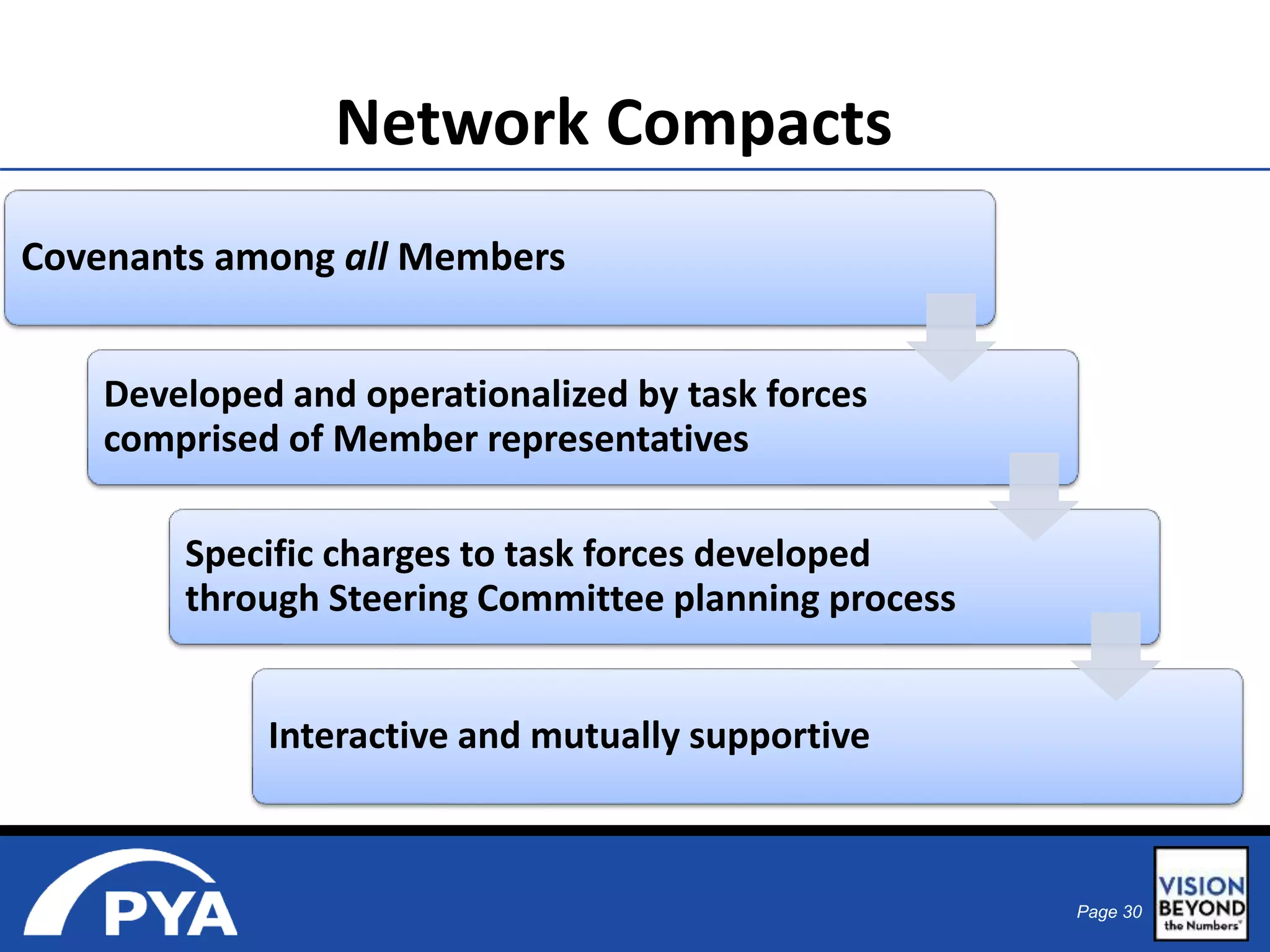
Network Compacts 
Covenants among all Members 
Developed and operationalized by task forces 
comprised of Member representatives 
Specific charges to task forces developed 
through Steering Committee planning process 
Interactive and mutually supportive
Page 31 
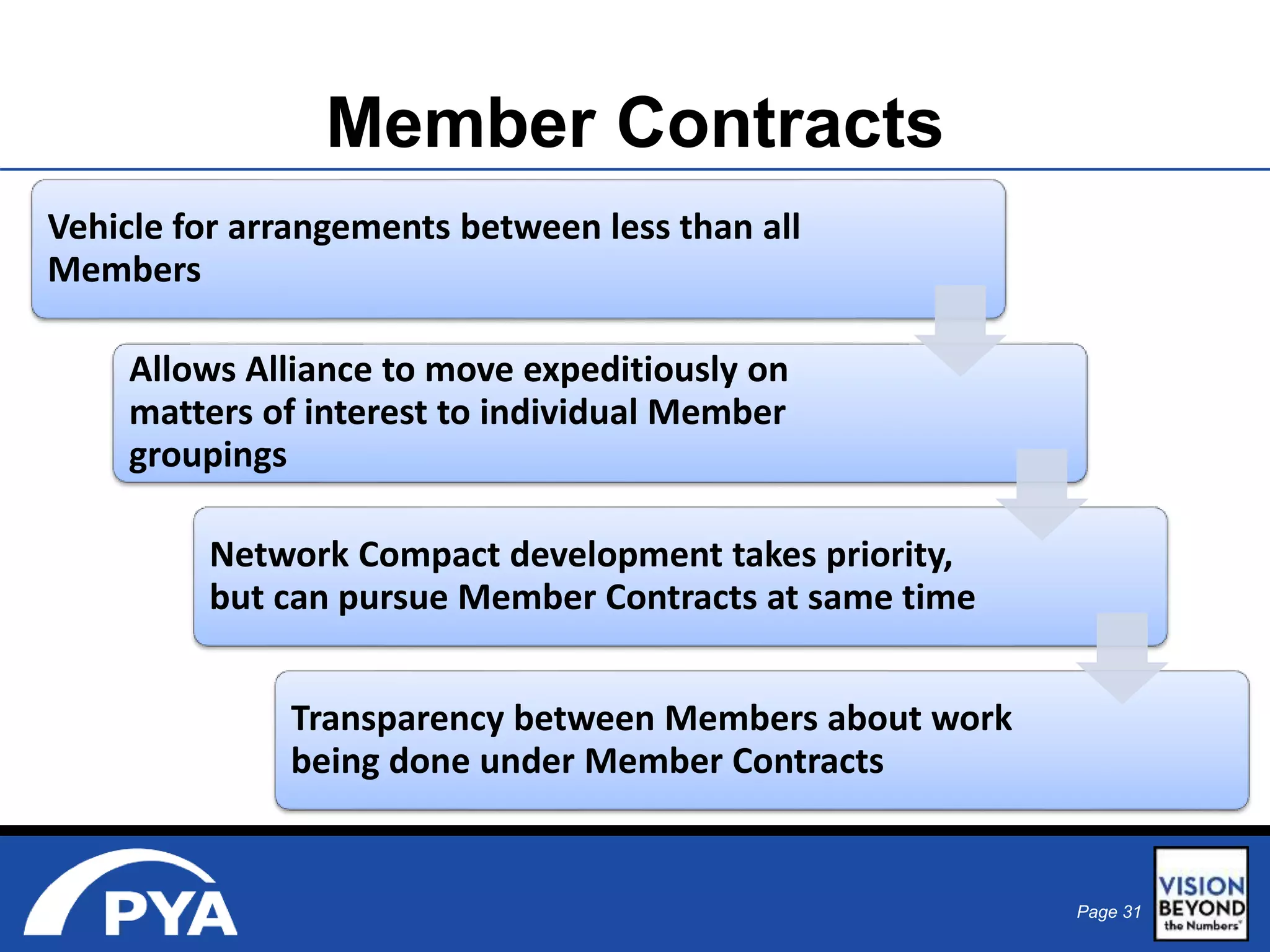
Member Contracts 
Vehicle for arrangements between less than all 
Members 
Allows Alliance to move expeditiously on 
matters of interest to individual Member 
groupings 
Network Compact development takes priority, 
but can pursue Member Contracts at same time 
Transparency between Members about work 
being done under Member Contracts
Page 32 
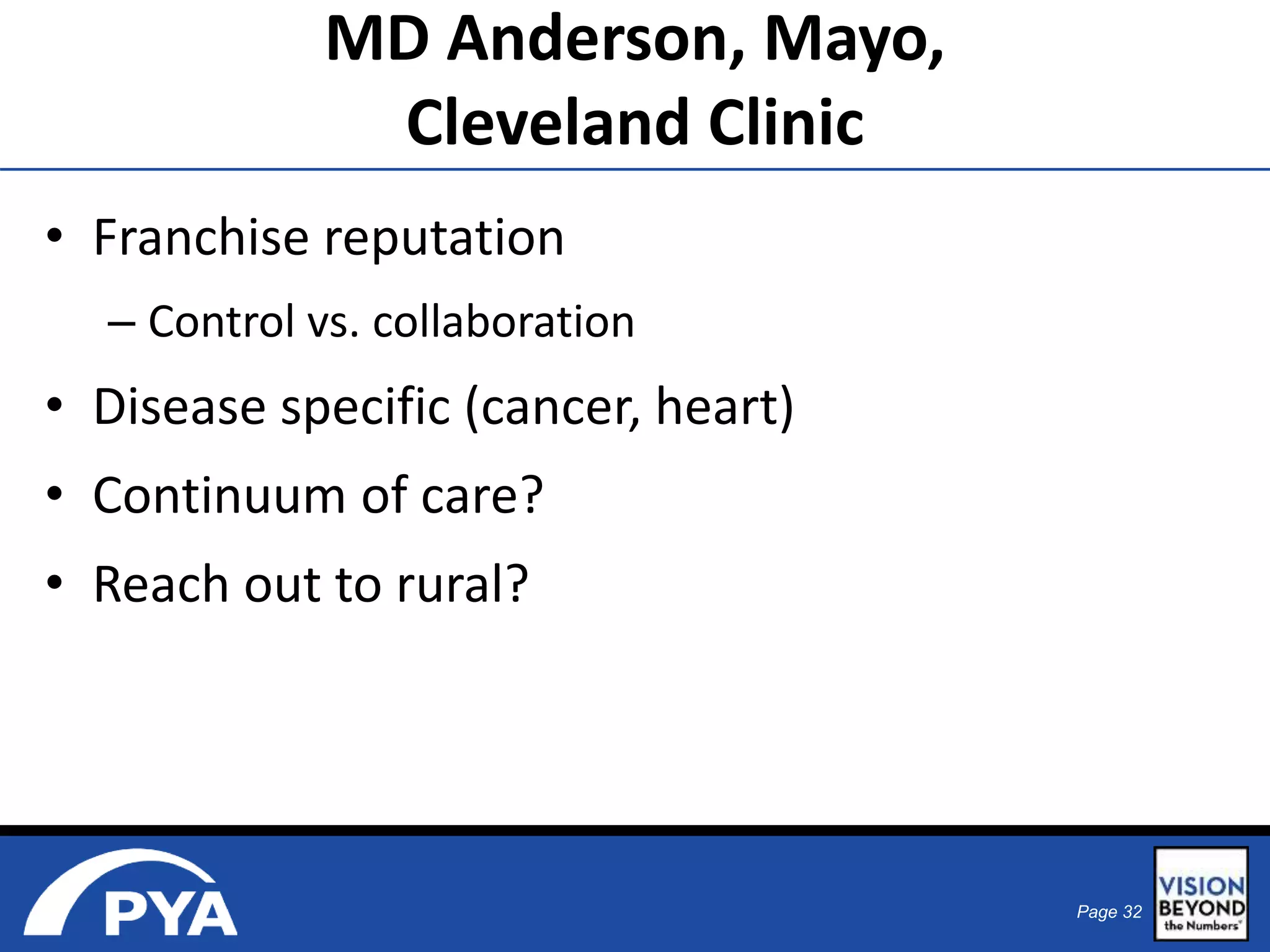
MD Anderson, Mayo, 
Cleveland Clinic 
• Franchise reputation 
– Control vs. collaboration 
• Disease specific (cancer, heart) 
• Continuum of care? 
• Reach out to rural?
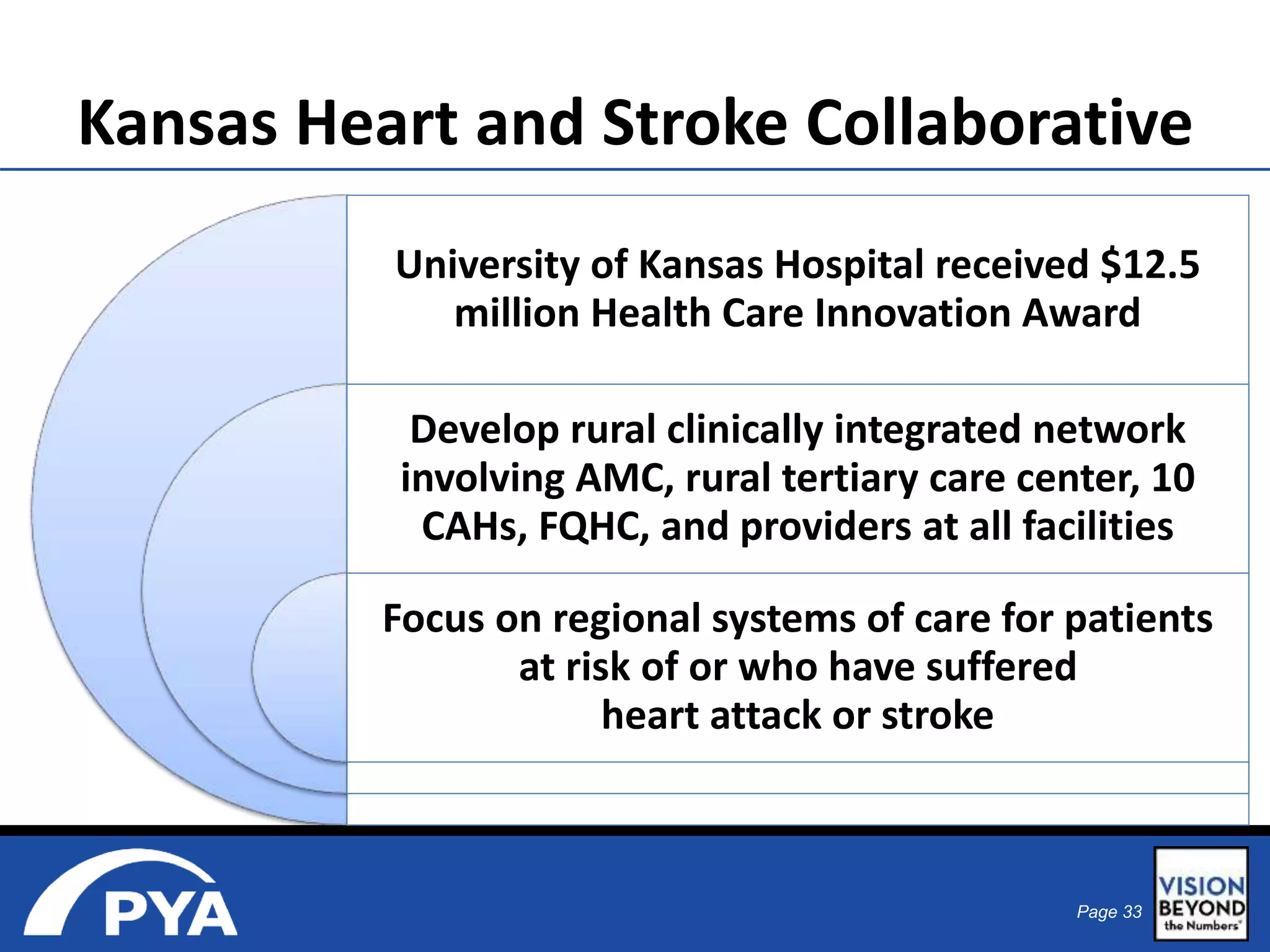
Kansas Heart and Stroke Collaborative 
University of Kansas Hospital received $12.5 
million Health Care Innovation Award 
Develop rural clinically integrated network 
involving AMC, rural tertiary care center, 10 
CAHs, FQHC, and providers at all facilities 
Focus on regional systems of care for patients 
at risk of or who have suffered 
Page 33 
heart attack or stroke
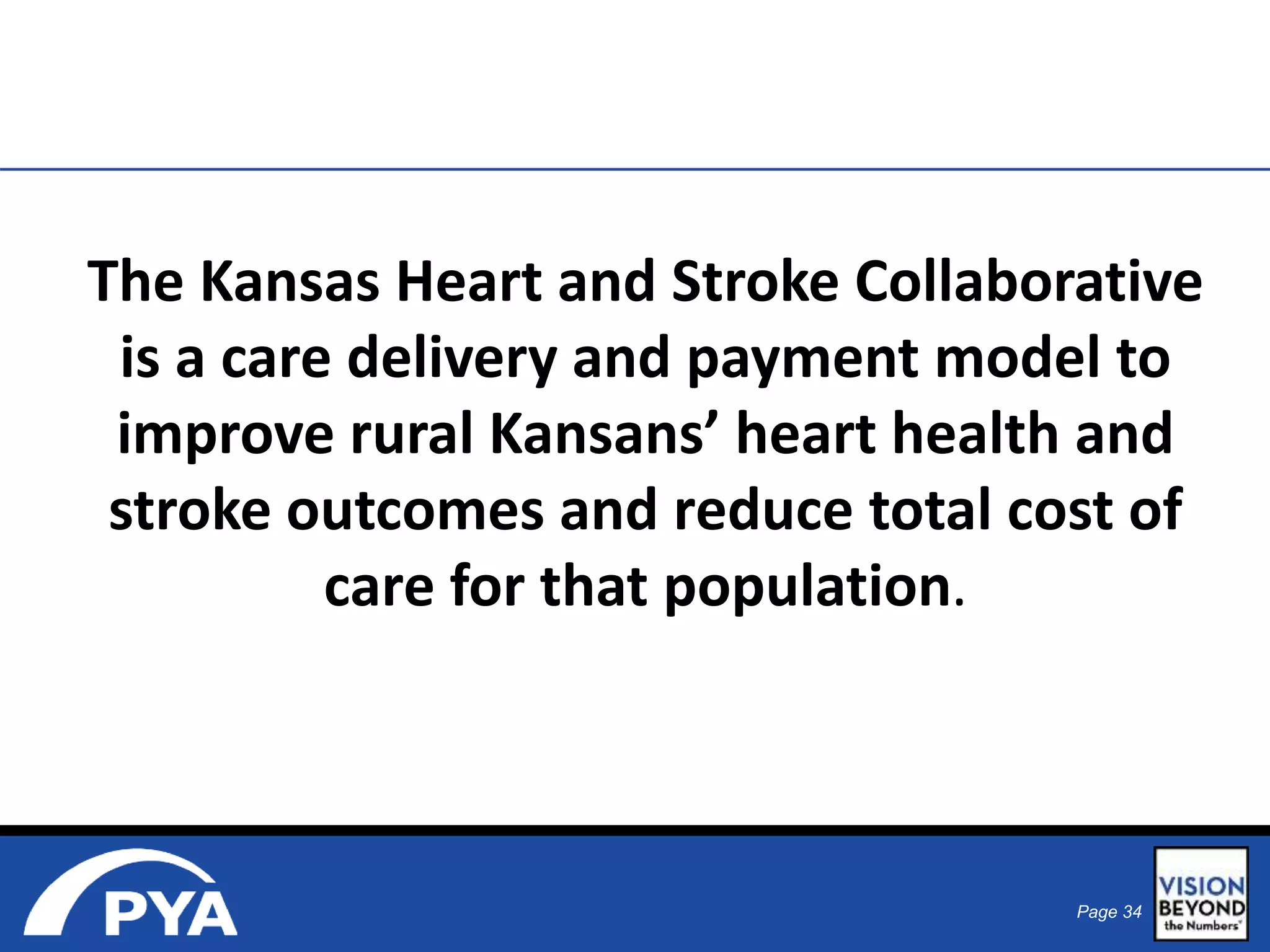
The Kansas Heart and Stroke Collaborative 
is a care delivery and payment model to 
improve rural Kansans’ heart health and 
stroke outcomes and reduce total cost of 
Page 34 
care for that population.
Page 35 
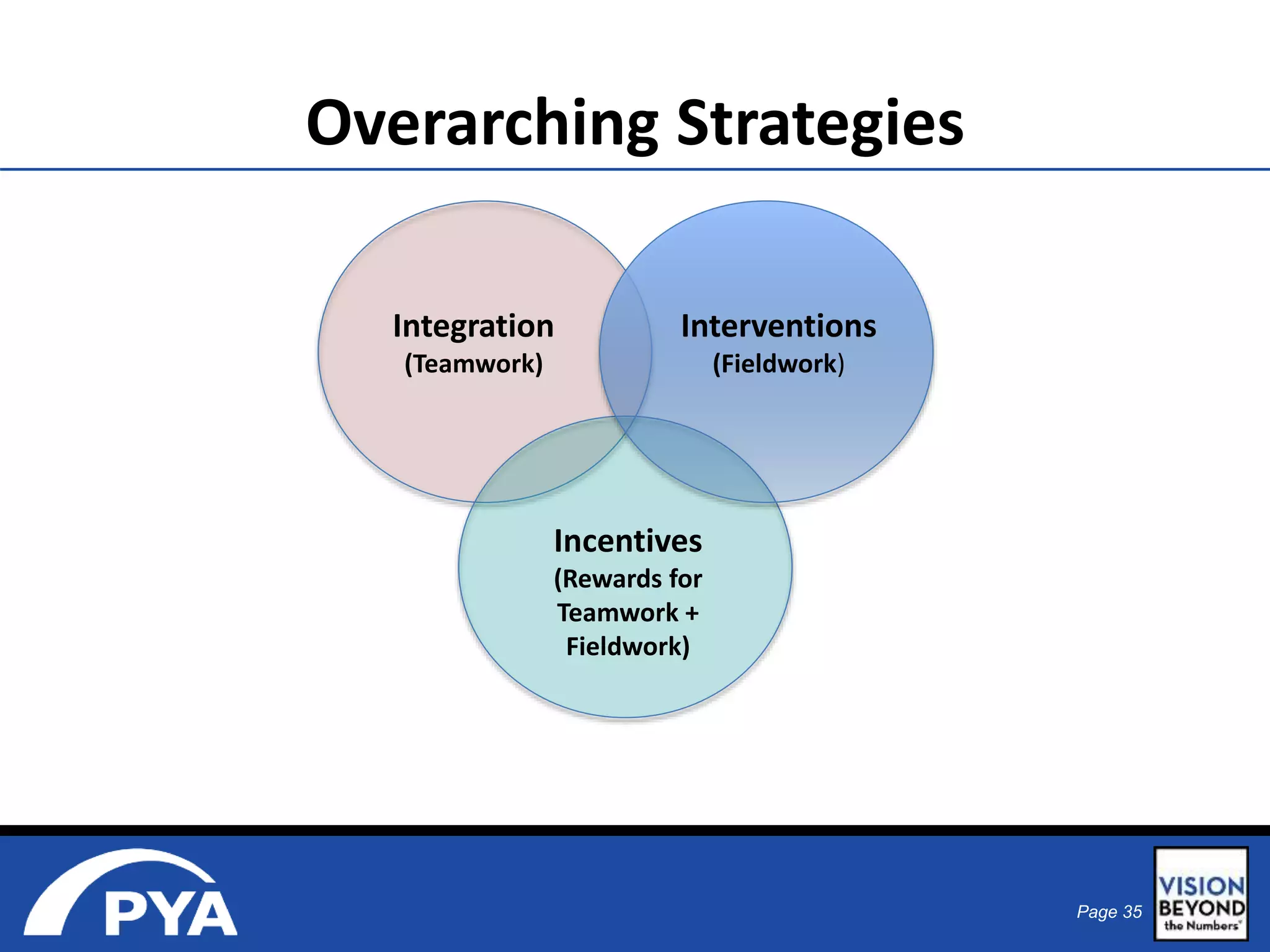
Overarching Strategies 
Integration 
(Teamwork) 
Interventions 
Incentives 
(Rewards for 
Teamwork + 
Fieldwork) 
(Fieldwork)
Page 36 
University of Colorado Health 
• Defensive move against national systems 
– Centura, Health One, Sisters of Charity Leavenworth 
• Focus on efficiencies 
• Prestige of AMC association (research and education) 
• Looking for like-minded partners
Page 37 
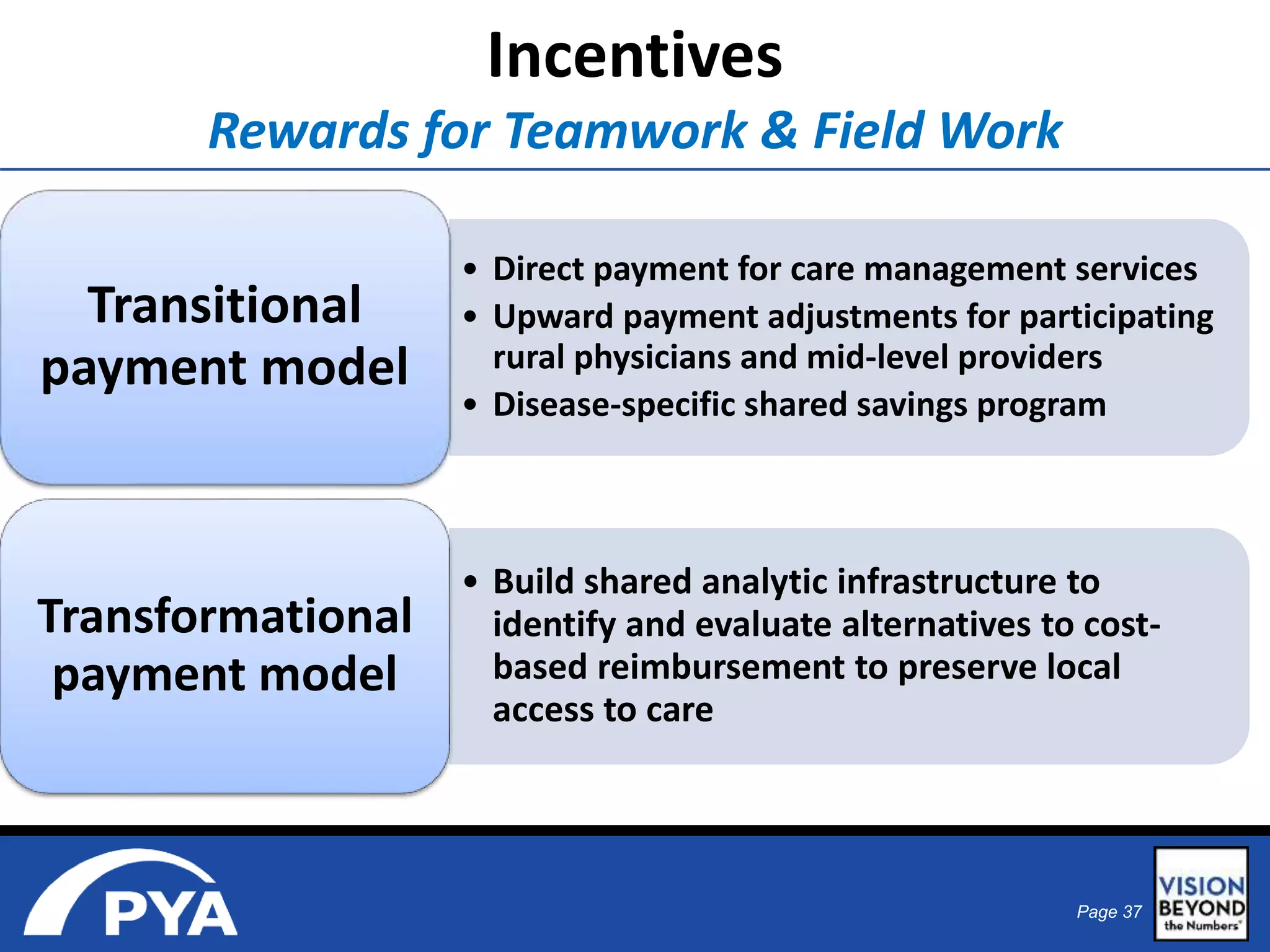
Incentives 
Rewards for Teamwork & Field Work 
• Direct payment for care management services 
• Upward payment adjustments for participating 
rural physicians and mid-level providers 
• Disease-specific shared savings program 
Transitional 
payment model 
• Build shared analytic infrastructure to 
identify and evaluate alternatives to cost-based 
reimbursement to preserve local 
access to care 
Transformational 
payment model
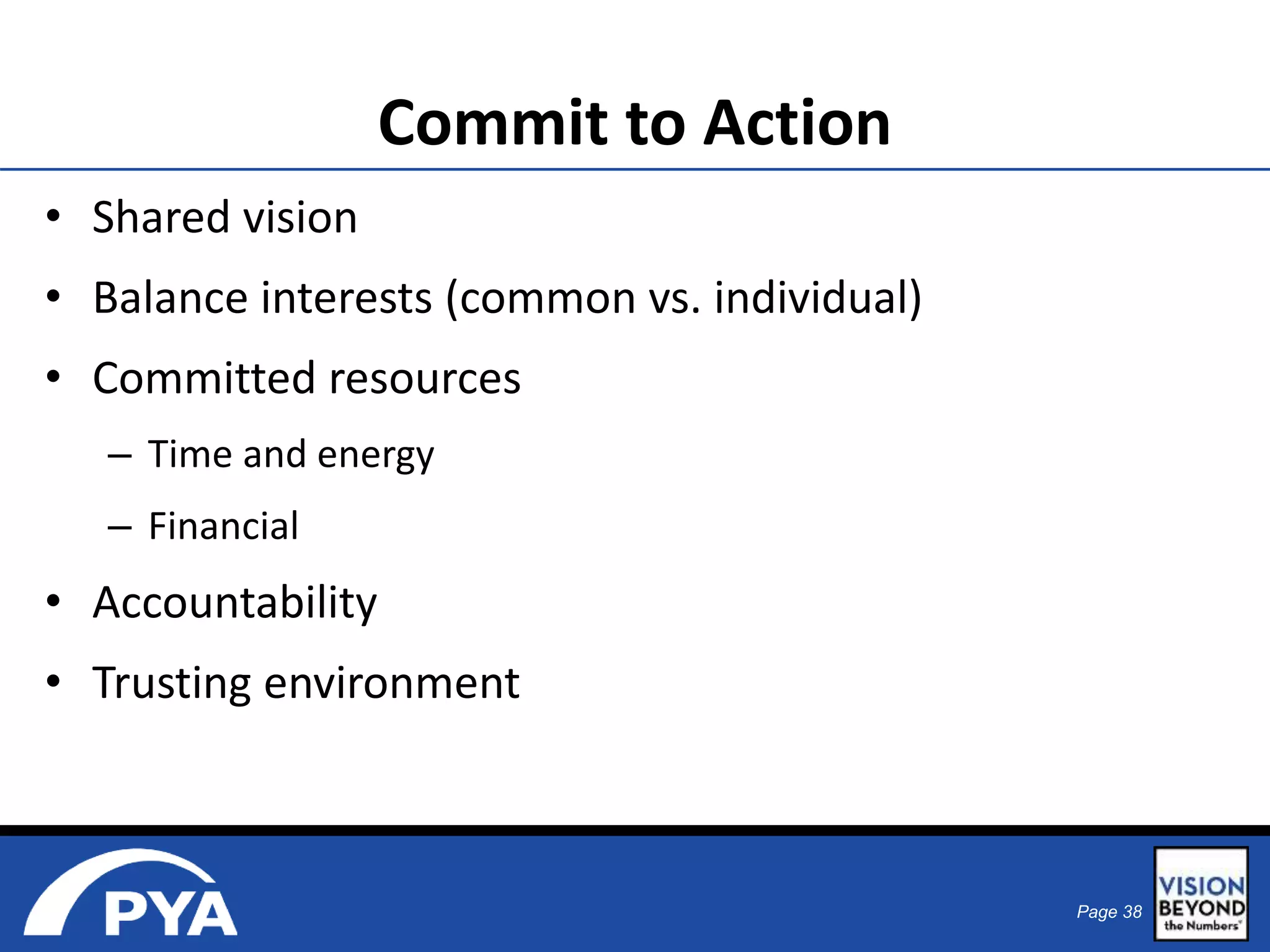
Page 38 
Commit to Action 
• Shared vision 
• Balance interests (common vs. individual) 
• Committed resources 
– Time and energy 
– Financial 
• Accountability 
• Trusting environment
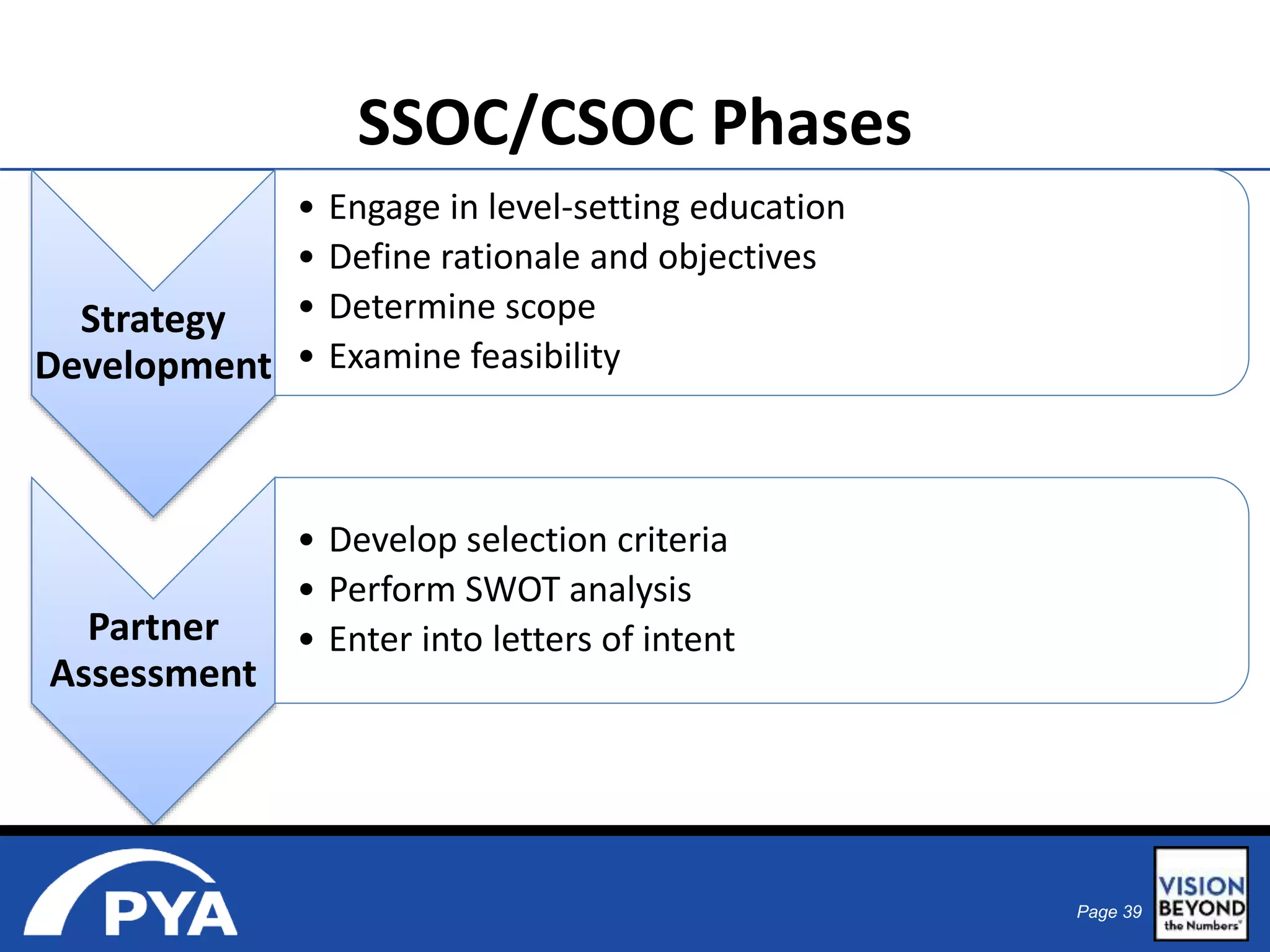
Page 39 
SSOC/CSOC Phases 
Strategy 
Development 
• Engage in level-setting education 
• Define rationale and objectives 
• Determine scope 
• Examine feasibility 
Partner 
Assessment 
• Develop selection criteria 
• Perform SWOT analysis 
• Enter into letters of intent
Page 40 
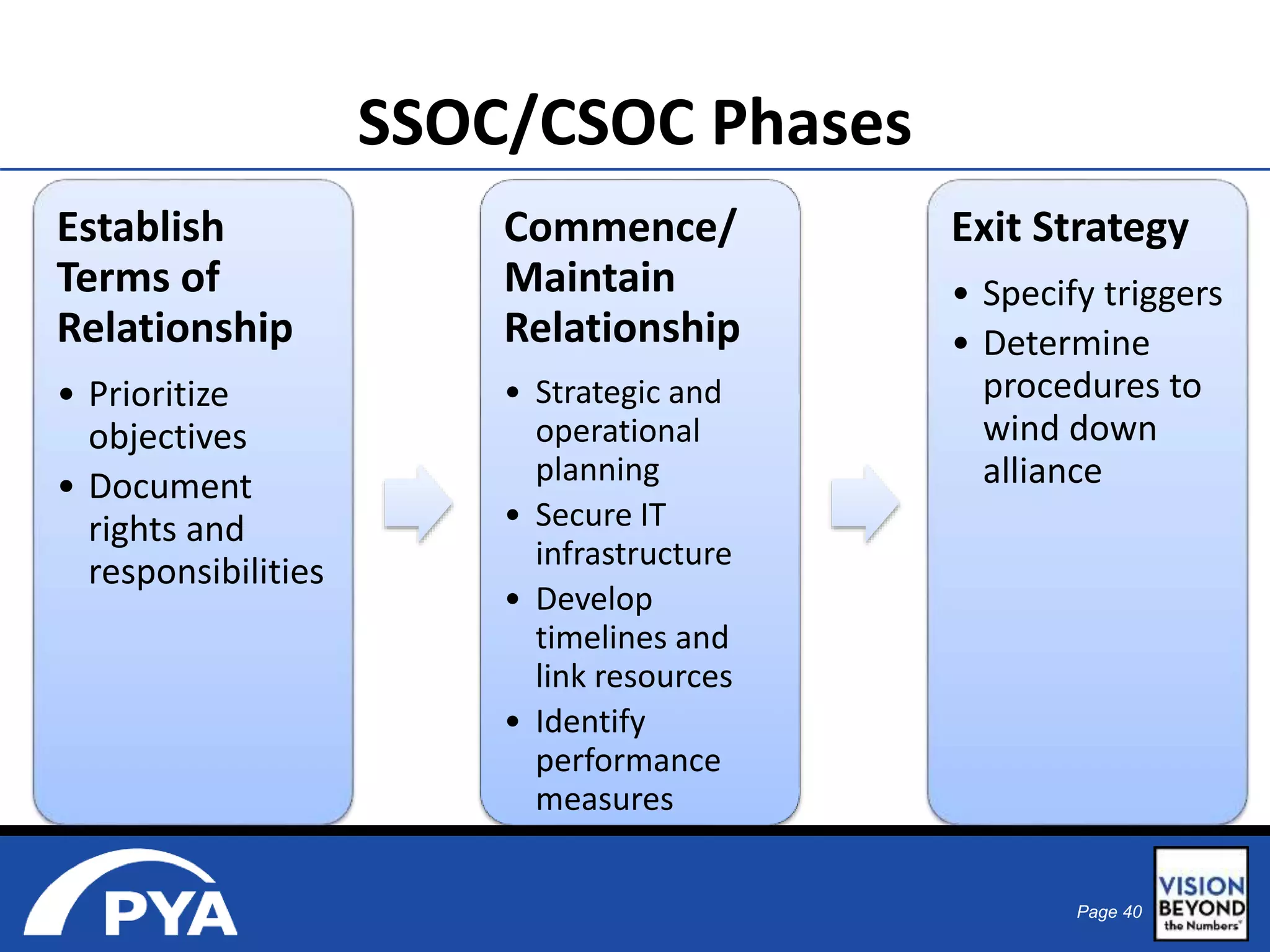
SSOC/CSOC Phases 
Establish 
Terms of 
Relationship 
• Prioritize 
objectives 
• Document 
rights and 
responsibilities 
Commence/ 
Maintain 
Relationship 
• Strategic and 
operational 
planning 
• Secure IT 
infrastructure 
• Develop 
timelines and 
link resources 
• Identify 
performance 
measures 
Exit Strategy 
• Specify triggers 
• Determine 
procedures to 
wind down 
alliance
Page 41 
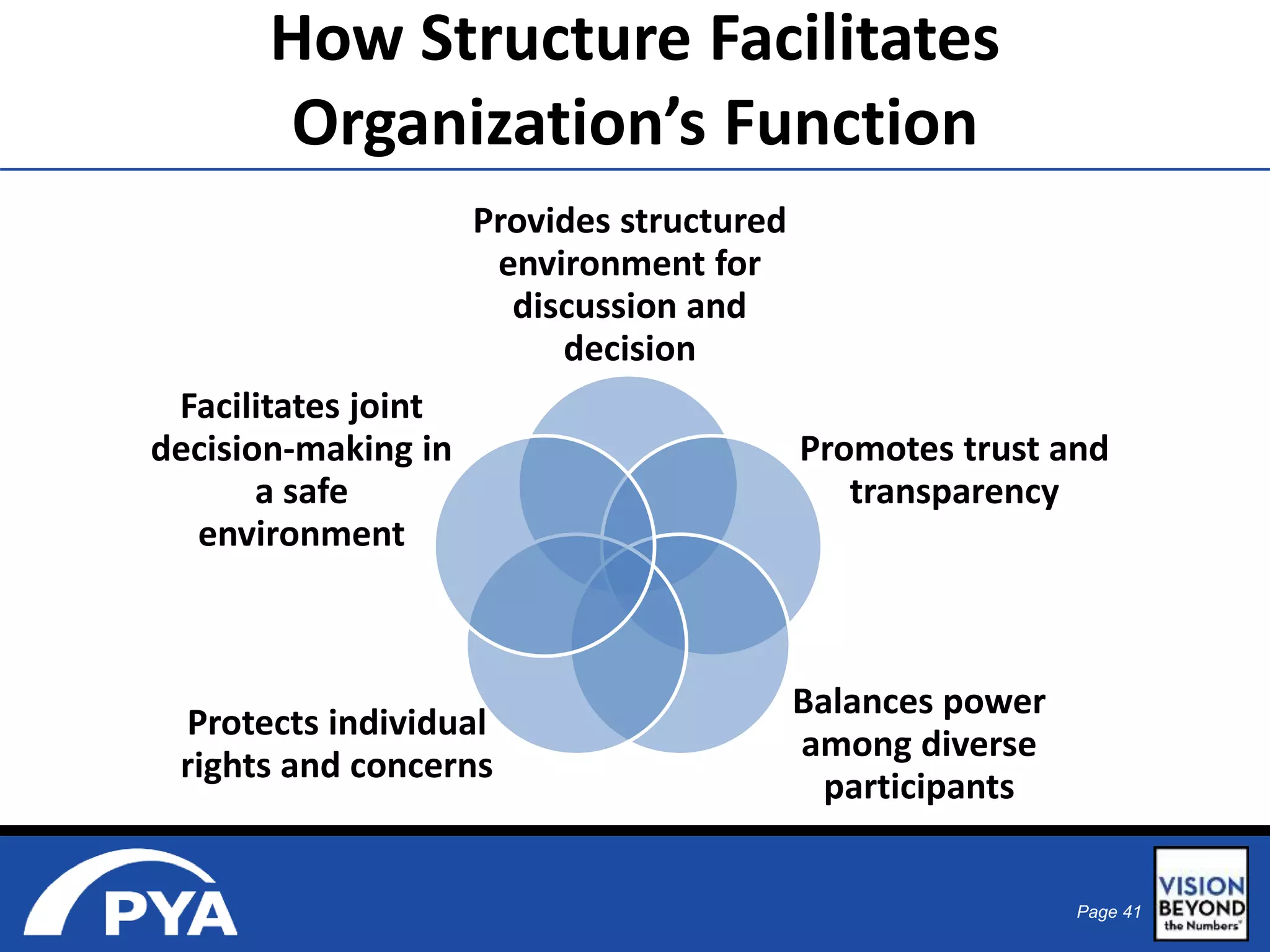
How Structure Facilitates 
Organization’s Function 
Provides structured 
environment for 
discussion and 
decision 
Promotes trust and 
transparency 
Balances power 
among diverse 
participants 
Facilitates joint 
decision-making in 
a safe 
environment 
Protects individual 
rights and concerns
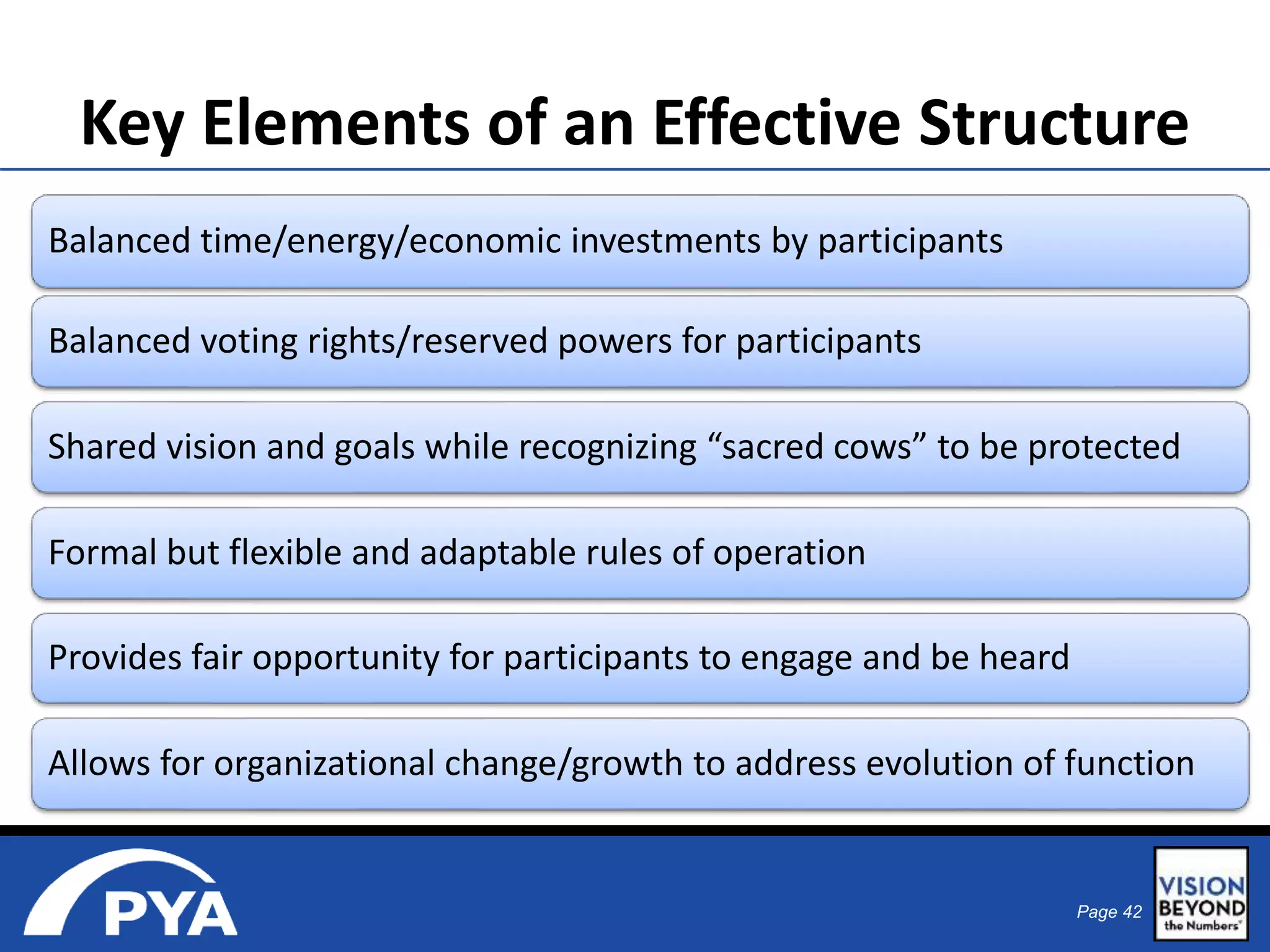
Key Elements of an Effective Structure 
Page 42 
Balanced time/energy/economic investments by participants 
Balanced voting rights/reserved powers for participants 
Shared vision and goals while recognizing “sacred cows” to be protected 
Formal but flexible and adaptable rules of operation 
Provides fair opportunity for participants to engage and be heard 
Allows for organizational change/growth to address evolution of function
Martie Ross 
mross@pyapc.com 
Jeff Ellis 
jellis@pyapc.com 
Pershing Yoakley & Associates, PC 
9900 W. 109th Street, Suite 130 
Overland Park, KS 66210 
913.232.5145 
Prepared for University of Missouri Health System 
November 15, 2013 Page 43

The Third Way--Maintaining Independence Through Interdependence

  • 1.
    Page 1 TheThird Way Maintaining Independence Through Interdependence National Rural Health Association Critical Access Hospital Conference October 2, 2014 – Kansas City, MO
  • 2.
    Page 2 RuralCommunities Residents are older, sicker, poorer, more likely to be uninsured, have higher healthcare costs Fiercely independent Access to healthcare key to survival
  • 3.
    Page 3 RuralHealthcare Pursue strategy of local service delivery High fixed costs/low volume Current payment systems unravelling No defined strategy for payment and delivery system reform
  • 4.
    Page 4 Consolidateor Close or . . .? Capital Investment Joint Operating Agreement Loss of Control Minority Investment Joint Venture Management Agreement Asset Purchase/Acquisition Lease Merger/ Membership Substitution
  • 5.
    Page 5 TheThird Way SSOC Shared Services Operating Company CSOC Clinical System Operations Company
  • 6.
    Shared Services OperatingCompany Page 6 • Governance structure to support decision-making process Independent providers form new company • Group purchasing arrangements • Combine administrative functions • Coordinated IT solutions • Share best practices Leverage resources and pursue economies of scale
  • 7.
    Page 7 SSOCExamples Stratus Healthcare (Georgia) Value Care Alliance (Connecticut) Trivergent Health Alliance (Maryland) Illinois Rural Community Care Organization
  • 8.
    Page 8 Population health management Clinical integration Joint contracting Planned Evolution
  • 9.
    Page 9 ButWhat’s Missing? Still focused on local delivery of care Not addressing continuum of care Still operating in silos
  • 10.
    Page 10 TripleAim Three Dimensions of Value
  • 11.
    Page 11 BringingValue to Healthcare Sick Care Population Health
  • 12.
    Sick Care PopulationHealth Page 12 Provider- Centered Patient- Centered
  • 13.
    Sick Care PopulationHealth Page 13 Diagnose and treat presenting illness or injury Address preventive and chronic care needs of specific population
  • 14.
    Sick Care PopulationHealth Page 14 Fee-for-Service Reimbursement Value-Based Payment Models
  • 15.
    Sick Care PopulationHealth Page 15 Risk Resides With Payer Risk Resides With Provider
  • 16.
    Sick Care PopulationHealth Page 16 Provider Silos Systems of Care
  • 17.
    Page 17 SiloSystem Single provider treats one patient at a time Providers in collaboration support health of defined population
  • 18.
    Care System OperationsCompany • Extended group with similar interests or concerns who interact and remain in informal contact for mutual assistance or support Page 18 Network • Regularly interacting or interdependent group of items forming a unified whole System
  • 19.
    CSOC Characteristics •Vehicle for independent providers to form system of care • Collaborative decision-making through new governance structure Page 19 – Define population served – Establish continuum of care – Define each participant’s role in that continuum – Identify and secure necessary resources – Align incentives – Require accountability
  • 20.
    Page 20 CSOCSurvey Vanderbilt Health Affiliated Network University of Iowa Health Alliance Health Network of Missouri Kansas Heart and Stroke Collaborative
  • 21.
  • 22.
    Vanderbilt Health AffiliatedNetwork • Formed in September 2012 as Vanderbilt employee health plan • Expanded provider network to meet employees’ needs • Now expanding offering to other employers (Aetna and BCBS-TN) Page 22
  • 23.
    VHAN - MountainStates Health Alliance • Share evidence-based care models • Collaborate in medical research and clinical trials • Develop consultative relationships among specialists and subspecialists • Support physician recruitment • Develop continuum of care in cardiovascular and oncology service lines • Develop narrow network for joint contracting Page 23 Affiliation agreement announced in May 2013
  • 24.
    VHAN –West TennesseeHealthcare • Educational program support • Enhance delivery of oncology support programs for physicians and patients • Consultative services to build upon clinical programs • Joint clinical research trials Page 24 Cancer program affiliation agreement announced in May 2013
  • 25.
    University of IowaHealth Alliance Page 25
  • 26.
    University of IowaHealth Alliance • Transition primary care practices to PCMH model • Establish evidence-based medicine standards of care • Pursue programs to determine/address health status of communities • Develop provider educational programs • Pursue patient engagement strategies • Share IT and data analytics costs • Collaborate in research initiatives • Position organizations to participate in new payment models Page 26 Formed in 2012 among 4 health systems (50 hospitals); provider network for Iowa/NE CO-OP
  • 27.
  • 28.
    Page 28 HealthNetwork of Missouri Academic medical center + 4 community hospitals 2+ years as learning collaborative Formed new entity in June 2014 to develop clinically integrated network
  • 29.
  • 30.
    Page 30 NetworkCompacts Covenants among all Members Developed and operationalized by task forces comprised of Member representatives Specific charges to task forces developed through Steering Committee planning process Interactive and mutually supportive
  • 31.
    Page 31 MemberContracts Vehicle for arrangements between less than all Members Allows Alliance to move expeditiously on matters of interest to individual Member groupings Network Compact development takes priority, but can pursue Member Contracts at same time Transparency between Members about work being done under Member Contracts
  • 32.
    Page 32 MDAnderson, Mayo, Cleveland Clinic • Franchise reputation – Control vs. collaboration • Disease specific (cancer, heart) • Continuum of care? • Reach out to rural?
  • 33.
    Kansas Heart andStroke Collaborative University of Kansas Hospital received $12.5 million Health Care Innovation Award Develop rural clinically integrated network involving AMC, rural tertiary care center, 10 CAHs, FQHC, and providers at all facilities Focus on regional systems of care for patients at risk of or who have suffered Page 33 heart attack or stroke
  • 34.
    The Kansas Heartand Stroke Collaborative is a care delivery and payment model to improve rural Kansans’ heart health and stroke outcomes and reduce total cost of Page 34 care for that population.
  • 35.
    Page 35 OverarchingStrategies Integration (Teamwork) Interventions Incentives (Rewards for Teamwork + Fieldwork) (Fieldwork)
  • 36.
    Page 36 Universityof Colorado Health • Defensive move against national systems – Centura, Health One, Sisters of Charity Leavenworth • Focus on efficiencies • Prestige of AMC association (research and education) • Looking for like-minded partners
  • 37.
    Page 37 Incentives Rewards for Teamwork & Field Work • Direct payment for care management services • Upward payment adjustments for participating rural physicians and mid-level providers • Disease-specific shared savings program Transitional payment model • Build shared analytic infrastructure to identify and evaluate alternatives to cost-based reimbursement to preserve local access to care Transformational payment model
  • 38.
    Page 38 Committo Action • Shared vision • Balance interests (common vs. individual) • Committed resources – Time and energy – Financial • Accountability • Trusting environment
  • 39.
    Page 39 SSOC/CSOCPhases Strategy Development • Engage in level-setting education • Define rationale and objectives • Determine scope • Examine feasibility Partner Assessment • Develop selection criteria • Perform SWOT analysis • Enter into letters of intent
  • 40.
    Page 40 SSOC/CSOCPhases Establish Terms of Relationship • Prioritize objectives • Document rights and responsibilities Commence/ Maintain Relationship • Strategic and operational planning • Secure IT infrastructure • Develop timelines and link resources • Identify performance measures Exit Strategy • Specify triggers • Determine procedures to wind down alliance
  • 41.
    Page 41 HowStructure Facilitates Organization’s Function Provides structured environment for discussion and decision Promotes trust and transparency Balances power among diverse participants Facilitates joint decision-making in a safe environment Protects individual rights and concerns
  • 42.
    Key Elements ofan Effective Structure Page 42 Balanced time/energy/economic investments by participants Balanced voting rights/reserved powers for participants Shared vision and goals while recognizing “sacred cows” to be protected Formal but flexible and adaptable rules of operation Provides fair opportunity for participants to engage and be heard Allows for organizational change/growth to address evolution of function
  • 43.
    Martie Ross mross@pyapc.com Jeff Ellis jellis@pyapc.com Pershing Yoakley & Associates, PC 9900 W. 109th Street, Suite 130 Overland Park, KS 66210 913.232.5145 Prepared for University of Missouri Health System November 15, 2013 Page 43

Editor's Notes