The State of Dark Data | Splunk 1
A Global Research Survey of 1,300+ Business and IT
Decision Makers Across Seven Leading Economies
The State of Dark Data | Splunk 2
TABLE OF
CONTENTS
Executive Summary................................................................................... 3
About the Survey........................................................................................ 5
Key Findings................................................................................................7
Part I: THE FUTURE OF DATA...................................................................11
Part II: AI: THE NEXT FRONTIER............................................................14
Part III: THE FUTURE OF JOBS...............................................................16
Conclusion..................................................................................................19
Key Recommendations............................................................................20
Appendix: Regional Trends..................................................................... 22
THE STATE OF DARK DATA
Industry Leaders Reveal the Gap
Between AI’s Potential and Today’s
Data Reality
Jan 18:10:55:111] "GET /category.sc
http://buttercup-shopping.com/cart.do?action=addtocart&itemId=EST-27&product_id=AV-SB
http://buttercup-shoppi
"GET /product.screen?product_id=FL-DSH-01&JSESSIONID=SD5SL7FF6AD
category_id=SURPRISE&JSESS
Learn more: splunk.com/darkdata
The State of Dark Data | Splunk 3
Data shapes every facet of the organization. It inspires
ideas, solves problems and makes money. In 2017, The
Economist declared data to be the world’s most valuable
resource, “the new oil.” Gartner says to treat data as an
asset. Forrester calls it “the new currency of business.”
For such a valuable asset, it’s surprising how much of it
we lose track of.
Fifty-five percent of an organization’s data is “dark” —
unquantified and untapped — according to new global
research by TRUE Global Intelligence, sponsored by
Splunk. The 1,300 business leaders surveyed recognize
that data is key to success, now and into the future, yet
very few say their organizations can successfully tap the
value of all of their data. Or find it.
The power of “big data” and increasingly sophisticated
analytics tools — the revolutionary promises of machine
learning and artificial intelligence — rely on our ability
to combine disparate data to uncover new insights. New
customer segments. New efficiencies. Tougher security.
Whole new lines of business.
We live in a data-saturated world. Billions of
interconnected devices communicate with countless
cloud services. We accumulate data from server log
files, GPS networks, security tools, call records, web
traffic and more. Every digital transaction, from back-
end handoffs to the
customer’s fingertips, is
catalogued. Everything
from the contents of
a warehouse’s shelves
to the temperature of
our server rooms to
the time and location
of every login to our
secure networks is
recorded and stored …
somewhere. Most of it,
today, is unstructured,
untagged, untapped. In
a word, useless.
If you want to be ahead or not
eliminated in a fierce market, you
need the support of intelligence,
and the vast majority of this
information comes out of this
chaotic data.”
— Survey Respondent
(CIO, Financial Services, China)
“
EXECUTIVE
SUMMARY
Data is our greatest asset — yet we’re lucky if we can find half of it.
http://buttercup-shopping.com/cart.
http://butterc
"GET /product.screen?
S&JSESSIONID=SD8SL8FF1ADFF6
ocart&itemId=EST-27&product_id=AV-SB-02
screen?product_id=FL-DSH-01&JSESSIONID=SD5SL7FF6AD
NID=SD9SL4FF4ADFF7
The State of Dark Data | Splunk 4
Out of the Darkness
Dark data may be the biggest untapped resource in
business today. Dark data, which includes the “data
exhaust” generated as a byproduct of our online lives,
is all the unknown and untapped data across your
organization, generated by systems, devices and
interactions. Maybe it’s siloed off somewhere; maybe
the format or metadata is inconsistent. Maybe no one’s
figured out what to do with it. Maybe you literally don’t
know it exists.
Most organizations struggle to capitalize on the full
potential of their data. A full third of respondents report
that more than 75 percent of their organization’s data
is dark. Just 11 percent — one in nine — report that less
than a quarter of their organization’s data is dark.
Inadequate processes, resources and technology
hamper the intelligent use of dark data. Neglected by
business and IT managers, dark data is an underused
asset that demands a more sophisticated approach to
how organizations collect, manage and analyze infor-
mation. Yet respondents also voiced hesitance about
diving in.
It’s a challenge, and an opportunity, of surprising scale.
Machine data, a major source of dark data, is growing
much faster than traditional organizational data, with
an accelerating importance to decision making and
organizational success. And because dark data can be
a powerful fuel for artificial intelligence, organizations
that fail to tap its power will also fail to keep up with,
much less surpass, their competitors.
And competition is global. Our survey found consid-
erable differences of opinion about data and artificial
intelligence. Some European countries seem to lag
behind a global average, while other nations, notably
China, voice a much more forward-thinking approach.
Organizations must grasp the opportunities and
confront the challenges of dark data — through greater
strategic thinking, targeted technology investment, and
more energetic and comprehensive skills training — to
take full advantage of the next data revolution. Organi-
zations need to think now about how to bring dark data
into the light.
http://buttercup-shopping.com/cart.do?action=addtoc
http://buttercup-shopping.com/
"GET /product.screen?product_id=FL-DSH
SSIONID=SD8SL8FF1ADFF6
V-SB-02
http://buttercup-shopping.com/cart.do?action=addtocart&itemId=EST-27&product_id=AV-SB-02
DSH-01&JSESSIONID=SD5SL7FF6AD
All the unknown and
untapped data across
your company, generated
by systems, devices and
interactions.
What
Is Dark
Data?
The State of Dark Data | Splunk 5
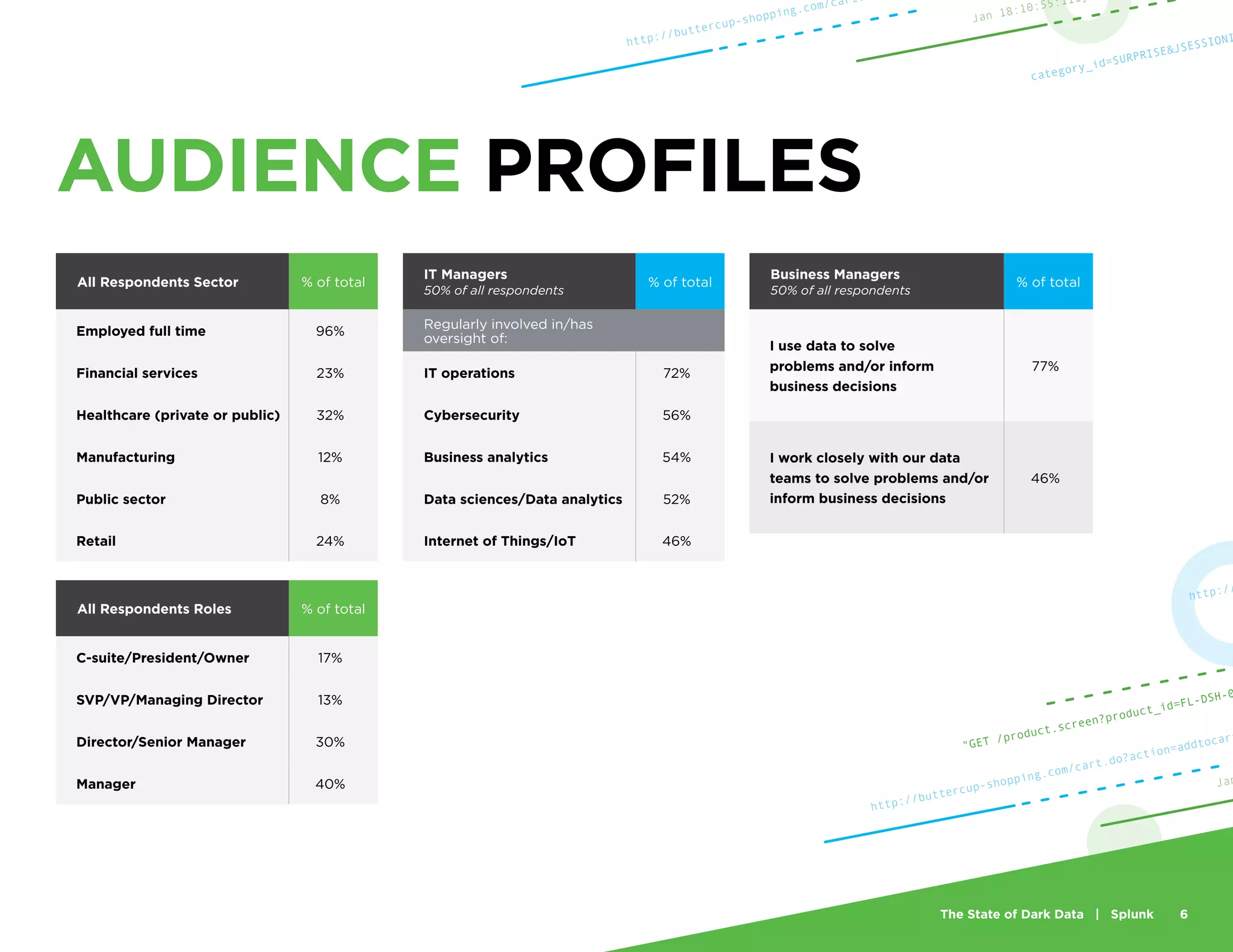
This report is based on a survey conducted in seven
countries by TRUE Global Intelligence. The respondents
are global business and IT executives and managers
engaged with how their organizations collect, manage
and use data. Evenly split between IT and business roles,
the respondents were 30 percent C-suite/owners and
senior leadership (VP/SVP), 30 percent director-level,
and 40 percent managers. The survey was conducted
between October 2018 and January 2019 in the following
markets, in local languages:
ABOUT THE SURVEY
Background and Methodology
Respondents were presented with
the following definition of data:
Information that can be
captured, quantified and
analyzed.
US
n=506
UK
n=150
France
n=150
China
n=150
Japan
n=101
Australia
n=150
Germany
n=150
Jan 18:10:55:111]
http://buttercup-shopping.com/cart.do
category_id=SURPRISE&JSESSIONID=SD9SL4FF4
The State of Dark Data | Splunk 6
AUDIENCE PROFILES
All Respondents Sector % of total
Employed full time 96%
Financial services 23%
Healthcare (private or public) 32%
Manufacturing 12%
Public sector 8%
Retail 24%
All Respondents Roles % of total
C-suite/President/Owner 17%
SVP/VP/Managing Director 13%
Director/Senior Manager 30%
Manager 40%
Jan 18:10:55:111
http://buttercup-shopping.com/cart.
category_id=SURPRISE&JSESSIONI
Business Managers
50% of all respondents
% of total
I use data to solve
problems and/or inform
business decisions
77%
I work closely with our data
teams to solve problems and/or
inform business decisions
46%
IT Managers
50% of all respondents
% of total
Regularly involved in/has
oversight of:
IT operations 72%
Cybersecurity 56%
Business analytics 54%
Data sciences/Data analytics 52%
Internet of Things/IoT 46%
Jan
http://buttercup-shopping.com/cart.do?action=addtocart
http://
"GET /product.screen?product_id=FL-DSH-0
The State of Dark Data | Splunk 7
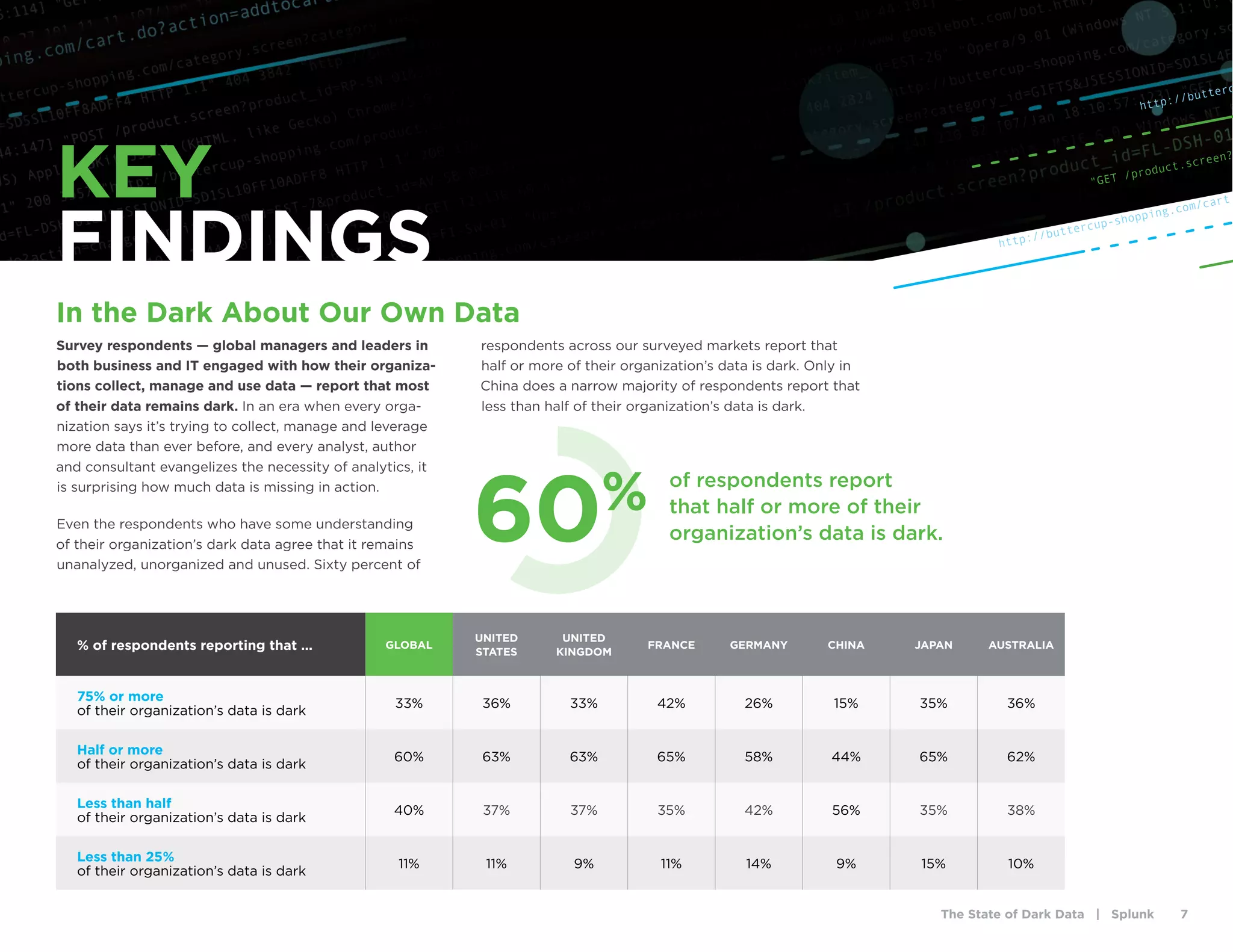
Survey respondents — global managers and leaders in
both business and IT engaged with how their organiza-
tions collect, manage and use data — report that most
of their data remains dark. In an era when every orga-
nization says it’s trying to collect, manage and leverage
more data than ever before, and every analyst, author
and consultant evangelizes the necessity of analytics, it
is surprising how much data is missing in action.
Even the respondents who have some understanding
of their organization’s dark data agree that it remains
unanalyzed, unorganized and unused. Sixty percent of
respondents across our surveyed markets report that
half or more of their organization’s data is dark. Only in
China does a narrow majority of respondents report that
less than half of their organization’s data is dark.
% of respondents reporting that ... GLOBAL
UNITED
STATES
UNITED
KINGDOM
FRANCE GERMANY CHINA JAPAN AUSTRALIA
75% or more
of their organization’s data is dark
33% 36% 33% 42% 26% 15% 35% 36%
Half or more
of their organization’s data is dark
60% 63% 63% 65% 58% 44% 65% 62%
Less than half
of their organization’s data is dark
40% 37% 37% 35% 42% 56% 35% 38%
Less than 25%
of their organization’s data is dark
11% 11% 9% 11% 14% 9% 15% 10%
In the Dark About Our Own Data
KEY
FINDINGS http://buttercup-shopping.com/cart
http://butterc
"GET /product.screen?
of respondents report
that half or more of their
organization’s data is dark.
60%
The State of Dark Data | Splunk 8
Data Counts …
But We Can’t Count It
The leaders we surveyed
understand the power and
potential of data. Nonetheless,
they confessed their organi-
zations lacked the resources,
processes or skills to make it
usable.
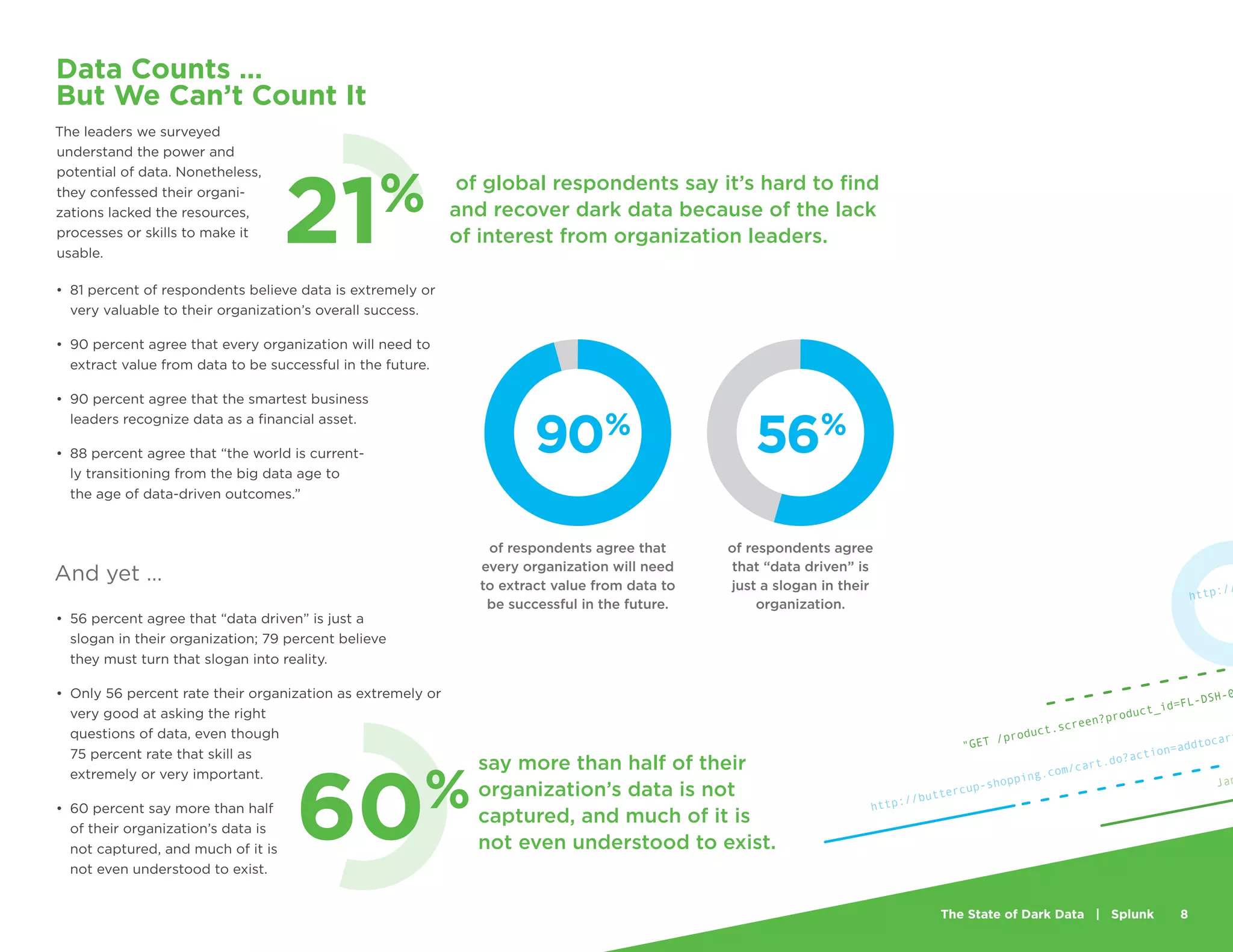
•	 81 percent of respondents believe data is extremely or
very valuable to their organization’s overall success.
•	 90 percent agree that every organization will need to
extract value from data to be successful in the future.
•	 90 percent agree that the smartest business
leaders recognize data as a financial asset.
•	 88 percent agree that “the world is current-
ly transitioning from the big data age to
the age of data-driven outcomes.”
And yet …
•	 56 percent agree that “data driven” is just a
slogan in their organization; 79 percent believe
they must turn that slogan into reality.
•	 Only 56 percent rate their organization as extremely or
very good at asking the right
questions of data, even though
75 percent rate that skill as
extremely or very important.
•	 60 percent say more than half
of their organization’s data is
not captured, and much of it is
not even understood to exist.
Jan
http://buttercup-shopping.com/cart.do?action=addtocart
http://
"GET /product.screen?product_id=FL-DSH-0
of respondents agree that
every organization will need
to extract value from data to
be successful in the future.
90%
of respondents agree
that “data driven” is
just a slogan in their
organization.
56%
21% of global respondents say it’s hard to find
and recover dark data because of the lack
of interest from organization leaders.
say more than half of their
organization’s data is not
captured, and much of it is
not even understood to exist.
60%
The State of Dark Data | Splunk 9
Jan 18:10:55:111
http://buttercup-shopping.com/cart.do?action=addtocart&item
http://butt
"GET /product.screen?product_id=FL-DSH-01&JSESSIONID=S
category
Data Skills Matter …
to Someone Else
Even though the vast majority of respondents agree
on the value of data to their companies and careers,
many say they’d be content to let others take the lead,
even at the expense of their own career progress.
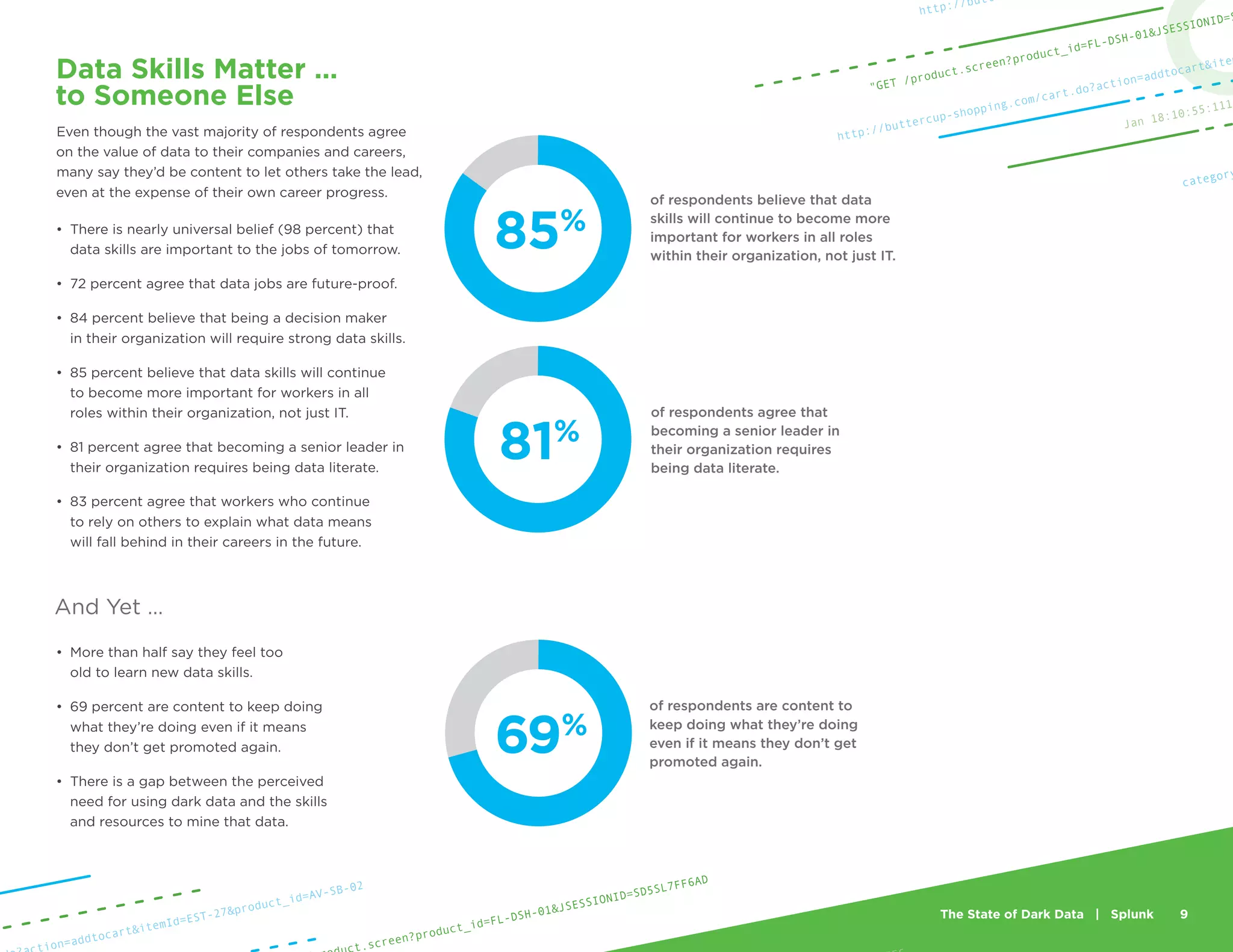
•	 There is nearly universal belief (98 percent) that
data skills are important to the jobs of tomorrow.
•	 72 percent agree that data jobs are future-proof.
•	 84 percent believe that being a decision maker
in their organization will require strong data skills.
•	 85 percent believe that data skills will continue
to become more important for workers in all
roles within their organization, not just IT.
•	 81 percent agree that becoming a senior leader in
their organization requires being data literate.
•	 83 percent agree that workers who continue
to rely on others to explain what data means
will fall behind in their careers in the future.
And Yet …
•	 More than half say they feel too
old to learn new data skills.
•	 69 percent are content to keep doing
what they’re doing even if it means
they don’t get promoted again.
•	 There is a gap between the perceived
need for using dark data and the skills
and resources to mine that data.
ion=addtocart&itemId=EST-27&product_id=AV-SB-02
t.screen?product_id=FL-DSH-01&JSESSIONID=SD5SL7FF6AD
of respondents believe that data
skills will continue to become more
important for workers in all roles
within their organization, not just IT.
85%
of respondents agree that
becoming a senior leader in
their organization requires
being data literate.
81%
of respondents are content to
keep doing what they’re doing
even if it means they don’t get
promoted again.
69%
The State of Dark Data | Splunk 10
Regional Variations
It’s worth noting the regional variations in survey
responses to see what insight we might derive. For
instance, Chinese respondents consistently placed the
highest value on data and data skills, and reported the
highest level of understanding of AI and the lowest
percentage of dark data.
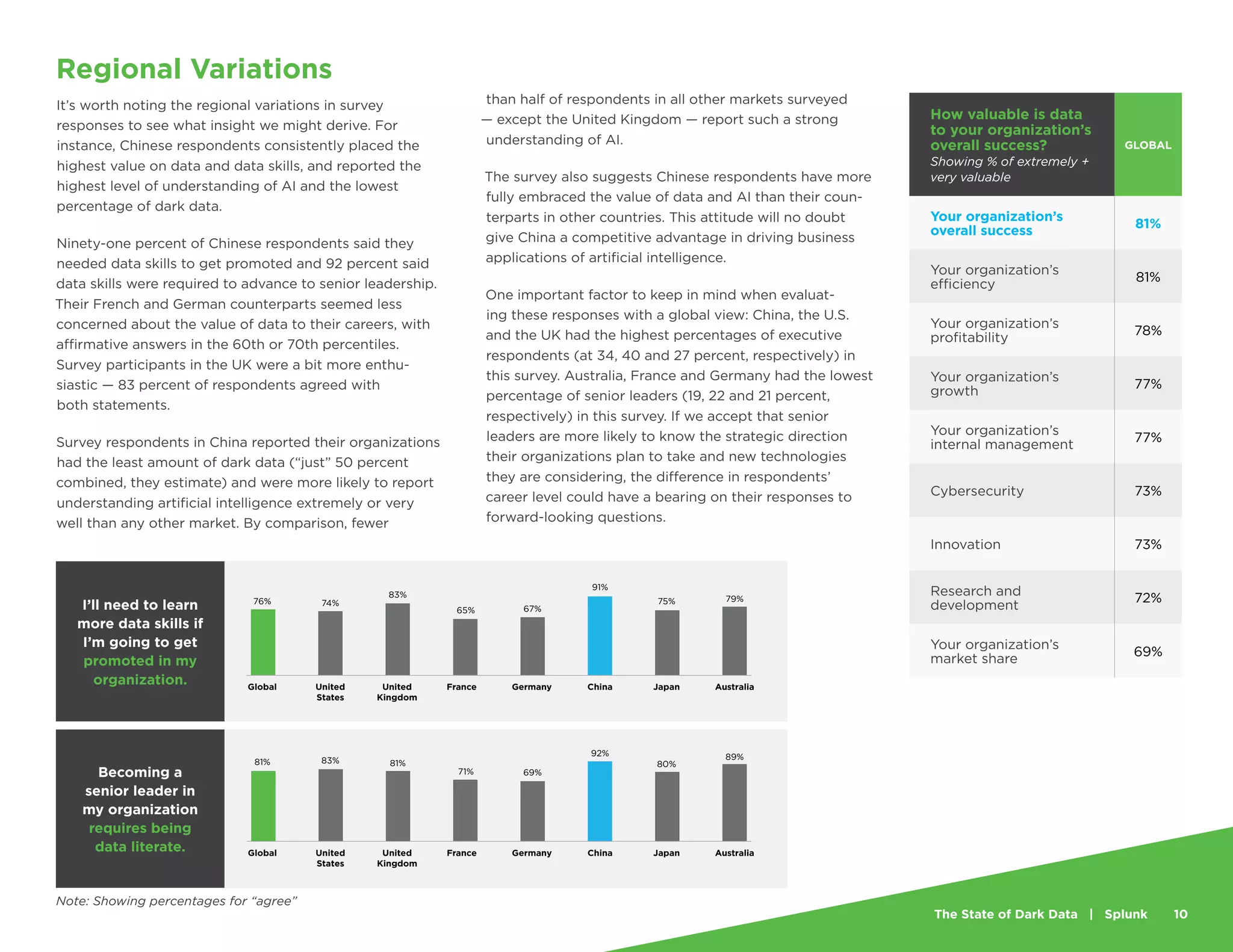
Ninety-one percent of Chinese respondents said they
needed data skills to get promoted and 92 percent said
data skills were required to advance to senior leadership.
Their French and German counterparts seemed less
concerned about the value of data to their careers, with
affirmative answers in the 60th or 70th percentiles.
Survey participants in the UK were a bit more enthu-
siastic ­
— 83 percent of respondents agreed with
both statements.
Survey respondents in China reported their organizations
had the least amount of dark data (“just” 50 percent
combined, they estimate) and were more likely to report
understanding artificial intelligence extremely or very
well than any other market. By comparison, fewer
than half of respondents in all other markets surveyed
— except the United Kingdom — report such a strong
understanding of AI.
The survey also suggests Chinese respondents have more
fully embraced the value of data and AI than their coun-
terparts in other countries. This attitude will no doubt
give China a competitive advantage in driving business
applications of artificial intelligence.
One important factor to keep in mind when evaluat-
ing these responses with a global view: China, the U.S.
and the UK had the highest percentages of executive
respondents (at 34, 40 and 27 percent, respectively) in
this survey. Australia, France and Germany had the lowest
percentage of senior leaders (19, 22 and 21 percent,
respectively) in this survey. If we accept that senior
leaders are more likely to know the strategic direction
their organizations plan to take and new technologies
they are considering, the difference in respondents’
career level could have a bearing on their responses to
forward-looking questions.
How valuable is data
to your organization’s
overall success?
Showing % of extremely +
very valuable
GLOBAL
Your organization’s
overall success
81%
Your organization’s
efficiency
81%
Your organization’s
profitability
78%
Your organization’s
growth
77%
Your organization’s
internal management
77%
Cybersecurity 73%
Innovation 73%
Research and
development
72%
Your organization’s
market share
69%
I’ll need to learn
more data skills if
I’m going to get
promoted in my
organization. Global United
Kingdom
France Germany China Japan Australia
United
States
76% 74%
83%
65%
91%
75% 79%
67%
Becoming a
senior leader in
my organization
requires being
data literate. Global United
Kingdom
France Germany China Japan Australia
United
States
81% 83% 81%
71%
92%
80%
89%
69%
Note: Showing percentages for “agree”
The State of Dark Data | Splunk 11
http://buttercup-shopping.com/cart.do?acti
http://bu
"GET /product.screen?product
PART I:
THE FUTURE
OF DATA
The organization that uses the most data will win.
What good is all this data if nobody’s using more than
a fraction of it? While our respondents strongly agreed
that we’re transitioning into an era of data-driven busi-
ness outcomes, most are not taking steps to surface the
dark data that could give them better, more accurate
insights and increased competitive advantage.
Respondents also recognize a wide gap between the
skills they have now and the ones they’ll need in the
future, particularly technical skills.
And virtually all the respondents, across the globe,
believe that the value of data will grow and become
increasingly central to organizational success in the
future. This suggests organizations will continue to
invest in technologies, processes and talent around data
and analytics.
•	 71 percent expect data to become more valuable
over the next 10 years, and nearly all expect data to
become more influential to their decision making.
•	 76 percent agree “the organization that
has the most data is going to win.”
•	 88 percent agree “the world is current-
ly transitioning from the big data age to
the age of data-driven outcomes.”
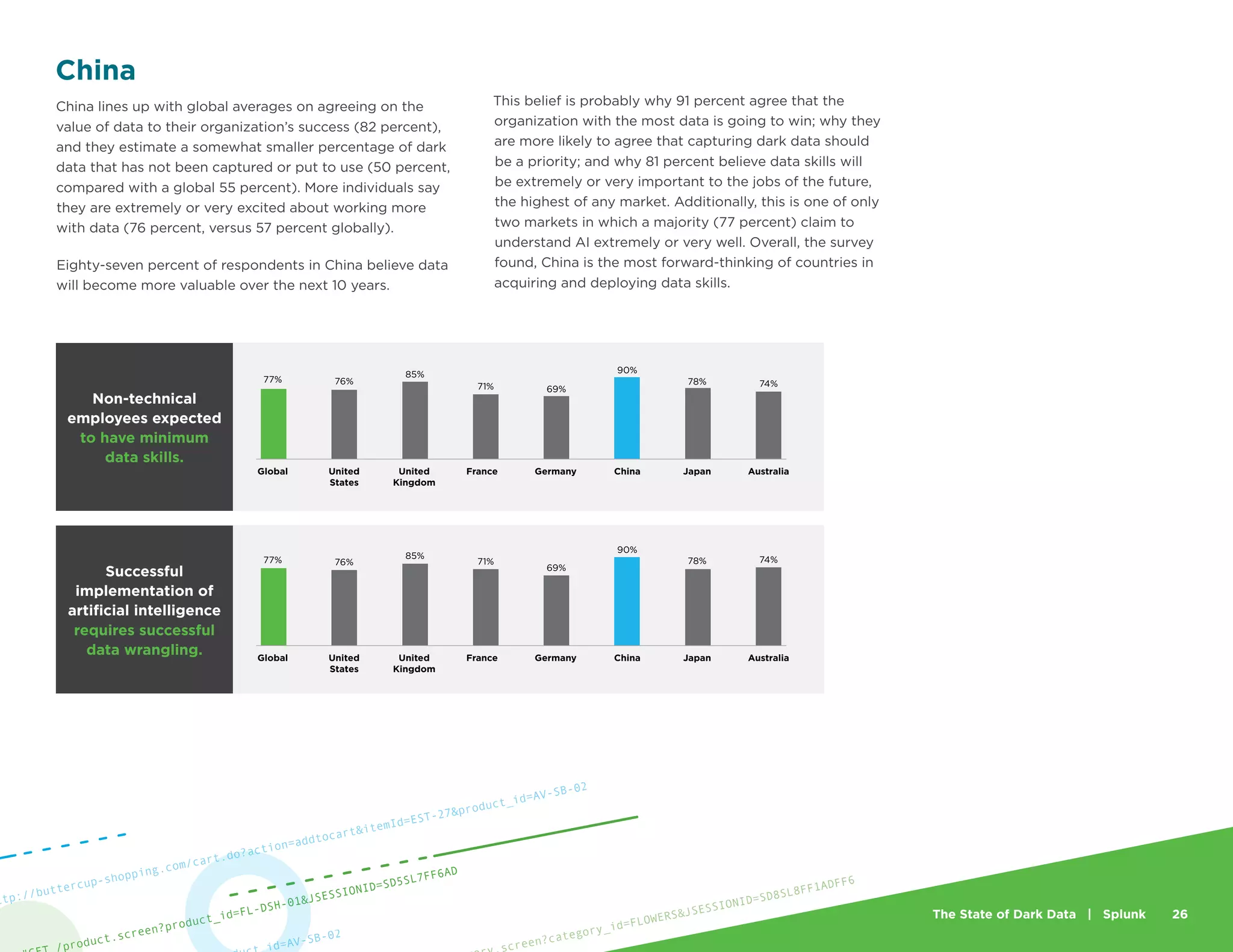
•	 85 percent agree successful implementation of
AI requires successful data management.
Respondents recognize that data shapes all facets
of their organizations, fueling the insights that make
organizations more innovative and profitable. A better,
more complete understanding of an organization’s data
will continue improvements in analytics-based deci-
sion making, a key reason to surface dark data. This
untapped data represents a world of potential to under-
stand customer behavior and other metrics, propelling
business forward.
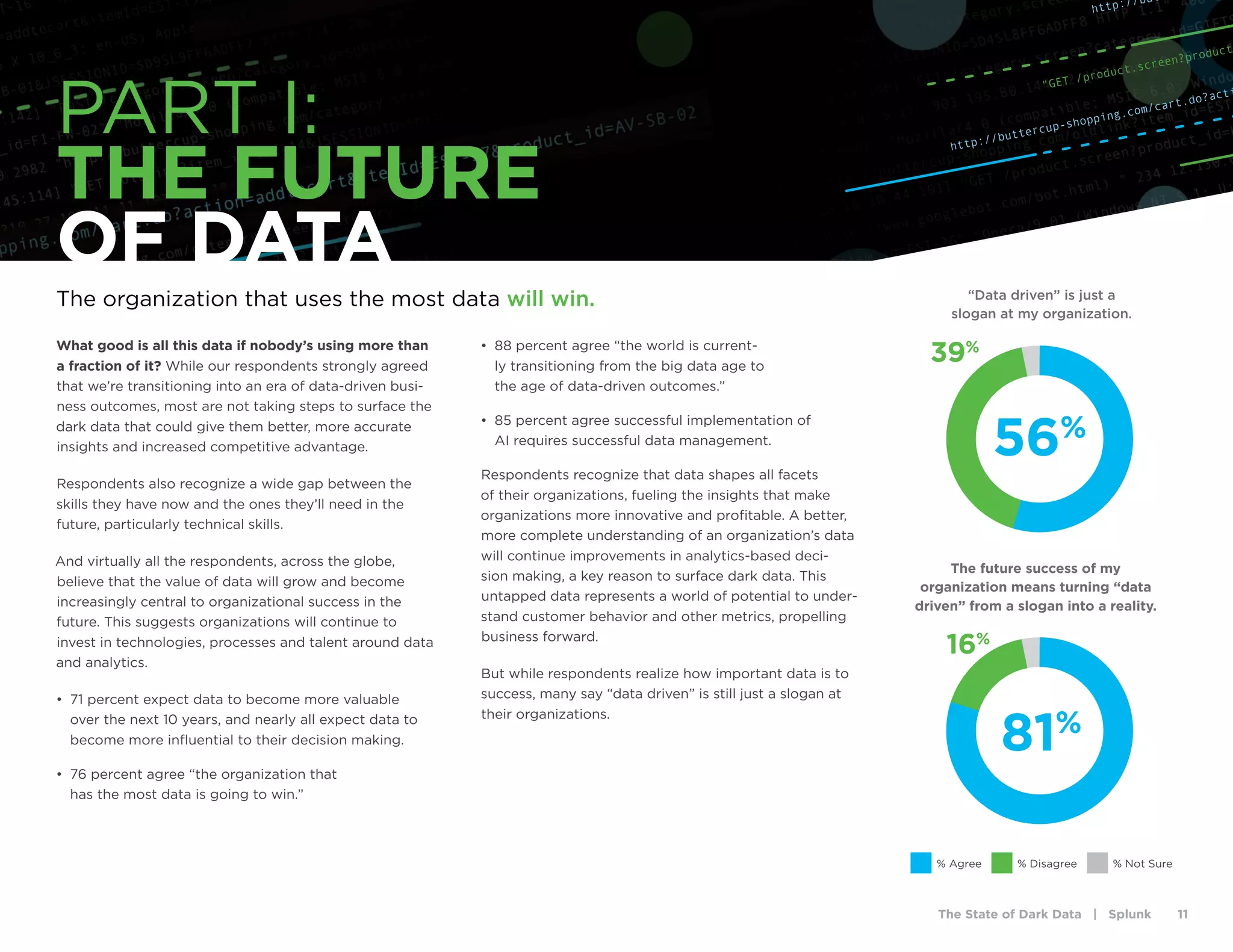
But while respondents realize how important data is to
success, many say “data driven” is still just a slogan at
their organizations.
“Data driven” is just a
slogan at my organization.
The future success of my
organization means turning “data
driven” from a slogan into a reality.
% Agree % Disagree % Not Sure
81%
16%
56%
39%
The State of Dark Data | Splunk 12
Why Data Stays Dark
Dark data contains records of all the activity and behav-
ior of customers, users, transactions, applications, servers,
networks and mobile devices. It includes configurations,
message queues, the output of diagnostic commands,
call detail records, sensor data from industrial systems,
and more.
Dark data, in short, is any data that isn’t being used. That
includes the many types of data generated by an organi-
zation’s systems and applications, from machine data to
server log files to customer and user data to sentiment
analysis derived from social media. It’s the byproduct of
day-to-day business activity, both within an organization
and across the ecosystem of customers, partners
and suppliers.
It can be data that is considered too old or outdated to
provide value, data in a format that can’t be accessed
with the tools available to the organization, incomplete
data or duplicate data — any data that needs to be
“cleaned” before it can be used.
Often, organizations ignore potentially valuable data
because they don’t have the time or resources to prepare
it for use. Or they may not understand its full potential.
Or they may be bogged down in the status quo, meeting
day-to-day requirements rather than looking ahead
for opportunities.
By definition, an
organization’s dark
data is the most
difficult to access.
The survey shows
that globally, 55
percent of organiza-
tions’ data is dark —
either they have the
data and don’t know
it, or they know they have it, but not
how to use it.
More than 80 percent of respondents
say that while more than half their
data is dark, it is potentially valuable.
They know that data is useful to mine,
in other words, but they don’t all
have the tools to go digging. And in
some cases, they don’t even know
where to dig. The reasons for the
difficulties identifying and recover-
ing dark data are both technical and
organizational: Respondents say
they’re overwhelmed with data and
short on the right talent and tools,
while facing organizational silos,
unresponsive leadership and more.
Obstacles to Recovering Dark Data GLOBAL
Volume of dark data 39%
Lack of necessary skill sets 34%
Lack of resources 32%
Difficulty in coordinating
across departments
28%
No one is dedicated to finding data
the org possesses
26%
Difficulty in coordinating with
data-generating third parties
23%
Lack of control over data-generating
devices and apps
22%
Lack of interest from
organization leaders
21%
Lack of creativity 19%
Jan 18:10:55:111] "GET /category.screen?category_id=FLOWERS&JSESSIONID=SD8SL8FF1ADFF6
27&product_id=AV-SB-02
cart.do?action=addtocart&itemId=EST-27&product_id=AV-SB-02
uct_id=FL-DSH-01&JSESSIONID=SD5SL7FF6AD
=SD9SL4FF4ADFF7
77% of global respondents agreed that
finding and capturing dark data
should be a top priority.
The State of Dark Data | Splunk 13
Organizations
should always use
data for strategic,
competitive
and operational
perspectives.”
— Survey Respondent
(CTO, Financial Services,
United States)
“
Turn on the Lights
How do organizations improve their access
to dark data and the insights it holds?
Traditionally, the quick and easy (if expen-
sive) solution was to hire a consultant. That
reflex may be weakening: Only 29 percent
of respondents said bringing in outside
consultants has a lot of potential to solve the
challenges of managing dark data. Twen-
ty-five percent believe consultants offer little
or no potential.
That means organizations will have to find
the power within. And furthering the “no
easy answers” theme, respondents said that
to make better use of data, they’ll need a
holistic approach to overcoming technical
and organizational obstacles. Data strategy,
and the pursuit of dark data, cannot be a “project” — it has
to be a key organizational priority, an essential competency
driven by in-house leaders and in-house talent with an eye to
the end-to-end management of all data.
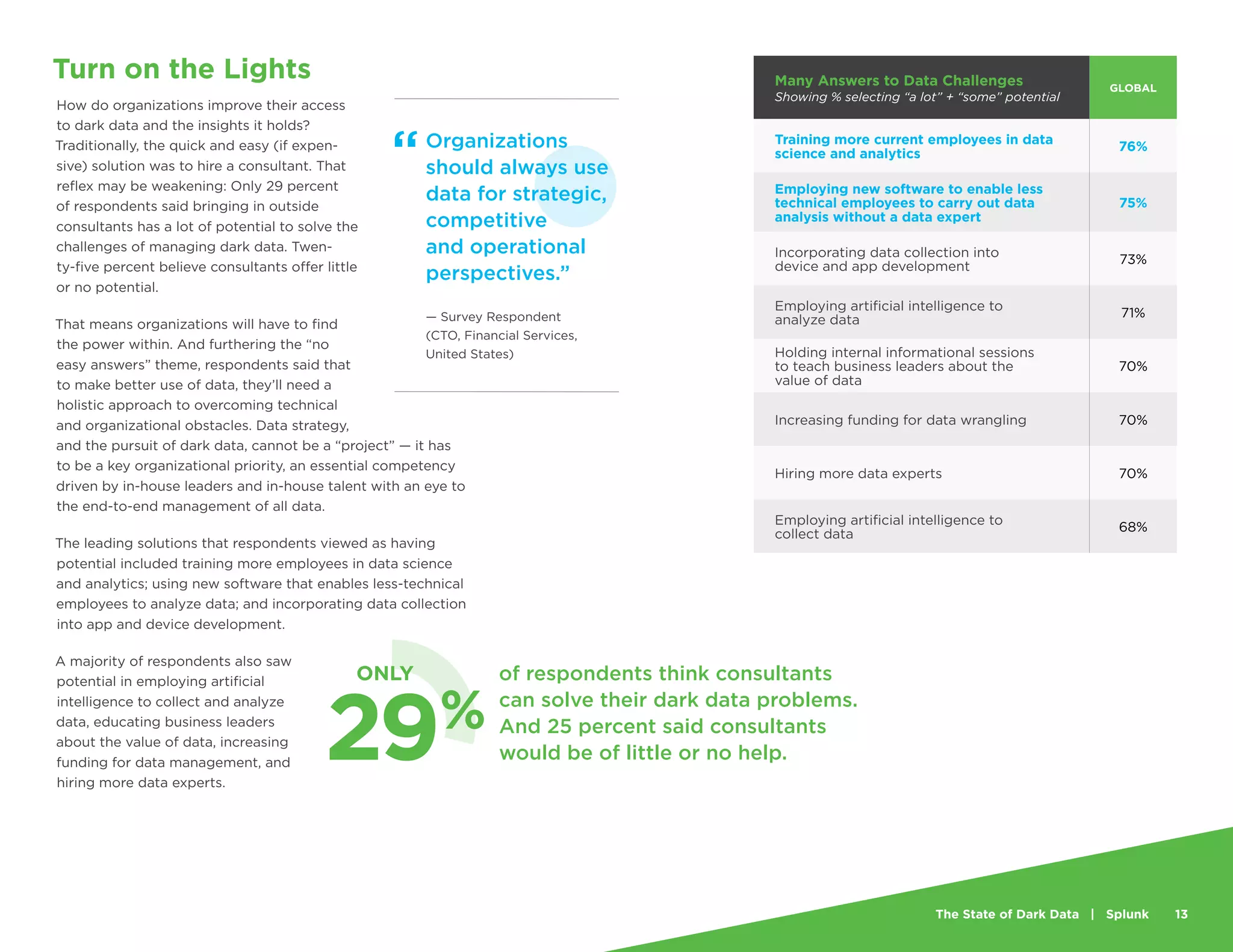
The leading solutions that respondents viewed as having
potential included training more employees in data science
and analytics; using new software that enables less-technical
employees to analyze data; and incorporating data collection
into app and device development.
A majority of respondents also saw
potential in employing artificial
intelligence to collect and analyze
data, educating business leaders
about the value of data, increasing
funding for data management, and
hiring more data experts.
29%
of respondents think consultants
can solve their dark data problems.
And 25 percent said consultants
would be of little or no help.
ONLY
Many Answers to Data Challenges
Showing % selecting “a lot” + “some” potential
GLOBAL
Training more current employees in data
science and analytics
76%
Employing new software to enable less
technical employees to carry out data
analysis without a data expert
75%
Incorporating data collection into
device and app development
73%
Employing artificial intelligence to
analyze data
71%
Holding internal informational sessions
to teach business leaders about the
value of data
70%
Increasing funding for data wrangling 70%
Hiring more data experts 70%
Employing artificial intelligence to
collect data
68%
The State of Dark Data | Splunk 14
Artificial Intelligence is the simulation by computers of
human intelligence processes such as learning, reason-
ing, analyzing and self-correction. So far, AI can’t replace
human reasoning and creativity, but it can process data
and derive insights at a scale and velocity that human
computation cannot not hope to achieve. It is then up to
humans to determine what to do with those insights.
AI takes over when data is too varied and voluminous for
humans to efficiently process. And a central value of AI
is its ability to work with vast quantities of data at very
high speed. Give AI more information to analyze and it
can produce deeper, more accurate insights. Today’s dark
data could one day be an accelerant for even greater AI
performance. Thus, the advent of AI and the value of dark
data go hand-in-hand.
Dark data provides an enormous, untapped resource of
information that AI can analyze. And AI-powered analyt-
ics tools can help make dark data ready for analysis on a
scale that would be impossible with current methods.
AI is in its early stages and it can be very difficult to find
a definition on which everyone agrees. It’s not surpris-
ing then that, globally, most respondents say they don’t
understand it very well (51 percent), and they judged
others to understand it even less. Just 41 percent believe
their organization has a superior grip on AI, while only
39 percent believe their colleagues and their industry in
general understand AI very/extremely well.
Globally, these data-focused IT and business respondents
believe AI will generally augment, rather than replace,
humans. Eighty-two percent say humans are and will
always be at the heart of AI, and 72 percent say that AI
is just a tool to solve business problems. More than half
agree that the threat of AI has been exaggerated (65
percent). But they agree that the promise, too, has been
overstated (60 percent).
While our respondents say that few of their organizations
are using AI right now, a majority see potential. For a
series of use cases including operational efficiency, strate-
gic decision making, HR and customer
experience, 61 percent to 67 percent
saw value in AI for their organizations
— but only 10 percent to 15 percent say
their organizations are deploying AI
for these use cases today.
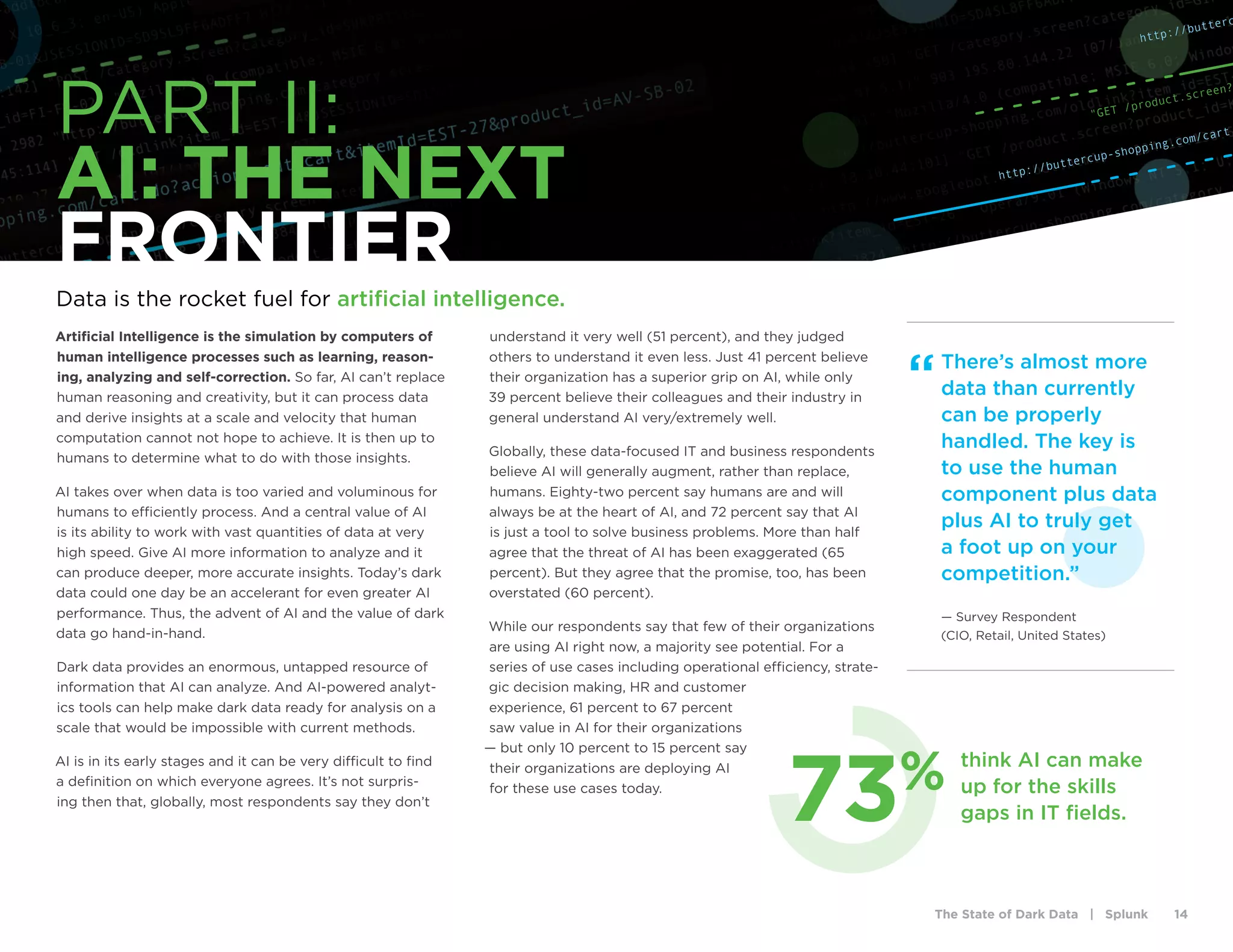
73% think AI can make
up for the skills
gaps in IT fields.
http://buttercup-shopping.com/cart
http://butterc
"GET /product.screen?
PART II:
AI: THE NEXT
FRONTIER
Data is the rocket fuel for artificial intelligence.
There’s almost more
data than currently
can be properly
handled. The key is
to use the human
component plus data
plus AI to truly get
a foot up on your
competition.”
— Survey Respondent
(CIO, Retail, United States)
“
The State of Dark Data | Splunk 15
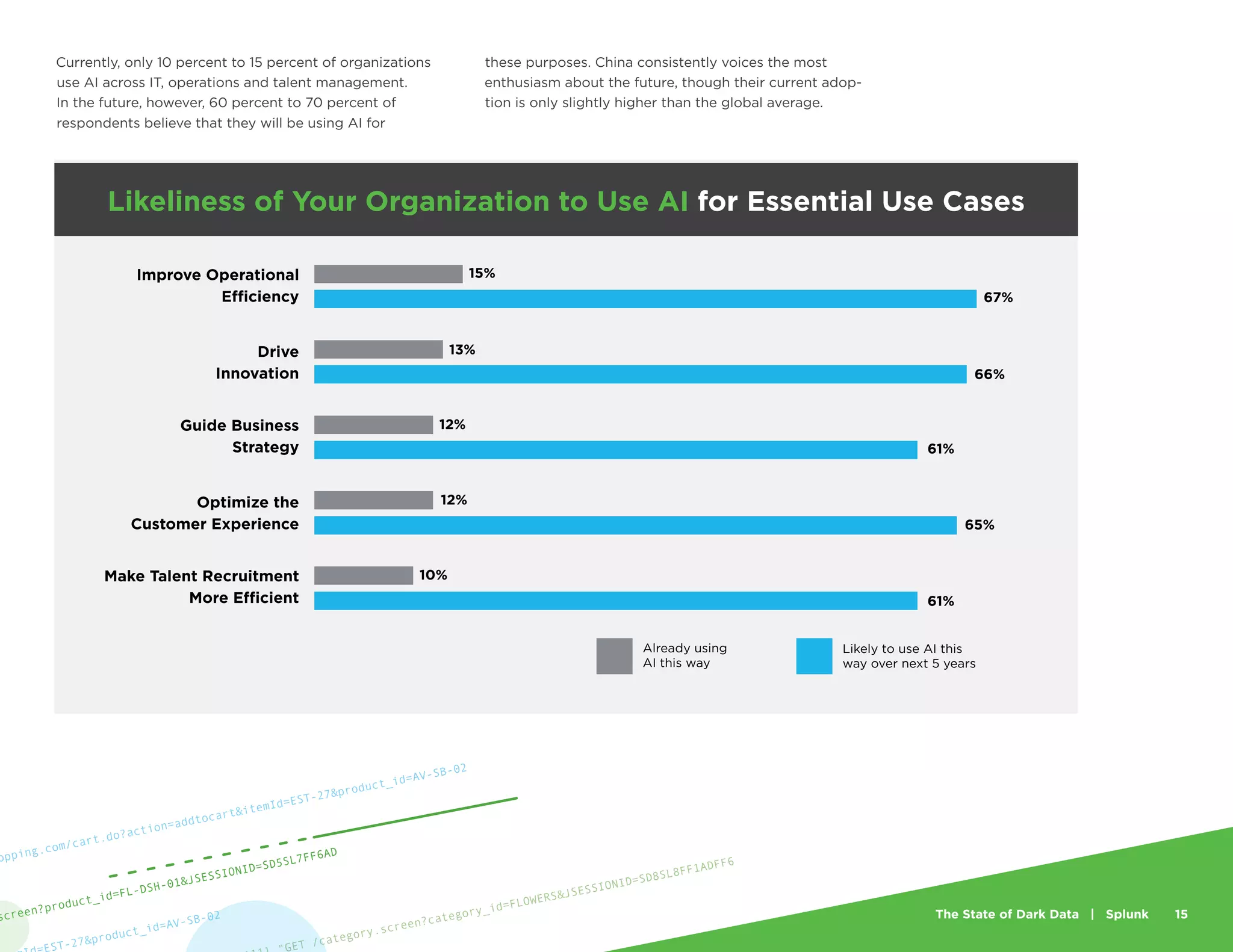
Likeliness of Your Organization to Use AI for Essential Use Cases
Optimize the
Customer Experience
Make Talent Recruitment
More Efficient
Guide Business
Strategy
Drive
Innovation
Already using
AI this way
Likely to use AI this
way over next 5 years
15%
13%
66%
12%
12%
10%
61%
61%
67%
65%
Improve Operational
Efficiency
GET /category.screen?category_id=FLOWERS&JSESSIONID=SD8SL8FF1ADFF6
ST-27&product_id=AV-SB-02
opping.com/cart.do?action=addtocart&itemId=EST-27&product_id=AV-SB-02
screen?product_id=FL-DSH-01&JSESSIONID=SD5SL7FF6AD
Currently, only 10 percent to 15 percent of organizations
use AI across IT, operations and talent management.
In the future, however, 60 percent to 70 percent of
respondents believe that they will be using AI for
these purposes. China consistently voices the most
enthusiasm about the future, though their current adop-
tion is only slightly higher than the global average.
The State of Dark Data | Splunk 16
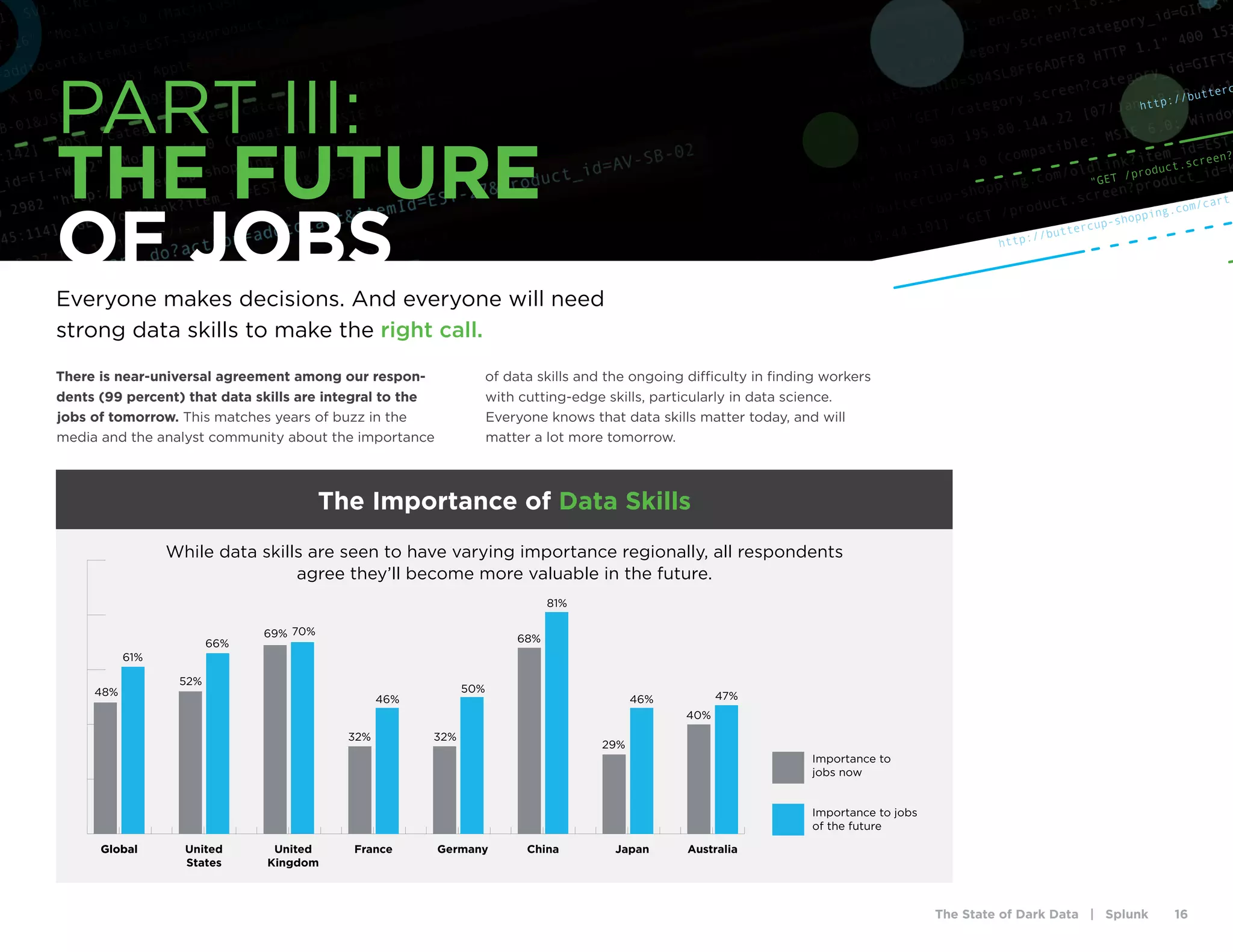
There is near-universal agreement among our respon-
dents (99 percent) that data skills are integral to the
jobs of tomorrow. This matches years of buzz in the
media and the analyst community about the importance
of data skills and the ongoing difficulty in finding workers
with cutting-edge skills, particularly in data science.
Everyone knows that data skills matter today, and will
matter a lot more tomorrow.
While data skills are seen to have varying importance regionally, all respondents
agree they’ll become more valuable in the future.
Global
Global United
Kingdom
France Germany China Japan Australia
Importance to
jobs now
Importance to jobs
of the future
United
States
48%
61%
52%
69% 70%
32%
46%
29%
46%
40%
47%
32%
50%
68%
81%
66%
The Importance of Data Skills
http://buttercup-shopping.com/cart
http://butterc
"GET /product.screen?
PART III:
THE FUTURE
OF JOBS
Everyone makes decisions. And everyone will need
strong data skills to make the right call.
The State of Dark Data | Splunk 17
As with other questions throughout the survey, attitudes
about the importance of data skills vary regionally, with
China in the lead. While 61 percent is the global average
of those saying data skills will be important, 84 percent of
respondents in China agreed, as did 70 percent in the U.S.
and 66 percent in the United Kingdom. There was signifi-
cantly less agreement in France and Japan (46 percent
each), Germany (47 percent) and Australia (50 percent).
Respondents said that employees combining techni-
cal data skills with business acumen will be the most in
demand in the next 10 years — more than employees
with either technical data skills or business expertise
alone. Globally, 41 percent of respondents said this mix of
skills will be required. Breaking down that average, China
and the U.S. were the most bullish, at 53 percent and 49
percent respectively, while agreement ranged between 35
percent and 38 percent in the UK, Japan, France, Germany
and Australia.
The future of jobs is clear: Data literacy will be a require-
ment to stay current. Eighty-three percent of respondents
agree that workers who continue to rely on others to
explain what data mean will fall behind in their careers.
But respondents predict the same employees who will be
most in demand — those with technical and business skills
— will also be the most difficult to hire.
Complacency and
Skills Gaps
Most IT and business respondents recognize the need for
data skills, and 92 percent say they are willing to learn new
data skills themselves. But “willing” is a key word, because
while they recognize the necessity, respondents weren’t
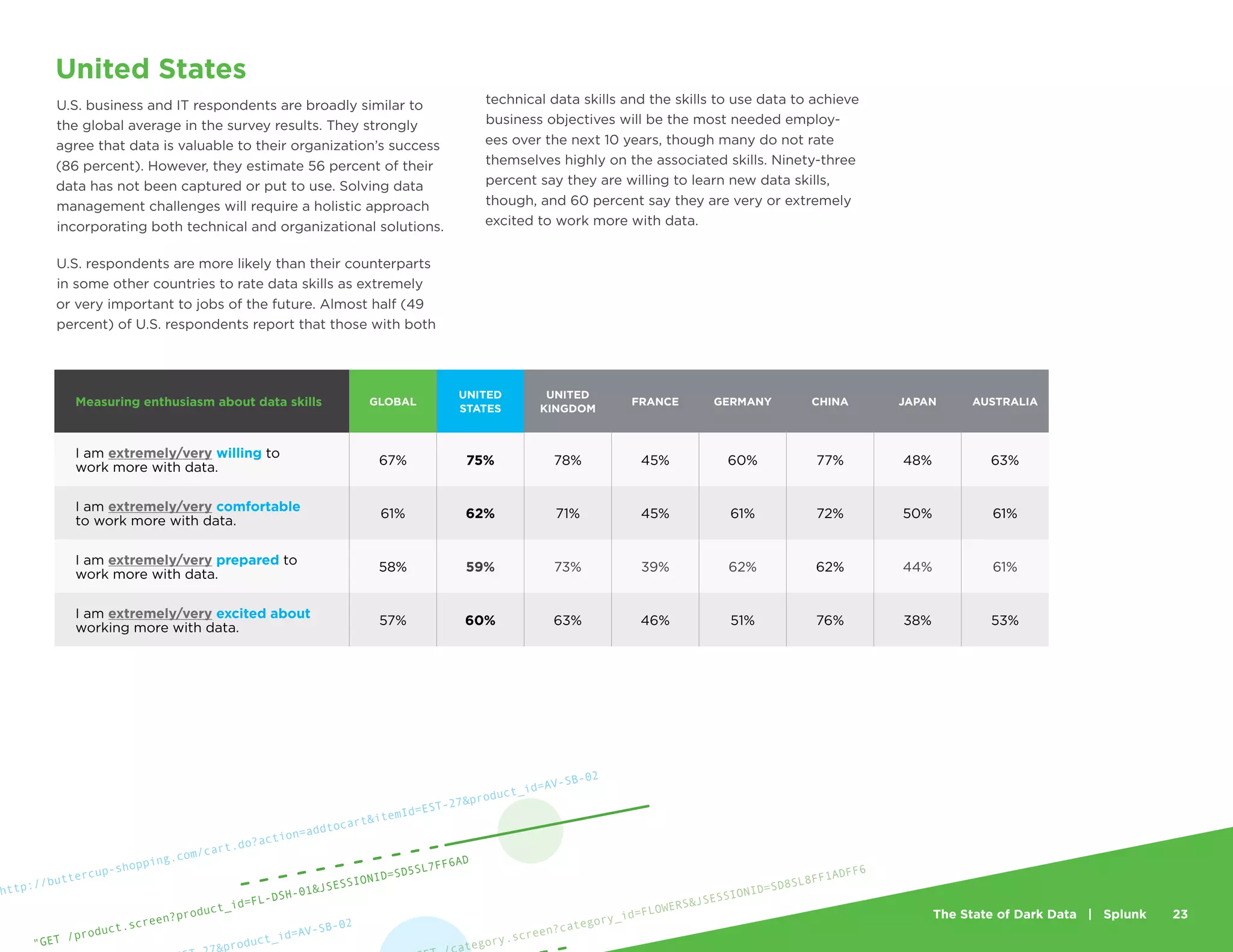
always as enthusiastic about it. For instance, globally, 67
percent agreed with the statement “I am [extremely or
very] willing to work more with data,” only 57 percent
agreed that they were “[extremely or very] enthusiastic to
work more with data.” (Worth noting: 58 percent agreed
that they were very or extremely comfortable working
more with data.)
Despite that slight deflation, respondents strongly agreed
that data skills will matter more for leadership roles. Most
(87 percent) feel capable of
keeping up with developments
in data skills, and 84 percent say
they’re prepared for the future
of data jobs.
If there’s a gap between the
recognition of data skills as
essential and personal enthusi-
asm for acquiring them, it may
be that many respondents see it
as an issue for the next genera-
tion to resolve — an attitude that
only makes it more urgent that
organizations begin to grapple
with the data-centric future.
Globally, 73 percent of survey
respondents say that
data skills are harder for them
than business skills. Most, 69 percent, say that they’re
content to keep doing what they’re doing, even if it means
they don’t get promoted again.
More than half of
U.S. and Chinese
respondents said
employees with both
technical data skills
and business acumen
will be most in demand
over the next decade —
and the hardest to find.
ategory.screen?category_id=FLOWERS&JSESSIONID=SD8SL8FF1ADFF6
product_id=AV-SB-02
art.do?action=addtocart&itemId=EST-27&product_id=AV-SB-02
ct_id=FL-DSH-01&JSESSIONID=SD5SL7FF6AD
The State of Dark Data | Splunk 18
And just over half — 53 percent — say they’re too old to
learn new data skills.
Clearly, the jobs of the future will require more sophisti-
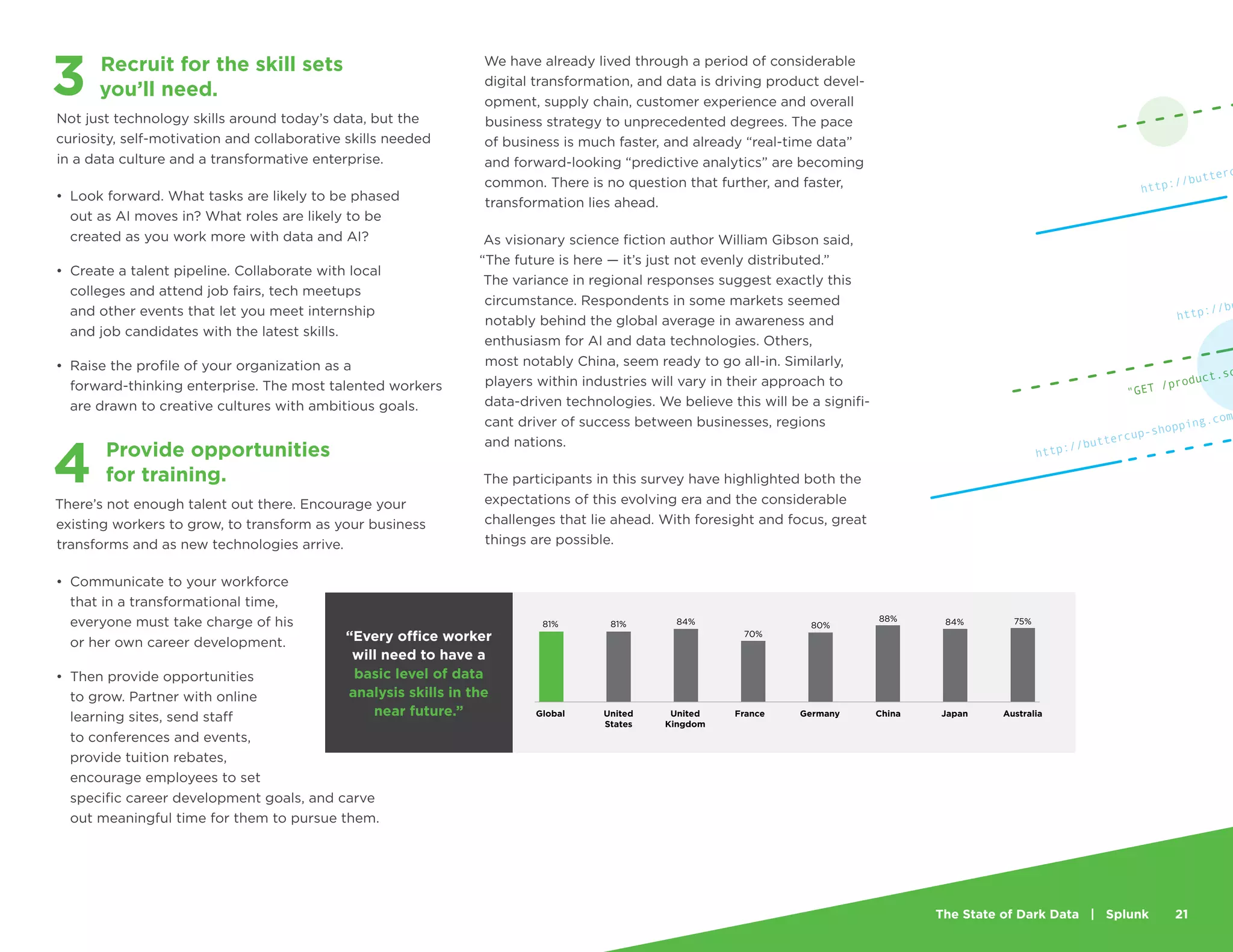
cated data skills of every worker. Globally, 81 percent of
respondents agree that “every office worker will need to
have a basic level of data analysis skills in the near future.”
Presumably, those workers and leaders who are compla-
cent about those skills will fall behind. In the new age of
data-driven decision making, with exploding amounts of
dark data to manage and analyze, bridging the data skills
gap may be the most crucial challenge facing organiza-
tions today.
More people aren’t
excited to work with
data because more
data might mean
more work for them.”
— Survey Respondent
(CEO, Retail, Australia)
“
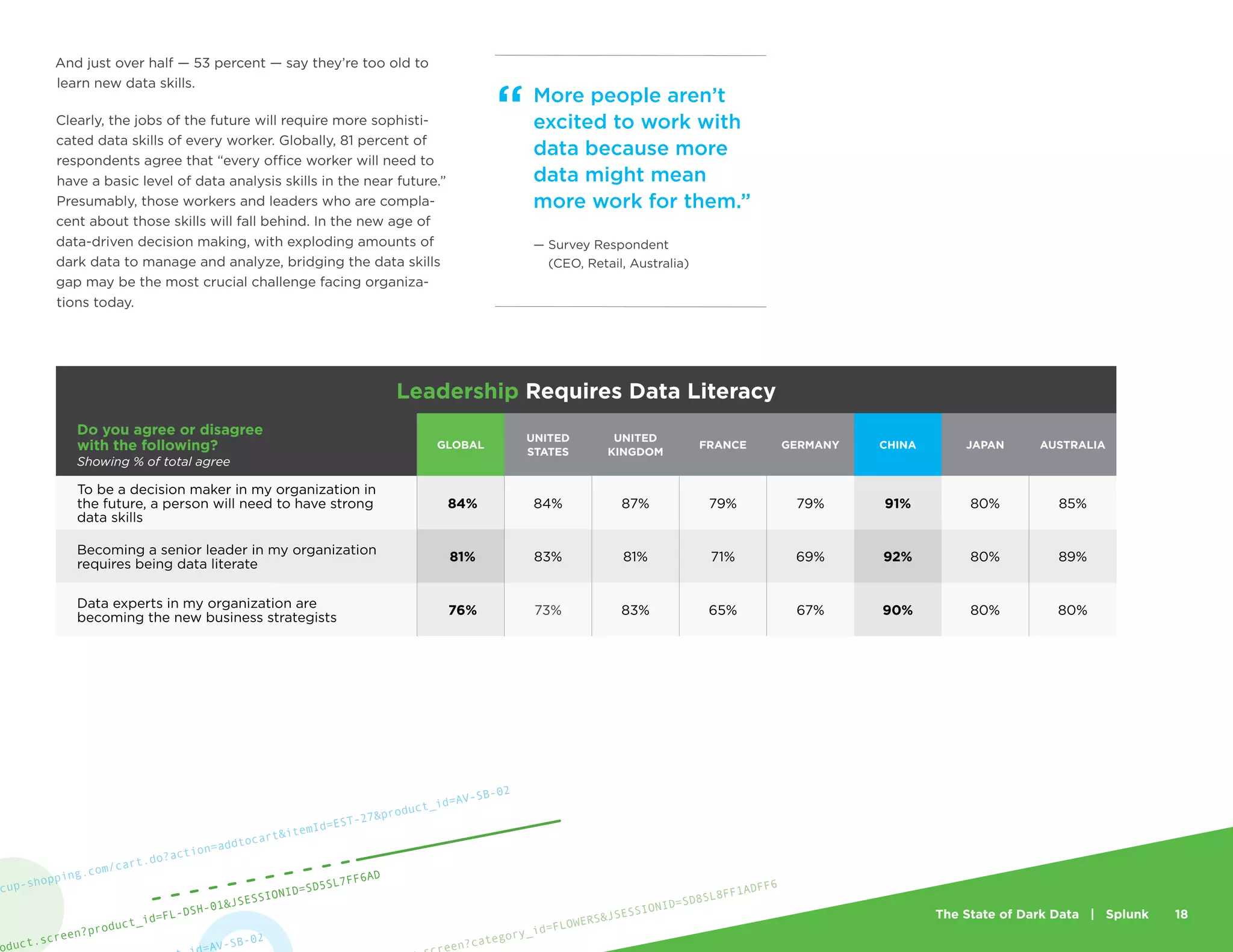
Do you agree or disagree
with the following?
Showing % of total agree
GLOBAL
UNITED
STATES
UNITED
KINGDOM
FRANCE GERMANY CHINA JAPAN AUSTRALIA
To be a decision maker in my organization in
the future, a person will need to have strong
data skills
84% 84% 87% 79% 79% 91% 80% 85%
Becoming a senior leader in my organization
requires being data literate
81% 83% 81% 71% 69% 92% 80% 89%
Data experts in my organization are
becoming the new business strategists
76% 73% 83% 65% 67% 90% 80% 80%
Leadership Requires Data Literacy
een?category_id=FLOWERS&JSESSIONID=SD8SL8FF1ADFF6
AV-SB-02
cup-shopping.com/cart.do?action=addtocart&itemId=EST-27&product_id=AV-SB-02
oduct.screen?product_id=FL-DSH-01&JSESSIONID=SD5SL7FF6AD
The State of Dark Data | Splunk 19
http://buttercup-shopping.com/cart
"GET /product.screen?
Everyone agrees that data is important today and will
be more important in the future. But are the leaders
of today fully committed to the coming revolution? Our
survey data suggests they are not. Some senior leaders,
in fact, may have made the decision to ride it out, hoping
to make it to retirement on their current levels of knowl-
edge and experience around data and AI. This presents
a challenge for organizations — and an opportunity for
aspiring leaders.
First, the technical challenges of data must be addressed.
Respondents were asked about 10 data-management
challenges, including dealing with multiple data sources,
lack of resources, internal silos, indifferent senior leader-
ship, and the sheer volume of information. Encouragingly,
“lack of support from senior leaders” scored the lowest
agreement (66 percent globally), but every other identi-
fied challenge averaged from 73 percent to 81 percent.
Interestingly, the countries whose respondents were
most bullish on the value of data and the need for data
skills also tended to rate each problem higher. This
suggests not that “data leaders” are doing a better job of
mastering the challenges, but that the most data-savvy
respondents are more likely to identify just how big a
challenge their data presents.
The classic advice about adopting new technologies
goes like this: identify the problem, brainstorm solutions,
zero in on a specific solution, and pilot it on a discrete
but meaningful project. This is good advice for solving
the challenges, and tapping the opportunities, of data
and AI — and clearly even the most data-forward compa-
nies are still in the early stages of figuring things out.
At the same time, the lack of skills must be addressed.
There’s near-universal understanding that we need a
more data-literate workforce, and many of our respon-
dents flagged the fact that universities are not churning
out data scientists at a high enough rate. Part of the
solution is surely automation and tools that “democratize”
data analysis. Make it easier for non-technical people to
draw insights from data, and they will. But even where
high-end technical skills aren’t needed, a data-oriented
mindset is.
Companies today should be looking not only for key
technical skills; they should be hiring for, and instilling,
a data-centric mindset. They should use the data, tools
and skills they have now to build the best data-driven
company and workforce, and use that as a foundation
for growth. But the respondents to this survey, both in
business and IT units, tell us that they’re already over-
whelmed. Only as we become more comfortable with the
amount of data at our fingertips, and the things we can
do with it, will we begin to uncover the greater potential
of our dark data.
CONCLUSION
The New Data Reality
Companies today
should be looking
not only for key
technical skills; they
should be hiring for,
and instilling, a data-
centric mindset.
The State of Dark Data | Splunk 20
Our respondents told us two conflicting stories: On
the one hand, dark data and artificial intelligence hold
almost unlimited potential to transform business and
society, and working with data will be essential to
virtually every job in their organizations. On the other
hand, these business and IT leaders have low confi-
dence in their own knowledge about AI and the data
their company possesses. They’re even more skeptical
of their colleagues’ and their organization’s readiness to
take advantage of the potential both in their troves of
untapped data and in the power of AI.
With that in mind, we’ve distilled four essential recom-
mendations for moving forward from an uncertain
present into a high-potential, data-driven future.
Know that AI is coming.
AI and machine learning will be transformative. Stay
on top of this fast-developing group of technologies and
find the use cases that make sense for your industry and
organization. Specifically, business and IT leaders should:
•	 Follow general developments in the field of AI.
Understand how these technologies are maturing
in various sectors to help your organization see the
potential to disrupt, rather than be disrupted.
•	 Consider the potential for automation in your
sector and in your organization, in terms of effi-
ciencies, greater accuracy, and ability to work
effectively with greater volumes of data.
Build an infrastructure and
culture of data.
Make “data driven” a reality, and make sure your
approach to data helps organize and surface it in ways
that will let you tap all of its potential.
•	 Understand your data. Commit to bringing more of it
out of the dark, out of the gray areas, to be a vital part
of your decision making. Data, like money, is an asset.
Like money, a business has a fundamental responsibil-
ity to keep track of it, and use it to best advantage.
•	 Put automation and AI on your IT roadmap. You
will be adopting and integrating these tech-
nologies, so get your infrastructure ready.
•	 Infuse data and analytics into decision making.
While you may not have all your analytics tools
in place yet, work with the data you have, rather
than exclusively hunches and “gut feel.” Incorpo-
rate data-gathering into your strategic processes.
KEY
RECOMMENDATIONS
2
1
Jan 18:10:55:1
http://buttercup-shopping.com/cart.do?action=addtocart&i
http://buttercu
"GET /product.screen?product_id=FL-DSH-01&JSESSIONI
categ
The State of Dark Data | Splunk 21
Recruit for the skill sets
you’ll need.
Not just technology skills around today’s data, but the
curiosity, self-motivation and collaborative skills needed
in a data culture and a transformative enterprise.
•	 Look forward. What tasks are likely to be phased
out as AI moves in? What roles are likely to be
created as you work more with data and AI?
•	 Create a talent pipeline. Collaborate with local
colleges and attend job fairs, tech meetups
and other events that let you meet internship
and job candidates with the latest skills.
•	 Raise the profile of your organization as a
forward-thinking enterprise. The most talented workers
are drawn to creative cultures with ambitious goals.
Provide opportunities
for training.
There’s not enough talent out there. Encourage your
existing workers to grow, to transform as your business
transforms and as new technologies arrive.
•	 Communicate to your workforce
that in a transformational time,
everyone must take charge of his
or her own career development.
•	 Then provide opportunities
to grow. Partner with online
learning sites, send staff
to conferences and events,
provide tuition rebates,
encourage employees to set
specific career development goals, and carve
out meaningful time for them to pursue them.
We have already lived through a period of considerable
digital transformation, and data is driving product devel-
opment, supply chain, customer experience and overall
business strategy to unprecedented degrees. The pace
of business is much faster, and already “real-time data”
and forward-looking “predictive analytics” are becoming
common. There is no question that further, and faster,
transformation lies ahead.
As visionary science fiction author William Gibson said,
“The future is here — it’s just not evenly distributed.”
The variance in regional responses suggest exactly this
circumstance. Respondents in some markets seemed
notably behind the global average in awareness and
enthusiasm for AI and data technologies. Others,
most notably China, seem ready to go all-in. Similarly,
players within industries will vary in their approach to
data-driven technologies. We believe this will be a signifi-
cant driver of success between businesses, regions
and nations.
The participants in this survey have highlighted both the
expectations of this evolving era and the considerable
challenges that lie ahead. With foresight and focus, great
things are possible.
4
3
“Every office worker
will need to have a
basic level of data
analysis skills in the
near future.” Global United
Kingdom
France Germany China Japan Australia
United
States
81% 81% 84%
70%
88% 84% 75%
80%
http://buttercup-shopping.com
http://bu
"GET /product.sc
http://butterc
The State of Dark Data | Splunk 22
Data Anxiety Is Global
Across the survey, researchers noted regional patterns in the data. China, in particular, took
the most aggressive stance toward the increasing value of data, the potential of AI and the
growing importance of data skills. Both the United States and the United Kingdom also tended
to score above the average in agreement with these sentiments. France, Germany, Japan and
Australia tended to hang back.
APPENDIX
United States
More likely than its counterparts to rate
data skills as extremely or very important to
jobs of the future.
United Kingdom
Often comes second (to China) in its
enthusiasm for data and AI, and its belief
in the importance of data skills.
France
Less likely than the global average to
consider data extremely or very valuable to
overall success; shows less enthusiasm for
workplace changes.
Germany
Strongly agrees on the value of data to an
organization’s success, despite estimating
that more than half of their data has not been
captured or put to use.
China
Takes the most aggressive stance toward the
increasing value of data, the potential of AI and
the growing importance of data skills.
Japan
Below the global average on how valuable data
is to an organization’s success, but similar to
the global average on how much of their data
they estimate is not captured.
Australia
Fewer understand AI extremely or very well.
Australian respondents lag slightly behind
the global average in saying that AI will be
important to their organizations.
Jan 18:10:55:111] "GET /category.screen?category_id=FLO
category_id=SURPRISE&JSESSIONID=SD9SL4FF4ADFF7
The State of Dark Data | Splunk 23
United States
U.S. business and IT respondents are broadly similar to
the global average in the survey results. They strongly
agree that data is valuable to their organization’s success
(86 percent). However, they estimate 56 percent of their
data has not been captured or put to use. Solving data
management challenges will require a holistic approach
incorporating both technical and organizational solutions.
U.S. respondents are more likely than their counterparts
in some other countries to rate data skills as extremely
or very important to jobs of the future. Almost half (49
percent) of U.S. respondents report that those with both
technical data skills and the skills to use data to achieve
business objectives will be the most needed employ-
ees over the next 10 years, though many do not rate
themselves highly on the associated skills. Ninety-three
percent say they are willing to learn new data skills,
though, and 60 percent say they are very or extremely
excited to work more with data.
Measuring enthusiasm about data skills GLOBAL
UNITED
STATES
UNITED
KINGDOM
FRANCE GERMANY CHINA JAPAN AUSTRALIA
I am extremely/very willing to
work more with data.
67% 75% 78% 45% 60% 77% 48% 63%
I am extremely/very comfortable
to work more with data.
61% 62% 71% 45% 61% 72% 50% 61%
I am extremely/very prepared to
work more with data.
58% 59% 73% 39% 62% 62% 44% 61%
I am extremely/very excited about
working more with data.
57% 60% 63% 46% 51% 76% 38% 53%
ategory.screen?category_id=FLOWERS&JSESSIONID=SD8SL8FF1ADFF6
product_id=AV-SB-02
http://buttercup-shopping.com/cart.do?action=addtocart&itemId=EST-27&product_id=AV-SB-02
"GET /product.screen?product_id=FL-DSH-01&JSESSIONID=SD5SL7FF6AD
The State of Dark Data | Splunk 24
France
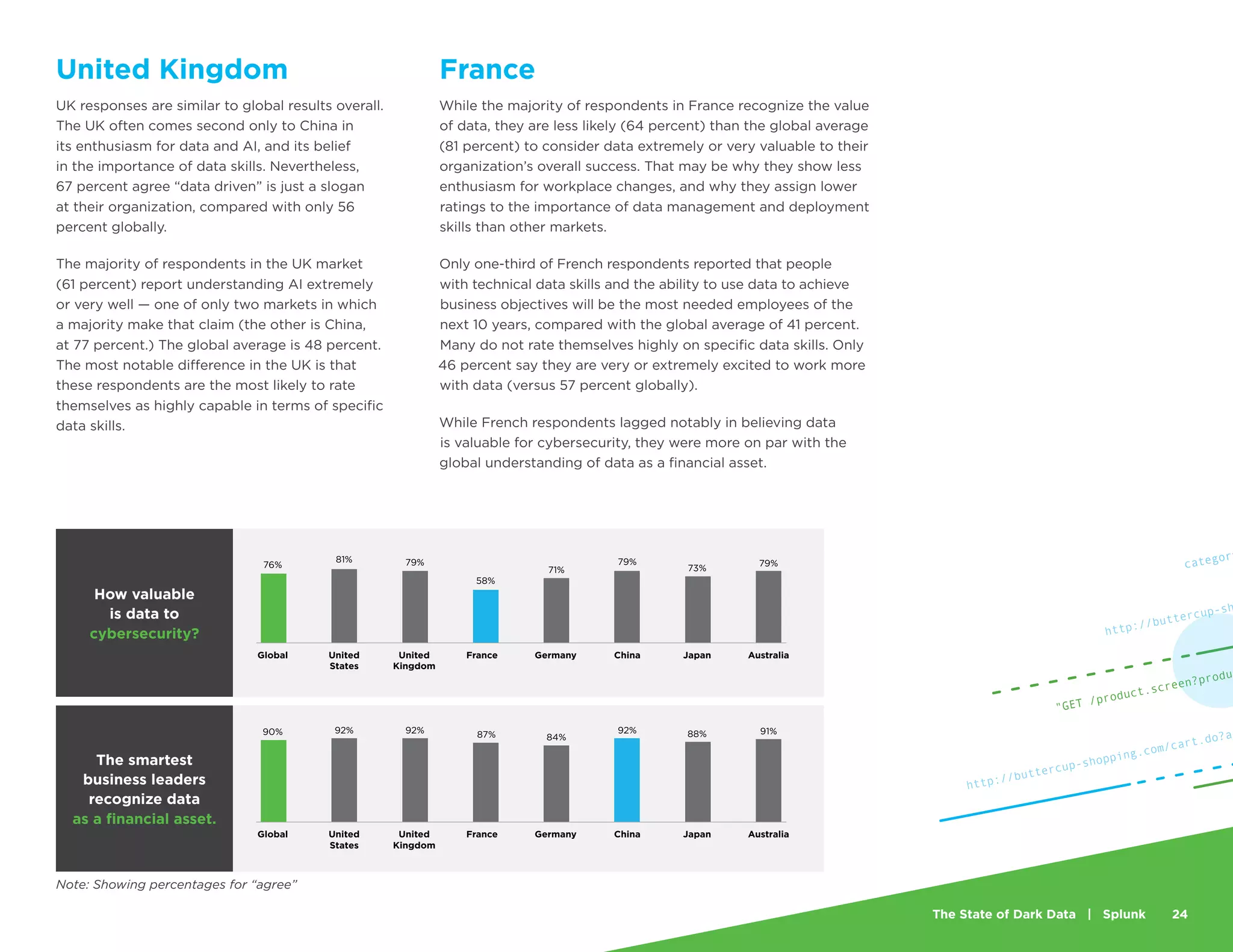
While the majority of respondents in France recognize the value
of data, they are less likely (64 percent) than the global average
(81 percent) to consider data extremely or very valuable to their
organization’s overall success. That may be why they show less
enthusiasm for workplace changes, and why they assign lower
ratings to the importance of data management and deployment
skills than other markets.
Only one-third of French respondents reported that people
with technical data skills and the ability to use data to achieve
business objectives will be the most needed employees of the
next 10 years, compared with the global average of 41 percent.
Many do not rate themselves highly on specific data skills. Only
46 percent say they are very or extremely excited to work more
with data (versus 57 percent globally).
While French respondents lagged notably in believing data
is valuable for cybersecurity, they were more on par with the
global understanding of data as a financial asset.
Note: Showing percentages for “agree”
How valuable
is data to
cybersecurity?
Global United
Kingdom
France Germany China Japan Australia
United
States
76%
81% 79%
58%
79%
73%
79%
71%
The smartest
business leaders
recognize data
as a financial asset.
Global United
Kingdom
France Germany China Japan Australia
United
States
90% 92% 92% 87% 92% 88% 91%
84%
United Kingdom
UK responses are similar to global results overall.
The UK often comes second only to China in
its enthusiasm for data and AI, and its belief
in the importance of data skills. Nevertheless,
67 percent agree “data driven” is just a slogan
at their organization, compared with only 56
percent globally.
The majority of respondents in the UK market
(61 percent) report understanding AI extremely
or very well — one of only two markets in which
a majority make that claim (the other is China,
at 77 percent.) The global average is 48 percent.
The most notable difference in the UK is that
these respondents are the most likely to rate
themselves as highly capable in terms of specific
data skills.
http://buttercup-shopping.com/cart.do?ac
http://buttercup-sh
"GET /product.screen?produ
category
The State of Dark Data | Splunk 25
Germany
The IT and business managers we surveyed in Germany
responded similarly to, though often a bit below, global
averages. They strongly agree on the value of their data to
their organization’s success (76 percent) but estimate 53
percent of their data has not been captured or put to use.
Sixty percent say they are very or extremely willing to
work more with data, and 51 percent say they are very or
extremely excited about doing so. Germans are more likely
to agree “data driven” is just a slogan at their organization
(71 percent, versus 56 percent global), and they are more
likely than those in some markets to give their organization
lower skill ratings on the phases of data management.
How valuable is data to each
of the following?
Showing % of extremely + very valuable
GLOBAL
UNITED
STATES
UNITED
KINGDOM
FRANCE GERMANY CHINA JAPAN AUSTRALIA
Your organization’s overall success 81% 86% 85% 64% 76% 82% 73% 81%
Your organization’s efficiency 81% 85% 89% 68% 77% 78% 72% 81%
Your organization’s profitability 78% 82% 79% 63% 75% 77% 75% 84%
111] "GET /category.screen?category_id=FLOWERS&JSESSIONID=SD8SL8FF1ADFF6
7&product_id=AV-SB-02
art.do?action=addtocart&itemId=EST-27&product_id=AV-SB-02
ct_id=FL-DSH-01&JSESSIONID=SD5SL7FF6AD
Jan
http://buttercup-shopping.com/cart.do?action=addtocart&itemId=EST-27&product_id=A
http://buttercup-sho
"GET /product.screen?product_id=FL-DSH-0
The State of Dark Data | Splunk 26
China
China lines up with global averages on agreeing on the
value of data to their organization’s success (82 percent),
and they estimate a somewhat smaller percentage of dark
data that has not been captured or put to use (50 percent,
compared with a global 55 percent). More individuals say
they are extremely or very excited about working more
with data (76 percent, versus 57 percent globally).
Eighty-seven percent of respondents in China believe data
will become more valuable over the next 10 years.
This belief is probably why 91 percent agree that the
organization with the most data is going to win; why they
are more likely to agree that capturing dark data should
be a priority; and why 81 percent believe data skills will
be extremely or very important to the jobs of the future,
the highest of any market. Additionally, this is one of only
two markets in which a majority (77 percent) claim to
understand AI extremely or very well. Overall, the survey
found, China is the most forward-thinking of countries in
acquiring and deploying data skills.
Non-technical
employees expected
to have minimum
data skills.
Global United
Kingdom
France Germany China Japan Australia
United
States
77% 76%
85%
71%
90%
78% 74%
69%
Successful
implementation of
artificial intelligence
requires successful
data wrangling. Global United
Kingdom
France Germany China Japan Australia
United
States
77% 76%
85%
71%
90%
78% 74%
69%
screen?category_id=FLOWERS&JSESSIONID=SD8SL8FF1ADFF6
id=AV-SB-02
ttp://buttercup-shopping.com/cart.do?action=addtocart&itemId=EST-27&product_id=AV-SB-02
/product.screen?product_id=FL-DSH-01&JSESSIONID=SD5SL7FF6AD
The State of Dark Data | Splunk 27
How well do you and your
organization understand AI?
Showing % of very well + extremely well
GLOBAL
UNITED
STATES
UNITED
KINGDOM
FRANCE GERMANY CHINA JAPAN AUSTRALIA
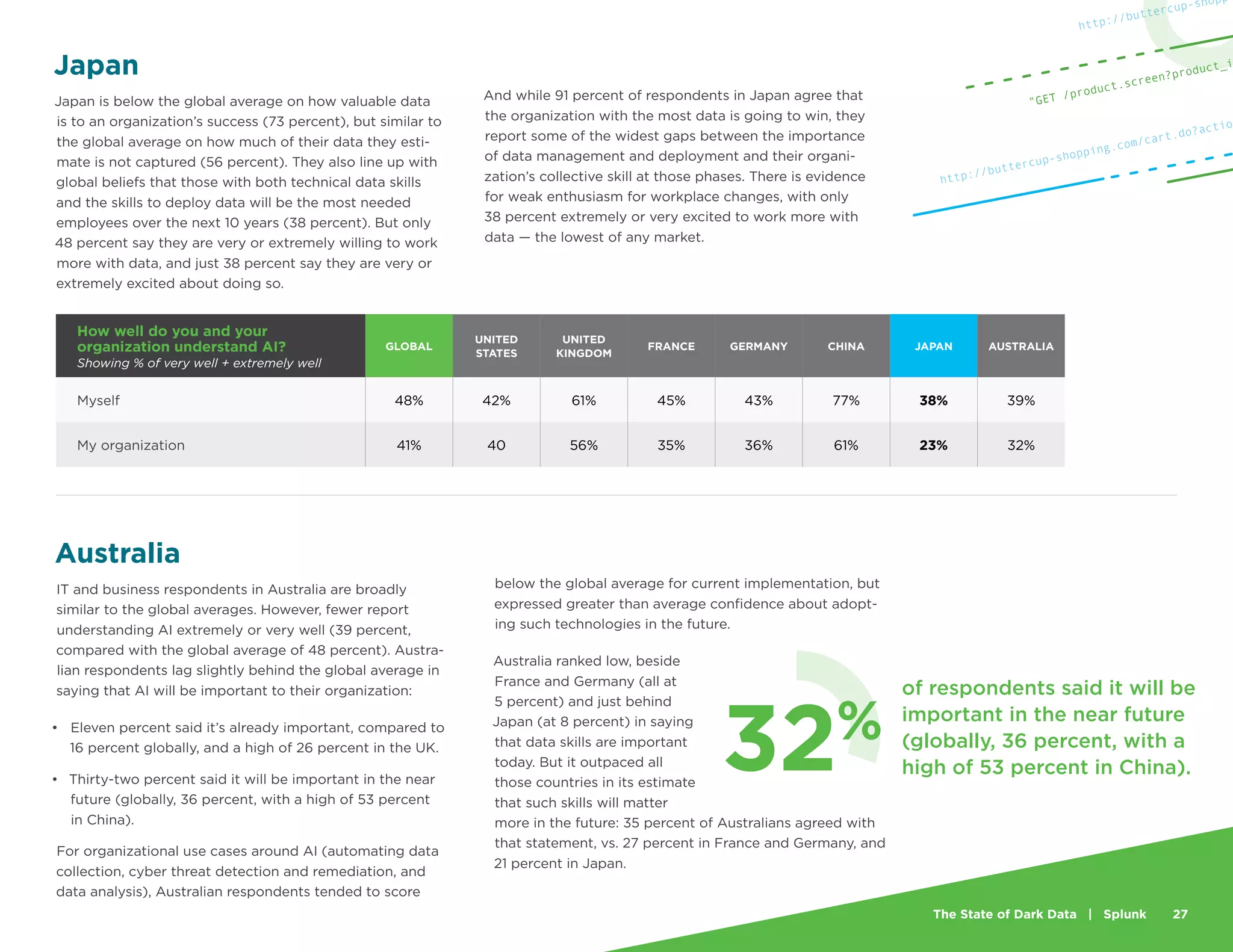
Myself 48% 42% 61% 45% 43% 77% 38% 39%
My organization 41% 40 56% 35% 36% 61% 23% 32%
Japan
Japan is below the global average on how valuable data
is to an organization’s success (73 percent), but similar to
the global average on how much of their data they esti-
mate is not captured (56 percent). They also line up with
global beliefs that those with both technical data skills
and the skills to deploy data will be the most needed
employees over the next 10 years (38 percent). But only
48 percent say they are very or extremely willing to work
more with data, and just 38 percent say they are very or
extremely excited about doing so.
And while 91 percent of respondents in Japan agree that
the organization with the most data is going to win, they
report some of the widest gaps between the importance
of data management and deployment and their organi-
zation’s collective skill at those phases. There is evidence
for weak enthusiasm for workplace changes, with only
38 percent extremely or very excited to work more with
data — the lowest of any market.
Australia
IT and business respondents in Australia are broadly
similar to the global averages. However, fewer report
understanding AI extremely or very well (39 percent,
compared with the global average of 48 percent). Austra-
lian respondents lag slightly behind the global average in
saying that AI will be important to their organization:
•	 Eleven percent said it’s already important, compared to
16 percent globally, and a high of 26 percent in the UK.
•	 Thirty-two percent said it will be important in the near
future (globally, 36 percent, with a high of 53 percent
in China).
For organizational use cases around AI (automating data
collection, cyber threat detection and remediation, and
data analysis), Australian respondents tended to score
below the global average for current implementation, but
expressed greater than average confidence about adopt-
ing such technologies in the future.
Australia ranked low, beside
France and Germany (all at
5 percent) and just behind
Japan (at 8 percent) in saying
that data skills are important
today. But it outpaced all
those countries in its estimate
that such skills will matter
more in the future: 35 percent of Australians agreed with
that statement, vs. 27 percent in France and Germany, and
21 percent in Japan.
http://buttercup-shopping.com/cart.do?actio
http://buttercup-shopp
"GET /product.screen?product_i
32%
of respondents said it will be
important in the near future
(globally, 36 percent, with a
high of 53 percent in China).
The State of Dark Data | Splunk 28
ABOUT SPLUNK.
Splunk Inc. (NASDAQ: SPLK) turns data into business outcomes. Organizations use market-leading
Splunk solutions to investigate, monitor, analyze and act on all forms of data — from the business,
IT, security and the Internet of Things. Our powerful platform and unique approach to data have
empowered companies to improve service levels, reduce operations costs, mitigate risk, enhance
DevOps collaboration and create new product and service offerings.
Learn more about how Splunk helps businesses understand
and act on their data: www.splunk.com/whysplunk
© 2019 Splunk Inc. All rights reserved. Splunk, Splunk>, Listen to Your Data, The Engine for Machine Data, Splunk Cloud, Splunk
Light and SPL are trademarks and registered trademarks of Splunk Inc. in the United States and other countries. REP-Splunk-Thought-Leadership-Dark-Data-121-LS

The state-of-dark-data-report

  • 1.
    The State ofDark Data | Splunk 1 A Global Research Survey of 1,300+ Business and IT Decision Makers Across Seven Leading Economies
  • 2.
    The State ofDark Data | Splunk 2 TABLE OF CONTENTS Executive Summary................................................................................... 3 About the Survey........................................................................................ 5 Key Findings................................................................................................7 Part I: THE FUTURE OF DATA...................................................................11 Part II: AI: THE NEXT FRONTIER............................................................14 Part III: THE FUTURE OF JOBS...............................................................16 Conclusion..................................................................................................19 Key Recommendations............................................................................20 Appendix: Regional Trends..................................................................... 22 THE STATE OF DARK DATA Industry Leaders Reveal the Gap Between AI’s Potential and Today’s Data Reality Jan 18:10:55:111] "GET /category.sc http://buttercup-shopping.com/cart.do?action=addtocart&itemId=EST-27&product_id=AV-SB http://buttercup-shoppi "GET /product.screen?product_id=FL-DSH-01&JSESSIONID=SD5SL7FF6AD category_id=SURPRISE&JSESS Learn more: splunk.com/darkdata
  • 3.
    The State ofDark Data | Splunk 3 Data shapes every facet of the organization. It inspires ideas, solves problems and makes money. In 2017, The Economist declared data to be the world’s most valuable resource, “the new oil.” Gartner says to treat data as an asset. Forrester calls it “the new currency of business.” For such a valuable asset, it’s surprising how much of it we lose track of. Fifty-five percent of an organization’s data is “dark” — unquantified and untapped — according to new global research by TRUE Global Intelligence, sponsored by Splunk. The 1,300 business leaders surveyed recognize that data is key to success, now and into the future, yet very few say their organizations can successfully tap the value of all of their data. Or find it. The power of “big data” and increasingly sophisticated analytics tools — the revolutionary promises of machine learning and artificial intelligence — rely on our ability to combine disparate data to uncover new insights. New customer segments. New efficiencies. Tougher security. Whole new lines of business. We live in a data-saturated world. Billions of interconnected devices communicate with countless cloud services. We accumulate data from server log files, GPS networks, security tools, call records, web traffic and more. Every digital transaction, from back- end handoffs to the customer’s fingertips, is catalogued. Everything from the contents of a warehouse’s shelves to the temperature of our server rooms to the time and location of every login to our secure networks is recorded and stored … somewhere. Most of it, today, is unstructured, untagged, untapped. In a word, useless. If you want to be ahead or not eliminated in a fierce market, you need the support of intelligence, and the vast majority of this information comes out of this chaotic data.” — Survey Respondent (CIO, Financial Services, China) “ EXECUTIVE SUMMARY Data is our greatest asset — yet we’re lucky if we can find half of it. http://buttercup-shopping.com/cart. http://butterc "GET /product.screen? S&JSESSIONID=SD8SL8FF1ADFF6 ocart&itemId=EST-27&product_id=AV-SB-02 screen?product_id=FL-DSH-01&JSESSIONID=SD5SL7FF6AD NID=SD9SL4FF4ADFF7
  • 4.
    The State ofDark Data | Splunk 4 Out of the Darkness Dark data may be the biggest untapped resource in business today. Dark data, which includes the “data exhaust” generated as a byproduct of our online lives, is all the unknown and untapped data across your organization, generated by systems, devices and interactions. Maybe it’s siloed off somewhere; maybe the format or metadata is inconsistent. Maybe no one’s figured out what to do with it. Maybe you literally don’t know it exists. Most organizations struggle to capitalize on the full potential of their data. A full third of respondents report that more than 75 percent of their organization’s data is dark. Just 11 percent — one in nine — report that less than a quarter of their organization’s data is dark. Inadequate processes, resources and technology hamper the intelligent use of dark data. Neglected by business and IT managers, dark data is an underused asset that demands a more sophisticated approach to how organizations collect, manage and analyze infor- mation. Yet respondents also voiced hesitance about diving in. It’s a challenge, and an opportunity, of surprising scale. Machine data, a major source of dark data, is growing much faster than traditional organizational data, with an accelerating importance to decision making and organizational success. And because dark data can be a powerful fuel for artificial intelligence, organizations that fail to tap its power will also fail to keep up with, much less surpass, their competitors. And competition is global. Our survey found consid- erable differences of opinion about data and artificial intelligence. Some European countries seem to lag behind a global average, while other nations, notably China, voice a much more forward-thinking approach. Organizations must grasp the opportunities and confront the challenges of dark data — through greater strategic thinking, targeted technology investment, and more energetic and comprehensive skills training — to take full advantage of the next data revolution. Organi- zations need to think now about how to bring dark data into the light. http://buttercup-shopping.com/cart.do?action=addtoc http://buttercup-shopping.com/ "GET /product.screen?product_id=FL-DSH SSIONID=SD8SL8FF1ADFF6 V-SB-02 http://buttercup-shopping.com/cart.do?action=addtocart&itemId=EST-27&product_id=AV-SB-02 DSH-01&JSESSIONID=SD5SL7FF6AD All the unknown and untapped data across your company, generated by systems, devices and interactions. What Is Dark Data?
  • 5.
    The State ofDark Data | Splunk 5 This report is based on a survey conducted in seven countries by TRUE Global Intelligence. The respondents are global business and IT executives and managers engaged with how their organizations collect, manage and use data. Evenly split between IT and business roles, the respondents were 30 percent C-suite/owners and senior leadership (VP/SVP), 30 percent director-level, and 40 percent managers. The survey was conducted between October 2018 and January 2019 in the following markets, in local languages: ABOUT THE SURVEY Background and Methodology Respondents were presented with the following definition of data: Information that can be captured, quantified and analyzed. US n=506 UK n=150 France n=150 China n=150 Japan n=101 Australia n=150 Germany n=150 Jan 18:10:55:111] http://buttercup-shopping.com/cart.do category_id=SURPRISE&JSESSIONID=SD9SL4FF4
  • 6.
    The State ofDark Data | Splunk 6 AUDIENCE PROFILES All Respondents Sector % of total Employed full time 96% Financial services 23% Healthcare (private or public) 32% Manufacturing 12% Public sector 8% Retail 24% All Respondents Roles % of total C-suite/President/Owner 17% SVP/VP/Managing Director 13% Director/Senior Manager 30% Manager 40% Jan 18:10:55:111 http://buttercup-shopping.com/cart. category_id=SURPRISE&JSESSIONI Business Managers 50% of all respondents % of total I use data to solve problems and/or inform business decisions 77% I work closely with our data teams to solve problems and/or inform business decisions 46% IT Managers 50% of all respondents % of total Regularly involved in/has oversight of: IT operations 72% Cybersecurity 56% Business analytics 54% Data sciences/Data analytics 52% Internet of Things/IoT 46% Jan http://buttercup-shopping.com/cart.do?action=addtocart http:// "GET /product.screen?product_id=FL-DSH-0
  • 7.
    The State ofDark Data | Splunk 7 Survey respondents — global managers and leaders in both business and IT engaged with how their organiza- tions collect, manage and use data — report that most of their data remains dark. In an era when every orga- nization says it’s trying to collect, manage and leverage more data than ever before, and every analyst, author and consultant evangelizes the necessity of analytics, it is surprising how much data is missing in action. Even the respondents who have some understanding of their organization’s dark data agree that it remains unanalyzed, unorganized and unused. Sixty percent of respondents across our surveyed markets report that half or more of their organization’s data is dark. Only in China does a narrow majority of respondents report that less than half of their organization’s data is dark. % of respondents reporting that ... GLOBAL UNITED STATES UNITED KINGDOM FRANCE GERMANY CHINA JAPAN AUSTRALIA 75% or more of their organization’s data is dark 33% 36% 33% 42% 26% 15% 35% 36% Half or more of their organization’s data is dark 60% 63% 63% 65% 58% 44% 65% 62% Less than half of their organization’s data is dark 40% 37% 37% 35% 42% 56% 35% 38% Less than 25% of their organization’s data is dark 11% 11% 9% 11% 14% 9% 15% 10% In the Dark About Our Own Data KEY FINDINGS http://buttercup-shopping.com/cart http://butterc "GET /product.screen? of respondents report that half or more of their organization’s data is dark. 60%
  • 8.
    The State ofDark Data | Splunk 8 Data Counts … But We Can’t Count It The leaders we surveyed understand the power and potential of data. Nonetheless, they confessed their organi- zations lacked the resources, processes or skills to make it usable. • 81 percent of respondents believe data is extremely or very valuable to their organization’s overall success. • 90 percent agree that every organization will need to extract value from data to be successful in the future. • 90 percent agree that the smartest business leaders recognize data as a financial asset. • 88 percent agree that “the world is current- ly transitioning from the big data age to the age of data-driven outcomes.” And yet … • 56 percent agree that “data driven” is just a slogan in their organization; 79 percent believe they must turn that slogan into reality. • Only 56 percent rate their organization as extremely or very good at asking the right questions of data, even though 75 percent rate that skill as extremely or very important. • 60 percent say more than half of their organization’s data is not captured, and much of it is not even understood to exist. Jan http://buttercup-shopping.com/cart.do?action=addtocart http:// "GET /product.screen?product_id=FL-DSH-0 of respondents agree that every organization will need to extract value from data to be successful in the future. 90% of respondents agree that “data driven” is just a slogan in their organization. 56% 21% of global respondents say it’s hard to find and recover dark data because of the lack of interest from organization leaders. say more than half of their organization’s data is not captured, and much of it is not even understood to exist. 60%
  • 9.
    The State ofDark Data | Splunk 9 Jan 18:10:55:111 http://buttercup-shopping.com/cart.do?action=addtocart&item http://butt "GET /product.screen?product_id=FL-DSH-01&JSESSIONID=S category Data Skills Matter … to Someone Else Even though the vast majority of respondents agree on the value of data to their companies and careers, many say they’d be content to let others take the lead, even at the expense of their own career progress. • There is nearly universal belief (98 percent) that data skills are important to the jobs of tomorrow. • 72 percent agree that data jobs are future-proof. • 84 percent believe that being a decision maker in their organization will require strong data skills. • 85 percent believe that data skills will continue to become more important for workers in all roles within their organization, not just IT. • 81 percent agree that becoming a senior leader in their organization requires being data literate. • 83 percent agree that workers who continue to rely on others to explain what data means will fall behind in their careers in the future. And Yet … • More than half say they feel too old to learn new data skills. • 69 percent are content to keep doing what they’re doing even if it means they don’t get promoted again. • There is a gap between the perceived need for using dark data and the skills and resources to mine that data. ion=addtocart&itemId=EST-27&product_id=AV-SB-02 t.screen?product_id=FL-DSH-01&JSESSIONID=SD5SL7FF6AD of respondents believe that data skills will continue to become more important for workers in all roles within their organization, not just IT. 85% of respondents agree that becoming a senior leader in their organization requires being data literate. 81% of respondents are content to keep doing what they’re doing even if it means they don’t get promoted again. 69%
  • 10.
    The State ofDark Data | Splunk 10 Regional Variations It’s worth noting the regional variations in survey responses to see what insight we might derive. For instance, Chinese respondents consistently placed the highest value on data and data skills, and reported the highest level of understanding of AI and the lowest percentage of dark data. Ninety-one percent of Chinese respondents said they needed data skills to get promoted and 92 percent said data skills were required to advance to senior leadership. Their French and German counterparts seemed less concerned about the value of data to their careers, with affirmative answers in the 60th or 70th percentiles. Survey participants in the UK were a bit more enthu- siastic ­ — 83 percent of respondents agreed with both statements. Survey respondents in China reported their organizations had the least amount of dark data (“just” 50 percent combined, they estimate) and were more likely to report understanding artificial intelligence extremely or very well than any other market. By comparison, fewer than half of respondents in all other markets surveyed — except the United Kingdom — report such a strong understanding of AI. The survey also suggests Chinese respondents have more fully embraced the value of data and AI than their coun- terparts in other countries. This attitude will no doubt give China a competitive advantage in driving business applications of artificial intelligence. One important factor to keep in mind when evaluat- ing these responses with a global view: China, the U.S. and the UK had the highest percentages of executive respondents (at 34, 40 and 27 percent, respectively) in this survey. Australia, France and Germany had the lowest percentage of senior leaders (19, 22 and 21 percent, respectively) in this survey. If we accept that senior leaders are more likely to know the strategic direction their organizations plan to take and new technologies they are considering, the difference in respondents’ career level could have a bearing on their responses to forward-looking questions. How valuable is data to your organization’s overall success? Showing % of extremely + very valuable GLOBAL Your organization’s overall success 81% Your organization’s efficiency 81% Your organization’s profitability 78% Your organization’s growth 77% Your organization’s internal management 77% Cybersecurity 73% Innovation 73% Research and development 72% Your organization’s market share 69% I’ll need to learn more data skills if I’m going to get promoted in my organization. Global United Kingdom France Germany China Japan Australia United States 76% 74% 83% 65% 91% 75% 79% 67% Becoming a senior leader in my organization requires being data literate. Global United Kingdom France Germany China Japan Australia United States 81% 83% 81% 71% 92% 80% 89% 69% Note: Showing percentages for “agree”
  • 11.
    The State ofDark Data | Splunk 11 http://buttercup-shopping.com/cart.do?acti http://bu "GET /product.screen?product PART I: THE FUTURE OF DATA The organization that uses the most data will win. What good is all this data if nobody’s using more than a fraction of it? While our respondents strongly agreed that we’re transitioning into an era of data-driven busi- ness outcomes, most are not taking steps to surface the dark data that could give them better, more accurate insights and increased competitive advantage. Respondents also recognize a wide gap between the skills they have now and the ones they’ll need in the future, particularly technical skills. And virtually all the respondents, across the globe, believe that the value of data will grow and become increasingly central to organizational success in the future. This suggests organizations will continue to invest in technologies, processes and talent around data and analytics. • 71 percent expect data to become more valuable over the next 10 years, and nearly all expect data to become more influential to their decision making. • 76 percent agree “the organization that has the most data is going to win.” • 88 percent agree “the world is current- ly transitioning from the big data age to the age of data-driven outcomes.” • 85 percent agree successful implementation of AI requires successful data management. Respondents recognize that data shapes all facets of their organizations, fueling the insights that make organizations more innovative and profitable. A better, more complete understanding of an organization’s data will continue improvements in analytics-based deci- sion making, a key reason to surface dark data. This untapped data represents a world of potential to under- stand customer behavior and other metrics, propelling business forward. But while respondents realize how important data is to success, many say “data driven” is still just a slogan at their organizations. “Data driven” is just a slogan at my organization. The future success of my organization means turning “data driven” from a slogan into a reality. % Agree % Disagree % Not Sure 81% 16% 56% 39%
  • 12.
    The State ofDark Data | Splunk 12 Why Data Stays Dark Dark data contains records of all the activity and behav- ior of customers, users, transactions, applications, servers, networks and mobile devices. It includes configurations, message queues, the output of diagnostic commands, call detail records, sensor data from industrial systems, and more. Dark data, in short, is any data that isn’t being used. That includes the many types of data generated by an organi- zation’s systems and applications, from machine data to server log files to customer and user data to sentiment analysis derived from social media. It’s the byproduct of day-to-day business activity, both within an organization and across the ecosystem of customers, partners and suppliers. It can be data that is considered too old or outdated to provide value, data in a format that can’t be accessed with the tools available to the organization, incomplete data or duplicate data — any data that needs to be “cleaned” before it can be used. Often, organizations ignore potentially valuable data because they don’t have the time or resources to prepare it for use. Or they may not understand its full potential. Or they may be bogged down in the status quo, meeting day-to-day requirements rather than looking ahead for opportunities. By definition, an organization’s dark data is the most difficult to access. The survey shows that globally, 55 percent of organiza- tions’ data is dark — either they have the data and don’t know it, or they know they have it, but not how to use it. More than 80 percent of respondents say that while more than half their data is dark, it is potentially valuable. They know that data is useful to mine, in other words, but they don’t all have the tools to go digging. And in some cases, they don’t even know where to dig. The reasons for the difficulties identifying and recover- ing dark data are both technical and organizational: Respondents say they’re overwhelmed with data and short on the right talent and tools, while facing organizational silos, unresponsive leadership and more. Obstacles to Recovering Dark Data GLOBAL Volume of dark data 39% Lack of necessary skill sets 34% Lack of resources 32% Difficulty in coordinating across departments 28% No one is dedicated to finding data the org possesses 26% Difficulty in coordinating with data-generating third parties 23% Lack of control over data-generating devices and apps 22% Lack of interest from organization leaders 21% Lack of creativity 19% Jan 18:10:55:111] "GET /category.screen?category_id=FLOWERS&JSESSIONID=SD8SL8FF1ADFF6 27&product_id=AV-SB-02 cart.do?action=addtocart&itemId=EST-27&product_id=AV-SB-02 uct_id=FL-DSH-01&JSESSIONID=SD5SL7FF6AD =SD9SL4FF4ADFF7 77% of global respondents agreed that finding and capturing dark data should be a top priority.
  • 13.
    The State ofDark Data | Splunk 13 Organizations should always use data for strategic, competitive and operational perspectives.” — Survey Respondent (CTO, Financial Services, United States) “ Turn on the Lights How do organizations improve their access to dark data and the insights it holds? Traditionally, the quick and easy (if expen- sive) solution was to hire a consultant. That reflex may be weakening: Only 29 percent of respondents said bringing in outside consultants has a lot of potential to solve the challenges of managing dark data. Twen- ty-five percent believe consultants offer little or no potential. That means organizations will have to find the power within. And furthering the “no easy answers” theme, respondents said that to make better use of data, they’ll need a holistic approach to overcoming technical and organizational obstacles. Data strategy, and the pursuit of dark data, cannot be a “project” — it has to be a key organizational priority, an essential competency driven by in-house leaders and in-house talent with an eye to the end-to-end management of all data. The leading solutions that respondents viewed as having potential included training more employees in data science and analytics; using new software that enables less-technical employees to analyze data; and incorporating data collection into app and device development. A majority of respondents also saw potential in employing artificial intelligence to collect and analyze data, educating business leaders about the value of data, increasing funding for data management, and hiring more data experts. 29% of respondents think consultants can solve their dark data problems. And 25 percent said consultants would be of little or no help. ONLY Many Answers to Data Challenges Showing % selecting “a lot” + “some” potential GLOBAL Training more current employees in data science and analytics 76% Employing new software to enable less technical employees to carry out data analysis without a data expert 75% Incorporating data collection into device and app development 73% Employing artificial intelligence to analyze data 71% Holding internal informational sessions to teach business leaders about the value of data 70% Increasing funding for data wrangling 70% Hiring more data experts 70% Employing artificial intelligence to collect data 68%
  • 14.
    The State ofDark Data | Splunk 14 Artificial Intelligence is the simulation by computers of human intelligence processes such as learning, reason- ing, analyzing and self-correction. So far, AI can’t replace human reasoning and creativity, but it can process data and derive insights at a scale and velocity that human computation cannot not hope to achieve. It is then up to humans to determine what to do with those insights. AI takes over when data is too varied and voluminous for humans to efficiently process. And a central value of AI is its ability to work with vast quantities of data at very high speed. Give AI more information to analyze and it can produce deeper, more accurate insights. Today’s dark data could one day be an accelerant for even greater AI performance. Thus, the advent of AI and the value of dark data go hand-in-hand. Dark data provides an enormous, untapped resource of information that AI can analyze. And AI-powered analyt- ics tools can help make dark data ready for analysis on a scale that would be impossible with current methods. AI is in its early stages and it can be very difficult to find a definition on which everyone agrees. It’s not surpris- ing then that, globally, most respondents say they don’t understand it very well (51 percent), and they judged others to understand it even less. Just 41 percent believe their organization has a superior grip on AI, while only 39 percent believe their colleagues and their industry in general understand AI very/extremely well. Globally, these data-focused IT and business respondents believe AI will generally augment, rather than replace, humans. Eighty-two percent say humans are and will always be at the heart of AI, and 72 percent say that AI is just a tool to solve business problems. More than half agree that the threat of AI has been exaggerated (65 percent). But they agree that the promise, too, has been overstated (60 percent). While our respondents say that few of their organizations are using AI right now, a majority see potential. For a series of use cases including operational efficiency, strate- gic decision making, HR and customer experience, 61 percent to 67 percent saw value in AI for their organizations — but only 10 percent to 15 percent say their organizations are deploying AI for these use cases today. 73% think AI can make up for the skills gaps in IT fields. http://buttercup-shopping.com/cart http://butterc "GET /product.screen? PART II: AI: THE NEXT FRONTIER Data is the rocket fuel for artificial intelligence. There’s almost more data than currently can be properly handled. The key is to use the human component plus data plus AI to truly get a foot up on your competition.” — Survey Respondent (CIO, Retail, United States) “
  • 15.
    The State ofDark Data | Splunk 15 Likeliness of Your Organization to Use AI for Essential Use Cases Optimize the Customer Experience Make Talent Recruitment More Efficient Guide Business Strategy Drive Innovation Already using AI this way Likely to use AI this way over next 5 years 15% 13% 66% 12% 12% 10% 61% 61% 67% 65% Improve Operational Efficiency GET /category.screen?category_id=FLOWERS&JSESSIONID=SD8SL8FF1ADFF6 ST-27&product_id=AV-SB-02 opping.com/cart.do?action=addtocart&itemId=EST-27&product_id=AV-SB-02 screen?product_id=FL-DSH-01&JSESSIONID=SD5SL7FF6AD Currently, only 10 percent to 15 percent of organizations use AI across IT, operations and talent management. In the future, however, 60 percent to 70 percent of respondents believe that they will be using AI for these purposes. China consistently voices the most enthusiasm about the future, though their current adop- tion is only slightly higher than the global average.
  • 16.
    The State ofDark Data | Splunk 16 There is near-universal agreement among our respon- dents (99 percent) that data skills are integral to the jobs of tomorrow. This matches years of buzz in the media and the analyst community about the importance of data skills and the ongoing difficulty in finding workers with cutting-edge skills, particularly in data science. Everyone knows that data skills matter today, and will matter a lot more tomorrow. While data skills are seen to have varying importance regionally, all respondents agree they’ll become more valuable in the future. Global Global United Kingdom France Germany China Japan Australia Importance to jobs now Importance to jobs of the future United States 48% 61% 52% 69% 70% 32% 46% 29% 46% 40% 47% 32% 50% 68% 81% 66% The Importance of Data Skills http://buttercup-shopping.com/cart http://butterc "GET /product.screen? PART III: THE FUTURE OF JOBS Everyone makes decisions. And everyone will need strong data skills to make the right call.
  • 17.
    The State ofDark Data | Splunk 17 As with other questions throughout the survey, attitudes about the importance of data skills vary regionally, with China in the lead. While 61 percent is the global average of those saying data skills will be important, 84 percent of respondents in China agreed, as did 70 percent in the U.S. and 66 percent in the United Kingdom. There was signifi- cantly less agreement in France and Japan (46 percent each), Germany (47 percent) and Australia (50 percent). Respondents said that employees combining techni- cal data skills with business acumen will be the most in demand in the next 10 years — more than employees with either technical data skills or business expertise alone. Globally, 41 percent of respondents said this mix of skills will be required. Breaking down that average, China and the U.S. were the most bullish, at 53 percent and 49 percent respectively, while agreement ranged between 35 percent and 38 percent in the UK, Japan, France, Germany and Australia. The future of jobs is clear: Data literacy will be a require- ment to stay current. Eighty-three percent of respondents agree that workers who continue to rely on others to explain what data mean will fall behind in their careers. But respondents predict the same employees who will be most in demand — those with technical and business skills — will also be the most difficult to hire. Complacency and Skills Gaps Most IT and business respondents recognize the need for data skills, and 92 percent say they are willing to learn new data skills themselves. But “willing” is a key word, because while they recognize the necessity, respondents weren’t always as enthusiastic about it. For instance, globally, 67 percent agreed with the statement “I am [extremely or very] willing to work more with data,” only 57 percent agreed that they were “[extremely or very] enthusiastic to work more with data.” (Worth noting: 58 percent agreed that they were very or extremely comfortable working more with data.) Despite that slight deflation, respondents strongly agreed that data skills will matter more for leadership roles. Most (87 percent) feel capable of keeping up with developments in data skills, and 84 percent say they’re prepared for the future of data jobs. If there’s a gap between the recognition of data skills as essential and personal enthusi- asm for acquiring them, it may be that many respondents see it as an issue for the next genera- tion to resolve — an attitude that only makes it more urgent that organizations begin to grapple with the data-centric future. Globally, 73 percent of survey respondents say that data skills are harder for them than business skills. Most, 69 percent, say that they’re content to keep doing what they’re doing, even if it means they don’t get promoted again. More than half of U.S. and Chinese respondents said employees with both technical data skills and business acumen will be most in demand over the next decade — and the hardest to find. ategory.screen?category_id=FLOWERS&JSESSIONID=SD8SL8FF1ADFF6 product_id=AV-SB-02 art.do?action=addtocart&itemId=EST-27&product_id=AV-SB-02 ct_id=FL-DSH-01&JSESSIONID=SD5SL7FF6AD
  • 18.
    The State ofDark Data | Splunk 18 And just over half — 53 percent — say they’re too old to learn new data skills. Clearly, the jobs of the future will require more sophisti- cated data skills of every worker. Globally, 81 percent of respondents agree that “every office worker will need to have a basic level of data analysis skills in the near future.” Presumably, those workers and leaders who are compla- cent about those skills will fall behind. In the new age of data-driven decision making, with exploding amounts of dark data to manage and analyze, bridging the data skills gap may be the most crucial challenge facing organiza- tions today. More people aren’t excited to work with data because more data might mean more work for them.” — Survey Respondent (CEO, Retail, Australia) “ Do you agree or disagree with the following? Showing % of total agree GLOBAL UNITED STATES UNITED KINGDOM FRANCE GERMANY CHINA JAPAN AUSTRALIA To be a decision maker in my organization in the future, a person will need to have strong data skills 84% 84% 87% 79% 79% 91% 80% 85% Becoming a senior leader in my organization requires being data literate 81% 83% 81% 71% 69% 92% 80% 89% Data experts in my organization are becoming the new business strategists 76% 73% 83% 65% 67% 90% 80% 80% Leadership Requires Data Literacy een?category_id=FLOWERS&JSESSIONID=SD8SL8FF1ADFF6 AV-SB-02 cup-shopping.com/cart.do?action=addtocart&itemId=EST-27&product_id=AV-SB-02 oduct.screen?product_id=FL-DSH-01&JSESSIONID=SD5SL7FF6AD
  • 19.
    The State ofDark Data | Splunk 19 http://buttercup-shopping.com/cart "GET /product.screen? Everyone agrees that data is important today and will be more important in the future. But are the leaders of today fully committed to the coming revolution? Our survey data suggests they are not. Some senior leaders, in fact, may have made the decision to ride it out, hoping to make it to retirement on their current levels of knowl- edge and experience around data and AI. This presents a challenge for organizations — and an opportunity for aspiring leaders. First, the technical challenges of data must be addressed. Respondents were asked about 10 data-management challenges, including dealing with multiple data sources, lack of resources, internal silos, indifferent senior leader- ship, and the sheer volume of information. Encouragingly, “lack of support from senior leaders” scored the lowest agreement (66 percent globally), but every other identi- fied challenge averaged from 73 percent to 81 percent. Interestingly, the countries whose respondents were most bullish on the value of data and the need for data skills also tended to rate each problem higher. This suggests not that “data leaders” are doing a better job of mastering the challenges, but that the most data-savvy respondents are more likely to identify just how big a challenge their data presents. The classic advice about adopting new technologies goes like this: identify the problem, brainstorm solutions, zero in on a specific solution, and pilot it on a discrete but meaningful project. This is good advice for solving the challenges, and tapping the opportunities, of data and AI — and clearly even the most data-forward compa- nies are still in the early stages of figuring things out. At the same time, the lack of skills must be addressed. There’s near-universal understanding that we need a more data-literate workforce, and many of our respon- dents flagged the fact that universities are not churning out data scientists at a high enough rate. Part of the solution is surely automation and tools that “democratize” data analysis. Make it easier for non-technical people to draw insights from data, and they will. But even where high-end technical skills aren’t needed, a data-oriented mindset is. Companies today should be looking not only for key technical skills; they should be hiring for, and instilling, a data-centric mindset. They should use the data, tools and skills they have now to build the best data-driven company and workforce, and use that as a foundation for growth. But the respondents to this survey, both in business and IT units, tell us that they’re already over- whelmed. Only as we become more comfortable with the amount of data at our fingertips, and the things we can do with it, will we begin to uncover the greater potential of our dark data. CONCLUSION The New Data Reality Companies today should be looking not only for key technical skills; they should be hiring for, and instilling, a data- centric mindset.
  • 20.
    The State ofDark Data | Splunk 20 Our respondents told us two conflicting stories: On the one hand, dark data and artificial intelligence hold almost unlimited potential to transform business and society, and working with data will be essential to virtually every job in their organizations. On the other hand, these business and IT leaders have low confi- dence in their own knowledge about AI and the data their company possesses. They’re even more skeptical of their colleagues’ and their organization’s readiness to take advantage of the potential both in their troves of untapped data and in the power of AI. With that in mind, we’ve distilled four essential recom- mendations for moving forward from an uncertain present into a high-potential, data-driven future. Know that AI is coming. AI and machine learning will be transformative. Stay on top of this fast-developing group of technologies and find the use cases that make sense for your industry and organization. Specifically, business and IT leaders should: • Follow general developments in the field of AI. Understand how these technologies are maturing in various sectors to help your organization see the potential to disrupt, rather than be disrupted. • Consider the potential for automation in your sector and in your organization, in terms of effi- ciencies, greater accuracy, and ability to work effectively with greater volumes of data. Build an infrastructure and culture of data. Make “data driven” a reality, and make sure your approach to data helps organize and surface it in ways that will let you tap all of its potential. • Understand your data. Commit to bringing more of it out of the dark, out of the gray areas, to be a vital part of your decision making. Data, like money, is an asset. Like money, a business has a fundamental responsibil- ity to keep track of it, and use it to best advantage. • Put automation and AI on your IT roadmap. You will be adopting and integrating these tech- nologies, so get your infrastructure ready. • Infuse data and analytics into decision making. While you may not have all your analytics tools in place yet, work with the data you have, rather than exclusively hunches and “gut feel.” Incorpo- rate data-gathering into your strategic processes. KEY RECOMMENDATIONS 2 1 Jan 18:10:55:1 http://buttercup-shopping.com/cart.do?action=addtocart&i http://buttercu "GET /product.screen?product_id=FL-DSH-01&JSESSIONI categ
  • 21.
    The State ofDark Data | Splunk 21 Recruit for the skill sets you’ll need. Not just technology skills around today’s data, but the curiosity, self-motivation and collaborative skills needed in a data culture and a transformative enterprise. • Look forward. What tasks are likely to be phased out as AI moves in? What roles are likely to be created as you work more with data and AI? • Create a talent pipeline. Collaborate with local colleges and attend job fairs, tech meetups and other events that let you meet internship and job candidates with the latest skills. • Raise the profile of your organization as a forward-thinking enterprise. The most talented workers are drawn to creative cultures with ambitious goals. Provide opportunities for training. There’s not enough talent out there. Encourage your existing workers to grow, to transform as your business transforms and as new technologies arrive. • Communicate to your workforce that in a transformational time, everyone must take charge of his or her own career development. • Then provide opportunities to grow. Partner with online learning sites, send staff to conferences and events, provide tuition rebates, encourage employees to set specific career development goals, and carve out meaningful time for them to pursue them. We have already lived through a period of considerable digital transformation, and data is driving product devel- opment, supply chain, customer experience and overall business strategy to unprecedented degrees. The pace of business is much faster, and already “real-time data” and forward-looking “predictive analytics” are becoming common. There is no question that further, and faster, transformation lies ahead. As visionary science fiction author William Gibson said, “The future is here — it’s just not evenly distributed.” The variance in regional responses suggest exactly this circumstance. Respondents in some markets seemed notably behind the global average in awareness and enthusiasm for AI and data technologies. Others, most notably China, seem ready to go all-in. Similarly, players within industries will vary in their approach to data-driven technologies. We believe this will be a signifi- cant driver of success between businesses, regions and nations. The participants in this survey have highlighted both the expectations of this evolving era and the considerable challenges that lie ahead. With foresight and focus, great things are possible. 4 3 “Every office worker will need to have a basic level of data analysis skills in the near future.” Global United Kingdom France Germany China Japan Australia United States 81% 81% 84% 70% 88% 84% 75% 80% http://buttercup-shopping.com http://bu "GET /product.sc http://butterc
  • 22.
    The State ofDark Data | Splunk 22 Data Anxiety Is Global Across the survey, researchers noted regional patterns in the data. China, in particular, took the most aggressive stance toward the increasing value of data, the potential of AI and the growing importance of data skills. Both the United States and the United Kingdom also tended to score above the average in agreement with these sentiments. France, Germany, Japan and Australia tended to hang back. APPENDIX United States More likely than its counterparts to rate data skills as extremely or very important to jobs of the future. United Kingdom Often comes second (to China) in its enthusiasm for data and AI, and its belief in the importance of data skills. France Less likely than the global average to consider data extremely or very valuable to overall success; shows less enthusiasm for workplace changes. Germany Strongly agrees on the value of data to an organization’s success, despite estimating that more than half of their data has not been captured or put to use. China Takes the most aggressive stance toward the increasing value of data, the potential of AI and the growing importance of data skills. Japan Below the global average on how valuable data is to an organization’s success, but similar to the global average on how much of their data they estimate is not captured. Australia Fewer understand AI extremely or very well. Australian respondents lag slightly behind the global average in saying that AI will be important to their organizations. Jan 18:10:55:111] "GET /category.screen?category_id=FLO category_id=SURPRISE&JSESSIONID=SD9SL4FF4ADFF7
  • 23.
    The State ofDark Data | Splunk 23 United States U.S. business and IT respondents are broadly similar to the global average in the survey results. They strongly agree that data is valuable to their organization’s success (86 percent). However, they estimate 56 percent of their data has not been captured or put to use. Solving data management challenges will require a holistic approach incorporating both technical and organizational solutions. U.S. respondents are more likely than their counterparts in some other countries to rate data skills as extremely or very important to jobs of the future. Almost half (49 percent) of U.S. respondents report that those with both technical data skills and the skills to use data to achieve business objectives will be the most needed employ- ees over the next 10 years, though many do not rate themselves highly on the associated skills. Ninety-three percent say they are willing to learn new data skills, though, and 60 percent say they are very or extremely excited to work more with data. Measuring enthusiasm about data skills GLOBAL UNITED STATES UNITED KINGDOM FRANCE GERMANY CHINA JAPAN AUSTRALIA I am extremely/very willing to work more with data. 67% 75% 78% 45% 60% 77% 48% 63% I am extremely/very comfortable to work more with data. 61% 62% 71% 45% 61% 72% 50% 61% I am extremely/very prepared to work more with data. 58% 59% 73% 39% 62% 62% 44% 61% I am extremely/very excited about working more with data. 57% 60% 63% 46% 51% 76% 38% 53% ategory.screen?category_id=FLOWERS&JSESSIONID=SD8SL8FF1ADFF6 product_id=AV-SB-02 http://buttercup-shopping.com/cart.do?action=addtocart&itemId=EST-27&product_id=AV-SB-02 "GET /product.screen?product_id=FL-DSH-01&JSESSIONID=SD5SL7FF6AD
  • 24.
    The State ofDark Data | Splunk 24 France While the majority of respondents in France recognize the value of data, they are less likely (64 percent) than the global average (81 percent) to consider data extremely or very valuable to their organization’s overall success. That may be why they show less enthusiasm for workplace changes, and why they assign lower ratings to the importance of data management and deployment skills than other markets. Only one-third of French respondents reported that people with technical data skills and the ability to use data to achieve business objectives will be the most needed employees of the next 10 years, compared with the global average of 41 percent. Many do not rate themselves highly on specific data skills. Only 46 percent say they are very or extremely excited to work more with data (versus 57 percent globally). While French respondents lagged notably in believing data is valuable for cybersecurity, they were more on par with the global understanding of data as a financial asset. Note: Showing percentages for “agree” How valuable is data to cybersecurity? Global United Kingdom France Germany China Japan Australia United States 76% 81% 79% 58% 79% 73% 79% 71% The smartest business leaders recognize data as a financial asset. Global United Kingdom France Germany China Japan Australia United States 90% 92% 92% 87% 92% 88% 91% 84% United Kingdom UK responses are similar to global results overall. The UK often comes second only to China in its enthusiasm for data and AI, and its belief in the importance of data skills. Nevertheless, 67 percent agree “data driven” is just a slogan at their organization, compared with only 56 percent globally. The majority of respondents in the UK market (61 percent) report understanding AI extremely or very well — one of only two markets in which a majority make that claim (the other is China, at 77 percent.) The global average is 48 percent. The most notable difference in the UK is that these respondents are the most likely to rate themselves as highly capable in terms of specific data skills. http://buttercup-shopping.com/cart.do?ac http://buttercup-sh "GET /product.screen?produ category
  • 25.
    The State ofDark Data | Splunk 25 Germany The IT and business managers we surveyed in Germany responded similarly to, though often a bit below, global averages. They strongly agree on the value of their data to their organization’s success (76 percent) but estimate 53 percent of their data has not been captured or put to use. Sixty percent say they are very or extremely willing to work more with data, and 51 percent say they are very or extremely excited about doing so. Germans are more likely to agree “data driven” is just a slogan at their organization (71 percent, versus 56 percent global), and they are more likely than those in some markets to give their organization lower skill ratings on the phases of data management. How valuable is data to each of the following? Showing % of extremely + very valuable GLOBAL UNITED STATES UNITED KINGDOM FRANCE GERMANY CHINA JAPAN AUSTRALIA Your organization’s overall success 81% 86% 85% 64% 76% 82% 73% 81% Your organization’s efficiency 81% 85% 89% 68% 77% 78% 72% 81% Your organization’s profitability 78% 82% 79% 63% 75% 77% 75% 84% 111] "GET /category.screen?category_id=FLOWERS&JSESSIONID=SD8SL8FF1ADFF6 7&product_id=AV-SB-02 art.do?action=addtocart&itemId=EST-27&product_id=AV-SB-02 ct_id=FL-DSH-01&JSESSIONID=SD5SL7FF6AD Jan http://buttercup-shopping.com/cart.do?action=addtocart&itemId=EST-27&product_id=A http://buttercup-sho "GET /product.screen?product_id=FL-DSH-0
  • 26.
    The State ofDark Data | Splunk 26 China China lines up with global averages on agreeing on the value of data to their organization’s success (82 percent), and they estimate a somewhat smaller percentage of dark data that has not been captured or put to use (50 percent, compared with a global 55 percent). More individuals say they are extremely or very excited about working more with data (76 percent, versus 57 percent globally). Eighty-seven percent of respondents in China believe data will become more valuable over the next 10 years. This belief is probably why 91 percent agree that the organization with the most data is going to win; why they are more likely to agree that capturing dark data should be a priority; and why 81 percent believe data skills will be extremely or very important to the jobs of the future, the highest of any market. Additionally, this is one of only two markets in which a majority (77 percent) claim to understand AI extremely or very well. Overall, the survey found, China is the most forward-thinking of countries in acquiring and deploying data skills. Non-technical employees expected to have minimum data skills. Global United Kingdom France Germany China Japan Australia United States 77% 76% 85% 71% 90% 78% 74% 69% Successful implementation of artificial intelligence requires successful data wrangling. Global United Kingdom France Germany China Japan Australia United States 77% 76% 85% 71% 90% 78% 74% 69% screen?category_id=FLOWERS&JSESSIONID=SD8SL8FF1ADFF6 id=AV-SB-02 ttp://buttercup-shopping.com/cart.do?action=addtocart&itemId=EST-27&product_id=AV-SB-02 /product.screen?product_id=FL-DSH-01&JSESSIONID=SD5SL7FF6AD
  • 27.
    The State ofDark Data | Splunk 27 How well do you and your organization understand AI? Showing % of very well + extremely well GLOBAL UNITED STATES UNITED KINGDOM FRANCE GERMANY CHINA JAPAN AUSTRALIA Myself 48% 42% 61% 45% 43% 77% 38% 39% My organization 41% 40 56% 35% 36% 61% 23% 32% Japan Japan is below the global average on how valuable data is to an organization’s success (73 percent), but similar to the global average on how much of their data they esti- mate is not captured (56 percent). They also line up with global beliefs that those with both technical data skills and the skills to deploy data will be the most needed employees over the next 10 years (38 percent). But only 48 percent say they are very or extremely willing to work more with data, and just 38 percent say they are very or extremely excited about doing so. And while 91 percent of respondents in Japan agree that the organization with the most data is going to win, they report some of the widest gaps between the importance of data management and deployment and their organi- zation’s collective skill at those phases. There is evidence for weak enthusiasm for workplace changes, with only 38 percent extremely or very excited to work more with data — the lowest of any market. Australia IT and business respondents in Australia are broadly similar to the global averages. However, fewer report understanding AI extremely or very well (39 percent, compared with the global average of 48 percent). Austra- lian respondents lag slightly behind the global average in saying that AI will be important to their organization: • Eleven percent said it’s already important, compared to 16 percent globally, and a high of 26 percent in the UK. • Thirty-two percent said it will be important in the near future (globally, 36 percent, with a high of 53 percent in China). For organizational use cases around AI (automating data collection, cyber threat detection and remediation, and data analysis), Australian respondents tended to score below the global average for current implementation, but expressed greater than average confidence about adopt- ing such technologies in the future. Australia ranked low, beside France and Germany (all at 5 percent) and just behind Japan (at 8 percent) in saying that data skills are important today. But it outpaced all those countries in its estimate that such skills will matter more in the future: 35 percent of Australians agreed with that statement, vs. 27 percent in France and Germany, and 21 percent in Japan. http://buttercup-shopping.com/cart.do?actio http://buttercup-shopp "GET /product.screen?product_i 32% of respondents said it will be important in the near future (globally, 36 percent, with a high of 53 percent in China).
  • 28.
    The State ofDark Data | Splunk 28 ABOUT SPLUNK. Splunk Inc. (NASDAQ: SPLK) turns data into business outcomes. Organizations use market-leading Splunk solutions to investigate, monitor, analyze and act on all forms of data — from the business, IT, security and the Internet of Things. Our powerful platform and unique approach to data have empowered companies to improve service levels, reduce operations costs, mitigate risk, enhance DevOps collaboration and create new product and service offerings. Learn more about how Splunk helps businesses understand and act on their data: www.splunk.com/whysplunk © 2019 Splunk Inc. All rights reserved. Splunk, Splunk>, Listen to Your Data, The Engine for Machine Data, Splunk Cloud, Splunk Light and SPL are trademarks and registered trademarks of Splunk Inc. in the United States and other countries. REP-Splunk-Thought-Leadership-Dark-Data-121-LS