The
Speech
Writing
Process
COMPONENTS
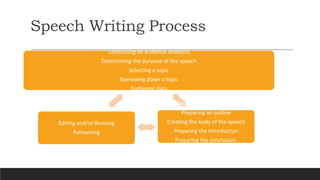
Speech Writing Process
Conducting an audience analaysis
Determining the purpose of the speech
Selecting a topic
Narrowing down a topic
Gathering data
Selecting a speech pattern
Preparing an outline
Creating the body of the speech
Preparing the introduction
Preparing the conclusion.
Editing and/or Revising
Rehearsing
Components of Speech Writing
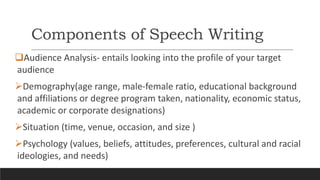
Audience Analysis- entails looking into the profile of your target
audience
Demography(age range, male-female ratio, educational background
and affiliations or degree program taken, nationality, economic status,
academic or corporate designations)
Situation (time, venue, occasion, and size )
Psychology (values, beliefs, attitudes, preferences, cultural and racial
ideologies, and needs)
Components of Speech Writing
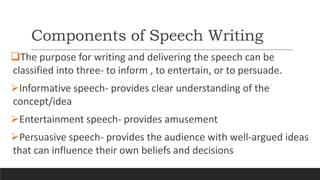
The purpose for writing and delivering the speech can be
classified into three- to inform , to entertain, or to persuade.
Informative speech- provides clear understanding of the
concept/idea
Entertainment speech- provides amusement
Persuasive speech- provides the audience with well-argued ideas
that can influence their own beliefs and decisions
Components of Speech Writing
The purpose can be general and specific.
GENERAL PURPOSE: To inform
SPECIFIC PURPOSE: To inform Grade 11
students about the process of conducting an
automated student government election
Components of Speech Writing
GENERAL PURPOSE: To entertain
SPECIFIC PURPOSE: To entertain
Grade 11 students with his/her funny
experiences in automated election.
Components of Speech Writing
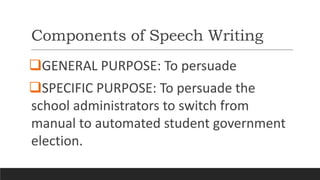
GENERAL PURPOSE: To persuade
SPECIFIC PURPOSE: To persuade the
school administrators to switch from
manual to automated student government
election.
Components of Speech Writing
The topic is your focal point
Choose one that really interests you.
In selecting a topic you may…
Use your personal experiences, discussing with your
family members or friends, free writing, listing, asking
questions, or semantic webbing.
Components of Speech Writing
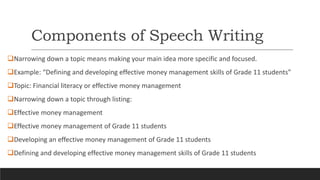
Narrowing down a topic means making your main idea more specific and focused.
Example: “Defining and developing effective money management skills of Grade 11 students”
Topic: Financial literacy or effective money management
Narrowing down a topic through listing:
Effective money management
Effective money management of Grade 11 students
Developing an effective money management of Grade 11 students
Defining and developing effective money management skills of Grade 11 students
Components of Speech Writing
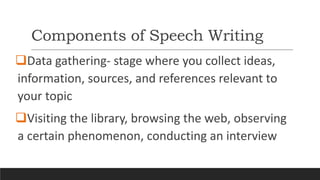
Data gathering- stage where you collect ideas,
information, sources, and references relevant to
your topic
Visiting the library, browsing the web, observing
a certain phenomenon, conducting an interview
Components of Speech Writing
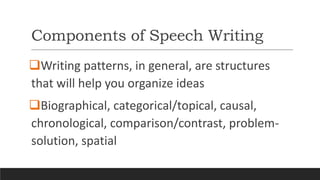
Writing patterns, in general, are structures
that will help you organize ideas
Biographical, categorical/topical, causal,
chronological, comparison/contrast, problem-
solution, spatial

The Speech Writing Process.pptx

  • 1.
  • 2.
    Speech Writing Process Conductingan audience analaysis Determining the purpose of the speech Selecting a topic Narrowing down a topic Gathering data Selecting a speech pattern Preparing an outline Creating the body of the speech Preparing the introduction Preparing the conclusion. Editing and/or Revising Rehearsing
  • 3.
    Components of SpeechWriting Audience Analysis- entails looking into the profile of your target audience Demography(age range, male-female ratio, educational background and affiliations or degree program taken, nationality, economic status, academic or corporate designations) Situation (time, venue, occasion, and size ) Psychology (values, beliefs, attitudes, preferences, cultural and racial ideologies, and needs)
  • 4.
    Components of SpeechWriting The purpose for writing and delivering the speech can be classified into three- to inform , to entertain, or to persuade. Informative speech- provides clear understanding of the concept/idea Entertainment speech- provides amusement Persuasive speech- provides the audience with well-argued ideas that can influence their own beliefs and decisions
  • 5.
    Components of SpeechWriting The purpose can be general and specific. GENERAL PURPOSE: To inform SPECIFIC PURPOSE: To inform Grade 11 students about the process of conducting an automated student government election
  • 6.
    Components of SpeechWriting GENERAL PURPOSE: To entertain SPECIFIC PURPOSE: To entertain Grade 11 students with his/her funny experiences in automated election.
  • 7.
    Components of SpeechWriting GENERAL PURPOSE: To persuade SPECIFIC PURPOSE: To persuade the school administrators to switch from manual to automated student government election.
  • 8.
    Components of SpeechWriting The topic is your focal point Choose one that really interests you. In selecting a topic you may… Use your personal experiences, discussing with your family members or friends, free writing, listing, asking questions, or semantic webbing.
  • 9.
    Components of SpeechWriting Narrowing down a topic means making your main idea more specific and focused. Example: “Defining and developing effective money management skills of Grade 11 students” Topic: Financial literacy or effective money management Narrowing down a topic through listing: Effective money management Effective money management of Grade 11 students Developing an effective money management of Grade 11 students Defining and developing effective money management skills of Grade 11 students
  • 10.
    Components of SpeechWriting Data gathering- stage where you collect ideas, information, sources, and references relevant to your topic Visiting the library, browsing the web, observing a certain phenomenon, conducting an interview
  • 11.
    Components of SpeechWriting Writing patterns, in general, are structures that will help you organize ideas Biographical, categorical/topical, causal, chronological, comparison/contrast, problem- solution, spatial